


1 Introduction
The ability to accurately predict when an upcoming task will be finished is important in many areas of life. People make decisions, choices, and binding commitments on the basis of completion time predictions, so errors can be costly. However, a substantial collection of research suggests that people commonly underestimate the time needed to complete tasks. In the present research, we examine a strategy that has been suggested as a prophylactic against this optimistic bias. In particular, we provide the first empirical test of an approach to planning – known as backward planning – that is often advocated by practitioners in applied settings. Backward planning involves starting a plan at the time of completion and working back through the required steps in reverse-chronological order. Our main objective is to test whether backward planning helps people to arrive at more realistic predictions of task completion time.
1.1 Bias in completion time predictions
Previous research indicates that people commonly underestimate how long it will take to finish tasks. Much of this work has documented the phenomenon known as the planning fallacy (Reference Dreborg, Hunhammar, Kemp-Benedict and RaskinKahneman & Tversky, 1979), a form of optimistic bias wherein people underestimate the time it will take to complete an upcoming task even though they realize that similar tasks have taken longer in the past (for reviews see Reference Buehler, Griffin and PeetzBuehler, Griffin & Peetz, 2010; Reference Buehler and GriffinBuehler & Griffin, 2015). The basic tendency to underestimate task completion times (i.e., an underestimation bias or optimistic bias) has been documented for a wide range of personal, academic, and work-related tasks (e.g., Reference Buehler, Griffin and RossBuehler, Griffin & Ross, 1994; Reference ByramByram, 1997; Reference Griffin and BuehlerGriffin & Buehler, 1999; Reference Kruger and EvansKruger & Evans, 2004; Reference Min and ArkesMin & Arkes, 2012; Reference Roy, Christenfeld and McKenzieRoy, Christenfeld & McKenzie, 2005; Reference Taylor, Pham, Rivkin and ArmorTaylor, Pham, Rivkin & Armor, 1998).
However, this robust optimistic bias in task completion prediction does not imply that people tend to underestimate how much time they will spend working on a task. Indeed, researchers and theorists have distinguished between predictions of performance time (i.e., the amount of time spent working on the target task itself) and completion time (i.e., when the task is finished) (Reference Buehler, Griffin and PeetzBuehler, Griffin & Peetz, 2010; Reference Halkjelsvik and JørgensenHalkjelsvik & Jørgensen, 2012). These are very different predictions and their accuracy depends on different factors. Task completion times depend not only on the performance time for the target task but also on the time taken by factors external to the task, such as competing activities, interruptions, delays, and procrastination. Consequently, predictions of task completion time appear to be more prone to optimistic bias than are predictions of task performance time (Reference Buehler, Griffin and RossBuehler et al., 1994; Reference Buehler, Peetz and GriffinBuehler et al., 2010; Reference Halkjelsvik and JørgensenHalkjelsvik & Jørgensen, 2012).
Although there are multiple reasons why people underestimate task completion times, one of the key contributors to bias, somewhat ironically, is people’s tendency to base predictions on a plan for carrying out the task. To arrive at a prediction, people often generate a plan-based scenario or simulation that depicts the sequence of steps that will lead from the beginning to successful conclusion of a project (Reference Buehler, Griffin and RossBuehler et al., 1994; Reference Buehler and GriffinBuehler & Griffin, 2003). This approach leaves them prone to bias. Mental scenarios typically do not provide a comprehensive and thorough representation of future events; instead, scenarios are idealized, schematic, and oversimplified, in that they focus on a few central features and omit peripheral or non-schematic elements (Reference DunningDunning, 2007; Reference Liberman, Trope and StephanLiberman, Trope & Stephan, 2007). Furthermore, given that people plan for success rather than failure, plan-based scenarios tend to focus on positive rather than negative possibilities (Reference Newby-Clark, Ross, Buehler, Koehler and GriffinNewby-Clark, Ross, Buehler, Koehler & Griffin, 2000). In short, the tendency to underestimate completion times stems partly from limitations in how people imagine or plan for an upcoming task.
We examine a cognitive strategy that might counter these problems, and thus our work contributes to an emerging literature on the “debiasing” of optimistic task completion predictions (Reference Buehler and GriffinBuehler & Griffin, 2015; Reference Buehler, Griffin and PeetzBuehler, Griffin & Peetz, 2010; Reference Halkjelsvik and JørgensenHalkjelsvik & Jørgensen, 2012). Several existing strategies sidestep the problems associated with overly optimistic plans by prompting predictors to focus on “outside” information, that is, information other than their plans for the specific target task (e.g., previous completion times, estimates from neutral observers). For instance, the strategy of “reference class forecasting” requires forecasters to base predictions on a distribution of outcomes from comparable previous projects (Reference FlyvbjergFlyvbjerg, 2008; Reference Lovallo and KahnemanLovallo & Kahneman, 2003), and empirical tests support the effectiveness of this strategy in reducing time and cost overruns in large scale construction projects (Flybjerg, 2008; Reference Flyvbjerg, Garbuio and LovalloFlyvbjerg, Garbuio & Lovallo, 2009). Similarly, research on smaller, individual projects found that prompting people to base predictions on past experience (by highlighting the relevance of previous completion times) resulted in unbiased predictions (Reference Buehler, Griffin and RossBuehler et al., 1994). Note, however, that such strategies are most applicable in those relatively rare prediction contexts where a class of comparable projects can be readily identified.
Other interventions encourage predictors to unpack or decompose the target task into smaller segments (Reference ByramByram, 1997; Reference Connolly and DeanConnolly & Dean, 1997; Reference Forsyth and BurtForsyth & Burt, 2008; Reference Kruger and EvansKruger & Evans, 2004). Given that plans generated holistically tend to be incomplete and oversimplified, breaking down a larger task into smaller sub-tasks may highlight steps that need to be completed, but would otherwise have been overlooked (Reference Kruger and EvansKruger & Evans, 2004). Tests of this strategy have yielded somewhat mixed results. Kruger and Evans found that unpacking reduced prediction bias (for a similar “segmentation effect” see Reference Forsyth and BurtForsyth & Burt, 2008), however other studies found that similar strategies were not effective (Reference ByramByram, 1997; Reference Connolly and DeanConnolly & Dean, 1997). Unpacking appears to be less effective if there are few task components (Reference Kruger and EvansKruger & Evans, 2004), if the unpacked components will be easy to carry out (Reference Hadjichristidis, Summers and ThomasHadjichristidis, Summers & Thomas, 2014), or if the tasks are in the distant future (Reference MoherMoher, 2012). Moreover, sometimes asking predictors to develop a detailed, concrete plan can actually exacerbate the optimistic bias in prediction (Reference Buehler and GriffinBuehler & Griffin, 2003), suggesting there is a risk that such strategies could backfire.
Interventions that focus attention directly on potential obstacles or problems have also produced mixed outcomes. Some studies have found that people predict longer completion times if they are prompted to focus on potential obstacles (Reference Peetz, Buehler and WilsonPeetz, Buehler & Wilson, 2010). In other studies, however, people’s predictions were not influenced by instructions to consider potential problems or surprises (Reference ByramByram, 1997; Reference HindsHinds, 1999) or to generate scenarios that differed from their initial plans (Reference Newby-Clark, Ross, Buehler, Koehler and GriffinNewby-Clark et al., 2000). When people are confronted directly with potential obstacles, they may be reluctant to incorporate this information into their predictions. Their desire to complete the task promptly may elicit a form of motivated reasoning (Reference KundaKunda, 1990) or desirability bias (Reference Krizan and WindschitlKrizan & Windschitl, 2007) wherein they dismiss the relevance of undesirable possibilities. Interestingly, people instructed to imagine a task from the perspective of an outside observer may be less prone to these motivated reasoning processes (Reference Buehler, Griffin, Lam and DeslauriersBuehler, Griffin, Lam & Deslauriers, 2012), and more willing to contemplate potential obstacles.
In sum, although previous research has identified several promising debiasing strategies, there appear to be limits to their applicability and effectiveness. The strategy examined in the present research – backward planning – capitalizes on predictors’ natural inclination to base predictions on plan-based scenarios, but induces them to generate plans in a manner that might avoid the usual pitfalls.
1.2 The backward planning strategy
Our research was inspired by ideas gaining currency in applied fields of project management, where practitioners advocate the use of backward planning (also referred to as back-planning or back-casting; Reference LewisLewis, 2002; Reference VerzuhVerzuh, 2005). Backward planning involves starting with the target goal or completion time in mind, and working back toward the present by identifying the steps needed to attain the goal in reverse-chronological order. The earliest references to backward planning emerged in the development of forecasting models for long-term (e.g., 30–50 year) issues related to socioeconomic and resource policy (e.g., future energy demands, Lovins, 1976; sustainable transport systems, Robinson, 1982; Baltic Sea exploration, Dreborg, Hunhammar, Kemp-Benedict, Raskin, 1999). More recently, backward planning has been advocated in the practitioner literature for smaller projects in organizational contexts such as education, government, and business (Reference LewisLewis, 2002; Verzuh, 2005, Wiggins & McTighe, 1998). Even closer to home, backward planning is commonly recommended for tasks that individuals carry out in everyday life, such as school assignments, work-related tasks, and personal projects (e.g., Fleming, 2010; Reference RutherfordRutherford, 2008; Reference SaintamourSaintamour, 2008; The Ball Foundation, 2007).
In each of these contexts, it has been argued that backward planning can yield unique insights that would not be derived from a traditional chronological planning process. A common theme is that backward planning provides planners with a novel perspective that prompts them to attend to information that would otherwise be neglected. For example, it has been suggested that backward planning helps people to: identify more clearly the steps they will need to take, appreciate how steps are dependent on one another, and anticipate potential obstacles. However, to our knowledge, no empirical research has been conducted to support such claims. Our studies provide the first empirical examination of backward planning and, to ensure the findings have widespread practical relevance, target the kinds of tasks and projects that people carry out in the course of everyday life.
1.3 Effects of backward planning
Our main hypothesis, in line with the anecdotal evidence reviewed above, is that backward planning may lead people to generate later, and thus more realistic, predictions of task completion time. We also sought to explore cognitive processes underlying this effect. Thus, we considered several cognitive processes that have been shown to affect task completion predictions, and could be influenced by backward planning.
First, backward planning may counter people’s natural inclination to focus on an idealized and hence highly-fluent scenario of task completion. Backward planning prompts people to adopt a novel temporal outlook that may disrupt the chronological, narrative structure of plan-based scenarios. Consequently, backward planners should be less likely to rely upon a schematic or idealized task representation. Consistent with this reasoning, research on temporal direction in memory has shown that instructions to recall a series of past events in reverse-chronological order results in fewer schema-based intrusions in memory (Reference Geiselman and CallotGeiselman & Callot, 1990; Reference Geiselman, Fisher, MacKinnon and HollandGeiselman, Fisher, MacKinnon & Holland, 1986). Along similar lines, backward planning may lead predictors to focus less exclusively on central, schematic information (e.g., a plan for successful task completion) and focus more on the kinds of information that are typically neglected (e.g., additional steps, potential obstacles, and competing demands on their time). In other words, backward planning may disrupt the fluent planning process that typically leads to a focus on successful completion, and instead raise the salience of possible barriers to completion.
Another intriguing possibility is that backward planning may shift the planner’s perception of the flow of time. People can view the passing of time either as the individual moving through time (ego motion perspective) or as time moving toward the individual (time motion perspective) (Reference BoroditskyBoroditsky, 2000; Reference ClarkClark, 1973). Because backward planning requires moving cognitively from the future back toward the present, it may emphasize the flow of time and induce a time motion perspective. In a relevant study (Reference Boltz and YumBoltz & Yum, 2010), participants were induced to adopt either a time motion or ego motion perspective using visual scenes (e.g., clouds moving toward the person vs. the person moving toward clouds) or linguistic cues, and then predicted how long tasks would take to perform. Adopting a time motion perspective reduced the underestimation bias in task predictions, and the authors suggest that this was because the time motion perspective makes deadlines seem closer. Thus, backward planning might result in less optimistic predictions of task completion time, in part, because it leads people to adopt a time motion perspective and hence feel closer to the deadline.
1.4 Present studies and hypotheses
We conducted four experiments to test effects of planning direction on task completion predictions and related cognitions. In each study, we asked participants to develop a plan for completing a target task, and manipulated the temporal direction of their planning. Participants were randomly assigned to either a backward planning condition, forward planning condition, or a control condition where direction was unspecified. After planning for the task, participants made a series of time predictions. The primary dependent variable was their prediction of when they would finish the target task (task completion time). Participants also predicted when they would start working on the task (start time) and how much actual working time it would take (performance time). In Study 4, participants also reported actual completion times in a follow-up session, allowing us to examine the degree of bias in their predictions. In each study, after reporting their time predictions, participants completed a set of process measures that assessed the degree to which the planning exercise elicited novel insights (e.g., led them to clarify the steps they would need to take, to think of steps they wouldn’t have thought of otherwise, to think of potential problems or obstacles they could encounter), led them to anticipate potential obstacles or to think of more planning steps, as well as their perception of the flow of time (time motion vs. ego motion perspective).Footnote 1
Our main hypotheses concern the predictions of task completion time, as previous research suggests that this type of prediction is particularly susceptible to optimistic bias. We expected that participants would predict longer task completion times (Hypothesis 1), and thus be less prone to underestimate actual completion times (Hypothesis 2) in the backward planning condition than in the forward and unspecified conditions. Although the planning process might also influence when people actually finish tasks (e.g., Gollwitzer, 1999; Reference Taylor, Pham, Rivkin and ArmorTaylor et al., 1998), previous research suggests that planning processes have a greater impact on predicted than on actual completion times (Reference Buehler and GriffinBuehler & Griffin, 2003, Buehler, Griffin & MacDonald, 1997). Thus, to the extent that backward planning leads people to predict later task completion times, it should also make them less prone to underestimate their actual completion times.
We examined predicted start times and performance times to shed additional light on where backward planning exerted its effects. If backward planning disrupts the fluency of planning processes, as we have proposed, this could shift the whole set of planning milestones later in time, leading to a shift in predicted start times as well as completion times. That is, backward planners may be more aware of potential delays at each planning milestone – including task initiation. Thus, our working hypothesis was that predicted start times would also be delayed in the backward condition. However, there are other reasonable possibilities. Backward planning might lead people to predict finishing tasks later, but not starting them later, if it draws attention to delays that would occur only after starting the task. Moreover, an increased focus on potential delays could even prompt participants to plan earlier start times in order to accommodate the delays. We were also uncertain whether backward planning would affect predictions of performance time, given that previous research has shown people are less prone to underestimate the time they spend on the task itself (Reference Buehler, Griffin and PeetzBuehler, Griffin & Peetz, 2010; Reference Halkjelsvik and JørgensenHalkjelsvik & Jørgensen, 2012). Our working hypothesis was that backward planning would influence predicted completion times, but not performance times, by drawing attention to obstacles external to the task itself.
We also examined the process measures to test whether, consistent with our theorizing, participants in the backward planning condition would report experiencing more novel planning insights, anticipate more potential obstacles, include more steps in their plans and be more likely to adopt a time motion perspective than participants in the forward and unspecified conditions.
2 Study 1: Date night
Study 1 provided an initial test of the effects of planning direction on prediction. To enhance experimental control, the study used a standard target task: Participants imagined a scenario used in previous research (Reference Kruger and EvansKruger & Evans, 2004) in which they needed to prepare for an upcoming romantic date. They were instructed to develop a detailed plan for this task in one of three temporal directions (backward, forward, or unspecified) and then predict how soon they would be finished. It was hypothesized that participants would predict later completion times in the backward condition than in the forward and unspecified conditions.
2.1 Method
2.1.1 Participants
Initially 239 undergraduate psychology students were recruited for the study, however, seven participants were excluded because they did not complete the planning exercise (n = 4) or the dependent measures (n = 3). The final sample consisted of 232 participants (50 male, 179 female, 3 other identity) between the ages of 17 and 37 (M = 19.24, SD = 1.98) compensated with course credit.
2.1.2 Procedure
Participants completed a self-administered online survey examining how people plan for future events. Participants first provided demographic information including age, gender, and year in university. Participants were then presented with a scenario (Reference Kruger and EvansKruger & Evans, 2004) in which they needed to prepare for a dinner date, and were asked to imagine it as though it was actually happening. In this scenario, the participant had recently met someone and arranged for a date at a fancy restaurant on Saturday at 8:00 p.m. It was now Saturday at 2:00 p.m. and the participant had no plans for the afternoon except getting ready for the date.
Participants were asked to develop a detailed plan of the actions they would take to prepare for the date. To guide their planning, participants were provided with a “timeline” spanning the period between the present (2:00 p.m.) and the time of the date (8:00 p.m.) broken into 30 minute intervals. Each interval was accompanied by an expandable text box, and participants were instructed to list all the steps they would take to get ready for the date, beginning each separate step on a new line, and to state “no plans” for any time interval when they would not be preparing for the date.
To manipulate planning direction, participants were randomly assigned to one of three conditions. In the backward planning condition, participants were instructed: “We want you to develop your plan in a particular way called backward planning. Backward planning involves starting with the very last step that needs to be taken and then moving back from there in a reverse-chronological order. That is, you should try to picture in your mind the steps you will work through in order to reach your goal (getting ready for your date) in a backward direction.” Corresponding with these instructions, the timeline was presented in reverse-chronological order (i.e., the top text box was labeled 8:00 p.m. and the bottom one labeled 2:00 p.m.) and participants were reminded to work through it in that order. In the forward planning condition, participants received parallel instructions to plan in a forward direction, and, corresponding with these instructions, the timeline was presented in a chronological order. In the unspecified planning condition, the instructions did not specify a temporal direction. Although the text boxes were again presented in chronological order, participants could choose to work through them in any order.
Time predictions:
The primary dependent variable was the prediction of task completion time. Participants were asked to indicate the time (hour and minute) they would be ready for the date. Participants also predicted the time they would start getting ready (i.e., task start time) and how long it would take to get ready (i.e., task performance time).
Process measures:
We counted the number of separate steps that participants listed in their plans. Also, after generating their time predictions, participants completed several measures concerning their perceptions of the planning exercise and the target task.
Perceived insights. Four items assessed participants’ perceptions of whether the planning exercise resulted in novel insights. Participants rated the extent to which they agreed (1 = Strongly disagree, 7 = Strongly agree) that the planning exercise: “Helped me clarify the steps I would need to take to prepare for a date”, “Made me think of steps that I wouldn’t have thought of otherwise”, “Made me break down my plans into important steps”, and “Made me think of potential problems or obstacles I could encounter”. These items were averaged to form an index of perceived planning insights (α = .82, M = 4.02, SD = 1.25).
Potential obstacles. Four items assessed the anticipation of obstacles or problems that could arise. Using a scale from 1 (Not at all) to 7 (Extremely), participants rated how difficult it would be to stick to their plan, and how likely it was they would: “Need to carry out extra steps they didn’t think to include in their plans”, “Encounter problems when preparing for the date”, and “Be delayed by interruptions or distractions from outside events”. These items were averaged to form an index of potential obstacles (α = .67, M = 4.00, SD = 1.18).
Motion perspective. To measure motion perspective, participants were asked to imagine that the date originally scheduled for 8:00 p.m. had to be rescheduled and moved forward 1 hour, and to indicate the new time of the date (adapted from McGlone & Harding, 1998). Participants who responded “9:00 p.m.” were coded as having an ego motion perspective; interpreting the forward time change as later suggests they adopted an orientation in which they were moving toward the time of the date. Those who responded “7:00 p.m.” were coded as having a time motion perspective; interpreting the forward time change as earlier suggests they had the perception that the time of the date was moving toward them.
2.2 Results
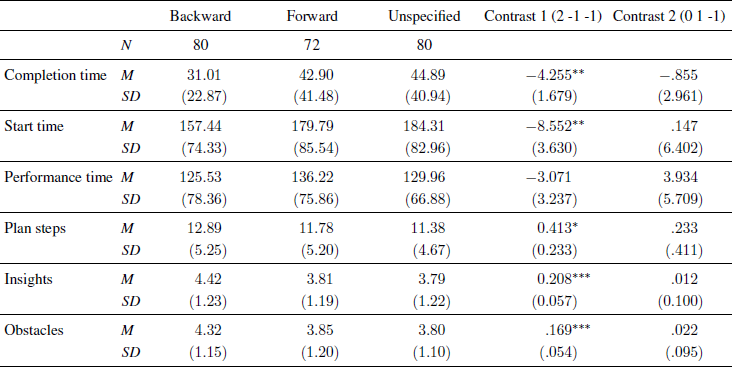
To examine effects of planning direction, each dependent measure was submitted to a regression analysis that included two orthogonal contrasts. The first contrast provides a powerful, focused test of our hypothesis by pitting backward planning against the forward and unspecified conditions (backward = 2, forward = –1, unspecified = –1). The second contrast compares the forward and unspecified conditions (backward = 0, forward = 1, unspecified = –1) which were not expected to differ. Because gender differences were plausible for the date preparation task, the regressions also included gender (male = 1, female = –1) and its interaction with each contrast. We report one-tail tests of significance for contrast 1, reflecting our directional hypothesis, and two-tail tests otherwise. See Table 1 for descriptive statistics and contrast coefficients.
† p < .10
* p < .05
** p < .01
*** p < .001
The values for contrasts are unstandardized coefficients (SEs in parenthesis).
2.2.1 Time predictions
Participants’ predictions of when they would finish getting ready for the date were converted into a number of minutes before the 8:00 p.m. deadline. These completion time predictions were submitted to the regression analysis described above. Consistent with the hypothesis, the first contrast was significant, indicating that participants expected to finish with less time to spare in the backward planning condition than in the forward and unspecified conditions.Footnote 2 Participants also predicted they would start later in the backward planning condition than in the forward and unspecified conditions.Footnote 3 However, a parallel analysis of the performance time predictions (time on task) indicated that participants did not expect to spend more time working on the task itself in the backward planning condition than in the forward and unspecified conditions.
The regressions also revealed significant effects of gender indicating that males expected to start their date preparations later (B = –22.67, SE = 6.27, t = –3.62, p < .001) and spend less time preparing for the date (B = –31.048, SE = 5.586, t = –5.558, p < .001) than did females, but there was no effect of gender on predictions of completion time (B = 2.105, SE = 2.897, t = .696, p = .487). There were no significant interactions, suggesting that the effects of planning direction on prediction generalized across gender. The results supplement (Table S1) provides descriptive statistics and contrast coefficients by gender.
2.2.2 Process measures
We also performed the standard regression analysis on each of the process measures. Significant effects of contrast 1 indicated that participants in the backward planning condition, compared to those in the forward and unspecified conditions, included more steps in their plans, experienced more novel planning insights, and anticipated greater obstacles.
To examine the effect of backward planning (vs. forward and unspecified) on the dichotomous motion perspective measure, we performed two χ2 tests of association that parallel the two contrasts. Participants were more likely to adopt a time motion perspective (vs. an ego motion perspective) in the backward condition (74.7%) than in the forward (54.9%) and unspecified conditions (57.5%), χ2(1, N = 230) = 7.49, p = .006. The prevalence of the time motion perspective did not differ across the forward and unspecified conditions, χ2(1, N = 151) = .10, p = .75.
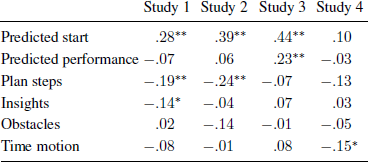
Correlations between the completion time predictions and process measures are presented in Table 2. Participants who predicted later task completion times (i.e., less time before the deadline) reported more novel planning insights, r(227) = –.14, p = .03, and included more steps in their plans, r(230) = –.19, p = .01.
* p < .05
** p < .01.
We also conducted mediational analyses that tested whether the effect of backward planning (contrast 1) on predicted completion times was mediated by each of the process measures. Specifically, we used the bootstrapping method (Reference Preacher and HayesPreacher & Hayes, 2008) to test the indirect effect of backward planning on predicted completion time through the process measures: plan steps, insights, obstacles, and motion perspective. There was a significant indirect effect for plan steps (M(axb) = –.475, SE = .347, 95% CI [-1.661, -.0544]) and insights (M(axb) = –.666, SE = .449, 95% CI [–1.871, –.022]). These results suggest that the effect of backward planning on predicted completion times was partially mediated by an increase in the number of steps included in the plan and the novel insights experienced by backward planners.
2.3 Discussion
The results supported the primary hypothesis that backward planning, in comparison to forward and unspecified planning, results in longer predictions of task completion time. Backward planners predicted they would finish getting ready for a date with less time to spare. Notably, backward planners also predicted they would start later than participants in the other conditions. This finding suggests that backward planning may have drawn attention not only to potential delays while carrying out the task, but also to factors that could delay task initiation. That is, backward planning appeared to shift the whole set of planning steps — including task initiation — later in time.
The lack of an effect on performance time predictions suggests that the effects of backward planning on both predicted completion times and start times were caused because backward planners made greater allowance for factors external to the task itself (e.g., unexpected interruptions, procrastination, competing demands) that could delay completion of the target task.
Consistent with this interpretation, participants believed that obstacles were more likely in the backward planning condition than in the other two conditions. Backward planners also included more steps in their plans and reported having experienced more new insights from the planning exercise, and these cognitions played a role in mediating the effect of backward planning on predicted completion time. The effect for planning steps is perhaps surprising, given the absence of an effect on performance time predictions. It may be that some planning steps involved a form of contingency planning (e.g., planning how to accommodate potential obstacles if they arise) rather than steps to be taken while working on the task. Finally, backward planners were more inclined to adopt a time motion perspective, which has been shown in previous research to increase completion time predictions (Reference Boltz and YumBoltz & Yum, 2010).
Additional studies are needed to ensure the findings are not due to idiosyncratic features of the date preparation task. One particular concern with this task is that it might not be representative of tasks that are prone to optimistic bias. People are more likely to underestimate completion times when tasks are longer in duration (Reference Buehler, Griffin and PeetzBuehler, Griffin & Peetz, 2010; Reference Halkjelsvik and JørgensenHalkjelsvik & Jørgensen, 2012) and they are motivated to finish early (Reference Buehler, Griffin and MacDonaldBuehler et al., 1997; Reference ByramByram, 1997). It remains to be seen whether the effects of planning direction generalize to such tasks.
3 Study 2: School assignment
This study tested whether planning direction would influence completion time predictions for a different target task. We again created a standard scenario for all participants, but this time involving a task – a major school project with incentives for early completion – that is highly susceptible to optimistic bias (Reference Buehler, Griffin and PeetzBuehler, Griffin & Peetz, 2010). Participants developed a plan for completing the task using backward, forward, or unspecified planning, and then predicted how far before the deadline it would be finished.
3.1 Method
3.1.1 Participants
Initially 156 undergraduate psychology students completed the study, however 20 participants were excluded because they did not complete the planning exercise and dependent measures (n = 2) or failed an attention check embedded in the questionnaire (n = 18). The attention check was comprised of two items directing participants to select a specified response (e.g., “This is a data quality question. Please select four on the scale below”). Such items can increase the likelihood that respondents pay attention when completing self-administered questionnaires (Reference Berinsky, Margolis and SancesBerinsky, Margolis & Sances, 2014; Reference Oppenheimer, Meyvis and DavidenkoOppenheimer, Meyvis & Davidenko, 2009). Participants were excluded if they gave incorrect responses to both items.Footnote 4 The final sample consisted of 136 undergraduate students (45 male, 89 female, 1 other identity, 1 missing) between the ages of 17 and 41 (M = 19.08 years, SD = 2.31 years) compensated with course credit.
3.2 Procedure
The procedure was similar to Study 1 but with a different target task. In an online questionnaire, participants were asked to imagine a scenario in which they needed to complete a major school assignment in the next two weeks. In this scenario, the participant was required to write a major paper that must be at least 12 pages long and include a minimum of eight references, four from journal articles available only in the library. Additionally, it was noted that the assignment fell at a time of year that was usually busy for students, and, as an incentive to have it done promptly, the instructor would award an extra 2% for every day before the due date that the assignment was submitted.Footnote 5
Participants were asked to develop a plan of the steps they would take to complete the assignment. They were provided with a timeline comprised of 14 text boxes spanning the period between the present date (Day 1) and the due date (Day 14), and were instructed to use the text boxes to list the steps they would take to complete the assignment. They were to state “no plans” in the text box for any day they did not plan to work on the assignment. To manipulate planning direction, participants were randomly assigned to three conditions (backward, forward, or unspecified) using instructions adapted from Study 1.
3.2.1 Time predictions
The primary dependent variable was the prediction of task completion time. Participants were asked, “How many days before the due date will you finish the assignment?” and response options ranged from 0 days before the due date (i.e., the due date itself) through 14 days before the due date (i.e., today). Participants also predicted how many days before the due date they would start the assignment, and how many hours of actual working time it would take.
3.2.2 Process measures
Participants then completed process measures similar to those in the previous study. Planning insights were assessed using the same four items from Study 1 (α = .79, M = 4.82, SD = 1.01). Potential obstacles were assessed with a single item in this study, as the remaining items were inadvertently omitted: Participants simply rated how difficult it would be to stick to their plan (1 = Extremely easy, 7 = Extremely difficult). To measure motion perspective, participants were asked to imagine that the due date (14 days from today) for the assignment had been moved forward two days, and to indicate how many “days from today” the assignment was now due. Participants who responded “16 days from today” were coded as having an ego motion perspective, while those who responded “12 days from today” were coded as having a time motion perspective.
3.3 Results
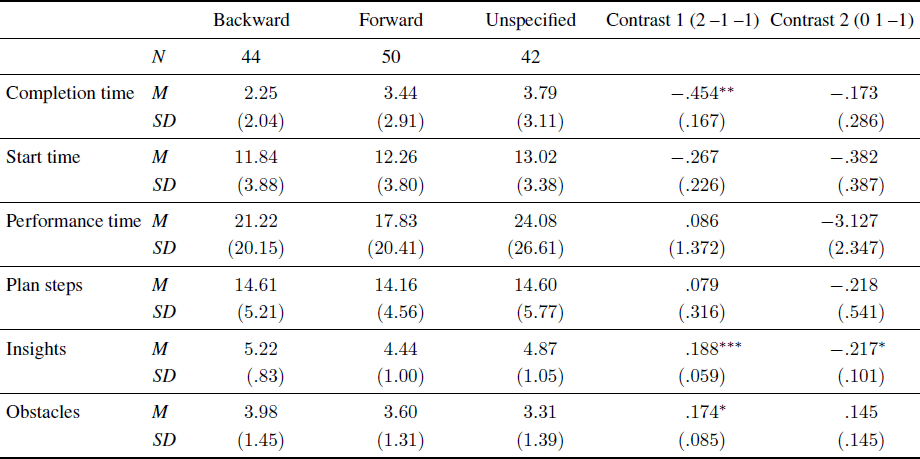
Dependent measures were again regressed on the two orthogonal contrasts as in Study 1. See Table 3 for descriptive statistics and regression coefficients.Footnote 6
† p < .10
* p < .05
** p < .01
*** p < .001
The values for contrasts are unstandardized coefficients (SEs in parenthesis).
3.3.1 Time predictions
The regression analyses revealed that, as hypothesized, participants predicted they would finish closer to the deadline in the backward planning condition than in the forward and unspecified conditions. Predictions in the forward and unspecified conditions did not differ significantly. The analyses did not reveal significant effects of planning direction (contrast 1 or 2) on participants’ predictions of when they would start the assignment, or how long they would work on it.
3.3.2 Process measures
The regression analyses performed on the process measures revealed that, unlike Study 1, participants did not list more plans in the backward planning condition than in the forward or unspecified conditions. However, as in Study 1, planning direction had a significant effect on the perceived insights index: Participants experienced greater planning insights in the backward condition than in the forward and unspecified condition (contrast 1). Perceived insights were also greater in the unspecified than in the forward condition (contrast 2). There was also evidence, as in Study 1, that backward planning increased the anticipation of obstacles. Participants believed it would be harder to stick to their plan in the backward condition than in the forward and unspecified conditions.
Finally, there was again a significant effect of planning direction on motion perspective. Participants were more likely to adopt a time motion perspective (vs. an ego motion perspective) in the backward condition (76.9%) than in the forward (31.7%) and unspecified conditions (38.5%), χ2(1, N = 119) = 18.44, p = .006, and there was not a significant difference across the forward and unspecified conditions, χ2(1, N = 80) = .401, p = .53.
Again there were few correlations between the completion time predictions and the process measures (see Table 2). Participants expected to finish closer to deadline when they anticipated more potential obstacles, r(134) = –.14, p = .10, and listed more steps in their plans, r(130) = –.24, p = .01. We also used the bootstrapping test, as in Study 1, to examine the indirect effect of backward planning on predicted completion time through the process measures: plan steps, insights, obstacles, and motion perspective. There were no significant indirect effects.
3.4 Discussion
The study provided further evidence that backward planning results in later predictions of task completion time, even for the kind of task that is highly susceptible to optimistic bias (i.e., an extensive project with incentives for early completion). Backward planning also appeared to have a parallel effect on predicted start times — with backward planners predicting they would start the task later — although this effect on its own was not significant. There was no evidence that backward planning influenced predictions of the number of hours that would be spent working on the task itself. The process measures provided further evidence that backward planning leads people to experience more novel insights during the planning process and to anticipate greater obstacles while carrying out the task, although it could not be shown that these processes mediated the effects of backward planning on prediction.
A limitation of the first two studies is that they examined hypothetical tasks that participants did not actually perform. Although this procedure affords a high degree of experimental control, it limits our ability to generalize results to consequential, real world tasks. Accordingly, the next two studies tested effects of backward planning on a variety of tasks that participants were planning to carry out (Studies 3 and 4), and assessed the effects of planning direction on actual completion times as well as predictions (Study 4).
4 Study 3: Real tasks
Study 3 tested the effect of planning direction on predictions concerning real projects. Given our interest in debiasing, we again sought target tasks shown to be highly susceptible to bias in previous research – namely extensive projects that participants wanted to complete promptly. Thus, participants were asked to nominate a project they needed to complete in the next month that would require multiple steps across several days, and that they hoped to finish as soon as possible. The nominated projects were further classified as academic (e.g., finishing an essay) or personal (e.g., making a slideshow of pictures for a wedding) to determine whether effects generalized across these broad project types. Participants were then instructed to plan for the project using either forward, backward, or unspecified planning. Notably, due to the fact that participants nominated projects with varying deadlines, the planning exercise was not structured with a standard timeline as in previous studies. Instead participants were provided with a single open-ended text box to list all the steps of their plan. After developing a plan for the project, participants predicted when it would be finished.
4.1 Method
4.1.1 Participants
Initially 240 undergraduate psychology students were recruited. A substantial number of the participants were excluded because they nominated tasks that did not meet the criteria in the instructions: exams or tests that could only be done at a fixed time (n = 54), tasks with a deadline more than a month away (n = 13), or tasks with a deadline the day of the study (n = 6). Participants were also excluded if they predicted finishing after the stated deadline (n = 17), or did not complete the main dependent measures (n = 3). The final sample consisted of 147 undergraduate students (62 male, 85 female) between the ages of 17 and 47 (M = 19.50 years, SD = 3.24 years) who were compensated with course credit.
4.2 Procedure
Participants first reported demographic information and then were asked to identify a project they would be doing in the coming month. This could be either a school project (e.g., writing a paper) or a personal project (e.g., organizing your photo albums) as long as it was a major project that would involve carrying out steps across several days. Additionally, participants were instructed that the project must be one that: they were required to complete sometime in the next month (i.e., there was a firm deadline), they were free to complete any time before the deadline, and they were hoping to finish as soon as possible. Participants briefly identified the project and reported the date of the deadline.
Participants then completed a planning exercise that asked them to develop a detailed plan for the project, and were randomly assigned to one of the three planning conditions (backward, forward, unspecified) using instructions similar to those in previous studies. They were provided with an open-ended text box and asked to list the steps of their plan in point form.
4.2.1 Time predictions
Participants were asked to predict task completion time in relation to the deadline: How many days before the deadline do you think you will finish the project? Participants also predicted how many days before the deadline they would start working on the project, and how many hours of actual working time it would take to complete their project.
4.2.2 Process measures
Participants completed the four items that assessed their perception that the planning exercise had resulted in novel planning insights, using a response scale from 1 (Not at all) to 11 (Extremely) (α = .66, M = 7.47, SD = 1.71). They also completed the four items used in Study 1 that assessed their anticipation of obstacles, using a response scale from 1 (Not at all) to 11 (Extremely) (α = .72, M = 7.11, SD = 1.84). To measure motion perspective, participants were asked to imagine that a hypothetical meeting originally scheduled for next week on Wednesday had been moved forward two days and to indicate the new meeting date. Participants who responded “Friday” were coded as having an ego motion perspective, while those who responded “Monday” were coded as having a time motion perspective.Footnote 7
4.3 Results
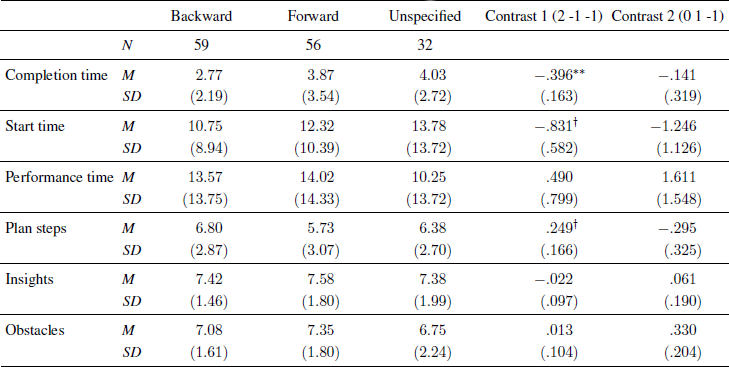
An examination of the project descriptions indicated that about half the participants (n = 79, 53.7%) nominated academic projects (e.g., writing an essay, completing a statistics assignment) and the remaining participants (n = 68, 46.3%) nominated personal projects (e.g., creating a photo slideshow for a wedding, booking a vacation). Accordingly, to control for variability in the projects, project type was included as a factor in the regression analyses (-1 = academic, 1 = personal). Each dependent measure was regressed on project type, the two contrasts, and the project type X contrast interactions. Descriptive statistics and regression coefficients are presented in Table 4.
† p < .10
* p < .05
** p < .01
The values for contrasts are unstandardized coefficients (SEs in parenthesis).
4.3.1 Time predictions
The regression analysis for completion time predictions revealed an effect of project type, as participants who selected academic projects (M = 3.09, SD = 2.78) predicted they would finish closer to the deadline than those who selected non-academic projects (M = 3.90, SD = 3.03), B = .500, SE = .250, p = .047. There was also a significant effect of contrast 1. Once again, as hypothesized, participants predicted they would finish closer to the deadline in the backward condition than in the forward and unspecified conditions. Predictions did not differ across the forward and unspecified conditions (contrast 2). There was not an interaction of project type and contrast 1 (p = .51) or contrast 2 (p = .26) suggesting that the effect of backward planning generalized across academic and personal projects. The results supplement provides descriptive statistics and contrast coefficients by project type (see Table S3).
The analysis of predicted start times also revealed an effect of project type, indicating that participants expected to start closer to the deadline for academic projects (M = 8.74, SD = 10.61) than for personal projects (M = 15.75, SD = 9.55), B = 3.613, SE = .845, p < .001. There were not significant effects of the planning direction contrasts. However, predicted start times were again descriptively later in the backward planning condition than in the other two conditions, and the test of contrast 1 approached significance, B = –.831, SE = .582, p = .08. The analysis of predicted performance times did not reveal significant effects of the planning direction contrasts or project type.
To further explore the significant effect of backward planning on predicted completion time we performed an additional control analysis. To control for the variation in task deadline lengths introduced by using self-selected tasks, we conducted a supplementary analysis including deadline length as a covariate. We also included interaction terms between the deadline length variable and the two standard contrasts, reasoning that the beneficial effect of backward planning on predicted completion times would have a greater scope to reveal itself in projects with longer deadlines. Thus, we regressed the predicted completion times on the two contrasts, deadline length, and the interactions between the contrasts and deadline length. For simplicity of interpretation, deadline length was centered at the grand mean. We had directional hypotheses for both the beneficial effects of backwards planning (contrast 1) and for the positive interaction between backwards planning and deadline length.
As expected, projects with longer deadlines were associated with completion time predictions that were further before the deadline (B = .12, t(141) = 6.48, p < .01). Even when deadline length was controlled, the first contrast (pitting backwards planning against the forward and control condition) was still significant (B = –.27, t(1,141) = 1.87, p = .03); this effect was marginally stronger when deadlines were longer (interaction B = –.020, t(1,141) = 1.56, p = .06). No other effects approached significance in this regression.
4.3.2 Process measures
The process measures were also submitted to the standard regression analysis that included project type, the two contrasts, and the project type X contrast interactions. There was not a significant effect of contrast 1 on planning insights, potential obstacles, or the number of steps in the plan.
There was again an effect of planning direction on motion perspective. Participants were more likely to adopt a time motion perspective in the backward condition (78.0%) than in the forward (34.4%) and unspecified conditions (40.6%), χ2(1, N = 105) = 16.51, p < .001, and the latter two conditions did not differ significantly, χ2(1, N = 64) = .27, p = .61.
As seen in Table 2, completion time predictions were not correlated significantly with any of the process measures (ps > .12). We also used the same method as in previous studies to test for indirect effects of backward planning on predicted completion time through the process measures: plan steps, insights, obstacles, and motion perspective. Naturally, given the lack of correlation, the analyses revealed no significant indirect effects.
4.4 Discussion
Study 3 again found that backward planning, in comparison to forward and unspecified planning, resulted in less optimistic predictions of task completion time, and extends this finding to include real tasks in people’s lives. The effect of backward planning on predicted start times approached significance, and was again, descriptively, parallel to its effect on predicted completion times. There was again no evidence that backward planning influenced predictions of the time that would be spent on the task itself.
Effects of planning direction seen previously on perceived planning insights and potential obstacles were not obtained in this study. The absence of these effects could reflect any number of changes made to the procedure (e.g., the move to a real task, the increased variability created by examining a unique project for each participant, the unstructured response format of the planning exercise) and we cannot determine which of these changes may have been responsible. Given that the next study also examines self-nominated target tasks, we postpone further discussion of these findings to the general discussion.
A noteworthy limitation of the studies so far is that they have not assessed actual task completion times, and thus cannot directly address questions of prediction bias. Although backward planning led to later predicted completion times (i.e., closer to the deadline), which could generally help to curb optimistic bias, there is as yet no direct evidence that predictions were less biased as a result of backward planning. This issue is addressed in the final study.
5 Study 4: Predicted vs. actual times
The main purpose was to replicate the effect of planning direction on predicted completion times for real projects, and to test whether backward planning reduces the tendency to underestimate completion times. Thus, the procedure was similar to the previous study, but included follow-up measures to track completion times for the target project. This allowed us to test whether participants tended to underestimate task completion time, and whether the backward planning strategy reduced this prediction bias.
Although there are various forms of prediction accuracy (e.g., prediction bias, correlational accuracy; Reference Buehler, Griffin and RossBuehler et al., 1994; Reference Epley and DunningEpley & Dunning, 2006; Reference Kruger and EvansKruger & Evans, 2004), we focused primarily on prediction bias (i.e., the mean difference between predicted and actual times) because it is arguably most consequential for real world time forecasts. Even if people’s predicted completion times are sensitive to variations in actual times (i.e., correlational accuracy or discrimination), a systematic tendency to underestimate actual completion times (i.e., prediction bias) is likely to have serious ramifications. Thus, our main objective was to test effects on prediction bias. Nevertheless, to shed light on the workings of the backward planning intervention, we also examined regressions that tested the sensitivity of predictions to variation in actual times.
5.1 Method
5.1.1 Participants
Initially 196 participants were recruited from Amazon MTurk, however participants were again excluded if they did not nominate tasks consistent with the criteria stated in the instructions (n = 6) or did not complete the planning exercise according to instructions (n = 3). All remaining participants correctly answered the same attention check items used in Study 2. The sample for the initial prediction questionnaire consisted of 187 participants (103 females, 82 males, 2 other identity) between the ages of 18 and 74 (M = 31.85 years, SD = 11.39 years). A follow-up questionnaire sent out two weeks later was completed by 161 (86%) of these participants, and 125 (59 male, 66 female; M = 32.40 years, SD = 11.50 years) of the participants reported that they had completed the target project. Participants were compensated $.50 for the initial questionnaire and $1 for the follow-up questionnaire.
5.1.2 Procedure
The initial online questionnaire was similar to that of Study 3. Participants first provided demographic information (i.e., age, gender) and an e-mail address so that they could be sent a follow-up questionnaire. Participants were then instructed to think of a major project they would be doing in the next two weeks that would involve carrying out multiple steps across several days. Additionally, participants were instructed that their project must be one that they had to complete sometime within the next two weeks (i.e., there was a firm deadline), they were free to complete at any time before the deadline, and they were hoping to finish as soon as possible. Participants described the project briefly and reported its deadline. Participants then completed the planning exercise used in Study 3 and were randomly assigned to either the forward, backward, or unspecified planning condition.
Time predictions:
As in the previous study, participants were asked: “How many days before the deadline do you think you will finish the project?” Participants also predicted how many days before the deadline they would start working on the project and how many hours of actual working time it would take.
Process measures:
Participants again completed the four items that assessed their perception that the planning exercise resulted in novel planning insights (1 = Not at all, 7 = Extremely) (α = .76, M = 4.76, SD = 1.14), and the four items that assessed their beliefs about potential obstacles (α = .56, M = 3.96, SD = 1.02). To measure motion perspective, participants were asked to imagine that a meeting originally scheduled for next Wednesday has been moved forward two days and to indicate the new meeting date. Participants who responded “Friday” were coded as having an ego motion perspective while those who responded “Monday” were coded as having a time motion perspective.
Follow-up measures:
Two weeks later, participants were sent an e-mail with a link to the follow-up questionnaire. The e-mail reminded participants of the nominated project and its deadline. Participants were asked whether they had finished the project, and if so, to report how many days before the deadline they had finished it, how many days before the deadline they had started working on it, and how many hours of actual working time they had spent on it.
5.2 Results
In this community sample, participants were most likely to nominate personal projects (n = 133; e.g., bathroom renovation, paint a canvas) followed by work related projects (n = 28; e.g., write performance reports, prepare month end balance sheet) and academic projects (n = 26; e.g., write an essay, register for classes). Thus we created a project type variable that distinguished the personal projects from the academic and work-related projects (–1 = academic and work, 1 = personal).
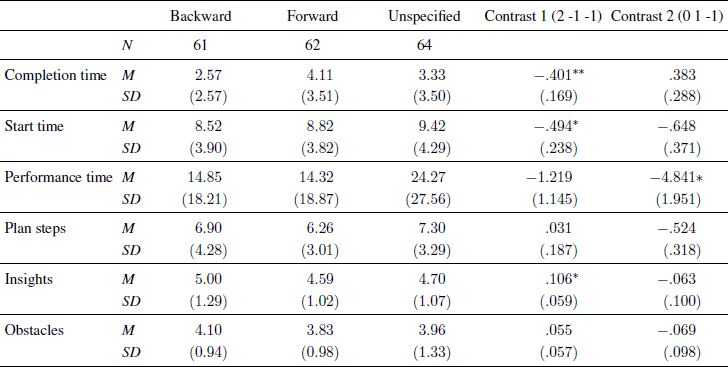
Analyses of the initial questionnaire were performed on the full sample (n = 187; see Table 5); the dependent measures were again regressed on project type, the two contrasts, and the project type X contrast interactions. Analyses of actual times and prediction bias (i.e., predicted-actual time) were performed on the subset of participants who finished the target project (n = 125; see Table 6). For these participants, we could test whether there was a systematic tendency to underestimate task completion times, and whether backward planning reduced this bias.
† p < .10
* p < .05
** p < .01
The values for contrasts are unstandardized coefficients (SEs in parenthesis).

† p < .10
* p < .05
** p < .01
The values for contrasts are unstandardized coefficients (SEs in parenthesis).
Time predictions:
The analysis of predicted completion time again revealed the hypothesized effect of backward planning. Participants expected to finish the project significantly closer to deadline in the backward condition than in the forward and unspecified conditions. No other effects were significant in this analysis.
The analysis of predicted start times also revealed an effect of backward planning. Participants predicted they would start significantly later in the backward planning condition than in the other conditions. This effect was qualified by a significant interaction with project type, B = –.589, SE = .238, p = .014. For academic and work projects, participants predicted later start times (fewer days before deadline) in the backward planning condition than in the other conditions (Ms = 6.38 vs. 9.76), whereas for personal projects, predicted start times did not differ (Ms = 9.10 vs. 8.82). The results supplement provides descriptive statistics and contrast coefficients by project type (see Table S4).
The analysis of performance time predictions yielded an unexpected effect of the second contrast. Participants predicted they would spend more hours working on the task in the unspecified condition than in the forward condition. Again this effect was qualified by a significant interaction with project type, B = –6.999, SE = 2.024, p = .001, indicating that the unexpected difference between the unspecified and forward conditions was found for academic and work projects (Ms = 39.05 vs. 10.53) but not for personal projects (Ms = 16.52 vs. 16.00).
As in Study 3, we conducted an additional control analysis that regressed predicted completion times on deadline length, the two contrasts, and interactions between the contrasts and deadline length, to control for variation in the length of deadlines for the self-selected tasks. All predictor variables were grand-mean centered. Again as expected, projects with longer deadlines were associated with predicted completion times further before the deadline (B = .34, t(181) = 4.94, p < .01). Even when deadline length was controlled, the first contrast (pitting backwards planning against the forward planning and unspecified condition) was still significant (B = –.33, t(181) = 2.04, p < .03). Although the interaction between deadline length and backwards planning was of a similar magnitude as in Study 3 (interaction B = –.023 instead of –.020), in this study it was far from significant (p > .6). No other effects approached significance in this regression.
Time predictions vs. actual time:
To test whether predictions were systematically biased, paired t-tests compared the predicted and actual times. Participants predicted they would finish their projects further before the deadline (M = 3.25, SD = 2.99) than they actually did finish (M = 2.15, SD = 2.10), t(124) = 4.18, p < .001. This finding is consistent with previous evidence that people tend to underestimate task completion times. Participants also predicted they would start work on the project further before deadline (M = 8.29, SD = 3.98) than they actually did (M = 7.57, SD = 4.33), t(124) = 2.41, p = .02. Participants’ predictions of the hours they would spend working on the project (M = 17.39, SD = 21.94) did not differ from actual performance times (M = 17.31, SD = 16.84), t(124) = .05, p = .96.
We hypothesized that the degree of optimistic bias in completion time predictions would be reduced by backward planning. To test this hypothesis, we computed predicted-actual difference scores, with greater positive values indicating a greater underestimation bias (see Table 6). These bias scores were submitted to the standard regression analysis, which included project type, the two contrasts, and the interactions. The analysis revealed a significant effect of the first contrast, indicating that, as hypothesized, predictions were less biased in the backward condition than in the forward and unspecified conditions. Bias did not differ significantly between the forward and unspecified conditions. There were no interactions with project type. The analyses of bias in predicted start times and performance times did not yield any significant effects.
We also conducted the control regression on bias in completion time predictions that included deadline length, the two contrasts, and interactions between the contrasts and deadline length. Again as expected, projects with longer deadlines were associated with more bias (B = .18, t(119) = 2.34, p < .03). Even when deadline length was controlled, the first contrast (pitting backwards planning against the forward planning and control condition) was significant (B = –.40, t(1,119) = 2.16, p < .02), indicating that the underestimation bias was smaller in the backward planning condition. No other effects approached significance in this regression.
The above analyses indicate that bias in predicted completion times was influenced by planning direction. To test whether bias was significant in each condition, paired t-tests compared predicted and actual completion times within each condition. The predicted and actual completion times differed significantly in the forward, t(42) = 3.85, p < .001, and unspecified conditions, t(37) = 2.85, p = .01, but not in the backward planning condition, t(43) = .46, p = .65.
Finally, we conducted regressions of actual times on predicted times to examine the sensitivity of predictions as well as bias. In these regressions, perfectly sensitive and unbiased predictions would result in unstandardized regression coefficients of 1 (perfect sensitivity) and an intercept of 0 (lack of systematic bias). We also included the two contrasts, which in this case indicate if the intercept (bias) is different between the various conditions, and interaction terms between the predicted time and the two contrasts, which indicate if the slopes (sensitivity) are different between conditions. In this special case, we centered both the actual completion times and the predicted completion times by the grand mean for the predicted completion times; this simplifies the interpretation of the intercept term, which now tests the degree of bias when predicted times are at their mean.
For the relation between predicted and actual completion times, the intercept was –1.13, t(119) = 6.52, p < .01, indicating that when predicted days before deadline were at their mean, the actual completion times averaged 1.13 days later. The effect of the first contrast was significant (B = .33, t(119) = 2.71, p < .01), indicating once again that the backward planning condition was less biased than the other two conditions. The slope between predicted and actual completion times was significant (B = .30, t(119) = 5.13, p < .01) but indicated a fair degree of insensitivity in predicting completion, as the slope was far below 1.0. Finally, there was an almost-significant trend toward greater sensitivity in the backward planning condition than in the other conditions, B(interaction) = .07, t(119) = 1.61, p < .06 (two-tailed).
For the relation between predicted and actual start times, the intercept was –0.87, t(119) = 2.96, p < .01, indicating that when predicted start days were at their mean, the actual start times averaged .87 days later. There were no effects of either contrast on the actual start times. The slope between predicted and actual completion times was significant and substantial (B = .73, t(119) = 5.13, p < .01) indicating a strong sensitivity in prediction to actual start times. This is much higher sensitivity than for predicted completion times, possibly because the start times are much closer to the time of prediction than are the predicted completion times.
For the relation between predicted and actual performance time, the intercept was only –0.33 hours (t(119) = 0.26, p > .70), indicating a high degree of accuracy (an average deviation of about half an hour) and providing little evidence of bias in performance time predictions. There was no effect of either contrast on the actual performance time; the closest to significance was the backwards planning contrast (B = –1.31, t(119) = 1.48, p > .07). The slope between predicted and actual performance time was significant and substantial (B=.44, t(119) = 7.29, p < .01) indicating a moderate sensitivity in predictions for the time spent working on the task.
Process measures:
The process measures were again submitted to the standard regression analysis that included the two contrasts, project type, and their interactions. An examination of the first contrast revealed that participants again reported greater insights in the backward condition than in the forward and unspecified conditions (contrast 1), which did not differ significantly from each other (contrast 2). Thus, there was again evidence, as in the first two studies, that participants experienced greater planning insights when they engaged in backward planning. Planning direction did not influence the number of steps included in the plan, or the anticipation of obstacles. Also, unlike the first three studies, participants were no more likely to adopt a time motion perspective in the backward condition (56.7%) than in the forward (60.7%) and unspecified conditions (61.9%), χ2(1, N = 184) = .36, p = .55, which also did not differ from each other, χ2(1, N = 124) = .02, p = .89.
An examination of the correlations in Table 2 indicates that participants who adopted the time motion perspective (vs. ego motion) made less optimistic predictions, r(182) = –.15, p = .05. However, unlike previous studies, motion perspective was not affected by planning direction, and thus was not a viable mediator. Indeed our tests of mediation for the process measures (using the bootstrap method to test for indirect effects of backward planning on predicted completion times) revealed no significant indirect effects.
5.3 Discussion
The study again demonstrated that backward planning, in comparison to other forms of planning, results in later predictions of task completion time. It also found that backward planning helped to curb the prevalent optimistic bias in task completion predictions. Participants generally underestimated how long they would take to finish their projects; however, this bias was eliminated in the backward planning condition. Backward planning led participants to predict later completion times, and did not have a corresponding impact on actual times, so it counteracted the systematic bias in prediction. Moreover, in addition to reducing bias, there was evidence that backward planning may have slightly improved the sensitivity of prediction to variation in actual completion times.
As in previous studies, planning direction appeared to have a similar effect on predicted start times, with backward planners expecting to start the task later than participants in the other conditions, although this effect was limited to academic and work related projects. There were also unexpected effects on performance time predictions that were not observed previously. Participants predicted to spend more hours working on their tasks in the unspecified condition than in the backward or forward conditions, and this difference appeared only for the academic and work related projects. Given that this unexpected effect emerged in only one of the four studies, we believe it should be interpreted cautiously.
The process measures again revealed an effect of planning direction that was consistent with our theorizing. As in Studies 1 and 2, an effect of planning direction on perceived insights re-emerged, with backward planners reporting more novel planning insights (e.g., breaking plans into important steps, thinking of new steps, considering potential obstacles) than forward and unspecified planners. However tests of mediation did not indicate that these planning insights mediated the effect of backward planning on predicted completion times.
Unexpectedly, the effect of planning direction on motion perspective found in the first three studies was not obtained in Study 4. A possible explanation is that the phrasing of the question was altered slightly between Studies 3 and 4. Participants were asked to state the day of a meeting originally scheduled for “next week on Wednesday” (Study 3) or “next Wednesday” (Study 4) that has been moved forward two days. Omitting the phrase “next week” could have created confusion for participants completing the survey on a Monday or Tuesday. In particular, if they believed the question referred to the coming Wednesday, a response of Monday would imply the meeting was in the past. Given that data was collected from 83% of the sample on a Tuesday, this change in the wording might account for the lack of effect in Study 4.
6 Meta analysis of effect sizes
To better understand and characterize the effects of backward planning, we performed a meta-analysis that aggregated effects across the four studies. Table 7 presents a standardized effect size, Hedges g, for contrast 1 (backward vs. forward and unspecified) in each study, as well as the weighted average effect size across the four studies. The meta-analysis supports the conclusion that backward planning led participants to predict later completion times and start times, and did not have a systematic influence on predicted performance times. The meta-analysis also indicates that, across the studies, backward planning led participants to include more steps in their plans, to experience more novel insights while developing their plans, and to consider more potential obstacles.
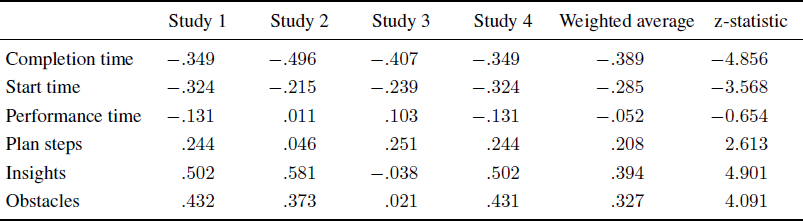
Note: Table values are Hedges’ g for the effect of backward planning (contrast 1) in each study, the weighted average effect size, and the z-statistic for the weighted average effect size.
7 General discussion
7.1 Backward planning and time prediction
People frequently underestimate the time it will take to complete tasks, and the present studies tested whether backward planning could help them arrive at more realistic forecasts. Consistent with our two primary hypotheses, instructing participants to engage in backward planning led them to predict later task completion times (Studies 1-4) and reduced or eliminated optimistic bias (Study 4). The effects on prediction were robust: They generalized across hypothetical task scenarios (preparing for a date, completing a major school assignment) and a variety of real tasks, across student and community samples, and across variations in the format of the planning exercise. Backward planning eliminated bias because it prompted later predicted completion times without a corresponding impact on actual completion times. This pattern is consistent with previous evidence that factors that influence plans and predictions often do not carry through and equally affect behavior over the longer term (Reference Buehler, Griffin and MacDonaldBuehler et al., 1997; Reference Buehler, Peetz and GriffinBuehler, Peetz & Griffin, 2010; Reference Koehler and PoonKoehler & Poon, 2006; Reference Poon, Koehler and BuehlerPoon, Koehler & Buehler, 2014).
Whereas backward planning influenced predicted completion time in each study, it did not have a measurable impact on predictions of performance time. This pattern of differential effects highlights the value of the theoretical distinction between predictions of completion time and performance time (Reference Buehler, Griffin and PeetzBuehler, Griffin & Peetz, 2010; Reference Halkjelsvik and JørgensenHalkjelsvik & Jørgensen, 2012). Task completion times depend not only on the duration of the task itself, but also on a host of external factors such as time spent on competing activities, interruptions, and procrastination. Thus the impact of backward planning on predicted completion times appears to reflect the additional considerations that apply uniquely to these predictions. Moreover, in Study 4 participants underestimated task completion times but not performance times. This result is consistent with literature reviews suggesting that underestimation bias is more common and more pronounced for task completion time than for performance time (Reference Buehler, Griffin and PeetzBuehler, Griffin & Peetz, 2010; Reference Buehler and GriffinBuehler & Griffin, 2015; Halkjelsvik & Jørgensen, 2012.
It is also noteworthy that backward planning appeared to exert roughly equal effects on predicted start times and predicted completion times. The effect of backward planning on predicted start times was significant in two studies (Studies 1 and 4), as well as in the 4-study meta-analysis, and the magnitude of the backward planning effect on start times never differed significantly from the parallel effect on completion times. This pattern suggests that backward planning prompted participants to shift the whole set of planning milestones later in time, resulting in a shift in predicted start times as well as predicted completion times.
Across all studies, predictions in the forward and unspecified conditions were generally very similar. In all four studies, contrast 2 (comparing the forward and unspecified conditions) revealed no effects on predicted completion times or start times; and in only one study (Study 4) was there an effect on predicted performance time. The similar results in these conditions may indicate, consistent with our general expectations, that participants typically planned in a forward direction unless instructed otherwise. The detailed planning requirements used in both of these two conditions resembled unpacking procedures used in previous research (Reference Kruger and EvansKruger & Evans, 2004), and yet participants underestimated task completion times, suggesting that unpacking plans into specific steps was not sufficient to eliminate bias. Previous research suggests that unpacking is less effective if there are few components to unpack (Reference Kruger and EvansKruger & Evans, 2004), if the unpacked components will be easy to carry out (Reference Hadjichristidis, Summers and ThomasHadjichristidis et al., 2014), and if the tasks are in the distant future (Reference MoherMoher, 2012). Temporal direction appears to be an additional moderator of unpacking effects.
7.2 Related cognitive processes
Our studies also assessed the effects of planning direction on related cognitive processes. The process measures allowed us to explore potential mechanisms underlying effects of backward planning, and to gain insights into the phenomenological experience of planning in a backward direction. Effects were less robust on these measures than on prediction. This could be because the measures were later in the questionnaire, further removed from the planning exercise, or because the cognitive processes we tried to capture are not highly accessible for self-report. Nevertheless, when aggregated across the studies, several effects that emerged were congruent with our theorizing.
We expected that backward planning would disrupt the fluent planning process that typically leads to a focus on successful completion, and instead raise the salience of information that is often neglected – such as required extra steps and potential obstacles. We also expected that the disruption of well-rehearsed, schematic planning scripts would lead predictors to feel they are experiencing novel insights in the planning process. Consistent with this theorizing, the aggregated results indicated that backward planning led participants to experience novel planning insights (e.g., clarify the steps they would need to take, think of steps they wouldn’t have thought of otherwise, think of potential problems or obstacles they could encounter) and to report increased anticipation of obstacles or problems. Furthermore, perceived planning insights were correlated with predicted completion time, and mediated the impact of backward planning on prediction, in Study 1.
In addition, an examination of the plans listed by participants suggested that backward planning led participants to consider additional steps. Although the effect size was relatively small, participants tended to include more planning steps in the backward planning condition than in other conditions, and in Study 1 the increase in planning steps played a role in mediating the effect of backward planning on prediction.
We also tested the possibility that planning direction would shift the planners’ perceptions of the flow of time. Consistent with our theorizing, in three studies (Studies 1, 2, and 3) backward planning increased the likelihood of adopting a time motion perspective, wherein time is experienced as moving toward the individual. This perspective has been found to result in longer predictions of task completion time in past research (Reference Boltz and YumBoltz & Yum, 2010). In the present research, a time motion perspective was associated with longer predictions in one study (Study 4), though it did not mediate effects of planning direction on prediction. Our dichotomous single-item measure may not have been sufficiently reliable to capture the indirect effects of backward planning through the time motion perspective; future studies may benefit from other approaches to measuring or manipulating this construct.
Undoubtedly, backward planning also works through processes that were not captured by our measures. One possibility is that the planning exercise creates anchoring effects. In many domains, people arrive at judgments by first contemplating a salient value that serves as the starting point or anchor, and then adjusting (often insufficiently) from that value (Reference Strack and MussweilerStrack & Mussweiler, 1997; Reference Tversky and KahnemanTversky & Kahneman, 1974). Indeed, several studies have revealed anchoring effects in time predictions (Reference Buehler, Peetz and GriffinBuehler, Peetz & Griffin, 2010; Reference KönigKönig, 2005; Reference LeBoeuf and ShafirLeBoeuf & Shafir, 2009; Reference Thomas and HandleyThomas & Handley, 2008). Buehler et al. found that task completion predictions were influenced by ostensibly arbitrary “starting points” suggested by the experimenter. For example, participants made earlier predictions when the initial starting point was the current date (early anchor) rather than the deadline date (late anchor) and they were asked to adjust from this starting point to arrive at their prediction. Conceivably backward planning heightens the salience of the deadline, and thus it functions as an anchor for subsequent judgments.
Although we cannot assess the role of anchoring effects in our studies, we believe the effects are not entirely attributable to anchoring. In the current study, unlike previous anchoring manipulations (e.g., Reference Buehler, Peetz and GriffinBuehler, Peetz & Griffin, 2010), participants created detailed plans that intervened between the putative anchor and the predictions. Although backward planners began at the deadline, they went on to identify every step they would take, and the full plan was available to inform their predictions. Notably, then, backward planners were not focused on the deadline when making predictions; they just began the planning process there. Furthermore, the anchoring-and-insufficient adjustment model predicts a relatively mindless shift that does not affect the actual content of plans, such as the salience of obstacles or the number of steps needed for completion. The evidence that backward planning influenced these higher order cognitive processes suggests that the planning exercise was doing more than merely providing differential anchors.
7.3 Implications and future directions
The present studies add to the planning fallacy literature by testing the consequences of a planning strategy that has been widely advocated but not subjected to empirical scrutiny. The results offer support for several anecdotal claims suggested by advocates of the approach (e.g., Fleming, 2010; Reference RutherfordRutherford, 2008; Reference SaintamourSaintamour, 2008; The Ball Foundation, 2007). In particular, the studies provide evidence that backward planning can elicit novel insights that help people to develop more realistic plans and expectations. The studies also extend the research literatures on behavioral prediction in general (Reference DunningDunning, 2007) and task completion prediction in particular (Reference Buehler, Griffin and PeetzBuehler, Griffin & Peetz, 2010; Reference Halkjelsvik and JørgensenHalkjelsvik & Jørgensen, 2012) by exploring the role of temporal direction. Although previous research has identified many other sources of accuracy and bias in prediction, our work is the first to examine this factor.
The present research could also have direct practical applications. In many contexts people strive to predict accurately when a task will be finished. They may be called upon by others to provide a realistic estimate, or may privately seek an accurate prediction to guide their own decisions. Moreover, people make important decisions and binding commitments on the basis of these predictions, and thus errors can be costly. For example, individuals may rely on task completion predictions to decide which projects, and how many projects, to tackle in the coming month. A tendency to underestimate completion times can result in over-commitment, stress, and aggravation. Planning interventions similar to those used in our experiments could be implemented in a range of settings where practitioners (e.g., teachers, project managers, co-workers) depend on realistic time estimates. The planning exercise is relatively brief and easily administered with written instructions, and a particular advantage is that it capitalizes on people’s natural inclination to base predictions on a specific plan for the task at hand. Our findings can also inform recommendations offered to the public (e.g., in textbooks and popular media) to improve planning, prediction, and time management.
An avenue for future research is to test the generality of effects using different variants of backward planning. Our intervention resembled task unpacking, and varied only the temporal direction in which task components were unpacked. However, backward planning can take different forms, and may introduce elements beyond temporal direction. In organizational contexts, for example, backward planners are sometimes asked to identify critical start and finish times for each step in a complex project, defined as the absolute latest starting and finishing time for each step that would still allow the deadline to be met (i.e., the critical path; Reference LewisLewis, 2002; Reference VerzuhVerzuh, 2005). It may be that the structure of backward planning can be tailored to suit specific tasks, contexts, or objectives.
There are almost certainly other moderators of and boundary conditions on the effects of planning direction that could be examined. According to Construal Level Theory (Reference Trope and LibermanTrope & Liberman, 2003), people should make more optimistic predictions when tasks are further in the future, because temporal distance heightens the prevailing tendency to rely on oversimplified representations of a task. This implies that backward planning may be most beneficial for projects in the distant future. It also remains to be seen whether backward planning will be effective in group settings that depend on collaborative planning. Personal characteristics relevant to planning and prediction, such as the propensity to engage in planning (Reference Lynch, Netemeyer, Spiller and ZammitLynch, Netemeyer, Spiller & Zammit, 2010) and dispositional procrastination (Reference LayLay, 1986), may also moderate effects of planning direction.
Finally, whereas our work focused on predictions of task completion, backward planning has potential to influence other types of predictions where optimistic bias is prevalent, such as predictions of future expenses (Reference Peetz and BuehlerPeetz & Buehler, 2009), affective states (Reference Wilson and GilbertWilson & Gilbert, 2003), or socially desirable behaviors (Reference Epley and DunningEpley & Dunning, 2000; Reference Koehler and PoonKoehler & Poon, 2006). More generally, varying temporal direction in the mental simulation of future events could influence a variety of outcomes that depend on people’s cognitive representation of the future, such as goal pursuit, motivation, and self-control. By continuing to explore the role of temporal direction in people’s cognitive representation of future events, research can provide valuable new insights into the links between past experience, present realities, and expectations for the future.


 Open access

