

Introduction
The COVID-19 pandemic has had a significant global impact and there are concerns regarding the potential repercussions on the population’s mental health. Early studies have demonstrated a clinically significant increase in mental distress in the UK population (Pierce et al., Reference Pierce, Hope, Ford, Hatch, Hotopf, John and Abel2020). Women, younger people, socially disadvantaged individuals, and those with existing mental health problems are said to be at risk of worse mental health outcomes (O’Connor et al., Reference O’Connor, Wetherall, Cleare, McClelland, Melson, Niedzwiedz and Robb2021). Against a backdrop of uncertainty regarding the future, the pandemic has led to an understandable increase in anxiety particularly related to (a) hygiene and contamination with ‘microbes’ and (b) the possibility of falling ill. In those with specific vulnerabilities, it is therefore unsurprising to find a generalised increase in stress and mental health difficulties. There is also growing evidence of increasing prevalence and exacerbation of symptoms particularly for individuals experiencing health anxiety (HA; Kibbey et al., Reference Kibbey, Fedorenko and Farris2020) and obsessive compulsive disorder (OCD; Davide et al., Reference Davide, Andrea, Martina, Escelsior, Davide and Mario2020) focused on contamination.
In addition to the negative effect on people’s mental health and thus an increased prevalence, the pandemic has significantly impacted the delivery of psychological services. When the first lockdown was announced in March 2020, the subsequent restrictions resulted in the near disappearance of face-to-face therapy. Services sought to move to remote ways of delivering therapy such as via telephone and video calls. Within the UK’s adult NHS Talking Therapies (TT, previously known as Improving Access to Psychological Therapies) services, over the first 7 months of the pandemic telephone consultations increased by 260% to account for 70% of appointments. Video conferencing also rose significantly from 2% to 17% of appointments, an increase of 850% (NHS Digital, 2021). Other mental health services anecdotally reported that very little face-to-face therapy was occurring, with staff having to predominantly work from home.
In the face of such challenging circumstances a key issue is the extent to which services can continue to deliver evidence-based treatments without losing fidelity and effectiveness. Previous studies have demonstrated the effectiveness of a blend of face-to-face sessions with the provision of additional self-study booklets for panic disorder, OCD (Bolton et al., Reference Bolton, Williams, Perrin, Atkinson, Gallop, Waite and Salkovskis2011; Clark et al., Reference Clark, Salkovskis, Hackmann, Wells, Ludgate and Gelder1999) and HA (Tyrer et al., Reference Tyrer, Salkovskis, Tyrer, Wang, Crawford, Dupont and Barrett2017). It has yet to be established whether or not a blend of online video-based consultations and additional reading materials would also be effective.
Alongside the impact on mental health of stress arising from COVID-19 and related restrictions, the specific characteristics of COVID-19 may mean that HA and OCD might be elevated in some instances. There are a number of important similarities with regard to the cognitive models of understanding HA (Salkovskis et al., Reference Salkovskis, Warwick and Deale2003) and OCD (Salkovskis, Reference Salkovskis1999) which have implications for their treatment (Salkovskis, Reference Salkovskis and Salkovskis1996). Due to the longer-term nature of the feared consequences in each of the disorders, it is often impossible to ‘disprove’ the feared outcome. Instead, the focus is on developing and evaluating less-threatening explanations of the individual’s problem rather than seeking to disconfirm the threats which drive the anxiety experienced. The two disorders also share several important processes presumed to be involved in the maintenance of these problems, including difficulties in obtaining certainty, beliefs about personal responsibility, and the importance of safety-seeking behaviours, particularly reassurance-seeking, avoidance and checking behaviours. Whilst it is currently unknown whether the cognitive and behavioural processes underlying OCD in the context of the pandemic are different from pre-pandemic presentations, experts in the field are inclined to believe they are unchanged (Jassi et al., Reference Jassi, Shahriyarmolki, Taylor, Peile, Challacombe, Clark and Veal2020) and can therefore be effectively addressed with cognitive behavioural therapy (CBT). There is currently good evidence that CBT is an effective treatment for both OCD and HA (Gava et al., Reference Gava, Barbui, Aguglia, Carlino, Churchill, De Vanna and McGuire2007; Olatunji et al., Reference Olatunji, Davis, Powers and Smits2013; Thomson and Page, Reference Thomson and Page2007). Further to this, the CHAMP study (Tyrer et al., Reference Tyrer, Salkovskis, Tyrer, Wang, Crawford, Dupont and Barrett2017) trained non-specialist therapists in CBT for health anxiety, delivered in the context of screening in the general hospital context. Very brief treatment, supplemented by a version of workbooks used in the present study, showed significant symptom improvements enduring up to 5 years follow-up compared with standard care; the cost of the treatment itself was fully offset by reduced medical care costs in the year following treatment. These findings have since been built upon with remotely delivered (telephone or videoconferencing) CBT for HA showing greater improvements in HA symptoms compared with treatment as usual, maintained at 12-month follow-up (Morriss et al., Reference Morriss, Patel, Malins, Guo, Higton, James and Tyrer2019).
When considering the specific components of treatment that are likely to effect change, within HA the focus is predominantly on cognitive strategies (Salkovskis et al., Reference Salkovskis, Warwick and Deale2003), whilst for OCD there is a balance between cognitive strategies and behavioural experiments (Salkovskis, Reference Salkovskis1999). When treating HA, it is often not possible to fully disprove the patient’s belief that they are going to become seriously ill. However, for OCD it is sometimes possible to disprove such beliefs, e.g. that something bad will happen that day if the patient abstains from engaging in a compulsion. Treatment for both disorders requires behavioural experiments focused on checking, attentional processes, and avoidance. In the absence of the ability to directly undertake in vivo experiments (Salkovskis et al., Reference Salkovskis, Warwick and Deale2003; Salkovskis, Reference Salkovskis1999), as was the case when lockdown was imposed, adaptations were needed. An obvious adaptation was to increase the cognitive element in therapy. In the present study, this was embedded in the provision of self-study booklets with self-directed cognitive and behavioural exercises. It is obviously important that we evaluate whether these new ways of working and delivering therapy are effective in helping people to overcome their difficulties. In particular, the management of HA and OCD would benefit from a better understanding of the impact of the ongoing pandemic and consideration of how to adapt existing evidence-based treatments given the continuing restrictions regarding social distancing. In view of the underlying similarities between the understanding and treatment of these problems if a blended approach to treatment could be demonstrated as effective, it may be possible to extend this work to develop a transdiagnostic/problem-specific approach to treatment, as has been proposed for medically unexplained symptoms (MUS; Salkovskis et al., Reference Salkovskis, Gregory, Sedgwick-Taylor, White, Opher and Ólafsdóttir2016).
Present study
The primary aim of the study was to evaluate the effectiveness of CBT interventions for HA and OCD delivered via a blend of online therapist consultations interspersed with self-study reading materials between sessions. The adaptation to remote consultations occurred at very short notice and was necessary for services due to COVID-19 restrictions. The study therefore takes the form of an open-arm trial as part of a service evaluation in the context of the changes imposed by the COVID-19 lockdown measures, whilst also considering sustainability of the adaptations post-COVID. The project was deemed a service evaluation of routinely collected data and hence, no ethical review was required by the R&D departments involved. A secondary aim was to compare HA and OCD in terms of self-reported reactions to COVID-19. Thirdly, we sought to evaluate the training workshops provided to therapists.
Method
Service context
Therapists from five TT services (Oxfordshire, Buckinghamshire, Berkshire, Nottinghamshire and Milton Keynes) were involved in the study. TT services provide short-term evidence-based psychological therapies to adults in England for common mental health problems including anxiety and depression. The workbook materials were not previously available in these services, which were previously reliant on face-to-face CBT for OCD and HA. The service evaluation was registered with the research and development departments for each trust.
Therapist training and supervision
Therapists were all qualified high-intensity CBT therapists with a minimum of 1-year post-qualification experience. Therapists attended three half-day training workshops, via Microsoft Teams, led by P.S. and V.B. (clinical psychologists). Session 1 focused on the treatment of HA, session 2 on OCD, and the third session consolidated learning and included generic CBT skills relevant to both conditions. Workshops included examples specific to COVID-19, ways to adapt treatment to online delivery, and an introduction to the additional patient reading materials. Sessions were recorded for therapists unable to attend. Continuing professional development certificates were issued to therapists for each workshop. Monthly supervision of 1 hour duration with P.S. was offered to all therapists involved in the study to discuss cases and review use of the reading materials.
Patient materials
Separate supplementary booklets were developed for HA and OCD, each consisting of six individual modules (see Table 1 for module headings). The HA booklet was adapted from materials used in previous HA trials (Seivewright et al., Reference Seivewright, Green, Salkovskis, Barrett, Nur and Tyrer2008; Tyrer et al., Reference Tyrer, Cooper, Salkovskis, Tyrer, Crawford, Byford and Barrett2014). The OCD booklets were developed by the study team based on CBT for OCD (Bream et al., Reference Bream, Challacombe, Palmer and Salkovskis2017) and were reviewed by experts with experience from OCD-UK.
Module headings for HA and OCD patient booklets

Design
The study was a single-arm open trial using treatment outcome data from consecutive cases, taken from the routine waitlist, from patients who gave written consent for their anonymous data to be used for the purposes of service evaluation.
Participants
Participants were recruited between January 2021 and March 2022. Participants had all been referred and accepted for psychological treatment in TT. Participants were required to be aged 18 years and over; with their main presenting problem as either HA or OCD (as indicated by scoring above the TT threshold for caseness on the relevant measures detailed below). Participants taking medication were required to have been on a stable dose for a minimum of 4 weeks.
Measures
Health Anxiety Inventory–Short Week (SHAI)
The SHAI is an 18-item self-report instrument designed to measure health anxiety. Items are rated on a 4-point scale and combined to give an overall total; higher scores indicate greater severity of symptoms. A total score of 18 or above is the current TT clinical threshold for the presence of health anxiety (NHS England, 2018). The questionnaire is reliable (r=0.90), with high internal consistency (α=0.95) and is sensitive to treatment effects over time (Salkovskis et al., Reference Salkovskis, Rimes, Warwick and Clark2002).
Obsessive Compulsive Inventory (OCI)
The OCI is a 42-item self-report questionnaire consisting of seven subscales including washing, checking, doubting, ordering, obsessions, hoarding and neutralising. Items are scored on a 5-point scale (0–4) with greater scores indicating increased frequency and associated level of distress. Within TT, a score of 40 or above indicates caseness for OCD (NHS England, 2018). The measure has good reliability and internal consistency (α=0.86–0.95; Foa et al., Reference Foa, Kozak, Salkovskis, Coles and Amir1998).
Generalised Anxiety Disorder Scale (GAD-7)
The GAD-7 is a brief 7-item anxiety scale, shown to be a reliable (r=0.83) and valid (α=0.92) tool for screening for anxiety disorders, particularly GAD and for assessing severity (Spitzer et al., Reference Spitzer, Kroenke, Williams and Löwe2006). Items are scored on a 4-point scale (0–3) with greater scores indicating greater severity of symptoms. A score of 10 points or more is indicative of the presence of GAD (Spitzer et al., Reference Spitzer, Kroenke, Williams and Löwe2006); however, within TT services a clinical threshold of 8 or above is used (NHS England, 2018).
Patient Health Questionnaire (PHQ-9)
The PHQ-9 is a widely used brief 9-item measure of depression (Kroenke et al., Reference Kroenke, Spitzer and Williams2001). Items are rated based over the past 2-weeks using a 4-point scale (0–3) with greater scores indicating greater severity of symptoms. The measure has been shown to be reliable (α=0.89) and valid in clinical populations (Kroenke et al., Reference Kroenke, Spitzer and Williams2001). TT uses a cut-off score of 10 or above for caseness (NHS England, 2018).
Work & Social Adjustment Scale (WSAS)
The WSAS is a valid and reliable (α=0.70–0.94), simple self-report measure of functional impairment (Mundt et al., Reference Mundt, Marks, Shear and Greist2002). Items are rated on a 9-point scale (0–8) covering the domains of work (if applicable), home management, social leisure activities, private leisure activities, and family and relationships. Higher scores indicate greater severity of functional impairment.
COVID-19 Scale
A self-report 3-item idiographic measure was devised to assess how much participants’ thoughts had been affected by COVID-19. These questions concerned how much they had been pre-occupied with thoughts of COVID-19, and how worried they were that COVID-19 could cause themselves or others harm. Participants were asked to rate the extent they agreed with the items during the past 2 weeks on a 0–100 scale (0, not at all true for me; 100, completely true for me).
Therapist feedback
Feedback from therapists was sought at three time points via a Qualtrics survey: firstly, prior to the training workshops to establish baseline knowledge of therapists and their confidence in treating HA and OCD; secondly, post-workshop to examine how helpful therapists found them; finally, after completion of initial cases to collate feedback on clinical application of skills learnt during workshops, usefulness of client facing materials, and observations on clinical presentation of cases.
Procedure
Participants were assigned to therapists’ caseloads from the routine waitlist as per service guidelines. Prior to starting treatment, participants were asked to provide written consent for their anonymous data to be used for the purpose of service evaluation. In cases where individuals declined, their treatment continued as usual.
At the start and end of treatment, participants completed the full battery of measures including the SHAI, OCI and idiosyncratic COVID-19 measure, plus the minimum dataset (MDS), consisting of the PHQ-9, GAD-7 and WSAS. The MDS and relevant Anxiety Disorder Specific Measure (ADSM), either the SHAI or OCI, depending on presenting problem, were completed at every other treatment session.
Therapists delivered the weekly, 50–60 minute, high-intensity (Step 3) CBT intervention via online video conferencing (Microsoft Teams), with the addition of providing participants with modules from the relevant supplementary booklets during treatment. All participants received all modules. Aside from the first module which was given out after session 1, the timing at which subsequent modules were given out by therapists varied, depending on completion of previous modules, and the stage of treatment.
Statistical analysis
Statistical analyses were undertaken using SPSS for Mac (version 27). Non-parametric analyses were conducted where appropriate. Due to the low sample size for the HA group, careful attention was paid to tests of normality.
Workshops
Visual inspection of the data confirmed it met the assumption of normality and hence considered appropriate for parametric analysis. Paired sample t-tests were used to analyse repeated measures. Our primary outcome was how confident therapists felt that they could engage participants with treatment using an online format with α set at 0.05. Secondary outcomes, therapists’ understanding of HA/OCD, and their confidence in helping someone with HA/OCD, were adjusted using Bonferroni correction (therefore p set at 0.025). All non-repeated measures are reported descriptively.
Participant data
Baseline MDS measures were analysed using independent samples t-tests. A mixed-model ANOVA was used to analyse baseline COVID scale scores according to diagnostic group. Box’s test of equality of covariance matrices and Levene’s test of equality of error variances were negative. Mauchly’s test of sphericity was not significant, so an epsilon adjustment was not carried out.
Treatment outcomes
Missing data were managed conservatively using last observation carried forward (9/135 data points). For two participants missing baseline MDS scores, their session 1 scores were carried forward. Pre–post GAD-7 and PHQ-9 scale scores were analysed using a mixed-model ANOVA with diagnosis as a between-subjects factor. A one-way ANOVA was used to analyse pre–post WSAS scores, again with diagnostic group as a between-subjects factor. In each case, Box’s test of equality of covariance matrices and Levene’s test of homogeneity of variance was not significant. Pre–post comparisons of SHAI and OCI scores were conducted using paired sample t-tests. Whilst the initial intention was to conduct a parametric analysis of pre–post COVID Scale sores, due to missing data resulting in small sample sizes, a non-parametric approach was taken comparing change scores with a Mann–Whitney U-test.
Recovery rates were calculated according to TT criteria (NHS England, 2022), requiring not only sub-threshold scores for the symptom specific ratings (HAI and OCI) but also for the PHQ-9.
Therapist feedback
Data from therapist feedback questionnaires are reported descriptively.
Results
Therapist demographics
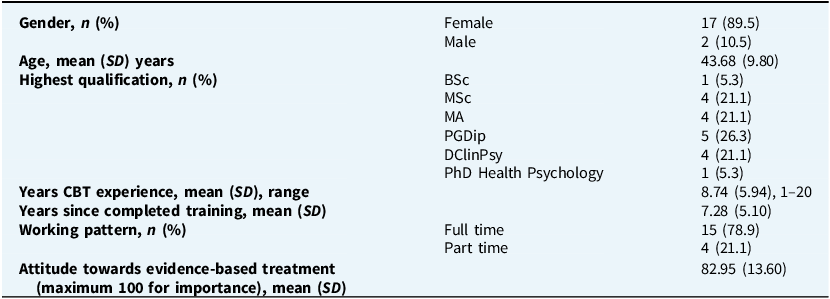
Nineteen therapists attended the HA and OCD workshops; see Table 2 for demographic data. Of the 19 who attended the training, 16 subsequently went on to complete cases in the study. During data collection, three therapists left the study: one retired after completing one case; and two moved to different services and had completed one and two cases, respectively. Monthly supervision sessions were conducted from December 2020 until completion of the study in May 2022.
Therapist demographics
Participants
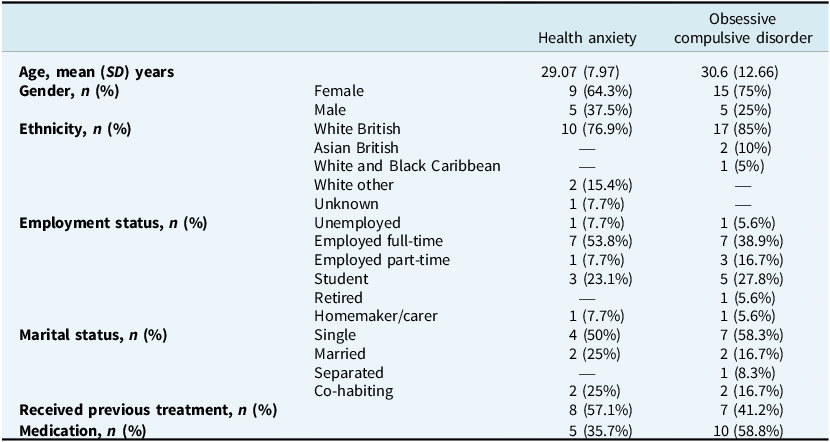
Thirty-four participants consented for inclusion in the study (HA=14, OCD=20); see Table 3 for demographic data split by diagnosis. The majority of the sample were white British, single, and employed full-time. There were no significant differences between groups for age (t 32=–0.39, p=0.18), gender (χ2(1)=0.46, p=0.50), or medication status (χ2(1)=1.64, p=0.20). Self-reported data from participants indicated that approximately half the HA group and 41.2% of the OCD group had previously received formal treatment for their disorder. Participants in both the HA and OCD groups received an average of 12 sessions of CBT (M=12.29, SD=4.31). All except two participants received a minimum of seven sessions.
Participant demographics
Baseline measures
There were no significant differences between groups at baseline for GAD-7 (t 31=–0.77, p=0.45), PHQ-9 (t 31=–0.45, p=0.66), or WSAS (t 30=–1.29, p=0.21); see Table 4.
Mean scores of baseline and post-treatment measures for HA and OCD groups
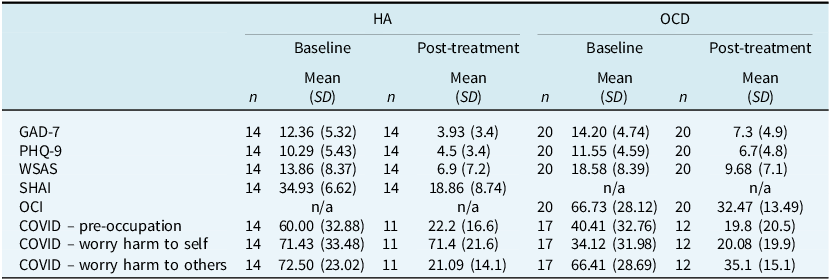
Table 4 shows the mean and standard deviation for baseline scores on the COVID-19 scale. There was a significant main effect of COVID Scale, F 2,58=15.97, p<0.001, and diagnosis F 1,29=4.20, p=0.05. These main effects were modified by a significant COVID scale by diagnosis interaction, F 2,58=8.96, p<0.001, indicating the groups were responding differently on some items. Simple main effects revealed that the HA group scored significantly higher than the OCD group on item 2 of the COVID Scale (‘I have worried about the potential harm COVID-19 could cause me’), t 29=3.17, p=0.004.
Treatment outcomes
The mixed model ANOVA of GAD-7 and PHQ-9 scores revealed a main effect of scale, F 1,32=4.60, p=0.04, indicating scores on each measure were different irrespective of when completed. There was a main effect of time, F 1,32=52.89, p<0.001, with post-treatment scores significantly lower than pre-treatment scores. The main effect of diagnosis was not significant, F 1,32=2.53, p=0.12. Neither the scale by diagnosis (F 1,32=0.88, p=0.36), nor time by diagnosis (F 1,32=0.24, p=0.63) interaction was significant. The interaction between scale and time was significant, F 1,32=8.16, p=0.007. Simple main effects analysis revealed that scores on the GAD-7 at pre-treatment (M=13.44, SD=4.99) were significantly higher than PHQ-9 scores (M=11.03, SD=4.91), t 33=3.10, p=0.004, but they were not significantly different at post-treatment (GAD-7: M=6.38, SD=4.81; PHQ-9: M=6.06, SD=4.39), t 33=0.55, p=0.59. Overall, participants in both the HA and OCD groups showed significant improvements on GAD-7 and PHQ-9 scores from pre- to post-treatment.
Analysis of the WSAS revealed a main effect of time, F 1,31=33.82, p<0.001. Mean scores for both the HA and OCD group were significantly lower at post-treatment (HA pre: M=13.86, SD=8.37; post: M=7.79, SD=7.19; OCD pre: M=18.58, SD=8.39; post: M=9.68, SD=7.14). The main effect of diagnosis was not significant, F 1,31=1.20, p=0.28, nor was the interaction, F 1,31=0.20, p=0.28.
Scores on the SHAI for participants within the HA group dropped significantly from pre (M=34.93, SD=6.62) to post (M=18.86, SD=8.74) treatment, t 13= 5.23, p=<0.001; effect size of d=2.1) with a recovery rate of 71%. OCI scores for the OCD group also reduced significantly from pre (M=66.73, SD=28.12) to post (M=32.47, SD=13.49) treatment, t 14= 4.73, p=<0.001; effect size of d=1.64, with a recovery rate of 65%.
Taken together, all of these analyses indicate that both groups improved to a broadly comparable extent.
As the sample sizes for those completing the COVID-specific scale both before and after treatment was small, this was analysed on the basis of a non-parametric comparison of change scores. Change scores for level of pre-occupation with COVID-19 from pre- to post-treatment in the HA group (median=45, range=10–65) were greater than the OCD group (median=14.5, range=–30–67), U=33.00, p=0.04. For worry about COVID-19 potentially harming themselves, change scores were again statistically different in the HA group (median=50, range=0-85) compared with the OCD group (median=7.5, range=–20–50), U=22.50, p=0.007. On the final question concerning the potential of COVID-19 causing harm to others, the change scores were higher for the HA group (median=55, range=13–90) than the OCD group (median=27.5, range=–16–75), U=34.50, p=0.05. This suggests that the HA group may have been more adversely impacted by COVID-19 and that treatment ameliorated this for that group.
Therapist ratings: health anxiety workshop
Prior to attending the workshop, therapists used a 0–100 scale to rate their overall confidence in using CBT for HA (M=65.95, SD=16.34), and their ability to engage people with HA when they met with them in person (M=70.16, SD=19.29). Therapists’ confidence engaging people with HA online improved significantly after attendance at the training workshop (t 18=–3.41, p<0.005). There were also significant improvements in their reported understanding of HA (t 18=–3.50, p<0.005) and their confidence that they could help people with HA (t 18=–4.56, p<0.001). Therapists rated the workshops as being useful in relation to their work directly with people with HA (M=85.53, SD=16.71) and that they improved their general knowledge about the subject (M=82.68, SD=20.08).
Therapist ratings: obsessive compulsive disorder workshop
Before the OCD workshop, therapists rated their overall confidence using CBT for OCD as M=64.53 (SD=18.94) on a scale of 0–100. They rated their ability to engage people with OCD face-to-face as M=68.87 (SD=17.70). Confidence engaging people with OCD online improved significantly after the workshop (t 14=–5.51, p<0.001). Significant improvements were also observed for therapists understanding of OCD (t 14=–3.59, p<0.005), and therapist confidence in being able to help people with OCD (t 14=–4.75, p<0.001). After the workshops, therapists rated the content as being useful in relation to their work directly with people with OCD (M=88.87, SD=13.40), and that it had improved their general knowledge of the subject (M=88.07, SD=14.63).
Therapist feedback
Feedback provided by therapists (n=15) after completion of at least one case showed that they found the workshops helpful at the time, M=8.53 (SD=1.30) out of 10. Therapists felt the workshops prepared them well for the clinical work, M=7.60 (SD=1.35), and they found the regular supervision sessions helpful, M=8.80 (SD=1.08). The provision of additional reading materials for patients was rated as beneficial by therapists, M=7.87 (SD=1.81).
Discussion
The present study aimed to evaluate the effectiveness of CBT interventions for HA and OCD delivered via a novel blend of online therapist consultations interspersed with self-study reading materials between sessions, introduced in order to manage the delivery of CBT during the COVID-19 lockdown when face-to-face treatment was not possible. Results were positive, with individuals in both the HA and OCD groups showing significant and substantial improvements across all MDS measures from pre- to post-treatment. Reductions in disorder-specific measures (SHAI and OCI) for each group also indicated significant improvement during the course of the intervention. Overall, these results are consistent with previous trials which have demonstrated large improvements on HA and OCD symptoms in response to CBT (Gava et al., Reference Gava, Barbui, Aguglia, Carlino, Churchill, De Vanna and McGuire2007; Olatunji et al., Reference Olatunji, Davis, Powers and Smits2013; Thomson and Page, Reference Thomson and Page2007). Thus whilst this study used online therapist consultations, the results are consistent with previous research on face-to-face CBT which demonstrated that the addition of self-study materials is an effective intervention for both OCD (Bolton et al., Reference Bolton, Williams, Perrin, Atkinson, Gallop, Waite and Salkovskis2011), and HA (Tyrer et al., Reference Tyrer, Salkovskis, Tyrer, Wang, Crawford, Dupont and Barrett2017).
The study also evaluated the impact of COVID-19 on these particular groups due to the emerging evidence of increased prevalence and distress for individuals with HA (Kibbey et al., Reference Kibbey, Fedorenko and Farris2020) and OCD (Davide et al., Reference Davide, Andrea, Martina, Escelsior, Davide and Mario2020). Interestingly, at the start of treatment the HA group were more pre-occupied by COVID-19 and more concerned about the potential for it to cause harm to themselves and others. The finding that change scores on these questions were greater for the HA group is perhaps a reflection of their greater opportunity for change (although there were some missing data). The finding that the HA group scored significantly higher on item 2 (concerned about potential harm to self from COVID-19) relative to the OCD group fits with the cognitive behavioural understanding of the disorder, in that individuals are prone to misinterpret information as evidence that they have, or are likely to develop, a serious illness (Salkovskis et al., Reference Salkovskis, Warwick and Deale2003).
The training workshops provided to therapists were well received and met their objectives. After completion of the workshops, therapists reported they felt more confident working with HA and OCD, and felt they prepared them well to work clinically. Therapists approved of the provision of self-study booklets and responded favourably to the regular supervision. Previous work has emphasised the importance of ongoing supervision for learning and applying CBT skills (Grey et al., Reference Grey, Salkovskis, Quigley, Clark and Ehlers2008; Mannix et al., Reference Mannix, Blackburn, Garland, Gracie, Moorey, Reid and Scott2006), and this highlights the importance of therapists being provided with adequate opportunities to continue to develop their skills.
Limitations
The study has a number of limitations. Most obvious is the absence of random allocation to the index intervention and a comparison group; a future comparison with treatment as usual would be appropriate in a full randomised controlled trial. The sample sizes, particularly for the HA group, were relatively small for parametric analysis of the data and hence special attention was given to tests of normality. The small numbers also meant, of course, that there was no comparison across the different services. There were some instances of missing data points, especially at post-treatment, but this was a relatively small proportion (6.67%). The more conservative strategy of last observation carried forward was employed to deal with the missing data as opposed to the multiple imputation method as it was not felt possible to assume that data missing was at random. Previous work has demonstrated that patients who disengage from TT services are likely to be progressing less well (Clark, Reference Clark2011). The study also encountered some difficulties with questionnaire completion, particularly for the ADSM. This was due to limitations of the TT computer system which automatically sends outcome measures to patients prior to their appointment. Unfortunately, only one ADSM can be assigned to the automated system and therefore we were reliant on therapists completing additional measures during the session. As a result, the secondary ADSM measure (either SHAI or OCI) was sometimes missed at either pre- or post-treatment, contributing to the small samples for comparison. It should also be noted that the sample lacked diversity with most individuals in both groups identifying as White British (HA=75%, OCD=85%); however, this was generally reflective of the demographics in the areas where data were collected. Regrettably, it was not possible to assess the extent to which participants completed the additional booklets provided, and as such we are unable to draw any firm conclusions as to how much the additional materials contributed to the improvements observed. Finally, as the study was not a randomised controlled trial, we do not know how the blended delivery of treatment would compare with either full online or face-to-face modalities.
Clinical implications
The findings from the study provide support for the effectiveness of the online delivery of treatment with the inclusion of additional self-study booklets. This is important, as whilst there is currently a trend towards resuming face-to-face therapy, it is likely that there will continue to be a blend of consultation strategies used by services.
Future research
Whilst this study was designed to evaluate the effectiveness of online CBT with self-study booklets, it would be beneficial to examine how these materials could be incorporated into face-to-face therapy now that there is some relaxation to the lockdown measures. A comparison study of face-to-face therapy with either the inclusion or exclusion of the booklets would be able to provide this.
Although efforts were made to obtain feedback on the booklets from experts by experience, unfortunately it was not possible to gain feedback from participants in the study. Any future studies using this approach should aim to obtain patient feedback to gauge acceptability of the treatment approach and the usefulness of the booklet content. Additionally, with regards to the COVID Scale, it would be beneficial to conduct a comparison with healthy controls to see if, and how, the findings differ. For example, given how prevalent COVID-19 has been within the news it is possible that the levels of pre-occupation are similar across the general population.
On the basis of the study’s results, in that on the majority of measures there were no exceptionally large differences in terms of outcomes, future studies could potentially explore the application of a transdiagnostic approach, as has been proposed for MUS (Salkovskis et al., Reference Salkovskis, Gregory, Sedgwick-Taylor, White, Opher and Ólafsdóttir2016). Some of the materials that target the transdiagnostic processes which maintain both disorders could be combined. This could include elements focused on difficulties obtaining certainty and the role of safety-seeking behaviours, particularly reassurance-seeking, avoidance, and checking, which are shared across both HA and OCD. This would require careful consideration to ensure that it would not be at the cost of cognitive specificity; for example, the greater concern of individuals with OCD regarding their sense of responsibility to prevent harm coming to others. As with all interventions, it would be vital to ensure that any approach began with a thorough assessment and individual formulation which would allow the patient and therapist to form a shared understanding of the problem. From there, a modular approach, similar to the structure of the self-study booklets, could be beneficial as it would allow therapy to be individualised to the patient. The content could be used flexibly such that components which do not fit with the individual’s formulation would not have to be used. A point of caution though: given some of the results, particularly related to concerns regarding COVID-19 appear specific to the HA group, it may not be appropriate to adopt such an approach whilst COVID-19 remains prevalent.
Data availability statement
Due to the specific nature of the clinical material, only very restricted data are available on application to the corresponding author.
Acknowledgements
We are grateful for the enthusiastic participation of Talking Therapies (TT) services and service leads in Nottingham, Oxfordshire, Aylesbury and Berkshire, and to the patients who participated.
Author contributions
Laura Johnsen: Conceptualization (equal), Formal analysis (equal), Investigation (lead), Methodology (equal), Project administration (lead), Writing - original draft (supporting), Writing - review & editing (equal); Victoria Bream: Investigation (supporting), Project administration (supporting), Supervision (supporting), Writing - review & editing (supporting); Sam French: Investigation (supporting), Project administration (supporting), Writing - original draft (supporting), Writing - review & editing (supporting); Richard Morriss: Conceptualization (supporting), Project administration (supporting), Supervision (supporting), Writing - original draft (supporting), Writing - review & editing (supporting); Paul M. Salkovskis: Conceptualization (equal), Data curation (equal), Formal analysis (equal), Investigation (supporting), Methodology (equal), Supervision (lead), Writing - original draft (supporting), Writing - review & editing (equal).
Financial support
There was no financial support for this research.
Competing interests
Paul M. Salkovskis is the editor of this journal. He has played no part in the editorial and review process for this article. The other authors have no competing interests to declare.
Ethical standards
All authors have abided by the Ethical Principles of Psychologists and Code of Conduct as set out by the BABCP and BPS.


 Open access


Comments
No Comments have been published for this article.