





Impact statement
Hydraulic transients in pipeline systems pose significant risks to water distribution networks, including potential damage and inefficiencies. Monitoring and managing these transient events in real time is critical to preventing pipeline damage, detecting leaks and ensuring reliable water delivery. This research introduces a novel computationally efficient extended Kalman filter-based approach, integrated with the elastic water column model, for real-time hydraulic transient data assimilation. By leveraging sensor data, the proposed methodology enables accurate monitoring of transient pressures and flows while reducing computational demands, making it feasible for large-scale water distribution systems. The approach also has the potential to be developed into a robust tool for detecting anomalies, such as leaks and bursts, enhancing the operational safety and reliability of water distribution systems.
Introduction
The resilience and efficiency of modern water distribution systems heavily depend on the ability to monitor, predict and manage hydraulic transients across pipe networks (Jung et al., Reference Jung, Karney, Boulos and Wood2007). Hydraulic transients are commonly triggered by sudden changes in flow demand, pump failures or valve operations, and if left unmanaged, can lead to pipe failures (Taiwo et al., Reference Taiwo, Ben Seghier and Zayed2023), water quality degradation (Weston et al., Reference Weston, Collins and Boxall2021) and service interruptions. Accurate real-time estimation of these transients (Stoianov et al., Reference Stoianov, Nachman, Madden and Tokmouline2007) is essential for system operators, as it allows proactive adjustments and mitigations to prevent damage and maintain service reliability. In this context, data assimilation (Evensen et al., Reference Evensen, Vossepoel and Van Leeuwen2022) techniques have emerged as a critical tool, enabling real-time adjustments to hydraulic transient models based on incoming observational data and improving the precision of state predictions under transient conditions.
The Kalman filter (KF) (Simon, Reference Simon2006) is an efficient data assimilation method that is straightforward to implement and computationally efficient, making it well-suited for real-time applications. Traditionally, hydraulic transient state estimation in pipeline systems has been successfully achieved through KF-based approaches integrated with conventional transient models (Torres et al., Reference Torres, Jiménez-Cabas, González, Molina and López-Estrada2020). These methods employed the method of characteristics or finite difference method as transient models, integrating them with the extended KF (EKF) for applications such as leak or burst detection (Benkherouf and Allidina, Reference Benkherouf and Allidina1988; Emara-Shabaik et al., Reference Emara-Shabaik, Khulief and Hussaini2002; Delgado-Aguiñaga et al., Reference Delgado-Aguiñaga, Besançon, Begovich and Carvajal2016). However, to ensure model accuracy, these methods often require a dense discretization, where pipes are divided into numerous segments to capture the dynamics accurately. This segmentation significantly increases the number of state variables and, consequently, the computational burden, making real-time estimation for large-scale networks challenging and often impractical. Furthermore, obtaining a linearized model for a pipe network, as required by the KF, is challenging due to the high non-linearity, complex topology and diverse boundary conditions (e.g., user demand changes). These challenges significantly limit the applicability of such methods to large, interconnected pipe networks often encountered in real-world scenarios.
Efficient data assimilation or state estimation in pipeline networks remains a critical challenge in pipe network systems. Reddy et al. (Reference Reddy, Narasimhan and Bhallamudi2006) proposed a transient state estimation approach in gas pipe networks based on a transfer function model. This method was further developed for leak detection and identification (Reddy et al., Reference Reddy, Narasimhan, Bhallamudi and Bairagi2011). The accuracy of the proposed approach for leak detection and identification was validated through simulations on a real series pipeline and a hypothetical pipeline network. Nevertheless, the time domain solution of the transfer function model requires weighted sums of the historical pressures and flow values from the initial to the current time. This increases the computational complexity not only for linearizing the model but also for processing the model during state estimation. Delgado-Aguiñaga and Besançon (Reference Delgado-Aguiñaga and Besançon2018) proposed a two-step scheme for EKF-based leak detection and diagnosis in pipeline networks. The method relies on a preliminary hydraulic analysis to identify the leaky pipe, followed by the EKF estimation applied to this single pipe. These developments have contributed to the transient data assimilation in pipe networks, although scalability and computational efficiency remain areas for further improvement.
This study presents a novel data assimilation approach that integrates an EKF with an elastic water column (EWC) model (Zeng et al., Reference Zeng, Zecchin and Lambert2022), designed to optimize computational efficiency without sacrificing accuracy. The EWC model allows for a simplified representation of transient behaviours. When combined with the EKF, this approach reduces the state dimensionality with fewer pipe segments, particularly effective for low-frequency transient events where a high spatial resolution is less critical. This reduction in state variables leads to not only faster computation but also simplified optimization problems, enabling the method to handle real-time data assimilation tasks more accurately across complicated pipe networks. Moreover, the EWC model can be written in the form of matrices in which the boundary conditions, such as demand and reservoir, are incorporated. This largely facilitates the linearization of the transient model, especially for large and complex network systems.
This study evaluates the proposed EKF-based data assimilation method through numerical simulations on two pipe networks: a simplified seven-pipe network and a larger, more complex 51-pipe network. By comparing the predicted transient states against known reference values, we demonstrate the method’s ability to accurately capture transient dynamics with reduced computational demand. Results indicate that the proposed approach not only maintains high accuracy in transient state prediction but also offers significant improvements in computational efficiency, making it well-suited for real-time applications in water distribution systems of various scales.
The contributions of this work are threefold: (1) development of a computationally efficient data assimilation approach designed for real-time transient pressure prediction, (2) integration of the EWC model with an EKF for applications in complex pipe networks, and (3) validation of the approach on networks of varying complexity, demonstrating its robustness and potential scalability. This study provides a promising solution to overcome the computational constraints of traditional methods, enabling enhanced real-time monitoring and management of water distribution networks.
Methodology
This section first illustrates the formulation of the EWC model in pipe network systems. Then, the EKF and its application based on the EWC model for real-time data assimilation were introduced.
The EWC model
The EWC model reformulates the two governing partial differential equations for hydraulic transients into a set of ordinary differential equations (ODEs). The mathematical derivation of this model is detailed in Zeng et al. (Reference Zeng, Zecchin and Lambert2022). The governing equations for the hydraulic transients in pipe networks are expressed as:
 $$ \left\{\begin{array}{c}\frac{d\mathbf{q}}{dt}=-{\mathbf{L}}^{-1}\mathbf{R}\left|\mathbf{q}\right|\mathbf{q}+{\mathbf{L}}^{-1}{\mathbf{A}}_I^T{\mathbf{h}}_I+{\mathbf{L}}^{-1}{\mathbf{A}}_R^T{\mathbf{h}}_R\\ {}\frac{d{\mathbf{h}}_I}{dt}={\left(\frac{1}{2}\left|{\mathbf{A}}_I\right|\mathbf{C}\right)}^{\hskip-0.65em -1}\left({\mathbf{A}}_I\mathbf{q}-{\boldsymbol{\psi}}_{\boldsymbol{I}}\right)\end{array}\right. $$
where t represents the time; $ {\mathbf{h}}_I $
corresponds to the internal nodes (excluding the reservoir nodes) and is defined as
$ {\mathbf{h}}_I $
corresponds to the internal nodes (excluding the reservoir nodes) and is defined as $ {\mathbf{h}}_I={\left[{h}_1,{h}_2,\dots, {h}_{n_I}\right]}^T $
with
$ {\mathbf{h}}_I={\left[{h}_1,{h}_2,\dots, {h}_{n_I}\right]}^T $
with $ {h}_i $
being the pressure head at the i
th node. The head at reservoir nodes is denoted by
$ {h}_i $
being the pressure head at the i
th node. The head at reservoir nodes is denoted by $ {\mathbf{h}}_R={\left[{h}_{n_I+1},\dots, {h}_{n_I+{n}_R}\right]}^T. $
Here,
$ {\mathbf{h}}_R={\left[{h}_{n_I+1},\dots, {h}_{n_I+{n}_R}\right]}^T. $
Here, $ {n}_I $
and
$ {n}_I $
and $ {n}_R $
represent the number of internal and reservoir nodes, respectively. The vector
$ {n}_R $
represent the number of internal and reservoir nodes, respectively. The vector $ {\boldsymbol{\unicode{x03C8}}}_{\boldsymbol{I}}={\left[{\psi}_1,{\psi}_2,\dots, {\psi}_{n_I}\right]}^T $
represents the demand flows at internal nodes. The flow rate vector q is defined as
$ {\boldsymbol{\unicode{x03C8}}}_{\boldsymbol{I}}={\left[{\psi}_1,{\psi}_2,\dots, {\psi}_{n_I}\right]}^T $
represents the demand flows at internal nodes. The flow rate vector q is defined as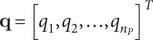 $ \mathbf{q}={\left[{q}_1,{q}_2,\dots, {q}_{n_P}\right]}^T $
in which
$ \mathbf{q}={\left[{q}_1,{q}_2,\dots, {q}_{n_P}\right]}^T $
in which $ {q}_j $
is the flow rate in the jth pipe and
$ {q}_j $
is the flow rate in the jth pipe and $ {n}_P $
is the number of pipes. The |∙| operator is defined, for ease of notation, as the absolute value of the elements in the case of a matrix input, or a diagonal matrix of the absolution value of the elements in the case of a vector input, and the
$ {n}_P $
is the number of pipes. The |∙| operator is defined, for ease of notation, as the absolute value of the elements in the case of a matrix input, or a diagonal matrix of the absolution value of the elements in the case of a vector input, and the $ \sqrt{\bullet} $
operator is defined as the elementwise square root of the vector input.
$ \sqrt{\bullet} $
operator is defined as the elementwise square root of the vector input.
The matrices of parameters in the equations are defined as follows:
-
• Inductance matrix L: A diagonal square matrix where L(j, j) = Lj (j = 1,2, …, $ {n}_P $
),
$ {n}_P $
), -
• Resistance matrix R: A diagonal square matrix where R(j, j) = Rj (j = 1,2, …,
$ {n}_P $
), -
• Capacitance vector C: A diagonal square matrix where (j, j) = Cj (j = 1,2, …,
$ {n}_P $
).


The hydraulic properties L, R and C for each pipe are given by:
 $$ L=\frac{l}{gA},R=\frac{fl}{2 gD{A}^2},\mathrm{C}=\frac{ gA l}{a^2} $$
where a is the wave speed, g is the gravitational acceleration, l is the pipe length, D is the pipe diameter and A = πD2/4 is the cross-sectional area. The term f represents the Darcy–Weisbach friction factor.
The connectivity of the network is described by the system incidence matrix A, an ( $ {n}_I $
+
$ {n}_I $
+ $ {n}_R $
)×
$ {n}_R $
)× $ {n}_P $
matrix. For a node i and pipe j, the matrix element A(i, j) is defined as:
$ {n}_P $
matrix. For a node i and pipe j, the matrix element A(i, j) is defined as:
 $$ A\left(i,j\right)=\left\{\begin{array}{c}\hskip-1.5em 1\hskip0.24em \mathrm{if}\ \mathrm{node}\hskip0.35em i\hskip0.35em \mathrm{is}\hskip0.35em \mathrm{at}\hskip0.35em \mathrm{the}\ \mathrm{start}\ \mathrm{of}\ \mathrm{the}\ \mathrm{pipe}\hskip0.35em j\\ {}\hskip-0.5em -1\hskip0.35em \mathrm{if}\ \mathrm{node}\hskip0.35em i\hskip0.35em \mathrm{is}\hskip0.35em \mathrm{at}\hskip0.35em \mathrm{the}\hskip0.35em \mathrm{end}\hskip0.35em \mathrm{of}\ \mathrm{the}\ \mathrm{pipe}\hskip0.35em j\\ {}\hskip-12.5em 0\hskip0.70em \mathrm{otherwise}\end{array}\right., $$
The incidence matrix A is partitioned as $ \mathbf{A}=\left[\begin{array}{c}{\mathbf{A}}_I\\ {}{\mathbf{A}}_R\end{array}\right] $
, where A
I
corresponds to all the internal nodes, and A
R
corresponds to the reservoir nodes.
$ \mathbf{A}=\left[\begin{array}{c}{\mathbf{A}}_I\\ {}{\mathbf{A}}_R\end{array}\right] $
, where A
I
corresponds to all the internal nodes, and A
R
corresponds to the reservoir nodes.
The system equations (Equation [1]) are first-order ODEs, which can be solved using methods such as the Runge–Kutta method, which was employed in this study. It is important to note that the model’s accuracy can only be guaranteed below the critical frequency $ {f}_c $
=a/(10 l). High accuracy is achievable if the dominant frequencies of transient pressure waves fall below this critical frequency. For transients involving high-frequency waves, a denser pipe discretization may be necessary to capture the rapid changes more effectively.
$ {f}_c $
=a/(10 l). High accuracy is achievable if the dominant frequencies of transient pressure waves fall below this critical frequency. For transients involving high-frequency waves, a denser pipe discretization may be necessary to capture the rapid changes more effectively.
EKF for pressure and flow prediction
The EKF is implemented for the direct estimation of transient pressure and flow in this study. Unlike the standard KF, which is designed for systems with linear equations, the EKF is capable of handling a non-linear system by linearizing it around the current state estimate using a Taylor series expansion.
Data assimilation in hydraulic transients aims to integrate observed data (e.g., pressure or flow measurements) into a transient model to improve the accuracy of predictions and the estimation of the system’s state. In reality, both the transient model and the observations are subject to various uncertainties, such as wave damping, unknown boundary conditions and measurement noise. The KF-based data assimilation approach is able to explicitly account for these uncertainties to provide a more accurate and dynamically updated transient state of the system, enabling real-time monitoring and analysis of the pipeline network for operational decisions.
The general procedure of the EKF for transient state estimation involves the following steps:
-
• Initialization
Define the initial transient state space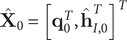 $ {\hat{\mathbf{X}}}_0={\left[{\mathbf{q}}_0^T,{\hat{\mathbf{h}}}_{I,0}^T\right]}^T $
with a size of (
$ {\hat{\mathbf{X}}}_0={\left[{\mathbf{q}}_0^T,{\hat{\mathbf{h}}}_{I,0}^T\right]}^T $
with a size of ( $ {n}_P+{n}_I $
) × 1. The linear system equations (Equation [1]) can be depicted by:
$ {n}_P+{n}_I $
) × 1. The linear system equations (Equation [1]) can be depicted by:

in which $ \mathbf{M} $
is a matrix involving parameters L, R, C and A; B represents external forcing terms that incorporate the effects of boundary conditions, such as demands and reservoir head levels. The subscript 0 means the initialized parameters.
$ \mathbf{M} $
is a matrix involving parameters L, R, C and A; B represents external forcing terms that incorporate the effects of boundary conditions, such as demands and reservoir head levels. The subscript 0 means the initialized parameters.
Initialize the predicted state error covariance matrix $ {\mathbf{P}}_0 $
with a size of (
$ {\mathbf{P}}_0 $
with a size of ( $ {n}_P+{n}_I $
) × (
$ {n}_P+{n}_I $
) × ( $ {n}_P+{n}_I $
), representing the uncertainty in the state prediction before incorporating the measurements. The diagonal elements
$ {n}_P+{n}_I $
), representing the uncertainty in the state prediction before incorporating the measurements. The diagonal elements $ {\mathbf{P}}_{i,i} $
represent the variances of each state variable and the off-diagonal elements
$ {\mathbf{P}}_{i,i} $
represent the variances of each state variable and the off-diagonal elements $ {\mathbf{P}}_{i,j} $
represent the covariances between different state variables.
$ {\mathbf{P}}_{i,j} $
represent the covariances between different state variables.
-
• Prediction step
In the prediction step, the transient state space in the next time step k is first predicted by using the linearized transient model. Here, the non-linear EWC model (Equation [4]) is linearized:
 $$ {\mathbf{X}}_{\boldsymbol{k}}={\left(\mathbf{I}-0.5\Delta t\bullet \mathbf{M}\right)}^{-\mathbf{1}}\left(\left(\mathbf{I}+0.5\Delta t\bullet \mathbf{M}\right)\bullet {\mathbf{X}}_{\boldsymbol{k}-\mathbf{1}}+\Delta t\bullet \mathbf{B}\right) $$
Equation (5) can be further simplified as:
 $$ {\mathbf{X}}_{\boldsymbol{k}}^{-}={\mathbf{F}}_{\boldsymbol{k}}\bullet {\hat{\mathbf{X}}}_{\boldsymbol{k}-\mathbf{1}}+{\mathbf{G}}_{\boldsymbol{k}} $$
where $ {\mathbf{F}}_{\boldsymbol{k}} $
is the transfer matrix of the linearized system equations and
$ {\mathbf{F}}_{\boldsymbol{k}} $
is the transfer matrix of the linearized system equations and $ {\mathbf{G}}_{\boldsymbol{k}} $
is the external inference (e.g., demand changes). The error covariance
$ {\mathbf{G}}_{\boldsymbol{k}} $
is the external inference (e.g., demand changes). The error covariance $ {\mathbf{P}}_{\boldsymbol{k}}^{-} $
is also predicted by:
$ {\mathbf{P}}_{\boldsymbol{k}}^{-} $
is also predicted by:
 $$ {\mathbf{P}}_{\boldsymbol{k}}^{-}={\mathbf{F}}_{\boldsymbol{k}}\bullet {\mathbf{P}}_{\boldsymbol{k}-\mathbf{1}}\bullet {\mathbf{F}}_{\boldsymbol{k}}^{\boldsymbol{T}}+{\mathbf{Q}}_{\boldsymbol{k}} $$
where $ {\mathbf{Q}}_{\boldsymbol{k}} $
is the process noise covariance.
$ {\mathbf{Q}}_{\boldsymbol{k}} $
is the process noise covariance.
-
• Correction step
The correction step calculates the Kalman gain $ {\mathbf{K}}_{\boldsymbol{k}} $
first, which determines how much the predictions should be adjusted based on the measurements and noise levels:
$ {\mathbf{K}}_{\boldsymbol{k}} $
first, which determines how much the predictions should be adjusted based on the measurements and noise levels:
 $$ {\mathbf{K}}_{\boldsymbol{k}}={\mathbf{P}}_{\boldsymbol{k}}^{-}{\mathbf{H}}_{\boldsymbol{k}}^{\boldsymbol{T}}{\left({\mathbf{H}}_{\boldsymbol{k}}{\mathbf{P}}_{\boldsymbol{k}}^{-}{\mathbf{H}}_{\boldsymbol{k}}^{\boldsymbol{T}}+\mathbf{R}\right)}^{-\mathbf{1}} $$
where $ {\mathbf{H}}_{\boldsymbol{k}} $
is the observation matrix that maps the system state variables to the observed measurements.
$ {\mathbf{H}}_{\boldsymbol{k}} $
is the observation matrix that maps the system state variables to the observed measurements. $ {\mathbf{H}}_{\boldsymbol{k}} $
has dimensions m ×
$ {\mathbf{H}}_{\boldsymbol{k}} $
has dimensions m × $ ({n}_P+{n}_I $
), where m is the number of measurements. Each row of
$ ({n}_P+{n}_I $
), where m is the number of measurements. Each row of $ {\mathbf{H}}_{\boldsymbol{k}} $
corresponds to the measurement at a specific node. In this study, only pressure measurements are considered, as they are typically more readily available and reliable in pipeline monitoring systems. Therefore, the first
$ {\mathbf{H}}_{\boldsymbol{k}} $
corresponds to the measurement at a specific node. In this study, only pressure measurements are considered, as they are typically more readily available and reliable in pipeline monitoring systems. Therefore, the first $ {n}_P $
columns (flow) of
$ {n}_P $
columns (flow) of $ {\mathbf{H}}_{\boldsymbol{k}} $
are all zeros, and the remaining
$ {\mathbf{H}}_{\boldsymbol{k}} $
are all zeros, and the remaining $ {n}_I $
columns (pressure) contain ones at the positions corresponding to the measured pressures.
$ {n}_I $
columns (pressure) contain ones at the positions corresponding to the measured pressures. $ \mathbf{R} $
is the measurement noise covariance, describing the uncertainties or noise in the measurement process. It is a diagonal matrix where each diagonal element
$ \mathbf{R} $
is the measurement noise covariance, describing the uncertainties or noise in the measurement process. It is a diagonal matrix where each diagonal element $ {\mathbf{H}}_{i,i} $
represents the variance of the noise in the ith measurement:
$ {\mathbf{H}}_{i,i} $
represents the variance of the noise in the ith measurement:
 $$ \boldsymbol{R}=\left[\begin{array}{cccc}{\sigma}_1^2& 0& \cdots & 0\\ {}0& {\sigma}_2^2& \cdots & 0\\ {}\vdots & \vdots & \ddots & \vdots \\ {}0& 0& \cdots & {\sigma}_m^2\end{array}\right] $$
where $ {\sigma}_i^2 $
is the variance of the noise for the ith pressure sensor.
$ {\sigma}_i^2 $
is the variance of the noise for the ith pressure sensor.
Once new measurements $ {\boldsymbol{z}}_{\boldsymbol{k}}={\left[{z}_1,{z}_2,\dots, {z}_m\right]}^T $
are available, the EKF updates its estimates and the corresponding error covariance to incorporate the new information:
$ {\boldsymbol{z}}_{\boldsymbol{k}}={\left[{z}_1,{z}_2,\dots, {z}_m\right]}^T $
are available, the EKF updates its estimates and the corresponding error covariance to incorporate the new information:
 $$ {\hat{\mathbf{X}}}_{\boldsymbol{k}}={\hat{\boldsymbol{X}}}_{\boldsymbol{k}}^{-}+{\mathbf{K}}_{\boldsymbol{k}}\left({\boldsymbol{z}}_{\boldsymbol{k}}-{\mathbf{H}}_{\boldsymbol{k}}{\mathbf{X}}_{\boldsymbol{k}}^{-}\right) $$
 $$ {\mathbf{P}}_{\boldsymbol{k}}=\left(\boldsymbol{I}-{\mathbf{K}}_{\boldsymbol{k}}{\mathbf{H}}_{\boldsymbol{k}}\right){\mathbf{P}}_{\boldsymbol{k}}^{-} $$
This update reduces the uncertainty in state estimation by integrating the predicted state and the measurement using a weighted approach determined by the Kalman gain, which balances the contributions of the model and measurement uncertainties.
The prediction and correction steps will then be repeated by using the updated state estimate $ {\hat{\mathbf{X}}}_{\boldsymbol{k}} $
and covariance
$ {\hat{\mathbf{X}}}_{\boldsymbol{k}} $
and covariance $ {\mathbf{P}}_{\boldsymbol{k}} $
as inputs for the next time step.
$ {\mathbf{P}}_{\boldsymbol{k}} $
as inputs for the next time step.
Evaluation metrics
To assess the accuracy of the proposed EKF-based approach, the root mean square error (RMSE) is used as the evaluation metric. The RMSE quantifies the difference between the predicted and actual values and is computed as:
 $$ RMSE=\sqrt{\frac{1}{N}\sum \limits_{i=1}^N{\left({\hat{y}}_{\boldsymbol{i}}-{y}_{\boldsymbol{i}}\right)}^2} $$
where $ N $
is the total number of data points,
$ N $
is the total number of data points, $ {\hat{y}}_{\boldsymbol{i}} $
is the ith predicted value, and
$ {\hat{y}}_{\boldsymbol{i}} $
is the ith predicted value, and $ {y}_{\boldsymbol{i}} $
is the ith true value.
$ {y}_{\boldsymbol{i}} $
is the ith true value.
Results
Case 1: Seven-pipe network
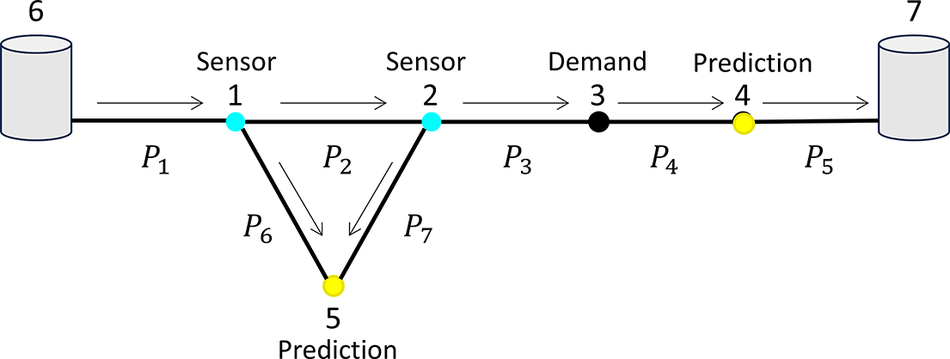
The accuracy and applicability of the proposed EKF-based transient data assimilation were evaluated through numerical tests on a simple seven-pipe network shown in Figure 1. This pipe network consists of two reservoirs, seven pipes, five internal nodes and one demand node. The diameter of each pipe was assumed to be D = 0.2 m, the pipe length is 1,000 m, the wave speed is a = 1,000 m/s, the Darcy–Weisbach factor f = 0.02 and the water level of the upstream and downstream reservoirs are H up = 50 m and H down = 48 m, respectively. Two pressure sensors are placed at Node 1 and Node 2, respectively.
The seven-pipe network system with two reservoirs, seven pipes, five internal nodes, and one demand node.

The initial conditions in the steady state were determined through hydraulic simulation. The initial flow rate in the main pipes (P1, P3, P4 and P5) was calculated as 9.44 L/s. A transient event was simulated by increasing the demand flow at Node 3 from 0 to 3 L/s over 0.5 s, following a half cosine curve. The EWC model was utilized to simulate this event, with a time step of Δt = 0.01 s and a total simulation duration of 50 s. Each pipe was discretized into five segments, yielding a critical frequency $ \left({f}_c\right) $
of 0.5 Hz. Since the cut-off frequency of the pressure wave is below 0.2 Hz, it remains well within the critical frequency, ensuring high accuracy in the EWC simulation. Simulated measurement data were generated for Nodes 1 and 2 during the event. Additionally, white noise with a zero mean and a standard deviation of 0.2 m (equivalent to a 1.2% variation in the pressure fluctuations) was added to the simulated pressure data to mimic realistic measurement noise.
$ \left({f}_c\right) $
of 0.5 Hz. Since the cut-off frequency of the pressure wave is below 0.2 Hz, it remains well within the critical frequency, ensuring high accuracy in the EWC simulation. Simulated measurement data were generated for Nodes 1 and 2 during the event. Additionally, white noise with a zero mean and a standard deviation of 0.2 m (equivalent to a 1.2% variation in the pressure fluctuations) was added to the simulated pressure data to mimic realistic measurement noise.
The proposed data assimilation technique was then employed to estimate the transient pressure and flow variations without knowing the true demand flow at Node 3. To mimic situations where the actual demand changes in the network are unclear or completely unknown, two cases were considered here by assuming the demand flow to be (a) Case 1.1: from 0 to 3 L/s suddenly and (b) Case 1.2: zero. Two EWC models with different assumptions of the demand flow were integrated into EKFs separately. Setting reasonable values for the initial state error covariance matrix $ {\mathbf{P}}_{k=0} $
in an EKF is crucial, as it represents the uncertainty in the initial state estimation. Moreover, the covariance matrix
$ {\mathbf{P}}_{k=0} $
in an EKF is crucial, as it represents the uncertainty in the initial state estimation. Moreover, the covariance matrix $ {\mathbf{P}}_{k=0} $
can also affect EKF’s convergence ability and speed. Generally, a small variance in
$ {\mathbf{P}}_{k=0} $
can also affect EKF’s convergence ability and speed. Generally, a small variance in $ {\mathbf{P}}_{k=0} $
can lead to stable but slow convergence, and vice versa. Considering the flow rate and demand flow fluctuations, the diagonal entries of
$ {\mathbf{P}}_{k=0} $
can lead to stable but slow convergence, and vice versa. Considering the flow rate and demand flow fluctuations, the diagonal entries of $ {\mathbf{P}}_{k=0} $
corresponding to the flow rates (the first
$ {\mathbf{P}}_{k=0} $
corresponding to the flow rates (the first $ {n}_p $
rows) were set to be a small value of 10−6 m6/s2. Similarly, the diagonal entries of
$ {n}_p $
rows) were set to be a small value of 10−6 m6/s2. Similarly, the diagonal entries of $ {\mathbf{P}}_{k=0} $
(the last
$ {\mathbf{P}}_{k=0} $
(the last $ {n}_I $
rows) corresponding to the pressure heads were set to be a large value of 1 m2. The covariance matrix
$ {n}_I $
rows) corresponding to the pressure heads were set to be a large value of 1 m2. The covariance matrix $ \mathbf{R} $
is a 2 × 2 diagonal matrix with the entries
$ \mathbf{R} $
is a 2 × 2 diagonal matrix with the entries $ {\mathrm{R}}_{i,i}=0.04 $
m2 due to the imposed measurement noise with a standard deviation of 0.2 m. A very small value of 10−8 m6/s2 was set for the diagonal entries of the covariance matrix
$ {\mathrm{R}}_{i,i}=0.04 $
m2 due to the imposed measurement noise with a standard deviation of 0.2 m. A very small value of 10−8 m6/s2 was set for the diagonal entries of the covariance matrix $ \mathbf{Q} $
to account for the minor numerical errors.
$ \mathbf{Q} $
to account for the minor numerical errors.
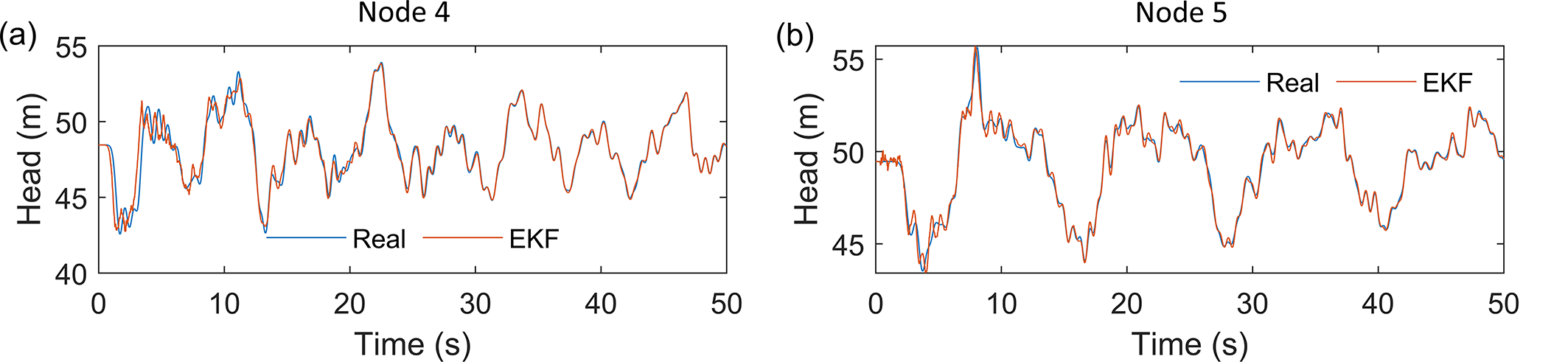
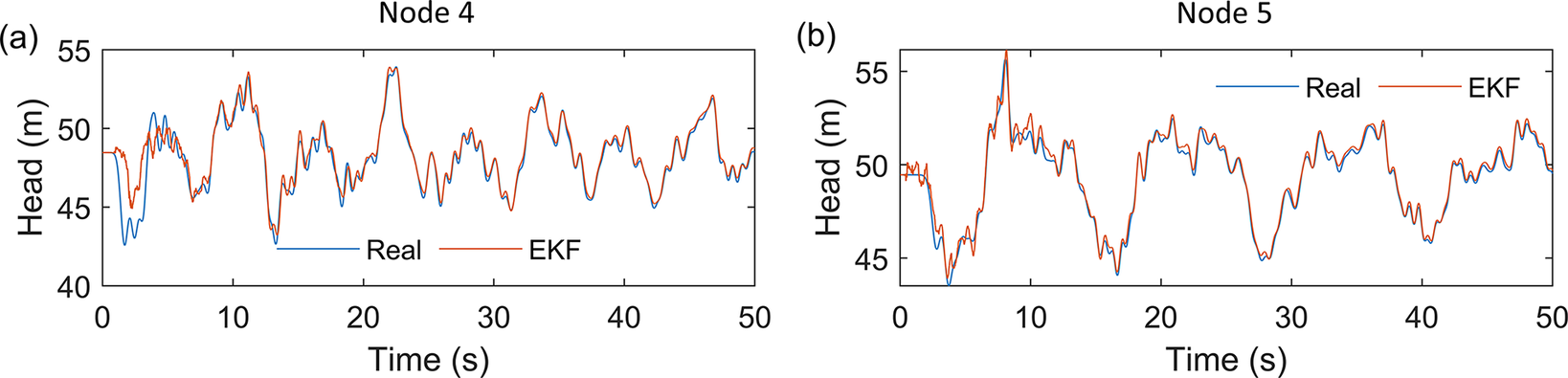
The estimated pressure traces at Node 4 and Node 5 by EKFs were compared with the true values, as shown in Figure 2 for Case 1.1 and in Figure 3 for Case 1.2. Both EKFs accurately predicted the pressure heads at Node 4 and Node 5, with the RMSEs of 0.38 m for Case 1.1 and 0.51 m for Case 1.2. The variations in assumed demands led to only slight mismatches in predicted pressure dynamics, indicating its ability to provide accurate real-time transient state estimation.
The predicted pressure head at (a) Node 4 and (b) Node 5 in Case 1.1.

The predicted pressure head at (a) Node 4 and (b) Node 5 in Case 1.2.

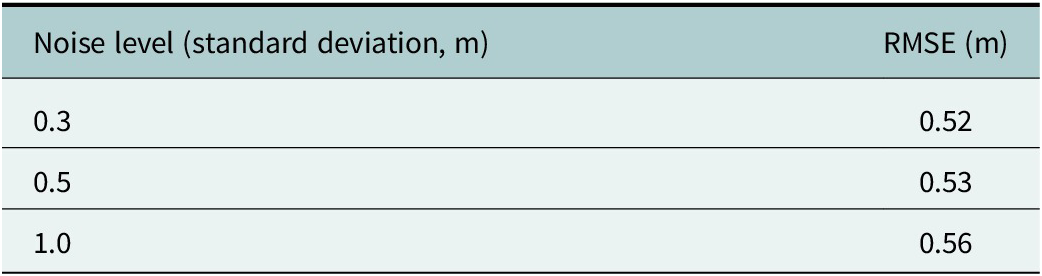
To further assess the robustness of the proposed method, zero-mean white Gaussian noise with standard deviations of 0.3, 0.5 and 1.0 m was added to the simulated pressure measurements in Case 1.2. The performance of the EKF method was evaluated by calculating the RMSE under these noise levels. The results are summarized in Table 1.
RMSEs of the EKF models under different noise levels for Case 1.2

The slight increase in error with higher noise levels demonstrates the robustness of the EKF method against the measurement uncertainty. Overall, the EKF maintains acceptable performance for hydraulic transient monitoring. The proposed EKF approach preserves high accuracy even under significant noise conditions, confirming its reliability for real-world applications where measurement noise is inevitable.
Case 2: 51-pipe network
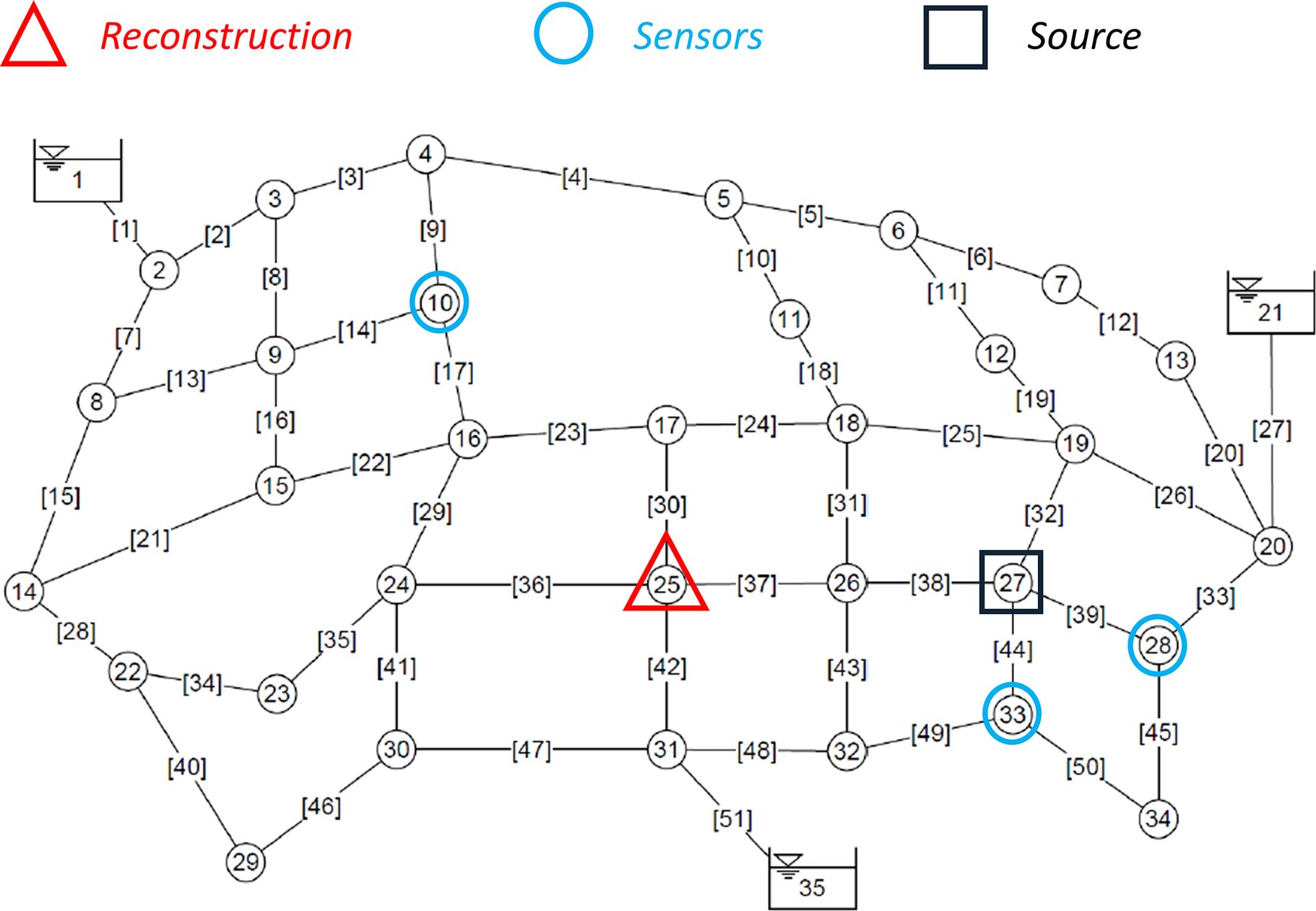
A larger-scale pipe network that contains 51 pipes and 3 reservoirs (shown in Figure 4) was employed to evaluate the applicability and robustness of the proposed approach. The wave speed of all the pipes is assumed as 1,000 m/s. The range of network parameters is [450, 994] m for pipe lengths, [304.8, 1,524] mm for pipe diameters and [0, 280] L/s for nodal demands. The water levels at the reservoir nodes are 132.4 m at Node 1, 121.92 m at Node 21 and 121.4 m at Node 35, respectively. Details of the network can be found in Zecchin (Reference Zecchin2010).
The 51 pipe networks with 3 reservoirs, 51 edges and 32 internal nodes (Zecchin, Reference Zecchin2010).

The transient was excited by smoothly halving the demand at Node 27 (from 113 to 56.6 L/s) over a short duration of Tv = 0.2 s. Through Fourier analysis, the cut-off frequency associated with the input change is ~2.5 Hz, with most of the energy concentrated in the 0–3 Hz bandwidth. To ensure the accuracy of the EWC model, each pipe segment was discretized to have a length of <50 m. The EWC model with a time step of 0.01 s and a total simulation duration of 50 s was performed to generate the dataset. Three sensors were placed at Nodes 10, 28 and 33. The simulated pressure data from the sensor locations were utilized as inputs to the EKF, while the pressure at Node 25 was used as a benchmark for validation purposes. The white noise with zero mean and a standard deviation of 0.3 m (equivalent to a 1.8% variation in the pressure fluctuations) was added to the simulated measurement data.
Assuming no demand changes at Node 27, 20 independent EKFs with different random seeds were performed to investigate the robustness of the proposed EKF-based approach. To account for the uncertainties in the more severe transient event, the diagonal entries of $ {\mathbf{P}}_{k=0} $
were set to be 10−4 m6/s2 for the flow rates and 1 for the pressure heads. The diagonal entries of the measurement noise covariance
$ {\mathbf{P}}_{k=0} $
were set to be 10−4 m6/s2 for the flow rates and 1 for the pressure heads. The diagonal entries of the measurement noise covariance $ {\mathrm{R}}_{i,i}=0.09 $
m2
$ {\mathrm{R}}_{i,i}=0.09 $
m2 $ \left(i=1,2,\mathrm{and}\;3\right) $
. The diagonal entries of the covariance matrix
$ \left(i=1,2,\mathrm{and}\;3\right) $
. The diagonal entries of the covariance matrix $ \mathbf{Q} $
was set to be 10−6 m6/s2.
$ \mathbf{Q} $
was set to be 10−6 m6/s2.
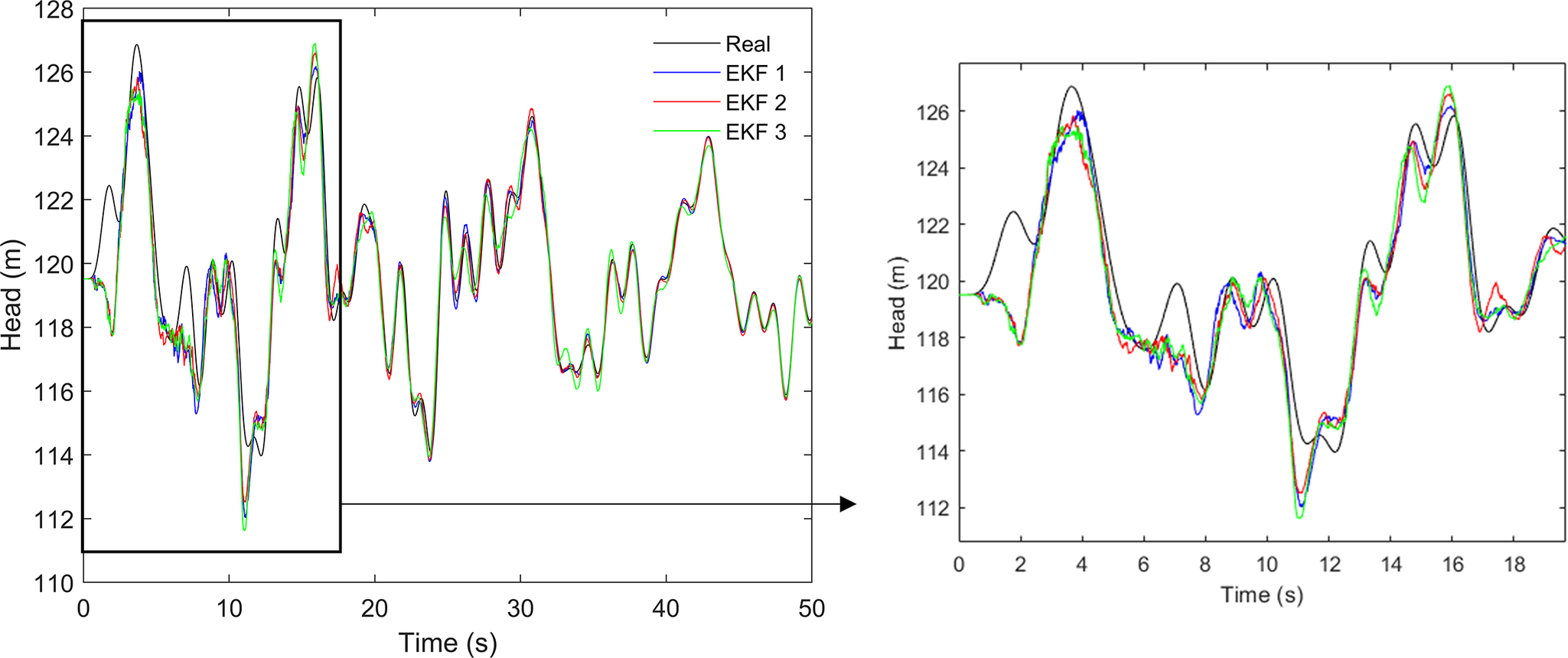
All 20 simulations with EKFs demonstrated a low level of error, with an average RMSE of 0.85 m. Figure 4 shows the “real” pressure head obtained from the EWC model and the estimated pressure heads from three selected EKFs with different random seeds (EKF 1, EKF 2 and EKF 3 in Figure 5) at Node 25. During the initial transient phase (0–15 s), minor deviations are observed at pressure peaks. After 15 s, the EKFs closely align with the “real” head, with negligible differences, indicating excellent performance in estimating long-term pressure traces. Despite the use of different random seeds, the EKF predictions are consistent across all the trials. This demonstrates the robustness and reliability of the EKF-based approach under varying initialization conditions for process and measurement noise.
The “real” pressure heads by EWC and estimated pressure heads by EKFs with different random seeds at Node 25.

Conclusion
This study presented a robust and computationally efficient data assimilation approach for hydraulic transients in pipe networks, integrating the EWC model with an EKF. The proposed method addresses the challenges of real-time transient data assimilation by reducing computational demands while maintaining high accuracy. The effectiveness of the approach was demonstrated through numerical experiments on a seven-pipe network and a larger 51-pipe network. The EKF-based method successfully estimated transient pressure and flow states in real time, even under different assumptions of demand variations and random noise. Key findings include the following:
-
1. The method accurately captured transient pressures in pipe networks, providing reliable state estimates for monitoring and control applications.
-
2. The EKF-based approach showed consistent performance across multiple scenarios, highlighting its robustness to variations in random seeds and noise characteristics.
-
3. The reduced computational requirements, achieved by a coarse pipe discretization, make this approach well-suited for large-scale networks with real-time applications.
Future work will focus on validating the approach using real-world water distribution systems and incorporating additional complexities, such as unsteady friction and leakage/burst events. Furthermore, exploring other advanced KF techniques, such as the ensemble KF, may offer better handling of system non-linearity and the challenges posed by large state spaces.
Open peer review
To view the open peer review materials for this article, please visit http://doi.org/10.1017/wat.2025.10007.
Data availability statement
The data presented in this study are available on request from the corresponding author.
Author contributions
Conceptualization: W.Z., J.Y. and A.Z. Methodology: W.Z. and J.Y. Resources: M.L. Writing – original draft preparation: J.Y. Supervision: W.Z., N.D. and M.L. Project administration: M.L. All authors have read and agreed to the published version of the manuscript.
Financial support
This research was funded by the Australian Research Council via the Discovery Project (DP230101513).
Competing interest
The authors declare none.

 Open access


Comments
No accompanying comment.