




I felt some trepidation when I learned that Netflix would be releasing a biopic of the late civil rights and peace activist Bayard Rustin with a focus on his role in organizing the March on Washington of 1963. Having spent much of my professional life researching the social movements of which he was a part, I suspected that it would tell a familiar and didactic tale about the Black freedom struggle, flattening out a richer and more complex story that it had the opportunity to tell. I was particularly concerned about how it might depict Abraham Johannes (A. J.) Muste, Rustin’s mentor and comrade and a leading figure in the labor, socialist, peace, and civil rights movements of the twentieth century. I recalled how the film The Trial of the Chicago 7 (2020) depicted pacifist Dave Dellinger as a milquetoast suburbanite who lost his temper and punched a cop, rather than as a radical whose faith in the power of nonviolence had been tested many times and over many decades in struggles against U.S. militarism and empire.Footnote 1 Of course, I predicted, Muste would be portrayed as an out-of-touch, white, pacifist ally against whom Rustin would struggle for sexual and racial self-determination.
Still, when I finally sat down to watch Rustin (2023) a few months later, I told myself to drop my proprietary attitude and to have an open mind. There are, after all, many stories to be told about the civil rights movement, and Rustin is surely a figure worth popularizing to the American public. Filmmakers also have the right to take poetic license when telling a “true” story because sometimes fiction can highlight a deeper truth more effectively than “the facts.” The question, it seems to me, has to do with the boundary between legitimate and illegitimate poetic license. Does it help to move a plot along and make it more compelling for the audience? Does it help the audience to understand and empathize with historical subjects, figures, and ideas with which they may be unfamiliar or unsympathetic? If it can do these things without doing violence to the historical record, then I believe that poetic license is legitimate.
So did the film conform to my expectations? Rustin has much to offer audiences; it highlights the agency of young people and women in the making of the movement, and it deploys fictional narratives and subplots to dramatize themes that are important to our historical-cultural moment. At the same time, however, the film distorts Rustin’s politics and role in the civil rights movement in ways that reify cultural tropes about the movement that it is time to discard. My comments largely focus on the film’s treatment of A. J. Muste, who makes only a brief appearance, but who plays a crucial role in forwarding a simplistic and liberal narrative that ultimately misrepresents the socialist and pacifist traditions that both he and Rustin drew upon to shape and critique the civil rights movement. By the end of the film, one would never guess that, after the March on Washington, Rustin would increasingly find himself alienated from the Black freedom struggle and the new left, less for his sexuality than for his advocacy of a civil rights–labor alliance and for his refusal to publicly condemn the war in Vietnam. Muste, by contrast, would be heralded as a prophet, as he called upon movement activists to confront the connections between the oppression of Black peoples at home and U.S. foreign policy abroad. By eliding these more complex historical and ideological realities, the film fails to do the work of history, reducing “the past to a closed world by telling a single, linear story with, essentially, a single interpretation,” as Robert Rosenstone observed of the films Reds (1982) and The Good Fight (1984). “Such a narrative strategy obviously denies historical alternatives, does away with complexities of motivation or causation, and banishes all subtlety from the world of history.”Footnote 2 My critique offers a more nuanced and historically grounded account of Muste and Rustin’s evolving relationship and politics—one that I would argue is more relevant for present struggles for economic and racial justice than the narrative put forward in the film.
The film’s focus is on the years from 1960 through 1963, offering a narrative arc of fall to redemption: Rustin is first banished from the civil rights movement because of homophobia, then resurrected as Dr. Martin Luther King Jr.’s advisor and organizer of the 1963 March on Washington. There are also flashbacks to Rustin’s 1953 arrest on a morals charge—a traumatic event that led to his dismissal from the Fellowship of Reconciliation (FOR), an influential Christian pacifist organization that Muste headed from 1941 to 1953.Footnote 3 There are also flashbacks to scenes of Rustin with Dr. King and his family, suggesting that they had a close working relationship until the influential Black Representative Adam Clayton Powell Jr. (D-NY), played brilliantly by Jeffrey Wright, forced him out of the movement by threatening to spread a rumor that he and Dr. King were having an affair.
The film largely succeeds in what I take to be its primary aims: first, to highlight a supposedly unsung hero of the civil rights movement; second, to illuminate the homophobia in a movement committed to justice and equality; and third, to demonstrate that the March on Washington was an idea and work in progress that actual people had to organize and work to make happen, not simply an iconic moment frozen in time.Footnote 4
This is culturally valuable work in a national political context in which discussions of racism and sexuality are being banned in public schools. Colman Domingo’s portrayal of Rustin captures his charisma and intelligence, as well as his arrogance, insecurities, and pain at being marginalized because of his homosexuality. The film should be commended for its frank and nonjudgmental depiction of Rustin’s sexuality; even as he is intimate with Tom Kahn, the white socialist and labor activist with whom he had a long-term relationship, he is not sexually exclusive. The fictional subplot of an affair with a Black minister on the downlow provides viewers with a window into the pressures on gay men to stay in the closet and highlights the very real persecution of gays and lesbians in 1950s America.
The film also highlights the gender and sexual politics of the civil rights movement. The richly drawn scenes of Rustin and the “Big Six”—the heads of the most important civil rights organizations of the era—debating methods and goals demonstrate that the movement was male-dominated, often homophobic, and patriarchal. And the film does this without demonizing them; rather we see that they had distinct personalities and very real differences in tactics and ideology, yet still worked together in a shared goal of Black liberation. The scenes of Rustin and other behind-the-scenes organizers (mostly women) making phone calls, figuring out logistics, and cleaning up after the march drives home the point that that this was a peoples’ movement, despite iconic moments like King’s “I Have a Dream” speech. Finally, the film hints at Rustin’s socialism and concerns about the class dimensions of racism—themes that are rarely touched upon in popular representations of the civil rights movement.
At the same time, the film offers a well-worn, conventional interpretation of the civil rights movement; indeed, even sympathetic critics have observed that the story line is “safe,” “bland,” and “formulaic,” simply adding a new character to a mythic and familiar narrative of the March on Washington as the movement’s apotheosis.Footnote 5 More trenchant criticism can be found in The Journal of American History and left-wing magazines like The Nation and Jacobin, which argue persuasively that the film elides Rustin’s social democratic politics and advocacy of a labor–civil rights alliance—a position that put him at odds with younger activists that the film portrays as his ardent admirers. Instead of thrashing things out with the Big Six, Dustin Guastella argues in Jacobin:
The real Rustin spent long evenings planning with veteran generals. Not only [A. Philip] Randolph but also labor leader Norman Hill, who gets almost no attention in the film, and socialist A. J. Muste, who is portrayed as an out-of-touch peacenik who tells Rustin to get back in the closet, accusing him of reverse-racism—a dramatically useful caricature of the Old White Man.
Guastella suggests that more sustained attention to Rustin’s real-life relationship with Tom Kahn could have offered an opportunity to tell Rustin’s story in terms that are critical for challenging the hegemony of neoliberal values and economics:
It would signal to the viewer that maybe the real ongoing historical neglect of Rustin was, in fact, political in nature; that Rustin’s views—on race, economics, and political strategy—were no less a reason for his official erasure from canonical civil rights history. In a cruel twist, it seems, Rustin’s sexuality has been weaponized yet again. In Rustin’s lifetime, it was used as an excuse to forget him—in his death it’s employed now to make us forget what he stood for.Footnote 6
Guastella is on to something here, but he also errs in casting Rustin’s story as a morality tale in which Rustin and Tom Kahn got it right, while youthful radicals, both Black and white, substituted “self-expression for politics,” and thereby paved the way for a centrist, neoliberal takeover of the Democratic Party. A more generative and historically grounded analysis comes from understanding what the film gets wrong about A. J. Muste’s character and politics, as well as the nature of his relationship with Rustin. As Guastella’s comments suggest, in the film, Muste serves as a foil for a subplot in which white homophobia, paternalism, and moderation seek to confine and control Rustin and, by extension, the Black freedom movement more broadly. This narrative not only distorts the historical record, but it also betrays Rustin’s own confidence in the prospects of working with white, working-class people for collective liberation. It also allows the film to elide the substantive differences that emerged between the two men in the 1960s—differences that played out in the movement and that continue to haunt progressive politics today.
The first scene featuring Muste (albeit off camera) occurs between Tom Kahn and Rustin in which the latter expresses frustration at being shut out of the southern struggle and concern about rising Black nationalist sentiment within the movement. Kahn urges Rustin to quit the War Resisters’ League (WRL), a pacifist organization for which Rustin served as executive secretary, and rejoin the movement, implying that the predominantly white organization and Muste in particular were holding him back: “Muste hates you because you possess all the things he doesn’t have: charm, passion, a goddam pulse….”Footnote 7 The film affirms Tom’s perspective by showing Rustin sheepishly and rather halfheartedly disagreeing with him.
The second is a scene at the headquarters of the WRL/Liberation magazine where Rustin sits uncomfortably behind a desk, along with “Jim,” a fictionalized white comrade. The two men are watching a TV news reel in which the Birmingham police attack Black children with fire hoses and dogs. When Jim comments that King “never should have sent those kids to Birmingham,” Rustin accuses him of being “all talk and no action,” of failing to recognize that Black people “are beyond powerful.” Hearing the raised voices, Muste comes out of his office, appearing “pale and patrician,” as the script describes him, where he observes Rustin accuse Jim of doing nothing but sit behind a desk for thirty years, “convincing yourself you are committed to saving the world, when the only thing you’re committed to is your own safety and superiority.” Muste interrupts the argument and accuses Rustin of reverse discrimination against Jim. “Every day we agree to surrender that which makes us different, so that together we might forge a more humane world,” he chastises Rustin, who responds that it is impossible for him to do so, presumably because he is a Black, gay man. He offers his resignation, but Muste implores him to stay for his own good. “You must stay here where I can protect you, from the world and from yourself … until you admit to your anger at being abandoned by your parents, which is why you became a homosexual, to hurt them and yourself, you will never be fully whole.” Rustin retorts, “Mr. Muste, sir, have you ever been to a Negro church?” Muste responds, “innumerable times.” Rustin replies that, as a Quaker, he had never attended a Black church until he went to the south as a civil rights activist; the point seems to be that his work among predominantly white Christian pacifists has kept him from the authentic spirituality of his people. He then violently slams his hands together in front of Muste’s face and departs.Footnote 8
Anyone familiar with the historical record knows that these scenes are made up. For one, it is highly doubtful that Rustin, a deeply committed nonviolent activist, would have become physically aggressive in an argument. More to the point, neither Kahn nor Rustin would have accused Muste of inaction because he was the consummate activist with decades of experience leading strikes, organizing unions, engaging in civil disobedience, leading antiwar demonstrations, and fighting for racial equality, for which he had been hounded by the Federal Bureau of Investigation (FBI) since the 1910s and had been arrested numerous times. Starting with the Lawrence Textile Strike of 1919, he spent two decades as a labor organizer and educator, including a stint as head of the Trotskyist Workers’ Party, USA. The “Musteites,” as they were known, helped to spearhead the movement for industrial unionism that led to the formation of the Congress of Industrial Organizations (CIO) and federal recognition of labor’s right to collectively bargain (Figure 1). Ever the radical and concerned that the Democratic Party had coopted the labor movement with the New Deal, Muste turned to the pacifist movement as a vehicle for revolutionary nonviolence. As head of Fellowship of Reconciliation (FOR) and in hundreds of speeches, articles, and two books, he maintained that the pacifist movement had to break with its middle-class reformism and emphasis on Christian witness and build a mass movement—one that reached out to “oppressed and minority groups such as Negroes, share-croppers, industrial workers, and help them to develop a nonviolent technique, as Gandhi did in the India National Congress.”Footnote 9
Muste (second from left) with his faculty colleagues at Brookwood Labor College, a center for progressive unionism in Katonah, New York, that helped to birth the Congress of Industrial Organizations (CIO). Courtesy of the Walter Reuther Library, Archives of Labor and Urban Affairs, ca. 1928.

Muste was particularly interested in using nonviolence to challenge white supremacy. In the early 1940s, he penned several pamphlets making theological and practical arguments in favor of civil disobedience as “an answer to Jim Crow” for the original March on Washington Movement led by his longtime comrade, African American labor leader A. Philip Randolph.Footnote 10 Indeed, King first learned about nonviolence from Muste as a student at Crozer Theological Seminary in the late 1940s. Although Niebuhrian realist theology was all the rage in mainline Protestant seminaries at midcentury, Muste was often taught as his pacifist counterpoint, and King had been assigned to read his book, Not by Might: Christianity, the Way to Human Decency (1945) and heard him speak. Like most African Americans at the time, King viewed nonviolence as impracticable and would not embrace it until the Montgomery Bus Boycott of 1954, when he was inspired by the “determined courage of individuals willing to suffer and sacrifice for their freedom and dignity.”Footnote 11
Those African Americans who did apply nonviolent, direct action to American race relations in the 1940s, such as Rustin, James Farmer, Bill Sutherland, Pauli Murray, and James Lawson, did so as part of interracial and Christian contexts and institutions that Muste helped to build, such as the FOR and the Congress of Racial Equality (CORE), which would become one of the most important civil rights organizations of the postwar era. They were, as Sutherland put it, “Muste boys. A. J. Muste was known as the number one pacifist in the United States and was a great influence on us.”Footnote 12 Their white comrades included George Houser, who would become director of the America Committee on Africa, and Glenn Smiley, who would join Rustin in training countless civil rights activists in nonviolence throughout the 1950s and 1960s (Figure 2). This explains why, in 1963, around the time of the March on Washington, King would say that “the current emphasis on nonviolent direct action in the race relations field is due more to A. J. than anyone else in the country.”Footnote 13
Dave Dellinger (left), Rustin (second from left), Winifred Rawlins, and Muste (right) plan a Fast for Peace at the nation’s capital. Courtesy of Swarthmore College Peace Collection, 1950.
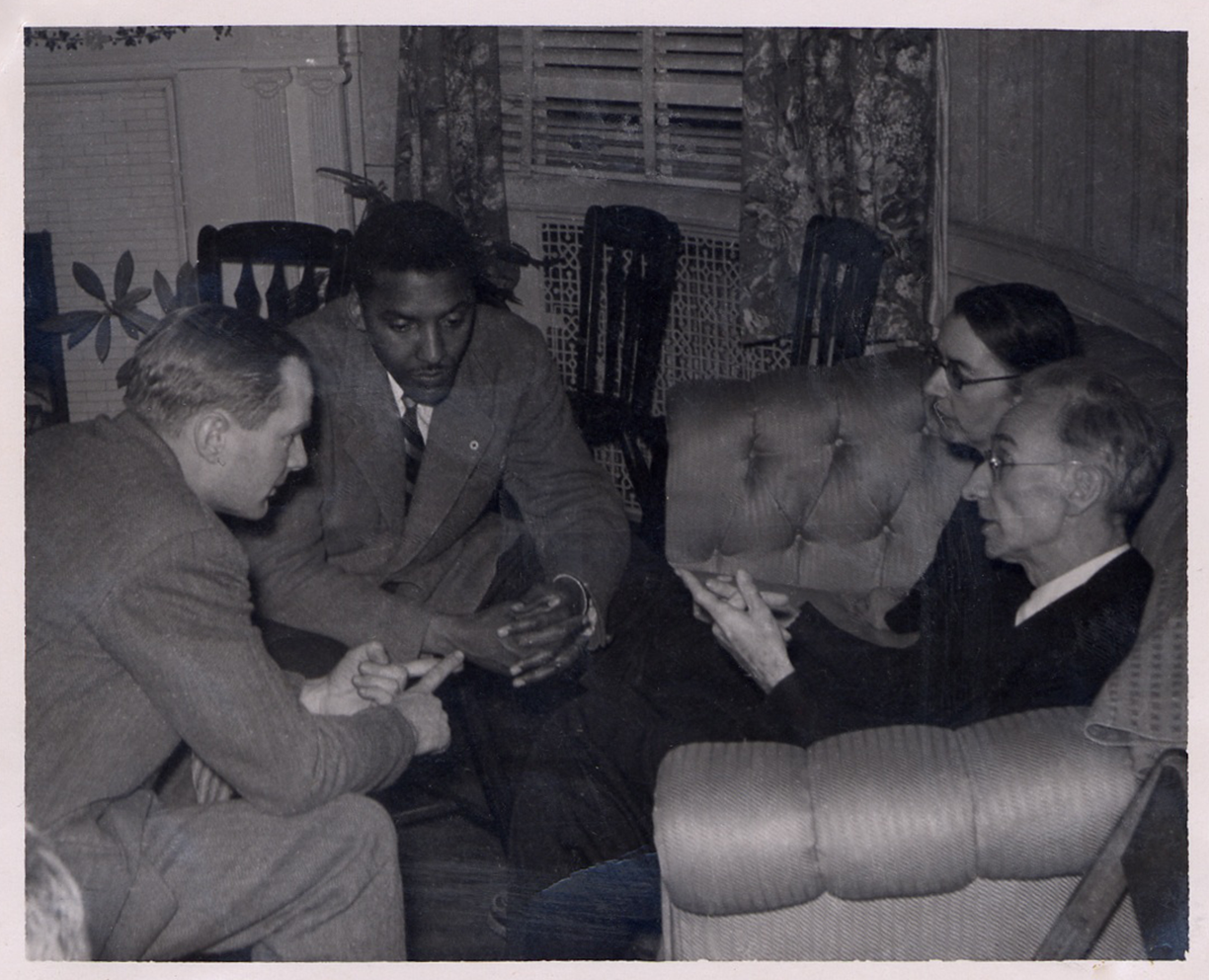
Moreover, although there were certainly many “patrician” members of the peace movement, many of whom probably thought they knew what was best for Black Americans, Muste was not one of them; he came from an immigrant, working-class family and had spent two decades in the ethnically diverse American labor movement. As Rustin himself commented, “I was deeply impressed [when I met Muste]. He wasn’t at all the fuzzy liberal pacifist type I’d expected. He didn’t believe that lobbying and letter writing can be effective just by themselves. You have to act, and act with your body.”Footnote 14 Unlike the paternalist character depicted in the film, Muste believed that oppressed peoples should lead and direct their own liberation. Together with Rustin, he counseled white pacifists eager to support the Black freedom struggle that their role laid “in supporting and commending nonviolence in popular struggles rather than in developing struggles ourselves.” He further maintained that it would be “arrogant” for pacifists to criticize African Americans who expressed bitterness toward white people or defended themselves with arms. “Had we earlier put ourselves in their place and been … aware of what it is to suffer contempt and incessant humiliation, this would not surprise us.” Rather than recoil from such sentiments, he asserted, white Americans should simultaneously support civil rights legislation and confront the history of white supremacy by changing their own attitudes of superiority and by organizing the white community.Footnote 15
He was also not the staid, asexual, out-of-touch, white Protestant, as the actor Bill Irwin portrays him in the film. While his charisma had perhaps dulled with age (he was 75 years old in 1960), he was, as Dissent editor and historian Michael Kazin has said, “a beloved figure on the liberal-left, able to transcend bitter sectarian conflicts and build coalitions that advanced common purposes.”Footnote 16 He also had a deeply spiritual and playful side; he had a sense of humor and loved baseball, the Marx brothers, and poetry. As Rustin himself recalled, Muste was “a person of immense joy … a truly liberated man” who never treated anyone with the “indignity of being treated as a special case.” He related an episode when the two men were in India and were awakened at 2 am by “a group of visiting gypsies” and stayed up the rest of the night dancing with them.Footnote 17 Like Rustin, new leftists and bohemians viewed Muste as a model of the self-actualized personality, including gay and bisexual figures like Paul Goodman, Barbara Deming, Lawrence Ferlinghetti, Allen Ginsberg, Nat Hentoff, Judith Malina, and David McReynolds (Figure 3).
Miriam Levine, A. J. Muste, and Judith Malina commit civil disobedience in front of the New York office of the Atomic Energy Commission. Courtesy of the A. J. Muste Foundation for Peace and Justice, 1963.

Muste’s rather iconic status among sexual nonconformists may come as a surprise to some readers because he has been described as homophobic by Rustin’s biographer, John D’Emilio.Footnote 18 For the film, it works well as a narrative device to illustrate a deeper truth about the contradictions within the peace movement involving an inconsistent commitment to various forms of inequality. At the same time, it is important to note that the reality was more complex. Muste, like most socialists of his generation, did indeed view homosexuality as a sign of bourgeois decadence and psychological maladjustment. His own sex life was conventional, and he believed that love was most fully expressed in monogamous relationships. On a more pragmatic level, he feared bad publicity for the movement because Rustin had been arrested several times for solicitation in the years preceding his 1953 arrest for “lewd vagrancy,” which was the main reason he had urged Rustin to seek psychiatric treatment. But, by the 1960s, Muste’s ideas about sexuality had shifted, as had Rustin’s, who had come to accept himself as a gay man. Muste read “Toward a Quaker View of Sex,” a pamphlet published by the London Yearly Meeting of Friends in 1963, which convinced him of the need to adopt a more flexible understanding “as to what constitutes ethical behavior, how love should and can be expressed, and what these things mean for the kind of communities we try to build.”Footnote 19 These views placed him on the more culturally liberal wing of the peace movement, and he criticized civil rights leaders when they attempted to marginalize Rustin for his homosexuality.
In other words, by the time of the March on Washington, Muste had become more liberal about sexual matters and had long since accepted the fact that he had no control over Rustin and his sexuality. He probably worried that Rustin’s homosexuality would make him a liability for the civil rights movement—a fear that, as the film shows, others shared and that turned out to be true; it was not for nothing that Senator Strom Thurmond (D-SC) tried to derail plans for the March on Washington by denouncing Rustin as a “sex pervert” and “Communist” on the floor of the U.S. Senate.Footnote 20 This was why Rustin had to be careful when he traveled south in the 1950s to advise and assist King; as an “outside agitator,” ex-communist, and homosexual, Rustin knew he was a target for bigots and redbaiters eager to discredit the movement, and his visits often did not last long—something that is obscured in the film as well.
More to the point, the two men had reconciled soon after the 1953 incident. Rustin may no longer have viewed Muste as a father figure or mentor, but they had a spiritual kinship related to their shared Quakerism that the film and Rustin’s many biographers have failed to appreciate. They also had a shared political project. About six months after Muste forced Rustin to resign from the FOR, the organization pushed Muste himself to retire, viewing his radical activities as potentially damaging to the peace movement in the context of the Red Scare. Now secretary emeritus, Muste sought to rebuild and reanimate the American left, which had been decimated by McCarthyism. He pursued this goal on multiple fronts: one was aiding the fledgling civil rights movement; another involved building a movement against nuclear testing and proliferation; still another were efforts to build a transnational, nonaligned peace movement to challenge the dangerously bipolar world; and finally facilitating intraleft dialogue through various initiatives, most importantly, a new monthly, Liberation magazine.
Rustin was Muste’s comrade in virtually all these endeavors. Within six months of leaving the FOR, he had been hired by the WRL as program director and soon thereafter became executive secretary of the organization, a position he would hold until 1965. Indeed, rather than being constrained by the WRL, as the film suggests, he played a major role in determining its priorities, which included advising King and organizing the March on Washington, as well as working with Muste to politicize and internationalize the peace movement. These efforts included participating in and coordinating civil disobedience projects at nuclear testing sites and during civil defense drills; building alliances with the European peace movement; and traveling to India, Africa, and the Middle East to promote nonviolence as a method for opposing nuclear proliferation, colonialism, and apartheid (Figure 4). It also included serving as co-editor of Liberation, along with Muste, Dave Dellinger, and Roy Finch.
Muste (center) and Rustin (far right) with other members of the World Peace Brigade, a transnational effort to promote decolonization and nuclear disarmament by nonviolent means, in Tanganyika, Africa. Muste was co-chairman, along with Michael Scott of England and J. P. Narayan of India. Courtesy of the Swarthmore College Peace Collection, 1962.

As this brief overview suggests, neither man had ever spent much time sitting behind a desk, nor did they have an acrimonious relationship. It also shows that the small world of radical pacifism was not one of inaction, as the film Rustin suggests, but rather tended to make a cult out of action. Indeed, it had a strong libertarian strain that often frustrated both Rustin and Muste, who were known as the “socialist” editors of Liberation, while Dellinger and Finch were known as the “anarchists.” A case in point is when a peace activist on the Quebec-to-Guantanamo Peace Walk of 1963 held a sign that said, “No federal troops in Cuba, Vietnam, and Dixie.” Muste had to ask them to take it down, explaining that, from the perspective of African Americans, federal enforcement of civil rights was exactly what they needed.Footnote 21
Another incident that highlights Rustin’s and Muste’s frustration with the anarcho-libertarian wing of the pacifist movement occurred during the European portion of the 1960 San Francisco-to-Moscow Walk for Peace. Rustin had been charged with organizing the European stretch of the march—a delicate matter in the context of heightened Cold War tensions, and had spent days negotiating the parameters that would govern the march, such as its slogans, lodging, points of entry, etc. Yet when the American team arrived, its leader, white pacifist Bradford Lyttle, refused to play by the rules, making his own signs, insisting upon staying in the cheapest accommodations, and refusing to use cars for transport. The British peace activist April Carter recalled that Rustin was “quite caustic … almost contemptuous toward Lyttle and the other marchers” who he characterized as anarchists “who won’t do what they’re told!” Notably, Rustin was quite protective of the elder Muste (dare we say paternal), who tended to go along with the younger crowd: “I forbid you to stay [in youth hostels]” or to “camp in barns and fields…. At your age and the amount of work you have to do before, during, and after the march, it would be childish and silly for you not to insist on what your age and future usefulness rightly require.”Footnote 22
This was the “white” world of activism that increasingly rubbed Rustin the wrong way and that the film gets wrong in its depiction of them as all talk and no action. For Rustin, it was the other way around: it increasingly seemed to him that pacifist perfectionism kept them isolated and irrelevant; their dramatic nonviolent actions attracted publicity, but they seemed unable or unwilling to translate their public notoriety into political power. He contrasted the American peace movement with Great Britain, where mass protests for peace had a greater impact, because, Rustin reasoned, the major peace leaders had longstanding and deep connections to the Labour Party.Footnote 23
The film captures the emotional core of Rustin’s growing estrangement from the pacifist movement. But, again, it was not so much because he wanted to be in on the action, but that he wanted to be involved in action that was relevant—that might reshape power relations in a meaningful way, and the civil rights movement in 1963, especially after Birmingham, was on the verge of doing just that. As the film Rustin shows, it was deeply affirming to him when the civil rights leadership allowed him to reassume a public role in the movement and organize the March on Washington. The success of the demonstration publicly identified him as a civil rights leader, and he was back in King’s good graces. By ending on this note, however, the film elides the fact that Rustin and King would soon thereafter part ways in their approach to the challenges that confronted the movement after President Lyndon Johnson signed the Civil Rights Act of 1964 and the Voting Rights Act of 1965—specifically, Black poverty and high levels of unemployment, the rise of Black nationalist sentiment, and the escalating war in Vietnam.
In 1965, Rustin published a controversial essay entitled “From Protest to Politics,” in which he called on the movement to address the economic conditions that were the root of racial inequality by shifting from the tactics of nonviolent direct action to building strategic alliances with the labor movement and liberals. The desegregation of public life had expanded political democracy, he wrote, but it would not lead to equality without a fundamental “refashioning of our political economy.” “I fail to see how the movement can be victorious in the absence of radical programs for full employment, abolition of slums, the reconstruction of our educational system, new definitions of work and leisure,” he argued. In making this point, he criticized civil rights activists for fetishizing protest and militancy over the hard work of building institutions and coalitions that would empower African Americans and the poor—a critique, notably, that was much like the one he had leveled at the pacifist movement. Black radicals “seek to change white hearts,” he wrote, “by traumatizing them.” But “neither racial affinities nor racial hostilities are rooted there. It is institutions—social, political, and economic institutions—which are the ultimate molders of collective sentiments.” He dismissed the growing appeal of Black nationalism as “silly” and “reactionary,” and criticized the idea of armed self-defense as nihilistic.Footnote 24
In 1965, Rustin resigned from the WRL and became head of the newly created A. Philip Randolph Institute, which focused on building alliances between the civil rights community and the labor movement. Thereafter, he would withdraw from peace activism altogether and refused to condemn publicly the war in Vietnam for fear of alienating Democratic Party hawks. This stance, as well as his vocal opposition to the Black Power Movement, made him persona non grata to the American left. Black power poet Amiri Baraka wrote an open letter calling him “a slave ship profiteer, a paid pervert for the racist unions, and I feel it necessary to expose you.”Footnote 25 Less homophobic but equally dismissive was white radical pacifist Staughton Lynd’s characterization of him as “a labor lieutenant of capitalism.”Footnote 26
Rustin was not alone in arguing that the civil rights movement needed a class analysis and politics; the question was what to do about it. King, for example, had long recognized the potential for a civil rights–labor alliance and had a close working relationship with United Auto Workers President Walter Reuther. Yet as the movement moved north, he became cognizant of how deeply racism was embedded in American institutions and culture, including the American Federation of Labor and Congress of Industrial Organizations (AFL-CIO) itself. He never endorsed Black power, but he recognized the psychological value it held for African Americans, as well as the ways it linked the Black struggle for freedom to African decolonization. Most critically, he increasingly viewed the Democratic Party as deeply complicit in hindering the struggle for self-determination, most notably in the horrific war unfolding in Vietnam. Thus, as King developed a post-1965 strategy, he emphasized the importance of building a nonviolent, interracial movement of the poor and took a principled stance against the Vietnam War, which made him persona non grata to the Johnson administration.Footnote 27
Where was Muste in all of this? He had long held that, in his words, “the problems of racial equality, economic and social order, and peace are integrally related and at one level constitute a single problem.” He was one of the signatories to the 1964 memo sent to President Johnson calling for a robust government response to the economic challenges posed by the “triple revolution” of automation, nuclear weapons, and human rights. He was also active in initiatives like the Assembly of Unrepresented People, which linked the antiwar movement to domestic struggles against poverty and racism and had supported the formation of the A. Philip Randolph Institute.Footnote 28 Still, it was one thing to develop mechanisms for the political and economic empowerment of African Americans and the poor, and quite another to align with the Johnson administration, which he called an “instrument of oppression” toward nonwhite peoples throughout the globe.Footnote 29
Muste had been reluctant to criticize publicly the civil rights leadership for its silence on Vietnam, working behind the scenes to encourage King, John Lewis, James Bevel, and other civil rights leaders to openly criticize U.S. foreign policy. But when Johnson escalated the war in Vietnam in early 1965, he went public with his views. In an article entitled “The Civil Rights Movement and the American Establishment,” he criticized what he called the “problematic tie-in” between civil rights leaders and the Johnson administration.Footnote 30 Comparing the decision faced by the civil rights movement with that of the labor movement in the 1930s, he maintained, as he had then, that an alliance with the Democratic Party would make it complicit with American militarism and empire. Indeed, he suggested that civil rights leaders would do well to take the criticisms of Black nationalists seriously: “What people like Le Roi Jones [a.k.a. Amiri Baraka] are underlining,” he asserted, “is that Mississippi represents on a small scale what has obtained on a vast scale for several centuries in other parts of the world. In Asia and Africa white men have proclaimed and lived the doctrine of white supremacy and have humiliated the non-white peoples.” While he could not abide by Black-nationalist sentiments that advocated guerilla-style warfare or that seemed “not to regard white people as human beings,” he was firmly in their camp when it came to an assessment of “the role of the United States today,” which was “largely that of obstruction.” The civil rights movement “for Freedom Now has to be for liberation of subjugated and humiliated people everywhere, or carry a cancer in its own body,” Muste proclaimed.Footnote 31
Muste thus “rejoiced” as Black criticism of the war intensified. Within the Congress of Racial Equality (CORE) militants circulated his essay as part of a larger effort to pass an antiwar resolution that directly linked the war in Vietnam to racism at home. They succeeded in July 1966, when Floyd McKissack replaced pacifist James Farmer as national director. A similar evolution had occurred about six months earlier within the Student Nonviolent Coordinating Committee (SNCC). Both organizations would become part of the antiwar coalition Muste was bringing together and that would become the Mobilization Against the War in Vietnam (MOBE), which he headed until his death in February 1967 (Figure 5). Meanwhile, King became more openly critical of the war, against the counsel of Rustin and other advisors—a stance that culminated in his participation in an April 1967 MOBE demonstration in New York City and his famous speech at Riverside Church condemning the war.
Antiwar activists honored Muste’s memory at the April 15, 1967, demonstration organized by the Spring Mobilization to End the War in Vietnam. Courtesy of John P. Goodwin.

Within CORE and SNCC, especially, antiwar sentiment was often accompanied by calls for Black separatism and armed self-defense. The way that Black radicals—and many white new leftists as well—increasingly associated nonviolence with obsequiousness and servility saddened Muste, but he otherwise shared their “basic view about America’s role in the world today” and the need for revolution, not reform. Hence Muste was invited to remain on CORE’s National Advisory Committee, even as the organization retracted its nonviolence clause and adopted “Black Power” as its guiding platform.Footnote 32
My purpose in highlighting the differences between Muste and Rustin is not to suggest that one man was right and the other was wrong, but rather to challenge popular narratives of the civil rights movement that are perpetuated in the film Rustin. One of those tropes is to elide white involvement altogether or to suggest that it only occurred in the early, “good” years of the movement when everyone was interracial, hopeful, and nonviolent. What we have seen in this essay, however, is that whites and Blacks occupied both sides of the debate about the merits of Black power and the question of whether they should work within the two-party system or outside of it. We also see that cross-racial alliances and debates continued to be part of “movement” culture through the 1970s, particularly in antiwar activism.
A second trope—sometimes celebrated and sometimes not—portrays the Black power movement as more militant, secular, and uncompromising over and against the softer, nonviolent, and religious (and whiter) movement of the early years. With the example of Muste and Rustin, however, we see that it was the white Protestant clergyman who was the uncompromising militant, whereas the urbane Black Quaker moved away from a politics rooted in morality to a politics of realism and compromise.
A third trope is a Whiggish tale in which Rustin’s triumph is also the movement’s triumph; the film ends with civil rights legislation on the horizon and Black people, like the gay Rustin, on the road to acceptance as equals in American society. While I do not want to diminish the profound achievements of the civil rights movement—achievements that include inspiring the gay liberation movement and second-wave feminism, the concerns that consumed activists such as Rustin, Muste, and King in the mid-1960s remain unresolved.
Despite their willingness to go along with the hawks in the Democratic Party, Rustin and his fellow social democrats were unable to move the party leftward and systematically address the economic roots of Black inequality. Indeed, as Rustin feared, a new right consolidated power in the 1970s and 1980s on the politics of white backlash and antifeminism, which led to the dismantling of the New Deal state, the watering down of civil rights protections, and the weakening of organized labor. Yet the radicals were no more successful. King’s interracial movement of the poor never really took root, and the questions he and Muste raised about the links between American racism, militarism, and capitalism remain as pertinent today as they did then.
Moreover, the peace movement since the end of the war in Vietnam has been unable to transcend its marginal status. Despite a commitment to “justice” as well as peace, it has largely functioned as a “new social movement” in which activism revolves around a single issue that at times merges with other movements to form broad but usually temporary coalitions. While this gives the movement authenticity and flexibility, it also fosters rather short-lived commitments and a culture of anti-authoritarianism that has precluded institutionalization. Indeed, a strong argument can be made for Rustin’s contention that the identity-driven, fractured political culture of the post-1960s has fostered incoherency and weakness, thereby opening a space for reactionary elements to gain power. Even after the disastrous defeat in Vietnam, the political right managed to rebuild an American empire and restructure the global order in ways that have given rise to vast inequalities in wealth and power, irreversible environmental degradation, and narrow religious and national chauvinisms.
What is the best approach for dealing with these challenges? Is it to build political power within existing institutions, even if it means making uncomfortable compromises with U.S. empire, as Rustin suggested? Or is it to work outside the system, serving, as Muste and King did, as prophets calling the nation to righteousness? Or is the answer to find a creative tension in between these extremes? Whatever the answer, the history of the Black freedom movement and its legacy of struggles for peace and justice today are a lot more complex and contested than the film Rustin allows. Poetic license in service to values of tolerance and inclusion may be enough for the Obamas, who produced the film, but it is not enough for the Black, brown, and white workers who have suffered through decades of neoliberal disinvestment in their communities. Filmmakers are, above all, storytellers, and the “real” story of Rustin—and the story of the racial class system he sought to dismantle—is far more compelling and relevant than the film’s director and producers seem to have recognized.


 Open access

