“Every man should be able to say: ‘I have lived in all times, because time is nothing but a labyrinth of mirrors’”
Introduction
In the Family Guy episode “Yug Ylimaf,” Brian inadvertently causes time to run backward using Stewie’s time machine. As Stewie exclaims,
I don’t know what the hell you did with all your messing around, Brian, but somehow my machine seems to have reversed the direction of time,
But, what’s “to reverse time”? In the episode, cups refill themselves, people walk backward, and words are spoken in a strange temporal rewind. This chaotic scene captures a fascination that is hardly new: The idea of stepping backward into one’s own history, undoing mistakes, reliving moments, or altering the course of events. From H.G. Wells’s The Time Machine to Christopher Nolan’s Tenet, narratives about reversing time often portray it as a dramatic act – pressing rewind on the universe, watching spilled glasses reassemble, or witnessing catastrophic events unfold in reverse. Yet, beneath these narrative devices lies a deep philosophical and scientific puzzle: What does it mean philosophically and physically to reverse time? And, crucially, does the physics of our universe allow us to make sense of this idea?
From a more theoretical point of view, the problem of time reversal has been central to contemporary philosophy of physics. Modern physics is built around dynamical laws, and many of these laws – from classical mechanics to quantum theory – are thought to be “time-reversal invariant.” Roughly speaking, this means that if a process is permitted by the laws when time goes forward, then its temporal mirror image should also be permitted. If so, then the laws themselves (and by themselves) do not single out a fundamental direction of time: The equations work equally well whether the universe runs forward or backward. This has served as the conceptual basis to claim that, for instance, physics is “blind” to the direction of time. This claim, however, sits uneasily with our experience of a temporally oriented world – one in which eggs break but do not un-break, in which we remember the past but not the future, and in which causes precede their effects. Thus, whether time-reversal invariance is well-captured by physics, what it amounts to, and what its philosophical implications are, have become pressing questions for both philosophy and physics. All these points have caused some enriching controversy in the last two decades.
The general aim of this Element is to argue that time reversal should not be regarded as a mere mathematical “artifice” applied to physical equations. Rather, it is a conceptually rich and multifaceted notion, one whose meaning and implementation are shaped by a combination of metaphysical commitments and heuristic-methodological strategies. Far from being a neutral tool, the way we define and apply time reversal encodes assumptions about the nature of time, its relation to motion, about the role of symmetries in physical theories, and about the relation between mathematical symmetries and the world they purport to describe.
More specifically, this Element unfolds along two key dimensions. First, in the conceptual-metaphysical dimension, I argue that different understandings of time reversal are motivated by different commitments about the ontology of time (Section 2). The so-called received view, in which time reversal is effectively understood as motion reversal, is underpinned by a broadly relationalist conception of time: What matters is the relative order and relations among events, and these can be “flipped” without invoking any absolute temporal orientation. In contrast, alternative views – such as the “pancake” or “geometrical” conception, where time reversal is taken to involve a literal inversion of temporal order or a geometrical projection – resonate more naturally with a substantivalist conception of time, in which time has an existence and structure of its own, independent of the dynamical phenomena it hosts. Thus, what might appear as a straightforward technical operation (replacing
 with
with
 in an equation, or flipping velocities) in fact rests upon deep metaphysical presuppositions.
Second, in the heuristic-methodological dimension, the way physicists employ symmetries – including time reversal – further shapes how time reversal is conceived. Here, I distinguish between two broad approaches to symmetries: the “by-discovery” view (or the “intuitive approach”) and the “by-stipulation” view (or the “textbook approach”). On the former, symmetries are taken to reflect genuine features of the world: Their presence in the equations is evidence of their presence in reality. Time reversal, then, helps us probe and discover the world’s symmetries. On the latter, symmetries are imposed as constraints or guiding principles in theory construction, chosen because they yield elegant, predictive, and coherent theoretical frameworks. Depending on which stance one adopts, time reversal may either be treated as a profound clue to the structure of temporal reality or as a heuristic device with limited (or null) metaphysical import. Once again, what is at stake is not simply how we manipulate equations, but how we interpret the relationship between mathematical formalism, physical theory, and conceptual structures.
Taken together, these two dimensions – the metaphysical and the heuristic-methodological – reveal the deep complexity and plurality hidden within the notion of “reversing time.” Much of the existing literature presupposes a certain definition of time reversal, and thereby treats the question of its invariance across laws as a straightforward matter. However, once we recognize the plurality of conceptualizations, the situation becomes more intricate. Are laws time-reversal invariant if we adopt the received (motion-reversal) view? In general, yes, they are. But under alternative conceptualizations, many familiar theories cease to exhibit time-reversal symmetry. So, which is the right one? Is there even a right one? Moreover, if we approach time reversal from a methodological stance – as a stipulative principle rather than a discovered feature – then appeals to time-reversal invariance in debates about the direction of time may turn out to be misplaced. Do unifying accounts alleviate these tensions? Only to a certain extent.
This Element, therefore, occupies a distinctive space at the intersection of physics, metaphysics, and methodology. It is not an exercise in technical physics, nor a purely abstract metaphysical speculation, but a philosophical investigation into how scientific concepts are shaped, justified, and deployed. The guiding conviction is that many longstanding puzzles – such as the relation between time-reversal invariance and the direction of time – cannot be resolved by “more physics” alone, since the difficulties lie not in the formalism but in the conceptualizations that structure our use of it. As I will argue, our disagreements about time reversal are not merely technical but reflect deep differences in what we take physics to be about, what metaphysical assumptions we are prepared to endorse, and what methodological principles we find compelling.
The stakes of this investigation extend beyond time reversal itself. More generally, they highlight how concepts in physics are often underdetermined by formalism, and how the work of philosophy is to make explicit the assumptions that guide our scientific arguments. In this sense, philosophy is not an external commentary on physics but an integral, critical partner, helping to clarify concepts, expose hidden commitments, and illuminate the diverse motivations that shape theory construction and interpretation.
1 Time Reversal in the Received View
Time reversal somehow aims to “reverse time.” But, what does it really mean to “reverse time”? The phrase sounds almost intuitive: We imagine a film reel being played backward, broken cups reassembling themselves, or planets retracing their orbits in reverse. Yet in physics, such imagery quickly runs into complications. Is time reversal simply a matter of flipping the temporal order of events, or does it also involve transforming the very states of a system? Should it be understood as a purely mechanical operation – reparametrizing time – or as a dynamical evolution governed by physical laws? These questions show that, far from being a straightforward idea, the formal implementation of time reversal in physics is subtler.
This section explores how time reversal is implemented and understood according to what I call “the received view”(or the “orthodox view,” as I have called it elsewhere; see Lopez Reference Lopez2019, Reference Lopez2021b). In simple terms, the received view is how time reversal is formally represented (and understood) in physics textbooks and in physics in general. This includes its different domains as well as what it reveals about its deeper conceptual foundations. I begin with an intuitive presentation of time reversal and the alternatives over the table. Then I continue with the classical picture, where time reversal can be introduced with relative clarity through the Hamiltonian formalism and specific models such as the harmonic oscillator. I then move to the quantum case, where the situation becomes more intricate, involving anti-linear operators, complex conjugation, and Wigner’s influential characterization. Finally, I step back to reflect on what these formal procedures actually mean: Whether they capture a single unified concept of time reversal, or whether different theories force us to rethink what it means to “reverse time.” The aim is to show that time reversal is not just a technical symmetry, but a window into how physics itself (in the received view) represents the idea of “reversing time.”
1.1 Time Reversal, Intuitive Approach
Let us begin with an intuitive introduction to time reversal. At first glance, we may think of it as the operation that simply reverses the direction of time. But what does that actually mean? Consider a familiar daily sequence: breakfast (B), lunch (L), dinner (D):
 (1.1)
(1.1)
A natural way to picture time reversal (denoted by
 ) is as the reversal of this sequence:
 (1.2)
(1.2)
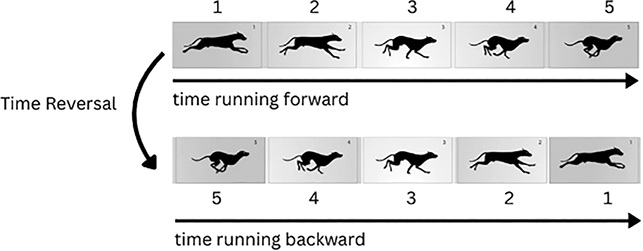
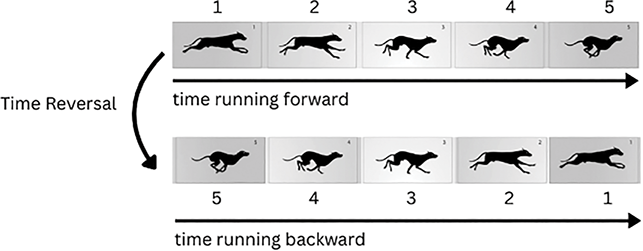
This straightforward representation is the sort of picture Roger Penrose invokes when discussing time reversal in the context of quantum-mechanical measurements (Reference Earman1989, pp. 355–360). Think of a sequence of a dog running. We all know what a dog running in the forward direction of time looks like, but in the backward direction, the sequence is just the order inversion (see Figure 1).
However, not everyone agrees that this captures the essence of time reversal – even at such an intuitive level. As Craig Callender (Reference Callender2000) points out, time reversal should not only invert the order of the sequence, as in (1.2), but should also transform the elements themselves. But, how? Properly defined, even in this simplified setting, time reversal should therefore be represented as:
 (1.3)
(1.3)
Here, for example,
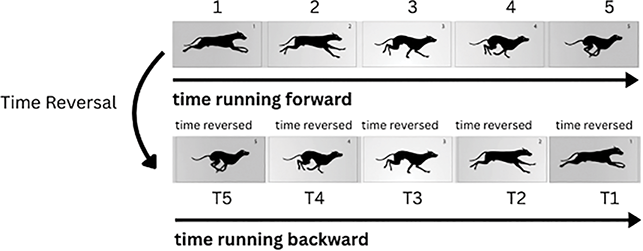
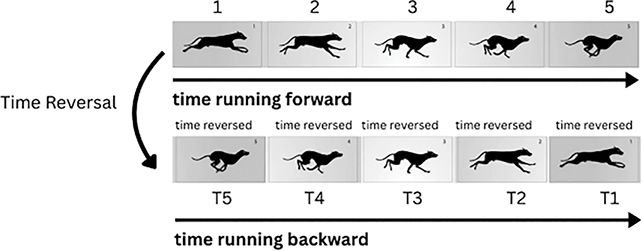
 would be the time-reversal counterpart of “dinner” (whatever that is taken to involve). Coming back to the dog-running sequence, it would be the same except that each individual slide will also be time-reversed. That is, it is not just the dog-running sequence in the opposite time order (as in Figure 1), but the dog-running sequence in the opposite order and with each state in turn time reversed (Figure 2).
Dog-running forward and backward sequences, only time order inversion.
The breakfast–lunch–dinner example (or the dog-running sequence) captures the basic intuition of “running things backwards.” Yet, as has been suggested, it is not entirely clear whether “running things backward” also requires reversing each individual state within the sequence. This is one of the central conundrums of time reversal: What does it mean to reverse each state in time? It is certainly not straightforward to specify what a time-reversed state in the dog-running sequence would amount to. Take T5, for example: It is presumably the same dog, but time-reversed. But what does that entail? Is it the same dog with all its neurophysiological processes also running backwards? Or is it the same dog simply running in reverse, while all its internal processes continue in their normal forward direction? May such a time-reversed dog even exist? To elucidate this, we need to move beyond the metaphor; we need a more precise account in physics.
Time reversal is, at first glance, a symmetry transformation defined by the specific effects it produces on the states, parameters, and variables that appear in dynamical laws. Since most such laws involve an explicit time parameter
 , the most immediate definition of time reversal (denoted by
 ) is:
) is:
 (1.4)
(1.4)
It is not the case that time reversal only does that. The idea, very reasonable, is that such a definition of time reversal implies how time derivatives transform under time reversal (see Callender 200, pp. 253–254). As we will see later, it is not clear if this implies that states themselves also reverse under (1.4), because the definition of state is contested. But it does indicate that (1.4) is enough as a definition to trigger other dynamical transformations within a physical theory.
Nonetheless, others think that this mapping alone is not sufficient as a definition, as it was not sufficient to reverse the order of the events in (1.2) and Figure 1. As before, time reversal should not only reverse the direction of physical evolution, but do something else (see Davies Reference Davies1974; Savitt Reference Savitt1996). And all this “something else” should also be part of its definition. The reasons here are clearer: to begin with, it is crucial to distinguish between a formal symmetry transformation – its mathematical implementation within the formalism of a physical theory – and its physical correlate (or ontic significance; see Dasgupta Reference Dasgupta2016). The formal framework of most physical theories allows for numerous mathematical symmetries, but only a subset of these correspond to physically meaningful ones (see Belot Reference Belot and Batterman2013). By also reversing the content of a physical evolution, time reversal seems to go beyond a formal symmetry. Time reversal does not merely mean (1.4), but it means reversing a physical evolution.
This was explicitly stated by Paul Davies, who has argued that the simple characterization given in (1.4) is purely mathematical, lacking physical content. It is, after all, only a transformation of the time coordinate. For time reversal to acquire genuine physical significance, it must be tied to processes or physically relevant quantities (Davies Reference Davies1974, p. 23). Put differently, time reversal as a physical symmetry transformation must involve more than a mere reparametrization of
 as in (1.4), as the breakfast–lunch–dinner examples must involve more than a mere reversion of the sequence. This observation, widespread in the literature, is not completely fair. Those who endorse the definition of time reversal given by (1.4) do not claim that it only performs a time reparameterization, but that such a transformation logically implies other transformations. I will come back to this point later.
Steven Savitt (1997) offers a closely related analysis that both clarifies and complements the different ways in which time reversal can be understood. He distinguishes three types of time-reversal transformations and corresponding notions of invariance: time-reversal invariance₁, which concerns the symmetry of the transformation (1.4) and Figure 1; time-reversal invariance₂, which corresponds to the symmetry of the transformation (1.3) and Figure 2; and time-reversal invariance₃, which aims to capture the idea of a “reversal of motion.” Savitt’s important observation is that these three senses do not always yield the same verdict about whether a given theory is time-reversal invariant. For instance, a theory
 might fail to be time-reversal invariant₃ while still satisfying time-reversal invariance₂. This naturally raises, once again, the question: What is the correct conceptualization and formal representation of time reversal, if there is any? In practice, physics tends to adopt Savitt’s second sense, and occasionally the third. Yet it is worth keeping all three possibilities in view rather than discarding any of them prematurely. As I will argue later, both metaphysical and methodological commitments can influence which sense of time reversal one regards as most appropriate.
Dog-running forward and backward sequences, time order inversion, and states are also time-reversed.
Recently, Bryan Roberts has proposed an explicitly ecumenical approach to time reversal, which he calls the Representational View (Roberts Reference Roberts2022). Previous distinctions, and much of the contemporary debate about time reversal, can be framed in terms of an apparent tension between two broad families of views. On the one hand, as I said, some authors hold that time reversal should amount simply to a reversal of the temporal parameter, as in transformations of the form (1.4) (see, e.g., Albert Reference Albert2000; Callender Reference Callender2000; López Reference Lopez2019). This transformation will trigger (or imply) other transformations, which will be theory-dependent. On the other hand, many accounts take time reversal to require, in addition, further transformations of the instantaneous state – such as reversals of momenta, spins, or phases – as in transformations of the form (see 1.5 below).
Roberts’ proposal aims to reconcile these seemingly competing conceptions by appealing to the role of representation. Central to the Representational View is the claim that time is to be understood, at the level relevant for physical symmetry analysis, in terms of its translation structure. More precisely, time is characterized by the group of time translations, and time reversal is identified with the automorphism that reverses that structure. On this view, a symmetry acting on a state space qualifies as a genuine spacetime symmetry only insofar as it arises as part of a representation of an underlying spacetime symmetry structure (Roberts Reference Roberts2022, p. 30).
Within this framework, time and time reversal thus exhibit a dual aspect. Time reversal can be understood both as a spacetime symmetry of the form (1.4), reversing the direction of time translations, and as a corresponding symmetry acting on the state space, typically of the form (1.5). Roberts argues that these are not rival notions but two manifestations of a single underlying structure related by representation. As he puts it, alternative notions of time reversal “are not inconsistent; they simply describe two different sides of the same representation relation” (Roberts Reference Roberts2022, p. 31). I will return to Roberts’ view at several points throughout this Element, both to clarify its unificatory ambition and to assess its philosophical implications.
In a formal setting, how dynamical quantities transform under time reversal can be specified with precision. As noted previously, most physicists and philosophers of physics hold that time reversal is not exhausted by a transformation of the form (1.4), but that either it implies subsidiary dynamical transformations, or its definitions must include them. Be that as it may, it is expected that, say, velocities should change sign, as well as momentum. However, matters are more intricate than this initial characterization suggests: The precise definition of the time-reversal transformation, and hence its concrete form, depends essentially on the theory and the type of dynamics under consideration.
Those who hold that time reversal’s definition should be wider and include the reversion of the physical evolution, believe that a time-reversal transformation is a symmetry transformation such that
 (1.5)
(1.5)
This means that, in addition to (1.4), time reversal also acts on physical states
 ), on physical magnitudes (
 ), and on derivative operators (
 ) appearing in the dynamical equations of a theory, where
 indicates the time-reversed counterpart. The key problem is to determine how time reversal operates in each particular case within each particular theory. I will come back to this point shortly.
Since time reversal is first and foremost a symmetry transformation, we are interested in time-reversal invariance. When, then, can we say that a dynamical equation is time-reversal invariant? A law
 is time-reversal symmetric if and only if it preserves both its validity and its structural form under the transformation
 , once the latter is properly defined. But what exactly does it mean to “preserve its validity and structural form”?
By validity, one usually means that
 is time-reversal symmetric if and only if every solution of
 is mapped by
 onto another solution of
 . Put differently, if
 is invariant under time reversal, then
 preserves the solution space of
 . From this it follows that
 must also preserve the functional relations among the elements of the dynamical equation – that is, its structure:
 (1.6)
(1.6)
This provides only a general schema, starting out from an intuitive account for time-reversal transformations. Nonetheless, it is unclear if the very definition of time reversal is exclusively given by (1.4) plus its logical consequences, or by (1.5). In any case, the home-taken message is that time reversal cannot merely represent an inversion of a sequence, but it must also act upon states, variables, and observables in the dynamical equation. This explains why, in each physical theory, the specific form of
 depends on how it acts upon the different elements in the dynamical equations.
1.2 Time Reversal in Classical Mechanics
Classical mechanics is a natural place to begin assessing time reversal in a concrete setting. In the Hamiltonian formulation, the state of a system at a given instant is specified by the generalized coordinates,
 , and their conjugate momenta,
 . The physical evolution of the system is then represented as a smooth curve through phase space,
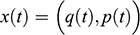 that satisfies Hamilton’s equations of motion.
To define time reversal in this context, let us introduce the transformation
 (the superscript “c” referring to “classical”), implemented as follows:
 (1.7)
(1.7)
In words, time reversal reparametrizes the time coordinate
 , flips the sign of each momentum
 , and leaves the positions
 unchanged. What this does, in effect, is transform every solution curve
 in phase space into a new curve
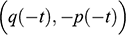 . If the equations of motion are truly time-reversal invariant, then this new curve must itself be a solution of the same equations.
This requirement has direct implications for the Hamiltonian function. Specifically, the Hamiltonian must be such that the transformation
 (1.8)
(1.8)
leaves its form intact, that is, it keeps it symmetric under the transformation. When this condition is satisfied, the Hamiltonian equations of motion will preserve both their solution space and their structural form under
 . The starting point is typically a particle moving on a line in a conservative force field, in which Hamilton’s equations of motion are left invariant under
 But why must momenta change under time reversal? It can be argued that, since momentum is defined in terms of velocities, and velocities change sign under
 , so does momentum. Nonetheless, strictly speaking, this presupposes that the Hamiltonian description derives from an underlying Lagrangian formulation, in which canonical momenta are defined by
 ; that is, explicitly in terms of velocities. This is not necessary, however, since the Hamiltonian formalism can be taken as a theory on its own, where momenta are independent coordinates on phase space. Having said that, it must also be said that in the large class of systems obtained from regular Lagrangians, the canonical momenta are linear in the velocities, and thus inherit their sign change under time reversal.Footnote 1
There are, however, deeper structural reasons for this sign change in Hamiltonian mechanics. The main reason is that for Hamilton’s equations to retain their form under time reversal, the transformation must be anti-symplectic. This implies that it sends the symplectic form from
 , reversing the orientation of phase space. For this reason, time reversal is not a canonical but an anti-symplectic transformation. This feature will not only explain why momenta change sign, but it will also prove important later in the quantum-mechanical case.
To make this more concrete, let us look at a specific model: the undamped harmonic oscillator. This familiar mass–spring system, free of friction or external driving forces, provides a useful illustration because the Hamiltonian of the system is
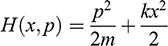 (1.9)
(1.9)
which is manifestly invariant under
 because the kinetic term only depends on
 through
 This ensures that Hamilton’s equations remain invariant under time reversal. The same symmetry is easier to find and visualize in the equivalent Newtonian formulation, using simpler notation. In this case, the system is governed by the equation of motion:
 (1.10)
Where
 is the angular frequency,
 is the spring constant, and
 is the mass of the oscillating particle.
The question we now want to answer is: Is this equation time-reversal symmetric? That is, if
 is a solution of (1.10), does the time-reversed function also satisfy the same equation, T
 ? To check this, we need to spell out what the classical time-reversal transformation does in this concrete case. An instantiation of (1.5) gives:
 (1.11)
This definition indeed reverses the trajectory of the system in the state space. And that explains why it is an adequate implementation. It is, however, important to note that if time reversal is defined by (1.4), it implies the same transformations. Here the reasoning is straightforward: Since position is not a time derivative, it remains unchanged; velocity (the first derivative of position with respect to time) changes sign when
 is reversed; and acceleration (the second derivative) remains the same, because a minus sign applied twice cancels out. In general, one can say that odd-order time derivatives flip sign under time reversal, while even-order derivatives do not.
With this in place, we can now check whether (1.10) is preserved under time reversal. Suppose
 is a solution. Then we apply
 as defined:
 (1.12)
Thus, if
 is a solution, so is its time-reversal
 . The equation of motion therefore preserves both its structure and its solution space under
 .
.
This example illustrates a general lesson: In classical mechanics, time reversal consists of reversing the time parameter, flipping the sign of momentum (or velocity), and leaving positions unchanged. It is worth emphasizing a subtlety: In Section 1.1, I introduced two alternative notions of time reversal (summarized in (1.4) and (1.5)). In the present case, as mentioned in passing, these notions yield the same implementation of time reversal. If time reversal is defined as in (1.4), the reversal of velocities, momenta, and, more generally, of any first time derivative follows as a logical consequence. If time reversal is defined as in (1.5), by contrast, these transformations are included explicitly as part of the definition.Footnote 2 There is a conceptual distinction (and, perhaps, a metaphysical one) that makes no difference formally and physically. Notwithstanding this, it will become relevant in the quantum case.
The upshot is that for Hamilton’s equations and systems like the harmonic oscillator, the laws are indeed time-reversal symmetric, regardless of whether (1.4) or (1.5) is adopted. In more complex systems – particularly those involving velocity-dependent forces such as magnetic fields – the analysis becomes more subtle, since additional quantities (like the magnetic field itself) must also be transformed for time reversal symmetry to hold. Nonetheless, I just wanted to show clearly how time reversal works in classical mechanics and how, in simple Hamiltonian cases, the symmetry is clear and robust.
1.3 Time Reversal in Quantum Mechanics
Moving from classical to quantum mechanics, the situation becomes considerably more intricate.Footnote 3 In the classical setting, time reversal can be straightforwardly understood as a transformation of trajectories in phase space: Positions are left fixed, momenta change sign, and the resulting time-reversed trajectory remains a solution of the same dynamical law. In quantum mechanics, however, the very notion of a “state” is different – it is represented not by a point in phase space but by a wavefunction or a vector in Hilbert space.Footnote 4 As a result, applying time reversal requires more than just reversing parameters or flipping signs. It raises questions about how the operation acts on amplitudes, operators, and the state, and even whether it should be represented by a unitary or an anti-unitary transformation. In short, while the classical case provides a clear and straightforward implementation that (almost) follows the intuitive picture, the quantum case is far more subtle.
We have said that one of the most intuitive features of a time-reversal transformation is that it should invert the direction of time. At first glance, (1.4) seems to capture the very idea of “reversing time” because it induces an inversion of first-time-derivative magnitudes. However, in quantum mechanics, the connection between such a transformation and the inversion of temporal direction is far from straightforward since the logical connection with time derivatives is far from clear. To see why, let us begin by adhering to the classical implementation of time reversal and follow it carefully.
Consider the wavefunction of the time-evolved state, that is, a curve in Hilbert space
 , evolving according to the Schrödinger equation:
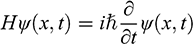 (1.13)
Suppose we try to implement time reversal as in the classical case with a linear, unitary operator Θ (the quantum counterpart of TcFootnote 5) that corresponds to the spacetime transformation
 (1.14)
This should imply, as in the classical case, that first-time derivatives also change sign under time reversal. Yet, it is not prima facie clear what (1.14) is supposed to do. As Roberts (Reference Roberts2022) points out, in informal presentations of time reversal, transformations in Hilbert space and transformations of spacetime coordinates are often conflated. First, there is the reparametrization of curves in Hilbert space, corresponding to the space-time transformation (1.14), which should map a dynamical trajectory
 to the curve
 Second, there is an operator acting on Hilbert space that maps states to states. In standard treatments of symmetries in quantum mechanics, spacetime transformations are represented on the space of states by operators on Hilbert space. In this sense, the operator
 must represent the time-reversal transformation at the level of quantum states, but it is not immediately clear how this representation should be implemented. Some of the reasons will become clear later on, but this is already a conceptual gap not usually acknowledged: The relation between spacetime symmetries and their representation in Hilbert space is not straightforward and depends largely on the structure of the dynamical theory (see Roberts Reference Roberts2022; Struyve Reference Struyve2025).
Besides this point, for Θ to be an acceptable time-reversal transformation in quantum mechanics, it must also satisfy certain requirements. A natural one, often imposed in textbook discussions, is that time reversal should preserve the space of solutions of the Schrödinger equation. In other words, if
 solves the equation, then
 should also do. That is, the time-reversed state must also belong to the same Hilbert space of states (see Sachs Reference Sachs1987, p. 36; Ballentine Reference Ballentine1998, p. 380). Let us call this condition CON.
Let us examine what happens under the application of time reversal as defined in (1.14) and CON. In applying
 , CON can be expressed equivalently as:
 (1.15)
The time-reversed curve is obtained by first reparametrizing the original trajectory as
 , and then applying
 , yielding a new trajectory whose position-space representative may be written
 . But, at this stage, one must ask how the Hamiltonian transforms. To preserve time-reversal symmetry formally, the transformed equation should retain its structure, meaning both sides should “match” in form. Additionally,
 must be a solution (CON). However, in this context, (1.15) leads toFootnote 6
 (1.16)
This transformation appears in the literature in two complementary ways. Callender (Reference Callender2000) observes that the Hamiltonian in the Schrödinger equation is associated with a first-time derivative, so it is natural for it to pick up a minus sign under time reversal (recall that (1.14) is meant to be an instantiation of (1.4)). Gasiorowicz (Reference Gasiorowicz1966, p. 27) argues that changing the sign of
 preserves the formal symmetry of the equation.
Formally, these steps are correct (see Sakurai and Napolitano Reference Sakurai and Napolitano2011, p. 291; Bigi and Sanda Reference Bigi and Sanda2009, p. 27), yet a fundamental problem arises: assuming
 is linear and unitary forces the Hamiltonian’s spectrum to invert, producing unphysical negative energies. Specifically, for any eigenstate
 with eigenvalue
 :
:
 (1.17)
 (1.18)
Thus,
 becomes an eigenstate with negative energy, violating the spectrum condition (see Roberts Reference Roberts2018, p. 326), which requires the Hamiltonian to remain bounded from below. To show it more clearly, the assumption that
 is linear and unitary (1.14), and it satisfies CON, leads us to trouble. Something must go. Clearly, a linear unitary operator like
 cannot implement time reversal physically in quantum mechanics – a reductio ad absurdum argument (see Jauchs Reference Jauch1959, p. 88). Therefore, time reversal in quantum mechanics must be implemented by an operator that does not generate equations (1.17) and (1.18).Footnote 7
It is at this point that the contrast with the classical case, as well as with the alternative notions of time reversal, becomes especially sharp. If time reversal is defined as in (1.4) – as Callender (Reference Callender2000) and Albert (Reference Albert2000) would argue – then the operator
 appears to provide the appropriate implementation of time reversal, that is, (1.14). However, this immediately generates tensions with the standard understanding of time reversal in quantum mechanics, as well as with the widespread claim that the Schrödinger equation is time-reversal invariant. These difficulties provide a strong motivation to explore and to take more seriously definitions of time reversal along the lines of (1.5). Unlike the classical case, the two notions no longer coincide in quantum mechanics.
The canonical solution is the following: Time reversal is defined in terms of an anti-unitary operator,
 . Anti-unitarity combines linear operations with complex conjugation. For any complex number
 , the conjugation operator
 satisfies
 In essence, anti-unitary operators flip the sign of
 , while also complex conjugating the wavefunction.
Let us follow the same steps as with
 above and examine what happens under the application of time reversal as anti-unitary and CON. In applying
 , CON can be expressed equivalently as:
 (1.19)
Since
 is anti-unitary, it complex conjugates numbers and operators as needed. In particular, the wavefunction transforms as

 and it changes the sign of i,
 . This implies that the infinitesimal expansion now gives
 (1.20)
which preserves not only its invariance under time reversal, but also the Hamiltonian’s spectrum not forcing the inversion that would conflict with the spectrum conditions and the usual physical interpretation of energy.
Overall, under
 the time-reversed Schrödinger equation satisfies the same structural form as the original Schrödinger equation and
 is a solution (satisfying CON). Intuitively, then, the anti-unitary operator
 can be thought of as reversing the “direction of evolution” while keeping probabilities and energies physically meaningful. At this point, it is important to recall a point mentioned earlier: In Hamiltonian mechanics, time reversal was an anti-symplectic transformation. If time reversal in quantum mechanics were represented by a unitary operator (
 ), this would create a formal mismatch, since anti-symplectic transformations in Hamiltonian mechanics correspond to anti-unitary representations in quantum mechanics, while canonical (symplectic) transformations correspond to unitary ones. That time reversal is, in fact, represented by an anti-unitary operator in quantum mechanics mirrors its characterization as an anti-symplectic transformation in Hamiltonian mechanics.
It might seem that, in the quantum case, there are two opposite, contradictory notions of time reversal that lead to substantially different results. Roberts’ Representational View offers a clever way to unify (1.4) and (1.5) in the quantum case, showing certain reconciliation. If the view is adopted, time reversal in quantum mechanics is likewise understood in terms of the representation of time translations in state space. In quantum theory, time translations are represented by a one-parameter unitary group generated by the Hamiltonian, and time reversal is identified with the automorphism that reverses this translation structure. By Wigner’s theorem (see Section 1.4), implementing this reversal at the level of Hilbert space requires an anti-unitary operator. As a result, time reversal is represented by an operation that includes complex conjugation, and, where appropriate, additional unitary factors accounting for spin or other internal degrees of freedom. Crucially, on this view, complex conjugation is not an additional transformation introduced alongside the reversal
 , but rather the way in which that same reversal of time translations is represented in Hilbert space. The anti-unitary character of time reversal is thus understood as a consequence of reversing the representation of time translations in quantum mechanics.
1.4 Time Reversal, Time Translation, and Time Evolution
As we have just seen, the implementation of time reversal in the received view is far from straightforward and requires careful consideration, case by case. We have seen how this implementation is guided by some intuitions related to “reversing time.” In Section 1.5, I will explore in detail some metaphysical assumptions in these intuitions, but it is important to be more precise about the physical meaning of “reversing time” in physical cases. In the end, it will be the physical meaning attached to the idea of “reversing time” that will serve as justification for a certain formal implementation. This task originates with Eugene Wigner (Reference Wigner1932) and has been revisited in more recent works (Sachs Reference Sachs1987; Earman Reference Earman2002; Roberts Reference Roberts2018).
The implementation of time reversal in quantum mechanics is not a special case, as it can be supposed. It puts into practice some ideas and conditions that apply to time reversal throughout physics. Quantum mechanics is just the place in which these ideas and conditions need explicitation. That is why it is useful to analyze the quantum mechanics case to shed some light on general features of time reversal. In the quantum mechanics case, two conditions are remarkable: (a) Wigner’s criterion for time reversal (which is equivalent to CON above) and (b) the Hamiltonian-spectrum criterion. I will first go through them briefly and then mention some ambiguities when talking about time translation and time evolution.
Eugene Wigner, in his pioneering work on time reversal (Reference Wigner1932), remarks that a central feature of time reversal is that it is an “involution”: applying it twice yields the identity. While any operator satisfying
 meets this condition, involution alone does not capture the idea of reversing a system’s state through time. Wigner formalized this requirement. He proposed that a time-reversal transformation must satisfy the condition:

In other words, the operator must reproduce the original state not only when applied twice, but also after the system has undergone a forward and then a formally identical backward evolution. This twofold time evolution defines what it means to be a time-reversal transformation.
Wigner further argued that any candidate operator must preserve transition probabilities:
 (1.21)
This requirement ensures that the second time evolution remains physically meaningful. Wigner’s original justification linked this preservation to invariance under time reversal, but it does not by itself explain why any time-reversal operator must preserve probabilities.
The connection to anti-unitary operators comes from Wigner’s theorem, which states that any symmetry transformation is represented either by a unitary or an anti-unitary operator. Only the anti-unitary option satisfies the two-time-evolution criterion and preserves transition probabilities, eliminating the unitary option. Uhlhorn (Reference Uhlhorn1962) later corrected and generalized Wigner’s argument, showing that preservation of orthogonality is sufficient: If two states are orthogonal
 , they remain orthogonal under the symmetry
 Roberts (Reference Roberts2018) emphasizes that orthogonality relates to the notion of state rather than time evolution itself. Hence, any time-reversal operator must preserve the structure of quantum states while leaving temporal properties properly reversed.
The second condition is the Hamiltonian-spectrum criterion. In the exposition of time reversal in quantum mechanics, I mentioned that the invariance of the Hamiltonian under time reversal must imply that it remains bounded (i.e., that it doesn’t flip positive energies into negative energies). The anti-unitary representation of time reversal precisely ensures that the Hamiltonian remains invariant:
 . This is crucial because the Hamiltonian represents the system’s energy. It must then be bounded. A naive, unitary implementation of time reversal, such as
 , would reverse the sign of the Hamiltonian, producing negative energies and thus physically meaningless states. Specifically, if ∣
 is an eigenstate of
 with energy
 , the reversed eigenstate
 would correspond to
 .
.
Both criteria are not isolated but work together. In Wigner’s condition, the second time evolution (with
 decreasing) must also be generated by a valid quantum-mechanical Hamiltonian. If the Hamiltonian were unbounded from below (i.e., negative energies), the second evolution would be physically impossible. Therefore, the time-reversal operator must be anti-unitary not only to preserve both the structure of the quantum states and the positivity of the Hamiltonian spectrum (its boundedness), but also to meet the very definition of time reversal according to Wigner. Roberts (Reference Roberts2018) strengthens this argument: All realistic quantum Hamiltonians are empirically bounded from below, ensuring stability of matter. Assuming a unitary time-reversal operator leads to a contradiction, as was shown before. In sum, the conditions (and the physics constraints imposed upon time reversal) are not arbitrary, but they aim to preserve some transversal idea of what “reversing time” is.
Before turning to a final assessment of the received view, it is worth highlighting a source of ambiguity in Wigner’s (informal) characterization of time reversal, namely a potential conflation between time translation (or time displacement) and time evolution (see López and Lombardi Reference Lopez and Lombardi2024). These notions are not equivalent. Time displacement is a geometrical operation that shifts a system to a different moment in time, whereas time evolution is governed by the system’s dynamical law (or evolution operator). In certain cases – most notably for completely isolated systems – the two coincide, but in general they differ both conceptually and operationally.
This distinction is clearly illustrated in non-relativistic quantum mechanics by the structure of the Galilei group (López and Lombardi Reference López, Lombardi, Lombardi, Fortin, López and Holik2019). When a system is isolated, time displacement commutes with spatial rotations, and the Hamiltonian – the generator of time evolution – also generates time displacement. However, when external fields interact with the system, the Hamiltonian typically no longer commutes with the angular momentum operators, while time displacement continues to do so (Laue Reference Laue1996; Ballentine Reference Ballentine1998). In such cases, the Hamiltonian still governs time evolution but ceases to generate time displacement.
This situation reveals a subtle ambiguity in Wigner’s definition: It is unclear whether time reversal is intended to reverse the geometrical displacement of a system in time or its dynamical evolution. The ambiguity is plausibly inherited from classical physics, where time translation and time evolution are often tacitly identified. The distinction matters, since it affects the constraints that should be imposed under time reversal. Dynamical evolution is generated by the laws of motion, so reversing it cannot serve to justify the time-reversal transformation itself – the transformation must be defined independently of the evolution it reverses. By contrast, time displacement involves a geometrical shift whose meaning is fixed independently of the dynamics, making the corresponding reversal conceptually straightforward. I will return to this point later.
This contrasts with Roberts’ Representational View. It also distinguishes time translation from time evolution, though in a different sense. On his account, time translations are elements of a spacetime symmetry structure, while time evolution is the representation of those translations on a theory’s state space (Roberts Reference Roberts2022, p. 53). So, they are not different, but the two sides of a representational relation. This distinction is internal to the Representational View and holds only conditionally on adopting it. By contrast, the distinction drawn here is intended to be more general and formulation-independent: Time translation is a geometrical transformation, whereas time evolution is generated by the dynamical structure of the theory. Later on, I will argue why the Representational View falls short to alleviate the tensions.
1.5 Taking Stock
Time reversal has distinct implementations in classical and quantum contexts, and its precise meaning hinges on differentiating the concrete transformation to be performed in each case. In classical mechanics, time reversal is often understood as reversing the velocities of particles (or their momenta) and effectively inverting the dynamical trajectory. In quantum mechanics, time reversal cannot perform the same transformations as in the classical case: Time reversal must be defined as an anti-unitary operator, as was shown.Footnote 8
As mentioned in passing before, both implementations of time reversal share a common goal: to capture, in formal terms, the idea of “reversing time,” essentially Wigner’s criterion. This does not rule out the possibility of alternative representations, but once specific conditions are imposed and a particular notion of “reversing time” is endorsed, the received view becomes the natural outcome. The deeper question, however, is why those conditions should be accepted and why that particular conception of time should be endorsed. At this point, the debate shifts from the formal representation of time reversal to its very conceptualization. And this is the crucial lesson: How we conceptualize time reversal – what we take “reversing time” to mean – directly shapes both the physical interpretation of the transformation and the formal constraints placed upon it. The time-reversal operator is, in this sense, nothing more than a formal reflection of a prior conceptual choice. That choice, however, is anything but trivial, for it carries with it implicit assumptions about the very nature of time.
The three elements – conceptualization, physical interpretation, and formal implementation – work together to offer a complete, justified, and robust notion of time reversal in physics. They cannot be isolated and assessed separately since they form a coherent whole (see Figure 3).
Elements of the notion of time reversal: conceptualization, physical interpretation, and formal implementation.

A second point worth emphasizing concerns the effort to preserve a unified and general concept of time reversal, even when its formal definition varies across different theories (see Robers Reference Roberts2022 for a methodological-formal unifying proposal). One might be tempted to think that the alternative representations of time reversal in classical mechanics and quantum mechanics, for example, reflect entirely different concepts – or even fundamentally different understandings of what time reversal means (see Callender Reference Callender2000; Albert Reference Albert2000; López Reference Lopez2019). I no longer hold this view. Instead, I take the variability in representation to be guided by the demand for conceptual uniformity across theories. At its core, the unifying idea is always the same: to reverse the temporal evolution while preserving the structural form of the dynamical laws. The formal implementation of time reversal, then, adapts to the specific structures of each physical framework, much like adjusting to the “geography” of the theory, while continuing to express this shared concept.Footnote 9 For instance, in classical mechanics, this is realized by flipping the sign of the momenta while leaving positions fixed, whereas in quantum mechanics it requires a more subtle operation, such as complex conjugation of the wave function. Both strategies, however, serve the same conceptual purpose. Of course, this position can be contested, or it can hide even deeper commitments that can be contested, as I will argue later. Still, it suggests that the formal implementation of time reversal is less arbitrary – or ad hoc – than it may initially appear.
2 Time Reversal and the Metaphysics of Time
At the end of the last section, I have claimed that there is a coherent unity among our conceptualization of time reversal, the physical interpretations and constraints, and the mathematical implementation. Yet, the conceptualization of time reversal is not simple or straightforward. Our philosophical stance on the nature of time shapes our very understanding of time reversal. If we claim to invert the direction of time, what such an inversion means – and upon what it acts – depends directly on how we conceive of time itself. In this sense, metaphysics comes first: It determines not only what time reversal is, but also what it is meant to transform. Therefore, alternative metaphysical theories of time will probably arrive at different conceptualizations of time reversal. In this section, I will explore these metaphysical commitments and their relation to time reversal.
2.1 Metaphysics of Time: Substantivalism and Relationalism
Is time independent of matter, or is it nothing over and above the change of matter? In response to this fundamental question, two broad metaphysical positions have been developed: temporal substantivalism (TS) and temporal relationalism (TR). Although rivers of ink have been spilled on these debates, I will restrict myself here to a general characterization, sufficient to illuminate why they matter for the conceptualization of time reversal (for a clear, traditional characterization of the debate, see Earman Reference Earman1989; for an updated one, see Dasgupta Reference Dasgupta2015; North Reference North, Ben-Menahem and Hemmo2018).
2.1.1 Temporal Substantivalism
The bone of contention between TS and TR is whether time is a substance on a par with matter. TS holds that time is an autonomous substance which exists independently of, and in a par with, matter and/or events. Therefore, time and matter (at least) constitute the basic ontology. TR denies this. The basic relational ontology solely consists of matter and/or events exemplifying various properties and relations. Of course, there are different ways to be a substantivalist or a relationalist, but this captures the core of the debate. Since I am not here concerned with the various forms of either view, or with whether some version of them is more palatable than others, I will not get into their many different versions (for comprehensive views of different substantivalisms and relationalisms, see Sklar Reference Sklar1974; Earman Reference Earman1989; Pooley Reference Pooley and Batterman2013; for a defense of TS see Earman Reference Earman1974; Hoefer Reference Hoefer1996; Maudlin Reference Maudlin2002; Castagnino and Lombardi Reference Castagnino and Lombardi2009; and Mozersky Reference Mozersky2015. For TR, see Barbour and Bertotti Reference Barbour and Bertotti1982; Rovelli Reference Rovelli2002, Reference Rovelli2004; Gryb and Thébault Reference Gryb and Thébault2016; and Lopez and Esfeld Reference Lopez and Esfeld2025).
What is to endorse TS? First of all, it amounts to recognizing time as an independent substance. For instance, in Newton’s view (or whoever defends manifold substantivalism about time, see Hoefer Reference Hoefer1996 for details on spacetime manifold substantivalism),Footnote 10 time is a substance made of qualitatively indistinguishable instants (or temporal points) that cannot be reduced to anything else, so they are primitive. Each instant is also primitively engaged in prior/posterior relations to other instants, delivering a special sort of primitive relations: instant-to-instant relations. Along with time, substantivalism also recognizes matter as a substance (e.g., point-like particles). Suppose that the matter ontology is one of individual point-like particles. TS’s basic ontology is hence composed of time (as a collection of instants engaged in instant-to-instant relations) and individual particles.
What is interesting is that matter engages in temporal relations, too. As long as, for instance, the spatial configuration of particles changes (e.g., either by a change in their instantiated properties, in their respective relative positions, or in relation to space points), it is possible to define temporal relations as event-to-event relations. However, these relations are not fundamental but supervene upon the instant-to-instant relations. In other words, we can define the duration between two events (e.g., a
 configuration of particles and a
 configuration of particles, where
 ) in relation to a third event (the ticking of my clock here and now). But this relation is not fundamental. The proper definition of a duration between events is in terms of the instants they occupy. These instant-to-instant relations are independent of the event-to-event relations, the latter supervening upon the former. But they are also viewed as absolute, giving a privileged frame of reference for duration. It is worth noticing that the distinction between event-to-event and instant-to-instant relations presupposes a third kind of relations in a substantivalist framework – event-to-instant relations.Footnote 11 This means that it is meaningful to univocally talk about at which instant a certain event is temporally located.
To sum up, I take TS as endorsing the following tenets:
(a) the basic ontology is one of time and matter (substance dualism)
(b) both kinds of substances are independent from each other.
(c) There exist three kinds of temporal relations: (i) instant-to-instant, (ii) event-to-instant, and (iii) event-to-event.
(d) Event-to-event relations are not basic but supervene upon instant-to-instant and event-to-instant relations.
To illustrate TS, let us assume a classical Newtonian framework and one of its possible metaphysical bases, point-like particles. I acknowledge that the metaphysics could be different, but this does not affect the main point that I want to make here. Nor does the assumption of classicality weaken my point: A relativistic framework would have to make similar assumptions, though the details could vary and be harder to depict. Let us call a “maximal configuration for substantivalism” (MCS) the totality of basic entities (particles), their properties, and a complete class of world-making relations that glues everything together at an instant. A class of world-making relations is necessary to speak of one configuration, as a unity, within which all the basic entities are world-mates. If it is supposed that the MCS is atemporal (or if the focus is only on one instant), then it would look as follows:
 (2.1)
(2.1)
Where
 refers to the set of all basic entities,
 refers to a collection of spatial points,
 to the possible properties that can be instantiated by the basic entities (mass, energy, etc.),
 to all point-to-point relations (i.e., the absolute distances between spatial points),
 to all entity-to-entity spatial relations (i.e., the relative distances between point-like particles in this case), and
 to all entity-to-point relations (i.e., the absolute location of an entity in space). Note that MCS assumes space to be a substance and is strictly a maximal spatial configuration, which leaves time out of the picture. To introduce time in MCS means that further entities (and world-making relations) are also introduced. Let us call a ‘maximal temporal configuration’ (MTCS) a MCS that is also temporal. Then,
 (2.2)
(2.2)
The novelty here is a new kind of substance, time, which is composed of instants,
 } and a new kind of world-making relations given by temporal relations
 . Temporal relations play a threefold role. First, they make time up
 by connecting different temporal instants. Second, they are world-making relations in the sense that they connect different MCSs as part of a temporal unity. Why do we need them? Because different MCSs might be thought of as, for instance, possible configurations. Things could have been arranged differently, so it is conceivable that things could have been arranged differently. But when it is said that a MCS is temporally connected with another MCS, something more specific is meant – they are connected by a world-making relation that confers unity, that goes from one MCS to the other, in a sequence,
 . Finally, as each MCS is temporal, it is located at an instant, delivering a third type of temporal relation (temporal location,
 ). It is noteworthy that
 represents an event happening in time and
 is then an event-to-event relation. In TS,
 is not a primitive relation, but it derives from
 along with
 , which are primitive.
It is clear that for a series of MCSs to be temporal (to be a MTCS), a new kind of world-making relation and entity were necessary. Time is as primitive as space in this case. Change in this case just derives from the existence of primitive time. Different MCSs will be located at different instants, which accounts for their difference. This may imply, in turn, different event-to-event relations, but they are derived from the instant-to-instant and event-to-instant relations. The question that concerns me here is: How may TS influence our conceptualization of time reversal, which will in turn guide the implementation of time reversal?
2.1.2 Temporal Relationalism
In contrast to TS, TR contends that there is solely one kind of substance–matter. Time is then not a substance, but an abstraction derived from a certain type of relations that matter engages in. It does not mean that time is just an illusion, or unreal, but it reduces to a certain type of relation among matter. Metaphysically, this implies that there is only one kind of temporal relation in which matter is engaged –event-to-event relations. To put it differently, TR holds that event-to-event relations are primitive, direct relations among material bodies, not parasitic upon relations among primitive instants. This is a crucial distinction between TR and TS. More importantly, event-to-event relations are what make change up and they exhaust whatever is temporal in TR.
Let us now suppose a classical relational ontology of individual point-like particles. What fundamentally exists are those particles and their spatial relations, which yield a specific spatial configuration of particles. This is what Leibniz has called “the order of coexistence.”
This is the relational equivalent to a maximal configuration (MCS) in the above-mentioned sense, but in a relational MC (MCR), there will not be spatial points as part of the basic ontology, nor all those relations in which spatial points engage:
 (2.3)
(2.3)
Where
 are the basic entities (in this case, point-like particles),
 the set of properties that these entities could instantiate, and
 all the spatial relations, that is, relative spatial relations between point-like particles.
An MCR is static. As time is not primitive, it cannot account for any change in event-to-event relation (contrast this with MTCS). In some sense, therefore, event-to-event relations must enter as primitive in the basic ontology, too. This amounts to the claim that change in a relational ontology must also be primitive (see Lopez and Esfeld Reference Lopez and Esfeld2025). This brings about what Leibniz called “the order of succession.” In his third letter to Samuel Clarke (dated February 25, 1716), he claimed that:
what that argument really proves is that times, considered without the things or events, are nothing at all, and that they consist only in the successive order of things and events.
which is just saying that different orders of coexistence (a series of MCRs) are connected by temporal relations. Or, in other words, that there is a maximal relational temporal configuration (MTCR</b>). This is what it means that event-to-event relations are primitive for any MTCR</b>. I therefore take TR as endorsing the following tenets:
(a) the basic ontology is one of matter (substance monism)
(b) There exist only event-to-event relations. These temporal relations are primitive, if the basic ontology changes
(c) Time is parasitic on event-to-event relations, in the sense that it reduces to such relations and, consequently, to change
This delivers the following picture. In a changing relational ontology, the basic ontology would look like:
 (2.4)
(2.4)
Where
 are different maximal configurations,
 makes explicit that each instant is reductively identical to a
 (that is, there are no instants as independent entities from matter),Footnote 12 and
 are primitive event-to-event relations. As aforementioned, the question is the same: How may TR influence our conceptualization of time reversal, which will in turn guide the implementation of time reversal?
2.2 Time Reversal and Substantivalism
Let us return to the question raised earlier: How does TS shape our conceptualization of time reversal? If time exists independently of matter, then a reversal of time is, prima facie, a reversal of time itself – not a reversal of matter within time. Metaphysically, it means that time reversal acts upon the instant-to-instant relations; any change of the other temporal relations follows from it. Recalling the intuitive approaches from Section 1, a substantivalist account of time reversal will most naturally appear as a geometrical transformation (or something closely akin to it) applied to the time parameter (see 1.4). This makes perfect sense: If
 represents anything at all, it represents substantival time, and time reversal is simply the inversion of time itself. As Jill North vividly puts it: “What is a time reversal transformation? Just a flipping of the direction of time! That is all there is to a transformation that changes how things are with respect to time: change the direction of time itself”(North Reference North2009, p. 212).
From this standpoint, the conceptualization of time reversal under TS is exhausted by the transformation
 . Yet this apparent simplicity should not be mistaken for triviality: In fact, under TS, it encodes a profound metaphysical claim about the independence of time from change and its primacy over dynamics. But, as I have shown before, it does not mean that time reversal does nothing beyond this. Since dynamical parameters – such as first-time derivatives – supervene on time, they will automatically change sign when t is inverted. In Newtonian mechanics, for example, velocities acquire a negative sign under time reversal. But the TS explanation makes clear that this is not because sign-change is part of the definition of time reversal. Rather, it is because the inversion of time itself induces – or, as Callender (Reference Callender2000) argues, strictly implies – the corresponding change in velocities. A substantivalist formulation of time reversal (call it TS-reversal) may therefore be summarized as follows:
(a) A reversal of the direction of time (t → –t).
(b) An induced change in all dynamical parameters that supervene on time (e.g., first-time derivatives).
This conception contrasts with Wigner’s famous characterization of time reversal as an involution. On the TS account, time reversal is not defined as an involution, though it may cause one whenever the dynamical parameters of a theory change in the relevant way. The definition should not be confused with one of its possible consequences. To put it differently: defining time reversal in terms of involution puts the cart before the horse. A TS-based view opens the way to think of time reversal as meaningful even when it does not generate an involution or an inversion of motion. Under this perspective, time reversal resembles a reflection more than an involution (see Savitt Reference Savitt1996, ch. 1; Arntzenius Reference Arntzenius1997).
It follows that treating time reversal as a reflection is not an ill-conceived implementation but may, in fact, be the most natural expression of the substantivalist framework. Ultimately, the question is metaphysical: It concerns the nature of time, and therefore the nature of time reversal, rather than the correctness of any particular piece of physics or mathematics. This does not imply, of course, that TS-reversal must necessarily play a role in physics. It may turn out to be unhelpful or lack a viable formal representation. But that would be an empirical or pragmatic argument against its utility – not a conceptual argument against its coherence.
2.3 Time Reversal and Relationalism
Let us now turn to TR. How does TR shape our conceptualization of time reversal? Prima facie, the transformation
 – often taken as the most intuitive hallmark of time reversal – must not be granted too much significance. For the relationalist, it would be naïve to regard
 as performing any physically relevant change in the dynamical equations. What matters, on this view, is not the transformation of t itself but the transformation of change – that is, the event-to-event relations that constitute temporal reality. Time reversal, accordingly, should be understood as a convenient shorthand for a cluster of dynamically relevant transformations that govern the reversal of change (or motion) in a system. Put in a slogan: for TR, time reversal is nothing over and above motion reversal.
As discussed in Section 1, this is precisely the meaning of (1.3 and 1.5) and of time-reversal invariance2,3 in Savitt’s account. I suggest that this constitutes the overarching concept underlying the treatment of time reversal in physics, and to a significant extent, its formal implementations. Under TR, time reversal (call it TR-reversal) identifies those elements that represent change within a given theory and transforms them accordingly.
We can thus propose the following general scheme for TR-reversal:
(a) A mere re-parametrization of t by
 (for any general time reversal).
(b) A transformation of all dynamically relevant magnitudes so as to generate a reversion of motion, understood as the dynamical operations that retrace a system’s trajectory backward along its history, thereby restoring its prior states in reverse order.

Here, the substantive content lies in (b), which provides the genuine symmetry transformation. This may be further clarified by what might be called a functionalist reduction of time reversal to motion reversal, which is precisely what TR advocates. The basic idea is that motion reversal (and the properties attached to it) realizes time reversal (and, with it, all subsidiary properties). More concretely, time reversal is functionally reduced to the idea of “backtracking,” in the sense that to say a system has been “time-reversed” is to say that there exist dynamical operations that retrace the system’s state or history to its origin (for details, see López Reference Lopez2021b).
From this perspective, the insufficiency of
 is not a matter of technical inadequacy, lack of physical intuition, but of metaphysical depth: It fails to reflect what TR takes time to be. The debate, therefore, is not about how best to manipulate the equations, but about the very ontology of time that underpins those equations.
2.4 The Received View and Relationalism
In Lopez (Reference Lopez2021b), I have extensively argued that the received view in physics, and particularly in quantum mechanics, presupposes a relational metaphysics of time. Readers are referred to that paper for a detailed analysis; here, I will offer some general comments in the same vein. The aim is to show how TR underlies the conceptualization of time reversal in physics, thereby guiding the associated physical constraints and the mathematical representations employed.
When introducing time reversal, most physics textbooks include cautionary remarks, for instance:
In this approach we see that no metaphysical notion of reversal of the direction of the flow of time is involved. We are led to consider time reversed processes but not reversal time itself. Although motion reversal and motion reversal invariance would be better names, we shall adhere to the accepted, if imprecise, usage.
Similarly, Ballentine notes:
The term ‘time reversal’ is misleading, and the operation that is the subject of this section would be more accurately described as motion reversal. We shall continue to use the traditional but less accurate expression ‘time reversal’, because it is so firmly entrenched
Wigner also remarks, in passing, that “reversal of the direction of motion” would be a more felicitous expression than time reversal (Reference Wigner1932, p. 325).
These observations should not be interpreted as an explicit endorsement of TR, but rather as an implicit acknowledgment – perhaps uncritical – of thinking about time along relational lines. The underlying motivation appears ultimately pragmatic: conceiving time reversal in terms of motion reversal is more useful in physics, more straightforward to represent mathematically, and easier to apply consistently across different theories. This explains why time reversal has overwhelmingly been conceptualized as motion reversal, in the spirit of (1.3 and 1.5) or time-reversal invariance2,3 in Savitt.
This does not imply that TS-reversal is incoherent or philosophically untenable. Indeed, TS-reversal might provide the most compelling philosophical account of time reversal (e.g., TS could turn out to be philosophically more compelling). However, it suggests that TS-reversal may have limited – or even negligible – physical utility in guiding the formal and empirical work of physics.
Quantum mechanics is the place where the contrast between TR-reversal and TS-reversal stands out. TR provides a natural conceptual framework for understanding Wigner’s general criterion. It is designed to generate a “backtracking” of a system’s evolution because time reversal is TR-reversal. Under this view, the physically relevant transformations are not those acting on an abstract time parameter t (as Callender Reference Callender2000; Albert Reference Albert2000; or Lopez Reference Lopez2019 could suggest), but those acting on the change or motion of the system (see Roberts Reference Roberts2018; Lopez Reference Lopez2021b). In other words, time reversal in quantum mechanics is understood as the reversal of change, with the role of the mathematical formalism being to faithfully represent this reversal of motion. TR thus justifies the received view by showing that the formal structures employed in physics – such as the two-time evolution required by Wigner’s criterion – directly realize the conceptual aim of reversing a system’s evolution to its initial state.
This relational perspective also clarifies debates surrounding specific physical quantities, such as the Hamiltonian. Rather than focusing on whether the Hamiltonian, as a first-time derivative, should change sign under time reversal by matter of definition, TR emphasizes its functional role in generating the backtracking of states. The critical issue, once again, is not the transformation of
 or of any individual physical magnitude per se, but whether the overall dynamics achieve the reversal of motion that constitutes time reversal. This explains why certain mathematical representations, such as unitary transformations of the Hamiltonian, fail to capture the intended conceptual meaning of time reversal – they do not effectively implement the backtracking of the system’s evolution.
By contrast, TS naturally faces conceptual and practical difficulties in justifying (or making sense of) the received view. Without the relational link between time reversal and motion reversal, the formal structures used in physics lose their straightforward conceptual grounding, and time reversal becomes an untested or potentially untestable transformation. TR, therefore, not only provides a coherent metaphysical basis for interpreting the mathematics and physics of time reversal but also ensures that empirical testing aligns with the conceptual aim of reversing change. In this sense, relationalism is a central pillar of the received view and the common formal implementations of time reversal, giving it both conceptual clarity and empirical robustness.
My view helps to explain why the two alternative implementations of time reversal can be defended on different metaphysical grounds. I do take the difference between them to be substantive, but to turn largely on background commitments about what, if anything, time reversal must track in the underlying ontology. Roberts’ Representational View likewise aims to explain why the two implementations can both be defensible, but it does so by arguing that there is no substantive incompatibility between them: On his account, both “represent structural facts about time” (Roberts Reference Roberts2022, p. 48) and “simply describe two different sides of the same representation relation” (Roberts Reference Roberts2022, p. 31). The key move in the Representational View is to treat time, for the purposes of symmetry analysis, as a structure that includes (and is in part identified with) time translations, rather than as merely a set of instants. Time reversal is then identified with the reversal of the time-translation structure, and the familiar “dynamical” transformations on states arise as the way that reversal is represented in the relevant state space. In what follows, I explain why this proposal should be treated with some caution.
First, Roberts’ account appears to depend heavily on a particular way of formulating physical theories. Many physical theories admit multiple, empirically equivalent formulations, but only some make time evolution explicit as a one-parameter group action on a state space. Roberts’ framework is naturally at home in such formulations, and it offers a unified treatment of time translations and their reversal. The concern, however, is that Roberts sometimes writes as if the availability of this representational structure establishes its necessity for an adequate account of time and time reversal. Yet the existence of a state-space representation (even a powerful and unifying one) does not by itself show that the corresponding state-space structures are constitutive of time, rather than one convenient way of encoding the dynamical laws. If this is right, further argument is needed to justify elevating the state-space translation structure from a useful representational resource to a claim about what time fundamentally is.
Second, there is an ontology-based worry. The Representational View is presented in a metaphysically neutral way, but its plausibility can depend on how one understands the ontological status of the state space. Suppose, for example, one adopts a primitive ontology approach in which the fundamental ontology consists of local beables in spacetime (Allori et al. Reference Allori, Goldstein, Tumulka and Zanghì2008). On such views, the state space (phase space, Hilbert space, configuration space) is a representational device, and symmetries of that representational apparatus need not correspond in any straightforward or faithful way to symmetries of the spacetime ontology. They perhaps should, but that is a representational problem; that is, a problem of how epistemic-heuristics values guide theory construction. From this perspective, defining the “correct” time-reversal transformation primarily by appeal to state-space symmetries risks treating representational structure as ontologically revealing without sufficient justification. It may well be that the time-reversal question should be understood in a broadly representational way (see López and Esfeld Reference Lopez and Esfeld2023), but many authors who emphasize the distinction between (1.4) and (1.5) motivate it in explicitly metaphysical terms (e.g., Albert Reference Albert2000; Callender Reference Callender2000; López Reference Lopez2019, Reference Lopez2021a,b; Struyve Reference Struyve2025).
Conversely, one way to increase the plausibility of the Representational View would be to adopt a metaphysics on which the relevant state space plays a fundamental role – such as versions of wave-function realism that treat configuration space as fundamental (Albert Reference Albert, Cushing, Fine and Goldstein1996; Ney Reference Ney, Ney and Albert2013).Footnote 13 Roberts does not commit himself to this ontological picture, and his view is compatible with different metaphysical interpretations (I guess). Still, it is worth noting that the representational strategy he favors might fit most naturally with a metaphysics that grants special status to the state space. Or, at least, a metaphysics that grants some status to the state space. That avenue is interesting, but it requires a substantive defense, and it also inherits familiar concerns about recovering ordinary spacetime structure from state-space ontology or configuration-space ontology (Monton Reference Monton2002).
In short, Roberts’ account is mathematically elegant and unifying, but its broader metaphysical upshot depends on debatable assumptions about representational choice and ontological interpretation. If these worries are taken seriously, the claim that time is to be identified with time-translation structure – and that time reversal is fundamentally the reversal of that structure as represented in state space – loses much of its persuasive force.
2.5 Some Metaphysical Alternatives
So far, I have argued and illustrated how the metaphysics of time can shape the conceptualization of time reversal and, consequently, its formal implementation. Yet, the literature suggests additional metaphysical considerations that may also be relevant, which indicates that the conceptualization of time reversal is even more nuanced. The common thread in these considerations is that time reversal depends primarily on the ontology of the theory, rather than on the technical or physical details of its usual formal representations. In other words, examining the ontology – or other underlying metaphysical assumptions – provides crucial guidance for identifying the most appropriate conceptualization (and implementation) of time reversal.
One prominent example comes from David Albert’s influential book Time and Chance (Reference Albert2000). Albert contends that a proper account of time reversal requires a distinction between basic and non-basic propertiesFootnote 14 in physical theories. Basic properties are those necessary to fully characterize the world at a given instant and cannot be defined in terms of more fundamental properties. Non-basic properties, in contrast, are derivative or mathematically constructed, such as quantities defined via differentiation or other formal operations from the basic ones.
Albert thus claims that time reversal should simply reverse the temporal ordering of physical states while leaving all basic quantities invariant (i.e., the complete state of the system at a time). In his view, time reversal should never flip the sign of a property’s value unless that property is either a temporal coordinate or a non-basic property defined as a time-derivative of some more basic property whose values remain unchanged under time reversal. His central claim is thus that basic properties should not change sign under time reversal. If a theory requires flipping the sign of a basic property in order to define time reversal, this should be taken as a red flag: either the property in question is not genuinely basic, or the proposed account of time reversal is misguided.
For example, in classical mechanics, the positions of particles are basic, and under time reversal, they remain unchanged; but velocities (time derivatives of positions) are not basic in Albert’s sense and, therefore, they are not part of the system’s complete state at a time. Velocities, in Albert’s view, are derivative quantities, and so it is appropriate that they flip sign under time reversal. Likewise, in electromagnetism, the electric field and the magnetic field are treated as basic and should remain invariant under time reversal.Footnote 15 He says:
Magnetic fields are not the sorts of things that any proper time-reversal transformation can possibly turn around. Magnetic fields are not – either logically or conceptually – the rates of change of anything.
He contrasts this with velocity: “The velocities of particles … are nothing but the rates of change of their positions.” (Albert Reference Albert2000, p. 20).
Albert’s view has been resisted in many places (see Earman Reference Earman2002; Malament Reference Malament2004; Peterson Reference Peterson2015; Struyve Reference Struyve2025), but I take Albert’s broader point as saying that debates about time reversal are often muddied by not being clear about the ontology of a theory (in particular, which are the basic properties and which are derivatives or non-basic), a message not far from Craig Callender (Reference Callender2023). Once we sort out what is genuinely basic, what describes completely the state of a system at an instant, the correct transformation rules under time reversal fall into place. The upshot is thus that time reversal is not a brute mathematical recipe but a concept whose correct application depends on the theory’s ontology.
Without trying to establish a metaphysical thesis, Callender shares Albert’s point that time reversal should be understood simply as a reversal in the temporal ordering of states. Callender summarizes this perspective by noting:
David Albert … argues – rightly in my opinion – that the traditional definition of [time-reversal invariance], which I have just given, is in fact gibberish. It does not make sense to time-reverse a truly instantaneous state of a system.
According to this line of thought, certain magnitudes – such as velocity,
 – may legitimately change sign. But this is only because such magnitudes are not strictly instantaneous: They presuppose a temporal process or directed change. By contrast, a property that is defined entirely at a single moment cannot coherently be said to undergo reversal.
Let us make a connection with Section 1. Both Albert and Callender maintain that time reversal should do something like (1.4). They go a step further and provide an ontological thesis to underpin it: Physical theory’s ontology tells us how time reversal should act. Bryan Roberts (Reference Roberts2018) calls this view “the pancake view”: “If the evolution of the world were like a growing stack of pancakes, why should time reversal involve anything other than reversing the order of pancakes in the stack?” (Reference Roberts2018, p. 317). He gives one reason to reject the pancake view, defending that time reversal should rather be implemented in the lines of 1.3 and 1.5. He says:
… properties at an instant often depend essentially on temporal direction, even though this may not be as apparent as in the case of velocity. Consider the case of a soldier running toward a vicious monster. In a given instant, someone might call such a soldier ‘brave’ (or at least ‘stupid’). The time-reversed soldier, running away from the vicious monster, would more accurately be described as ‘cowardly’ at an instant. The situation in fundamental physics is analogous: properties like momentum, magnetic force, angular momentum, and spin all depend in an essential way on temporal direction for their definition. The problem with the pancake objection is that it ignores such properties: time reversal requires taking each individual pancake and‘turning it around’, as it were, in addition to reversing the order.
Robert’s point is not strictly backed by a metaphysical thesis, but it offers a valuable conceptual motivation for endorsing the standard application of time reversal in physics. Yet, it is not free of difficulties. For instance, it is unclear why the time-reversed version of a “brave soldier” should be considered a “coward.” I have discussed this issue in the context of measurements (Lopez Reference Lopez2022), but the concern remains: if “bravery” is a property that characterizes a soldier’s typical behavior, why should time reversal alter properties that define the usual behavior of the objects being reversed? Or, going back to Figure 1.2, what is a running dog reversed in time? Why do we think that such a dog will be able to even run?
Be that as it may, the point to drive home here is that alternative conceptualizations – and, consequently, implementations – of time reversal (such as those in 1.4 versus 1.3 or 1.5) are shaped by ontological considerations. In the context of the “pancake view,” the debate revolves around distinguishing basic from non-basic properties and determining what constitutes the complete state of a system at a given time. (For a recent defense of the pancake view, see Allori Reference Allori, Lopez and Lombardi2025).
This is where Roberts’ Representational View, as an attempt to unify alternative notions of time reversal, falls a bit short. Roberts’ proposal succeeds in showing an important degree of methodological and formal continuity between these notions, and in clarifying how they can be rendered compatible at the level of representation. However, it is at the metaphysical level that the proposal turns out unsatisfactory. In my view, authors such as Albert (and Callender as well) are making an explicitly ontological point. In Albert’s case, the aim is to distinguish between basic and non-basic properties, and it is this distinction that is meant to guide our understanding of time reversal.
While the representational unification achieved by Roberts can accommodate different formal implementations of time reversal, it does not capture the underlying ontological contrast that motivates those implementations, nor does it offer an argument for why that contrast should be regarded as irrelevant. In this respect, the Representational View risks bypassing a central question in the debate, namely, which ontology-driven considerations should matter for our conception of time reversal, and why. As noted previously, the Representational View could enter the metaphysical discussion more directly by endorsing a picture on which state space is taken to be ontologically fundamental (or real in any sense), but such a move would require further argument, which Roberts himself does not provide.
Metaphysical considerations, other than time, do not restrict themselves to properties or instantaneous states. Valia Allori has emphasized the significant role of the entities of a theory in determining the concept of time reversal. In her Reference Allori2015 paper about time reversal in classical electromagnetism, Allori claims that disagreements about time reversal in classical electromagnetism are due to disagreements about the ontology of the theory. Without solving the latter, there are not many hopes of solving the former. A paradox stemming from three seemingly incompatible claims:
1. Electromagnetic fields are real.
2. Classical electrodynamics is time-reversal invariant.
3. The content of the state of affairs does not depend on whether it belongs to a forward or backward sequence of states.
She argues that these claims cannot all be true simultaneously, justifying why the disagreement among philosophers regarding time reversal in classical electrodynamics is fundamentally a disagreement about the ontology of the theory, namely, about the ontological status of fields or of the instantanteous states (claim 1). Allori contends that alternative views solve the paradox differently by rejecting one of the three claims. According to her, therefore, resolving this paradox requires a careful examination of the ontological assumptions underlying the theory. She states:
We argue that the disagreement about the time reversal invariance of CED can be accounted for by focusing on [FIELDS] and [STATE], and this is fundamentally a disagreement about ontology.
In her Reference Allori2019 paper, Allori extends her analysis to quantum mechanics. She critiques the view that the wave function represents a physically real scalar field in configuration space, arguing that such a perspective leads to the conclusion that time is not invariant in the quantum world. Instead, she advocates for the primitive ontology approach (see Allori et al. Reference Allori, Goldstein, Tumulka and Zanghì2008), which posits that the fundamental entities of a theory are those that exist in space and time. In this view, the wave function is not considered a scalar field but rather a ray in Hilbert space. Unlike Albert’s view, for instance, this perspective explains why the wave function has this status: Its role is to generate the evolution of the primitive ontology while ensuring the theory’s invariance. The account avoids circularity because the wave function is not part of the instantaneous state; it only enters later to implement the motion of the ontology. Consequently, the theory remains invariant, since the states that constitute the world’s history consist solely of the primitive ontology, and any action of time reversal on the state does not involve the wave function itself.
In this way, Allori suggests that adopting this approach can restore time-reversal invariance in quantum theories by redefining its meaning in a way that aligns with the ontological commitments of the theory. Once again, the home-taken message is clear: The conceptualization of time reversal depends on profound ontological reasons that are not easy to settle. And that explains why the discussion involves such complexity.
Finally, another line of reasoning draws on the notion of metaphysical (or ontological) underdetermination. In a Reference Lopez2023 paper (Lopez Reference Lopez2023a), I argued that the concept of time reversal is subject to metaphysical underdetermination in at least three respects:
(i) with regard to the metaphysical conception of time one adopts,
(ii) concerning which laws are considered fundamental versus phenomenological and their role within one’s ontology, and
(iii) with respect to the identification of the theory’s basic properties.
I demonstrated how variations in any of these three dimensions yield distinct conceptualizations and formal implementations of time reversal. A significant implication of this, which I will return to in the final section, concerns the direction of time.
Along similar lines, Ward Struyve (Reference Struyve2025) contends that alternative conceptualizations of time reversal – and, consequently, the apparent failure of time-reversal invariance – depend critically on the ontology adopted for the relevant physical theory, which is itself underdetermined. He contrasts the Albert–Callender ontology for classical electromagnetism and quantum mechanics with alternative ontologies under which these theories would indeed be time-reversal invariant.
2.6 Taking Stock
I began this section, building on the previous one, by arguing that alternative implementations of time reversal are guided by alternative conceptualizations, which in turn are shaped by a range of ontological and metaphysical commitments. The most immediate of these is time itself. To truly grasp what time reversal entails, we must first confront the question: What is time? I have shown how TS and TR lead to distinct conceptualizations – and, consequently, distinct implementations – of time reversal. Beyond time, other metaphysical commitments subtly but decisively steer how time reversal is understood and applied.
But what does all this mean for the debate? It means that the discussion scales upward: Time reversal is as much a matter of ontology and metaphysics as it is of equations or technical formalism. Yes, the received view dominates in physics – but this does not render philosophical scrutiny irrelevant. “Time reversal” may be just a label, yet what it signifies depends on the conceptual lens we bring to it. There is, inevitably, a tension between philosophical reflection and physical practice. On one hand, the time reversal invoked in physics may not be a reversal of time itself, depending on one’s ontological commitments. On the other hand, philosophers must approach the physics of time reversal with a grain of salt, aware that technical implementations carry implicit conceptual assumptions that may well not be aligned with one’s assumptions. The lesson is clear: To understand time reversal in its full depth, we must navigate not only the formal but also the metaphysical terrain, recognizing that beneath every piece of mathematics (or of physics) lies a conceptual choice.
3 Time Reversal and Time-Reversal Invariance
So far, I have focused exclusively on the time-reversal transformation itself. I have argued – and shown – how the formal implementation of time reversal is shaped by its conceptualization, which, in turn, is guided by various philosophical commitments regarding time and the ontology of the theory. While time reversal is intriguing in its own right its real significance in physics lies in the concept of time-reversal invariance, the symmetry revealed when the time-reversal transformation is applied. Intuitively, this can be illustrated as the lawlike equivalence of a movie played forward versus backward. But, this is not exactly so, and further technicalities are needed. More specifically, as discussed in Section 1, time-reversal invariance concerns the preservation of the solution space and the structural form of the dynamical equations.
In this section, I turn to a different factor that also shapes our understanding of time reversal. Unlike the metaphysical considerations examined previously, this is a methodological issue at the level of the structure of the theory: the role that time-reversal symmetry plays in theory construction. Specifically, the question is whether a theory is required, at the level of its fundamental equations, to be time-reversal symmetric. As before, I will explore alternative perspectives, showing that methodological choices in theory construction – such as the demand for time-reversal symmetry – play a crucial role in shaping our conceptual, physical, and formal understanding of time reversal.
Throughout this discussion, I will use the terms “invariance” and “symmetry” interchangeably, while noting that there are important distinctions. Genuine physical symmetries, for instance, are not merely formal: they must satisfy interpretative constraints as well (Belot Reference Belot and Batterman2013). Terms such as “symmetry,” “invariance,” and “covariance” are often treated as synonyms, although strictly speaking, they are not. In general, “symmetry” is the broader concept, which may give rise to “invariance” (when a quantity remains unchanged under a transformation), while “covariance” usually refers to the structural form of a law being preserved under the transformation. In general, covariance requires invariance (though not the other way around), and both concepts are ways of expressing the idea of symmetry (see López and Lombardi Reference López, Lombardi, Lombardi, Fortin, López and Holik2019 for a more formal treatment). In what follows, I will use the terms “symmetry” and “invariance” interchangeably, since this does not affect the substance of the discussion. For the sake of clarity and simplicity, I will define time-reversal invariance here as a transformation that inverts the direction of time (with all the subtleties already discussed), maps solutions into solutions (formal aspect), and satisfies relevant interpretative and empirical constraints – for example, producing observable indistinguishability between time-reversed states.
The central question of this section then concerns whether theories are stipulatively required – that is, a priori – to exhibit time-reversal invariance at the level of their fundamental laws. I take this question to represent yet another significant driver in our conceptualization of time reversal within the philosophical literature. By examining it, we gain insight into how methodological commitments, alongside metaphysical and ontological ones, shape both the conceptual and formal understanding of time reversal in physics.
3.1 Two Alternative Accounts: Intuitive vs. Textbooks
In a 2015 paper, Daniel Peterson distinguishes between two accounts of time reversal: an intuitive account and a theory-relative account. As I discussed in Section 1, most accounts in physics are theory-relative, meaning that the specific transformations associated with the time-reversal operator are determined on a case-by-case basis, depending on the theory under consideration. Yet, another dimension is worth emphasizing. In most theory-relative accounts, as Peterson notes, there is an underlying heuristic-methodological assumption: namely, that the theory in question is time-reversal invariant. From this assumption, taken as a heuristic principle, the concrete form of the time-reversal transformation is then worked out.
Frank Arntzenius and Hillary Greaves (Reference Arntzenius and Greaves2009) make this point explicit in the context of classical electromagnetism:
Next let us consider the electric and magnetic fields. How do they transform under time reversal? Well, the standard procedure is simply to assume that classical electromagnetism is invariant under time reversal. From this assumption of time reversal invariance of the theory (…) it is inferred that the electric field E is invariant under time reversal (…).
They label this procedure the “textbook account,” since it reflects the standard way physicists proceed. Crucially, the issue here is not whether the electric field E is fundamental or part of the primitive ontology, but whether changing its sign would preserve the time-reversal invariance of the theory. When considered carefully, this assumption functions much like Wigner’s criterion, discussed in Section 1: Since time reversal is defined by four operations, the time-reversed evolution must itself count as a possible evolution for the transformation to be well-defined. As Peterson (Reference Peterson2015, p. 47; see also López Reference Lopez2021a) points out, this is equivalent to assuming time-reversal invariance from the beginning.
The key point, then, is that the assumption of time-reversal invariance plays a heuristic and methodological role in determining the appropriate implementation of the transformation. But why adopt such an assumption? Is this not simply imposing invariance “by hand”? In a sense, yes. If the question is whether a given theory is time-reversal invariant at the level of its fundamental laws, then the textbook account may indeed appear circular. Yet here we must be careful not to conflate distinct goals, or different conceptions of the role of symmetry in physics. For some, the goal is to test whether a theory is invariant under a pre-defined transformation (Peterson’s intuitive account). For others, the goal is to build a theory that satisfies a given symmetry constraint from the outset (Peterson’s theory-relative account or the textbook account). In what follows, I will argue that this distinction reveals two broad and competing conceptions of symmetry. Before turning to that argument, however, it is worth illustrating why physicists often treat time-reversal invariance as a heuristic starting point.
The general idea – now commonplace in both physics and philosophy of physics – is to regard symmetries as guiding principles in theory construction. Time reversal is no exception. This approach can be traced back to Albert Einstein’s use of spacetime symmetries in formulating special and general relativity, and was later developed by Wigner (see Wigner Reference Wigner1967; Brading and Castellani Reference Brading, Castellani, Butterfield and Earman2007, §5.2, for detailed discussion). A clear example of this attitude is found in the presentation of Bohmian mechanics by Detlef Dürr and Stephan Teufel (Reference Dürr and Teufel2009), who also use classical electromagnetism to illustrate their point:
The primitive variables usually remain unchanged, while secondary variables, those whose role is “merely” to express the physical law for the primitive variables, may change in a “strange” way. A well-known example is Maxwell–Lorentz electrodynamics. The state is
 ) and
) and

(…). It is clear that
 , but then B must follow suit to make the equation time-reversal invariant. The lesson is that some variables may need to be changed in a strange way for the law to be invariant. But as long as those variables are secondary, there is nothing to worry about.
This is essentially a restatement of Arntzenius and Greaves’ textbook account. Dürr and Teufel introduce the operator “*” as an involution, that is, a representation of time reversal. What is striking is their remark that some variables may change in a “strange” way. Strange relative to what? The answer, as they immediately note, is: strange only insofar as needed to preserve the law’s invariance. Thus, the form of the time-reversal transformation is fixed through a formal and physical mechanism whose goal is to safeguard the invariance of the dynamical equations.
More suggestively, Dürr and Teufel add:
Let us close with a final remark on time-reversal invariance. One should ask why we are so keen to have this feature in the fundamental laws when we experience the contrary. Indeed, we typically experience thermodynamic changes which are irreversible, i.e., which are not time reversible. The simple answer is that our platonic idea (or mathematical idea) of time and space is that they are without preferred direction, and that the ‘directed’ experience we have is to be explained from the underlying time symmetric law. How can such an explanation be possible? This is at the same time both easy and confusing. Certainly, the difference in scales is of importance. The symmetry of the macroscopic scale can be different from that of the microscopic scale, if the ‘initial conditions’ are chosen appropriately.
Some pages before, they say:
A symmetry can be a priori, i.e., the physical law is built in such a way that it respects that particular symmetry by construction. This is exemplified by spacetime symmetries, because spacetime is the theater in which the physical law acts (as long as spacetime is not subject to a law itself, as in general relativity, which we exclude from our considerations here), and must therefore respect the rules of the theater.
Here, Dürr and Teufel connect the assumption of time-reversal invariance to what they call “our platonic idea” of a perfectly symmetric spacetime. On this view, symmetries such as time reversal can be treated as a priori constraints on theory construction, dictated by the “rules of the theater” in which dynamics unfold. This does not mean, of course, that the textbook account presupposes a full-blown Platonic metaphysics of time. Rather, two aspects must be distinguished: First, the assumption of invariance can serve a heuristic role in guiding both the form of the transformation and the structure of the theory; second, such assumptions may also be justified by appeal to broader metaphysical or conceptual commitments – what Dürr and Teufel characterize as “platonic intuition.” Indeed, other justifications are more pragmatic. For instance, Robert Sachs (Reference Sachs1987) proposes a condition on any time-reversal transformation:
In order to express explicitly the independence between the kinematics and the nature of the forces, we require that the transformations leave the equations of motion invariant when all forces or interactions vanish.
For Sachs, time-reversal invariance is a powerful methodological tool: By presupposing it, one gains a principled way of analyzing the role of interactions and their relation to temporally asymmetric behavior. Once again, invariance appears to be imposed by hand, but in service of theory construction rather than as an empirical test of existing theories.
Still, the tension should not be ignored. John Earman, for instance, observes that if every admissible description is equivalent under a transformation, then the symmetry “could not fail to be a true symmetry of nature,” thereby undermining the usual view that symmetries are contingent rather than necessary features of the laws (Earman Reference Earman1989, p. 121). This highlights a risk of the textbook account: namely, that it elevates time-reversal invariance to the status of a necessary symmetry of fundamental dynamics. By contrast, more intuitive accounts allow for the possibility that time-reversal invariance is contingent, thereby avoiding trivialization. Yet, as mentioned earlier, I am not completely sure that this is a genuine debate as a misalignment of aims and expectations.
To summarize: Two distinct views of time reversal coexist in the philosophy of physics. On the one hand, the theory-relative or textbook account treats time-reversal invariance as a methodological assumption guiding both the form of the transformation and the dynamical structure of the theory, effectively making it necessary. On the other hand, more intuitive approaches take the transformation as a formal tool for investigating whether a given theory is or is not invariant under time reversal, leaving open its contingency. In my view, this tension reflects a broader divide in the philosophy of symmetries.
3.2 Role of Symmetries in Physics: By-Discovery or By-Stipulation
In recent work (López Reference Lopez2023b, Reference Lopez2024), I have proposed a distinction between two approaches to symmetries: by stipulation and by discovery (for a view that rejects this dichotomy, see Roberts Reference Roberts2022, Section 4).Footnote 16 The same divide applies directly to time-reversal symmetry. On the by-stipulation view, time-reversal invariance is introduced as a postulate, imposed prior to the specification of any particular dynamics. On the by-discovery view, by contrast, time-reversal invariance is extracted from the dynamics once this is in place. Put schematically: stipulated symmetries operate as prescriptive principles constraining theory construction, while discovered symmetries are revealed by the structural relations already encoded in the dynamical laws (see Redhead Reference Redhead1975; Lange Reference Lange2007; Brading and Castellani Reference Brading, Castellani, Butterfield and Earman2007 for comparable distinctions).
The literature abounds with illustrations of both approaches. The preceding section already highlighted several instances of the by-stipulation view. In contrast, other canonical texts take a decidedly by-discovery-oriented line. Joseph Lagrange, for example, insisted in his Mécanique Analytique that symmetries and conservation principles “must be viewed as general results of the laws of dynamics rather than fundamental principles of this science” (Lagrange Reference Lagrange1811, p. 241). Newton’s Principia offers a similar case: The relativity principle is not stipulated as a founding axiom but instead appears as a corollary to the equations of motion (Newton Reference Newton and Motte.1729 [1687], Book I, Corollary VI; see also Lorentz and Poincaré in Brading and Castellani Reference Brading and Castellani2003, p. 6). Here, symmetry is not presupposed but emerges from the whole dynamics.
John Earman (Reference Earman2004) articulates the same tension in slightly different language, contrasting the “a posteriori” or bottom-up approach with the “a priori” or top-down approach to symmetries:
The received wisdom about the status of symmetry principles has it that one must confront a choice between the a posteriori approach (a.k.a. the bottom-up approach) versus the a priori approach (a.k.a. the top-down approach).
This remark dovetails with the previous observations: In the by-discovery view, symmetries are taken to be contingent features of the dynamics, rather than necessary conditions. By contrast, the by-stipulation view invests them with a kind of “normative necessity”: If a candidate theory fails to exhibit a symmetry, it risks being ruled out as inadequate from the start. This highlights an idea already present, although underexplained, in the intuitive and textbook account distinction. To sharpen the contrast between the views, let me put the definitions in more explicit terms:
By-stipulation: A symmetry functions as a guiding principle, assumed a priori, and necessary (for the theory).
By-discovery: A symmetry is a consequence of the theory, established a posteriori, and contingent (for theory).
The epistemic dimension (a priori vs. a posteriori) refers to whether the symmetry is known independently of the dynamics or derived from it. The modal dimension (necessary vs. contingent) indicates whether the same physical theory could, in principle, exist without exhibiting the symmetry. These distinctions are crucial, since they clarify whether a theory could remain recognizably the same while displaying different symmetry content. For the by-stipulation view, this is clearly impossible, while for the by-discovery view, it is possible.
It is important to observe that the by-discovery stance carries with it a clear epistemic gain. Learning that a law, or a spacetime structure, exhibits a particular symmetry provides substantive knowledge about the natural world. Theories need not have possessed the symmetries they actually do – indeed, many historical theories failed precisely by lacking the right invariances, that is, they fail to correctly represent the world. Thus, to uncover that a system is time-reversal invariant is to learn something non-trivial about the world’s temporal structure. On this view, symmetries play a descriptive role, informing us of how reality is structured. By contrast, the by-stipulation view treats symmetry constraints as heuristic or normative devices: They are imposed not because they describe the world but because they shape theory construction (see Lopez and Esfeld Reference Lopez and Esfeld2023 for an example of time reversal in a Humean framework).
This divergence of aims has consequences for how one approaches time reversal. If the expectation is that time-reversal symmetry should illuminate whether the world itself is time-reversal invariant, or whether time has a direction, then the by-stipulation strategy seems unsatisfactory: How could a principle introduced as a methodological constraint disclose the deep temporal structure of reality? Conversely, if the ambition is to deploy time reversal as a theoretical tool – a principle guiding the construction of candidate laws – then the stipulation approach proves entirely appropriate, and the metaphysical uneasiness dissolves. The apparent tension in the literature stems less from any internal contradiction than from the failure to distinguish their respective aims and motivations. Once these differences are acknowledged, it becomes clear that debates over time reversal are not merely about the transformation itself, but about what kind of heuristic and methodological role we expect time-reversal symmetry to play. Once again, two non-aligned aims in two alternative approaches.
3.3 Case Study: Bohmian Mechanics
Let us now consider, in a concrete case, how time-reversal invariance can function as a heuristic principle guiding theory construction – what I earlier called by-stipulation time-reversal invariance. A particularly illuminating example is Bohmian mechanics (BM). As is well known, BM defines the physical state of a system not solely through the wave function but by means of a dual structure consisting of: (i) the wave function, which evolves unitarily according to the Schrödinger equation, and (ii) the actual configuration of particles in physical space, whose trajectories are determined by the guiding equation. This dual dynamics – unitary evolution for the wave function and deterministic trajectory evolution for the particles – provides a perspicuous ontology: The world is composed fundamentally of point particles with precise positions, tracing continuous trajectories in space. The wave function, in turn, plays a nomological role: It governs the motion of particles but does not constitute matter itself (for further technical and ontological details, see Dürr, Goldstein, and Zanghì Reference Dürr, Goldstein and Zanghì1992; Dürr and Teufel Reference Dürr and Teufel2009; Goldstein and Zanghì Reference Goldstein, Zanghì, Albert and Ney2013; Esfeld et al. Reference Esfeld, Lazarovici, Hubert and Dürr2014).
What is often overlooked, however, is that time-reversal invariance has played a decisive role in shaping what has become the “standard” formulation of BM. The reason is that there exist not just one but many workable candidates for a guidance equation, each of which could, in principle, give rise to a BM-like theory. If the ultimate aim of BM is to resolve the measurement problem by supplying a guidance equation for particle motion, then why privilege the “standard” version over the various alternatives? Dürr, Goldstein, and Zanghì’s answer appeals to the “theoretical virtues” of BM when compared with competitors. In their view, the standard version is distinguished by its simplicity and by its compatibility with the correct space–time symmetries – most importantly, Galilean invariance and time-reversal invariance. In other words, their justification of BM as the canonical formulation is not merely pragmatic but rests on explicit assumptions about the role of invariances, and time-reversal invariance in particular, in the construction of the physical theory.
The argument proceeds as follows. The aim is to identify the simplest Galilean-invariant version of a guidance equation. Since the equation is meant to describe how particles move, the natural starting point is to prescribe only their velocities rather than higher derivatives (Dürr and Teufel Reference Dürr and Teufel2009, p. 147). Accordingly, the wave function is required to determine a velocity vector field
 on configuration space for all particles, thereby governing the evolution of their positions.
Two assumptions are then introduced:
(i) any acceptable candidate law must ensure that the velocity of a particle at time
depends on the wave function, its spatial derivative at
, the particle’s mass, and Planck’s constant
; and(ii) any such law must be both Galilean invariant and time-reversal invariant.


The first assumption is grounded in the structural requirements of the theory: Velocities must be defined in terms of the wave function and physical constants. The second assumption reflects the conviction that BM-like theories must be formulated in a Galilean spacetime, which entails that the guidance equation itself must respect Galilean invariance – and, by stipulation, time-reversal invariance as well.
On this basis, Dürr, Goldstein, and Zanghì propose that the velocity field
 should take the general form:
 (3.1)
(3.1)
Where
 ; the use of the gradient
 reflects the requirement of rotational invariance, itself a consequence of Galilean symmetry.
At this stage, however, the expression can yield either a real or an imaginary vector field. Which one should be chosen? Here, time-reversal invariance enters decisively. Since the left-hand side of (3.1) represents a velocity, it must change sign under time reversal: if
 , then reversing time – at the very least
 – implies
 . To preserve invariance, the right-hand side of (3.1) must also transform so as to produce a minus sign.
This is achieved by assuming that the time-reversal operator not only inverts time but also complex-conjugates the wave function:
 (3.2)
(3.2)
Under this transformation, the real and imaginary parts of (3.1) behave differently:
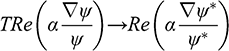 (3.3)
(3.3)
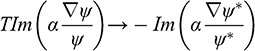 (3.4)
(3.4)
Thus, only the imaginary part transforms with the required minus sign, thereby ensuring time-reversal invariance. The resulting guidance equation is therefore fixed as:
 (3.5)
(3.5)
This line of reasoning explains why the canonical form of the guidance equation employed in BM is not an arbitrary choice but the outcome of enforcing a heuristic-methodological constraint – namely, that the simplest Galilean-invariant formulation must also be time-reversal invariant. This justification is not, of course, free of issues (see Skow Reference Skow2010 for criticism). Be that as it may, it is clear from this concrete case which role time-reversal invariance can play under the by-stipulation view: Time reversal is not an afterthought but an active heuristic principle in the very construction of the theory. The philosophical payoff is clear: The case of BM shows that “by-stipulation” time-reversal invariance can act as a powerful heuristic, narrowing the range of theoretical options and even fixing core elements of a theory’s ontology. The “right” form of the time-reversal transformation is then decided not by speculating about the “intrinsic nature” of time reversal or what time is, but by imposing theoretical constraints in developing a physical theory. In other words, the demand for time-reversal invariance does not merely decorate an already given formalism; it helps to shape what counts as the theory itself.
3.4 Taking Stock
This section has aimed to uncover yet another source of divergence in the debates surrounding time reversal. In this case, the emphasis fell on the role of time reversal qua symmetry. I argued that two distinct goals are often in play, and that their misalignment risks muddying the waters. On the one hand, intuitive approaches tend to treat time reversal as a powerful probe into the temporal structure of reality. From this perspective, time-reversal invariance is conceived as a contingent property of the world – something to be discovered, tested, and perhaps denied. In my terminology, this is by-discovery symmetry (and, in particular, by-discovery time-reversal symmetry).
By contrast, the standard, mainstream view treats symmetries not as empirical features awaiting discovery but as heuristic principles guiding the very construction of theories, by-stipulation symmetry. On this view, time-reversal symmetry is not a possible property of the world that we strive to detect, but a methodological stipulation that helps us build elegant and well-behaved physical theories. The tension is clear: what strikes one camp as a blatant triviality strikes the other as a fundamental misapplication of the concept. The result is a systematic talking-past-one-another.
Yet, if anything, this misalignment is instructive. By disentangling these aims, motivations, and strategies, we gain a clearer sense of how differently “time reversal” operates across contexts. What looks like a purely formal transformation in one setting can appear as a metaphysical key in another; what is a methodological constraint for the physicist becomes a substantive hypothesis for the metaphysician. The lesson, then, is that to understand time reversal in its full depth, we must chart not only its formal and metaphysical terrain, but also its heuristic–methodological role in the relation between physics and philosophy of physics.
4 Time Reversal and the Direction of Time
The concept of time reversal is philosophically rich in its own right, offering fertile ground for debates about the nature of time, the ontology of physical theories, and the role of symmetries in science. Yet its influence is perhaps most visible in discussions of the direction of time. As I have argued throughout this work, any implementation of time reversal depends on prior conceptualizations, themselves shaped by broader metaphysical and heuristic-methodological commitments. When carried into the debate on temporal direction, the concept of time reversal thus already arrives laden with conceptual complexity. The pressing question, then, is how this inherited complexity affects our understanding of the direction of time.
The problem of the direction of time itself is contested. As John Earman noted, there is no clarity about what the problem is supposed to be (1974, p. 15). Some view it as a question of justifying our temporally asymmetric experience (Price Reference Price and Callender2011). Others frame it in terms of entropy and the apparent tension between irreversible thermodynamics (Second Law) and time-reversal invariant statistical mechanics (Reichenbach Reference Reichenbach1956; Callender Reference Callender1997; Albert Reference Albert2000; Loewer Reference Loewer2012). Closely related is the debate over the so-called Past Hypothesis, which postulates a very low-entropy initial condition of the universe (Albert Reference Albert2000; Price Reference Price1996; see Earman Reference Earman2006 for critique).
In a broad sense, these all concern the direction of time, but I remain skeptical that they capture its core. To reduce the direction of time to the thermodynamic arrow, for instance, is to assume that temporal directionality can be explained entirely (or reduced entirely) in terms of entropy increase. Yet, as Sklar (Reference Sklar1974) and Earman (Reference Earman1974) emphasize, this is far from obvious. Similar reductionist strategies – whether appealing to growing complexity (Barbour Reference Barbour2020), to the radiation asymmetry in electromagnetism (Zeh Reference Zeh1999), or to other physical asymmetries – rest on the same assumption: that the direction of time reduces to some non-temporal feature of the world.
I suggest a more general way of framing the issue (Lopez Reference Lopez2025a, Reference Lopez2025b; Lopez and Esfeld Reference Lopez and Esfeld2025). The central problem is not whether time has a direction – virtually all physical theories and most philosophical views accept that it does. Neither is it about whether the direction of time exists –putting aside strong eliminativist views (see Farr Reference Farr2020), of course it does! The problem, it seems to me, is about how this direction exists. Is it primitive, irreducible? Or is it derivative, reducible to other asymmetries, and emergent from deeper structures? From this perspective, two families of views can be distinguished: reductionism and primitivism.
Reductionists contend that the direction of time requires explanation, typically by appeal to non-temporal asymmetries. Following Reichenbach (Reference Reichenbach1956) and Sklar (Reference Sklar1974), they define time’s direction as the direction in which some magnitude increases. On this view, entropy has long been the leading candidate: since Boltzmann, the strategy has been to reconcile time-reversal invariant microscopic laws with macroscopic irreversibility by positing a very special initial condition, the Past Hypothesis. This approach underlies the influential “Mentaculus” of Albert (Reference Albert2000) and Loewer (Reference Loewer2012). While elegant, the model rests heavily on justifying the Past Hypothesis – a task dubbed the “hard problem” of temporal direction (Goldstein Reference Goldstein, Bricmont, Dürr and Galavotti2001). Some respond by promoting the Hypothesis to the status of law (for instance, Albert and Loewer do it by relying on the best system approach to laws), though critics argue that such a move is neither necessary nor well-motivated (Earman Reference Earman2006; Barbour Reference Barbour2020; Lazarovici and Reichert Reference Lazarovici and Reichert2020).
Primitivists, by contrast, deny that the direction of time calls for further explanation. For them, temporal orientation is itself fundamental: It explains why entropy increases, why radiation propagates outward, and why the universe expands; all of them temporally biased verbs. As Maudlin (Reference Maudlin2002), Mozersky (Reference Mozersky2015), and I (Lopez Reference Lopez2022, Reference Lopez, Lopez and Lombardi2025a, Reference Lopez2025b; Lopez and Esfeld Reference Lopez and Esfeld2025) argue, we cannot even make sense of temporally asymmetric predicates without presupposing a direction of time. The point is structural: just as we postulate spatial or causal structures to account for phenomena, so too we must postulate temporal orientation. Historically, Newton’s doctrine of absolute time is the classic articulation of this view, while contemporary defenders include Earman (Reference Earman1974), Maudlin (Reference Maudlin2002), Castagnino & Lombardi (Reference Castagnino and Lombardi2009), Mozersky (Reference Mozersky2015), and myself (Lopez Reference Lopez2025a, Reference Lopez2025b; Lopez and Esfeld Reference Lopez and Esfeld2025). Their arguments vary, but all converge on the claim that temporal direction is built into the very fabric of spacetime, whether conceived substantivally (as an intrinsic orientation at each point, Maudlin Reference Maudlin2002 and Mozersky Reference Mozersky2015) or relationally (as in Lopez and Esfeld Reference Lopez and Esfeld2025).
In what follows, I will focus specifically on the relation between time-reversal invariance and the direction of time, setting aside alternative approaches to the problem and its potential solutions.
4.1 Time-Reversal Invariance and the Direction of Time
What is the precise relation between time-reversal invariance and the direction of time? A widespread assumption in the literature is that time-reversal invariance implies temporal isotropy, that is, the absence of any intrinsic direction of time (see Mehlberg Reference Mehlberg1961; Horwich Reference Horwich1987; Price Reference Price1996; Arntzenius Reference Arntzenius1997; Maudlin Reference Maudlin2002; Loewer Reference Loewer2012). On this view, if the dynamical laws of physics are invariant under time reversal, then they effectively deny any built-in temporal orientation, and hence provide a challenge to primitivist accounts of the direction of time. Tim Maudlin formulates the point with clarity:
The usual approach sets the problem as follows: the fundamental physical laws have a feature called ‘Time Reversal Invariance’. If the laws are time-reversal invariant, then it is supposed to follow that physics itself recognizes no directionality of time.
This line of thought has deep roots. H. Mehlberg had already articulated a similar view in the 1960s:
In mathematical parlance, temporal isotropy in scientific contexts is, therefore, tantamount to the covariance of laws of nature under time reversal. This amounts to asserting that within science time’s arrow will have to be rejected if the laws of nature remain unaltered and valid in a universe whose past and future are interchanged with ours.
Paul Horwich (Reference Horwich1987) develops this connection even further, making time-reversal invariance a litmus test for temporal anisotropy:
In addition, the account should help us to understand why the existence of time-asymmetric laws [i.e., non-time-reversal invariant laws, in my vocabulary] is generally taken to guarantee time’s anisotropy.
What emerges here is not an isolated observation about time and time-reversal invariance, but rather a more general moral about how spacetime symmetries are typically interpreted. Lawrence Sklar (Reference Sklar1974) emphasizes that symmetries such as invariance under translations, rotations, reflections, and boosts – together with time reversal – are closely tied to our understanding of spacetime itself:
Some of the important symmetries of physical laws are the invariance of laws under translation in space, invariance under translation in time, invariance under spatial rotation, invariance under change of inertial frame, invariance under spatial reflection, and so-called time-reversal invariance. All of these invariance principles are intimately related to the structure of the spacetime in which the material happenings of the world occur.
The overarching idea, then, is that there must be some correspondence between the symmetries of the dynamical equations and the symmetries of spacetime itself. In other words, time-reversal invariance in the laws is often taken to signal the absence of an intrinsic direction of time in the structure of the world. John Earman (Reference Earman1989) and Jill North (Reference North2009, Reference North2021) have made this correspondence principle explicit at the general level, formulating it as an “adequacy criterion” (Earman) or a “methodological principle” (North). As Earman succinctly puts it: “The realization that laws of motion cannot be written in the air alone but require the support of various space-time structures.” (Earman Reference Earman1989, p. 46)
North develops these methodological principles as follows:
Yet we tend to infer that there is no more structure to the world than what the fundamental laws indicate there is. Physics adheres to the methodological principle that the symmetries in the laws match the symmetries in the structure of the world. This is a principle informed by Ockham’s razor; though it is not just that, other things being equal, it is best to go with the ontologically minimal theory. It is not that, other things being equal, we should go with the fewest entities, but that we should go with the least structure. We should not posit structure beyond that which is indicated by the fundamental dynamical law.
More generally, I believe, these considerations belong to what Shamik Dasgupta (Reference Dasgupta2016) has aptly called “symmetry-to-reality inferences” (see also Baker Reference Baker2010). The guiding thought is that the symmetries of our best dynamical theories provide constraints on, or even direct insight into, the fundamental structure of reality. My own view is that this inferential mechanism must be handled with great caution, and that one should resist drawing straightforward metaphysical conclusions from dynamical symmetries alone (see López Reference Lopez2023b, Reference Lopez2024). Yet the important point, for present purposes, is that the majority of arguments connecting time-reversal invariance with the denial of a primitive direction of time rely on precisely this sort of inferential mechanism.
Indeed, elsewhere (López Reference Lopez2023a, Reference Lopez, Lopez and Lombardi2025a), I have dubbed this line of reasoning the “dynamical argument” or the “time-reversal argument”:
P1. If the dynamical laws are time-reversal invariant, then a primitive direction of time is metaphysically unnecessary. [assumption]
P2. We should not posit unnecessary structures. [parsimony]
P3. Most dynamical laws are, in fact, time-reversal invariant. [empirical premise]
P4. Therefore, a primitive direction of time is unnecessary. [from P1 and P3]
C. Hence, we should not posit a primitive direction of time. [from P2 and P4]
This argument has been widely influential, but also widely contested. Sklar, for example, voices a pointed skepticism:
Do the proponents of this position really wish to allege that if the laws of nature all do turn out to be time-reversal invariant, our whole impression that the world of events is a world in which an asymmetric temporal priority relates event to event is an illusion?
I do not think the argument requires us to regard temporal asymmetry as illusory. Nevertheless, I do think it faces serious challenges, both conceptual and methodological (see López Reference Lopez2023b, Reference Lopez2024, Reference Lopez, Lopez and Lombardi2025a). For the purposes of this section, however, the key point is that the inferential structure of the argument – the move from time-reversal invariance to the denial of a primitive direction of time – rests on assumptions about symmetry, structure, and parsimony that are far from straightforward. And, as I will suggest, the conceptual complexities already discussed in previous sections cast significant doubt on the reliability of this inferential mechanism, which has long been considered central to the philosophical problem of the direction of time.
4.2 Time Reversal, but Which One?
P3 in the “time-reversal argument” claims that (fundamental) dynamical laws, in the overwhelming majority of physical theories, are time-reversal invariant. But this seemingly straightforward claim immediately raises a critical (now obvious) question: under which time-reversal transformation? As I have emphasized throughout this Element, time reversal is a conceptually complex notion, one whose formalization is deeply shaped by both metaphysical assumptions and heuristic-methodological commitments. The fact that physicists typically employ a particular definition of time reversal does not mean that this definition is the one most apt for philosophical inquiry. Much depends on how the transformation is conceptualized and implemented. And once we recognize this, two kinds of outcomes become possible. On the one hand, alternative definitions of time reversal may lead us to conclude that some theories traditionally thought to be time-reversal invariant are not. On the other hand, certain ways of construing time reversal may even suggest that applying the transformation to problems such as the direction of time is off the right track.
Consider first the received view of time reversal (as laid out in Sections 1 and 2). According to this view, time reversal is understood primarily as motion reversal, that is, a transformation that operates analogously to equations (1.3) and (1.5). I have shown how this approach is implemented in both classical and quantum mechanics, and in this sense, most physical theories do turn out to be time-reversal invariant. Thus, the truth of P3 is conditional: If time reversal is defined as in the received way, then P3 holds. This account, as argued, is not arbitrary – it enjoys justification both in terms of physical constraints and in terms of a relational metaphysics of time (see Section 2 and 2.4).
By contrast, under the so-called pancake view – where time reversal is defined either as simply reversing the temporal order (1.2) or as geometrically inverting the temporal axis
 (as in (1.4), or as Savitt’s time-reversal invariance1) – most theories turn out to be non-time-reversal invariant. This is the line defended by Albert (Reference Albert2000), Callender (Reference Callender2000), and me (2019). In this framework, P3 no longer holds. Yet, importantly, this view is not without motivation: It rests on different metaphysical assumptions about what it means to “reverse time.” And while it may seem at odds with how physicists usually implement time reversal in practice, one could argue – plausibly – that reversing time properly ought to resemble something like the pancake view, and that the so-called time-reversal transformation in physics does not genuinely represent time reversal (this is Callender Reference Callender2000’s argument, where he distinguishes between time reversal and Wigner reversal). Indeed, many physicists acknowledge that “time reversal” in physics really amounts to motion reversal, which in itself suggests a degree of conceptual caution (see Section 2 and 2.5).
Here, then, is the first way in which the debate about the direction of time hinges on our conceptualization of time reversal. Even if one accepts the overall structure of the “time-reversal argument,” P3 may or may not hold depending on which transformation is judged to capture the concept of time reversal. And this in turn reflects deeper metaphysical commitments – for example, commitments about the nature of time itself. In this sense, the argument is underdetermined: There is no univocal notion of time reversal, and consequently, no clear consensus on whether fundamental laws are time-reversal invariant in any philosophically relevant sense (see Lopez Reference Lopez2023a).
But this is only one axis of divergence. A second concerns the heuristic-methodological approach to symmetries more generally. As argued in Section 3, if we adopt the by-stipulation (or textbook) account, then the very idea of using time reversal to probe the temporal structure of the world is misguided from the outset. On this account, time-reversal invariance is not a metaphysical tool but a stipulated heuristic principle – a normative guideline in the construction of physical theories. Symmetries, in this sense, are built into the framework, stipulated rather than discovered in the world. If so, then time-reversal invariance carries no metaphysical weight: It tells us nothing about the direction of time.
This brings us to a crucial point: for the “time-reversal argument” to even get off the ground, one must presuppose that time-reversal invariance is not merely a heuristic principle but a conceptual tool capable of revealing features of the world’s temporal structure. In other words, the argument tacitly assumes something like the by-discovery view of symmetries. Without this assumption, the argument loses its significance. This is not to say that the by-discovery view is correct – far from it – but it does show that the very formulation of the argument relies on taking it somehow for granted. And this is where the real difficulty lies: The “time-reversal argument” (and with it, the problem of the direction of time) does not simply depend on the physical facts about our best theories, but on deep philosophical assumptions about what time reversal is, how symmetries relate to reality, and whether they can legitimately guide our metaphysics of time.Footnote 17
One potential way forward is to identify a clear case in which time-reversal invariance is violated under any plausible notion of time reversal, and where the violation is sufficiently fundamental and robust to count as physically relevant for the arrow of time. A frequently cited candidate is the decay of neutral kaons in weak interactions. Whether this phenomenon constitutes a genuine violation of time-reversal symmetry, and whether it is significant enough to ground a physical arrow of time, remains contested. Huw Price, for instance, argues that it does not (Price Reference Price and Callender2011), as does Paul Horwich (Reference Horwich1987). Others, by contrast, maintain that such phenomena provide strong evidence for a physics-based temporal direction. Roberts (Reference Roberts2022) offers a sustained defense of this latter position. In essence, his argument relies on adopting the Representational View. He argues that:
… the symmetries of time are ‘projected’ down onto the state space of a dynamical theory by a representation, just as the symmetries of a table are projected by its shadow down onto the floor. As a result, T violation on the state space of electroweak theory teaches us not only about state space but about the structure of time itself
In this domain, the Representational View is particularly compelling, notwithstanding the reservations raised in the preceding discussions. On this point, I agree with Roberts: Electroweak theory provides a strong case for a direction of time grounded in the violation of time-reversal invariance, independently of the specific notion of time reversal one adopts. The Representational View helps us to see it. This is not to say that the argument is immune to further criticism, nor that it settles all questions concerning the arrow of time. Still, given our current understanding, it offers the most robust physics-based candidate available if time reversal is taken as relevant for the discussion.
4.3 Taking Stock
In this short section, I have sought to show how the conceptual complexity of time reversal profoundly shapes debates in which the notion plays a central role. In the case of the problem of the direction of time, it is now clearer how deep these divergences run and how easily we risk falling into conceptual unclarity and talking-past-each-other debates. A normative-heuristic view of time-reversal invariance, for example, makes the problem (as formulated in the Introduction to Section 4) trivially circular. Yet this is not an argument against the normative-heuristic perspective itself. Rather, it is a reason to insist that if such a view is adopted, it should not be applied to the metaphysical problem of the direction of time. This recognition may prompt reformulations of the problem, or alternatively, a reconsideration of how we conceptualize time reversal in the first place.
Acknowledging these tensions pushes us to clarify our concepts, to make explicit their divergent aims and motivations. As I have repeatedly stressed, the debate ultimately scales upward: Its resolution does not lie in more technical formalism or sharper physical skills, but in a reflective examination of the conceptual frameworks and methodological drivers at work. Naturally, some views may appear more compelling than others, and often their appeal will depend on the context in which they are applied. But if there is a lesson to draw, it is this: To understand time reversal and its bearing on the direction of time, we must confront not just the physics, but the philosophical commitments that shape how we deploy the concept in the first place.
Conclusion: Time Reversal, from Physics to Philosophy and Back
In the Family Guy episode “Yug Ylimaf,” time runs backward, cups refill themselves, words are spoken in reverse, and the universe seems to obey a radically different set of rules. It is, of course, funny precisely because it is impossible – or at least wildly implausible. The reality of time reversal in physics and the philosophy of physics is far subtler, far less fantastic, and yet conceptually fascinating. Unlike in the realm of science fiction, reversing time is not about replaying a cosmic film; it is a mathematical, physical, but first and foremost, conceptual puzzle. It is about understanding the precise conditions under which our laws of nature could, in principle, remain invariant under temporal inversion, and what that implies about the very structure of reality. In other words, while science fiction lets us fantasize about “rewinding” life’s moments, philosophy and physics compel us to reflect on what it really means to talk about time going backward, and how such talk can be implemented in physics and guide our metaphysical inquiries.
In this Element, I attempted to cover a part of these complexities. Section 1 laid the groundwork by examining what is often called the “received view” of time reversal. Here, I showed that the notion of time reversal is not merely a formal operation or a convenient mathematical artifice; it is intimately tied to the physical and conceptual architecture of the theories in which it appears. In classical mechanics, for instance, time reversal involves reversing the motion of particles in ways that are consistent with classical equations; in quantum mechanics, it requires conjugating the states to ensure invariance. The section highlighted that from concepts to physics to mathematics, there exists a chain of reasoning linking our understanding of what time reversal is, how it is represented mathematically, and which physical constraints should be applied. Recognizing this chain is crucial: It demonstrates that time reversal is a notion that straddles multiple layers of understanding, from our abstract ideas about temporal symmetry to the concrete technical tools used to implement it.
Section 2 then explored the metaphysical underpinning of time reversal. Here, I argued that our conceptualization of it is not neutral; it is guided by assumptions about the nature of time. The received view, I showed, is strongly motivated by temporal relationalism, in which temporal intervals exist only in relation to change, while alternative views – such as the so-called pancake view – can be motivated by temporal substantivalism, where time is an entity that exists independently of events. The case study of time reversal in quantum mechanics demonstrated how these metaphysical assumptions are not idle speculation: They shape the very definition and implementation of time reversal in physics, and they influence whether we consider a law to be time-reversal invariant in a philosophically meaningful sense. Metaphysics, in this context, is not a distant speculation – it is a compass guiding how we interpret, constrain, and apply the formal machinery of physics.
Section 3 shifted the focus from metaphysics to heuristic and methodological considerations. Time reversal is not only about what the world is, but also about how physicists construct theories to explore it. I distinguished between two accounts of symmetries: The by-stipulation or textbook account, where symmetries are imposed as formal constraints to organize and guide theory construction; and the by-discovery or intuitive account, where symmetries are discovered as patterns or structures in the behavior of the world. These divergent heuristic-methodological strategies are far from trivial; they dictate how time reversal is conceptualized, which transformations are deemed legitimate, and which results are considered physically meaningful. The case study of BM illustrated how conceiving time reversal as a stipulated symmetry guides the development of the theory’s dynamics. The upshot is that conceptual clarity requires attending not only to metaphysical assumptions but also to the heuristic-methodological scaffolding upon which our physical theories are built.
Section 4 brought these threads together by exploring their implications for the debate about the direction of time. Depending on which conceptual and methodological view is endorsed, the same laws of physics may appear time-reversal invariant or not; the very assumptions of the problem depend on how the transformations in play are interpreted. I showed that failure to recognize these divergences can lead us to see apparent contradictions, trivial conclusions, or circular arguments. At the same time, acknowledging the plurality of perspectives opens the door to a richer understanding of time reversal, clarifying what its different implementations can, and cannot, tell us about the world’s temporal structure. This section, perhaps more than any other, underscores the stakes of philosophical reflection upon time reversal and related philosophical problems.
Taken together, the sections demonstrate that time reversal is not a sci-fi device, not a lever to rewind our mistakes, and not a magic button to undo the past – but it may be a lens through which we can examine the fundamental assumptions embedded in our physical theories scaffolding. By dissecting the received view, showing alternative time-reversal transformations, revealing the metaphysical drivers, elucidating the heuristic-methodological divergences of time-reversal invariance, and tracing the consequences for debates on the direction of time, this Element has aimed to show that the study of time reversal shows a complex and rich terrain for philosophical inquiry. In the end, the philosophy of time reversal may not let us “rewrite history,” but it teaches us to read it more attentively. It shows us that the philosophy of physics is not merely a descriptive enterprise – it can be an act of conceptual speleology.
Acknowledgments
This Element is a synthesis of six years of work on time reversal, both in Argentina and in Switzerland. I’m immensely grateful to my former PhD supervisors, Olimpia Lombardi and Michael Esfeld, for their support, motivation, and discussions on this topic. I changed my mind many times on the road thanks to numberless discussions with colleagues over the years and interactions with audiences in many places. To all of them, thanks, but especially to Bryan Roberts, Karim Thébault, Carl Hoefer, Craig Callender, Dustin Lazarovici, Andrea Oldofredi, Frida Trotter, Sebastián Fortín, and Federico Holik. With all of them, I have had enriching discussions that made me think twice about what I was saying or assured me that I was on to something. I also thank to the Buenos Aires Group of Philosophy of Particular Sciences and the Buenos Aires Group of Metaphysics of Science, where I have many times presented my work-in-progress.
This work was supported by the SNSF Project 105212B_200464, by the University of Lausanne, and by the National Scientific and Technical Research Council (CONICET) of Argentina.
James Owen Weatherall
University of California, Irvine
James Owen Weatherall is Professor of Logic and Philosophy of Science at the University of California, Irvine. He is the author, with Cailin O’Connor, of The Misinformation Age: How False Beliefs Spread (Yale, 2019), which was selected as a New York Times Editors’ Choice and Recommended Reading by Scientific American. His previous books were Void: The Strange Physics of Nothing (Yale, 2016) and the New York Times bestseller The Physics of Wall Street: A Brief History of Predicting the Unpredictable (Houghton Mifflin Harcourt, 2013). He has published approximately fifty peer-reviewed research articles in journals in leading physics and philosophy of science journals and has delivered over 100 invited academic talks and public lectures.
About the Series
This Cambridge Elements series provides concise and structured introductions to all the central topics in the philosophy of physics. The Elements in the series are written by distinguished senior scholars and bright junior scholars with relevant expertise, producing balanced, comprehensive coverage of multiple perspectives in the philosophy of physics.