





Introduction
Roughly half of the languages spoken today have grammatical gender (Corbett, Reference Corbett1991), according to which the nouns of a language are divided into categories such as masculine and feminine, based on semantic and/or morpho-phonological features. Grammatical gender is not only determined by the noun itself (assignment) but also marked on surrounding words (agreement), including definite and demonstrative articles, relative pronouns, verbs, and adjectives (see Stöhr et al., Reference Stöhr, Akpınar, Bianchi, Kupisch, Braunmüller and Gabriel2012). Although grammatical gender might seem costly in terms of learning and processing, previous work using online techniques has shown that it can facilitate speech processing (e.g., Lew-Williams & Fernald, Reference Lew-Williams and Fernald2010; Wicha et al., Reference Wicha, Moreno and Kutas2004). This type of research mostly focused on using definite articles as a gender cue in West-Germanic and Romance languages, whereas comparable studies on the use of gender in Slavic languages, which lack definite articles but mark gender on adjectives, are scarce. The aim of the present study is to examine whether Russian-speaking children compared to adults are able to use gender as a cue to anticipate the upcoming noun during online sentence comprehension. More specifically, the focus will be on the use of adjectives, as they are grammatically marked in correspondence with the nouns they agree with in Russian.
Previous studies have demonstrated that monolingual adults are faster to respond to nouns preceded by informative cues to grammatical gender than to nouns without such cues. This pattern has been replicated in many languages such as French (Grosjean et al., Reference Grosjean, Dommergues, Cornu, Guillelmon and Besson1994; Dahan et al., Reference Dahan, Swingley, Tanenhaus and Magnuson2000), German (Cholewa et al., Reference Cholewa, Neitzel, Bürsgens and Günther2019; Friederici & Jacobson, Reference Friederici and Jacobson1999; Hopp & Lemmerth, Reference Hopp and Lemmerth2018), Spanish (Lew-Williams & Fernald, Reference Lew-Williams and Fernald2010; Wicha et al., Reference Wicha, Moreno and Kutas2004) and Dutch (Brouwer et al., Reference Brouwer, Sprenger and Unsworth2017; Huettig & Janse, Reference Huettig and Janse2016). Besides adults, monolingual children have also been tested to investigate whether gender-marking facilitates their speech processing. Lew-Williams and Fernald (Reference Lew-Williams and Fernald2007) examined grammatical gender processing in 2- to 3-year-old Spanish learning toddlers as well as an adult control group in a looking-while-listening paradigm. Participants were presented with pairs of pictures that either had the same gender (e.g., la pelota, “thefem ballfem,” la galleta, “thefem cookiefem”) or different gender (e.g., la pelota “thefem ballfem,” el zapato, “themasc shoemasc”). Immediately after presentation of the visual stimuli, the participants heard simple sentences (e.g., Encuentra la pelota. ¿La ves? “Find the ball. Do you see it?”) that contained one of the two objects on the screen (i.e., the target). It was found that Spanish adults and children were faster to look at the target picture on trials when pictures had different compared to the same gender, because in the first case they could use the gender after hearing the definite article, allowing them to narrow down possible lexical candidates. The effect was measured from the onset of the noun onward. This indicates that both groups were able to use grammatical gender to facilitate their sentence comprehension.
Following Lew-Williams and Fernald’s (2007) experimental set-up, Brouwer et al. (Reference Brouwer, Sprenger and Unsworth2017) tested 4- to 7-year-old Dutch-speaking children and an adult control group on a visual-world eye-tracking paradigm (Cooper, Reference Cooper1974; Tanenhaus et al., Reference Tanenhaus, Spivey-Knowlton, Eberhard and Sedivy1995) to assess whether they could use gender-marking to not only recognize a noun faster but also to predict it before it was heard. In order to do this, they added an adjective in between the gender-marked definite article and the noun (e.g., Waar is de groene lamp? “Where is the green lamp?”; see also Cholewa et al., Reference Cholewa, Neitzel, Bürsgens and Günther2019; Loerts et al., Reference Loerts, Wieling and Schmid2013; Melançon & Shi, Reference Melançon and Shi2015). This inclusion of an adjective extended the period during which gender effects could be found and allowed them to differentiate between effects of grammatical knowledge and knowledge of co-occurrence probabilities between the article and the noun (Dahan et al., Reference Dahan, Swingley, Tanenhaus and Magnuson2000). It also aided in teasing apart anticipation from facilitation effects. The main difference between the two is that anticipation refers to predictively constructing interpretations for the words that are not yet perceived, whereas facilitation refers to the integration of perceived information (e.g., Federmeier, Reference Federmeier2007; Lukyanenko & Fisher, Reference Lukyanenko and Fisher2016). More specifically, an anticipatory effect entails that participants are able to predict which noun is coming up on the basis of preceding information. To measure this effect, eye movements on same and different gender trials are compared before the noun itself is uttered (e.g., from the onset of the article until noun onset). In contrast, a facilitation effect implies that participants recognize the noun faster on different than same gender trials, as measured from noun onset until noun offset. The results of Brouwer et al. (Reference Brouwer, Sprenger and Unsworth2017) demonstrated that Dutch children who were successful in producing correct gender-marked definite articles were able to anticipate the gender of the upcoming noun, whereas children who were not successful in producing correct definite articles only showed a facilitation effect.
To date, the research on the role of grammatical gender in online sentence processing mostly focused on languages with definite articles such as Spanish (Lew-Williams and Fernald, Reference Lew-Williams and Fernald2007), Dutch (Brouwer et al., Reference Brouwer, Sprenger and Unsworth2017), or Italian (e.g., Caffarra et al., Reference Caffarra, Siyanova-Chanturia, Pesciarelli, Vespignani and Cacciari2015). This work has shown the importance of the definite article for language learning, but the question arises how this works for languages without definite articles. The focus in the current study will be on Russian which has a grammatical gender system with three possible genders (masculine, feminine, and neuter). However, gender is not marked on definite articles, as they do not exist in Russian, but on a much more extended set of agreement cues such as adjectives, demonstratives, possessives, quantifiers, certain numerals, and (past tense) verbs, by means of inflection. In this study, the focus will be on adjectives that carry a grammatical gender cue. Furthermore, gender is generally expressed on the noun by means of a suffix (see Rodina & Westergaard, Reference Rodina and Westergaard2017). Most of the neuter nouns end in -o or its allomorphs (e.g., белое облако beloe oblako “whiteneut cloudneut”), the feminine nouns in -a or its allomorphs (e.g., белая машина belaja mašina “whitefem carfem”), and the masculine nouns end in consonants (e.g., белый снегØ belyj snegØ “whitemasc snowmasc,” see Table 1). The endings (i.e., inflectional suffixes) depend not only on the gender but also on the case and the number of the following noun.
Possible endings of the adjectives in singular, nominative case in Russian

* Variation in forms depends on a preceding consonant (soft vs. hard)
Both morphophonological and semantic factors can influence gender assignment. Gender is highly transparent for at least 90% of the Russian nouns (Sekerina et al., Reference Sekerina, Brooks and Kempe2006). In other words, for the majority of nouns, gender can be predicted on the basis of the morpho-phonological form. This is the reason why transparency has shown to be such an important predictor in recent empirical research on the acquisition of gender in monolingual Russian children (e.g., Rodina & Westergaard, Reference Rodina and Westergaard2012), as well as heritage speakers of Russian that acquired Russian from birth (e.g., Mitrofanova et al., Reference Mitrofanova, Rodina, Urek and Westergaard2018), and simultaneous bilingual children (Rodina et al., Reference Rodina, Kupisch, Meir, Mitrofanova, Urek and Westergaard2020; Rodina & Westergaard, Reference Rodina and Westergaard2017). It is estimated that about 10% of the nouns are nontransparent and therefore have various possible endings. The role of semantics is argued to be less important in Russian; it is only relevant for a limited set of nouns that distinguish male versus female human beings and certain animals (Rodina & Westergaard, Reference Rodina and Westergaard2012, Rodina, Reference Rodina2014).
In Russian, adjectives do not have to be immediately adjacent to the nouns they modify. The adjective can be separated from the head noun in sentence-initial position (e.g., Красную положите бабочку в пакет Krasnuju položite babočku v paket red put butterfly in paper bag “Put the red butterfly in the paper bag”). This split-constituent construction, which encodes contrastiveness, is a marked option compared to the canonical and regular nonsplit scrambled word order.
Only few studies have looked at the role of grammatical gender in predictive processing in Russian. Akhutina et al. (Reference Akhutina, Kurgansky, Polinsky and Bates1999), for example, tested Russian-speaking adults using the cued-shadowing procedure. In a cued-shadowing procedure, participants are asked to repeat a second word (noun) in a word pair primed by a cue that contains the first word (an adjective with an ending congruent with the gender of the subsequent noun). It was found that Russian adults are able to exploit gender agreement cues online as demonstrated by faster shadowing latencies for primed nouns, which helped them to recognize the upcoming word faster. However, the cued-shadowing task involves a combination of recognition and production components, which therefore provides less direct insight into processing.
Sekerina and her colleagues have investigated the effect of gender as a cue in Russian during eye-tracking. First, Sekerina et al. (Reference Sekerina, Brooks and Kempe2006) tested native Russian adults on using adjectives to anticipate transparent and nontransparent nouns in split constituent constructions (i.e., adjective-verb-noun). Note that the distance between the adjective and the noun in such sentence constructions allows for examining the gender effect prior to hearing the onset of the noun. In that study, each sentence contained a feminine or masculine noun with a gender-matching color adjective, while participants were seeing a display with two objects of the same color (target and competitor, one masculine, and one feminine) and two distractor objects of different colors (one masculine and one feminine). Results showed that participants initiated eye movements to both the transparent and the nontransparent noun immediately after hearing the adjective and prior to the occurrence of both noun types. However, the amount of competition between the target and competitor was stronger for nontransparent than transparent nouns.
Second, Sekerina (Reference Sekerina and Makarova2012) presented gender-marked color adjectives and target nouns to native Russian adults in both word orders: the nonsplit adjective-noun-verb construction (e.g., Красную машинку положите в позицию 6 Krasnuju mašinku položite v poziciju 6 red car put in position 6 “Put the red car in position 6”) or the split-constituent adjective-verb-noun construction (e.g., Красную положите машинку в позицию 6 Krasnuju položite mašinku v poziciju 6 red put car in position 6 “Put the red car in position 6”). As in Sekerina et al. (Reference Sekerina, Brooks and Kempe2006), the gender-marked color adjective either matched in gender with the target or with both target and competitor. Findings demonstrated that native Russian adults fixated the target noun more and earlier than the color competitor of different gender in both types of word order.
In sum, the previous processing studies on Russian gender-marking have only tested native Russian adults and no children. In addition, the prior work mainly focused on split-constituent constructions, which is the grammatically marked option of word order variation in Russian. To our knowledge, no studies have examined the online use of gender-marking in regular and canonical nonsplit constructions in native Russian children. A limitation of using such constructions is that, in the first instance, it seems to be impossible to disentangle anticipation from facilitation effects as the adjective and the noun are presented adjacent to each other. In order to solve this, the current study presented two adjectives preceding the noun such that true anticipation effects (on the second adjective) could be examined. Covey et al. (Reference Covey, Gabriele and Fiorentino2018) have presented a similar adjective1-adjective2-noun construction in a speeded picture-selection task to adult second language learners of Hindi. They only found a facilitation effect but not an anticipation effect. However, in Hindi, many adjectives agree in number and gender with the noun but some adjectives are invariant and do not realize gender agreement. The second adjective in their stimuli was always invariant, and thus gender uninformative, which is not possible to construct in Russian.
Note that this approach is similar to the previous eye-tracking studies that have looked at the use of gender-marking on definite articles to predict the upcoming noun (Brouwer et al., Reference Brouwer, Sprenger and Unsworth2017; Cholewa et al., Reference Cholewa, Neitzel, Bürsgens and Günther2019; Loerts et al., Reference Loerts, Wieling and Schmid2013; Melançon & Shi, Reference Melançon and Shi2015). In those studies, an adjective was also presented in between the definite article and the noun to not only identify whether participants could recognize the noun faster, but to also examine whether they could predict the noun before it was heard (i.e., during the adjective).
There are two reasons to believe that definite articles might be stronger gender-marking cues for anticipating an upcoming noun than adjectives. The first reason is related to how gender becomes lexically represented during first language acquisition, as gender must be stored as an inherent property of the noun. Schriefers and Jescheniak (Reference Schriefers and Jescheniak1999) have formalized this by assuming that “all nouns of a given grammatical gender are linked to one gender node specifying grammatical gender” (p. 577). Such links or associations between nouns and gender nodes are developing during the course of first language acquisition. Depending on the language, both phonological and semantic cues may aid in determining these links during language acquisition. Regarding the gender classification of nouns, it is important to point out that learners and children, in particular, seem more sensitive to phonological cues than noun semantics when learning which gender to use for which noun. More specifically, children until age 9 have been shown to primarily make use of phonological information present in the suffix (i.e., noun internal information) rather than the gender information present in articles (i.e., noun external information) or semantic information (Karmiloff-Smith, Reference Karmiloff-Smith1979; see also Gagliardi & Lidz, Reference Gagliardi and Lidz2014). In Russian, the noun suffix is typically a reliable cue, and in line with that Russian children display a similar sensitivity to word form when assigning gender (e.g., Mitrofanova et al., Reference Mitrofanova, Rodina, Urek and Westergaard2018). This strong reliance on phonological cues has been argued to arise because they are available before semantic cues, possibly because children start learning to classify nouns before form-meaning mappings are in place (Culbertson et al., Reference Culbertson, Gagliardi and Smith2017).
Furthermore, it seems that during processing, children may also rely on co-occurrence relations and/or transitional probabilities between nouns and gender-marked information to know the gender of the nouns (Grüter et al., Reference Grüter, Lew-Williams and Fernald2012). The co-occurrence probabilities between definite articles and nouns are typically very high. It has, for example, been demonstrated that definite articles may be acquired with nouns as so-called chunks (Grüter et al., Reference Grüter, Lew-Williams and Fernald2012). In addition, Zangl and Fernald (Reference Zangl and Fernald2007) showed that noun recognition was disrupted when 18-month-old English toddlers heard sentences in which the definite article was replaced with a nonce word (Where’s po ball? instead of Where’s the ball?). This result indicated that toddlers use co-occurrence patterns and have expectations that definite articles are followed by nouns. It is expected that links between definite articles and nouns become even stronger in a more mature first language lexicon.
The second reason why adjectives carry potentially weaker gender-marking cues than definite articles is that adjectives are especially challenging to learn as they comprise a more diverse class of words than definite articles. More specifically, adjectives are conceptually complex, can occur in potentially ambiguous syntactic frames (Gentner, Reference Gentner and Kuczaj1982; Gentner & Boroditsky, Reference Gentner, Boroditsky, Bowerman and Levinson2001), and they occur not so frequently in speech to children (Sandhofer et al., Reference Sandhofer, Smith and Luo2000), which reduces the experience children have with adjectives. Compared to definite articles, adjectives can therefore be seen as semantically “heavier” as they do not only convey information about the gender of the noun, but also indicate the (semantic) properties of the noun (e.g., color, shape, etc.).
Although adjectives are complex to learn, Fernald et al. (Reference Fernald, Thorpe and Marchman2010) have demonstrated that the skill to interpret adjective-noun phrases in real time already develops gradually over the third year in English-learning children. Thorpe and Fernald (Reference Thorpe and Fernald2006) have further shown that children at the age of two are able to narrow down the set of possible lexical candidates when adjectives are semantically informative. To our knowledge, no such online studies have been conducted with Russian children. In offline studies, it has been reported, though, that the masculine–feminine gender distinction is established very early on, at approximately the age of three (Gvozdev, Reference Gvozdev1961; Ceitlin, Reference Ceitlin, Bondarenko and Shubik2005, Reference Ceitlin2009). It seems comparatively more difficult to acquire the gender of neuter nouns. The reason for this could be due to its low frequency in the input. It is estimated that the gender of transparent neuter nouns is mastered between three and four years of age, while nontransparent nouns remain problematic until approximately the age of six years (Gvozdev, Reference Gvozdev1961; Ceitlin, Reference Ceitlin2009).
Taken together, the previous research on the acquisition of grammatical gender in Russian has mostly been limited to those that use offline instead of online methods (e.g., Mitrofanova et al., Reference Mitrofanova, Rodina, Urek and Westergaard2018; Rodina & Westergaard, Reference Rodina and Westergaard2012). The online studies that have been reported focused primarily on noncanonical sentence structures. The focus of the current study will be on canonical ones with primarily transparent nouns. Another novel aspect of our study is that we will compare the performance of monolingual Russian children with adults. This group comparison has not often been made before in the literature (but see Rodina, Reference Rodina2014).
The current study
The aim of the current study is to examine whether native Russian-speaking children compared to adults use gender-marked adjectives to anticipate the upcoming noun during online sentence comprehension. More specifically, we tested adults and children ranging in the age between three and six years on canonical sentence structures with predominantly transparent, high-frequency nouns. In a Visual World Paradigm, we presented simple questions that were constructed with two adjectives that preceded the noun, such that we could assess anticipation effects (e.g., Где красивый зеленый стульчик? Gde krasivyj zelenyj stulʹčik? “Where is the prettymasc greenmasc chairmasc?”). On the visual display, two pictures were shown, one of which was the target (e.g., стульчик stulʹčik “chairmasc”) and one the distractor of either the same (e.g., мячик mjačik “ballmasc”) or different gender (e.g., шапочка šapočka “hatfem”).
In line with previous findings (Sekerina et al., Reference Sekerina, Brooks and Kempe2006; Sekerina, Reference Sekerina and Makarova2012), it was expected that Russian adults are able to anticipate nouns on the basis of adjectives. It was expected that the magnitude of the anticipation effect would be larger for adults than for children as adults have built up stronger links between adjectives and nouns due to linguistic experience and/or due to cognitive advantages. Russian children are known to be sensitive to phonological cues that mark gender from age 3, as indicated by error-free performance on transparent nouns by that age (Ceitlin, Reference Ceitlin2009; Gagarina & Voeikova, Reference Gagarina, Voeikova, Stephany and Voekova2009; Gvozdev, Reference Gvozdev1961; Mitrofanova et al., Reference Mitrofanova, Rodina, Urek and Westergaard2018; Rodina & Westergaard, Reference Rodina and Westergaard2012). Any age-related differences between adults and children in our sample are therefore unlikely to be due to competence, but may well reflect an experience-based processing difference. A previous study on gender processing in German indicates that less experienced language users, such as children and L2 learners, more strongly rely on phonological cues than experienced adult L1 users (Bordag et al., Reference Bordag, Opitz and Pechmann2006). Instead of accessing gender information as part of the lemma, which can be activated early on by experienced language users, learners are assumed to process gender information in a more bottom-up fashion and compute grammatical gender based on the information that is available at the noun suffix (i.e., at a slightly later stage of processing). A difference in experience between adults and children could thus affect how fast gender information is retrieved, which may show up as a difference in anticipation. In this study, we therefore focus on the importance of the role of the adjective during processing by zooming in on the time window prior to the noun. Finally, for Russian children between the ages of 3 and 6, we similarly expect the magnitude of the anticipation effect to increase with age, as a result of experience.
Methods
Participants
Participants were adult L1 speakers of Russian (N = 34, M AGE = 22;10 years, SD AGE = 6;2 years, range = 19 to 48 years) and child L1 speakers of Russian (N = 43) of varying ages: three-year-olds (N=6), four-year-olds (N=16), five-year-olds (N=13), and six-year-olds (N=8) (M AGE = 5;1 years, SD AGE = 0;11 years, range = 3;0 to 6;10 years).
The experiment was conducted in Riga, Latvia. All participants were selected from Russian minority families, with children attending Russian minority preschool and adults following a Russian-taught university program. All participants had Russian as their L1, despite Latvian being the only official language in Latvia. Due to varying political and social issues, the Russian-speaking minority is ethnically segregated (Silova, Reference Silova2002; Batelaan, Reference Batelaan2002) and thus they should be considered native speakers of Russian and not heritage speakers. The adults had varying levels of proficiency in Latvian (ranging from level A0 to level B2 of the Common European Framework of Reference for Languages (CEFR). Parents of the children reported no daily exposure to Latvian. For adult participants, the experiment was set up at the University of Latvia, Faculty of Humanities. Children were tested at the Riga preschool educational institution number 259. Note that the child group was a convenience sample, as we tested all children present in our age range at this school. Written consent was provided by the supervisors of these educational institutions. Adult participants and parents of the child participants had to give written consent, indicating that they took part in the experiment voluntarily and could stop at any moment if they wished to do so. For this study, we received ethical approval from the Ethics Assessment Committee of the Faculty of Arts, at Radboud University.
Materials Footnote 1
Similar stimuli were used as in Lew-Williams and Fernald (Reference Lew-Williams and Fernald2007) and Brouwer et al. (Reference Brouwer, Sprenger and Unsworth2017), including colored line drawings of animate and inanimate nouns and recorded question sentences. The same experimental setup was used for both adults and children to make the results comparable to each other. The auditory and visual materials used are described in detail below.
Auditory stimuli
For the auditory stimuli, simple questions were recorded in Russian by a female native speaker in a child-directed pace (see Table 2). All questions were constructed in a similar manner with two adjectives followed by a noun. Two adjectives were used to add more time between the first gender cue (i.e., the ending of the first adjective) and the noun, which allowed us to measure possible anticipation effects.
An example of the segments of an auditory stimulus with accompanying durations

In the current study, we restricted the number of possible endings to nominative case, because nouns in other cases are usually presented in more complex sentences that might be difficult to process for very young children. In addition, plural endings are not used in this study as they carry no information about the gender of the following plural noun.
The first adjective in the question was the word хороший horošij “nice” for animate objects and красивый krasivyj “pretty” for inanimate objects. The second adjective in the question was always a color adjective (красный krasnyj “red,” синий sinij “blue,” желтый želtyj “yellow” or зеленый zelenyj “green”). As target nouns, eight diminutive nouns were used because they are common in child-directed speech in Russian. In addition, previous research has shown that diminutives play an important role in novel word acquisition in Russian children (Kempe et al., Reference Kempe, Brooks, Mironova and Fedorova2003). Nouns were four animate objects (мишка miška “bearmasc.dim,” ёжик ëžik “hedgehogmasc.dim,” птичка ptička “birdfem.dim,” собачка sobačka “dogfem.dim”) and four inanimate objects (мячик mjačik “ballmasc.dim,” стульчик stulʹčik “chairmasc.dim,” книжка knižka “bookfem.dim,” шапочка šapočka “hatfem.dim”). Within each animacy category, two nouns were feminine and two were masculine. We decided not to use neuter gender nouns because the neutral gender is mostly used for abstract nouns like счастье sčastʹe “happiness” or слово slovo “word”; these words are (1) probably not acquired yet by toddlers and (2) hard to find graphical representations for. Out of eight target nouns, seven had a phonologically transparent cue and one was opaque (мишка miška “bearmasc.dim”). The target nouns were selected because they were high-frequency items for children. Apart from diminutive suffixes, all nouns in this experiment were phonologically dissimilar, to avoid effects of phonological competition between the target noun and the distractor.
A total of 32 target sentences were used in this experiment, out of which 16 questions consisted of masculine adjective1-adjective2-noun combinations and 16 questions consisted of feminine adjective1-adjective2-noun combinations.
After the questions had been recorded, we used Praat (Boersma & Weenink, Reference Boersma and Weenink2005) and Audacity© (2019) to adjust sound recordings and to align the onsets and durations of the critical words across the experimental stimuli. The following durations were set for all experimental items: adjective1 – 720 ms, adjective2 – 590 ms, and noun – 780 ms. From the beginning of the sentence, adjective1 onset was set at 480 ms, adjective2 onset at 1200 ms, and noun onset at 1590 ms.
Eight attention getters were recorded. These sentences were words of encouragement, such as У тебя отлично получается! U tebja otlično polučaetsja! “You are doing great!,” Молодец! Molodec! “Well done!,” and Умничка! Umnička! “Smart girl/boy!” to maintain the children’s attention. In addition, a short, royalty-free bell sound was played upon the presentation of the fixation picture.
Visual stimuli
The visual stimuli were cartoon pictures, selected from different websites and free to use, including one of the nouns spoken in the audio stimuli (see Fig. 1). Two different visual representations were found for each noun. The pictures were shown in pairs, one being the target picture (the label of the noun as uttered in the audio stimuli) and another the distractor. Both pictures were presented in the same color, i.e., the color adjective that was labeled in the audio stimuli. Pairs could be either same-gender nouns (Fig. 1A) or different-gender nouns (Fig. 1B).
(A) An example of a same-gender trial (стульчик stulʹčik “chairmasc,” мячик mjačik “ballmasc”) for the question Где красивый зеленый стульчик? Gde krasivyj zelenyj stulʹčik? (“Where is the prettymasc greenmasc chairmasc?”), and (B) An example of a different-gender trial (ёжик ëžik “hedgehogmasc,” собачка sobačka “dogfem”) for the question Где хороший синий ёжик? Gde horošij sinij ëžik? (“Where is the nicemasc bluemasc hedgehogmasc?”).

Eight pictures were chosen as the attention getter items. They were colorful cartoon pictures depicting animals, children, and kindergarten activities. For the fixation screen, a picture of a smiley face was used. All pictures were presented on a gray background.
Procedure
Participants were tested individually by the first author in a quiet room at the educational facility they attended. Children were tested in a kindergarten bedroom and adults were tested in an empty lecture room at the university. Participants were seated in front of a TV monitor while their eyes were recorded using a high-resolution video camera. To make the eye movement recordings easily interpretable, we opted for using a large TV monitor (LG, 78cm diagonal, 1920×1080 Full HD) to present the stimuli. In that way participants had to make larger and more noticeable eye movements to look at the presented stimuli. The same setup was used for both testing locations. OpenSesame (Mathôt et al., Reference Mathôt, Schreij and Theeuwes2012) was used to present the stimuli.
Participants were instructed to look at the TV monitor. Visual stimuli were shown on the screen and audio stimuli were played through speakers. Each participant was presented with one out of four possible lists. These lists were created to counterbalance the color, the side of the target picture, and the picture of the noun. Side was counterbalanced within and between lists (target picture left or right), and the color adjective was counterbalanced between lists (animate target pictures were yellow or blue; inanimate target pictures were red or green). A list consisted of eight blocks of trials. Each block started with one attention getter item at the beginning of the block, followed by four experimental trials (a total of 40 trials).
Each individual trial had the following structure: a fixation picture (smiley face) appeared on the screen simultaneously with the presentation of a fixation sound (bell sound). The fixation screen lasted for 2000 ms followed by a visual stimulus pair that remained on the screen for 4000 ms. Auditory stimuli were presented 1000 ms after the visual stimulus pair had appeared and lasted for approximately 2560 ms.
The experiment lasted approximately five minutes for both age groups. This time limit was chosen to make sure that both groups were tested under the same conditions and toddlers would not get bored and lose their attention. After the experimental task, adult participants filled out a questionnaire. Children’s parents and teachers filled in questionnaires about children at their convenience, either before or after the experimental session. These questionnaires included questions about participants’ sex, age, education, linguistic proficiency in Russian, Latvian and English, and parental education. Child participants were rewarded with stickers at the end of the experiment.
Data processing
The video recordings of participants were coded for gaze location using ELAN software (Wittenburg et al., Reference Wittenburg, Brugman, Russel, Klassmann and Sloetjes2006) by a research assistant who had no knowledge of the Russian language and who was unaware of the purpose of this study. The research assistant examined video recordings frame by frame (40 ms each) and determined whether participants were looking at the left side of the screen, the right side of the screen, in the centre, or away. After this, the looks were categorized as target looks (if participant looked at the target) versus distractor looks (when participant looked at the distractor) in R (R Development Core Team, 2008).
Results
Figure 2 shows the proportion of fixations to targets over time for adults (Fig. 2A) and children (Fig. 2B). The time course is presented from the onset of the first adjective until the end of the noun. To investigate the role of grammatical gender in sentence processing in Russian, we conducted several generalized mixed-effects logistic regression analyses (glmer; Jaeger, Reference Jaeger2008) in R using the lme4 package (Bates et al., Reference Bates, Mächler, Bolker and Walker2015). The dependent variable was categorical with target fixations coded as 1 and distractor fixations as 0. In each model, Trial type (different vs. same gender) was entered as a categorical fixed effect and Time (40 ms bins) as a continuous fixed effect. Trial type was coded as a numeric contrast, that is, Different gender as −0.5 and Same gender as +0.5 (Barr, Reference Barr2008). Time was centered and rescaled. Following a hypothesis testing procedure, main effects of Trial Type, Time, and its interaction were directly entered into the model. We thus ran models for which we had a specific prediction and we did not make use of model comparisons, except for the random effects structure. The most parsimonious model included random effects for Participants and Items and no random slopes.
Target fixation proportions over time for same versus different gender trials for (A) adult and (B) child native speakers of Russian. The start of the anticipation window is marked by the dotted line and the end of the anticipation window by the dashed line.

To analyze anticipation effects, a time frame was chosen starting from 200 ms from the offset of the last syllable of the first adjective (dotted line) until 200 ms after the onset of the noun (dashed line), as the latency to plan and execute a saccade has been estimated to be around 200 ms (Matin et al., Reference Matin, Shao and Boff1993).
Adults
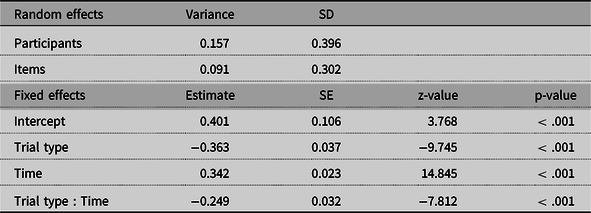
The aim of the first analysis was to investigate the ability of adult speakers to anticipate the gender of the upcoming noun. Table 3 provides the results of the first analysis, which revealed significant effects of Trial type and Time and a significant interaction between Trial type and Time. Figure 3A shows a plot for the interaction between Trial type and Time. The slope of the different gender trials is steeper than the slope of the same gender trials, suggesting that adult speakers of Russian anticipate the upcoming noun on the basis of the first adjective.
Anticipation ability in adults: Results of the glmer model
Plot for the interaction between Trial type and Time. It shows the proportion of target fixations over time for same versus different gender trials for adults (A) and children (B) in the anticipation window. Note that smaller x-axis values indicate points earlier in time.

Children
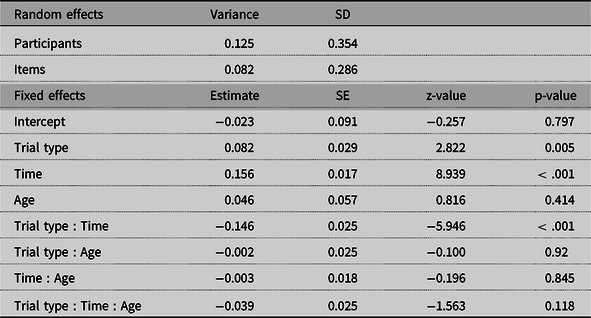
The second analysis looked at the anticipation ability in children Footnote 2 . Besides Trial type and Time, we also included Age (in months) as a continuous fixed factor to the model. Age was not only included as a main effect but also in interaction with Trial Type and Time. This analysis revealed a significant effect of Time, a significant effect of Trial type, and a significant interaction between Time and Trial type (see Table 4). Age was not significant as a main effect nor in interaction with any of the other effects. The plot for the interaction between Trial type and Time (Fig. 3B) shows that children seem to start lower on the intercept for different gender trials than for same gender trials, however, they rapidly start using gender information to look at the target.
Anticipation ability in children: Results of the glmer model
As pointed out by an anonymous reviewer, the sample size is relatively small for the wide age range of children included in this study. To make more reliable claims about the presence or absence of an age effect, we decided to compare anticipation ability between 3- and 4-year-olds (N=22) directly to the 5- and 6-year-olds (N=21) to increase power. This binary variable was contrast-coded. The younger age group was coded as −0.5 and the older age group as +0.5. The results demonstrated an anticipation effect (Trial Type by Time: β=−0.13; se=0.04; z-value=−3.62, p<.001), but more importantly, no significant main effect of Age was found nor did Age interact with the other predictors (Trial Type and Time) in the model (all p>.1). Both analyses thus reveal that children show an anticipation effect, which does not seem to increase with age.
Adults versus children
In our final analysis, we compared the eye gaze behavior of the children with the adults to examine the differences in predicting behavior between those two groups. A new predictor called Group (adults vs. children) was therefore added. It was coded as a numeric contrast (adults as −0.5 and children as +0.5). The continuous factor Age was not included in this analysis any more.
The results for the anticipation window are shown in Table 5. The analysis revealed significant effects of Time, Trial type, and Group. It also showed significant two-way interactions between Trial type and Time, Trial type and Group, and Time and Group. Furthermore, the analysis revealed a significant three-way interaction between Trial type, Time, and Group. Figure 3 shows the plot for this significant three-way interaction. The slope for the adults for different gender trials is much steeper than the slope for the children, indicating that the anticipation effect is stronger in adult speakers of Russian than in child speakers.
Anticipation ability in adults versus children: Results of the glmer model

General discussion
The present study aimed to investigate whether native Russian adults and 3- to 6-year-old children use grammatically marked adjectives to predict the upcoming noun. More specifically, we compared the anticipation effect in children and adults. In a Visual World Paradigm, participants were presented with pairs of pictures displayed on a screen while hearing simple Russian questions (e.g., Где красивый зеленый стульчик? Gde krasivyj zelenyj stulʹčik? “Where is the prettymasc greenmasc chairmasc?”). Those sentences contained one of the displayed pictures (i.e., the target and chair) and a distractor (e.g., ball). Each target noun was preceded by two gender-marked adjectives that allowed us to investigate whether participants could use the gender of the (first) adjective anticipatorily (i.e., before hearing the onset of the noun). Two types of trials were presented: same-gender trials, in which both pictures were of the same grammatical gender (e.g., chairmasc, ballmasc) and different-gender trials, in which the pictures were of different gender (e.g., chairmasc, hatfem). Importantly, in different-gender trials, listeners received an informative gender cue upon hearing the first adjective, allowing them to narrow down possible lexical candidates.
We hypothesized that Russian children and adults could predict upcoming nouns based on gender-marked adjectives. We expected that the ability to predict in children was dependent on age: the older they are, the better they are at prediction. We also hypothesized that adults would show a larger anticipation effect than children.
There were three main findings. First, as predicted, we demonstrated that native Russian adults looked more to targets in different-gender trials compared to same-gender trials (even before hearing the onset of the noun), indicating that they are able to use gender-marked adjectives to anticipate the upcoming noun. This finding is in line with previous work by Sekerina et al. (Reference Sekerina, Brooks and Kempe2006) and Sekerina (Reference Sekerina and Makarova2012), who have shown that Russian adults can predict nouns on the basis of adjectives in both split-constituent constructions as well as nonsplit constructions. More specifically, Sekerina (Reference Sekerina and Makarova2012) demonstrated that the size of this prediction ability was equal for nontransparent and transparent nouns, except that the competition effect appeared to be stronger for nontransparent than transparent nouns. At the same time, Akhutina et al. (Reference Akhutina, Kurgansky, Polinsky and Bates1999) found gender priming effects in Russian for both types of nouns. In our study, we included an unbalanced mix of transparent and nontransparent nouns, which makes it impossible to draw conclusions regarding the role of transparency. A more systematic approach including an equal amount of transparent and nontransparent nouns would be needed to investigate the effect of transparency on grammatical gender processing in Russian.
Second, in line with our predictions, we found that native Russian children use gender-marked adjectives to anticipate the upcoming noun. This is the first study that has investigated the online use of gender-marking in regular and canonical nonsplit constructions in native Russian children. The children in our study had most likely acquired the gender for the nouns used in our study, as previous studies on the acquisition of gender in Russian children have reported that grammatical gender is acquired very early in Russian, and there are hardly any mistakes with transparent gender nouns by age 3 (Gvozdev, Reference Gvozdev1961; Ceitlin, Reference Ceitlin2009; Gagarina & Voeikova, Reference Gagarina, Voeikova, Stephany and Voekova2009). We examined whether the strength of the anticipation effect was associated with age for children, but could not find such an effect (see also Borovsky et al., Reference Borovsky, Elman and Fernald2012). This could be due to the fact that our sample size was relatively small for the age range included in this study. Future investigations could look into receptive vocabulary size (Borovsky et al., Reference Borovsky, Elman and Fernald2012), productive vocabulary size (Mani & Huettig, Reference Mani and Huettig2012), and/or take both anticipation and gender production ability skills within the same child into account (Brouwer et al., Reference Brouwer, Sprenger and Unsworth2017).
Another explanation for the lack of an age effect might be the fact that the task used in our study did not require children to have a complete gender system in place. As we mentioned before, the masculine–feminine gender distinction is established very early on, at approximately the age of three (Gvozdev, Reference Gvozdev1961; Ceitlin, Reference Ceitlin2009; Gagarina & Voeikova, Reference Gagarina, Voeikova, Stephany and Voekova2009). The nouns in our task had masculine or feminine genders, with the majority being phonologically transparent. Employing a task that includes neuter gender as well as opaque nouns might reveal that the anticipation ability in children develops over time and is therefore associated with the stages at which the grammatical gender system is acquired. Alternatively, testing children under the age of three on this stimulus set would also be interesting for future research.
The findings of both the adults and children are in line with the previous work on using gender-marked definite articles to anticipate nouns in French (Melançon & Shi, Reference Melançon and Shi2015), German (Cholewa et al., Reference Cholewa, Neitzel, Bürsgens and Günther2019; Hopp & Lemmerth, Reference Hopp and Lemmerth2018), and Dutch (Brouwer et al., Reference Brouwer, Sprenger and Unsworth2017; Loerts et al., Reference Loerts, Wieling and Schmid2013). It seems that both definite articles as well as adjectives are useful grammatical gender cues to narrow down lexical candidates. A direct comparison of the strength of the two cues is not possible in Russian as this language does not have definite articles. In addition, in the current set-up with two succeeding adjectives, both adjectives carry gender information. One could thus argue that the studies with definite articles only consist of one gender cue, whereas this study consisted of two cues. However, we analyzed the time frame from 200 ms of the offset of the last syllable of the first adjective until 200 ms after the onset of the noun. As it takes 200 ms to plan and execute a saccade (Matin et al., Reference Matin, Shao and Boff1993), it is likely that the gender cue of the second adjective has not even been fully processed. This makes it improbable that the number of available gender cues differs between the determiner and adjective studies.
The third main finding of the current study is that the size of the anticipation effect was larger for adults than for children. This is in line with previous research which showed that adults were faster in using definite articles to predict nouns than children (Brouwer et al., Reference Brouwer, Sprenger and Unsworth2017). The same discrepancy between adults and children holds for facilitation effects (Lew-Williams & Fernald, Reference Lew-Williams and Fernald2007). It was expected that adults would outperform children as they can make better use of their cognitive resources and/or they have stronger links between adjectives and nouns due to prolonged linguistic experience and for that reason can more readily activate gender information during processing (e.g., Bordag et al., Reference Bordag, Opitz and Pechmann2006). Moreover, some of the younger children in our sample may still have been in the process of acquiring their first language and may therefore not have been able to use prediction to the full extent (Trueswell et al., Reference Trueswell, Sekerina, Hill and Logrip1999), possibly because they are more likely to process phonological cues in a more bottom-up manner. On the basis of our data, we could not disentangle whether this reflects a difference in grammatical competence, i.e., differential proficiency with respect to the use of grammatical gender, whether it is caused by a difference in processing visual and/or auditory stimuli, or whether this is a more general language processing difference between the two groups. As suggested by an anonymous reviewer, a cluster-based permutation analysis of this interaction effect could potentially help giving more insight into the details of this difference. Such a statistical method is able to establish whether the difference is connected to (1) an earlier start of the anticipation effect in adults, (2) a larger effect size for the adults, while the start of the effect is comparable for the two groups, or (3) both. Visual inspection of Figures 2 and 3 seems to indicate that both might play a role. This would be an interesting next step for future research.
In conclusion, this is the first study that compared Russian-speaking adults and 3- to 6-year-old children on the use of gender marking on adjectives to anticipate the upcoming noun during online sentence comprehension. Results demonstrated that both groups were able to process sentences in an anticipatory manner, before the noun itself was revealed. Within the Russian child group, age did not seem to modulate the magnitude of the anticipation effect. However, the adults showed stronger prediction abilities than the child group, indicating that the strength of the anticipation effect is (at least partly) associated with linguistic and/or cognitive experience. Future studies should investigate the role of individual differences in cognitive and/or linguistic (production) skills on grammatical gender processing in Russian.
Acknowledgments
We would like to thank the children, parents, and staff of the Riga preschool educational institution number 259 as well as the students and staff of the University of Latvia, Faculty of Humanities for their participation in the study. Specifically, we would like to acknowledge Nadežda Skarina and Dr. Natalja Šroma for organizing testing at the respective educational institutions. We would also like to express our thanks to Danique ter Doest for coding the data and to Natalja Jemeljanova and Alisa Barnhoorn for providing their voices for the audio recordings.
Conflict of Interests
Author S. Brouwer served as associate editor for Applied Psycholinguistics during the submission of this manuscript, but played no role in the editorial process for this manuscript.


 Open access

