


5.1 Introduction
Originating from one of the key cleavages of political contestation (Rokkan Reference Rokkan1970), Social Democrats have been at the heart and center of politics in Western Europe and so has their voter appeal and base. Yet their place at the center of voters’ minds changed fundamentally with many social democratic parties losing large vote shares at least since the early 2000s for various reasons.Footnote 1
From this perspective, an enormous amount of research has been created analyzing how party competition in general, elite responses to public opinion shifts, coalition formation processes, and more exogenous events such as climate change have minimized the electoral appeal of social democratic parties. Overall, thus, we have a quite rich understanding about the factors contributing to the decline of Social Democracy – be they cultural or economic. Interestingly, though, we still lack an answer to one of the key questions implicitly standing behind all these research questions: With which parties did former social democrats end up with? Put differently: Where are all the social democrats today?
While empirically few answers have been given, scholarly and journalistic work is rich in allegations. The most common public narrative is that former social democrats first got dealigned from the party and in the next step defected to the Radical Right. Social Democrats themselves have also been taken in by many of these perspectives when their party leaders suggest that listening to some specific voter segment – be they the left behind, the unemployed, the rural regions, or the cosmopolitans – will eventually enhance their electoral fortunes.
Many of these allegations are not based upon theoretically founded scholarly work (for more on this, also see Chapter 3) but appear to be rather ad hoc post-theorizing of Social Democrats’ losses. In essence, two perspectives exist on what has happened to social democratic support. These perspectives have in common that they build on a key empirical observation about Social Democracy: The idea that the classical working-class voter we have in mind when talking about social democratic voters no longer exist (Betz Reference Betz1994; de Lange Reference De Lange2007; Gingrich and Häusermann Reference Gingrich and Häusermann2015; Kurer Reference Kurer2020). This in turn provided a challenge for Social Democrats, their leaders and programmatic appeals; namely, the challenge to provide a unified programmatic offer for an ever more heterogeneous voter base. This challenge is then understood as the key cause leading to decline of Social Democracy.
The first perspective then suggests that due to Social Democrats’ programmatic appeals becoming ever more liberal on the second, societal dimension, Social Democrats have lost their base within the remaining working class. These working-class voters were then eventually picked up by the Radical Right – also because of their welfare chauvinist offers. This argument has become an often recited “fact” by both the media and Social Democrats themselves.
The second perspective, admittedly far less prominent, is that Social Democrats lost voters to abstention – fairly independent of their programmatic appeals (Schäfer and Streeck Reference Schäfer and Streeck2013; Evans and Tilley Reference Evans and Tilley2017; Schäfer and Zürn Reference Schäfer and Zürn2021). Building on theoretical arguments on dealignment (Dalton et al. Reference Dalton, Flanagan and Allen Beck1984; Dalton and Wattenberg Reference Dalton and Wattenberg2000), the mechanism standing behind this hypothesis is that social democrats simply got dealigned from their party and either never realigned or moved on to various parties.
In this chapter, we seek to speak to this debate by introducing – to the best of our knowledge – for the first time valid empirical evidence to this debate by relying on long-run individual-level panel data. We study the individual-level voting flows of the Social Democrats’ core voters using panel data from Germany (1983–2018), the United Kingdom (1990–2018), and Switzerland (1999–2018). In a first step, we identify the original voters of Social Democrats in all three countries and descriptively follow their voting transitions until today. In a second step, we estimate regressions correlating switching away from social democratic parties with individual-level factors heavily discussed in the literature to be responsible for social democratic voters’ decisions at the ballot box.
In contrast to the public narrative, we find little support that social democrats are defecting to one particular party. Our findings indicate that Social Democrats lose their voters in all directions, but that most former social democrats appear to be the demobilized voters of today. If anything, social democrats in all three countries flowed to progressive options – the Greens in Germany, the Liberal Democrats in the UK, and the Green Liberal Party in Switzerland. Even more worrisome: In all three countries, the Social Democrats struggle to attract “new voters.” This pattern is strongest for the German SPD: The SPD loses its core without finding means to attract “new voters.” In line with these descriptive trends, we show in our regression models that Social Democrats struggle to attract younger voter cohorts of the generations born after 1970 – generations X, Y, and Z. Social Democrats live from the old and die from the young. By contrast, often discussed factors such as occupation, education, or unemployment have much smaller effects on leaving or staying with Social Democrats.
5.2 Where Are All the Social Democrats: Mechanisms behind the Decline
A fundamental mechanism in work on party behavior is the idea that through their programmatic offers – but also through personal and other means – political parties can attract voters (Downs Reference Downs1957a; Strøm Reference Strøm1990; Müller and Strøm Reference Müller and Strøm1999). Most prominently, Downs (Reference Downs1957a) introduced political science to the idea that much like product offers in an economy, political offer via ideological positions is the key means to attract voters (customers). The idea standing behind such arguments is simple: Parties provide a program and voters decide which programmatic offer fits their interests best.
Building on this original work, a rich body of research investigates how parties’ programmatic offer relates to voters (for an overview: Adams Reference Adams2012). Leaving methodological challenges and questions of cause and effect aside, this research finds that in many ways political parties are mostly in an equilibrium with their voters (Adams et al. Reference Adams, Clark, Ezrow and Glasgow2004); and if they are not, parties eventually seem to adapt to the interest of the masses (Adams et al. Reference Adams, Haupt and Stoll2009; Bischof and Wagner Reference Bischof and Wagner2020; for a contrary finding, see O’Grady and Abou-Chadi Reference O’Grady and Abou-Chadi2019).
In the case of Social Democrats, however, pundits and scholars emphasize that the strong ties between their voters, programmatic appeals, and leaders have been seriously damaged in the last thirty years. Social Democrats have been facing a long-running electoral crisis: Starting in the 1980s, their slow but steady decline started (Przeworski and Sprague Reference Przeworski and Sprague1986; Kitschelt Reference Kitschelt1994), interrupted by a peak during the late 1990s; the Social Democrats today are no longer the mass parties classical work on party cleavages had in mind when referring to them. Admittedly, the Social Democrats still are at the center of policy making in coalition governments but frequently as junior coalition partners. Even if they win elections – such as the German national elections in 2021 – they tend to be far away from being what once was called a “mass party.”
Current research provides several explanations as to why Social Democrats are losing: the decline (and split) of the working class (Gingrich and Häusermann Reference Gingrich and Häusermann2015; Evans and Tilley Reference Evans and Tilley2017; Kurer Reference Kurer2020), the politics of capitalism more generally (Beramendi et al. Reference Beramendi, Häusermann, Kitschelt, Kriesi, Beramendi, Häusermann, Kitschelt and Kriesi2015), globalization shocks (Kriesi et al. Reference Kriesi, Grande, Lachat, Dolezal, Bornschier and Frey2008; Colantone and Stanig Reference Colantone and Stanig2018a, Reference Colantone and Stanig2018b), “backlash” to market liberal politics (Schwander and Manow Reference Schwander and Manow2017), more general patterns of de and realignment to new competitors (Koelble Reference Koelble1991; Kitschelt Reference Kitschelt1994; Gidron Reference Gidron2022), and programmatic adaptation to new competitors (Hjorth and Larsen 2022; Krause et al. Reference Krause, Cohen and Abou-Chadi2020).
Interestingly, existing scholarly work leaves one important question aside: Where are all the former social democrats today? In our reading of the literature, the answer to this question lies at the heart of the entire research agenda on the decline of Social Democrats. The few exceptions that address that question rely on data – mostly cross-sectional data – and methods that make it hard to learn about the voting history of former social democrats. Much like Chapter 3, current research relies on voting recall questions (Karreth et al. Reference Karreth, Polk and Allen2013; Krause et al. Reference Krause, Cohen and Abou-Chadi2020, Cohen et al. Reference Cohen, Krause and Abou-Chadi2023). By nature, such data only allows us to learn about the short-term voter flows between two elections, but the question at hand seems particularly interesting from a long-term perspective. Some scholarly work even relies on geographical clustered data – such as election results on the district (Schwander and Manow Reference Schwander and Manow2017) or national level (Benedetto et al. Reference Benedetto, Hix and Mastrorocco2020) – and draws conclusion about transitions. Such approaches are prone to ecological fallacies and cannot feasibly make claims about voter transitions.
5.3 Where Are All the Social Democrats: Theoretical Perspectives
Theoretically, answering this question is fundamental to draw conclusions on how Social Democrats can deal with their decline. After all we need to know with which parties former social democrats ended up with in order to understand how Social Democracy can return to the electoral center of politics.
The decline of Social Democracy was already foreshadowed in classical work by Przeworski and Sprague (Reference Przeworski and Sprague1986) and Kitschelt (Reference Kitschelt1994). Most prominently Kitschelt emphasized the increasingly heterogeneous social and economic backgrounds of the former working class (Kitschelt Reference Kitschelt1994: 23–27). This in turn – but also other factors such as generational change – he argued, should lead to an increasing polarization of political preferences, in particular to the raise of a second dimension of political conflict – what we here call the societal dimension.
The most significant change coming along with the societal dimension are new challengers: All across Western Europe, green and left-libertarian and new radical right parties emerged. In addition, some Social Democrats face challenges from left-wing competitors on the economic dimension as well – for example, the German SPD is confronted with the Linke. Furthermore, all Social Democrats are affected by patterns of dealignment (Dalton et al. Reference Dalton, Flanagan and Allen Beck1984; Dalton and Wattenberg Reference Dalton and Wattenberg2000), which means that fewer and fewer core voters still reliably support the Social Democrats. The traditional class cleavage, on which their core voting potential has historically been based upon, no longer exists and has undergone profound reconfiguration.
A first theoretical perspective in line with the public narrative is the idea of a detour effect to the Radical Right. As it seems unlikely that social democrats directly flock toward the Radical Right – because that would mean jumping from the left block all the way directly to the extreme right – this narrative starts from the idea that in the first stage, voters become dealigned from Social Democrats. The mechanism standing behind such a dealignment can be multifaceted; voters might no longer sense representation by Social Democracy as the arguments suggest in Kitschelt (Reference Kitschelt1994). In the second step, these former social democrats are understood to still hold traditional working-class values, with a preference for strong welfare states and redistribution at its core. Given that most Social DemocratsFootnote 2 no longer offer such traditional programs, these voters are searching for a new party representing these values. They are then understood to eventually find representation of their values in radical right parties with their welfare chauvinist positions.
However, this narrative leaves at least two key theoretical aspects untouched and both speak against the detour effect. First, they tend to ignore the societal dimension of political conflict. This is crucial as it seems rather unlikely that traditional social democrats are attracted in large numbers by xenophobic and homophobic rhetoric; quite on the contrary, it seems more likely that such positions are a major reason core social democrats refuse to vote for the Radial Right. Second and related, the values of modern-day working class might be much more progressive on the societal dimension than the narrative suggests. As predicted by Kitschelt (Reference Kitschelt1994) today’s working class have heterogeneous preferences. On top of that, many workers themselves have a migration background within their family or a history of seeking refuge. All of this makes it unlikely that we observe such a detour effect to the Radical Right.
Instead of a detour effect, a direct switch toward other parties is also theoretically plausible. In particular voters with long-lasting preferences for more progressive policies on the societal dimension might be attracted by new challenger parties such as the Greens. Thus, these voters are likely to immediately move on toward the Greens; in particular in the German case where a left alternative was missed by many voters due to party and employment bans of communists (Bischof and Valentim Reference Bischof and Valentim2021).
A second theoretical perspective sticks with the first stage of the detour effect: social democrats abstain from elections and dealign from politics altogether (Schäfer and Streeck Reference Schäfer and Streeck2013; Evans and Tilley Reference Evans and Tilley2017). In ever more unequal societies, it appears rational for specific voter segments to abstain from elections altogether: Politically unaddressed inequality signals to poorer voters that their preferences tend to be neglected while in turn richer voters and their preferences tend to be represented by most party systems (Bartels Reference Bartels2008; Peters and Ensink Reference Peters and Ensink2015). This could then result in decreasing turnout, abstention, and dealignment from politics. It could also predominantly affect traditional social democrats who sense that the third-way politics of most social democratic parties meant a dramatic turn away from their policy preferences; the lack of descriptive and substantive representation of these traditional working-class voters results in their abstention in large numbers.
5.4 Data and Cases
To learn about the long-term transitions of social democratic voting, we need to observe the same individuals for a long time period. Previous research has not relied on long-term panel data. We do so by relying on socioeconomic panels from Germany, the United Kingdom, and Switzerland. Given the interest of the panels – mainly economic – using this data has some drawbacks that we will discuss later, but it is the only available source that allows for the investigation of individual voting records in a long-running perspective.
5.4.1 Case Selection
Our case selection is pragmatic; the countries we study are the only ones in Western Europe conducting long-running and large-panel studies. However, we believe that the three countries provide interesting variation to study patterns of social-democratic decline. The German SPD, the British Labour Party, and the Swiss SP provide an excellent snapshot of quite different social democratic party organizations. While all three of them originate from the classical Rokkanian cleavage mobilizing around capital (owner) versus workers, the SP never had the electoral size of its sister parties – which is mostly due to the party and electoral system in Switzerland. However, its importance for policymaking and governing is comparable. All three of them are struggling (in different degrees) to maintain their vote shares and face severe electoral challenges particularly on the second dimension, most notably by green and left-libertarian parties. In the UK and Switzerland, socially liberal and more center-oriented parties add an additional element of electoral competition from the LibDems and the Green-Liberal party, respectively. Also in all three countries, there has emerged a notable competitor on the Radical Right, which allows to empirically examine the relevance of the often-claimed alleged voter transitions from Left to (Radical) Right. Finally, different institutional setups and distinct programmatic profiles in the three countries under consideration allow us to some extent to assess which voter transitions from social democratic parties to competitors are conditional on the electoral system and the specific ideological orientation of the party.
5.4.2 The Panel Data, Our Coding Decisions
The analyses in this chapter will focus on description only. What we first want to understand are the individual voting trajectories across time as such. In a second step, we then correlate these long-term voting trajectories with key individual-level characteristics believed to be relevant for social democrats’ voting decisions in the last forty years. Our study is based on three high-quality individual-level panels that maximize representation of the general population at the national level. Table 5.1 gives an overview of the panels we included, the time span we analyze, and the number of social democrats included in our analysis.
| Country | Panel | Time span | Obs. total | Original SD votes | Unique SD IDs |
|---|---|---|---|---|---|
| Germany | German Socio-Economic Panel (GSOEP) v35 | 1984–2018 | 689,005 | 116,327 | 9,617 |
| United Kingdom | British Household Panel Survey (BHPS) | 1990–2008 | 238,996 | 73,016 | 7,382 |
| Understanding Society (UKHLS) Study 6614 | 2009–2018 | 75,439 | |||
| Switzerland | Swiss Household Panel (SHP) Wave 20 | 1999–2018 | 156,516 | 29,642 | 3,273 |
The number of respondents we analyze varies across cases, but it is sufficiently large across all three countries as can be seen in the last column of Table 5.1. In the UK, we essentially rely on two panels – the British Household Panel Survey (BHPS) and the Understanding Society: the UK Household Longitudinal Survey (UKHLS) (University of Essex 2023). The UKHLS continues the data collection efforts of the BHPS in most regards, and we made sure to only include respondents in the UKHLS which were already part of the BHPS’ original data collection efforts. In Germany, we rely on the German Socio-Economic Panel (SOEP) and in Switzerland on the Swiss Household Panel (SHP) (Voorpostel et al. Reference Voorpostel, Tillmann, Lebert, Kuhn, Lipps, Ryser, Antal, Monsch, Dasoki, Klaas and Wernli2020).
To conduct our analyses, we need a consistent definition of social democratic “core” voters across time and space. We decided to use a conservative strategy and define a social democratic voter as one who repeatedly votes for the Social Democrats. In all three countries, thus, we use the survey years falling into the first election cycle and define social democratic voters as those who report to vote for the Social Democrats twice in this first election cycle.Footnote 3 We then use this sample of respondents and follow their trajectory across all election years contained in each panel. We worked with different definitions not reported in this chapter and can confirm that the major patterns presented later do not hinge on our specific coding decision.
Beyond the broader trends across time, we also seek to understand the lifetime cycle of all voters. To do so, we report the first and their last voting behavior recorded for all of our panelists. We are fully aware that this is a tremendous simplification of individual voting habits as it ignores any within changes throughout a respondents’ life. Yet, it pictures the beginning and end of voting for parties in a very effective way.Footnote 4
While the three panels allow us to understand voting trajectories across a long-time span for a rich number of respondents, it also comes with important limitations. First, not all panel studies report voting across the entire study period. The GSOEP only does so in 2018 and 2014. Instead, we have to rely on a question that is more related to party identification than voting; respondents are asked to name “the party they support” – which is best understood as a mixture of survey questions on voting and party identification. However and importantly, in the case of the social democrats in Germany, they are heavily correlated. In 2014 and 2018, 85% of respondents with a SPD party identification report to have voted for the SPD. Thus, clearly the measure comes with measurement error but given the strong correlation with voting, we are reasonably certain that the cross-time patterns are sufficiently approximated. Also, the patterns we uncover for the SPD using party identification align very much to the patterns we find when looking into reported voting in 2014 and 2018 only. In contrast to the German panel data, BHPS and SHP report voting and, thus, we rely on standard voting questions for both countries.Footnote 5
Second, while all three panels are sufficiently large for our analyses, eventually all panels end because respondents either drop out or die. Since we want to follow the voting patterns of “original social democrats,” this means that panel attrition makes the number of respondents included across time shrink. To visually address this, we recalculated the percentages for each year such that it sums to 100%. Yet, almost all patterns we outline later seem to be more general trends. Thus, we can be fairly certain that they are not subject to biases due to panel attrition.
5.5 Findings
We start our analysis by looking into the lifetime voting cycles for all respondents included in our panels – more than half a million respondents. For each respondent, we recorded the first and last reported voting behavior. Note that we thus collapse quite different time intervals between two within-subject observations: While for some respondents who participate in the SOEP since the 1980s, we will look at very long-term (non)transitions, for other respondents, the displayed transition only captures a few years. The probability of an out-transition obviously increases with the duration of this interval. By design, the presented flow charts hence represent a weighted average of the varying transition probabilities over time.
Figure 5.1 reports these lifetime transitions for all countries included in our study. What becomes immediately visible across all countries is the similarity in the patterns away from the social democratic parties. The major message is that original social democrats are demobilized. They increasingly abstain from elections. This pattern is strongest in Germany – but the extent of the flow in Germany is to some extent certainly a function of the party identification measure. Nevertheless, the largest amount of British social democrats also abstains from elections. Only in Switzerland is the loss to abstention comparable in size to the number of voters leaving for the Greens.
Transition away from Social Democrats, across entire lifespan
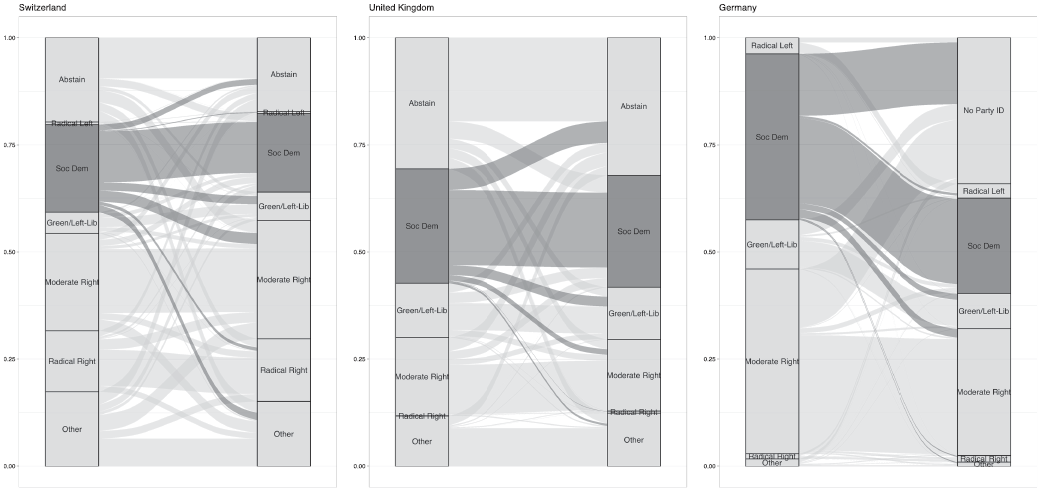
Also in Germany, a sizable number of voters leaves to the Green party. Equally in the UK, social democrats transition to the LibDems, which represent the most important party in the Green/Left-Libertarian camp. Largely due to the electoral system, the Greens have never been a viable option to vote for in the UK under the perspective of strategy voting arguments. Therefore, we read this as a common pattern across all three countries: The most attractive option to defect to are parties that are programmatically progressive on the societal dimension issues. This pattern stands out most in Switzerland where the social democratic core shifts to both the more left-leaning Green party and the socially progressive but economically pro-market Green Liberal party (hence classified into Moderate Right).
Interestingly, both the Swiss SP and the British Labour Party are still successfully keeping and mobilizing considerable amounts of their core voters. Much in contrast, the German SPD struggles to keep its core voters and, perhaps even more importantly, does hardly attract any new voters. This is again different for the British and Swiss Social Democrats, which more successfully mobilize new voters along with attracting voters from all of their competitors. But the transition trajectories for the German SPD are alarming and much in line with its recent electoral decline: The SPD cannot attract new voters and struggles to mobilize its original core.
What becomes evident across all three cases is that the public narrative of original social democrats’ dealignment and realignment into the Radical Right is not supported. Such voters do exist, but they do not exist in large or even decisive numbers. The largest threat from competitors is the progressive option on the societal dimension, in particular green and left-libertarian parties.
How do the Social Democrats handle their complex environments so far? Both Labour and the SP do reasonably well. They manage to mobilize their core, while attracting outsiders. The SP so far stands out as the success story, while the German SPD is lost in transition. It faces severe challenges on both key dimensions of party competition. Thereby it also suffers from its history; the split of the Lafontaine group and the rise of a strong competitor on the first dimension. On the second dimension, the Green party leaves them also with a stronger challenger, which today is on its way to take over the role of the Social Democrats as the second largest party in Germany.
5.5.1 Transitions through Time
The first part of our analyses used a “big brush approach” in which we pooled respondents across time to get a very general understanding of the pattern of voter transitions. The second part takes the temporal dimension more seriously and looks into transitions of all social democrats in our data across each election. For the next set of analyses, we focus on the group of original social democratic voters in the first available wave of each panel data set. We define original core voters as those who have a strong (at least eight out of ten) social democratic party identification in Germany and the UK and those who have voted three times in a row for the Social Democrats in Switzerland (due to missing party ID information). We then plot the voter flows between elections over time. The bars always capture the total number of remaining panel respondents who originally supported the Social Democrats along with their updated party identification or vote intention.
We start the second part of the chapter with the Swiss case (Figure 5.2) because of the particularly large number of effective parties and, hence, potential competitors for the Social Democrats. The Swiss panel started in 1999 with a total of 1,488 respondents who we define as core supporters of the social democratic party. Following this cohort for four years until the next general election, we can see that about a quarter of them abandon the party. The largest share moved to the Green party, which in Switzerland has an almost identical ideological profile but differs somewhat in terms of issue saliency, most notably on environmental issues. A similarly large group of former social democratic voters indicates that they support “other” parties, which in most cases means that they gave their vote to a mixed group of politicians from different parties (“vote for persons, not a party”) rather than submitting the social democratic list to the ballot. Finally, more marginal segments of voters defect in all other directions including a small but nonnegligible group of voters who directly moves to the other end of the ideological spectrum and votes for the radical right Swiss People Party who continued their rapid growth at that time.
Transition away from SP, across elections

Four years later, in 2007, the pattern largely resembles one of the previous election with the Greens capturing a particularly relevant share of former social democratic votes. The year 2011 brought the relevant entry of a new competitor, the Green-Liberals, a more centrist environmental party classified into the Moderate Right camp. This new electoral option has certainly attracted parts of the Social Democratic electorate, but its entry hurt the Green party at least as much as the Social Democrats at that time. The year 2015 represents the consolidation of this pattern with the votes of the social democratic defectors almost evenly split across all the possible competitors. All in all, most former social democrats remained within the left bloc and only about 24% eventually moved on to the right bloc.
Much in contrast to the Swiss SP, both the British Labour Party and the German SPD went through a period of radical programmatic renewal – the Third Way. Both party leaders at the time (late 1990s), Tony Blair and Gerhard Schröder, “modernized” their party mainly on the economic dimension by proposing and adopting liberal market policies. To be fair, at least in the case of Schröder, this period was also marked by a period in government with the Green party and, thus, similar shifts on societal dimension issues – particularly the phase out from nuclear energy. So, these programmatic shifts should potentially also show us a quite different pattern of voting transitions than in the Swiss case. Specifically so, because this period is at the core of the public detour effect narrative.
Yet, what we find first for the UK, shown in Figure 5.3, aligns in most regards with the patterns in the Swiss case. Again, voters get demobilized – but mostly in the first two election cycles (1997 and 2001) we analyze. Interestingly, this is the period during which Tony Blair and his Third Way dominated the party. Thus, it appears that at least to some degree, these policies might have driven voters away from Labour.
Transition away from Labour, across elections
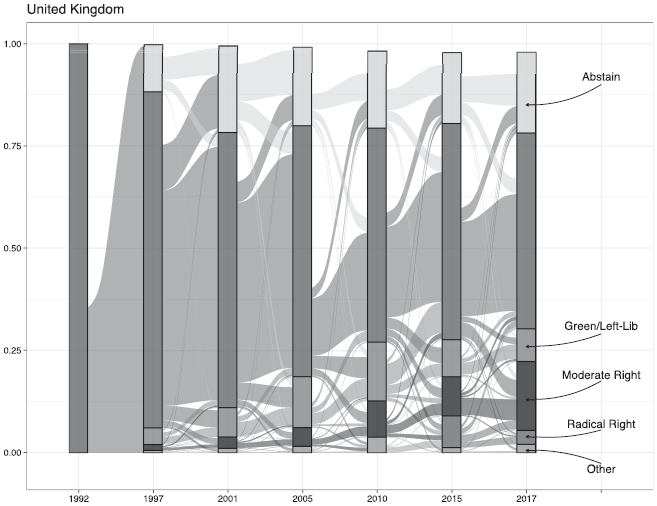
But what is then much alike to the Swiss case is the defection to the “progressive option” – the LibDems, which are the main actor in the Green/Left-Libertarian party family in the UK. Overall, even less voters moved away from the left bloc and joined the Right: All in all about 20% of former Labour voters moved to the Right with only a small fraction eventually voting for UKIP (3–5%).
In our last case, shown in Figure 5.4, we focus on the German case. In the first part of the analyses, we finished with a rather pessimistic view for the German SPD. Yet, the transitions across elections reveal a similar picture. From the beginning of our analysis, the SPD struggles to mobilize its core, and from the beginning their core defects to the Green party. In 1987, the Greens just entered the German parliament one election cycle ago in 1983. They are a young party, often still perceived as a protest party which is incapable to “deliver” policies. But social democratic voters appear to be attracted by this option much from its beginnings but also in considerably smaller numbers than in Switzerland and the UK. This is very interesting as at the time in many ways environmental concerns were perceived as being incompatible with policies for the working class: How to offer environmental policies and at the same time ensure that factories and companies keep running? Yet, in contrast to the former two countries, the SPD’s case seems exemplary for the abstention argument: Supporters leave the party but then also never return to any political party identification. They seem to abstain from politics altogether and in large numbers.
Transition away from the SPD, across elections
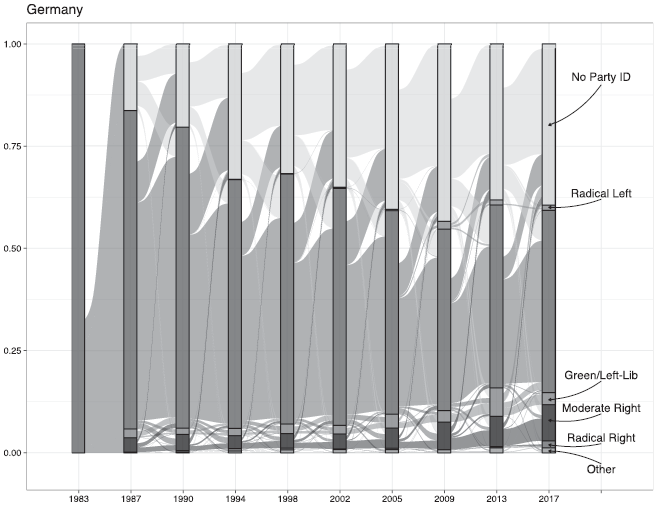
Apart from dealignment and the Green defection, the SPD seems to be spared from competition for its core voters by other parties. Former social democrats do not defect to the Right in large numbers, neither to the Linke. This means that the SPD is incapable in mobilizing its core as well as keeping their core from defecting to the Greens. Yet, there is good news: This means that much like the SP, a more progressive platform on the societal dimension could keep voters from defecting to the Greens while competition on the first dimension – such as welfare chauvinism – might not be relevant to keep voters from defecting to the right and left extremes. But we need to keep in mind that the first analyses showed that the SPD barely has any inflows from other parties. If this pattern persists, it may become difficult to save the SPD from descending into political insignificance.
This becomes drastically clear in Figure 5.5. Here we focus just on the last two German elections and rely on reported voting by respondents instead of party identification. We do this in order to show two things.
The threat of AfD, a new party entry from the right
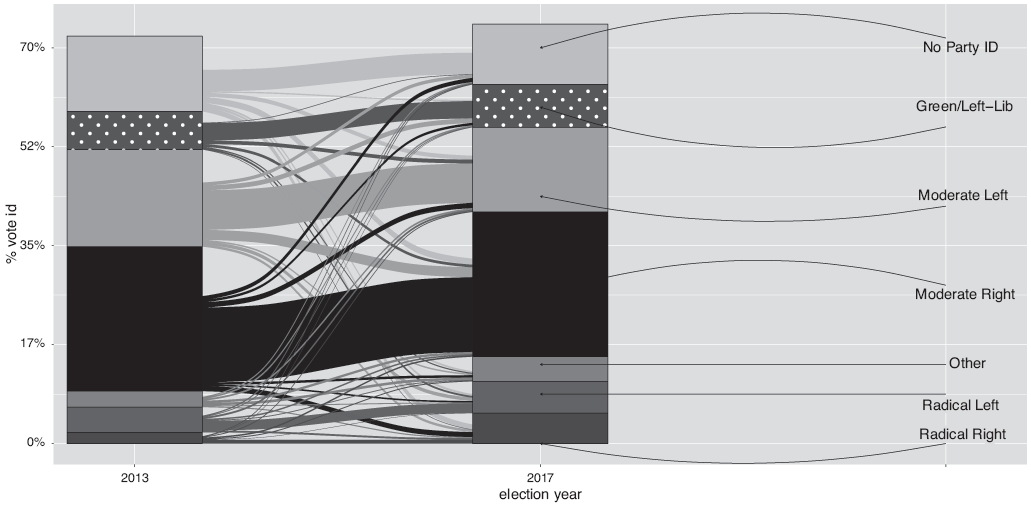
First, that the patterns here align well with the findings discussed earlier based on party identification instead of voting. Second, the radical right party AfD entered the German political arena in 2013 as a mainly Eurosceptic party – but signs of radical right policies became relevant shortly after the 2013 elections. This means that the AfD started to offer the policies that allegedly drove former SPD voters to it in between the two elections. Again, we do not find such a flow to the AfD. The SPD loses more of its 2013 voters to the Christian Democrats, the Greens, the Linke, and abstention. For robustness, we also looked into voter inflows for the AfD to further substantiate that former social democrats did not flock toward the Radical Right in meaningful numbers in Germany. In line with our previous findings, by far the largest inflows are from voters who previously reported not having strong links to any party (figure not shown here for space constraints).Footnote 6
5.5.2 Who Leaves?
In a final step of the analysis, we wish to better understand the abovementioned party transitions by looking into the sociodemographic underpinnings of distinct switching patterns. More specifically, we ask what kind of voters characteristics correlate with the choice of distinct electoral alternatives to the Social Democrats.
The existing work on the social democratic decline suggests various potentially important individual-level factors that may help us understand defection better. We first look at a standard set of socioeconomic and sociodemographic variables which is typically used to explain vote choice: gender, age, education, and income. In addition, we also examine the role of unemployment (e.g., Kurer Reference Kurer2020; Wiertz and Rodon Reference Wiertz and Rodon2021) and union membership (e.g., Karreth et al. Reference Karreth, Polk and Allen2013; Abou-Chadi and Wagner Reference Abou-Chadi and Wagner2019) in supporting social democratic parties.
Given the above-discussed patterns over time and the evident difficulty of social democratic parties to attract new voters, a second important aspect of vote switching may be related to birth cohort. We differentiate between five different birth cohorts ranging from respondents born during WWI to the so-called Generation Y/Z born after.Footnote 7
Finally, perhaps the most frequently investigated factor explaining social democratic support (and the increasing lack thereof) is occupation and class. The well-documented decline of traditional class voting (Kitschelt Reference Kitschelt1994; Oesch and Rennwald Reference Oesch and Rennwald2010; Karreth et al. Reference Karreth, Polk and Allen2013; Rennwald Reference Rennwald2014; Rennwald and Evans Reference Rennwald and Evans2014; Gingrich and Häusermann Reference Gingrich and Häusermann2015) implies that we would expect disproportionate defection among the traditional working-class base. These outflows should be partly compensated by stronger or more enduring support from the new middle class. At the same time, the presence of a strong green or left-libertarian party that also attracts this culturally liberal segment of society is another source of competition (e.g., Rennwald and Evans Reference Rennwald and Evans2014).
In order to examine switching patterns by individual characteristics, we turn to regression models. More specifically we rely on the same sample of respondents discussed earlier – the social democratic core – and then estimate regression models of the following form:
yi,t = β1 currently unemployedi,t + β2 ever unemployedi,t + β3 incomei,t + β4 educationi + β5 union memberi + β6 femalei + β7 agei,t + β8 age cohorti + β9 occupationi,t + αc + εi,t
First, we estimate the correlation of these factors for switchers. We define Yi,t as being ‘1’ whenever a social democrat suggests to have voted for a different party then the Social Democrats. We estimate all regressions using ordinary least squares, cluster our standard errors at the respondent level (i), and use country-level fixed effects (αc) to control away any country-specific differences.
Figure 5.6 reports the findings of the regression model – we rely on a coefficient plot reporting the point estimates of these regressions as markers along with the shaded 90%, 95%, and 99% confidence intervals. All coefficients are standardized such that a direct comparison of the coefficients is possible. It becomes strikingly visible that the fundamental issue of social democratic parties is to attract younger cohorts: Specifically, the generations born after 1981 are flocking away from Social Democracy in larger numbers. By contrast, the “war generations” – being born before the end of World War II – are sticking with Social Democracy. The results discussed later further substantiate that it is the old core that sticks with Social Democracy and the young core leaving Social Democracy behind.
Who switches away from Social Democrats to any other party?
Note: OLS regression models with country fixed effects and standard errors clustered on respondent ID. Variables standardized by dividing by two standard deviations. Cohorts: WWI < 1930; WWII < 1946; boomer < 1965; Gen X < 1981; Gen Y/Z ≥ 1981.
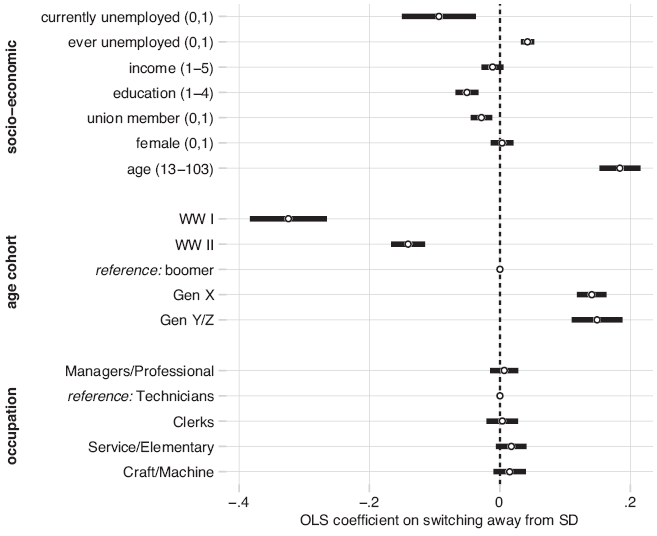
The remaining variables behave as laid out in previous work: Economic hardship tends to drive voters away from Social Democracy, only recent unemployment appears to drive voters toward Social Democrats. But this effect is small and its insecurity is large. By contrast, higher education and union membership keep voters aligned.
But are there differences across party switchers? It is more than likely that the individual factors predict the different vote outcomes differently across parties. To better understand this, we split the voting outcome by party destination in Figure 5.7. Notice that in an effort to ensure readability, the x-axis varies across outcomes, meaning that the size of the coefficients cannot directly be compared across outcomes. One factor remains relevant across all destinations: age cohorts. No matter which new party former social democratic voters choose, the cohort they are born is the major factor correlated with switching away. Thereby, the youngest generations are the ones that are most likely to switch to the fringes. While the generation X seems the one most driven to dealign with party politics altogether.
Who switches to whom?
Note: OLS regression models with country fixed effects and standard errors clustered on respondent ID. Variables standardized by dividing by two standard deviations. Cohorts: WWI < 1930; WWII < 1946; boomer < 1965; Gen X < 1981; Gen Y/Z ≥ 1981.
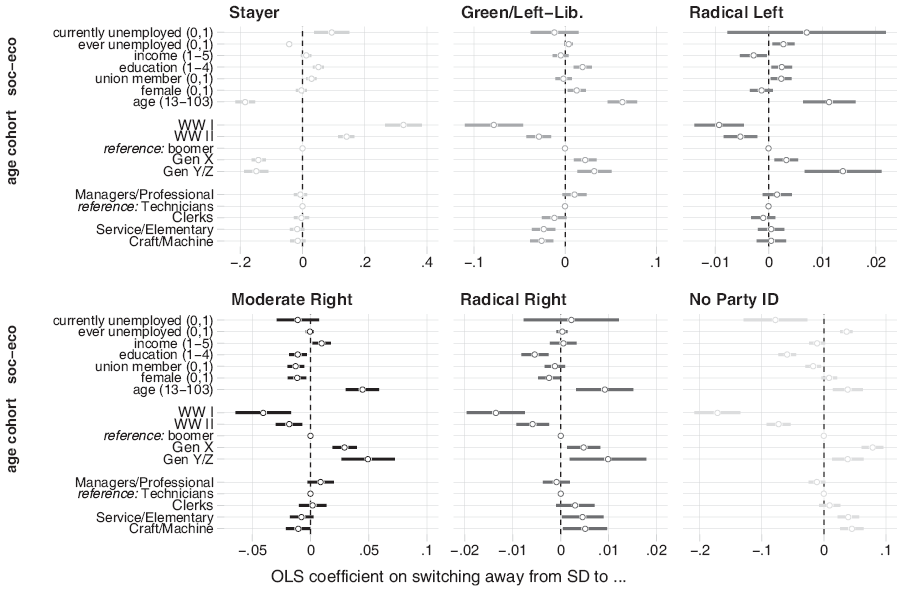
As others have suggested (e.g., Kitschelt Reference Kitschelt1994; Rennwald and Evans Reference Rennwald and Evans2014; Gingrich and Häusermann Reference Gingrich and Häusermann2015), the relevance of occupation varies tremendously across party voting. While manager and professionals stick to the Left, service, elementary and machine workers are disenfranchised and flocking in smaller numbers to the Radical Right. Similarly lower income is a strong factor dealigning social democrats from party politics altogether, and similar effects are visible for having been unemployed in the past.
Altogether, these findings substantiate theoretical arguments elsewhere but also make it clear that in order to understand where Social Democracy is today, we need to understand within individual voting patterns. We do not find stark deviations from this general pattern when looking at the three countries one by one.
5.6 Conclusion
In this chapter, we set out to empirically assess voter outflows of social democratic parties in three countries. We do so by relying on long-term panel data and thereby addressing an important lacuna in research on Social Democracy: Where are all the former social democrats today?
Public narrative has it that the former core moved on to abstention and then later flocked toward the Radical Right. Empirically we do not find support for this narrative. Social democrats only flock in small numbers toward the Radical Right. The most common patterns in our analyses are: (1) former social democrats move on to abstain from politics altogether and (2) they flock to progressive options on the societal dimension (Green and Liberal parties). We also find that the key challenge for social democratic parties today is to attract younger generations. Currently our analyses suggest that social democrats key support base today is largely the boomer and that the following generations find it hard to build up a strong identity toward them. Interesting in light of the diversity in programmatic emphasis of different social democratic parties, these broad patterns are quite comparable across the three cases (Switzerland, Germany, and the UK) we study. This also indicates that potential institutional differences, most prominently the electoral system, do not have a strong impact on the trajectories of social democratic voting. Following classical work on electoral systems, one would assume that the potential to lose votes to the Radical Right are even smaller in majoritarian than in proportional system. This is due to reasons of strategic voting as the Radical Right will have a hard time to attract enough voters to enter any domestic parliament. But we find little to no evidence for such patterns. In many majoritarian systems, the Moderate Right might be much less “moderate” than in proportional systems; having among their members also much more radical politicians, just take the Republicans in the US after the 2016 Presidential elections as an example. This might mean that centripetal tendencies could make the Moderate Right the key competitor instead of any other party family.


 Open access