


Introduction
Ancient Rome created the largest state entity in Europe, uniting politically and economically diverse geographic regions, ethnic groups, and political units on a scale comparable to that of the modern European Union. It grew and prospered over two centuries until the ‘crisis’ of the third century ad, after which it was reborn on new political, religious, and cultural foundations. Several studies suggest that the late Empire also differed from the Principate (27 bc to ad 284) in economic terms (Carrié, Reference Carrié1994, Reference Carrié and Morrisson2012; Arthur, Reference Arthur and Saguí1998: 157; Vera, Reference Vera, Carrié and Testa2002, Reference Vera2005; Leidwanger, Reference Leidwanger2020: 110–53; Komar, Reference Komar2020: 283; Reference Komar2024a, Reference Komar2024b; Komar et al., Reference Komar, Brughmans and Borisova2025). The aim of this article is to examine whether there are observable differences in global trading patterns and the degree of economic integration between the early and late Roman Empire. To this end, regression analyses using ORBIS simulations and amphora distribution data from five Mediterranean regions will be employed.
Early and Late Roman Economy: Theoretical Assumptions
After the publication in 1973 of Moses Finlay’s Ancient Economy, studies of the ancient economy have demonstrated that, at least in the case of the Roman Empire, the archaeological evidence (Hopkins, Reference Hopkins, Abrams and Wrigley1978, Reference Hopkins1980, Reference Hopkins, Scheidel and von Reden2002: 190–230; Lo Cascio, Reference Lo Cascio, Cascio and Rathbone1994, Reference Lo Cascio, Scheidel, Morris and Saller2007, Reference Lo Cascio, Bowman and Wilson2009: 87–106; Saller, Reference Saller, Manning and Morris2005: 223–38; de Callataÿ, Reference de Callataÿ2005: 361–72; Jongman, Reference Jongman, Bang, Ikeguchi and Ziche2006: 237–54, Reference Jongman and de Callataÿ2014: 169–88, Reference Jongman and Kelli2017: 260–68; Friesen & Scheidel, Reference Friesen and Scheidel2009: 61–91; Scheidel, Reference Scheidel2009: 46–70; Kron, Reference Kron and de Callataÿ2014: 123–46; Erdkamp, Reference Erdkamp, Erdkamp, Verboven and Zuiderhoek2015) does not support the assumptions that economic integration in the ancient world was relatively low and driven primarily by elite activities (Finley, Reference Finley1973; Whittaker, Reference Whittaker1985), or by networks of friendship and obligation tied to the ruling classes (Tchernia, Reference Tchernia1986; Manacorda, Reference Manacorda1989). Contrary to earlier expectations (e.g. Paterson, Reference Paterson, Parkins and Smith1998: 164; Sarris, Reference Sarris2015a, Reference Sarris and Lavan2015b), the state did not play a leading role in fostering and stimulating the exchange of goods, even though food shortages (particularly of grain) in individual cities could only be addressed through imperial intervention (Saller, Reference Saller, Scheidel and von Redden2002: 254, note 2; Erdkamp, Reference Erdkamp2005).
Whether significant market integration took place in the Roman Empire, together with which regions the Empire influenced, and when it reached its peak nevertheless deserves further scrutiny. Currently, two models of the Roman economy are under discussion. The first is the ‘Roman bazaar’ model, developed by Peter Bang (Reference Bang2007, Reference Bang2008) based on literary sources and comparative studies, which has become a kind of ‘new orthodoxy’. The second is the ‘market economy’ model proposed by Peter Temin (Reference Temin2013), which has recently found support in material evidence from the early Empire (Brughmans & Poblome, Reference Brughmans and Poblome2016; Komar, Reference Komar2024a). While both models have attracted supporters, they have also been subject to substantial criticism (e.g. Saller, Reference Saller, Scheidel and von Redden2002; Silver, Reference Silver2009; Tchernia, Reference Tchernia2011: 101–33; Bransbourg, Reference Bransbourg2012; Brughmans & Poblome, Reference Brughmans and Poblome2016) and are often viewed as representing two opposing extremes. But the reality was far more complex, and the truth is likely to lie somewhere in between; the devil is, indeed, in the detail (Van Limbergen et al., Reference Van Limbergen, Hoffelinck, Taelman, Van Limbergen, Hoffelinck and Taelman2022: 3).
This study adopts a more nuanced approach. Given the substantial political and cultural transformations that the Roman Empire underwent between the Principate and Late Antiquity, it is reasonable to expect that comparable changes also occurred within the Roman economy. According to some scholars (e.g. Kingsley, Reference Kingsley, Kingsley and Decker2001: 57; McCormick, Reference McCormick and Morrison2012; Pieri, Reference Pieri and Morrisson2012; Carrié, Reference Carrié and Morrisson2012), the distribution of goods throughout much of the imperial period points to the presence of market forces linking the entire Mediterranean basin. By the sixth century ad, however, commercial exchange appears to have become significantly more restricted, probably because of the increasing dominance of powerful institutions governing trade (Arthur, Reference Arthur and Saguí1998: 157). On the other hand, literary evidence suggests that many inhabitants of the Late Roman Empire remained dependent on foodstuffs available on the open market, indicating that the economic significance of the annona and other state-subsidized distribution—or sales at preferential prices—should not be overestimated (Carrié, Reference Carrié1994, Reference Carrié and Morrisson2012; Vera, Reference Vera, Carrié and Testa2002, Reference Vera2005: 259–61). It is therefore plausible that ‘there were parallel, but not necessarily mutually exclusive, systems of transport or trade, one in the domain of the state, the other in the domain of private merchants’ (Fulford, Reference Fulford, Bowman and Wilson2009: 254–55). However, the precise role of each system across different chronological periods and their respective influence on the Roman economy remains unclear. The emergence of the Christian Church as another economic power during Late Antiquity is likely as there is evidence that ecclesiastical institutions owned fertile and well-connected arable lands (Leone, Reference Leone2006), as well as wine and olive oil pressing facilities, and produced surpluses of agricultural goods (Peña Cervantes, Reference Peña Cervantes, Pérez and Pérez2008; Ashkenazi & Aviam, Reference Ashkenazi and Aviam2017). Be that as it may, the broader role that the Church played in the organization of production and trade remains insufficiently studied and requires further research.
This study employs regression analysis to examine whether statistical evidence can reveal changes in the pan-Mediterranean distribution of amphora-borne foodstuffs in the period spanning the Principate and Late Antiquity, i.e. changes that would suggest significant differences in the nature of the Roman economy across this time period. This macroeconomic approach, while necessarily overlooking local nuances and specific case studies, is deliberate: only such a broad perspective makes it possible to identify large-scale trading patterns across the Roman world.
Methodology: Amphorae, Computer Simulations, and Regression Analyses
Ceramic containers transporting wine, olive oil, fish sauces, and other products have long been considered valuable proxies by historians studying the economy of Antiquity (e.g. Purcell, Reference Purcell1985; Tchernia, Reference Tchernia1986, Reference Tchernia2011; Panella & Tchernia, Reference Panella, Tchernia, Scheidel and von Reden2002). Unlike tableware and kitchen pottery, these containers were rarely transported with other goods (‘piggybacked’; for an exception, see Tchernia, Reference Tchernia2011: 257–58, 345–46) and hence their distribution is generally free from biases caused by incidental transfers of pottery on annona ships transporting grain (for the olive oil annona in Late Antiquity, see below). This article is based on published material and analyses of the proportions of amphorae discovered in Rome, northern Adriatic Italy (Aquileia, Padova, Verona), Ephesus, Cyprus (Paphos, Kourion, Amathous), southern Spain (the province of Hispania Ulterior), and southern Gallia Narbonensis. These sites include major and secondary civilian consumption centres and were selected to represent the ‘core’ (Italy), as well as the western (Gallia Narbonensis, Hispania Ulterior) and eastern (Ephesus, Cyprus) parts of the Empire (Figure 1). Moreover, they contain evidence of long-term occupation and amphora use, ranging from the late Republican period or first century ad to the seventh century ad, except for Hispania Ulterior (only amphorae dated to the period of the Principate) and Gallia Narbonensis (only material dated to Late Antiquity). As the numbers of amphorae for Empurias were not given in the statistics published by Remolà Vallverdú (Reference Remolà Vallverdú2000: 270), it was not possible to use Late Antique amphorae from Spain, whereas Gaul did provide more robust data.
Map of the Mediterranean showing major amphora-producing regions and key archaeological sites.

Two chronological divisions were recognized: up to the third century ad (material from Italy, Ephesus, Cyprus, and Hispania Ulterior) and Late Antiquity (material from Italy, Ephesus, Cyprus, and Gallia Narbonensis). This analysis focuses on the number of diagnostic fragments (rims, bases, and handles) rather than on the minimum number of individual vessels (MNI) or estimated vessel equivalent (EVE) (see Franconi et al., Reference Franconi, Brughmans, Borisova and Paulsen2023 for a comparison of different pottery quantification methods) or total volumes, as diagnostic fragment counts are the most commonly published form of ceramic data. In addition, as this analysis looks solely at diagnostic amphora fragments, this avoids the biases that amphorae (i.e. large, heavy sherds) usually give in analyses that rely only on all fragment counts. These are raw data, not altered by mathematical or statistical transformations that could potentially distort subsequent analyses. Exact number of diagnostic amphora fragments by geographical region and chronological period, along with the contexts from which they were recovered (containers of uncertain provenance excluded) are presented in Table 1.
Number of diagnostic amphora fragments by geographical region and chronological period, with their relevant contexts.

This study is based on archaeological reports rather than on raw data directly analysed by the author, and this approach necessarily has certain limitations. Efforts have, however, been made to minimize their impact, which is further mitigated when analysing large-scale trends. First, given the large volume and diversity of the data, as well as the deliberate exclusion of unique, imprecisely quantified, or otherwise problematic sites (such as Monte Testaccio or Nuovo Mercato di Testaccio), the uncertain or potentially biased nature of some contexts should not significantly distort the overall pattern. Second, the potential effects of classification errors or variability in the preservation of different amphora types are reduced by focusing exclusively on diagnostic fragments (rather than all sherds) and by the robustness of the database. The scale of reuse and recycling of amphorae for long-distance transport in Antiquity—which could introduce bias—was generally an exception rather than the norm (Peña, Reference Peña2007: 61–118; Brughmans & Pecci, Reference Brughmans, Pecci, Bowman and Wilson2020). The use of barrels has only been confirmed for a limited period and geographic area (Marlière, Reference Marlière2002), but as they survive only under certain conditions (e.g. waterlogged contexts), a bias in the archaeological record cannot be excluded. Nevertheless, all the aforementioned potential distortions are considered in the discussion of the results of the regression analysis presented below.
Regression analysis is a statistical method used to examine the relationship between two or more interrelated variables, allowing researchers to quantify the degree to which changes in one variable are associated with changes in another (Orton, Reference Orton1980: 116–24; Shennan, Reference Shennan1988: 114–65). In archaeological and historical studies, it has been employed, for example, to demonstrate the relationship between grain prices and distance from Rome (Kessler & Temin, Reference Kessler and Temin2005; Bransbourg, Reference Bransbourg2012; Temin, Reference Temin2013), or the correlation between distance and the distribution of pottery in Cyprus (Kaldeli, Reference Kaldeli2008). In its simplest form, a regression model is expressed as: Y = a + bX + ε, where Y is the dependent variable (e.g. grain price), X is the independent variable (e.g. distance from Rome), a is the intercept (the value of Y when X = 0), b is the slope coefficient (indicating the strength and direction of the relationship between X and Y), and ε is the error term accounting for variation not explained by the model. This equation helps to estimate how much Y changes in response to changes in X, and whether that relationship is statistically significant. A coefficient of correlation (R2) measures the strength and direction of the linear relationship between two variables, ranging from –1 (perfect negative correlation) to +1 (perfect positive correlation), with 0 indicating no linear correlation.
In this study, pottery distribution is viewed as a function of travel time, which was a more significant factor in organizing the distribution of goods in Antiquity than linear distance, as demonstrated by price analyses in Diocletian’s Edict (Arnaud, Reference Arnaud2005, Reference Arnaud2007; Scheidel, Reference Scheidel2013). Travel time is estimated using ORBIS, the Stanford Geospatial Network Model of the Roman World (http://orbis.stanford.edu) circa 200 ad, which includes 632 nodes (cities and other connecting points) and 1947 edges (connections between two nodes, representing sea, river, or terrestrial routes). ORBIS simulates the time and cost of these connections based on the season and mode of transport (e.g. river downstream, river upstream, cart), factors that significantly influence travel duration, and, consequently, the final price of goods (Duncan-Jones, Reference Duncan-Jones1974; Kunow, Reference Kunow1980; Deman, Reference Deman, Hackens and Marchetti1987; Carreras Monfort & De Soto Cañamares, Reference Carreras Monfort and De Soto Cañamares2010; Scheidel, Reference Scheidel2014). Although not without critics regarding its accuracy (Warnking, Reference Warnking, Brughmans and Wilson2022), ORBIS remains, for now, the best available representation of general movement patterns within the Roman Empire.
ORBIS allows simulation of the shortest route between points A and B, as well as the fastest and the cheapest routes. The latter assumes that sailings were not necessarily direct but followed the most frequently used paths, connecting multiple ports where ships could replenish supplies and buy or sell additional cargo. This study uses the ‘Route’ mode in ORBIS to model journeys from various production areas to five destinations—Rome, Aquileia, Hispalis (Seville; early period) and Marseille (late period), Paphos, and Ephesus—during the ‘Summer’ season and selecting the ‘Cheapest’ option. ORBIS data (travel times), proportions of amphorae, and the selected origin and destination points are presented in Table 2 (Principate period) and Table 3 (Late Antiquity).
Journey times and proportions of amphorae of different provenances in five analysed regions during the Principate.

Journey times and proportions of amphorae of different provenances in five analysed regions during Late Antiquity.

Results
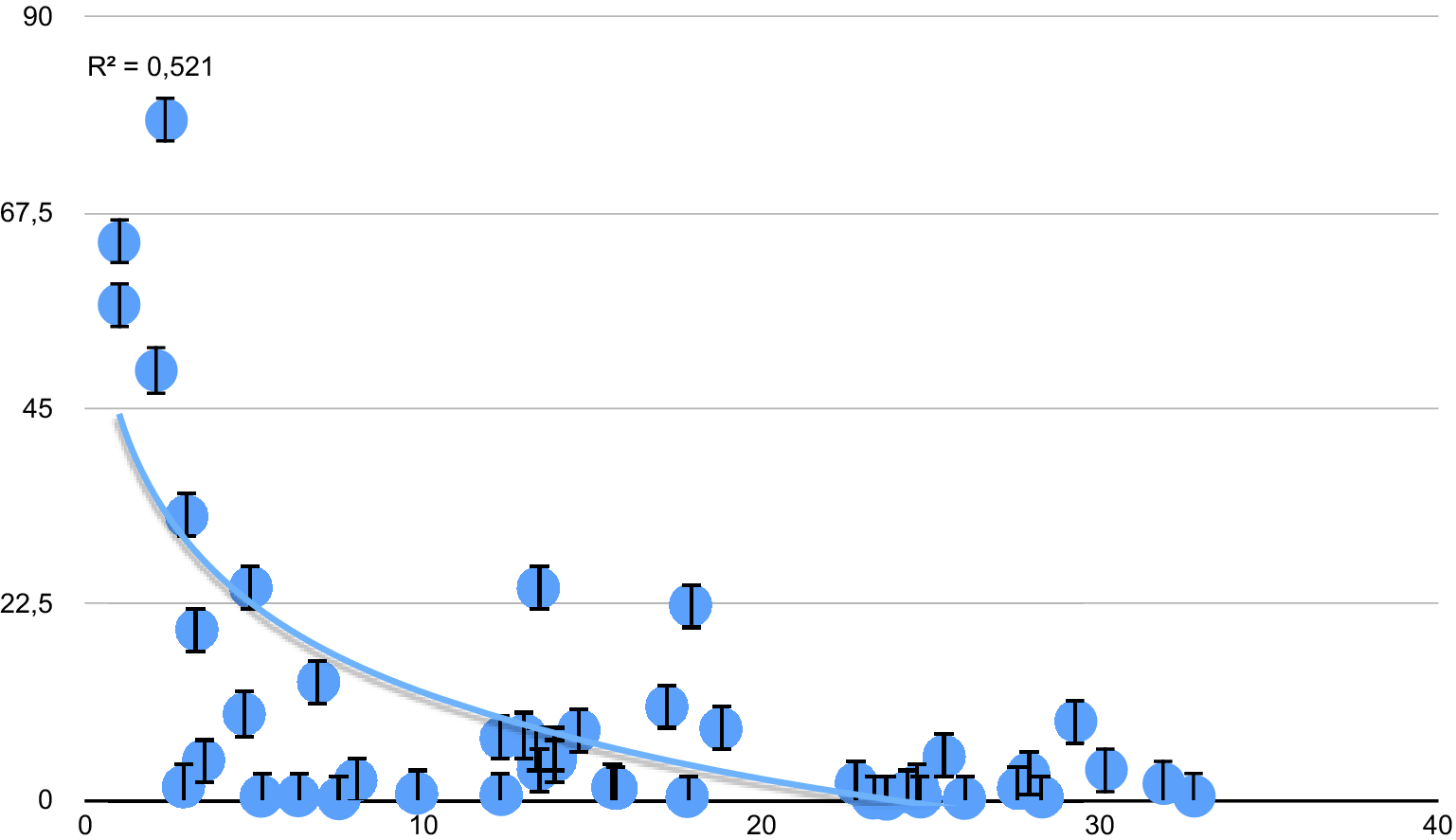
Figure 2 shows the relationship between the time of the journey (x) and the proportion of different types of amphorae (y) in Rome, northern Adriatic Italy, Hispania Ulterior, Ephesus, and Cyprus between the first century bc and the third century ad. Transport containers discovered in these areas are grouped according to their geographic provenance, i.e. Tyrrhenian, Adriatic, Gallic, Spanish, Lusitanian, African, Egyptian, Cypriot/Cilician, Anatolian, Levantine, and Aegean. A correlation between the proportions of amphorae and the time it took to deliver them to each of the five destinations is significant (R2 = 0.52), which suggests that commercial exchange might have been determined by the time of the journey. The pattern, however, is obscured by the proportions of many amphorae from the Levant, Cyprus/Cilicia, and Egypt, which are low at every destination (less than five per cent, see Table 2). This complicates the picture, as the numbers of diagnostic fragments differ by a couple of sherds only, and hence their proportions may be largely affected by the state of preservation of the material (i.e. some amphorae break more easily than others). Moreover, low proportions at every destination suggest that the easternmost regions of the Mediterranean did not regularly produce enough surplus to export their wine, olive oil, and fish sauces.
Relationship between journey time in days (x-axis) and the proportion of amphorae by origin (y-axis) in Rome, northern Adriatic Italy, Hispania Ulterior, Ephesus, and Cyprus, first century bc to the third century ad. The figure illustrates how the duration of transport influenced the distribution of amphorae from different production centres across key Mediterranean regions over time.

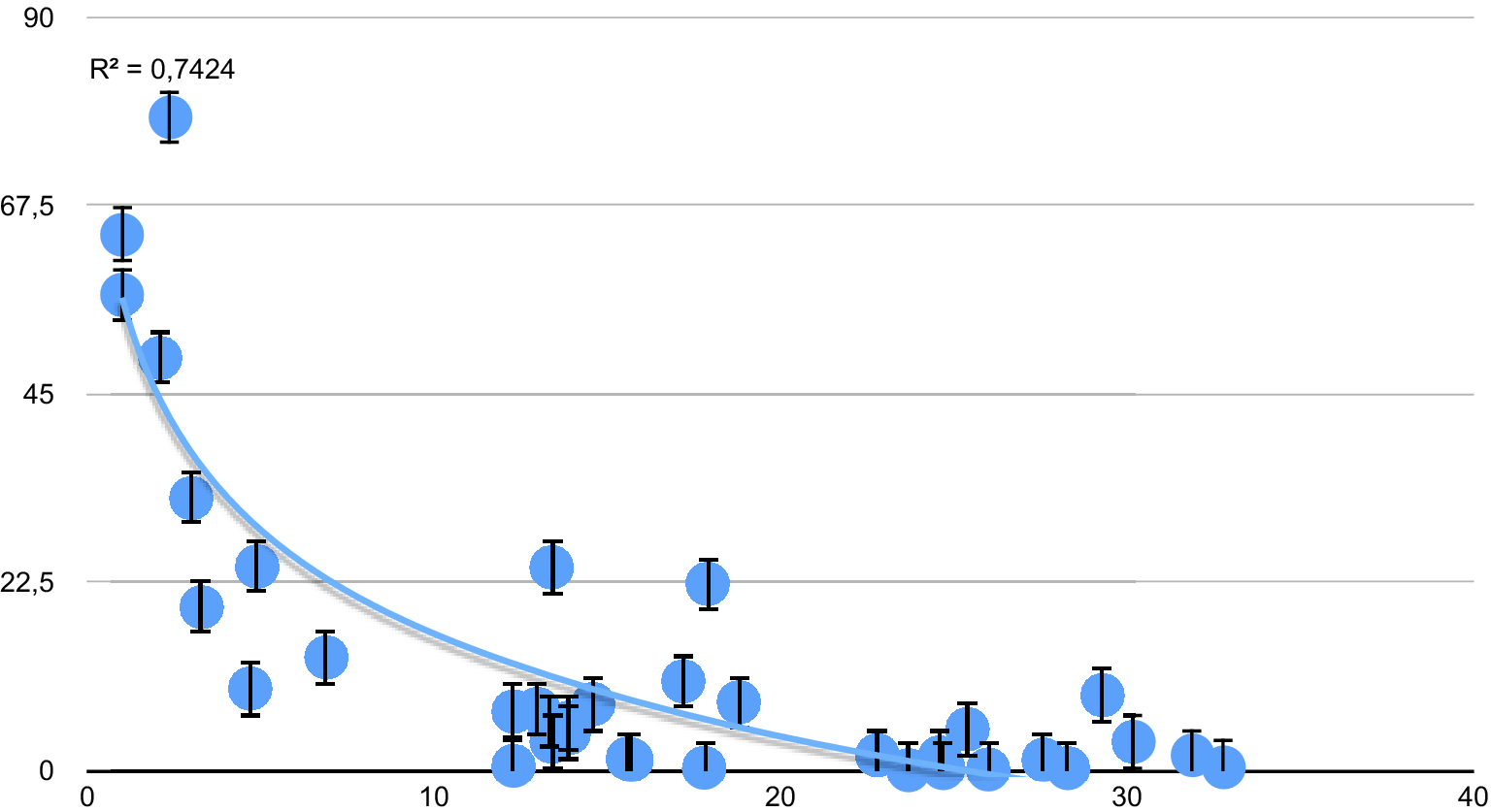
To avoid a bias caused by low fragment counts and thus unreliable conclusions, Figure 3 excludes the proportions of Egyptian, Levantine, and Cypriot/Cilician amphorae. As for Calabrian/Sicilian and Black Sea/North Aegean amphorae, they appear not only in low proportions (less than three per cent) but were also found at only one destination each—Rome and Ephesus, respectively—indicating that they were not typical pan-Mediterranean export products. All other data show a surprisingly strong correlation (R2 = 0.75) between travel time (from the place of origin) and the proportions of amphorae (at the destination), with deviations that almost always fall within the standard error range. This correlates with the assumption that market forces regulated approximately seventy-five per cent of Mediterranean commercial exchange in amphora-borne foodstuffs between the first century bc and the third century ad.
Relationship between journey time in days (x-axis) and the proportion of amphorae by origin (y-axis) in Rome, northern Adriatic Italy, Hispania Ulterior, Ephesus, and Cyprus, first century bc to the third century ad, excluding Egyptian, Levantine, Cypriot/Cilician, Calabrian/Sicilian, and Black Sea/North Aegean containers.

During Late Antiquity, the situation appears to have changed, as there is a very weak correlation (R2 = 0.22) between travel time and the proportions of amphorae (Figure 4). We should, however, remember that western amphorae (except those from Africa, Lusitania, and Calabria/Sicily) almost disappeared from the archaeological record after the third century ad, which indicates either a lack of surplus or a change in transport containers (e.g. from amphorae to barrels). Figure 5 therefore shows the regression analysis for Late Antiquity, with western amphorae (except African, Lusitanian, and Calabrian/Sicilian types) excluded since barrels may have been used and may have caused the proportions of these western amphorae to underrepresent the actual volume of imports. The correlation between travel time and the proportions of amphorae remains low (R2 = 0.25), suggesting that non-market factors dominated most commercial exchange during this period.
Relationship between journey time in days (x-axis) and the proportion of amphorae by origin (y-axis) in Rome, northern Adriatic Italy, Gallia Narbonensis, Ephesus, and Cyprus during Late Antiquity.

Relationship between journey time in days (x-axis) and the proportion of amphorae by origin (y-axis) in Rome, northern Adriatic Italy, Gallia Narbonensis, Ephesus, and Cyprus during Late Antiquity, excluding Italian, Spanish, and Gallic amphorae.

Discussion
The results of this study suggest that significant economic changes occurred in Late Antiquity. Until the third century ad, the distribution of approximately seventy-five per cent of amphorae was governed primarily by travel time, corroborating the assumption that transport costs were a key factor regulating the trade of wine, olive oil, and fish sauces. Notably, in Hispania Ulterior (second century bc to second century ad), amphorae finds were almost exclusively from the Iberian Peninsula and the Tyrrhenian coast of Italy (Table 2), while imports from the Eastern Mediterranean were nearly absent, accounting for less than one per cent, presumably due to higher transport costs (Mateo Corredor, Reference Mateo Corredor2016). Likewise, in Cyprus during the early to mid-Roman period, Eastern Mediterranean products predominated over seventy per cent, with Italian, Gallic, African, and Lusitanian imports forming a minority (Kaldeli, Reference Kaldeli2008). It should be noted, however, that proportions of amphorae in Cyprus varied considerably by context: for example, Spanish and Gallic amphorae in Amathous (Agora) and Paphos (Spanish amphorae at Customs House; Gallic amphorae at the House of Orpheus) are exceptionally well represented.
Despite such local variability, this general pattern is supported by data from other Mediterranean regions, even if less comprehensive. For instance, at Pax Julia in Beja (Portugal), imports from the Eastern Mediterranean were few, around 2.5 per cent (Conceição Lopes et al., Reference Conceição Lopes, De Almeida Rui and Vaz Pinto2020: 126, tab. 2), while near Valencia they typically accounted for only 3–3.5 per cent (Pascual Berlanga, Reference Pascual Berlanga and Demesticha2015: 274–78). Conversely, at Marina el-Alamein (Majcherek, Reference Majcherek and Krzyżanowski1991, Reference Majcherek1993) and across Egypt more broadly (Dzierzbicka, Reference Dzierzbicka2018), Western Mediterranean amphorae were considerably less frequent than those from the Eastern Mediterranean, although detailed statistics are missing.
From these data, it is clear that the relationship between cost and distribution patterns holds across the Mediterranean. Foodstuffs from regions where export costs were high were consistently rare: this applies to Gallic wines and Baetican olive oil in northern Adriatic Italy, Ephesus, and Cyprus; to Levantine and Lusitanian imports in Rome; and to Eastern products on the Western Mediterranean fringe. The model presented here thus appears to support the assumption that market forces played a central role in the Roman economy before the third century ad, and that individual regional markets were relatively well integrated.
During Late Antiquity, the most notable change was the increase in Palestinian amphorae found in Rome and northern Adriatic Italy, whose proportions considerably bias the regression pattern (Table 3). This may reflect the agricultural prosperity of the Levant in Late Antiquity, as suggested by both written and archaeological sources (Avi-Yonah, Reference Avi-Yonah1958: 41–49; Kingsley, Reference Kingsley, Kingsley and Decker2001; Bar, Reference Bar2004). However, if increased production in Palestine led to price discounts for its products (a return to scale effect), we would expect to find these amphorae predominantly in Ephesus, where transport costs would be lower, and their proportions in Rome and northern Adriatic Italy should not exceed those in Ephesus. Yet, the percentages of Gazan containers increased significantly in Rome and northern Adriatic Italy, while remaining low in Ephesus (0.78 per cent). Even more strikingly, the proportions of Eastern Mediterranean containers during Late Antiquity are higher in Hispania Tarraconensis and Gallia Narbonensis than in Ephesus (Remolà Vallverdú, Reference Remolà Vallverdú2000: 269–79). I conclude that the observed patterns of Levantine, Cypriot, and Cilician imports support the assumption that trade in these products during Late Antiquity was not governed primarily by market forces.
The regression analysis shows that the proportions of African amphorae in Rome and northern Adriatic Italy were exceptionally high (61.98 per cent and 60.46 per cent, respectively), while in Ephesus they were remarkably low (1.56 per cent). At the same time, although Calabrian/Sicilian amphorae were abundant in Rome, their presence in northern Adriatic Italy was minimal (0.49 per cent), and they were completely absent in Ephesus and Cyprus. The transport of African goods to Italy can be linked to the growing role this region played in supplying grain for the annona (Rickman, Reference Rickman1980: 263–64). Considering that in the third century ad wine and olive oil also became part of state-sponsored free food distributions, state involvement in the trade of African wine and olive oil appears plausible. Additionally, Anatolian amphorae (Samos Cistern type) may have reached Italy through state directives (Arthur, Reference Arthur, Malone and Stoddart1985, Reference Arthur and Saguí1998: 175, Reference Arthur2002: 128–30), while the privileged position of Cypriot/Cilician wine traders in Late Roman commerce (Decker, Reference Decker2005: 54–55; Iacomi, Reference Iacomi, Aydınoğlu and Şenol2010: 27–28) also suggests special connections between this region and the state. The increasing presence in Rome of wine from Bruttium (Calabrian/Sicilian amphorae), praised by Cassiodorus as a delicacy (Cassiodorus, Variae XII 12), might be linked to the outflow of Egyptian grain to Constantinople and the subsequent Vandal conquest of Africa, which heightened the demand for Sicilian grain and probably other regional products that became increasingly important for the Roman elite. Conversely, the appearance of small Keay 52-type amphorae from Bruttium and Sicily corresponds with wine distributions to Rome’s inhabitants in the late third century ad Aurelian era since these are the only Italian wines transported in amphorae during this period. Some scholars associate them with the canon vinarius tax paid by these areas following their inclusion in the Vicariato suburbicario (Panella, Reference Panella, Carandini, Ruggini and Giardina1993: 646, Reference Panella and Geny2001: 180, 196; Pacetti, Reference Pacetti and Saguí1998). The scarcity of these containers in northern Adriatic Italy and Gallia Narbonensis further supports the idea that they were subject to state-controlled transfers. All these examples point to a considerable decline in free market–regulated exchange during Late Antiquity. This raises the question of whether such changes were a consequence of the ‘crisis of the third century’, or shifts in market conditions such as competition from African goods (Costa, Reference Costa and Lavan2015: 104), and/or transformations in major commercial routes associated with the rise of Constantinople, for example African grain that had previously supplied Rome (Hobson, Reference Hobson2015: 11) being redirected to Constantinople in Late Antiquity (Panella, Reference Panella, Carandini, Ruggini and Giardina1993).
Finally, based on the results from Ephesus, one may conclude that the economy during Late Antiquity became much more regionalized, which aligns with studies from other areas (e.g. Wickham, Reference Wickham1988; Reynolds, Reference Reynolds2010a, Reference Reynolds, Fine Wares, Wares, Menchelli, Santoro, Pasquinucci and Guiducci2010b, Reference Reynolds, Bowman and Wilson2018). Nearly ninety per cent of Ephesus’s demand for amphora-borne foodstuffs was met by Anatolia, compared to only about thirty-three per cent before the third century ad. Although Africa was the main source of imported tablewares at Ephesus during Late Antiquity, Ephesian pottery (i.e. Late Roman Amphorae 3, LRA3 hereafter) appears only in small quantities in Carthage, suggesting a lack of close reciprocal connections between these regions. The reorientation of the annona towards Constantinople and related logistical movements did not significantly alter the exchange pattern. Similarly, the scarcity of Ephesian (LRA3) amphorae in Egypt—which would be expected as return cargo on ships supplying Constantinople with Egyptian grain (Gonzáles Cesteros, Reference González Cesteros, Raycheva and Steskal2021: 341–43, 346), if profit maximization were the primary motive—suggests limited space for private trade. Assuming that the supply of foodstuffs to major Mediterranean cities was a key factor of integration during the imperial period, and that the fragmentation of commercial organization signals decentralization (Panella, Reference Panella, Carandini, Ruggini and Giardina1993: 663, Reference Panella and Geny2001: 179), the case of Ephesus indicates that the level of integration of Roman markets decreased during Late Antiquity. It therefore appears that the reorganization of trade routes associated with the founding of the new capital at Constantinople had little impact on private entrepreneurs, who had limited opportunities to profit from buying and selling goods along the route connecting Alexandria to Constantinople. This is in line with Durliat’s (Reference Durliat, Bowden and Hodges1998) argument about the limited role merchants played in stimulating trade during this period. It is highly likely that state or institutional orders organized the flow of goods between these centres (direct A-to-B movements), indicating a shift in economic principles rather than changes in market conditions.
Conclusions
This study suggests that a significant transformation took place between the economies of the Principate and those of Late Antiquity. Until the third century ad, the distribution of amphora-borne foodstuffs—as evidenced by regression analyses—can largely be explained by the dominance of market forces. This explanation becomes less applicable in Late Antiquity. Furthermore, the regression results align with the view that Roman markets were relatively well integrated during the Principate, with degrees of market integration declining notably after the ‘crisis’ of the third century. It appears that Temin’s (Reference Temin2013) market economy model more accurately reflects the economic realities of the Principate, whereas Bang’s (Reference Bang2008) ‘oriental bazaar’ model better characterizes the economic landscape of Late Antiquity. These findings indicate a marked shift in trading patterns, suggesting that political and cultural transformations exerted a profound impact on the Roman economy.
It is reasonable to conclude that processes such as regionalization, increased state control over commercial enterprises, the expanding role of the annona, and the subsidized distribution of staples beyond grain—along with the emergence of the Church as a new producer and trader—significantly constrained the scope for free and independent merchants. This led to the transformation of the earlier Roman Empire’s market-oriented, profit-driven economy into a system resembling a centrally planned economy, in which a limited number of dominant actors set the terms governing Late Antique trade. While this shift did not entirely eliminate free market exchange, it suggests that such activity was considerably circumscribed during Late Antiquity.
Acknowledgements
This work was supported by the National Science Centre of Poland under grant no. 2019/35/D/HS3/02142.




 Open access

