


Introduction
In 2021 Israel underwent yet another parliamentary election, the fourth in two years. Yet, this time the election resulted in Prime Minister Benjamin Netanyahu leaving office after 12 consecutive years in power. This happened because the ‘Anti-Netanyahu bloc’ managed to overcome basic ideological disagreements forming a coalition with right-wing parties such as Yemina/Yemina (טב) and left-wing parties such as Meretz/Meretz (מרצ), and including for the first time an independent Arab party (Ra'am) in the coalition. Although in 2021 Israel had a major military operation in the Gaza Strip and witnessed major riots in mixed Arab–Jewish cities within its borders, the parties managed to ‘agree not to agree’ and form a government. The Prime Minister who was appointed first, within the rotation agreement, was Naftali Bennett, whose party (Yemina) had de facto six seats (i.e., less than 10 per cent of the seats) in the coalition.
Election report
Election for the 24th Knesset
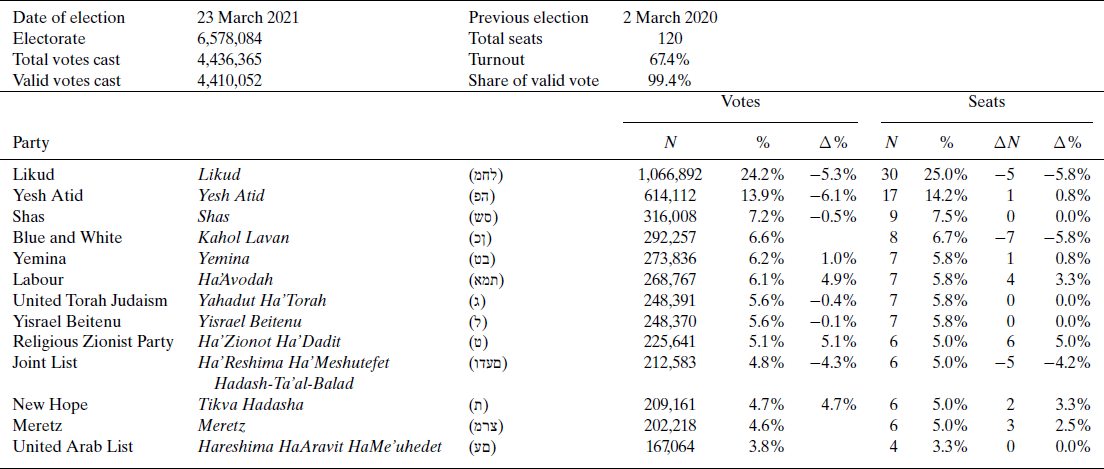
The election for the 24th Knesset, which was held on 23 March, did not change the balance of power between the left and right political blocs (Table 1). Yet, the Likud/Likud (מחל) party, headed by Prime Minister Benjamin Netanyahu, decreased its number of seats in the Knesset from 36 to 30. Even though Likud was the biggest party in the Knesset (25 per cent), far higher than the second biggest party, Yesh Atid/Yesh Atid (פה) (14.2 per cent), the right-wing parties did not manage to form a majority coalition.
Elections to Parliament (Knesset) in Israel in 2021

Notes: Blue and White split after the 23rd election into Blue and White, Yesh Atid and Telem. Derech Erez split from Telem and joined New Hope before the 24th election.
Yemina ran with other right-wing parties at the 23rd election.
Labour–Gesher–Meretz split after the 23rd election into Labour, Meretz and Gesher. Gesher Joined the Likud Party.
Joint List split before the 24th election into Joint List and United Arab List.
Sources: Central Election Commission (2021), https://votes24.bechirot.gov.il; Knesset (2021), https://main.knesset.gov.il/About/History/Pages/KnessetHistory.aspx?kns=24#.
The two Orthodox parties maintained their power in the Knesset, as the number of seats they gained did not change. Shas/Shas (שס) gained nine seats, whilst United Torah Judaism/Yahadut Ha'Torah (ג) won seven seats. The united list Yemina – comprising the National Union (also known as the Religious Zionist/Ha'Zionot Ha'Dadit (ט) Party), the Jewish Home/Ha'Bayit Hayehudi and the New Right/HaYamin HaHadash – split before the election. The Religious Zionist Party/Ha'Zionot Ha'Dadit (ט), combined with National Unity-Tkuma, Noam, Otzma Yehudit and Yemina, ran separately and gained six seats. Jewish Home did not participate in the election but supported Yemina, which only had the New Right left on the list. Yemina won seven seats. The new party New Hope/Tikva Hadasha (ת) gained six seats. All right bloc parties together won 65 seats in the Knesset, yet did not have a majority as New Hope declared they would not join a coalition with Netanyahu.
Yisrael Beitenu/Yisrael Beitenu (ל), the Russian immigrants’ party, maintained their presence in the Knesset with seven seats. At the centre of the political map, Blue and White/Kahol Lavan (כן) gained eight seats and Yesh Atid 17, which compares poorly to the 33 seats both parties had together in the previous Parliament. As for the left-wing parties, the alliance between Labour/Ha'Avodah (אמת)–Gesher/Gesher–Meretz, which won seven seats in the previous election, split. Labour won seven seats, Meretz six, and Gesher joined Likud. The Arab-minority party, the Joint List/Ha'Reshima Ha'Meshutefet Hadash-Ta'al-Balad (ודעם), was also split into two parties, Joint List and United Arab List/Hareshima HaAravit HaMe'uhedet (עם) (commonly known as Ra'am). The first won six seats, while the second gained four seats. Overall, the representation of Arab parties decreased from 15 to 10 seats. The results of the election were that the ‘Netanyahu bloc’ had 52 seats in Parliament, while the ‘Anti-Netanyahu bloc’ had 57 seats. Yemina and Ra'am did not declare before the election to which bloc they would join (Gedalya-Lavy & Ganel Reference Gedalya-Lavy and Ganel2021).
A total of 52 Knesset members recommended the President, Reuven Rivlin, to give Netanyahu the mandate to form a government; 45 recommended Yair Lapid (head of Yesh Atid), and seven recommended Naftali Bennet (head of Yemina). This was the first time in the history of Israel that three candidates received recommendations to form a government.
Indirect presidential election
During 2021, indirect presidential elections were also held in Israel. The President of Israel, who has a mainly symbolic role, is elected every seven years by the Knesset. On 7 July, Isaac Hertzog was inaugurated as 11th President of the State of Israel. He was elected by a majority of 87 votes (77 per cent), the biggest majority in the history of Israel. He is the son of a former President of Israel, Chaim Hertzog (former sixth President of Israel).
Cabinet report
On 6 April, the President appointed Netanyahu to try to assemble a coalition government. He failed to do so, and the mandate was then given to Yair Lapid on 5 May. After long and challenging talks between all parties of the ‘Anti-Netanyahu bloc’, including Yemina and Ra'am, and only one hour before his mandate expired, Lapid managed to declare the formation of a new government.
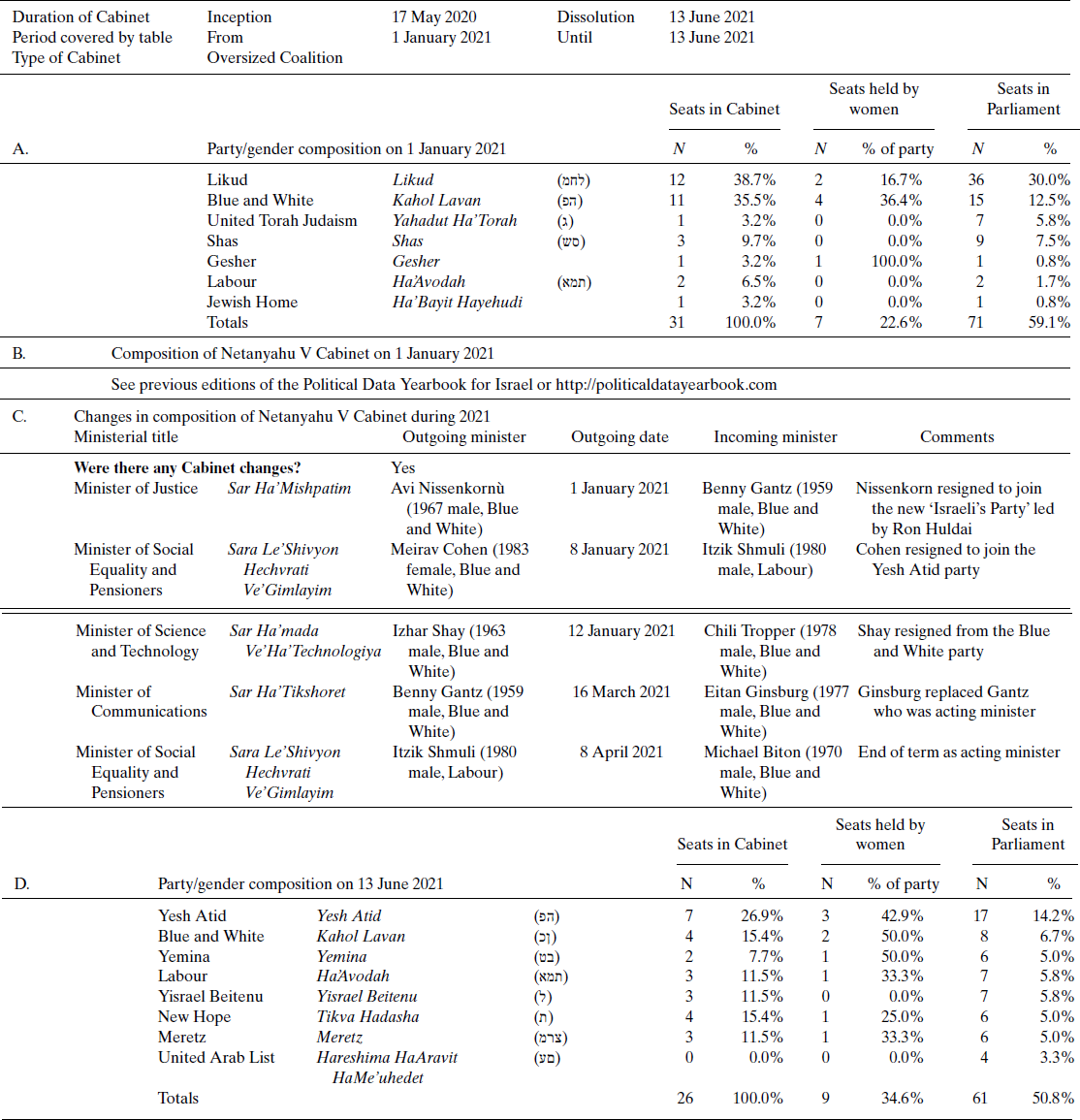
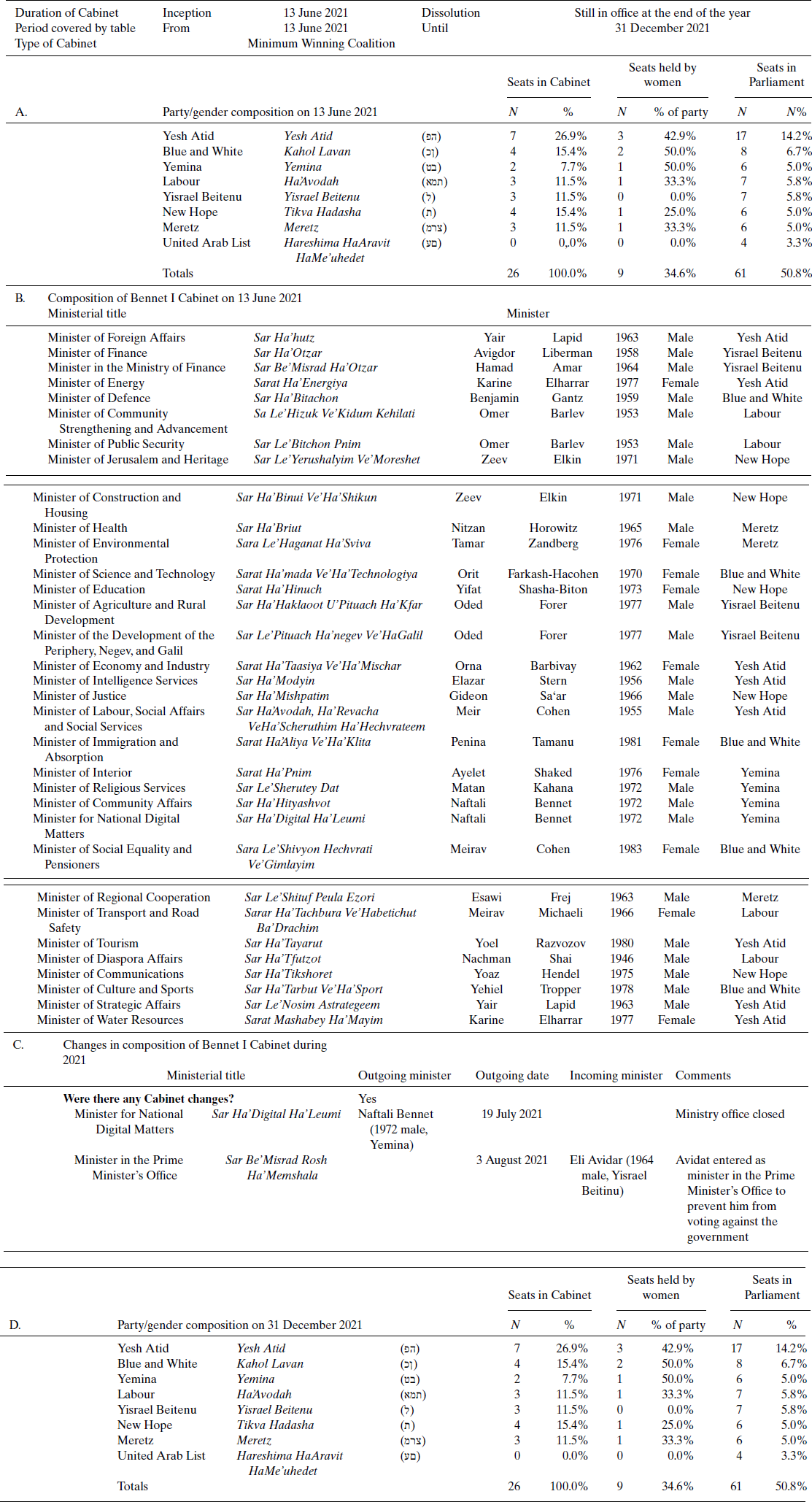
The new government resulted from the collaboration between parties from the right and left of the political spectrum. The following parties formed the new coalition: Ra'am, Meretz and Labour on the left side, Yesh Atid, Yisrael Beitenu, and Blue and White, which are more centrist parties, and New Hope and Yemina from the right side of the political map. The new coalition was sworn into the Knesset on 13 June with a majority vote of 60 against 59 (Member of the Knesset (MK) Said el Harami, from Ra'am, abstained, and MK Chikli, from Yemina, voted against the coalition). The new coalition government was a minimum winning coalition with 61 MKs. Just like the previous coalition, the new one was a rotation government. Bennet, head of Yemina, served first as Prime Minister. His party has only 10 per cent of the coalition MKs. Later on, Bennet would be replaced by Lapid, head of Yesh Atid, the biggest party in the coalition, who was appointed Alternate Prime Minister. A unique feature of the coalition was that it included an Arab party (Ra'am). This was the first independent Arab party to join a coalition government in Israel.
The new Cabinet comprised 28 ministers – the third largest so far in Israeli history – with half of them being new ministers (Tables 2 and 3). Nine ministers (almost one-third of the Cabinet) were women. This is a record number in the history of Israel's governments (Kenig Reference Kenig2021).
Cabinet composition of Netanyahu V in Israel in 2021

Note: MK Hamichai Shikli from Yemina voted against the new government in its investiture vote.
Source: Knesset (2021), https://main.knesset.gov.il.
Cabinet composition of Bennet I in Israel in 2021

Notes: Lapid is also the alternate Prime Minister.
Bennet is also the Prime Minister.
Source: Knesset (2021), see: https://main.knesset.gov.il.
The main goal of the new government was to provide governmental stability, focusing on issues that have a large national consensus and avoiding issues that have the potential to collapse the government. Throughout 2021 the coalition struggled to keep its majority, while the opposition tried to find one more MK to leave the coalition, especially from the right-wing party Yemina, in order to make the government fall.
Parliament report
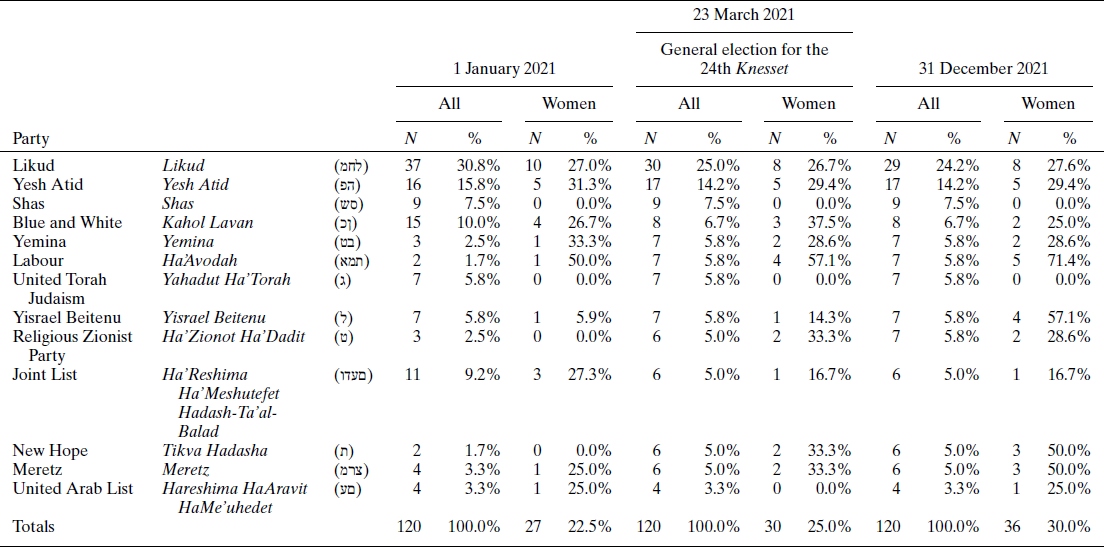
Knesset terms are dictated by the date on which a new Knesset is convened (and not by election dates). Hence, the 24th Knesset of Israel term started on 6 April 2021. The 24th Knesset presented 19 first-time MKs. The number of women in the Knesset was held steady at 30 female MKs (25 per cent of MPs). The number of non-Jewish MKs decreased from 17 to 14 (Central Election Commission 2022). For details on the composition of the Knesset, see Table 4.
Party and gender composition of Parliament (Knesset) in Israel in 2021

Notes: New Hope was formed on 8 December 2020. It is calculated on 1 January 2021, as two MPs of Derech Eretz joined the party (9 December 2021).
Likud is combined with Gesher party (one MP).
The Religious Zionist Party is counted as Jewish Home (1) and National Union (2).
Sources: Central Election Commission website (2021), https://votes24.bechirot.gov.il; Knesset (2021), https://main.knesset.gov.il/About/History/Pages/KnessetHistory.aspx?kns=24#.
Political party report
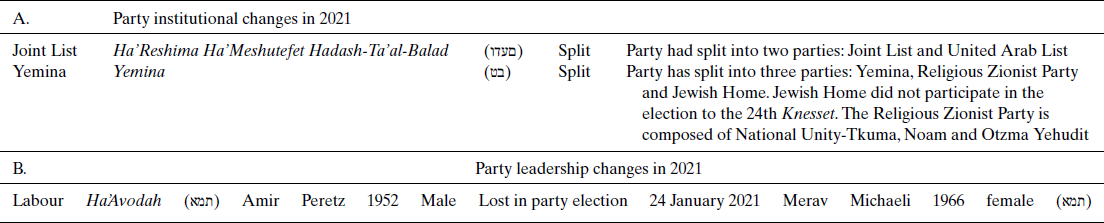
There were not many significant changes in the leading figures of the large parties (Table 5). Labour held an internal election for the head of the party. Meirav Michaeli, who opposed Labour's decision to join the coalition government in 2020, won the elections with 70 per cent of the votes. As a result, Labour left the 35th government.
Changes in political parties in Israel in 2021

Source: Israeli Democratic Institute, https://en.idi.org.il/israeli-elections-and-parties, accessed on 30 August 2022.
There were two main splits within parties towards the election: the Joint List split into two Arab-oriented parties, and Yemina split into several right-wing parties (for more details, see Election report).
Institutional change report
No major changes were adopted in 2021. In May, following the agreement between Yesh Atid and Yemina, the Knesset changed the basic law: The Government (Amendment No. 10). The amendment enlarged the equal power in decisions between left and right parties also in Parliament's committees (as well as in government). Another basic law changed, basic law: The Knesset (Amendment No. 51). This change expanded the ‘Norwegian law’ content, which enables ministers to resign from the Knesset but remain as a minister. Their seat is then occupied by the next person on the party's list (Knesset 2022).
Issues in national politics
Apart from the elections, the main issue on Israel's political, economic and social agenda was still the COVID-19 pandemic. Yet, after the election, the focus became less as the severeness of the pandemic declined. Other developments affecting Israeli politics focused on national security threats, and a military operation in the Gaza Strip that also caused clashes inside mixed cities in Israel.
COVID-19 pandemic
On 20 December 2020, Israel launched its COVID-19 vaccination campaign. At the beginning of January, over 1 million Israelis were already vaccinated, and by April Israel became the country with the highest number of people vaccinated per capita in the world. The high rate of vaccination enabled the government to lift most of its restrictions until the COVID-19 Delta variant began to spread throughout the country. Israel was the first country to give the third vaccination (later the fourth one was also given). By the end of the year, a fifth wave emerged as the Omicron variant spread in the country. Some restrictions were implemented again, yet not as severe as in the previous waves of COVID-19.
The economy
In 2021, Israel's economic performance was influenced by the ease of the COVID-19 pandemic. The country witnessed one of the its best years in economic performance. Gross domestic product (GDP) rose by 8.2 per cent, and GDP per capita rose by 6.4 per cent. The unemployment rate decreased from about 15 per cent to 6.1 per cent by the end of the year. The price index was 2.2 per cent. The interest rate was 0.1 per cent during most of the year. The yearly budget deficit significantly decreased from 11.4 per cent in 2020 to 4.4 per cent in 2021. The debt-to-GDP ratio decreased to 69 per cent from 73 per cent at the end of 2020. Relatively to other Organisation for Economic Co-operation and Development (OECD) countries in 2021, Israel's economic indicators were better than average (Bank of Israel 2022; Central Bureau of Statistics 2022).
Ongoing terrorism and security threats
During 2021, Israel experienced terrorist incidents and a major military operation as well as severe riots in mixed Jewish–Arab cities. On 6 May, violent clashes began between the police and Palestinians at Sheikh Jarrah in Jerusalem. The aftermath resulted in Hamas launching rockets into Israeli cities, which in turn led the Israeli Defense Force (IDF) to launch operation ‘Guardian of the Walls’. During a 12-day period, Hamas and the Palestinian Islamic Jihad launched over 4400 rockets into Israel. Seven civilians and one soldier died and several hundred were injured during those attacks. The IDF launched hundreds of attacks on military targets in the Gaza Strip. About 200 terrorists and 100 Palestinian civilians were killed by Israel Defense Forces (2022). During the operation, riots of Arab–Israeli citizens occurred in largely populated Arab cities. During the seven days, there were clashes between Arab–Israelis and the Jewish population that led to two civilian's deaths and several being badly injured. Those violent acts occurred during the negotiation to form the new coalition government and led to a halt in the negotiations between the parties. Nevertheless, the parties overcame the events and managed to form a coalition with an Arab party for the first time.
The main security concern in 2021 was the continuation of the establishment of Iranian forces in Syria and the ongoing Iranian pursuit of nuclear bomb capability. During this year, the Israeli air force attacked Iranian and Syrian targets in Syria. The talks over the nuclear agreement between the United States and Iran under European mediation was also a major concern, as Israel feared that Iran would have its sanctions lifted and also get closer to achieving nuclear bomb capabilities (Knesset 2022).
Foreign affairs
In 2021, Israel continued to establish relationships with several Arab states, mainly Gulf States and Morocco. This involved forming a full diplomatic relationship with Morocco and opening embassies in Tel Aviv and Marrakesh.
The main event that influenced Israeli foreign and local politics was the election of a new Democratic US President to the White House. The Joe Biden administration changed the shape of relationships and policy regarding Israel in relation to President Donald Trump's policies. The right-wing government had more difficulties with the power change in the United States, which affected mainly the policies over restoring the nuclear agreement with Iran.

 Open access

