





Introduction
Coarticulation is an essential feature of speech dynamics allowing speech segments (e.g., words, sentences) to be produced in rapid, continuous, and meaningful speech streams. More specifically, coarticulation characterizes the temporal overlap of articulatory speech gestures for neighbouring segments (Browman & Goldstein, Reference Browman and Goldstein1992; Fowler, Reference Fowler1980), which transfers into the acoustic speech signal via fine-grained intersegmental variations.
Despite being present very early on in infants’ oral communication, coarticulatory patterning evolves while children develop spoken language fluency. In previous research we examined developmental trajectories in lingual vocalic anticipatory coarticulation – that is, from the tongue, which is essential to the production of all vowels regardless of the language spoken. Thereby, lingual coarticulation degree reflects how much the tongue gesture for a target vowel overlaps with those for previous segments. We found that this degree decreased with increasing age both at the vicinity of segments or over longer temporal spans (intra-syllabic: Noiray, Abakarova, Rubertus, Krüger & Tiede, Reference Noiray, Abakarova, Rubertus, Krüger and Tiede2018; inter-syllabic: Rubertus & Noiray, Reference Rubertus and Noiray2018; both: Noiray, Wieling, Abakarova, Rubertus & Tiede, Reference Noiray, Wieling, Abakarova, Rubertus and Tiede2019. Young children in kindergarten exhibited a greater degree of anticipatory coarticulation than older children in primary school and adults. Results corroborated previous evidence of larger speech production units in children than in adults (reviews: Nittrouer, Studdert-Kennedy & Neely, Reference Nittrouer, Studdert-Kennedy and Neely1996; Noiray et al., Reference Noiray, Abakarova, Rubertus, Krüger and Tiede2018, 2019). We also noted variations in vocalic coarticulation degree depending on the identity of preceding consonants and their speech motor demands. Those were present in both children's and adult's speech.
While developmental differences in vocalic anticipatory coarticulation have been widely examined from the production perspective, little is known about their perception. In this study, we therefore investigated how developmental and contextual differences in vocalic anticipatory coarticulation transfer to the perceptual domain. To this end, we compared vocalic anticipatory perception in adult and seven-year-old child listeners. From the above-mentioned coarticulation studies (Noiray et al., Reference Noiray, Abakarova, Rubertus, Krüger and Tiede2018, 2019; Rubertus & Noiray, Reference Rubertus and Noiray2018), we selected speech stimuli from one adult, one age-matched child, and one three-year-old reflecting developmental differences in the degree of vocalic anticipation described above. With this approach, we aimed to elucidate whether adults and children differ in the perceptual integration of vocalic information present in segmental transitions. Results should further inform how contextually induced differences in vocalic anticipation influence listeners’ sensitivity to anticipatory cues. Before laying out our empirical trajectory, we first review the empirical findings that motivated the present study.
Adult processing of coarticulatory information in adult and child speech
From a perceptual standpoint, vowels are particularly salient due to their long duration, loudness, and formant patterns (e.g., review: Nazzi & Cutler, Reference Nazzi and Cutler2019). In addition, the speech stream provides various vocalic cues that may be discernible beyond their acoustically defined temporal domain onto previous segments. Research has shown that adult listeners perceive those vocalic cues and can, for instance, predict upcoming vowel targets in anticipation of their acoustic onset (lingual & labial coarticulation: e.g., Katz, Kripke & Tallal, Reference Katz, Kripke and Tallal1991; Nittrouer & Whalen, Reference Nittrouer and Whalen1989; Waldstein & Baum, Reference Waldstein and Baum1994; lingual coarticulation: e.g., Sereno & Lieberman, Reference Sereno and Lieberman1987; labial coarticulation: e.g., Sereno, Baum, Marean & Lieberman, Reference Sereno, Baum, Marean and Lieberman1987). However, it is unclear whether the developmental differences in vocalic anticipatory coarticulation reported here affect adult listeners’ ability to predict upcoming vowels in anticipation of their acoustic onsets.
Nittrouer and Whalen (Reference Nittrouer and Whalen1989) investigated differences in adult listeners’ perception of fricative-vowel syllables produced by three-, four-, five-, seven-year-old children and adults. When only presented with a portion of the onset fricative, listeners predicted upcoming vowels more accurately and earlier in child speech – embedding a greater degree of vocalic anticipation than in adult speech. However, listeners did not perform well when presented with speech material produced by three-year-olds despite exhibiting the highest coarticulation degrees among all child groups. Given that speech production is more variable in young children than adults (e.g., segment durations, acoustic and articulatory realizations: Goffman, Smith, Heisler & Ho, Reference Goffman, Smith, Heisler and Ho2008; Green, Moore, Higashikawa & Steeve, Reference Green, Moore, Higashikawa and Steeve2000; Lee, Potamianos & Narayanan, Reference Lee, Potamianos and Narayanan1999; Ménard, Schwartz, Boë & Aubin, Reference Ménard, Schwartz, Boë and Aubin2007; Sadagopan & Smith, Reference Sadagopan and Smith2008), coarticulatory cues conveyed in the speech of three-year-old children may have been less informative for listeners in this study.
To summarize, anticipatory perception seems to benefit from children's large degree of vocalic anticipation, although this facilitative effect may be reduced in the case of young children due to the motor imprecision and variability characterizing their speech (e.g., Abakarova, Iskarous & Noiray, Reference Abakarova, Iskarous and Noiray2020; Zharkova, Hewlett & Hardcastle, Reference Zharkova, Hewlett and Hardcastle2011; Zharkova, Reference Zharkova2020). This empirical discrepancy calls for in-depth investigations to uncover when developmental differences in coarticulatory patterns cease to facilitate adults’ perception of child speech in comparison to adult speech.
Children's differences in the perception of coarticulatory information
Attention to segmental transitions, the most dynamical parts of the speech signal, is used for speech sound discrimination at the early stage of language development (e.g., Bertoncini & Boysson-Bardies, Reference Bertoncini and Boysson-Bardies2000; Houston & Jusczyk, Reference Houston and Jusczyk2003). However, to what extent older children use coarticulatory information for speech perception in comparison to adults remains an empirical question (reviews: Mayo, Reference Mayo2000; Mayo, Scobbie, Hewlett & Waters, Reference Mayo, Scobbie, Hewlett and Waters2003). Contrary to research addressing adults, most studies targeting children's perception of anticipatory coarticulation have used (semi-) synthesized speech partly because it is easier to manipulate specific acoustic parameters (e.g., Ohde, Haley & McMahon, Reference Ohde, Haley and McMahon1996; Sussman, Reference Sussman2001). Sussman (Reference Sussman2001) found that four- and five-year-old children could identify missing vowels in synthesized C1VC syllables when the vocalic on- and offset transitions were preserved but they performed more poorly than adults. In addition, when listening to C1VC syllables with C1 transition information conflicting with the vocalic target, children's responses were in most cases influenced by the subsequent steady-state vowel formant information. Instead, adults were confused by conflicting vocalic information conveyed in the C1 transition with respect to the subsequent steady-state vowel portion. As a result, their responses were less consistent than children. Sussman concluded that adults use fine-grained dynamic information to a greater extent than children – who may instead rely on longer, louder, and more prominent spectral information for speech processing. This finding is particularly important when it comes to children's processing of transitional cues because child speakers exhibit large degrees of vocalic coarticulation with vocalic information being transmitted over longer temporal extents than in adult speech.
Perception of varying coarticulatory degrees
As mentioned above, variations in vocalic anticipatory coarticulation have been observed as a function of the specific vowels and consonants assembled and whether they share similar articulatory demands on speech articulators (e.g., Abakarova, Iskarous & Noiray, Reference Abakarova, Iskarous and Noiray2018; Fowler, Reference Fowler1994; Noiray et al., Reference Noiray, Abakarova, Rubertus, Krüger and Tiede2018; Rubertus & Noiray, Reference Rubertus and Noiray2020; review: Recasens, Reference Recasens2018). While the production of all vowels necessitates a tongue gesture, some consonants do not (e.g., /b/ which recruits the lips), and therefore permit a large degree of vocalic overlap (e.g., /bu/ as illustrated in Figure 1). Other syllables (e.g., /du/ in Figure 1) instead allow minimal vocalic anticipation degree due to high demands on the tongue during both the consonant and vowel execution. In this case, the vocalic gesture cannot be initiated well in advance because it would compete with those for the planned consonant and therefore affect its intelligibility. This phenomenon has been largely described within the theory of coarticulatory resistance (in adults: e.g., Abakarova et al., Reference Abakarova, Iskarous and Noiray2018; Bladon & Al-Bamerni, Reference Bladon and Al-Bamerni1976; review: Recasens, Reference Recasens2018). In the present study, we were interested whether this relationship translates into the perceptual domain.
Conceptualization of the gestural organization for two articulators: lips and tongue (tongue dorsum, TD; tongue tip, TT) and segments’ prominence in the production of two CV syllables: [bu] (left) and [du] (right). Tongue contours were plotted from production data of one adult female at consonant and vowel temporal midpoints. Dashed lines indicate the vocalic acoustic onset.

In her perceptual investigation of coarticulatory resistance, Fowler (Reference Fowler2005) used əCV disyllables for which consonants varied in their degree of resistance to vocalic anticipation. Stimuli were either spliced (appropriate vocalic information during /ə/) or cross-spliced (inappropriate vocalic information during /ə/). Differences in reaction time showed that listeners identified vowels in spliced disyllables with minimally resistant consonants better than with highly resistant consonants. The opposite pattern occurred for cross-spliced disyllables. These findings suggest that listeners’ anticipatory perception is sensitive to transient coarticulatory effects from intervening consonants. However, to our knowledge no study so far has investigated effects of coarticulatory resistance on children's vocalic anticipatory perception, either when exposed to adult or to child speech.
Research questions and predictions
In the present study, we first asked whether listeners are sensitive to developmental differences in vocalic coarticulation degree (within-listener group comparisons). In our previous research, we had found greater coarticulation degrees in child compared to adult speech. Based on Nittrouer and Whalen's (Reference Nittrouer and Whalen1989) perception study, we expected listeners to benefit from greater coarticulation degrees and therefore identify vocalic targets to a greater extent in child speech compared to adult speech. However, given the absence of a facilitation effect observed with three-year-old speakers, we also anticipated lower perception accuracy when presented with three-year-old speech.
Second, we compared adult and child listeners’ ability to use anticipatory cues and predict upcoming vowels (between-listener group comparisons). Due to less experience with their native language, we expected child listeners to perform more poorly than adults when presented with adult speech conveying lower coarticulation degrees and hence lesser anticipatory cues than child speech.
Last, we examined variations in vowel prediction accuracy as a function of whether its gestural specificities competed with those of preceding consonants. Given previous findings, we expected greater vowel accuracy in the context of /b/ that does not recruit the tongue articulator and hence is permeable to lingual coarticulatory influences than in the /d/ that recruits the tongue and therefore resists vocalic influences.
Method
Participants
We tested 29 seven-year-old children (range: 7;4–7;9 y; mean: 7;5 y) and 93 Adults (range: 18–55 y; mean: 31 y). All participants were monolingual German listeners living in the region of Berlin and Potsdam. None reported any language-related, hearing-related, or visual impairments, except one boy who was diagnosed with a red-green colour-blindness. All participants including children and their parents gave written consent to participate in the study. The Ethical Committee of the University of Potsdam approved the study.
Stimulus material
We used speech samples of the structure /ainə/ + CV produced by one woman (A), one seven-year-old girl at the end of the first grade (C7), and one three-year-old girl (C3). While the German indefinite article /aɪnə/ (schwa henceforth noted as @) was unaltered between samples, the segmental structure of the subsequent CV varied (C=/b/, /d/; V=/i:, u:, y:, a:/), e.g., /aɪn@ bi:/, /aɪn@ dy:/. To illuminate the temporal organization of anticipatory perception in child and adult listeners, we employed a gating paradigm (Grosjean, Reference Grosjean1980) which consists in truncated speech sequences of increasing durations called ‘gates’ generated from the original speech samples.
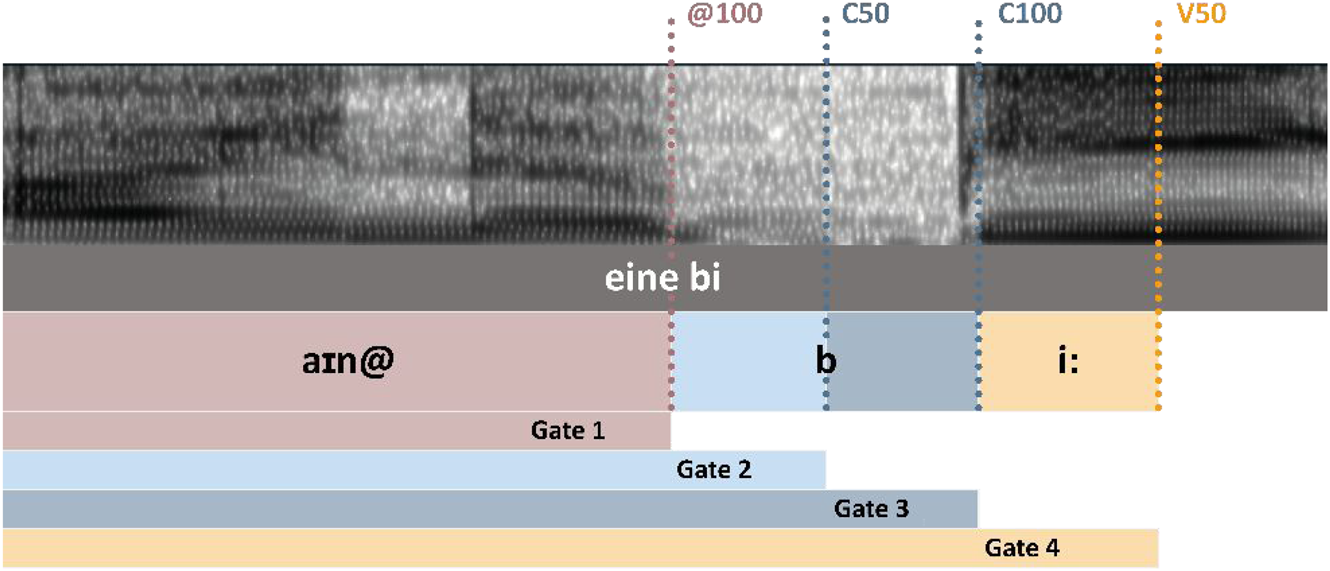
Four temporal gates were generated with Praat (Boersma & Weenink, Reference Boersma and Weenink2020) using a custom-made script that extracted segment boundaries at the offset of schwa, the midpoint and offset of the consonant, and at the midpoint of the vowel. The gates always included the article (/ain@/) and an increasing portion of the original untruncated sample. While the shortest gate would only include /ain@/, the longest possible gate would include the article, the consonant (/b/ or /d/), and a portion of one of the four target vowels until its midpoint. Figure 2 depicts all gates within one possible sample. The midpoint of a segment is always tagged “50” and the offset tagged “100”.
Temporal gates for each utterance (/ain@/+CV).
The speech stimuli were chosen from the coarticulation studies conducted in our laboratory: Noiray et al. (Reference Noiray, Abakarova, Rubertus, Krüger and Tiede2018, Reference Noiray, Wieling, Abakarova, Rubertus and Tiede2019) and Rubertus and Noiray (Reference Rubertus and Noiray2018, Reference Rubertus and Noiray2020). Details regarding the recording procedure, data processing, and analysis can be found there. For all speech stimuli the audio signal (sampling rate: 48kHz) and ultrasound images of the tongue surface (sampling rate: 48Hz) were recorded.
The selection of the speech stimuli was based on the developmental and contextually induced variations in coarticulation degree (e.g., Noiray et al., Reference Noiray, Wieling, Abakarova, Rubertus and Tiede2019). First, the speech of the youngest three-year-old child exhibited a globally higher coarticulation degree than the speech of the seven-year-old who in turn exhibited a higher coarticulation degree than the adult. Second, CDs varied as a function of intervocalic consonant with higher coarticulation degrees in the context of the labial consonant /b/ compared to the alveolar consonant /d/.
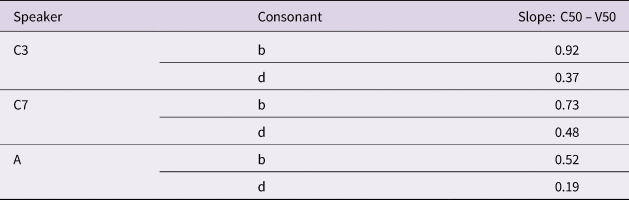
Coarticulation degrees were calculated via regression analyses, commonly used in coarticulation studies (e.g., Gibson & Ohde, Reference Gibson and Ohde2007; Noiray, Ménard & Iskarous, Reference Noiray, Ménard and Iskarous2013; Sussman, Duder, Dalston & Cacciatore, Reference Sussman, Duder, Dalston and Cacciatore1999). Regression slopes express systematic changes in the horizontal position of the tongue body during the consonant (Xc) dependent on those during the vowel (Xv). Table 1 reports coarticulation degrees (expressed as regression coefficient) for each of the speakers and consonants selected for the perception study. The seven-year-old shows a slightly higher coarticulation degree than the three-year-old in /d/ context.
Lingual coarticulation degree (regression coefficients) between C50 and V50 for each consonantal context and speaker. The higher the coefficient, the greater the degree of lingual coarticulation.
In the next step, target speech samples were selected for each speaker controlling for segment durations. Peak amplitudes of each sound sample were normalized with Adobe Audition CC 2018.
Experimental procedure
All children and 42 out of the 93 adults were tested in the Laboratory for Oral Language Acquisition (LOLA) at the University of Potsdam. The perception test was run with OpenSesame (Mathôt, Schreij & Theeuwes, Reference Mathôt, Schreij and Theeuwes2012), using a computer and headphones (adults: over-ear super Lux headphones, frequency range: 10 Hz - 30 kHz, impedance: 32 Ω; children: on-ear JBL headphones, frequency range: 20 Hz - 20 kHz, impedance: 32 Ω). Participants were instructed either in written form on the screen (adults) or verbally (children) that they would hear utterances of different female speakers and different durations and would be asked to guess the upcoming vowel following the portion of speech heard as fast as possible. Responses were given via keypress on the keyboard. Four coloured keys were selected to represent the four target vowels. Vowel-colour associations were always shown on the screen. To avoid any bias due to handedness or favoured colour, we used two sets of colour-vowel associations which were counterbalanced across participants. Practice trials including both full length and gated speech items preceded each testing session to familiarize participants with the task. During the testing session, speech sequences were prompted in randomized order. Participants listened to a total of 96 sequences (three speakers * four gates * two consonants * four vowels). Each speech item was presented only once to consider children's limited attention span and keep the number of trials consistent between listeners. The perception test included breaks and the experimenter regularly encouraged children to stimulate their interest in the task.
Two testing conditions were employed with adult listeners: in our laboratory with the same experimental set-up used with children (43 adults) and online (51 adults) using an online version of the test implemented with SoSci Survey (Leiner, Reference Leiner2019). Participants were recruited via our university recruitment platform (and received credit points as part of their curriculum), social media, or within circles of acquaintances. In this version, participants used the computer mouse to select target vowels. The online test was designed to be fully self-explanatory. Prior to the perception test, we asked a few technical questions (e.g., type of headphone, type of device used). Commentary fields were included at the end of the test to assess the difficulty of the task and collect participants’ overall opinions. While these precautionary measures may not guarantee the exact same experimental conditions across all participants, they allowed us to monitor adults’ testing. Furthermore, when testing an effect of experimental environment (in the laboratory or online) on adult listeners’ responses, results did not yield any significant difference in vowel predictions at any gate. All adult listeners were therefore grouped together for subsequent analysis.
Data analysis
Six adults and five children were excluded from data analysis for the following reasons: a) less than half of the number of observations in at least two conditions (five adults), b) accuracy for V50 below chance (p = .25; one adult and one child), c) technical issues (one child), or d) participant reportedly did not understand the task (three children). Therefore, 87 adults and 24 children were included in the analysis.
To assess accuracy in vowel anticipatory perception over different gates we employed generalized linear mixed models fitted in R (R Core Team, 2020) with the lme4 package (version 1.1.23; Bates, Maechler, Bolker & Walker, Reference Bates, Maechler, Bolker and Walker2015). Modelling was conducted with the glmer function for binomial data to assess probabilities of correct answers in each listener group (transforming our response variable to log odds or short “logits”). To adjust the p-value for pairwise multiple comparisons we used the emmeans function of the emmeans package (version 1.4.8; Lenth, Reference Lenth2020) using Tukey as the method for adjustment. The random effect structure was determined by the design of the study (repeated measurements for each listener and for item across listeners), visual inspection of grouping trends within the data, distribution of variances in model outputs, and theoretical considerations as suggested by Winter (Reference Winter2019). In models for which we had no interest in the specific effect of consonants (m1 and m2) we combined consonants and vowels to the factor syllables. In addition, the complexity of the random effect structure was reduced in a stepwise fashion for cases where it was not supported by our data (singular fit or converge problems). Random effect structures were adapted for each model to fit these criteria.
Results
Perceptual sensitivity to developmental differences in vocalic anticipation
To determine whether listeners’ anticipatory perception differ across speakers’ age, we compared logits between speakers (A, C7, C3) for each temporal gate with listener groups (children or adults) and consonantal contexts (b, d) pooled together. For the random effect structure, we created the variable nListSyl that explicitly nested listener groups (child and adult) with syllable. We ran the following model:
 $$\eqalign{&m1 < \!\!- glmer( correct \sim Speaker{^\ast} Time + {\islant12% (} {\it 1\vert participant} {\islant12% )} + {\islant12% (} {\it 1 + Speaker\vert nListSyl} {\islant12% )} \cr & + {\islant12% (} {\it 1\vert item} {\islant12% )} , \;data = dat, \;family = ^{\prime}\!\!binomial^{\prime}, \;control= glmerControl{\islant12%(} optimizer \cr &= c{\islant12% (} {''bobyqa'' } {\islant12% )} {\islant12% )} {\islant12% )} ] } $$
Figure 3 represents listeners’ vowel prediction functions for all temporal gates and speakers. Logits were transformed back to probabilities of the answer being correct, to ease interpretation.
Probability functions for correct vowel prediction for each speaker across all gates with listener groups and consonantal contexts pooled together. Red dashed line indicates chance level performance.

First, regardless of speaker group and gate, mean probabilities for correct vowel predictions were above the 25% chance level (red dashed line). Still, prediction accuracy was greater close to the acoustic onset of the target vowel compared to earlier gates. This increase was not characterized by a strictly linear shape over time: it was flatter between the earlier gates (@100 versus C50) and the longer gates (C100 versus V50) but steeper between the midpoint and the offset of the consonant (C50 versus C100).
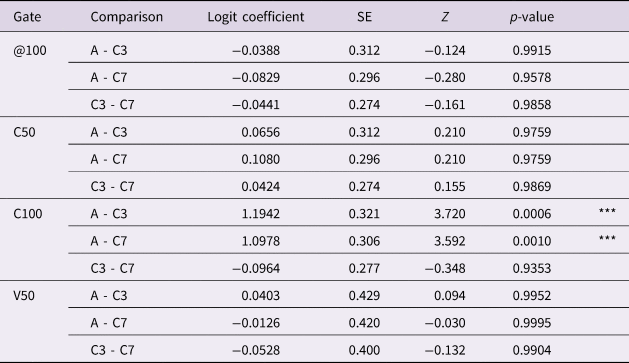
Second, when comparing listeners’ perceptual performances across speakers, we found a reliable speaker's effect at the offset of the consonant between the three-year-old (yellow line) and adult (blue line) (logit coefficient: +1.19, SE = 0.32, z = 3.72, p < .05) and the seven-year-old (orange line) and the adult (logit coefficient: +1.10, SE = 0.31, z = 3.59, p < .05). For the two child speakers, listeners were equally successful at anticipating vowel targets. Results of pairwise comparisons between the speakers for each gate are summarized in Table 2.
Pairwise comparison of vowel prediction accuracy between speakers for each gate. Results were obtained via emmeans function with Tukey p-value adjustment. Cohort abbreviations are C3: three-year-old child, C7: seven-year-old child, and A: adult. Significance codes ‘***’: p < .001; ‘**’: p < .01; ‘*’: p < .05; ‘.’: p < 0.1
Differences in vocalic anticipatory perception across listener groups
Next, we compared child and adult listeners’ anticipatory vowel perception, to elucidate whether children at the age of seven already have similar predicting abilities as adults. We fitted a new model:
 $$\eqalign{&m2 < \!\!- glmer( correct \sim ListSpeak{^\ast} Gate + {\islant12% (} {\it 1\vert Participant} {\islant12% )} + {\islant12% (} {\it 1\vert Syllable} {\islant12% )} \cr & + {\islant12% (} {\it 1\vert Item} {\islant12% )} , \; data = dat, \;family \cr & = ^{\prime}\!\!binomial^{\prime}, \;control = glmerControl \;{\islant12% (} {optimizer = ^{\prime}\!\!bobyqa^{\prime}} {\islant12% )} {\islant12% )} } $$
For this model we created the nominal predictor ListSpeak which combines all levels of predictors associated to listeners’ age and speakers’ age (i.e., Child listener: C3 speaker, Adult listener: C3 speaker, …, Adult listener: Adult speaker) to avoid overfitting of the data and simplify p-value adjustment. Pairwise between listener group comparisons were carried out within speaker groups and with consonantal context pooled together.
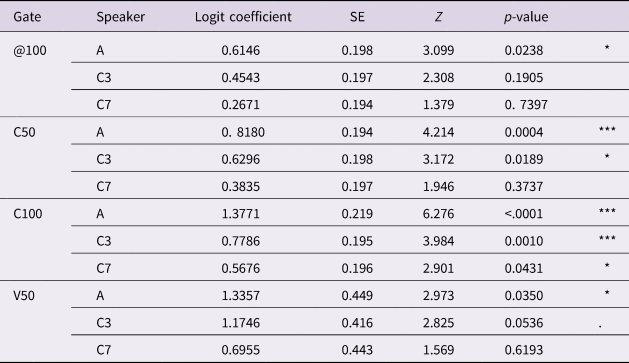
Figure 4 reports probabilities of correct vowel prediction for each listener group. Overall, adult listeners (blue line) identified vocalic targets in all three speakers and from the earliest temporal gates onward better than child listeners. However, when comparing probability slopes between listener group adults’ perceptual advantage was not uniform across all temporal gates. For instance, when presented with speech of the three-year-old speaker (left panel), adult listeners were reliably more successful than child listeners within the temporal domain of the consonant (C50: logit coefficient: +0.63, SE = 0.20, z = 3.17, p = .0189; C100: logit coefficient: +0.78, SE = 0.20, z = 3.98, p = .001) but not at the earliest gate (@100). For the seven-year-old speaker, listeners groups only differed significantly in anticipatory vowel perception starting from the offset of the consonant (middle panel). When tested with adult speech (right panel), adult listeners predicted the vowel significantly better than child listeners for all gates (for respective logit coefficient, SE, z, and p-value see Table 3). Results of pairwise comparisons between listeners by speaker for each gate are provided in Table 3.
Probability functions for correct vowel prediction for each listener group across all gates separated by speakers (from left to right with ascending age) with consonantal contexts pooled together. Red dashed line indicates chance level performance.

Pairwise comparison of vowel prediction accuracy between listener groups for each speaker by gate. Results were obtained via emmeans function with Tukey p-value adjustment. Cohort abbreviations are C3: three-year-old child, C7: seven-year-old child, and A: adult. Significance codes ‘***’: p < .001; ‘**’: p < .01; ‘*’: p < .05; ‘.’: p < 0.1
Contextual effects on vocalic anticipatory perception
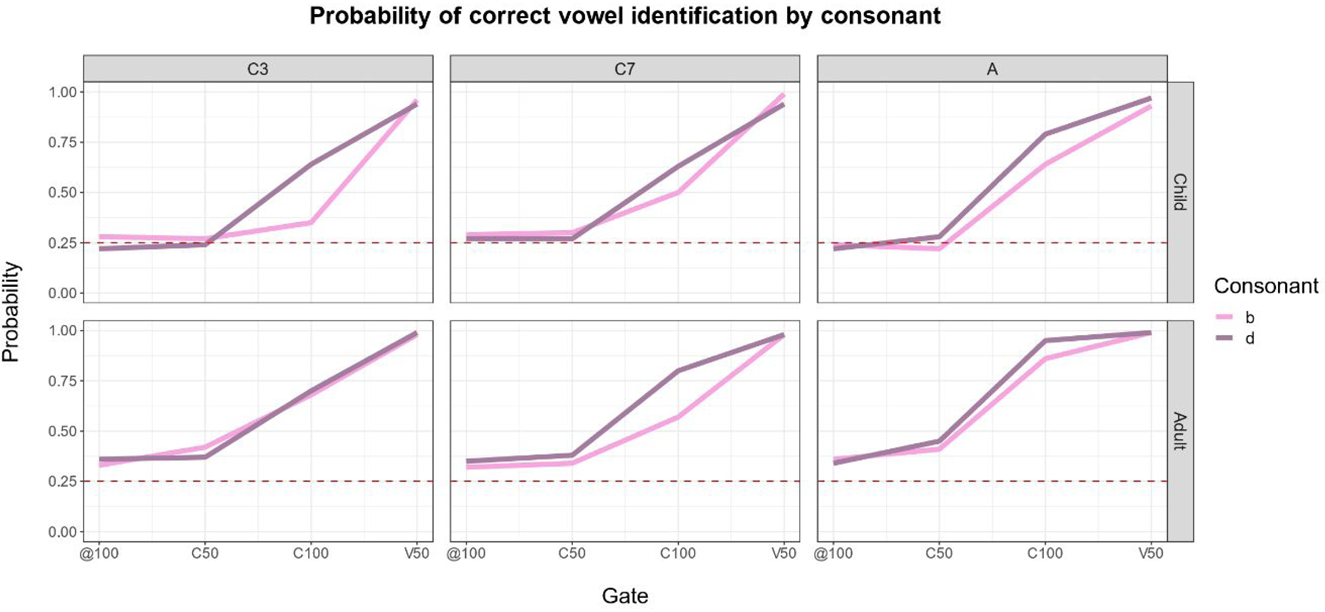
Next, we investigated whether the consonantal context preceding the vocalic targets modulated the observed differences in listeners’ anticipatory perception. To address this question, we fitted a model with all possible combinations of listeners (children, adults), speakers (adult, three-, seven-year-old), and consonantal contexts (/b/, /d/) in a predictor called ListSpeakCon.
 $$\eqalign{&m3 < \!\!- glmer{\islant12% (} correct \sim ListSpeakCons{^\ast} Time + {\islant12% (} {\it 1 \vert Participant} {\islant12% )} + {\islant12% (} {\it 1\vert Vowel} {\islant12% )} \cr &+ {\islant12% (} {\it 1\vert Item} {\islant12% )} , \;data = dat, \;family = ^{\prime} \!\! \hskip-0.8pt binomial^{\prime}, \;glmerControl{\islant12% (} optimizer \cr &= ^{\prime} \!\!\!optimx ^{\prime}, \;optCtrl = list{\islant12% (} method = ^{\prime} \hskip1pt\!\!\!nlminb^{\prime}{\islant12% )} {\islant12% )} {\islant12% )} } $$
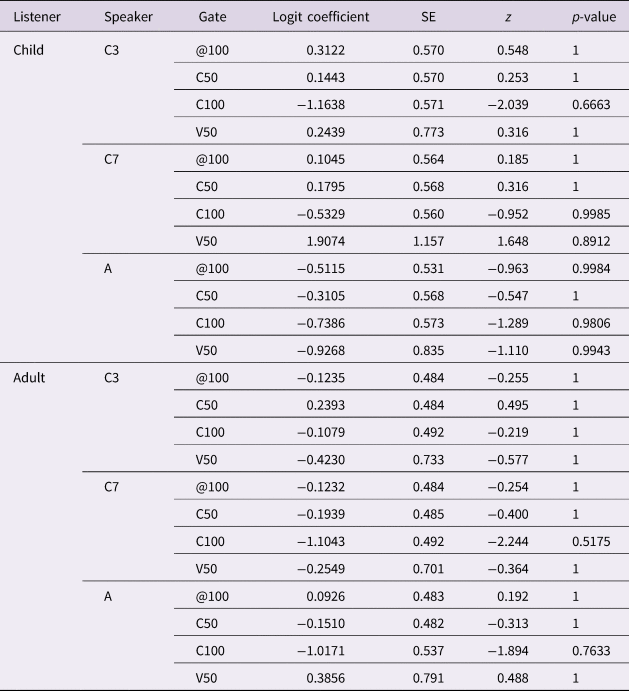
Figure 5 illustrates correct prediction probability functions for child (upper row) and adult listeners (lower row) for both consonants by speaker (panels are ordered from left to right with ascending age). Even though visual inspection of Figure 5 suggests both listeners groups better predicted vowels in the context of /d/ than /b/, all pairwise comparisons did not yield any significant effect (Table 4).
Probability functions for correct vowel anticipation for each consonant across all gates separated by speakers (from left to right with ascending age) for child (1st row) and adult (2nd row) listeners. Red dashed line indicates chance level performance.
Pairwise comparisons of vowel prediction accuracy between consonantal contexts (/b/ was set as baseline) for each gate grouped by listener and speaker. Results were obtained via emmeans function with Tukey p-value adjustment. Cohort abbreviations are C3: three-year-old child, C7: seven-year-old child, and A: adult. Significance codes ‘***’: p < .001; ‘**’: p < .01; ‘*’: p < .05; ‘.’: p < 0.1
Discussion
In previous research, we found that vocalic coarticulation degree differed as a function of age and phonetic contexts (Noiray et al., Reference Noiray, Abakarova, Rubertus, Krüger and Tiede2018, 2019; Rubertus & Noiray, Reference Rubertus and Noiray2018). The main goal of this study was to investigate whether the observed developmental and contextual changes in intersegmental speech organizations transfer in perception. More specifically, we asked whether and how children and adults listeners process variations in coarticulatory information in the speech stream. To address these questions, we investigated anticipatory vowel perception in 24 German seven-year-old and 87 adult listeners.
Developmental differences in coarticulatory information dynamics
Based on Nittrouer and Whalen's (Reference Nittrouer and Whalen1989) findings we predicted that highly coarticulated child speech – that is, with large vocalic influences on previous segments would facilitate listeners’ vowel predictions when compared to lower coarticulated adult speech. Our findings did not support this hypothesis. While all listeners were able to predict upcoming vowels in speech sequences produced by either child or adult speakers from the midpoint of the consonant latest, the expected influence of coarticulation degree onto perceptual processing was reversed: perceptual accuracy was enhanced in adult as compared to child speech. This result aligns with previous reports of more variable speech motor patterns (e.g., the lips, jaw) (e.g., Green, Nip & Maassen, Reference Green, Nip and Maassen2010; Kent, Reference Kent1976; Lee et al., Reference Lee, Potamianos and Narayanan1999; Ménard & Noiray, Reference Ménard and Noiray2011). This is also reflected in children's speech outputs that remain quite variable compared to adults (e.g., Vorperian & Kent, Reference Vorperian and Kent2007; Eguchi, Reference Eguchi1969; Ménard et al., Reference Ménard, Schwartz, Boë and Aubin2007). The speaker differences in anticipatory perception observed in our study may therefore be attributed to children's inconsistency in speech motor coordination making the production of individual segments more variable and thus anticipatory vocalic information less helpful than in adult speech (Nittrouer & Whalen, Reference Nittrouer and Whalen1989). Nevertheless, children's imprecise production patterns may not solely explain why all listeners identified vowels produced by the three- and seven-year-old child equally well, especially given the large age gap between the two speakers.
We propose an alternative explanation for this unpredicted result. Previous research on anticipatory coarticulation has shown that, unlike adults, young children may initiate vocalic gestures two segments before the acoustically defined temporal domain of the vowel (Rubertus & Noiray, Reference Rubertus and Noiray2018; Noiray et al., Reference Noiray, Wieling, Abakarova, Rubertus and Tiede2019). Therefore, children do not only exhibit greater coarticulation degrees compared to adults, but they also show longer temporal extents of vocalic influences. As a consequence, vocalic information spreads from an earlier time point in child speech as compared to adults’. Vocalic information is more diffuse throughout the entire sequence and hence probably less salient than more compact information conveyed within a short temporal span. This pattern is schematized in the left panel of Figure 6. The amount of vocalic information over the four temporal gates (from left to right) is represented by a grey dashed line for highly coarticulated child speech and by a solid black line for minimally coarticulated adult speech.
Schematized levels of prominence of vocalic information and changes in vocalic information in low (adult) and high (child) coarticulated speech over time (gate).
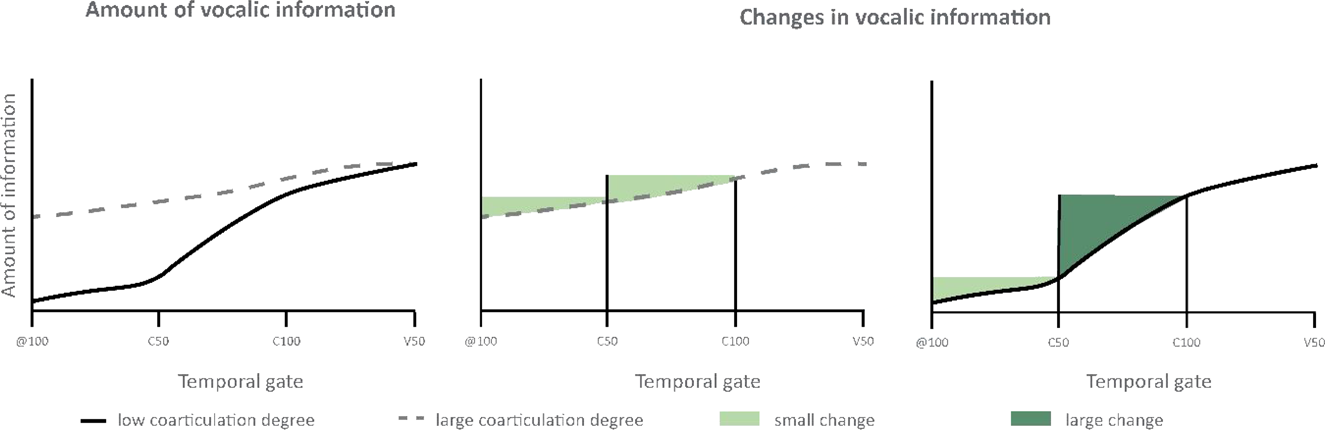
More importantly, developmental differences in the amount of vocalic information over time also affect the shape of segmental transitions – in other words, its dynamics. Those dynamics are schematized in Figure 6 for child speech (middle panel) and adult speech (right panel). In child speech, because the lingual vocalic gesture is activated early, vocalic information is conveyed from the earliest temporal gate (@100) onward. The amount of vocalic information is not considerably lower than at the midpoint of the consonant (C50), which in turn is not considerably lower than at the offset of the consonant (C100). In sum, differences in the amount of vocalic information between adjacent gates do not change by much; therefore, the magnitude of change in vocalic information over time remains small (light green area). In adult speech however, the dynamics characterizing changes in vocalic information over time can be predicted differently (right panel): on the one hand, those changes are minimal between @100 and C50 (light green area). On the other hand, greater differences in vocalic information occur between C50 and C100 (dark green area) because at the offset of the consonant a high amount of vocalic information is now present in the signal.
Thus, when vocalic gestures are activated as early as in child speech, changes in vocalic information over time are less dynamic than in adult speech and hence presumably less perceptually salient. Assuming listeners parse the incoming speech signal incrementally, they may not pay much attention to vocalic information occurring far in advance from the vowel's acoustic onset because it might interfere with the perception of on-going segments (e.g., consonants).
Mayo and Turk's (Reference Mayo and Turk2005) findings provide further support for the hypothesis that dynamical changes in vocalic information underlie listeners’ better vowel predictions. They found that both adult and child listeners’ perceptual sensitivity towards transitional cues was modulated by its spectral informativeness, i.e., its extent and duration. In a consonant categorization task, listeners assigned greater weight to transitional information when those cues were spectrally distinct across a consonantal pair (e.g., /do/-/bo/) than when spectrally similar (/de/-/be/). Similarly, listeners may show greater predictive ability in low as compared to high coarticulated speech because, in the former case, the acoustic speech signal conveys large changes in vocalic information during the consonant-vowel transition (see Figure 6, right panel: dark green area from C50 to C100) that are perceptually more salient than when spread over longer speech samples (see Figure 6, middle panel: light green area from @100 to C50 and C50 to C100). Furthermore, note that for the earliest gates (@100 to C50) dynamic changes in vocalic information are almost equal between speaker groups (compare light green area in the middle and right panel). These different patterns of information dynamics are also reflected in the finding of discrepancies between speaker groups as a function of speaker over time, with speaker differences not emerging before the offset of the consonant (cf. Figure 3).
Going a step further, we investigated whether the coarticulation patterns illustrated in Figure 6 are supported by actual lingual production data of the three speakers. To this end, horizontal tongue dorsum positions were normalized following Noiray et al. (Reference Noiray, Wieling, Abakarova, Rubertus and Tiede2019). The most anterior tongue dorsum position during V50 among all trials for each speaker was set to zero (front in Figure 7) and the most posterior to one (back in Figure 7). All other tongue dorsum positions were then scaled in relation to these references.
Dependence of the horizontal tongue dorsum positions (y-axis) across gates (@100: left panels, C50: mid panels, and C100: right panels) on the tongue dorsum position during the vowel midpoint (V50, x-axis) for each speaker. Tongue positions are indicated by the labels: front, center and back on the y-axis. 95% confidence intervals are shown.

Figure 7 reports correlations between the horizontal tongue dorsum position at the midpoint of the vowel (x-axis) and the various temporal gates (y-axis) at @100, C50, and C100 (left, mid and right panels) by fitting a linear smooth using the ggplot function from the ggplot2 package (Version: 3.3.2; Wickham, Reference Wickham2016). Coarticulation degree is high if tongue position at a specific gate (e.g., @100) resembles those of the upcoming vowel midpoint. This relationship is captured by a steep slope.
The figure shows that both child speakers’ slopes are higher than those for the adult speaker from the earliest gate (@100) and increase more continuously over time compared to the adult speaker, whose slopes instead increase abruptly between C50 and C100. Coarticulation slopes therefore captures well the patterns depicted in Figure 6.
Developmental differences in anticipatory perception
Next, we investigated whether the two groups of listeners differed in vocalic anticipatory perception. First, all listeners used vocalic coarticulatory information available in the temporal domain of the consonant to predict upcoming vowels. This finding aligns with previous studies (adults: e.g., Katz et al., Reference Katz, Kripke and Tallal1991; Nittrouer & Whalen, Reference Nittrouer and Whalen1989; Sereno & Lieberman, Reference Sereno and Lieberman1987; Waldstein & Baum, Reference Waldstein and Baum1994; children: e.g., Ohde et al., Reference Ohde, Haley and McMahon1996; Sussman, Reference Sussman2001). It further indicates that if a developmental shift occurs in children's attention to signal properties, seven-year-old child listeners at least behaved in similar ways as adults. Furthermore, our finding suggests that children at this age can use sub-phonemic information and that their phonetic representations are already fine-grained (e.g., Cross & Joanisse, Reference Cross and Joanisse2018; Desmeules-Trudel, Moore & Zamuner, Reference Desmeules-Trudel, Moore and Zamuner2020).
Yet, vowel prediction accuracy was greater in adult listeners compared to child listeners. There is evidence that children employ different strategies when making phonemic identifications; they are in general less consistent in their usage of minimal phonemic information than adults (e.g., Parnell & Amerman, Reference Parnell and Amerman1978). Thus, children may be less successful in extracting or processing sub-phonemic information conveyed in a consonant because it is short and spectrally quite inconspicuous (aside from the burst) compared to vowels. Noiray et al. (Reference Noiray, Wieling, Abakarova, Rubertus and Tiede2019) have argued that vowels may serve as “attractors” in children's gestural planning because vowels are acquired early and are perceptually more salient than most consonants. Turning to perception, Sussman (Reference Sussman2001) found that children rely more on steady-state formants than transitional information if both conflicted with each other. This indicates that vowels also serve as attractors in children's perception.
Given that speech conveys all sorts of information, informative (e.g., anticipatory vocalic information) and uninformative, children must gain experience with their native language not only to become fluent speakers but also to become fluent listeners. The role of experience may also be particularly relevant when it comes to processing of truncated speech. Research found that perception is less robust to signal distortions in children than in adult speech (e.g., Eisenberg, Shannon, Schaefer Martinez, Wygonski & Boothroyd, Reference Eisenberg, Shannon, Schaefer Martinez, Wygonski and Boothroyd2000; Elliott, Reference Elliott1979). Even though the quality of spectral properties in the speech stimuli we used were not manipulated, the gating method employed is unusual. Adults are more experienced listeners than children; they can therefore better cope with all sorts of degraded speech (e.g., in noisy environments, truncated speech) while children may need long and clear speech chunks.
Perception of context variation in coarticulation degree
Last, we investigated how variations in vocalic coarticulation degree due to consonantal contexts affected listeners’ anticipatory perception. Results suggest that consonant specific differences in coarticulation degree may be too subtle to be reflected in listeners’ anticipatory vowel perception, at least with the experimental design selected in this study.
However, contrary to our expectations, listeners seemed to predict vowels better in /d/ than in /b/ contexts. This finding may provide further evidence for differences in information dynamics as outlined in Figure 6. Indeed, when preceded by the resistant lingual consonant /d/, vocalic gestures can only be initiated at the end of the consonant while it may be initiated earlier when co-produced with a labial consonant allowing large coarticulatory effects (e.g., /b/; Rubertus & Noiray, Reference Rubertus and Noiray2018). Thus, the amount of vocalic information is overall greater during the consonant /b/ (Figure 6, middle panel) than it is during /d/ (Figure 6, right panel) context, and changes in segmental information from the consonant to the vowel therefore less dynamic as in the context of /d/. Therefore, vocalic information may be perceptually more salient in the context of /d/ than in the context of /b/.
Conclusion
This study investigated developmental and consonant-related effects on both adults and children's vocalic anticipatory perception. Overall, both children and adult listeners used coarticulatory information to predict target vowels in the speech of speakers from various ages. This finding not only demonstrates that both populations can utilize such information, it also suggests that, by the age of seven, children already have detailed phonetic representations and use them when parsing speech. Yet, children are not as successful as adults in using anticipatory coarticulatory information. This discrepancy may be due to differences in the way children process coarticulatory information, in auditory skills, in brain maturity to track speech and/or in their experience as a listener. Last, results suggest that anticipatory perception is sensitive to information dynamics – that is, listeners assign greater weight to the magnitude of change in the acoustic signal rather than to the overall amount of vocalic information spread throughout a speech sequence. This finding provides new insight on the role of segmental transitions for speech processing both from an adult and child perspective. However, more empirical research is needed to replicate the finding and inform how sensitivity to information dynamics contributes to the development of spoken language fluency.
Acknowledgements
This research was supported by the Deutsche Forschungsgemeinschaft (255676067, recipient: Dr. Aude Noiray). The authors are grateful to Martijn Wieling for statistical input, to Carol Fowler for insightful feedback, to the BabyLab at University of Potsdam (in particular to Barbara Höhle and Tom Fritzsche) for helping with participants’ recruitment, and to Lisa Hintermeier for assisting in the recordings. Last but not least, the authors thank all the participants, adults, and children without whom this research would not have been possible.


 Open access

