





Impact statement
Global warming and climate change caused by the principal greenhouse gas CO2 are an existential threat to the planet. To date, CO2 abatement processes have been ineffective on a large scale as planetary CO2 emissions continue to rise. Industrial scaling and exciting advances in a new decarbonization process, CO2 to carbon nanotechnology (C2CNT), are discussed/presented. C2CNT decarbonization utilizes a recently discovered chemistry to remove CO2 through transition metal-nucleated electrochemical splitting, producing carbon and oxygen. The carbon product is valuable graphene nanocarbons (GNCs), such as useful carbon nanotubes, which are composed of concentric graphene cylinders. Additionally, the value of GNCs provides an economic incentive for carbon capture and removal.
Introduction
CO2 emissions reached a record 37.4 Gt in 2024 (GCO 2024). Carbon capture, utilization and storage (CCUS) offers CO2 removal and conversion into useful products (Ampoman et al. Reference Ampoman, Morgan, Koranteng and Nyamekye2024; Memon et al. Reference Memon, Manzoor, Fatima, Javed, Zainab, Ali, Ullah, Saleem and Ullah2024). However, most industrial decarbonization relies on energy-intensive CO2 concentration methods, such as amine-based solvents or membrane systems (Du et al. Reference Du, Yang, Xu, Lei, Lei, Li, Liu, Wang and Sun2024; Navik et al. Reference Navik, Wang, Ding, Qiu and Li2024; Rochelle Reference Rochelle2024; Wang et al, Reference Wang, Feng, Wen, Zhan, Zhu, Ning, Zhang and Mei2024a, Reference Wang, Ma, Harrison, Alsouleman, Gao, Huang, Chen and Nie2025; Zheng et al. Reference Zhang, Liu, Qian, Zhang and Liu2024a) or lime-based reactions (Afani et al, Reference Afani, Satgunam, Mahlingam, Manap, Nagi, Liu, Hohan, Tan and Yunus2024; Kumar et al. Reference Kumar, Chung, Khan, Son, Park and Jeon2024; Zhang et al. Reference Zhang, Liu, Qian, Zhang and Liu2024a,Reference Zhang, Wang, Han, Zhao, Wu and Lib). These systems are still only sporadically deployed, concentrating only on CO2 rather than storing it and offer negligible and unproven sequestration capacity (Djlegarski et al. Reference Djlegarski, Krzyzynska and Andersson2023).
CO2 to carbon nanotechnology (C2CNT) is a large-scale CCUS process that converts CO2 into graphene-based nanocarbons (GNCs) by molten carbonate electrolysis (Ren et al. Reference Ren, Li, Lau, Gonzalez-Urbina and Licht2015b; Ren et al. Reference Ren, Yu, Peng, Lefler, Li and Licht2019; Licht et al. Reference Licht2020–2025; Liu et al. Reference Liu, Licht and Licht2022a,Reference Liu, Licht, Wang and Lichtb). The resulting zero-, one-, two- and three-dimensional (3D) symmetry graphene nanomaterials possess exceptional mechanical and electronic properties. GNCs are stable for geological timescales, as exemplified by graphite.
Molten carbonate electrolysis of CO2 was introduced in 2009–2010 (Licht Reference Licht2009; Licht et al. Reference Licht, Wang, Ghosh, Ayub, Jiang and Ganley2010b; Licht and Wang Reference Licht and Wang2010; Licht et al. Reference Licht, Wu, Zhang and Ayub2011), and evolved from prior work on solar-to-chemical energy conversion (Li et al. Reference Li, Lau and Licht2015a,Reference Li, Liu, Cui, Lau, Stuart, Wang and Lichtb; Licht Reference Licht2005; Licht et al. Reference Licht, Myung and Sun1996, Reference Licht, Khaselev, Ramakrishnan, Faiman, Katz, Shames and Goren1998, Reference Licht, Wang and Soga Tand Umeno1999, Reference Licht, Halperin, Kalina, Zidman and Halperin2003, Reference Licht, Chitayat, Bergmann, Dick, Ayub and Ghosh2010a, Reference Licht, Wang, Ghosh, Ayub, Jiang and Ganley2010b, Reference Licht, Myung and Sun1996–Reference Licht, Myung and Sun2010a, Reference Licht2014–2019). By 2015, CO2 was shown to convert directly into carbon nanofibers and nanotubes via transition-metal nucleation (Ren et al. Reference Ren, Lau, Lefler and Licht2015a, Reference Ren, Li, Lau, Gonzalez-Urbina and Lichtb; Ren et al. Reference Ren, Yu, Peng, Lefler, Li and Licht2019; Licht et al. Reference Licht2020–2025; Liu et al. Reference Liu, Licht and Licht2022a,Reference Liu, Licht, Wang and Lichtb,Reference Liu, Licht, Wang and Lichtc). Electrolysis requires 0.8–2.0 V at 0.05–0.6 A/cm2 (Licht et al. Reference Licht, Wang, Ghosh, Ayub, Jiang and Ganley2010b; Ren et al. Reference Ren, Lau, Lefler and Licht2015a). The carbonate electrolysis reactions are:
 $$ {{\mathrm{C}\mathrm{O}}_3}^{2\hbox{-}}\to {\mathrm{C}}_{\mathrm{GNC}}+{\mathrm{O}}_2+{\mathrm{O}}^{2\hbox{-} } $$
CO2 reacts with the oxide, releasing heat that rapidly and continuously regenerates the carbonate, as occurs with Li2CO3 or mixed SrCO3 and Li2CO3 electrolytes.
 $$ {\displaystyle \begin{array}{l}{\mathrm{CO}}_2+{\mathrm{O}}^{2-}\to {{\mathrm{CO}}_3}^{2-}:\\ {}{\mathrm{Li}}_2{\mathrm{CO}}_3:{\mathrm{CO}}_2+\hskip2px {\mathrm{Li}}_2\mathrm{O}\to {\mathrm{Li}}_2{\mathrm{CO}}_3\hskip1.5em \Delta \mathrm{H}\left(770{}^{\circ}\mathrm{C}\right)=-158,000\;\mathrm{J}/\mathrm{mol}\end{array}} $$
 $$ \mathrm{Net}\;\mathrm{reaction}:{\mathrm{C}\mathrm{O}}_2\to {\mathrm{C}}_{\mathrm{GNC}}+{\mathrm{O}}_2 $$
Heat from CO2 oxide reactions, and electrolysis overpotential, sustains the 650–800 °C operating temperature (Wang et al. Reference Wang, Licht, Liu and Licht2020; Liu et al. Reference Liu, Licht and Licht2022a,Reference Liu, Licht, Wang and Lichtb,Reference Liu, Licht, Wang and Lichtc). Unlike other systems, C2CNT does not require CO2 preconcentration. This article presents recent advances, including decarbonization from dilute CO2, direct air capture (DAC) and separate O2 collection for oxy-fuel use.
Results and discussion
C2CNT capture of 5% CO2
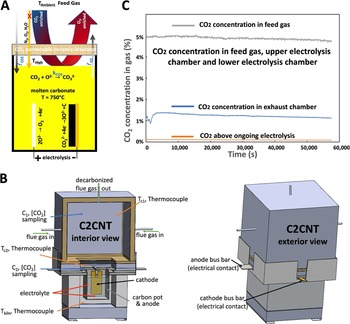
Industrial flue gases contain N2, O2 and H2O and are largely insoluble in molten carbonates such as Li2CO3. In contrast, CO2 dissolves and reacts readily in CO, enabling selective uptake (Figure 1A). CO2 flows into the electrolysis chamber, reacts in the electrolyte and is converted to GNCs at the cathode. The oxide produced reacts with incoming CO2, maintaining the electrolyte as a carbon sink.
C2CNT decarbonization. (A) The oxide-laden electrolyte of C2CNT is a carbon sink, drawing in CO2 while excluding the other insoluble components of flue gas, such as N2, O2 and H2O. (B) The Genesis CCUS captures CO2 from flue gas without the need to preconcentrate the CO2. The flue gas is separated by a planar insulation membrane from the hot carbon sink electrolyte in the inner electrolysis chamber.

Figure 1B shows a bench-scale C2CNT system with a 12 × 12 × 15 cm carbon pot. CO2 concentration is monitored with an external sensor cooled by a 304SS tube. Electrolysis at 5.0 A and 750 °C using Li2CO3 with a 25 cm² brass cathode reduced the exhaust CO2 concentration from 5% to under 0.2% (Figure 1C), indicating over 75% capture efficiency.
Industrial scale-up of C2CNT decarbonization
Figure 2A shows the industrial C2CNT system operating at the Shepard Centre Natural Gas Power Plant in Calgary. Each Genesis kiln module captures 100 t CO2/year and produces 25 t/year GNCs. Electrodes have been scaled from 5 to 11,000 cm2 (Ren et al. Reference Ren, Li, Lau, Gonzalez-Urbina and Licht2015b). Electrolytes have evolved from costly Li2CO3 to multicomponent systems using cheaper carbonates (Liu et al. Reference Liu, Licht and Licht2022a,Reference Liu, Licht, Wang and Lichtb,Reference Liu, Licht, Wang and Lichtc,Reference Licht, Hofstetter, Wang and Lichte).
Industrial carbon capture by molten carbonate electrolytic splitting of CO2. (A) The Genesis Device® kiln used for large-scale CO2 molten carbonate electrolysis. (B1 and B2) The cathode, with an active area of 11,000 cm2, upon lifting from the electrolyte and cooling. (C) TGA purity of captured CO2 product measured from multiple carbon capture electrolysis runs in various lithium or mixed strontium/lithium carbonate electrolyte. (D) Carbon nanotube product: SEM and TGA of a 770 °C 60% SrCO3/40 wt% Li2CO3 electrolyte 16-h electrolysis at J = 0.2 A/cm2. (E) Carbon nano-onion product: SEM and TGA of a 770 °C 54% SrCO3, 41% Li2CO3, 5 wt% Na2CO3 electrolyte electrolysis 4-h at J = 0.6 A/cm2.

Figure 2B shows the Muntz brass cathode before and after electrolysis at 770 °C and 0.6 A/cm2. GNCs, such as carbon nanotubes (CNTs) and carbon nano-onions, resist oxidation up to 600 °C. Scanning electron microscopy (SEM), transmission electron microscopy (TEM), Raman and X-ray Diffraction (XRD) analyses confirm morphology and purity (Supplementary Information; Johnson et al. Reference Johnson, Ren, Lefler, Licht, Vicini and Licht2017; Liu et al. Reference Liu, Licht and Licht2021; Liu et al. Reference Liu, Licht and Licht2022a,Reference Liu, Licht, Wang and Lichtb,Reference Liu, Licht, Wang and Lichtc). Thermogravimetric analysis (TGA) measurements (Figure 2C) confirm high-purity carbon with residual mass < 5%.
Figures 2D and 2E show how varying conditions produce different GNCs: CNTs at 770 °C in 60% SrCO3/40% Li2CO3 for 16 h at 0.2 A/cm2 and nano-onions in a 54% SrCO3/41% Li2CO3/5% Na2CO3 mixture for 4 h at 0.6 A/cm2 (Liu et al. Reference Liu, Ren, Licht, Wang and Licht2019; Licht et al. Reference Licht, Hofstetter, Wang and Licht2024e).
Industrial separation of the electrolyte from the carbon capture product
During electrolysis, GNCs form a carbanogel – a matrix of product and electrolyte – on the cathode (Wang et al. Reference Wang, Licht and Licht2021; Licht et al. Reference Licht, Hofstetter and Licht2024c,Reference Licht, Hofstetter and Lichtd). The product content ranges from 2 to 5% for CNTs from 8 to 20% for nano-onions. Loose electrolyte drips off the cathode post-electrolysis, while tightly bound electrolyte requires pressure extraction.
As shown in Figure 3, separation evolved from manual (Figure 3A) to vertical hydraulic presses (Figure 3B), and to the Carbanogel Harvester and Electrolyte Recycler (CHER) system (Figure 3C), which scrapes, presses and recycles electrolyte while forming compressed GNC pucks. A video of the scraper unit separating the carbanogel from the cathode is Movie 1 (https://www.youtube.com/watch?v=dMDOBgx2taM), and a full demonstration of the action of the CHER extraction unit is Movie 2 (https://www.youtube.com/watch?v=-SODerJNsYY), both of which are available in the Supplementary Information. Extraction efficiencies up to 98% were achieved by optimizing pressure (up to 3,000 psi), time and temperature (Figure 3D1, D2).
Extraction, subsequent to CO2 electrolysis: separation of the raw product grown on the cathode from excess electrolyte. (A) A 2021 desktop manual press is used to filter the high-temperature carbanogel raw product into its separate product and electrolyte. (B) A 2024 large-scale hydraulic-driven vertical extraction press. (C) The 2025 industrial CHER extraction unit, designed to repetitively scrape the carbanogel from the electrolysis cathode, separate the GNC product from the excess electrolyte and recover the GNC product made from CO2. (D) The CHER extraction efficiency of removing the electrolyte during repeat post-electrolysis insertion of the raw-product covered cathode.

New C2CNT carbon capture advances to be scaled-up
Direct cathode press (DCP) electrolyte removal
The DCP (Figure 4) removes electrolyte directly from the cathode without scraping. Hydraulic pressure extracts the molten electrolyte, which can be returned immediately to the electrolysis chamber. This method minimizes processing time and oxidation loss. A higher-pressure version using 8″ hydraulic cylinders is under development (Supplementary Information). Movies 3 and 4 demonstrate DCP operation. Movie 3 (https://www.youtube.com/watch?v=_UFVd210aec) is a simple animation of the DCP in action, and Movie 4 https://www.youtube.com/watch?v=BmbukaCVJko) is a demonstration of an operational DCP, both of which are available in the Supplementary Information.
The direct cathode press electrolyte removal. (A) Illustration of the press and components. (B) Subsequent to electrolysis, the cathode, laden with product and electrolyte (raw product), is moved to the press, as shown in (C), loaded into the press. (D) The cathode is directly pressed (rather than scraped as illustrated in Figure 3), removing electrolyte and retaining the product. (E) The cathode, still retaining the product but with excess electrolyte removed, is lifted from the press. Further details of the direct cathode press, including an action animation and demonstration of actual operation, are provided in the Supplementary Information.

Eliminating active concentration of CO2: Genesis CCUS
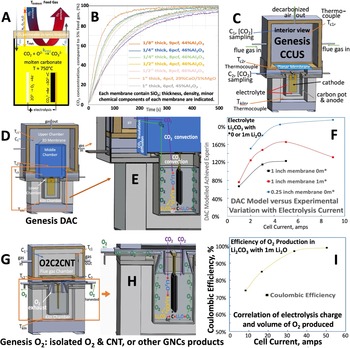
Conventional decarbonization relies on energy-intensive CO2 concentration using lime or amine-based systems, which add CO2 burden. The Genesis CCUS process (Figure 5A–C) offers a passive alternative, eliminating the need for active CO2 concentration. It introduces a gas-permeable, high-temperature insulation membrane between the gas feed and molten carbonate electrolyte, establishing a diffusion-dominated intermediate zone. As shown in Figure 5A, CO2 diffuses through this membrane into the electrolyte, which acts as a carbon sink, while N₂, O₂ and H₂O remain insoluble.
Recent advances in the C2CNT decarbonization process. (A–C) Genesis CCUS: (A) The addition of a porous, insulating membrane above the electrolyte carbon sink thermally isolates the feed gas from the electrolysis. (B) The CO2 diffusion rate through several porous insulation materials. (C) The Genesis CCUS captures CO2 from flue gas without the need to preconcentrate the CO2. (D–F) The Genesis DAC expands the C2CNT process to air as a source of CO2 by expanding the feed gas/electrolysis chamber interfacial membrane for sufficient CO2 diffusion. (G–I) The Genesis O2 configuration separates the CO2 splitting products, facilitating the separate collection of O2 from the anode and carbon nanomaterials from the cathode.

This porous membrane also thermally insulates the gas feed from the ~750 °C electrolysis chamber. High CO2 diffusivity through thermal insulations, such as aluminosilicate and calcium–magnesium silicate, has been demonstrated (Licht et al. Reference Licht, Hofstetter and Licht2024b), as shown in Figure 5B. Figure 5C illustrates a Genesis CCUS configuration where CO2 from 5 and 30% flue gas concentrations is effectively captured and converted into CNTs without preconcentration (Licht et al. Reference Licht, Hofstetter and Licht2025a).
Direct air electrolysis to CO2 to CNTs: Genesis DAC
DAC is challenged by the need to process air containing only 0.04% CO2, without heating the remaining 99.96% to high temperatures. The Genesis DAC system (Figure 5D–F) introduces a passive, membrane-insulated design that allows CO2 to diffuse from ambient air into the electrolysis chamber, converting it to CNTs (Licht et al. Reference Licht, Peltier, Gee and Licht2025b,Reference Licht, Peltier, Gee and Lichtc). This is the first DAC approach to meet all of the following: (1) no active CO2 concentration, (2) conversion to high-value product and (3) thermal insulation of the gas feed.
Compared to planar membranes used for flue gas, Genesis DAC employs large-area, open-channel porous insulations to maintain sufficient CO2 flux from air while minimizing heat loss. Figure 5D shows the use of a 3D porous insulation to establish a diffusion-dominated zone between the feed and electrolysis chambers. Sustained electrolysis rates were experimentally measured and compared with diffusion-based models (Figure 5F), confirming effective DAC performance, with possible underestimation by up to a factor of 2 (Licht et al. Reference Licht, Peltier, Gee and Licht2025b,Reference Licht, Peltier, Gee and Lichtc).
Separate harvesting of O2 and nanocarbons from CO2: Genesis O2
Oxy-fuel combustion improves fuel burning efficiency, heat recovery and combustion temperature, concentrates CO2 for mitigation and decreases NO x pollutants and flue gas volume. An obstacle has been the production of the necessary concentrated O2. A facile CCUS molten carbonate process for producing concentrated O2 is demonstrated by splitting CO2 into separately harvested GNCs and oxygen. When C2CNT decarbonization is integrated with a fossil fuel combustion process, oxygen is produced at a rate matching its consumption in the combustion process, providing a source for the fossil fuel process to be oxy-fuel driven.
A wide range of processes, including traditional power plants, cement, iron and ammonia production, to large-scale refineries and smaller-scale processes, such as engines, ovens and furnaces, rely on the air combustion of fossil fuels. Concentrated O2 combustion of fuel (oxy-fuel combustion), rather than air, offers several advantages over conventional air combustion, such as in coal power plants (Tu et al. Reference Tu, Zhang and Gao2021; Rogalev et al. Reference Rogalev, Rogalev, Kindra, Zlyvko and Bryzgunov2022; Shiquan et al. Reference Shiquan, Binghong, Zhijun and Yanwei2022; Guo et al. Reference Guo, Liu, Zhang, Hu, Li, Liu and Zheng2024), other industrial plants (Uwizeyimana et al. Reference Uwizeyimana, Hassan and Rodriguez2019; Abubakar et al. Reference Abubakar, Mokheimer and Kamal2021; Raho et al. Reference Raho, Colangelo, Milanese and de Risi2022; Wang et al. Reference Wang, Feng, Wen, Zhan, Zhu, Ning, Zhang and Mei2024a, Reference Wang, Shan, Wang, Zhou and Cenb) or even internal combustion engines (Li et al. Reference Li, Peng, Pei, Ajmal, Rana, Aitouche and Mobasheri2021). These include improved fuel efficiency, heat recovery, CO2 concentration for mitigation, reduced NO x pollutants and decreased flue gas volume (and related lowering of flue gas processing costs) (El Sheikh et al. Reference El Sheikh, Ryabov, Hamid, Bukharkina and Hussain2020; Koohestanian and Shahraki Reference Koohestanian and Shahraki2021; Rong et al. Reference Rong, Jin, Xiaoshan, Hongwei, Yongjie, Jun and Liqi2022; Yadav and Mondal Reference Yadav and Mondal2022; Bazooyar and Jomekian Reference Bazooyar, Jomekian, Rahimpour, Makarem and Meshksar2024). However, widespread implementation has been limited by the challenge of producing concentrated oxygen at scale. To date, oxy-fuel combustion has been primarily used in applications like glass production and welding, which benefit from the higher combustion temperatures attainable with oxygen combustion (Singh et al. Reference Singh, Kumar, Dubey and Singh2021; Zier et al. Reference Zier, Stenzel, Kotzur and Stolten2021).
The first CCUS configuration, which, in addition to removing CO2, simultaneously separates and produces high-concentration O2, is presented here and termed Genesis O2. The oxygen-harvesting Genesis O2 configuration is shown in Figure 5G and incorporates a separate exhaust for the O2 generated during the electrolysis. This design offers the key advantage over the C2CNT configuration: the highly concentrated O2 output is available for oxy-fuel combustion as a separate product from the GNC. Another advantage is that the separate O2 offtake provides a pressure differential to enhance CO2 draw-in from the flue gas.
Figure 5H illustrates Genesis decarbonization action during electrolysis and distinguishes it from the regular single-exhaust Genesis process shown in Figure 5E. CO2 from the flue gas enters the electrolysis chamber and exothermically reacts with oxide in the electrolyte to form carbonate. The carbonate is consumed at the cathode to regenerate oxide and simultaneously produce the GNC product, illustrated in black, that accumulates on the cathode, while O2 is released from the anode reaction. The inner walls of the carbon pot collectively function as the anode and generate the O2 as the CO2-splitting byproduct. Evolved O2 rises from the anode walls. In this new configuration, the produced O2 is isolated within the additional O2 channels shown on the right and left sides of the electrolysis chamber, and exits through a dedicated separate slit or pipe as shown. This harvested O2 gas can be used for oxy-fuel combustion. The product at the cathode forms a lattice of GNCs intermingled with the electrolyte.
Figure 5G Genesis O2 configuration provides a contiguous trap of O2 around the inner perimeter of the carbon pot, isolating the electrolyte interface and the anode headspace from the cathode headspace. Both O2 and CO2 concentrations are measured using CO2meter.com sensors, positioned outside the hot chamber through a 304 stainless steel tube that allows cooling to maintain the sensor’s room temperature operation. With fascinating results, this design forms separate anode and cathode half-cell compartments. Unexpectedly, the concentration of CO2 in the O2 exhaust rose during electrolysis to a concentration higher than the inlet flue gas, displacing the O2 product. In contrast to this headspace-separated configuration, high CO2 concentrations are not observed in the regular configuration when there is a single shared headspace above the anode and cathode. However, this separate anode and cathode half-cell compartment process stopped producing CO2 when 1 m Li2O was added to the Li2CO3 electrolyte. From that point onward, the CO2 concentration dropped quickly, and the O2 purity in the manifold grew to 98% (±2%). It should be noted that in the future, rather than through chemical addition, oxide can be added electrochemically (in situ) by pre-electrolysis in a CO2-deficient environment (without flue gas feed) as described by the reaction of Equation (1), without simultaneously adding CO2 as described in equation 2. A proposed mechanism explaining the initial rise of CO2 concentrations in the separated half-cell Genesis O2 configuration is presented in the Supplementary Information.
The volume of O2 gas produced in the exhaust during electrolysis in Li2CO3 with 1 m Li2O electrolyte was studied and compared to the electrolysis charge (the time-integrated constant current). This high level of O2 purity was maintained throughout the measurements, without further added Li2O. The measured rate of gas volume collected over time t (s), V20°C (ml/s), is converted to moles per second, Rm-O2 (mol/s) of pure (98% to 99%) O2, adjusted to 20 °C rather than STP:
 $$ {\mathrm{R}}_{\mathrm{m}\hbox{-} \mathrm{O}2}={\mathrm{V}}_{20{}^{\circ}\mathrm{C}}\times \left(293\mathrm{K}/273\mathrm{K}\right)/\left(2,414\;{\mathrm{cm}}^3/\mathrm{mole}\right)/\mathrm{t}\left(\mathrm{s}\right) $$
The coulombic efficiency of oxygen generation, CE (%), is then determined from the measured volumetric rates of gas generation using the constant applied electrolysis current, I (A), where n = 4 moles electrons per mole of O2 produced, and Faraday’s constant, F = 96,485C/mol e−:
 $$ \mathrm{CE}\left(\%\right)=4\mathrm{F}100\%\left({\mathrm{R}}_{\mathrm{m}\hbox{-} \mathrm{O}2}/\mathrm{I}\left(\mathrm{A}\right)\right) $$
Coulombic efficiency was measured at several constant electrolysis currents of 8.4A (J = 0.1 A/cm2), 16.8A (0.2 A/cm2), 33.6A (0.4 A/cm2) and 50.4A (0.6 A/cm2). It is noteworthy that a current density of 0.6 A/cm2 is a high rate and is the same current density used in the commercial electrolytic molten electrolyte production of aluminum. In each case, the measured O2 product concentration was 99% (±2%). The respective O2 exhaust rates, measured at the increased electrolysis currents, were 0.39, 0.89, 2.03 and 3.11 ml/s. These rates of O2 generated were used to determine coulombic efficiency from Equations (4) and (5).
Figure 5I correlates the electrolysis current with O2 production coulombic efficiency. The conversion efficiency of the electrolytic charge to the O2 product is observed to increase with increasing cell current. At a cell current of 33.6 A, the coulombic efficiency increases to 97%, and at the highest current, the coulombic efficiency increases to 99% at 0.60 A/cm2.
Ongoing applications of CNTs made from CO2 by the C2CNT process
CNTs, due to their graphene-based, cylindrical morphology, exhibit exceptional tensile strength (up to 93,900 MPa), thermal conductivity, flexibility and electrochemical performance (Chang et al. Reference Chang, Hsu, Aykol Hung, Chen and Cronin2010; Islam et al. Reference Islam, Hasan, Rahman, Mobarak, Mimona and Hossain2024). Applications include batteries (Licht et al. Reference Licht, Cui, Stuart, Wang and Lau2013, Reference Licht, Douglas, Ren, Carter, Lefler and Pint2016), low-carbon composites (Licht Reference Licht2017; Licht et al. Reference Licht, Liu, Licht, Wang, Swesi and Chan2019) and emerging uses in polymers (Licht et al. Reference Licht, Hofstetter and Licht2024b,Reference Licht, Hofstetter and Lichtc) and plasmas (Licht et al. Reference Licht, Hofstetter and Licht2025a).
Comparison of C2CNT decarbonization to amine or calcium-looping decarbonization
Traditional CCS methods, such as amine scrubbing and calcium looping (CaL), rely on CO2 concentration and regeneration cycles, incurring substantial energy penalties. Amine-based systems require 6.1–14.5 GJ/t CO2, factoring in solvent regeneration, compression and transport (Du et al. Reference Du, Yang, Xu, Lei, Lei, Li, Liu, Wang and Sun2024; Rochelle Reference Rochelle2024; Singh et al. Reference Singh, Goji, Sing, Sharma and Repo2025). CaL processes involve 8.1–16.5 GJ/t CO2, limited by sorbent degradation and energy-intensive cycling (Kumar et al. Reference Kumar, Chung, Khan, Son, Park and Jeon2024; Zhang et al. Reference Zhang, Wang, Han, Zhao, Wu and Li2024b; Afani et al. Reference Afani, Satgunam, Mahlingam, Manap, Nagi, Liu, Hohan, Tan and Yunus2024; Tan et al. Reference Tan, Liu, Zhang, Wei and Song2024; Toledo et al. Reference Toledo, Arce, Carvalho and Avila2023).
In contrast, the C2CNT process directly converts CO2 into GNCs and oxygen via electrolysis, eliminating the need for preconcentration. Energy requirements range from 7.2 to 15.5 GJ/t CO2 or from 26 to 57 GJ/t GNC, depending on process conditions (Ren et al. Reference Ren, Lau, Lefler and Licht2015a; Licht et al. Reference Licht, Liu, Licht, Wang, Swesi and Chan2019; Srinivasan Reference Srinivasan2019). Preferred electrolytes include lithium and lithium–strontium carbonates, which offer optimal CO2 activity and electrochemical properties (Licht et al. Reference Licht, Hofstetter and Licht2024a,Reference Licht, Hofstetter and Lichtb,Reference Licht, Hofstetter and Lichtc,Reference Licht, Hofstetter and Lichtd,Reference Licht, Hofstetter, Wang and Lichte,Reference Licht, Peltier, Gee and Lichtf).
C2CNT additionally produces GNCs with applications in construction, electronics and polymers, replacing high-emission materials like steel or aluminum. Some GNCs (formed via Fe/Ni catalysis) are magnetic, enabling selective recovery and reuse. With Technology Readiness Level 7–8, the system is modular and compatible with aluminum smelting infrastructure, supporting scale-up to megatonne (Mt) CO2 capture capacity.
Commentary on future challenges and factors to improve C2CNT decarbonization
Large-scale deployment of C2CNT faces both sociopolitical and technical barriers. Policy limitations, fossil fuel subsidies and insufficient climate urgency hinder adoption despite the growing impacts of CO2 emissions. Technically deployable, advancing C2CNT can include improving CO2 uptake, increasing product yield, reducing energy use and adapting systems to a wide CO2 concentration range – from ambient air (~0.04%) to fermentation gas (~90%).
Recent developments aim to enhance energy selectivity for CO2 reduction by insulating non-CO2 gas components from the electrolysis zone (Reference Licht, Peltier, Gee and Lichtb; Licht et al. Reference Licht, Peltier, Gee and Licht2024f, Reference Licht, Hofstetter and Licht2025a). Parallel efforts focus on localized carbon product generation at emission sources, such as on-site CNT production at cement plants or the use of carbon nano-onions in rubber and plastics (Licht Reference Licht2017; Hofstetter et al. Reference Hofstetter, Licht and Licht2025).
A key goal is scaling to Mt-level facilities. The Genesis Device® is designed for bolt-on, modular expansion, scaling from the current 100 to 1,000 t/y via larger reaction vessels. A future 1 Mt CO2/y plant may consist of three potlines, each with several hundred Genesis Devices, analogous to aluminum smelting plants. Figure 6 illustrates both the current 100 t/y system and the proposed Mt-scale plant design.
(Top) A commercially operational aluminum smelting plant, illustrating the industrial-scale infrastructure. (Bottom left) Schematic of the current Genesis Device® designed for the electrochemical conversion of 100 tonnes of CO2 per year into graphene nanocarbon (GNC) products such as carbon nanotubes (CNTs). (Bottom right) Conceptual design of a future large-scale Genesis Device system targeting 1 megatonne (Mt) per year of CO2 conversion, producing ~0.25 Mt of GNCs. This scale-up is modeled after aluminum smelting operations and involves a tenfold increase in capacity through the serial integration of kilotonne-per-year (kt/y) Genesis Device modules.

Conclusions
This study introduces the discovery, scale-up and industrial deployment of a transition metal-nucleated molten carbonate electrolysis process – C2CNT – for direct CO2 conversion into high-yield, high-purity GNCs. The technology operates as a single-pot system, eliminating the need for CO2 preconcentration by capturing from both dilute (e.g., air) and concentrated (e.g., flue gas) sources. Key benefits include: (1) simultaneous CO2 capture and conversion into valuable GNCs, generating economic incentives for decarbonization; (2) long-term carbon storage as durable nanomaterials; and (3) downstream CO2 offset via GNC incorporation into composites (e.g., plastics and cement) or as substitutes for carbon-intensive materials.
Reported advances include: (1) demonstration and industrial scaling of the C2CNT process; (2) development of large-scale GNC separation systems; (3) introduction of a DCP for GNC extraction and tailored C2CNT configurations for (4) flue gas decarbonization (Genesis CCUS), (5) DAC (Genesis DAC) and (6) independent oxygen product recovery (Genesis O₂).
Open peer review
To view the open peer review materials for this article, please visit http://doi.org/10.1017/cat.2025.10007.
Supplementary material
The supplementary material for this article can be http://doi.org/10.1017/cat.2025.10007.
Data availability statement
The data supporting this article have been included as part of the Supplementary Information.
Acknowledgements
The authors would like to express gratitude to Molood Nasirikheirabadi, Ethan Peltier and Simon Gee of Carbon Corp for experimental contributions to this research.
Author contribution
Conceptualization: G.L. and S.L. Data curation: S.L. Formal analysis: G.L. and S.L. Investigation: All authors. Writing original draft: G.L. and S.L. Project administration: S.L. Writing – review and editing: G.L., K.H. and S.L.
Financial support
This work was supported in part by Direct Air, Carbon International, Carbon Corp and Emissions Reduction Alberta award IT0162473.
Competing interests
The authors declare none. Direct Air Capture LLC and Carbon Corp both maintain mission statement commitments to mitigate climate change.




 Open access


Comments
We present for your consideration as a Case Study in Carbon Technology our study entitled:
“Large scale electrolytic molten carbonate carbon capture and transformation to carbon nanotubes and other graphene nanocarbons”
by Gad Licht, Kyle Hofstetter and Stuart Licht.
The study provides significant advances and industrial capabilities of an important decarbonization process for the large scale removal of the greenhouse gas CO2 and its electrochemical spliting to oxygen and useful graphene nanocarbons, such as carbon nanotubes (CNTs). Developments reported in this C2CNT process that will be of interest to your readership in the critical need to mitigate CO2 include industrial scale C2CNT decarbonization design and use, the first reports of capture and utilization of fluegas CO2 as O2 and CNT separate products, a new method for separation of the electrolyte from the high purity CNT product, the use of C2CNT for both carbon utilization and direct air capture processes, and the characterization and applications of the CNTs, made from CO2, in plasmas, polymers composites and buckypaper.
Thank you for your time, efforts and consideration,
Stuart Licht
Professor Emeritus, Department of Chemistry
George Washington University, Washington, DC, USA