

“[B]ring(ing) non-state spaces and people to heel…represents the last great enclosure movement in Southeast Asia….Governments, whether colonial or independent, communist or neoliberal, populist or authoritarian have embraced it fully. The headlong pursuit of this end by regimes otherwise starkly different suggests that such projects of administrative, economic, and cultural standardization are hard-wired into the architecture of the modern state itself.” (Scott Reference Scott2009: 4, emphasis added)
On the Incapacities and Inclinations of the Modern State
It is no secret or surprise that states around the world exhibit dramatic variation in their capacity to govern the territories they formally rule. The phenomena of ‘weak states’ and even ‘failed states’ on one end of the spectrum, as opposed to highly Weberian, developmental, and ‘disciplinary states’ on the other, has become readily familiar to social scientists, policymakers, and journalists alike. Much recent scholarship has attempted to trace and explain this variation. Yet underlying the issue of state incapacity is an issue more rarely addressed – that of state leaders' inclination to govern in the first place. Is it possible that what appear to be weak states are often more properly conceived as standoffish states? Is an absence of stateness always a product of state incapacities? Or might it indicate state inclinations to avoid actively administering their populations and territories?
This article addresses these questions in dialogue with the most important book recently (or perhaps ever) written on this theme: James Scott's The Art of Not Being Governed. According to Scott, states' appetites to control and extract resources from the societies they rule are practically boundless and universal. States seek to subjugate their subjects by standardising them through highly centralised administrative practices, rendering the ruled “legible” through homogenisation projects from above. At the heart of this drive for legibility is state-makers' desire “to bring non-state spaces and people to heel” (Scott Reference Scott2009: 4), making the de facto administrative ambit of the state coincide seamlessly with its de jure territorial domain.
What kinds of states have embarked on this kind of project for administrative legibility and thorough territorial control? Virtually all of them, according to Scott, as seen in the quotation above. It is beyond question that states' attempt to categorise, control, and tax their charges abound in the historical record, and that states' attitudes toward non-state peoples have historically been almost uniformly hostile. Yet have states been anywhere near as uniformly concerned with standardising their charges as Scott suggests? Has their hostility toward the ungoverned always been expressed through efforts to extend active administration in a territorially encompassing manner? Or might states express their intrinsic hostility toward non-state peoples and spaces through a much wider variety of practices than Scott's legibility paradigm can effectively apprehend?
Our primary claims in this article are that (1) states' appetites to administer populations to render them legible are in fact radically uneven, and hence (2) states' practices in managing zones of lawlessness, disorder, and illegibility are radically diverse in turn. Variations in governance practices thus arise from variation in state appetites, and not only from variation in state capacities, to govern.
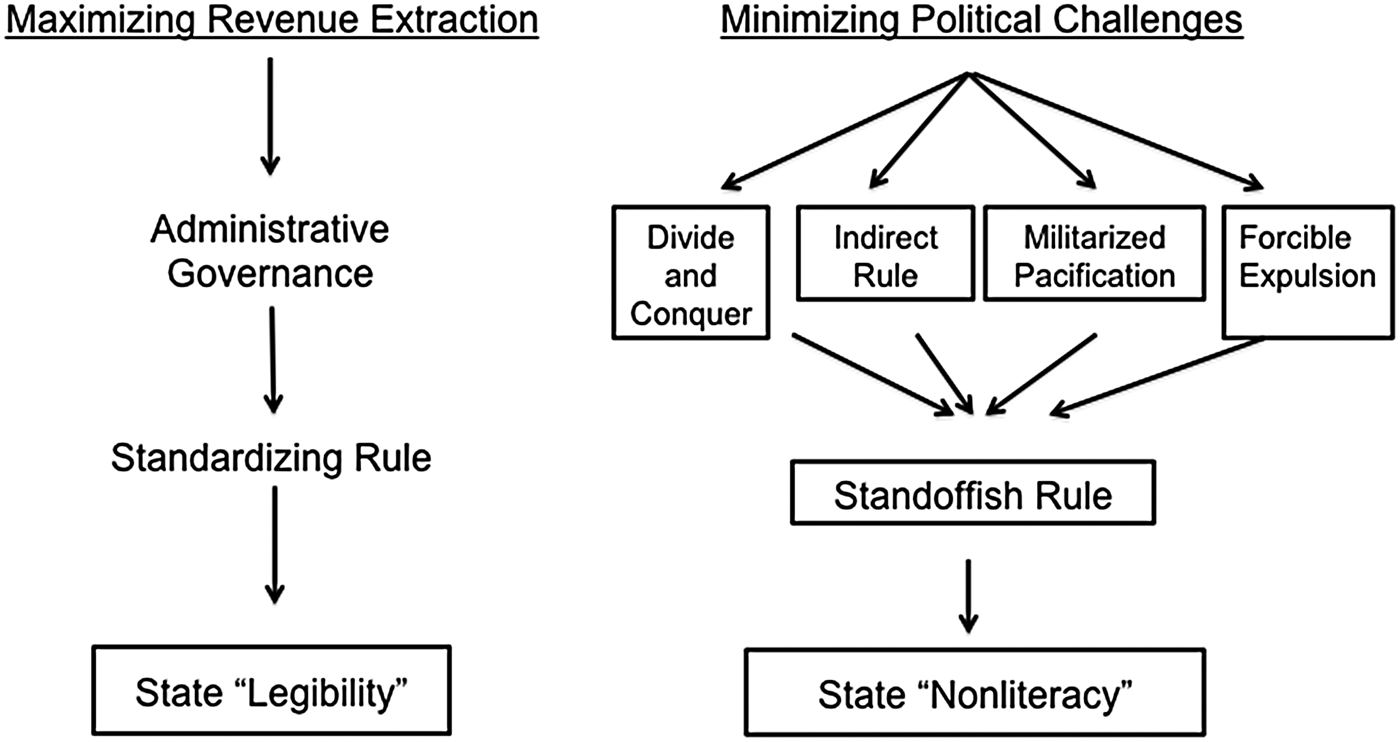
These claims derive from different starting assumptions than Scott's. Whereas Scott argues that the state's most fundamental objective is to maximise economic extraction, we argue that it is, instead, to minimise political challenges. An absence of stateness often indicates a state's success at avoiding costly entanglements with, and unnecessary provocations toward, populations and territories it considers too risky or unimportant to govern. It does not necessarily indicate the state's failure at accomplishing the kind of standardisation that Scott portrays as a defining goal of the state.
In short, the world is riddled with ‘standoffish states’, not just standardising states. By our definition, standoffish states are those that intentionally eschew the pursuit of detailed knowledge, rountinised administration, and cultural assimilation of considerable portions of their subject population. Standoffishness is a matter of degree. States may strive to standardise some segments of their populations at some times, yet remain standoffish toward other groups at other times. Selectivity and standoffishness thus go hand in hand. Standoffish rule should not be confused with sympathetic rule, or what liberal thinkers tend to portray as ‘salutary neglect’. Nor should standoffishness imply an absence of state-society contact, including what at times is extremely violent and coercive contact. Far from rejecting Scott's critique of states for their brutal treatment of non-state peoples, we offer what is in some respects an even more critical normative intervention.Footnote 1 Legibility is often accompanied by the benefits of citizenship and state largesse; the mixture of brutality and neglect that peoples on the margins of governance more commonly experience is typically bereft of any such silver linings.
In the analysis to follow, we train our lens on four distinct practices of rule, all of which prioritise the minimisation of political challenges over the maximisation of economic extraction, and all of which are (painfully) familiar in the historical and contemporary record. One is indirect rule, in which the central state eschews the pursuit of detailed knowledge or administration of a particular group or terrain, opting to rely on the cooperation of local strongmen to forestall anti-state unrest. A second is divide and conquer, as central authorities exacerbate conflicts and cleavages among different social groups, rather than pursuing cultural assimilation and homogenisation of those groups.Footnote 2 A third is militarised pacification, when state leaders employ raw force to terrorise and destroy their strongest challengers, rather than ‘bringing them to heel’ under predictable and rountinised control within a legible administrative grid. The fourth is forcible expulsion, in which states deal with unwelcome societal heterogeneity by banishing those categorical groups and individuals perceived as most troublesome from their territorial domain, making them disappear rather than trying to make them behave. We consider all of these practices varieties of ‘standoffishness’ in the sense that they all eschew any project of imposing legibility and standardisation, even though some clearly involve more active and extensive contact between states and subjects than others.
Drawing inspiration from Scott, we refer to all four of these state practices as constitutive of non-literate Leviathans. Scott (Reference Scott2009: 221) brilliantly distinguishes “nonliteracy” from “illiteracy” in his depiction of non-state peoples in highland Southeast Asia. To say “illiteracy” is to imply incapacity to read; to say “nonliteracy” is to suggest informed disinterest in reading. Much as Scott sees mobile populations as nonliterate due to their disinterest in (and not their ignorance of) the purported fruits of modern civilisation, we see Leviathans as frequently nonliterate in their disinclination (and not simply their incapacity) to render their subjects legible. We develop this claim by cataloguing instances when Southeast Asian states have proven surprisingly disinterested in pursuing regulatory governance, even though standoffishness would appear to be an exceptionally costly or risky option. Specifically, we show how, even in the zones where the potential costs of eschewing the pursuit of legibility appear highest – those containing violent insurgencies – states can prove surprisingly disinterested in pursuing regulatory governance in a highly administrative manner. Leviathans elect to remain nonliterate even in the Southeast Asian region which helped generate Scott's theory, and even when the costs and risks of illegibility would seem to be highest.
State Building in Alternative Modes: Legibility Vs. Non-Literacy
The fundamental challenge of state power is commonly portrayed as one in which the political centre struggles to project its writ to the farthest reaches of national territory. Those populations located close to the national capital would seemingly have little hope of avoiding state campaigns to render them ‘legible’ through cultural homogenisation and administrative standardisation.
We suspect that this claim would sound very odd to the poorest and most vulnerable citizens of national capitals throughout the world. Literally within walking distance of gleaming national government offices in capitals ranging from Jakarta to Cairo to Washington, DC, one finds densely populated communities whose primary experiences with state authority are those of coercion and neglect. Police officers might come on the scene at times of violent crime, but they are typically slow to arrive and fast to abandon such neighbourhoods to their own devices. Even on their very doorsteps, states are highly selective in how and where they assert authority. Standoffishness is always an option, and is perhaps the most common attitude with which states handle the majority of their populations who lack substantial economic or political resources.
Our framework thus differs from Scott's in fundamental ways. As Figure 1 indicates, these differences unfold from our different starting assumptions regarding state-makers' goals. Whereas for Scott, the core motivation is to maximise resource extraction, we focus on how a ruling centre seeks to minimise political challenges. From our perspective, there are multiple ways that states may eschew administrative standardisation while nevertheless repelling challengers. Consequently, we see standoffishness where Scott stresses standardisation. The upshot in our analysis is not relations of legibility between state and society, but nonliteracy.
Alternative Modes of State Building.
To be sure, our framework does not supplant Scott's as much as it supplements it. The two competing frameworks capture different domains of state behaviour – or state-building in alternative ‘modes’. States sometimes strive to standardise, and sometimes seek to remain standoffish. Yet in our view, such a conclusion is a bit too noncommittal to be helpful. Rather than simply cataloguing instances of state standoffishness, we explore how states approach populations and territories where standoffishness would appear to be an exceptionally costly or risky option. If we can show that, even in those zones where states should be most likely to conduct campaigns for administrative standardisation and societal homogenisation, they do so only irregularly and unevenly, this would strongly suggest that the phenomenon of non-literate Leviathans must be ubiquitous indeed, and in need of further theorising. Although this can only be established through considerable future research, our initial claim is that the non-literacy mode captures a wider range and variety of state practices in the world than Scott's legibility mode.
This argument joins a chorus of recent scholarship on states' uneven inclinations to govern. For example, a state's ‘will’ to deploy violence matters as much as raw capacity when understanding divergent authoritarian responses to mass protests across Eastern Europe, Africa, and the Middle East (Bellin Reference Bellin2012; Levitsky and Way Reference Levitsky and Way2010; Thompson Reference Thompson2001). “Coercive capacity also requires the will to repress,” note Way and Lachapelle (Reference Lachapelle, Lucan and Steven2013: 8) in their comparative study of Egypt and Iran, which shows how different revolutionary heritages durably conditioned cross-case divergence in security forces' collective will to crush recent uprisings. Analogously, Holland (Reference Holland2013) has highlighted statist disinclinations to govern in the context of social welfare provision in Latin America. She develops a theory of state ‘forbearance’ to explain why elected officials sometimes deliberately refrain from enforcing laws against the urban poor in Chile and Colombia, selectively yet intentionally opting to eschew law enforcement despite the state's ready capacity to do.
An especially promising inquiry along these lines is Staniland's (Reference Staniland2012) study of emergent political orders in war-ridden contexts, in which he proposes that “The assumption implicitly built into studies of civil war that centralizing states represent homogenizing, monopolizing Leviathans is unsustainable” (Staniland Reference Staniland2012: 246). Instead, we should recognise how a fascinating heterogeneity colours the strategic interests of states in their interactions with armed insurgents. Based on evidence from contemporary South Asia, Staniland offers a typology of six wartime orders that captures how state-insurgent interactions yield different modalities of order under conflict, which in turn shape patterns of violence on the ground. States in civil war, according to Staniland (Reference Staniland2012: 244), are “not simple-minded maximizers of monopoly but instead are optimizers of authority in complex, often counterintuitive interaction with other armed actors”. Our concept of standoffishness embraces a similar corrective to the conventional image of a Weberian state in its monopoly-maximising guise. It also offers a conceptual vocabulary to discuss myriad and messy state behaviours that, like Staniland's wartime political orders, are “not the domain of a few obscure outliers, but instead are hiding in plain sight” (Staniland Reference Staniland2012: 248).
In the empirical section that follows, we trace these alternative pathways by examining several Southeast Asian Leviathans' responses to violent leftist and separatist insurgency in the wake of World War II. To be sure, there are cases of counterinsurgency in Southeast Asia that seem to accord with Scott's notion of legibility and robust administration, such as the wholesale creation of ‘New Villages’ in British Malaya in the 1950s. Yet even in this paradigmatic case of administrative surveillance, the New Villages were created only after years of failure under the original British strategy of militarised pacification, and ultimately depended on practices of ethnic divide-and-conquer that are more accurately conceptualised as campaigns to reinforce cultural heterogeneity than to craft cultural homogeneity. In other insurgent zones of Southeast Asia, including the hills of Burma where Scott initially developed his framework, state authorities never accomplished or even seemingly attempted a transition from militarised pacification to administrative standardisation. To say that such zones have confronted “the hard power of the fiscal state” with its “mania for classificatory order” (Scott Reference Scott2009: 230, 238) would seem to represent a rather significant categorical error. What those zones have confronted has been horrific indeed; but those horrors have unfolded with the Burmese state acting more in nonliteracy than legibility mode.
Counterinsurgencies
If there is any governance challenge that Leviathans would seem to lack the luxury of confronting in a standoffish style, it is the challenge of armed insurgency. Whether such insurgencies threaten to seize state power or to fracture it through territorial separatism, they violate what we have portrayed as the state's core structural interest: preventing the emergence of political challenges to the ruling centre. If states are ‘hard-wired’ to pursue the standardisation and homogenisation of their populations and territories, it is in insurgent zones where we should be most likely to see such state campaigns taking place. And sometimes, to be sure, we do. Yet the unevenness of such attempts and the tendency for states to conduct counterinsurgency through practices such as indirect rule, militarised pacification, divide and rule, and forcible expulsion, rather than administrative governance, calls into question any claim that states are always keen to impose a bureaucratic grid over their subjects.Footnote 3 When it comes to counterinsurgency, Leviathan tends to depend on guns, and only turn to grids when guns alone have repeatedly and patently failed to eradicate the insurgent challenge.
States employ diverse practices towards insurgents and their lawless zones. For purposes of simplest exposition, we draw on Slater (Reference Slater2010b) to argue that state appetites for quelling insurgencies are shaped by the type of rebellion – leftist or regionalist, most broadly speaking – that is being confronted. When leftist rebellions have an urban impact and emanate from ethnic ‘others’ (as in 1940s–50s British Malaya), they are at once especially ‘illegible’ and threatening to a wide cross-section of political and economic elites. We see this as the most likely type of internal violence to induce state officials to embark on a campaign of administrative standardisation, surveillance, and governance – and to gain critical elite support for doing so. Yet to the extent that states can manage such rebellions with militarised pacification (or other ‘nonliterate’ practices) alone, we do not expect to see the sort of administrative interventions that Scott highlights.
By contrast, when leftist insurgency remains relegated to rural areas and/or arises from the same identity group which dominates the polity as a whole (as in the 1950s Philippines), rural strongmen tend to have independent sources of social control which reduce pressure for Leviathan to impose a new administrative grid. Here, we expect standoffish state practices such as indirect rule to prevail over more standardising forms of governance. When rebellion is regionalist or separatist in character (as in Burma since independence in 1948), state officials typically lack both the interest and allies necessary to combat their foes with classificatory as opposed to strictly coercive techniques. It is separatist rebellions which we see states as especially likely to tackle by dispersing, deporting, and even destroying their opponents through forcible expulsion and militarised pacification, rather than attempting to sedentarise and administer the broader population from which the rebellion emanates.
British Malaya, 1948–57: From Pacification to Governance
‘The Emergency’ in British Malaya from 1948 to 1957 was concluded through a paradigmatic state campaign to render subjects legible through a new and improved administrative grid – but this was by no means how the counterinsurgency campaign commenced. In the initial years of the Chinese-dominated Malayan Communist Party's (MCP's) uprising in the squatter communities on the outskirts of Malaya's major cities, British authorities showed no inclination to confront the rebellions with anything but raw, militarised force. It was only after abject failure at purely militarised pacification that the colonial Leviathan adopted a more administrative approach to countering the leftist threat, with the support of a wide range of Malayan elites. From a comparative and theoretical perspective, the initial coercive response seems more like the rule, while the eventual administrative approach appears to be more of an historical exception – an exception grounded in the exceedingly difficult administrative challenges that the Emergency posed to the British Malayan colonial state and its closest allies.
When the British declared a state of emergency to help it combat MCP radicals in June 1948, it marked a shift from urban labour conflict to outright insurgency in the squatter communities along the jungle fringes.Footnote 4 These squatter communities were primarily populated by ethnic Chinese migrants, who had long been untouched by the administrative reach of either British colonial or state-level Malay political authority. These ‘illegible’ communities had mushroomed in size during the Japanese occupation (1942–45), when thousands of Chinese fled Japanese repression in Malaya's cities. Before the outbreak of the Emergency, however, this illegibility was of no major concern to either British or Malay officialdom, as “weakly administered land regulations” allowed “the squatters to remain largely untouched by authority in the years immediately following the war” (Osborne Reference Osborne1965: 9). This was not simply a matter of incapacity, but disinterest. As Kernial Singh Sandhu (Reference Sandhu and Nyce1973: xxx) pointed out, “The so-called squatter problem was allowed to grow, mainly as the result of administrative ‘tidakapathy’ (from the Malay tidakapa, meaning ‘never mind’). The Government saw no urgency in the need to deal with the squatters, who were virtually out of sight.” In other words, the stance of the state toward the squatters had always been one of standoffishness, and not any sense of determination or urgency to render squatters legible.
The outbreak of leftist insurgency did not quickly give rise to active attempts at administrative governance. Raw coercion and punishment were the initial order of the day. This was certainly the approach supported by the planter community, who had long been pressing the colonial state to confront the MCP with a more “ruthless application of the sentences of death, banishment, and particularly of flogging” (Stenson 1970: 162). Sub-national Malay royalty – the key partners of the British in their historically entrenched practice of indirect rule – similarly supported militarised pacification and forcible expulsion rather than administrative governance. At one of their first national conferences after the Emergency's onset, the “Rulers expressed anxiety over news that the deportation of Chinese detainees had ceased” (Smith Reference Smith1995: 115). As for British state officials themselves, most belittled the insurgency as “the work of a few agitators and extremists, probably directed from outside the country” (Stubbs Reference Stubbs1989: 69).
From 1948 until early 1950, the British approach to insurgency was strictly one of ‘coercion and enforcement’. This was due to widespread perceptions that low-cost militarised pacification would suffice to crush the MCP, making higher-cost administrative governance as unnecessary as it was undesirable. However, by February 1950, “it was becoming evident that the Government was losing ground to the MCP” (Stubbs Reference Stubbs1989: 98). The state response to this worsening conflict environment was not initially to build new administrative institutions, but to retool the colonial state's coercive institutions: the military and the police. From 1950, the key technique introduced into the counterinsurgency was forced resettlement of Chinese squatters into so-called ‘New Villages’. While this strategy of coercive population control accords more closely with Scott's framework than the pure coercion period of 1948–50, the initial goal of the New Village policy was not so much the predictable administration and standardisation of those who were forcibly resettled, but simply their collective immobilisation in what were effectively prison camps. Far from representing state eagerness to render subjects legible and fiscally taxable, the resettlement program was a second-best option to expelling its subjects altogether. “With deportation an impractical alternative,” Heng Pek Koon argues, “squatter resettlement was chosen as the more viable remedy to the problem” (Heng Reference Heng1988: 54). In the parlance of the time, the British goal was one of “screwing down the people in the strongest and sternest manner” (Hack Reference Hack1999: 7).
Precious little state administration was extended into the New Villages before 1952. This was despite the fact that a government report as early as 1949 had concluded that “one of the most striking features of the squatter communities was the fact that they were outside the normal processes of administration” and that for counterinsurgency to be effective, “the provision of effective administration is a sine qua non” (Osborne Reference Osborne1965: 12). This would “entail the provision of adequate communications, police stations, schools and health facilities and the like” (Osborne Reference Osborne1965: 12). Yet the political will to conduct such a concerted counterinsurgency was lacking, even in a time of outright civil war. Only after a dramatic worsening in the severity of insurgency, culminating in the daylight assassination of Henry Gurney, the top British official in Malaya, did Leviathan generate the will not just to pacify but to govern. Or to put it another way, it was only with Gurney's assassination that it became clear to state leaders that pacification would require governance. Finally convinced that military victory would require the ‘winning of hearts and minds’ among the broad population of non-insurgents, British authorities undertook an extraordinary expansion of state administration that remains legendary in the annals of counterinsurgency history today. Even then, British success hinged on the implacable resistance of the majority Malay population to any bid for power by a minority Chinese movement – in other words, it rested on the lasting heterogeneity rather than any novel homogenisation of the population it sought first strictly to militarily pacify, and only belatedly to administratively govern.
In sum, the conduct of the Malayan Emergency eventually came to approximate Scott's vision of a state obsessed with the sedentarisation and standardisation of its populace. Yet this more administrative and interventionist approach to governance emerged very gradually – and very grudgingly – as the purely coercive and expatriating approach to counterinsurgency proved stubbornly inadequate to the political challenge. Since this sort of case should be highly amenable to Scott's framework, its weaknesses here strongly suggest that ‘nonliteracy’ is likely to be a very common phenomenon, even when states confront violent insurgencies. The following cases of the Philippines and Burma do more to expose the limitations of the legibility framework.
Philippines, 1946–53: A Partial, Temporary Shift from Pacification to Governance
While the ‘illegibility’ and direct elite impact of insurgency in British Malaya belatedly inspired many (but not all) of the sort of state standardisation practices that Scott sees as constitutive of the modern state, the rural ‘Huk’ rebellion in the Philippines produced a much less vigorous administrative response. To the limited extent that agrarian insurgency pressed the state to conduct more muscular interventions in the rural sector, its response was more militarised and more temporary than Scott's vision of administrative state-building would seemingly expect.Footnote 5 In the realm of administration, the Philippine state consistently remained more standoffish than standardising in approach, even when the Huk rebellion was at its worst. State subjects were not rendered legible, but they were pacified nevertheless, allowing Manila to retreat from the countryside after only a few short years of more concerted and committed – if never quite demilitarised – governance.
Leftist rebellion broke out in the Philippines at nearly the same historical juncture as in British Malaya, in the wake of World War II. Also as in Malaya, leftist insurgency emerged against a backdrop of a relatively weak and standoffish state, with little experience at projecting power into the countryside. As a wide range of scholars has argued, this standoffishness has its roots in the pre-war fusion of political and economic power in the hands of a rural oligarchy of ‘caciques’ under American rule (which was, at least in a de facto sense, indirect rule). The costs of standoffishness increased after the war, however, as the anti-Japanese Hukbalahap resistance movement evolved into a 500,000-member-strong National Peasants' Union (PKM), which sought to make its presence felt in the electoral arena through a new Democratic Alliance (DA).
Rather than confronting this rising rural challenge with new governance initiatives, Philippine authorities met it with coercion alone. And not even centralised coercion, but localised coercion. Instead of building up the colonial-era military, newly independent Philippine rulers allowed troops to melt into provincial elites' “civilian guards” (Kerkvliet 1997: 125)Footnote 6 and channelled firearms to the municipal police forces these local bosses controlled. In January 1946, in response to instances of refusal by Hukbalahap remnants to surrender their firearms, the secretary of the interior “had five thousand machine guns distributed to municipal and provincial police forces in Central Luzon” (Goodwin Reference Goodwin2001: 148). The Philippine Constabulary – the most basic coercive arm of the central state – became increasingly irrelevant. As “Manila's control over the countryside weakened, provincial politicians demanded neutralisation of the Constabulary as a condition for the delivery of their vote banks to presidential candidates, thereby fostering a de facto local autonomy and endemic political violence” (McCoy Reference McCoy and McCoy1993: 14). Such practices of indirect rule allowed Manila to remain standoffish rather than embark upon new standardisation efforts in the Luzon countryside.
Leftist mobilisation did not press the caciques to “crawl together under the apron of the military” or to support the building of stronger state institutions more generally (Anderson Reference Anderson and Anderson1998 [1988]: 225). The government's calculation that coercion alone could pacify the countryside led to a fateful decision to deny elected office to six victorious DA candidates in the April 1946 vote. When confronted by a combination of electoral exclusion and growing violence by ‘civilian guards’ and municipal police, former Hukbalahap forces began remobilising into the People's Liberation Army (HMB), or ‘Huks’.
The Huks seemed by 1950 to pose an increasingly credible threat to seize the state. “Huk leaders were confident that a relatively quick seizure of power was possible, perhaps within as little as two years” (Goodwin Reference Goodwin2001: 77). Some American advisors showed signs of panic, as exemplified by the conclusion of two U.S. reports that military force alone would not quell the Huk threat. Yet the provincial politicos who commanded the Philippine state remained unconvinced that breaking the Huk resistance could require more determined and centralised administrative governance, and not just a harsher military crackdown.
Their resistance was temporarily overcome by the alliance of CIA country director Edward Lansdale and his Filipino right-hand man, Ramon Magsaysay. At the time of Magsaysay's appointment as defence minister in September 1950, the government's approach to the Huk insurgency had been purely coercive. The new strategy adopted more of a ‘hearts and minds’ approach, but unlike in Malaya – where quelling an illegible insurgency ultimately entailed more energetic administrative governance – the military was the sole institutional basis for Lansdale and Magsaysay's new approach.
As rural rebellion neared its apex, Magsaysay imposed hierarchical order on the Philippine military. As Defence Minister, “Magsaysay merged the twenty-two-thousand-man Philippine Constabulary with the army, which included another thirty-three thousand troops, thereby creating a single chain of command” (Goodwin Reference Goodwin2001: 118). This housecleaning and reorganisation provided Magsaysay with more military muscle to implement Manila's directives in the provinces. Most significantly, “the ‘civilian guards’ – essentially the private armies of large landowners who were notorious for their mistreatment of villagers – were disbanded” (Goodwin Reference Goodwin2001: 119). This represented a stark about-face in government policy, as President Elpidio Quirino had been encouraging the formation of “citizen armies” before Magsaysay's appointment (The Manila Times 1950a). Disarming such groups proved to be an arduous and expensive process. Military officers typically had to buy “loose weapons” rather than confiscating them; in Cavite province, the governor retained armed “special agents” until at least mid-1952, much to Magsaysay's consternation (The Manila Times 1952).
Magsaysay's success in demobilising such private armies represented a real bite out of provincial politicos' power. Not only did this limit caciques' capacity to control their own workforce; it weakened their stranglehold on local voters. Lansdale and Magsaysay agreed that the Huks had gained considerable mileage from the fraudulent and violent national elections of 1949. Making the midterm elections of November 1951 a cleaner affair thus became a top priority. In the confrontation that followed, Magsaysay's interest in a clean vote won the day over provincial politicos' interest in winning re-election through any means necessary. Magsaysay retained his post and eventually won the presidency in 1953. Yet his disbanding of provincial civilian guards and reorganisation of the Philippine military proved to be his only accomplishments as a state-builder.
Marshalling a country's capacity for large-scale violence into a state monopoly is merely a precursor to imposing legibility over a population – it does not require legibility, and it certainly does not lead inevitably toward legibility's ultimate achievement. Magsaysay accomplished this, but little more, when taking on entrenched interests. Even this limited gain for a more centralised vision of the Philippine Leviathan proved fleeting. Provincial elites had no lasting reason to seek protection through the national police – or any national institutions – rather than their own local “muchachos” (Hutchcroft Reference Hutchcroft2000: 293). Leftist insurgency momentarily became so severe that patron-client relations and local coercive institutions lacked the capacity to manage it, at least in certain locations. Yet even those caciques who perceived a need to relinquish their sources of coercive power only saw the need to make a tactical retreat, not a strategic withdrawal. The discourse of the period suggested the impermanence of the disarming of such units, as in the mayor of Lipa City's revealing request for the surrender of all local firearms to military personnel for “safe-keeping” (The Manila Times 1950b). Caciques would only “crawl together under the apron of the military” for as little time as absolutely necessary. Once the Huk rebellion was under control, the Philippine state slipped back into its historically non-interventionist, standoffish mode.
Burma, 1948-?: Coercion without Governance
The Burmese military's brutal suppression of regional rebellions over the past six-plus decades is portrayed by Scott as a consummate example of state standardisation campaigns in motion. This only makes sense, however, if one fails to distinguish between administrative standardisation and militarised pacification, and conflates efforts to decimate and expel minority populations with attempts to administer and assimilate them. Normatively speaking, Scott is spot-on in his denunciation of the Burmese military's (or tatmadaw's) brutality toward non-state peoples. But analytically speaking, the tatmadaw's approach to regionalist insurgencies has had precious little if anything to do with legibility, administration, standardisation, assimilation, or a ‘grid’ of any conceivable sort. Instead of carrying out administrative governance in insurgent zones, the military has long been “carrying out relentless counterinsurgency programs in a bid to crush armed opposition once and for all” (Smith Reference Smith1991: 199).
The linkage from separatism to militarisation in Burma is most clearly seen in the state's response to the post-independence rebellion of the Karen National Union (KNU) and its military wing, the Karen National Defence Organization (KNDO).Footnote 7 The tatmadaw's relationship to Karen insurgents has long drawn upon British legacies of divide-and-conquer. Colonial favouritism toward the minority Christian Karens had placed them under a relatively detached sort of indirect rule in ‘Upper Burma’ (compared to the direct and repressive control over majority Burmans and Buddhist groups in ‘Lower Burma’). This generated enduring territorial divisions and regionally fragmented political identities. The tables turned in the 1940s when Karens were excluded from the Japanese-created Burma Independence Army (BIA), due to “Burman resentments about the overrepresentation of that ethnic group in the prewar colonial army and bureaucracy” (Callahan Reference Callahan2003: 53). As the Burman-dominated BIA became the core of the postcolonial army, the KNU and KNDO became marginalised from the political arena and pushed to the literal periphery of the Burmese territorial state.Footnote 8 The tables of ethnic privilege may have turned, but the divide-and-conquer game remained fundamentally unchanged.
The Burmese military's field campaigns against the Karen insurgency illustrate how little pursuits of legibility shaped the tatmadaw's counterinsurgent practices. Rather, its approach demonstrates its aggressively expulsive (rather than standardising) inclinations, even toward an ethnic group that was already incorporated in its coercive apparatus. Before 1948, Karens occupied leadership positions in the Burmese army, served in Union Military Police (UMP) units, and fought alongside their Burman counterparts. Despite intermittent outbreaks of inter-ethnic violence, the tatmadaw retained Karens within its forces. This may at first appear to confirm the Burmese state's “ethnocratic tendency,” i.e., its drive as a consummate legibility-seeking state to assimilate ethnic minorities with the Burman majority (Brown Reference Brown1994: 91).
However, instead of choosing to accommodate Karens already situated within the Burmese state coercive apparatus, the tatmadaw in May 1948 purged Karen units from its ranks. It began by reorganising ethnically segregated deployment patterns, creating a new Burman-centered special police reserve called the Sitwundan, and supporting a controversial initiative between the Anti-Fascist People's Freedom League (AFPFL) and communist rebels hostile to the Karens that “must have made it clear to Karen army and political leaders that a [Karen-Burman power-sharing agreement] was no longer viable for either side” (Callahan Reference Callahan2003: 129). The tatmadaw shifted to an aggressively militarised approach against separatist Karens, echoing the British colonial state's divide-and-conquer approach to pacification since 1945. If in British Malaya we observed a reluctant embrace of administrative governance in the creation of New Villages, the case of Burma elucidates a more consistent stance of state standoffishness as seen in legibility-avoiding practices of militarised pacification and divide-and-conquer.
The tatmadaw's anti-Karen turn in 1948 rendered once legible armed Karen soldiers into non-legible fighters at considerable costs to the tatmadaw's manpower and organisational capacity. While the status quo ante would have maintained Karen leadership in the War Office, Karen rifle brigades, and Karen levies, the tactical shift away from accommodation fuelled both the Karen secessionist cause and violent rebellions across the country.Footnote 9 By August 1948, Karens in the army had mobilised in anti-government violence, seizing cities close to Rangoon and eventually forcing U Nu to cede control over the important Twante Canal linking the Rangoon port to the Irrawaddy delta. By September, swaths of Karen soldiers were defecting from the tatmadaw to join irregular forces and the KNU gained momentum in demanding an independent Karen-Mon state in the heartland of Lower Burma. By the new year of 1949, the Karen insurgency had escalated into large-scale violence as full-fledged battles raged, culminating in the KNDO's capture of Mandalay in March 1949 (Lintner Reference Lintner2000: 13). In response, the tatmadaw embarked on a scorched-earth military campaign to quell the separatist uprisings, rather than the kind of administrative advances that characterised the Malayan government's evolving reaction to leftist insurgency.
A second example comes from a ruthless tatmadaw campaign that originated in the 1960s: the infamous ‘Four Cuts’ (hpyat lay phyat) against Karen and other ethnic-minority secessionists. This counterinsurgency tactic entailed cutting insurgents off from four strategically important resources: food, funds, intelligence, and recruits. In effect, the Four Cuts campaign depopulated areas inhabited by putatively troublesome ethnic minorities (Lang Reference Lang2002). When implemented in the northern and eastern frontier regions, it “prevented Karens from organizing and divided many communities in rebel-controlled areas,” as “leaders were isolated from their supporters and the village network system destroyed” (Harriden Reference Harriden2002: 118–119).
In 1988, the tatmadaw extended its aggressive campaign against the Karen population in the lower delta as well (Harriden Reference Harriden2002: 123). In general, the tatmadaw's strategy was geared toward forcible expulsion of numerous ethnic minorities. “[S]ince it was impossible to determine which Shans, Karens, or Arakanese were rebels and which were peaceful citizens, the easiest solution was to force everyone out of the homes and in many cases across a flimsy border with a neighboring state such as Thailand or Bangladesh” (Callahan Reference Callahan2003: 223). A conservative estimate places the number of frontier inhabitants killed during four decades of Burmese counterinsurgency campaigns at five hundred thousand (Smith Reference Smith1991, cited in Callahan Reference Callahan2003: 210).
In the final analysis, the tatmadaw's field campaigns against regional rebellions helped produce a more unified coercive apparatus; but the state's administrative apparatus withered in tandem, quite unlike Malaya's. Even during the parliamentary period of the 1950s, state-building would be almost entirely a military affair. “The Burma army experienced a veritable explosion of institution building in the mid-1950s,” while “improvements in civilian bureaucratic capacities did not keep pace with the transformation of the army” (Callahan Reference Callahan2003: 175, 18). This administrative incapacity has proven enduring. Unable to collect revenue or conduct other administrative tasks effectively, Burma has been dubbed Southeast Asia's “broken-backed state” (Jackson Reference Jackson and Jeshurun1985: 20).
The Burmese state's approach to minority ethnic groups on its territorial peripheries has thus been characterised by varieties of standoffishness rather than single-minded campaigns of standardisation. Most recently in early 2012, the Thein Sein government's ceasefire agreements with the KNU and its Shan (Restoration Council of Shan State/Shan State Army) counterpart have hinted at a hopeful shift for the future (Keenan 2012; Oo Zaw and Win Min Reference Oo and Win2007); yet even if these ceasefires bear lasting fruit, they will mark a return to colonial-style indirect rule rather than any centralised effort at rendering non-Burman minorities legible. Hitherto however, Burma strikes us as an extreme, even paradigmatic case of militarised pacification and forcible expulsion – and not of administrative homogenisation. Ethnic minorities are not treated as candidates for ‘Burmanisation’, but as mortal enemies of the military and the nation. Militarised pacification and forcible expulsion have left the state in Burma ‘nonliterate’ vis-à-vis its most marginal populations. In radical contrast to the manpower-hungry precolonial Burmese Leviathan portrayed by Scott, the contemporary Burmese state wilfully expels its non-Burman populations, triggering wave after wave of refugee flight with every military campaign in the borderlands.
Conclusion
In this article we have sought to illuminate the existence and significance of ‘nonliterate Leviathans’, i.e., standoffish states that intentionally eschew the pursuit of detailed knowledge, routinised administration, and cultural assimilation of considerable portions of their subject population. Empirically, we demonstrated how states have avoided or only reluctantly adopted administrative standardisation campaigns, even when confronting violent insurgencies, in Malaya, the Philippines, and Burma, contrary to what Scott's well-known thesis on legibility-seeking states predicts. In the process, we have explored how four familiar historical modes of state practice – indirect rule, divide and conquer, militarised pacification, and forcible expulsion – represent multiple ways for states actively not to seek standardised, routinised governance. Collectively, these practices starkly expose the many ways it is possible for states to operate in a standoffish rather than a standardising mode. They suggest the enduring relevance of an alternative set of state-building pathways along which states emerge, develop, and strive to achieve their core objective: preventing political challenges to their rule.
Our concept of standoffish states opens multiple avenues for future research. We contend that variation in states' appetites for legibility shapes a remarkable heterogeneity of states practices for dealing with illegibility. Yet when states develop practices that substantively alter the demographic and societal makeup of nonstate counterparts – such as the Burmese states' forcible expulsion of ethnic minorities from Burma proper, the Philippine state's militarised pacification of counterinsurgents, or the creation of ‘New Villages’ in British Malaya that worked to culturally divide and thus conquer troublesome populations – they might also alter the object or target of their appetite. This interactive relationship merits further consideration. State strategies for encountering zones of lawlessness and disorder might need to evolve over time to preserve rulers' standoffish position toward areas seen as more troublesome than promising to govern.
Standoffish states also generate new puzzles and questions regarding comparative state practice beyond Southeast Asia. By problematising Scott's assertion that states are necessarily hardwired to standardise, we direct attention away from ‘capacity’, towards ‘inclination’ as a critical pivot for understanding interstate variation in South Asia, Latin America, as well as the Middle East (Holland Reference Holland2013; Staniland Reference Staniland2010; Lachapelle et al. Reference Lachapelle, Lucan and Steven2013). In addition to recasting the different ways that states behave across the world as a puzzle of inclinations rather than capacities, nonliterate Leviathans offer to turn explanations for why states behave as they do on their heads. An absence of stateness, which is usually understood of as a result of failed efforts to establish regular governance and centralise control, may in fact reflect a state's success at remaining standoffish from people and places it considers too risky or too costly to control (also see Oliveira Reference Oliveira2013).
It will also be important to keep in mind that standoffishness goes in hand in hand with selectivity. Understanding how states select whom to render legible, and what to remain nonliterate of, promises to illuminate some under-theorised aspects of state-led projects of administrative, economic, and cultural standardisation. For example, in this article, we have highlighted the ways that states will sometimes actively avoid and expel certain populations in lieu of systematically incorporating them within standardising grids. Understanding the pursuit of nonliteracy bears implications for ongoing studies of identity politics that tend to pay more attention to the insufficiencies of legibility-seeking projects for citizenship claims than to questions concerning how and with what consequences states refrain from rendering certain populations legible at all.
Another field of inquiry that could benefit from taking the selectivity of nonliterate Leviathans seriously is the fiscal realm. Influential scholarship on modern state building and taxation posits the pursuit of legibility and revenue extraction as complementary efforts (Ertman Reference Ertman1997; Tilly Reference Tilly1992). However, there are instances in which making people and resources administratively visible and levying taxes upon them prove competing tasks. European experiences with opium regulation in colonial Southeast Asia represent one such case (see Kim Reference Kim2012). Much like violent insurgencies, commodities like opium elucidate standoffish states at work, as colonial states often managed to collect large returns of revenue over time by preserving nonliteracy over opium populations. In addition, to the extent that this countervailing relationship developed amidst moral crusades concerning opium's legal and legitimate role in British, French, Dutch, as well as American rule in Southeast Asia, a focus on lucrative yet contentious commodities helps specify under what conditions states seek nonliteracy over legibility.
Last but not least, our fundamentally differing starting assumptions from Scott's regarding state behaviour promise to help us rethink states to their very core. If states are primarily geared toward minimising political challenges, and not toward maximising economic extraction from the societies they rule, the basic concept of ‘failed state’ should take on quite a different meaning. Rather than locating state failure in ineffective efforts to extract resources from trouble zones, we might do better to locate it in areas where challengers to state authority will not be appeased and tamed – no matter how standoffishly the state chooses to confront them.
Acknowledgements
The authors thank the participants at the “Southeast Asia on the Move” Conference hosted by the Institute for East Asian Studies at Sogang University, the “State and Non-State Space” panel at the Social Science History Association annual meeting in Chicago, and the “Conflict, Legitimacy, and Authoritarian Rule” workshop at the University of Michigan for opportunities to share working drafts of this paper. We are particularly grateful to Taylor Fravel, Philip Gorski, Jean Lachapelle, Fatima Mustafa, Didier Péclard, James Scott, Matthias Staisch, Paul Staniland, Eric Tagliacozzo, Andrew Walker, Lucan Way, Jonathan Wrytzen and two anonymous reviewers at Trans -Regional and -National Studies of Southeast Asia for helpful feedback and suggestions.



