




Introduction
Cross-cultural exchanges between India and China during the first millennium are often understood through a Buddhist lens; by investigating the impact of Indian Buddhist sources, be they literary, doctrinal, or artistic, to receiving Chinese communities. In these cultural transactions, instigated by traveling pilgrim-monks and enacted by imperial power players in China, India emerges as a remote, idealized, and “hollow” center. Imagined or real, the importance of images of India in medieval Chinese Buddhist landscape has long been acknowledged in scholarship (Bagchi Reference Bagchi2012; Kieschnick and Shahar Reference Kieschnick and Shahar2013; Mair Reference Mair2013; Salguero Reference Salguero2014; Sen Reference Sen2001, Reference Sen2003, Reference Sen2017; Zürcher Reference Zürcher and Silk2013).Footnote 1 A number of art historical studies highlight how the artistic styles of certain Indian Buddhist centers such as Sarnath, Mathura, and Amaravati, may have traveled to different parts of China to energize the formulation of local styles in sculptural production.Footnote 2 What seems to be missing in this unidirectional looking is the impact of these cultural communications in India. What were the Indian responses to Chinese Buddhists' demands and their physical presence? How was China imagined and translated in medieval India?
Embracing recent methodological interventions in interdisciplinary study of interconnected pre-modern worlds while challenging the shortcomings of the diffusionist model, this essay proposes to locate the activities of Chinese monks in India and the iconographies of China-inspired Indian Buddhist images within the larger historical context of shifting cultural and political geography of the medieval Buddhist world. As we will see in the first section, Bodhgaya, the site of the Buddha's enlightenment, was indeed a cosmopolitan center where the border politics between the Song dynasty in China and its western neighbors, including Tibet and Xixia, were expressed ostentatiously. A comparative study of iconography of Wutaishan Mañjuśrı̄ in India and China demonstrates that a specific type of Mañjuśrı̄ iconography may have been introduced to India through the interventions of Chinese visitors. Although this study compiles only a few select examples, textual and visual references to China-inspired images in later textual sources and ritual practices suggest that China emerged as the Buddhist land in late medieval Indian imagination after Buddhist institutions declined in their land of origin. Before proceeding, we should also note a caveat on the usage of “India” and “China”: although acknowledging the pitfalls of conceptualizing a cultural monolith like India or China and imagined boundaries that are conceptualized backward from the “onward historical developments” (Ali Reference Ali, Feener and Sevea2009, p. 11), this study continues to employ these terms as place holders to designate the two regions to indicate their geographical and cultural distances.Footnote 3
Challenges
There are at least two major challenges in exploring the seemingly simple questions of Indian response to Chinese input: (1) the center-periphery diffusionist model for understanding Buddhism's spread across Asia, and (2) lack of historical, especially textual data on the reception of Chinese activities in Indic sources. The diffusionist model that defines Buddhism's transmission holds the center-to-periphery unidirectionality at its core, and local innovations in the imagined periphery are rarely understood in the context of possible reverse transfer back to the center – what Jan Nattier characterized as “retroactive” influxes (Zhiru Reference Zhiru2007, p. 12). Nattier introduced a window to understand the distinct possibility of the reverse transfer of knowledge in sūtra translations when she demonstrated the likelihood of the Heart sūtra (the Prajñāpāramitā hṛdaya) being a Sanskrit translation from a Chinese version nearly three decades ago. Xuanzang, while residing at Nalanda, translated a Chinese Buddhist text into Sanskrit, and as Nattier characterizes, Xuanzang was in fact “an active transmitter of Chinese Buddhist culture in foreign lands” (Nattier Reference Nattier1992, p. 180).Footnote 4 However, the diffusionist frame remains strong in the study of Buddhist iconography and art. Thus, a mismatch in the chronological sequence in which Chinese evidence predates surviving Central Asian or South Asian examples is often explained through the lost-original scenario, and the possibility of reverse transmission is rarely raised. If we put aside the diffusionist model for a moment and embrace a multi-directional, dynamic perspective in understanding pre-modern cultural interactions as proposed in a number of recent studies (e.g., Acri Reference Acri2016, Reference Acri2018, Reference Acri2019; Sen Reference Sen2017), we find unexpected instances that capture cross-cultural interactions manifested in different nodal points, especially the rarely documented instances of reverse travel of Buddhist ideas and artifacts to the sub-continent. As we will see, famous Chinese bodhisattvas, such as Wutaishan (五台山) Wenshu (文殊), that is, Mañjuśrı̄ of Mt. Wutai, left a lasting impact in South Asia.
The second challenge of the apparent lack of historical documentations can be addressed by considering a wider variety of sources, especially material culture and art historical evidence in a new light. Multi-directional connections across overlapping “world systems” (Sen Reference Sen2017) are fruitfully explored through examining frequently traded objects such as textiles, ceramics, glass vessels, and ivory carvings, as seen in a number of studies focusing on early modern Indian Ocean trades and connectivity across Monsoon Asia (e.g., Acri Reference Acri2016; Guy Reference Guy2019a; Park Reference Park2020; Um Reference Um2018). For earlier periods, archeological findings, such as foreign coins, metal and ceramic objects recovered from shipwrecks, help inform our understanding of the interconnected trade networks (e.g., Guy Reference Guy2019b; Hall Reference Hall2010; Ray Reference Ray2018; Reference Ray2020; Tripati Reference Tripati2017). Although archeological findings are limited, literary and epigraphic references suggest that Chinese silk was a prized commodity of ancient trade between India and China.Footnote 5 Votive offerings that were made at Buddhist pilgrimage sites that traveled with pilgrims also help trace the movement of people and ideas. Another category of itinerant objects that should be considered more fully in our exploration of trans-cultural receptions between China and India is a book. The general movement of Buddhist texts may largely be eastward, but in at least one instance, an early Ming dynasty Buddhist book (a woodblock xylograph printed in red ink on paper) traveled from Southeastern China (probably Suzhou) all the way to the Kathmandu Valley through monastic networks and gift giving and inspired the production of its manuscript copy in Nepal (Kim Reference Kim2017). As we mine historical lessons from the possibility of multidirectional transmission of Buddhist texts, it is equally important to acknowledge the impact of continued demands for written texts by visiting pilgrims in Indian Buddhist centers, especially on the development of Indic manuscript culture (Kim Reference Kim2021, esp. pp. 40–49).
In addition to itinerant objects, physical traces left by visitors can also help understand their local impact and reception. As Risha Lee (Reference Lee2009) demonstrates, a late thirteenth-century Hindu temple built for a Tamil-speaking merchant community in Quanzhou in southern China (Fujian) challenges “a binary understanding of cultural interaction” in which one monolithic culture “influences” the other, and the “Indic” stone carvings surviving in this temple “index an active translation of ideas and images in built-form” (Lee Reference Lee2009, pp. 240–41).Footnote 6 Although none of the monuments exclusively built for and/or patronized by foreign communities in pre-modern India survive, we know of at least one Chinese Buddhist temple with a “Chinese-style pagoda” in the South Indian port city of Nagapattinam in today's coastal Tamil Nadu that stood until the nineteenth century: a Buddhist temple initially built under the Pallava king Narasimha in the early-eighth century (720 CE according to Chinese records) was unfortunately befallen to serve a Jesuit community in the late-nineteenth century (Akarsh Reference Akarsh2019; Seshadri Reference Seshadri2009).Footnote 7 According to the Jiutangshu (舊唐書 the Old Book of Tang), Narasiṃha requested from the Chinese emperor (Xuanzong) an official name (額 lit. forehead; signboard) for the temple, and the name, Guihua (歸化) was given, which Eduard Chavannes takes as meaning that the emperor sent an inscription that says “Guihuasi (歸化寺)” to be hung in front of the temple (Ed. Chavannes Reference Chavannes1904, p. 44, fn. 3).Footnote 8 If such a building signage for a Chinese temple in India was indeed sent from China to India, it was most likely a wooden panel with inscription in Chinese, which would have been an unusual foreign object invoking distinct responses from locals and visitors to the site. This object doesn't survive (and the veracity of its existence cannot be established beyond doubt), but as my discussion below will demonstrate, medieval Chinese inscriptions in India that do survive (like those found in Bodhgaya) can help expand our understanding of trans-cultural interactions.
The most common art historical methodological tool marshaled to explore trans-regional connections is the stylistic analysis, which often engenders the dominant diffusionist model. Style concerns how certain forms are executed, like drapery folds or shapes of eyes. If visual art is likened to language, style is the form, and the manner of speech/writing, whereas iconography is the content, and the thought behind expression. Just as style can be a visual gage to discern movements of people and artifacts by their appearance across different geographies and temporalities, iconography can be tapped for more nuanced historical analysis. If certain idiosyncrasies in a text signal reverse-translation (i.e., from Chinese to Sanskrit) as Nattier suggests, can we discern similar idiosyncratic features in an image that suggest a possibility of reverse translation? Here, it is important to remember that Buddhist iconography is not timeless; it changed and developed over time responding to varying circumstances and different contexts. From the eighth century onward when exponential proliferation of images, especially different forms of a same deity, appeared, increased trans-regional movements of esoteric Buddhist masters were one of the main contributing factors to the pantheon's diversification; certain masters' visionary experiences shaped certain forms of a deity envisioned. Artists, most of whom remain unnamed in the Indic context, were strategists and engineers who provided artful solutions to a host of new problems such as how to represent a more complex form of a deity or how to capture a more elaborate backstory of a divinity that emerged in later centuries and needed to be highlighted for liturgical or doctrinal reasons. On the contrary, as Buddhist pilgrims traveled to Indian Buddhist sites, famous images of specific localities traveled far and began to be replicated in foreign destinations. Thus, toponym transfer of sacred sites and replication of auspicious images are common phenomena in the Buddhist world. Just as Chinese pilgrims brought certain images and the stories associated with famous and miraculous Buddhist images back to China, some local cults in China also traveled to the subcontinent, and they probably provided connective threads for later imagination of China as the Buddha land after the demise of Buddhist institutions in India. Attending to the two problems identified in this section, the following discussion explores relatively well-known examples of material culture and art historical evidence of cultural interactions between India and China through an interactive, comparative, and connective framework (Sen Reference Sen2021) to challenge the diffusionist model of knowledge transfer between India and China.
Material traces: rereading Yunshu's Bodhgaya inscription
Much of what we know about Indian Buddhism on the ground during the first 700 years of the Common Era comes from the travelogs that Chinese pilgrims to India left. The well-known records of Xuanzang and Yijing give the impression that the cultural exchanges between India and China were thriving until the eighth century. But, these journeys continued well beyond the eighth century. Although less celebrated than Xuanzang and Yijing, there were many other Chinese Buddhist pilgrims who visited Indian Buddhist sites well into the eleventh century. We know about Chinese monks visiting India at the turn of the first millennium thanks to the inscriptions they left at Bodhgaya. The five Chinese inscriptions found at Bodhgaya have been known in the western scholarship since Eduard Chavannes published them in 1896.Footnote 9 Despite their historical, material cultural, and art historical value, these inscriptions lay in the scholarly blind spot of much of the twentieth century scholarship on Bodhgaya and Buddhist art in India and beyond, partly because they are Chinese inscriptions in India, which requires going beyond the prevailing region-specific area studies model. Unlike the now-lost Chinese signage for a temple in Nagapattinam, these inscriptions are hybrid objects that were most likely produced in India by Indian artisans for Chinese visitors.
The most well-known piece among the five Chinese inscriptions, now in the Indian Museum, Kolkata, records a meritorious donation by a Chinese monk, Yunshu (蘊述 or Keyun 可蘊), who is identified in the first line of the inscription as a monk from Xihe of the Great Song.Footnote 10 The inscription is dated with a Song imperial era, Tianxi (天禧), which confirms the date of the inscription as 1022.Footnote 11 According to the inscription, Yunshu donated a “stone stupa of thousand Buddhas”Footnote 12 near the Bodhi tree (30 paces north of Bodhi tree). This stupa may have looked like one of the ubiquitous votive stupas with multiple Buddha images on the drums, fragments from which make what the locals call the “sahasra (thousand)-Buddha stupas” in Bodhgaya (Kim Reference Kim, Hawkes and Shimada2009, pp. 290–91).
The format of the stele looks similar to other contemporary eastern Indian steles with pointed arch top, but in every other aspect, this is a unique, hybrid object (Fig. 1). Although the general shape of the stele follows the format of sculpted Buddhist images with flat back that were placed in the niches of a medieval Indian Buddhist temple, the formal similarity ends in the general shape since the main part of the stele is text, not figurative image, that too, written in Chinese. On the top, we see the image of the Buddha in bhūmisparśa mudrā (earth-touching gesture, signaling his enlightenment) in the center inside an arched frame, and on either side stand two six-armed female deities in heroic posture (Fig. 2). Despite the small size and cursory nature of the carving, it is possible to identify the two goddesses as representing Mārı̄cı̄, the goddess of dawn, as the unnamed artist supplied all the unique iconographic features of the goddess Mārı̄cı̄, such as the seven sows and a rahu of the chariot under her feet. Although the Buddha in earth-touching gesture and the goddess Mārı̄cı̄ are commonly found in Bodhgaya, the configuration of the Buddha with two Mārı̄cı̄ on either side is rare in surviving visual and textual materials.Footnote 13 The unusual pairing of double Mārı̄cı̄ with the Buddha in the center recognizes the significant role Mārı̄cı̄ plays in the Esoteric Buddhist context: as the goddess of light and victory, she brings forth the dawn of enlightenment to the Buddha in the center.Footnote 14 It is difficult to say whether the patron of this stele, monk Yunshu, had any say in this choice, since Yunshu's inscription does not mention the goddess. Certainly, the main theme of the text is his deep admiration of the Buddha's enlightenment experience, eulogizing the three bodies (trikāya) of the Buddha and the diamond seat (vajrāsāna).Footnote 15
Inscribed stele of Chinese monk, Yunshu, dated 1022 CE (in Song imperial era Tianxi 天禧; renxun 壬戌) found in the Mahabodhi temple complex, Bodhgaya, India. Indian Museum, Kolkata. Photo by the author.

Details of Figure 1.

It is most likely that the stele was prepared by local artists who, by then, would have been exposed to the demands of foreign visitors for many generations. Stylistically speaking, the carved images of the Buddha and the goddesses show features similar to carved details on the lower part of votive stupas and that of image donations at Bodhgaya, where ritual scenes with devotees and ritualists are often depicted. Somewhat tubular rendition of limbs and body parts along with a bit of roundness and volume in what can be characterized as deep relief carving in miniature is consistent with many surviving votive sculptures that many pilgrims donated at the site (Fig. 3). The pointed, triangular rendition of uṣṇiṣa of the Buddha image is also shared in other Buddha images associated with pilgrims' activities at Bodhgaya. If we employ the methodological tool of material culture analysis in examining the inscribed text, it is possible to deduce whether the text was carved by a person literate in Chinese calligraphy or not. The material analysis of an inscription includes how each letter is executed physically, i.e., the way a letter is formed and carved, including the quality of carving and depth of each stroke on the surface with an eye toward the relationship between the written letters and the process of carving. My tentative conclusion is that the Chinese text in Yunshu's stele was most likely carved by a local artisan. The way certain characters are carved, in letters like biao 標 in line 3, wu 無/无 throughout, and xie 寫, in line 3, to name but a few, the top part or the side part of a Chinese character is rather fuzzy and illegible, suggesting that the inscriber most likely did not understand what each Chinese character should look like or how a Chinese character was supposed to be formed.Footnote 16 Although seemingly uniform in appearance at first, the inscription's calligraphic features are ungainly in comparison to other Song dynasty stele of the similar age, like a tomb stele of a government official, which is controlled and elegant.Footnote 17 An imperial envoy like Wang Xuance (王玄策) of the Tang dynasty did travel with artists as in the famous story of the failed attempt by the Chinese artists to copy the Mahabodhi temple's main image of the Buddha.Footnote 18 But, it is unlikely that our monk, Yunshu traveled with an artist or an inscriber. What he probably traveled with is his literacy and knowledge of the sutras as an educated Buddhist monk, and writing utensils, either a brush and charcoal ink or a reed pen, and possibly paper, which would still have been a novelty in India at the time: although Faxian is reported to have spent 2 years copying sūtras in Tamralipti, a coastal town in today's West Bengal at the turn of the fifth century, his record is far from clear what material supports were utilized for his copying efforts, that is, whether Faxian had access to paper from his home country or used locally available materials like palm-leaf or cloth. Commissioning his own custom donation at Bodhgaya in the eleventh century, Yunshu probably had to either supply his text on sheer cloth or directly write on the stone for the artisan to carve from.
Votive panel depicting the veneration of the book and saptaratna (seven jewels), Bodhgaya, ca. eleventh century. Victoria & Albert Museum IS.659-1883.

Yunshu's stele is also distinct among Bodhgaya Chinese inscriptions. The other two Bodhgaya Chinese inscriptions that were commissioned with images appear on the bottom register, the usual place for donor inscriptions and images of donor(s) in religious sculptures in India, and the text is written perpendicularly to the images, which makes the Chinese inscription appear less pronounced.Footnote 19 When the sculpted panel of eight manushi Buddhas (Buddhas of the past, present, and future) that bear a Chinese inscription was placed at the site in a niche or against a votive stupa after completion, it would have been difficult to read the text even if one knew Chinese due to its discreet perpendicular placement that mimics the horizontal direction of Indic writing from left to right.Footnote 20 In Yunshu's piece, however, there is no disguising the Chinese-ness of the inscription. We should also note that Yunshu asserts his identity as a Chinese monk from the Great Song in the very first line. Although there is no known record of him being sent on an imperial mission in Chinese documents, his language embraces his status as a subject in imperial China and suggests that he considers his role as an able envoy of the emperor to the most important Buddhist pilgrimage site.Footnote 21 The audience of Yunshu's inscription was most likely fellow Chinese monks and other visitors from the Sinitic world.Footnote 22 Yunshu's inscription ends with an addendum that records the donation of kaśa (robe) to be hung over the vajrāsana, by “fellow country men 同禮佛郷僧” Chinese monks Yilin and Yijing, who were from “Dongjing,” or today's Kaifeng, the capital of Northern Song in Henan. If Chavannes's identification is correct, Yunshu was from a regional center (near Taiyuan) in Shanxi, a state where Mt. Wutai is famously located.Footnote 23 Along with the Chinese, visitors from the Tibetan plateau were zealously seeking Buddhist teachers and cultic objects from India by the beginning of the eleventh century (coinciding with the beginning of phyi-dar, the second transmission of Buddhism to Tibet). This is an important point to recognize to understand the motivation behind the erection of such monuments and their immediate and potential impact to other visitors to Bodhgayā.
The last dated Chinese inscription known to us is the one documented in the Mahant's compound at Bodhgaya by Cunningham. It is unclear whether the original stele still survives at the Mahant's compound or not, but the facsimile rubbing of the inscription from Cunningham's documentation is kept in the British Museum (Gongkatsang and Willis Reference Gongkatsang and Willis2013). This stele is a straightforwardly imperial project in every aspect. The text is divided into two portions, the heading in seal script and the main text in regular script, and a strip of swirly foliage borders frame each compartment (Fig. 4). Such framing border designs are commonly employed in other Song dynasty inscriptions. Unlike Yunshu's stele, the writing is neat and clean, and it also includes seal script on the top portion. Although I have not been able to examine the original, from the facsimile, it seems likely that the written text for the stele with the exact calligraphy was sent to India from the Song court. It is not surprising that a Chinese imperial mission had a skilled artisan at their service who could execute the letters of the text cleanly and without any blemish.Footnote 24
Rubbing of the Song Imperial stele erected in Bodhgaya, dated mingdao 2, 1033 CE. Image © Trustees of the British Museum.

As stated in the seal script on the top, this marks the erection of a “stūpa” (塔) in honor of the late emperor “Taizong” in 1033 CE by the emperor and the empress dowager. The inscription bears the date of 1033 CE in Chinese imperial era Mingdao (明道) second year of Renzong (r. 1022–1063) and Chinese almanac era (癸酉).Footnote 25 The Empress Dowager, the co-commissioner of the project, would have to be Empress Liu who was married to Renzong's father, Zhenzong (r. 997–1022), and was one of the very few female rulers in Chinese history. She became the de-facto ruler when Zhenzong fell ill in 1020 and was the regent to Renzong, her adopted son, until her own death in 1033.Footnote 26 Given her death in the third month of 1033, it is likely that this order came from Empress Liu who seems to have been an able administrator and a savvy politician who cared much about “defining the symbolic representation and political structure of her regency” (Chaffee Reference Chaffee2001, p. 2). Although the account of her early life is uncertain, all known historical records portray that she came from a lowly social status and rose to prominence through her association with Zhenzong who appreciated her beauty and keen intellect. It is most likely that it was Empress Liu's initiative to send a Buddhist mission with this imperial order to erect a stupa next to Vajrāsāna, the seat of Enlightenment, at Bodhgaya.Footnote 27 It is curious that Empress Liu would send a Buddhist mission to erect a stupa on behalf of Taizong at the end of her life since Taizong banished her from Prince Xiang's (future Zhenzong) quarters and she was only able to join Zhenzong after the death of Taizong. There may have been a personal reason for Empress Dowager Liu to send this mission, that is, to make things proper, honoring an imperial ancestor, here the grandfather of emperor Renzong.Footnote 28 The stele dictates that Taizong was a devout Buddhist who wished to listen to the word of the Buddha residing in the heavenly realm, and ultimately, the stated goal for honoring Taizong's wish is to secure divine protection for the house of Song for generations to come. The stele's purpose can also be understood in the context of medieval global politics. This stele's erection in 1033 happens to coincide with the moment when pressure from the Tanguts (the kingdom of Xixia) in the northwest was on the rise: Tangut's new ruler Yuan-hua came to throne in 1032, who would proclaim his title as an emperor in 1039 CE. In addition to being a permanent record of a pious act, an imperial stele erected in Bodhgayā in memory of the emperor Taizong who was militarily successful and who firmly established the foundation of the “Great Song” would have carried a strong political message especially to the visitors from the Sinitic world. Although the Sino–Tibetan relationship during the Song dynasty is not well documented, we can see that Bodhgaya was one of the few places where the politics of the time were played out in the open, as Song sought alliances with Tibetans against Tanguts in 1032 CE.Footnote 29 An imperial edict from the Song imperial house would have helped to convey the message of alliance with Tibetans as it signaled their shared zealous attitudes toward the foremost Buddhist pilgrimage site of Bodhgaya where Tibetans also began to frequent and leave inscriptions (Gongkatsang and Willis Reference Gongkatsang and Willis2013).
Buddhist India was not a blank, uninhabited space where Chinese, Tibetan and any other foreign visitors could leave their marks and pursue trans-regional politics without any local interventions. What was the impact of all these Chinese politics being played out in India? Where can we find these voices? As Upinder Singh observes, people of India were not so concerned about outsiders, at least in the early centuries of the Common Era, but the mention of the people of “China” consistently appears in Indic texts despite the “relative indifference of the Indian texts towards foreigners,” signaling “continued awareness and familiarity” with China (Singh Reference Singh2016). A historically sensitive analysis of local responses will require further research. As we have seen, by looking for material traces of unnamed local artisans involved in the production of Chinese language inscriptions and image donations by Chinese pilgrims left at Bodhgaya, we can begin to imagine the cross-cultural interactions at the most important pilgrimage site of the Buddhist world and their local and trans-local legacy.
Wutaishan Mañjuśrı̄ in India
Another evidence that we can reassess to consider the impact of Chinese presence in Buddhist India is the development of a specific iconographic type of bodhisattva Mañjuśrı̄. Mañjuśrı̄ is a prominent figure in Mahāyāna Buddhism as the bodhisattva of wisdom, and his iconography has been subject to scholarly scrutiny.Footnote 30 Mañjuśrı̄'s human origin is tied to his residence in Wutaishan, the famous sacred mountain in northern Shanxi, China (Sen Reference Sen2003, pp. 77–86). Yijing (635–715 CE) who spent a number of years at Nalanda in today's Bihar attests that Wutaishan Mañjuśrı̄ was well known in India during his sojourn there. In his patriotic and perhaps homesick moments, he mentions twice how people in India admire China because Mañjuśrı̄ resides in that country.Footnote 31 A number of early clearly identifiable independent Mañjuśrı̄ images we see in India come from Nālandā, like the stucco image of seated Mañjuśrı̄ on the Great stūpa of Site No. 3 and the standing Mañjuśrı̄ sculpture at the site museum dating to the seventh century on stylistic grounds.Footnote 32 If Yijing's report carries any veracity of the situation on the ground, he may in fact have been one of the propagators of the legendary story of the Mañjuśrı̄ of Mountain Wutai in India.
A stone image of Mañjuśrı̄ now in the ASI site Museum at Nālandā suggests a tantalizing possibility that a specific iconography of Wutaishan Mañjuśrı̄ may have traveled to India from China along the human traffic (Fig. 5). The sculpture depicts the bodhisattva Mañjuśrı̄, seated on a lion with his right leg hanging while displaying the typical gesture of preaching (dharmacakra mudrā).Footnote 33 He wears the tiger-claw necklace, one of the earliest iconographic attributes to be standardized on Mañjuśrı̄ images along with the princely (kumāra) hairdo, both of which are shared in the early iconography of the Hindu god, Karttikeya/Skanda. Hovering over his left shoulder is an utpala lotus with a rectangular shaped object, representing a book (pustaka) in a typical Indic “pothi” format of elongated rectangular shape. The preaching gesture and the up-turned triangular-shape lotus (representing utpala) with a book on top became well-established iconographic attributes of the bodhisattva of wisdom in India by the ninth century, and the image is datable to the early- to mid-tenth century based on its stylistic features.Footnote 34 The so-called dharma relic (“ye dharmahetu…”) inscribed above his head around the halo also suggests an early-tenth century date, paleographically speaking.Footnote 35 I suspect this particular lion-riding Mañjuśrı̄ iconography was initially introduced to Nalanda through the input of Chinese visitors, like Yijing's promotion of the idea of Mañjuśrı̄ of Mt. Wutai. In India, a lion-riding image of Mañjuśrı̄ is rare before the eleventh century whereas most Chinese Mañjuśrı̄ images datable to the eighth to the ninth centuries depict him riding a lion.Footnote 36 Mañjuśrı̄ images in China most often appear as an attendant to the Buddha, and he is paired with bodhisattva Samantabhadra. As seen in the mid-Tang period examples from Dunhuang (Caves 159, 196, 468, 25), Mañjuśrı̄ is placed to the right (of the viewer) facing left. If we compare the Nalanda Mañjuśrı̄ with these mid-Tang Mañjuśrı̄ images, we notice that the lion in the Nalanda example is oriented toward the opposite direction from the Chinese examples: the lion is walking toward right while Mañjuśrı̄ sits engaged frontally. Interestingly, this rightward orientation is found in the depiction of Mañjuśrı̄ in the mid-tenth-century mural of Cave 61 (947–951 CE), which is arguably the most well-known and comprehensive visual representation of the sacred geography of Mt. Wutai at Dunhuang (Choi Reference Choi2014; Lin Reference Lin, Andrews, Chen and Kuan2020; Wong Reference Wong1993).Footnote 37 In the center of a panoramic representation of the sacred landscape of Mount Wutai is a monastery in which a triad of two bodhisattvas and a preaching Buddha appear in the center (Fig. 6). Here, the cartouche next to each bodhisattva clearly identifies the bodhisattva on the lion on the left side as a “true body of Mañjuśrı̄ (文殊眞身)” in the Hall of the True Body of the Great Sage Mañjuśrī 大聖文殊眞身殿 in Mt. Wutai.Footnote 38
Mañjughoṣa, Nālandā monastery, Bihar, India, ca. early-mid-tenth century. ASI Site Museum, Nalanda. Photo by the author.

Hall of the true body of the great sage Mañjuśrı̄, the central monastic structure housing an image of the Buddha with Mañjuśrı̄ on lion on the left and Samantabhadra on the right. Cave 61. Mogao Caves, Dunhuang, China. ca. 947–957 CE. Cao family.

A cursory examination of Mañjuśrı̄ images at Dunhuang suggests that Mañjuśrı̄ riding his lion from the left side of the viewer is found more in later murals (as seen in the image from Cave 153 of the Xixia period) than in earlier ones (Lin Reference Lin, Andrews, Chen and Kuan2020, figs. 17.16 and 17.25; Wong Reference Wong1993, pp. 27–30). At least two examples, the one painted in Cave 165 and another painted in Cave 153, a Xixia period cave, show Mañjuśrı̄ in a frontal position with one leg pending while the lion faces to the right, quite similar to the Nalanda image under discussion (Fig. 7). Mañjuśrı̄'s frontal engagement is one of the formal features of the “new-mode Mañjuśrı̄” which is so named and first represented in Dunhuang Cave 220 prepared in 925.Footnote 39 Although the Nalanda image is missing two critical features of the new mode Mañjuśrı̄, the animated movement with the cloud trail and his entourage of a young boy (Sudhāna) and the King of Khotan as the lion-tamer (Hamar Reference Hamar2019), there are at least two visual clues that link the Nalanda image with Chinese examples of the “new mode Mañjuśrı̄” of the early-tenth century. If we take the animated visuality of the new mode Mañjuśrı̄ as an essential feature of its newness as Weicheng Lin argues, the Nalanda image does convey this sense of animation through the roaring lion whose paws are arranged to depict active stride, with his hind right leg stepping forward while lifting up his front right paw. Against the bodhisattva's serene posture and countenance, the lion's open gape and expressive face with wavy mane all convey a sense of animation, which is rather rare in bodhisattva images. Although there are no bellowing clouds surrounding him, the swirling foliage pattern (a common motif that stems from the tail of the bird above the throne back), the upward flame around the halo, and the upwardly flowing sash from his diadem behind his ears all add to the sense of animation. In addition, an image of the Buddha in meditation with a bowl on his lap floats on the top left corner (Mañjuśrı̄'s right side), which is not a common element in independent Mañjuśrı̄ images in India. A miniature Buddha image above a main deity may be a lineage marker in the context of the Esoteric Buddhist iconographic code that was yet to be codified and become a formula. A floating Buddha image next to the main deity can also relate to a more personal element in an image donation, reflecting a specific practitioner's visionary experience (Kim Reference Kim2016, p. 213). In the current case, this floating Buddha in meditation with a bowl finds an interesting parallel in woodblock prints of Wutaishan Mañjuśrı̄ found at Dunhuang that were circulating in the tenth century.
Mañjuśrı̄ on a lion, north wall, Cave 153 Mogao, Dunhuang, Xi Xia period. After Lin (Reference Lin, Andrews, Chen and Kuan2020), fig. 17.16.

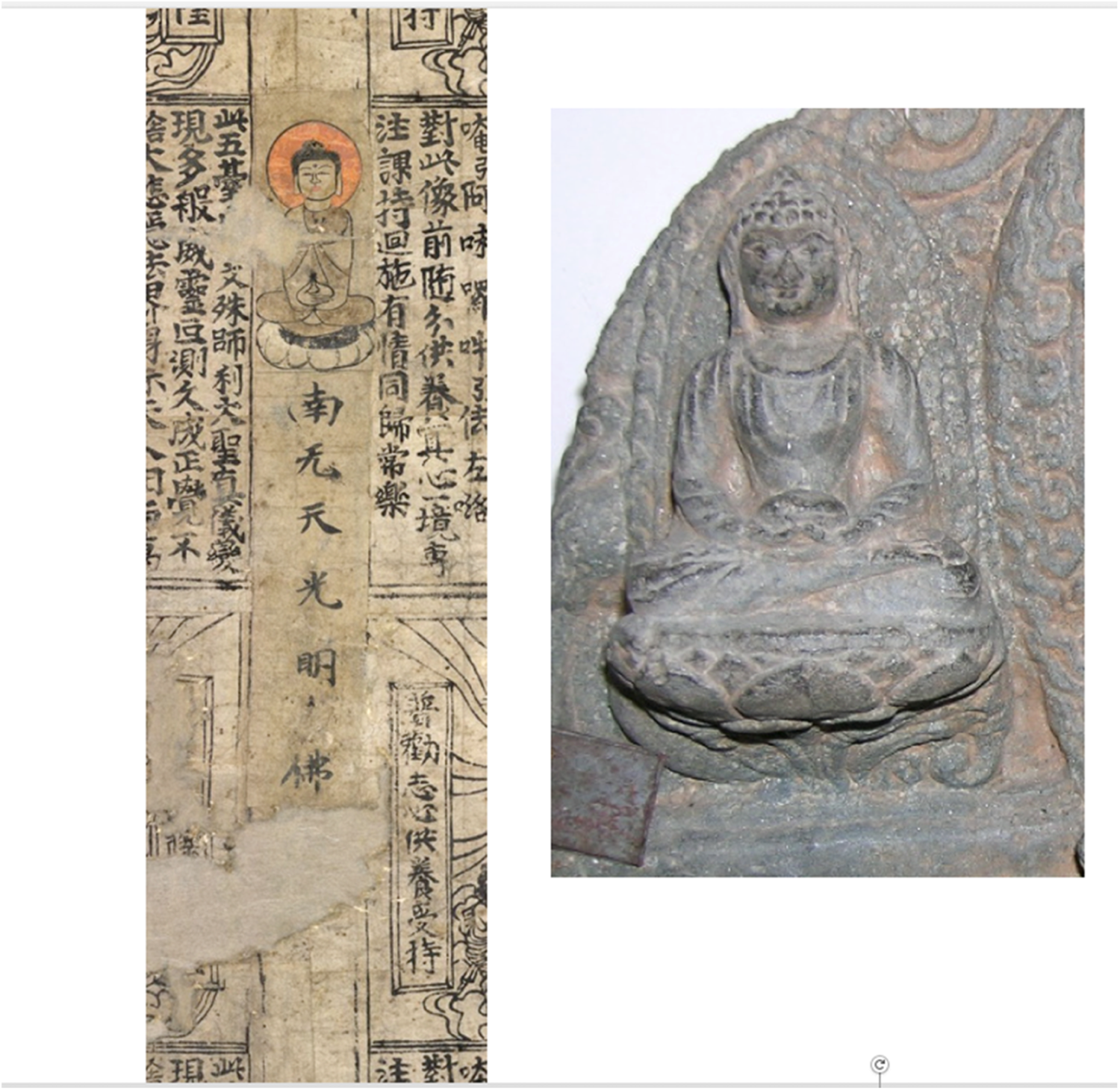
Sometimes referred to as “Mañjuśrı̄ prayer sheet,” the top half of the sheet is an image of the new mode Mañjuśrı̄ identified as the very image of the “Great Sage Mañjuśrı̄ bodhisattva” (大聖文殊師利菩薩) in Mt. Wutai and the bottom half of the sheet is the text on the merit of the devotion to Wutaishan Mañjuśrı̄ along with Mañjuśrı̄ mantra, arapacana, transliterated in Chinese. In a copy now in the British Museum, four sheets of the same Mañjuśrı̄ prayer prints are pasted together to form one big sheet (Fig. 8). A strip of paper is pasted vertically in the middle of this four-sheet combination and on it is painted a small image of a seated Buddha in meditation with a small round object in his hands with a prayer, “Salute to the Buddha of heavenly radiance” (南无天光明佛) written under him. The addition of a painted image of the Buddha of a special prayer on a collage of woodblock prints makes this an individualized, deluxe edition. This specific prayer (南无天光明佛) is only attested in the 一切佛菩薩名集 (compilation of all names of the Buddhas and bodhisattvas) of the Fangshan shijing (房山石經), and the name, the Buddha of heavenly radiance, appears in the litany of 1,000 Buddha names. This may be a generic Buddha that signals multitude of the Buddhas of many kalpas or eons, but such a litany of Buddha names form an age-old Buddhist practice of buddhānusmṛti (popular in Pure Land Buddhism; known in Chinese nian-fo; Japanese nembutsu) (Harrison Reference Harrison and Gyatso1992). An illustrated section of the sūtra of Buddha names (now in the British Museum OA 1919.1–1.074) in fact has a repeating phrase of salutation (南无, from Sanskrit namaḥ) with a Buddha name topped by a generic image of meditating Buddha (Fig. 9). That an image of meditating Buddha was of particular importance for travelers across the silk road is also attested in painted images of an itinerant monk carrying an open rack with sūtra scrolls on his back. In a ninth century example in the British Museum, an image of meditating Buddha appears right in front of the walking monk's slightly crossed eyes (Fig. 10). The image of the Buddha seems to have dramatically appeared in front of him on a stream of clouds from above facing toward the direction of his forward stance, as if guiding him on his journey to the West. The monk's slightly open mouth and concentrated expression gazing on the Buddha is a perfect illustration of the Buddhānusmṛti practice.
Woodblock print of Wutaishan Mañjuśrı̄, from Dunhuang Cave 17, ca. tenth century, ink on paper, British Museum Stein collection, 1919.0101.0. Image © The Trustees of the British Museum.

Illustrated section of the sūtra of Buddha names now in the British Museum OA 1919.1-1.074. Image © The Trustees of the British Museum.

Traveling monk, ca. 851–900, Mogao Grottoes Cave 17, Dunhuang, Gansu Province. Ink and pigments on paper, 16 1/8 × 12 3/16 in. The British Museum, 1919.0101.0.168 (Ch. 00380). Image © The Trustees of the British Museum.

Given the rarity of the Buddha in meditation with a bowl to appear in the composition of a Mañjuśrı̄ image, I am inclined to suggest that the floating Buddha may have been inspired by an object like the four-fold prayer sheet of Mañjuśrı̄ with a painted image of the meditating Buddha, which would have been a common, extremely portable object that would have been carried by a visiting pilgrim (Fig. 11). No officially sponsored travel to India is known during the early-tenth century and the Chinese records of westward travels are quiet for the first half of the tenth century as the early-tenth century was a time of great change and turmoil in Chinese and Central Asian politics with the fall of Tang in 907 CE and the fall of the Yarlung dynasty of Tibet. However, the lack of surviving records does not mean that there was no movement. Buddhist activities continued in Dunhuang throughout the first half of the tenth century, and even had some new innovations appear, like the new mode Mañjuśrı̄ of Cave 220.Footnote 40 And as a recent study on Dunhuang's tenth century pilgrim record in the form of a composite manuscript (the “Daozhao manuscript”) by van Schaik and Galambos (Reference van Schaik and Galambos2012) demonstrates that the tenth century was not a dark age for transregional contacts and connections as Chinese and Tibetan official chronicles would have us believe. The Song's first ruler, emperor Taizu (r. 960–976), commissioned a large-scale pilgrimage to India very early in his reign in 966 (ibid., p. 36), which among other things, suggests that the westward travels and transregional connections must have remained imperative throughout the period of hiatus in official records. When viewed through the interactive India–China comparative lens as proposed here, the Nalanda Mañjuśrı̄ image may be taken as one visual trace of transregional activities that remain little documented in most known historical sources.
Bodhisattvas of “Mahācı̄na”
Was Mañjuśrı̄'s Chinese connection recounted or remembered in India even after Yijing's time? Would the Nalanda Mañjuśrı̄ image have evoked the idea of Wutaishan Mañjuśrı̄ in the minds of people in the tenth century? Mañjuśrı̄'s function and identity transformed from that of an exoteric, Mahāyāna bodhisattva whose cult was associated with a sacred mountain in a specific locality, Wutaishan, known for his power for protection and wish-granting, to one of the great eight bodhisattvas that form a maṇḍala for meditation and protection, to a supercharged esoteric bodhisattva/deity who commands his own entourage as the lord of a maṇḍala (as in Mañjughoṣa or Mañjuvajra of the Guhyāsamajatantra). Although the historical entry point of each type may be staggered with the first one the earliest and the last one the latest, these three types of Mañjuśrı̄ coexisted by the eleventh century, much like the three-phase model of Esoteric Buddhism that Robert N. Linrothe (Reference Linrothe1999) articulated. An early-eleventh century manuscript from Nepal now in the Cambridge University Library suggests that Wutaishan Mañjuśrı̄ was known and understood in medieval South Asia. In fact, this manuscript and related manuscript evidence suggest that there were other bodhisattvas of Chinese origin known in South Asia in the eleventh century. Before examining the manuscript evidence, let us first briefly consider how China is referred to in Indic records.
In early-Indic textual and epigraphic sources, the term “cı̄na” refers to China. The most common references are tied to silk, as in “cı̄napaṭṭa,” which is said to come from Cı̄nabhūmi in the Arthaśāstra (2.11.107–114) (Singh Reference Singh2016, pp. 34–35). A third or fourth century dedicatory inscription in an apsidal temple at Nagarjunakonda (Site 43) identifies Sri Lankan Buddhist teachers (ācāryas from “Taṁbapaṁna”) residing in what seems to have been a cosmopolitan Buddhist saṅgha whose teachings benefited the lands of many countries, including “cı̄na” (Singh Reference Singh2016, p. 39). By the time our manuscript evidence appears in the turn of the first millennium, the term “mahācı̄na” (lit. great China) is used to refer to China. One may be tempted to suggest that this term refers to Greater China or Central Asia, but as we will see shortly, the usage in our manuscript evidence makes it clear that “mahācı̄na” in these manuscripts do refer to mainland China.
Although more research is necessary to determine when and how this term was introduced in Indic records, it is likely that this term was an attempt to translate terms like Da-Tang (Great Tang) and Da-Song (Great Song) introduced by Chinese visitors to India. By the turn of the eleventh century when many Tibetan Buddhist visitors are also leaving records at pilgrimage sites and seeking teachers from Indian monasteries in the Gangetic plain, it is likely that there was a greater need to differentiate the “Great China” (Da-Song) from physiognomically similar Asian visitors. At least in one instance, we have an exquisitely painted palm-leaf manuscript of the Perfection of Wisdom sūtra prepared in the early-twelfth century at Nalanda for a monk named Vijayakı̄rtti who, according to the colophon, was born in “cı̄nadeśa” that most certainly refers to Tibet as the manuscript was transported to Tibet soon after its production and survives there (Kim Reference Kim2013). It remains a huge challenge to identify an exact location of a toponym in medieval South Asia. Many pre-modern toponyms in Indic language records did not remain static in terms of their referents, either. Often the boundaries of what a toponym refers to changed, or the name of the place changed. It is likely that what cı̄na and mahācı̄na meant for the authors of epigraphic and textual records and the speakers of Indic languages in medieval South Asia changed over time. For the period when our manuscript evidence comes from, it seems reasonable to understand the term “mahācı̄na” to mean China.
The CUL Add. 1643 is a Nepalese painted palm-leaf manuscript of the Aṣṭasahāsrikā Prajñāpāramitā (lit. Perfection of Wisdom in eight thousand verses; henceforth Perfection of Wisdom sūtra) that entered the CUL collection at the end of the nineteenth century with many Nepalese Sanskrit palm-leaf manuscripts. This manuscript and another Perfection of Wisdom sūtra manuscript in the Asiatic Society, Kolkata (A15) provided the primary source material for French Indologist, Alfred Foucher's (1865–1952) pioneering study of Buddhist iconography published in 1900. According to the colophon on folio 222 verso, the Cambridge manuscript was completed on Thursday, March 3, 1015 CE (N.S. 135) in a monastery named Śrı̄ Hlam or Lham.Footnote 41 In this monastery, the “ocean of new treatises” (nayaśāstrasāgare), Sujātabhadra prepared it.Footnote 42 Śrı̄ Lham was “the great self-ornament of Nepal [Kathmandu Valley], delight of every being, where the speech of the Buddha shines eternally.”Footnote 43 The claim of its status as a self-generated jewel of Nepal reflects the awareness of this monastery's role and status vis-à-vis the trans-regional Buddhist network and within Nepal.Footnote 44 It must have been a thriving monastic center with a superb scriptorium where stunning painted manuscripts were prepared.Footnote 45 The Cambridge manuscript is one of the most ambitiously designed manuscripts known from the eleventh century, with the highest number of painted panels known among the dated manuscripts: eighty-five painted panels are strewn throughout the manuscript. Unusual for Indic painted manuscripts of this age, each painted panel is accompanied by a caption written in more casual hand, which identifies each image as that of a famous pilgrimage site or an auspicious image of a specific locality, not only in the sub-continent but also all over the Buddhist world known to the makers of this manuscript in Nepal at the beginning of the eleventh century. The manuscript is a portable device containing the famous pilgrimage sites in one compact colorful package that can be opened up and experienced in unfolding three-dimensional space, like virtual pilgrimage (Kim Reference Kim2012, Reference Kim2013). Most importantly for our purpose, it includes three painted panels that are identified as depicting a bodhisattva in “mahācı̄na” or China, and the last one on folio 202 verso where Chapter 29 of the text ends is an image labeled “Mañjughoṣa in China” (mahācı̄nemañjughoṣaḥ).
The painting depicts Mañjuśrı̄ seated with his right leg pendant on a blue lion (Fig. 12). The bodhisattva displays preaching gesture and holds a blue lotus (utpala). The caption does not identify him as Wutaishan Mañjuśrı̄ but the painter clearly understood the Mountain home of Mañjuśrı̄ since the backdrop is depicted with geometric patterns in red, blue, and yellow that typically represent mountains. That this mountainous landscape represents the Nepalese understanding of Mount Wutai, the five-peaked mountain is supported by another Nepalese manuscript of the Perfection of Wisdom sūtra in the Asiatic Society (A15) prepared in 1071 CE where we find another image of Mañjuśrı̄ with a caption that says Mañjughoṣa on the five-peaked mountain (pañcaśire mañjughoṣa), which translates Wutaishan (lit. five-peaked mountain) back to Sanskrit. The painting in the Cambridge manuscript has two attending female figures, one yellow standing figure to the left, and another blue figure kneeling with hands in añjalı̄ facing right, and they create a sense of animation in this miniature painting (only measuring about 5 × 5 cm2), just as the young boy figure of Sudhana and the lion tamer, the Khotanese King adds to the animation of the scene in the new mode Mañjuśrı̄ images. The name Mañjughoṣa (lit. sweet voice) for a form of Mañjuśrı̄ appears in sādhana (lit. conjuring up a deity, instruction for esoteric Buddhist ritual means to identify with a chosen deity) literature in the Vajrayāna Buddhist context, and the painting largely conforms with the sādhana text's description of the vision of Mañjughoṣa to the extent that it is an image of two-armed form of Mañjuśrı̄ in golden complexion seated on a lion with a single blue lotus rising above his left shoulder. The added details like the mountainous landscape specifies the place where Mañjuśrı̄ appears as Mount Wutai. This does not mean Wutaishan Mañjuśrı̄ is to be understood as Mañjughoṣa, or Mañjuvara, another form of Mañjuśrı̄ similar to Mañjughoṣa, specifically indicated for preaching gesture, lalitāsana (one leg pendant seated posture), one or two lotus(es) with a book on top, and two attendants, blue Yamāntaka and Sudhanakumāra. It means that Wutaishan Mañjuśrı̄ was so important in people's perception that even Mañjuśrı̄ as an esoteric Buddhist bodhisattva remembers that layer of Mañjuśrı̄'s trans-regional meaning. On the contrary, we can also consider the impact of the new mode Mañjuśrı̄ images from “China” (more specifically, Dunhuang) that may have informed the development of esoteric Mañjuśrı̄ images like Mañjughoṣa and Mañjuvara. For instance, the addition of blue, wrathful Yamāntaka holding a staff and touching Mañjuśrı̄'s feet described in one of the Mañjuvara sādhanas recalls the image of the lion tamer, the Khotanese king, typically depicted as a bearded royal figure.
Mañjughoṣa in China (mahācı̄na), folio 202v, AsP Ms, 1015 CE (N.S. 135), Cambridge University Library Add 1643. Reproduced by kind permission of the Syndics of Cambridge University Library.

The other two images of Chinese origin identified in the Cambridge manuscript appear on folio 123v where Chapter 13 ends and folio 127r where Chapter 14 ends. The one on folio 127r is identified as Samantabhadra in China (mahācı̄nesamantabhadraḥ), and the painting depicts a green bodhisattva sitting on a white elephant with his left leg pendant, displaying his hands in preaching gesture (Fig. 13). A stalk of flower with vajra and a flaming jewel on top rises above his left shoulder. Samantabhadra does not appear as an independent bodhisattva in the sub-continent and there is no independent cult dedicated to him; Samantabhadra appears only in the context of eight or sixteen great bodhisattvas, forming a maṇḍalaic entourage. Samantabhadra as an independent bodhisattva is popular in China where he is often paired with Mañjuśrı̄ flanking the Buddha in the center in Tang dynasty images. Just as Mañjuśrı̄ is associated with a sacred mountain, Wutaishan, Samantabhadra in China also has a mountain home, Emeishan, or Mt. Emei in Sichuan. The codification of four great bodhisattvas associated with four sacred mountains in China is known to happen during the early Ming dynasty (Wang-Toutain Reference Wang-Toutain1998; Zhiru Reference Zhiru2007, p. 218), but the painting in the Cambridge manuscript suggests the manuscript makers in eleventh-century Nepal were aware of Samantabhadra's association with his mountain abode as articulated in China: the unnamed Nepalese miniaturist depicted the elephant riding bodhisattva against a rocky mountainous backdrop painted in yellow and blue geometric shapes with white and red accents.
Samantabhadra in China (mahācı̄na), folio 127r left panel. AsP Ms, 1015 CE (N.S. 135), Cambridge University Library Add 1643. Reproduced by kind permission of the Syndics of Cambridge University Library.

The last painted panel, the first one of the China series images to appear in the Cambridge manuscript, on folio 123v identifies the image as “Lokanātha in the form of Buddha in China (mahācı̄nebuddharupakalokanāthaḥ).” The painting depicts a monk whose body color is white seated in meditation on a lotus inside a shrine with a multi-tiered shrine structure with a stupa finial (Fig. 14). Halo behind his head and fire or light emitting from his body in the immediate background mark the figure's importance and spiritual power. Surrounding this shrine are six monks dynamically adoring the figure inside the shrine: the four monks whose skin color is yellow are dressed in red monastic robe like the central figure and the other two are dressed in yellow monastic robe and their skin color is painted green, as if to indicate diverse denomination and ethnicity of monks. This image remained a puzzle for me for many years as the referent seemed particularly unclear. The image seems to refer to a famous bodhisattva image of China like the other two, but I could not identify what the “Buddharupa-Lokanātha” or Avalokiteśvara in the form of Buddha might be. It is only when I turned to rely more on what the image is telling and consider the possibility of the transmission of knowledge about famous auspicious images not through texts or illustrated guides but through oral storytelling especially in trans-cultural travels of these stories that a new, distinct possibility of identifying this image in China came to sight. I believe this image represents Kṣitigarbha, or perhaps more aptly, Dizang whose cult developed in early medieval China.
Lokanātha in the form of Buddha in China (mahācı̄nebuddharupalokanātha), folio 123v right, AsP Ms, 1015 CE (N.S. 135), Cambridge University Library Add 1643. Reproduced by kind permission of the Syndics of Cambridge University Library.

Although some scholars have argued for the pre-Chinese origin of Dizang, either back to India or to Central Asia, Zhiru's 2007 study convincingly demonstrates that the cult of Dizang (Jijang in Korean, Jizo in Japanese) as the guardian of the deceased (or the Lord of the Underworld) may in fact have been articulated and developed in China. The Chinese name Dizang may come from the translation of the name Kṣitigarbha (lit. earth-matrix or womb), but Kṣitigarbha is not an independently important bodhisattva in India. Like Samantabhadra, he is mainly known as one of the eight major bodhisattvas. The unique feature of Dizang iconography in East Asia is his appearance in monastic garb with shaven head like a monk or a Buddhist master. His human, monastic appearance may be tied to the story of an eighth-century Korean monk Jijang (Dizang in Chinese, the namesake of the bodhisattva) whose miracle-filled life story and residence in Mount Jiuhua in Anhui contributed to the later establishment of Mount Jiuhua as the abode of bodhisattva Dizang, which happened during the Ming dynasty (Zhiru Reference Zhiru2007, pp. 216–18). For our purpose of identifying the painting of “Buddharupa Lokanātha” in China in an early-eleventh century Nepalese manuscript, the human, monk-like appearance of Dizang fits the bill. Adoration by many monks of different stripes recalls the story of the Korean monk, Jijang in Mount Jiuhua, who as a charismatic Buddhist master drew many followers, which was first recorded in Jiuhua shan Huacheng si ji (九華山化城寺記) completed in 813. In addition, by the ninth century, the Dizang cult “blended with other cults, notably those of Amitabha and Guanyin” (Wang-Toutain Reference Wang-Toutain1998; Zhiru Reference Zhiru2007, p. 22). Given the nature of Dizang as the savior of the damned, it is not difficult to imagine Buddhist specialists in early-eleventh century Nepal taking the story of an unusual monk-looking bodhisattva to be a unique form of Avalokiteśvara in the distant land of China. Given the absence of mountainous backdrop, the painting also suggests that the association between Mt. Jiuhua and Dizang was probably not as strong as that between Mañjuśrı̄ and Mt. Wutai, or that between Samantabhadra and Mt. Emei.
Although there may exist a text that would explain how eleventh-century manuscript makers in Nepal might have learned about the marvelous power of Dizang in China, in its absence, the painting can tell the tale. Even if the story we can draw from the picture may be mediated and inaccurate, it is nonetheless a valuable record of trans-regional and transcultural travels of powerful auspicious images and cultic sites that are otherwise little documented. Nepal was an important midway point between Central Tibetan regions and the Buddhist sites in the Gangetic plain. Given the presence of Chinese travelers from Song to Bodhgaya in the eleventh century discussed above, there are at least two paths through which the stories about Dizang in China may have traveled to Nepal, either through Chinese visitors to India sharing stories with Himalayan visitors, or through Tibetan visitors who already knew about Dizang from their interactions with Chinese (Wang-Toutain Reference Wang-Toutain2007) and were frequenting the Valley seeking artisans and teachers.
The Cambridge manuscript's design principles and programmatic ambition to make a virtual pilgrimage package inspired subsequent copies in Nepal and Bengal. Although Samantabhadra on a white elephant and Mañjuśrı̄ on a blue lion were copied without captions about a century later in a Bengali manuscript (the manuscript is discussed in Kim Reference Kim2013, Reference Kim2014, Reference Kim, Chowdhury and Chakravarti2018), the more human-like image of Dizang doesn't seem to have appealed to South Asian Buddhists perhaps because by this time, Buddhist masters adorned with regalia like the bejeweled crowns of vajrācārya were becoming a norm (Brown Reference Brown2017; Linrothe Reference Linrothe2014).Footnote 46 As far as I have seen, the record goes cold after the 1015 CE manuscript. The knowledge of Mañjuśrı̄'s Chinese connection and his Mountain abode at Wutaishan remained in circulation in medieval South Asia well after the fall of the Buddhist institutions in the Gangetic plains in India. In the Svayambhūpuraṇa, an important Buddhist epic that narrates the origin of Nepal's (here, the Kathmandu Valley) sacred landscape that was written down after the fifteenth century, Mañjuśrı̄, who came from his abode in China, is given a credit for creating the Kathmandu valley.
China as the Buddhist land in medieval Indian imagination
Although the Buddhist institutional core weakened in India, the pious Buddhists from elsewhere, perhaps bolstered by more active trans-regional movements, made significant contributions to medieval Indian Buddhist landscape.Footnote 47 Chinese and Tibetan visitors in particular seem to have made a lasting impact. After the demise of Buddhism in India, “Mahācı̄na” is imagined and understood to be the ultimate Buddha land in the land of Buddhist origin. The Svayambhūpuraṇa that imagines the powerful bodhisattva Mañjuśrı̄ in China coming to the Kathmandu Valley and initiating Buddhism there is believed to have been written down in the fifteenth century or later. Composed following the demise of Buddhist institutions in India, the Svayambhūpuraṇa is significant because it shifts the center of the Buddhist world to Nepal, demonstrating the cultural confidence of the Valley's inhabitants as Alexander von Rospatt (Reference von Rospatt, Kim and Lewis2019) observes. On the contrary, the prominent role given to a bodhisattva from China is equally significant in understanding how China was imagined in the sub-continent during the second millennium: it is the land of Mañjuśrı̄, the Buddhist land.
As institutional Buddhism lost grounds in the Gangetic plain, powerful and famous Buddhist deities were integrated into the Hindu pantheon from the thirteenth century onward. This integration process was slow and complex, and there is a lot more work to be done for the period after the fifteenth century on how Buddhism was imagined and understood in the sub-continent.Footnote 48 Himalayan Buddhism was well and thriving throughout the second half of the millennium while the Mughal rule expanded in the sub-continent and different religious movements arose changing the religious landscape. Although rarely seen comparatively or understood as interconnected, as Indrani Chatterjee's recent study (Reference Chatterjee2013) demonstrates, the Himalayan and trans-Himalayan regions remained connected to the rest of the South Asian subcontinent from the thirteenth through nineteenth centuries through “monastic geographicity” (Chatterjee Reference Chatterjee2013, p. 2). If China was imagined as the land of Mañjuśrı̄ in post fifteenth-century Nepal, was this understanding known in other parts of the sub-continent? Certainly, how China was imagined in India changed as circumstances changed both in India and China.Footnote 49
As mentioned at the outset, the terms “China” and “India” are used to signal the geographic and cultural distance between the two regions despite the caveat of presentist nation-centrism that the terms carry. Adopting a comparative perspective of India–China while emphasizing interconnectivity and multi-directionality of transregional movements has helped uncover little known evidence of trans-regional connections and trans-cultural interactions in pre-modern times. As we have seen, close reading of material cultural and art historical records can reveal new threads of potential connections that are forgotten in history. On the contrary, the importance of Nepalese and Tibetan evidence in understanding the perception of China in medieval South Asia outlined here illuminates what the lens of “China–India studies” may miss in capturing the complexity of trans-regional interconnectivity especially if we were to adopt it without considering the categories' implication as monolithic, post-historical concepts. I hope this study has demonstrated how we can challenge the diffusionist model and explore interconnected histories by attending to very local manifestations of ideas and knowledge from a globally comparative perspective.
One of the integrated Buddhist deities in the Hindu context bears the epithet “mahācı̄na-tārā” which later Hindu tantric texts identify as a wrathful form of the goddess Tārā based on “the practice (ācāra) of Mahācı̄na.”Footnote 50 A frightening four-armed blue goddess that we see today in Kolkata during the annual Kālı̄ pūjā among the ten manifestations (mahāvidyās) of the powerful Hindu goddess, Kālı̄, looks similar to the textual description of Mahācı̄na-Tārā (Fig. 15). The Buddhist reference is dropped in the contemporary examples, and China is an economically and politically formidable neighbor in the global politics rather than the “Buddhist land.” Nonetheless, this particular form of Tārā installed in the city where we find the only Chinatown in India seems to betray the forgotten history. Perhaps Mahācı̄na-Tārā survived in the Hindu pantheon much longer than any other Buddhist deities precisely because of her claimed foreign origin, in the distant Buddhist land of China.
Goddess Kālı̄ with ten mahāvidyās, clay images installed for Kāliı̄ pūjā, South Kolkata, October 24, 2003. Photo by the author.


 Open access

