

The fiftieth anniversary of Operation Condor—a system of transnational repression that military intelligence officials from Argentina, Bolivia, Chile, Paraguay, and Uruguay officially founded in Santiago, Chile, in late November 1975—was marked in 2025. At the 1975 gathering, attendees adopted “a motion presented by the Uruguayan delegation in honor of the host country” and unanimously decided to call the new system Condor, as evidenced in the minutes of the meeting.Footnote 1 With US backing and support, Condor became the most sophisticated, institutionalized, and coordinated scheme ever established to silence political dissidents living in exile in South America and beyond (Lessa Reference Lessa2022; see also Dinges Reference Dinges2005; McSherry Reference McSherry2005; Kornbluh Reference Kornbluh2013). At its peak, eight countries were involved, with Brazil joining in 1976, and Peru and Ecuador in 1978.
Fifty years later, autocracies across the globe still relentlessly suppress opposition by exiled activists, journalists, politicians, and dissidents, completely disregarding the rule of law and human rights, as well as basic international relations norms of sovereignty, territorial integrity, and the protections granted to refugees and asylum seekers. The nongovernmental organization Freedom House recorded 1,375 incidents of transnational repression committed by 54 governments between 2014 and 2025; the top five most active countries were China, Turkey, Russia, Tajikistan, and Egypt (Gorokhovskaia and Vaughan Reference Gorokhovskaia and Vaughan2026).
In the scholarly literature, the term transnational repression conceptualizes the deliberate targeting of refugees and dissidents by states across borders (Lessa and Balardini Reference Lessa and Balardini2024). In just a decade, transnational repression has become a field of study in its own merit, and it spans international relations, political science, sociology, migration studies, and human rights.Footnote 2 It primarily focuses on explaining the inner workings of transnational repressive practices (Moss and Furstenberg Reference Moss and Furstenberg2024). Most of the scholarship examines contemporary manifestations of transnational repression, whereby origin countries usually act unilaterally and/or in cooperation (often co-optation) with host states, through in-depth country case studies, such as China, the Philippines, and Venezuela (Sánchez-Montijano and Preciado Rueda Reference Sánchez-Montijano and Preciado Rueda2025; Quinsaat Reference Quinsaat, Moss and Saipira2024). Several datasets have also been compiled, most recently, the Authoritarian Actions Abroad Database (Dukalskis Reference Dukalskis2021); Freedom House’s Transnational Repression Database (Gorokhovskaia and Linzer Reference Gorokhovskaia and Linzer2022); the Transnational Repression of Uyghurs Dataset (Lemon et al. Reference Lemon, Jardine and Hall2023); and the Latin American Transnational Surveillance dataset (Spektor et al. Reference Spektor, Fernandes, Marcos, Lucas, Victor and Sion2024).
Lately, instances of cooperation in transnational repression have attracted rising interest;Footnote 3 scholars have argued that such cooperation likely happens in regional clusters and is carried out by states that have common economic or political interests and share illiberal norms, with no respect for the rule of law (Michaelsen and Ruijgrok Reference Michaelsen and Ruijgrok2024; Lessa and Balardini Reference Lessa and Balardini2024; Cordell and Medhi Reference Cordell and Medhi2024).
In this article, we probe deeper into a cooperative instance of transnational repression in South America in the 1970s and introduce a novel dataset, the Database on South America’s Transnational Human Rights Violations, hereafter THRV, which comprises data on 805 victims between 1969 and 1981 in South America. This original dataset captures the targeted persecution of exiled dissidents from seven nationalities across thirteen countries in the Americas and Europe during state terrorism in South America. We shed light on this historical case, which has so far been rather marginalized in the current research on transnational repression, and demonstrate how it makes an original contribution to the existing literature. We unpack the rich data compiled in our dataset and discuss descriptive statistics that help improve our knowledge of the key features of this relatively understudied episode of transnational repression in South America.
We proceed as follows. We initially outline the data collection process and then offer a concise literature review on Operation Condor. Subsequently, we describe the data by focusing on the novel findings that significantly differ from the conclusions of previous works in three respects, namely the victims, the geographies of terror, and the perpetrating state bodies. Finally, we conclude with discussion of how the THRV relates to other transnational repression datasets and contemporary trends.
The THRV database
The THRV dataset is the first that systematically maps the victims of human rights violations (primarily, abductions, disappearances, arbitrary executions, and appropriation of children) that were carried out in a cooperative manner by eight South American states. It thus records these coercive, lethal and nonlethal attacks suffered by 805 victims across thirteen countries between August 1969 and February 1981. The database’s chosen temporal window of 1969 and 1981 is significant for two reasons. First, empirically, it reflects the first and last instance of transnational human rights violations in South America that we could confirm. Second, analytically, it enables a deeper examination and appreciation of the complex political and historical dynamics that shaped the onset, evolution, consolidation, and eventual downfall of Operation Condor, as well as the myriad actors (e.g., police, civilian, military intelligence) who participated in it over time.
The THRV was developed between 2017 and 2026 through a methodical and careful review of existing reliable and available information on transnational repression in South America that had been compiled by state and civil society sources. Data collection on transnational repression is especially and notably challenging (Tsourapas Reference Tsourapas2021; Dukalskis et al. Reference Dukalskis, Furstenberg, Gorokhovskaia, Heathershaw, Lemon and Schenkkan2022), and the safety of scholars involved in researching such themes is often at risk (Lessa Reference Lessa2023). An unexpected turn of events led to the creation of this database. In February 2017, Lessa received death threats while she was conducting field research on Operation Condor in Uruguay and, consequently, had to leave the country. Subsequently, a list of victims compiled in order to guide the work of a research assistant was eventually transformed into a database to determine the number of Operation Condor victims more reliably. Through the database, we can better differentiate Condor operations from state-level repression in South America, a distinction that researchers and journalists frequently conflate, as McSherry (Reference McSherry2019) rightly observes.
Our sole criterion for distinguishing victims of transnational repression from national-level cases—and for determining their inclusion in the database—was the occurrence of a border crossing in the perpetration of the crime. This crossing of borders could take one (or more) of these three forms: (1) the exchange of information about a victim between two countries (normally the victim’s origin country and the host country), (2) international collaboration among agents in the perpetration of the crime(s), and (3) the clandestine rendition of a victim from the host country to the origin country. The dataset also contains a residual category of “interconnected cases,” which includes two additional groups of victims: minors and relatives of victims, who were often apprehended as part of operations targeting specific activists, and individuals detained in one country in parallel to, or because of, operations in another country against members of the same targeted organization.
We identified the 805 cases by methodically applying these criteria. This is a conservative number, and the real number of victims is most likely larger; this is because of the challenges surrounding data collection and verification, but also in view of the fact that not all victims may have been officially recorded and/or investigated. The starting point for each recorded case in our dataset is the date the victim was initially abducted or murdered; we then documented information on up to eighteen variables.
A few words on ethics are in order at this point. Data collection is extremely difficult when investigating clandestine systems of state repression as the ones that functioned in South America in the 1970s. Within that, Condor was a secret operation that few knew about even at the time. Since democratization, only a few countries have seriously scrutinized past atrocities, and in many cases, such as Brazil, Uruguay, and Paraguay, they did so with years, or even decades, of delay. Access to state archives has been overall arduous and frequently restricted, not only to researchers but also to victims and their families. Last, the deeply traumatic nature of the events under consideration means that some victims are reluctant to share their experiences and/or might no longer be alive to do so. In releasing this dataset, we have taken particular care to ensure that its public accessibility does not cause any harm to the victims and their families, thereby anonymizing all personal data. For further information on the data collection process, ethics, and the full description of the dataset and its variables, please consult these online supplementary materials: the appendix and the codebook.
Transnational repression in South America
Although an extensive literature review is beyond our scope, we identify four main trends at the heart of scholarship on transnational repression in South America and Operation Condor. We primarily concentrate on Operation Condor, as it has been the focus of scholarly works in this field. Over the years, this transnational terror system has generated much fascination and interest.
First, several US-based authors have discussed at length the role and support that the US provided to South America’s military dictatorships in general and to Operation Condor in particular, including delivering military and economic aid, training over sixty thousand Latin American police and military officers at the infamous School of the Americas (Gill Reference Gill2004), and permitting the use of communications installations in the Panama Canal Zone for Condortel—Condor’s secret and encrypted system of communication among members countries (Dinges Reference Dinges2005; McSherry Reference McSherry2005; Kornbluh Reference Kornbluh2013). Second, numerous South America–based scholars have focused their analysis on unraveling Condor’s inner workings and its on-the-ground operations owing to increased access to local archives in recent years (Calloni Reference Calloni1999; Martorell Reference Martorell1999; Serra Padrós Reference Serra Padrós, Padrós, Barbosa, Lopez and Fernandes2010; Silveira Bauer Reference Silveira Bauer2012; Slatman Reference Slatman and Padrós2013; López Reference López2016). Third, various scholars, journalists, and judicial professionals have closely investigated the cases of emblematic Condor victims, such as (among others) the murders in 1974 and 1976 of Carlos Prats González, former commander in chief of the Chilean Army, and his wife, Sofia Cuthbert, in Buenos Aires (Carrió Reference Carrió2005); Zelmar Michelini and Héctor Gutiérrez Ruiz, Uruguayan legislators killed in Buenos Aires alongside former militants William Whitelaw and Rosario Barredo (Trobo Reference Trobo2005); and Orlando Letelier, former ambassador and minister in the Allende government, in Washington DC (Dinges and Landau Reference Dinges and Landau1981; McPherson Reference McPherson2019). Finally, and more recently, scholars have examined novel aspects, such as criminal proceedings shedding light on Condor’s atrocities (Lessa Reference Lessa2019; Sharnak Reference Sharnak, Capdepón and Layús2020) and memorialization efforts (Preda Reference Preda2020).
Only lately has Operation Condor been conceptualized as an instance of transnational repression (Lessa Reference Lessa2022); this is most likely because much of the existing literature prioritized contemporary manifestations of the phenomenon, not historical cases. Through our THRV database, we thus generate new knowledge of how transnational repression worked in the 1970s in South America. We structure our analysis along three axes: who was repressed (the victims), where repression occurred (the geographies of transnational terror), and who repressed (the machinery of repression).Footnote 4
A caveat should be raised before we begin discussing our results. As with all instances of authoritarian repression implemented in a clandestine manner, and as mentioned earlier, data collection is extremely challenging. In this case, no single repository of information exists on the victims of transnational repression and Operation Condor in South America.Footnote 5 In fact, numerous data sources are still not accessible or available to researchers. Thus, our results reflect the primary sources that we had access to and could use in building this dataset between 2017 and 2026. These might change should new sources be available in the future. We are open to expanding the database as time evolves and novel primary sources become accessible.
The victims of South America’s transnational terror
The 805 victims whose information was compiled in our database are predominantly male (69 percent) and adult (93 percent); female victims and minors (under the age of eighteen) constitute 31 percent and 7 percent of the dataset, respectively (Tables 1 and 2). This first descriptive finding is notable: these percentages are remarkably similar to those of the victims of national repression, as recorded by truth-seeking bodies in Argentina and Uruguay. Argentina’s National Commission on the Disappearance of Persons (CONADEP, in its Spanish acronym), which investigated disappearances during the 1976–1983 dictatorship, found in 1984 that 70 percent of victims were male and 30 percent female (CONADEP [1984] 2006, 301). Equally, Uruguay’s 1985 Investigative Commission on the Situation of Disappeared People and Its Causes determined that 72 percent were male victims, 23 percent female, and 7 percent children (Rico Reference Rico2007, 16). This conclusion corroborates the fact that transnational repression worked as an extension of and complement to domestic repressive policies simultaneously unfolding in the two most active states of this cross-border terror system.
Victims by gender

Source: THRV database.
Victims by age group

Source: THRV database.
The dataset further contains valuable information on two defining features of the victims: their nationality and activism. First, on nationality, 99 percent of victims came from seven South American countries: Argentina, Bolivia, Brazil, Chile, Paraguay, Peru, and Uruguay. Uruguayans were, however, the most pursued group (Figure 1), accounting for approximately half (384, or 48 percent) of total recorded cases in the dataset, followed by Argentines (190, or 23 percent), Chileans (115, or 14 percent), and Paraguayans (forty, or 5 percent).
Victims by nationality, number of cases, from the THRV database.

This conclusion on the predominance of Uruguayan victims challenges the dominant focus in the scholarship on high-profile Condor victims, often Chilean nationals such as Prats, Letelier, and the Christian Democrat politician Bernardo Leighton. Relatedly, some of the earlier publications in English on Condor, between the mid-2000s and early 2010s, closely associated Condor with Chile (Dinges Reference Dinges2005; McSherry Reference McSherry2005; Kornbluh Reference Kornbluh2013); this was likely because its November 1975 founding meeting occurred in Santiago, hosted by the country’s Directorate of National Intelligence (DINA, in its Spanish acronym). Our finding is in line with the conclusions of the Argentine CONADEP ([1984] 2006, 269), which had already confirmed in its 1984 final report that most victims of the regional repressive coordination were Uruguayans.
The nature and time spans of the Southern Cone’s dictatorships help explain the large number of Uruguayan victims. We concisely discuss some key points here, but we have developed them further in other publications (Lessa Reference Lessa2022; Lessa and Balardini Reference Lessa and Balardini2024). After taking over, the dictatorship of General Augusto Pinochet in Chile rapidly and violently repressed political opponents, with hundreds of people being executed or disappeared in the coup’s immediate aftermath in late 1973 (Aldrighi and Waksman Reference Aldrighi and Waksman2015). The same pattern, albeit in a clandestine way, unfolded in Argentina after the March 1976 takeover that paved the way for a ruthless persecution of the opposition. Conversely in Uruguay, repression was less lethal in its early phases (1968 to 1972). Two features are noteworthy in this period. First, although state terrorism acts were committed in Uruguay and the country was slowly spiraling into dictatorship, it remained a democracy, and the civil-military coup formally occurred on June 27, 1973. Second, the country’s constitution enabled prisoners detained under the Prompt Security Measures, a state of emergency, to opt for exile over serving their sentence in Uruguay (Alonso Reference Alonso2016). Therefore, many activists left Uruguay and relocated to Argentina and Chile, where they continued to actively denounce political repression back home. The questioning voices of numerous Uruguayan exiles, therefore, gradually turned into a growing threat for the dictatorship in Montevideo by the mid-1970s, and they hence became a prime target of transnational repression. While Argentina and Chile primarily silenced political opposition through state-level repression, Uruguay had to resort to transnational terror to reach those opponents who were no longer physically located inside its national territory.
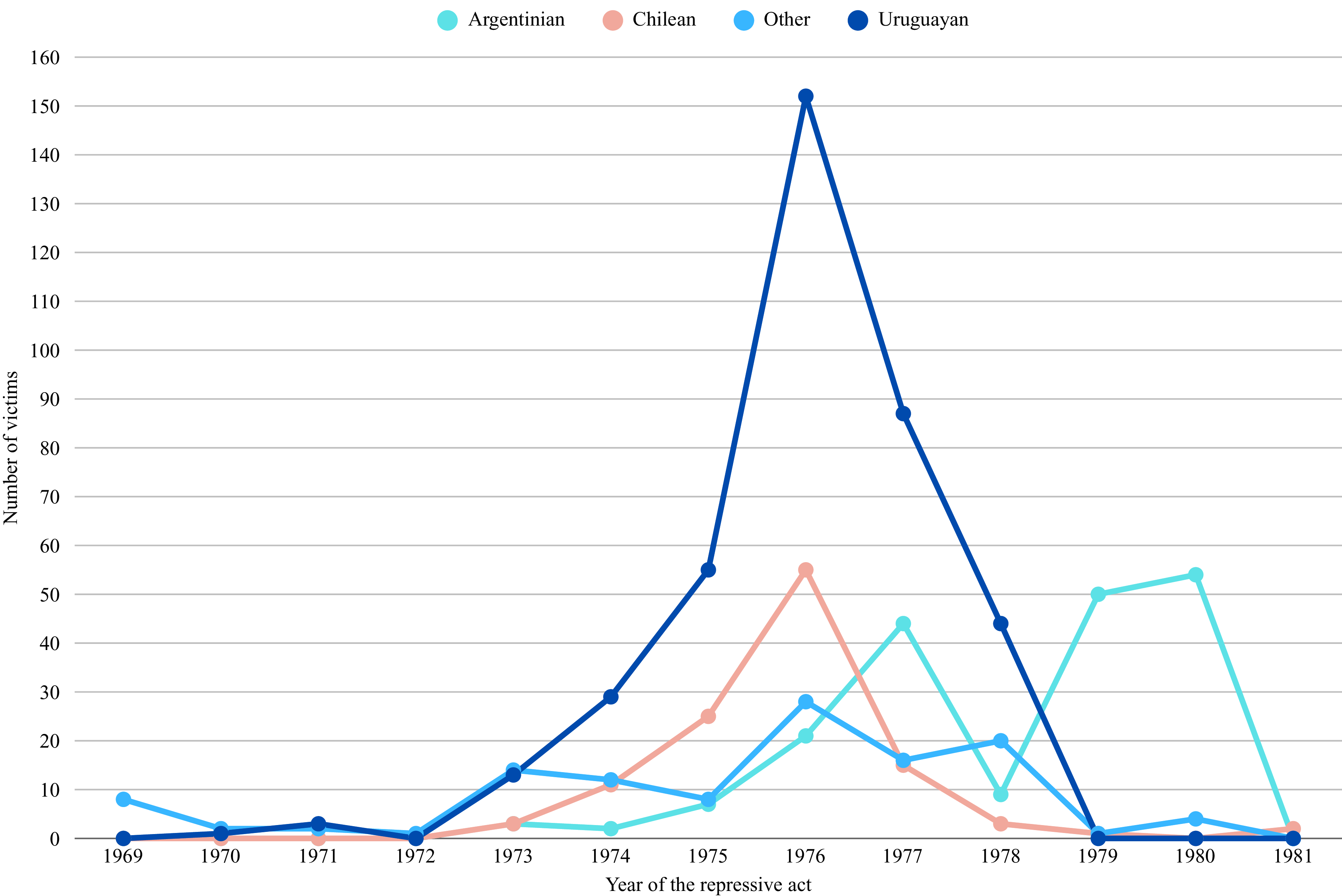
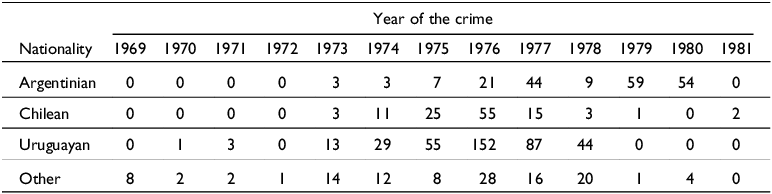
There is some variation over time in the nationality of the victims, as shown in Figure 2 and Table 3. While Uruguayans faced significantly higher levels of persecution between 1974 and 1978, this trend was interrupted in 1979 and 1980 when Argentines constituted the most targeted group. This change was due to the Argentine security forces’ use of the Condor intelligence and operative channels to pursue members of the Montoneros revolutionary group, who were attempting to reenter Argentina from abroad, between 1979 and 1980, as part of the contraofensiva campaign.Footnote 6
Victim totals by nationality and by year of crime, 1969–1981.

Victim totals by nationality and by year of crime, 1969–1981

Source: THRV database.
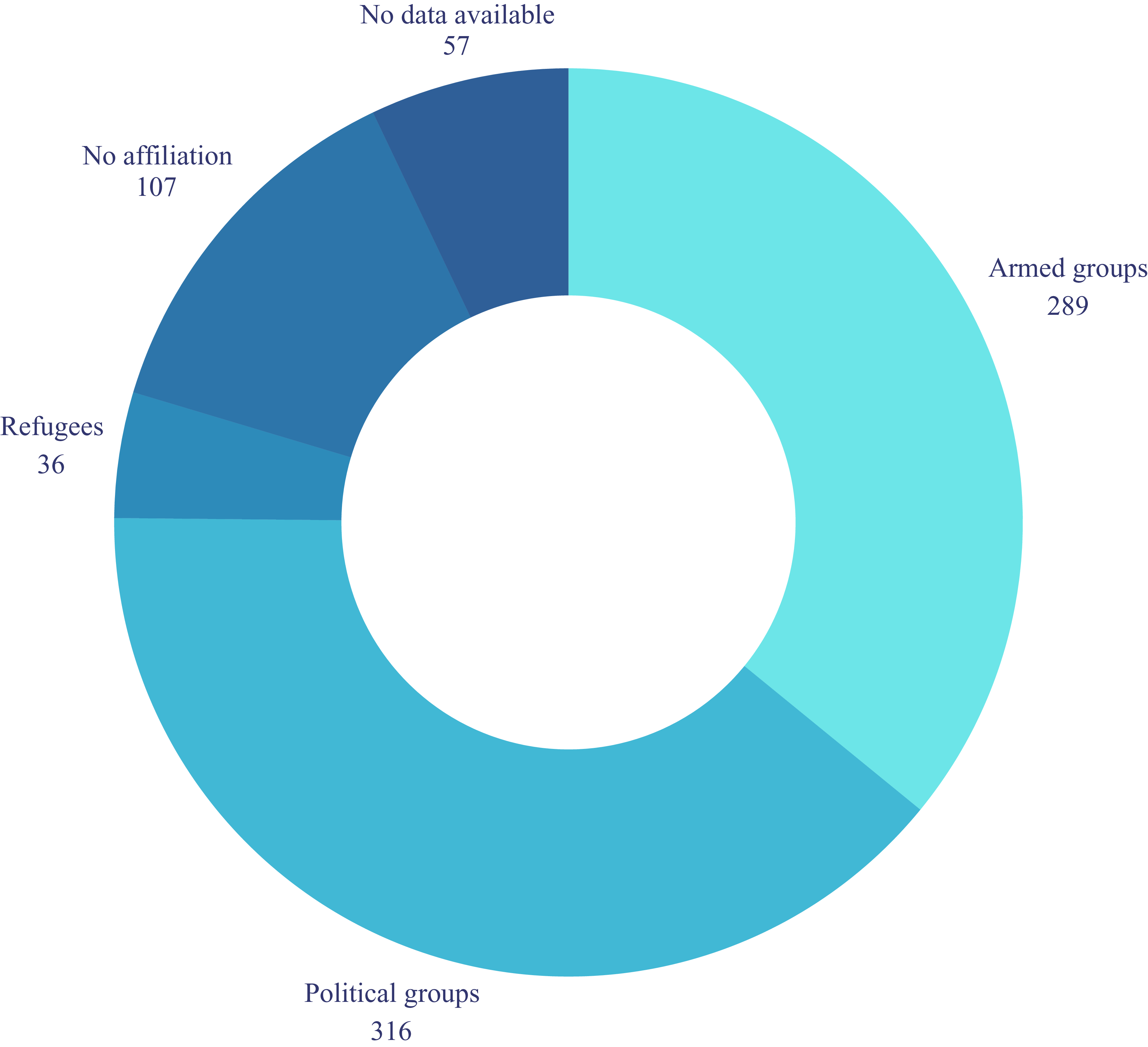
Second, concerning activism, militants who were active in political groups (316, or 40 percent) constituted the largest set of those targeted, followed by members of revolutionary organizations (289, or 36 percent);Footnote 7 5 percent were individuals with refugee status (thirty-six), and 13 percent of the recorded victims (107) did not have any affiliation (Figure 3). These findings unmistakably reveal the highly targeted nature of transnational repressive attacks, with 81 percent of victims having a clear affiliation to either a political or social movement or a guerrilla group or having secured refugee status.
Victims by affiliation, number of cases, from the THRV database.

The dataset includes militants with a diverse set of backgrounds, but a few groups particularly stand out: the Party of the Victory of the People—founded by Uruguayan exiles in Buenos Aires in July 1975—amounts to 15 percent; the Argentine Montoneros guerrilla group accounts for 15 percent; members of the Revolutionary Coordinating Junta (JCR, in its Spanish acronym), 14 percent; and the Uruguayan revolutionary organization, the Tupamaros National Liberation Movement, 11 percent.
The finding on the prevalence of political activists being persecuted defies dominant understandings of Operation Condor in previous analyses, which mostly justified the onset of the collaboration among South America’s security forces as an inevitable response to counter the emerging threat from the continent’s revolutionary armed groups, which had begun to coordinate their actions in 1972 through the JCR. The JCR was a coordinating body formed by Chile’s Revolutionary Left Movement (MIR, in its Spanish acronym), Argentina’s Workers’ Revolutionary Party-People’s Revolutionary Army (PRT-ERP, in its Spanish acronym), Uruguay’s Tupamaros National Liberation Movement (MLN, in its Spanish acronym), and Bolivia’s National Liberation Army (ELN, in its Spanish acronym) (Marchesi Reference Marchesi, Kruijt, Tristán and Álvarez2019). This justification was especially prominent in numerous declassified South American and US government documents from the time.Footnote 8 South America’s dictatorships strategically used the threat of the JCR as a convenient excuse for defending the deepening of their existing practices of collaboration even further.Footnote 9 In fact, the dataset shows that JCR members account for just 14 percent of the total. Therefore, regional terror mechanisms, once in place, purposely targeted all dissenting voices to the authoritarian regimes, comprising armed guerrilla groups but mainly traditional forms of political and social opposition, including established political parties and trade unions.
Transnational human rights violations
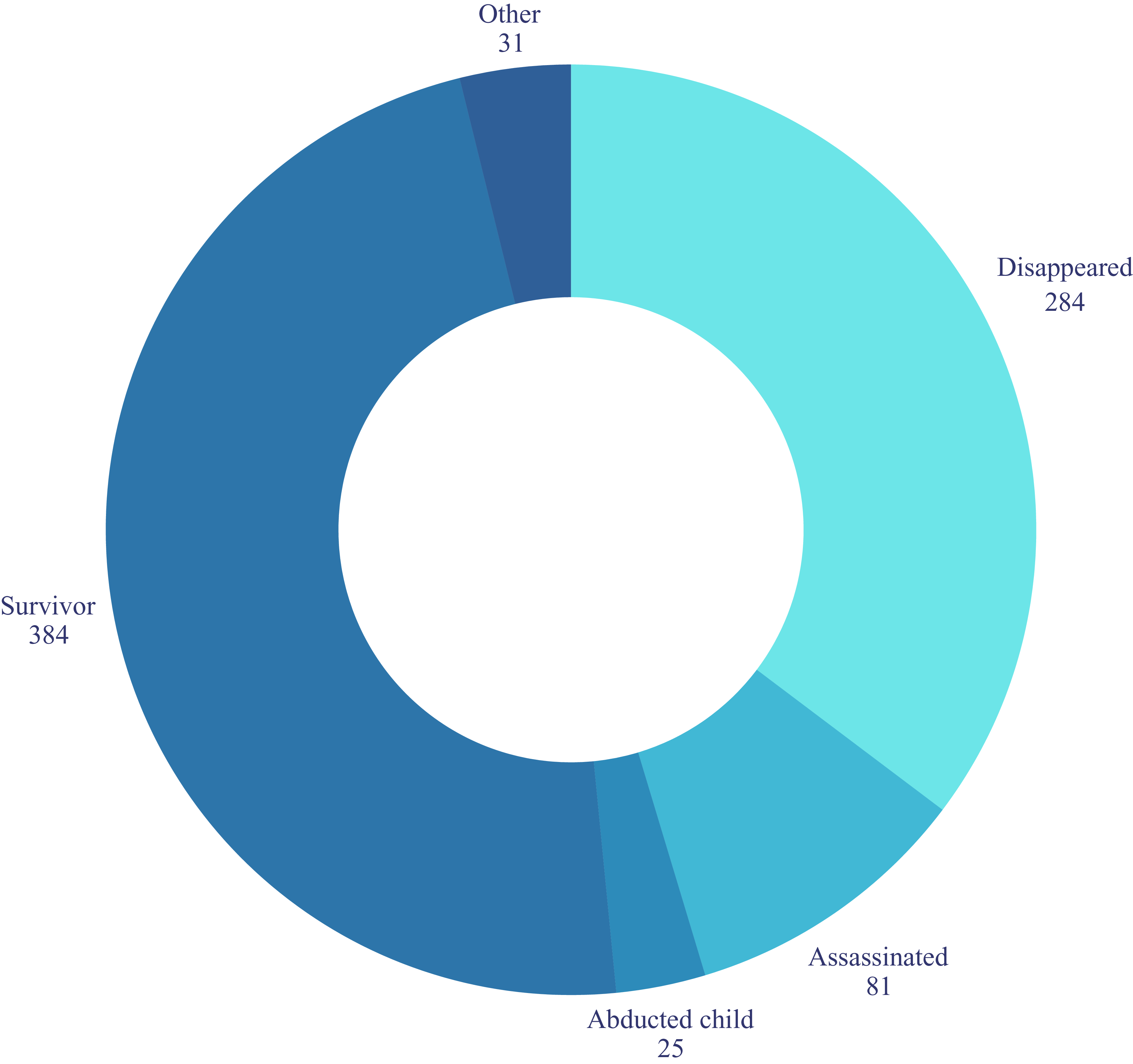
What human rights abuses did the victims endure? And how did they evolve over time? The dataset distinguishes between five categories of crimes: extrajudicial executions, disappearances, child abduction, survivors of torture and arbitrary detention, and others (a residual category comprising attempted murder, death in prison, detainees whose initial abduction was confirmed but no additional information on their fate could be found, and fugitives). There is roughly an even balance between victims of lethal and nonlethal crimes (Figure 4); there are 384 recorded cases of survivors of torture and arbitrary detention (48 percent) and 365 victims of disappearances and executions (45 percent combining the two categories). Out of the 805 victims, twenty-five were minors and newborns who were initially kidnapped with their parents and later returned to their families, or who were born during their mothers’ clandestine detention, subsequently stolen by dictatorship agents and illegally adopted; they eventually recovered their biological identities, such as the well-known case of the former Uruguayan legislator Macarena Gelman.
Victim’s status, number of cases, from the THRV database.

This finding that most victims survived transnational repression defies established traditional narratives and the focus on high-profile lethal victims of disappearance or murder by Operation Condor in the existing literature (Dinges and Landau Reference Dinges and Landau1981; Sivak Reference Sivak1997; Carrió Reference Carrió2005; Trobo Reference Trobo2005). Although certainly cases such as the assassination in Buenos Aires of former Bolivian president Torres in June 1976 are illustrative, they constitute only one aspect of Condor’s operations. The dataset demonstrates how transnational repression had a more extensive reach than previously documented regarding the victims’ activism and their profiles. Transnational repression also clearly pursued rank-and-file militants, many of whom survived after enduring the tragic ordeals of torture and clandestine imprisonment. Further, this finding is in line with a relatively novel trend in the literature and policy responses relating to the victims of South America’s dictatorships. Between the 1980s and 2000s, the focus was primarily on the victims of disappearances and executions, given the gravity of the crimes committed and, strategically, to better counter the perpetrators’ denial of those atrocities. Nonetheless, since the 2000s, victims of nonlethal atrocities, such as torture, sexual violence, and political imprisonment, have started to receive more attention, with emblematic trials on sexual violence in Argentina and Uruguay, and the investigations by the Valech I and II Commissions in Chile.
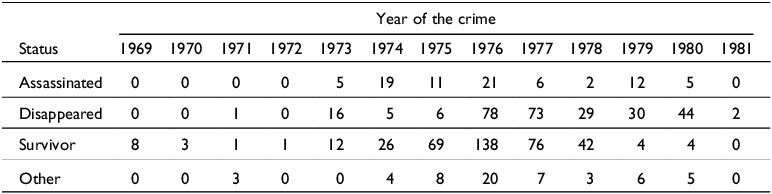
Second, on the temporal evolution, all lethal and nonlethal attacks peaked in 1976 (Figure 5 and Table 4). Examining the data further by year and category, extrajudicial executions are the most stable of all crimes between 1974 and 1979, and they also peak in 1976. The “other” category is similarly steady.Footnote 10 Conversely, patterns of disappearances are the most varied, with spikes in 1973, 1976, and 1980, and remaining relatively constant between 1976 and 1977. The persecution of the Montoneros returning exiles was especially ruthless, with 67 percent of the victims of transnational repression between early 1979 and late 1980 being disappeared. Finally, the trend for victims surviving arbitrary detentions and torture steadily grows between 1973 and 1976, when it begins to significantly decline. We discuss the significance of the apex of atrocities in 1976 in the next section.
Victim status by year of crime, 1969–1981.

Victim status by year of crime, 1969–1981

Source: THRV database.
South America’s geographies of terror
In this section, we analyze three novel findings on the geographical spaces where transnational repression occurred, namely the countries where the crimes were perpetrated, the significance of capital cities, and clandestine renditions.
First, transnational repression had a vast geographical reach, extending throughout and beyond South America. Victims were pursued in thirteen countries: in Latin America, exiled individuals were persecuted in Argentina, Bolivia, Brazil, Chile, Costa Rica, Paraguay, Peru, and Uruguay; in Europe, targets were hunted down in France, Spain, Italy, and Portugal; and there were dissidents attacked in the United States too. Nevertheless, most transnational repression operations occurred in a single country, Argentina, where 559 victims were targeted (70 percent); Uruguay follows with 137 cases (17 percent), Brazil with twenty-seven (3 percent), Chile with twenty-three (3 percent), other Latin American countries with forty-three (5 percent), and sixteen victims (2 percent) were targeted outside the continent (Figure 6).
Countries where crimes were perpetrated, number of cases, from the THRV database.

This conclusion, that Argentina was the main operational theater of transnational repression in South America, provides solid evidence to corroborate further what criminal trials conducted since the late 2000s have already pointed to. The 2016 sentence in the emblematic Argentine Condor trial asserted that, after the 1976 military coup, Argentina had been converted from a sanctuary for dissidents and exiles into “a hunting ground” in which they were cornered (“First Instance Sentence” 2016, 1225). Likewise, the Uruguayan Operation Condor survivor Sara Méndez told us during a 2013 interview that Argentina had effectively become a “death trap” for exiles.Footnote 11 Finally, declassified archival documents endorse this conclusion, too: a well-known September 1976 FBI cable, known as “Chilbom,” remarked that Argentina, Uruguay, and Chile had engaged in “joint operations, primarily in Argentina” (emphasis added).Footnote 12
Certainly, the fact that Argentina was the country where most transnational repressive operations unfolded affected both their timing and the methodology. The coup d’état in March 1976 effectively removed any remaining protections for Argentine and foreign citizens, leaving them at the mercy of their persecutors and with no nearby neighboring countries to seek safe haven in, as they were already under military rule. The peak in all transnational crimes in 1976 coincides with domestic repression dynamics in Argentina: in 1976 almost half of all disappearances (45 percent) took place in the country (CONADEP [1984] 2006, 302). Rising violence levels in the mid-1970s also match the scenario in Uruguay, where victims of disappearances similarly peaked between 1975 and 1977, and those of extrajudicial executions between 1974 and 1976 (Rico Reference Rico2008, 717, 777).
The finding on 17 percent of cases unfolding in Uruguay was unexpected. Uruguay’s active role in transnational repression, it being the country with the largest number of victims and where the second highest number of crimes were perpetrated, can be explained in three respects. First, as remarked in the “Chilbom” cable, Uruguay was one of Condor’s most enthusiastic members along with Argentina and Chile. Second, a close collaboration, which dated back to 1974, existed between the Argentine and Uruguayan armed forces, especially the navy, in national security matters (CELS 1982). Third, the dictatorship persecuted local militants in Uruguay because of and in parallel to operations being conducted in Argentina. For instance, in 1976, fifty-three Party for the Victory of the People (PVP, in its Spanish acronym) militants were abducted in Buenos Aires and fifty in Montevideo in interrelated operations.
Second, an interconnected and relevant conclusion regarding the geographies of borderless terror indicates that capital cities provided a particularly conducive environment for both political mobilization and transnational repression. In fact, eight out of ten of the initial abductions recorded in the dataset occurred in the capitals of Argentina, Uruguay, and Chile, with 60 percent of all crimes initiated in Buenos Aires, 15 percent in Montevideo, and 2 percent in Santiago. This finding reflects how Buenos Aires, in particular, had progressively become a crucial resistance hub against South American dictatorial regimes by the mid-1970s, where over one hundred thousand Brazilian, Bolivian, Chilean, Paraguayan, and Uruguayan refugees (as well as economic migrants) had settled since the 1960s and 1970s (Amnesty International 1976; Porta and Sempol Reference Porta and Sempol2006).
Finally, the dataset confirms the frequent use of clandestine renditions of targeted victims, which occurred in a quarter of the recorded cases (202), with most victims forcefully returned to origin countries. For another 148 victims, we could not determine from the available information whether they had been subject to rendition. Of the confirmed cases of clandestine renditions, ninety-five prisoners were transferred to Uruguay (47 percent), fifty-one to Argentina (25 percent), twenty-five to Paraguay (13 percent), seventeen to Chile (9 percent), and the remaining 6 percent to Brazil, Bolivia, and Peru (Figure 7). Renditions were particularly concentrated in the period between 1976 and 1978, in which 78 percent of them took place.
Transferred victims by destination country, calculated on the set of victims for whom a transfer was recorded, number of cases, from the THRV database.

All the Condor member countries participated in secret renditions of prisoners: we tracked victims being sent to Argentina, Bolivia, Brazil, Chile, Paraguay, Peru, and Uruguay. Such clandestine practices of rendition took different forms: they sometimes involved pairs of cooperating states, as in the emblematic secret flight, known as primer vuelo, through which twenty-four Uruguayan activists of the PVP were renditioned from Buenos Aires to Montevideo on July 24, 1976. In other instances, multiple countries were involved, such as the rendition on May 16, 1977, of three Argentine and two Uruguayan militants from Asunción, Paraguay’s capital, to Buenos Aires. These renditions unfolded through regular commercial or clandestine flights, by passenger ferry or small boat, and by land at border crossings. For instance, at least five Argentine victims were handed over in 1976 from Bolivian to Argentine authorities at the border towns of Villazón (Bolivia) and La Quiaca (Argentina).Footnote 13
The machinery of transnational terror
Although the dataset does not compile data on perpetrators, we believe it is necessary to briefly discuss the institutions that implemented transnational repression and use some relevant data from our dataset. As mentioned earlier, data collection on clandestine state repression systems is extremely complex, and more so when it comes to participating agents. We do, however, know that the armed and security forces (including the police) were the primary state institutions involved in transnational repression. In the dataset, we recorded the names of up to six detention sites in which victims were held during their imprisonment and compiled them into six categories, according to the ownership of each facility: military sites, police stations, prisons and regular penitentiaries, buildings belonging to other security forces, buildings belonging to civilian state agencies, and civilian private properties. This is the best approximation we have to determine which institutional actors conducted transnational repression operations. Three conclusions can be highlighted.
First, imprisonment after abduction was extremely prevalent: seven out of ten victims were taken to at least one detention site. Second, for those victims, in many cases (29 percent), the name and type of detention site could not be determined; this was expected given the aforesaid clandestine nature of imprisonment prominent in South America at the time. The analysis of positively identified detention sites reveals that, after abduction, victims were predominantly held within police premises and military units, 36 percent and 25 percent, respectively; 19 percent were taken to prisons and 15 percent to civilian private properties (Figure 8). We categorized detention sites by the institution or individual who owned each premise; however, secret prisons notably functioned inside most official police and military units. One secret torture center in a civilian private property located in Buenos Aires, known as Automotores Orletti, was closely associated with Operation Condor; 12 percent (ninety-eight) of all our recorded victims were detained there between May and November 1976.
Known detention centers by category, values expressed in percentages, from the THRV database.
Note: BB = “buildings belonging.”

Third, victims of transnational repression were imprisoned in the same secret centers that were also employed for national repression, yet victims were not allocated randomly, and some sites, such as Automotores Orletti and La Casona in Montevideo, saw a higher percentage of exiled dissidents and/or prisoners forcefully returned from abroad through clandestine renditions. Transnational repression operations therefore relied on the existing network of clandestine detention sites already established to implement state-level repression in South America.
The latter is further evidenced by the fact that the specific branches of the same institutional actors that participated in national repression were tasked with transnational repression, closely collaborating in such operations with the diplomatic corps and border agencies. These included the Department of Foreign Affairs of the Argentine Federal Police, Uruguay’s Defense Information Service, the Chilean DINA’s Exterior Brigade, Paraguay’s Military Intelligence, and Brazil’s Center of Foreign Information and the Army Information Center (“First Instance Sentence” 2016).
Although official agents from South America’s dictatorships largely conducted domestic and transnational repression operations, the role and involvement of paramilitary groups is worth summarily mentioning. As early as 1974, the Argentine Anticommunist Alliance (hereafter AAA), a right-wing parastatal death squad comprising police and military officers, but also Peronists, intelligence officers, and delinquents, participated in the persecution of foreign dissidents living in Buenos Aires, most notably in the case of the Uruguayan Antonio Viana Acosta in February 1974. Such links between state and nonstate actors endured afterward. For example, the leader of the Automotores Orletti task force was Aníbal Gordon, a criminal who had belonged to the AAA and had worked for Argentina’s State Intelligence Secretariat since 1968 (Lessa Reference Lessa2022).
Paramilitary actors were also involved in operations outside South America. The individuals responsible for the attempted murder of Leighton and his wife, Anita Fresno, in Rome in October 1975 belonged to Ordine Nuovo (New Order) and Avanguardia Nazionale (National Vanguard), two prominent factions of Italian neo-fascism active between 1969 and 1974. The DINA agent Michael Townley recruited them with the assistance of the Spanish intelligence services in 1975 (Ruggiero Reference Ruggiero2023). Remarkably, many Italian neo-fascist terrorists continued being involved in South America’s terror campaigns, collaborating with the DINA in Chile between 1977 and 1978, and aiding in the 1980 military coup in Bolivia (Ruggiero Reference Ruggiero2023). Likewise, the involvement of anti-Castro Cubans, such as Guillermo Novo and his Cuban Nationalist Movement, who participated alongside Townley in Letelier’s assassination in September 1976, has been extensively documented (Dinges Reference Dinges2005).
This brief discussion illustrates how, although Condor is a historical instance of transnational repression, delineating its key repressive practices and actors offers useful lessons for understanding contemporary dynamics, too. Indeed, contemporary literature has drawn attention to “configurations of actors,” who facilitate and help perpetrate cross-border terror, including the diplomatic corps and private actors (Glasius Reference Glasius2023, 53).
Conclusion
This article has introduced a novel dataset on a historical case of cooperation in transnational repression in South America. The THRV clearly contributes to the contemporary scholarship. Similar to the Central Asian Political Exiles Database, the THRV focuses on individual victim cases, and like Freedom House’s Transnational Repression Database, it captures episodes of direct and physical coercion (Dukalskis et al. Reference Dukalskis, Furstenberg, Gorokhovskaia, Heathershaw, Lemon and Schenkkan2022). There are, however, four distinguishing features of the THRV. First, it is the only database, as far as we are aware, that focuses on an instance of cooperative transnational repression composed of eight member countries. Second, none of the later instances of transnational repression has achieved the level of institutionalization seen in South America: Operation Condor featured dedicated institutions, such as Condortel and its operative axis Condoreje, and had a system of rotating presidencies held by member countries (see Lessa Reference Lessa2022). Third, among the eight countries involved, there was variation in their political regimes over time: whilst they were mostly autocracies, some were democracies too, during specific time periods, such as Uruguay (until 1973), Argentina (between 1973 and until early 1976), and Peru (1978–1979), whereas Brazil began a slow process of transition towards democracy in 1974. Finally, it is one of just two datasets that compile data on transnational repression before 1990, with the other one being the Latin American Transnational Surveillance dataset (Spektor et al. Reference Spektor, Fernandes, Marcos, Lucas, Victor and Sion2024); the four main datasets analyzed in Dukalskis et al. (Reference Dukalskis, Furstenberg, Gorokhovskaia, Heathershaw, Lemon and Schenkkan2022) focus on contemporary occurrences.
Examining this historical instance contributes to identifying continuities and discontinuities between past and contemporary cases of transnational repression. First, there is a remarkable similarity in the actors involved, which include military and intelligence agents but also the diplomatic corps and private actors. Second, transnational repressive practices have endured, with monitoring and surveillance alongside threats and physical coercion still dominant. Third, technology is crucial in facilitating communications and the monitoring of intended victims and targets, even more so in today’s digital age. The main discontinuity relates to ideology: although most victims in South America were left-wing activists, from political and revolutionary armed groups, and persecuted by conservative right-wing dictatorships, the variety of countries (54 as per Freedom House’s latest report on transnational repression) engaging in these practices, from China and Russia to Belarus and Iran, speaks of the heterogeneity of governments and ideologies currently in play (Gorokhovskaia and Vaughan Reference Gorokhovskaia and Vaughan2026).
Finally, the THRV data not only complements a growing body of research on transnational repression but also has attracted significant interest from practitioners and has already had a direct impact on shaping ongoing judicial proceedings. For instance, we have provided lists of victims to attorneys general’s offices in Southern Cone countries to help guide prosecutorial strategies as well as to the human rights lawyer Karinna Fernández Neira in Chile, who in late 2021 filed a writ of protection before the courts to challenge a proposal by the then presidential candidate José Antonio Kast. At the time, the Republican Party politician had included in his electoral platform a proposal to create “an international coordination” of Latin American governments to identify, detain, and prosecute radical left-wing activists (Viza Reference Viza2021). Immediately, Chilean human rights defenders and lawyers warned that such a scheme could amount to a revised Operation Condor. Moreover, the Inter-American Court of Human Rights has applied conclusions from the dataset to prove the specific persecution that Uruguayan exiles living in Argentina suffered at the hands of Operation Condor in 1976.Footnote 14
In 2026, more than fifty years since Operation Condor and forty years since democratization in Brazil and Uruguay, we hope that researchers, students, lawyers, judicial professionals, and policymakers will use this data in their continued efforts to shed light onto South America’s unprecedented horrors and fight against impunity.
Supplementary material
To view supplementary material for this article, please visit https://doi.org/10.1017/lar.2026.10133
Acknowledgments
The authors are grateful to Ezequiel González Ocantos, Giovanni Mantilla, Kirssa Cline Ryckman, and Tom Bedford. Between 2017 and 2026, the Database on South America’s Transnational Human Rights Violations has been supported by various funders, namely UCL Public Policy through Research England’s QR-PSF funding, Research England’s Higher Education Innovation Fund (HEIF) through UCL Innovation & Enterprise, the “Operation Condor” project by the European Union’s Horizon 2020 research and innovation program under the Marie Skłodowska-Curie grant agreement number 702004, and the University of Oxford’s John Fell Fund Grant No. 0006189.






 Open access

