


Reliable clinical recording of symptomatology and valid pathophysiological research require consistent use of terminology. Over time, thought insertion has developed a reliable definition (see Appendix), in contrast to a comparable first-rank symptom of schizophrenia, thought broadcast (Reference Pawar, Mullins and SpencePawar et al, 2002). However, less is known about the validity of though insertion. It is classified as a delusion, a false belief that the subject receives inserted, alien thoughts; but is thought insertion solely a delusion? This review examines the phenomenology of thought insertion and similar, possibly related phenomena and then proceeds to examine the utilisation of the concept of thought insertion by authors in a variety of literatures.
METHOD
We performed a computerised search of the following databases: PsycInfo (1887-2002), Medline (1966-2002), Biosis (1985-2002), Embase (1980-2002), Philosopher's Index (1940-2002). A total of 51 references were obtained using the key words THOUGHT INSERTION, 201 for FIRST RANK SYMPTOMS OF SCHIZOPHRENIA and a further three for THOUGHT ALIENATION. Papers describing the phenomenology of thought insertion were reviewed and data supplemented by a manual search of cited articles and books. In total, the full-text versions of 36 peer-reviewed papers and 14 books were critiqued for this review.
RESULTS
The phenomenology of thought insertion
Cultural beliefs about inserted thoughts
A belief is not regarded as delusional if it is culturally acceptable; and certain phenomena resembling thought insertion have gained cultural credence through being incorporated into occult, parapsychological and religious literatures. Frued (Reference Freud and Strachey1974) was interested in occult phenomena and described ‘thought transference’ similar to telepathy. He observed professional ‘fortune-tellers’ convincing people that they had acquired intimate knowledge of their lives through the transfer of thoughts. Freud's interpretation was that such information was conveyed at an unconscious level. However, ‘true’ telepathy continues to be a subject of popular curiosity and, were it ever authenticated, would almost certainly imply thought insertion. Similar beliefs are also contained in certain religious writings. For instance, in the Christian New Testament, Mark 13:11 describes an inspired external control, affecting thought and speech:
‘But when they shall lead you, and deliver you up, take no thought beforehand what ye shall speak, neither do ye premeditate; but whatsoever shall be given you in that hour, that speak ye: for it is not ye that speak, but the Holy Ghost.’ (Authorised King James Version)
Some contemporary authors have argued that first-rank symptoms are non-pathological in the context of spiritual experience. In their first case (‘Simon’), Jackson & Fulford (Reference Jackson and Fulford1997) describe thought insertion but discount its pathological nature because Simon appears otherwise well and is professionally successful. His experiences seem congruent with his religious beliefs. Yet, he clearly describes household appliances affecting his thinking: ‘the things that come are not the things that I have been thinking about... They kind of short circuit the brain, and bring their message’.
Thought sharing
There are, of course, natural means by which one person's thoughts can be known to another: for example, we can deduce what others think from their manifest behaviours. However, in pathological states there is a subjective breach of a perceived psychological border, conceptualised as the ‘ego-boundary’, which is described ‘concretely’ (Reference SimsSims, 1991). In some way, the victim's mind/ego seems (to him or her) to become permeable, and abnormal influence passes ‘into’ or ‘out from’ the ‘ego’ according to the symptom type. Hence, Fish (Reference Fish1967) describes the ego-boundary losing its normal integrity in schizophrenia:
‘[The] patient knows that his thoughts and actions have an excessive effect on the world around him, and he experiences activity, which is not directly related to him having a definite effect on him’.
Although most authors emphasise those symptoms in which influence encroaches upon the ego (Appendix), Stanghellini & Monti (Reference Stanghellini and Monti1993) delineate an experience of activity. Patients could believe that they can breach the ego-boundaries of others: for example, one stated that her thoughts could ‘fly’ to others, who could ‘catch’ them. Without this sense of activity or volition such an experience might resemble thought broadcast (Reference Pawar, Mullins and SpencePawar et al, 2002).
Hence, the ego-boundary can be permeable in both ‘directions’ (‘inwards’ and ‘outwards’) and specific first-rank symptoms could preferentially implicate such directional permeability. In thought insertion the permeation is inwards: another's thoughts breach the ego-boundary. In thought withdrawal and broadcast the permeation is outwards: the patients' own thoughts pass externally (Table 1).
Profiles of thought insertion and other, selected phenomena
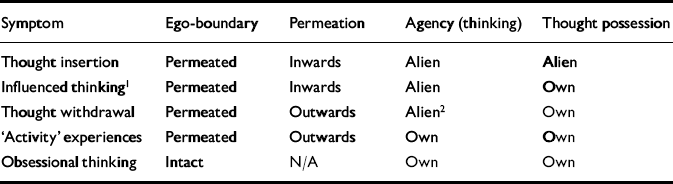
| Symptom | Ego-boundary | Permeation | Agency (thinking) | Thought possession |
|---|---|---|---|---|
| Thought insertion | Permeated | Inwards | Alien | Alien |
| Influenced thinking1 | Permeated | Inwards | Alien | Own |
| Thought withdrawl | Permeated | Outwards | Alien2 | Own |
| ‘Activity’ experiences | Permeated | Outwards | Own | Own |
| Obsessional thinking | Intact | N/A | Own | Own |
Thought insertion
The experience of thought insertion has two components:
-
(a) the ego is intruded upon;
-
(b) the ownership of the thought is alien.
A much-quoted example is provided by Mellor (Reference Mellor1970):
‘I look out of the window and I think the garden looks nice and the grass looks cool, but the thoughts of Eamonn Andrews come into my mind. There are no other thoughts there, only his...He treats my mind like a screen and flashes his thoughts on to it like you flash a picture’.
Earlier descriptions of thought insertion are found in Jaspers (Reference Jaspers, Hoenig and Hamilton1963). In one case a patient describes such thoughts as ‘com[ing] at any moment like a gift...I do not dare to impart them as if they were my own’ (Gruhle, in Reference Jaspers, Hoenig and HamiltonJaspers, 1963). Jaspers refers to these thoughts as ‘implanted, coming like an inspiration from elsewhere’ and remarks that ‘no one speaks them to the patient nor are the thoughts “made”,... the thoughts are not his own’ (italics added).
Jaspers seems to distinguish such surprising or incongruous ‘inserted/implanted’ thoughts from those that are ‘made by others’, by which he seems to mean thoughts that emerge under the perceived influence of an external agent (so-called ‘passivity thinking’; Appendix).
‘Patients think something and yet feel that someone else has thought it and in some way forced it on them. The thought arises and with it a direct awareness that it is not the patient but some external agent that thinks it. The patient does not know why he has this thought nor did he intend to have it. He does not feel master of his own thoughts and in addition he feels in the power of some incomprehensible external force’ (pp. 122-123).
Hence, the patient with passivity thinking reports: ‘Some artificial influence plays on me; the feeling suggests that somebody has attached himself to my mind and feeling...’ (Reference Jaspers, Hoenig and HamiltonJaspers, 1963: p. 123; italics added).
Jaspers' distinction between ‘implanted thoughts’ and ‘passivity thinking’ is, therefore, a subtle one. It seems to hinge upon whether the thought came spontaneously (i.e. was ‘implanted’) or emerged under the perceived influence of another (‘made’, ‘passivity’ thinking). In modern parlance, the former has been described as a narrowly defined thought insertion, whereas the latter, influenced (or ‘controlled’) thinking, has been seen as comprising a broader category, with possible diagnostic implications (Reference O'GradyO'Grady, 1990; cf. Reference Peralta and CuestaPeralta & Cuesta, 1999).
Taylor & Heiser (Reference Taylor and Heiser1971) also draw a distinction between the ownership of a thought and the process of thinking it. These authors (and Reference KoehlerKoehler, 1979) distinguish the ‘experience of influence’ (in which the process of thinking is controlled from outside) from the ‘experience of alienation’ (in which a thought belongs to another agency; i.e. is inserted). Hence, the influence/alienation distinction equates to that of passivity/implantation. In each dichotomy it is the second term that satisfies the contemporary definition of thought insertion (Appendix). Koehler is explicit that although the ‘influenced’ patient owns his or her thoughts, the thought insertion patient does not.
Other terms
As Jaspers' subtlety illustrates, there is a potential for confusion at the boundaries of the thought insertion concept, and multiple terms have been used in describing similar (non-thought insertion) phenomena: ‘influenced’, ‘made’ and ‘passivity’ thinking (Appendix). Although these three terms appear equivalent, problems arise when others are applied inconsistently. For instance, when Taylor & Heiser (Reference Taylor and Heiser1971) use the term ‘alienation’ (to indicate thought insertion), they contradict Fish's (Reference Fish1967) use of the term (to indicate ‘influenced/made’ thinking):
‘[The patient's] thoughts are under the control of an outside agency... others are participating in his thinking’ (Reference FishFish, 1967: p. 39; italics added).
Fish differentiates this form of ‘alienation’ from thought insertion, which he describes thus:
‘[The patient] knows that thoughts are being inserted into his mind, and recognises them as being foreign and coming from without’ (Reference FishFish, 1967: p. 39).
Hence, the term ‘thought alienation’ is probably best avoided, as it means different things to different authors.
Elsewhere, Schneider (Reference Schneider and Hamilton1959) uses another term, ‘thought intrusion’, when describing external influence, attributed to hypnosis by a woman with schizophrenia. Although his precise meaning is uncertain, ‘intrusion’ (in this context) appears equivalent to influence.
The act of thinking: ‘agency’
The perceived process of thinking seems to be important when making some of the above distinctions (e.g. between ‘influenced’ and ‘inserted’ thoughts). During ‘influence’ the process of thinking has been noticeably altered, whereas during ‘insertion’ it is reportedly absent; the thought ‘arrives’ de novo. Indeed, Mellor (Reference Mellor1970) states that inserted thoughts are forced upon ‘passive’ minds and Jaspers (Reference Jaspers, Hoenig and Hamilton1963) comments that ‘the patient does not oppose them in any way’. The common feature that has been stressed is a loss of volition. In this state (thought insertion), the subject is the passive recipient of alien thoughts that are the products of alien thinking.
The philosophers Stephens & Graham (Reference Stephens and Graham1994), conceptualise thought insertion as a problem of ‘agency’, which they define as ‘consist[ing] in regarding one's mental episodes or thoughts as expressions of one's own active doing: as things one does rather than things that happen to one’. Hence, they differentiate ‘influenced’ thinking from thought insertion on the basis of whether or not the alien performs the thinking. ‘The merely influenced subject believes that someone else has caused him to think the thought... In thought insertion, by contrast, the subject believes that someone else has actually done the thinking for him. He has not been manipulated into thinking something; rather his agency has been bypassed completely’ (italics added).
Hence, the concept of agency helps us to disambiguate thought insertion from influenced/made thinking (Table 1). An ‘influenced’ thought emerges when the alien ‘other’ interferes with the subject's agency but the subject owns the ensuing thought. In thought insertion the subject's own agency is absent and an alien thought is ‘inserted’. In this account, patients retain ownership of a ‘made’ thought whereas thought insertion thoughts (by definition) are experienced as ‘alien’.
Again, these distinctions are rather subtle, and may be difficult to fully elucidate clinically. Stephens & Graham's definition of ‘influenced’ thinking may go further than that of Jaspers (Reference Jaspers, Hoenig and Hamilton1963). The latter's account does not state explicitly that influenced thinking permits (self-) ownership of the ensuing thought. However, some of our own patients have made such a distinction:
‘A man said that ‘great forces’ were being used against his thinking, but that his thoughts were still his own’ (Reference Spence, Brooks and HirschSpence et al, 1997).
Thought insertion and attribution
Some subjects attribute their loss of agency to an identified other (e.g. Eamonn Andrews, above) but this is not universal. Similarly, patients describe various modes of causation. ‘Influencing machines’ were described before the first-rank symptoms were first ‘ranked’ by Schneider. ‘Air-loom machines’, reported by James Tilly Matthews (1800), were said by him to have the power ‘to make ideas or to steal others...’ (Haslam, 1810, in Reference PorterPorter, 1991: p. 146; italics added). Tausk's (Reference Tausk and Buckley1988) patient with schizophrenia described her thoughts as being produced by an ‘electrical machine’ controlled by others, at a distance. A patient of Jaspers (Reference Jaspers, Hoenig and Hamilton1963) also described the experience of electricity: ‘one evening the thought was given to me electrically that I should murder Lissi’ (original italics). Again, some of our own patients bear out this experiential quality, prompting explanations of aetiology:
‘One man said that thoughts were being put into his mind and that they “felt different” from his own; another said that the television and radio were responsible for different thoughts, which were “tampered with electrically” and always felt the same way (i.e. recognisably different from his “own”)’ (Reference Spence, Brooks and HirschSpence et al, 1997).
Diverse mechanisms are reported, including hypnotism in Schneider's case (above) and that of Reiter (Reference Reiter1926): while experiencing schizophrenia, a woman believed that ‘she was hypnotised by Professor C., who transferred his thoughts to her and made her do as he wanted’.
Beliefs regarding the mechanism through which another usurps agency have assumed little importance in modern diagnostic criteria. The significance of such additional psychopathology has not been elaborated. Does it matter whether a machine, a spirit or an agent unknown to the subject inserts a thought? According to Berrios (Reference Berrios1997), such content is of little explanatory interest; delusions are ‘empty speech acts’. However, it is conceivable that beliefs and attributions could help determine whether the subject seeks, or is brought to, psychiatric attention. If subjects experience a spiritual dimension to thought insertion, and are not behaviourally compromised, then they might seek religious or spiritual contexts (Reference Jackson and FulfordJackson & Fulford, 1997).
Is thought insertion solely a belief?
Subjects experiencing thought insertion were included in Nayani & David's (Reference Nayani and David1996) phenomenological survey of auditory hallucinations. These subjects' descriptions of their ‘alien’ thoughts varied quite widely: ‘internal hallucinators’ (i.e. those who heard voices ‘inside their heads’) described inserted thoughts in terms of bad impulses or unpleasant visual images (e.g. to maim or kill) whereas ‘external hallucinators’ described them in terms of unpleasant internal voices. Other authors have described patients whose inserted thoughts ‘feel different’ (e.g. Reference Spence, Brooks and HirschSpence et al, 1997), and in Cahill & Frith (Reference Cahill, Frith, Halligan and Marshall1996), a patient identified the exact point of entry of an inserted thought into his head. As well as being alien, the thought could be ‘felt’ to enter. Hence thought insertion might not be solely a belief: in some (if not all) patients it can incorporate abnormalities of perception. This is also implied by those authors who distinguish ‘experiences of alienation’ from ‘experiences of influence’ (Reference Taylor and HeiserTaylor & Heiser, 1971; Reference KoehlerKoehler, 1979).
The applications of thought insertion
Diagnosis
The centrality of first-rank symptoms to the diagnosis of schizophrenia, although controversial (Reference CrichtonCrichton, 1996), is apparent in the standard diagnostic manuals (e.g. ICD—10). Thought insertion, on its own, is sufficient for a diagnosis of schizophrenia to be made, if present for 1 month in the absence of an organic or mood disorder (F20, ICD—10; World Health Organization, 1992). Hence, a simple definition of thought insertion can appear to simplify practice for clinicians attempting to diagnose a complex disorder in the absence of a biologically validated pathognomonic marker. Also, first-rank symptoms can be reliably agreed upon by different examiners (e.g. Reference McGuffin, Farmer and GottesmanMcGuffin et al, 1984).
Consistent with this view, O'Grady (Reference O'Grady1990) reported that ‘narrow’ definitions of first-rank symptoms (as a group) might be more specific to schizophrenia (cf. psychotic depression). Hence, thought insertion might be more ‘schizophrenic’ than is ‘influenced’ thinking. However, relatively few patients in his sample exhibited first-rank symptoms and these symptoms were not investigated individually.
A later and larger study of people with psychoses (Reference Peralta and CuestaPeralta & Cuesta, 1999) found thought insertion and other first-rank symptoms to be distributed across psychotic diagnoses and not specific to schizophrenia; the study utilised phenomenological definitions comparable with those of Reference MellorMellor, 1970). Thought insertion was elicited in 19% of people diagnosed with schizophrenia (19.7% in Mellor's study), 7.2% of those with ‘mood disorder’ and similar percentages of those with ‘brief reactive’ (8%) and ‘atypical’ psychoses (6%). The figures for ‘made thoughts’ were 35.8, 27.7, 32 and 18%, respectively (Reference Peralta and CuestaPeralta & Cuesta, 1999). The authors concluded that first-rank symptoms are symptomatic of psychosis generally, and not schizophrenia specifically.
Explaining schizophrenia
Notwithstanding the above findings, although schizophrenia has lacked a pathognomonic biological marker, its characteristic symptoms (such as thought insertion) have been used by some to explain the syndrome. Hence, Nasrallah (Reference Nasrallah1985) proposed that thought insertion is an indicator of defective interhemispheric integration, thoughts from the right hemisphere being interpreted as ‘alien’ by the left. Crow (Reference Crow1998) has likewise focused upon first-rank symptoms, in advancing the theory that schizophrenia is the ‘price humans pay for language’. Again, deficits in hemispheric integration/asymmetry are invoked to explain first-rank symptoms. Also, Frith's (Reference Frith1992) cognitive neuropsychological account of thought insertion and other first-rank symptoms has been generalised into a model of disordered ‘internal monitoring’. Hence, inserted thoughts are experienced as such because the subject/patient is unaware of his or her own intentions (to think). Thoughts arising unbidden are therefore perceived as ‘alien’. Critique of this elegant and influential theory is beyond the scope of this paper but rehearsed extensively elsewhere (Reference CampbellCampbell, 1999; Reference SpenceSpence, 2001; Reference ThorntonThornton, 2002).
Forensic psychiatry
A diagnostic symptom detectable on a single mental state examination might be particularly useful for forensic psychiatrists having to perform assessments under difficult conditions. Thought insertion appears useful because of its perceived diagnostic significance and because it is relatively reliable. Furthermore, there have been reports of its possible utility in predicting dangerousness. Link et al (Reference Link, Andrews and Cullen1992) described the ‘threat/control-override’ syndrome after epidemiological studies (initially replicated) suggested that the difference in ‘previous violence’ between former patients and controls could be accounted for by the presence of specific symptoms, including persecutory delusions and thought insertion. Such patients reported beliefs that involved either a perceived threat to themselves or external control over their minds and actions. The strength of the association with violence increased with the number of delusions present (Reference Link, Andrews and CullenLink et al, 1992). However, subsequent prospective studies have failed to replicate this finding, and it seems as if a number of confounding variables could account for the original results: a retrospective design; reliance upon self-report of symptoms; and failure to control for anger and impulsivity (Reference Appelbaum, Robbins and MonahanAppelbaum et al, 2000).
Philosophy of mind
Understanding the nature of unusual human experience has long been common ground for psychiatry and philosophy. Recent interdisciplinary dialogue has been realised (to a degree) through the mutual investigation of thought insertion (e.g. Reference ChadwickChadwick, 1994; Reference Fulford and SimsFulford, 1995; Spence, Reference Spence1996, Reference Spence2001; Reference GibbsGibbs, 2000; Reference StephensStephens, 2000; Reference ThorntonThornton, 2002). The subjective experience of thought insertion appears to challenge a key philosophical concept: ‘immunity to subjective error’. If a subject is aware of a thought, how can she claim that the thought is not hers? Assuming intelligibility, some philosophers have begun to tackle thought insertion. Hence, to Stephens & Graham (Reference Stephens and Graham1994) a solution is the distinction between subjectivity and agency: although the subject retains awareness of her thoughts (subjectivity), she has lost the associated sense of mental causation (agency). It is noticeable how similar these formulations are to psychological models of ‘unawareness’ of voluntary processes (Reference AngyalAngyal, 1936; Reference FeinbergFeinberg, 1978; Reference FrithFrith, 1992). However, what remains unexplained is the distinction between ‘inserted’ thoughts and those everyday thoughts that come into our minds, apparently spontaneously, and to which we do not attach any paranoid interpretation (Reference SpenceSpence, 1996). Invoking a ‘normal’ model of thinking, in which thoughts are preceded by ‘intentions’ to think (Reference FrithFrith, 1992), is open to critique (see Reference CampbellCampbell, 1999; Reference SpenceSpence, 2001; Reference ThorntonThornton, 2002). Among other problems, it opens up an infinite regress: intentions to think would themselves be preceded by intentions to think, ad infinitum.
Gaps in the literature
Our review has revealed no pathophysiological studies of thought insertion per se and few that have reported findings of more than tangential relevance. One case report suggests that symptoms resembling influenced thinking can follow posterior right hemisphere lesions (Reference MesulamMesulam, 1981). A study comparing first-rank symptoms in people with idiopathic schizophrenia with those occurring secondary to temporal lobe epilepsy found no difference in the rates of thought insertion (implying that temporal lobe dysfunction might be equally relevant to both; Reference Oyebode and DavisonOyebode & Davison, 1989). A neuroimaging study of ‘made movements’ implicated the right parietal cortex but these data were not examined for associations with thought insertion, or influenced thinking, where present (Reference Spence, Brooks and HirschSpence et al, 1997). It appears that the pathophysiology of thought insertion awaits elucidation. However, there is some evidence that first-rank symptoms (including thought insertion) could be partially heritable (Reference Loftus, Crow and DeLisiLoftus et al, 2000; Reference Cardno, Sham and FarmerCardno et al, 2002).
Other noticeable absences from our review include systematic studies of the phenomenology of thought insertion and any coping mechanisms adopted by those affected. One anecdotal report describes a patient who screamed to stop thoughts entering his mind (Reference SpenceSpence, 1999).
These gaps in the literature could reflect the inherent difficulty of ‘capturing’ such phenomena and also an assumption that thought insertion is solely an abnormal belief. Our review suggests that thought insertion is still little understood. Further research could assist in understanding both its emergence in the psychotic process and those related phenomena thought to affect the ‘healthy’ mind (Reference Jackson and FulfordJackson & Fulford, 1997).
Clinical Implications and Limitations
CLINICAL IMPLICATIONS
-
▪ Thought insertion is a symptom of psychosis and not specific to schizophrenia (although it occurs in approximately a fifth of patients with schizophrenia).
-
▪ ‘Influenced’, ‘made’ and ‘passivity’ thinking are equivalent terms, describing another symptom of psychosis which is not specific to schizophrenia (although it occurs in approximately a third of patients with schizophrenia).
-
▪ The term ‘thought alienation’ means different things to different authors and might be better avoided.
LIMITATIONS
-
▪ This review was restricted to English-language publications and might have missed relevant papers in other languages (German in particular).
-
▪ Most of the distinctions described are subtle and could be variably elucidated in the clinic.
-
▪ Little is known of how patients cope with such symptoms and few studies provide clues to their pathophysiology.
APPENDIX
Definitions of thought insertion and related phenomena
Thought insertion
‘The subject believes that thoughts that are not his own have been inserted into his mind.’ (Reference AndreasenAndreasen, 1984)
The subject ‘experiences thoughts which are not his own intruding into his mind. The symptom is not that he has been caused to have unusual thoughts, but that the thoughts themselves are not his’ (Reference Wing, Cooper and SartoriusWing et al, 1983).
Same meaning applied by Fish (Reference Fish1967), Mellor (Reference Mellor1970) and Landmark (Reference Landmark1982).
Equivalent terms : ‘implanted thoughts’ (Reference Jaspers, Hoenig and HamiltonJaspers, 1963); ‘experience of alienation’ (Reference Taylor and HeiserTaylor & Heiser, 1971); ‘passive experience of alienation’ (Reference KoehlerKoehler, 1979).
Influenced thinking
The patient's ‘OWN thoughts... are being controlled or influenced by an outside force’ (Reference KoehlerKoehler, 1979; original capitals).
Same meaning applied by Landmark (Reference Landmark1982) and O'Grady (Reference O'Grady1990).
Equivalent terms: ‘made’ and ‘passivity’ thinking (Reference Jaspers, Hoenig and HamiltonJaspers, 1963); ‘thought alienation’ (Reference FishFish, 1967); ‘experience of influence’ (Reference Taylor and HeiserTaylor & Heiser, 1971); possibly ‘thought intrusion’ (Reference Schneider and HamiltonSchneider, 1959).
Experiences of activity
‘Patients... intentionally transmit their thoughts... [and] intentionally exert control on objects and events of the outside world’ (Reference Stanghellini and MontiStanghellini & Monti, 1993).



eLetters
No eLetters have been published for this article.