


INTRODUCTION
Human exposure to verocytotoxin-producing Escherichia coli O157 (VTEC O157) is a public health concern, causing significant morbidity (an estimated 0·3 cases/1000 person-years) [Reference Tam1].
VTEC O157 infection can cause a range of illness from mild diarrhoea to haemolytic uraemic syndrome (HUS) and can lead to death [2, Reference Karmali, Gannon and Sargeant3]. Those aged >60 years have the highest death rate due to VTEC O157, but children aged <5 years are most likely to develop HUS, which can be debilitating and in some cases lead to the need for kidney dialysis or transplantation [2]. Exposure can occur through contaminated food, via direct contact with infected animals, contact with a contaminated environment, or via person-to-person spread [2]. In the UK, the main animal reservoir of VTEC O157 is cattle, especially Youngstock aged <2 years, which carry the bacteria asymptomatically and shed the agent via faeces [Reference Chapman4, Reference Paiba5].
The prevalence of positive animals in England and Wales was estimated at 4·2% [95% confidence interval (CI) 2–6·4] with a within-herd prevalence of approximately 10% and herd prevalence of 38·7% [Reference Paiba5]. In Scotland, a similar distribution within herds has been found, although the prevalence of positive animals may be higher, with a large-scale study of beef cattle aged 12–30 months detecting 7·9% of cattle as positive [Reference Synge6, Reference Gunn7]. The prevalence detected in other similar countries ranges widely from 5% in Swedish herds (determined from pooled samples of five pools) to 28% in slaughtered cattle in the United States [Reference Elder8, Reference Eriksson9]. However, the variation in point prevalence estimates may be effected by temporal peaks of shedding, regional clusters or the transient shedding by cattle. Youngstock of 2–24 months [Reference Paiba5] and 2–6 months [Reference Nielsen10] have been found to have higher prevalence than adult cattle or very young calves. There appears to be no protective effect of prior exposure and environmental contamination is facilitated by the persistence of the bacteria [Reference Grauke11].
Legislation has been introduced in the European Union to prevent dirty cattle from entering slaughterhouses, with the aim of reducing transmission of VTEC O157 through meat by reducing cross-contamination from hides to meat [12]. Nevertheless, contact with cattle and other farm animals on farms remains a major source of infection in humans [Reference O'Brien, Adak and Gilham13, Reference Locking14], with outbreaks of VTEC O157 in England occurring associated with visiting farm amenities [Reference Pritchard15, Reference Ihekweazu16]. Identifying and modifying management strategies associated with faecal shedding could reduce animal exposure and transmission.
Studies in dairy and beef cattle have not identified consistent associations between management practices and faecal shedding of VTEC O157 [Reference Karmali, Gannon and Sargeant3]. Group studies have linked excretion with larger numbers of finishing cattle, the presence of pigs on the farm, a dairy unit stocking beef animals, housed cattle, increasing group size, winter feed, feeding straw and feeding maize silage to dairy herds [Reference Gunn7, Reference Herriott17–Reference Ellis-Iversen20]. A protective effect has been linked with change of diet in housed animals, dry bedding, maintaining animals in the same groups and feeding maize on dairy farms [Reference Gunn7, Reference Ellis-Iversen19–Reference Schouten21]. Studies on individual adult animals have linked excretion with feeding grain, molasses and hay and weaning, whereas access to colostrum, or remaining with the dam for >2 days reduced the risk of shedding [Reference Hovde22, Reference Rugbjerg, Nielsen and Andersen23]. Seasonal fluctuation in shedding was seen in many studies [Reference Synge6, Reference Gunn7, Reference Schouten21, Reference Berends24], but not in all [Reference Eriksson9].
To examine risk factors for VTEC O157 shedding by cattle we analysed data collected from a longitudinal study with a view to identifying control measures [Reference Smith, Paiba and Ellis-Iversen25]. The shedding of VTEC O157 by an infected animal is known to vary at different sampling occasions [Reference Karmali, Gannon and Sargeant3]. Hence this study sampled individual animals over time and collected information at the animal level to gather evidence on changes in management and the impact on VTEC O157 shedding in the individual. The study was also designed to investigate the effect of environmental contamination on the presence of VTEC O157 in individual animals.
MATERIALS AND METHODS
Farm and cohort selection
The study population was selected from those 29 farms that were E. coli O157 positive in a previous cross-sectional study of VTEC O157 in England and Wales [Reference Paiba5]. Farms that allowed access to the general public and producer-retailers were excluded from the previous study, as isolation of VTEC could create ethical and contractual barriers to continuation of the study on these premises. Herds where cattle dealing took place were also excluded, since the sample population would be subject to frequent change. Of the 29 positive herds, 12 agreed to participate in the study, whereas two farms had sold up and the remaining 15 declined participation.
Up to 90 cattle from the higher risk age group (<24 months) were randomly selected from each farm at the initial visit. Selection of animals was aided by using random number tables. Where a farm had fewer than 90 cattle aged <24 months, all were selected. At later visits, all cattle in this age group arriving on the farm (birth or purchase) were added to the cohort. The animals’ ages were verified by inspection of the farm records.
Data collection and sampling
Farms were scheduled to be sampled for 1 year at approximately monthly intervals, from March 2000. At each visit, individual rectal faeces samples were taken from each animal in the preselected cohort of youngstock. Additionally, a standardized collection of environmental samples was completed to provide an estimate of the environmental burden of infection within that group. Information on potential explanatory variables, alongside the ear-tag, cattle cleanliness and condition score and the group of each animal were recorded at the time of sampling. All sampling procedures were performed by trained veterinary staff with personal UK Home Office licenses, in compliance with relevant laws and institutional guidelines.
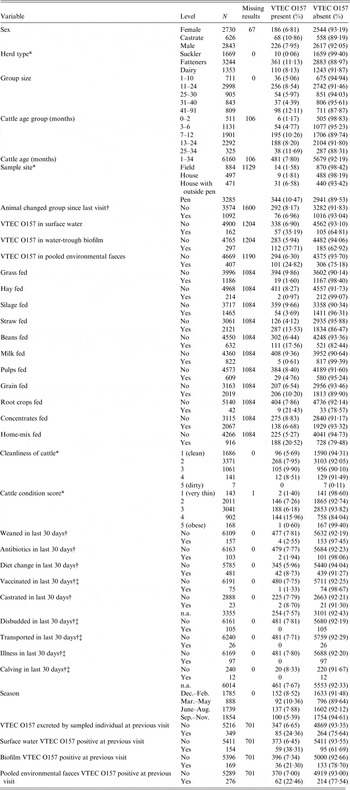
At the initial farm visit, a questionnaire was completed with the farmer on the structure and management of the farm. Throughout the study period, farm staff collected information on events that occurred on the farm using standardized recording forms (the ‘Farm Diary’). The full list of variables is given in Table 1.
Risk factor variables collected from visits to 10 cattle farms from which VTEC O157 was detected
n.a., Not applicable.
* Variable recategorized into binary categories after univariable analysis to investigate the effect of one of the levels.
† Event calculated from original data as having occurred in the last 30 days.
‡ Indicates variables unable to be included in the model due to insufficient numbers of samples in a category of analysis.
Detection of E. coli O157
Cattle sampling involved collection of at least 5 g faeces from the rectum of each animal by rectal grab with a clean glove lubricated with a small amount of obstetrical lubricant. Three environmental samples were collected from the cattle enclosures of every group of monitored cattle. These consisted of a sample of the surface of water troughs (at least 100 ml), the film of biological material at the top and the floor of the trough (biofilm), and pooled environmental faecal pats (a pooled sample of five separate fresh pats). Sterile plastic pots were used to hold the samples. These were kept in a cool box containing ice blocks until they were delivered to the laboratory on the day of collection. Those not incubated immediately were refrigerated at 4 °C until used, with all samples incubated within 72 h of collection. Rectal faecal samples and environmental samples were examined for the presence of VTEC O157, with verotoxin identification and phage-typing, using the method described by a previous study [Reference Paiba5]. After a 6-h enrichment, E. coli were separated by immunomagnetic separation (IMS) with O157-specific magnetic beads and then identified using a latex agglutination test.
The method was validated to detect VTEC O157 at concentrations between 1 and 10 colony-forming units/g faeces. The method of detecting VTEC O157 is an adaptation of a method that is around a hundredfold more sensitive than previous methods [Reference Chapman, Wright and Siddons26]. The sensitivity of the method reduced the chance of misclassification.
Data handling and analysis
Data from the questionnaire, the ‘Farm Diary’, the sampling booklets and the results of the laboratory tests were entered into a Microsoft Access database. Risk factor variables were either taken directly from the raw data or calculated to demonstrate whether there had been a change in the last 30 days or since the last visit (indicated by † in Table 1). However, information on whether there had been a change since the last visit was not always available (i.e. at the initial visit). All variables that were significant by univariable analysis were recoded as categorical variables with an additional category added to incorporate records with missing data. This was completed to retain records in the multivariable risk factor model.
Mixed-effect regression analysis was conducted using Stata IC10 (StataCorp LP, USA). Data on VTEC O157 isolation were correlated at three levels, i.e. animal, group and farm. The level of unexplained variance at the animal level was very small (0·3%), compared with farm and group (~30–40%) (L. Hoinville, unpublished data). Additionally, the findings from other research also showed that including animal as a random effect had little effect, and so group and farm were selected as the random-effect variables [Reference Robinson27]. Whether an animal was VTEC O157 positive at the previous visit was poorly correlated with its status at each visit (0·152), although a fixed-effect variable related to the previous VTEC O157 status was tested for inclusion in the regression model to determine whether this was needed to account for the correlation between consecutive samples from the same animal.
All risk factor variables were initially analysed individually for association with excretion of VTEC O157 with univariable mixed-effects logistic regression and variables with P < 0·05 were selected for multivariable mixed-effects logistic regression. The explanatory variables were also examined for collinearity, with any Pearson correlation coefficient >0·7 initiating investigation to determine which of the collinear variables had the lowest P value and largest effect on model fit, which was then retained in the model.
Age, group size, cleanliness of cattle, and cattle condition score were considered as a continuous or as a categorical variable, based on biologically plausible groups/previous published work [Reference Paiba5, Reference Gunn7, Reference Ellis-Iversen19]. Several variables where no, or very few, isolations of VTEC O157 were associated with the risk factor were recoded (indicated by * in Table 1) or had to be excluded from further analysis (indicated by ‡ in Table 1).
Forwards stepwise regression analysis was used to select variables for inclusion into the multivariable model. The age of the cattle was forced into the model as an a priori variable and retained in the final model. The initial variable was selected based on the P value of the univariable regression. As several variables showed P < 0·001, the variable selected was that with the highest likelihood. Further variables were assessed in sequence by comparing the fit of the model with and without the variable using the likelihood ratio test. The variable with the lowest P value was selected until no variables entering the model had a probability lower than 0·05.
RESULTS
Two of the original 12 farms were excluded from the analysis as no VTEC O157 was isolated from cattle during the study. A total of 6266 individual cattle samples were collected from the 1383 cattle in 139 groups on the remaining ten farms. A prevalence of 7·7% was detected (481 VTEC O157 positive samples) with 28·9% of monitored cattle providing at least one positive sample. However, the prevalence was biased by the removal of the two negative farms. The individual shedding patterns of the animals were variable and have been published elsewhere [Reference Smith, Paiba and Ellis-Iversen25]. The majority (97·9%) of the 481 isolates were VT2 positive, with 1·9% isolates VT1 and VT2 positive and a single isolate VT1 positive, whereas 59 of the 60 positive environmental isolates were all VT2 positive and a single isolate was both VT1 and VT2 positive. The most common phage types identified from the animal isolates were PT4 (34·7%), PT2 (34·2%) and PT34 (12·5%), with the same top three phage types detected in the environmental samples [two (36·7%), four (30·0%) and 34 (20·0%)]. The ten farms were distributed across eight counties in England and Wales and the farm characteristics are given in Table 2.
Farm characteristics of the initial 12 farms followed during the study
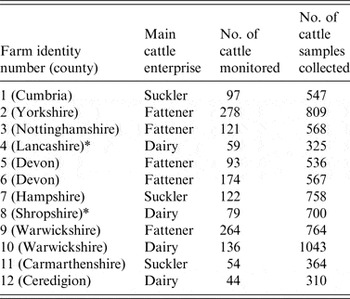
* Farm excluded from analysis due to absence of VTEC O157 positives.
Sampling was undertaken approximately monthly for 6–11 months, from March 2000 to February 2001. The study period was originally planned for 1 year, but was curtailed by an outbreak of foot and mouth disease in 2001. The cohorts on each of the 10 farms ranged between 44 and 278 animals. Not all animals were sampled at each visit due to animals leaving the study (deaths, sales, culls) and animals being added (births, purchases). Each monitored animal was sampled between one and 11 times, with most individuals sampled three times (16·3%).
Results of the univariable analysis are presented in Table 3. The univariable model could not successfully analyse a number of variables due to a small number of records or small number of positives present in some levels. Cleanliness and cattle condition score could not be analysed using all the original categories as the model would not converge. Both were recoded into a binary variable (fat cattle and dirty cattle) for the analysis. Analysis was also completed on recoded variables for sex, herd type and sample site where levels were combined to investigate the effect of a single level.
Univariable analysis results from mixed-effect regression with farm and group as the random effects [baseline (OR = 1·00) levels not shown]

OR, Odds ratio; CI, confidence interval; cf., compared with.
Significant variable results highlighted in bold. The results from levels of data created for missing values are not presented (all non-significant P < 0·05).
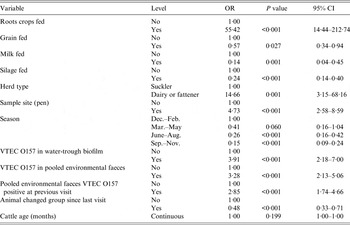
The results from the multivariable mixed-effects model are reported in Table 4. Although temporal variability of shedding by animals was shown, the date of sampling was not forced into the model. However, temporal variables accounting for the age of the animal at each sampling visit were included a priori and the season of sampling was available for selection into the multivariable model to account for these trends.
Multivariable analysis results from mixed-effect regression with farm and group as the random effects (n = 5104). The results from levels of data created for missing values are not presented (all non-significant P < 0·05)
OR, Odds ratio; CI, confidence interval.
This model demonstrated a strong positive association of VTEC O157 shedding with feeding root crops and a strong negative association with animals fed silage or milk. However, the confidence intervals for the association of feeding root crops (95% CI 14·44–212·74) and milk (95% CI 0·04–0·45) were wide. Sampling in winter (December–February) was positively associated with VTEC O157 isolation. Keeping cattle in pens was strongly associated with shedding. There was evidence of an association between keeping cattle in dairy or fattening herds and shedding, albeit the confidence intervals were wide. Changing group since the last visit protected against shedding.
Of the environmental risk factor variables, detection of VTEC O157 in pooled floor faeces within the cattle enclosure or in the biofilm of the water supply was associated with shedding in the multivariable model, as was detection of VTEC O157 in the environmental faeces at the previous visit. As these variables could also be classified as outcomes and could be correlated (although not strongly) with the other associated variables, the model was rerun without the environmental risk factor variables. The result did not impact upon the significance or direction of any of the associations. At the univariable level, the environmental risk factor variables did not have a strong correlation with the outcome (biofilm 0·25, pooled faeces 0·17, faeces at previous visit 0·15).
No strong correlations between variables in the multivariable model were detected (<0·7). Even expected correlations such as between season and sampling site (penned or at pasture) detected only correlations between −0·13 and −0·35. The correlation of the age of the cattle with the feed variables were −0·09, −0·11, 0·13 and −0·08 for roots, grain, milk and silage, respectively.
The final model was significantly associated with the outcome (Wald's χ 2 P < 0·01) and a likelihood ratio test confirmed that the model was significantly improved by the addition of the random effects in comparison to a fixed-effects model (P < 0·001).
DISCUSSION
The study presented here followed a large number of cattle over time, with >6000 individual rectal faecal samples collected using a robust sampling protocol and with a large dataset of potential risk factors collected. The study has identified a number of factors significantly associated with the detection of VTEC O157 in individual cattle.
Seasonal variation in VTEC O157 isolation was observed and there was a strongly significant difference between the higher rate of isolation during winter (December–February) and isolations during summer (June–August) and autumn (September–November). The higher frequency of shedding in the UK winter may be affected by cold and wet conditions which may affect the survival of VTEC in faecal pats, which are less likely to dry out in the winter months. Franz et al. [Reference Franz28] hypothesized that the availability of nutrients promoted other bacteria that competed with VTEC O157 and it is possible that colder environments would reduce such competition. Housing of cattle is also common in winter and the close contact of the housed cattle may improve routes for re-circulation of VTEC within a group. However, there was little correlation between season and enclosure location of the cattle. This peak in winter is at variance with previously published literature [Reference Synge6, Reference Gunn7, Reference Schouten21, Reference Berends24]. Interestingly, these studies did not examine individual animals in England and Wales and the difference between herd/group and individual isolation and local variations in farming practice make comparison difficult. A Scottish study by Ogden et al. [Reference Ogden, MacRae and Strachan29] examined faecal samples from individual animals and found higher prevalence in winter, but higher average concentrations of E. coli O157 in each sample in summer which may explain the difference in prevalence results between group and individual sampling protocols. Silage is used as a winter feed and was included in the multivariable model, which may have adjusted the outcome of the seasonal variable. It is possible that this may explain differences in seasonal peaks identified by studies that did not include silage feeding in their analysis.
A number of types of feed offered to the cattle were associated with shedding. The feeding of root crops for animals on two of the farms were associated with increased shedding, which is at variance with other studies. Schouten et al. [Reference Schouten21] studied Dutch dairy cattle in 678 herds, of which 49 were positive, and found that maize feeding was protective and that there was no effect of sugar beet pulp. The small number of samples from animals that were fed roots (42 animals) in our study resulted in wide confidence intervals and this result may be due to random chance. The infrequent occurrence of feeding roots within the study also lessens the importance of this risk factor within the cattle population. Feeding grain and silage decreased the risk of shedding; again, these results do not agree with all previous studies. Rugbjerg et al. [Reference Rugbjerg, Nielsen and Andersen23] found that feeding grain or molasses increased the risk in Danish dairy cattle and barley silage reduced the risk in calves, but found no association with feeding hay, straw, beets, silage of different types, concentrates, soya and potato powder. A large Scottish study found that farms producing their own silage had lower prevalence and noted a protective effect of changing diet, unfortunately there was no description of the other feeds examined [Reference Gunn7]. A Scottish study looking at the effect of risk factors on herd prevalence within 32 herds, found feeding grain residue from distilling as a risk factor, but did not find significant associations for hay, silage, straw, root crops, concentrates or minerals [Reference Synge6]. Feeding straw had been identified as a risk factor at the herd level [Reference Ellis-Iversen19] and a significant univariable association was found in this study, but it ceased to be significant in the multivariate model, possibly due to the few herds that used it for feeding.
This study had to group some less common feeds into a single category. Pulps included feeds as diverse as sugar beet pulp (high fibre), molasses (high energy) and soya meal (high protein) and it is plausible that some of these feeds would have different effects, so the effect of one or more of these feeds may be underreported due to misclassification.
Feeding milk was associated with reduced risk, although the mechanism for this is unknown. It may be due to interaction with an unstudied risk factor or due to less favourable gut conditions for E. coli O157 excretion due to the milk diet. Bonardi et al. [Reference Bonardi30] could not isolate VTEC O157 from calves fed milk replacer and Berends et al. [Reference Berends24] found that calf herds fed mainly milk replacer and moderate amounts of roughage had a significantly lower likelihood of being positive than calf herds fed mainly roughage with concentrates. The veal herds fed milk replacer also took longer after establishment to become positive. The protective effect of feeding milk may also have been presented by suckler herds having significantly lower risks in the model. This may be the effect of better colostrum uptake, as Rugbjerg et al. [Reference Rugbjerg, Nielsen and Andersen23] found a lower risk for calves aged 1–4 months that had suckled colostrum from the dam, or had stayed with the dam for >2 days. A New Zealand study [Reference Taylor31] of calves aged <1 week found no association with immunoglobulin levels. This could indicate that the effect of passive immunity occurs later, as the calves enter the higher risk period, or the effect of contact with the dam has another influence on calves shedding VTEC O157. Suckler herds in this study rarely purchased animals, in contrast with the fattener herds and one of the dairy herds. The purchasing of cattle has been associated with herd infection previously [Reference Nielsen10]. However, studies in England and Wales [Reference Ellis-Iversen19] and Scotland [Reference Gunn7] did not find an association. The loss of two dairy herds from the analysis, due to the absence of VTEC O157 being excreted during the study in these previously positive herds, may have biased the results and underestimated a protective effect of being a dairy herd.
Changing group since the last visit reduced the risk of VTEC O157 isolation. This was unexpected, as cattle are social animals and the stress of adjusting to new group members was considered a potential causal factor for VTEC O157 multiplication. Synge et al. [Reference Synge6] found that a change in the number of suckler cows in a group was associated with increased isolation of VTEC O157. However, Gunn et al. [Reference Gunn7] found that a change in group was protective in housed animals. This variable may have been affected by the large number of missing values (1600). Some of these missing values were present due to all of the values for this variable at the first visit being coded as missing, with the remainder due to missing information collected from the farmers at other visits.
Age has been reported as a risk factor in a number of papers [Reference Paiba5, Reference Rugbjerg, Nielsen and Andersen23] and this study found a significant association on univariable analysis for a higher risk in the 3–6 and 7–12 months age groups. However, both the categorical and continuous age variables were not significant in multivariate analysis but the variable for animal age in months was forced into the multivariable model to control for uncontrolled confounding, such as the change in feed offered to cattle as they age. In this study, no single individual feed was strongly correlated with age, although the proportion of the baseline age group that were fed milk was significantly higher than the older age groups. Weaning was not significantly associated with VTEC O157 presence in this study and this supports the findings of another British study [Reference Synge6].
The sampling of pooled environmental faeces and biofilm from the water troughs was conducted at the same time as sampling the cattle and so the association between these factors may be subject to misclassification bias. However, there was no perfect or strong correlation between cattle shedding VTEC O157 and VTEC O157 detected in the pooled environmental faeces, supporting the hypothesis that environmental VTEC O157 was not merely a consequence of cattle shedding. The association with VTEC O157 in environmental faeces at the previous visit and shedding supports the effect of environmental contamination. The identification of a similar profile of verotoxins and phage types in the cattle and the environmental isolates also highlights the link between these reservoirs. Ensuring a clean and dry environment for cattle is important for VTEC O157 control. Studies have linked wet bedding with increased risk of shedding [Reference Ellis-Iversen19, Reference Ellis-Iversen20] but found that cleaning water-troughs did not affect the risk. Hygiene measures such as using disinfectant boot dips and wearing stock coats reduced the risk in a randomized controlled trial [Reference Ellis-Iversen20], but were not found to be significant in a survey by Schouten et al. [Reference Schouten21]. The association with cattle kept in pens, or house and pens, might be due to the concentration of contamination. The potential stress caused by higher cattle density may also explain this result, but other known stressors were not associated with VTEC O157 shedding.
Most other recent studies that were considered for comparison identified the presence of VTEC O157 using methods similar to this study, based on IMS to improve sensitivity [Reference Synge6, Reference Gunn7, Reference Eriksson9, Reference Nielsen10, Reference Schouten21, Reference Rugbjerg, Nielsen and Andersen23, Reference Berends24, Reference Taylor31] and one used culture followed by PCR [Reference Kuhnert18]. However, the study design (including sampling regimen) and difference in the ages and purposes of cattle make comparison difficult.
The selection of farms from a pool of randomly selected premises may be biased, as 52% of those eligible declined to take part citing staff resources. Those farms with fewer resources, or unwilling to commit their resources, may be different in management from those that participated. However, the participant farms were not different in land size or size of cattle herd than those farms that refused to participate. Likewise, there were no significant differences identified in the number of people who lived and worked or worked only on the farms (results not presented here). There is therefore no evidence to suggest that those farms included in the study were different from those eligible to take part but not included.
Although only ten VTEC O157 positive farms were studied, they included a variety of farm types. However, as farms that had public access, or were producer-retailers were excluded from the study, it raises doubt as to whether the results can be applied to these premises where the public health risk is highest. There may be a difference between cattle premises in England and Wales and those in Scotland, as the levels of VTEC O157 reported differ, both in cattle [Reference Paiba5, Reference Gunn7] and in people [32] and so caution is required in applying these results to Scotland.
The definition of the time-frame for a risk factor to be classed as present in this study was set at a 30-day interval. Another study used 14 days [Reference Gunn7] but this was not adopted due to the practicality and cost of sampling more frequently. However, when using a 30-day interval, shedding may have ceased following exposure to a risk factor, although the previous analysis of the temporal patterns detected by this study showed that there was an average of 39 days between VTEC isolations at consecutive visits from the same animal [Reference Smith, Paiba and Ellis-Iversen25]. For this analysis, using more than a 30-day time-frame would have resulted in the exposure to a risk factor being associated with two sample results and would have complicated the analysis. No suitable data were available to resolve this, particularly as different time windows may be needed for different exposures. This potential misclassification may well have resulted in lower odds ratios and non-significant results.
The evidence generated from this study was used to target a number of interventions (including improving pen and water-trough hygiene) which were evaluated in a randomized controlled trial [Reference Ellis-Iversen20]. The cause of VTEC O157 shedding in young cattle is likely to be complex. Many risk factors, both intrinsic and extrinsic, have been associated with excretion. However, the varying protocols and risk factors studied elsewhere do not allow for a clear understanding of the process that leads to shedding. This study, which supports some of the previous findings, identified associations with herd type, housing type, season of sampling, moving animals between groups, environmental contamination and with feeding practices. The results from studies that examined variables common to those investigated in this paper and found different results suggests that there may be a complex interaction between variables. Future studies, with standardized protocols covering a wider range of risk factors, are required so that confounding and interaction can be understood. Due to the variation of shedding within individual animals, longitudinal studies would be required, with strain identification by either phage-typing or preferably whole genome sequencing, to identify persistent or new infections. Studies that included all potential carrier animals on farms, particularly dams as well as calves, would also be of interest. The sample size required will be large and collaborative studies would appear to be the most effective approach.
ACKNOWLEDGEMENTS
We thank the farmers, their families and their farm staff for participating in this study. The APHA Regional Laboratory staff are gratefully acknowledged for their assistance in both the sample and data collection and the laboratory examination of samples. Thanks are due to Dr Sarah Evans and John Wilesmith for their advice in relation to the epidemiological design of the study and protocols. Claire Cassar and Katherine Lynch are thanked for laboratory confirmation of the isolates. Drs Felicity Clifton-Hadley, Rob Davies and Ernesto Liebana, and Robin Sayers are thanked for their assistance in the study design. We are also very grateful to Charles Byrne, Chris Cole, Nicole Allum and Steven Readman for their database design, data handling and data entry. This project was funded by the Department of Environment, Food and Rural Affairs (Project OZ0138) and the article was developed from material submitted by W. J. Pollitt in part satisfaction of the degree of Master of Science from the London School of Hygiene and Tropical Medicine.
DECLARATION OF INTEREST
None.



