



INTRODUCTION
Diarrhoea causes an estimated 578 000 deaths per year in the developing world, mostly in children <5 years old [Reference Liu1]. The World Health Organization (WHO) estimates that 663 million people lack access to improved water supplies, an important factor contributing to the burden of diarrhoeal disease [2]. Because many improved water sources are contaminated, an estimated 1·8 billion people lack access to safe water [3, Reference Onda, LoBuglio and Bartram4]. For populations lacking access to improved water supplies, and those served by improved water supplies that provide contaminated water, point-of-use water treatment methods offer a means to improve drinking water quality and reduce the risk of diarrhoeal and other waterborne diseases [Reference Clasen5–Reference Fewtrell7].
In Indonesia, diarrhoeal diseases are a significant contributor to morbidity and mortality in young children [Reference Agtini8, Reference Black9]. Much of the burden of diarrhoeal illness is thought to result from poor water quality [Reference Luby10]. In communities lacking piped water systems, drinking water is often collected from springs, shallow wells, or unsafe municipal sources, which are typically contaminated by human and animal fecal waste, soil run-off and other environmental contaminants. As a result, the Indonesian government has promoted boiling at the household level for decades and boiling has become an entrenched habit. However, boiling water can be expensive [Reference Quick11, Reference Quick12], damaging to the environment [Reference Luby10, Reference Clasen13], and does not leave residual protection against recontamination, although safe storage can mitigate this risk [Reference Brick14, Reference Wright, Gundry and Conroy15]. A 2007 evaluation in Indonesia found that respondents who reported boiling were less likely to have Escherichia coli contamination of water stored in their homes compared with non-boilers, but that nearly half of stored water samples that had been boiled were contaminated [Reference Sodha16]. This finding was likely a result of unsafe water storage practices.
Point-of-use chlorination is currently promoted as an alternative to boiling in many countries in the developing world [Reference Mintz17]. It is thought to be less expensive and time intensive than boiling, and provides residual disinfection to protect against recontamination. Previous studies in several developing countries have shown that point-of-use chlorination significantly reduces the risk of reported diarrhoea [Reference Quick11, Reference Quick12, Reference Garrett18, Reference Harshfield19].
A program marketing a point-of-use chlorination product in Indonesia (brand name Air RahMat, or ‘blessed water’ in Bahasa Indonesia) was developed through a public–private partnership in 2005. Prior to commercial implementation, Air RahMat (under the generic name of chlorine) was initially used in emergency responses to natural disasters [Reference Gupta20]. Air RahMat was subsequently launched on the islands of Java, Sumatra and Sulawesi as a financially self-sustaining, everyday use product that treated 660 litres of water for approximately 5000 Indonesian rupiah (US$0·37). Beginning in 2006, Air RahMat was promoted in Tangerang (population: 1·5 million people), a suburb located on the island of Java, but uptake was modest. In March 2008, we conducted an evaluation in Tangerang to compare the use and effectiveness of Air RahMat and other water treatment methods in improving water quality and preventing diarrhoea in children <5 years old.
MATERIALS AND METHODS
Survey enrolment procedures
In order to conduct an evaluation comparing several water treatment approaches, we selected a convenience sample of four communities in Tangerang where Air RahMat sales levels were high enough to permit an assessment of the health impact of the product. We attempted to enrol all households with at least one child <5 years old, and a female head of household at least 18 years old in each of the four communities.
Enumerators fluent in Bahasa Indonesia, the local language, conducted a baseline survey and 11 subsequent weekly home visits to assess the use of Air RahMat and other water treatment methods, the impact of these methods on drinking water quality, and the occurrence of diarrhoea among children <5 years old.
Baseline survey
The baseline survey, initiated in March 2008, included information about demographic and socioeconomic characteristics, water sources, principal water storage and treatment practices, and diarrhoeal episodes (defined as ⩾3 loose or watery stools within 24 h) in children <5 years old in the preceding 7 days. We used World Health Organization definitions to categorize water sources as unimproved or improved [21]. Improved sources included household connections, public standpipes, boreholes, protected hand dug wells and springs, and rainwater catchment.
Weekly survey (March–June 2008)
Weekly household visits were unannounced, and began immediately after the baseline survey and continued through June 2008. During each week's home visit, we observed water storage practices, obtained information on reported treatment of the current day's drinking water, and reported diarrhoea in children <5 years old in the preceding 7 days. Due to resource limitations, we were unable to make direct observations of whether water removed from storage containers was touched by hands or other foreign objects.
Water sample collection
Each household's stored water was collected and tested for the presence of E. coli at baseline and at each weekly visit. Samples from each household's main water source were collected and tested for E. coli on the final visit. The Colilert®/Quanti-Tray/2000 method was used to determine most probable number (MPN) E. coli per 100 ml of water (IDEXX Laboratories, Inc., Westbrook, ME). Stored water was also tested for residual chlorine using the N, N-diethyl-phenylenediamine (DPD) colorimetric method (LaMotte, Chestertown, MD) to confirm the chlorine presence.
Statistical analysis
All data were analysed using SAS version 9·3 (Cary, NC). Household characteristics were summarized by community. The primary independent variable was water treatment, which included four methods: boiling, Air RahMat, Air RahMat plus boiling and no treatment. Households included in the ‘Air RahMat plus boiling’ category reported at home visits that they used both methods to treat their drinking water that week. Multivariable log-binomial regression models were used to assess associations between water treatment method and E. coli contamination (⩾1 MPN/100 ml), and diarrhoea prevalence in children <5 years as binary outcome variables. Boiling was set as a referent category in both analyses. Potential correlations between repeated outcome measurements per household over the 12-week period and between households within the same community were considered using the GEE (generalized estimating equation) approach with compound symmetry correlation structure in three-level hierarchical modelling. Both analyses controlled for respondent's age (in years), whether the respondent had completed primary school, household socioeconomic status (SES), and water source over the 12-week study period. Reported household assets were used to calculate wealth index quartiles as a proxy measure of SES through principal component analysis [Reference Filmer and Pritchett22]. Because of evidence that suggests an association between degree of E. coli contamination and diarrhoea risk [Reference Luby10, Reference Moe23], in the analysis of diarrhoea the level of E. coli contamination in stored water was additionally adjusted as a categorical variable (<1, 1–1000, >1000 MPN/100 ml).
Ethics
The study protocol was approved by the Institutional Review Boards of the Centers for Disease Control and Prevention (Protocol 4804), Bloomberg School of Public Health at Johns Hopkins University (CHR# H.52.06.02.03.E1), and the University of Indonesia (Protocol 01/KE/I/07). Informed consent was obtained from female heads of household at the time of the first household visit.
RESULTS
In the baseline survey, we interviewed female heads of households in 289 homes from four communities (A–D). Eight (2·8%) households were lost to follow up and excluded from analysis.
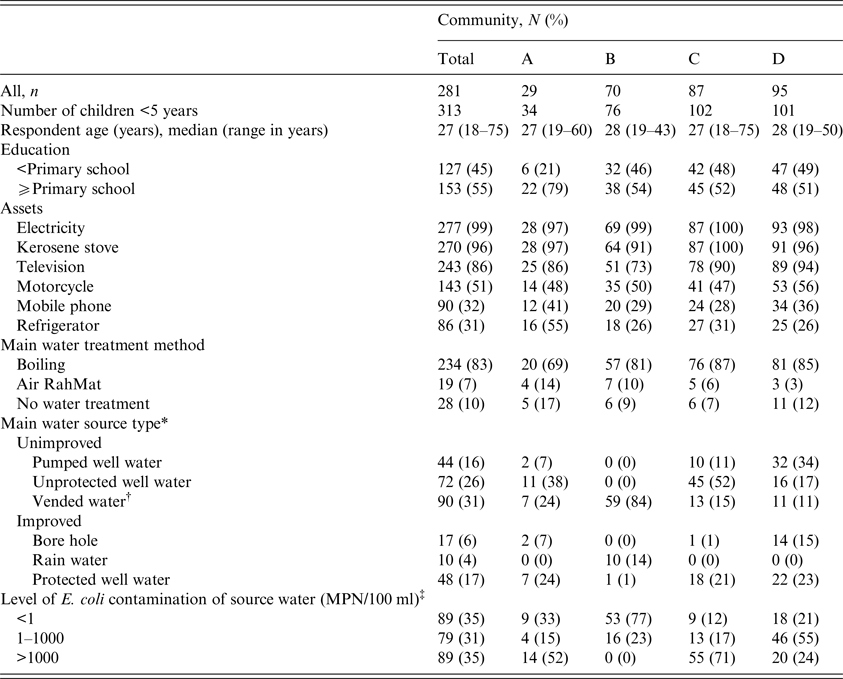
The median age of respondents in 281 households was 27 years (range 18–75 years) (Table 1). Approximately 45% of respondents had not completed a primary education. Electricity (99%), kerosene stoves (96%) and televisions (86%) were common among households; mobile phones (32%) and refrigerators (31%) were less common.
Household characteristics, water treatment method, and source water contamination reported at baseline overall and by community, Tangerang, Indonesia, March 2008
* Defined by WHO Statistical Information System.
† Refilled from a commercial vendor (e.g. door-to-door merchant, municipal tank, tanker truck, kiosk or bottled water).
‡ Not measured at baseline. Used week 12 data. N = 257.
Of 281 households, 206 (73%) reported using an unimproved water source as their main source of water at baseline. Narrow-mouthed, safe water storage containers were used by 249 (89%) of 281 households; 251 (97%) of 259 observed storage containers were covered. At baseline, the principal water treatment method reported by respondents was boiling (83%), followed by Air RahMat (7%); 10% used no water treatment method. A majority of households (93%) reported using kerosene to boil their water, which cost an average of 3493 Indonesian rupiah (US$0·26) per litre and lasted a median of 1 day (range 0·25–4 days), for a median cost per day of US$0·26. In contrast, a bottle of Air RahMat cost 5000 rupiah (US$0·37) and lasted a median of 4 weeks (range 1–25 weeks), for a median cost per day of US$0·01. Among 269 households that reported not treating drinking water with Air RahMat at baseline, the main reasons included unappealing smell (34%), not knowing enough information about Air RahMat (15%) and poor taste (14%).
Of 257 source water samples tested at baseline, 89 (35%) were heavily contaminated with E. coli (>1000 MPN/100 ml) and 89 (35%) had no detectable contamination (<1 MPN/100 ml) (Table 1).
During the 12-week study period, 3078 stored water samples were collected and tested for free chlorine residual and E. coli. Exclusive Air RahMat use was reported by respondents who provided 163 (5·3%) stored water samples, 100 (61·3%) of which had detectable free residual chlorine. Combined use of Air RahMat and boiling was reported by respondents who provided 68 stored water samples, of which 15 (22%) had detectable free chlorine residual.
Overall, 1386 (45%) of 3078 stored water samples collected during 12 weekly home visits had no detectable E. coli (Table 2). No E. coli was detected in stored water samples from 1013 (42·5%) of 2382 home visits in which boiling was reported; 98 (58·3%) of 163 home visits at which Air RahMat use was reported; 36 (52·9%) of 68 home visits in which both boiling and Air RahMat use were reported; and 234 (50·3%) of 465 visits in which water was reportedly not treated (Table 2).
Frequency of reported household water treatment method and level of E. coli contamination in household stored drinking water over 12 weekly study visits, Tangerang, Indonesia, March–June 2008

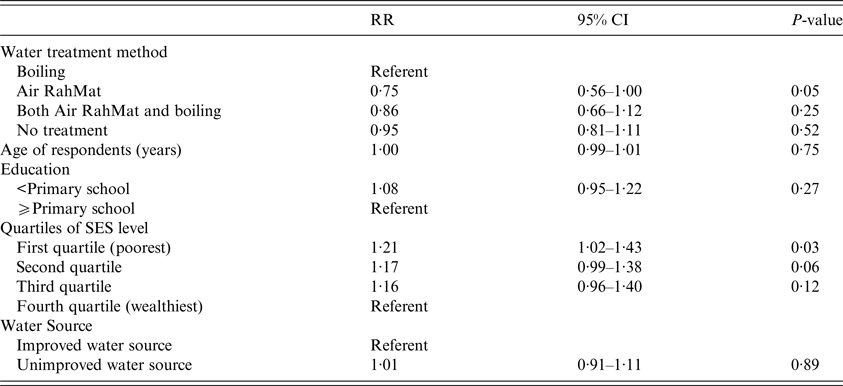
After adjusting for demographic factors, the risk of E. coli contamination in stored water was estimated to be lower for respondents reporting Air RahMat use only (risk ratio (RR) 0·75, 95% confidence interval (CI) 0·56–1·00) than for those who boiled (Table 3). There was no difference in the risk of E. coli contamination in stored water between respondents who reported using both Air RahMat and boiling for water treatment and those who only boiled. For households in the poorest quartile, the risk of E. coli contamination was estimated to be higher than for households in the wealthiest quartile (RR 1·21, 95% CI 1·02–1·43).
Adjusted risk ratios (RR) of E. coli contamination (⩾1 MPN/100 ml)* in stored household drinking water over 12 weekly household visits, Tangerang, Indonesia, March–June 2008
* Using WHO guideline value for safe drinking water.
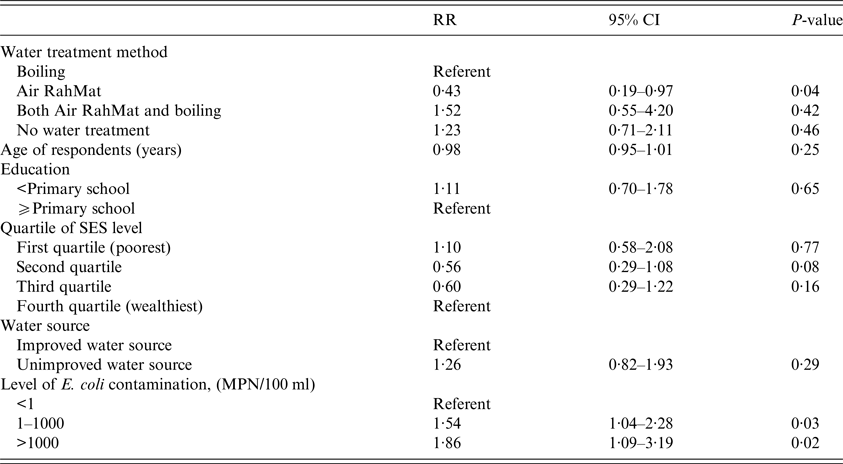
The risk of diarrhoea in children <5 years old was estimated to be lower for respondents who reported treating water with Air RahMat only (RR 0·43, 95% CI 0·19–0·97) than for those who reported boiling, adjusting for demographic factors and E. coli contamination (Table 4). Similar to the analysis of E. coli contamination, there was no difference in the risk of diarrhoea in children <5 years old between respondents who reported using both Air RahMat and boiling and those who exclusively boiled. The risk of diarrhoea in children <5 years old was significantly greater in households with an E. coli concentration of 1–1000 MPN/100 ml (RR 1·54, 95% CI 1·04–2·28) and >1000 MPN/100 ml (RR 1·86, 95% CI 1·09–3·19) in their stored water than in households with no detectable contamination.
Adjusted risk ratios (RR) of reported diarrhoea* among children <5 years old, over 12 weekly visits, Tangerang, Indonesia, March–June 2008
* Any diarrhoea in the household during the past 7 days.
DISCUSSION
Findings in this evaluation suggest that reported use of Air RahMat was inversely associated with E. coli contamination in stored water and diarrhoea in children <5 years old, compared with reported water treatment by boiling. In addition, study results suggest that diarrhoea was positively associated with E. coli contamination in stored drinking water. The effectiveness of sodium hypochlorite for water disinfection in piped systems has been common knowledge for over 100 years [Reference McGuire24], and well documented for stored water for over 25 years [Reference Wright, Gundry and Conroy15]. Similarly, the beneficial impact of chlorinated water on health has been well documented for piped water systems [Reference Cutler and Miller25] and, more recently, for stored water [Reference Clasen5, Reference Fewtrell7]. Finally, at least two previous studies have documented that diarrhoea risk increases with the degree of E. coli contamination of drinking water [Reference Luby10, Reference Moe23].
The greater effectiveness of water treatment with chlorine compared with boiling in this study was surprising, but there are several possible explanations for this observation. Although boiling is a highly effective water treatment method, insufficient heating may not kill all waterborne microbes [Reference Wright, Gundry and Conroy15, Reference Sobsey26–Reference Clasen29]. Boiled water also lacks residual protection, without which sterile water can become recontaminated following the immersion of unclean fingers, other fomites, or through storage in a dirty container [Reference Clasen and Bastable6]. The possibility of recontamination may explain why several households that reported using both Air RahMat and boiling did not exhibit lower risk of E. coli contamination in stored water or lower risk of diarrhoea compared with households that reported boiling only. If water was boiled after treatment with Air RahMat, residual chlorine and subsequent protection from recontamination would have been lost.
The question arising from this confluence of findings is why, despite the effectiveness and relative low cost of Air RahMat, its use was low (7%) in this Indonesian population. There are several possible explanations. First, the Indonesian government has heavily promoted boiling drinking water for decades, and until recently boiling was the only method of water treatment promoted at any level of the health system [Reference Sodha16]. Second, >90% of respondents in each of the four communities reported owning a kerosene stove, making boiling simple and convenient. Though our study found Air RahMat lasted longer than kerosene used for boiling and had a substantially lower cost per day, we did not account for additional necessary uses of kerosene, such as for cooking. Furthermore, many respondents reported that they believed boiling water was cheaper than Air RahMat, which is consistent with the findings of another study in Sulawesi, Indonesia, even though the majority of the respondents in that study reported using firewood as their main fuel source [Reference Sodha16]. This finding is in contrast to promotional materials used in the Air RahMat program that highlighted the lower cost of the chlorine product relative to boiling [30]. Third, survey respondents cited poor smell and taste as deterrents to using chlorine for water treatment. These findings suggest that poor product acceptability may be difficult to overcome. Similar results have been observed in other studies [Reference Gupta20, Reference Freeman31, Reference O'Reilly32]. Fourth, a high percentage of respondents (15%) reported not using Air RahMat because they did not know enough about the product. Finally, because diarrhoea prevented by drinking safe water is a non-event, some benefits of using Air RahMat may have been overlooked by the communities. This inability to observe the benefits of drinking water treated with Air RahMat may have limited adoption of the product [Reference Enger33]. The lack of observable benefits is consistent with other studies comparing point-of-use chlorination to boiling, and has been described as an important factor associated with adoption of a new technology by Rogers, in Diffusion of Innovations [Reference Rogers34]. Overcoming obstacles to adoption of new technologies may require the development of novel behavioural interventions [Reference Figueroa, Kincaid and Bartram35].
The finding that households living in the poorest SES quartile were more likely to have E. coli levels >1000 MPN/100 ml in stored water than households in the wealthiest quartile was consistent with the likelihood that households with a lower SES live in poorer environmental conditions, increasing the risk of recontamination of stored, treated water [Reference Fotso and Kuate-Defo36]. These mechanisms of recontamination have been noted in several evaluations of water quality in populations practicing boiling [Reference Clasen13, Reference Sodha16, Reference Gupta20, Reference Clasen29], where nearly half of stored water samples in households that reported boiling were contaminated with E. coli.
One method for protecting sterile water from contamination is through safe storage practices, such as the use of narrow-mouth or covered containers [Reference Quick12, Reference Roberts37]. Though most households in this study used narrow-mouthed or covered water storage containers, it is possible that hands or fomites touching the water, or a lack of container cleanliness were the means of recontamination [Reference Wright, Gundry and Conroy15, Reference Heitzinger38].
This study had several important limitations. First, due to low Air RahMat uptake, we selected a convenience sample of communities for our study that were known to be using the product. These communities may not have been representative of the Indonesian population. Second, while we were able to test for the presence of chlorine in drinking water, there was no way to confirm effective treatment among households that reported boiling. Third, high percentages of reported water treatment, particularly boiling, which we were not able to objectively confirm, might have been inflated by the desire of non-boiling respondents to please the interviewers, or by a Hawthorne effect induced by frequent home visits. Fourth, the non-blinded evaluation design with self-reported outcomes used in this study raises the possibility that participants using Air RahMat may have underreported diarrhoea in order to please interviewers and, therefore, courtesy bias could have resulted in a spurious association between water treatment and diarrhoea. This potential for biased results could have been mitigated by a double-blinded, placebo-controlled study design. The purpose of this evaluation, however, was to compare the effectiveness of different water treatment practices employed in a ‘real world’ setting rather than conduct a water treatment trial. Furthermore, conducting a blinded trial of this intervention would be challenging because of chlorine's distinct smell and taste, and the requirement that households treat their own water. To our knowledge, two previous blinded studies of the impact of chlorination on water quality and health have been conducted, and although neither found a measurable health impact, both were substantially limited in their ability to draw clear conclusions. The first, by Kirchhoff et al., had a small sample size (20 households), high drop-out, and, most importantly, was not able to effectively blind the intervention because of the strong taste of chlorine [Reference Kirchhoff39]. A second blinded study, by Jain et al., examined the health impact of sodium dichloroisocyanurate water treatment tablets, but faced challenges of unexpectedly good source water quality and the use of safe storage containers by both intervention and control groups. As a result, both study groups were able to maintain adequate stored water quality and benefitted equally from the intervention [Reference Jain40]. Fifth, we did not ask respondents about symptom-free periods in children following diarrhoea episodes, which raise the possibility that we overcounted the number of diarrhoea episodes in children for whom diarrhoea was reported in consecutive weeks. Finally, this study began at the end of the rainy season and was conducted over a relatively short time period. Therefore, it could neither assess the seasonal variability of some enteric pathogens and water treatment practices, nor the attenuation of water treatment practices over time that has been observed in some studies [Reference Arnold and Colford41]. Future research should extend the duration of data collection to more fully address these possibilities.
Results of this study suggest that households practicing water treatment with Air RahMat had lower levels of E. coli contamination in stored drinking water and of diarrhoea in children <5 years old compared with households that boiled their water. In spite of the beneficial effects of chlorination and its relatively low cost, Air RahMat use was very low in this population. Until universal access to piped, treated water can be achieved, the challenge to health authorities in reducing waterborne diarrhoeal diseases is to either improve the effectiveness of boiling and promote safer water storage, or increase demand for alternative water treatment methods with demonstrated effectiveness and acceptability to the local population.
ACKNOWLEDGEMENTS
The authors would like to thank the Johns Hopkins Center for Communication Programs and CARE International Staff in Jakarta, Indonesia. We would also like to thank the many enumerators who supervised and conducted daily field work, data collection and data entry. This work was supported by the United States Agency for International Development and the Institute for Public Health and Water Research.
DECLARATION OF INTEREST
There are no relationships or support among any of the authors that might be perceived as constituting a conflict of interest.
DISCLAIMER
The use of trade names and names of commercial sources is for identification only and does not imply endorsement by the CDC or the U.S. Department of Health and Human Services. The findings and conclusions in this report are those of the authors and do not necessarily represent the official position of the CDC.



