





1 Introduction
For each integer j and positive integer n with
$n>j$
 , let
, let

Then,
$G_j(n)$
 is a subgroup of
$(\mathbb Z/n\mathbb Z)^*$
is a subgroup of
$(\mathbb Z/n\mathbb Z)^*$
 , so that
$F_j(n)\mid \varphi (n)$
, so that
$F_j(n)\mid \varphi (n)$
 , where
$\varphi $
, where
$\varphi $
 is Euler’s function. The case
$j=1$
is Euler’s function. The case
$j=1$
 has been studied in [Reference Erdős and Pomerance3] and elsewhere. There are some results in the literature corresponding to some other values of j (see [Reference Morrow8, Reference Rotkiewicz10, Reference Weisstein11]). The case
$j=0$
has been studied in [Reference Erdős and Pomerance3] and elsewhere. There are some results in the literature corresponding to some other values of j (see [Reference Morrow8, Reference Rotkiewicz10, Reference Weisstein11]). The case
$j=0$
 is connected to results on conditions for a ring to be commutative and was mentioned to me by Lenstra. The sequence
$F_0(n)$
is connected to results on conditions for a ring to be commutative and was mentioned to me by Lenstra. The sequence
$F_0(n)$
 for
$n= 1,2,\ldots $
for
$n= 1,2,\ldots $
 is A072994 in OEIS, computed by Cloitre. Lenstra (private communication) asked about the average order of
$F_0(n)$
is A072994 in OEIS, computed by Cloitre. Lenstra (private communication) asked about the average order of
$F_0(n)$
 . In this note, we obtain some results about the average order and the normal order. We also look at the more general problem of
$F_j(n)$
. In this note, we obtain some results about the average order and the normal order. We also look at the more general problem of
$F_j(n)$
 .
.
2 The average order of
$F_0(n)$


We reserve the letter p for a prime variable. As is common, we write
$p^i\,\|\,n$
 if
$p^i\mid n$
if
$p^i\mid n$
 and
$p^{i+1}\nmid n$
and
$p^{i+1}\nmid n$
 . Let
$\mathrm {rad}(n)=\prod _{p\,|\,n}p$
. Let
$\mathrm {rad}(n)=\prod _{p\,|\,n}p$
 , the squarefree kernel of n. By the Chinese remainder theorem,

This formula is to be contrasted with

Let
$\lambda (n)$
 denote the exponent of the multiplicative group
$(\mathbb Z/n\mathbb Z)^*$
denote the exponent of the multiplicative group
$(\mathbb Z/n\mathbb Z)^*$
 . Known as Carmichael’s function, we have
$\lambda (n)$
. Known as Carmichael’s function, we have
$\lambda (n)$
 equal to the least common multiple (lcm) of the numbers
$\lambda (p^i)$
equal to the least common multiple (lcm) of the numbers
$\lambda (p^i)$
 for
$p^i\,\|\,n$
for
$p^i\,\|\,n$
 . Further, for a prime power
$p^i$
. Further, for a prime power
$p^i$
 , we have
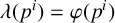
$\lambda (p^i)=\varphi (p^i)$
, we have
$\lambda (p^i)=\varphi (p^i)$
 except if
$p=2,i\ge 3$
except if
$p=2,i\ge 3$
 , and then
$\lambda (2^i)=\frac 12\varphi (2^i)=2^{i-2}$
, and then
$\lambda (2^i)=\frac 12\varphi (2^i)=2^{i-2}$
 . We will use the function

where
$\log _k$
 is the k-fold iterate of log. Note that
$L(x)=x^{o(1)}$
is the k-fold iterate of log. Note that
$L(x)=x^{o(1)}$
 as
$x\to \infty $
as
$x\to \infty $
 , but
$L(x)>(\log x)^m$
, but
$L(x)>(\log x)^m$
 for any m and x sufficiently large depending on m.
Theorem 2.1. As
$x\to \infty $
 , we have
$\sum _{n\le x}F_0(n) \le x^2/L(x)^{1+o(1)}$
, we have
$\sum _{n\le x}F_0(n) \le x^2/L(x)^{1+o(1)}$
 .
.
Proof. Let
$k=k(n)=\varphi (n)/F_0(n)$
 . We consider three cases:
-
(i) $k(n)>L(x)$
; -
(ii) $k(n)\le L(x)$
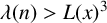
and
$\lambda (n)>L(x)^3$
; -
(iii) $k(n)\le L(x)$
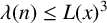
and
$\lambda (n)\le L(x)^3$
.



For
$n\le x$
 , we have
$F_0(n)=\varphi (n)/k(n)\le x/k(n)$
, we have
$F_0(n)=\varphi (n)/k(n)\le x/k(n)$
 , so that for case (i),

We now assume that
$k(n)\le L(x)$
 . Let
$u=(n,\lambda (n))$
. Let
$u=(n,\lambda (n))$
 and write
$n=uv$
and write
$n=uv$
 . We have

Thus, for
$p\mid n$
 , we have

Thus, if
$p^i\,\|\,n$
 , we have
$p^{i-1}(p-1)\mid nk$
, we have
$p^{i-1}(p-1)\mid nk$
 , which implies that
$\lambda (n)\mid nk$
, which implies that
$\lambda (n)\mid nk$
 . This then implies that

Now, consider those
$n\le x$
 in case (ii), say there are N of them. That is,

For each such n, (2.2) implies that
$(n,\lambda (n))\ge \lambda (n)/k>L(x)^2$
 . Since
$(n,\lambda (n))\le (n,\varphi (n))$
. Since
$(n,\lambda (n))\le (n,\varphi (n))$
 , we have

Now, [Reference Erdős, Luca, Pomerance, Granville and Luca1] gives

from which we deduce that
$N\le x/L(x)^{1+o(1)}$
 , so that

We now consider those
$n\le x$
 in case (iii), so that
$k\le L(x)$
in case (iii), so that
$k\le L(x)$
 and
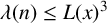
$\lambda (n)\le L(x)^3$
and
$\lambda (n)\le L(x)^3$
 . For these n, we have
$u=(n,\lambda (n))\le L(x)^3$
. For these n, we have
$u=(n,\lambda (n))\le L(x)^3$
 and from (2.2),
$\lambda (n)\mid uk$
and from (2.2),
$\lambda (n)\mid uk$
 . With
$n=uv$
. With
$n=uv$
 , we have
$v\le x/u$
, we have
$v\le x/u$
 . Further,
$\lambda (v)\mid \lambda (n)\mid uk$
. Further,
$\lambda (v)\mid \lambda (n)\mid uk$
 . For a divisor d of
$uk$
. For a divisor d of
$uk$
 , the number of integers
$v\le x/u$
, the number of integers
$v\le x/u$
 with
$\lambda (v)=d$
with
$\lambda (v)=d$
 is at most
$(x/u)/L(x/u)^{1+o(1)}$
is at most
$(x/u)/L(x/u)^{1+o(1)}$
 uniformly. Here, we have used [Reference Pomerance and Mollin9, Lemma 5.2]. Since u is small, we have
$L(x/u)=L(x)^{1+o(1)}$
uniformly. Here, we have used [Reference Pomerance and Mollin9, Lemma 5.2]. Since u is small, we have
$L(x/u)=L(x)^{1+o(1)}$
 , so that our count is bounded above by
$(x/u)/L(x)^{1+o(1)}$
, so that our count is bounded above by
$(x/u)/L(x)^{1+o(1)}$
 . This holds for each
$d\mid uk$
. This holds for each
$d\mid uk$
 , so our count in this case is at most

Now, for each n counted, we have
$F_0(n)\le x/k$
 , so the contribution of these n is at most

3 The average order of
$F_j(n)$
for
$j\ne 0,1$


It was shown in [Reference Erdős and Pomerance3] that

It is clear that we should restrict to n composite since if n is prime, we have
$F_1(n)=~n-~1$
 , so that
$\sum _{n\le x}F_1(n)\sim \frac 12x^2/\log x$
, so that
$\sum _{n\le x}F_1(n)\sim \frac 12x^2/\log x$
 as
$x\to \infty $
as
$x\to \infty $
 . We even have a name for members of
$G_1(n)$
. We even have a name for members of
$G_1(n)$
 when n is composite: these are the bases for which n is a pseudoprime.
When
$j>1$
 , there is a similar special case. For a prime
$p>j$
, there is a similar special case. For a prime
$p>j$
 , we have
$F_j(jp)$
, we have
$F_j(jp)$
 a multiple of
$p-1$
a multiple of
$p-1$
 and a divisor of
$\varphi (jp)$
and a divisor of
$\varphi (jp)$
 (see (3.2)), so
$\sum _{p\le x/j}F_j(jp)\asymp _jx^2/\log x$
(see (3.2)), so
$\sum _{p\le x/j}F_j(jp)\asymp _jx^2/\log x$
 . Hence, in this case, we only consider values of n that are not j times a prime.
Theorem 3.1. For each fixed integer
$j\ne 0,1$
 , we have

Proof. The argument is similar to the proof of (3.1). Fix an integer
$j\ne 0,1$
 . We have

As discussed in Section 1,
$G_j(n)$
 is a subgroup of
$(\mathbb Z/n\mathbb Z)^*$
is a subgroup of
$(\mathbb Z/n\mathbb Z)^*$
 ; say it has index
$k=k(n)$
; say it has index
$k=k(n)$
 , so that
$F_j(n)=\varphi (n)/k$
, so that
$F_j(n)=\varphi (n)/k$
 . We have

and so each
$p-1$
 divides
$(n-j)k$
divides
$(n-j)k$
 . Thus,

Since
$F_j(n)=\varphi (n)/k(n)< x/L(x)$
 for
$k(n)>L(x)$
for
$k(n)>L(x)$
 , we may assume that
$k\le L(x)$
, we may assume that
$k\le L(x)$
 . Now, assume that
$n\le x$
. Now, assume that
$n\le x$
 is divisible by a prime
$p>kL(x)$
is divisible by a prime
$p>kL(x)$
 . Write
$n=mp$
. Write
$n=mp$
 , where
$1\le m\le x/p$
, where
$1\le m\le x/p$
 . We have
$(mp-j)k\equiv 0\pmod {p-1}$
. We have
$(mp-j)k\equiv 0\pmod {p-1}$
 so that

Note that if
$j>0$
 , we are assuming that
$m\ne j$
, we are assuming that
$m\ne j$
 . Thus,
$m\ge j+(p-1)/(p-1,k)$
. Thus,
$m\ge j+(p-1)/(p-1,k)$
 and m is in a residue class mod
$(p-1)/(p-1,k)$
and m is in a residue class mod
$(p-1)/(p-1,k)$
 so that the number of choices for m is at most
$kx/p(p-1)+|j|k/(p-1)$
so that the number of choices for m is at most
$kx/p(p-1)+|j|k/(p-1)$
 . Summing this for
$p>kL(x)$
. Summing this for
$p>kL(x)$
 , we get
$o_j(x/L(x))$
, we get
$o_j(x/L(x))$
 for the count and, so,
$o_j(x^2/L(x))$
for the count and, so,
$o_j(x^2/L(x))$
 for the contribution to the sum in the theorem.
We now may assume that every prime factor of n is bounded above by
$kL(x)$
 and that
$x/L(x)<n\le x$
and that
$x/L(x)<n\le x$
 . Further, if the squarefull part of n is greater than y, then the number of such
$n\le x$
. Further, if the squarefull part of n is greater than y, then the number of such
$n\le x$
 is
$O(x/\sqrt {y})$
is
$O(x/\sqrt {y})$
 . We apply this with
$y=L(x)^2$
. We apply this with
$y=L(x)^2$
 and, so, we may assume that the squarefull part of n is at most
$L(x)^2$
and, so, we may assume that the squarefull part of n is at most
$L(x)^2$
 . Since
$n>x/L(x)$
. Since
$n>x/L(x)$
 is assumed, we deduce that n has a squarefree divisor d in the interval
$I:=(x/kL(x)^2,x/L(x)]$
is assumed, we deduce that n has a squarefree divisor d in the interval
$I:=(x/kL(x)^2,x/L(x)]$
 . For each squarefree integer d in I, we count those
$n\le x$
. For each squarefree integer d in I, we count those
$n\le x$
 with
$n\equiv 0\pmod d$
with
$n\equiv 0\pmod d$
 and
$(n-j)k\equiv 0\pmod {\lambda (\mathrm {rad}(d))}$
and
$(n-j)k\equiv 0\pmod {\lambda (\mathrm {rad}(d))}$
 , using (3.3). Since d is squarefree, the second congruence reduces to
$n-j\equiv 0\pmod {\lambda (d)/(\lambda (d),k)}$
, using (3.3). Since d is squarefree, the second congruence reduces to
$n-j\equiv 0\pmod {\lambda (d)/(\lambda (d),k)}$
 . If there are any solutions at all to the two congruences, we must have the greatest common divisor (gcd) of the moduli dividing j.
Then, the number of n in this case is at most
$1+(k,\lambda (d))|j|x/d\lambda (d)$
 . Letting d run over squarefree numbers in I, using [Reference Pomerance and Mollin9, Lemma 5.2] and partial summation,

Thus, the number of choices for n in this case is
$O_j(\tau (k)x/L(x)^{1+o(1)})$
 , so summing over
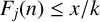
$F_j(n)\le x/k$
, so summing over
$F_j(n)\le x/k$
 , we get
$O_j(x^2/L(x)^{1+o(1)})$
, we get
$O_j(x^2/L(x)^{1+o(1)})$
 . This completes the proof.
4 Lower bounds for the average order
One may wonder how close the expression
$x^2/L(x)^{1+o(1)}$
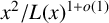 in Theorems 2.1, 3.1 and in (3.1) is to the true average orders. In [Reference Erdős and Pomerance3, Theorem 2.1], it is shown that

for all large x. The exponent
$15/23$
 depends on the existence of many primes p with
$p-1$
depends on the existence of many primes p with
$p-1$
 not divisible by a large prime, and it is discussed in [Reference Erdős and Pomerance3] how a certain natural conjecture about these primes leads to the assertion that we have equality in (3.1). For a rigorous lower bound, we have the exponent
$15/23$
not divisible by a large prime, and it is discussed in [Reference Erdős and Pomerance3] how a certain natural conjecture about these primes leads to the assertion that we have equality in (3.1). For a rigorous lower bound, we have the exponent
$15/23$
 improving to
$0.7156$
improving to
$0.7156$
 using [Reference Lichtman4, Theorem 1.1].
The same goes for
$F_0(n)$
 , namely

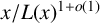
for all large x and, conjecturally, this average is equal to
$x/L(x)^{1+o(1)}$
 . See the final paragraph of [Reference Luca, Pomerance, Landman, Nathanson, Nešetřil, Nowakowski, Pomerance and Robertson6] where the distribution of those n with
$\lambda (n)\mid n$
. See the final paragraph of [Reference Luca, Pomerance, Landman, Nathanson, Nešetřil, Nowakowski, Pomerance and Robertson6] where the distribution of those n with
$\lambda (n)\mid n$
 is discussed. Note that
$\lambda (n)\mid n$
is discussed. Note that
$\lambda (n)\mid n$
 if and only if
$F_0(n)=\varphi (n)$
if and only if
$F_0(n)=\varphi (n)$
 .
.
For fixed
$j\ne 0,1$
 , we have the same lower bound estimates for

To see this, one merely replaces the number 1 in [Reference Erdős and Pomerance3, (2.6)] with j.
5 The normal order
For each positive integer n, let

where
$\Lambda $
 is the von Mangoldt function. We have the following theorem.
Theorem 5.1. For each integer j, there is a set
$S_j\subset \mathbb N$
 of asymptotic density
$1$
of asymptotic density
$1$
 such that

for
$n\in S_j$
 and
$n\to \infty $
and
$n\to \infty $
 .
.
This theorem for
$j=1$
 is [Reference Erdős and Pomerance3, Theorem 4.1]. To generalise to
$j\ne 1$
is [Reference Erdős and Pomerance3, Theorem 4.1]. To generalise to
$j\ne 1$
 , one need only check that we have
$\log (n/\mathrm {rad}(n))/\log \log n =o(1)$
, one need only check that we have
$\log (n/\mathrm {rad}(n))/\log \log n =o(1)$
 as
$n\to \infty $
as
$n\to \infty $
 in a set of asymptotic density 1.
As in [Reference Erdős and Pomerance3], we have the corollary that for each j,
$F_j(n)\le (\log x)^{\psi (x)}$
 for all but
$o(x)$
for all but
$o(x)$
 integers
$n\le x$
integers
$n\le x$
 , where
$\psi (x)\uparrow \infty $
, where
$\psi (x)\uparrow \infty $
 arbitrarily slowly. In fact, from the Erdős–Wintner theorem, for each positive real number u, the asymptotic density
$D_j(u)$
arbitrarily slowly. In fact, from the Erdős–Wintner theorem, for each positive real number u, the asymptotic density
$D_j(u)$
 of the set of n with
$F_j(n)\le (\log n)^u$
of the set of n with
$F_j(n)\le (\log n)^u$
 exists, with
$D_j(u)$
exists, with
$D_j(u)$
 continuous, strictly increasing, tending to 0 as
$u\downarrow 0$
continuous, strictly increasing, tending to 0 as
$u\downarrow 0$
 and tending to 1 as
$u\uparrow \infty $
and tending to 1 as
$u\uparrow \infty $
 .
.
6 The number of subgroups
For a finite abelian group
$\mathcal G$
 , written multiplicatively, and m a positive integer, the sets

are subgroups of
$\mathcal G$
 ; call them power kernels. Let
$\lambda (\mathcal G)$
; call them power kernels. Let
$\lambda (\mathcal G)$
 be the exponent of
$\mathcal G$
be the exponent of
$\mathcal G$
 . It is easy to see that

so that
$\mathcal G_m=\mathcal G_d$
 , where
$d={(m,\lambda (\mathcal G))}$
, where
$d={(m,\lambda (\mathcal G))}$
 . Applying this to the groups
$G_j(n)$
. Applying this to the groups
$G_j(n)$
 , we have the following result, where
$\tau $
, we have the following result, where
$\tau $
 is the divisor function.
Theorem 6.1. For a positive integer n, let
$\mathcal G=(\mathbb Z/n\mathbb Z)^*$
 , with power kernels
$\mathcal G_d$
, with power kernels
$\mathcal G_d$
 for
$d\mid \lambda (n)$
for
$d\mid \lambda (n)$
 . For j an integer with
$j<n$
. For j an integer with
$j<n$
 , we have
$G_j(n)=\mathcal G_d$
, we have
$G_j(n)=\mathcal G_d$
 , where
$d=(\lambda (n),n-j)$
, where
$d=(\lambda (n),n-j)$
 . In particular, there are exactly
$\tau (\lambda (n))$
. In particular, there are exactly
$\tau (\lambda (n))$
 different subgroups of the form
$G_j(n)$
different subgroups of the form
$G_j(n)$
 for each positive integer n.
It is possible to consider the count
$\tau (\lambda (n))$
 statistically. Its logarithm has the normal order
$\tfrac 12\log 2 (\log \log n)^2$
statistically. Its logarithm has the normal order
$\tfrac 12\log 2 (\log \log n)^2$
 and there is a Gaussian distribution (see [Reference Erdős and Pomerance2]). One may also consider the total number of nonisomorphic subgroups of
$(\mathbb Z/n\mathbb Z)^*$
and there is a Gaussian distribution (see [Reference Erdős and Pomerance2]). One may also consider the total number of nonisomorphic subgroups of
$(\mathbb Z/n\mathbb Z)^*$
 . This was considered in [Reference Martin and Troupe7] and the result is similar to what we have for
$\tau (\lambda (n))$
. This was considered in [Reference Martin and Troupe7] and the result is similar to what we have for
$\tau (\lambda (n))$
 in [Reference Erdős and Pomerance2]. (The paper [Reference Martin and Troupe7] also considered the larger statistic, where one counts subsets that are subgroups.) One can also consider
$\tau (\lambda (n))$
in [Reference Erdős and Pomerance2]. (The paper [Reference Martin and Troupe7] also considered the larger statistic, where one counts subsets that are subgroups.) One can also consider
$\tau (\lambda (n))$
 on average; for this see [Reference Luca and Pomerance5].
Acknowledgements
I thank Hendrik Lenstra for introducing me to the function
$F_0(n)$
 and his queries about it. I also thank Florian Luca, Greg Martin and Paul Pollack for timely help and for reminding me of some of the literature. I am grateful to the referee for a careful reading and some helpful suggestions.



 Open access

