


Life expectancy at birth and at 65 years of age in the European Union (EU) population has risen greatly, suggesting not only that greater numbers of individuals are reaching old age but also that elderly people are themselves living longer. But the quality of these extra years is still in question. To address this, in 2004 the European Commission introduced a new structural indicator, healthy life-years (HLY), which is a disability-free life expectancy. Subsequent work demonstrated larger inequalities in HLY at age 50 than in life expectancy mostly between Western and Eastern European countries, although inequalities exist within Western Europe. Reference Jagger, Gillies, Moscone, Cambois, Van and Nusselder1 The introduction of the HLY indicator raised the importance of health expectancies for monitoring the impact of population ageing, specifically addressing the fundamental question of whether the increases in life expectancy are accompanied by better or poorer health. Although health expectancies, including trends over time, are available for over 50 countries Reference Robine, Romieu and Cambois2 the focus has remained on disability-free life expectancy or healthy life expectancy based on self-perceived health, despite the known burden of mental disorders. Reference Murray and Lopez3 The few studies that have estimated mental health expectancies have generally been confined to life expectancies free of dementia Reference Ritchie, Robine, Letenneur and Dartigues4-Reference Perenboom, Boshuizen, Breteler, Ott and Van de Water7 or cognitive impairment, Reference Sauvaget, Jagger and Arthur8,Reference Matthews, Miller, Brayne and Jagger9 thereby focusing on older rather than younger ages.
Cross-national comparisons of disability-free life expectancy are hampered by the lack of harmonisation of the underlying measures. Comparability issues are perhaps slightly less problematic for mental health expectancies since there have been initiatives such as the European Study of the Epidemiology of Mental Disorders (ESEMeD, a cross-national epidemiological survey of adults in Belgium, France, Germany, Italy, The Netherlands and Spain (2001–2003; n = 21 425)), Reference Alonso, Angermeyer, Bernert, Bruffaerts, Brugha and Bryson10 aimed at producing harmonised measures across Europe. Furthermore, mental disorders are strongly associated with physical morbidity and disability cross-nationally. Reference Scott, Von, Alonso, Angermeyer, Bromet and Fayyad11 In order to address the deficit of comparable mental health expectancies in Europe, particularly at younger ages, we compare mental health expectancies in young adulthood (age 25 years) and middle age (age 55 years) between the six European countries involved in the ESEMeD project.
Method
Mental health expectancies were calculated using the Sullivan method by applying the age-specific prevalence of selected mental disorders to population life tables by country. Reference Sullivan12
Procedures for obtaining informed consent and protecting human participants were approved and monitored for adherence by the institutional review boards of organisations coordinating surveys in each country based on a template developed by the World Mental Health Data Collection Coordinating Centre. A complete list of the participating institutional review boards, type of consent obtained, procedures for documenting consent and incentives offered for participation is available at: www.hcp.med.harvard.edu/wmh/ftpdir/nationalsample_Ethics_statement.pdf.
Prevalence of mental disorders
For the prevalence of mental disorders we used ESEMeD data, a cross-sectional face-to-face household interview survey based on probability samples representative of the adult population of the same six European countries, Reference Alonso, Angermeyer, Bernert, Bruffaerts, Brugha and Bryson10 which is part of the World Health Organization (WHO) World Mental Health Surveys. Reference Demyttenaere, Bruffaerts, Posada-Villa, Gasquet, Kovess and Lepine13 The target population was individuals aged 18 years or older residing in private households. Individuals living in institutions, as well as those not able to understand the language in which they were being assessed, were excluded. A stratified multistage random sample without replacement was drawn in each country. Further details of the multistage sample have been published previously. Reference Alonso, Angermeyer, Bernert, Bruffaerts, Brugha and Bryson10 The total number of participants providing diagnostic and sociodemographic data was 21 425.
Data on the prevalence of mental disorders were collected in the first stage of the study from version 3.0 of the Composite International Diagnostic Interview (CIDI 3.0), Reference Kessler and Ustun14 a comprehensive, fully structured diagnostic interview for the assessment of mental disorders, administered by trained lay interviewers in the respondent's home. The CIDI 3.0 includes fully structured questions on the presence, persistence and intensity of clusters of psychiatric symptoms followed by probes for age at onset and lifetime course, which provides, by means of computerised algorithms, lifetime and current (12-month and 1-month prior to the interview) diagnoses according to the ICD-10 15 and the DSM-IV. 16 Appropriate organic exclusion criteria were taken into account in the evaluation of the diagnoses. The computerised diagnostic algorithms were calibrated against clinician-administered reappraisal assessments in ESEMeD, pooled with data collected in the USA using the same interview methods. Reference Haro, Arbabzadeh-Bouchez, Brugha, de Girolamo and Jin17 Translation, data-quality control and handling procedures are described elsewhere. Reference Alonso, Angermeyer, Bernert, Bruffaerts, Brugha and Bryson10,Reference Harkness, Pennell, Villlar, Gebler, Aquilar-Gaxiola, Bilgen, Kessler and Ustun18 Here we focus on a subset of the most common and disabling mental disorders only: major depression, dysthymia and generalised anxiety disorder. In addition to studying these separately, we also defined common mental disorder as the presence of any of these disorders. Prevalences were estimated for 1-month mental disorder and were weighted for sample design and non-response, in order to represent the adult population of each country.
Life tables
Population and death data by single year of age for men and women separately for each of the six countries (Belgium, France, Germany, Italy, The Netherlands and Spain) corresponding to the study period (2001–2003) were obtained from the European Health Expectancy Monitoring Unit (EHEMU) Information System (www.ehemu.eu). From these we calculated full life tables, closed at age 85 years and over. Reference Jagger19 A combined life table for 2002 for the six countries was calculated by combining death and population counts and then employing the same methods as before. We abridged the life tables (at ages 18, 25, 35, 45, 55, 65, 75).
Statistical methods
Sullivan's method was used to combine the age and gender-specific prevalence of each mental disorder and the life tables by country. This method takes the total years lived in an age group from the life table and applies to it the prevalence of the disorder (in that age group) to produce the years lived with the disorder. The calculation of life expectancy with the disorder then proceeds as for life expectancy. Thus, life expectancy with the disorder at the start of the age group, say age x, is the total number of years with the disorder accumulated from age x divided by the number of survivors at age x. Reference Sullivan12 Life expectancy with the disorder (for example life expectancy with common mental disorders) at age x is analogous to life expectancy at age x and should be viewed as an average value for a population rather than the actual experience of an individual. Life expectancy free of the disorder is formed from the total life expectancy at a particular age minus the life expectancy with the disorder (for example years spent with common mental disorders). Confidence intervals for estimates of life expectancy with and without the disorder were calculated assuming negligible variation in mortality rates since the sample size of the survey (producing the prevalences) was small compared with the total country populations on which the mortality data (life tables) were based. Reference Newman20 Since the prevalence data omitted those in institutions, applying Sullivan's method assumes the prevalence of mental health conditions in community and institutional settings is the same. However, the impact of this in early and midlife, at ages 25 and 55, on which this paper focuses, is likely to be negligible.
Results
The overall response rate for the six countries was 61.2%, with the highest rates in Spain (78.6%) and Italy (71.3%) and the lowest in France (45.9%) and Belgium (50.6%). As context for the analyses of mental health expectancy in 2001, first we reviewed the life expectancy at birth for men and women for the six ESEMeD countries between 1995 and 2008. In general men's life expectancy at birth was increasing more consistently than women's and at a faster rate (average increase between 1998 and 2008: men 3.9 years; women 2.5 years). In 2001, at birth, the gap between the countries with the highest and lowest life expectancy was 2.1 years for men and 2.4 years for women. As mental health expectancies combine life expectancy and the prevalence of the disorder we also present the standardised prevalence of each disorder for each country (standardised to the European standard population) (online Table DS1).
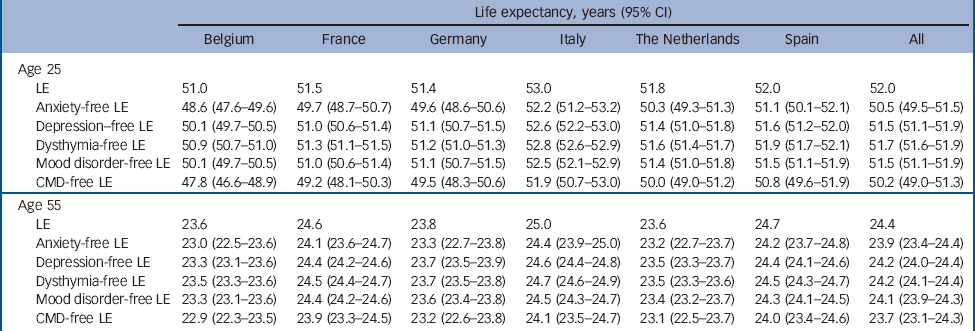
The between-country variation in total life expectancy at age 25 and 55 was greater for the female population than the male (Fig. 1). For both male and female populations the six countries were least similar for life expectancy free of anxiety (generalised anxiety disorder) and life expectancy free of common mental disorders at age 25 than for total life expectancy or life expectancy free of other mental disorders: dysthymia, depression or mood disorder. By age 55 the same pattern held for the female population but for the male population countries were similar on all measures. Tables 1 and 2 show full results for ages 25 and 55 for males and females respectively.
With regard to our overall measure of mental health, life expectancy with common mental disorders for the male population aged 25 (all countries combined) was 1.8 years (95% CI 0.7–2.9), 3.4% of total life expectancy, compared with 5.1 years (95% CI 3.6–6.6), 8.8% of total life expectancy, for the female population. By age 55 life expectancy with common mental disorders had reduced both in absolute terms and as a proportion of total life expectancy, for the male population to 0.7 years (95% CI 0.1–1.3) or 2.7% of total life expectancy and for the female population 2.3 years (95% CI 1.0–3.6) or 7.9% of total life expectancy (Figs 2 and 3).
Figure 4 provides a clearer picture of the variation in both absolute years and the proportion of remaining years spent with common mental disorders for all countries combined. The gender difference in life expectancy free of common mental disorders is 1.2 years at age 18, rising to 2.8 years at age 55, whereas the gender difference in life expectancy with common mental disorders is largest at age 18 and decreases thereafter. Thus, more of the gender difference in overall life expectancy is accounted for by women's extra years with common mental disorders at younger ages, whereas by age 55 the balance is reversed and the gender difference in years free of common mental disorders outweigh those with common mental disorders. Life expectancy with common mental disorders as a proportion of total life expectancy varies little even up to age 55.
Country variation in total life expectancy and life expectancies free of each mental disorder for (a) men and (b) women at age 25 and (c) men and (d) women at age 55.
LE, life expectancy; CMD, common mental disorders.

Discussion
Main findings
This report presents the first cross-national comparisons of the burden of mental disorders as expressed by life expectancy spent with common mental disorder. As for disability, the female population spends more absolute years with common mental disorders (and each disorder individually) and a greater proportion of total life expectancy with such disorders. Indeed, when all countries were combined, both the number and proportion of life expectancy with common mental disorders at age 25 were more than double those for the male population (5.1 (8.7%) v. 1.8 (3.4%) years), which corresponds to the higher prevalence of common mental disorders widely reported in women. Reference Fryers, Brugha, Morgan, Smith, Hill and Carta21 This confirms the findings of Gispert et al Reference Gispert, Ritchie, Rajmil, Rue, Glutting and Roset22 who report that life expectancy and mental health expectancies (based on the 12-item version of the General Health Questionnaire) at all ages were higher for women than for men, in north-east Spain. We found, however, that gender differences in life expectancy with common mental disorders accounted for more of the gender differences in life expectancy at younger than older ages, suggesting that, at younger ages, women's longer life expectancy is offset by an equivalent number of years spent with common mental disorders.
At younger ages we found Western European countries to be less similar on their values of life expectancy free of anxiety and free of common mental disorders than they were on life expectancy overall or with other disorders. This variability accords with the considerable differences across countries in the prevalence rates for mood disorders already reported from ESEMeD comparing these six countries. Reference Bromet, Andrade, Hwang, Sampson, Alonso and de Girolamo23 Moreover, the variability in the proportion of remaining life spent with common mental disorders was much greater in the female population (range: 7.2–13.4%, all countries combined: 8.8%) than in the male population (range: 2.2–6.4%, all countries combined: 3.4%). Also, we found that the proportion of life spent with common mental disorders declined little at older ages. Melzer and colleagues Reference Melzer, Buxton and Villamil24 reported that prevalence rates of common mental disorders in women peaked at age 50 and declined thereafter, but the same decline was not seen until a decade later in men, leading to a suggested link with planned retirement, which may occur earlier in some European countries.
Limitations
Some care is needed in drawing conclusions on the relative burden of mental disorders in different European countries from these analyses. First, the ESEMeD studies included only community-dwelling inhabitants, omitting those in institutional care.
Life expectancy (LE) for males by country, type of mental disorder at age 25 and age 55
| Life expectancy, years (95% CI) | |||||||
|---|---|---|---|---|---|---|---|
| Belgium | France | Germany | Italy | The Netherlands | Spain | All | |
| Age 25 | |||||||
| LE | 51.0 | 51.5 | 51.4 | 53.0 | 51.8 | 52.0 | 52.0 |
| Anxiety-free LE | 48.6 (47.6–49.6) | 49.7 (48.7–50.7) | 49.6 (48.6–50.6) | 52.2 (51.2–53.2) | 50.3 (49.3–51.3) | 51.1 (50.1–52.1) | 50.5 (49.5–51.5) |
| Depression–free LE | 50.1 (49.7–50.5) | 51.0 (50.6–51.4) | 51.1 (50.7–51.5) | 52.6 (52.2–53.0) | 51.4 (51.0–51.8) | 51.6 (51.2–52.0) | 51.5 (51.1–51.9) |
| Dysthymia-free LE | 50.9 (50.7–51.0) | 51.3 (51.1–51.5) | 51.2 (51.0–51.3) | 52.8 (52.6–52.9) | 51.6 (51.4–51.7) | 51.9 (51.7–52.1) | 51.7 (51.6–51.9) |
| Mood disorder-free LE | 50.1 (49.7–50.5) | 51.0 (50.6–51.4) | 51.1 (50.7–51.5) | 52.5 (52.1–52.9) | 51.4 (51.0–51.8) | 51.5 (51.1–51.9) | 51.5 (51.1–51.9) |
| CMD-free LE | 47.8 (46.6–48.9) | 49.2 (48.1–50.3) | 49.5 (48.3–50.6) | 51.9 (50.7–53.0) | 50.0 (49.0–51.2) | 50.8 (49.6–51.9) | 50.2 (49.0–51.3) |
| Age 55 | |||||||
| LE | 23.6 | 24.6 | 23.8 | 25.0 | 23.6 | 24.7 | 24.4 |
| Anxiety-free LE | 23.0 (22.5–23.6) | 24.1 (23.6–24.7) | 23.3 (22.7–23.8) | 24.4 (23.9–25.0) | 23.2 (22.7–23.7) | 24.2 (23.7–24.8) | 23.9 (23.4–24.4) |
| Depression-free LE | 23.3 (23.1–23.6) | 24.4 (24.2–24.6) | 23.7 (23.5–23.9) | 24.6 (24.4–24.8) | 23.5 (23.3–23.7) | 24.4 (24.1–24.6) | 24.2 (24.0–24.4) |
| Dysthymia-free LE | 23.5 (23.3–23.6) | 24.5 (24.4–24.7) | 23.7 (23.5–23.8) | 24.7 (24.6–24.9) | 23.5 (23.3–23.6) | 24.5 (24.3–24.7) | 24.2 (24.1–24.4) |
| Mood disorder-free LE | 23.3 (23.1–23.6) | 24.4 (24.2–24.6) | 23.6 (23.4–23.8) | 24.5 (24.3–24.7) | 23.4 (23.2–23.7) | 24.3 (24.1–24.5) | 24.1 (23.9–24.3) |
| CMD-free LE | 22.9 (22.3–23.5) | 23.9 (23.3–24.5) | 23.2 (22.6–23.8) | 24.1 (23.5–24.7) | 23.1 (22.5–23.7) | 24.0 (23.4–24.6) | 23.7 (23.1–24.3) |
CMD, common mental disorder.
Life expectancy (LE) for females by country, type of mental disorder at age 25 and age 55 and 95% confidence intervals

| Life expectancy, years (95% CI) | |||||||
|---|---|---|---|---|---|---|---|
| Belgium | France | Germany | Italy | The Netherlands | Spain | All | |
| Age 25 | |||||||
| LE | 56.8 | 58.6 | 57.0 | 58.7 | 56.4 | 58.7 | 57.9 |
| Anxiety-free LE | 53.4 (52.1–54.7) | 51.5 (50.0–52.9) | 53.3 (52.0–54.6) | 54.7 (53.3–56.1) | 52.1 (50.8–53.4) | 55.6 (54.2–57.0) | 53.5 (52.1–54.9) |
| Depression-free LE | 55.6 (55.1–56.1) | 57.9 (57.4–58.4) | 56.2 (55.7–56.7) | 57.5 (57.0–58.0) | 55.0 (54.5–55.5) | 57.2 (56.7–57.7) | 56.9 (56.4–57.4) |
| Dysthymia-free LE | 56.3 (56.0–56.7) | 58.1 (57.7–58.4) | 56.9 (56.5–57.2) | 58.2 (57.9–58.5) | 55.8 (55.5–56.1) | 57.8 (57.5–58.2) | 57.4 (57.1–57.8) |
| Mood disorder-free LE | 55.5 (55.0–56.0) | 57.5 (57.0–58.0) | 56.2 (55.7–56.7) | 57.4 (56.9–58.0) | 54.9 (54.4–55.5) | 57.0 (56.5–57.5) | 56.7 (56.2–57.3) |
| CMD-free LE | 52.5 (51.0–53.9) | 50.7 (49.2–52.3) | 52.8 (51.3–54.2) | 54.0 (52.5–55.6) | 51.3 (49.9–52.8) | 54.5 (52.9–56.0) | 52.8 (51.3–54.3) |
| Age 55 | |||||||
| LE | 28.4 | 30.2 | 28.4 | 29.8 | 27.9 | 29.9 | 29.2 |
| Anxiety-free LE | 26.4 (25.3–27.6) | 26.9 (25.6–28.2) | 27.3 (26.1–28.4) | 27.6 (26.3–28.8) | 26.9 (25.7–28.0) | 28.5 (27.3–29.8) | 27.4 (26.2–28.6) |
| Depression-free LE | 27.9 (27.5–28.2) | 29.9 (29.5–30.3) | 28.0 (27.6–28.3) | 28.9 (28.6–29.3) | 27.4 (27.0–27.7) | 29.0 (28.7–29.4) | 28.7 (28.3–29.0) |
| Dysthymia-free LE | 28.1 (27.8–28.4) | 29.7 (29.4–30.0) | 28.3 (28.1–28.6) | 29.4 (29.1–29.7) | 27.8 (27.5–28.0) | 29.5 (29.2–29.7) | 29.0 (28.7–29.2) |
| Mood disorder-free LE | 27.8 (27.4–28.2) | 29.6 (29.1–30.0) | 27.9 (27.5–28.3) | 28.9 (28.5–29.3) | 27.3 (26.9–27.7) | 29.0 (28.6–29.4) | 28.6 (28.2–29.0) |
| CMD-free LE | 26.1 (24.8–27.3) | 26.4 (25.0–27.8) | 26.9 (25.7–28.2) | 27.0 (25.7–28.4) | 26.4 (25.2–27.6) | 27.9 (26.6–29.3) | 26.9 (25.6–28.2) |
CMD, common mental disorder.
Although the prevalence of institutionalisation is small at younger ages, it rises more sharply after the age of 65 years and moreover the prevalence does vary between European countries. However, the lack of regular statistics on the proportion in institutional care and the lack of agreement of definition makes it impossible to formally adjust for the population in institutions. However, by omitting them we make the assumption that the institutional sector will have similar rates of these common mental disorders to those outside of institutions and, for the disorders we have considered, this assumption seems tenable. In addition, we have concentrated our analysis on an upper age of 55 years, which is less likely to incur bias from the omission of those in institutional care.
Second, we are unable to draw conclusions about recovery from mental disorders since Sullivan's method is based on prevalence. However, prevalence itself is a function of duration and therefore as the duration of mental disorders increases then prevalence (and the years with mental disorders) would increase. Other limitations lie in the instruments used to assess mental disorders. The diagnostic interview used in this study has also been used to date retrospectively the onset of disorders as well as their recent presence but the former relies on retrospective recall, which is known to be limited. Reference Andrews, Anstey, Brodaty, Issakidis and Luscombe25 We also limited the study to a group of countries with reliable population and death data that are not available in all of the WHO World Mental Health Survey regions in which the same disorders have been studied in the general population. Reference Demyttenaere, Bruffaerts, Posada-Villa, Gasquet, Kovess and Lepine13
Although we have been able to compare mental health life expectancy across different age groups, the present study is limited in being cross-sectional at one time point so that we are unable to consider whether there are changes over time. Given the European targets of increasing healthy life expectancy, this question is of major interest within Europe. Further research should make use of repeated surveys using identical assessment and diagnostic methods in order to study trends. Reference McManus, Meltzer, Brugha, Bebbington and Jenkins26 Finally, it should be noted that mental health expectancies are population-level health indicators and give no impression of the experience of mental disorders in individuals.
Disability-free life expectancy and activity limitation
Health expectancy was developed to assess whether increasing life expectancy is spent in good or poor health. Indeed, the pessimistic viewpoint of Kramer Reference Kramer27 was argued on the premise that the prevalence of mental disorders was rising throughout the world due to the large relative increases in the number of people in
(a) Expected years of life and (b) proportion of life expectancy (%) with and without common mental disorders (CMD) at age 25 by gender and country.
M, male; F, female.

age groups at high risk for developing mental disorders, particularly dementia and the increase in the average duration of chronic diseases due to the successful application of techniques for arresting their fatal consequences. Despite this and the known burden of mental disorders worldwide, Reference Murray and Lopez3 studies of mental health expectancies are still relatively rare Reference Jagger, Ritchie, Bronnum-Hansen, Deeg, Gispert and Grimley28 and the limited number of calculations of mental health expectancies have been for dementia-free life expectancy and for single countries. Reference Ritchie, Robine, Letenneur and Dartigues4,Reference Gispert, Ritchie, Rajmil, Rue, Glutting and Roset22,Reference Perenboom, Boshuizen, Breteler, Ott and Van de Water29,Reference Ritchie, Jagger, Brayne, Letenneur, Robine, Mathers, Bone and Romieu30
The impact of mental health disorders, including cognitive impairment and depression, on disability-free life expectancy at older ages have been demonstrated. Reference Peres, Jagger and Matthews31,Reference Jagger, Matthews, Matthews, Robinson, Robine and Brayne32 Peres et al Reference Peres, Jagger and Matthews31 found that emotional problems had a greater impact on disability-free life expectancy than total life expectancy, reducing disability-free life expectancy by 1.8 years, but total life expectancy by only 0.5 years at age 65, with the effect increasing with age and being most marked in older people reporting other comorbidities. Similar results were reported for cognitive impairment with men aged 65 without cognitive impairment at baseline living 3.4 years (3.6 years for women) longer than those with cognitive impairment but spending 4.4 years (4.3 years for women) more free of disability. Reference Jagger, Matthews, Matthews, Robinson, Robine and Brayne32
The underlying measure for the European Structural Indicator HLY is a global activity limitation question in which participants are asked whether they are hampered in their daily activities by any long-standing illness, disability or mental health problem. Reference Jagger, Gillies, Moscone, Cambois, Van and Nusselder1 The 2002 European Social Survey (ESS) (www.europeansocialsurvey.org) included the six countries of
(a) Expected years of life and (b) proportion of life expectancy (%) with and without common mental disorders (CMD) at age 55 by gender and country.
M, male; F, female.

ESEMeD, which makes possible a comparison of the relative contribution of common mental disorders to activity limitation across ages in terms of the proportion of life with common mental disorders and the proportion of life with moderate or severe activity limitation. From the ESS 2002 and the six ESEMED countries, life expectancy with moderate or severe activity limitation as a proportion of total life expectancy at age 25 ranged from 16 to 30% for the male population and from 18 to 33% for the female population compared with 2–6% and 7–13% respectively for life expectancy with common mental disorders (as a proportion of total life expectancy). At age 55 life expectancy with activity limitation as a proportion of total life expectancy ranged from 24 to 46% (male population) and from 31 to 50% (female population), compared with 2.0–3.5% and 5.2–12.5% respectively for life expectancy with common mental disorders. Although we cannot definitely apportion disability to common mental disorders, these figures would suggest that common mental disorders contribute to a larger proportion of activity limitation at younger than older ages. This deserves greater notice in policy-making, since interventions aimed at increasing HLY at younger ages may need to be different to those at older ages.
In conclusion, both age and gender differences are fundamental to our understanding of common mental health expectancy in adulthood. Unlike with physical health conditions, increasing age does not mean living relatively more years with common
(a) Expected years of life and (b) proportion of life expectancy (%) with and without common mental disorders (CMD) at different ages for combined countries.
M, male; F, female.

mental disorders. The concept of mental health expectancy therefore can make a major contribution to our understanding of healthy life expectancy at younger ages and should be taken into greater consideration in the development of health policies to increase HLY in Europe.
Acknowledgements
We acknowledge the support of the ESEMeD/MHEDEA 2000 Investigators who are not co-authors of this paper: Matthias Angermeyer, Sebastian Bernert, Koen Demyttenaere, Isabelle Gasquet, Steven J. Katz, Ronald C. Kessler, and Jean Pierre Lépine; and also Tony Fouweather for analysis. The ESEMeD is part of the World Mental Health (WMH) Surveys initiative; we are indebted to the support received by the WMH Consortium.




eLetters
No eLetters have been published for this article.