

Since the 1930s, African American voters have been a key component of Democratic Party electoral coalitions, and Black allegiance to the Democratic Party remains robust (White and Laird Reference White and Laird2020). Despite African Americans’ centrality to Democrats’ success, scholars have long maintained that Black voters receive lower quality representation and responsiveness than their white counterparts—especially when represented by white elected officials (Butler and Broockman Reference Butler and Broockman2011; Clark Reference Clark2019; Grose Reference Grose2011; Whitby Reference Whitby1987). There are various explanations for why Black constituents tend to receive lower-quality representation. For instance, Frymer (Reference Frymer2010) argues that African Americans are a “captured group” within the modern Democratic Party and thus unlikely to see their policy preferences reflected in the agenda and activities of (white) Democratic legislators. Other explanations include a limited number of descriptive representatives (Clark Reference Clark2019) or the fact that Black people make up a small percentage of many constituencies (Cameron, Epstein, and O’Halloran, Reference Cameron, Epstein and O’Halloran1996), which suggests that representatives should be responsive to increases in their Black constituency.
While previous evidence has suggested that members of Congress (MCs) change their behaviors in response to shifts in policy mood or other aspects of their constituency (Erikson et al. Reference Erikson, MacKuen and Stimson2002; Hayes et al. Reference Hayes, Hibbing and Sulkin2010), there is little similar evidence that MCs are responsive to changes in their number of Black constituents. In this paper, we attempt to answer whether MCs respond to percentage changes in their Black constituency by altering their legislative behavior. Leveraging redistricting-induced changes in MCs’ constituencies, we examine whether and how representatives demonstrate responsiveness to their Black constituents.
To examine legislator responsiveness, we rely on several data sources to capture different aspects of African Americans’ substantive representation. We investigate several forms of responsiveness to capture whether MCs are willing to change their behavior in some areas but not others. We examine MCs’ Leadership Conference on Civil Rights (LCCR) congressional scorecards, the civil rights-related bills the MC sponsors and cosponsors, and the extent to which the MC mentions civil rights during their floor speeches. We consider actions such as sponsoring civil rights legislation as more costly actions and the other behaviors as less costly. Using the 2010 redistricting cycle as a shock to MCs’ reelection constituencies, we compare an MC’s record before redistricting (in the 112th Congress) to their record after redistricting (in the 113th Congress).
Overall, our findings are largely consistent with the previous literature, indicating modest redistricting-related changes to representatives’ behavior. In response to increases in their Black constituency, Democratic MCs appear to alter their speaking behavior, and Republican MCs appear to alter their voting behavior. We find no evidence of responsiveness in bill sponsorships or cosponsorships, suggesting that responsiveness to the Black community is modest and contingent on the type of behavior and legislators’ partisanship.
Representation and Responsiveness
Representation scholars have focused on two primary connections between constituents and their elected officials: congruence and responsiveness. Congruence refers to the extent representatives share the policy preferences of their constituents (Miller and Stokes Reference Miller and Stokes1963). Typically measured using a comparison of MCs’ roll-call votes and public opinion data on constituents (Wlezien Reference Wlezien2017), this research finds that MCs’ votes tend to resemble the policy preferences of their constituents. This link between citizens and their elected officials operates primarily via the ballot box. Citizens are more likely to vote for candidates who share their policy positions (Shor and Rogowski Reference Shor and Rogowski2018), and when representatives deviate from their constituents’ wishes, they are more likely to be replaced by a more congruent candidate (Canes-Wrone et al. Reference Canes-Wrone, Brady and Cogan2002).
A second mechanism is responsiveness, which focuses on whether elected officials are willing to alter their behavior in reaction to (or in anticipation of) changes in their constituency and its attitudes (Canes-Wrone Reference Canes-Wrone2015). Previous research suggests that such responsiveness is relatively commonplace, such that legislators alter their behavior in response to changes in the “policy mood” either on individual issues (Erikson et al. Reference Erikson, MacKuen and Stimson2002; Stimson et al. Reference Stimson, MacKuen and Erikson1995) or by changes in their district (Hayes et al. Reference Hayes, Hibbing and Sulkin2010).
Although evidence suggests a general link between the attitudes of constituents and the behaviors of their representatives, this link is not equally strong across all groups. Constituents who are white, well-educated, and affluent tend to be more likely to have their preferences reflected in policy (Bartels Reference Bartels2008; Gilens Reference Gilens2012; Griffin and Newman Reference Griffin and Newman2007). In contrast, Black and Latine constituents tend to receive far less issue congruence and responsiveness from their elected officials. Griffin and Newman (Reference Griffin and Newman2007) find that policymakers’ positions are more proximate to non-Latine Whites than to Latines—even in districts where Latines make up the majority. However, the authors find that MCs are more likely to represent the interests of their Latine constituency when Latines in their district turn out to vote at high rates, suggesting that MCs consider how much a group turns out to vote when deciding whether to represent their interests. Thus, groups that turn out to vote at higher rates, such as African Americans, may be more likely to see responsiveness from their MCs.
This literature suggests that the congruence and responsiveness of elected officials are conditional. Black and Latine constituents—as well as those with less education and income—are less likely to receive high-quality responsiveness from their elected officials. Research suggests that this gap can be mitigated by the presence of descriptive representatives. For example, African American MCs provide better allocation and service responsiveness than non-Black MCs, even accounting for district characteristics (Grose Reference Grose2011). Similarly, the presence of Black legislators as well as women from working-class “pink collar” backgrounds increases spending on education and social services (Barnes et al. Reference Barnes, Beall and Holman2021; Clark Reference Clark2019). This suggests that elected officials from marginalized backgrounds typically have an implicit motivation to represent constituents who share their identity (Broockman Reference Broockman2013).
Although previous research suggests that African American MCs provide better substantive representation compared to their white counterparts, it is unclear whether African American MCs will be more responsive to changes in their Black constituency than white MCs. Given the implicit motivation to represent African American interests among African American MCs, these MCs are likely to provide higher-quality representation to Black interests regardless of district demographics. For example, Black MCs tend to vote overwhelmingly in line with LCCR preferences on civil rights issues, regardless of district demographics. In the 112th and 113th Congresses, African American MCs in our data received an average score of 98.4 and 99.8, respectively, from the LCCR. For comparison, non-Black Democrats in our data received an average score of 95.1 during the 112th Congress and 97 during the 113th Congress. Considering both Black and non-Black Democrats tend to approach a ceiling on this measure of substantive representation, we contend that scholars must expand their analysis to different types of legislative behavior to understand whether MCs are responsive to their Black constituents.
In this paper, we focus on three aspects of legislative behavior. First, we measure MCs’ voting on civil rights issues via their LCCR scores as an indicator of policy responsiveness to the Black community. Since floor votes tend to be highly constrained by party leadership, issue activity can be a useful means for legislators to signal that they are prioritizing issues important to their constituents (Sulkin Reference Sulkin2005). For this reason, we also test for changes in MCs’ civil rights-related bill sponsorship and cosponsorship before and after redistricting. Third, a growing literature has focused on representatives’ rhetoric as an important facet of representation and responsiveness (Dietrich and Hayes Reference Dietrich and Hayes2023). We thus use MCs’ floor speeches and the frequency with which they discuss civil rights as a final measure of responsiveness. We focus on these behaviors to explore different types of responsiveness, and because they vary in terms of cost to the MC. While floor speeches, roll call voting, and bill co-sponsorship are relatively low-cost, bill sponsorship requires resources in terms of time and staffing and is thus a more costly behavior.
We do not have sanguine expectations for MCs’ responsiveness to changes in their Black constituency for several reasons. For Democrats, longstanding research has argued that African American voters have been a “captured group” in the modern Democratic Party since the mid-1960s and thus will not have their interests prioritized in Congress (Frymer Reference Frymer2010). Moreover, recent research suggests that many Democratic candidates tend to run for office by downplaying their commitment to Black interests (Hutchings et al. Reference Hutchings, Nichols, Gause and Piston2020; Stephens-Dougan Reference Stephens-Dougan2020), suggesting that legislators should speak less and engage in less issue entrepreneurship around Black interests. Finally, research has demonstrated markedly worse congruence between Republican MCs’ behaviors and Black preferences (Markarian et al. Reference Markarian, Hacker, Lockhart and HajnalForthcoming). As a result, we do not expect to find substantial positive evidence of MC responsiveness to changes in their Black constituency.
H1: Members of Congress will not alter their substantive representation of Black interests when the percent Black in their district changes.
Data
To test our hypothesis, we collected data on MCs who served before and after the 2010 redistricting cycle (the 112th and 113th Congresses). Because our interest is in responsiveness to changes in district demographics, we restrict our analyses to MCs serving in the U.S. House who were in office in both Congresses (N = 343). Using the 2012 and 2014 editions of The Almanac of American Politics, we collect the percent Black, white, and Hispanic in the district for each MC and the MC’s vote share in each election. These data allow us to record changes in the proportion of African Americans in each district following redistricting.Footnote 1
To capture policy responsiveness to African Americans, we follow past literature in using attentiveness to civil rights as a proxy for Black substantive representation. We measure MCs’ civil rights activity in several ways. First, we use voting scorecards from the LCCR. These scorecards are released biannually and reflect how often each MC voted in line with the LCCR’s preferences on around 20 major bills and amendments. LCCR scores have been used frequently as a proxy for Black substantive interests (Grose Reference Grose2011; Whitby Reference Whitby1987; Cameron, Epstein, and O’Halloran, Reference Cameron, Epstein and O’Halloran1996; Canon and Posner Reference Canon and Posner1999). Second, we record the number of civil rights bills the MC sponsored or co-sponsored in each congressional session.Footnote 2 Finally, we use data collected by Dietrich and Hayes (Reference Dietrich and Hayes2023) on the frequency of mentions of civil rights in MCs’ floor speeches.
We analyze these data using a series of regressions predicting legislative behavior with changes in the Black population in the district. The dependent variable for each model is the MCs behavior for each of the following during the 113th Congress. (i) The MCs’ LCCR score, (ii) the number of civil rights-related bills the MC sponsored, (iii) the number of civil rights-related bills the MC co-sponsored, or (iv) the number of floor speeches in which the MC mentioned civil rights.Footnote 3 The main independent variable for each model is the change in the percent Black constituents in the MC’s district between 2012 and 2010 based on Census estimates reported in The Almanac of American Politics.
We control for the percentage of Black people in the MC’s district in 2012, a lagged dependent variable capturing each MC’s behavior from the 112th Congress, and whether the MC was Black. By controlling for MC’s pre-redistricting behavior and post-redistricting constituency, this model specification allows us to isolate the effect of change in the total percentage of Black people in a district on legislator behavior. Finally, we interact the change in the Black population variable with a binary indicator for the MC’s party affiliation. The interaction term allows us to investigate partisan differences in responsiveness to African Americans.
It is worth noting that most MCs’ LCCR scores for both the 112th and 113th Congresses were close to either 0 or 100, based on party affiliation. During the 113th session, the average LCCR score was 5.3 for Republicans and 97.6 for Democrats. Most MCs did not sponsor a civil rights bill. Among the 343 MCs in our data, only 28 MCs sponsored one or more such bills during the 113th Congress. For comparison, 243 MCs in our data co-sponsored at least one civil rights bill during the same Congress.Footnote 4
Results
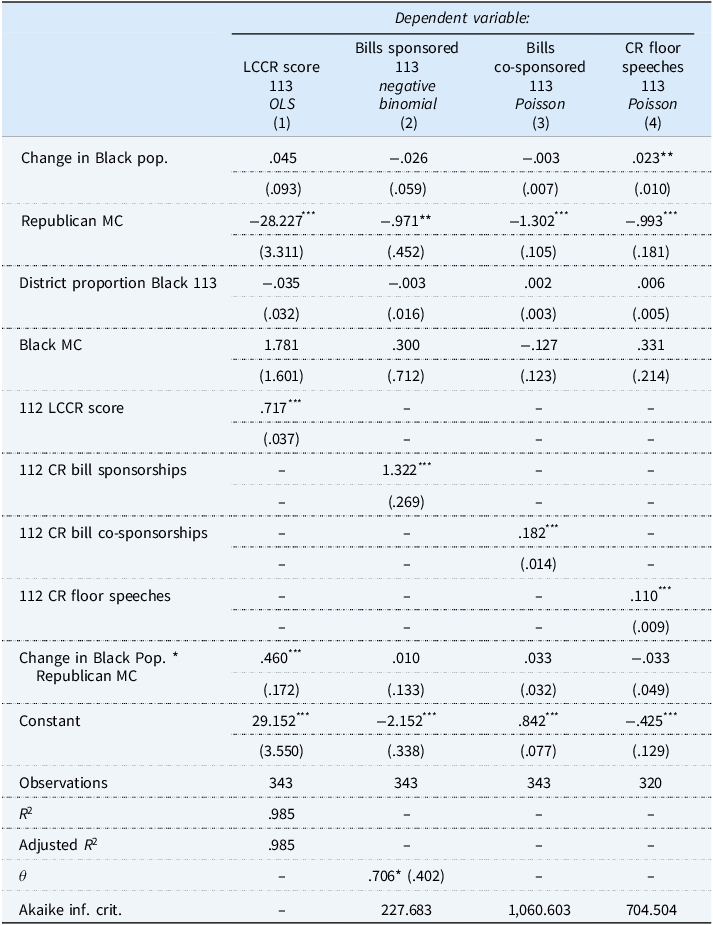
Table 1 reports our results. From left to right, the table shows the results of the regression with the dependent variable as the MC’s LCCR score, the number of civil rights-related bills the MC sponsored, the number of civil rights-related bills co-sponsored, and the number of floor speeches the MC gave in which they mentioned civil rights, all from the 113th Congress. We use a negative binomial regression for the bill sponsorship analysis because this data enters the model as a count, and the variance of this variable exceeds the mean. The co-sponsorship and floor speech variables are counts, so we use a Poisson regression.
Redistricting effect on legislative responsiveness
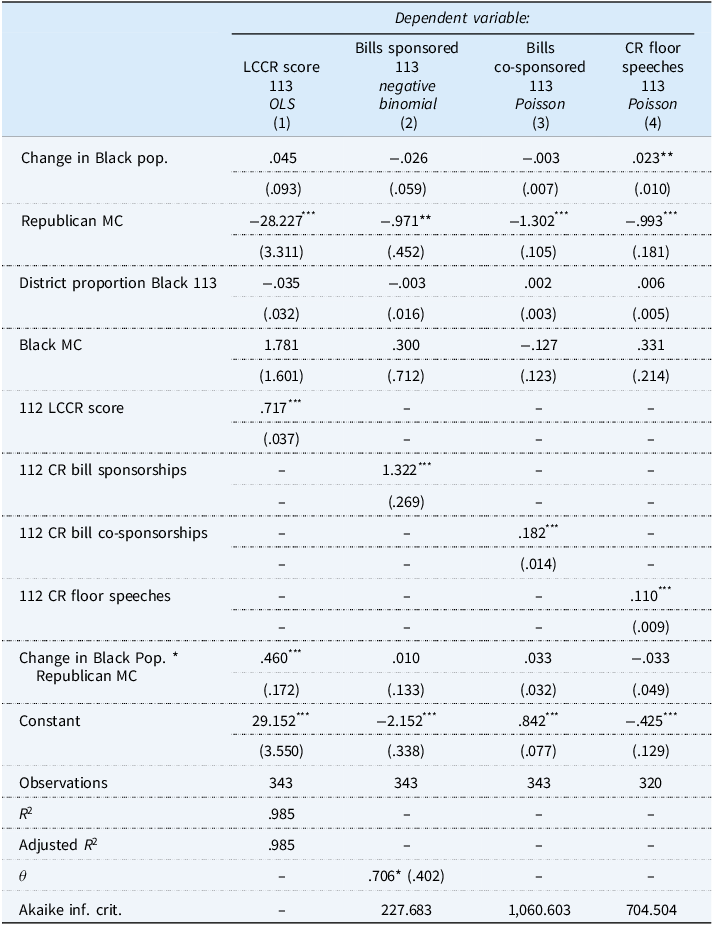
Table 1. Long description
The table presents regression results analyzing legislative responsiveness in the 113th Congress. It includes four columns with dependent variables: MCs LCCR score, number of civil rights-related bills sponsored, number of civil rights-related bills co-sponsored, and number of floor speeches mentioning civil rights. The table has 11 rows, each representing different independent variables and their impact on the dependent variables. Key variables include Republican MC, District proportion Black, Black MC, 112 LCCR score, 112 CR bill sponsorships, 112 CR bill co-sponsorships, 112 CR floor speeches, and Change in Black Population. The table uses OLS, negative binomial, and Poisson regressions. Notable trends include significant negative impacts of Republican MCs on LCCR scores and bill sponsorships, and positive impacts of Black MCs and previous Congress activities on current legislative responsiveness.
*p < .1; **p < .05; ***p < .01.
According to Table 1, Republican MCs are significantly less likely to represent Black interests across all four of our dependent variables.Footnote 5 We also find that the strongest predictor of an MC’s behavior in the 113th Congress is their behavior in the 112th Congress. This suggests that legislators tend to remain consistent—rather than responsive—in their support for Black substantive interests.
Because African Americans overwhelmingly support Democrats, we might expect Republican and Democratic MCs to differ in whether they are responsive to changes in their Black constituency. The interaction term in each model allows us to test for this possibility. Based on our analysis, MCs did not sponsor or co-sponsor more civil rights-related bills in response to an increase in their Black constituency. These effects are true for both Democratic and Republican MCs.
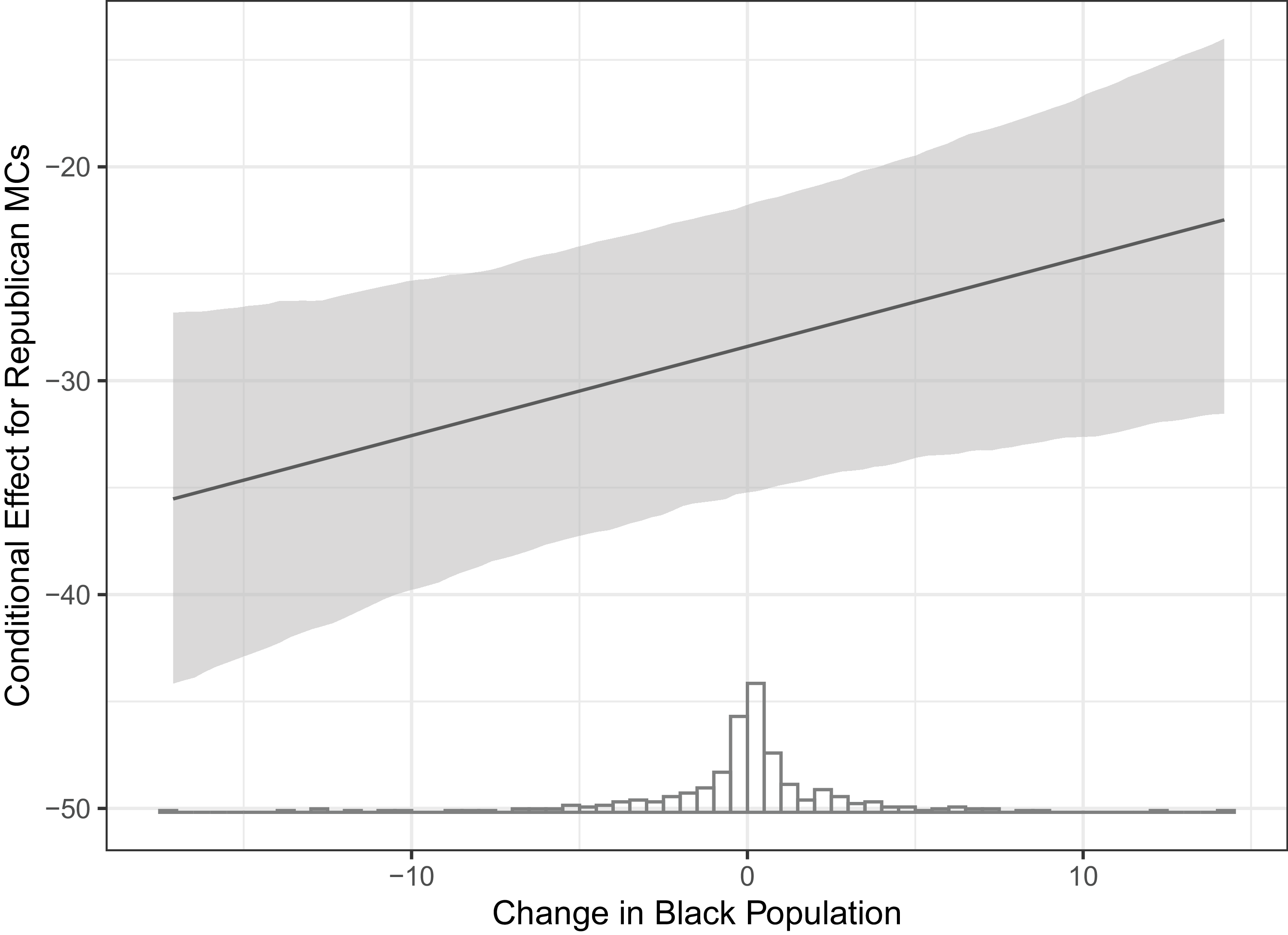
We do find evidence of responsiveness in the LCCR and floor speech analysis. Surprisingly, the positive and significant interaction term (b = .460; p < .01) in column 1 of Table 1 suggests that Republican MCs vote more in line with LCCR priorities in response to increases in their Black constituency. In substantive terms, our model estimates that a Republican MC whose district became 1 standard deviation more African American would have an LCCR score 4.08 points higher than a Republican MC whose district became 1 standard deviation less African American. This corresponds to approximately one additional vote in line with LCCR’s legislative priorities in the 113th Congress. In Figure 1, we plot the conditional effects of change in a district’s Black population on LCCR scores for Republican MCs, with one outlier omitted. Although small, we see a positive slope indicating that Republicans vote more in line with, or against, LCCR priorities in response to increases and decreases in their Black constituency.Footnote 6
Effect of district change on LCCR scores for republican MCs.
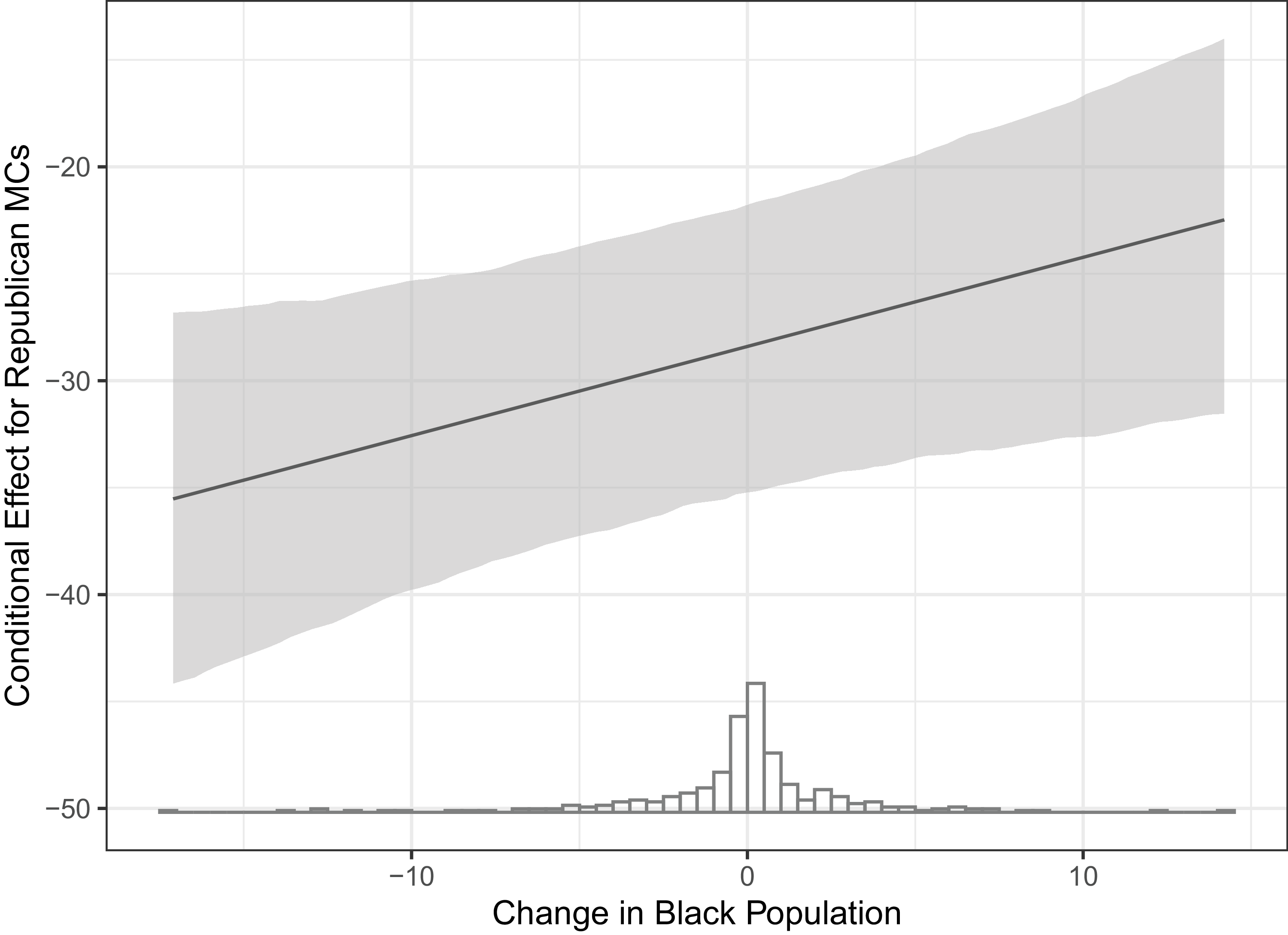
Figure 1. Long description
A histogram displays the conditional effect for Republican members of Congress as the black population changes. The x-axis represents the change in black population, ranging from negative ten to positive ten. The y-axis represents the conditional effect for Republican members of Congress, ranging from negative fifty to negative twenty. The histogram includes a line plot with a shaded area indicating the confidence interval. The line plot shows a positive trend, indicating that as the black population increases, the conditional effect for Republican members of Congress also increases. The histogram also includes a frequency distribution at the bottom, showing the distribution of changes in the black population. The data is continuous, and all values are approximated.
Although this analysis suggests that Democrat MCs are not responsive, we must consider that Democrat legislators in the 113th Congress had an average LCCR score of 97.6. LCCR scores are a reflection of each MC’s recorded votes on legislation aligned with LCCR priorities. For Democrats, this means that they are already voting in line with the majority of the bills the LCCR uses to create the score, regardless of how much of their district is Black.
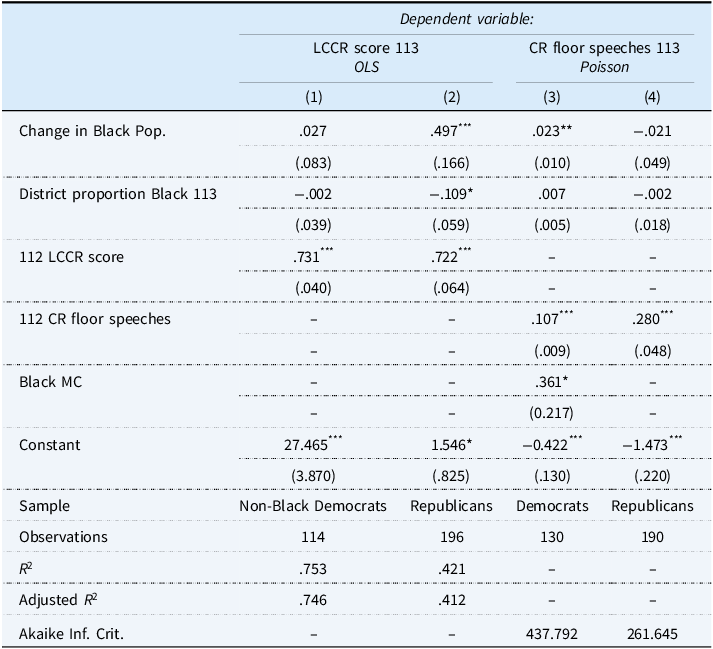
To examine whether Republican or Democratic MCs are driving the significant LCCR score finding, we report two additional models in the first two columns of Table 2. Since Black MCs have a higher average LCCR score compared to non-Black Democrats, we run these models with Black MCs subsetted out of the data. The first model reports the analysis among non-Black Democrat MCs, and the second model reports the analysis among Republican MCs. This allows us to see if non-Black Democrats are also responsive to changes in their Black constituency. As shown, change in Black population is positive and statistically significant for the Republican analysis (b = .497; p < .01) but not for Democrats (b = .027; p = .886).
Redistricting effect on legislative responsiveness
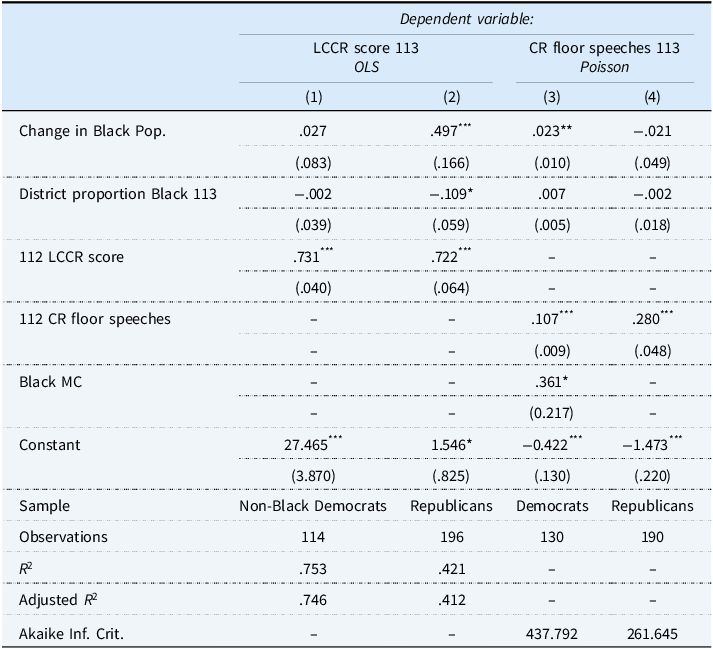
Table 2. Long description
The table presents data on the effect of redistricting on legislative responsiveness, focusing on non-Black Democrats and Republicans. It includes four columns with headers: LCCR score 113 OLS, LCCR score 113 OLS, CR floor speeches 113 Poisson, and CR floor speeches 113 Poisson. The rows are labeled with variables such as Change in Black Pop., District proportion Black 113, 112 LCCR score, 112 CR floor speeches, Black MC, and Constant. The table also specifies the sample groups: Non-Black Democrats, Republicans, Democrats, and Republicans, with observations ranging from 114 to 190. Key metrics include R-squared, Adjusted R-squared, and Akaike Information Criterion. Notable trends show that the change in Black population is significant for Republicans but not for Democrats.
*p < .1; **p < .05; ***p < .01.
We also see some evidence of responsiveness in willingness to mention civil rights during floor speeches in column 4 of Table 1 (b = .023; p = .015). This significant effect is consistent whether we remove party from the model entirely or control for party instead of interacting it with population change.Footnote 7 Since the interaction term in the floor speech analysis is not statistically significant, however, we again investigate whether members of one party are driving this significant effect.
Columns 3 and 4 in Table 2 report the results of the floor speech model with the data subsetted to include only Democrat MCs and Republican MCs, respectively. While the change in Black population coefficient is positive and statistically significant for the Democrat analysis (b = .023; p = .016), the same is not true for Republicans (b = − .021; p = .663). This suggests that only Democrats are more likely to mention civil rights during floor speeches in response to increases in their district’s Black population. In substantive terms, among Democratic MCs, a one-standard deviation increase in the change in Black population is equivalent to mentioning civil rights during floor speeches about one more time.
Our findings paint a nuanced picture of congressional responsiveness to Black interests. Consistent with prior research, we find that MCs are not more likely to introduce or cosponsor legislation related to civil rights in response to gains in Black constituents. We do, however, find evidence of responsiveness for roll call voting on civil rights legislation and the willingness to mention civil rights during floor speeches. Democratic MCs speak about civil rights at significantly higher rates after their district gains Black constituents, although this is not reflected in their voting behavior. Republican MCs, on the other hand, are significantly more likely to vote in line with LCCR interests when their district gains Black constituents. Although the magnitude of both effects is small, these findings provide some cause for optimism about the representation of Black interests. In response to small changes in an MC’s Black constituency, MCs appear willing to deliver more representation so long as the mode of representation is relatively low-cost to the MC. This underscores the importance of more holistic indicators of legislative behavior in order to assess representation and responsiveness.
Discussion
African American voters are a critical voting bloc in United States electoral politics. For decades, Black voters have been loyal to the Democratic Party. This loyalty has led many to consider the voting bloc a “captured group” and thus less likely to have their interests represented in Washington (Frymer Reference Frymer2010). Consistent with this theory, research consistently finds that legislators are less likely to represent or be responsive to African American interests (Gilens Reference Gilens2012; Griffin and Newman Reference Griffin and Newman2007; Kaslovsky Reference Kaslovsky2021). Responsiveness is considered to be a hallmark of representative democracy; thus, African Americans being a captured group presents a normative concern for the United States.
This paper examined whether MCs in the 112th and 113th Congresses were responsive to Black voters. Leveraging changes to an MC’s district due to redistricting, we investigated whether increases or decreases to an MC’s Black constituency led to changes in legislative behavior. We find that MCs did not sponsor or cosponsor more civil rights-related bills in response to increases in their Black constituency. However, in response to increases in their number of Black constituents, Democratic MCs were more likely to mention civil rights during floor speeches, and Republican MCs were more likely to vote in line with LCCR priorities.
We interpret these findings as a cause for optimism about the prospects of African American representation. Past research would suggest we would not find any evidence of responsiveness because they are a captured group. But central to electoral capture theory is the premise that racially conservative whites will object to appeals to Black interests. Given recent research suggesting durable changes in white Democrats’ racial attitudes (Engelhardt Reference Engelhardt2023), it is possible that white Democrats have less fear of backlash for voicing the interests of Black Americans. Consistent with this, we find evidence that white Democratic MCs are willing to talk about issues of importance to the Black community. Moreover, our estimates of legislators’ responsiveness to changes in their Black constituency are likely conservative estimates. Because we report over-time change within legislators, we exclude from our analysis any legislators who retired or were defeated at the ballot box. Voting out legislators who are out of step is an important mechanism for Black Americans to ensure their interests are being represented, and our analytic framework does not include these shifts. This provides a glimmer of hope that the Democratic Party’s most consistent voting bloc will no longer be a captured group within the party.
Additionally, our research provides rare evidence that white Republican MCs can be sufficiently motivated by electoral concerns to respond to African American interests, at least in their registered votes on civil rights issues. Although still generally opposed to the legislative priorities of the LCCR, our findings from the 112th and 113th Congresses suggest that Republicans whose districts gained more Black voters altered their behavior to be more progressive on civil rights issues. This effect is quite modest—the gap between Republican MCs who lost a significant number of Black voters and those who gained a significant number of Black voters is associated with only 1 more vote (out of 20) in line with LCCR priorities. But a single vote can be quite consequential on closely divided civil rights issues. For example, the LCCR was on the losing side of the Supplemental Nutrition Assistance Program (H.R. 3102), which imposed stricter limits on welfare benefits. That bill passed 217-210, with 15 Republican MCs dissenting and voting “nay.” That included Gary Miller (R-CA) and Peter King (R-NY), who had the two largest increases in Black percent among Republicans (at 7.5% and 7.1%, respectively). Although we cannot know whether their increased number of Black constituents weighed in their minds, this is at least consistent with what we would expect if they were attempting to be more inclusive of Black Americans’ policy demands.
These findings open up several additional lines of inquiry for future research. First, we hope that our findings underscore the importance of examining representation and responsiveness across several indicators. Traditional measures of policy responsiveness, such as vote scores, are still important, but it is difficult to observe significant changes in voting behavior in a polarized Congress. Future research should also investigate issue attention and rhetorical representation as key components of responsiveness.
Moreover, our focus has been exclusively on the representation of African Americans’ interests in Congress. Our data are thus limited; redistricting-induced changes in Black populations tend to be small, and congressional party leaders exert substantial influence over legislative behaviors. Future research could extend our analyses to the state level, where district demographic changes are likely to offer more statistical leverage to analyze responsiveness.
Lastly, our focus has been on one marginalized community. The ready availability of indicators of responsiveness to Black issues makes this focus an important starting point. But focusing on the Black community has its limitations as well. Black voters tend to be more geographically constrained, and Black voters’ allegiance to the Democratic Party makes it difficult to detect Republican responsiveness to Black preferences. Future research should apply our framework to the study of responsiveness to other marginalized groups.
Supplementary Material
The supplementary material for this article can be found at https://doi.org/10.1017/rep.2026.10084.
Financial Support
This research did not receive any specific financial support.
Competing Interests
The authors declare no ethical issues or conflicts of interest in this research.
Data Availability Statement
Research documentation and/or data that support the findings of this study are available upon request. The data and documentation can also be uploaded to a dataverse if requested.


 Open access

