7.1 Thinking about States as Corporate Entities
7.1.1 A Basic Ontological Account of the State as an Artificial Corporate Entity
So far, this book has suggested that we cannot properly theorize international organizations before ascribing to some theory about the entities that are supposed to make them up, including states. In this respect, much of current scholarship has tended to proceed with an image of the state akin to that of a ‘natural’ and, in any event, fundamentally irreducible entity. Wherever this premise has been adopted, explicitly or implicitly, it has led down to two problematic paths: international organizations are either merely artificial and ‘mechanistic’ entities or just as real and ‘natural’ as states are. By contrast, Chapter 4 suggested that theorizing international organizations should take place in an altogether different context, one where the state itself is conceptualized as a unitary, albeit artificial, corporate entity. Chapters 5 and 6 then outlined the problems surrounding corporate existence from a philosophical perspective. It is now time to unravel in more detail what all this means with regard to states, and eventually international organizations.
Most contemporary doctrinal explorations of statehood revolve around definitional concerns. Simply put, they are mainly preoccupied with figuring out what counts as a state for the purposes of international law. The assumption behind this exercise seems to be that international law features a general customary norm defining statehood. The latter is often associated with familiar criteria such as territory, population, government, or the capacity to enter into relations with other states.Footnote 1 Thus defined, the state is often taken to be the non-negotiable, fundamental particle of our doctrinal universe. This outlook does not necessarily preclude the emergence of other entities, yet it makes these ultimately analysable in terms of what states are and do. Non-state entities are processed either as agents of states or as owing their legal personality to a norm created by states.
To understand why this methodological statism is ultimately misleading, we need to revisit how we approach the question of statehood as such. And, to do that, we need to distance ourselves from (perfectly legitimate for their own purposes) efforts to pin down the ‘ordinary meaning’ of the term ‘state’ that have dominated discourse.Footnote 2 Rather than trying to abstract what states look like once they have already been established, we should instead shift focus on how they are possible to begin with. Hence, the purpose here is to provide a bare-bones ontological exegesis of a state’s emergence as a form of social organization. Doing so, this chapter seeks to develop a theoretical account from first principles and examine how this corresponds to contemporary practice.Footnote 3 The proposed ontological account of the state will then serve to unveil key continuities with the idea of international organization.
Asking the ‘how’ question about the state presents us with a genuine fork in the road, a juncture that requires the adoption of an analytical starting point. States can be construed either as naturally irreducible entities or as artificially constructed ones. While both these approaches have deep historical roots and varying degrees of explanatory appeal, this book will defend the second. Even as this stance does not present the kind of radical philosophical position that it might have in the past, it is still worth explaining for the sake of analytical clarity. This is especially the case as, despite our seemingly more sophisticated contemporary philosophical understandings of the state in conventional terms, rough anthropomorphic analogies and ‘billiard ball’ conceptions of the state still find their way in our theory making on all sorts of issues.Footnote 4
Why reject the state as a reality conceptualized along naturalist lines? Certainly, it is impossible to prove that any corporate entity, including the state, does not have a soul or a super-mind. But given that it is generally impossible to disprove a negative claim with evidence, the burden should lie on anyone making the claim that the state has a soul or a super-mind to prove it. Until then, a conventional understanding of the state remains by comparison the ‘best explanation’ of that entity’s unitary status.Footnote 5 However helpful state anthropomorphism may be for pedagogical purposes, if it entails some sort of natural or soulful existence for the state, then it rests on unproved, and probably unprovable, theoretical assumptions. In other words, even if we assume that there is something natural and inherent about human beings emerging as unitary persons – a topic of intense philosophical discussion – there is arguably nothing natural or inherent about states being unitary persons. In the final analysis, the individual human being may or may not be like the state, as Hume or Plato suggested; what seems unobjectionable, however, is that the state is like the state. Unless otherwise shown, it is itself, if anything, an artificial, corporate entity.
A similar retort holds for the ‘fiction’ version of state anthropomorphism that understands the state only as if it had a soul or mind of its own. Granted, the purpose of a fiction is to admit as true legal propositions in conscious recognition that they are not true.Footnote 6 Therefore, these propositions actually not being true does not necessarily mitigate against the use of a fiction. However, the question remains: why accept, even as a legal fiction, that the state should be modelled following a particular philosophical take on the individual human being? While there is some explanatory value to be gained here, the assumption that there is a fiction at play to explain something that can be explained in non-fictional terms seems analytically redundant. Following Occam’s razor alone, the fiction theory should thus be viewed with scepticism.
Equally important, there is a hard limit to how far we can push the fiction theory without lapsing into logical error. If the state itself, and for that matter any kind of collectivity, rests on nothing but a legal fiction, then who is supposed to be the author of that fiction? If one agrees that the law is ultimately sourced in social facts as opposed to metaphysical or purely conceptual ideas, then a theory about how these social facts – meaning facts that escape the orbit of individual dispositions – give rise to the law and its associated institutions seems, in the final analysis, indispensable. This means that the fiction theory cannot settle the problem by itself.
Finally, as the next pages explain, the fiction version of state anthropomorphism along with the related ‘billiard ball’ metaphor are contradicted as analytical models by non-international-organizations-related practice from within international law. Despite some enticing simplifications that these models may offer, a host of examples suggest that the state is not treated by international law as an inherently irreducible entity for all intents and purposes. Most importantly, practice shows that the state may fragment itself through decentralization while maintaining its legal personality. Hence, the state can indeed be conceptualized as closed off and unitary, but only under certain circumstances, and not inherently so. Instead, there is a much deeper logic behind the state’s construction, both without and within international law, a logic that suggests that there is nothing elementary or monolithic about it.
The following pages uncover this logic and show how it can buttress the emergence of not only states but also international organizations. Zeroing in on the ‘how’ question regarding the emergence of states as unitary actors, this section argues that the state itself should be construed as an artificial entity. This competing picture traces the ontological, and eventually the analytical, possibility of the state’s emergence to two foundational elements: (1) a rule or rules, explicit or implicit, for the transformative description of events; (2) some sort of social convention or acceptance within a community such that the aforementioned rule can be considered to enjoy the status of a social fact.
7.1.2 Descriptive Transformation of Events as the Ontological Foundation of Statehood
Perhaps the most famous aphorism regarding states’ existence in international law belongs to James Crawford: ‘[a] State is not a fact in the sense that a chair is a fact; it is a fact in the sense in which it may be said a treaty is a fact: that is, a legal status attaching to a certain state of affairs by virtue of certain rules or practices’.Footnote 7 Leaving for a moment to the side the epithet legal, the idea seems premised on a separation between certain things that just exist as such in the physical world and things that can only exist once some status is ascribed to them.
This proposition can be deceptive. It may create the impression that certain entities can somehow emerge in the world in a manner independent of our descriptions.Footnote 8 This notion is equally dubious for states as it is for chairs, for neither enjoys an existence that is mind-independent. Indeed, if all creatures with minds were to somehow disappear from existence, there would no longer be states to speak of, but also chairs. All these things would no longer exist, not in the sense that the physical reality that we presently associate with them would cease to exist, but in the sense that the descriptive carve-out that we engage in when employing notions such as ‘chair’ would now be absent from the world. In other words, while some entities may have seemingly more or less remote connections to so-called physical reality, or even no connection whatsoever, they are all in need of a description before they can be viewed as such. In turn, this need of a description makes them equally mind-dependent at a fundamental level.Footnote 9
Contemporary social ontology often articulates this kind of status-ascribing descriptions in term of ‘X counts as Y’ propositions, where ‘X’ denotes the entity to which the status is assigned and ‘Y’ the status thus assigned. For example: this piece of paper counts as money. Such descriptions may be entirely abstract or context-dependent: ‘this piece of paper counts as money’ versus ‘this piece of paper counts as money in the US’, or ‘these pieces of wood count as a chair’ versus ‘these pieces of wood count as a chair for the purposes of the International Convention on the Harmonized Commodity Description and Coding System’.Footnote 10 Corporate entities too, including states, cannot exist apart from such status-ascriptions. Indeed, from a pure naturalist perspective, ‘there are no activities of the state which can be called “its own”’.Footnote 11 Instead, the state relies on rules describing reality in a certain way,Footnote 12 giving rise to status-ascriptions such as ‘human being X counts as the head of state’, without which the state literally cannot act.
Social reality can appear immensely complex when viewed in terms of ‘X counts as Y’ propositions. In practice, however, human communities tend to entrust whole sectors of status-ascriptions to particular subsets of human beings. Thus, for example, Greece’s constitution provides that any legislation voted by a majority in Parliament counts as law, as well as who counts as an MP, and so on. In other words, an institutionalized way of generating status-ascriptions has been put in place that may set increasingly context-specific statuses and status-ascription conditions. Facts covered by such status-ascriptions can be called ‘institutional’ because they can only make sense given the existence of the human institutions in question.Footnote 13 For example, being a Greek citizen only makes sense in the context of an institutionalized setting: the relevant laws that define and confer nationality, the authorities entrusted with making such laws, and so on.
Still, regardless of how complex this system may develop to be, it can always be traced back to more elementary descriptions, such as ‘X counts as the constitution of Greece’. The idea here is not that we can source the emergence of a state or the validity of its laws back to a hypothetical fundamental norm in the way that Hans Kelsen suggested.Footnote 14 Rather, it is to appreciate how, at the most basic level of the state’s existence, lies the capacity to assign status, in the sense of crafting and maintaining the descriptive priority of certain versions of events over others as part of social reality (making it the case, for example, that a document counts as a constitution as opposed to another piece of paper).
This capacity may well develop in a nested fashion.Footnote 15 When this happens, a fundamental proposition of ‘X counts as Y’ contemplates the power of Y to further assign statuses by virtue of its institutional role that may then do the same with Z and so on. For example, a constitution may create a parliament that may then create a consumer protection authority that then may pass its own regulations as to what counts as deceptive advertising, and so on.Footnote 16 Beginning from the basic level of ‘X counts as Y’, each anterior step then structurally supports the next steps of the sequence, with no apparent inherent upper analytical limit as to the branching out of this process.
To conclude, in whatever terms states may be abstracted after they have been set up, they can only owe their continued existence to describing certain aspects of physical reality in corresponding institutional terms. From this perspective, what is elementary and non-eliminable is not the ideal-type ‘state’, but rather the capacity to read this institution into the world. Crucially, this capacity may develop in a nested manner, in practice often branching out in a highly sophisticated and structured series of descriptive transformations.
7.1.3 The Need for a Social Convention Supporting the Descriptive Transformation of Events
Theorizing the state as an artificial entity means that at the very root of this chain of descriptive transformations lie social facts regarding a community of actual people interacting in certain ways rather than metaphysical or naturalistic notions. Sourcing the state in social reality also signifies that its existence rests on more than mere analytical postulate: it is neither just ‘turtles all the way down’ nor an endless self-referential loop.Footnote 17 Rather, from an ontological point of view, this capacity for status-ascription must be shown to correspond to social facts, meaning facts about how certain human beings relate to each other and the wider world, in the very elementary way in which conferring status to any sort of entity generally operates at a social level through social convention.
This idea encapsulates two basic elements. The first refers to the human beings whose behaviour anchors the existence of a particular status. This goes back to the mind-dependent nature of social facts and the notion that, were all human beings to disappear, there would no longer be states to speak of, or chairs (again, in the sense of their conceptualization as objects that are distinct from the rest of the physical world), and so on. The second element pertains to the way in which facts about these human beings have to interrelate so as lead to the emergence of these social facts.
There are numerous theories as to how transformative re-description actually operates in that regard. Social ontologist John Searle, for example, traced its emergence to ‘individuals directly involved and a sufficient number of members of the relevant community’ who must ‘recognize and accept the existence of such facts’.Footnote 18 The question in that sense has also been posed by legal theorists. HLA Hart, for instance, referred to the ‘rule of recognition’ that establishes the conditions under which legal prescriptions may become valid. Famously, Hart gave a sociological rather than a normative account of what puts this rule in place, itself not too dissimilar from Searle’s.Footnote 19 He argued that the system’s ‘officials’, meaning legal practitioners such as judges and lawyers, need to hold a convergent set of practices conforming to the rule of recognition. Crucially, they also need to exhibit a practical attitude of rule acceptance, whereby they guide and evaluate conduct in accordance with those rules. Apart from legal officials, ordinary citizens need to manifest their acceptance, in practice evidenced largely by acquiescence in the outcomes of these activities.Footnote 20
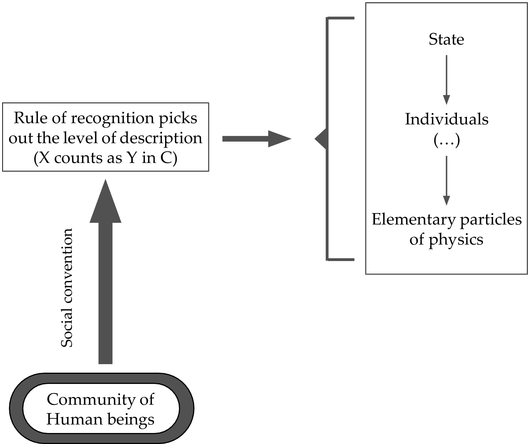
While neither Searle’s nor Hart’s accounts have been left unquestioned,Footnote 21 the key here is to grasp the immanent conceptual structure that emerges regardless of individual variations: to the extent that it corresponds to a social reality, a state can only meaningfully exist on the basis of (1) human beings (2) accepting through convention or other means (3) a descriptive transformation of events (Figure 7.1).

Figure 7.1 A basic ontological account of the state as an artificial entity
Figure 7.1Long description
The flowchart is illustrated as follows. A block labelled community of human beings is on the bottom left. An arrow labelled social convention points from the community of human beings to another block labelled rule of recognition picks out the level of description (X counts as Y in C). From this block, an arrow points to a block on the right labelled as follows: state at the top, followed by individuals, ellipsis, and elementary particles of physics.
This broad account radically departs from how we tend to imagine the state as international lawyers. It puts front and centre a status-generative relationship rather than an abstractly defined and hermetically sealed elementary particle. The following pages show how, properly construed, basic notions of international law correspond to this alternative approach to statehood that is relational rather than atomistic. This relational account will not dislodge the state as a unitary actor but instead explain why international law can inherently admit any and all other actors that emanate from that same relation, including international organizations.
7.2 Theorizing the State for the Purposes of International Law
7.2.1 A Transformative Description of Events Accepted through Convention or Other Means
Re-imagining statehood as a relationship puts front and centre of our legal ontology a descriptive transformation of events that is rooted in social facts. This is a purposive self-description in institutional terms that may then fire off a chain of nested status-ascriptions that encompass the state’s apparatus, and potentially other institutions as well.
International law’s relationship to this descriptive transformation can be construed in two ways. First, international law can be thought to register directly what happens at the state level.Footnote 22 In this scenario, international law does not produce its own descriptions of states’ institutional reality but rather relies on those descriptions provided by those states and their adjacent institutions by assigning descriptive priority to them. Alternatively, international law does not register directly a state’s own sanctioned descriptions of its institutional reality but instead relies on other actors’ acceptance of these descriptions. This would happen most importantly through the notion of recognition, which would, in that case, rightly be called ‘constitutive’.Footnote 23 Both ways of configuring international law’s relationship to the emergence of a state are viable from an analytical perspective, and, as we shall examine in the following pages, both entail the possibility of international organizations by default. Nevertheless, the first one seems to correspond better to current doctrine and practice in relation to statehood itself.Footnote 24 It is thus worth explicating in greater detail what it means.
The key notion that I will be employing in this respect is that of a renvoi.Footnote 25 Better known as a concept of private international law, a renvoi originally refers to the doctrine whereby the courts of one state may come to apply the laws of another state in cases involving some international element.Footnote 26 The more abstract idea that is relevant here is the notion that a legal system can refer to, and incorporate, elements of another system, while remaining analytically separate from it. This creates a subtle form of dependence between legal norms, whereby they both exist independently from one another, but one only becomes relevant within a given system because the other refers to it.
A good example of this is the relationship between domestic nationality laws and international legal norms on diplomatic protection. Domestic nationality laws are relevant in this respect only because international law refers to them, and in that sense, they are brought within the system of international law.Footnote 27 However, this does not mean that domestic nationality laws are formally ‘part’ of international law, at least not in the same sense that norms of international law are generally thought to be. Thus, a change in domestic nationality law does not signify any change in terms of international legal norms, precisely because these are understood to belong to different legal systems. Accordingly, if the UK changes its domestic law conditions for granting nationality, this does not mean that customary international law on diplomatic protection has changed. Rather, it means that its application will now be different where the UK is concerned. Of course, international law may develop specific norms that restrict the state’s freedom to regulate its own nationality.Footnote 28 The point is that this will require a separate norm of international law, a change in the legal system that departs from the default renvoi rule.
The example of nationality can help illuminate how international law constructs the very existence of the state as a unitary actor. International law relies on what are essentially outside sources, meaning descriptive statements of the type ‘X counts as Y’, not only for nationality but also for who counts as an organ of the state, including its representatives at the international level. Thus, for example, article 7 of the VCLT 1969 (reflecting customary international law)Footnote 29 provides that a person is considered as representing a state if ‘he produces appropriate full powers’ or ‘it appears from the practice of the States concerned or from other circumstances that their intention was to consider that person as representing the State for such purposes and to dispense with full powers’.Footnote 30 Similarly, article 7 does not create the office of or otherwise directly confer authority to a head of state, head of government, or minister of foreign affairs. Instead, it only establishes a rule that no evidence of authority is required for these officials, essentially through a renvoi.Footnote 31
It is by a similar renvoi that state organs are defined for the purposes of international responsibility. For example, article 2 of the ASR explains that ‘[a]n organ includes any person or entity which has that status in accordance with the internal law of the State’.Footnote 32 The deference to state-sanctioned descriptions is further exemplified by article 11, which provides that mere acknowledgement and adoption of a certain conduct by a state as its own suffices for it to be considered as such in international law.Footnote 33 Again, as with nationality, there might be instances where international law develops rules limiting its reliance on states’ self-description – the notion of de facto organs is one such notable case.Footnote 34 But this does not change the underlying principle, which is that international law does, as a default rule, defer to self-descriptions of institutional facts as far as the state is concerned.Footnote 35 This is so much so that entities that arguably meet the classic criteria of statehood are not considered states insofar as they do not claim to be.Footnote 36
A similar rationale prevails with the second element of our basic ontological scheme, namely the relationship between self-descriptions and their societal basis. We already saw how this relationship has been theorized by lawyers and non-lawyers alike through notions such as ‘acceptance’ or ‘convention’. In this respect, international law appears to be relatively agnostic, caring more about whether these social facts exist rather than how they are put into place. When it comes to states, this can be exemplified by the notion of ‘statehood as effectiveness’.Footnote 37 This also corresponds to the widely accepted notion that the continuity of the state is not challenged by changes in its government, regardless of whether these are ‘constitutional’ or not.Footnote 38 Once again, this is only a default rule that can be subject to exceptions whereby international law may withhold deferral to self-descriptions of certain social facts for particular reasons.Footnote 39 Still, it showcases how an entity that may initially seem opaque is itself the product of a complex interaction between different moving parts. While what happens with the creation of states could be described in terms of fulfilling the elements of an abstract definition, the ‘how’ of it must be boiled down to international law taking note of this descriptive transformation of events that is sufficiently rooted in social reality. States themselves are intricate non-monolithic entities of an organizational nature even for the purposes of international law.
This descriptive transformation constructs the state by incorporating what might otherwise seem as ‘outside’ causal forces, which it registers as ‘internal’ workings of the state. From this perspective, it becomes apparent that, even from inside the system of international law, the presumption of the state’s unity and agency is sourced neither in its scientifically observable causal effectiveness nor in metaphysics. Rather, the reality of the state is indeed fully and irreducibly ‘a normative operation’.Footnote 40 International law’s criterion of individuating states is not natural causal powers. Instead, the respective causal powers are recognized in international law only after the state has been circumscribed from other entities. Therefore, what matters is not whether there is a causal link between the state and an act but whether this act is connected to the state in a particular way so as to count as its own. In other words, the ‘reality’ of the state rests on neither naturalistic or metaphysical notions – or somehow on the fiction thereof – but on international law recognizing legal effect to a series of relationships that bind the state together as one by assigning priority to a given description of reality over others.
Crucially, this priority should be understood to refer by default to the state’s own descriptions of its institutional reality. In practical terms, this means that the state already has a rule of re-description in place that anchors propositions such as ‘X counts as head of state’. International law recognizes the corporate unity of the state by giving effect to propositions such as this one. Therefore, when a head of state signs a treaty, international law does not process this event as the head of state causing the state to consent to a treaty; rather, from the perspective of international law, the head of state’s signature counts as the state’s acceptance. There is certainly a dependence relationship between these two events: without the head of state moving her hand, the state cannot sign. However, in the eyes of international law, this relationship is understood as an ‘internal’, or an ‘in virtue of’ form of dependence rather than a causal one.Footnote 41 Similarly, when a state’s government is replaced, international law does not consider that the state has changed, as the relationship that occurs between the state and any given individuals acting as its officials is not considered to be one of identity.
7.2.2 An Element of Community
Systems of re-description and social convention are not free-floating entities: they have an ontological conditioning that involves actual human beings and cannot meaningfully exist apart from them. Any group of human beings that is capable of creating such institutions owing to some convention or practice, I will refer to as a ‘community’. Employing this term, I am not aspiring to define this notion in anthropological or abstract political terms. Rather I am employing it as a placeholder for the idea that there is an irreducibly social element to the creation of institutions.Footnote 42 Typically, this community will be seen and interacted with through the institutions it creates. In practice, the most certain evidence that it exists will be the fact that it has been active in setting up such institutions. Still, we should not lose sight of the fact that, at a basic ontological level, the underlying community of human beings enjoys a separate existence from its institutions.Footnote 43
What type of community has the capacity to constitute itself into a state presents a broader problem for international law, and one regarding which the law has not always been inclusive or unambiguous.Footnote 44 I will revisit this question at the end of this chapter, where I will explain that it can be bracketed out as a common variable in theorizing both states as well as international organizations. The key point here is to register an analytical understanding of a community as an entity that may lead to the formation of a state but necessarily exists separately to it and may persist regardless of it, being in that sense fundamental in its own regard. Most importantly, at the very least behind already constituted states, there exists a community of interrelated human beings, however the latter is defined, rather than a supra-individual organism or a ‘ghost’ doing all the work, or the fiction of one.
The ‘best explanation’ of the state’s potential for emergence and persistence through time then is to construe it as a unitary, yet artificial, entity. International law should be thought to construct the state by recognizing the capacity of re-description of the underlying community which the state ‘encapsulates’. Thus, the state is a unitary entity because the internal descriptive transformation by which the state views itself as such is admitted by international law. The state can further be called an artificial entity because the state’s activities and existence are ultimately grounded on suitably related facts involving lower-level entities, and not on the assumption of some metaphysical or organic quality attached to it. Indeed, just as some philosophers suggest that a human being can constitute itself into a person by viewing itself as unitary, a community can constitute itself into a corporate entity when it puts in place rules of re-description – rules that create a new level of description under which the community in question appears as a unitary entity. Therefore, statehood should be understood as another form of organization rather than as an intrinsic quality with quasi-metaphysical import that is somehow breathed into an entity when certain objective criteria are met. What is fundamental is not the state as a platonic form, but the status-ascribing relationship that may lead to its creation and sustain its institutional apparatus.
7.3 Institutional Organization besides or beyond the State
Conceptualizing statehood as a form of organization ultimately founded in a community’s exercised capacity to self-describe rather than as a fixed quality suggests that there are no inherent limitations to restrict the exercise of this capacity only to the creation of states.Footnote 45 This view reintroduces the state just as a potential member of a broader family of entities that are all equally admissible by default within international law. All these entities can be said to form a family not because of any abstract institutional or functional similarities that they may or may not share but due to their common root in the capacity of a community to self-describe, and to the extent that this capacity is recognized by international law.Footnote 46 Put simply, international law cares about the shared roots of these institutions rather than how they may come to branch out.
I call this approach ‘institutional genealogy’. Through that term I wish to shift focus from a discourse that revolves around trying to define as accurately as possible certain platonic types of institutions (such as statehood or international organizations) back to the continuous line that connects all these entities to a common ontological core, namely the status-generative capacity of certain communities of human beings.Footnote 47
Having already seen how this rooted capacity of communal self-description lies behind international law’s construction of the state as a unitary corporate entity, the next step then is to register how this capacity may branch out beyond, or even outside, the state. This will help explain why it is this capacity with its relational underpinning rather than the abstraction of the state that should be thought of as our non-eliminable point of reference and, hence, why the system does not pose any default limits on what forms of social organization may emerge from exercising that capacity.
Apart from deducing it analytically, this foundational primacy and elementary character of communal self-description can also be inferred from practice. As we have seen, at a very basic level, this concerns the state’s very identity as a continuous entity at a given point and through time. For the same underlying reason, statehood itself is restricted only to entities that claim to be, and thus self-describe as, states at any given point.Footnote 48 Similarly, the foundational primacy of self-description may account for bringing already constituted states to an end: it allows a state to contract itself out of existence by voluntarily dissolving into its component parts or merging with another state. Likewise, a state can partially devolve by granting independence to one of its sub-parts. Arguably, none of these practices need to be authorized or otherwise prescribed by separate norms of customary international law: they are inherent in the very notion of the state itself just being a product of descriptive transformations of events.
Between the extremes of state creation and dissolution lies a myriad of other instances of the creation of sub- or supra-state entities that equally evidence international law’s default deferral to self-descriptions of institutional reality by a community.Footnote 49
A classic case of sub-state entities in that regard is those federal states for which the component states enjoy the capacity to conclude international agreements with third parties directly and in their own name.Footnote 50 To the extent to which these entities enjoy legal personality in international law, this is neither to the exclusion of the federal state nor is it identical to it.Footnote 51 Instead, ‘each level of personality operates within a different network of legal relations’.Footnote 52 This approach was echoed in the ILC’s earlier work on state responsibility, which noted that:
[w]here an organ of a component State of a federal State acts in a sphere in which the component State has international obligations that are incumbent on it and not on the federal State, that component State clearly emerges at the international level as a subject of international law separate from the federal State, and not merely as a territorial government entity subordinate to the federal State.Footnote 53
It is also in line with arbitral practice suggesting that components of federal states can be held responsible for the commitments that they have undertaken directly and in their own name.Footnote 54
The opposite, methodologically statist view would have federal components in all circumstances acting merely as agents of the federal state. This position has been summarized by Sir Gerald Fitzmaurice as follows:
In so far as they are empowered or authorized under the constitution of the union to negotiate or enter into treaties with foreign countries, even if it is in their own name, they do so as agents for the union, which, as alone possessing international personality, is necessarily the entity that becomes bound by the treaty and responsible for carrying it out.Footnote 55
This view takes off from a very different premise than the one employed here. Disregarding practice, it axiomatically assumes that the state’s legal personality does not admit gradation, analysing away other entities through concepts such as authorization, consent, or agency. Indeed, as we have seen, if one posits the state as the fundamentally irreducible particle, then it is not only possible but also inescapable to then eventually reduce all other such entities, including international organizations, back to it: any one of these entities could be re-described through the fiction of authorization as just another instance of the state acting and being the ‘real’ actor.Footnote 56 But the question remains as to why one should adopt such a view of the state. If one understands the state by reference to social facts through a default renvoi to already established descriptive priorities rather than as a metaphysically fixed point, then there is no reason to restrict the corporate form to the state alone.
Practice supporting this notion goes beyond federal states in ways that may defy neat classification but exhibit the same underlying rationale. Protectorates having their own measure of international legal personality in parallel to the protecting state are a case in point.Footnote 57 The same is true for non-self-governing territories whose people have, in their exercise of their right of self-determination, elected to freely associate with an independent state, usually their former administrating power, rather than create their own states.Footnote 58 Although these arrangements vary in practice, they too reflect the idea of an entity not being legally subsumed by its so-called parent state, without being a state in itself.Footnote 59 Thus, for example, associated entities such as Puerto Rico, the Cook Islands, or Niue have been admitted as members to a number of international organizations in their own name.Footnote 60
These instances not only show that the state should not be conceptualized as an inherently closed-off entity but also that international law admits communal self-description giving rise to institutions that do not fit our classic definition of what counts a state.
Another adjacent category of practice showcasing the same ideas has historically concerned certain sub-parts of non-federal states. One prominent such case is Hong Kong, which has the status of a special autonomous region of China. While formally part of China, Hong Kong’s Basic Law also gives it the right to make agreements with other states.Footnote 61 As Crawford explained in that regard, ‘as a matter of international law, these are obligations of Hong Kong, and to that extent Hong Kong may be described as an international legal person’.Footnote 62 In fact, Hong Kong has signed a number of such agreements.Footnote 63 It has also joined international organizations, including the WTO in its own right – an organization to which, since 2001, China is also a member. Similarly, British dominions such as Australia, Canada, New Zealand, and South Africa were recognized as having the capacity to sign treaties in their own name for some time before they became formally independent states.Footnote 64 While not states at the time, these dominions also became members to the League of Nations, along with India when it was still a non-self-governing colony, and thus even further away from statehood.Footnote 65 The UN has also featured similar examples of parts of states acting in ways that do not fit the classic ‘billiard ball’ conception of the state: India, again, as well as the Philippines and the Soviet constituent republics of Belarus and Ukraine became members of the organization without being independent states at the time, in parallel to the UK, US, and the USSR being considered fully fledged states in their own regard, and members of the UN.Footnote 66
In sum, all these sub-state or otherwise dependent entities possess an international legal presence that truly exists in parallel to that of their so-called parent state. Leaving to the side theoretical arguments, the very existence of these examples evidences the artificiality of the view that these entities are invariably just acting as agents of some other state: it makes little sense of practice to argue that a state becomes a member to an international organization but also ‘delegates’ to one of its sub-entities to represent it at the same organization. On the whole, these examples showcase in practice what the previous pages argued through logical deduction: the state should not be understood as an inherently irreducible monolithic entity, including in the eyes of international law.Footnote 67 Instead, the state is a constructed entity, neither inherently open nor closed. It can be moulded and remoulded by default and without prescription by a specific rule of international law in a non-pre-defined manner that can give rise to a practically infinite variety of legal institutions and arrangements that may exist in parallel to one another.
Following this rationale, there is nothing that restricts such alternative forms of organization from taking place beyond the state level. And indeed, practice is also replete with instances of supra-state or intrastate arrangements evidencing the same principle at work. Historically, these have ranged from ‘condominiums’ to ‘personal’ and ‘real’ unions, and confederate entities.Footnote 68 These too exhibit remarkable diversity, being almost as varied in terms of typology as the historical circumstances that gave birth to them. Admittedly of decreasing importance in the modern world, these examples may too yield deeper insights into how international law constructs the state in a conventional and constructed, rather than essentialist, manner.Footnote 69
Confederations are perhaps the most interesting such case for our purposes. Contrary to federal states, confederations are set up by an international agreement rather than a national constitution.Footnote 70 The units that make up the confederation remain states in their own right, retaining their legal personality, while the new entity that emerges – the confederation – is also bestowed with its own separate legal personality.Footnote 71 The confederation thus represents a partial decentralization that leaves participating states still standing as legal persons while also giving rise to a new, and legally distinct, entity. Although encompassing only a handful of historical examples,Footnote 72 the key here is the underlying idea that the notion of a confederation corresponds to: the capacity of a political community to organize itself at the same time within and beyond national boundaries, leading to the creation of a legal person that exists in parallel to its members in the international legal order. As with the examples of sub-state entities mentioned earlier, here too international law seems to admit by default a legal entity that emerges out of the state, without the need for special rules of incorporation or other ‘structural changes’ in the system.Footnote 73
7.4 International Organization as a Corollary of the Capacity to Constitute a State
Understanding the state as an artificial yet unitary entity in this manner opens up a different approach to theorizing international organizations than those currently on offer. If at the foundation of international law lies the capacity of a community to self-describe as a unitary entity, and if states are the products of that capacity being exercised, the question then becomes whether these communities can further organize themselves beneath or beyond the national level. The whole inquiry then turns to whether there is an inherent barrier that prevents the descriptive transformation that ‘animates’ the state to also give rise to interstate or supra-state entities. This is a markedly different problem from trying to make sense of the differences and similarities of states and international organizations as platonic archetypes, or assuming that there is barrier to entry for the latter and trying to overcome it by positing rules of incorporation or changes in the definition of international law as we saw in Chapters 2–4.
Drawing inspiration from the philosophical exposition of this problem, which also corresponds to practice regarding entities other than international organizations, we should answer this question in the negative: there is no such barrier to begin with. The same capacity can support partial and total corporate unification of a political community within and beyond national boundaries, and the emergence of the respective corporate actors in the eyes of international law. The theory advocated here boils down to this proposition: a community of the type that has the capacity to organize itself as a state can also organize itself beneath and beyond the state level, whether directly or through nested institutions. In other words, if international law recognizes the capacity of a community to set up a state, then, by the same token, it recognizes its capacity to set up other types of corporate entities, and in general to freely delegate, decentralize, or otherwise organize itself.
In a sense, the recognized capacity of a political community to set up a state, and the ensuing capacity of the latter to set up an international organization, operates as a rule of incorporation, since both are supposed to license descriptive transformations of events. However, the argument here differs from positing a general rule of incorporation in the sense of domestic law. It negates pinning that capacity to a new, separate, and ultimately special positive rule of customary international law. Moreover, by tracing international organizations back to the same capacity to constitute the state itself, the theory advanced here negates the notion that there is an intrinsic difference between these institutions and states: they are just variations of the same theme at different scales. International organizations’ existence is anchored to the political communities whose capacity to produce authoritative descriptions of events has been at play. This capacity has been presumably already recognized within the system of international law, given how in practice international organizations are normally founded and membered by institutions that are themselves an expression of it, including most commonly states themselves. It is being anchored to this capacity that matters and not whether some sense of ‘community’ may then emerge within an organization’s bureaucratic apparatus.Footnote 74 In sum, international law should be thought of as capable of inherently accommodating entities with distinct legal personality existing in parallel to the state when these represent the organization of the underlying political communities at a different level.
The case of confederations can be especially instructive for how the emergence of international organizations should be understood in this regard. The takeaway is not that international organizations are confederations,Footnote 75 much less that they are all-encompassing ‘super-states’ if that expression means that they somehow absorb the legal orders of their member states.Footnote 76 Rather, it is that states may set up a new legal person that is recognized by international law as having its own legal personality and retain their individual legal personalities. Accordingly, there is no reason why the same logic cannot sustain the creation of an international organization without the need for arguments concerning changes in the law.
Instead, the correct analysis should be that there is a spectrum of ‘public’ entities in international law, and that states, confederations, international organizations, as well as any other entity that exists on that spectrum, are part of the same family tree of legal persons.Footnote 77 We may call such entities collectively ‘public’ institutions,Footnote 78 because they are ultimately anchored to what international law recognizes as public authority in its most elementary sense, meaning authority that is exercised in the name of one or more communities as a whole rather than the concerned individuals.Footnote 79 The conceptual relationship of these actors with states is based on their common root in that capacity having been exercised, not on some abstract similarity that may or may not obtain between them. Thus, international organizations do not acquire their status because they are ‘self-governing’ or analogous to states (in certain respects they are, in others they are not), and certainly not due to some special provision allowing for it. Rather, they acquire their status because they are themselves expressions of the same capacity that pulls the state together as one in the eyes of international law, operating at a different level of organization.Footnote 80
Accordingly, international organizations should not be theorized as associations of domestic law in systems with or without a rule of incorporation.Footnote 81 Instead, the more appropriate legal metaphor is that of an artificial entity exercising public power in relation to another artificial entity exercising such power when they both ultimately stem from common underlying social conventions. For example, this is the relationship that normally occurs in public legal persons in domestic law, where a central authority can create decentralized public entities with a separate legal personality. Therefore, if an analogy must be sought in domestic law, this should be with those independent non-territorial public persons of domestic law that enjoy distinct legal personality but still form part of the state’s apparatus in the broad sense – consider, for example, the legal set-up of independent competition or consumer-protection authorities in most European jurisdictions.
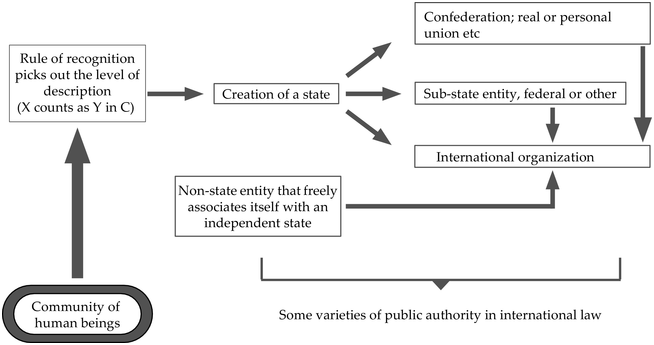
All in all, the proposed theory replaces the premise of a rule of incorporation or other change in positive law with the premise that the capacity of a community to organize itself into a state can be exercised in tandem with another organized community in a way that creates a non-eliminable legal point of reference in the eyes of international law. This premise, which corresponds to broader international practice instead of just practice in relation to international organizations, is underpinned by the immanent logic of this capacity when it is theorized as the exercise of a recognized power of re-description, as opposed to the expression of a metaphysical quality of a mysterious ‘spirit’ of the state, or the fiction of one. In other words, it is not only the same type of ‘magic’, whatever that may be, that animates both states and international organizations in the eyes of international law; it is actually the same force working across different boundaries and levels of organization, ultimately anchored in shared social facts.Footnote 82 The distinctiveness of states in law creates the conditions for the distinctiveness of international organizations in law, to the same extent and with the same effects, rather than being an obstacle to it as the default position implies (Figure 7.2).

Figure 7.2 Capacity to self-describe and the state as a member of a family of institutions
Figure 7.2Long description
The flowchart runs as follows. A block labeled community of human beings leads to rule of recognition picks out the level of description (X counts as Y in C), followed by creation of a state and non-state entity that freely associates itself with an independent state. Three arrows point from creation of a state, to the following three blocks: confederation, real or personal union e t c, sub-state entity, federal or other, and international organization. An arrow points from non-state entity to international organization. Both confederation and sub-state entity lead to international organization. Creation of a state and non-state entity that freely associates itself with an independent state are grouped under the heading, some varieties of public authority in international law.
This account drastically departs from our classic framework for theorizing international organizations. As Chapter 8 will explore in more detail, the different logic immanent in this alternative account – focusing on continuity in the exercise of public power rather than comparing and contrasting the two actors or analysing international organizations merely as groups of states – yields new insights and more convincing answers to age-old doctrinal problems. Before getting to those, however, it is worth pausing to address two potential ambiguities of what has been suggested so far. These relate to (1) who is the ‘self’ that engages in self-description through various forms of social organization, including states as well as international organizations; (2) the potential for abuse coupled with the idea of international law’s default renvoi to the aforementioned self-descriptions.
7.5 Addressing Potential Ambiguities of the Present Theory
7.5.1 Who Is the Self That Does the Self-Description?
One of the fundamental elements of the theory advanced here is a community of human beings that exists separately from the state, meaning that it is a constitutive element of the state itself but also in the sense that it continues to exist when a state has been set up, and may also exist regardless of the emergence of the state at a given point in time.Footnote 83 This account places this community’s capacity for institutionalization at the centre of a radial structure wherefrom the emergence of a state is only one of many possibilities, all equally admissible by default as far as the international legal system is concerned. The question may arise at this point: what type of community has the capacity to engage in self-descriptions such that can lead to the creation of states, as well as these other forms of social organization, in the eyes of international law?
While I will sketch an answer to this question, it is important to appreciate that any answer that is given will apply equally to states and international organizations: if a community has the capacity to organize itself in the form of a state, then it will have ipso facto the capacity to join or form an international organization. In essence, the question of what type of community enjoys this capacity in the eyes of international law is a separate matter that is not peculiar to theorizing international organizations as such and can therefore be bracketed out for the purposes of our analysis. With this in mind, I will now outline my answer.
The question boils down to how one understands international law’s relationship to the capacity of a community to self-describe. At a basic level, this capacity can be configured either as a power or as a liberty. In classic Hohfeldian analysis of rights, the term ‘power’ denotes the capacity to effect a change in legal relations.Footnote 84 In turn, this corresponds to another’s liability to have their legal relations changed. A classic example of a power in that sense is triggering a unilateral contract extension clause. By contrast, the term ‘liberty’ denotes a situation whereby one is free to act in a certain way, but this does not correspond to anyone’s duty to accommodate them. For example, I am at liberty to pick up an unclaimed five-pound note lying on the pavement, but others do not have a duty not to take it themselves or allow me to take it myself.
Now, consider, for example, a change in a state’s head of state. From the perspective of international law, there are two main ways to process such an event. The first is to say that any change in government is an inherent ‘power’ of a state, that works automatically and with direct legal effect in the field of international relations. It makes sense to describe this as a Hohfeldian power because even such relatively minor changes in self-description impact the entitlements and obligations of other states: for instance, they now must extend head-of-state immunities to that person.
The second way is to describe such changes in self-description only as a ‘liberty’, meaning that other states do not have a corresponding liability to accommodate these changes in any way. In this scenario, self-descriptions are capable of producing legal effects only to the extent that they meet the recognition or otherwise expressed consent of other states. Here we may further distinguish between the capacity to self-describe as such versus specific instances of exercising that capacity. In the first instance, recognition just offers a longer route to the same outcome as the exercise of a power would. A state recognizes another state and this one-off recognition then admits any and all ensuing self-descriptions, rendering them a Hohfeldian power vis-à-vis this specific recognizing state that becomes liable to accommodate them. In the second and more extreme scenario, recognition needs to attach to individual descriptive transformations and does not create any liability vis-à-vis future changes. This is a world where, for example, the recognition of each new government of a given state would be necessary.
As already mentioned, even though either conception of the capacity to self-describe may analytically entail the emergence of international organizations as an institutional form, configuring it as a Hohfeldian power in the first sense seems to reflect current doctrinal consensus.Footnote 85 According to this view, communities of already established states do have the power to effect changes in their legal entitlements, from as minute as changing their government to as profound as partially disaggregating their state or even dissolving it altogether. But this power may extend beyond communities already organized as states. Similarly, for example, a community living in a trust or a non-self-governing territory has a right (in the terms of our analysis better understood as a power) to effect a change in its legal entitlements by pursuing one of the options outlined in GA Res 1541 (XV), including by creating an independent state, while the colonial state has a corresponding liability to have its legal entitlements changed.Footnote 86
What happens beyond these two cases, however, is less clear cut: international law does not seem to pose any abstract requirements on what type of community may eventually lead to the creation of a state or other form of self-government.Footnote 87 On the other hand, it does not appear to provide a general legal entitlement to do so in the same sense that it does for example, for peoples living in trust or non-self-governing territories.Footnote 88 Yet again, this is a broader problem that cuts across international law and, as such, should not change how we understand the position of international organizations.
7.5.2 Exercise of the Capacity of Self-Description: Limits and the Potential for Abuse
The idea that certain communities have the power to freely change their legal entitlements through self-description may seem strange from a normative point of view. It does not appear to contain any built-in limiting principle or other general guarantee against abuse. Although sensible in origin, such concerns turn out to be mostly speculative. Even though it is theoretically possible that a state names a different head of state every day, grant an ever-increasing number of sub-state entities extensive treaty-making powers, or create an infinite number of international organizations, the realities of political economy severely constrain this freedom in practice. In other words, states seldom try to ‘game’ the system, because every such change has to abide with considerations of an internal legal and political nature that are by themselves quite restricting.
This does not mean that the potential for abuse does not exist at all. But here again, we should be reminded that this renvoi to self-description is only the default rule which can be overridden by other norms. This could include a general prohibition of the abuse of rights as part of customary international lawFootnote 89 or more specific rules restricting this deferral, as, for example, when the emergence of a state is connected ‘with the unlawful use of force or other egregious violations of norms of general international law, in particular those of a peremptory character’.Footnote 90 Such restricting norms could theoretically develop specifically in relation to international organizations.Footnote 91 The fact that there does not seem to be much practice in that regardFootnote 92 should, if nothing else, be interpreted as a sign that states generally do not set up or join international organizations with the sole intention of abuse, rather than as an inherent conceptual vulnerability of international law.Footnote 93 Either way, the point here is that there does not appear to be a special problem with international organizations that is not encountered when thinking about how the state is set up in general.Footnote 94
Finally, the concepts themselves entail certain restrictions. As with states, formal independence is important but not enough for the establishment of an international organization. Just as with states, in extreme cases, the potential lack of factual independence may limit claim to legal distinctiveness.
Formal independence is key in the sense that an entity must at some level be understood as an independent legal entity in the formal sense. As Chapter 8 will further develop, this will remain a question of the intentions of the members concerned, and in absence of a clear statement of intent, subject to an inference regarding these intentions, as the ICJ reasoned in Reparation for Injuries.Footnote 95 The upshot is not that the intention to create an international organization with international legal personality has to be stated expressly in a treaty. Rather it is that an organization may not possess such personality against the express intentions of the entities that would otherwise count as its members. States’ positive declaration that they do not wish to create an entity with international legal personality should be thought as determinative in this respect.Footnote 96 Similar treatment should be reserved for when states consciously withhold the description of an entity as an international organization with legal personality.Footnote 97 In such cases, there is no attempted descriptive transformation of events to be given priority by international law to begin with. Likewise, it is hard to see how an international organization can emerge when cooperating states choose to describe an entity solely in domestic law terms.Footnote 98
Aside from the cases of explicitly withholding such status or of choosing to submit an entity to the domestic jurisdiction of one state, there can also be less direct ways of inferring that participating states did not aim to create an international organization. This will especially be the case where the purported organs of an entity are appointed directly by the respective governments of states as part of their institutional set-up, and the organs’ decisions are subject to the subsequent approval of any one of those governments, as was the case with the Administering Authority for Nauru in the respective ICJ case.Footnote 99 In all such cases, the resulting absence of international legal personality leads to activities being ultimately attributable to the corresponding cooperating states or other actors, together with any responsibility that may arise under international law for any wrongful conduct carried out.Footnote 100
However, just as with statehood, the intention to create a formally separate legal entity is a necessary but not a sufficient condition for the ascription of the respective legal status.Footnote 101 Instead, formal independence creates only a presumption, that may be upturned taking into account other factors, including total factual dependence on another entity.Footnote 102 Although it is theoretically possible to imagine such a scenario affecting an international organization, this does not appear to be a real concern in practice.Footnote 103 Even if it were, it would not fundamentally distinguish international organizations from states, for which the exact same problems could theoretically arise.
7.6 Conclusion
Theorizing states themselves as artificial entities offers a more nuanced way of accounting for the analytical possibility of international organizations with distinct legal personality. In the final analysis, the same capacity that underpins the existence of the state as a distinct legal entity for the purposes of international law can inherently accommodate the notion of international organizations. The state can be conceptualized as a unitarity entity without the need for implausible metaphysical constructions – whether these are employed on an ‘as if’ basis or not. Once the anthropomorphic premise and the ensuing state’s intrinsic ontological status have been dropped, then the space opens to argue that if the state enjoys such status owing to how international law recognizes the capacity of a community to self-organize, then entities that are ultimately anchored in the same capacity also belong to the same family of legal subjects. It is ultimately this deeper connection with the state that defines the legal nature of international organizations rather that an analogy between the two actors or the fulfilment of some abstract criteria of ‘self-governing’ subjects that international law supposedly adheres to. And, because this connection is a necessary corollary of the state’s own legal personality, neither a rule of incorporation nor a structural change in the legal system needs to be assumed before we can make sense of international organizations in positive law.