

Why do political leaders promote a standard language? Beyond its widely studied roles in fostering shared identity and national cohesion as part of nation building (Anderson Reference Anderson2006; Gellner Reference Gellner1983; Weber Reference Weber1976), another significant function has been to facilitate communication between the state and ordinary citizens, a vital component in the state’s endeavor to establish control over a given territory. Smooth state–society communication enhances the state’s ability to gather information for administrative tasks, such as tax collection and monitoring citizen activities (Laitin Reference Laitin1992), rendering society more ‘legible’ to the state (Laitin Reference Laitin1992; Lee and Zhang Reference Lee and Zhang2017; Scott Reference Scott1998; Zhang and Lee Reference Zhang and Lee2020).
Building on these insights, this paper offers a new perspective from the lens of authoritarian control. I argue that standard language promotion can serve as a tool for autocrats to increase citizens’ satisfaction with the government by expanding the reach of propaganda. Smooth state–society communication allows the state not only to collect information about its citizens but also to disseminate information to them. Although both information collection and dissemination are crucial for any state and state building process, the authoritarian perspective offers unique insights for two reasons. First, beyond the initial stages of state formation, many authoritarian regimes have strategically utilized language for various purposes – for example, power-sharing through multilingualism (Liu and Ricks Reference Liu and Ricks2012), projecting benevolence with minority language recognition (Kao et al. Reference Kao, Liu and Wu2023), and suppressing minorities by imposing the ‘language of power’ (Castillo Reference Castillo2023). Secondly, mass literacy in a standard language often carries democratic implications, encouraging political participation and deliberation among equal citizens (Hobsbawm Reference Hobsbawm1996, 1069; Patten Reference Patten2001, 701), yet its potential role in maintaining authoritarian rule merits closer attention.
Existing studies on standard language promotion under authoritarianism primarily emphasize its role in fostering nationalistic appeals, with some overlap with the nation building literature. For instance, research on early twentieth-century Thailand (Liu and Ricks Reference Liu and Ricks2012), Malaysia under the National Front (Liu and Ricks Reference Liu and Ricks2012; Ostwald and Subhan Reference Ostwald and Subhan2021), and Turkmenistan during Niyazov’s rule (Fierman Reference Fierman2009) highlights how authoritarian leaders promote a standard national language to assimilate or marginalize minorities, underscoring the significance of group boundaries and identities in these dynamics. A notable exception is Yue Hu’s (Reference Hu2018,Reference Hu2024) studies on China, which approach standard language as a tool of state–society communication and show how individuals’ proficiency in an official language is associated with their political trust in the government. Extending Hu’s work, I further investigate the case of China, identifying the causal effect of deliberate standard language promotion on government satisfaction and providing empirical evidence that expanding the reach of propaganda serves as a potential mechanism.
China is home to hundreds of mutually unintelligible local dialects and languages spoken by the Han majority,Footnote 1 as well as the languages of fifty-five officially recognized ethnic minority groups. In recent decades, Chinese leaders have achieved remarkable success in popularizing ‘putonghua’ (standard Beijing Mandarin), which literally means ‘common speech’. A major push for putonghua promotion began in 2001 with the Law on Standard Spoken and Written Chinese Language, which mandated the use of putonghua in all public domains (Articles 9–13), including schools, where the shift could profoundly impact younger generations. Over the next decade, the medium of instruction at all levels of schools has gradually yet effectively shifted from regional Chinese varieties and ethnic minority languages to putonghua. Even for classrooms using regional Chinese varieties, which share characters with putonghua in writing, the shift has been significant given that these varieties differ markedly from putonghua in pronunciation, vocabulary, and at times even grammar. Once spoken mainly in northeastern China, putonghua has rapidly become the country’s lingua franca, with its proficiency surging from 53 per cent in 2000 to 80.72 per cent by 2020 (China News Service 2021).
I identify causal effects of putonghua promotion on citizens’ satisfaction with the government by leveraging cross-cohort and cross-locality variation in the exposure to putonghua at school following the 2001 Language Law. Given the variations in the timing of reforms by province and in the level of compliance at the lower levels, I use a staggered difference-in-differences (DID) estimator interacted by the degree of county-level compliance. The staggered DID estimator ‘turns on’ at different times in different provinces, determining the treatment status for individuals by province and birth year. Cohorts that have not reached schooling age by the year of adopting reforms in their province are considered ‘fully treated’, cohorts who had already surpassed the schooling age at the time of adoption are ‘untreated’, and those in between are ‘partially treated’. I then interact the estimator with the county-level compliance measure, as the effect of putonghua promotion is likely stronger in counties more compliant with the reform mandate. Upon analyzing the 2020 China Family Panel Studies (CFPS) survey, I find that greater exposure to putonghua at elementary and middle school – the compulsory education period and the main realm of putonghua promotion – has increased government satisfaction among those whose mother tongue is not putonghua. The result is robust to alternative model specifications and various bandwidths of cohorts to be included in the analysis.
To explore the mechanisms, I draw on individual-level school language records collected from all CFPS surveys conducted biennially between 2010 and 2020 and original interviews. I find that one plausible mechanism is increased consumption of political news through television, a key channel for state propaganda exclusively delivered in putonghua. Among individuals whose mother tongue is not putonghua, those exposed to a putonghua-speaking school environment, compared to those not exposed, show higher television news consumption both during and after schooling years. Interview evidence suggests that this exposure may encourage individuals to watch more television news, either to improve putonghua skills or because they can better understand the content.
The main contribution of this paper is to introduce the authoritarian logic of language standardization and to empirically evaluate its consequences and mechanisms through the case of China. Departing from the existing focus on group identity and conflict, this study highlights the impact of language standardization on a new outcome variable: citizens’ satisfaction with government performance. It also foregrounds China – a case that has received little attention in political science literature on ethnic and language politics, aside from the well-documented issues in Tibet and Xinjiang. Often perceived as a relatively homogeneous country with over 90 per cent Han Chinese, China is repositioned here as an interesting case in which linguistic diversity generates complex political dynamics.
This paper also makes two broader contributions. First, it advances studies of racial and ethnic politics, which often treat language as a marker of ethnicity. By highlighting diverse language groups both within and beyond the Han majority, it addresses recent calls to consider language as a distinct variable (Marquardt Reference Marquardt2018,Reference Marquardt2022; Rivera-Burgos Reference Rivera-Burgos2023; Ziblatt et al. Reference Ziblatt, Hilbig and Bischof2024). Secondly, it supplements the growing literature on education in authoritarian regimes. Rather than fostering democratic development, studies show that education under authoritarianism can lead to deliberate disengagement (Croke et al. Reference Croke, Grossman, Larreguy and Marshall2016) and promote loyalty and obedience to the regime (Cantoni et al. Reference Cantoni, Chen, Yang, Yuchtman and Zhang2017; Koesel Reference Koesel, Koesel, Bunce and Weiss2020; Paglayan Reference Paglayan2022). The case of putonghua promotion in Chinese schools offers further evidence of non-democratic implications of mass education, focusing on its linguistic dimension.
Language Standardization under Authoritarianism
Previous research on standard language promotion highlights two major roles of language: defining identity and facilitating communication. Regarding their identity-defining roles, studies have shown that a standard language fosters a shared identity among fellow speakers of an ‘imagined community’ in nation building (Anderson Reference Anderson2006). A classic example is the promotion of the French language among rural populations, which led to the creation of a French identity in the late nineteenth century (Weber Reference Weber1976). Similarly, in the post-colonial context, the promotion of Tanzania’s Swahili (Blommaert Reference Blommaert1996; Miguel Reference Miguel2004) and Indonesia’s Bahasa (Anderson Reference Anderson2006; Bazzi et al. Reference Bazzi, Gaduh, Rothenberg and Wong2019) promoted a strong national identity while diluting subnational identities prone to conflicts. Following the collapse of the Soviet Union, the replacement of Russian with indigenous languages in newly independent states also helped create a shared national identity (Fierman Reference Fierman2009; Laitin Reference Laitin1998).
The identity-defining role of standard languages becomes particularly significant in authoritarian regimes, as it can be instrumental in strengthening their rule. One common source of authoritarian legitimacy is nationalistic appeals (Cannady and Kubicek Reference Cannady and Kubicek2014; Dukalskis and Lee Reference Dukalskis and Lee2020; Nathan Reference Nathan2020). Existing studies show that language standardization enables autocrats to generate such appeals, either by uniting diverse groups or by reinforcing the status of the dominant group. Some leaders have adopted an ethnically neutral language to unite groups.Footnote 2 As mentioned, Tanzania’s Nyerere and Indonesia’s Sukarno and Suharto promoted Swahili and Bahasa, respectively; both languages were lingua francas rather than the mother tongue of any major group, helping to establish a strong national identity across populations and thus bolstering the cause of the rulers (Blommaert Reference Blommaert1996, 247). Others have pursued a more contentious strategy, imposing the ethnic majority’s mother tongue as the national language. Thailand’s seemingly homogeneous society today is the result of a strong monolingual policy initiated in the early twentieth century under King Chulalongkorn, who sought to assimilate Chinese communities perceived as a threat (Liu and Ricks Reference Liu and Ricks2012). Without necessarily forcing assimilation, Malaysia’s authoritarian-leaning government under the National Front shifted from multilingualism to monolingualism in 1971, thereby enhancing the regime’s legitimacy through appeals to Malay nationalism (Liu and Ricks Reference Liu and Ricks2012; Ostwald and Subhan Reference Ostwald and Subhan2021).
In contrast to the prevalent focus on identity, a second strand of literature examines the communicative function of language. While language is often treated as a proxy for ethnic identity, individuals commonly speak a repertoire of languages to interact with non-coethnics and to navigate different levels of government, which may operate in local, regional, or official state languages (Laitin Reference Laitin1992). Liu and Pizzi (Reference Liu and Pizzi2018) show that the purported economic advantages of ethnolinguistic homogeneity extend to countries with substantial non-native speakers conversant in official languages. Marquardt (Reference Marquardt2018,Reference Marquardt2022) further demonstrates that fluency in a metropolitan language grants access to state services and high-status group membership, affecting policy preferences independently of ethnic identity.
From this perspective, the promotion of a standard language is crucial for facilitating communication between the state and society, thereby supporting state building. Drawing on Max Weber’s concept of ‘rationalization’, which includes standardizing calendars, measures, and currency, Laitin (Reference Laitin1992) argues that language rationalization, defined as ‘the territorial specification of a common language for purposes of efficient administration and rule’ (9), helps the state collect taxes, monitor citizen activities, and enforce regulations through a shared language. Along similar lines, scholarship on ‘legibility’, first introduced by Scott (Reference Scott1998), suggests that the rise of mass literacy during state and nation building reduced communication costs between citizens and officials, enhancing the state’s information-gathering capacity essential for tax collection and regulation of private affairs (Lee and Zhang Reference Lee and Zhang2017; Zhang and Lee Reference Zhang and Lee2020).
In authoritarian contexts, the communication-facilitating dimension of standard language promotion remains underexplored, particularly in comparison to its more extensively studied role in generating nationalistic appeals. This gap is striking given the pervasive information control under authoritarianism, including censorship, surveillance, and propaganda. A notable exception is Yue Hu’s (Reference Hu2024) study on China, which – building on his earlier work (Hu Reference Hu2018) – finds that citizens with higher listening proficiency in the official language are more likely to trust and align with the government (Hu Reference Hu2024, chapter 3). This operates through two channels. At the cognitive level, the official language acts as the voice of political authority (Hu Reference Hu2024, chapter 4; see also Hu Reference Hu2020). At the informational level, listening skills help citizens better receive and understand state messaging. Although the latter channel is not fully developed in the analysis, it points to an important implication: standard language promotion can strengthen authoritarian rule by enhancing the reach of propaganda. This deserves special attention, as examining propaganda highlights the state’s capacity not only to collect but also to disseminate information, an equally vital but understudied aspect of state–society communication.
Extending Hu’s work, this study seeks to identify the causal effect of the state’s deliberate promotion of standard language and further explore the propaganda mechanism. Using the case of China, I hypothesize that standard language promotion increases citizens’ satisfaction with the government, and that exposure to putonghua increases television news consumption – a key channel for state propaganda delivered exclusively in putonghua. The scope condition is that promotion efforts are aimed at facilitating communication rather than defining identity. China presents a suitable case, given its emphasis on promoting a ‘common speech’ for communication rather than imposing national symbolism (Chen Reference Chen1999; Simpson Reference Simpson, Chan and Minett2016),Footnote 3 at least until recent shifts yet to be discussed. Furthermore, a large part of standard language promotion is directed towards speakers of regional Chinese varieties within the Han majority – China’s dominant ethnic group, comprising over 90 per cent of the population. That said, the hypotheses may be less applicable in countries where language policy is more closely linked to identity, especially in highly ethnically diverse societies.
Putonghua Promotion in China
China’s official language is ‘putonghua’, which translates to common speech and is also known as standard Beijing Mandarin. By 2020, 80.72 per cent of the population was reported to be proficient in putonghua, establishing it as the lingua franca of the country (China News Service 2021). While this figure may be an upper-bound estimate – presented by the Ministry of Education to underscore the achievements of its putonghua promotion initiative – the contrast with the same agency’s 2000 report of 53.06 per cent suggests that proficiency has risen considerably. However, putonghua is not the first language for most people in China. A nationally representative survey conducted in 2010 indicates that only 14.4 per cent of the population speak putonghua as their primary home language. These individuals are largely concentrated in northeastern regions: Beijing and the capital, as well as Liaoning, Jilin, and Heilongjiang provinces (Figure 1).
Percentage of individuals primarily speaking putonghua at home by province.
Note: created by author based on the 2010–12 China Family Panel Studies. Provinces shaded in gray indicate areas not covered by the survey. Home language information is available for 94.4 per cent of the 2010–12 survey participants who were born on or before 2002 (aged 10 and above), totaling 44,375 out of 47,020.

The vast majority of the population speaks various other languages, including not only ethnic minority languages such as Mongolian, Tibetan, and Uyghur but also regional varieties of Chinese such as Cantonese, Shanghainese, and Sichuanese. Although these regional varieties share written characters with putonghua, they differ significantly in pronunciation, vocabulary, and at times grammar, making their spoken forms mutually unintelligible. Many are predominantly oral; when written, speakers may resort to rare or non-standard Chinese characters to approximate local sounds. For this reason, speakers of regional varieties, especially those more distant from putonghua, describe learning putonghua as comparable to learning a foreign language (Interviews R1-2021, R8-2023, R10-2023, R33-2024). Even speakers of Mandarin dialects, though linguistically closer to putonghua, report mutual unintelligibility, particularly in rural areas (Interviews R13-2023, R14-2023, and R35-2024 on Liaoning, Shandong, and Sichuan dialects).
Given this complex linguistic landscape, Chinese leaders have long sought to promote putonghua. Although their commitment fluctuated over time,Footnote 4 a significant milestone was reached in 2001 with the Law on Standard Spoken and Written Chinese Language.Footnote 5 As the first national law on language, the law actively mandated the use of putonghua in state organs, education, publication, broadcasting, and public services (Articles 9–13).Footnote 6 The law’s legislative goal was three-fold: ‘economic and cultural exchange’ (Article 1), ‘national unity and ethnic solidarity’ (Article 5), and ‘the construction of socialist material and spiritual civilization’ (Article 5). The first two were often intertwined, as the government aimed to encourage economic transactions across language groups while integrating minorities into this process (Lin and Jackson Reference Lin and Jackson2021). Importantly, the third objective was fundamentally about propaganda. According to a legislator involved in drafting the law, it entailed aligning the form and content of putonghua with socialist ideology, while countering the spread of ‘corrupt ideological content like colonialism, feudalism, pornography, and vulgarity, which obstructs the progress of socialist civilization’ (Wang Reference Wang2000).
Following the national enactment, provincial-level governments adopted local regulations to implement the law, with the timing varying from as early as 2002 to as late as 2014. This uneven pace may reflect a mix of factors. Administrative capacity was crucial, since compliance required various resource-intensive measures such as training putonghua-speaking teachers and administering proficiency exams. In provinces with substantial ethnic minority populations, implementation was likely further complicated by the question of how strongly to prioritize putonghua over minority languages (Zhang and Cai Reference Zhang and Cai2021) – a key concern in the drafting process that generated tensions between education departments and ethnic affairs commissions at the national level (Rohsenow Reference Rohsenow, Zhou and Sun2004, 35–6; Zhou Reference Zhou, Zhou and Sun2004, 91). In addition, provinces with strong local cultural pride, like Guangdong, appeared slower to comply, partly due to popular resistance against putonghua promotion (Gao Reference Gao2015) and implicit local government endorsement evident in the continued support for Cantonese in public by Guangdong’s senior officials even in 2013 (Guangdong Department of Education 2013). Finally, variation may also have reflected shifting central expectations, with greater attention devoted to global cities and to politically sensitive peripheral regions.
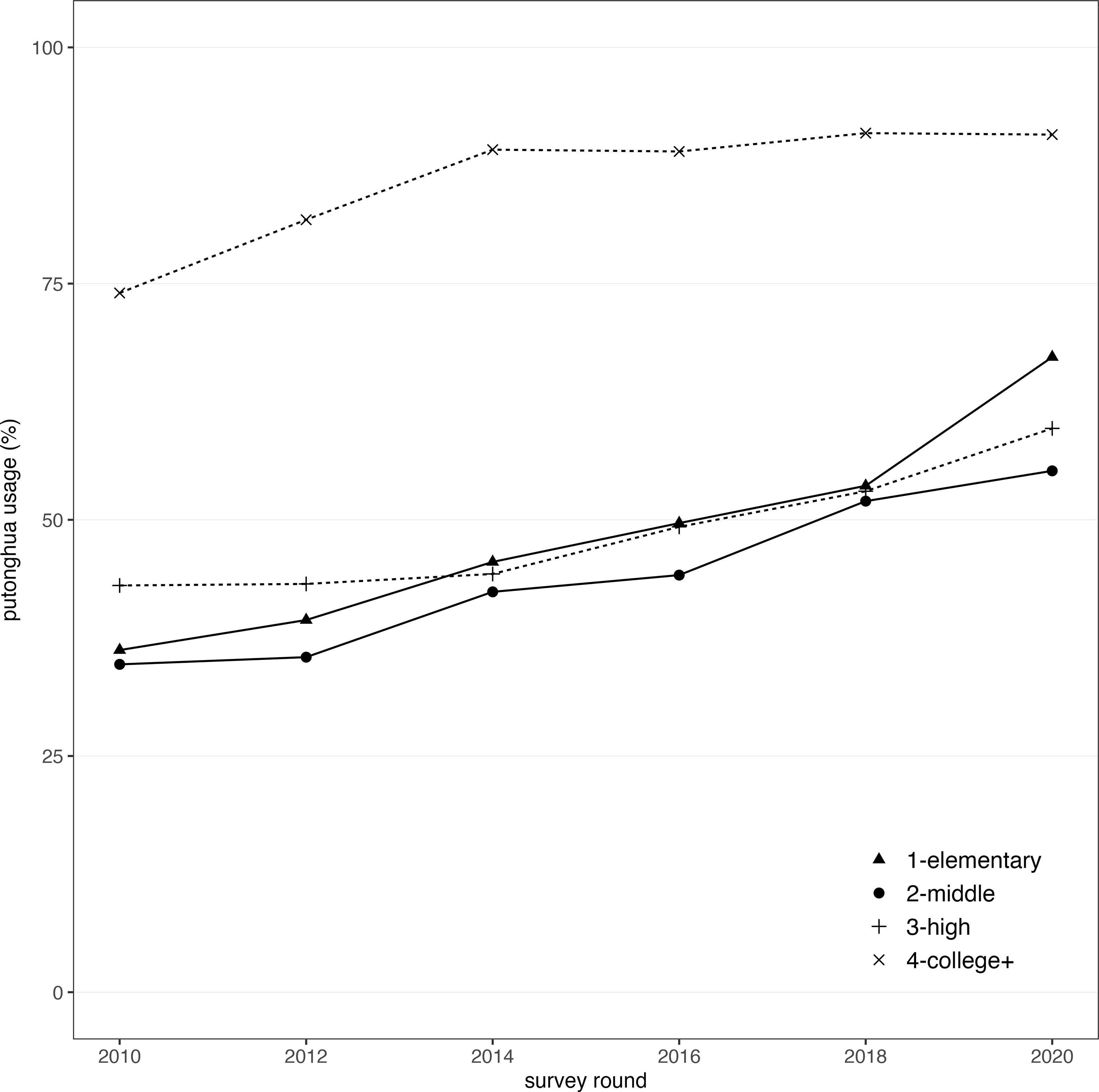
Despite variation in timing, the law was ultimately implemented nationwide and brought real changes to people’s daily lives, particularly in schools. Previously, many schools utilized regional languages or, less frequently, ethnic minority languages as their instructional language; putonghua was taught as a class subject. However, the 2001 law strongly mandated that putonghua should become the primary medium of instruction. The implementation particularly focused on elementary and middle schools, which constitute the compulsory education period in China. As depicted in Figure 2, the transformation was remarkable, especially at elementary schools. The percentage of elementary school fourth- to sixth-grade students primarily speaking putonghua at school was only 36.21 per cent in 2010, but soared to 67.22 per cent in 2020. Aligned with this trend, several interviewees from different provinces shared similar observations: in their extended families, which primarily speak dialects, only the younger members – roughly those born in the 2000s – speak putonghua even when others speak to them in dialects, likely because they use putonghua at school (Interviews R14-2023, R19-2023, R21-2023).
Percentage of students primarily speaking putonghua at school by survey round.
Note: created by author based on the 2010–20 China Family Panel Studies surveys. School language information was collected for students aged 10 and above (elementary fourth grade and above). On average across surveys, the information is available for 94.26 per cent of these individuals. Solid lines indicate the period of compulsory education, the primary realm of putonghua promotion efforts.

The political consequences of this dramatic shift in the language practice, however, remain to be examined. Through the lens of standard language promotion as a tool for autocrats, the subsequent sections investigate the impact of putonghua promotion on citizens’ government satisfaction in China.
Data and Methods
This study draws on quantitative analyses of large-scale survey data, complemented by original interviews with forty Chinese citizens conducted between 2023 and 2025. This section centers on the quantitative component. Further details on the interviews – which were invaluable for generating hypotheses, evaluating potential mechanisms, and obtaining contextual insights – are provided in the Supplementary Material.
Data
The main data source is the 2020 CFPS, supplemented by all previous rounds conducted biennially since 2010. The CFPS is a nationally representative, longitudinal survey of individuals and families in China, carried out by the Institute of Social Sciences Survey at Peking University. The survey covers twenty-five out of thirty-one province-level units (provinces, municipalities, and autonomous regions) in China, representing 95 per cent of the total Chinese population.Footnote 7 The initial 2010 survey conducted interviews with 42,587 individuals (33,597 adults and 8,990 youths) from 14,651 households across 162 counties. Subsequent surveys tracked the original respondents, with some attrition due to dropouts and deaths, and additions of new family members through marriage and births. The surveys ask an extensive array of questions, including education, marriage, employment, health, social interactions, and political attitudes (see Xie and Hu Reference Xie and Hu2014 for more information).
The CFPS stands out as the most suitable source for three reasons. First, it provides rich information about respondents’ language usage both at home (available in 2010–12 surveys) and at school (2010–20 surveys). The longitudinal structure of the dataset enables us to trace respondents’ language usage over time, and its household-based sampling approach helps distinguish language patterns at the family level. Secondly, with over 30,000 individuals, the CFPS offers a sufficiently large respondent pool for analysis. Finally, alongside the main analysis using the 2020 survey, consistent patterns arising in previous surveys (see the Supplementary Material) enhance confidence in the findings.Footnote 8
I focus on respondents who reside outside of ‘putonghua strongholds’ in northeastern regions, defined as counties where over 80 per cent of respondents reported putonghua as their primary home language in the 2010–12 surveys,Footnote 9 and whose mother tongue or family language is not putonghua. Furthermore, I restrict my analysis to cohorts who were just ahead of the impact of the school language reform and those who were among the earliest to experience the reform. This approach aims to minimize the influence of any generational variations in the outcome variables that cannot be attributed to the language reform. Specifically, I regard fourth to sixth grades in elementary school and seventh to ninth grades in middle school as focal points of the language reforms, roughly corresponding to ages 10–15.Footnote 10 Given that provincial regulations were adopted between 2002 and 2014 (see Figure 3), the narrowest window of analysis consists of individuals born between 1986 (age 16 in 2002; the youngest cohort who just missed the 2002 reform) and 2005 (age 9 in 2014; the oldest cohort who just experienced the 2014 reform). For the main analysis, I use this narrowest window of cohorts (bandwidth 0). For robustness checks, I add cohorts around the cut-offs to show that the results are not sensitive to specific bandwidths.Footnote 11
Constructing groups by provincial enactment and birth year.
Note: Xinjiang and Heilongjiang had issued relevant language regulations in 1993 and 1998, respectively, but promptly amended them following the 2001 Law. Except for these two cases, the years listed above indicate the issuance of first provincial regulations.

It should be noted that the timing of provincial enactment as depicted in Figure 3 does not show a systematic pattern. It is not correlated with provincial GDP per capita, the share of ethnic minority populations, or putonghua proficiency levels measured in 2000 just prior to the national enactment. Nor is it correlated with the degree of central control, proxied by whether the provincial party secretary concurrently held a position in the fifteenth (1997–2002) or sixteenth (2002–7) Politburo of the Chinese Communist Party. While the timing may not be purely random – likely reflecting a mix of factors (see section ‘Putonghua Promotion in China’) – the absence of any clear systematic pattern mitigates concerns that the estimated effects of putonghua promotion simply reflect underlying differences between earlier and later adopters (see the Supplementary Material for supporting analyses).
Key Variables
To identify causal effects of putonghua promotion, I focus on two explanatory variables. First, given the variation in the timing of provincial regulation adoption, I use a staggered difference-in-differences (DID) estimator, which captures individuals’ exposure to putonghua based on their province and cohort (hereafter referred to as putonghua cohort). Secondly, to account for variation in the extent to which the putonghua promotion mandate was actually implemented across localities, I interact this province- and cohort- specific treatment variable with a county-level compliance measure (compliance).Footnote 12
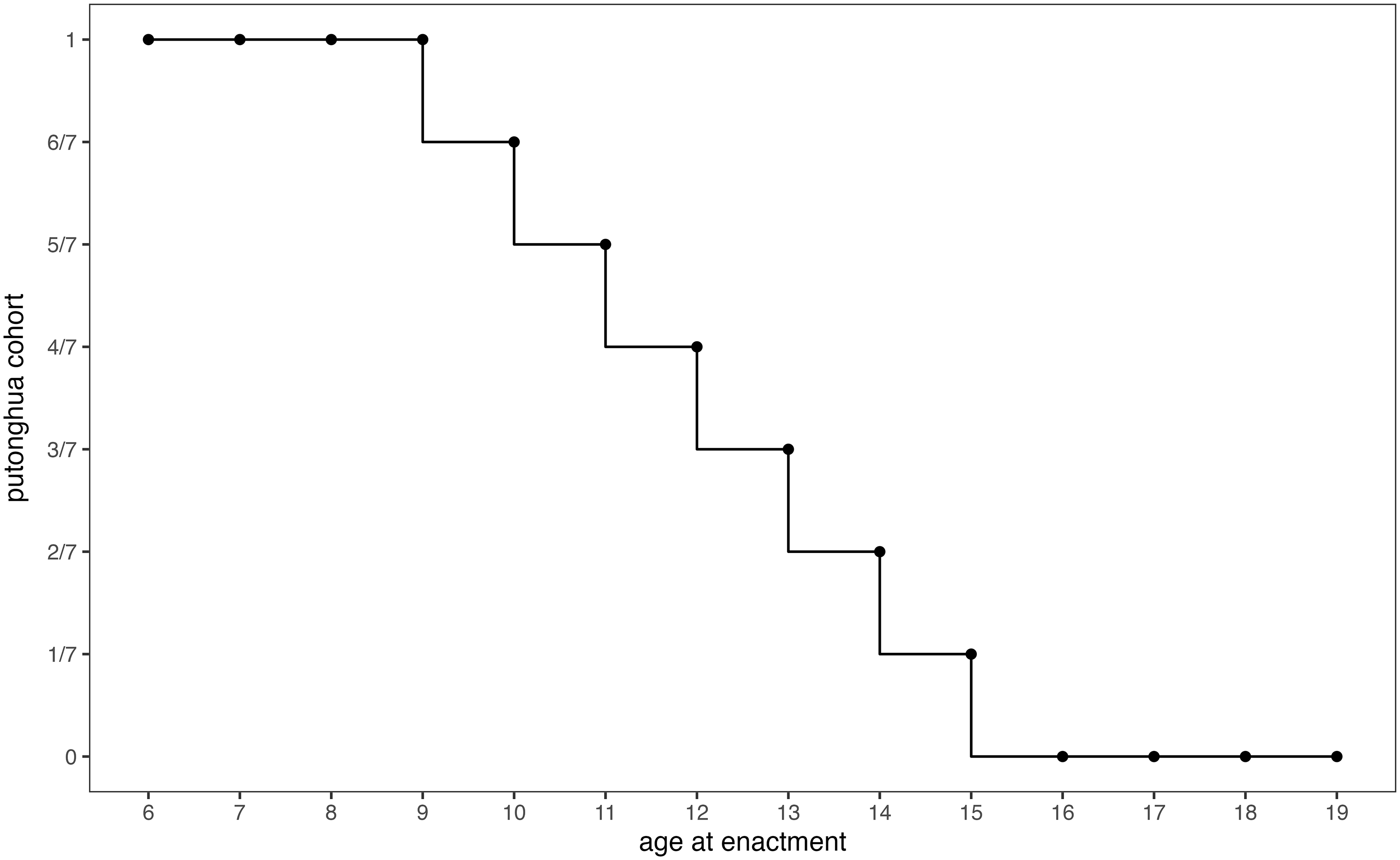
For the putonghua cohort variable, I leverage respondents’ age at the year of adopting the provincial regulation for implementing the 2001 law. Adapting Croke et al.’s (Reference Croke, Grossman, Larreguy and Marshall2016, 586–7) approach, I define those aged 9 or below, or those who have not reached the fourth grade, at the year of provincial enactment as ‘fully treated’ (putonghua cohort = 1) and those aged 16 or above, or those who have already surpassed the ninth grade, as an ‘untreated’ group that was not affected by the Law (putonghua cohort = 0). Those aged between 10 and 15 are considered ‘partially treated’, assigning a dosage of treatment that corresponds to the years of exposure to putonghua instruction. Figure 4 visualizes the coding scheme.Footnote 13 This scheme – comparing those who just qualified for the treatment (partially or fully) with those who just missed it – is the main source of exogenous variation.
Operationalization of putonghua cohort variable.
Note: the x-axis, age at enactment, refers to the age when the provincial regulation for the 2001 law was enacted. The y-axis, putonghua cohort, is 1 for fully treated subjects (age 9 or below), 0 for untreated subjects (age 16 or above), and fractional values ${67}, {57}, \cdots, {17}$
for partially treated subjects (age 10–15).
${67}, {57}, \cdots, {17}$
for partially treated subjects (age 10–15).

Next, the county-level compliance variable is introduced because the effect of putonghua promotion likely depends heavily on on-the-ground implementation. To measure compliance, I use data from the earliest CFPS survey on the prevalence of putonghua usage at elementary and middle schools, creating the following metric: $compliance_{c} = {{N^{putonghua}_{c,2010}} \over {N^{all}_{c,2010}}}.$
The numerator denotes the number of elementary and middle school students who reported putonghua as their primary school language in county c in 2010; the denominator denotes the total number of students who reported their school language in county c in 2010.Footnote 14 Across the 162 counties, the average number of student responses is 22.5.
Ideally, county-level compliance would be measured by the actual use of putonghua in classrooms during the years immediately following the adoption of provincial regulations, verified through administrative school-level records or direct surveys of teachers and students. However, the CFPS does not disclose county names, making it impossible to collect corresponding records; and even with the names, such data do not appear to be systematically available. The proposed metric serves as an innovative alternative, and its validity is supported by two pieces of evidence (see the Supplementary Material for supporting analyses). First, when aggregated to the province level, the 2010 measure strongly correlates with government statistics on putonghua proficiency in 2000 – just prior to the enactment of the national language law. This suggests that it captures pre-existing linguistic capacity and attitudes that likely shaped subsequent implementation, rather than simply reflecting the consequences of the reform itself.Footnote 15 Secondly, the 2010 measure also correlates with equivalent measures constructed from later surveys (2012–20), suggesting that it represents meaningful policy uptake rather than transitory fluctuations. Temporal patterns across five quantile-based county groups indicate that their relative ordering remains consistent over time, even as the absolute gap narrows with lower-compliance groups gradually catching up. This consistency supports that the 2010 measure captures a persistent dimension of local compliance.Footnote 16
The main outcome variable is citizens’ satisfaction with the government – in particular, its performance. Conceptually, this variable corresponds to Easton’s (Reference Easton1975) notion of ‘specific support’ (as opposed to ‘diffuse support’), which refers to ‘what the political authorities do and how they do it’ (437). Due to political sensitivity, the CFPS does not directly ask about respondents’ support for or trust in the regime or the central government, which instead corresponds to diffuse support. It does ask about citizens’ evaluations of government performance, which may be less sensitive. Despite the conceptual distinction, empirically, satisfaction with government performance – such as economic welfare and public goods provision – is often correlated with diffuse support (in China, Dickson et al. Reference Dickson, Landry, Shen and Yan2016; Tang Reference Tang2016; across Asian countries, Nathan Reference Nathan2020), rendering it a central outcome worth exploring in the context of authoritarianism.
For measurement, I use a set of eight questions concerning the perceived severity of various issues in the country, including government corruption, environmental protection, economic disparity, employment, education, medical service, housing, and social security.Footnote 17 These eight items constitute the entire set of CFPS questions on perceptions of domestic challenges and together provide a comprehensive view of citizens’ evaluations of government performance. Their explicit reference to the national scope, ‘problems in our country’, allows us to assess citizens’ evaluations of the central, rather than the local, government. The response scale ranges from 0 to 10, with 0 indicating no severity and 10 denoting extreme severity. To gauge the extent of positive evaluation while minimizing potential noise, I compute the average of eight variables and subtract this value from 10. Responses to these eight questions demonstrate positive correlations with each other, with a Cronbach’s alpha of 0.876. Results using each individual variable as an outcome appear in the Supplementary Material.Footnote 18
Estimation
For estimation, I interact two key explanatory variables as explained: first, the plausibly exogenous province- and cohort-specific exposure to putonghua promotion at school, and secondly, county-level compliance to the putonghua promotion mandate.Footnote 19 Specifically, I estimate the following regression equation: $\eqalign {y_{itpc} = & \beta _1 (putonghuacohort_{pt} \cdot compliance_c) + \beta _2 putonghuacohort_{pt} + \beta _3 compliance_c \cr & + {\bf X}^\prime _{itpc}\Gamma + \zeta _{c} + \mu _{t} + \epsilon _{itpc},}$
where y
itpc
is the outcome variable for individual i in province p, county c, and birth year t; putonghuacohort
pt
is the degree of exposure to putonghua by cohort determined by one’s province and birth year; and compliance
c
is the level of putonghua promotion by county. ${\bf X}^\prime _{itpc}$
is a vector of controls, including gender, ethnicity, urban or rural residency, parents’ highest education, and the family’s relative income level. ζ
c
and μ
t
denote fixed effects for county and birth year, respectively. County fixed effects absorb all time-invariant county characteristics, while birth-year fixed effects control for nationwide trends that affect all individuals in the same cohort. ϵ
itpc
is an idiosyncratic error. Standard errors are clustered at the county level.
${\bf X}^\prime _{itpc}$
is a vector of controls, including gender, ethnicity, urban or rural residency, parents’ highest education, and the family’s relative income level. ζ
c
and μ
t
denote fixed effects for county and birth year, respectively. County fixed effects absorb all time-invariant county characteristics, while birth-year fixed effects control for nationwide trends that affect all individuals in the same cohort. ϵ
itpc
is an idiosyncratic error. Standard errors are clustered at the county level.
The coefficient of interest is β 1, which captures the treatment effect of putonghua promotion depending on local compliance. In binary terms, the coefficient compares the degree of government satisfaction among individuals in treated cohorts to those in untreated cohorts, in high-compliance counties relative to low-compliance counties. Since individuals’ actual language usage at school does not appear in the equation, the coefficient can be interpreted as an intention-to-treat effect of putonghua promotion at schools.Footnote 20 The coefficient β 3 for county-level compliance is not estimated in the presence of county fixed effects; the variable is nonetheless included to allow for alternative specifications using province fixed effects, in which β 3 becomes estimable. Importantly, compliance is not correlated with government satisfaction. County-specific factors that may have influenced compliance levels are accounted for through county fixed effects in most models; additional county-level controls – GDP per capita and urban population share – are included in models with province fixed effects.Footnote 21
My estimation strategy extends the standard staggered DID framework in two key respects. First, rather than relying on a binary treatment assignment, it incorporates partial treatments to capture variation in the degree of overlap between policy adoption and individual schooling years. Secondly, it allows for treatment heterogeneity by interacting cohort- and province-specific exposure with local compliance. While the model explicitly incorporates observed treatment heterogeneity, recent studies have raised concerns about the causal interpretation of staggered adoption designs when treatment effects may change over time. In response, I present results in the Supplementary Material using a stacked DID design that partially mitigates these concerns.
Furthermore, in designs relying on plausibly exogenous cross-cohort variations, it is challenging to ensure that the estimated causal effect is truly attributable to the treatment of interest, and not cohort-specific trends or some other concurrent interventions. My approach effectively addresses this concern by directly adding birth-year fixed effects. As discussed, I also restrict the analysis to a narrow window of cohorts more comparable to each other and further demonstrate that the result is not sensitive to a specific choice of bandwidth.
Findings
Before presenting the main findings, I first show descriptive evidence regarding citizens’ government satisfaction based on the putonghua cohort and local compliance with the putonghua promotion mandate. To reduce noise for visualization, I reorganize the cohort into three-year segments, determined by the age of respondents at the time of adopting the provincial regulation. Specifically, I put respondents aged 1 to 3 at the time of adoption into one group, those aged 4 to 6 into another, and so on. I also divide local compliance levels into two groups: ‘high’ compliance for counties above the median of the sample, and ‘low’ compliance for those below the median. Figure 5 depicts the mean government satisfaction for each three-year grouping, for high- and low-compliance counties, respectively.
Government satisfaction by putonghua cohort and compliance.
Note: groups 1–3 (aged 16 and above at the time of provincial legislation), situated to the left of the left vertical line, were untreated by the reform. Groups 6–8 (aged 9 and below), situated to the right of the right vertical line, were fully treated. Groups 4–5 (aged 10–15), situated in between, were partially treated.

Among cohorts unaffected by the reform, government satisfaction is consistently lower in high-compliance counties compared to low-compliance counties, indicating a parallel trend (see the Supplementary Material for further details). However, in high-compliance counties, the satisfaction level markedly increases for cohorts partially affected by the reform and surpass that of low-compliance counties for cohorts fully affected by the reform. In contrast, satisfaction levels in low-compliance counties exhibit relatively mild changes across cohorts.
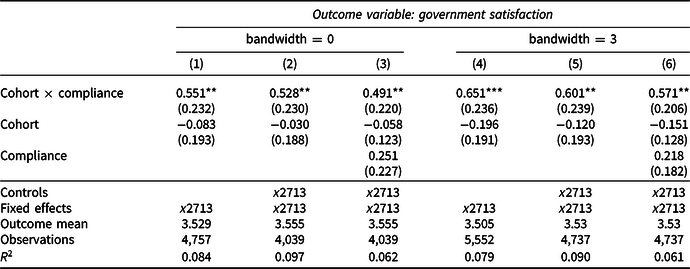
The main results regarding the effect of putonghua promotion on citizens’ government satisfaction are presented in Table 1. In Columns 1–3, I use a bandwidth of 0, covering individuals born between 1986 and 2005. For Columns 4–6, I use a bandwidth of 3, covering those born between 1983 and 2008. Columns 1 and 4 are reduced models without controls. Columns 2 and 5, my preferred specification, incorporate controls. Columns 3 and 6 add county-level controls, combined with province fixed effects. Across the models, the estimated effect of putonghua promotion ranges from roughly 0.50 to 0.60. Given the sample mean of roughly 3.5, the coefficients indicate that exposure to putonghua at school increases government satisfaction by about 15 per cent. Substantively, an effect of 0.5–0.6 means that, in counties with full compliance, individuals in the treated cohort report government satisfaction about 0.5–0.6 points higher than comparable individuals in the untreated cohort. To more directly link this interpretation back to the underlying survey items, which asked respondents to rate the severity of various problems in the country on a 0–10 scale, this 0.5–0.6 increase in government satisfaction corresponds to individuals viewing these governance problems – including government corruption, environmental protection, economic disparity, employment, education, medical service, housing, and social security – as 0.5–0.6 points less severe.
Effect of putonghua promotion on government satisfaction

Note: coefficients are estimated using ordinary least squares. For columns 2 and 5, control variables include gender, ethnic minority or not, urban or rural residency, parents’ highest education, and the family’s relative income level. For columns 3 and 6, they additionally include county GDP per capita (logged) and county urban population proportion. For columns 1, 2, 4, and 5, fixed effects are for county and birth year; standard errors are clustered by county. For columns 3 and 6, fixed effects are for province and birth year; standard errors are clustered by province. **p < 0.05; ***p < 0.01.
To better illustrate how the effect of putonghua cohort varies by compliance level, I further estimate the following modified regression equation: $y_{itpcg} = \sum _{q=1}^{5} \beta _q(putonghuacohort_{pt} \cdot compliance_{cq}) + {\bf X}^\prime _{itpc}\Gamma + \zeta _{c} + \mu _{t} + \epsilon _{itpc},$
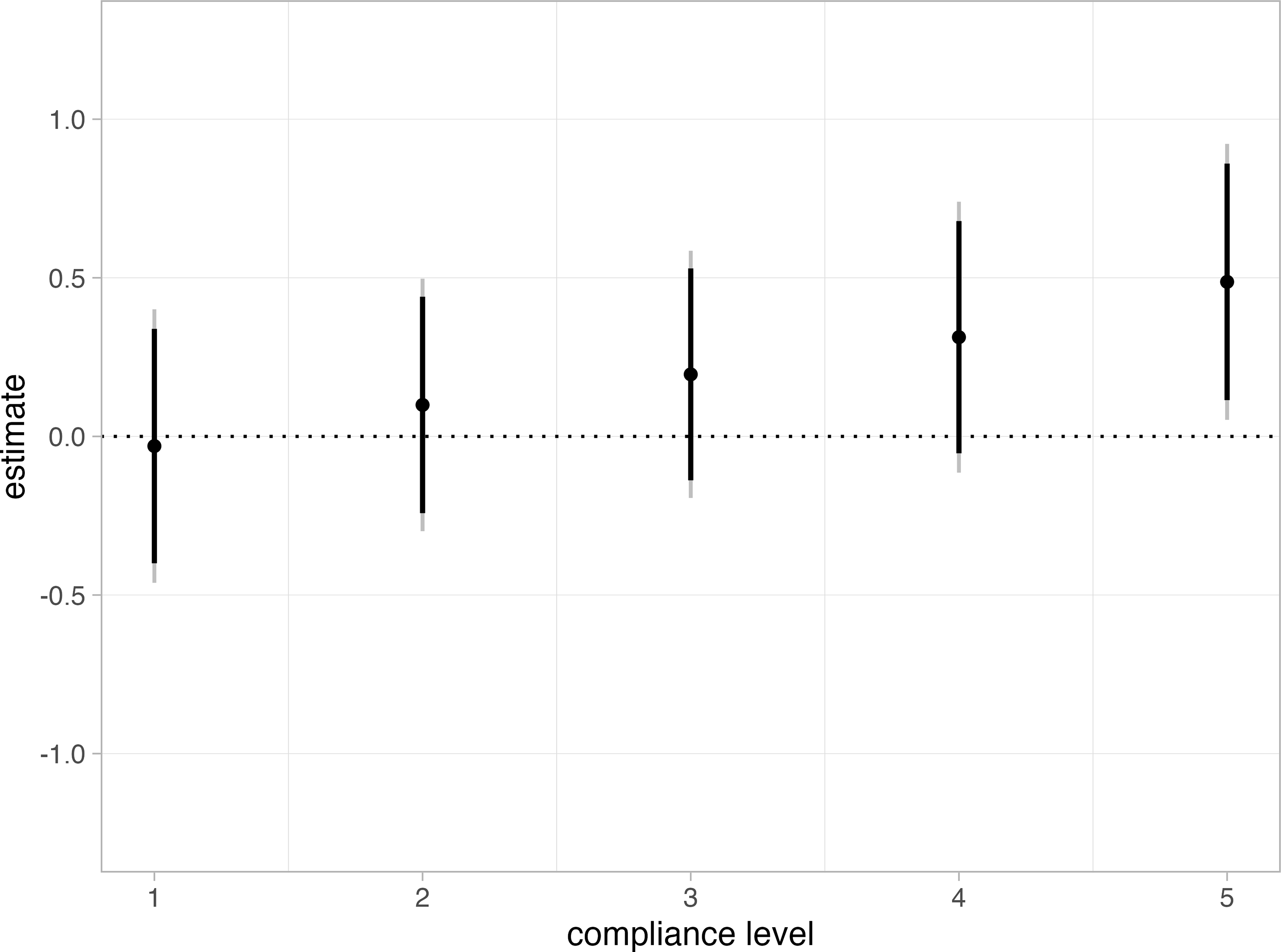
where q denotes quintiles of compliance levels. Figure 6 presents the results. Across the five compliance levels, the effects clearly exhibit an upward linear trend. This suggests that the putonghua promotion has negligible impact on government satisfaction in counties with lower compliance but effectively increases satisfaction in those with higher compliance. The effect becomes statistically significant at the highest compliance quintile.
Effect of putonghua promotion on government satisfaction by compliance levels.
Note: thick black lines represent 90 per cent confidence intervals, and thin gray lines represent 95 per cent confidence intervals. The cohort bandwidth is 0.

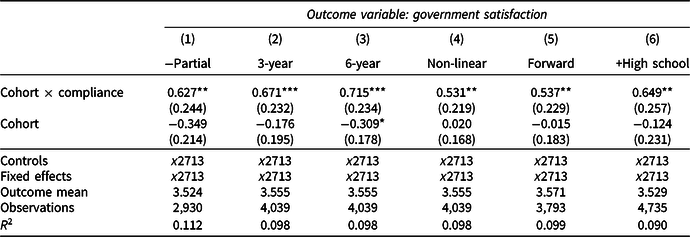
The findings remain robust across various alternative specifications, as presented in Table 2. In column 1, I exclude individuals categorized as partial treats (age 10–15). In columns 2–5, I employ alternative coding schemes for putonghuacohort
pt
. First, I lump three-year cohorts within the partial treatment category, allocating the value of 1/3 to ages 13–15 and 2/3 to ages 10–12. Secondly, I lump all six-year partial treats and assign 1/2. Thirdly, I assign non-linear values that decline quadratically, assuming that earlier exposure may have stronger effects ( $1-({{\rm age}-9}{7})^2$
). Finally, I shift the time frame by one year, categorizing individuals aged 17 and above (instead of 16) as untreated, and those aged 10 and below (instead of 9) as fully treated. This adjustment accommodates variations in the school entry age, typically 6 or 7. In column 6, I consider those attending high school at the time of adoption as partially treated rather than untreated and use the scale spanning from 1/10, 2/10, to 9/10. As further shown in the Supplementary Material, the findings remain robust to using (1) alternative compliance measures, (2) disaggregated government satisfaction indicators, (3) the stacked difference-in-differences approach, (4) various bandwidths of cohorts (0 to 10) included in the analysis, and (5) previous survey rounds.
$1-({{\rm age}-9}{7})^2$
). Finally, I shift the time frame by one year, categorizing individuals aged 17 and above (instead of 16) as untreated, and those aged 10 and below (instead of 9) as fully treated. This adjustment accommodates variations in the school entry age, typically 6 or 7. In column 6, I consider those attending high school at the time of adoption as partially treated rather than untreated and use the scale spanning from 1/10, 2/10, to 9/10. As further shown in the Supplementary Material, the findings remain robust to using (1) alternative compliance measures, (2) disaggregated government satisfaction indicators, (3) the stacked difference-in-differences approach, (4) various bandwidths of cohorts (0 to 10) included in the analysis, and (5) previous survey rounds.
Robustness checks results (bandwidth = 0)

Note: coefficients are estimated using ordinary least squares. Control variables include gender, ethnic minority or not, urban or rural residency, parents’ highest education, and the family’s relative income level. Fixed effects are for county and birth year. Coefficients for the (county-level) compliance variable are not shown as they are absorbed by county fixed effects. Standard errors are clustered by county. *p < 0.1; **p < 0.05; ***p < 0.01.
In the Supplementary Material, I show the heterogeneous effects between Han and ethnic minority respondents. The results suggest that the positive effect of putonghua promotion on government satisfaction is present for both groups.Footnote 22 However, since most ethnic minority respondents in the sample reside outside autonomous regions (see footnote 7), these results should not be generalized to all ethnic minority populations in China. I leave a more comprehensive examination of ethnic minorities’ responses to putonghua promotion for future research.
Mechanisms
Why might putonghua promotion at school increase government satisfaction? To explore the mechanisms, I now turn to individual-level evidence by utilizing school language records from all rounds of CFPS survey between 2010 and 2020.Footnote 23 Consistent with the main analysis, I focus on individuals who reside outside of putonghua strongholds and whose mother tongue is not putonghua. To preview, I find that early exposure to a putonghua-speaking environment at elementary and middle school is associated with increased consumption of political news via television, a key channel for state propaganda delivered exclusively in putonghua.Footnote 24
Some caveats are in order. First, compared to the main analysis, the individual-level analysis involves a slightly younger population, as it covers those who were attending elementary or middle school (fourth to ninth grades) during the period of the 2010–20 surveys. Language records from elementary school are largely available for those born between 1997 and 2010, and for middle school, between 1994 and 2007. Secondly, these findings do not establish causality. While the evidence is only suggestive, it provides useful insights into how the shift in the medium of instruction affects individuals’ behavioral patterns, which may influence their attitudes towards the government. In the Supplementary Material, I apply the main causal inference design to television political news consumption, which shows a statistically significant increase at the 0.10 level.
Television news remains one of the most powerful propaganda tools in China (Di Reference Di and Shirk2011; Pan et al. Reference Pan, Shao and Xu2022). Its content is regulated by the National Radio and Television Administration, which reports directly to the Propaganda Department of the Chinese Communist Party (Pan et al. Reference Pan, Shao and Xu2022). Sensitive topics never appear on television – more strictly than in books and newspapers – and even local news channels are closely supervised by propaganda departments at each administrative level (Di Reference Di and Shirk2011). Importantly, coverage of national news – more relevant to this study’s focus on citizens’ satisfaction with the (central) government – is effectively monopolized by China Central Television (CCTV). Each night at 7 p.m., CCTV’s flagship newscast, Xinwen Lianbo, is broadcast simultaneously across dozens of central and provincial channels. As of 2019, it drew about 55–60 million viewers – roughly 4.6 per cent of China’s 1.2 billion population (Pan et al. Reference Pan, Shao and Xu2022). The content, language, and format have remained largely unchanged over time (Huang Reference Huang2015), typically featuring government leaders’ activities and economic, social, and scientific achievements shown in a positive light.
In this context, television political news consumption may persuade viewers to hold positive evaluations of government performance. The influential studies by Huang (Reference Huang2015,Reference Huang2018) suggest that news programs in China, especially Xinwen Lianbo, are overtly propagandistic, serving less as instruments of persuasion than as signals of the government’s strength through the very act of propaganda. However, there is evidence that such programs can still be persuasive. For instance, Pan et al.’s (Reference Pan, Shao and Xu2022) experimental study shows that messages in the typical Xinwen Lianbo format can effectively sway people’s policy positions closer to the government through framing. Furthermore, Hu and Shao (Reference Hu and Shao2022) find that there is a non-trivial number of intentional viewers who, by watching the news, seek confirmation of social stability or exposure to positive stories such as the government’s anti-criminal or anti-corruption efforts and national achievements. Taken together, television news programs can – at least for some – change their views of the government or reinforce already-positive orientations towards it. Notably, so-called ‘soft propaganda’, such as emotional films and television dramas, has been found to foster more nationalistic attitudes but not necessarily more positive evaluations of government performance (Mattingly and Yao Reference Mattingly and Yao2022). By contrast, this study’s focus on television news makes it plausible that it influences citizens’ attitudes towards government performance. Consistent with this reasoning, the CFPS 2020 survey shows that political news consumption on television is positively associated with government satisfaction (p-value < 0.01).
The television news is delivered exclusively in putonghua. Interviews reveal two major observations in this respect. First, putonghua-exclusive television is less appealing to viewers not proficient in the language. An ethnic minority interviewee from south-central China noted that many elderly people in their neighborhood rarely watch television news because they neither understand the spoken language nor the subtitles in Chinese characters (Interview R21-2023). Another interviewee from a Cantonese-speaking region mentioned that they used to watch Hong Kong TV shows instead of Chinese state media, as these shows were in Cantonese and accessible in their area due to its proximity (Interview R18-2023).Footnote 25 Secondly, people also learn putonghua through watching television news. One interviewee mentioned that some parents intentionally turn on the news to expose their children to the most standard pronunciation of putonghua (Interview R17-2023). Additionally, several interviewees noted that although their parents’ generation may not be fluent speakers of putonghua, they have developed listening skills from watching television shows (Interviews R8-2023, S2-2023, S3-2024). This aligns with online discussions recommending television news as an effective method for improving putonghua skills.Footnote 26
Combined, I hypothesize that individuals exposed to a putonghua-dominant environment at school are more likely to consume television news either because of their heightened proficiency in putonghua or to enhance their putonghua skills. I test this hypothesis in two ways: one using cumulative records of elementary and middle school language from all 2010–20 surveys, and the other using current records from the 2020 survey. In the cumulative-record approach, I first identify individuals who attended elementary (middle) school during the survey period. I then code whether or not they reported putonghua as their primary language at least once during elementary (middle) school. Finally, I take unique individuals from all 2010–20 surveys, prioritizing their most recent responses. In the current-record approach, I simply focus on elementary and middle school students in the 2020 survey, coding whether or not they reported putonghua as their primary school language. For the outcome variable, I use a question on television political news consumption in the past week, with responses ranging from 0 to 7 days.Footnote 27 Among the individuals included in the analyses, the average consumption is approximately 1.5 to 1.7 days in a week.
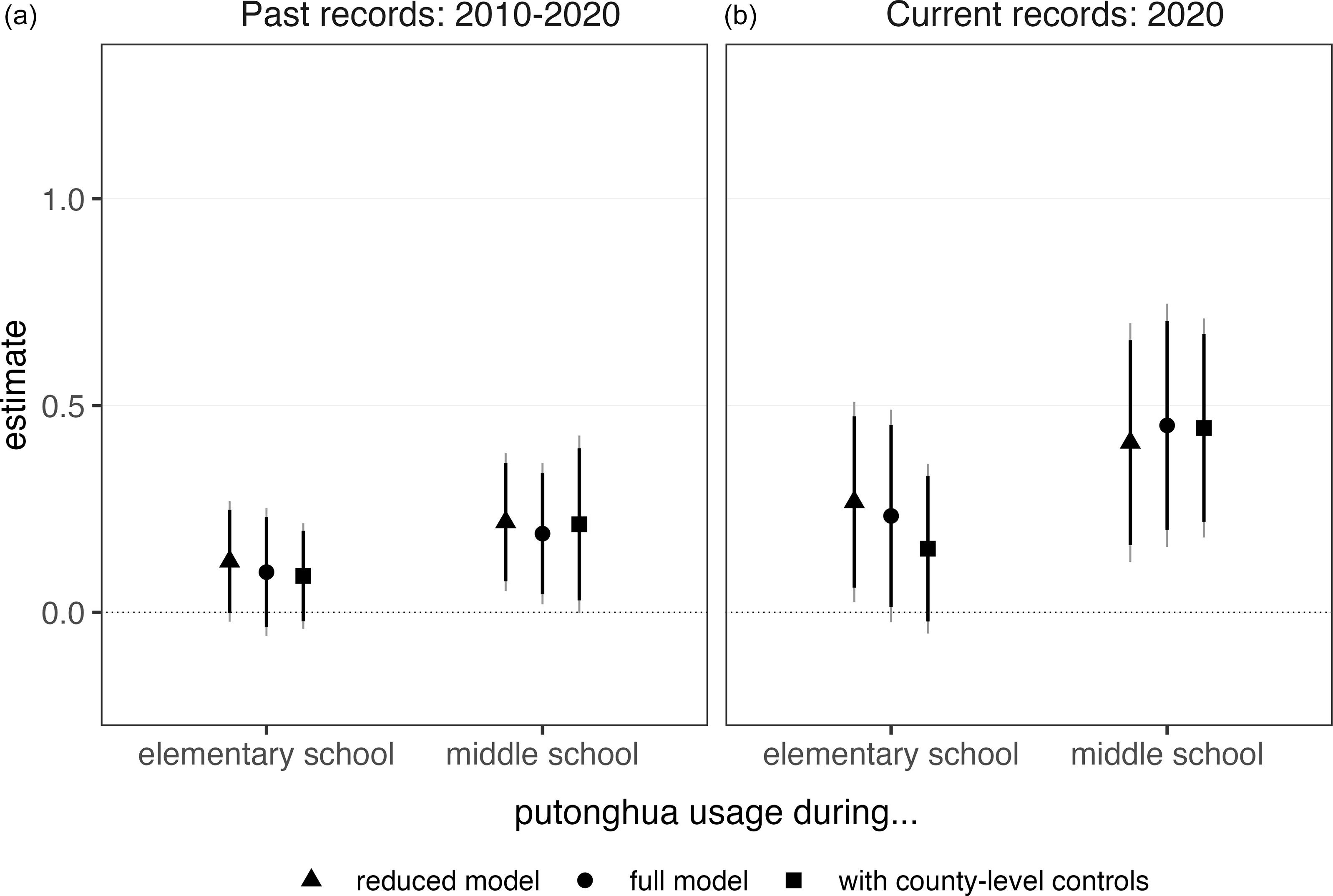
Effect of putonghua usage at school on TV political news consumption.
Note: for panel (a), I regress whether respondents reported putonghua as their primary language at least once during elementary and middle school, separately, on television news consumption. The reduced models omit controls. The full models incorporate controls: gender, ethnic minority or not, urban or rural residency, parents’ highest education, and the family’s relative income level. The reduced and full models include county, birth year, and survey fixed effects; standard errors are clustered by county. The models with county-level controls add counties’ GDP per capita (logged) and urban population proportion, with province, birth year, and survey fixed effects; standard errors are clustered by province. For panel (b), I regress whether respondents reported putonghua as their primary language at school, interacted by the school level (elementary or middle), on television news consumption. All other specifications are the same as panel (a), but with an additional control for the school level and without survey fixed effects.

Figure 7 visualizes the results. The estimates indicate that exposure to a putonghua-speaking environment during middle school – compared to during elementary school – has clear and statistically significant positive effects on television political news consumption. The effect is particularly pronounced when using the current records, as shown in panel (b): middle school students who currently primarily use putonghua at school consume political news via television approximately 0.45 days more in a given week than their peers who do not. Exposure during elementary school produces effects that are insignificant or marginally significant, yet the directions are consistently positive and aligned with the middle school estimates.
There exist at least two alternative mechanisms linking exposure to putonghua with government satisfaction: first, the reinforcement of national identity or nationalistic attitudes due to greater reliance on the country’s official language; and secondly, improved access to resources such as education that are available only to individuals proficient in putonghua. While I do not draw definitive conclusions regarding these mechanisms, I offer preliminary evidence that may guide future research (see the Supplementary Material for details). First, individuals’ exposure to putonghua in elementary and middle school does not appear to be associated with a stronger nationalistic attitude, as proxied by a question on anti-West sentiment, suggesting that this mechanism is less plausible.Footnote 28 Secondly, such exposure does appear to be positively associated with enrollment in post-secondary education – opening the door to high-income jobs and elite networks, lending more plausibility to this mechanism. Still, a thorough examination is needed to ascertain whether there is a causal relationship and whether this translates into greater satisfaction with the government, since education is also associated with more critical political attitudes in China.
Beyond education, improved access to other resources like government services – particularly those requiring interactions with street-level bureaucrats such as at community service centers, complaint centers, and police stations – represents another related mechanism, though this study does not directly explore it. In many government offices, signs read ‘Please speak putonghua’, and one interviewee noted that because her father is not proficient in putonghua, he lets her mother handle all public communication (Interview R36-2024). Such dependence likely reduces one’s ability to engage with government services and diminishes the chance of satisfactory first-hand experiences. Overall, the proposed mechanism of TV political news consumption does not exclude these alternative pathways; further research is needed to examine these dynamics more comprehensively.
Conclusion
Drawing on the case of China, I have argued that standard language promotion can serve as a tool for autocrats to increase citizens’ satisfaction with the government by expanding the reach of propaganda. The scope condition for this dynamic is that promotion efforts should primarily aim to facilitate communication rather than shape identity. Otherwise, imposing the language of a dominant group may result in lower regime support (White and Saikkonen Reference White and Saikkonen2023), generate resistance from ‘outsiders’ who do not speak it (Marquardt Reference Marquardt2018), or provoke backlash by strengthening subnational identities (Fouka Reference Fouka2019). Even in China, which has long emphasized facilitating communication across populations, resistance to putonghua promotion did exist – despite the generally positive effects on government satisfaction found in this study. One notable example is the ‘Protecting Cantonese Movement’ in Guangdong province in 2010. Following a proposal to replace Cantonese – a regional lingua franca in Guangdong and neighboring areas – with putonghua on local television channels, outraged citizens mobilized in a series of mass protests (Gao Reference Gao2012). Another example comes from the Inner Mongolia Autonomous Region in 2020. Despite a history of limited political mobilization (Han Reference Han2011), ethnic Mongols staged unprecedented protests against a curriculum reform reducing Mongolian-language instruction, with at least eight suicides reported during the unrest (Bulag Reference Bulag2020). These cases serve as cautionary examples: in China, too, efforts framed as communication-facilitating are not universally embraced, especially in regions with particularly strong regional identities.
Furthermore, recent changes in China suggest that a communication-facilitating focus may shift over time. Earlier campaigns were largely neutral and emphasized communication, with annual themes such as ‘Speaking Putonghua, Starting from Me’ in 1998 and ‘Putonghua: Link of Emotions, Bridge of Communication’ in 2004 (see Xu Reference Xu2021, 226–67, for a full list of annual promotion themes). Under Xi Jinping, who assumed power in 2012, these efforts became more nationalistic and closely tied to the ‘Chinese Dream’, Xi’s vision for the great rejuvenation of the Chinese nation, exemplified by the 2013 theme: ‘Promote Putonghua, Build the Chinese Dream Together’ (Xu Reference Xu2021). Since 2018, they have taken an even more ideological turn, with state authorities incorporating ‘Xi Jinping Thought on Socialism with Chinese Characteristics for a New Era’ as a guiding principle. The scope of these efforts has also expanded, targeting toddlers in preschools through the 2021 ‘Children Speak in Unison’ plan (PRC Ministry of Education 2021) and Cantonese-speaking residents of Hong Kong, a Special Administrative Region under growing central control (Government of Hong Kong SAR 2022). This shift in emphasis, combined with an expanded scope, raises the possibility of growing contention, particularly in regions with strong local identities.
To conclude, I would like to highlight several areas for future research. First, the distinction I have drawn between promotion efforts aimed at facilitating communication and at shaping identity may be less clear-cut in practice. Given individuals’ limited capacity, even communication-focused standard language promotion may inadvertently constrain the ability to master local languages, potentially leading to assimilation – and resistance. More research is needed in other contexts to understand when such efforts may falter. Secondly, the findings suggest that the positive effects of standard language promotion depend critically on local compliance with the promotion mandate. Future studies could explore what drives compliance, focusing on factors such as the strength of local culture, demographic composition, and government resources. Finally, it would be valuable to consider the broader effects of standard language promotion beyond propaganda. Citizens’ proficiency in the standard language may offer additional benefits and risks for autocrats: enhanced information gathering and censorship capabilities, but also increased capacity for collective action and greater access to non-local information. These dynamics deserve further exploration to deepen our understanding of the multifaceted implications of standard language promotion under authoritarian regimes.
Supplementary material
The supplementary material for this article can be found at https://doi.org/10.1017/S000712342610146X.
Data availability statement
The China Family Panel Studies (CFPS) datasets are publicly available upon registration with the CFPS data center (https://cfpsdata.pku.edu.cn/) and at Peking University’s Open Research Data Platform (https://opendata.pku.edu.cn/dataverse/CFPS). The CFPS restricted dataset, which contains county-level information for 2010, is available subject to approval from the CFPS data center. Replication codes for this paper can be found at https://doi.org/10.7910/DVN/AO47PF.
Acknowledgments
I thank the editors and anonymous reviewers for constructive feedback. For helpful comments, I thank Danny Choi, Natalia Garbiras-Diaz, Yue Hou, Yue Hu, Xinhui Jiang, David Laitin, Jaecheol Lee, Yifei Li, Jia Miao, Kevin O’Brien, Rachel Stern, Yuhua Wang, Xiaogang Wu, Soosun You, Yu Zeng, and Kaidi Zhu, as well as participants at NYU Shanghai’s Humanities and Social Sciences Colloquium, Nanjing University’s Political Science Research Workshop, and my panels at the American Political Science Association Annual Meeting (2023, 2024). For excellent research assistance, I thank Julie Wu and Jay Ye. Finally, I am grateful to all interviewees for sharing their time and experiences. I used AI tools to support language editing and refinement of the manuscript and take full responsibility for the content and accuracy of the final version.
Financial support
This work was supported by the author’s start-up and annual research funds provided by NYU Shanghai (2022–5).
Competing interests
None.
Ethical standards
The research was conducted in accordance with the protocols approved by the Institutional Review Board of NYU Shanghai (IRB approval #2023-057).
 ?”). See the Supplementary Material for more information about their average values and non-response rates.
 ?”).
?”). ?”).
?”). 80.72%
 . Available at
 . Available at
  . Available at





 Open access

