

Introduction
On March 11, 2020, The World Health Organization (WHO) declared the spread of a virus disease, COVID-19, a global pandemic. The disease first emerged in China in December 2019, but it rapidly spread to other parts of the world. In Europe, Spain and Italy were among the five countries most severely affected by the first wave of the pandemic (European Council, 2021). In response to the high infection rates, both countries implemented stringent restrictive measures, including confining families to their homes. In Italy, children were only permitted to leave their homes after 3 weeks (Ministero dell’Interno, 2020), whereas, in Spain, the restriction was even stricter, with children having to wait 6 weeks before being allowed to go outside (Orden SND/370/2020). In contrast, countries like Portugal, despite its geographical proximity, did not experience such high infection rates, and thus, confinement was less harsh for the population (Decreto do Presidente da República n.° 14-A/2020, de 18 de março). The pandemic brought about dramatic changes in daily life. It is important to note that, in response to psychosocial stressors, childhood and adolescence are vulnerable stages for the development of health problems (Cianfarani & Pampanini, Reference Cianfarani and Pampanini2023), including psychological issues (Magson et al., Reference Magson, Freeman, Rapee, Richardson, Oar and Fardouly2021; Ng & Ng, Reference Ng and Ng2022). In this context, confinement and subsequent restrictions aimed at reducing the risk of infection significantly disrupted children’s social interactions, leisure activities, and academic routines, since schools were closed for a time.
Although the measures implemented during the COVID-19 pandemic differed in Italy, Spain, and Portugal, confinement caused psychological distress in families across all three countries. Two weeks after the start of mandatory confinement, Orgilés et al. (Reference Orgilés, Morales, Delvecchio, Mazzeschi and Espada2020b) identified significant emotional and behavioral difficulties in Italian and Spanish children and adolescents, mostly concentration problems, boredom, irritability, and nervousness. Between March and April 2020, in a sample of Spanish, Italian, and Portuguese children, Francisco et al. (Reference Francisco, Pedro, Delvecchio, Espada, Morales, Mazzeschi and Orgilés2020) found that the psychological impact varied across countries in several domains. For instance, more Spanish children experienced changes in behavioral and concentration difficulties compared to Italian children. Additionally, while more Spanish children reported reduced appetite, they felt less lonely than before the pandemic compared to Italians and Portuguese. More Portuguese children were anxious and experienced sleep disturbances than their Italian and Spanish counterparts. The impact of confinement was mediated by various factors, including access to outdoor spaces at home and parental stress. Another factor associated with psychological impairment was coping. Emotion-oriented coping strategies were linked to a greater number of symptoms, particularly those related to anxiety, mood, and behavior, while the use of task- and avoidance-oriented coping strategies was related to less mood and anxiety symptoms, respectively (Orgilés et al., Reference Orgilés, Morales, Delvecchio, Francisco, Mazzeschi, Pedro and Espada2021). The relationship between emotion-oriented strategies and psychological symptoms varied by age group: they were more strongly associated with anxiety and behavioral issues in preschool children, with sleep disturbances in school-age children, and with mood problems in adolescents (Delvecchio et al., Reference Delvecchio, Orgilés, Morales, Espada, Francisco, Pedro and Mazzeschi2022). Subsequently, Orgilés et al. (Reference Orgilés, Francisco, Delvecchio, Espada, Mazzeschi, Pedro and Morales2022) examined the evolution of the psychological impact at 2, 5, and 8 weeks after the start of restrictive measures, revealing that the psychological impact evolved differently in each country. Italian children adapted better than Spanish and Portuguese children after 2 weeks of confinement, although they showed more symptoms after 8 weeks. Portuguese children, who did not face mandatory confinement like the others, but school closures, did not experience significant changes over time. Finally, Spanish children displayed a marked reduction in emotional symptoms at the 8-week follow-up.
Several works have been conducted to synthesize the existing literature and estimate the impact of COVID-19 confinement on the mental health of children and adolescents. A meta-analysis by Racine et al. (Reference Racine, McArthur, Cooke, Eirich, Zhu and Madigan2021), with studies conducted during 2020 and covering more than 80,000 children, estimated overall prevalence rates of clinically elevated symptoms of anxiety (20.5%) and depression (25.2%), which were double the rates seen before the pandemic. The meta-analysis by Bussières et al. (Reference Bussières, Malboeuf-Hurtubise, Meilleur, Mastine, Hérault, Chadi, Montreuil, Généreux, Camden, Roberge, Lane, Jasmin, Kalubi, Bussiéres, Hurtubise, Bach, Chrysagis, Turner, Gauvin and Hérault2021), involving over 14,000 children, demonstrated a significant association between lockdown and negative mental health outcomes, with effect sizes being larger in Europe compared to Asia. Similarly, Panchal et al. (Reference Panchal, Salazar de Pablo, Franco, Moreno, Parellada, Arango and Fusar-Poli2023), in a review of studies involving 55,000 children, identified common psychological difficulties such as anxiety, depression, irritability, and sleep and eating disturbances. Nevertheless, despite the lifting of lockdown measures and the reopening of schools, social distancing measures—such as wearing face masks, limiting social contact, reducing leisure activities, and even imposing new periods of confinement—were still present. For instance, in Spain, Vallejo-Slocker et al. (Reference Vallejo-Slocker, Sanz, García-Vera, Fresneda and Vallejo2022) reported a worsening in the proportion of Spanish vulnerable children and adolescents exhibiting abnormal behavioral, emotional, and peer-related problems 1 year after the beginning of the pandemic, which was preceded by their finding of increased psychological symptoms compared to a 2017 national survey (Vallejo-Slocker et al., Reference Vallejo-Slocker, Fresneda and Vallejo2020). Various international longitudinal studies have been conducted to examine the evolution of psychological effects following the initial confinement. In a review by Wolf and Schmitz (Reference Wolf and Schmitz2024), the authors observed a general trend of increased mental health problems and decreased psychological well-being in children and adolescents after the onset of the COVID-19 pandemic. Similarly, Orban et al. (Reference Orban, Li, Gilbert, Napp, Kaman, Topf, Boecker, Devine, Reiß, Wendel, Jung-Sievers, Ernst, Franze, Möhler, Breitinger, Bender and Ravens-Sieberer2023) reported a consistent increase in internalizing symptoms, such as anxiety and depression, even over a year after the pandemic began, though findings were mixed regarding externalizing problems. For instance, one study reported an increase in aggressive behavior among Italian and Austrian schoolchildren between March and December 2020 (Wenter et al., Reference Wenter, Schickl, Sevecke, Juen and Exenberger2022), whereas another study involving Portuguese and Italian adolescents found no significant change in externalizing difficulties between late-2020 and mid-2021 (Martinsone et al., Reference Martinsone, Stokenberga, Damberga, Supe, Simões, Lebre, Canha, Santos, Santos, Fonseca, Santos, Gaspar de Matos, Conte, Agliati, Cavioni, Gandellini, Grazzani, Ornaghi and Camilleri2022).
Although available evidence confirms that the initial confinement and subsequent months of restrictions had negative effects on the mental health of children and adolescents, knowledge about whether these effects persisted over longer periods remains limited. According to Wenter et al. (Reference Wenter, Schickl, Sevecke, Juen and Exenberger2022), internalized and aggressive symptoms in children aged 7–13 were higher in December 2021 than in March 2020. However, the study by Ravens-Sieberer et al. (Reference Ravens-Sieberer, Devine, Napp, Kaman, Saftig, Gilbert, Reiß, Löffler, Simon, Hurrelmann, Walper, Schlack, Hölling, Wieler and Erhart2023), conducted from September to October 2022, showed that, while mental health 3 years later was worse than before the pandemic, it had improved compared to earlier assessments during the COVID-19 time. Similarly, Blackwell et al. (Reference Blackwell, Wu, Chandran, Arizaga, Bosquet Enlow, Brennan, Burton, Bush, Cella, Cummins, D’Sa, Frazier, Ganiban, Gershon, Koinis-Mitchell, Leve, Loftus, Lukankina, Margolis and LeWinn2024) reported minor decreases in externalizing problems and anxiety by August 2022 compared to March 2020, despite a slight increase in depressive symptoms. These findings suggest that, despite some alleviation of symptoms as restrictions eased and the pandemic emergency subsided, psychological disturbances may have persisted over time.
However, to the best of our knowledge, studies published to date have only tracked psychological symptoms up to 2022. Given that the WHO (2023) declared the official end of the pandemic in May 2023, with a progressive lifting of restrictions by governments, it is crucial to examine changes in psychological symptoms in children and adolescents up to this point and beyond. Therefore, the primary aim of this research is to assess the evolving psychological impacts during and after the COVID-19 health crisis on children residing in countries with varying levels of restrictions—Italy, Spain, and Portugal. The study covers five distinct time points: 2 weeks (Time 1: March 2020), 5 weeks (Time 2: April 2020), 8 weeks (Time 3: April 2020), 6 months after the start of the lockdown (Time 4: September 2020), and three and a half years later (Time 5: September 2023). The specific objectives of the study are as follows: (1) to examine fluctuations in children’s psychological well-being, including areas such as anxiety, mood, sleep, behavior, eating, and cognition, across the aforementioned time intervals; (2) to analyze the progression of psychological effects in children from each country at the five-time points; and (3) to explore the interaction between each country and the time of measurement with regard to children’s psychological symptoms.
Methods
Participants
Throughout the study, parents of 1613 children aged 3–17 years old participated at least once (n = 812 in Italy, n = 338 in Spain, and n = 463 in Portugal). The sample is described in Table 1. The average age of children was 10.01 years old (SD = 4.36), with 39.2% being girls. Italian and Portuguese children were significantly older than Spaniards but with a low effect size. Regarding parents, most of them were female, married, had undergraduate studies and the monthly family income was, with a similar proportion, of €1,000–1,999 and €3,000–4,999. Differences between countries were also studied. No Portuguese parents had Primary studies, while in the other countries there were. More Italian parents had Secondary studies, and less had Doctoral or Master studies than Spanish and Portuguese. No more differences were found across the sociodemographic variables studied.
Sample characteristics and equivalence by country (N = 1613)

Note: M = Mean, SD = Standard Deviation.
a Cross-table (χ2) for categorical variables, and Kruskal–Wallis (χ2) for continuous variables.
b Effect size = Cramer’s V for multi-categorical variables, and Epsilon-squared for continuous variables.
*** p ≤.001,
* p ≤ .05.
Procedure
The research received approval from the Ethics Board of Miguel Hernández University of Elche (2017.266.E.OEP; 2018.71.E.OIR). Participants were recruited through social media platforms such as Facebook, LinkedIn, and Instagram, as well as through the researchers’ personal contacts via email, employing a snowball sampling approach. An online survey tailored specifically for this study was created and disseminated in each respective country using Qualtrics or Google Forms platforms. Following the initial screening, families were contacted via email. Due to restrictions posed by the COVID-19 pandemic, in-person assessments were not allowed, making it necessary to develop an online survey customized for this research. Prior to every survey completion, participants were informed on the study’s objectives and requested to provide informed consent for participation. Data collection occurred across all three countries employing a snowball sampling method at five-time points, using a longitudinal design: 2 weeks (Time 1: March 2020), 5 weeks (Time 2: April 2020), 8 weeks (Time 3: April 2020), 6 months after the start of lockdown (Time 4: September 2020), and a fifth follow-up three and a half years later (Time 5: September 2023). The survey completion time was about 20 min. At each time point, new participants were welcomed, along with those who had previously participated but dropped out during earlier assessments (see Figure 1 for the participant numbers in each assessment).
Flowchart for participants of the study.

Throughout the first two assessments, both Italy and Spain were subjected to mandatory confinement measures. By Time 3, Italy transitioned into a less stringent phase, permitting access to parks and visits to relatives, while Spain allowed children to go outdoors for 1 h daily but maintained closures of public spaces and gardens. Portugal, instead, recommended home confinement throughout the entire study period, without enforcing a mandatory rule. Notably, schools remained closed in all three countries during Times 1–3. By Time 4, all children had returned to schools in all countries. During the fifth assessment, the situation was completely normal, as it was before the pandemic.
Measures
The study involved parents residing in Italy, Spain, and Portugal, with children aged 3–17 in the first assessment. They participated in an online survey, providing information on sociodemographic factors for both them and their children, along with psychological symptoms in their children related to the COVID-19 pandemic, including anxiety, mood, sleep disturbances, behavioral difficulties, eating problems, and cognitive changes.
Sociodemographic factors comprised the informant’s (father or mother) age, sex, educational level, marital status, monthly family income, and the child’s age and sex. Psychological symptoms in children were evaluated using the Psychological Impact of COVID-19 and Confinement on Children and Adolescents scale (Orgilés et al., Reference Orgilés, Morales and Espada2020). The scale assessed the extent of various symptoms compared to pre-quarantine levels, with items covering anxiety, mood, sleep, behavior, eating, and cognitive domains. Response options ranged from 1 (much less compared to quarantine/pandemic) to 5 (much more compared to quarantine/pandemic), with scores of 4 and 5 indicating symptom worsening during pandemic. Francisco et al. (Reference Francisco, Pedro, Delvecchio, Espada, Morales, Mazzeschi and Orgilés2020) provided validity evidence for this instrument with anxiety (SCAS-P) and depression (SMFQ-P) measures. Symptom exacerbation during pandemic was quantified by summing the number of symptoms worsened across six areas: anxiety (e.g., “is nervous” and “is easily alarmed”) (McDonald’s ω = .87), mood (e.g., “is sad”) (McDonald’s ω = .82), sleep (e.g., “has nightmares”) (McDonald’s ω = .89), behavior (e.g., “argues with the rest of the family”) (McDonald’s ω = .74), eating (e.g., “eats a lot”) (McDonald’s ω = .45), and cognition (e.g., “has difficulty concentrating”) (McDonald’s ω = .70). The total scale reliability was excellent (McDonald’s ω = .95). Each factor represented the cumulative symptoms worsened by each child during and after the COVID-19 pandemic (e.g., a score of 3 in the anxiety subscale indicated worsening in three anxiety symptoms during the pandemic).
Statistical Analyses
Non-parametric tests were employed due to the non-normal distribution of variables, as indicated by the Kolmogorov–Smirnov test (p-value < 0.05). Sociodemographic variable equivalence across samples from the three countries was examined using chi-squared tests for categorical variables and Kruskal–Wallis tests for continuous variables. Statistically significant comparisons’ effect sizes were evaluated using Cramer’s V for multi-categorical variables and Epsilon-squared (ε2) for continuous variables. The interpretation of Cramer’s V considered values > 0.25 as very strong, > 0.15 as strong, > 0.10 as moderate, > 0.05 as weak, and > 0 as none or very weak (Akoglu, Reference Akoglu2018). Epsilon-squared (ε2) interpretation considered small effect sizes ranging from 0.01 to < 0.08, medium effect sizes ranging from 0.08 to < 0.26, and large effect sizes from 0.26.
Binary logistic regression analyses were employed to examine differences between participants who dropped out of the study in any of the assessments across the analyzed variables (anxiety, mood, sleep, behavioral disturbances, eating disturbances, and cognitive disturbances) compared to those who remained in the study. Dropout rates were also investigated by country.
Repeated measures models (considering the five temporal moments) of generalized estimation (GENLIN) were employed to analyze the evolution of psychological symptoms (anxiety, mood, sleep, behavioral disturbances, eating disturbances, and cognitive disturbances) across time. Country and time were introduced as independent variables. Variables in which there were differences among the three countries were included as covariates to control for their effect. Estimated marginal means of psychological reactions (anxiety, mood, sleep, behavioral disturbances, eating disturbances, and cognitive disturbances), considering independent categorical variables (time and country), were calculated. All participants’ measurements were included, even if they had not responded to all five assessments, with group comparisons at each time point. Statistical significance was determined at a p value of < 0.05. The data were analyzed using the SPSS v28.00 program for Windows. Jamovi 2.3.2 was used to calculate the reliability of the instruments with the study sample, specifically McDonald’s ω (McDonald, Reference McDonald1999). Unlike Cronbach’s alpha, McDonald’s ω works with factor loadings and provides a more adjusted estimation of reliability (Ventura-León & Caycho-Rodríguez, Reference Ventura-León and Caycho-Rodríguez2017).
Results
Attrition
Figure 1 shows that the initial assessment involved 1012 parents of children aged 3–17 years. In the second assessment, the retention rate was 33.3% (n = 537); in the third, 27% (n = 435); in the fourth, 42.6% (n = 687); and in the final assessment, 28.7% (n = 463).
There were no statistically significant differences between participants who dropped out of the study and those who continued across times, except for cognitive symptoms in the second (OR = 1.32, 95% CI: 1.02, 1.70, p = .03), third (OR = 1.28, 95% CI: 1.01, 1.63, p = .05), and fourth assessment (OR = 1.49, 95% CI: 1.15, 1.94, p = .002). Parents with children and adolescents exhibiting a higher number of cognitive symptoms at baseline tended to remain in the study compared to others.
Retention rates differed by country. The retention rate was higher in Italy and Spain compared to Portugal in the second (χ2 = 16.47, p < .001, Cramer’s V = .10) and third assessments (χ2 = 37.15, p < .001, Cramer’s V = .15). However, retention rates were higher in Spain and Portugal compared to Italy in the fourth (χ2 = 350.41, p < .001, Cramer’s V = .46) and fifth assessments (χ2 = 46.89, p < .001, Cramer’s V = .17).
Evolution of Psychological Effects across Time on Children from Italy, Spain, and Portugal, and the Total Sample (Tables 2 and 3)
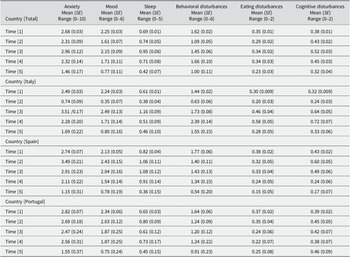
Italy
Compared to T2, a significantly larger proportion of parents at T5 reported a worsening in mood and behavioral symptoms relative to the pre-pandemic period. Compared to T3, significantly lower levels of anxiety, sleep, eating, and cognitive disturbances were reported at T5. Compared to T4, parents at T5 reported significantly lower symptoms of anxiety, sleep, behavioral, eating, and cognitive disturbances. In Italy, no significant changes were observed in other symptoms, nor between T1 (2 weeks after the start of the pandemic) and T5. These findings suggest that the initial worsening due to the pandemic was less pronounced 5 weeks after the pandemic began than three and a half years later. However, by this latest time point, mental health had improved compared to 8 weeks of lockdown and the reopening of schools. No significant difference in mental health outcomes was observed between 2 weeks of confinement and the end of the pandemic.
Spain
At T5, a significant reduction in the perceived worsening of anxiety, behavioral, eating, and cognitive disturbances was observed compared to T1 and T3. Relative to T2, all domain levels were significantly lower at T5. Additionally, the worsening of sleep, eating, and cognitive disturbances at T5 was reported as significantly lower than at T4. Although the marginal means at T5 represented the lowest scores in the Spanish data across all domains, no other significant differences were found compared to the means at the other time points. These results suggest that, once the pandemic situation had fully stabilized, mental health outcomes were better than at any of the previous time points.
Portugal
Anxiety and sleep symptoms were reported as significantly worse 2 weeks after the start of the pandemic (T1) compared to T5. A significant reduction in anxiety, mood, sleep, and behavioral disturbances was also observed from T2 to T5. Compared to T3, sleep difficulties significantly decreased at T5, although cognitive disturbances increased. Lower anxiety levels were reported at T5 compared to T4, but eating and cognitive difficulties were higher. No other significant differences were found. These results suggest a general reduction in internalizing and externalizing problems three and a half years after the start of the pandemic but also indicate some increases in cognitive and eating impairments compared to 8 weeks and 6 months into the pandemic.
Total Sample
Anxiety levels significantly decreased at T5 compared to all earlier assessments, as observed in Table 2. From a mean of 2.68 (SE = 0.03) in anxiety at T1, and reaching its peak at T3 (Mean = 2.96, SE = 0.12), it reduced to 1.46 (SE = 0.17) at T5, suggesting a considerable reduction in anxiety levels three and a half years after the onset of the pandemic. Mood-related symptoms decreased significantly at T5 compared to all previous assessments. From a mean of 2.25 (SE = 0.03) at T1, it decreased to 0.77 (SE = 0.11) at T5. These results indicate a significant reduction in emotional difficulties three and a half years after the onset of the pandemic. Sleep problems were more prevalent during T3, with a mean of 0.95 (SE = 0.06), and significantly decreased at T5 (Mean = 0.42, SE = 0.07). Behavioral problems significantly decreased at T5 (Mean = 1.00, SE = 0.11) compared to T2 (Mean = 1.09, SE = 0.05) and T4 (Mean = 1.66, SE = 0.10). Eating and cognitive disturbances also significantly decreased at T5 (Mean = 0.23, SE = 0.03 and Mean = 0.32, SE = 0.04, respectively) compared to T3 (Mean = 0.34, SE = 0.02 and Mean = 0.52, SE = 0.03, respectively) and T4 (Mean = 0.34, SE = 0.03 and Mean = 0.45, SE = 0.03, respectively).
Estimated marginal means of child psychological reactions for total sample and country

Note: SE = Standard Error.
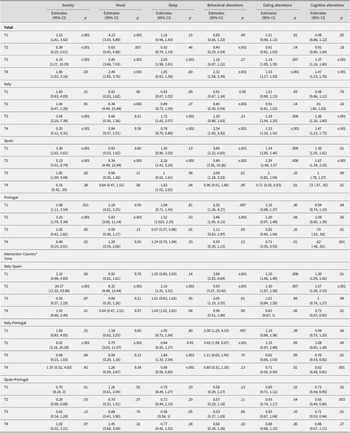
Child psychological reactions: Repeated measures data analysis using the GEE Model for total sample, countries, and interactions between time and country

Note: T5 is the category of comparison.
Differences between Countries across Time
The differences in anxiety symptoms between T5 and the other time points revealed a significant Country*Time interaction at T2 among the three countries. The reduction in anxiety from T2 to T5 was steepest in Spain, followed by Portugal and then Italy, indicating differences in anxiety symptoms at T2 across the three countries.
Mood difficulties followed a similar trend, with a significant interaction between T2 and T5 when comparing Spain and Portugal with Italy. While Spain and Portugal showed reductions by T5, mood difficulties increased in Italy, suggesting that mood problems were higher in Spain and Portugal than in Italy at T2.
Regarding sleep difficulties, a significant interaction was observed between Spain and Italy at T2, with Spain showing a larger difference and reduction. Interactions were also found between Italy and Portugal at T3, with Italy showing major decreases by T5. Another significant interaction occurred at T4, comparing Spain and Portugal with Italy, where the reductions in sleep difficulties were steeper in Spain and Portugal. These results suggest that sleep difficulties were higher in Spanish children and adolescents compared to Italians at T2, higher in Italians compared to Portuguese at T3, and higher in Spaniards and Portuguese compared to Italians at T4.
Regarding behavioral difficulties, changes from T1 to T5, as well as from T2 to T5, differed between Spain, Portugal, and Italy, with Spain and Portugal showing higher reductions in behavioral problems than Italy at T5 compared to T1 and T2. Moreover, at T3, Spain showed a greater reduction than Italy, with no significant differences compared to Portugal.
For eating disturbances, significant interactions were found between T1, T2, and T5, with Italy showing a larger reduction compared to Spain. A significant interaction also emerged in the T4–T5 comparison between Italy and Portugal, with a larger reduction observed in Italy. These results suggest that eating disturbances were more pronounced in Spain compared to Italy at T1 and T2, but higher in Italy compared to Portugal at T4.
Cognitive disturbances also demonstrated significant Country*Time interactions. When comparing T5 with T1 and T2, Spain showed greater changes compared to Portugal and Italy, with a reduction. Between T3 and T5, the changes significantly differed between Italy and Spain in comparison to Portugal, also with a reduction. By T4, the changes leading to T5 were different in Italy compared to Portugal and Spain. These findings suggest that Spanish children exhibited more cognitive difficulties than their Portuguese and Italian counterparts at T1 and T2. At T3, the worsening was more pronounced in Italian and Spanish children compared to Portuguese children, while at T4, it was greater in Italians than in Spaniards and Portuguese.
Discussion
The main purpose of this study was to investigate the progression of the psychological impact of the COVID-19 pandemic on children and adolescents across three European countries (Italy, Spain, and Portugal). To achieve this, various psychological symptoms were assessed longitudinally at five distinct time points, with the final assessment conducted as a follow-up three and a half years after the onset of the pandemic.
The findings of this study indicate a significant and widespread reduction in psychological symptoms in the overall sample three and a half years after the pandemic began, in comparison to previous assessments. A substantial body of research has documented that psychological symptoms among children and adolescents generally increased during the pandemic, compared to pre-pandemic levels (Bussières et al., Reference Bussières, Malboeuf-Hurtubise, Meilleur, Mastine, Hérault, Chadi, Montreuil, Généreux, Camden, Roberge, Lane, Jasmin, Kalubi, Bussiéres, Hurtubise, Bach, Chrysagis, Turner, Gauvin and Hérault2021; Ma et al., Reference Ma, Mazidi, Li, Li, Chen, Kirwan, Zhou, Yan, Rahman, Wang and Wang2021; Nearchou et al., Reference Nearchou, Hennessy, Flinn, Niland and Subramaniam2020; Ng & Ng, Reference Ng and Ng2022; Orban et al., Reference Orban, Li, Gilbert, Napp, Kaman, Topf, Boecker, Devine, Reiß, Wendel, Jung-Sievers, Ernst, Franze, Möhler, Breitinger, Bender and Ravens-Sieberer2023; Panchal et al., Reference Panchal, Salazar de Pablo, Franco, Moreno, Parellada, Arango and Fusar-Poli2023; Racine et al., Reference Racine, McArthur, Cooke, Eirich, Zhu and Madigan2021; Wolf & Schmitz, Reference Wolf and Schmitz2024). However, few studies have tracked the evolution of these symptoms after governments and the WHO declared the pandemic over. In the present study, we found a general improvement in psychological difficulties three and a half years after the pandemic began, following the lifting of all restrictive measures, compared to earlier periods when these difficulties were worse. Several studies have linked the deterioration of mental health in children and adolescents to the restrictive measures implemented during the pandemic, such as lockdowns and quarantines (Brooks et al., Reference Brooks, Webster, Smith, Woodland, Wessely, Greenberg and Rubin2020; Orban et al., Reference Orban, Li, Gilbert, Napp, Kaman, Topf, Boecker, Devine, Reiß, Wendel, Jung-Sievers, Ernst, Franze, Möhler, Breitinger, Bender and Ravens-Sieberer2023; Pearcey et al., Reference Pearcey, Shum, Raw, Waite, Patalay and Creswell2020; Wolf & Schmitz, Reference Wolf and Schmitz2024). Thus, the lifting of these measures may be associated with the observed improvement in psychological well-being.
Upon examining the results from each country, distinct patterns in the evolution of psychological symptoms over time were observed. In Italy, no significant differences were found between symptoms in September 2023 and those measured 2 weeks after the pandemic began. Surprisingly, higher rates of mood and behavioral problems were reported in September 2023 compared to 5 weeks after the pandemic’s onset (April 2020). It is important to note that on April 1, the Italian government permitted children to walk outdoors accompanied by an adult, which may have contributed to alleviating psychological difficulties. However, 8 weeks after the pandemic began, symptoms related to anxiety, sleep, eating, and cognitive disturbances were more prevalent than at the pandemic’s end. Although this assessment was conducted during a less restrictive phase in Italy, and despite many children considering lockdown a positive period (Capurso et al., Reference Capurso, Buratta and Mazzeschi2022), the extension of the State of Emergency and prolonged school closures may have contributed to exhaustion, leading to an increase in symptoms as the weeks progressed. Compared to September 2020, significant reductions in these symptoms, including behavioral problems, were observed three and a half years later. Martinsone et al. (Reference Martinsone, Stokenberga, Damberga, Supe, Simões, Lebre, Canha, Santos, Santos, Fonseca, Santos, Gaspar de Matos, Conte, Agliati, Cavioni, Gandellini, Grazzani, Ornaghi and Camilleri2022) did not find significant changes in externalizing or internalizing problems between October 2020—roughly corresponding to our T4—and May 2021. Thus, the present study suggests that, considering a longer period, significant decreases in psychological symptoms may have occurred from the time schools reopened—when numerous potentially stressful changes were introduced to the school environment to prevent infections—to the period when these restrictions were largely lifted.
In the Spanish sample, a contrasting pattern to the Italian sample was observed. By September 2023, a lower level of impairment across all symptoms was registered compared to 5 weeks after the pandemic began. Spain implemented one of the strictest lockdowns in Europe, coinciding with the first and second assessments. These stringent restrictions, which prohibited children from going outdoors, may explain the high levels of psychological symptoms. A qualitative study conducted during the lockdown in Spain found that while some children experienced both positive and negative emotions about staying at home, others expressed fear of the virus and a desire for the confinement to end (Idoiaga et al., Reference Idoiaga, Berasategi, Eiguren and Picaza2020). However, 6 weeks into the lockdown, the ban on children going outside was lifted, which likely contributed to the initial improvement in some psychological symptoms in the Spanish sample. Notably, no significant differences in certain domains were observed between this assessment and September 2023. Compared to the reopening of schools in September 2020, three and a half years later a significant decrease was observed only in sleep, eating, and cognitive disturbances. Overall, the results from Spain suggest that by September 2023, the perceived worsening of symptoms due to the pandemic was not as severe as at earlier time points, indicating a general improvement.
Regarding Portuguese children, in September 2023 eating and cognitive disturbances worsened significantly compared to three and a half years earlier, possibly due to factors unrelated to the COVID-19 pandemic. However, emotional, sleep, and behavioral difficulties were reported to be significantly lower in September 2023 compared to during the lockdown. Portugal was one of the countries that managed the COVID-19 pandemic with less strict measures such as voluntary lockdowns primarily for those infected. Despite this, this country followed a similar pattern to Spain, which may be attributed to the school closures imposed from March 2020 until the end of the academic year. According to Costa and Baptista (Reference Costa, Baptista and Reimers2024), school closures in Portugal exacerbated inequalities and reduced social interaction with peers and teachers, leading to worsened mental health outcomes at the start of the following academic year, a pattern confirmed in this study, though only for anxiety.
The progression of symptoms assessed in this study varied across the three countries. Comparing Italy and Spain, from 5 weeks after the start of the pandemic (T2) to September 2023 (T5), all comparisons show that Spanish children experienced a significantly greater reduction in symptoms than Italian children. Moreover, compared to other time points, in September 2023 Spanish children demonstrated significantly lower behavioral, sleep, and cognitive difficulties compared to Italians. In the comparison between Italy and Portugal, Portuguese children also showed a greater reduction in emotional and behavioral symptoms from T2 to T5 compared to Italian children. However, when considering later time points (T3 and T4), by September 2023, Italian children showed more significant improvements than Portuguese children in cognitive, sleep, and eating disturbances. Finally, when comparing Spain and Portugal, Spanish children exhibited significantly greater improvements than Portuguese children in T5 relative to T1, T2, and T3. This differentiated pattern across countries can be explained, among other factors, by the severity of the pandemic and the stringency of the restrictive measures implemented in each region (Wolf & Schmitz, Reference Wolf and Schmitz2024), or the level of attention given to mental health care.
The main finding of this study is that psychological well-being has progressively improved over time, with these improvements sustained three and a half years after the onset of the pandemic. Sprang and Silman (Reference Sprang and Silman2013) noted that the high prevalence of post-traumatic stress disorder among children subjected to isolation and quarantine renders pandemics comparable to other disasters. It is well-established that the mental health effects of various disasters (such as terrorist attacks, earthquakes, and floods) on children and adolescents tend to persist for years (Kousky, Reference Kousky2016). For instance, the aftermath of Hurricane Katrina, which struck the Atlantic coast in 2005, continued to affect survivors 12 years later (Raker et al., Reference Raker, Zacher and Lowe2020). However, the COVID-19 pandemic represents a more prolonged disaster with varying degrees of impact over time, leaving uncertainty as to whether its effects would mirror those of other disasters (Wolf & Schmitz, Reference Wolf and Schmitz2024). Our findings suggest a normalization of psychological symptoms once the stressor has disappeared, which aligns with other longitudinal studies conducted in Europe. For example, Ravens-Sieberer et al. (Reference Ravens-Sieberer, Devine, Napp, Kaman, Saftig, Gilbert, Reiß, Löffler, Simon, Hurrelmann, Walper, Schlack, Hölling, Wieler and Erhart2023) compared psychological variables in German children and adolescents at different stages of the pandemic, with the latest data collected in September–October 2022. While mental health had not fully returned to pre-pandemic levels, it showed improvement compared to the early stages of the pandemic.
This study has some limitations. The primary limitation is the sample size, which constrains the interpretation of certain results. Participant attrition at T5, particularly in the Spanish and Portuguese samples (Figure 1), was significant. Additionally, in a previous study (Orgilés et al., Reference Orgilés, Francisco, Delvecchio, Espada, Mazzeschi, Pedro and Morales2022), the Feeding subscale demonstrated poor reliability. Moreover, given the need to obtain information online through caregivers due to restrictions, and to ensure consistency, the same parent-reported version of the questionnaire was administered to all participants, including adolescents. Another limitation is the lack of recent pre-pandemic baseline data. For example, in Spain, the most recent available data dates to 2017 (Ministerio de Sanidad, Consumo y Bienestar Social, 2017), making it challenging to determine whether psychological well-being levels three and a half years later have returned to pre-pandemic levels. Although perceived worsening compared to the pre-pandemic period was assessed, inconsistencies have been identified between retrospective measures taken before the pandemic and during confinement (Dupuis et al., Reference Dupuis, Studer, Wicki, Marmet and Gmel2023). These inconsistencies may be amplified when considering longer timeframes, such as September 2023. Despite these limitations, the study has notable strengths. To date, this is the first longitudinal study tracking the psychological impact of the COVID-19 pandemic on children and adolescents over three and a half years, with five assessment time points. This design has allowed for a more precise observation of the trajectory of psychological symptoms over time. Furthermore, the study’s international scope, including samples from Italy, Spain, and Portugal—three countries that implemented varying restrictive measures in response to COVID-19—provides insights into how these differing measures may have affected children’s and adolescents’ psychological well-being. Finally, this study contributes to understanding the COVID-19 pandemic as distinct from other natural disasters. While it is well-known that the psychological effects of events like earthquakes, terrorist attacks, or hurricanes can persist for decades, our results suggest that the psychological well-being of children and adolescents follows a consistent pattern of normalization towards pre-pandemic levels.
The findings of this study have several practical implications. First, the study provides evidence of the psychological impact of pandemic periods with and without lockdowns on children and adolescents. Second, the significant and widespread reduction in psychological difficulties demonstrates the remarkable capacity for adaptation that children and adolescents exhibit over time in response to psychosocial stressors like the pandemic. While this study does not allow for causal inferences between the observed results and variables such as the time elapsed since the pandemic’s onset or the measures implemented by each country, other studies have identified links between various factors and the psychological impact of COVID-19 on children. For example, factors such as the intensity of the pandemic and the severity of lockdown measures (Pearcey et al., Reference Pearcey, Shum, Raw, Waite, Patalay and Creswell2020), access to outdoor spaces such as gardens or terraces (Francisco et al., Reference Francisco, Pedro, Delvecchio, Espada, Morales, Mazzeschi and Orgilés2020), parental stress (Orgilés et al., Reference Orgilés, Morales, Delvecchio, Mazzeschi and Espada2020b), pre-existing psychological difficulties (Panchal et al., Reference Panchal, Salazar de Pablo, Franco, Moreno, Parellada, Arango and Fusar-Poli2023), parental psychopathology, and dysfunctional family environments (Wolf & Schmitz, Reference Wolf and Schmitz2024) have all been shown to influence psychological outcomes in children. In their review, Wolf and Schmitz (Reference Wolf and Schmitz2024) also highlighted the influence of other variables such as circumstances of the pandemic—for example, social isolation, loneliness, and the loss of routines—and the lack of coping resources—for example, excessive worries about health and uncertainty about the pandemic—which would cause stress according to Lazarus and Folkman (Reference Lazarus and Folkman1984). Enhancing children’s socio-emotional skills would be beneficial for better coping with stress and preventing undesirable psychological effects. Orgilés et al. (Reference Orgilés, Espada and Morales2020a) compared the psychological impact of the COVID-19 pandemic on a control group of children with those who had participated in the “Super Skills for Life” (SSL) program during the two years prior to the pandemic. SSL is a training program designed to improve children’s ability to handle everyday stressors and life changes. The study found that children who had not participated in SSL exhibited significantly more anxiety, poorer mood, greater sleep difficulties, and more cognitive disturbances during the pandemic compared to children who received the intervention. This suggests that fostering socio-emotional skills in children from a preventive perspective can be highly beneficial. Such programs not only equip children to manage daily stressors but also prepare them to handle larger, more unpredictable challenges, such as the COVID-19 pandemic.
In conclusion, this study provides valuable insights into the psychological impact of the COVID-19 pandemic on children and adolescents across three European countries, measured at five-time points (2, 5, and 8 weeks, 6 months, and three and a half years after the onset of the pandemic). While there were initial increases in psychological difficulties due to lockdowns, the findings show a progressive improvement in well-being over time, with significant reductions in symptoms observed three and a half years after the pandemic began. Differences in symptom progression were noted across Italy, Spain, and Portugal, suggesting that pandemic conditions may have influenced mental health outcomes, with stricter restrictions seemingly linked to worse psychological effects. Notably, Spanish children showed significantly greater reductions in symptoms by September 2023 compared to Italian and Portuguese children. Among Italy and Portugal, reductions varied depending on the specific symptoms and time points. This research enhances our understanding of how children and adolescents recover from large-scale public health crises and underscores the importance of preventive mental health strategies in fostering long-term resilience.
Data availability statement
Data are available upon reasonable request from the authors.
Author contribution
Víctor Amorós-Reche: Formal analysis, investigation, methodology, project administration, writing—original draft. Alexandra Morales: Formal analysis, investigation, methodology. Rita Francisco: Conceptualization, investigation, supervision, writing—review & editing. Elisa Delvecchio: Conceptualization, investigation, supervision, writing—review & editing. Claudia Mazzeschi: Data curation, investigation, writing—review & editing. Cristina Godinho: Data curation, investigation, writing—review & editing. Marta Pedro: Data curation, investigation. Jonatan Molina: Data curation, writing—original draft. Jose P. Espada: Conceptualization, funding acquisition, investigation, supervision, writing—review & editing. Mireia Orgilés: Conceptualization, funding acquisition, investigation, supervision, writing—original draft.
Funding statement
This study was supported by the Spanish Ministerio de Ciencia e Innovación and the European Regional Development Fund (PSI2017-85493-P).
Competing interests
The authors declare none.