








1. Introduction
A core problem in spectral graph theory is the characterisation of graphs with restricted eigenvalues. In this paper, by eigenvalues of a graph $G$
, we mean those associated with its adjacency matrix
$G$
, we mean those associated with its adjacency matrix $A_G$
. We focus on graphs with eigenvalues bounded from below, and we denote by
$A_G$
. We focus on graphs with eigenvalues bounded from below, and we denote by ${\mathcal{G}}(\lambda )$
the family of graphs with smallest eigenvalue at least
${\mathcal{G}}(\lambda )$
the family of graphs with smallest eigenvalue at least $-\lambda$
. Because
$-\lambda$
. Because ${\mathcal{G}}(\lambda )$
is closed under disjoint union, it is enough to characterise the connected graphs in
${\mathcal{G}}(\lambda )$
is closed under disjoint union, it is enough to characterise the connected graphs in ${\mathcal{G}}(\lambda )$
.
${\mathcal{G}}(\lambda )$
.
The well-known fact that all line graphs have smallest eigenvalue at least $-2$
prompted a great deal of interest in the characterisation of graphs in
$-2$
prompted a great deal of interest in the characterisation of graphs in ${\mathcal{G}}(2)$
. After Hoffman [Reference Hoffman8] constructed generalised line graphs, the interest deepened as it became apparent that generalised line graphs are not the only graphs in
${\mathcal{G}}(2)$
. After Hoffman [Reference Hoffman8] constructed generalised line graphs, the interest deepened as it became apparent that generalised line graphs are not the only graphs in ${\mathcal{G}}(2)$
. The ubiquitous Petersen graph, the Shrikhande graph, the Clebsch graph, the Schläfli graph, and the three Chang graphs were among the first exceptional graphs to be identified. An important result in this direction is the complete enumeration of strongly regular graphs in
${\mathcal{G}}(2)$
. The ubiquitous Petersen graph, the Shrikhande graph, the Clebsch graph, the Schläfli graph, and the three Chang graphs were among the first exceptional graphs to be identified. An important result in this direction is the complete enumeration of strongly regular graphs in ${\mathcal{G}}(2)$
by Seidel [Reference Seidel17].
${\mathcal{G}}(2)$
by Seidel [Reference Seidel17].
In 1976, the characterisation of graphs in ${\mathcal{G}}(2)$
culminated in a beautiful theorem of Cameron, Goethals, Seidel, and Shult [Reference Cameron, Goethals, Seidel and Shult3]. The ingenuity of their approach lies in translating the spectral graph-theoretic problem into one about root systems, which are used in the classification of semisimple Lie algebras. They proved that, apart from the generalised line graphs, there exist only finitely many other connected graphs in
${\mathcal{G}}(2)$
culminated in a beautiful theorem of Cameron, Goethals, Seidel, and Shult [Reference Cameron, Goethals, Seidel and Shult3]. The ingenuity of their approach lies in translating the spectral graph-theoretic problem into one about root systems, which are used in the classification of semisimple Lie algebras. They proved that, apart from the generalised line graphs, there exist only finitely many other connected graphs in ${\mathcal{G}}(2)$
, all having at most
${\mathcal{G}}(2)$
, all having at most $36$
vertices. More precisely, every connected graph in
$36$
vertices. More precisely, every connected graph in ${\mathcal{G}}(2)$
can be represented by a root system
${\mathcal{G}}(2)$
can be represented by a root system $D_n$
(for some
$D_n$
(for some $n$
) or by the root system
$n$
) or by the root system $E_8$
. For a comprehensive account of this theory and related developments, we refer the reader to the monograph [Reference Cvetković, Rowlinson and Simić6].
$E_8$
. For a comprehensive account of this theory and related developments, we refer the reader to the monograph [Reference Cvetković, Rowlinson and Simić6].
Can we classify graphs with smallest eigenvalue beyond $-2$
? In 1992, Bussemaker and Neumaier [Reference Bussemaker and Neumaier2, Theorem 2.5] identified the smallest
$-2$
? In 1992, Bussemaker and Neumaier [Reference Bussemaker and Neumaier2, Theorem 2.5] identified the smallest $\lambda \gt 2$
for which
$\lambda \gt 2$
for which ${\mathcal{G}}(\lambda )\setminus {\mathcal{G}}(2)$
contains precisely one connected graph, namely, the graph
${\mathcal{G}}(\lambda )\setminus {\mathcal{G}}(2)$
contains precisely one connected graph, namely, the graph $E_{10}$
defined in Figure 1. More recently, motivated by a discrete-geometric question on spherical two-distance sets [Reference Jiang, Tidor, Yao, Zhang and Zhao12], Jiang and Polyanskii proved [Reference Jiang and Polyanskii11, Theorem 2.10] that the number of connected graphs in
$E_{10}$
defined in Figure 1. More recently, motivated by a discrete-geometric question on spherical two-distance sets [Reference Jiang, Tidor, Yao, Zhang and Zhao12], Jiang and Polyanskii proved [Reference Jiang and Polyanskii11, Theorem 2.10] that the number of connected graphs in ${\mathcal{G}}(\lambda ) \setminus {\mathcal{G}}(2)$
is finite for every
${\mathcal{G}}(\lambda ) \setminus {\mathcal{G}}(2)$
is finite for every $\lambda \in (2, \lambda ^*)$
. Here and throughout,
$\lambda \in (2, \lambda ^*)$
. Here and throughout,
 \begin{equation*}\lambda ^* \, :\!= \, ho ^{1/2}+ho ^{-1/2} \approx 2.0198008871,\end{equation*}
where $ho$
is the unique real root of
$ho$
is the unique real root of $x^3 = x + 1$
. Despite its algebraic definition, the peculiar constant
$x^3 = x + 1$
. Despite its algebraic definition, the peculiar constant $\lambda ^*$
admits a natural interpretation within spectral graph theory.
$\lambda ^*$
admits a natural interpretation within spectral graph theory.
Proposition 1.1 (Hoffman [Reference Hoffman9]).For every $n \in \mathbb{N}$
with
$n \in \mathbb{N}$
with $n \ge 4$
, define the graph
$n \ge 4$
, define the graph $E_n$
as in Figure
1
. As
$E_n$
as in Figure
1
. As $n \to \infty$
, the largest eigenvalue of
$n \to \infty$
, the largest eigenvalue of $E_n$
increases to
$E_n$
increases to $\lambda ^*$
, or equivalently, the smallest eigenvalue of
$\lambda ^*$
, or equivalently, the smallest eigenvalue of $E_n$
decreases to
$E_n$
decreases to $-\lambda ^*$
.
$-\lambda ^*$
. $E_4$
,
$E_4$
, $E_5$
,
$E_5$
, $E_6$
, and
$E_6$
, and $E_n$
.
$E_n$
.

The finiteness result above, together with Proposition 1.1, implies that $\lambda ^*$
is the smallest
$\lambda ^*$
is the smallest $\lambda \gt 2$
for which
$\lambda \gt 2$
for which ${\mathcal{G}}(\lambda )\setminus {\mathcal{G}}(2)$
contains infinitely many connected graphs. Naturally, the authors of [Reference Jiang and Polyanskii11] posed the problem of determining all connected graphs in
${\mathcal{G}}(\lambda )\setminus {\mathcal{G}}(2)$
contains infinitely many connected graphs. Naturally, the authors of [Reference Jiang and Polyanskii11] posed the problem of determining all connected graphs in ${\mathcal{G}}(\lambda ^*) \setminus {\mathcal{G}}(2)$
.
${\mathcal{G}}(\lambda ^*) \setminus {\mathcal{G}}(2)$
.
We provide a complete classification of all connected graphs in ${\mathcal{G}}(\lambda ^*) \setminus {\mathcal{G}}(2)$
. Observe that the algebraic integer
${\mathcal{G}}(\lambda ^*) \setminus {\mathcal{G}}(2)$
. Observe that the algebraic integer $-\lambda ^*$
is not totally real and therefore cannot occur as a graph eigenvalue. Consequently,
$-\lambda ^*$
is not totally real and therefore cannot occur as a graph eigenvalue. Consequently, ${\mathcal{G}}(\lambda ^*)\setminus {\mathcal{G}}(2)$
consists precisely of those graphs whose smallest eigenvalue lies in the open interval
${\mathcal{G}}(\lambda ^*)\setminus {\mathcal{G}}(2)$
consists precisely of those graphs whose smallest eigenvalue lies in the open interval $(\! -\lambda ^*, -2)$
. To state our classification, we need the following definitions.
$(\! -\lambda ^*, -2)$
. To state our classification, we need the following definitions.
Definition 1.2 (Augmented path extension). A rooted graph $F_R$
is a graph
$F_R$
is a graph $F$
equipped with a nonempty subset
$F$
equipped with a nonempty subset $R$
of vertices, which we refer to as roots (depicted by solid circles). Given a rooted graph
$R$
of vertices, which we refer to as roots (depicted by solid circles). Given a rooted graph $F_R$
and
$F_R$
and $\ell \in \mathbb{N}$
, the augmented path extension
$\ell \in \mathbb{N}$
, the augmented path extension
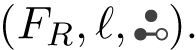 f the rooted graph $F_R$
is obtained from the disjoint union of
$F_R$
is obtained from the disjoint union of $F$
and the rooted graph
$F$
and the rooted graph
 y adding a path $v_0 \ldots v_\ell$
of length
$v_0 \ldots v_\ell$
of length $\ell$
, connecting
$\ell$
, connecting $v_0$
to every vertex in
$v_0$
to every vertex in $R$
, and connecting
$R$
, and connecting $v_\ell$
to the two roots in
$v_\ell$
to the two roots in
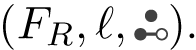
 See Figure 2 for a schematic drawing. A family of augmented path extensions is the collection of graphs
 or a fixed rooted graph $F_R$
and some
$F_R$
and some $\ell _0 \in \mathbb{N}$
.
$\ell _0 \in \mathbb{N}$
.
The augmented path extension

Definition 1.3 (Maverick graph). A maverick graphis a connected graph with smallest eigenvalue in $(\! -\lambda ^*,-2)$
that is not an augmented path extension of any rooted graph.
$(\! -\lambda ^*,-2)$
that is not an augmented path extension of any rooted graph.
We now present our main result in a nutshell before giving the detailed classification.
Theorem 1.4 (Classification theorem at a glance).The class ${\mathcal{G}}(\lambda ^*) \setminus {\mathcal{G}}(2)$
of connected graphs with smallest eigenvalues in
${\mathcal{G}}(\lambda ^*) \setminus {\mathcal{G}}(2)$
of connected graphs with smallest eigenvalues in $(\! -\lambda ^*, -2)$
consists precisely of
$(\! -\lambda ^*, -2)$
consists precisely of $794$
families of augmented path extensions, and
$794$
families of augmented path extensions, and $4752$
maverick graphs with up to
$4752$
maverick graphs with up to $19$
vertices.
$19$
vertices.
In its weak form, our classification theorem says that every sufficiently large connected graph in ${\mathcal{G}}(\lambda ^*)\setminus {\mathcal{G}}(2)$
resembles the graph
${\mathcal{G}}(\lambda ^*)\setminus {\mathcal{G}}(2)$
resembles the graph $E_n$
for some
$E_n$
for some $n$
.
$n$
.
Theorem 1.5.
There exists $N \in \mathbb{N}$
such that for every connected graph
$N \in \mathbb{N}$
such that for every connected graph $G$
on more than
$G$
on more than $N$
vertices, if the smallest eigenvalue of
$N$
vertices, if the smallest eigenvalue of $G$
is in
$G$
is in $(\! -\lambda ^*, -2)$
, then
$(\! -\lambda ^*, -2)$
, then $G$
is isomorphic to an augmented path extension of a rooted graph.
$G$
is isomorphic to an augmented path extension of a rooted graph.
We establish Theorem 1.5 in Section 2 using tools developed for forbidden subgraphs characterisation in [Reference Jiang and Polyanskii11], together with two classical results about generalised line graphs [Reference Cvetković, Doob and Simić4, Reference Cvetković, Doob and Simić5, Reference Hoffman10, Reference Rao, Singhi and Vijayan15]. Since we rarely work with subgraphs that are not induced, we emphasise that all subgraphs are induced throughout this paper.
To obtain the full classification, we proceed in two steps. First, we classify all augmented path extensions in ${\mathcal{G}}(\lambda ^*)$
(excluding those already in
${\mathcal{G}}(\lambda ^*)$
(excluding those already in ${\mathcal{G}}(2)$
is straightforward). Second, we enumerate the maverick graphs.
${\mathcal{G}}(2)$
is straightforward). Second, we enumerate the maverick graphs.
A key ingredient in pinning down the augmented path extensions in ${\mathcal{G}}(\lambda ^*)$
is the following linear-algebraic lemma, which is proved in Section 3. This lemma simplifies the task of determining whether an augmented path extension belongs in
${\mathcal{G}}(\lambda ^*)$
is the following linear-algebraic lemma, which is proved in Section 3. This lemma simplifies the task of determining whether an augmented path extension belongs in ${\mathcal{G}}(\lambda ^*)$
to a finite computation.
${\mathcal{G}}(\lambda ^*)$
to a finite computation.
Lemma 1.6.
For every rooted graph $F_R$
and
$F_R$
and $\ell \in \mathbb{N}$
, the smallest eigenvalue of
$\ell \in \mathbb{N}$
, the smallest eigenvalue of
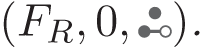
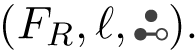 is more than $-\lambda ^*$
if and only if the same holds for
$-\lambda ^*$
if and only if the same holds for
In Section 4, we characterise all rooted graphs $F_R$
for which
$F_R$
for which
 hese turn out to be precisely the line graphs of certain connected bipartite graphs $H_r$
. We then enumerate the corresponding
$H_r$
. We then enumerate the corresponding $H_r$
in Section 5. In retrospect, directly enumerating the rooted graphs
$H_r$
in Section 5. In retrospect, directly enumerating the rooted graphs $F_R$
, which may have up to
$F_R$
, which may have up to $14$
vertices and
$14$
vertices and $6$
roots, would have been unwieldy without first identifying them as line graphs of bipartite graphs.
$6$
roots, would have been unwieldy without first identifying them as line graphs of bipartite graphs.
In Section 6, we enumerate all maverick graphs. This is done by first generating graphs in ${\mathcal{G}}(\lambda ^*)$
and then systematically removing those belonging to
${\mathcal{G}}(\lambda ^*)$
and then systematically removing those belonging to ${\mathcal{G}}(2)$
or arising as augmented path extensions. To exclude graphs in
${\mathcal{G}}(2)$
or arising as augmented path extensions. To exclude graphs in ${\mathcal{G}}(2)$
, we apply a forbidden subgraph characterisation of
${\mathcal{G}}(2)$
, we apply a forbidden subgraph characterisation of ${\mathcal{G}}(2)$
due to Kumar, Rao, and Singhi [Reference Kumar, Rao and Singhi14]. To further eliminate augmented path extensions from
${\mathcal{G}}(2)$
due to Kumar, Rao, and Singhi [Reference Kumar, Rao and Singhi14]. To further eliminate augmented path extensions from ${\mathcal{G}}(\lambda ^*)$
, we use the observation that, roughly speaking, if
${\mathcal{G}}(\lambda ^*)$
, we use the observation that, roughly speaking, if $G \in {\mathcal{G}}(\lambda ^*)$
is not an augmented path extension, then there exists a subgraph of
$G \in {\mathcal{G}}(\lambda ^*)$
is not an augmented path extension, then there exists a subgraph of $G$
with at most
$G$
with at most $11$
vertices that is not an augmented path extension.
$11$
vertices that is not an augmented path extension.
It is natural to suspect that most graphs in ${\mathcal{G}}(\lambda ^*) \setminus {\mathcal{G}}(2)$
arise as perturbations of graphs in
${\mathcal{G}}(\lambda ^*) \setminus {\mathcal{G}}(2)$
arise as perturbations of graphs in ${\mathcal{G}}(2)$
. In Section 7, we show that every connected graph in
${\mathcal{G}}(2)$
. In Section 7, we show that every connected graph in ${\mathcal{G}}(\lambda ^*) \setminus {\mathcal{G}}(2)$
with moderately large order can be obtained from a graph in
${\mathcal{G}}(\lambda ^*) \setminus {\mathcal{G}}(2)$
with moderately large order can be obtained from a graph in ${\mathcal{G}}(2)$
by adding a pendant edge. Moreover, the underlying graph in
${\mathcal{G}}(2)$
by adding a pendant edge. Moreover, the underlying graph in ${\mathcal{G}}(2)$
turns out to be a line graph of a bipartite graph and thus can be represented by a root system
${\mathcal{G}}(2)$
turns out to be a line graph of a bipartite graph and thus can be represented by a root system $A_n$
for some
$A_n$
for some $n$
.
$n$
.
Corollary 1.7.
For every connected graph $G$
on at least 18 vertices, if the smallest eigenvalue of
$G$
on at least 18 vertices, if the smallest eigenvalue of $G$
is in
$G$
is in $(\! -\lambda ^*, -2)$
, then there exists a unique leaf
$(\! -\lambda ^*, -2)$
, then there exists a unique leaf $v$
of
$v$
of $G$
such that
$G$
such that $G-v$
is the line graph of a bipartite graph.
$G-v$
is the line graph of a bipartite graph.
In Section 8, we explore graphs that are slightly beyond ${\mathcal{G}}(\lambda ^*)$
, and we end the paper with open problems in Section 9.
${\mathcal{G}}(\lambda ^*)$
, and we end the paper with open problems in Section 9.
Parts of our proofs are computer-assisted with validated numerics. We explain our computer-aided proofs and how anyone can reproduce them independently. To help readers identify computer-assisted proofs, we employ a bespoke symbol
 at the conclusion of each such proof. All our code is available as ancillary files in the arXiv version of this paper.
We deliberately craft our code without relying on third-party libraries, ensuring it can be adapted across different programming languages. This approach also offers the significant advantage that individuals interested in verifying our algorithms have the flexibility to use large language models to translate our code written in Ruby into their programming language of choice, providing a valuable starting point. It is important to note that while this translation serves as an efficient initial step, further human refinement may be necessary to ensure the code fully captures the nuances of our original implementations.
A graph $\hat {H}$
with petals and a schematic drawing of its line graph
$\hat {H}$
with petals and a schematic drawing of its line graph $L(\hat {H})$
.
$L(\hat {H})$
.

2. Forbidden subgraph characterisation
The proof of Theorem 1.5 centres around the notion of generalised line graphs originally defined by Hoffman [Reference Hoffman8]. Although we do not need their definition, for concreteness we state the alternative definition from [Reference Cvetković, Doob and Simić5].
Definition 2.1 (Graph with petals and generalised line graph).A graph with petals is a multigraph $\hat {H}$
obtained from a graph by adding pendant double edges. A generalised line graph
$\hat {H}$
obtained from a graph by adding pendant double edges. A generalised line graph $L(\hat {H})$
is the line graph of a graph
$L(\hat {H})$
is the line graph of a graph $\hat {H}$
with petals where two vertices of
$\hat {H}$
with petals where two vertices of $L(\hat {H})$
are adjacent if and only if the corresponding edges in
$L(\hat {H})$
are adjacent if and only if the corresponding edges in $\hat {H}$
have exactly one vertex in common. See Figure 3 for a schematic drawing.
$\hat {H}$
have exactly one vertex in common. See Figure 3 for a schematic drawing.
We need the following properties — just like line graphs, all the generalised line graphs are in ${\mathcal{G}}(2)$
, and they have a finite forbidden subgraph characterisation.
${\mathcal{G}}(2)$
, and they have a finite forbidden subgraph characterisation.
Theorem 2.2 (Theorem 2.1 of Hoffman [Reference Hoffman10]).The smallest eigenvalue of a generalised line graph is at least $-2$
.
$-2$
.
Theorem 2.3 (Cvetković, Doob, and Simić [Reference Cvetković, Doob and Simić4, Reference Cvetković, Doob and Simić5], and Rao, Singhi, and Vijayan [Reference Rao, Singhi and Vijayan15]).There are 31 minimal forbidden subgraphs, one of which is $E_6$
defined in Figure
1
, for the family
$E_6$
defined in Figure
1
, for the family ${\mathcal{D}}_\infty$
of generalised line graphs.
${\mathcal{D}}_\infty$
of generalised line graphs.
To prove Theorem 1.5, the strategy is to forbid specific subgraphs, including all the minimal forbidden subgraphs for ${\mathcal{D}}_\infty$
except
${\mathcal{D}}_\infty$
except $E_6$
, in every sufficiently large connected graph in
$E_6$
, in every sufficiently large connected graph in ${\mathcal{G}}(\lambda ^*)\setminus {\mathcal{G}}(2)$
. To that end, we recall from [Reference Jiang and Polyanskii11] the following ways to extend a rooted graph.
${\mathcal{G}}(\lambda ^*)\setminus {\mathcal{G}}(2)$
. To that end, we recall from [Reference Jiang and Polyanskii11] the following ways to extend a rooted graph.
Definition 2.4 (Path extension, clique extension, and path-clique extension). Given a rooted graph $F_R$
,
$F_R$
, $\ell \in \mathbb{N}$
, and
$\ell \in \mathbb{N}$
, and $m \in \mathbb{N}^+$
,
$m \in \mathbb{N}^+$
,
-
(a) the path extension $(F_R, \ell )$
is obtained from
$F$
by adding a path
$v_0 \ldots v_\ell$
of length
$\ell$
, and connecting
$v_0$
to every vertex in
$R$
.Footnote
1
$(F_R, \ell )$
is obtained from
$F$
by adding a path
$v_0 \ldots v_\ell$
of length
$\ell$
, and connecting
$v_0$
to every vertex in
$R$
.Footnote
1
-
(b) the path-clique extension
$(F_R, \ell , K_m)$
is further obtained from
$(F_R, \ell )$
by adding a clique of order
$m$
, and connecting every vertex in the clique to
$v_\ell$
. -
(c) the clique extension
$(F_R, K_m)$
is obtained from
$F$
by adding a clique of order
$m$
, and connecting every vertex in the clique to every vertex in
$R$
.


Figure 4 consists of schematic drawings of the path extension $(F_R, \ell )$
, the path-clique extension
$(F_R, \ell )$
, the path-clique extension $(F_R, \ell , K_m)$
, and the clique extension
$(F_R, \ell , K_m)$
, and the clique extension $(F_R, K_m)$
.
$(F_R, K_m)$
.
Three extensions of a rooted graph $F_R$
.
$F_R$
.

To forbid a subgraph $F$
in every sufficiently large connected graph in
$F$
in every sufficiently large connected graph in ${\mathcal{G}}(\lambda )$
, it is necessary that no sufficiently large path extension of
${\mathcal{G}}(\lambda )$
, it is necessary that no sufficiently large path extension of $F$
belongs to
$F$
belongs to ${\mathcal{G}}(\lambda )$
. This condition turns out to be sufficient when
${\mathcal{G}}(\lambda )$
. This condition turns out to be sufficient when $\lambda \ge 2$
. Hereafter, we denote the smallest eigenvalue of a graph
$\lambda \ge 2$
. Hereafter, we denote the smallest eigenvalue of a graph $G$
by
$G$
by $\lambda _1(G)$
.
$\lambda _1(G)$
.
Lemma 2.5.
Suppose that $F$
is a graph and
$F$
is a graph and $\lambda \ge 2$
. If
$\lambda \ge 2$
. If $\lim _{\ell \to \infty } \lambda _1(F_R, \ell ) \lt -\lambda$
for every nonempty vertex subset
$\lim _{\ell \to \infty } \lambda _1(F_R, \ell ) \lt -\lambda$
for every nonempty vertex subset $R$
of
$R$
of $F$
, then there exists
$F$
, then there exists $N \in \mathbb{N}$
such that
$N \in \mathbb{N}$
such that $F$
is never a subgraph of any connected graph on more than
$F$
is never a subgraph of any connected graph on more than $N$
vertices with smallest eigenvalue at least
$N$
vertices with smallest eigenvalue at least $-\lambda$
.
$-\lambda$
.
For the proof of Lemma 2.5, we need the following three results. The first two results automatically extend the inequality condition on path extensions to path-clique extensions and clique extensions.
Lemma 2.6. (Lemma 2.15 of Jiang and Polyanskii [Reference Jiang and Polyanskii11]). For every rooted graph $F_R$
and
$F_R$
and $\lambda \ge 2$
, if
$\lambda \ge 2$
, if $\lim _{\ell \to \infty } \lambda _1(F_R, \ell ) \lt -\lambda$
, then there exists
$\lim _{\ell \to \infty } \lambda _1(F_R, \ell ) \lt -\lambda$
, then there exists $m \in \mathbb{N}^+$
such that
$m \in \mathbb{N}^+$
such that $\lambda _1(F_R, \ell , K_m) \lt -\lambda$
for every
$\lambda _1(F_R, \ell , K_m) \lt -\lambda$
for every $\ell \in \mathbb{N}$
.
$\ell \in \mathbb{N}$
.
Lemma 2.7.
For every rooted graph $F_R$
and
$F_R$
and $\lambda \ge 2$
, if
$\lambda \ge 2$
, if $\lim _{\ell \to \infty } \lambda _1(F_R, \ell ) \lt -\lambda$
, then there exists
$\lim _{\ell \to \infty } \lambda _1(F_R, \ell ) \lt -\lambda$
, then there exists $m \in \mathbb{N}^+$
such that
$m \in \mathbb{N}^+$
such that $\lambda _1(F_R, K_m) \lt -\lambda$
.
$\lambda _1(F_R, K_m) \lt -\lambda$
.
Proof.
Pick $\ell \in \mathbb{N}^+$
such that
$\ell \in \mathbb{N}^+$
such that $\lambda _1(F_R, \ell ) \lt -\lambda$
. Set
$\lambda _1(F_R, \ell ) \lt -\lambda$
. Set $\lambda ' \, :\!= \, -\lambda _1(F_R, \ell )$
. Let
$\lambda ' \, :\!= \, -\lambda _1(F_R, \ell )$
. Let $v_0\ldots v_\ell$
be the path added to
$v_0\ldots v_\ell$
be the path added to $F$
to obtain
$F$
to obtain $(F_R, \ell )$
, where the vertex
$(F_R, \ell )$
, where the vertex $v_0$
is connected to every vertex in
$v_0$
is connected to every vertex in $R$
, and let
$R$
, and let ${\boldsymbol{x}}\colon V(F) \cup \{{v_0, \ldots , v_\ell } \} \to {\mathbb{R}}$
be an eigenvector of
${\boldsymbol{x}}\colon V(F) \cup \{{v_0, \ldots , v_\ell } \} \to {\mathbb{R}}$
be an eigenvector of $(F_R, \ell )$
associated with
$(F_R, \ell )$
associated with $-\lambda '$
. We abuse notation and write
$-\lambda '$
. We abuse notation and write $x_i$
in place of
$x_i$
in place of $x_{v_i}$
for
$x_{v_i}$
for $i \in \{{0,\ldots , \ell } \}$
. Define
$i \in \{{0,\ldots , \ell } \}$
. Define $\tilde {\boldsymbol{x}} \colon V(F) \cup V(K_m) \to {\mathbb{R}}$
by
$\tilde {\boldsymbol{x}} \colon V(F) \cup V(K_m) \to {\mathbb{R}}$
by
 \begin{equation*} \tilde {x}_v = \begin{cases} x_v & \text{if }v \in V(F); \\ x_0/m & \text{if }v \in V(K_m). \end{cases} \end{equation*}
We claim that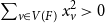 $\sum _{v \in V(F)}x_v^2 \gt 0$
. Indeed, assume for the sake of contradiction that
$\sum _{v \in V(F)}x_v^2 \gt 0$
. Indeed, assume for the sake of contradiction that $x_v = 0$
for
$x_v = 0$
for $v \in V(F)$
. Using
$v \in V(F)$
. Using $-\lambda ' x_i = \sum _{u\sim v_i}x_u$
for
$-\lambda ' x_i = \sum _{u\sim v_i}x_u$
for $i \in \{{0, \ldots , \ell } \}$
, where the sum is taken over all vertices
$i \in \{{0, \ldots , \ell } \}$
, where the sum is taken over all vertices $u$
that are adjacent to
$u$
that are adjacent to $v_i$
in
$v_i$
in $(F_R, \ell )$
, we obtain that
$(F_R, \ell )$
, we obtain that
 \begin{equation*} (A_P + \lambda ' I)\begin{pmatrix} x_0 \\ \vdots \\ x_\ell \end{pmatrix} = \boldsymbol{0} \end{equation*}
where $P$
denotes the path
$P$
denotes the path $v_0\ldots v_\ell$
. Since
$v_0\ldots v_\ell$
. Since $\lambda _1(P) \gt -2 \gt -\lambda '$
, the matrix
$\lambda _1(P) \gt -2 \gt -\lambda '$
, the matrix $A_P + \lambda ' I$
is positive definite, contradicting the assumption that
$A_P + \lambda ' I$
is positive definite, contradicting the assumption that ${\boldsymbol{x}}$
is nonzero.
${\boldsymbol{x}}$
is nonzero.
Because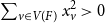 $\sum _{v \in V(F)}x_v^2 \gt 0$
, clearly
$\sum _{v \in V(F)}x_v^2 \gt 0$
, clearly $\tilde {\boldsymbol{x}}$
is a nonzero vector. We compute
$\tilde {\boldsymbol{x}}$
is a nonzero vector. We compute
 \begin{equation*} \tilde {\boldsymbol{x}}^{\intercal } \tilde {\boldsymbol{x}} = \sum _{v \in V(F)}x_v^2 + m(x_0/m)^2. \end{equation*}
Moreover we can compute $\tilde {\boldsymbol{x}}^{\intercal } A_{({F_R}, \, {K_m})}\tilde {\boldsymbol{x}}$
as follows
$\tilde {\boldsymbol{x}}^{\intercal } A_{({F_R}, \, {K_m})}\tilde {\boldsymbol{x}}$
as follows
 \begin{equation*} \tilde {\boldsymbol{x}}^{\intercal } A_{({F_R}, \, {K_m})}\tilde {\boldsymbol{x}} = \sum _{u,v \in V({F_R}, \, 0)\colon u\sim v}x_ux_v + m(m-1)(x_0/m)^2. \end{equation*}
Since ${\boldsymbol{x}}$
is an eigenvector of
${\boldsymbol{x}}$
is an eigenvector of $(F_R, \ell )$
associated with
$(F_R, \ell )$
associated with $-\lambda '$
, we obtain that
$-\lambda '$
, we obtain that
 \begin{equation*} \sum _{u, v \in V(F_R, 0)\colon u\sim v} x_ux_v + x_0x_1 = \sum _{v \in V(F_R, 0)}x_v \sum _{u\sim v}x_u = -\lambda '\sum _{v \in V(F)}x_v^2 - \lambda ' x_0^2. \end{equation*}
Thus $\tilde {\boldsymbol{x}}^{\intercal } A_{(F_R, K_m)}\tilde {\boldsymbol{x}}$
can be simplified to
$\tilde {\boldsymbol{x}}^{\intercal } A_{(F_R, K_m)}\tilde {\boldsymbol{x}}$
can be simplified to
 \begin{equation*} \tilde {\boldsymbol{x}}^{\intercal } A_{(F_R, K_m)}\tilde {\boldsymbol{x}} = -\lambda '\sum _{v \in V(F)}x_v^2 -\lambda 'x_0^2 - x_0x_1 + m(m-1)(x_0/m)^2. \end{equation*}
The Rayleigh principle says that $\lambda _1(F_R, K_m)$
is at most
$\lambda _1(F_R, K_m)$
is at most
 \begin{equation*} \frac {-\lambda '\sum _{v \in V(F)}x_v^2 - \lambda 'x_0^2 - x_0x_1 + m(m-1)(x_0/m)^2}{\sum _{v \in V(F)}x_v^2 + m(x_0/m)^2}, \end{equation*}
which, as $m\to \infty$
, approaches
$m\to \infty$
, approaches
 \begin{equation*} -\lambda ' - \frac {(\lambda '-2)x_0^2+x_0(x_0 + x_1)}{\sum _{v \in V(F)}x_v^2} .\end{equation*}
Here we used the claim that the denominator in the limit is positive.
Recall that $\lambda ' = -\lambda _1(F_R, \ell ) \gt \lambda \ge 2$
. It suffices to show that
$\lambda ' = -\lambda _1(F_R, \ell ) \gt \lambda \ge 2$
. It suffices to show that $x_0(x_0 + x_1)\ge 0$
. In fact, we prove inductively that
$x_0(x_0 + x_1)\ge 0$
. In fact, we prove inductively that $x_i(x_i + x_{i+1}) \ge 0$
for
$x_i(x_i + x_{i+1}) \ge 0$
for $i \in \{{\ell -1, \ldots , 0} \}$
. The base case where
$i \in \{{\ell -1, \ldots , 0} \}$
. The base case where $i = \ell -1$
follows immediately from
$i = \ell -1$
follows immediately from $-\lambda ' x_\ell = x_{\ell -1}$
and
$-\lambda ' x_\ell = x_{\ell -1}$
and $\lambda ' \gt 2$
. For the inductive step, using
$\lambda ' \gt 2$
. For the inductive step, using $-\lambda ' x_{i+1} = x_i + x_{i+2}$
and
$-\lambda ' x_{i+1} = x_i + x_{i+2}$
and $\lambda ' \gt 2$
, we obtain
$\lambda ' \gt 2$
, we obtain
 \begin{multline*} x_{i+1}(x_{i+1} + x_{i+2}) = x_{i+1}(x_{i+1} - \lambda 'x_{i+1}-x_i) = -(\lambda '-2)x_{i+1}^2 - (x_i + x_{i+1})x_{i+1} \\ \le -(x_i + x_{i+1})x_{i+1} = -(x_i + x_{i+1})^2 + x_i(x_i + x_{i+1}) \le x_i(x_i + x_{i+1}), \end{multline*}
which implies that $x_i(x_i+x_{i+1}) \ge 0$
by the inductive hypothesis.
$x_i(x_i+x_{i+1}) \ge 0$
by the inductive hypothesis.
The third result shows that forbidding a star and an extension family of $F$
effectively forbids
$F$
effectively forbids $F$
itself in every sufficiently large connected graph. Denote by
$F$
itself in every sufficiently large connected graph. Denote by $S_k$
the star on
$S_k$
the star on $k+1$
vertices.
$k+1$
vertices.
Definition 2.8 (Extension family). Given a graph $F$
and
$F$
and $\ell , m \in \mathbb{N}^+$
, the extension family
$\ell , m \in \mathbb{N}^+$
, the extension family ${\mathcal{X}}(F, \ell , m)$
of
${\mathcal{X}}(F, \ell , m)$
of $F$
consists of the path-extension
$F$
consists of the path-extension $(F_R, \ell )$
, the path-clique extension
$(F_R, \ell )$
, the path-clique extension $(F_R, \ell _0, K_m)$
, and the clique extension
$(F_R, \ell _0, K_m)$
, and the clique extension $(F_R, K_m)$
, where
$(F_R, K_m)$
, where $R$
ranges over the nonempty vertex subsets of
$R$
ranges over the nonempty vertex subsets of $F$
, and
$F$
, and $\ell _0$
ranges over
$\ell _0$
ranges over $\{{0, \ldots , \ell -1} \}$
.
$\{{0, \ldots , \ell -1} \}$
.
Lemma 2.9 (Lemma 2.6 of Jiang and Polyanskii [Reference Jiang and Polyanskii11]). For every graph $F$
and
$F$
and $k, \ell , m \in \mathbb{N}^+$
, there exists
$k, \ell , m \in \mathbb{N}^+$
, there exists $N \in \mathbb{N}$
such that for every connected graph
$N \in \mathbb{N}$
such that for every connected graph $G$
on more than
$G$
on more than $N$
vertices, if no member in
$N$
vertices, if no member in $\{{S_k} \} \cup {\mathcal{X}}(F, \ell , m)$
is a subgraph of
$\{{S_k} \} \cup {\mathcal{X}}(F, \ell , m)$
is a subgraph of $G$
, then neither is
$G$
, then neither is $F$
.
$F$
.
Remark. Ding, Oporowski, Oxley, and Vertigan proved that for every $n \in \mathbb{N}$
, every sufficiently large connected graph contains
$n \in \mathbb{N}$
, every sufficiently large connected graph contains $S_n$
,
$S_n$
, $P_n$
, or
$P_n$
, or $K_n$
as a subgraph [Reference Ding, Oporowski, Oxley and Vertigan7, Theorem 5.3]. Lemma 2.9 extends their result.
$K_n$
as a subgraph [Reference Ding, Oporowski, Oxley and Vertigan7, Theorem 5.3]. Lemma 2.9 extends their result.
We now have all of the ingredients needed to establish Lemma 2.5.
Proof of Lemma
2.5
. Choose $\ell \in \mathbb{N}^+$
such that
$\ell \in \mathbb{N}^+$
such that $\lambda _1(F_R, \ell ) \lt -\lambda$
for every nonempty
$\lambda _1(F_R, \ell ) \lt -\lambda$
for every nonempty $R \subseteq V(F)$
. According to Lemmas 2.6 and 2.7, choose
$R \subseteq V(F)$
. According to Lemmas 2.6 and 2.7, choose $m \in \mathbb{N}^+$
such that
$m \in \mathbb{N}^+$
such that $\lambda _1(F_R, \ell _0, K_m) \lt -\lambda$
for every nonempty
$\lambda _1(F_R, \ell _0, K_m) \lt -\lambda$
for every nonempty $R \subseteq V(F)$
and every
$R \subseteq V(F)$
and every $\ell _0 \in \mathbb{N}$
, and
$\ell _0 \in \mathbb{N}$
, and $\lambda _1(F_R, K_m) \lt -\lambda$
for every nonempty
$\lambda _1(F_R, K_m) \lt -\lambda$
for every nonempty $R \subseteq V(F)$
.
$R \subseteq V(F)$
.
Suppose that $G$
is a graph with
$G$
is a graph with $\lambda _1(G) \gt -\lambda$
. The choice of
$\lambda _1(G) \gt -\lambda$
. The choice of $\ell$
and
$\ell$
and $m$
ensures that no member in
$m$
ensures that no member in ${\mathcal{X}}(F, \ell , m)$
is a subgraph of
${\mathcal{X}}(F, \ell , m)$
is a subgraph of $G$
. Furthermore, the star
$G$
. Furthermore, the star $S_k$
, whose smallest eigenvalue is
$S_k$
, whose smallest eigenvalue is $-\sqrt {k}$
, cannot be a subgraph of
$-\sqrt {k}$
, cannot be a subgraph of $G$
for any
$G$
for any $k \in \mathbb{N}^+$
satisfying
$k \in \mathbb{N}^+$
satisfying $\sqrt {k} \gt \lambda$
. Finally we apply Lemma 2.9 to obtain the desired
$\sqrt {k} \gt \lambda$
. Finally we apply Lemma 2.9 to obtain the desired $N \in \mathbb{N}$
.
$N \in \mathbb{N}$
.
With Lemma 2.5 at our disposal, we return to forbidding certain subgraphs in every sufficiently large connected graph in ${\mathcal{G}}(\lambda ^*)\setminus {\mathcal{G}}(2)$
. The following computation ensures that
${\mathcal{G}}(\lambda ^*)\setminus {\mathcal{G}}(2)$
. The following computation ensures that $E_6$
occurs as a subgraph in every sufficiently large connected graph in
$E_6$
occurs as a subgraph in every sufficiently large connected graph in ${\mathcal{G}}(\lambda ^*) \setminus {\mathcal{G}}(2)$
.
${\mathcal{G}}(\lambda ^*) \setminus {\mathcal{G}}(2)$
.
Lemma 2.10 (Lemma 2.14 of Jiang and Polyanskii [Reference Jiang and Polyanskii11]). For every minimal forbidden subgraph $F$
for the family
$F$
for the family ${\mathcal{D}}_\infty$
of generalised line graphs, if
${\mathcal{D}}_\infty$
of generalised line graphs, if $F$
is not isomorphic to
$F$
is not isomorphic to $E_6$
, then
$E_6$
, then $\lim _{\ell \to \infty } \lambda _1(F_R, \ell ) \lt -\lambda ^*$
for every nonempty vertex subset
$\lim _{\ell \to \infty } \lambda _1(F_R, \ell ) \lt -\lambda ^*$
for every nonempty vertex subset $R$
of
$R$
of $F$
.
$F$
.
In addition, we further forbid small supergraphs of $E_6$
through the following computation, proved with computer assistance in Appendix A.
$E_6$
through the following computation, proved with computer assistance in Appendix A.
Four $8$
-vertex graphs
$8$
-vertex graphs $F$
with two vertices
$F$
with two vertices $v_6$
and
$v_6$
and $v_7$
such that
$v_7$
such that $F - \{{v_6, v_7}\}$
is isomorphic to
$F - \{{v_6, v_7}\}$
is isomorphic to $E_6$
, and both
$E_6$
, and both $F - v_6$
and
$F - v_6$
and $F - v_7$
are isomorphic to
$F - v_7$
are isomorphic to $E_7$
.
$E_7$
.

Proposition 2.11.
For every connected graph $F$
that contains
$F$
that contains $E_6$
as a subgraph, if
$E_6$
as a subgraph, if $F$
is a
$F$
is a $7$
-vertex graph that is not isomorphic to
$7$
-vertex graph that is not isomorphic to $E_7$
, or
$E_7$
, or $F$
is an
$F$
is an $8$
-vertex graph in Figure
5
, then
$8$
-vertex graph in Figure
5
, then $\lim _{\ell \to \infty } \lambda _1(F_R, \ell ) \lt -95/47$
for every nonempty vertex subset
$\lim _{\ell \to \infty } \lambda _1(F_R, \ell ) \lt -95/47$
for every nonempty vertex subset $R$
of
$R$
of $F$
.
$F$
.
Proof of Theorem
1.5
. By combining Lemmas 2.5 and 2.10, we obtain $N_1 \in \mathbb{N}$
such that for every minimal forbidden subgraph
$N_1 \in \mathbb{N}$
such that for every minimal forbidden subgraph $F$
for
$F$
for ${\mathcal{D}}_\infty$
, if
${\mathcal{D}}_\infty$
, if $F$
is not isomorphic to
$F$
is not isomorphic to $E_6$
, then
$E_6$
, then $F$
is not a subgraph of any connected graph on more than
$F$
is not a subgraph of any connected graph on more than $N_1$
vertices with smallest eigenvalue more than
$N_1$
vertices with smallest eigenvalue more than $-\lambda ^*$
. Combining Lemma 2.5 and Proposition 2.11, we obtain
$-\lambda ^*$
. Combining Lemma 2.5 and Proposition 2.11, we obtain $N_2 \in \mathbb{N}$
such that for every connected graph
$N_2 \in \mathbb{N}$
such that for every connected graph $F$
that contains
$F$
that contains $E_6$
as a subgraph, if
$E_6$
as a subgraph, if $F$
is a
$F$
is a $7$
-vertex graph that is not isomorphic to
$7$
-vertex graph that is not isomorphic to $E_7$
, or
$E_7$
, or $F$
is an
$F$
is an $8$
-vertex graph in Figure 5, then
$8$
-vertex graph in Figure 5, then $F$
is not a subgraph of any connected graph on more than
$F$
is not a subgraph of any connected graph on more than $N_2$
vertices with smallest eigenvalue more than
$N_2$
vertices with smallest eigenvalue more than $-\lambda ^*$
. Here, we use the fact that
$-\lambda ^*$
. Here, we use the fact that $\lambda ^* \approx 2.01980 \lt 2.02127 \approx 95/47$
.
$\lambda ^* \approx 2.01980 \lt 2.02127 \approx 95/47$
.
Suppose that $G$
is a connected graph on more than
$G$
is a connected graph on more than $N \, :\!= \, \max (N_1, N_2)$
vertices with smallest eigenvalue in
$N \, :\!= \, \max (N_1, N_2)$
vertices with smallest eigenvalue in $(\! -\lambda ^*,-2)$
. Observe from Theorem 2.2 that
$(\! -\lambda ^*,-2)$
. Observe from Theorem 2.2 that $G$
is not a generalised line graph. Thus
$G$
is not a generalised line graph. Thus $G$
contains a subgraph
$G$
contains a subgraph $E$
that is a minimal forbidden subgraph for
$E$
that is a minimal forbidden subgraph for ${\mathcal{D}}_\infty$
. The choice of
${\mathcal{D}}_\infty$
. The choice of $N_1$
forces
$N_1$
forces $E$
to be isomorphic to
$E$
to be isomorphic to $E_6$
. The choice of
$E_6$
. The choice of $N_2$
ensures that
$N_2$
ensures that $G[V(E) \cup \{{v} \}]$
is isomorphic to
$G[V(E) \cup \{{v} \}]$
is isomorphic to $E_7$
for every vertex
$E_7$
for every vertex $v$
at distance
$v$
at distance $1$
from
$1$
from $E$
in
$E$
in $G$
, and, in fact, every such vertex
$G$
, and, in fact, every such vertex $v$
is adjacent to the same vertex of
$v$
is adjacent to the same vertex of $E$
. In particular,
$E$
. In particular, $G$
is an augmented path extension of a rooted graph.
$G$
is an augmented path extension of a rooted graph.
3. The linear-algebraic lemma
We generalise Lemma 1.6 to a class of graphs that encapsulates both augmented path extensions and path-clique extensions.
Definition 3.1 (Path augmentation). Given two rooted graphs $F_R$
and
$F_R$
and $G_S$
and
$G_S$
and $\ell \in \mathbb{N}$
, the path augmentation
$\ell \in \mathbb{N}$
, the path augmentation $(F_R, \ell , G_S)$
of
$(F_R, \ell , G_S)$
of $F_R$
and
$F_R$
and $G_S$
is obtained from the disjoint union of
$G_S$
is obtained from the disjoint union of $F$
and
$F$
and $G$
by adding a path
$G$
by adding a path $v_0\ldots v_\ell$
of length
$v_0\ldots v_\ell$
of length $\ell$
, connecting
$\ell$
, connecting $v_0$
to every vertex in
$v_0$
to every vertex in $R$
, and connecting
$R$
, and connecting $v_\ell$
to every vertex in
$v_\ell$
to every vertex in $S$
. See Figure 6 for a schematic drawing.
$S$
. See Figure 6 for a schematic drawing.
Lemma 3.2.
Suppose that $G_S$
is a rooted graph. If
$G_S$
is a rooted graph. If $\lambda = -\lim _{\ell \to \infty } \lambda _1(G_S,\ell )$
, and
$\lambda = -\lim _{\ell \to \infty } \lambda _1(G_S,\ell )$
, and $\lambda _1(G) \gt -\lambda$
, then the following holds. For every rooted graph
$\lambda _1(G) \gt -\lambda$
, then the following holds. For every rooted graph $F_R$
and
$F_R$
and $\ell \in \mathbb{N}$
, the smallest eigenvalue of
$\ell \in \mathbb{N}$
, the smallest eigenvalue of $(F_R, \ell , G_S)$
is more than
$(F_R, \ell , G_S)$
is more than $-\lambda$
if and only if the same holds for
$-\lambda$
if and only if the same holds for $(F_R, 0, G_S)$
.
$(F_R, 0, G_S)$
.
Proof of Lemma
1.6
. Take
 in Lemma 3.2, and observe that
 is just $E_{\ell +4}$
. Lemma 1.6 follows immediately from Proposition 1.1.
$E_{\ell +4}$
. Lemma 1.6 follows immediately from Proposition 1.1.
To provide additional context for Lemma 3.2, we discuss the behaviour of the smallest eigenvalue of the path augmentation $(F_R, \ell , G_S)$
as
$(F_R, \ell , G_S)$
as $\ell \to \infty$
. The following result follows from [Reference Belardo and Brunetti1, Proposition 3.5]. We provide a self-contained proof here.
$\ell \to \infty$
. The following result follows from [Reference Belardo and Brunetti1, Proposition 3.5]. We provide a self-contained proof here.
The path augmentation $(F_R, \ell , G_S)$
.
$(F_R, \ell , G_S)$
.

Lemma 3.3.
For all rooted graphs $F_R$
and
$F_R$
and $G_S$
,
$G_S$
,
 \begin{equation*}\lim _{\ell \to \infty }\lambda _1(F_R, \ell , G_S) = \min \left (\lim _{\ell \to \infty }\lambda _1(F_R, \ell ), \lim _{\ell \to \infty }\lambda _1(G_S, \ell )\right ).\end{equation*}
Proof. Set $\lambda _{F_R} = \lim _{\ell \to \infty } \lambda _1(F_R, \ell )$
and
$\lambda _{F_R} = \lim _{\ell \to \infty } \lambda _1(F_R, \ell )$
and $\lambda _{G_S} = \lim _{\ell \to \infty } \lambda _1(G_S, \ell )$
. Since both
$\lambda _{G_S} = \lim _{\ell \to \infty } \lambda _1(G_S, \ell )$
. Since both $(F_R, \ell )$
and
$(F_R, \ell )$
and $(G_S, \ell )$
are subgraphs of
$(G_S, \ell )$
are subgraphs of $(F_R, \ell , G_S)$
, clearly
$(F_R, \ell , G_S)$
, clearly $\limsup _{\ell \to \infty }\lambda _1(F_R, \ell , G_S) \le \min (\lambda _{F_R},\lambda _{G_S})$
.
$\limsup _{\ell \to \infty }\lambda _1(F_R, \ell , G_S) \le \min (\lambda _{F_R},\lambda _{G_S})$
.
To see the reverse, let $v_0\ldots v_\ell$
be the path added to the disjoint union of
$v_0\ldots v_\ell$
be the path added to the disjoint union of $F$
and
$F$
and $G$
to obtain
$G$
to obtain $(F_R, \ell , G_S)$
, and let
$(F_R, \ell , G_S)$
, and let ${\boldsymbol{x}} \colon V(F_R, \ell , G_S) \to {\mathbb{R}}$
be a unit eigenvector associated with
${\boldsymbol{x}} \colon V(F_R, \ell , G_S) \to {\mathbb{R}}$
be a unit eigenvector associated with $\lambda _1(F_R, \ell , G_S)$
. We abuse notation and write
$\lambda _1(F_R, \ell , G_S)$
. We abuse notation and write $x_i$
in place of
$x_i$
in place of $x_{v_i}$
. Choose
$x_{v_i}$
. Choose $k \in \{{0,\ldots ,\ell -1} \}$
such that
$k \in \{{0,\ldots ,\ell -1} \}$
such that $x_kx_{k+1}$
reaches the minimum in absolute value. In particular, using the inequality
$x_kx_{k+1}$
reaches the minimum in absolute value. In particular, using the inequality $|{x_ix_{i+1}}| \le (x_i^2+x_{i+1}^2)/2$
, we obtain
$|{x_ix_{i+1}}| \le (x_i^2+x_{i+1}^2)/2$
, we obtain
 \begin{equation*} |x_kx_{k+1}| \le \frac {1}{\ell } \sum _{i \, = \, 0}^{\ell -1}|x_ix_{i+1}| \le \frac {1}{\ell }\sum _{i \, = \, 0}^{\ell }x_i^2 \le \frac {1}{\ell }. \end{equation*}
Notice that removing the edge $v_kv_{k+1}$
disconnects
$v_kv_{k+1}$
disconnects $(F_R, \ell , G_S)$
into subgraphs
$(F_R, \ell , G_S)$
into subgraphs $F' \, :\!= \, (F_R, k)$
and
$F' \, :\!= \, (F_R, k)$
and $G' \, :\!= \, (G_S, \ell -k-1)$
. Let
$G' \, :\!= \, (G_S, \ell -k-1)$
. Let ${\boldsymbol{x}}_1$
and
${\boldsymbol{x}}_1$
and ${\boldsymbol{x}}_2$
be the restrictions of
${\boldsymbol{x}}_2$
be the restrictions of ${\boldsymbol{x}}$
to
${\boldsymbol{x}}$
to $V(F')$
and
$V(F')$
and $V(G')$
respectively. Finally, we bound the smallest eigenvalue of
$V(G')$
respectively. Finally, we bound the smallest eigenvalue of $(F_R, \ell , G_S)$
as follows:
$(F_R, \ell , G_S)$
as follows:
 \begin{multline*} \lambda _1(F_R, \ell , G_S) = {\boldsymbol{x}}^{\intercal } A_{(F_R, \ell , G_S)} {\boldsymbol{x}} = {\boldsymbol{x}}_1^{\intercal } A_{F'} {\boldsymbol{x}}_1 + 2x_kx_{k+1} + \\ + {\boldsymbol{x}}_2^{\intercal } A_{G'}{\boldsymbol{x}}_2 \ge \lambda _{F_R} {\boldsymbol{x}}_1^{\intercal }{\boldsymbol{x}}_1 - 2/\ell + \lambda _{G_S}{\boldsymbol{x}}_2^{\intercal } {\boldsymbol{x}}_2 \ge \min (\lambda _{F_R}, \lambda _{G_S}) - 2/\ell , \end{multline*}
which implies that $\liminf _{\ell \to \infty } \lambda _1(F_R, \ell , G_S) \ge \min (\lambda _{F_R}, \lambda _{G_S})$
.
$\liminf _{\ell \to \infty } \lambda _1(F_R, \ell , G_S) \ge \min (\lambda _{F_R}, \lambda _{G_S})$
.
Example. Consider the two cases where
 and
and
 . In both cases, because $\lim _{\ell \to \infty }\lambda _1(F_R,\ell ) = -2$
and
$\lim _{\ell \to \infty }\lambda _1(F_R,\ell ) = -2$
and $\lim _{\ell \to \infty }\lambda _1(G_S,\ell ) = -\lambda ^*$
, according to Lemma 3.3,
$\lim _{\ell \to \infty }\lambda _1(G_S,\ell ) = -\lambda ^*$
, according to Lemma 3.3, $\lambda _1(F_R, \ell , G_S)$
approaches
$\lambda _1(F_R, \ell , G_S)$
approaches $-\lambda ^*$
as
$-\lambda ^*$
as $\ell \to \infty$
. Interestingly, the smallest eigenvalue approaches
$\ell \to \infty$
. Interestingly, the smallest eigenvalue approaches $-\lambda ^*$
in different ways —
$-\lambda ^*$
in different ways —
 approaches $-\lambda ^*$
from below, whereas
$-\lambda ^*$
from below, whereas
 approaches from above. Lemma 3.2 rules out other ways $\lambda _1(F_R, \ell , G_S)$
could approach its limit.
$\lambda _1(F_R, \ell , G_S)$
could approach its limit.
We devote the rest of the section to the proof of Lemma 3.2. Denote by $E_{v,v}$
the matrix unit where the
$E_{v,v}$
the matrix unit where the $(v,v)$
-entry with value
$(v,v)$
-entry with value $1$
is the only nonzero entry. We first characterise
$1$
is the only nonzero entry. We first characterise $\lim _{\ell \to \infty }\lambda _1(G_S, \ell )$
.
$\lim _{\ell \to \infty }\lambda _1(G_S, \ell )$
.
Lemma 3.4.
Suppose that $G_S$
is a rooted graph. Let
$G_S$
is a rooted graph. Let $v_0$
be the vertex in
$v_0$
be the vertex in $V(G_S,0)\setminus V(G)$
. If
$V(G_S,0)\setminus V(G)$
. If $\lambda = -\lim _{\ell \to \infty }\lambda _1(G_S,\ell )$
, then the set of
$\lambda = -\lim _{\ell \to \infty }\lambda _1(G_S,\ell )$
, then the set of $x \ge 2$
, for which the matrix
$x \ge 2$
, for which the matrix
 \begin{equation} A_{(G_S,0)} + xI - \left (x/2 - \sqrt {x^2/4-1}\right )E_{v_0,v_0} \end{equation}
is positive semidefinite, is equal to $[\lambda , \infty )$
, and moreover, the above matrix is singular when
$[\lambda , \infty )$
, and moreover, the above matrix is singular when $x = \lambda$
.
$x = \lambda$
.
Proof. Denote by $P_\ell$
the path of length
$P_\ell$
the path of length $\ell$
. Since
$\ell$
. Since $\lim _{\ell \to \infty }\lambda _1(P_\ell ) = -2$
, clearly
$\lim _{\ell \to \infty }\lambda _1(P_\ell ) = -2$
, clearly $\lambda \ge 2$
. Let
$\lambda \ge 2$
. Let $x \ge 2$
be chosen later, and for every
$x \ge 2$
be chosen later, and for every $n \in \mathbb{N}^+$
, set
$n \in \mathbb{N}^+$
, set $d_n \, :\!= \, \det \ (A_{P_{n-1}} + xI )$
. Using Laplace expansion, we derive the linear recurrence
$d_n \, :\!= \, \det \ (A_{P_{n-1}} + xI )$
. Using Laplace expansion, we derive the linear recurrence $d_{n+2} = x d_{n+1} - d_n$
with the initial conditions
$d_{n+2} = x d_{n+1} - d_n$
with the initial conditions $d_0 = 1$
and
$d_0 = 1$
and $d_1 = x$
. It follows from the classical theory of linear recurrence that
$d_1 = x$
. It follows from the classical theory of linear recurrence that $\lim _{\ell \to \infty } d_{\ell -1}/d_\ell = x/2 - \sqrt {x^2/4-1}$
.
$\lim _{\ell \to \infty } d_{\ell -1}/d_\ell = x/2 - \sqrt {x^2/4-1}$
.
Claim.
For every $\ell \in \mathbb{N}^+$
, the matrix
$\ell \in \mathbb{N}^+$
, the matrix $A_{(G_S, \ell )} + x I$
is positive semidefinite if and only if
$A_{(G_S, \ell )} + x I$
is positive semidefinite if and only if $A_{(G_S, 0)} + xI - (d_{\ell -1}/d_\ell )E_{v_0,v_0}$
is positive semidefinite.
$A_{(G_S, 0)} + xI - (d_{\ell -1}/d_\ell )E_{v_0,v_0}$
is positive semidefinite.
Proof of Claim. We partition the matrix $A_{(G_S,\ell )} + xI$
into the following blocks:
$A_{(G_S,\ell )} + xI$
into the following blocks:
 \begin{equation*} \begin{pmatrix} A_{(G_S,0)} + xI & B \\ B^{\intercal } & C \end{pmatrix}, \end{equation*}
Since $C = A_{P_{\ell -1}} + xI$
, and
$C = A_{P_{\ell -1}} + xI$
, and $\lambda _1(P_{\ell -1}) \gt -2 \ge -x$
, the block
$\lambda _1(P_{\ell -1}) \gt -2 \ge -x$
, the block $C$
is positive definite. Therefore, the above block matrix is positive semidefinite if and only if the Schur complement
$C$
is positive definite. Therefore, the above block matrix is positive semidefinite if and only if the Schur complement $A_{(G_S, 0)} + xI - BC^{-1}B^{\intercal }$
of
$A_{(G_S, 0)} + xI - BC^{-1}B^{\intercal }$
of $C$
is positive semidefinite. Let
$C$
is positive semidefinite. Let $v_1$
be the vertex in
$v_1$
be the vertex in $V(G_S, 1) \setminus V(G_S, 0)$
. Since the only nonzero entry of
$V(G_S, 1) \setminus V(G_S, 0)$
. Since the only nonzero entry of $B$
is its
$B$
is its $(v_0, v_1)$
entry, the matrix
$(v_0, v_1)$
entry, the matrix $BC^{-1}B^{\intercal }$
simplifies to
$BC^{-1}B^{\intercal }$
simplifies to $(C^{-1})_{v_1, v_1}E_{v_0,v_0}$
. Cramer’s rule yields
$(C^{-1})_{v_1, v_1}E_{v_0,v_0}$
. Cramer’s rule yields $(C^{-1})_{v_1,v_1}=\det C' / \det C$
, where
$(C^{-1})_{v_1,v_1}=\det C' / \det C$
, where $C'$
is obtained from
$C'$
is obtained from $C$
by removing the
$C$
by removing the $v_1$
-th row and column. To finish the proof of the claim, note that
$v_1$
-th row and column. To finish the proof of the claim, note that $\det C' = d_{\ell -1}$
and
$\det C' = d_{\ell -1}$
and $\det C = d_\ell$
.
$\det C = d_\ell$
.
First, we consider the case where $x \ge \lambda$
. The claim implies that
$x \ge \lambda$
. The claim implies that $A_{(G_S,0)} + xI - (d_{\ell -1}/d_\ell )E_{v_0,v_0}$
is positive semidefinite. Sending
$A_{(G_S,0)} + xI - (d_{\ell -1}/d_\ell )E_{v_0,v_0}$
is positive semidefinite. Sending $\ell$
to
$\ell$
to $\infty$
, we know that the matrix in (1) is positive semidefinite when
$\infty$
, we know that the matrix in (1) is positive semidefinite when $x \ge \lambda$
. Next, we consider the case where
$x \ge \lambda$
. Next, we consider the case where $x \in [2, \lambda )$
. The claim implies that
$x \in [2, \lambda )$
. The claim implies that $A_{(G_S,0)} + xI - (d_{\ell -1}/d_\ell )E_{v_0,v_0}$
is not positive semidefinite for sufficiently large
$A_{(G_S,0)} + xI - (d_{\ell -1}/d_\ell )E_{v_0,v_0}$
is not positive semidefinite for sufficiently large $\ell$
. Sending
$\ell$
. Sending $\ell$
to
$\ell$
to $\infty$
, we know that the matrix in (1) is not positive semidefinite when
$\infty$
, we know that the matrix in (1) is not positive semidefinite when $x \in [2, \lambda )$
. Finally, assume for the sake of contradiction that the matrix in (1) is positive definite when
$x \in [2, \lambda )$
. Finally, assume for the sake of contradiction that the matrix in (1) is positive definite when $x = \lambda$
. We can then decrease
$x = \lambda$
. We can then decrease $x$
slightly so that the matrix in (1) is still positive definite, which yields a contradiction.
$x$
slightly so that the matrix in (1) is still positive definite, which yields a contradiction.
We adopt the convention that the path extension $(G_S, -1)$
is just the graph
$(G_S, -1)$
is just the graph $G$
.
$G$
.
Corollary 3.5.
Suppose that $G_S$
is a rooted graph. If
$G_S$
is a rooted graph. If $\lambda = -\lim _{\ell \to \infty } \lambda _1(G_S, \ell )$
, then for every
$\lambda = -\lim _{\ell \to \infty } \lambda _1(G_S, \ell )$
, then for every $\ell \in \mathbb{N}$
, the matrix
$\ell \in \mathbb{N}$
, the matrix
 \begin{equation*} A_{(G_S, \ell )} + \lambda I - \big(\lambda /2 - \sqrt {\lambda ^2/4-1}\big) E_{v_\ell, \, v_\ell } \end{equation*}
is singular, where $v_\ell$
is the vertex in
$v_\ell$
is the vertex in $V(G_S, \ell )\setminus V(G_S, \ell -1)$
.
$V(G_S, \ell )\setminus V(G_S, \ell -1)$
.
Proof. We prove by induction on $\ell$
. Lemma 3.4 implies the base case where
$\ell$
. Lemma 3.4 implies the base case where $\ell = 0$
. For the inductive step, suppose that
$\ell = 0$
. For the inductive step, suppose that $\ell \in \mathbb{N}^+$
. Let
$\ell \in \mathbb{N}^+$
. Let $r$
be the vertex in
$r$
be the vertex in $V(G_S, \ell -1) \setminus V(G_S,\ell -2)$
. Define the rooted graph
$V(G_S, \ell -1) \setminus V(G_S,\ell -2)$
. Define the rooted graph $H_r$
to be the graph
$H_r$
to be the graph $H = (G_S, \ell -1)$
equipped with a single root
$H = (G_S, \ell -1)$
equipped with a single root $r$
. Note that
$r$
. Note that $(H_r, m) = (G_S, \ell + m)$
, and so
$(H_r, m) = (G_S, \ell + m)$
, and so $\lim _{m\to \infty }\lambda _1(H_r, m) = -\lambda$
. Apply the base case to
$\lim _{m\to \infty }\lambda _1(H_r, m) = -\lambda$
. Apply the base case to $H_r$
, we know that
$H_r$
, we know that $A_{(H_r,0)} + \lambda I - (\lambda /2-\sqrt {\lambda ^2/4-1})E_{v_\ell ,v_\ell }$
is singular.
$A_{(H_r,0)} + \lambda I - (\lambda /2-\sqrt {\lambda ^2/4-1})E_{v_\ell ,v_\ell }$
is singular.
Now we obtain a simple matrix criterion to decide whether $\lambda _1(F_R, \ell , G_S) \gt \lim _{\ell \to \infty }\lambda _1(G_S, \ell )$
, from which Lemma 3.2 follows immediately.
$\lambda _1(F_R, \ell , G_S) \gt \lim _{\ell \to \infty }\lambda _1(G_S, \ell )$
, from which Lemma 3.2 follows immediately.
Lemma 3.6.
Suppose that $G_S$
is a rooted graph. If
$G_S$
is a rooted graph. If $\lambda = -\lim _{\ell \to \infty }\lambda _1(G_S, \ell )$
, and
$\lambda = -\lim _{\ell \to \infty }\lambda _1(G_S, \ell )$
, and $\lambda _1(G)\gt -\lambda$
, then the following holds. For every rooted graph
$\lambda _1(G)\gt -\lambda$
, then the following holds. For every rooted graph $F_R$
and
$F_R$
and $\ell \in \mathbb{N}$
, the smallest eigenvalue of the path augmentation
$\ell \in \mathbb{N}$
, the smallest eigenvalue of the path augmentation $(F_R, \ell , G_S)$
is more than
$(F_R, \ell , G_S)$
is more than $-\lambda$
if and only if the matrix
$-\lambda$
if and only if the matrix
 \begin{equation*} A_{(F_R, 0)} + \lambda I - \big(\lambda /2 + \sqrt {\lambda ^2/4-1}\big) E_{v_0, \, v_0} \end{equation*}
is positive definite, where $v_0$
is the vertex in
$v_0$
is the vertex in $V(F_R, 0) \setminus V(F)$
.
$V(F_R, 0) \setminus V(F)$
.
Proof. We claim that $\lambda _1(G_S, \ell -1) \gt -\lambda$
. Assume for the sake of contradiction that
$\lambda _1(G_S, \ell -1) \gt -\lambda$
. Assume for the sake of contradiction that $\lambda _1(G_S, \ell -1) = -\lambda$
. Let
$\lambda _1(G_S, \ell -1) = -\lambda$
. Let ${\boldsymbol{x}} \colon V(G_S,\ell -1) \to {\mathbb{R}}$
be an eigenvector of
${\boldsymbol{x}} \colon V(G_S,\ell -1) \to {\mathbb{R}}$
be an eigenvector of $(G_S, \ell -1)$
associated with
$(G_S, \ell -1)$
associated with $-\lambda$
. Let
$-\lambda$
. Let $v_0 \ldots v_\ell$
be the path of length
$v_0 \ldots v_\ell$
be the path of length $\ell$
that is added to
$\ell$
that is added to $G$
to obtain
$G$
to obtain $(G_S, \ell )$
. We extend
$(G_S, \ell )$
. We extend ${\boldsymbol{x}}$
to
${\boldsymbol{x}}$
to $\tilde {\boldsymbol{x}} \colon V(G_S, \ell ) \to {\mathbb{R}}$
by setting
$\tilde {\boldsymbol{x}} \colon V(G_S, \ell ) \to {\mathbb{R}}$
by setting $\tilde {x}_{v_\ell } = 0$
. Since
$\tilde {x}_{v_\ell } = 0$
. Since $\tilde {\boldsymbol{x}}^{\intercal } A_{(G_S,\ell )}\tilde {\boldsymbol{x}} = -\lambda \tilde {\boldsymbol{x}}^{\intercal }\tilde {\boldsymbol{x}}$
, and
$\tilde {\boldsymbol{x}}^{\intercal } A_{(G_S,\ell )}\tilde {\boldsymbol{x}} = -\lambda \tilde {\boldsymbol{x}}^{\intercal }\tilde {\boldsymbol{x}}$
, and $\lambda _1(G_S,\ell ) = -\lambda$
, the nonzero vector
$\lambda _1(G_S,\ell ) = -\lambda$
, the nonzero vector $\tilde {\boldsymbol{x}}$
is an eigenvector of
$\tilde {\boldsymbol{x}}$
is an eigenvector of $(G_S,\ell )$
. Using
$(G_S,\ell )$
. Using $-\lambda x_{v_i} = \sum _{u \sim v_i} x_u$
for
$-\lambda x_{v_i} = \sum _{u \sim v_i} x_u$
for $i \in \{{\ell , \ldots , 1} \}$
, one can then prove by induction that
$i \in \{{\ell , \ldots , 1} \}$
, one can then prove by induction that $x_{v_i} = 0$
for
$x_{v_i} = 0$
for $i \in \{{\ell , \ldots , 0} \}$
. Therefore the vector
$i \in \{{\ell , \ldots , 0} \}$
. Therefore the vector ${\boldsymbol{x}}$
restricted to
${\boldsymbol{x}}$
restricted to $V(G)$
is an eigenvector of
$V(G)$
is an eigenvector of $G$
associated with
$G$
associated with $-\lambda$
, which contradicts the assumption that
$-\lambda$
, which contradicts the assumption that $\lambda _1(G) \gt -\lambda$
.
$\lambda _1(G) \gt -\lambda$
.
Coming back to the proof of the lemma, we partition the matrix $A_{(F_R, \ell , G_S)} + \lambda I$
into the following blocks:
$A_{(F_R, \ell , G_S)} + \lambda I$
into the following blocks:
 \begin{equation*} \begin{pmatrix} A_{(F_R,0)}+\lambda I & B \\ B^{\intercal } & C \end{pmatrix}. \end{equation*}
Since $C = A_{(G_S, \ell -1)}+\lambda I$
, and
$C = A_{(G_S, \ell -1)}+\lambda I$
, and $\lambda _1(G_S, \ell -1) \gt -\lambda$
from the claim, the block
$\lambda _1(G_S, \ell -1) \gt -\lambda$
from the claim, the block $C$
is positive definite. Therefore, the above block matrix is positive definite if and only if the Schur complement
$C$
is positive definite. Therefore, the above block matrix is positive definite if and only if the Schur complement $A_{(F_R,0)} + \lambda I - BC^{-1}B^{\intercal }$
of
$A_{(F_R,0)} + \lambda I - BC^{-1}B^{\intercal }$
of $C$
is positive definite. Since the only nonzero row of
$C$
is positive definite. Since the only nonzero row of $B$
is its
$B$
is its $v_0$
-th row, say
$v_0$
-th row, say $B_{v_0}$
, the matrix
$B_{v_0}$
, the matrix $BC^{-1}B^{\intercal }$
simplifies to
$BC^{-1}B^{\intercal }$
simplifies to $\ (B_{v_0}C^{-1}B_{v_0}^{\intercal } ) E_{v_0,v_0}$
.
$\ (B_{v_0}C^{-1}B_{v_0}^{\intercal } ) E_{v_0,v_0}$
.
It suffices to verify that $B_{v_0} C^{-1}B_{v_0}^{\intercal } = \lambda /2 + \sqrt {\lambda ^2 / 4 - 1}$
. Notice that the block matrix
$B_{v_0} C^{-1}B_{v_0}^{\intercal } = \lambda /2 + \sqrt {\lambda ^2 / 4 - 1}$
. Notice that the block matrix
 \begin{equation*} \begin{pmatrix} \lambda /2 + \sqrt {\lambda ^2 / 4 - 1} & B_{v_0} \\ B_{v_0}^{\intercal } & C \end{pmatrix} \end{equation*}
is precisely the matrix in Corollary 3.5, and so it is singular. Since the block $C$
is invertible, its Schur complement
$C$
is invertible, its Schur complement $\lambda /2 + \sqrt {\lambda ^2 / 4 - 1} - B_{v_0}C^{-1}B_{v_0}^{\intercal }$
must be zero.
$\lambda /2 + \sqrt {\lambda ^2 / 4 - 1} - B_{v_0}C^{-1}B_{v_0}^{\intercal }$
must be zero.

4. Characterisation of rooted graphs
In this section, we characterise those rooted graphs $F_R$
for which
$F_R$
for which
 To this end, we first introduce the notion of a single-rooted graph and its line graph.
Definition 4.1 (Single-rooted graph and its line graph). A single-rooted graph $H_r$
is a rooted graph
$H_r$
is a rooted graph $H$
with a single root
$H$
with a single root $r$
. The line graph of a single-rooted graph
$r$
. The line graph of a single-rooted graph $H_r$
, denoted by
$H_r$
, denoted by $L(H_r)$
, is the rooted graph
$L(H_r)$
, is the rooted graph $F_R$
, where
$F_R$
, where $F$
is the line graph of
$F$
is the line graph of $H$
, and
$H$
, and $R$
is the set of edges incident to
$R$
is the set of edges incident to $r$
in
$r$
in $H$
.
$H$
.
Theorem 4.2.
There exists a finite family $\mathcal{F}$
of rooted graphs such that for every connected augmented path extension, it is an augmented path extension of a rooted graph in
$\mathcal{F}$
of rooted graphs such that for every connected augmented path extension, it is an augmented path extension of a rooted graph in $\mathcal{F}$
if and only if its smallest eigenvalue is greater than
$\mathcal{F}$
if and only if its smallest eigenvalue is greater than $-\lambda ^*$
. Moreover, the family
$-\lambda ^*$
. Moreover, the family $\mathcal{F}$
has the following properties:
$\mathcal{F}$
has the following properties:
-
(a) every rooted graph in
$\mathcal{F}$
is the line graph of a connected bipartite single-rooted graph
$H_r$
, for which
$r$
is not a leaf of
$H$
, -
(b) for every rooted graph
$F_R$
in
$\mathcal{F}$
, there exists
$\ell _0 \in \{{0,\ldots ,6} \}$
such that the smallest eigenvalue of
is in
$(\! -\lambda ^*,-2)$
if and only if
$\ell \ge \ell _0$
.


 is in
is in 

Remark. The finiteness of the family $\mathcal{F}$
is not essential here, since it will be confirmed by the enumeration in Section 5. We include it here because the proof of Theorem 4.2 already establishes finiteness with only minor computer assistance for small computations.
$\mathcal{F}$
is not essential here, since it will be confirmed by the enumeration in Section 5. We include it here because the proof of Theorem 4.2 already establishes finiteness with only minor computer assistance for small computations.
To characterise such rooted graphs $F_R$
, we need the following sufficient condition for line graphs, which is an immediate consequence of [ Reference van Rooij and Wilf16, Theorem 4]. The claw graph and the diamond graph are defined in Figure 7.
$F_R$
, we need the following sufficient condition for line graphs, which is an immediate consequence of [ Reference van Rooij and Wilf16, Theorem 4]. The claw graph and the diamond graph are defined in Figure 7.
The claw graph $C$
and the diamond graph
$C$
and the diamond graph $D$
.
$D$
.

Theorem 4.3 (Theorem 4 of van Rooij and Wilf [Reference van Rooij and Wilf16]). Every graph that contains neither the claw graph nor the diamond graph as a subgraph is a line graph.
The following computation, together with Lemma 1.6, roughly speaking, enables us to forbid certain subgraphs in the rooted graph $F_R$
.
$F_R$
.
Proposition 4.4.
For every rooted graph $F_R$
in Figure
8
, the smallest eigenvalue of
$F_R$
in Figure
8
, the smallest eigenvalue of
 is less than $-\lambda ^*$
.
$-\lambda ^*$
.
The rooted graphs in Proposition 4.4.

Proof. We shall prove that
The computation is straightforward. We label the rooted graphs in Figure 8 by K2C, S3, K3, C5, C7, P7, P9, K7. For each rooted graph $F_R$
, we output the determinant of
$F_R$
, we output the determinant of
 , which turns out to be negative. Our code is available as the ancillary file forb_rooted_graphs.rb in the arXiv version of the paper.
Lemma 4.5.
For every rooted graph $F_R$
, if
$F_R$
, if $(F_R, 0)$
is connected and
$(F_R, 0)$
is connected and
 , then there exists a connected bipartite single-rooted graph $H_r$
such that
$H_r$
such that
-
(a)
$F_R$
is the line graph of
$H_r$
; -
(b) if
$r$
is not a leaf of
$H$
, then every vertex of
$H$
is at distance at most
$8$
from
$r$
; -
(c) the maximum degree of
$H$
is at most
$7$
.


Proof. Suppose that $F_R$
is a rooted graph such that
$F_R$
is a rooted graph such that $(F_R, 0)$
is connected and
$(F_R, 0)$
is connected and
 . Let
. Let $\overline {K}_2$
,
$\overline {K}_2$
, $S_3$
,
$S_3$
, $K_3$
,
$K_3$
, $C_5$
,
$C_5$
, $C_7$
,
$C_7$
, $P_7$
,
$P_7$
, $P_9$
and
$P_9$
and $K_7$
be the eight rooted graphs defined in Figure 8.
$K_7$
be the eight rooted graphs defined in Figure 8.
We first prove that the claw graph $C$
is not a subgraph of
$C$
is not a subgraph of $(F_R, 1)$
. Assume for the sake of contradiction that
$(F_R, 1)$
. Assume for the sake of contradiction that $C$
is a subgraph of
$C$
is a subgraph of $(F_R, 1)$
. Then
$(F_R, 1)$
. Then $C$
is also a subgraph of
$C$
is also a subgraph of $(F_R, 2)$
. Let
$(F_R, 2)$
. Let $v_2$
be the vertex in
$v_2$
be the vertex in $V(F_R, 2) \setminus V(F_R, 1)$
, and let
$V(F_R, 2) \setminus V(F_R, 1)$
, and let $v_2 u_1\ldots u_\ell$
denote a shortest path (possibly of length
$v_2 u_1\ldots u_\ell$
denote a shortest path (possibly of length $0$
) from
$0$
) from $v_2$
to a vertex
$v_2$
to a vertex $u_\ell$
at distance
$u_\ell$
at distance $1$
from
$1$
from $C$
in
$C$
in $(F_R, 2)$
. Label the vertices of
$(F_R, 2)$
. Label the vertices of $C$
as in Figure 7, and let
$C$
as in Figure 7, and let $S \subseteq \{{0,1,2,3} \}$
be the nonempty subset of vertices of
$S \subseteq \{{0,1,2,3} \}$
be the nonempty subset of vertices of $C$
that are adjacent to
$C$
that are adjacent to $u_\ell$
in
$u_\ell$
in $(F_R, 2)$
. Notice that the augmented path extension
$(F_R, 2)$
. Notice that the augmented path extension
 contains
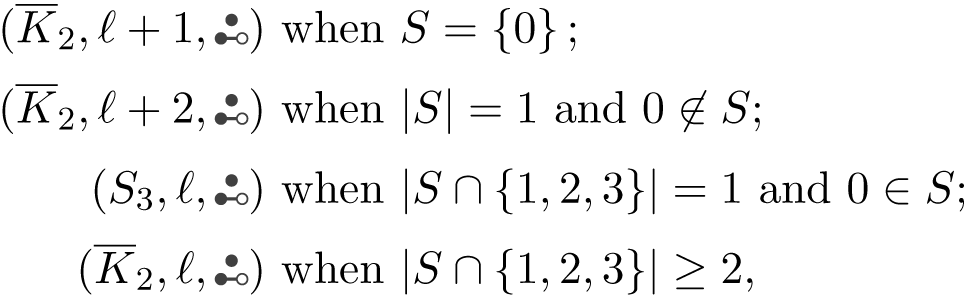
as a subgraph, which yields a contradiction in view of Lemma 1.6 and Proposition 4.4.
We next prove that the diamond graph $D$
is not a subgraph of
$D$
is not a subgraph of $(F_R, 1)$
. Assume for the sake of contradiction that
$(F_R, 1)$
. Assume for the sake of contradiction that $D$
is a subgraph of
$D$
is a subgraph of $(F_R, 1)$
. Let
$(F_R, 1)$
. Let $v_1$
be the vertex in
$v_1$
be the vertex in $V(F_R, 1) \setminus V(F_R, 0)$
, and let
$V(F_R, 1) \setminus V(F_R, 0)$
, and let $v_1u_1\ldots u_\ell$
be a shortest path (possibly of length
$v_1u_1\ldots u_\ell$
be a shortest path (possibly of length $0$
) from
$0$
) from $v_1$
to a vertex
$v_1$
to a vertex $u_\ell$
at distance
$u_\ell$
at distance $1$
from
$1$
from $D$
. Label the vertices of
$D$
. Label the vertices of $D$
as in Figure 7, and let
$D$
as in Figure 7, and let $S\subseteq \{{0,1,2,3} \}$
be the nonempty subset of vertices of
$S\subseteq \{{0,1,2,3} \}$
be the nonempty subset of vertices of $D$
that are adjacent to
$D$
that are adjacent to $u_\ell$
in
$u_\ell$
in $(F_R, 1)$
. Notice that the augmented path extension
$(F_R, 1)$
. Notice that the augmented path extension
 contains
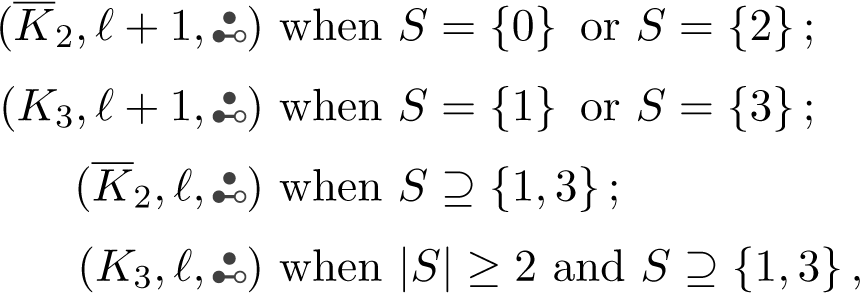
as a subgraph, which yields a contradiction in view of Lemma 1.6 and Proposition 4.4.
At this point, Theorem 4.3 implies that there exists a graph $H'$
such that
$H'$
such that $(F_R, 1)$
is the line graph of
$(F_R, 1)$
is the line graph of $H'$
. Let
$H'$
. Let $v_0$
be the vertex in
$v_0$
be the vertex in $V(F_R, 0) \setminus V(F)$
, and let
$V(F_R, 0) \setminus V(F)$
, and let $v_1$
be the vertex in
$v_1$
be the vertex in $V(F_R, 1) \setminus V(F_R, 0)$
. We identify the two vertices
$V(F_R, 1) \setminus V(F_R, 0)$
. We identify the two vertices $v_0$
and
$v_0$
and $v_1$
of
$v_1$
of $(F_R, 1)$
with two edges
$(F_R, 1)$
with two edges $e_0$
and
$e_0$
and $e_1$
of
$e_1$
of $H'$
. Since
$H'$
. Since $v_0v_1$
is an edge of
$v_0v_1$
is an edge of $(F_R, 1)$
, the edges
$(F_R, 1)$
, the edges $e_0$
and
$e_0$
and $e_1$
share a common vertex in
$e_1$
share a common vertex in $H'$
. Let
$H'$
. Let $r, u_0, u_1$
be the vertices of
$r, u_0, u_1$
be the vertices of $H'$
such that
$H'$
such that $e_0 = ru_0$
and
$e_0 = ru_0$
and $e_1 = u_0u_1$
. Since
$e_1 = u_0u_1$
. Since $v_1$
is a leaf of
$v_1$
is a leaf of $(F_R, 1)$
and
$(F_R, 1)$
and $v_0v_1$
is a pendant edge of
$v_0v_1$
is a pendant edge of $(F_R, 1)$
, we deduce that
$(F_R, 1)$
, we deduce that $u_1$
is a leaf of
$u_1$
is a leaf of $H'$
, and
$H'$
, and $u_0$
is a leaf of
$u_0$
is a leaf of $H' - u_1$
. Let
$H' - u_1$
. Let $H = H' - \{{u_0, u_1} \}$
. Clearly
$H = H' - \{{u_0, u_1} \}$
. Clearly $F_R$
is the line graph of
$F_R$
is the line graph of $H_r$
. Since
$H_r$
. Since $(F_R, 1)$
is connected, so are
$(F_R, 1)$
is connected, so are $H'$
and
$H'$
and $H$
.
$H$
.
To finish the proof of (a), we need to further show that $H$
is bipartite. Assume for the sake of contradiction that
$H$
is bipartite. Assume for the sake of contradiction that $H$
contains an odd cycle
$H$
contains an odd cycle $C_k$
of length
$C_k$
of length $k$
as a subgraph that is not necessarily induced. Take a shortest path
$k$
as a subgraph that is not necessarily induced. Take a shortest path $P$
of length
$P$
of length $\ell$
between
$\ell$
between $r$
and
$r$
and $C_k$
. Notice that the edges in
$C_k$
. Notice that the edges in $P$
and
$P$
and $C_k$
induce the following graph as a subgraph of
$C_k$
induce the following graph as a subgraph of
 :
:

which yields a contradiction in view of Lemma 1.6 and Proposition 4.4.
We are left to prove (b) and (c). Assume for the sake of contradiction that $r$
is not a leaf of
$r$
is not a leaf of $H$
, and there exists a vertex
$H$
, and there exists a vertex $u_9$
at distance
$u_9$
at distance $9$
from
$9$
from $r$
in
$r$
in $H$
. Take a shortest path
$H$
. Take a shortest path $P \, :\!= \, ru_1\ldots u_9$
between
$P \, :\!= \, ru_1\ldots u_9$
between $r$
and
$r$
and $u_9$
. Since
$u_9$
. Since $r$
is not a leaf of
$r$
is not a leaf of $H$
, we can choose a neighbour of
$H$
, we can choose a neighbour of $r$
, say
$r$
, say $u_0$
, in
$u_0$
, in $H$
that is not on
$H$
that is not on $P$
. Notice that these edges
$P$
. Notice that these edges $ru_0, ru_1, u_1u_2, \ldots , u_8u_9$
in
$ru_0, ru_1, u_1u_2, \ldots , u_8u_9$
in $H$
induce
$H$
induce
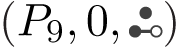 as a subgraph of
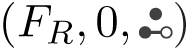 , which yields a contradiction in view of Proposition 4.4. Lastly, assume for the sake of contradiction that there exists a vertex $u$
with degree at least
$u$
with degree at least $8$
in
$8$
in $H$
. Take a shortest path
$H$
. Take a shortest path $P$
of length
$P$
of length $\ell$
between
$\ell$
between $r$
and
$r$
and $u$
in
$u$
in $H$
. We can choose neighbours of
$H$
. We can choose neighbours of $u$
, say
$u$
, say $u_1, \ldots , u_7$
, in
$u_1, \ldots , u_7$
, in $H$
that are not on
$H$
that are not on $P$
. Notice that the edges of
$P$
. Notice that the edges of $P$
together with the edges
$P$
together with the edges $uu_1, \ldots , uu_7$
induce
$uu_1, \ldots , uu_7$
induce
 as a subgraph of
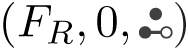 , which yields a contradiction in view of Lemma 1.6 and Proposition 4.4.
We need one more ingredient on augmented path extensions that are not in ${\mathcal{G}}(2)$
.
${\mathcal{G}}(2)$
.
Lemma 4.6.
For every rooted graph $F_R$
and every
$F_R$
and every $\ell \in \mathbb{N}$
, if the smallest eigenvalue of
$\ell \in \mathbb{N}$
, if the smallest eigenvalue of
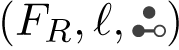 is less than $-2$
, then the same holds for
$-2$
, then the same holds for

Proof. Let $v_0\ldots v_\ell$
be the path of length
$v_0\ldots v_\ell$
be the path of length $\ell$
added to the disjoint union of
$\ell$
added to the disjoint union of $F$
and the rooted graph
$F$
and the rooted graph
 to obtain
 , and let $v_{-1}v_0\ldots v_\ell$
be the corresponding path of length
$v_{-1}v_0\ldots v_\ell$
be the corresponding path of length $\ell +1$
to obtain
$\ell +1$
to obtain
 . Suppose that
 We can pick a nonzero vector
 such that
 . Define the vector
 by
by
 \begin{equation*} \tilde {x}_v = \begin{cases} -x_v & \text{if }v \in V(F); \\ -x_{v_0} & \text{if }v = v_{-1}; \\ x_v & \text{otherwise}. \\ \end{cases} \end{equation*}
Clearly,
 and
and $\tilde {\boldsymbol{x}}^{\intercal } \tilde {\boldsymbol{x}} = {\boldsymbol{x}}^{\intercal } {\boldsymbol{x}} + x_{v_0}^2$
. In particular,
$\tilde {\boldsymbol{x}}^{\intercal } \tilde {\boldsymbol{x}} = {\boldsymbol{x}}^{\intercal } {\boldsymbol{x}} + x_{v_0}^2$
. In particular, $\tilde {\boldsymbol{x}}$
is a nonzero vector that satisfies
$\tilde {\boldsymbol{x}}$
is a nonzero vector that satisfies
 which implies that
 according to the Rayleigh principle.
We are in the position to characterise the rooted graphs $F_R$
for which
$F_R$
for which
 .
.
Proof of Theorem
4.2
. Let the family $\mathcal{F}$
consist of rooted graphs
$\mathcal{F}$
consist of rooted graphs $F_R$
such that
$F_R$
such that $(F_R, 0)$
is connected,
$(F_R, 0)$
is connected,
 for every $\ell \in \mathbb{N}$
, and
$\ell \in \mathbb{N}$
, and $F_R = K_0$
or
$F_R = K_0$
or $|R| \ge 2$
. Consider a connected augmented path extension of a rooted graph
$|R| \ge 2$
. Consider a connected augmented path extension of a rooted graph $F_R$
in
$F_R$
in ${\mathcal{G}}(\lambda ^*)$
. Without loss of generality, we may assume that either
${\mathcal{G}}(\lambda ^*)$
. Without loss of generality, we may assume that either $F_R = K_0$
or
$F_R = K_0$
or $|R| \ge 2$
. Clearly,
$|R| \ge 2$
. Clearly, $(F_R, 0)$
is connected. By Lemma 1.6,
for every
$(F_R, 0)$
is connected. By Lemma 1.6,
for every $\ell \in \mathbb{N}$
, and so
$\ell \in \mathbb{N}$
, and so $F_R \in {\mathcal{F}}$
.
$F_R \in {\mathcal{F}}$
.
For (a), apply Lemma 4.5 to each rooted graph $F_R \in {\mathcal{F}}$
to obtain a connected bipartite single-rooted graph
$F_R \in {\mathcal{F}}$
to obtain a connected bipartite single-rooted graph $H_r$
such that
$H_r$
such that $F_R$
is the line graph of
$F_R$
is the line graph of $H_r$
. Since
$H_r$
. Since $R = \varnothing$
or
$R = \varnothing$
or $|R| \ge 2$
, the root
$|R| \ge 2$
, the root $r$
of
$r$
of $H_r$
cannot be a leaf of
$H_r$
cannot be a leaf of $H$
. Furthermore, Lemma 4.5(b) and Lemma 4.5(c) imply that the order of
$H$
. Furthermore, Lemma 4.5(b) and Lemma 4.5(c) imply that the order of $H_r$
is bounded by
$H_r$
is bounded by $7^8$
, implying that
$7^8$
, implying that $\mathcal{F}$
is finite.
$\mathcal{F}$
is finite.
For (b), take a rooted graph $F_R$
in
$F_R$
in $\mathcal{F}$
. Note that
$\mathcal{F}$
. Note that
 contains $E_{10}$
as a subgraph, whose smallest eigenvalue is less than
$E_{10}$
as a subgraph, whose smallest eigenvalue is less than $-2$
. Let
$-2$
. Let $\ell _0 \in \mathbb{N}$
be the minimum
$\ell _0 \in \mathbb{N}$
be the minimum $\ell \in \mathbb{N}$
such that
$\ell \in \mathbb{N}$
such that
 In particular, $\ell _0 \le 6$
. By Lemma 4.6,
$\ell _0 \le 6$
. By Lemma 4.6,
 if and only if $\ell \ge \ell _0$
.
$\ell \ge \ell _0$
.
5. Enumeration of the rooted graphs
In this section, we enumerate, by means of a computer search, all connected bipartite single-rooted graphs $H_r$
such that
$H_r$
such that $r$
is not a leaf of
$r$
is not a leaf of $H$
, and
$H$
, and
 , and we describe them concisely through their maximal members. We also record, for each such $H_r$
, the minimum value of
$H_r$
, the minimum value of $\ell _0 \in \{{0,\ldots ,6} \}$
for which
$\ell _0 \in \{{0,\ldots ,6} \}$
for which
 . By Theorem 4.2, each pair $(H_r, \ell _0)$
thus determines a family of augmented path extensions
$(H_r, \ell _0)$
thus determines a family of augmented path extensions
 in
in ${\mathcal{G}}(\lambda ^*) \setminus {\mathcal{G}}(2)$
, where
${\mathcal{G}}(\lambda ^*) \setminus {\mathcal{G}}(2)$
, where $F_R = L(H_r)$
and
$F_R = L(H_r)$
and $\ell \ge \ell _0$
.
$\ell \ge \ell _0$
.
Definition 5.1. Given two single-rooted graphs $H_r$
and
$H_r$
and $H'_s$
, we say that
$H'_s$
, we say that $H_r$
is a general subgraph of
$H_r$
is a general subgraph of $H'_s$
if there exists an injective graph homomorphism from
$H'_s$
if there exists an injective graph homomorphism from $H$
to
$H$
to $H'$
that maps
$H'$
that maps $r$
to
$r$
to $s$
.
$s$
.
Theorem 5.2.
Let the family $\mathcal{H}$
consist of the connected bipartite single-rooted graphs
$\mathcal{H}$
consist of the connected bipartite single-rooted graphs $H_r$
such that
$H_r$
such that $r$
is not a leaf of
$r$
is not a leaf of $H$
, and the smallest eigenvalue of
$H$
, and the smallest eigenvalue of
 is greater than $-\lambda ^*$
. Let
$-\lambda ^*$
. Let ${\mathcal{H}}^*$
be the subfamily of
${\mathcal{H}}^*$
be the subfamily of $\mathcal{H}$
that consists members that are maximal under general subgraphs.
$\mathcal{H}$
that consists members that are maximal under general subgraphs.
-
(a) For every general subgraph
$H_r$
of a member in
${\mathcal{H}}^*$
, if
$H$
is connected and
$r$
is not a leaf of
$H$
, then
$H_r$
is in
$\mathcal{H}$
. -
(b) There are a total of 794 members of
$\mathcal{H}$
with the following statistics.
Footnote
2
-
(c) There are a total of 48 members of
${\mathcal{H}}^*$
, which are listed in Figure
9
.


Single-rooted graphs of $\mathcal{H}$
that are maximal under general subgraphs.
$\mathcal{H}$
that are maximal under general subgraphs.

Proof. For (a), consider a general subgraph $H_r$
of
$H_r$
of $H_s' \in {\mathcal{H}}$
. Since
$H_s' \in {\mathcal{H}}$
. Since
 is a subgraph of
 , we know that
 .
.
To enumerate the members in $\mathcal{H}$
, notice that for every member
$\mathcal{H}$
, notice that for every member $H_r \in {\mathcal{H}}$
, except the trivial single-rooted graph
$H_r \in {\mathcal{H}}$
, except the trivial single-rooted graph $K_1$
, there exists a sequence
$K_1$
, there exists a sequence $H_r^{(2)}, \ldots , H_r^{(n)} = H_r$
of members of
$H_r^{(2)}, \ldots , H_r^{(n)} = H_r$
of members of $\mathcal{H}$
such that
$\mathcal{H}$
such that
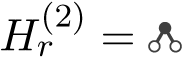 , and for every $i \in \{{2,\ldots , n-1} \}$
,
$i \in \{{2,\ldots , n-1} \}$
, $H^{(i+1)}$
is obtained from
$H^{(i+1)}$
is obtained from $H^{(i)}$
by adding an edge that is incident to at least one vertex of
$H^{(i)}$
by adding an edge that is incident to at least one vertex of $H^{(i)}$
. This allows us to search for more non-trivial members of
$H^{(i)}$
. This allows us to search for more non-trivial members of $\mathcal{H}$
by adding a new edge to the existing ones.
$\mathcal{H}$
by adding a new edge to the existing ones.
We store members of $\mathcal{H}$
in the hash dict based on their size and store those that are maximal under general subgraphs in the array maximal. At the start, dict[0] consists of the trivial single-rooted graph
$\mathcal{H}$
in the hash dict based on their size and store those that are maximal under general subgraphs in the array maximal. At the start, dict[0] consists of the trivial single-rooted graph $K_1$
, dict[2] consists of
$K_1$
, dict[2] consists of
 , and the counter m is incremented from 2.
Whenever dict[m] is nonempty, we iterate through members of dict[m]. For each $H_r$
in dict[m], we carry out the following steps.
$H_r$
in dict[m], we carry out the following steps.
-
(i) We add a new edge to
$H_r$
in every possible way to obtain new connected bipartite single-rooted graphs
$H_r'$
. -
(ii) We admit those
$H_r'$
with
to dict[m+1] (cf. Section 5.1 and 5.2). -
(iii) We append
$H_r$
to maximal when no
$H_r'$
was admitted to dict[m+1].


 to
to 

For each $H_r$
in dict, we output it as a string of the form u[1]u[2]…u[2e-1]u[2e] which lists the edges u[1]u[2],…,u[2e-1]u[2e] of
$H_r$
in dict, we output it as a string of the form u[1]u[2]…u[2e-1]u[2e] which lists the edges u[1]u[2],…,u[2e-1]u[2e] of $H_r$
, and we designate r to represent the root of
$H_r$
, and we designate r to represent the root of $H_r$
in the string. We also output the minimum
$H_r$
in the string. We also output the minimum $\ell _0 \in \{{0,\ldots , 6} \}$
such that
$\ell _0 \in \{{0,\ldots , 6} \}$
such that
 (cf. Section 5.3). Finally, we output the maximal single-rooted graphs stored in maximal.
Our code and its output are available as the ancillary files enum_rooted_graphs.rb andenum_rooted_graphs.txt in the arXiv version of the paper.
For the rest of this section, we share further details of our implementation.
5.1 Positive definiteness of
$A_{G'} + \lambda ^* I$

Before we admit a single-rooted graph $H_r'$
to dict[m+1], we need to check whether
$H_r'$
to dict[m+1], we need to check whether $A_{G'} + \lambda ^* I$
is positive definite, where
$A_{G'} + \lambda ^* I$
is positive definite, where
 . Since $H_r'$
is obtained from
$H_r'$
is obtained from $H_r$
in dict[m] by adding a new edge, the graph
$H_r$
in dict[m] by adding a new edge, the graph
 can be obtained from $G'$
by removing a vertex. Since
$G'$
by removing a vertex. Since $A_G + \lambda ^* I$
is already positive definite, by Sylvester’s criterion, it suffices to check whether the determinant of
$A_G + \lambda ^* I$
is already positive definite, by Sylvester’s criterion, it suffices to check whether the determinant of $A_{G'} + \lambda ^* I$
is positive. To avoid the irrational number
$A_{G'} + \lambda ^* I$
is positive. To avoid the irrational number $\lambda ^*$
, we use two rational approximations
$\lambda ^*$
, we use two rational approximations $\lambda ^*_-$
and
$\lambda ^*_-$
and $\lambda ^*_+$
:
$\lambda ^*_+$
:
 \begin{equation*} 2.0198008850 \approx 18259/9040 \, =\!: \, \lambda ^*_- \lt \lambda ^* \lt \lambda ^*_+ \, :\!= \, 91499/45301 \approx 2.0198008874, \end{equation*}
Exactly one of the following two cases occurs.
Case 1: $\det (A_{G'} + \lambda ^*_- I) \gt 0$
. Since
$\det (A_{G'} + \lambda ^*_- I) \gt 0$
. Since $A_G + \lambda ^*_- I$
is positive definite, so is
$A_G + \lambda ^*_- I$
is positive definite, so is $A_{G'} + \lambda ^*_- I$
according to Sylvester’s criterion. In this case, we can assert that
$A_{G'} + \lambda ^*_- I$
according to Sylvester’s criterion. In this case, we can assert that $A_{G'} + \lambda ^* I$
is positive definite.
$A_{G'} + \lambda ^* I$
is positive definite.
Case 2: $\det (A_{G'} + \lambda ^*_+ I) \lt 0$
. Since the matrix
$\det (A_{G'} + \lambda ^*_+ I) \lt 0$
. Since the matrix $A_{G'} + \lambda ^*_+ I$
is not positive definite, we can assert that
$A_{G'} + \lambda ^*_+ I$
is not positive definite, we can assert that $A_{G'} + \lambda ^* I$
is not positive definite either.
$A_{G'} + \lambda ^* I$
is not positive definite either.
Otherwise, we raise an exception, although this never occurs for any graph encountered throughout the computer search.
5.2 Hash function of single-rooted graphs
When we admit a single-rooted graph $H_s'$
to dict[m+1], we need to check whether it is isomorphic to an existing member of dict[m+1]. To efficiently detect isomorphic duplicates, we maintain a hash table @hash of existing members of dict[m+1] using the following hash function.
$H_s'$
to dict[m+1], we need to check whether it is isomorphic to an existing member of dict[m+1]. To efficiently detect isomorphic duplicates, we maintain a hash table @hash of existing members of dict[m+1] using the following hash function.
For a bipartite single-rooted graph $H_r$
, its hash value is a triple [dr, dA, dB], where dr is the degree of
$H_r$
, its hash value is a triple [dr, dA, dB], where dr is the degree of $r$
in
$r$
in $H$
, dA is the degree sequence of the vertices in the part that contains
$H$
, dA is the degree sequence of the vertices in the part that contains $r$
, and dB is the degree sequence of the vertices in the part that does not contain
$r$
, and dB is the degree sequence of the vertices in the part that does not contain $r$
. Clearly, when two bipartite single-rooted graphs are isomorphic, their hash values are equal.
$r$
. Clearly, when two bipartite single-rooted graphs are isomorphic, their hash values are equal.
This allows us to test whether $H_s'$
is isomorphic to any existing member of dict[m+1] by examining only the members of @hash[hv], where hv is the hash value of
$H_s'$
is isomorphic to any existing member of dict[m+1] by examining only the members of @hash[hv], where hv is the hash value of $H_s'$
.
$H_s'$
.
5.3 Positive semidefiniteness of
$A_G + 2I$

When computing the minimum $\ell _0$
, Sylvester’s criterion implies that checking whether
$\ell _0$
, Sylvester’s criterion implies that checking whether $A_G + 2I$
is positive semidefinite amounts to verifying that all principal minors of
$A_G + 2I$
is positive semidefinite amounts to verifying that all principal minors of $A_G + 2I$
are nonnegative. To make this subroutine more efficient, we use the following fact.
$A_G + 2I$
are nonnegative. To make this subroutine more efficient, we use the following fact.
Theorem 5.3 (Theorem 2.5 of Bussemaker and Neumaier [Reference Bussemaker and Neumaier2]). There is no graph whose smallest eigenvalue is in $(\lambda _1(E_{10}),-2)$
, where
$(\lambda _1(E_{10}),-2)$
, where $\lambda _1(E_{10}) \approx -2.006594$
.
$\lambda _1(E_{10}) \approx -2.006594$
.
Corollary 5.4.
For every graph $G$
, the matrix
$G$
, the matrix $A_G + 2I$
is positive semidefinite if and only if the matrix
$A_G + 2I$
is positive semidefinite if and only if the matrix $A_G + (305/152) I$
is positive definite.
$A_G + (305/152) I$
is positive definite.
Proof. Since $\lambda _1(E_{10}) \lt -305/152 \lt -2$
, the smallest eigenvalue of
$\lambda _1(E_{10}) \lt -305/152 \lt -2$
, the smallest eigenvalue of $G$
is at least
$G$
is at least $-2$
precisely when it exceeds
$-2$
precisely when it exceeds $-305/152$
.
$-305/152$
.
In our implementation, we assert that $A_G + 2I$
is positive semidefinite if and only if all the leading principal minors of
$A_G + 2I$
is positive semidefinite if and only if all the leading principal minors of $A_G + (305/152)I$
are positive.
$A_G + (305/152)I$
are positive.
6. Enumeration of the Maverick graphs
In this section, we enumerate the connected graphs in ${\mathcal{G}}(\lambda ^*)\setminus {\mathcal{G}}(2)$
that are not augmented path extensions.
${\mathcal{G}}(\lambda ^*)\setminus {\mathcal{G}}(2)$
that are not augmented path extensions.
Theorem 6.1. There are a total of 4752 maverick graphs with the following statistics.

We need the following technical result on the generation of maverick graphs.
Definition 6.2 (Witness). Given a graph $G$
, a quadruple
$G$
, a quadruple $(u_0,u_1,u_2,u_c)$
of distinct vertices is a witness for an augmented path extension if
$(u_0,u_1,u_2,u_c)$
of distinct vertices is a witness for an augmented path extension if $u_0u_1$
,
$u_0u_1$
, $u_1u_2$
, and
$u_1u_2$
, and $u_0u_c$
are the only edges of
$u_0u_c$
are the only edges of $G$
that are not in
$G$
that are not in $G - \{{u_1,u_2,u_c} \}$
.
$G - \{{u_1,u_2,u_c} \}$
.
Remark. As the name suggests, a graph $G$
has a witness for an augmented path extension if and only if
$G$
has a witness for an augmented path extension if and only if $G$
is an augmented path extension of a rooted graph.
$G$
is an augmented path extension of a rooted graph.
Lemma 6.3.
For every maverick graph $M$
on
$M$
on $n$
vertices, there exists a sequence
$n$
vertices, there exists a sequence $K_2 = G_2, \ldots , G_n = M$
of connected graphs satisfying the following three properties.
$K_2 = G_2, \ldots , G_n = M$
of connected graphs satisfying the following three properties.
-
(i) For every
$i \in \{{3,\ldots ,n} \}$
,
$\lambda _1(G_i) \gt -\lambda ^*$
, and there exists
$v_i \in V(G_i)$
such that
$G_{i-1} = G_i - v_i$
. -
(ii) If
$n \ge 10$
, then
$\lambda _1(G_{10}) \lt -2$
. -
(iii) If
$n \ge 11$
and
$G_{10}$
has a unique witness for an augmented path extension, then
$G_{11}$
is not an augmented path extension.


The proof requires the following fact about graphs with smallest eigenvalue less than $-2$
that are minimal under subgraphs.
$-2$
that are minimal under subgraphs.
Theorem 6.4 (Kumar, Rao, and Singhi [Reference Kumar, Rao and Singhi14]). Every minimal forbidden subgraph for the family ${\mathcal{G}}(2)$
of graphs with smallest eigenvalue at least
${\mathcal{G}}(2)$
of graphs with smallest eigenvalue at least $-2$
has at most 10 vertices.
$-2$
has at most 10 vertices.
Proof of Lemma
6.3
. Suppose $M$
is a maverick graph on
$M$
is a maverick graph on $n$
vertices. Since
$n$
vertices. Since $M$
is connected,
$M$
is connected, $M$
is not a null graph, and
$M$
is not a null graph, and $\lambda _1(M) \gt -\lambda ^*$
, the case where
$\lambda _1(M) \gt -\lambda ^*$
, the case where $n \le 9$
is trivial. Hereafter, we may assume that
$n \le 9$
is trivial. Hereafter, we may assume that $n \ge 10$
. Theorem 6.4 provides a connected subgraph
$n \ge 10$
. Theorem 6.4 provides a connected subgraph $G_{10}$
of
$G_{10}$
of $M$
on
$M$
on $10$
vertices such that
$10$
vertices such that $\lambda _1(G_{10}) \lt -2$
. We can then easily build the other connected graphs in the sequence using
$\lambda _1(G_{10}) \lt -2$
. We can then easily build the other connected graphs in the sequence using $G_{10}$
.
$G_{10}$
.
In the case where $n \ge 11$
and
$n \ge 11$
and $G_{10}$
has a unique witness, say
$G_{10}$
has a unique witness, say $(u_0,u_1,u_2,u_c)$
, of an augmented path extension, since
$(u_0,u_1,u_2,u_c)$
, of an augmented path extension, since $M$
is not an augmented path extension, there exists a vertex
$M$
is not an augmented path extension, there exists a vertex $v_{11} \in V(M) \setminus V(G_{10})$
that is adjacent to at least one of
$v_{11} \in V(M) \setminus V(G_{10})$
that is adjacent to at least one of $u_1$
,
$u_1$
, $u_2$
, and
$u_2$
, and $u_c$
in
$u_c$
in $M$
. We can specifically choose
$M$
. We can specifically choose $G_{11} = M[V(G_{10}) \cup \{{v_{11}} \} \! ]$
. Assume for the sake of contradiction that
$G_{11} = M[V(G_{10}) \cup \{{v_{11}} \} \! ]$
. Assume for the sake of contradiction that $G_{11}$
has a witness
$G_{11}$
has a witness $(u_0',u_1',u_2',u_c')$
. It must be the case that
$(u_0',u_1',u_2',u_c')$
. It must be the case that $u_0'=u_0$
,
$u_0'=u_0$
, $u_1'=u_c$
,
$u_1'=u_c$
, $u_2'=v_{11}$
,
$u_2'=v_{11}$
, $u_c' ot \in \{{u_0,u_1,u_2,u_c} \}$
, and
$u_c' ot \in \{{u_0,u_1,u_2,u_c} \}$
, and $u_0u_1$
,
$u_0u_1$
, $u_1u_2$
,
$u_1u_2$
, $u_0u_c$
,
$u_0u_c$
, $u_cv_{11}$
and
$u_cv_{11}$
and $u_0u_c'$
are the only edges of
$u_0u_c'$
are the only edges of $G_{11}$
that are not in
$G_{11}$
that are not in $G_{11} - \{{u_1, u_2, u_c, u_c'} \}$
. Thus
$G_{11} - \{{u_1, u_2, u_c, u_c'} \}$
. Thus $G_{10}$
has another witness
$G_{10}$
has another witness $(u_0,u_1,u_2,u_c')$
, which contradicts the uniqueness of the witness
$(u_0,u_1,u_2,u_c')$
, which contradicts the uniqueness of the witness $(u_0,u_1,u_2,u_c)$
for
$(u_0,u_1,u_2,u_c)$
for $G_{10}$
.
$G_{10}$
.
The enumeration of all maverick graphs is achieved by a computer search.
Proof of Theorem
6.1
. To enumerate the maverick graphs, we store the graphs that can possibly occur in a sequence described by Lemma 6.3 in the hash table dict based on their order. At the start, dict[2] consists of the single graph $K_2$
, and the counter n is incremented from 2.
$K_2$
, and the counter n is incremented from 2.
Whenever dict[n] is nonempty, we iterate through members of dict[n]. For each $G$
in dict[n], we carry out the following five steps.
$G$
in dict[n], we carry out the following five steps.
-
(i) We connect a new vertex to a nonempty vertex subset
$S$
of
$G$
in every possible way to obtain new graphs
$G' = (G_S, 0)$
. See Section 6.1 for a more efficient implementation. -
(ii) We store those
$G'$
with
$\lambda _1(G') \gt -\lambda ^*$
in a temporary array candidates. -
(iii) In view of Lemma 6.3 (ii), when n = 9, we remove
$G'$
from candidates when
$\lambda _1(G') \lt -2$
. -
(iv) In view of Lemma 6.3 (iii), when n = 10, we remove
$G'$
from candidates when
$G$
has a unique witness for an augmented path extension, and
$G'$
is an augmented path extension (cf. Section 6.2). -
(v) We merge candidates into dict[n+1] (cf. Section 6.3).


We append the maverick graphs among the members in dict[n] to the array mavericks. To select the maverick graphs, we reject members of dict[n] with smallest eigenvalue at least $-2$
for n from 2 to 9, and we always reject augmented path extensions in dict[n].
$-2$
for n from 2 to 9, and we always reject augmented path extensions in dict[n].
Our program terminates at n = 20 because dict[20] is empty. Our code and its output are available as the ancillary files enum_maverick_graphs.rb and enum_maverick_graphs.txt in the arXiv version of the paper.
Remark. On a MacBook Pro equipped with an Apple M1 Pro chip and 16 GB of memory, the program initially completed its task in under 25 minutes. With the assistance of ChatGPT-4, we rewrote the code in Julia, a high-performance dynamic language, reducing runtime to under 8 minutes on the same machine. The code is available as enum_maverick_graphs.jl in the arXiv version of the paper.
We reuse the techniques discussed in Section 5.1 and 5.3 to check positive definiteness and positive semidefiniteness of matrices. We share additional details of our implementation below.
6.1 Adding a new vertex
To accelerate the generation of graphs, we leverage on the computation done for $G$
in dict[n] based on the following observation. Suppose that
$G$
in dict[n] based on the following observation. Suppose that $G$
is a graph such that
$G$
is a graph such that $\lambda _1(G) \gt -\lambda ^*$
. Let
$\lambda _1(G) \gt -\lambda ^*$
. Let $\mathcal{S} = \{{S \subseteq V(G)}\colon {\lambda _1(G_S, 0) \gt -\lambda ^*} \}$
. For every
$\mathcal{S} = \{{S \subseteq V(G)}\colon {\lambda _1(G_S, 0) \gt -\lambda ^*} \}$
. For every $S \in \mathcal{S}$
, and every
$S \in \mathcal{S}$
, and every $U \subseteq V(G')$
, where
$U \subseteq V(G')$
, where $G' = (G_S, 0)$
, note that
$G' = (G_S, 0)$
, note that $\lambda _1(G'_U, 0) \gt -\lambda ^*$
implies that
$\lambda _1(G'_U, 0) \gt -\lambda ^*$
implies that $\lambda _1(G_{U \cap V(G)}, 0) \gt -\lambda ^*$
, which is equivalent to
$\lambda _1(G_{U \cap V(G)}, 0) \gt -\lambda ^*$
, which is equivalent to $U \cap V(G) \in \mathcal{S}$
. In other words, when we connect a new vertex to a nonempty subset
$U \cap V(G) \in \mathcal{S}$
. In other words, when we connect a new vertex to a nonempty subset $U$
of
$U$
of $G' = (G_S, 0)$
with
$G' = (G_S, 0)$
with $S \in \mathcal{S}$
, we only need to iterate through
$S \in \mathcal{S}$
, we only need to iterate through $U$
with
$U$
with $U \cap V(G) \in \mathcal{S}$
.
$U \cap V(G) \in \mathcal{S}$
.
To keep track of the set $\mathcal{S}$
defined for
$\mathcal{S}$
defined for $G$
, we add an attribute @possible_subsets, a list of distinct nonempty vertex subsets of
$G$
, we add an attribute @possible_subsets, a list of distinct nonempty vertex subsets of $G$
, to each graph
$G$
, to each graph $G$
. For the graph
$G$
. For the graph $K_2$
in dict[2], its @possible_subsets consists of all the nonempty vertex subsets of
$K_2$
in dict[2], its @possible_subsets consists of all the nonempty vertex subsets of $K_2$
. For each
$K_2$
. For each $G$
in dict[n], instead of connecting a new vertex, say
$G$
in dict[n], instead of connecting a new vertex, say $v'$
, to a nonempty vertex subset
$v'$
, to a nonempty vertex subset $S$
of
$S$
of $G$
in every possible way, we connect
$G$
in every possible way, we connect $v'$
to
$v'$
to $S$
for every
$S$
for every $S$
in @possible_subsets of
$S$
in @possible_subsets of $G$
. To obtain @possible_subsets of the graphs obtained from
$G$
. To obtain @possible_subsets of the graphs obtained from $G$
, we initially set new_possible_subsets to be the list with a single vertex subset
$G$
, we initially set new_possible_subsets to be the list with a single vertex subset $\{{v'} \}$
. For each
$\{{v'} \}$
. For each $S$
in @possible_subsets of
$S$
in @possible_subsets of $G$
, check whether
$G$
, check whether $\lambda _1(G_S, 0) \gt -\lambda ^*$
, and if so, we append both
$\lambda _1(G_S, 0) \gt -\lambda ^*$
, and if so, we append both $S$
and
$S$
and $S \cup \{{v'} \}$
to new_possible_subsets, and we append
$S \cup \{{v'} \}$
to new_possible_subsets, and we append $(G_S, 0)$
to candidates. Finally, we set @possible_subsets of each graph
$(G_S, 0)$
to candidates. Finally, we set @possible_subsets of each graph $G'$
in candidates to new_possible_subsets.
$G'$
in candidates to new_possible_subsets.
6.2 Finding witnesses
Given a graph $G$
, to find its witnesses for an augmented path extension, we iterate through all edges
$G$
, to find its witnesses for an augmented path extension, we iterate through all edges $u_1u_2$
of
$u_1u_2$
of $G$
with
$G$
with $d(u_1) = 2$
and
$d(u_1) = 2$
and $d(u_2) = 1$
, check whether the vertex
$d(u_2) = 1$
, check whether the vertex $u_0$
, that is, the other neighbour of
$u_0$
, that is, the other neighbour of $u_1$
, is adjacent to a leaf
$u_1$
, is adjacent to a leaf $u_c$
, and we output all quadruples
$u_c$
, and we output all quadruples $(u_0, u_1, u_2, u_c)$
.
$(u_0, u_1, u_2, u_c)$
.
6.3 Hash function of graphs and generalised degrees
When we add a graph $G$
in candidates to dict[n+1], we need to check whether it is isomorphic to an existing member of dict[n+1]. To that end, we maintain a hash table @hash of existing members of dict[n+1] using the following hash function.
$G$
in candidates to dict[n+1], we need to check whether it is isomorphic to an existing member of dict[n+1]. To that end, we maintain a hash table @hash of existing members of dict[n+1] using the following hash function.
For a vertex $v$
of a graph
$v$
of a graph $G$
, the generalised degree of
$G$
, the generalised degree of $v$
in
$v$
in $G$
is the pair [dv, dw], where dv is the degree of
$G$
is the pair [dv, dw], where dv is the degree of $v$
in
$v$
in $G$
, and dw is the number of edges in the subgraph of
$G$
, and dw is the number of edges in the subgraph of $G$
induced by the neighbours of
$G$
induced by the neighbours of $v$
. The hash value of a graph
$v$
. The hash value of a graph $G$
is then the sorted sequence of generalised degrees. Clearly, when two graphs are isomorphic, their hash values are equal, and moreover, the generalised degree of a vertex is preserved under isomorphism.
$G$
is then the sorted sequence of generalised degrees. Clearly, when two graphs are isomorphic, their hash values are equal, and moreover, the generalised degree of a vertex is preserved under isomorphism.
This allows us to test isomorphism between $G$
and any existing member of dict[n+1] by examining only the members of @hash[hv], where hv is the hash value of
$G$
and any existing member of dict[n+1] by examining only the members of @hash[hv], where hv is the hash value of $G$
. In addition, when we attempt to build an isomorphism between
$G$
. In addition, when we attempt to build an isomorphism between $G$
and a member
$G$
and a member $G'$
of @hash[hv], we only map a vertex of
$G'$
of @hash[hv], we only map a vertex of $G$
to a vertex of
$G$
to a vertex of $G'$
that has the same generalised degree.
$G'$
that has the same generalised degree.
7. Twisted Maverick graphs
A visual examination of the maverick graphs reveals that a notable portion of them appear structurally similar.
Definition 7.1 (Twisted path extension and twisted maverick graph). Given a rooted graph $F_R$
and
$F_R$
and $\ell \in \mathbb{N}$
, the twisted path extension of the rooted graph
$\ell \in \mathbb{N}$
, the twisted path extension of the rooted graph $F_R$
is the path augmentation
$F_R$
is the path augmentation
 See Figure 10 for a schematic drawing. Given a graph $G$
, a quadruple
$G$
, a quadruple $(u_0,u_1,u_2,u_c)$
of distinct vertices is a witness for a twisted path extension if
$(u_0,u_1,u_2,u_c)$
of distinct vertices is a witness for a twisted path extension if $u_0u_1$
,
$u_0u_1$
, $u_0u_2$
,
$u_0u_2$
, $u_1u_2$
, and
$u_1u_2$
, and $u_0u_c$
are the only edges of
$u_0u_c$
are the only edges of $G$
that are not in
$G$
that are not in $G - \{{u_1,u_2,u_c} \}$
. A maverick graph is twisted if it is a twisted path extension of a rooted graph.
$G - \{{u_1,u_2,u_c} \}$
. A maverick graph is twisted if it is a twisted path extension of a rooted graph.
The twisted path extension
 .
.

A direct computer screening of the maverick graphs produced in Section 6 reveals that roughly a quarter of them are twisted.
Theorem 7.2. There are a total of 1161 twisted maverick graphs with the following statistics.

Proof. For each maverick graph, we find its witnesses for a twisted path extension as follows: we iterate through all edges $u_1u_2$
of
$u_1u_2$
of $G$
with
$G$
with $d(u_1) = d(u_2) = 2$
, check whether
$d(u_1) = d(u_2) = 2$
, check whether $u_1$
and
$u_1$
and $u_2$
share a common neighbour, if so, check whether the common neighbour, say
$u_2$
share a common neighbour, if so, check whether the common neighbour, say $u_0$
, is adjacent to a leaf
$u_0$
, is adjacent to a leaf $u_c$
, and output all quadruples
$u_c$
, and output all quadruples $(u_0, u_1, u_2, u_c)$
. Once a witness is found for a maverick graph, we assert that it is twisted. As it turns out, every maverick graph that is twisted has a unique witness. Our code and its output are available as the ancillary files enum_twisted_mavericks.rb and enum_twisted_mavericks.txt in the arXiv version of the paper.
$(u_0, u_1, u_2, u_c)$
. Once a witness is found for a maverick graph, we assert that it is twisted. As it turns out, every maverick graph that is twisted has a unique witness. Our code and its output are available as the ancillary files enum_twisted_mavericks.rb and enum_twisted_mavericks.txt in the arXiv version of the paper.
For the proof of Corollary 1.7, we need the following connection between twisted path extensions and augmented path extensions.
Proposition 7.3.
For every rooted graph $F_R$
and
$F_R$
and $\ell \in \mathbb{N}$
, if
$\ell \in \mathbb{N}$
, if
 then
then
 .
.
Proof. Let $\lambda \gt 1$
, to be chosen later, and let
$\lambda \gt 1$
, to be chosen later, and let $v_0$
be the vertex in
$v_0$
be the vertex in $V(F_R,\ell )\setminus V(F_R,\ell -1)$
. In the case where
$V(F_R,\ell )\setminus V(F_R,\ell -1)$
. In the case where $\ell = 0$
, instead let
$\ell = 0$
, instead let $v_0$
be the vertex in
$v_0$
be the vertex in $V(F_R,\ell )\setminus V(F_R)$
. Denote by
$V(F_R,\ell )\setminus V(F_R)$
. Denote by $E_{v_0,v_0}$
the matrix unit where the
$E_{v_0,v_0}$
the matrix unit where the $(v_0,v_0)$
-entry with value
$(v_0,v_0)$
-entry with value $1$
is the only nonzero entry.
$1$
is the only nonzero entry.
We claim that
 if and only if
 \begin{equation} A_{(F_R,\ell )} + \lambda I - \left (\frac {2\lambda -2}{\lambda ^2-1}+\frac {1}{\lambda }\right )E_{v_0,v_0} \end{equation}
is positive semidefinite. Indeed, we partition the matrix
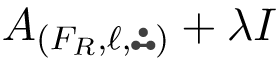 into blocks:
 \begin{equation*}\begin{pmatrix} A_{(F_R, \ell )} & B \\ B^{\intercal } & C \end{pmatrix}\end{equation*}
Since
 and
and $\lambda \gt 1$
, the block
$\lambda \gt 1$
, the block $C$
is positive definite. Therefore, the Schur complement
$C$
is positive definite. Therefore, the Schur complement $A_{(F_R, \ell )} + \lambda I - BC^{-1}B^{\intercal }$
of
$A_{(F_R, \ell )} + \lambda I - BC^{-1}B^{\intercal }$
of $C$
is positive semidefinite. Since the only nonzero row of
$C$
is positive semidefinite. Since the only nonzero row of $B$
is its
$B$
is its $v_0$
-th row, say
$v_0$
-th row, say $B_{v_0}$
, the matrix
$B_{v_0}$
, the matrix $BC^{-1}B^{\intercal }$
simplifies to
$BC^{-1}B^{\intercal }$
simplifies to $B_{v_0}C^{-1}B_{v_0}^{\intercal } E_{v_0,v_0}$
. We then compute directly:
$B_{v_0}C^{-1}B_{v_0}^{\intercal } E_{v_0,v_0}$
. We then compute directly:
 \begin{equation*} B_{v_0}C^{-1}B_{v_0}^{\intercal } = \begin{pmatrix} 1 \\ 1 \\ 1 \end{pmatrix}^{\intercal } \begin{pmatrix} \lambda & 1 & \\ 1 & \lambda & \\ & & \lambda \end{pmatrix}^{-1} \begin{pmatrix} 1 \\ 1 \\ 1 \end{pmatrix} =\frac {2\lambda -2}{\lambda ^2-1}+\frac {1}{\lambda }. \end{equation*}
Similarly, we can prove that
 if and only if
 \begin{equation} A_{(F_R, \, \ell )} + \lambda I - \left (\frac {\lambda }{\lambda ^2-1}+\frac {1}{\lambda }\right ) E_{v_0,v_0} \end{equation}
is positive semidefinite. Finally, take
 and observe that the matrix in (3) minus the matrix in (2) is equal to the matrix $(\lambda -2)/(\lambda ^2-1)E_{v_0,v_0}$
, which is positive semidefinite.
$(\lambda -2)/(\lambda ^2-1)E_{v_0,v_0}$
, which is positive semidefinite.
Proof of Corollary
1.7
. Suppose that $G$
is a connected graph on at least
$G$
is a connected graph on at least $18$
vertices such that
$18$
vertices such that $\lambda _1(G) \in (\! -\lambda ^*, -2)$
. In view of Theorems 6.1 and 7.2,
$\lambda _1(G) \in (\! -\lambda ^*, -2)$
. In view of Theorems 6.1 and 7.2, $G$
is either an augmented path extension or a twisted maverick graph. We break the rest of the proof into two cases.
$G$
is either an augmented path extension or a twisted maverick graph. We break the rest of the proof into two cases.
Case 1: $G$
is an augmented path extension. In view of Lemmas 1.6 and 4.5, there exists a connected bipartite single-rooted graph
$G$
is an augmented path extension. In view of Lemmas 1.6 and 4.5, there exists a connected bipartite single-rooted graph $H_r$
and
$H_r$
and $\ell \in \mathbb{N}$
such that
$\ell \in \mathbb{N}$
such that $G$
is
$G$
is
 . Let
. Let $(u_0, u_1, u_2, u_c)$
be the witness for the augmented path extension. Clearly
$(u_0, u_1, u_2, u_c)$
be the witness for the augmented path extension. Clearly $u_c$
is a leaf of
$u_c$
is a leaf of $G$
, and
$G$
, and $G - u_c$
is the path extension
$G - u_c$
is the path extension $(L(H_r), \ell +2)$
, which is the line graph of the bipartite graph
$(L(H_r), \ell +2)$
, which is the line graph of the bipartite graph $(H_r, \ell +3)$
. We are left to prove the uniqueness of such a leaf. We claim that there exists a neighbour of
$(H_r, \ell +3)$
. We are left to prove the uniqueness of such a leaf. We claim that there exists a neighbour of $u_0$
in
$u_0$
in $G - \{{u_1,u_2,u_c} \}$
that is not a leaf of
$G - \{{u_1,u_2,u_c} \}$
that is not a leaf of $G$
. Assume for the sake of contradiction that every neighbour of
$G$
. Assume for the sake of contradiction that every neighbour of $u_0$
in
$u_0$
in $G - \{{u_1,u_2,u_c} \}$
is a leaf of
$G - \{{u_1,u_2,u_c} \}$
is a leaf of $G$
. In this case,
$G$
. In this case, $\ell = 0$
and
$\ell = 0$
and $F_R$
is a null graph with more than one vertex, which contradicts the connectedness of
$F_R$
is a null graph with more than one vertex, which contradicts the connectedness of $H_r$
. Let
$H_r$
. Let $u_{-1}$
be such a neighbour of
$u_{-1}$
be such a neighbour of $u_0$
. Then
$u_0$
. Then $\{{u_{-1},u_0,u_1,u_c} \}$
induces a star
$\{{u_{-1},u_0,u_1,u_c} \}$
induces a star $S_3$
with
$S_3$
with $3$
leaves in
$3$
leaves in $G$
. Since a line graph cannot contain
$G$
. Since a line graph cannot contain $S_3$
as a subgraph, and
$S_3$
as a subgraph, and $u_c$
is the only leaf of
$u_c$
is the only leaf of $G$
in
$G$
in $\{{u_{-1},u_0,u_1,u_c} \}$
, we have to remove
$\{{u_{-1},u_0,u_1,u_c} \}$
, we have to remove $u_c$
from
$u_c$
from $G$
to obtain a line graph.
$G$
to obtain a line graph.
Case 2: $G$
is a twisted maverick graph
$G$
is a twisted maverick graph
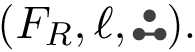 . In view of Proposition 7.3,
 . By Lemmas 1.6 and 4.5, there exists a connected bipartite single-rooted graph $H_r$
such that
$H_r$
such that $F_R$
is
$F_R$
is $L(H_r)$
. Let
$L(H_r)$
. Let $(u_0,u_1,u_2,u_c)$
be the witness for the twisted path extension. Clearly
$(u_0,u_1,u_2,u_c)$
be the witness for the twisted path extension. Clearly $u_c$
is a leaf of
$u_c$
is a leaf of $G$
, and
$G$
, and $G - u_c$
is the graph
$G - u_c$
is the graph
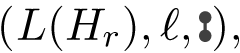 which is the line graph of the bipartite graph
 . The proof for the uniqueness of such a leaf follows exactly that of the previous case.
Remark. The order 18 in Corollary 1.7 is the smallest possible because of the two maverick graphs of order 17 that are not twisted — each has a unique leaf, and its removal results in a graph that contains the star $S_3$
as a subgraph.
$S_3$
as a subgraph.
8. Beyond the classification theorem of
${\mathcal{G}}(\lambda ^*)\setminus {\mathcal{G}}(2)$

In this section, we briefly explore graphs whose smallest eigenvalues lie slightly beyond $-\lambda ^*$
. As it turns out, Theorem 1.5 extends, whereas Theorem 4.2 does not.
$-\lambda ^*$
. As it turns out, Theorem 1.5 extends, whereas Theorem 4.2 does not.
Theorem 8.1.
There exist $\lambda \gt \lambda ^*$
and
$\lambda \gt \lambda ^*$
and $N \in \mathbb{N}$
such that for every connected graph
$N \in \mathbb{N}$
such that for every connected graph $G$
on more than
$G$
on more than $N$
vertices, if the smallest eigenvalue of
$N$
vertices, if the smallest eigenvalue of $G$
is in
$G$
is in $(\! -\lambda , -2)$
, then
$(\! -\lambda , -2)$
, then $G$
is isomorphic to an augmented path extension of a rooted graph.
$G$
is isomorphic to an augmented path extension of a rooted graph.
Theorem 8.2.
For every $\lambda \gt \lambda ^*$
, every finite family
$\lambda \gt \lambda ^*$
, every finite family $\mathcal{F}$
of rooted graphs, and every
$\mathcal{F}$
of rooted graphs, and every $N \in \mathbb{N}$
, there exists a connected graph
$N \in \mathbb{N}$
, there exists a connected graph $G$
on more than
$G$
on more than $N$
vertices such that the smallest eigenvalue of
$N$
vertices such that the smallest eigenvalue of $G$
is in
$G$
is in $(\! -\lambda , -\lambda ^*)$
, and
$(\! -\lambda , -\lambda ^*)$
, and $G$
is not an augmented path extension of any rooted graph in
$G$
is not an augmented path extension of any rooted graph in $\mathcal{F}$
.
$\mathcal{F}$
.
To understand why Theorem 1.5 generalises beyond $-\lambda ^*$
, note that in its derivation in Section 2, the constant
$-\lambda ^*$
, note that in its derivation in Section 2, the constant $\lambda ^*$
plays an essential role only in Lemma 2.10. In [Reference Jiang and Polyanskii11, Appendix A], Jiang and Polyanskii already noted that
$\lambda ^*$
plays an essential role only in Lemma 2.10. In [Reference Jiang and Polyanskii11, Appendix A], Jiang and Polyanskii already noted that $\lambda ^* \approx 2.01980$
can be replaced with
$\lambda ^* \approx 2.01980$
can be replaced with $101/50 = 2.02$
in Lemma 2.10. To obtain the best constant, we define the following graphs and compute the limit of their smallest eigenvalues.
$101/50 = 2.02$
in Lemma 2.10. To obtain the best constant, we define the following graphs and compute the limit of their smallest eigenvalues.
Proposition 8.3.
For every $n \in \mathbb{N}$
with
$n \in \mathbb{N}$
with $n \ge 4$
, define the graph
$n \ge 4$
, define the graph $E_n'$
as the path extension
$E_n'$
as the path extension
 in Figure
11
. The smallest eigenvalue of
in Figure
11
. The smallest eigenvalue of $E_n'$
decreases to
$E_n'$
decreases to $-\lambda '$
, where
$-\lambda '$
, where
 \begin{equation*}\lambda ' \, :\!= \, \gamma + 1/\gamma \approx 2.02124\end{equation*}
and $\gamma$
is the unique positive root of
$\gamma$
is the unique positive root of $x^4 + x^3 = x^2 + 2$
.
$x^4 + x^3 = x^2 + 2$
. $E_4'$
,
$E_4'$
, $E_5'$
,
$E_5'$
, $E_6'$
, and
$E_6'$
, and $E_n'$
.
$E_n'$
.

Proof. Using Lemma 3.4, we know that the matrix
 \begin{equation*} \begin{pmatrix} r &\quad 1 &\quad 1 &\quad 1 \\ 1 &\quad x &\quad 1 &\quad 0 \\ 1 &\quad 1 &\quad x &\quad 0 \\ 1 &\quad 0 &\quad 0 &\quad x \end{pmatrix} \end{equation*}
is singular when $x = \lambda '$
, where
$x = \lambda '$
, where $r = x/2 + \sqrt {x^2/4-1}$
. Upon substituting
$r = x/2 + \sqrt {x^2/4-1}$
. Upon substituting $x = r + 1/r$
, the determinant of the above matrix equals
$x = r + 1/r$
, the determinant of the above matrix equals $r^4 - r^2 + 2r + 2/r - 2/r^2 - 3$
, which factors into
$r^4 - r^2 + 2r + 2/r - 2/r^2 - 3$
, which factors into $(r^4 + r^3 - r^2 -2)(r^2-r+1)/r^2$
. Since
$(r^4 + r^3 - r^2 -2)(r^2-r+1)/r^2$
. Since $\gamma$
is the unique positive root of
$\gamma$
is the unique positive root of $r^4 + r^3 - r^2 - 2$
, and no root of
$r^4 + r^3 - r^2 - 2$
, and no root of $r^2 - r + 1$
is real, it must be the case that
$r^2 - r + 1$
is real, it must be the case that $\lambda ' = \gamma + 1/\gamma$
.
$\lambda ' = \gamma + 1/\gamma$
.
Besides $E_6$
, the graph
$E_6$
, the graph $E_6'$
is also one of the 31 minimal forbidden subgraphs for the family
$E_6'$
is also one of the 31 minimal forbidden subgraphs for the family ${\mathcal{D}}_\infty$
of generalised line graphs. It turns out that
${\mathcal{D}}_\infty$
of generalised line graphs. It turns out that $E_6'$
serves as the bottleneck case in Lemma 2.10.
$E_6'$
serves as the bottleneck case in Lemma 2.10.
Proposition 8.4.
For every minimal forbidden subgraph $F$
for the family
$F$
for the family ${\mathcal{D}}_\infty$
of generalised line graphs, if
${\mathcal{D}}_\infty$
of generalised line graphs, if $F$
is not isomorphic to
$F$
is not isomorphic to $E_6$
, then
$E_6$
, then $\lim _{\ell \to \infty }\lambda _1(F_R, \ell ) \lt -95/47$
for every nonempty vertex subset
$\lim _{\ell \to \infty }\lambda _1(F_R, \ell ) \lt -95/47$
for every nonempty vertex subset $R$
of
$R$
of $F$
, except when
$F$
, except when $F_R$
is the rooted graph
$F_R$
is the rooted graph $E_6'$
in Figure
12
.
$E_6'$
in Figure
12
.
The rooted graph $E_6'$
.
$E_6'$
.

We postpone the computer-assisted proof of Proposition 8.4 to Appendix A. Now we prove Theorem 8.1 for every $\lambda \in (\lambda ^*, \lambda ')$
.
$\lambda \in (\lambda ^*, \lambda ')$
.
Proof of Theorem
8.1
. Pick an arbitrary $\lambda \in (\lambda ^*, \lambda ')$
. Since
$\lambda \in (\lambda ^*, \lambda ')$
. Since $\lambda ' \approx 2.02124 \lt 2.02127 \approx 95/47$
, by Propositions 8.3 and 8.4, we may replace the constant
$\lambda ' \approx 2.02124 \lt 2.02127 \approx 95/47$
, by Propositions 8.3 and 8.4, we may replace the constant $\lambda ^*$
in Lemma 2.10 with
$\lambda ^*$
in Lemma 2.10 with $\lambda$
. The rest of the proof follows exactly that of Theorem 1.5 on Page 7.
$\lambda$
. The rest of the proof follows exactly that of Theorem 1.5 on Page 7.
Remark. For $n \ge 10$
, the graph
$n \ge 10$
, the graph $E_n'$
is in
$E_n'$
is in ${\mathcal{G}}(\lambda ') \setminus {\mathcal{G}}(2)$
. Since it is not an augmented path extension, Theorem 8.1 no longer holds for
${\mathcal{G}}(\lambda ') \setminus {\mathcal{G}}(2)$
. Since it is not an augmented path extension, Theorem 8.1 no longer holds for $\lambda \ge \lambda '$
.
$\lambda \ge \lambda '$
.
To show that it is impossible to generalise Theorem 4.2 beyond $-\lambda ^*$
, we need the following result on the set of smallest graph eigenvalues.
$-\lambda ^*$
, we need the following result on the set of smallest graph eigenvalues.
Theorem 8.5 (Theorem 2.19 of Jiang and Polyanskii [Reference Jiang and Polyanskii11]). For every $\lambda \gt \lambda ^*$
, there exist graphs
$\lambda \gt \lambda ^*$
, there exist graphs $G_1, G_2, \ldots$
such that
$G_1, G_2, \ldots$
such that $\lim _{n\to \infty } \lambda _1(G_n) = -\lambda$
.
$\lim _{n\to \infty } \lambda _1(G_n) = -\lambda$
.
Proof of Theorem
8.2
. Fix $\lambda \gt \lambda ^*$
. Assume for the sake of contradiction that there exists a finite family
$\lambda \gt \lambda ^*$
. Assume for the sake of contradiction that there exists a finite family $\mathcal{F}$
of rooted graphs and
$\mathcal{F}$
of rooted graphs and $N \in \mathbb{N}$
such that every graph
$N \in \mathbb{N}$
such that every graph $G$
on more than
$G$
on more than $N$
vertices, if
$N$
vertices, if $\lambda _1(G) \in (\! -\lambda ,-\lambda ^*)$
, then
$\lambda _1(G) \in (\! -\lambda ,-\lambda ^*)$
, then $G$
is isomorphic to an augmented path extension of a rooted graph in
$G$
is isomorphic to an augmented path extension of a rooted graph in $\mathcal{F}$
. By Lemma 3.3, for each rooted graph
$\mathcal{F}$
. By Lemma 3.3, for each rooted graph $F_R \in {\mathcal{F}}$
, we can set
$F_R \in {\mathcal{F}}$
, we can set
 We can then pick an open interval $I \subset (\! -\lambda , -\lambda ^*)$
that avoids the finite set
$I \subset (\! -\lambda , -\lambda ^*)$
that avoids the finite set $\{{\lambda _{F_R}}\colon {F_R \in {\mathcal{F}}} \}$
. Note that only finitely many graphs have their smallest eigenvalues in
$\{{\lambda _{F_R}}\colon {F_R \in {\mathcal{F}}} \}$
. Note that only finitely many graphs have their smallest eigenvalues in $I$
, contradicting Theorem 8.5.
$I$
, contradicting Theorem 8.5.
9. Concluding remarks
Since Theorem 8.1 holds for every $\lambda \in (\lambda ^*, \lambda ')$
, we ask the following natural question.
$\lambda \in (\lambda ^*, \lambda ')$
, we ask the following natural question.
Problem 9.1.
Classify all the connected graphs with smallest eigenvalue in $(\! -\lambda ',-\lambda ^*)$
. In particular, classify such graphs on sufficiently many vertices.
$(\! -\lambda ',-\lambda ^*)$
. In particular, classify such graphs on sufficiently many vertices.
To conclude the paper, we reiterate a similar problem raised in [Reference Jiang and Polyanskii11] on signed graphs, which are graphs whose edges are each labelled by $+$
or
$+$
or $-$
. When we talk about eigenvalues of a signed graph
$-$
. When we talk about eigenvalues of a signed graph $G^\pm$
on
$G^\pm$
on $n$
vertices, we refer to its signed adjacency matrix — the
$n$
vertices, we refer to its signed adjacency matrix — the $n \times n$
matrix whose
$n \times n$
matrix whose $(i,j)$
-th entry is
$(i,j)$
-th entry is $1$
if
$1$
if $ij$
is a positive edge,
$ij$
is a positive edge, $-1$
if
$-1$
if $ij$
is a negative edge, and
$ij$
is a negative edge, and $0$
otherwise.
$0$
otherwise.
Problem 9.2.
Classify all the connected signed graphs with smallest eigenvalue in $(\! -\lambda ^*,-2)$
. In particular, classify such signed graphs on sufficiently many vertices.
$(\! -\lambda ^*,-2)$
. In particular, classify such signed graphs on sufficiently many vertices.
Understanding such signed graphs and extending their classification beyond $-\lambda ^*$
would offer insights into spherical two-distance sets. We refer the reader to [Reference Jiang and Polyanskii11, Section 5] and [Reference Jiang and Wang13] for the relevant discussion.
$-\lambda ^*$
would offer insights into spherical two-distance sets. We refer the reader to [Reference Jiang and Polyanskii11, Section 5] and [Reference Jiang and Wang13] for the relevant discussion.
Acknowledgements
We would like to thank the referees for their careful reading of the manuscript and for their constructive comments, which have helped improve the quality of the paper.
A. Computer-assisted proofs
Proof of Propositions
2.11 and 8.4
. For the exceptional case in Proposition 8.4 where $F_R$
is the rooted graph in Figure 12, the path extension
$F_R$
is the rooted graph in Figure 12, the path extension $(F_R, \ell )$
is just
$(F_R, \ell )$
is just $E_{\ell +7}'$
, whose smallest eigenvalue approaches
$E_{\ell +7}'$
, whose smallest eigenvalue approaches $-\lambda '$
as
$-\lambda '$
as $\ell \to \infty$
according to Proposition 8.3. We strengthen the other inequalities in Proposition 8.4 by replacing
$\ell \to \infty$
according to Proposition 8.3. We strengthen the other inequalities in Proposition 8.4 by replacing $\lambda '$
with
$\lambda '$
with $95/47$
.
$95/47$
.
In view of Lemma 3.4, for each rooted graph $F_R$
considered in Propositions 2.11 and 8.4, to show
$F_R$
considered in Propositions 2.11 and 8.4, to show $\lim _{\ell \to \infty } \lambda _1(F_R, \ell ) \lt -95/47$
, we only need to show that
$\lim _{\ell \to \infty } \lambda _1(F_R, \ell ) \lt -95/47$
, we only need to show that
 \begin{equation*} A_{(F_R, 0)} + (95/47)I - (95/94-3\sqrt {21}/94)E_{v_0, \, v_0} \end{equation*}
is not positive semidefinite, where $v_0$
is the vertex in
$v_0$
is the vertex in $V(F_R,0)\setminus V(F)$
. Since
$V(F_R,0)\setminus V(F)$
. Since $95/94-3\sqrt {21}/94 \gt 6/7$
, to show that the above matrix is not positive semidefinite, it suffices to show the matrix
$95/94-3\sqrt {21}/94 \gt 6/7$
, to show that the above matrix is not positive semidefinite, it suffices to show the matrix
 \begin{equation} A_{(F_R, 0)} + (95/47)I - (6/7)E_{v_0, \, v_0} \end{equation}
with rational entries is not positive semidefinite.
Our implementation is straightforward. We iterate through the $7$
-vertex graphs labelled by A1,…,A39 and the
$7$
-vertex graphs labelled by A1,…,A39 and the $8$
-vertex graphs labelled by B1,…,B4 in Proposition 2.11, and the minimal forbidden subgraphs, labelled by G1,…,G31, for the family
$8$
-vertex graphs labelled by B1,…,B4 in Proposition 2.11, and the minimal forbidden subgraphs, labelled by G1,…,G31, for the family ${\mathcal{D}}_\infty$
in Proposition 8.4. For each graph
${\mathcal{D}}_\infty$
in Proposition 8.4. For each graph $F$
, we check whether
$F$
, we check whether $A_F + (95/47)I$
, a principal submatrix of the matrix in (A1), is positive semidefinite. Since
$A_F + (95/47)I$
, a principal submatrix of the matrix in (A1), is positive semidefinite. Since $95/47$
is not an algebraic integer, it cannot be a graph eigenvalue. We instead check whether
$95/47$
is not an algebraic integer, it cannot be a graph eigenvalue. We instead check whether $A_F + (95/47)I$
is positive definite. If so, we output the nonempty vertex subsets
$A_F + (95/47)I$
is positive definite. If so, we output the nonempty vertex subsets $R$
of
$R$
of $F$
, for which the determinant of the matrix in (A1) is nonnegative.
$F$
, for which the determinant of the matrix in (A1) is nonnegative.
In the output, either $F$
is isomorphic to
$F$
is isomorphic to $E_7$
or
$E_7$
or $E_6$
, or
$E_6$
, or $F_R$
is the exceptional rooted graph in Figure 12. Therefore the output of our program serves as the proof of the strict inequalities in Propositions 2.11 and 8.4.
$F_R$
is the exceptional rooted graph in Figure 12. Therefore the output of our program serves as the proof of the strict inequalities in Propositions 2.11 and 8.4.
Our code is available as the ancillary file path_extension.rb in the arXiv version of this paper. We provide the input as path_extension.txt for the convenience of anyone who wants to program independently. In the input, each line contains the label of the graph and the string of the form u[1]u[2]…u[2e-1]u[2e], which lists the edges u[1]u[2],…,u[2e-1]u[2e] of the graph. The first line represents the graph $E_6$
, the next 4 lines represent
$E_6$
, the next 4 lines represent $B_1, \ldots , B_4$
in Figure 5, and the remaining lines represent the 31 minimal forbidden subgraphs for
$B_1, \ldots , B_4$
in Figure 5, and the remaining lines represent the 31 minimal forbidden subgraphs for ${\mathcal{D}}_\infty$
.
${\mathcal{D}}_\infty$
.


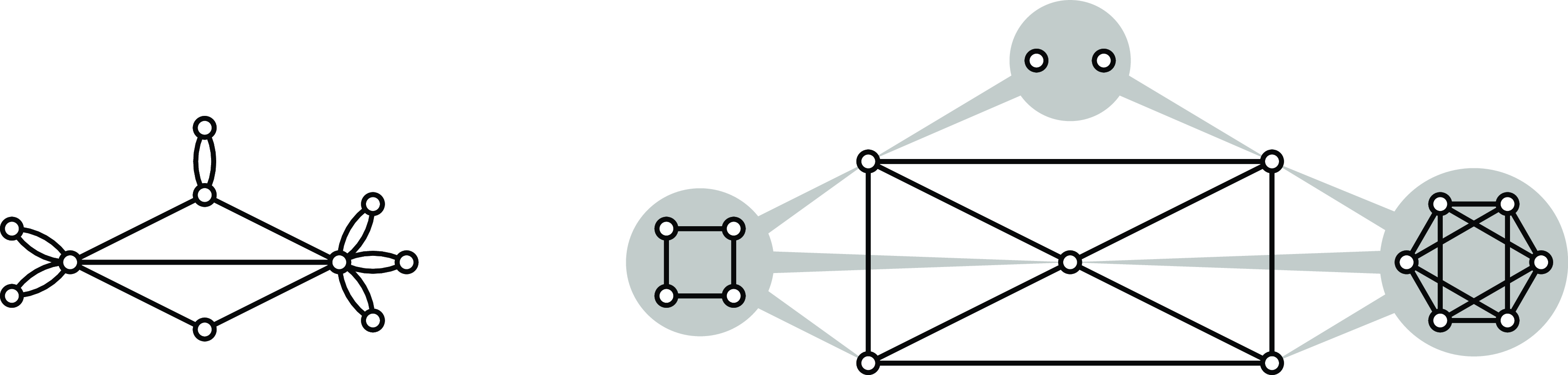




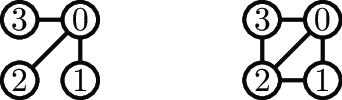


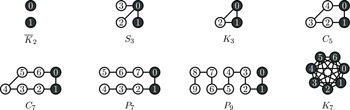


 Open access

