


It has been claimed Reference Corrigan1 that stigma is a major barrier to mental health service use and explains, among other factors such as accessibility and quality of services, why many people choose not to participate in treatment. However, empirical support for this assertion is scarce. Reference Schomerus and Angermeyer2 We therefore examined the impact of self-stigma and stigma-related cognitions on service use. In this context, perceived stigma refers to the level of stigma people with mental illness observe in society (e.g. ‘The public thinks people with mental illness are stupid’); self-stigma implies internalisation of public stigma, resulting in low self-esteem (e.g. ‘I have a mental illness and therefore I am stupid’).
As baseline predictors of service use over 6 months, we assessed self-stigma, the level of perceived stigma and two key stigma-related cognitions that indicate resilience to stigma (low perceived legitimacy of discrimination and strong identification with the group of people with mental illness). Reference Watson, Corrigan, Larson and Sells3,Reference Rüsch, Lieb, Bohus and Corrigan4 Assuming that stigma may affect the use of various services differently, we studied three services: in addition to counselling/psychotherapy, we chose a more empowering (mutual-help/peer-support groups run by consumers) v. a more disempowering (psychiatric admission) service, and a conservative design, controlling for baseline psychopathology.
Method
Eighty-five participants with mental illness were recruited from centres offering out-patient mental health services in the Chicago area. Reference Rüsch, Corrigan, Wassel, Michaels, Olschewski and Wilkniss5 Of these, 75 (88%) completed the follow-up assessment after 6 months, and 10 could not be contacted or were not willing to participate. At follow-up, participants reported whether they had used individual psychotherapy/counselling, mutual-help/peer-support groups or psychiatric hospitalisation. Psychotherapy/counselling was available in community clinics or day programmes and was often limited in number depending on funding sources.
All participants gave written informed consent and the study was approved by the institutional review boards of the Illinois Institute of Technology and collaborating organisations. Mean (s.d.) age of the 75 participants was 44.3 (9.8) years and 69% were male; mean (s.d.) years of education was 13.6 (2.3). Over half (56%) were African American and a third (35%) were White; a few reported Hispanic/Latino (5%) or mixed/other (4%) ethnicities. Axis I diagnoses were made using the Mini International Neuropsychiatric Interview. Reference Sheehan, Lecrubier, Sheehan, Amorim, Janavs and Weiller6 Overall, 18 participants (24%) had schizophrenia, 21 (28%) had schizoaffective, 27 (36%) had bipolar I or II, and 9 (12%) had recurrent unipolar major depressive disorder. Also, 32 (43%) had comorbid current alcohol or substance use disorder or dependence. On average, participants were first diagnosed about 14.1 (s.d.=9.7) years ago and had been admitted to psychiatric institutions about nine times (mean 8.8, s.d. = 13.5).
We measured self-stigma on the 10-item self-esteem decrement subscale of the Self-Stigma of Mental Illness Scale Reference Corrigan, Watson and Barr7 (α = 0.88). The level of stigma participants perceived in society was assessed using the 12-item Perceived Devaluation–Discrimination Questionnaire Reference Link8 (α = 0.85). Perceived legitimacy of discrimination is defined as an individual's perception that their ingroup's lower status in the social hierarchy is fair and legitimate. It was assessed with three items adapted from Schmader et al Reference Schmader, Major, Eccleston and McCoy9 (e.g. ‘Do you think it is justified that people without a mental disorder have a higher status than people with a mental disorder?’) (α = 0.82). Identification with the group of people with mental illness was conceptualised by five items adapted from Jetten et al Reference Jetten, Branscombe, Schmitt and Spears10 (e.g. ‘I feel strong ties with the group of people with mental illness’) (α = 0.85). General psychopathology was assessed using a short 9-item version of the Symptom Check List–Revised Reference Klaghofer and Brähler11 (α = 0.82). For all scales, higher scores represented higher levels of the measured constructs.
Results
For both psychotherapy/counselling and mutual-help/peer-support groups, we found a bimodal distribution: a large majority of participants had either used the service continuously over 6 months or not at all. A small minority had used the service either only once or for less than 6 months. For logistic regressions, we categorised the use of each service as a dichotomous dependent variable (using the service not at all/only once v. for 1–6 months). Among 75 participants at follow-up, 52 (69%) had used individual counselling/psychotherapy, and 23 (31%) had used this service once or not at all. Mutual-help/peer-support groups were used by 35 (47%), and 40 (53%) had used them only once or not at all. Overall, 16 participants (21%) were admitted to psychiatric hospitals over the follow-up period, whereas 59 (79%) were not.
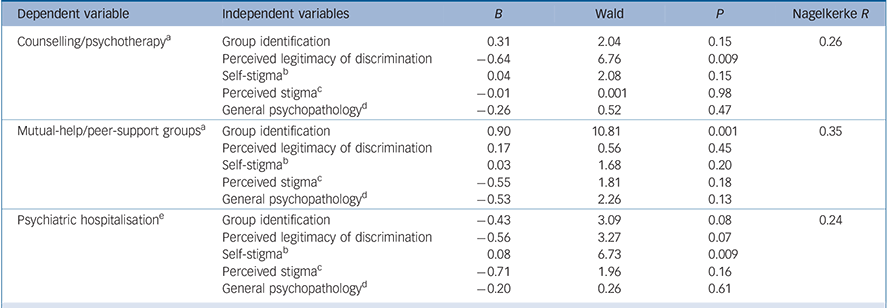
Controlling for baseline levels of perceived stigma and psychopathology, low perceived legitimacy of discrimination, but not self-stigma or group identification, predicted use of counselling/psychotherapy (Table 1). Participation in mutual-help/peer-support groups, on the other hand, was predicted by strong group identification. High self-stigma at baseline predicted psychiatric hospitalisation, independent of perceived stigma and psychopathology.
Logistic regressions on mental health service use over 6 months
| Dependent variable | Independent variables | B | Wald | P | Nagelkerke R |
|---|---|---|---|---|---|
| Counselling/psychotherapya | Group identification | 0.31 | 2.04 | 0.15 | 0.26 |
| Perceived legitimacy of discrimination | -0.64 | 6.76 | 0.009 | ||
| Self-stigmab | 0.04 | 2.08 | 0.15 | ||
| Perceived stigmac | -0.01 | 0.001 | 0.98 | ||
| General psychopathologyd | -0.26 | 0.52 | 0.47 | ||
| Mutual-help/peer-support groupsa | Group identification | 0.90 | 10.81 | 0.001 | 0.35 |
| Perceived legitimacy of discrimination | 0.17 | 0.56 | 0.45 | ||
| Self-stigmab | 0.03 | 1.68 | 0.20 | ||
| Perceived stigmac | -0.55 | 1.81 | 0.18 | ||
| General psychopathologyd | -0.53 | 2.26 | 0.13 | ||
| Psychiatric hospitalisatione | Group identification | -0.43 | 3.09 | 0.08 | 0.24 |
| Perceived legitimacy of discrimination | -0.56 | 3.27 | 0.07 | ||
| Self-stigmab | 0.08 | 6.73 | 0.009 | ||
| Perceived stigmac | -0.71 | 1.96 | 0.16 | ||
| General psychopathologyd | -0.20 | 0.26 | 0.61 |
We then repeated the regression analyses to control for the possible confound of diagnosis (schizophrenia/schizoaffective disorder v. bipolar disorder/unipolar depression; and presence v. absence of a current substance-related disorder as dummy-coded variables). Diagnoses were not significant predictors in any of the regressions (all P>0.40), and all previously significant predictors remained significant.
Discussion
We found evidence that self-stigma and stigma-related cognitions predict service use among people with serious and chronic mental illness, independent of baseline psychopathology, diagnosis and the level of perceived stigma. Cognitions associated with resilience to stigma (rejecting stigma as unfair; strong group identification) Reference Watson, Corrigan, Larson and Sells3,Reference Rüsch, Lieb, Bohus and Corrigan4 may facilitate use of out-patient services and be more relevant to help-seeking than the level of perceived stigma per se. Increased self-stigma, on the other hand, could be associated with reduced willingness or ability to seek help, possibly leading to decreased coping resources and thus to psychiatric hospitalisation as a last resort. The time lag between baseline assessment of psychopathological symptoms and subsequent hospitalisation may explain the lack of association between the two.
Limitations of our study should be considered. First, we did not collect information on service use from sources other than service users, and dichotomous dependent variables limited the power of our analyses. Second, despite our longitudinal data, firm conclusions on causality cannot be drawn because treatment participation before baseline assessment may have influenced stigma-related predictor variables. Third, our conclusions are limited to people with serious and chronic mental illness who already participate in mental health services. Finally, stigma-related variables, accessibility, quality and use of services should be investigated in different healthcare systems internationally.
Stigma-related factors appear to affect mental health service use. High self-stigma could be a risk factor for psychiatric hospitalisation, whereas strong group identification may encourage people with mental illness to turn to peers for mutual help, thus increasing empowerment. Research should investigate how initiatives meant to reduce self-stigma, public stigma and structural discrimination can facilitate help-seeking.
Funding
Our work was supported by a Marie Curie Outgoing International Fellowship of the EU to N.R. and by funding from the NIAA, NIMH and the Fogarty International Center to P.W.C.




eLetters
No eLetters have been published for this article.