





Volunteers sustain membership associations by contributing their time, skills, and energy; recruiting volunteers and sustaining their engagement remains an ongoing challenge, especially as organizations seek to engage increasingly diverse membership bases. Scholars have long studied individual motivations for volunteering (Musick & Wilson, Reference Musick and Wilson2008; Wilson, Reference Wilson2000, Reference Wilson2012), but less attention has been paid to how organizational leadership structures influence members’ willingness to volunteer (AbouAssi, Reference AbouAssi2021). Leadership demographics are critical for shaping members’ sense of belonging, identification, and trust—factors that directly relate to volunteerism.
Furthermore, the experiences of individuals in the nonprofit sector are often shaped by the complex interplay of gender and race. Existing studies (Johnson & Kappelides, Reference Johnson and Kappelides2021; McCambridge & Suarez, Reference McCambridge and Suarez2017) reveal a stark reality: most nonprofit leadership, staff, and volunteers are White. This overrepresentation creates a “White space,” where White people hold dominant positions and racially minoritized individuals are underrepresented or marginalized (Anderson, Reference Anderson2015). Racially minoritized individuals who do enter the nonprofit sector often encounter bias, microaggressions, and racism (Buttenwiese, Reference Buttenwiese2019; Timbrell, Reference Timbrell2020). There is also a gender gap in nonprofit leadership. Women, though constituting a majority of the workforce, are underrepresented on nonprofit boards and are underpaid as CEOs (McCambridge & Suarez, Reference McCambridge and Suarez2017), reflecting broader societal inequities. These racial and gender disparities extend to volunteerism; women are more likely to volunteer than men, and White individuals are more likely to volunteer than racially minoritized individuals (AbouAssi et al., Reference AbouAssi, Berlan and Wright2024; Mesch et al., Reference Mesch, Rooney, Steinberg and Denton2006; Taniguchi, Reference Taniguchi2006). Hence, racially minoritized women, for example, may encounter unique challenges at the intersection of these identities.
Understanding these intersections is essential for developing effective strategies to promote inclusion and enhance organizational outcomes (Buse et al., Reference Buse, Bernstein and Bilimoria2016; Dula, Reference Dula2022; Fredette & Sessler Bernstein, Reference Fredette and Sessler Bernstein2019; Wang & Ashcraft, Reference Wang and Ashcraft2014). Yet, existing scholarship that links leadership demographics to volunteering usually examines identities unidimensionally—examining race or gender in isolation (see, e.g., AbouAssi, Reference AbouAssi2021). This approach risks oversimplifying the dynamics of representation by neglecting how identities intersect in practice. In volunteer contexts—where identity congruence can influence trust, belonging, and motivation—this omission is consequential.
Intersectionality theory suggests that individuals center their experiences and perspectives at the intersection of multiple identities, not single categories (Cho et al., Reference Cho, Crenshaw and McCall2013; Crenshaw, Reference Crenshaw2013; Shang et al., Reference Shang, Reed and Croson2008). Building on that, this article explores how the congruence in identities of members and leaders of membership associations shapes volunteering behaviors and outcomes; we ask: How does intersectional identity congruence between nonprofit leaders and members influence volunteer engagement, behavior, and satisfaction? We contribute to the literature by demonstrating how intersectional identity relates to volunteer engagement and outcomes differently than unidimensional models by providing empirical evidence from membership associations.
Theoretical framework
Volunteering and identity
Association members engage in different ways. Some choose to participate passively, such as by paying dues or voting for the board, whereas others actively engage by volunteering their time in organizational activities (AbouAssi & An, Reference AbouAssi and An2017; Holmes & Slater, Reference Holmes and Slater2012). Active engagement varies in motives.
Volunteering can be driven by an organization’s need for human capital (AbouAssi et al., Reference AbouAssi, Jo and Bies2022), yet the decision to engage remains personal. Volunteers are driven by their values and desire to make a difference (Houston, Reference Houston2006; Wilson, Reference Wilson2000). Others may be motivated by their capacity (income, education, and skills), opportunities to build networks, or anticipated benefits such as recognition or career advancement (Townsend et al., Reference Townsend, Gibbs, Macfarlane, Block, Staiger, Gold, Johnson and Long2014). These benefits are particularly salient for racially minoritized individuals, for whom membership associations can provide collective action, education on systemic issues, and mentorship while navigating discrimination (AbouAssi et al., Reference AbouAssi, Berlan and Wright2024; Adesaogun et al., Reference Adesaogun, Flottemesch and Ibrahim-DeVries2015).
Volunteering is also a means of identity expression to fulfill needs that are deeply connected to their unique life circumstances (Finkelstein et al., Reference Finkelstein, Penner and Brannick2005; Grönlund, Reference Grönlund2011; Laverie & McDonald, Reference Laverie and McDonald2007; Wilson, Reference Wilson2012). Social identity theory explains why people may volunteer differently by race and gender: individuals are more likely to engage when they perceive an organization as aligned with their “in-group” identity (Tajfel & Turner, Reference Tajfel, Turner, Austin and Worchel1986). In the United States, White individuals are generally more likely to volunteer than racially minoritized groups (Foster-Bey, Reference Foster-Bey2008; Rotolo et al., Reference Rotolo, Wilson and Hughes2010), although research finds mixed results in associations (AbouAssi et al., Reference AbouAssi, Berlan and Wright2024; Musick et al., Reference Musick, Wilson, Bynum and Musick2000; Nesbit & Gazley, Reference Nesbit and Gazley2012). Interestingly, racially minoritized volunteers often report higher satisfaction and participation in a wider range of activities, though for fewer hours (AbouAssi et al., Reference AbouAssi, Berlan and Wright2024). Gender dynamics also differ; women are slightly more inclined to volunteer overall (Mesch et al., Reference Mesch, Rooney, Steinberg and Denton2006; Taniguchi, Reference Taniguchi2006; Wilson, Reference Wilson2012), but in membership associations, men often engage more extensively (Fyall & Gazley, Reference Fyall and Gazley2015; Themudo, Reference Themudo2009).
These findings underscore that individuals are not unidimensional (Grönlund, Reference Grönlund2011); rather, identities are inherently intersectional. Intersectionality theory emphasizes the intersection of multiple factors like race, gender, religion, and partisanship, which intricately shape individuals’ perceptions, behaviors, and sense of representation. Race and gender interact in ways that create qualitatively different experiences, which cannot be understood in isolation (Cho et al., Reference Cho, Crenshaw and McCall2013; Crenshaw, Reference Crenshaw2013). This perspective is essential in nonprofit membership associations, where members navigate roles and expectations that are shaped by organizational hierarchies, peer relationships, and broader social inequities. For racially minoritized women, for example, engagement in associations reflects the compounded effects of gendered and racialized experiences, which differ from those of both men and White women (Weisinger et al., Reference Weisinger, Borges-Méndez and Milofsky2016).
Investigating intersectional identities is therefore necessary to deepen our understanding of volunteering behavior (Weisinger et al., Reference Weisinger, Borges-Méndez and Milofsky2016). One aspect of intersectionality that is ripe for exploration is that of identity congruence between organizational leadership and volunteers, which scholars have shown is an important factor in shaping the experience of volunteerism (AbouAssi, Reference AbouAssi2021; Ruiz & Ravitch, Reference Ruiz and Ravitch2023). While more complex than the congruence of a single identity, intersectional identity congruence between these actors is likely to shape the volunteer experience in meaningful ways. Our approach is to assess whether shared race and gender (the intersectional full match) between leadership and volunteers of membership associations operates differently when it comes to volunteering behavior and outcomes than shared race or gender, consistent with intersectionality’s focus on the inseparability of social identities.
Identity congruence and volunteering behavior and outcomes
Identity congruence refers to alignment between members’ and leaders’ identities. Representative bureaucracy research shows that demographic similarity can shape perceptions of fairness, trust, and belonging (Bishu & Kennedy, Reference Bishu and Kennedy2020; Riccucci & Van Ryzin, Reference Riccucci and van Ryzin2017; Wilkins & Keiser, Reference Wilkins and Keiser2006). Yet, congruence does not always yield positive outcomes, partially due to the varying forms of representation. Passive representation focuses on the demographic makeup of a bureaucracy mirroring that of the general population, emphasizing identity congruence without necessarily implying specific actions on behalf of those represented. In contrast, active representation occurs when bureaucrats take actions intended to advance the interests of populations that they both serve and share an identity with. Finally, symbolic representation suggests that the presence of demographically representative bureaucrats enhances public trust and legitimacy by signaling inclusivity and fostering a sense of belonging among underrepresented groups (Ospina & Foldy, Reference Ospina and Foldy2009).
Much of the literature on identity congruence comes from studies of public agencies. For example, Grissom et al. (Reference Grissom, Nicholson-Crotty and Keiser2012) show that the presence of minority school administrators can positively influence student outcomes, such as increasing the number of minority students in gifted programs. Administrators of color are also more likely to hire teachers from similar racial backgrounds (Carroll, Reference Carroll2019). Gender representation research finds similar patterns. Female leaders often create opportunities for other women in managerial roles, as seen in both nonprofit and government contexts (Lee, Reference Lee2019; Prouteau & Tabariés, Reference Prouteau and Tabariés2010). These studies underscore how identity congruence can shape opportunities, performance, and perceptions of legitimacy across public institutions. Yet, the effects are not always consistent. Greater representation does not automatically translate into behavioral change or equitable outcomes; hiring more Black and Latino police officers has not necessarily reduced racial profiling (Wilkins & Williams, Reference Wilkins and Williams2008), and having more female police leaders does not guarantee reductions in gender-based violence (Johnston & Houston, Reference Johnston and Houston2018). These mixed findings illustrate the complex and contingent nature of identity congruence in public-sector settings.
Evidence from nonprofits and membership associations also highlights both the promise and pitfalls of identity congruence. Organizations with higher racial congruence among leadership reported stronger productivity (Richard et al., Reference Richard, del Carmen Triana and Li2021). In voluntary associations, racially minoritized members often encounter heightened scrutiny and limited decision-making authority, leaving them feeling like outsiders in “White spaces” (Cahuas & Matute, Reference Cahuas and Matute2020; Timbrell, Reference Timbrell2020). This sense of exclusion may compel them to overcompensate, leading to emotional strain and disproportionate workloads. Racial disparities in perceptions of fairness and inclusion further complicate matters: Black and Hispanic workers often report unfair treatment (Dixon et al., Reference Dixon, Storen and van Horn2002). These dynamics are particularly acute for racially minoritized women, who often lack mentors with shared identities.
Gender congruence also matters in nonprofit associations. AbouAssi (Reference AbouAssi2021) and AbouAssi and An (Reference AbouAssi and An2017) report higher engagement from women members in organizations led by women; gender similarity between leaders and members can reinforce shared values and foster belonging (Grissom et al., Reference Grissom, Nicholson-Crotty and Keiser2012). Increasing the number of women serving on a board can correspond with greater participation by female members, as shared identities strengthen emotional ties to the organization (Ospina & Foldy, Reference Ospina and Foldy2009). Because boards shape the strategic direction and policies of associations, their composition is particularly salient for fostering trust and member engagement (Jones & Stewart, Reference Jones and Stewart2024).
Building on these works, we draw on intersectionality theory to conceptualize identity congruence as the degree to which members’ intersecting identities align with those of organizational leaders. This alignment is not merely additive—race plus gender—but interactive, creating qualitatively distinct forms of congruence. A full match (shared race and gender) may foster deeper perceptions of belonging, whereas race-only or gender-only matches may carry different or even contradictory implications. For example, a woman of color may feel both represented and marginalized when she shares race but not gender with a leader, depending on the salience of each identity in the organizational context (Read & Eagle, Reference Read and Eagle2011; Sanchez-Hucles & Davis, Reference Sanchez-Hucles and Davis2010). Reflecting this intersectional logic, we operationalize congruence in four categories—full match, race only, gender only, and no match. Intersectionality theory suggests that a given racial match may generate divergent outcomes depending on gender alignment and vice versa, making a combined measure of race and gender congruence essential to understanding volunteer behavior in associations.
While initial volunteering decisions often hinge on perceptions of fit and belonging (Clary et al., Reference Clary, Snyder, Ridge, Copeland, Stukas and Haugen1998; Stukas et al., Reference Stukas, Hoye, Nicholson, Brown and Aisbett2016), this article investigates the association between intersectional identity matching between volunteers and leadership on their likelihood, scope, and duration of volunteering, as well as their overall satisfaction. Specifically, it examines whether racially minoritized women volunteer more frequently, in more diverse roles, for longer periods, or report higher satisfaction when the association’s leadership or board has greater representation of racially minoritized women.
Representation in leadership can serve as a powerful cue that one’s values and identity will be respected in the organization (Ashforth & Mael, Reference Ashforth and Mael1989; Ospina & Foldy, Reference Ospina and Foldy2009). Social identity theory suggests that individuals are more willing to affiliate with organizations that reflect “in-group” characteristics, whereas signaling theory highlights how visible congruence reduces perceived risks of exclusion or discrimination (Guo & Musso, Reference Guo and Musso2007; Tajfel & Turner, Reference Tajfel, Turner, Austin and Worchel1986). When prospective volunteers see leaders who share their race and gender identities, they may perceive greater belonging and fit with the association, making initial engagement more likely. Thus, we hypothesize:
H1: Intersectional congruence between members and leaders is positively associated with initial volunteering.
Once engaged, intersectional congruence may shape members’ commitment in terms of both the time they dedicate and the breadth of activities they undertake. Shared race and gender can reinforce perceptions of value alignment and legitimacy, strengthening the sense of fit between members’ personal values and organizational goals, and heightening the sense of belonging (Grissom et al., Reference Grissom, Nicholson-Crotty and Keiser2012; van Vianen et al., Reference van Vianen, Nijstad and Voskuijl2008). This perception of belonging encourages longer-term involvement (Omoto & Snyder, Reference Omoto and Snyder1995; Wang & Ashcraft, Reference Wang and Ashcraft2014) and could also encourage members to give more time to the association or expand the scope of their engagement by volunteering for more activities.
Taking on a wider range of roles requires that members feel safe to step outside of their comfort zone and contribute without fear of judgment or exclusion (Edmondson, Reference Edmondson1999). Equally important is the confidence that members can successfully handle responsibilities beyond narrow or routine tasks (Parker, Reference Parker1998). Leaders who share members’ intersecting identities can foster both conditions by normalizing diverse forms of engagement, signaling acceptance, and serving as role models. In doing so, they legitimize experimentation with new roles and encourage members to stretch their involvement across different activities. In addition, increased commitment among racially minoritized people may reflect compensatory behaviors, as they often feel pressure to overperform and demonstrate competence in predominantly White spaces (AbouAssi et al., Reference AbouAssi, Berlan and Wright2024; Nesbit & Gazley, Reference Nesbit and Gazley2012; Timbrell, Reference Timbrell2020).
At the same time, one-dimensional identity congruence does not always translate into greater time commitments. For example, gender congruence is not related to the number of volunteer hours contributed by women (AbouAssi, Reference AbouAssi2021); racially minoritized people tend to engage in a wider range of activities, even if they dedicate less time to each (AbouAssi et al., Reference AbouAssi, Berlan and Wright2024). This means that identity congruence may generate expectations that are sometimes empowering but also disappointing when symbolic inclusion fails to produce real influence (Ahmed, Reference Ahmed2020; Gonzales, Reference Gonzales2019). Intersectionality suggests, however, that when multiple identities align, these effects may be amplified, producing stronger commitments. Intersectional congruence could both extend the time that female people of color invest in volunteering and diversify the roles they undertake; we hypothesize:
H2: Intersectional congruence between members and leaders is positively associated with more time invested in volunteering.
H3: Intersectional congruence between members and leaders is positively associated with volunteering in more activities.
Finally, volunteer satisfaction is strongly influenced by organizational culture, especially when there is alignment—or congruence—between personal identity and the organization’s values. Research shows that when organizations actively uphold social responsibility and inclusivity, members report higher commitment and satisfaction (Misener et al., Reference Misener, Morrison, Shier and Babiak2020). In contrast, a poor person–organization fit reduces satisfaction (Humphrey, Reference Humphrey2022). For people of color, additional pressures—such as microaggressions, limited access to influential networks, and symbolic inclusion—further compound dissatisfaction (Evans & Moore, Reference Evans and Moore2015). Therefore, identity alignment is key to sustained, meaningful volunteer engagement. Identity congruence can shape volunteer satisfaction. Shared identities foster trust, communication ease, and psychological safety (Eagly & Carli, Reference Eagly and Carli2007; Ospina & Foldy, Reference Ospina and Foldy2009). Perceptions of fit may enhance members’ sense of purpose and belonging, allowing members to enjoy volunteering, and thereby improving satisfaction (van Vianen et al., Reference van Vianen, Nijstad and Voskuijl2008; Wang & Ashcraft, Reference Wang and Ashcraft2014). Therefore, we hypothesize:
H4: Intersectional congruence between members and leaders is positively associated with higher satisfaction from volunteering.
Research design
Data sources
The research draws upon data available from an American Society of Association Executives (ASAE) dataset. The ASAE Foundation administered the Decision to Volunteer survey in 2007 to gauge members’ involvement in 23 membership associations. A total of 26,305 members responded to the survey, yielding an overall response rate of 14%. The budget, age, and names of all key employees and governing board members of the 23 membership associations included in the ASAE datasets are obtained from IRS 990 forms for the years 2005–2007, using the National Center for Charitable Statistics databases.
Variables
Dependent variables
We used an array of questions from ASAE’s 2007 Decision to Volunteer survey (Gazley & Dignam, Reference Gazley and Dignam2008) to operationalize four dependent variables. Volunteer engagement is a binary variable based on whether someone volunteered for the association at all; volunteer time was measured by asking respondents to select an average hourly range invested in the organization. The breadth of volunteering was quantified as the total number of different volunteer activities they participated in (e.g., fundraising, member recruitment, or committee service). Finally, satisfaction with volunteering was measured on a scale from 1 (very dissatisfied) to 5 (very satisfied) in response to the question, “How satisfied are you with the volunteering experience?”
Independent variables
The main objective of this article is to observe intersectional identity congruence between the members and the leadership of associations and examine how that impacts their volunteering engagement, behavior (breadth and depth), and satisfaction. We obtained gender and race of the survey respondents from the ASAE’s 2007 dataset. To measure the gender and race of organizational leadership, we predicted these identities for each executive director (ED) and board member based on their names, which were obtained from the IRS form 990 filings of the 23 organizations included in the ASAE survey, using the R Project for Statistical Computing (https://www.r-project.org/). The method uses the Bayes’ rule, relying on the U.S. Census and mortgage applications, and has been used in several studies (Adjaye-Gbewonyo et al., Reference Adjaye-Gbewonyo, Bednarczyk, Davis and Omer2014; Elliott et al., Reference Elliott, Morrison, Fremont, McCaffrey, Pantoja and Lurie2009; Imai & Khanna, Reference Imai and Khanna2016). For race, we then collapsed, these predictions into a binary variable where a value of 1 indicates being a racially minoritized person.
However, Kozlowski et al. (Reference Kozlowski, Murray, Bell, Hulsey, Larivière, Monroe-White and Sugimoto2022) warn against a potential bias in such an approach since it overestimates White individuals; the issue of gender-neutral names remains. To verify the results and mitigate potential bias, we randomly sampled a subset of names for which two researchers coded gender and race based on publicly available information from LinkedIn, Google, and organizational websites. This subsample consisted of 75 unique names. While four minor discrepancies existed between the two (resulting in a 95% agreement rate), we corrected these to improve accuracy. Using survey responses of self-identification of racial/ethnic background as Asian, Black or African American (non-Hispanic), Hispanic, White, or others, we created a binary variable where 1 represents a racially minoritized person and 0 represents a White person.
Two intersectionality congruence variables were constructed by comparing the combined racial and gender identity of the members with those of organizational leadership. First, members and EDs were each categorized into one of four intersectional identity types based on their reported gender (woman = 1) and race (racially minoritized individual = 1): racially minoritized woman, White woman, racially minoritized man, or White man. These classifications were used to construct a four-category ED–member congruence variable. The categories include (1) full match, (2) gender-match only, (3) race-match only, and (4) no match. A matrix showing member–ED identity congruence coding is provided in Appendix A.
Second, we created a variable measuring board–member congruence. Board composition was summarized by calculating whether most board members (50% or more) shared race and/or gender with each member. This yielded four categories: full match, gender-match only, race-match only, and no match, mirroring the logic of the ED congruence variable. This approach allows for a consistent assessment of identity congruence between members and both levels of organizational leadership. A matrix showing member–board identity congruence coding is provided in Appendix B.
This operationalization is grounded in intersectionality theory, which underscores that race and gender cannot be disentangled when analyzing experiences of inclusion and representation (Crenshaw, Reference Crenshaw2013). By distinguishing between race-only, gender-only, and full matches (with “no match” used as the reference category in all regression models), we capture how overlapping identities may produce unique dynamics in volunteer engagement that would remain invisible in single-axis measures.
Logistic regression was used for the binary outcome of volunteering. Time invested and satisfaction, both ordinal outcomes, were modeled using ordered logistic regression, which provides more interpretable coefficients in terms of odds. The proportional odds assumption was tested using gologit2 with the autofit option and was not violated in any case. Ordered logit models were used as the primary specification, and ordered probit models were estimated as robustness checks. The breadth of volunteering was modeled using negative binomial regression to account for overdispersion in the count variable. For all models, standard errors were clustered by organization. Model justification and goodness-of-fit tests are reported in the are reported in the Appendices C, D, E and F (Tables D1 and F1).
Controls
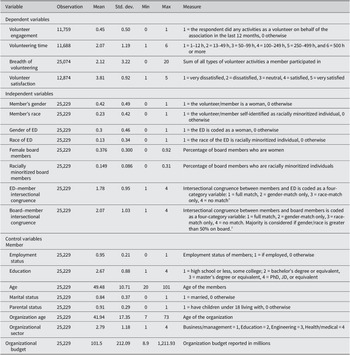
To better isolate the relationships between intersectional identity congruence and the volunteer behavior and outcomes, we controlled for individual- and organizational-level characteristics as both could shape the volunteer experience—motivating or predisposing individuals to volunteer and incentivizing or shaping the manner of engagement, respectively (Studer & von Schnurbein, Reference Studer and von Schnurbein2013). While recognizing the limitations of available data to control for all potential confounds, we include those variables previously identified in the literature and those predictive of volunteering to derive a sophisticated estimate of this relationship (Bernerth & Aguinis, Reference Bernerth and Aguinis2016). At the individual level, these controls include employment, education, marital status, age, and number of children (Musick & Wilson, Reference Musick and Wilson2008). We also controlled for the capacity of an organization to manage volunteers—measured by organizational age and budget—and sector, both of which scholars have concluded impact volunteering influential for volunteerism (AbouAssi et al., Reference AbouAssi, Jo and Bies2022; Hager, Reference Hager2014; Studer & von Schnurbein, Reference Studer and von Schnurbein2013). Table 1 presents descriptive statistics for all variables included in the analysis.
Descriptive statistics

Table 1. Long description
The table is organized with columns for Variable, Observation, Mean, Standard deviation, Minimum, Maximum, and Measure. The first section, Dependent variables, lists: Volunteer engagement (n equals 11,759, mean 0.45, standard deviation 0.50, min 0, max 1, coded as 1 if respondent volunteered in the past 12 months, 0 otherwise); Volunteering time (n equals 11,688, mean 2.07, standard deviation 1.19, min 1, max 6, with 1 equals 1 to 12 hours, 2 equals 13 to 49 hours, 3 equals 50 to 99 hours, 4 equals 100 to 249 hours, 5 equals 250 to 499 hours, 6 equals 500 hours or more); Breadth of volunteering (n equals 25,074, mean 2.12, standard deviation 3.22, min 0, max 20, sum of all types of volunteer activities participated in); Volunteer satisfaction (n equals 12,874, mean 3.81, standard deviation 0.92, min 1, max 5, with 1 equals very dissatisfied, 2 equals dissatisfied, 3 equals neutral, 4 equals satisfied, 5 equals very satisfied). The next section, Independent variables, includes: Member’s gender (n equals 25,229, mean 0.42, standard deviation 0.49, min 0, max 1, 1 equals woman, 0 otherwise); Member’s race (n equals 25,229, mean 0.23, standard deviation 0.42, min 0, max 1, 1 equals racially minoritized, 0 otherwise); Gender of E D (n equals 25,229, mean 0.3, standard deviation 0.46, min 0, max 1, 1 equals woman, 0 otherwise); Race of E D (n equals 25,229, mean 0.13, standard deviation 0.34, min 0, max 1, 1 equals racially minoritized, 0 otherwise); Female board members (n equals 25,229, mean 0.376, standard deviation 0.300, min 0, max 0.92, percentage of women on board); Racially minoritized board members (n equals 25,229, mean 0.149, standard deviation 0.086, min 0, max 0.31, percentage of racially minoritized individuals on board); E D–member intersectional congruence (n equals 25,229, mean 1.78, standard deviation 0.95, min 1, max 4, with 1 equals full match, 2 equals gender-match only, 3 equals race-match only, 4 equals no match); Board–member intersectional congruence (n equals 25,229, mean 2.07, standard deviation 1.03, min 1, max 4, same coding as above, majority defined as over 50 percent on board). The final section, Control variables, lists: Employment status (n equals 25,229, mean 0.95, standard deviation 0.21, min 0, max 1, 1 equals employed, 0 otherwise); Education (n equals 25,229, mean 2.67, standard deviation 0.88, min 1, max 4, with 1 equals high school or less, 2 equals bachelor’s degree, 3 equals master’s degree, 4 equals Ph D, J D, or equivalent); Age (n equals 25,229, mean 49.48, standard deviation 10.71, min 20, max 101, age in years); Marital status (n equals 25,229, mean 0.84, standard deviation 0.37, min 0, max 1, 1 equals married, 0 otherwise); Parental status (n equals 25,229, mean 0.91, standard deviation 0.29, min 0, max 1, 1 equals children under 18 at home, 0 otherwise); Organization age (n equals 25,229, mean 41.94, standard deviation 17.35, min 7, max 73, age in years); Organizational sector (n equals 25,229, mean 2.79, standard deviation 1.18, min 1, max 4, with 1 equals business or management, 2 equals education, 3 equals engineering, 4 equals health or medical); Organizational budget (n equals 25,229, mean 101.5, standard deviation 212.09, min 8.9, max 1,211.93, in millions). The table footnote defines E D as executive director and clarifies that congruence variables are four-category codes, with means and standard deviations reflecting distributions of these codes.
Note: ED, executive director.
a Congruence variables are coded as four-category variables (1 = full match, 2 = gender-match only, 3 = race-match only, 4 = no match). Reported means and standard deviations reflect the distribution of numeric codes and should not be interpreted as continuous values.
Limitations
We acknowledge several limitations. First, the sample of 23 organizations is not representative of the broader population of U.S. membership associations; the low response rate (14%) and the varying sample size across models due to item nonresponse raise concerns. Nonrespondents may differ systematically from respondents, limiting generalizability. Second, the dataset was collected in 2007. Since then, shifts in cultural competency, leadership demographics, and Diversity, Equity, and Inclusion (DEI) have likely reshaped organizational and volunteer dynamics, although membership associations continue to operate under the shadow of institutional racism (AbouAssi et al., Reference AbouAssi, Berlan and Wright2024). Patterns of volunteerism have also evolved, with new demographic and cultural influences shaping participation (Wilson, Reference Wilson2012). These developments should inform interpretation of the findings. At the same time, this dataset remains one of the few large-scale, systematically collected sources linking volunteer perspectives with nonprofit leadership demographics. While dated, it offers valuable baseline insights into leader–volunteer congruence—in the absence of more recent comparable data—and has been used productively in other studies (AbouAssi, Reference AbouAssi2021; Hager, Reference Hager2014; Wang & Ashcraft, Reference Wang and Ashcraft2014). Finally, the cross-sectional design precludes causal inference, highlighting the need for future longitudinal research or experimental studies to assess how congruence influences volunteer engagement and satisfaction.
Another limitation relates to data coding. While the survey offered different racial/ethnic categories for self-identification, such detail was not feasible for organizational leadership data. We therefore used a simplified racial/ethnic coding scheme, which may obscure important nuances and intersections. Similarly, gender was coded as binary to align with survey responses, potentially overlooking nonbinary identities. Finally, model selection was aligned with the structure of each outcome variable but rests on assumptions (e.g., proportional odds and distributional form) that may not fully capture the complexity of identity dynamics.
Results
Volunteer engagement
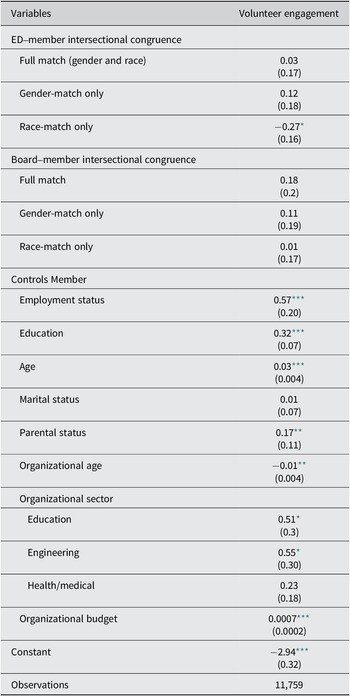
Insignificant results in Table 2 show that intersectional identity congruence between members and leadership is not associated with volunteering, particularly for board–member intersectional identity congruence. Regarding EDs, members are less likely to volunteer only when they share racial identity but not gender or intersectional identity. While leadership diversity may shape perceptions of representation, identity alignment with leadership alone does not appear to relate to a member’s choice to volunteer.
Volunteer engagement
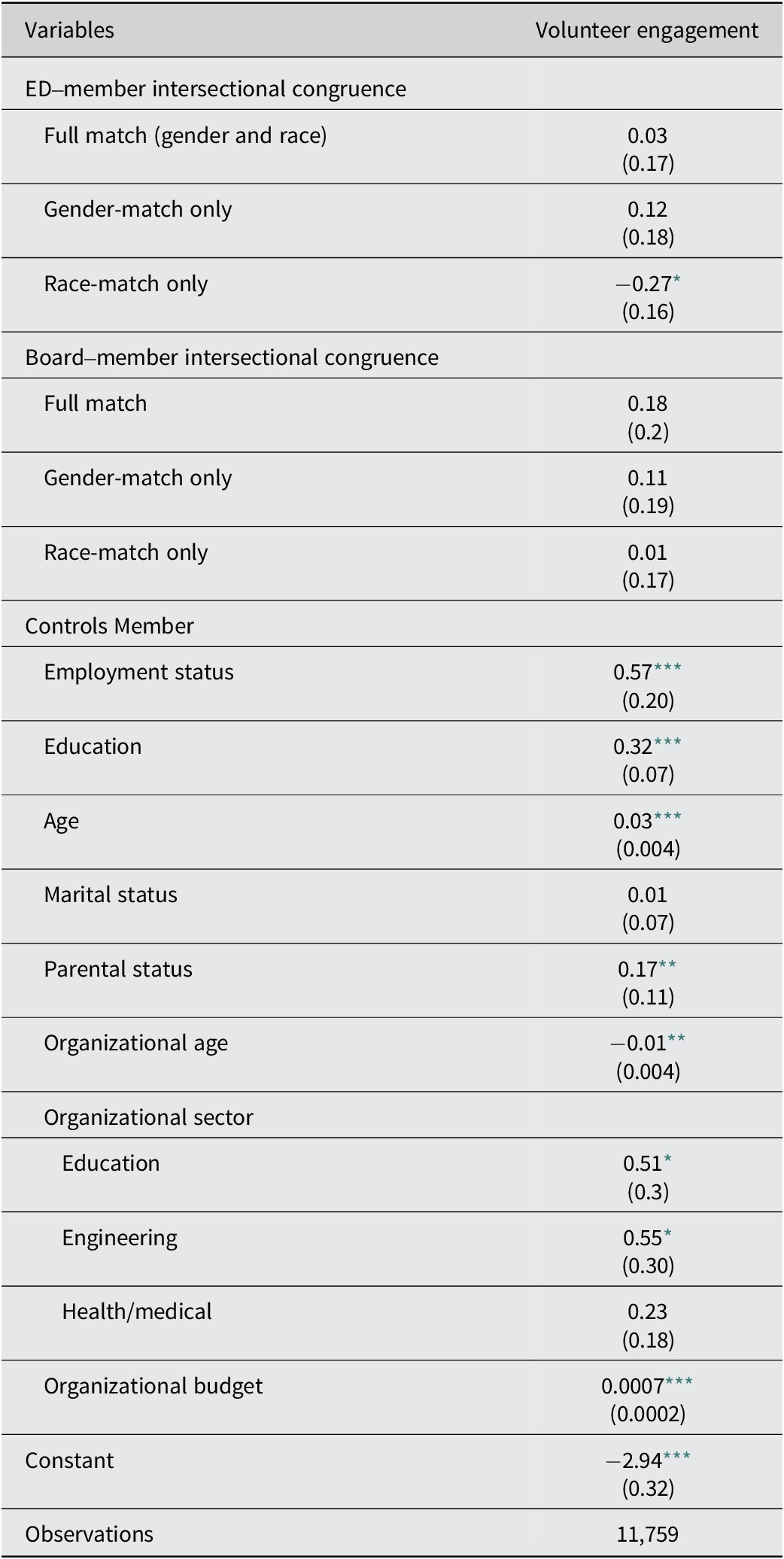
Table 2. Long description
From the top, the table has two columns: Variables and Volunteer engagement. The first main section is ED–member intersectional congruence, with three subcategories: Full match (gender and race) has 0.03 with standard error 0.17, Gender-match only has 0.12 with standard error 0.18, Race-match only has negative 0.27 with a single asterisk indicating p less than 0.1 and standard error 0.16. The next main section is Board–member intersectional congruence: Full match is 0.18 with standard error 0.2, Gender-match only is 0.11 with standard error 0.19, Race-match only is 0.01 with standard error 0.17. The Controls Member section includes: Employment status 0.57 with three asterisks for p less than 0.01 and standard error 0.20, Education 0.32 with three asterisks and standard error 0.07, Age 0.03 with three asterisks and standard error 0.004, Marital status 0.01 with standard error 0.07, Parental status 0.17 with two asterisks for p less than 0.05 and standard error 0.11, Organizational age negative 0.01 with two asterisks and standard error 0.004. Organizational sector is subdivided: Education 0.51 with one asterisk and standard error 0.3, Engineering 0.55 with one asterisk and standard error 0.30, Health/medical 0.23 with standard error 0.18. Organizational budget is 0.0007 with three asterisks and standard error 0.0002. The constant is negative 2.94 with three asterisks and standard error 0.32. The number of observations is 11,759. A note states that the reference category for congruence variables is ‘No match’ and that ED stands for executive director. Asterisks indicate significance: one asterisk for p less than 0.1, two for p less than 0.05, three for p less than 0.01.
Note: Reference category for both congruence variables is “No match” (i.e., member does not share race or gender with leadership). ED, executive director.
* p < 0.1.
** p < 0.05.
*** p < 0.01.
Among the control variables, all but marital status is significantly associated with the likelihood of volunteering. Organizational budget and age are statistically significant, and sector differences emerged. Organizations in the education and engineering sectors are likely to have more volunteers than those in the business and management sectors (reference category).
Volunteering time
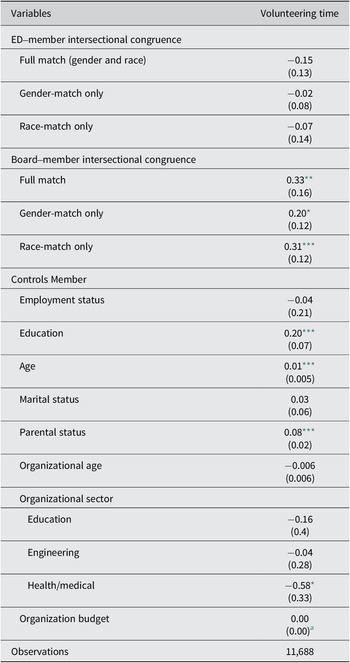
In Table 3, the results underscore the distinction between the symbolic role of executive leadership and the governance function of boards in influencing volunteer behavior. While intersectional identity congruence with EDs is not associated with the amount of time members choose to volunteer, identity congruence with board members—whether racial, gendered, or both—is significantly associated with higher volunteering hours.
Volunteering time
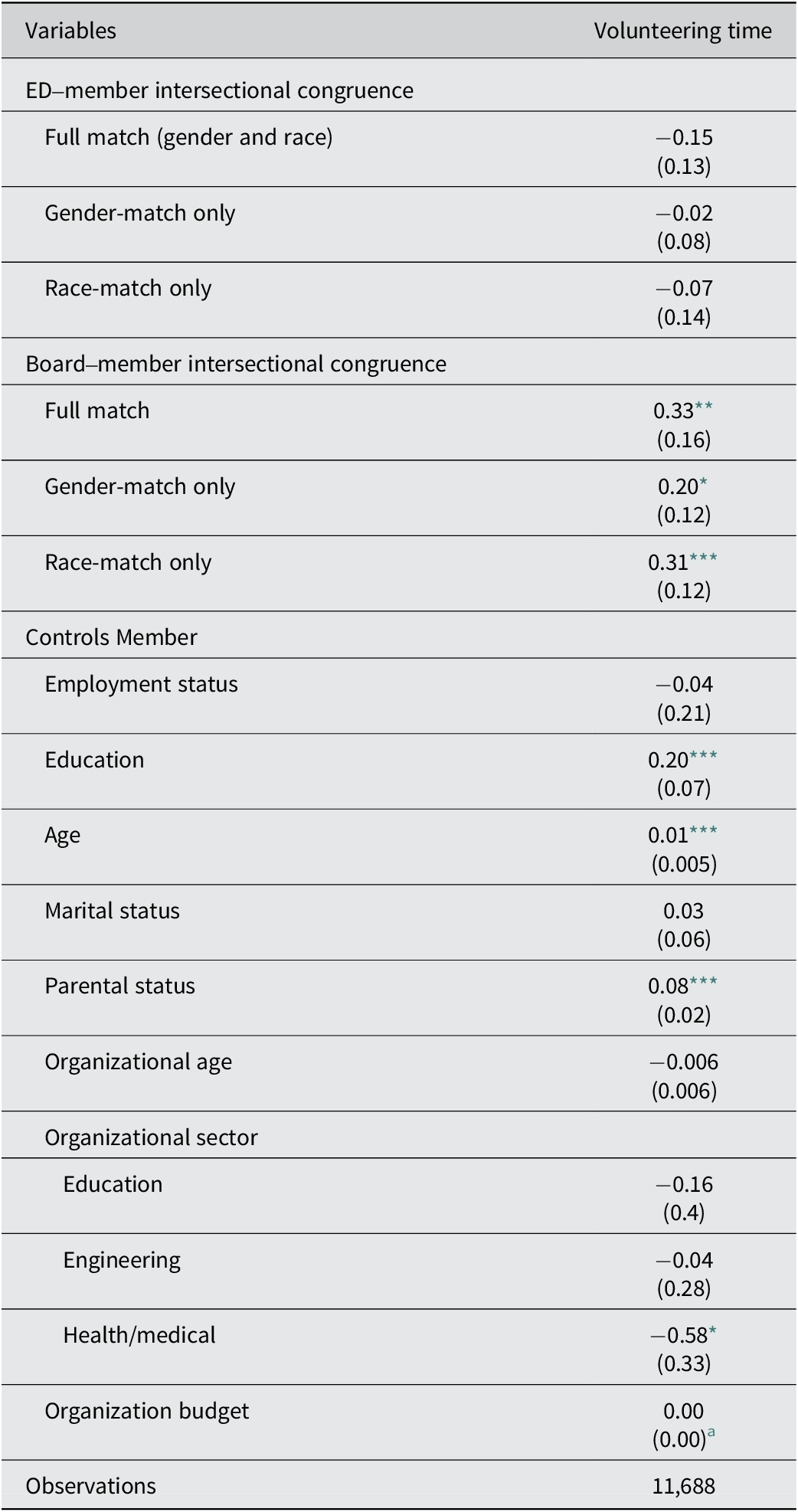
Table 3. Long description
The table lists variables in four main sections. First, under ED–member intersectional congruence: Full match (gender and race) has coefficient minus 0.15 with standard error 0.13, Gender-match only minus 0.02 (0.08), Race-match only minus 0.07 (0.14). Next, Board–member intersectional congruence: Full match 0.33 with two asterisks (p less than 0.05), standard error 0.16; Gender-match only 0.20 with one asterisk (p less than 0.1), standard error 0.12; Race-match only 0.31 with three asterisks (p less than 0.01), standard error 0.12. Controls Member section: Employment status minus 0.04 (0.21), Education 0.20 with three asterisks (p less than 0.01), standard error 0.07; Age 0.01 with three asterisks (p less than 0.01), standard error 0.005; Marital status 0.03 (0.06); Parental status 0.08 with three asterisks (p less than 0.01), standard error 0.02; Organizational age minus 0.006 (0.006). Organizational sector: Education minus 0.16 (0.4), Engineering minus 0.04 (0.28), Health/medical minus 0.58 with one asterisk (p less than 0.1), standard error 0.33. Organization budget 0.00 (0.00) with superscript a, indicating coefficient is close to zero and not significant. Observations total 11,688. The reference category for congruence variables is ‘No match.’ ED stands for executive director.
Note: Reference category for both congruence variables is “No match” (i.e., member does not share race or gender with leadership). ED, executive director.
a Values are rounded to two decimal places. Organization budget coefficient is close to zero and not statistically significant.
* p < 0.1.
** p < 0.05.
*** p < 0.01.
Several control variables are significantly associated with time volunteered. Member age, education, and having children are positively associated with higher time investment. Only one organizational sector coefficient is significant: members affiliated with health and medical associations reported significantly lower time investment in volunteering than those in business and management associations.
Breadth of volunteering
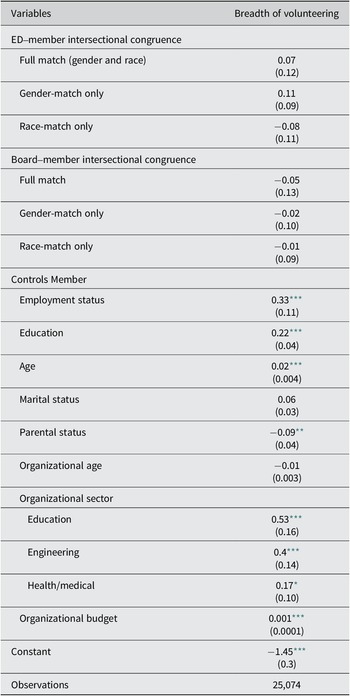
Table 4 shows that intersectional identity congruence with either the ED or the board is not significantly associated with the number of volunteer activities a member participated in. Compared with members with no identity match, those with a full, gender-only, or race-only match with the ED did not report any variations in volunteer involvement. Likewise, no board congruence categories—full, gender-only, or race-only match—significantly differ from the reference group.
Breadth of volunteering
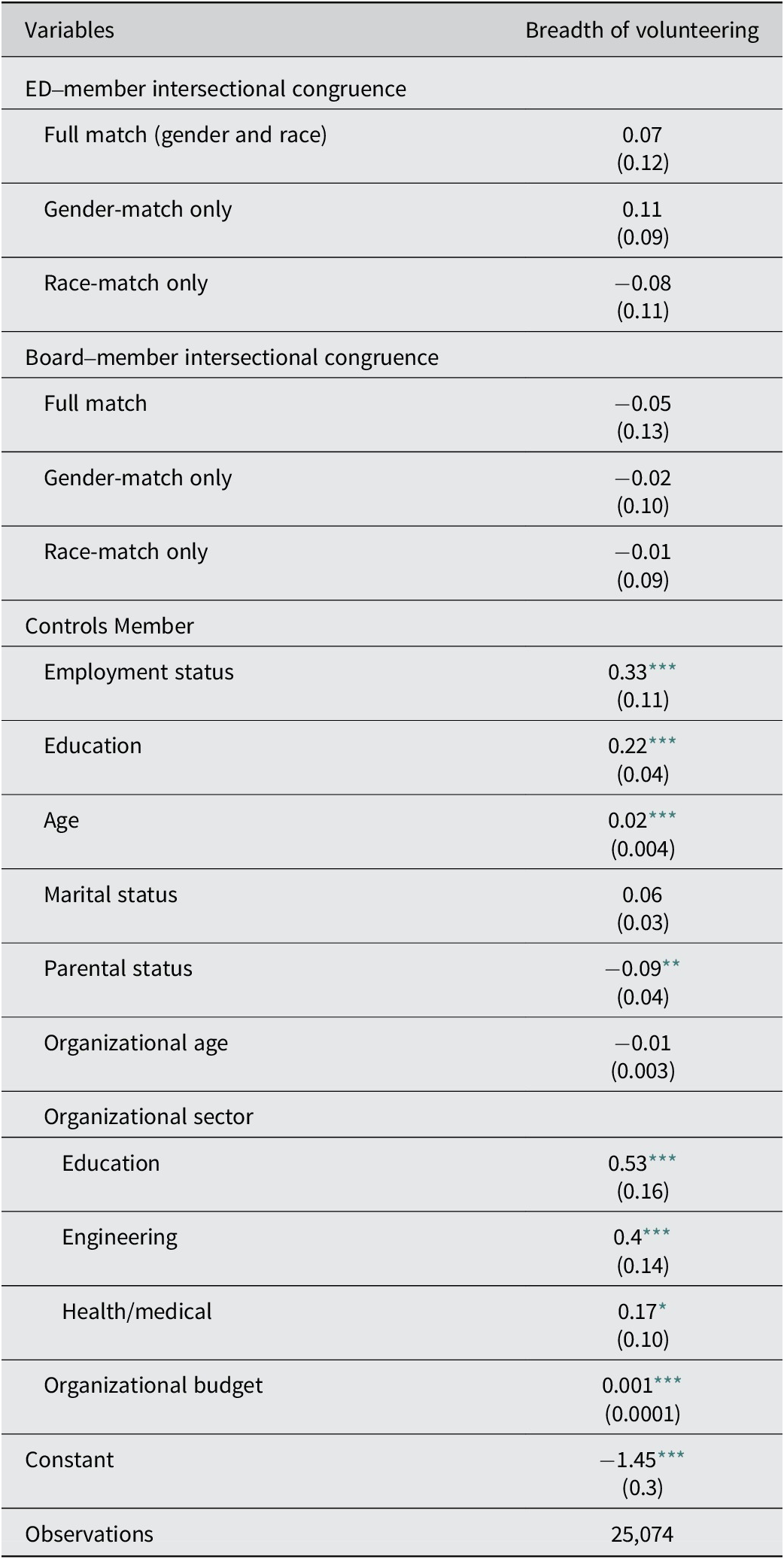
Table 4. Long description
From the top, the table lists variables in the first column and their corresponding coefficients with standard errors in the second column, measuring breadth of volunteering. Under E D to member intersectional congruence: full match (gender and race) is 0.07 with standard error 0.12, gender-match only is 0.11 with standard error 0.09, race-match only is minus 0.08 with standard error 0.11. Under board to member intersectional congruence: full match is minus 0.05 with standard error 0.13, gender-match only is minus 0.02 with standard error 0.10, race-match only is minus 0.01 with standard error 0.09. Controls for member include employment status 0.33 with standard error 0.11, education 0.22 with standard error 0.04, age 0.02 with standard error 0.004, marital status 0.06 with standard error 0.03, parental status minus 0.09 with standard error 0.04, organizational age minus 0.01 with standard error 0.003. Organizational sector is subdivided into education 0.53 with standard error 0.16, engineering 0.4 with standard error 0.14, health or medical 0.17 with standard error 0.10. Organizational budget is 0.001 with standard error 0.0001. The constant is minus 1.45 with standard error 0.3. The number of observations is 25,074. Statistical significance is indicated by asterisks: one asterisk for p less than 0.1, two for p less than 0.05, three for p less than 0.01. The reference category for congruence variables is no-match, meaning the member does not share race or gender with leadership. E D stands for executive director.
Note: Reference category for both congruence variables is No-match (i.e., member does not share race or gender with leadership). ED, executive director.
* p < 0.1.
** p < 0.05.
*** p < 0.01.
Several control variables are significantly associated with broader volunteer engagement. Employed, more educated, and older members participated in a greater number of volunteer activities. However, having children was associated with reduced engagement. Organizational budgets are also positively associated with the breadth of volunteering, whereas organizational age is not. Compared with members in business/management organizations, those in the education, engineering, and health/medical sectors reported significantly broader volunteer participation.
Volunteer satisfaction
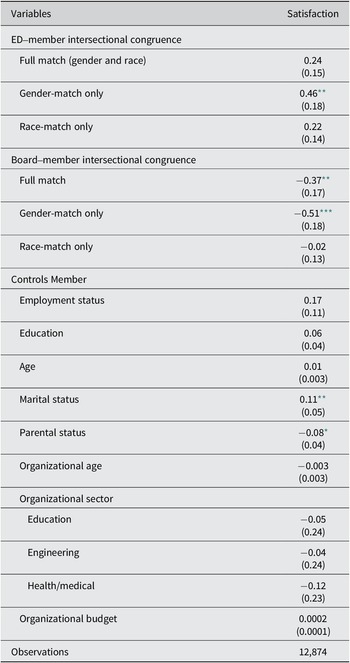
In partial contrast to the fourth hypothesis, Table 5 shows a mixed association between identity congruence and volunteer satisfaction. Intersectional congruence between members and the board is statistically significant but negative. Members who shared both race and gender with a majority of the board reported lower satisfaction than those with no identity match, whereas intersectional congruence and race-only congruence with the ED are statistically insignificant.
Volunteer satisfaction
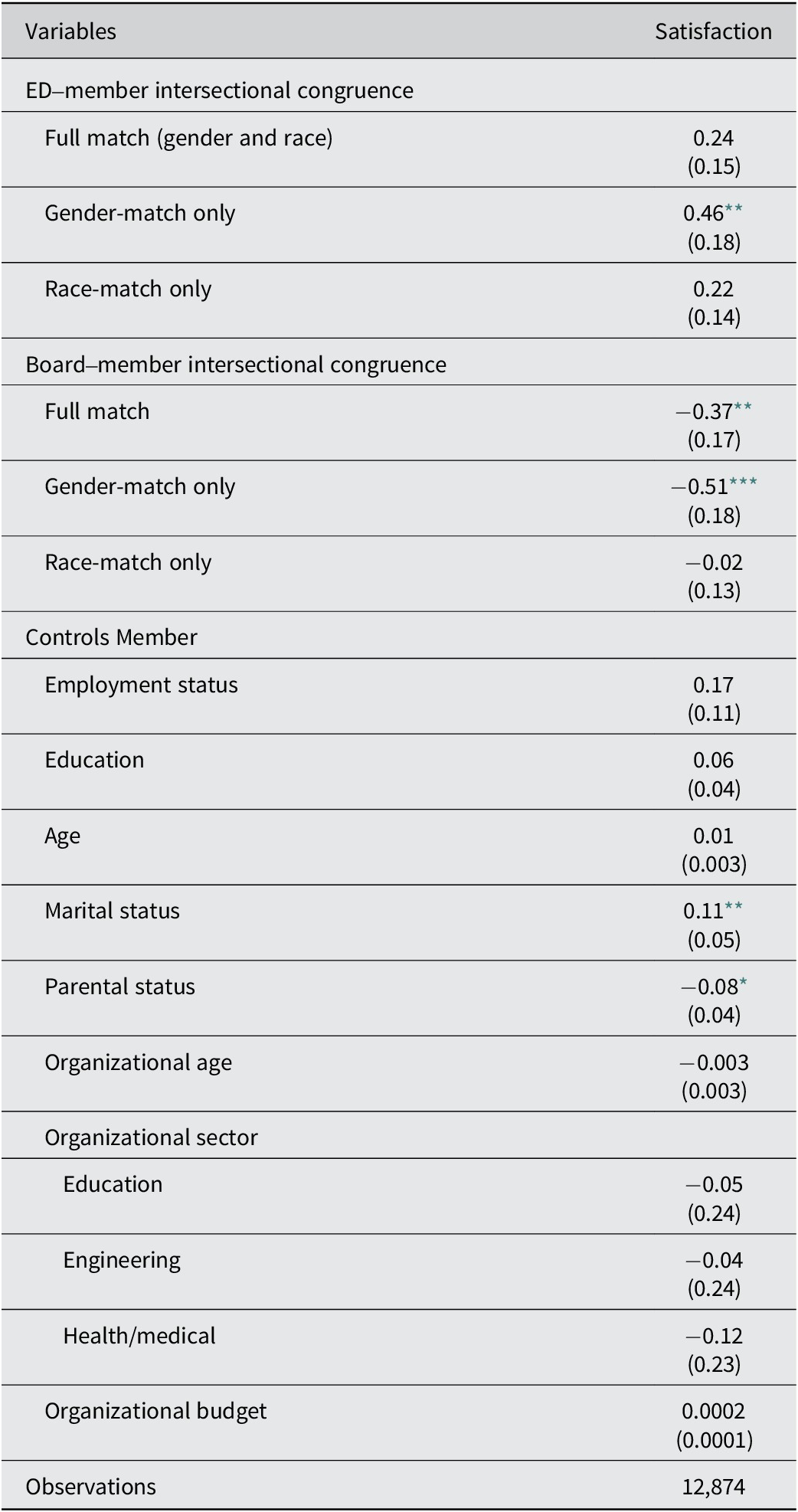
Table 5. Long description
The table is organized vertically. The first section is ED–member intersectional congruence, with three rows: Full match (gender and race) has a coefficient of 0.24 with standard error 0.15, Gender-match only is 0.46 with double asterisk for p less than 0.05 and standard error 0.18, Race-match only is 0.22 with standard error 0.14. The next section is Board–member intersectional congruence: Full match is negative 0.37 with double asterisk for p less than 0.05 and standard error 0.17, Gender-match only is negative 0.51 with triple asterisk for p less than 0.01 and standard error 0.18, Race-match only is negative 0.02 with standard error 0.13. The controls section lists Member controls: Employment status is 0.17 with standard error 0.11, Education is 0.06 with standard error 0.04, Age is 0.01 with standard error 0.003, Marital status is 0.11 with double asterisk for p less than 0.05 and standard error 0.05, Parental status is negative 0.08 with single asterisk for p less than 0.1 and standard error 0.04, Organizational age is negative 0.003 with standard error 0.003. Organizational sector is subdivided: Education is negative 0.05 with standard error 0.24, Engineering is negative 0.04 with standard error 0.24, Health/medical is negative 0.12 with standard error 0.23. Organizational budget is 0.0002 with standard error 0.0001. The final row is Observations, with a value of 12,874. The reference category for congruence variables is No match. ED stands for executive director. Asterisks indicate statistical significance: one asterisk for p less than 0.1, two for p less than 0.05, three for p less than 0.01.
Note: Reference category for both congruence variables is “No match” (i.e., member does not share race or gender with leadership). ED, executive director.
* p < 0.1.
** p < 0.05.
*** p < 0.01.
Gender-only congruence with the board is also associated with significantly lower satisfaction. Conversely, gender-only congruence with the ED is significantly associated with higher satisfaction. Racial congruence with both the board and the ED is not statistically significant. Among the control variables, being married is associated with higher satisfaction, whereas having children is associated with lower satisfaction.
Discussion
The influence of intersecting identities on volunteer behavior is complex and often difficult to operationalize, even if conceptually intuitive (Read & Eagle, Reference Read and Eagle2011). While studies in this area often examine race or gender separately, few address their intersection or test intersectional congruence between members and leadership (AbouAssi, Reference AbouAssi2021; AbouAssi et al., Reference AbouAssi, Berlan and Wright2024). This study advances the field by examining how shared racial and gender identities between organizational leaders and members are associated with different aspects of volunteer engagement, including hours volunteered, types of activities, and satisfaction.
The findings show that members’ identity congruence with leadership is not consistently associated with volunteer engagement. Intersectional identity congruence, in particular, has no association with the likelihood of volunteering. The results challenge the argument that shared identity between leaders and constituents reliably fosters trust, motivation, and organizational commitment (Ospina & Foldy, Reference Ospina and Foldy2009).
The negative association between race-only congruence with EDs and engagement further underscores this complexity. Rather than fostering greater participation, racial similarity without gender congruence may inadvertently highlight the limits of representation. While racial similarity might signal inclusivity, members may also perceive such leaders as lacking power to shift entrenched organizational cultures or policies (Cahuas & Matute, Reference Cahuas and Matute2020). Members may perceive leaders of color as tokenized within predominantly White organizational structures (Ahmed, Reference Ahmed2020; Anderson, Reference Anderson2015). This perception can heighten disillusionment if members expect advocacy and structural inclusion that do not materialize, generating pressures and expectations that reduce, rather than increase, engagement when not accompanied by meaningful organizational change (Gonzales, Reference Gonzales2019; Settles et al., Reference Settles, Buchanan and Dotson2019). This aligns with representative bureaucracy theory, which warns that passive representation alone does not guarantee active or symbolic representation (Riccucci & Van Ryzin, Reference Riccucci and van Ryzin2017; Wilkins & Keiser, Reference Wilkins and Keiser2006).
However, when it comes to time investment, a different pattern emerges. Members who share aspects of identity—such as race, gender, or both—with board members report significantly greater time commitments than those without such alignment, highlighting how identity congruence fosters deeper engagement. Two mechanisms may explain this pattern. First, unlike EDs, who are primarily associated with operational tasks, boards represent the organization’s strategic direction and embody its core values (Jones & Stewart, Reference Jones and Stewart2024). When members see their identities reflected in board leaders, they are more likely to perceive value alignment, which strengthens legitimacy, belonging, and trust (Bishu & Kennedy, Reference Bishu and Kennedy2020; Grissom et al., Reference Grissom, Nicholson-Crotty and Keiser2012). Such belonging has long been linked to stronger commitment (Omoto & Snyder, Reference Omoto and Snyder1995; Wang & Ashcraft, Reference Wang and Ashcraft2014), with leaders reinforcing this attachment by signaling acceptance and serving as role models—ultimately motivating members to invest more time. Second, members may also recognize that these leaders face added challenges to their authority, prompting them to invest more time as an expression of solidarity and support (AbouAssi & An, Reference AbouAssi and An2017).
In contrast, intersectional congruence is not associated with the breadth of volunteer engagement, measured by the number of different activities participated in by members. This suggests that while identity alignment may encourage time commitment, it does not necessarily lead to diversified engagement. Factors such as skills, interest, time availability, and mission alignment may better explain variation in volunteer roles (Musick & Wilson, Reference Musick and Wilson2008). This highlights the limits of symbolic representation—it may facilitate getting engaged or deeper time investment but not necessarily shape the nature or variety of roles taken on (Studer, Reference Studer2016).
The most nuanced relationships with identity congruence appeared in volunteer satisfaction. Intersectional congruence with the board being associated with lower volunteer satisfaction is consistent with an expectation–disconfirmation dynamic: when members perceive “people like me” on the board, they reasonably anticipate more voice, responsiveness, and equitable practices. If unmet, these expectations could lead to frustration or disillusionment (Craig & Richeson, Reference Craig and Richeson2012; Gonzales, Reference Gonzales2019). Numeric diversity on boards does not automatically translate into inclusive micropractices, which are crucial for perceived fairness and engagement (Buse et al., Reference Buse, Bernstein and Bilimoria2016; Guo & Musso, Reference Guo and Musso2007; Harrison & Murray, Reference Harrison and Murray2012). This “representation–inclusion gap” helps explain why board congruence may amplify scrutiny and disappointment among those who expected substantive—not merely symbolic—change.
Women and racially minoritized people experience identity threat, hypervisibility, and extra scrutiny in nonprofits (Ahmed, Reference Ahmed2020; Gonzales, Reference Gonzales2019; Settles et al., Reference Settles, Buchanan and Dotson2019). Intersectional board congruence may heighten the salience of identity without ensuring responsive organizational structures and norms, inadvertently triggering identity threat or pressure to represent one’s group, which can depress satisfaction despite improved descriptive representation (Ospina & Foldy, Reference Ospina and Foldy2009). At the end, passive representation can raise expectations that are unmet unless leaders exercise active and inclusive engagement.
The contrast with the positive association for executive–director gender congruence and satisfaction suggests that the mechanism also depends on role visibility and contact. EDs are more present in members’ day-to-day experiences; congruence here can translate into psychological safety, smoother communication, and tangible support—benefits that members can directly perceive—whereas board-level representation signals values at a distance and can therefore create larger expectancy gaps if not backed by inclusive governance practice (Didericksen et al., Reference Didericksen, Walters and Wallis2024; Jones & Stewart, Reference Jones and Stewart2024).
Finally, our operationalization of board congruence as a simple majority (≥50%) may capture visibility more than influence. Board power often flows through committee chairs, agendas, and informal norms; without inclusive behaviors, “majority” presence may still leave underrepresented volunteers feeling unheard (Buse et al., Reference Buse, Bernstein and Bilimoria2016; Harrison & Murray, Reference Harrison and Murray2012). Future research should test whether satisfaction improves when board practices are more inclusive or when congruence occurs at high-leverage and more visible positions (e.g., board chair). In sum, identity alignment can both inspire and disappoint. It may heighten expectations of inclusion or social change, but without meaningful representation or power-sharing, these expectations may remain unfulfilled.
Relatedly, there is a need to differentiate between perceptual and actual congruence. While actual congruence is the focus herein, it is crucial to recognize that volunteers’ experiences are also influenced by their perceptions of leadership demographics. These perceptions may not always align with reality, yet they can have a powerful effect (Kristof‐Brown et al., Reference Kristof-Brown, Zimmerman and Johnson2005). For example, a board might be diverse, but if volunteers are unaware of this, the potential benefits of that diversity might not be fully realized. Conversely, a perceived congruence—even if inaccurate—can still foster a sense of connection and belonging. While our primary focus is on the actual alignment, future research could explore how this perceptual congruence operates and how a gap between the two might impact volunteer engagement and satisfaction.
Moreover, shared identity may carry different meanings depending on organizational context. In some nonprofits, particularly those shaped by traditional gender norms or hierarchical leadership dynamics, identity congruence may feel more symbolic than active (Riccucci & van Ryzin, Reference Riccucci and van Ryzin2017). Racial or gender similarity with board members may even create pressures for performance or representation that White-majority boards do not face—reflecting broader societal expectations for minority leaders to fix structural issues without the authority or resources to do so (Cahuas & Matute, Reference Cahuas and Matute2020; Gonzales, Reference Gonzales2019).
Conclusion
To conclude, we want to underscore that gender and race cannot be considered in isolation: their interaction yields effects that diverge from unidimensional studies. Gender congruence appears more associated with satisfaction, whereas board-level race congruence is related to time investment. Identity congruence between members and leadership is not consistently associated with volunteering behaviors and outcomes. Such associations are positive for the number of hours spent volunteering but negative for volunteer satisfaction when there is an identity match with the board. While identity congruence can foster trust and investment under certain conditions, it can also raise unfulfilled expectations, revealing the need for nonprofits to go beyond representational diversity. Building inclusive structures and meaningful engagement opportunities may matter more than visible diversity or demographic similarity alone.
Future research should explore other identity dimensions that are less stable (Shang et al., Reference Shang, Reed and Croson2008) and investigate the mediating or moderating effects of individual factors, such as personal motives, and organizational factors, including organizational culture and environment, communication, and leadership behavior, in shaping the link between identity congruence and volunteer outcomes. While leader representation can cultivate support and belonging—potentially boosting volunteer engagement and satisfaction—this effect may be attenuated or neutralized by complex theoretical mechanisms. Specifically, internalized biases and the varying identity salience among volunteers may hinder this effect, as only the most salient identities could guide behavior. Future research must clarify the impact of identity salience and move beyond simple representation. Additional examination is needed for the quality of direct interpersonal relationships—including interactions among members and with lower-level managers involved in recruitment (Ertug et al., Reference Ertug, Brennecke, Kovács and Zou2022; Guillaume et al., Reference Guillaume, Dawson, Otaye-Ebede, Woods and West2017)—which are known to be critical determinants of job satisfaction, organizational commitment, and performance.
Data availability statement
Data are available from the ASAE Foundation.
Funding statement
This research was partially funded by the ASAE Foundation through the Sal Martino Grant for DEI Research.
Competing interests
The authors declare they have no competing interests to disclose.
Ethical standard
The ASAE Foundation, which owns the dataset, granted the authors the use of the data. The authors certify that they have no affiliations with or involvement in any organization or entity with any financial or nonfinancial interest in the subject matter or materials discussed in this article.
Use of AI
The authors used GEMINI for language editing and readability improvements. The authors reviewed and verified the final content.
Appendices
Appendix A: Executive director–member identity congruence matrix

Long description
The table has three columns: Member identity, E D identity, and Match type. From the top row downward, the pairings and match types are as follows. Racially minoritized woman with racially minoritized woman is a full match. Racially minoritized woman with white woman is gender-match only. Racially minoritized woman with racially minoritized man is race-match only. Racially minoritized woman with white man is no match. White woman with racially minoritized woman is gender-match only. White woman with white woman is full match. White woman with racially minoritized man is no match. White woman with white man is race-match only. Racially minoritized man with racially minoritized woman is race-match only. Racially minoritized man with white woman is no match. Racially minoritized man with racially minoritized man is full match. Racially minoritized man with white man is gender-match only. White man with racially minoritized woman is no match. White man with white woman is race-match only. White man with racially minoritized man is gender-match only. White man with white man is full match.
Appendix B: Board–member identity congruence matrix
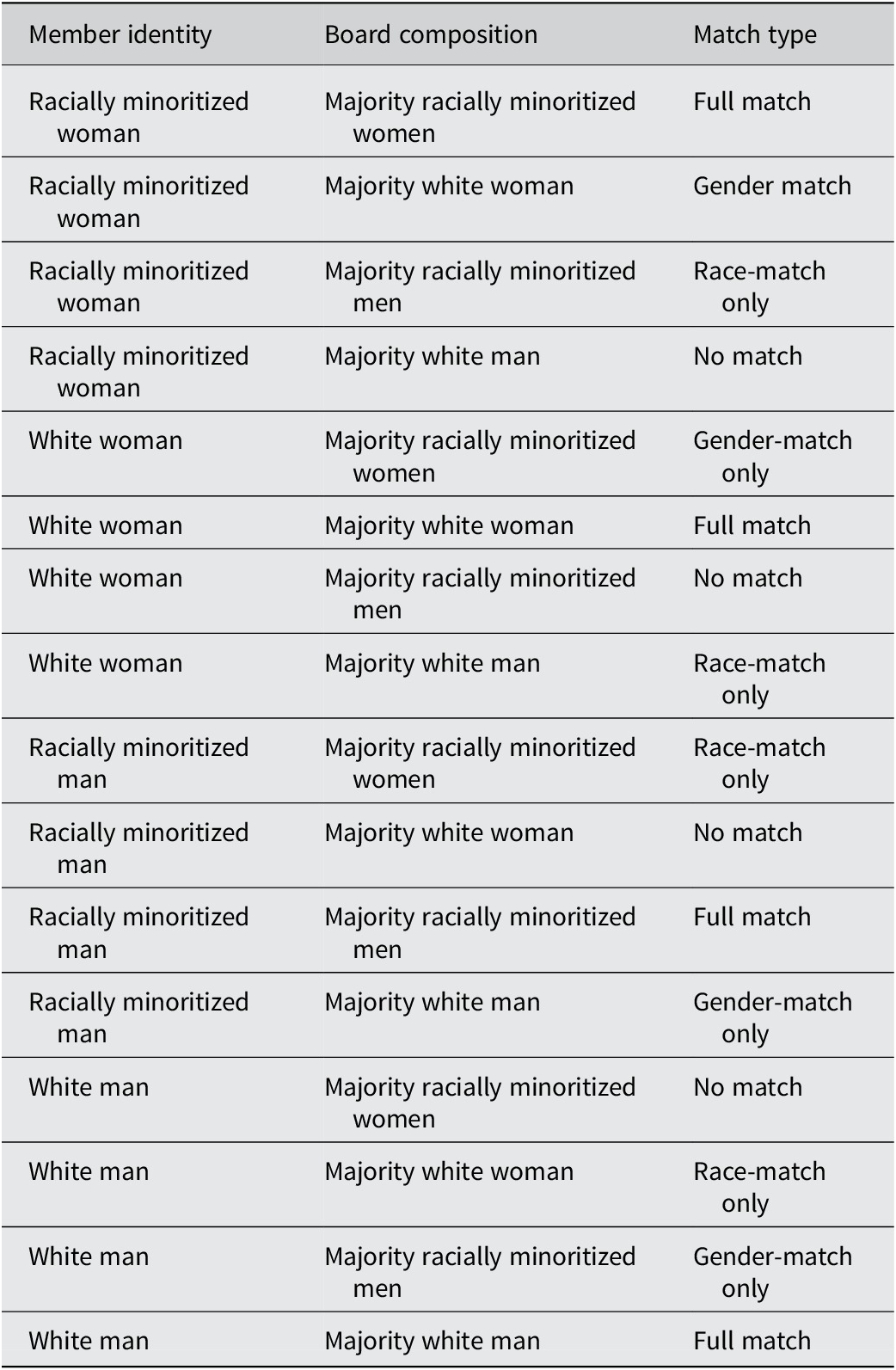
Long description
The table has three columns: Member identity, Board composition, and Match type. From the top row downward, the entries are as follows. Racially minoritized woman with majority racially minoritized women yields full match. Racially minoritized woman with majority white woman yields gender match. Racially minoritized woman with majority racially minoritized men yields race-match only. Racially minoritized woman with majority white man yields no match. White woman with majority racially minoritized women yields gender-match only. White woman with majority white woman yields full match. White woman with majority racially minoritized men yields no match. White woman with majority white man yields race-match only. Racially minoritized man with majority racially minoritized women yields race-match only. Racially minoritized man with majority white woman yields no match. Racially minoritized man with majority racially minoritized men yields full match. Racially minoritized man with majority white man yields gender-match only. White man with majority racially minoritized women yields no match. White man with majority white woman yields race-match only. White man with majority racially minoritized men yields gender-match only. White man with majority white man yields full match.
Appendix C: Model diagnostics and robustness checks for volunteer engagement
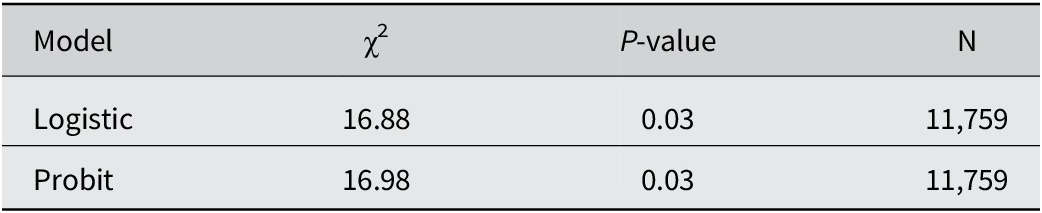
To assess model fit for the binary logistic regression model predicting volunteer engagement, we conducted a Hosmer–Lemeshow goodness-of-fit test. The test result (χ2 = 16.88, p = .031) suggests some deviation between observed and predicted probabilities. Given the large sample size (N = 11,759), this result is not uncommon and may reflect sensitivity rather than substantive misfit. As a robustness check, we estimated an equivalent probit model with clustered standard errors. The probit model yielded a similar Hosmer–Lemeshow result (χ2 = 16.98, p = .030), but the key congruence variables remained statistically significant and in the expected direction, indicating the robustness of the main findings.
Hosmer–Lemeshow goodness-of-fit test
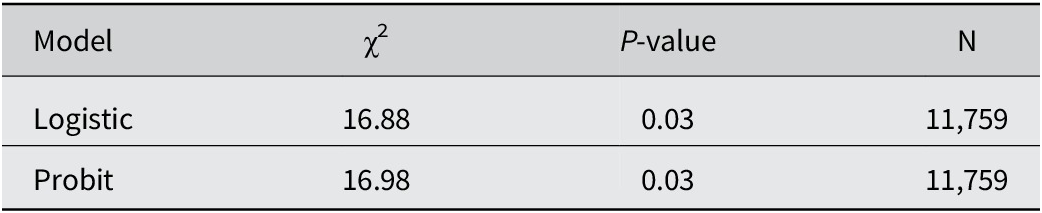
Table C1. Long description
The table contains four columns labeled Model, chi-squared, P-value, and N. The first row under headers lists Logistic with chi-squared 16.88, P-value 0.03, and N 11,759. The second row lists Probit with chi-squared 16.98, P-value 0.03, and N 11,759. Both models have identical sample sizes and P-values, with slightly different chi-squared values.
Appendix D: Model diagnostics and robustness check for time invested in volunteering
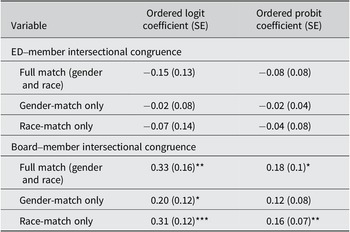
As a robustness check for the ordered logit model, we estimated an ordered probit model with clustered standard errors. The results were consistent in direction and general significance patterns. While one board congruence category became statistically insignificant in the probit model, the overall findings remained substantively stable.
Comparison of ordered logit and ordered probit models (key variables only)

Table D1. Long description
The table has two main sections. The first section, ED–member intersectional congruence, lists three rows: Full match (gender and race) with coefficients negative zero point one five (zero point one three) for ordered logit and negative zero point zero eight (zero point zero eight) for ordered probit; Gender-match only with negative zero point zero two (zero point zero eight) for logit and negative zero point zero two (zero point zero four) for probit; Race-match only with negative zero point zero seven (zero point one four) for logit and negative zero point zero four (zero point zero eight) for probit. The second section, Board–member intersectional congruence, lists: Full match (gender and race) with zero point three three (zero point one six) double asterisk for logit and zero point one eight (zero point one) asterisk for probit; Gender-match only with zero point two zero (zero point one two) asterisk for logit and zero point one two (zero point zero eight) for probit; Race-match only with zero point three one (zero point one two) triple asterisk for logit and zero point one six (zero point zero seven) double asterisk for probit. Asterisks indicate significance: one for p less than zero point one, two for p less than zero point zero five, three for p less than zero point zero one. ED is defined as executive director.
Note: ED, executive director. * p < 0.1.** p < 0.05.*** p < 0.01.
Appendix E: Model diagnostics and robustness check for breadth of volunteering
To justify the use of a negative binomial regression model for the breadth of volunteering outcome, we first estimated a Poisson model and conducted a Pearson goodness-of-fit test. The result (χ2 = 114,419, p < 0.001) indicated substantial overdispersion, suggesting poor model fit. We then estimated a negative binomial regression model, which yielded a statistically significant dispersion parameter (lnα = 0.88, SE = 0.09). These results confirm that the negative binomial specification is more appropriate for the count-based volunteering measure.
Appendix F: Model diagnostics and robustness check for volunteer satisfaction
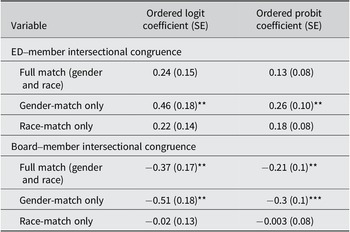
To test the proportional odds assumption, we estimated a generalized ordered logit model using gologit2 with the autofit option. The test did not indicate a violation, supporting the use of an ordered logit model for volunteer satisfaction. As a robustness check, we also estimated an ordered probit model with clustered standard errors. The key identity congruence variables remained significant and in the same direction, confirming the robustness of the results.
Comparison of ordered logit and ordered probit models (key variables only)
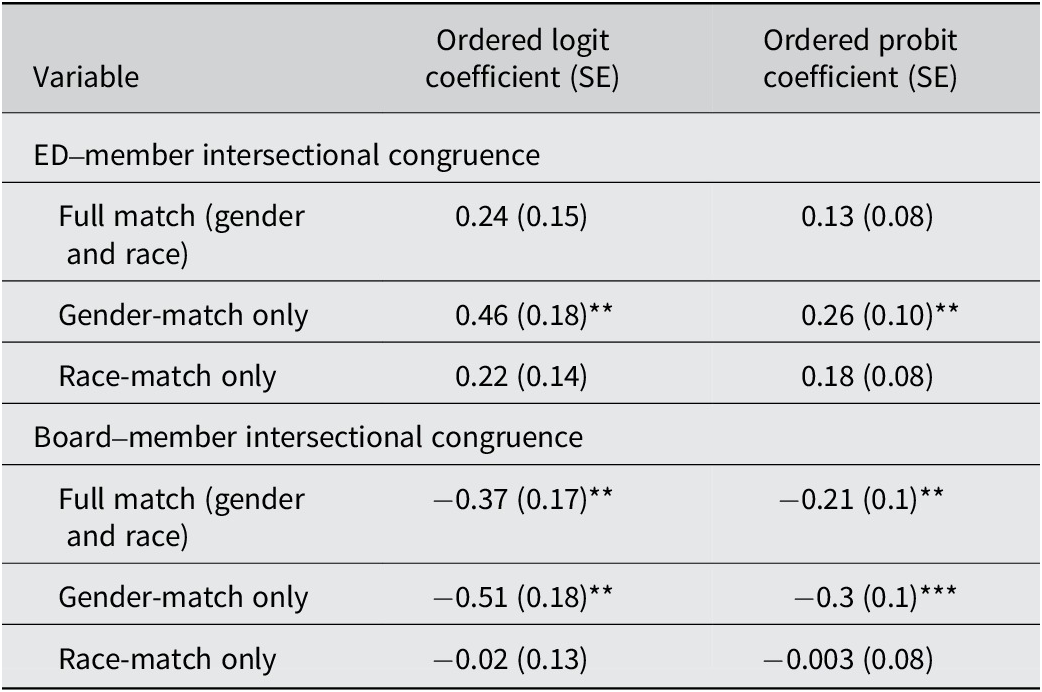
Table F1. Long description
The table has three columns: Variable, Ordered logit coefficient with standard error, and Ordered probit coefficient with standard error. The first group is ED–member intersectional congruence, with three rows: Full match (gender and race) shows 0.24 (0.15) for logit and 0.13 (0.08) for probit; Gender-match only shows 0.46 (0.18) with two asterisks for logit and 0.26 (0.10) with two asterisks for probit; Race-match only shows 0.22 (0.14) for logit and 0.18 (0.08) for probit. The second group is Board–member intersectional congruence, with three rows: Full match (gender and race) shows minus 0.37 (0.17) with two asterisks for logit and minus 0.21 (0.1) with two asterisks for probit; Gender-match only shows minus 0.51 (0.18) with two asterisks for logit and minus 0.3 (0.1) with three asterisks for probit; Race-match only shows minus 0.02 (0.13) for logit and minus 0.003 (0.08) for probit. Asterisks indicate significance: one for p less than 0.1, two for p less than 0.05, three for p less than 0.01. ED is defined as executive director.
Note: ED, executive director. * p < 0.1.** p < 0.05.*** p < 0.01.

 Open access

