


Introduction
We come to this project as an established criminological researcher who (somewhat) successfully resisted a legal order to compel a disclosure (McClelland and Bruckert Reference McClelland and Bruckert2022; Parent c. R. 2014)—a mid-career researcher who works with criminalized people and has concerns about confidentiality protections, and an experienced lawyer (and doctoral candidate) working with marginalized communities. We most certainly appreciate that research ethics is an ongoing dynamic conversation—one that requires much more thought and engagement than emerges from the current checklists provided by research ethics boards and qualitative research training. As such we make no grand claim that one paper can address the complexity of ethical tensions and dilemmas at play in any reflection on disclosure. Rather, in the context where there is little information on what to do when moral dilemmas arise regarding disclosing confidential information, we endeavour to contribute to the conversation by providing a decision-making framework.
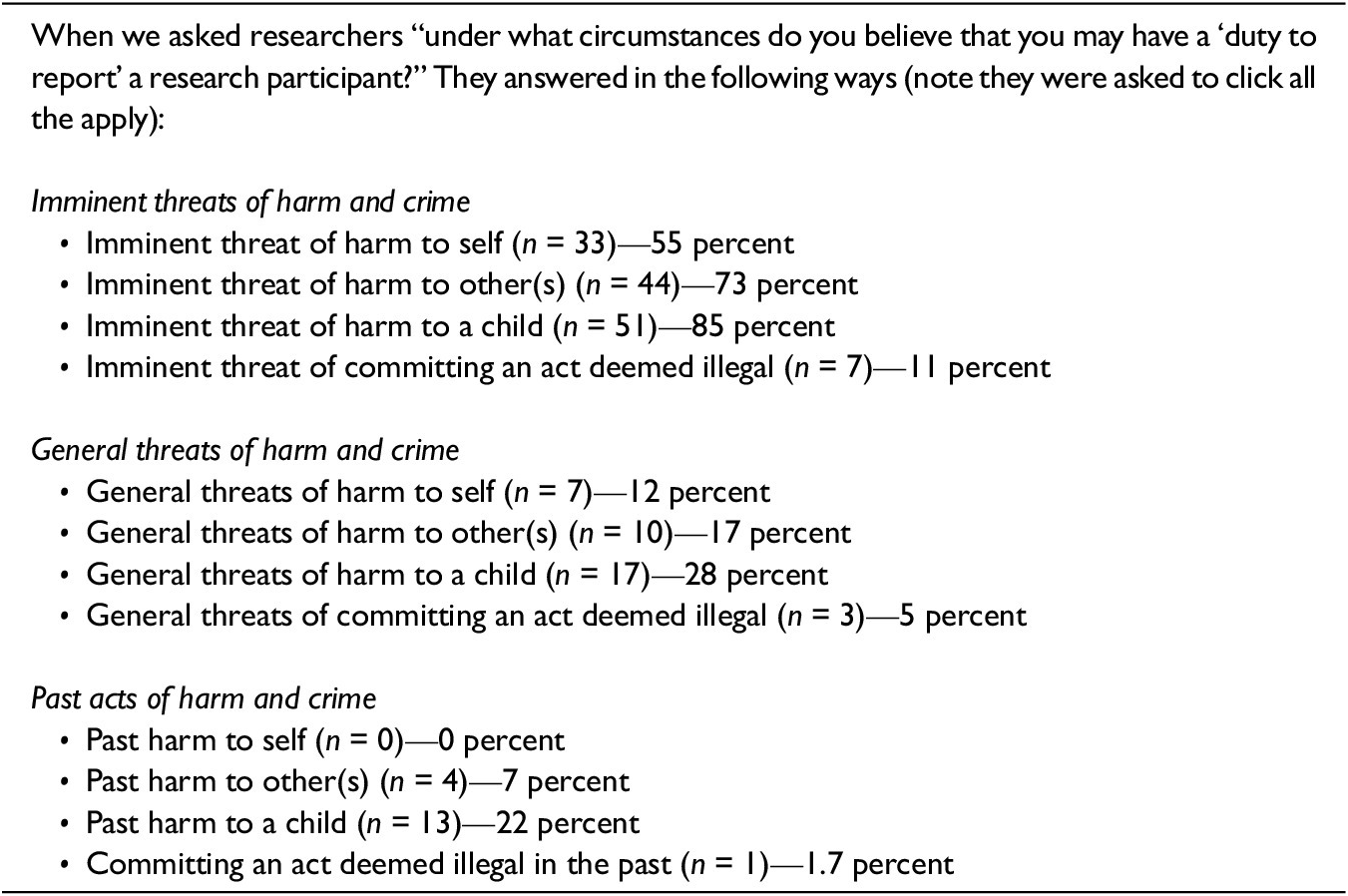
Survey results on rights and duties to report threshold

The obligation to do no harm is a well-established research ethic (Haggerty Reference Haggerty2004; Palys and Lowman Reference Palys and Lowman2014; van den Hoonaard Reference Hoonaard2001; Reference Hoonaard2002) and participants rely on our promises of anonymity and confidentiality—they trust that we will uphold our commitment. Indeed, failure to protect confidentiality can have devastating impacts on the personal, social and professional lives of those who generously share their stories with us. At the same time, however, professional responsibilities and ethics of care can manifest in a desire, or even a requirement, to breach confidentiality. This begs the questions, what are the limits of the promise of confidentiality? In what situations might researchers have a right to disclose information they garnered while collecting data? And where do researchers go for answers and guidance to navigate this terrain?
In this paper, we first examine the literature on the duty to report and the right to report. Subsequently, drawing on sixty survey responses, twelve in-depth interviews with researchers and thirty interviews with criminalized or socially sanctioned communities who have participated in research projects we juxtapose the perceptions of research participants with the competing and contradictory ethical obligations researchers navigate and the range of philosophical positions they embrace as they endeavour to “be ethical.” Additionally, we include findings related to the consequences of disclosures for participants and researchers. To assist addressing ongoing tensions and dilemmas, we conclude the paper with a decision-making framework for researchers struggling with the conundrum of whether they have a duty, and/or the right, to disclose confidential information. To this end we combine the Wigmore test (Wigmore Reference Wigmore and McNaughton1961), with the Supreme Court of Canada Smith v Jones 1999 decision.
What is the duty to report? What is the right to report?
Qualitative researchers have cautioned that without guarantees of confidentially, conducting social research on contentious phenomena, such as sex, drugs and crime, would be exceptionally difficult (Palys and Lowman Reference Palys and Lowman2014). To enable the free flow of knowledge and information that may not otherwise be possible, qualitative researchers rely on promises of confidentiality to facilitate trust (van den Hoonaard Reference Hoonaard2002) and protect participants from potential disclosures (Palys and Lowman Reference Palys and Lowman2000). Indeed, as the Tri-Council Policy Statement: Ethical Conduct for Research Involving Humans (Canadian Institutes of Health Research, Natural Sciences and Engineering Research Council of Canada, and Social Sciences and Humanities Research Council of Canada 2022) states, “respect for privacy in research is an internationally recognized norm and ethical standard” (p. 57). But the promise of confidentially is always haunted by the spectre of disclosure via the duty, or the right, to report.
Duty to report (or duty to warn, duty to inform, duty to protect)
Legal practitioners often describe human relations in terms of legal duties. A legal duty is a way of saying that a particular standard of conduct is owed by one person to another and in the absence of such a duty there is no obligation to act in any specific way. When a legal duty is present, not acting in the prescribed manner can result in legal liability and some form of consequence. For example, the legal duty to report child abuse (and in some cases elder abuse) applies to all Canadian residents (e.g., in Ontario this is legislated under the Child, Youth and Family Services Act 2017 and the Retirement Homes Act 2010); as such it overrides class privilege (e.g., between a doctor and patient; lawyer and client). The duties to report, warn, protect or informFootnote 1 are also ways of describing the obligation of some professionals including, for example, psychologists, social workers and nurses (via legal precedent, legislation, policy or codes of conduct) to share information that has been confided to the professional to avert serious and imminent harm. Social researchers who also have clinical designations, such as the above noted psychologists, may be required by virtue of professional codes of practice to breach confidentiality under certain circumstances (see Truscott and Crook Reference Truscott and Crook1993; Reference Truscott and Crook2004; Sheppard et al Reference Sheppard, Schulz and McMahon2020; Regulated Health Professions Act 1991) opening up the possibility of tension between the duty to report and the requirement to maintain confidentiality in the context of research.
In short, the duty to report may apply to all persons within a specific jurisdiction or may apply to specific people who have clinical designations and legal frameworks with which they must abide. Not following through with obligations via a legal duty may result in a penalty and failing to meet code of conduct reporting standards can have professional consequences. Quite simply, all researchers need to navigate professional codes and confidentiality protection.
Right to report (or right to warn, right to protect)
In general, for professionals in legally privileged relationships such as lawyers and psychiatrists, there is no obligation to report illegal activity that may encounter in their work with patients and clients.Footnote 2 However, situations may arise where a professional feels they have a moral obligation to intervene to prevent harm. In Canada, the 1999 Supreme Court of Canada case Smith v Jones sets out the very limited circumstances that would justify sharing information acquired within the confines of a privileged relationship (Smith v Jones 1999). Smith v Jones originated when the accused was charged with aggravated sexual assault towards a sex worker. Prior to a psychiatric consultation, defence counsel told the accused that the discussion would be privileged in the same way as a consultation with a lawyer. During the meeting with the psychiatrist, the accused revealed plans to kidnap, rape and kill sex workers. The psychiatrist brought concerns to the court requesting permission to disclose the information in the interests of public safety. The trial judge found that the psychiatrist was released from his duties of confidentiality, based on the public safety exception to the solicitor-client privilege of confidentiality. This right to report provides a narrow release valve from confidentiality protections for those who feel they may have a moral duty to disclose information garnered in a professional context and override obligations to protect confidentiality.
Review of literature
Navigating confidentiality protections in qualitative research: ethics first and law of the land
Researchers without a clinical designation are only guaranteed privilege on a case-by-case basis in Canada. Scholarship on navigating confidentiality protections in qualitative research has highlighted that ethical considerations need to be dynamic and tailored to the populations and social contexts under examination. As such researchers are urged to carefully think through the unique ethical dilemmas posed by their research topic and study population. Here we can think about the specific considerations when, for example, researching unhoused individuals, children, survivors of violence, sex workers and people who use drugs (Daley Reference Daley2015; Duncan et al Reference Duncan, Drew, Hodgson and Sawyer2009; Elger et al Reference Elger, Handtke and Wangmo2015; Ellis et al Reference Ellis, Walters, Friedman, Ouellet, Ezell, Rosentel and Pho2015; Ensign Reference Ensign2003; Fitzgerald and Hamilton Reference Fitzgerald and Hamilton1996). The literature also draws attention to the importance of attending to particular challenges when there is a small and interconnected participant sample (Damianakis and Woodford Reference Damianakis and Woodford2012) or when individuals are incarcerated (Cowburn Reference Cowburn2005; Reference Cowburn2010; Drake and Maundrell Reference Drake and Maundrell2017). While there is consensus that researchers must develop strategies to ensure their research practices and protocols mitigate harms (Decker et al Reference Decker, Naugle, Carter-Visscher, Bell and Seifert2011; Palys and Lowman Reference Palys and Lowman2014; Palys et al Reference Palys, Turk and Lowman2018; Palys and Lowman Reference Palys and Lowman2000; Reference Palys and Lowman2006; Palys and MacAlister Reference Palys and MacAlister2016) it is important to appreciate that the scholarship is divided in relation to the primacy of law over ethics; some advocate for an “ethics-first” approach (Palys et al Reference Palys, Turk and Lowman2018), while others promote the “law-of-the-land” model (Drake and Maundrell Reference Drake and Maundrell2017)
The “ethics-first” approach highlights the need for researchers to take a proactive and robust ethical stance towards the protection of confidentiality (Palys and Lowman Reference Palys and Lowman2014; Palys and Ivers Reference Palys and Ivers2018; Palys and Lowman Reference Palys and Lowman2000; Reference Palys and Lowman2006; Palys and MacAlister Reference Palys and MacAlister2016). To help ensure future jurisprudence is as favourable and respectful as possible to research participants and academic freedom this body of scholarship has outlined how to anticipate the court’s evidentiary requirements when a claim of privilege is invoked and strategies to align research with the Wigmore test (McClelland and Bruckert Reference McClelland and Bruckert2022; Palys and MacAlister Reference Palys and MacAlister2016).
The “law-of-the-land” approach is embraced by researchers who qualify promises of confidentiality by informing participants that the confidentiality protections are limited to the extent permitted by law (Drake and Maundrell Reference Drake and Maundrell2017). Researchers who adhere to this approach have outlined a thoughtful awareness of circumstances in which they might have a (perceived) moral obligation or be required via a legal duty, to break a promise of confidentiality; accordingly, they argue for informing participants about the risk of compelled disclosure as part of the consent process (Lee and Reznetti Reference Lee and Reznetti1990; Lee Reference Lee1993; Drake and Maundrell Reference Drake and Maundrell2017). Notably, garnering access to conduct research in a prison context may necessitate agreeing to duty to report policies imposed by authorities. One such study on incarcerated men convicted of sex offences, noted that the duty to report “supersedes any ethical or moral dilemma and must be adhered to” if the research is to be understood as credible by the institution (Blagden and Pemberton Reference Blagden and Pemberton2010).
There is also the potential that informing participants about a researcher’s disclosure obligations may compromise the validity of research. An illustrative example is the controversial instance of Dr Ivan Zinger’s dissertation research on the mental health impacts of solitary confinement (Zinger et al Reference Zinger and Cherami Wichmann2001). Zinger interviewed federally incarcerated prisoners about their mental health over 30, 60 and 90 days in administrative segregation. In advance of the interviews, Zinger cautioned participants that any references to self-harm or suicide would be reported to Corrections Service Canada (for whom he also worked at the time). The results of the research found limited detrimental impacts of the practice, with only very minimal instances of self-harm or suicidal ideation, essentially giving it a clean bill of health for continued use. Upon being published, the research received a wide-ranging critique, with other scholars questioning the validity of the results, as participants had been deterred to discuss a central mental health consequence of being in held in solitary confinement, along with the human rights of the practice in general (Gendreau and Keyes Reference Gendreau and Keyes2001; Jackson Reference Jackson2001; Palys and Lowman Reference Palys and Lowman2001).Footnote 3
Navigating intentional disclosures
To the best of our knowledge, there is limited research on intentional disclosures of research-participant information in Canada. Indeed, it is the disclosures that researchers have contested that we know the most about (i.e., Ogden, Bruckert, Maillé and Bauer). In a UK study, Wiles et al (Reference Wiles, Crow, Heath and Charles2008) found that researchers working on issues related to children, youth, elderly persons, palliative care, learning disabilities and mental health reported feeling compelled to break confidentiality when participants were perceived as being at risk of harm, but not in relation to other forms of illegal activity (p. 419). Researchers have also identified that they may feel obligated to disclose information if a study participant reported being a victim of crime (Bostock Reference Bostock2002). Notably, some researchers insist that if a disclosure was required, they would first gain consent from the participant to share the information and that, “the decision to break confidentiality was one that was taken very seriously and was only undertaken where this was seen to be in the best interests of the person involved” (Wiles et al Reference Wiles, Crow, Heath and Charles2008, 419). In this vein, Bostock (Reference Bostock2002), ensured buy-in by working collaboratively with her research participants to negotiate a reporting policy that was aligned with the needs of the immigrant mothers she was interviewing.
For researchers with clinical designations, decisions about intentional disclosures are generally guided and influenced by legal and regulatory frameworks which outline the duty to report. That said, what constitutes harm can be contested and is, at times, open to interpretation. For example, research has highlighted that there is limited clarity or consistency across countries on definitions of real or potential harm within disclosure legislation (Donnelly Reference Donnelly2019). If definitions of harm are too broad or vague, the result could be over reporting, which has the potential not only to limit available resources to intervene in vital cases of concern but also result in “intrusive professional involvement in adults’ lives with or without their consent, undermining the rights and autonomy of individuals” (Donnelly Reference Donnelly2019, 242).
One potentially useful approach regarding decision-making and confidentiality protections is advanced by Goossens and their colleagues (Goossens et al Reference Goossens, Vargen, Wedman and Connolly2021). The researchers argue that the criminalization of HIV nondisclosure resulted in psychologists invoking a “duty to warn” (i.e., advising clients of the potential for disclosure). But determining when and how a potential HIV nondisclosure constitutes a reportable harm is not always a straightforward process. Applying the legal test resulting from the Smith v Jones decision, these researchers call on psychologists to be aware of updated science on HIV, be attentive to social and structural issues related to racism, ongoing colonization and their own personal biases towards sexual health and to seek alternative courses of action first. The approach Goossens et al propose is nuanced and urges researchers to be conscious that a disclosure could cause individual harm, could damage the therapeutic relations and could reinforce existing structural harms.
Effectiveness and impact of disclosures
Following through on the duty to report is a normative expectation, but is there research to back up the effectiveness of disclosures? Does reporting lead to the desired outcomes of public protection and harm mitigation? Researchers have noted that despite the widespread use of duty to report obligations, there is little research examining if such duties work as intended (McTavish et al Reference McTavish, Kimber, Devries, Colombini, Jennifer, Wathen, Agarwal and MacMillan2017; Reference McTavish, Kimber, Devries, Colombini, Jennifer, Wathen and MacMillan2019). McTavish et al conducted a meta-synthesis of qualitative research which they describe as “the most comprehensive review to date of mandatory reporting of child maltreatment, focusing on mandated reporters’ (MRs) experiences with reporting” (McTavish et al Reference McTavish, Kimber, Devries, Colombini, Jennifer, Wathen, Agarwal and MacMillan2017, 1). Their study suggests that there are many potentially harmful outcomes associated with mandatory reporting, including “child death following a report or after being removed from the family of origin” (McTavish et al Reference McTavish, Kimber, Devries, Colombini, Jennifer, Wathen, Agarwal and MacMillan2017, 5) and “children being revictimized by the reporting process, children whose abuse intensified after a report was filed, [and] foster care environments that were perceived to be worse than family-of-origin environments” (2017, 11).The researchers note their “search retrieved no evidence about the effectiveness of mandatory reporting” and, as such, more “research on the effectiveness of this process is urgently needed” (McTavish et al Reference McTavish, Kimber, Devries, Colombini, Jennifer, Wathen, Agarwal and MacMillan2017, 15). Studies on the social service sector have also noted that there are unintended consequences of the duty to report, primarily on the relationship between workers and clients; for example the possible breach of trust may make women more reluctant to use shelters and other services (Alaggia et al Reference Alaggia, Jenney, Mazzuca and Redmond2007). Moreover, breaches of confidentiality in hospital settings, which are relatively common, have been shown to impact “patients’ overall experience and led some to withhold important information” (Jensen and Eg Reference Jensen and Eg2022, 22). In short, this research draws into question the benefit of reporting; benevolent intentions can have detrimental outcomes for the individual and organizations involved.
Methods
This paper draws on findings from a research project, The Tactics and Practices of Ethical Scholarly Inquiry, which explored the ethics practices of qualitative researchers with an eye to informing the protection of confidentiality. Grounded in qualitative inquiry the study entailed multiple qualitative sources supplemented by quantitative data (Creswell Reference Creswell2010) and legal research on the concept of privilege in Canadian common-law precedent, codes of conduct and legislation. In 2020, we conducted twelve semi-structured one-on-one key informant interviews with Canadian scholars who have undertaken qualitative research with criminalized or socially sanctioned communities (i.e., due to labour, gender, sexuality and/or health status). These interviews were held virtually due to COVID-19 restrictions. Interviews lasted between one and two hours and were focused on the researcher’s experiences, the challenges and obstacles they navigate and the strategies they deploy to protect their research participants.Footnote 4
In March 2020, we also launched the Confidentiality and Research: Tactics and Practices for Ethical Scholarly Inquiry online survey. The survey, which ran until December of that year, was completed by sixty participants from across Canada. Respondents included graduate students (28% n = 17), university-based researchers who were early-career (up to five years post-PhD; 25% n = 15), mid-career (five to fifteen years; 27% n = 16), established (over fifteen years; 13% n = 8) and community-based researchers (i.e., not affiliated with a university) (7% n = 4). All participants were, or had been, actively working on qualitative projects on or with criminalized or socially sanctioned communities. The survey was comprised of a series of Likert scales and open-ended questions on perceptions of confidentiality and the tactics and practices used to protect participant data. We also asked respondents to reflect on seven scenarios which qualitative researchers could potentially encounter in interactions with research participants, including past and general threats of self-harm or harm to others, disclosures of illegal activity and future threats of specific harm to self or others.
Between March 2021 and November 2022, we conducted thirty semi-structured one-on-one key informant interviews with people who had participated in qualitative research projects on vulnerable (often criminalized) populations (e.g., sex workers, drug users). Interviews lasted between thirty minutes to one hour and focused on the nature of a research project the participant had engaged in; individuals were asked about privacy concerns, consequences of confidentiality breaches, trust, perceptions of the project’s data protections and motivations for participating. Regarding demographics, we worked to ensure participants represented a diverse range of experiences, backgrounds and identity categories.
Interviews—both key informant and those with research participants—were digitally recorded and transcribed verbatim. For the interviews and open-ended survey results, we used NVivo qualitative data management software and employed an iterative approach to data analysis guided by the emergence of themes. After the emergent themes were coded, they were classified into main and residual categories and subjected to analysis (Fereday and Muir-Cochrane Reference Fereday and Muir-Cochrane2006). Quantitative survey data are presented as descriptive statistics in relation to a range of qualitative data sources to provide a richer analysis (Creswell Reference Creswell2010).
The methods used in the legal analysis began by asking the question: What should the decision-making framework used by researchers be with respect to ascertaining their duty to report and to make disclosures? To answer this question, we analyzed case law at all court levels: federal and provincial, related statutes and legal commentary. Special attention was paid to the legal reasoning in Parent c. R., where Justice Bourque of the Quebec Superior Court had to ask herself the same question with the factual matrix presented by Professors Parent and Bruckert. Parent c. R. was entered into legal research websites Quicklaw and CanLii, and cited up—that is, cases were sought that applied the legal reasoning and similar legal issues in Parent v R. The same methodological approach was used to review Smith v Jones.
Findings
Our findings highlight that conceptions of breaching confidentiality are situational and can be subjective. Researchers may be conflicted between their (perceived) moral obligation and the duty to report and there is little guidance available for those without a clinical designation. For some researchers breaching confidentiality may be understood as a moral imperative to protect participants, while for others not breaching may be regarded as a moral imperative, to protect participants from the harms of state authorities. As one researcher noted, “laws may not always be ethical and personal ethics may not always be legal.” Participants noted that making ethical determinations in the field should mean we regard research ethics not a “one and done,” but as an ongoing intellectual puzzle. At this same time, given the material potential consequences and harm—psychological and reputational—for participants and researchers, the work of ethics is much more than an intellectual exercise.
In what follows, we outline our findings from our interviews and survey, as they relate to knowledge and perspectives on a rights and duties to report, responses to survey scenarios, philosophies of breaching and the consequences of failing to maintain confidentiality.
Knowledge and perspectives on a rights and duties to report
In our survey, we asked qualitative researcher participants about their knowledge of, and perspectives on, their obligations related to the rights and duties to report. The findings highlight the lack of clear lines or certainty regarding the qualitative researcher’s ethical and legal duties, with 43 percent of participants noting they were unsure of where reporting rights or duties originate. Although many responses oriented their understanding in ways that aligned with the right to report guidelines from the Smith v Jones decision that disclosures should be limited solely to imminent threats of physical harm to identifiable persons.Footnote 5 Indeed, when asked where obligations to report originate in law, policy or practice, one participant noted: “the Supreme Court gives advice in Smith v Jones, but they stopped short of making disclosure a requirement in the circumstances they outline; only that it would be ‘permissible’ under certain circumstances.”
In terms of balancing ethical and legal obligations, a slight majority (52% n = 31) of the researchers we surveyed felt that their ethical obligations to protect the confidentiality of research participants should override any legal requests or requirements to disclose information. Whereas 38 percent (n = 23) identified that they would protect the confidentiality of their research participants up to the limits of the law and 18 percent (n = 11) indicated that they felt the protection of confidentiality should not be limited to legal parameters. When asked if a duty to report overrides the protection of confidentiality to research participants, 46 percent (n = 28) of the respondents said it would depend on the circumstances and 36 percent (n = 22) said a duty should not override confidentiality protections.
When we asked participants, “if circumstances arose where you determine that confidentiality should be breached, who would you go to for advice and support?” none said they would go to local police, 25 percent would go to their research ethics office (n = 15), 25 percent to the chair of their research ethics board (n = 15) and 27 percent to the chair of their department (n = 16). A number of our participants were graduate students, of these 42 percent (n = 25) said they would go to their graduate supervisor. Additionally of all respondents, 33 percent (n = 20), answered “other,” which included “university legal team,” “trusted colleagues who hold similar ethics as me,” “trusted community member,” and “lawyer.”
Responses to scenarios
Acknowledging that navigating ethical issues in research is an ongoing dynamic process for researchers, we asked survey respondents how they would respond to number of scenarios including the following.
Scenario 1: During an interview on women and drug use, a participant mentions that the night before she shook her newborn baby in a moment of panic and exhaustion
In response, several respondents underlined that there is a duty to report child abuse under provincial legislation and, if relevant to the study, that such a duty should be included in consent forms. However, in the presented scenario, it is not clear if the mother’s actions constituted abuse and instead her disclosure may be her way of reaching out for support. Overall, respondents were generally committed to an ethos of care. Accordingly, they would first clarify the situation and then work to find supports for the mother and, if needed, they would examine (often in consultation with the mother) if reporting was necessary. Specifically, 52 percent (n = 31) answered, “At the end of the interview I would let the participant know I am concerned for them and their baby’s welfare and tell them about available supports,” 15 percent (n = 9) answered, “I would stop the interview to provide counselling or, if I did not feel I was able to offer the necessary support, I would arrange for the provision of counselling” and 12 percent (n = 7) answered, “After the interview, in order to protect the baby, I would notify the relevant authorities.” Twenty-five respondents provided additional information and context on their reply, with many noting that they would clarify the outcome of the shaking and would create a support strategy: “‘Shake’ is pretty broad. If I felt the baby’s life was in imminent danger, I would call relevant authorities. If I did not, I would arrange for counselling and orient towards supports.” Cognizance of potential impacts were evident in the finding that reporting the mother’s actions to the provincial child welfare authority was an option for only a small number of respondents, while a handful of others regarded this as a fraught course of action given their understanding that child welfare authorities could engender more harm for the child and mother given the intense stigma and discrimination towards people who use drugs.
Scenario 2: During an interview with men taking part in a treatment programme for intimate partner violence, a participant mentions that he is angry because he just learned that his girlfriend cheated on him. He says when she gets home from work later that day, he plans “to end her for good” and mentions that he has a knife
There was much less consensus in this scenario than was the case for the others. Indeed, survey respondents were conflicted and many noted that research in this area would likely include information on the duty to report in the consent process; a small majority of respondents indicated that they might have needed to report this situation. Some respondents identified that this scenario met the criteria of the Smith v Jones decision of presenting an imminent threat of harm to an identifiable person. Overall, 28 percent (n = 17) answered, “After the interview I would notify the relevant authorities,” 27 percent (n = 16) answered, “I would stop the interview to provide counselling or, if I did not feel I was able to offer the necessary support, I would arrange for the provision of counselling,” 12 percent (n = 7) answered, “At the end of the interview I would let the participant know I am concerned for their welfare and that of their partner and tell them about available supports and services” and 18 percent (n = 11) indicated “other.” Twenty-six respondents provided additional information and context on their reply. Many discussed the need for the researcher to be well coordinated with the treatment programme counsellors, to ensure the safety and wellness of both the man and his partner. Some participants noted that the “authorities” could escalate a situation or harm the man, especially if he was racialized, and that the research should default to the best practices of the programme and its requirements.
Scenario 3: During an interview on the impacts of the overdose crisis on homeless people, a participant who has lost many friends to overdose and is experiencing compounded grief mentions that they regularly think of taking their own life
Here again, the majority of respondents would offer support to the participant, with 67 percent (n = 40) of respondents answering, “At the end of the interview I would let the participant know I am concerned for their welfare and tell them about available services and supports” and 27 percent (n = 16) answered, “I would stop the interview to provide counselling or, if I did not feel I was able to offer the necessary support, I would arrange for the provision of counselling.” Twenty-six of the participants expanded on their answers with many noting that they had had similar experiences and had developed thoughtful plans to enable support, open conversations and safety for participants. A number of respondents cautioned that the involvement of policing authorities could lead to harm for the participant. Those with a clinical designation noted that they may have a duty to report. One respondent who works on issues of death and dying wrote, “I would ensure this ‘duty to report’ was clearly explained at the outset. I would also involve the person explicitly in this process […] I would certainly involve them in the process of reporting and getting the help they need.”
Overall, outcomes of the scenarios underlined the tensions between ethical, moral and institutional obligations and highlighted researchers’ thoughtful engagement with ethical dilemmas. Respondents noted that researchers working on contentious topics should engage proactively and work collaboratively with relevant communities and stakeholders to ensure networks of support should worst case scenarios arise. Findings were generally aligned with the protection of participants’ confidentiality, except in very narrow circumstances where there was an imminent threat of bodily harm to an identifiable person.
Philosophies of breaching confidentiality
Our research suggests that the tension between obligation and ethics manifests in a spectrum of rationales regarding the “right” approach; we have categorized these into three philosophies: disclosure as professional obligation, disclosure as moral imperative to protect someone from harm and not disclosing to protect someone from the harms of state intervention. The first, embraced by those with clinical designations (who risk professional and legal consequences for failure to disclose information), is that breaching can be a professional obligation and that potential harms are mitigated by transparency: “I am a member of a regulated health profession, so I abide by ‘duty to report’ in all matters that involve the public.” Another participant, Angela, a health care professional, further explained:
I ensure “duty to report” is clearly explained at the outset. […] Having reported [in clinical practice] to child protection agencies, the “client” told me this information about their concerns for child welfare with the full awareness I would need to report and seemed to share the information as a way of seeking help.
There were two distinct ways that researchers without established professional obligations to disclose articulated moral reasoning that pivoted on the notion of harm. For some the moral imperative to prevent harm should take precedence over their commitment to protect confidentiality. For example, Casey acknowledged: “I would actually breach confidentiality if [someone] was actively planning something.” Others deployed the language of harm but highlighted the harms that could result when disclosure was to agents of the state: “breaching confidentiality, particularly in cases where under force by legal interventions puts the safety, and at times lives of our participants at risk” (Catherine). Another participant, who does not have a clinical designation, noted: “I also don’t believe in legal intervention, I believe in community accountability. Also ‘harm’ from a legal POV is warped: it’s racist, transphobic, sexist, colonial, and not genuinely ethical.”
In practice the lines between these three philosophies blur (even within the context of one interview)—participants with a professional obligation stressed that they sought “work-arounds” and avoided reporting to official channels, those who acknowledged they would breach to prevent harm agonized over when such action was justified, for example one survey participant wrote: “I don’t think the ‘authorities’ (aka calling 911, law enforcement) are actually useful or the first point of contact in these situations. Instead, I would connect with community resources and counselling.” Even the firmest proponents of the “never breech” philosophy wavered when pushed:
My short answer is no, there is never a situation where confidentiality should be breached. But I do worry. If I was ever in a situation where I was confident that there was imminent harm to another person, I’m not sure if I wouldn’t breach confidentiality. So, in principle, the answer is no. In practise, I suspect you could find a scenario that I would say, yeah, that’s my line. (Judy)
In short, at times, breaching confidentiality may be understood as a moral imperative to protect participants from potential harm while at other times it is the inverse—not breaching is perceived as a moral imperative (to protect participants from the harms of state authorities). As one researcher noted: “laws may not always be ethical, and personal ethics may not always be legal” (Thomas).
Consequences of breaching
The conflict and angst that emerged in the context of the “would you ever breach” question speak to the fact that ethical decisions are more than just moral exercises; in the end researchers’ actions can have very real material consequences. Some of these consequences are related to the researcher themselves, including their ability to conduct research:
One of my colleagues was doing research on domestic violence and felt that she had an obligation to report when a research participant said they were at risk of being harmed. But the person was also within that dual role of criminalised and victimised the same time. And the researcher did call a parole officer and breached confidentiality. They were working with community organisations as partners and the community partner freaked out. They were never going to work with another researcher again, ever!
(Steward)These real or potential costs to researchers pale, however, when compared with the impacts of breaches on the lives of participants. Indeed, there has been a range of research studies outlining devastating impacts of confidentiality breaches, including ostracization from family and friends; loss of employment, social assistance and housing; the apprehension of children by the state; harassment, bullying and violence; and social exclusion and marginalization (Bostock Reference Bostock2002; Fitzgerald and Hamilton Reference Fitzgerald and Hamilton1996; Palys and Lowman Reference Palys and Lowman2014; van den Hoonaard Reference Hoonaard2002). Here we turn to the interviews with individuals who had participated in qualitative research projects to explore the actual or potential emotional, personal, social, financial and legal harms that could (and sometimes did) flow from confidentiality breaches. Christian, who had been criminalized and/or socially sanctioned and who had participated in research projects noted:
There are things that I talked about that hadn’t passed the statutes of limitation, so I could have been criminally charged. There could have been consequences on any number of levels in my life. I could have lost jobs. I could have lost friends or family. I could have been sent to jail; I could have been fined.
Participants described the sharing of confidential information as traumatic and disturbing experiences highlighting, for example, how destabilizing and “personally violating” (Glen) it is to have experiences shared in confidence made public. Berni described the potential toll as “pretty significant emotional consequences because I would have felt really betrayed and violated and I would have had a lot of anxiety and stress about what this could mean for me.” Participants also flagged impacts on personal relations in terms of both interpersonal conflict—“[if my partner had found out] I would have gotten yelled at, ‘Why did you do this? You should keep this to yourself. Don’t talk to nobody’” (Phil)—and the loss of family supports. For example, Tony reflected “the family of my boyfriend don’t know about me. I think it would have an impact on that. Maybe they will ask him to end the relationship.” That said, the biggest preoccupation was the potential personal impact that disclosure could have on those (mostly women) who were raising children and feared losing custody: “I am a mother and if things were shared, it could make me lose my child” (Simone).
Closely related to personal harms were social consequences including the loss of community, social supports and friends: “I have a certain position within my community. I don’t necessarily want things that I say to be known within my community. So, being outed is one of my main concerns” (Olivia). Some participants feared not only ostracization if information such as HIV status was disclosed but retaliation from those in their social circle: “I could have been beaten up” (Emma). Others spoke of financial costs either by virtue of the immediate loss of employment or because it would be difficult to secure a job “down the road” (Henry). This was a particular concern for individuals such as Jerry who are already navigating barriers: “employment could have been an issue [if information was disclosed]. It was hard to even find work with a record and being on parole.”
By far the biggest risk preoccupation, however, was legal consequences. Participants who engaged in criminalized activities (even if peripherally so) were mindful that confidentiality breaches could culminate in engagement with the criminal justice system and ultimately result in the loss of freedom: “It’s very scary—you’re gambling your life away if you are on parole and most especially if you are a lifer. You know what I mean? Like I could lose two years for something that I said, if they don’t like it they can throw me back for anything” (Glen).
In short, most participants were cognizant that confidentiality breaches would cause them emotional, personal, social, financial or legal harms. Moreover, while a few participants, such as Benjamin (who asserted that as an advocate his personal information was already widely known), were unconcerned about confidentiality breaches it is important to appreciate that potential costs are dynamic—as people’s lives change so do possible consequences. This was brought into sharp relief by Simone, who told us:
Now that I have built up a career and a name for myself, I have a child and I have things to lose, especially because I participate in research that is around the criminalization of people. And so being a mother and I participated in research, and they didn’t project my confidentiality and they didn’t protect my privacy. That research has the ability to do great harm to me.
A decision-making framework for researchers
In light of the tensions and concerns that emerged in the research, the question becomes—what strategies can researchers deploy to navigate complex ethical issues and when might a duty or right to report apply? Accordingly, here we propose a decision-making framework for researchers which puts the Wigmore test into conversation with the Supreme Court of Canada in Smith v Jones. The goal is to support researchers who find themselves considering disclosing information that they acquired during their data collection.
In Canada, legal privilege to protect communications between a researcher and participant only exists on a case-by-case basis. Understanding the specific circumstance of each research project and the participant populations is key to knowing one’s rights and responsibilities. In law, case-by-case privilege is measured through a mixed test of facts about the circumstances and previous case law, where the scope of the privilege is “shaped by the public interest that calls the privilege in the first place” (R v National Post, at para 52). In short, decision-making here hinges on our values and the value we, as a society, ascribe to specific relationships, for example, the value we place on preset practitioner privilege and on researcher participants (Parent c. R. 2014; Wigmore Reference Wigmore and McNaughton1961).
As a starting place, to understand the rights and responsibilities of a researcher to a participant, the researcher should look to how the relationship originated by applying the Wigmore test, which is the tool used by courts to make determinations on privilege on a case-by-case basis. The test itself notes that for communications to be deemed protected:
-
1) The communications must originate in confidence that they will not be disclosed.
-
2) This element of confidentiality must be essential to the full and satisfactory maintenance of the relation between the parties.
-
3) The relation must be one which in the opinion of the community ought to be sedulously fostered.
-
4) The harm caused by caused by disclosing the communications is the greater than the benefit of disclosure.
A key consideration to this last point is weighing the potential impact of the disclosure on participants and on the larger project of social research itself (e.g., losing trust and credibility within studied communities).
Applying the Wigmore test early on in a research project can also assist the researcher with clarifying how privileged (i.e., protected) the relationship between themselves and participants could be understood to be in the eyes of the law. Additionally, as we have also stated previously, if researchers wish to ensure the paramount maintenance of confidentiality protections, meeting the standards set by the Wigmore test is key (McClelland and Bruckert Reference McClelland and Bruckert2022). For example, in Parent, where the court found that the 2007 project originated from a gap in the area of research on female and male escorts in Toronto, Ottawa and Montreal and that the participants agreed to be interviewed on a confidential basis (Parent c. R. 2014). Additionally, the project was funded by the Canadian Government’s Social Science and Humanities Research Council and as it involved human subject was subject to strict scrutiny and detailed evaluations by the Research Ethics Board at the University of Ottawa. The professors’ application for funding and to the research ethics board outlined steps that would be taken to ensure anonymity and confidentiality; moreover, when research subjects were recruited, they were promised that the study would be held in confidence. These facts weighed heavily in favour of demonstrating that the relationship between the researcher and subject originated with the promise of confidentiality.
We now turn to the Supreme Court of Canada’s Smith v Jones decision, which provides a three-step process for defining harms which may require a disclosure. First, is there a clear risk to an identifiable person or group of persons? A group or person must always be ascertainable. In some situations, great significance might be given to the clear identification of a particular individual or group of intended subjects of harm, even if the group of intended harmed people is large. At the same time, the researcher must consider if a general threat of death or violence directed to everyone in a city or community, or anyone with whom the person may come into contact, may be too vague to warrant setting aside privilege. Other things to consider are circumstances that would lend in favour of not disclosing. For example, was the statement made by the participant generic? Was it without a subject or target group? A threat such as “I am so angry I could punch something!” may be generic and without a target group, therefore not raising the ire of the researcher.
Second, is there a risk of serious bodily harm or death? The “seriousness” factor requires that the threat be such that the intended harmed person is in danger of being killed or of suffering grievous bodily harm. To define this, we draw from the Supreme Court of Canada in R v McCraw for a definition of “serious bodily harm”—“hurt or injury, whether physical or psychological, that interferes in a substantial way with the integrity, health or well‑being of a victim.” For example, a researcher confronted with a statement from their participant, such as “I am so angry I am going to pull his hair” may not surpass the “serious bodily harm” step of this test, whereas someone faced with the threat of permanently maiming someone or withholding all meals from a vulnerable person may meet this step of the test. It is important to note the inclusion of “psychological harm” in the definition. Exposing children or other vulnerable persons to harm or threatening sexual violence are examples of psychological harm. This is a more subjective analysis that requires deeper understanding of the specific case and the potential risks.
Finally, is the danger imminent? With respect to the “imminence” factor, the nature of the threat must be such that it creates a sense of urgency. This sense of urgency may be applicable to sometime in the future. Depending on the seriousness and clarity of the threat, it will not always be necessary to impose a particular time limit on the risk. For example, the Justices used the example of someone threatening to kill someone after being released from prison in 3 years. Also, it should be noted that the situation that ended up leading to Smith v Jones being in court was because the person who made the threats was remanded awaiting trial and thus there was no immediate danger to the women he stated he was planning to harm. Here, looking to the court for permission to disclose was right path forward for this context. However, if the revelation were to arise in a context where the person was free to go and do whatever heinous act, they state an intention to complete, decisions might need to be made without court intervention. Also, thoughts with no timeline, that may seem circumspect in terms of planning and deliberation, may not clear this framework.
It is important to note that in their decision, the Supreme Court was clear that any decision to disclose must be limited to the degree of disclosure needed to prevent whatever potential event may occur and that there is still an obligation of confidentiality and privilege. This means that confidentiality is not thrown out the window if there is fear of potential imminent harm to an identifiable person and that any disclosure made to in the service of protection should be as limited as possible.
While there is no quick fix for ethical and moral dilemmas, weighing Wigmore in relation to Smith v Jones can assist in defining potential harms—of both of disclosing and of not disclosing. It is up to the researcher to weigh these potential harms and determine their own ethical course of action.
Conclusion
In this paper, we presented findings from our mix-methods study (a survey and interviews with researchers, interviews with individuals who had participated in research) to examine approaches to, philosophies of and implications of confidentiality disclosure. Overall, when faced with the potential of actual and imminent threats of harm to an identifiable person, many researchers align with Supreme Court of Canada guidance on the right to report. At the same time as there is considerable apprehension given that reporting—either as a right or as a duty—has significant potential for harm.
One of the key lingering issues that haunts us (and many others) is that it is much easier to be retrospective than prospective and as we have stated before: “when sh*t hits the fan, there is little practical institutional guidance on what to do” (McClelland and Bruckert Reference McClelland and Bruckert2022, 196). Thus, while we are firmly in the “ethics-first” camp, in the interests of addressing ongoing tensions and dilemmas, we have proposed a decision-making framework that puts the Wigmore test into conversation with the Supreme Court of Canada Smith v Jones decision. We must stress here that our objective is not to encourage reporting and as researchers we always err on the side of ensuring we can meet the criteria of Wigmore; for us maintaining confidentiality is paramount. But while courts apply long-standing common-law principles, researchers are left with the subjective question of when it is appropriate (or not) to breach confidentiality. As such, the responsibility to understand the legal terrain is downloaded on to researchers at the same time as (unlike our colleagues with clinical designations) we are provided with little clarity or guidance on what applies, when and how. We hope this paper, and the decision-making framework put forth, is a point of departure for continued reflection and interrogation.

 Open access

