

Introduction
“The salience of one’s racial identity, or of any other group identity, is a function of the cognitive accessibility of information pertinent to that identity, and the fit of that identity with social reality.”
-
– Dawson (Reference Dawson1994, 11)
While the Great Recession disrupted economic and financial systems globally, the impact was particularly acute for minority and immigrant populations in the United States. As early as 2008, employment prospects for Latino immigrants declined steeply relative to other racial and ethnic groups (Kochhar Reference Kochhar2009). By 2009, Blacks and Latinos experienced higher levels of unemployment, more difficulty affording housing and healthcare, and overall difficulty making ends meet relative to Whites (Berndt and James Reference Berndt and James2009).
Given how macro-level changes can influence meso-level financial conditions, we ask whether broader economic decline affects minority solidarity. One measure of minority solidarity is ethnically linked fate. Ethnic-linked fate refers to the perception that one’s individual success is inseparable from the success of the group. At its highest levels, this collective orientation can drive political efficacy and participation in civic life. As a form of group identity, linked fate varies in response to contextual factors, including the political environment and macroeconomic conditions. Therefore, fluctuations in ethnic-linked fate over time, particularly in response to economic crises.
The way that minorities perceive commonality and a sense of shared destiny with each other calls for further exploration. Despite considerable work examining predictors of linked fate and its presence within and between communities, scholars have recently argued that more research is needed to examine broader historical and macro-level conditions that may shape levels of linked fate (Rogers and Kim Reference Rogers and Kim2023; Sanchez, Masuoka and Abrams Reference Sanchez, Masuoka and Abrams2019). By incorporating multiple survey years, we further the literature by taking up that call. We examine macro-level forces with a focus on the 2008 recession. This study explores the important differences between minority-linked fate and macro-level economic forces by including both Blacks and Latinos in its design.
The extent to which identity and class status drive minority political behavior animates contemporary American politics research, with the theoretical proposition that racialized minorities prioritize shared policy values tracing back as far as Du Bois (Reference Du Bois2015). In first identifying feelings of “linked fate” among Black Americans, Dawson (Reference Dawson1994) initiated a new research agenda. Dawson (Reference Dawson1994) not only shed light on cohesive progressive support among the Black community but also uncovered the nature of Black-linked fate: the belief that individual advancement is tied to collective success.
A key question explored in early linked-fate literature was why race supersedes class for upper-income Black Americans while class-aligned voting patterns dominate in other affluent demographic groups. Attempts to further explore the nature of linked fate have exposed its conditional nature, opening the door to research on contexts where race matters less (White Reference White2007). In seeking to understand why race supersedes class for upper-income Black Americans in contrast to the class-aligned voting patterns typically observed among other affluent demographic groups, Dawson’s work also opened the door to new scholarship exploring the conditional nature of linked fate to identify contexts where race matters less and group solidarity breaks down (White Reference White2007). Subsequent scholars have investigated whether, and in what contexts, the concept applies to other marginalized populations in the United States, including Latinos, Asians, women, and LGBTQ+, among others (Campi and Junn Reference Campi and Junn2019; D’Amico Reference D’Amico2025; Kiang, Wilkinson and Juang Reference Kiang, Wilkinson and Juang2022; Sanchez and Masuoka Reference Sanchez and Masuoka2010; Sanchez, Masuoka and Abrams Reference Sanchez, Masuoka and Abrams2019).
Against this backdrop, moments of economic precarity present another ambiguous and understudied context. On the one hand, one might assume that pressures on economic well-being strengthen class-based preferences. Since Dawson (Reference Dawson1994) argues that economic stratification holds the potential to catalyze intra-group political differentiation, one could hypothesize that economic pressures undermine shared fate with co-ethnics. On the other hand, it is precisely in moments of zero-sum economic competition where ethno-racial antagonisms are likely to be exacerbated, hardening group boundaries (Alba Reference Alba2020; Maltby et al. Reference Maltby2020; Pérez Reference Pérez2015). In these moments, ethnic-linked fate can be a protective mechanism against xenophobic rhetoric and discrimination (Lu and Jones Reference Lu and Jones2019; Pérez Reference Pérez2015). This leads to a pressing question: do individual economic interests outweigh community interests during times of economic hardship?
In this paper, we address this extant ambiguity. We examine the 2008 recession to assess minority-linked fate, the observed outcome. We ask whether a widespread acute economic downturn enhanced or diminished the importance of linked fate among Latinos and Blacks, focusing on whether the Great Recession of 2008 enhanced or diminished the importance of linked fate among Latinos and Blacks. The puzzle here is whether economic hardship weakens both Black- and Latino-linked fates. Do individual economic interests outweigh community interests during times of economic hardship? Should economic hardship be perceived or experienced as a threat to ethno-racial groups, the salience of identity may increase along with group unity and cohesion. We use empirical analysis to look for signs of weakening ethno-racial interests during the 2008 recession. Previous recession periods in recent history were not nearly as devastating as the 2008 recession (Bennett and Kochhar Reference Bennett and Kochhar2019)Footnote 1 , suggesting that this is a key period to focus on. We utilize the American National Election Studies (ANES) with large samples of Black and Latino respondents spanning pre-recession and post-recession periods (2004–2016).
The analysis reveals a unique and negative association between Black-linked fate in the immediate aftermath of the recession. Black-linked fate sharply declines as the effects of the recession linger into 2012 and rebounds in 2016, with no significant decline or rebound among Latinos during the same period. Controlling for other factors, financial hardship is not a significant predictor of ethnic-linked fate for Blacks or Latinos across this period. Lastly, for Blacks, there is an association between income, education level, and linked fate during this period. These results hold constant even when controlling for the Obama presidency, which coincided with the crises.Footnote 2
The role of the economy
Economic self-interest is inextricable from discussions of linked fate, as Dawson (Reference Dawson1994) first conceived of the concept to explain why upwardly mobile Black Americans were seemingly voting against their class interests. In a discipline where models of political behavior and opinion proceed from Downsian precepts of rational, economic self-interest (Downs Reference Downs1957), the idea of actors voting out of group solidarity appears “irrational.” Prior to the Civil Rights Movement, when racism ensured broad socio-economic marginalization among the Black population, group loyalty posed little mystery, according to Dawson. But as Blacks and other marginalized publics gained more social and economic rights after the 1960s, the idea that individual group members would share a common political perspective on issues not directly related to their group identity did appear puzzling. Why would Black Americans, even those experiencing greater prosperity, continue to hold views or vote in ways that seemingly went against their class interests?
Dawson’s theory of “linked fate,” as he originally conceived of it, allowed him to explain this seeming paradox while still operating within a Downsian framework (Dawson Reference Dawson1994, 57–58). Middle-class Black support for redistributive policies and for party candidates who promised to enact redistributive policies was “rational” if they believed their own continued socio-economic advancement would be stalled until broader structural barriers affecting the whole group were dismantled. Seeing that their own socio-economic destiny tied to that of the broader group, prioritizing racial identity over class identity made rational sense.
But if material conditions are thought to drive political behavior and political attitudes, the subsequent linked fate literature has not paid close attention to how broad economic shifts might affect beliefs in linked fate and a sense of group solidarity. Instead of looking at how underlying changes to the political economy might challenge linked fate, scholars have continued to focus on conditional demographic factors, such as those described above, or encounters with discrimination and a hostile political environment. To be sure, researchers have looked at the impact of class or income on levels of linked fate (Kiang, Wilkinson and Juang Reference Kiang, Wilkinson and Juang2022; Lu and Jones Reference Lu and Jones2019; Sanchez and Masuoka Reference Sanchez and Masuoka2010; Sanchez, Masuoka and Abrams Reference Sanchez, Masuoka and Abrams2019; Shaw, Foster and Combs Reference Shaw, Foster and Combs2019), but not on the toll that changing economic circumstances might have.
In summary, sudden economic precarity can cause massive disruptions to social relationships amid wider worries about direct personal harm. The Great Recession of 2008 clearly represents one of those moments of shock to personal relationships and the lived experiences of Blacks and Latinos.
Case study: The great recession
The 2008 recession was marked by widespread economic hardship and represents an ideal period for testing the tension between race and class under periods of wider economic stress. Previous recessions in recent history were not nearly as devastating as the 2008 recession (Bennett and Kochhar Reference Bennett and Kochhar2019), suggesting that this is a key period to focus on. Many Americans felt financial strain as the 2008 financial crisis rippled through the economy. Early hints of the crisis began in April 2007 with bankruptcies. By the end of 2007, the nation was in recession, which lingered until 2009, with a staggered recovery into 2014 and beyond by some economic measures.
Moreover, data and polling indicate the severity of the crisis for most Americans. As a result of the subprime mortgage crisis, the United States experienced a significant economic decline beginning in late 2007 through early 2009. In a January 2008 Pew Research Center (PRC) survey of 1,500 adults, PRC indicates that over a third of those surveyed listed the economy as their top concern (Pew Research Center 2008). In March of the same year, Gallup reported that over 50 percent of Americans saw the economy as the top priority (Jacobe Reference Jacobe2008). Beyond 2008, there was a decline in gross domestic product (GDP), record unemployment, and high housing foreclosure levels into 2009 and beyond (Rich Reference Rich2013).
The economy presented an acute challenge beginning in 2008. Gallup polling, Pew Research Center surveys, and the Collaborative Multi-racial Post-election Survey (CMPS) all indicate that the economy was a major issue. It is worth noting that research has long demonstrated that partisan identity influences perceptions of politics and the economy (Campbell et al. Reference Campbell1960; Gerber and Huber Reference Gerber and Huber2010), suggesting that minority Democratic voters might be inclined to view the recession through a partisan filter with a newly elected Democrat in the White House. However, it is evident that Latinos and Blacks reported feeling the full force of the 2008 economic crisis based on polling data. Table 1 demonstrates that an overwhelming majority of Americans, including American minorities, listed the economy as the most important problem facing the nation in 2008. The main takeaway here is that, irrespective of race or ethnicity, respondents identified the economy as the most important issue. In addition, Table 1 highlights the significance of the Great Recession as a critical period for examining theories of linked fate.
Most minority respondents selected the economy as the top issue regardless of race-ethnicity in 2008

Data from the 2008 CMPS.
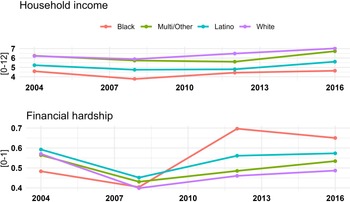
Figure 1 illustrates that changes in household income and financial hardship were particularly pronounced for Black and Latino respondents during the 2008–2012 period. Economic conditions in 2008 were especially challenging for both groups, with effects persisting through 2012. While annual household income declined for both Blacks and Latinos, the decrease was steeper among Black respondents in 2008. Financial hardship increased overall relative to 2004, with the highest levels observed in 2012 and 2016. Particularly among Black respondents, there is a sharp increase in financial hardship after the recession hit. Overall, this suggests not only an impact but also a delayed impact and a widening gap between groups in the post-recession years. Likewise, household wealth declines were largest among U.S. Hispanics and Blacks (Taylor et al. Reference Taylor2011). Moreover, some research has suggested that Blacks and Latinos themselves felt singled out and scapegoated by whites and the larger financial industry during the recession (McKenzie Reference McKenzie2014).
Economic trends for Blacks and latinos 2004–2016.
Data from the 2004–2016 ANES.

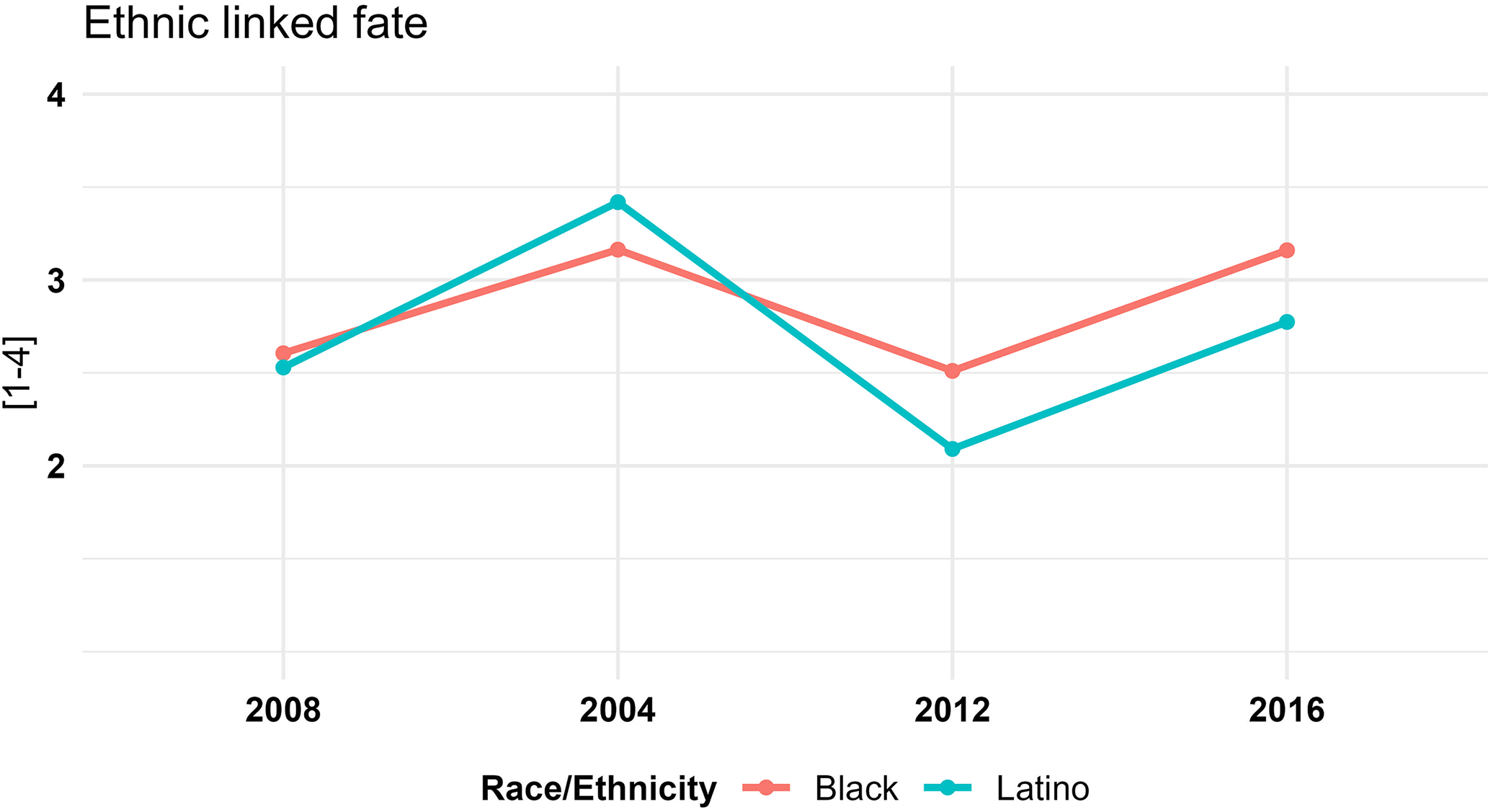
A gap in linked fate is also observed in the post-recession years. While linked fate generally declined during the recession, there is a steeper decline among Latinos and a wider racial–ethnic gap in the post-recession years. We observe elevated levels in 2004 trending downward before rebounding in 2016. By 2016, trends approach but do not reach the baseline. As the economy recovered, Latino-linked fate remained lower on average. These patterns suggest that the interplay between race-ethnicity and class may generate intra-group divisions during periods of economic strain. In particular, Figure 1 indicates that class-based concerns may become more salient and potentially divisive during financial crises, creating an opportunity to evaluate Dawson’s theory. Under such conditions, the prominence of economic considerations may foster self-interested attitudes and behaviors that compete with group-based solidarities.
Further, minorities in the United States, including Black and Latino populations, are often stereotyped as economic burdens, reinforcing systemic inequities and exclusionary policies. Racialized politics were evident at the state and local levels, particularly around immigration policy (Gulasekaram and Ramakrishnan Reference Gulasekaram and Ramakrishnan2013).Footnote 3 Such policies impact communities directly and can lead to changes in group-level behavior. Pantoja, Ramírez and Segura (Reference Pantoja, Ramirez and Segura2001) report that state-level immigrant hostility led to a boost in Latino immigrant applications for citizenship and subsequent participation in the 1996 presidential election. Polling evidence indicates that racial stereotyping and discrimination increased during the 2008 recession due to perceptions of resource scarcity (Krosch, Tyler and Amodio Reference Krosch, Tyler and Amodio2017). Racialized beliefs about upward mobility could have heightened protective and defensive mechanisms, thus increasing linked fate. And yet, should individual economic concerns dominate, shared common beliefs may weaken in the struggle to survive financially. Because of this, levels of linked fate among Blacks may be significantly higher in 2008 and 2012, since the threatening economic context and the salience of ethno-racial-specific economic interests in 2008 could have reinforced community behavior and beliefs. The lack of conflict between race-ethnicity and class would lead to increases in linked fate during the recession, challenging Dawson’s theory.
Here, we extend Dawson’s inquiry by examining whether changing material conditions during a contemporary economic downturn influence ethnic-linked fate. While the improved material circumstances were at the heart of his puzzle, we consider whether a sudden worsening of material circumstances—or at least significant uncertainty surrounding material circumstances—could alter perceptions of one’s self-interest and weaken a sense of common fate with one’s ethno-racial group.
Theoretical framework: Dawson, linked fate, and social class
Political observers have long been intrigued by the shared political views and consistent bloc voting behavior of Black Americans. Dawson noted that even the Black middle class did not introduce political heterogeneity in the 1980s and 1990s. Blacks remained committed to racial and ethnic loyalties, seemingly behaving out of step with their individual financial interests.
With his theory of Black-linked fate, Dawson (Reference Dawson1994) sought to show that the seeming disconnect of upwardly mobile Black Americans continuing to support progressive policies and progressive political candidates could, in fact, be reconciled with economic self-interest, consistent with foundational literature by Downs (Reference Downs1957) and Turner, Brown, and Tajfel (Reference Turner, Brown and Tajfel1979) regarding the interplay between individual and social identities. In a rebuke to Wilson (Reference Wilson1987), he claimed that the new Black middle class retained a latent sensitivity to their racialization, even if they did not directly experience racism themselves, believing that it continued to drive perceptions of Black America and larger patterns of stratification in the United States. Meanwhile, others likely encountered structural racism by running into glass ceilings in the labor market or finding limited opportunities for residential mobility, for example. This confluence of forces resulted in a continuing political alignment among the Black public despite increasing economic divergence, as even the well-off believed their own continued socio-economic advancement remained tied to the Black community as a whole. Redistributive politics aligned with their interests.
In this, linked fate was more than just a measure of group identity and subtler than theories of racial formation (Omi and Winant Reference Omi and Winant1986). His concept of “linked fate” as the explanation behind this puzzle took off among researchers, and a stylized linked fate variable became more common in surveys of ethno-racial minority groups and other disadvantaged publics. Popular variations to the question “Do you think that what happens to [respondent’s identity group] in this country will have something to do with what happens in your life?” have allowed researchers to assess ongoing perceptions of linked fate among Blacks and others, including Latinos.
Much of this subsequent scholarship reports that Blacks exhibit higher degrees of linked fate than other groups. Figure 1 supports this, with Black respondents reporting higher levels of linked fate, on average, for every year except 2004. That said, there have been prominent challenges as to whether the empirical foundations behind Dawson’s theory are still true, as recent work points to a growing political conservatism among Black Americans (White and Laird Reference White and Laird2020).
Among Latinos, lower rates of expressed linked fate are often attributed to the complexities of pan-ethnic labeling, including questions about the extent to which the U.S. Latinos identify with the term at all or view it as a salient part of their identity. Given the diverse population the label seeks to encompass, with Latinos varying by national origin, primary language, immigration status, or generation, scholars have been more focused on patterns of ethnic attachment and identification with the pan-ethnic label. In addition, given the more recent immigrant origins of Latino populations and their greater political heterogeneity, scholars have tended to show more interest in examining the extent to which Latinos express a common identity or shared sense of racialization.
Much of the work on these latter questions does look beyond static predictors to examine broader environmental contexts that may or may not shape Latino pan-ethnic attachments or pan-ethnicity. For example, several works look at the way discriminatory experiences and racially charged political or policy climates influence the salience of Latino identity (Barreto and Pedraza Reference Barreto and Pedraza2009; Gutierrez Reference Gutierrez2025; Pérez Reference Pérez2015; Sanchez and Espinosa Reference Sanchez and Espinosa2016), while others have looked at whether participation in movements impacts Latino identity (Silber Mohamed Reference Silber Mohamed2013, Reference Silber Mohamed2017; Zepeda-Millán and Wallace Reference Zepeda-Millán and Wallace2013). This suggests a malleability to Latino identity, with political and social contexts fostering stronger pan-ethnic Latino identity and more cohesive political behavior (Pantoja, Ramirez, and Segura Reference Pantoja, Ramirez and Segura2001; Ramírez Reference Ramírez2013).
Nonetheless, given the internal diversity of the Latino population, it is perhaps unsurprising that work specifically examining linked fate has tended to find differences across segments of the Latino population. For example, Sanchez and Masuoka (Reference Sanchez and Masuoka2010) found linked fate among Latinos weakened with an increase in income, which, as they note, runs contrary to the dynamics Dawson (Reference Dawson1994) originally observed among Black Americans.
Revisiting that study with newer survey data, Sanchez, Masuoka, and Abrams (Reference Sanchez, Masuoka and Abrams2019) found that income no longer had a statistically significant relationship to Latino-linked fate, while a number of other variables did. For example, education, skin color, and discrimination (both perceived and actual) had positive relationships to linked fate, while age had a negative relationship. Reflecting on these differences, they note, “We were unable to parse out which type of context explains the differences we found between the 2006 and 2016 data, and so future research can start to test how these different circumstances influence reported rates of Latino linked fate” (Sanchez, Masuoka, and Abrams Reference Sanchez, Masuoka and Abrams2019, 680).
Although directed at Latino politics scholars, they are not alone in calling for greater attention to the contextual factors shaping minority-linked fate. In an overview of the linked fate literature more broadly, Rogers and Kim (Reference Rogers and Kim2023) have also urged greater focus on how “history, agency, and power” drive expressions of linked fate. These calls have not gone unheeded. There are growing examples of scholarship exploring contextual influences on Black- and Latino-linked fate, including neighborhood effects (Shaw, Foster, and Combs Reference Shaw, Foster and Combs2019; Watts-Smith, Walke, and Lopez-Bunyasi Reference Watts-Smith, Walker and Lopez-Bunyasi2025), hostile group policies (Maltby et al. Reference Maltby2020), inclusive group policies (Trummel Reference Trummel2025), and generational experiences (Macías Mejía Reference Macias Mejia2025; Watts Smith, Lopez Bunyasi, and Smith Reference Watts Smith, Lopez Bunyasi and Smith2019). However, there have been no time-series analyses that we pursue here and none that look at disruptive economic dislocations like the Great Recession, despite evidence indicating the racialized lens through which Blacks and Latinos experienced its impacts (McKenzie Reference McKenzie2014) and impacts on these groups’ political behavior (Huyser et al. Reference Huyser2018).
Expectations
While the improved material circumstances were at the heart of Dawson’s puzzle, we consider whether a sudden worsening of material circumstances—or at least significant uncertainty surrounding material circumstances—could alter perceptions of one’s self-interest and weaken a sense of common fate with one’s ethno-racial group.
In summary, levels of linked fate among Blacks and Latinos may be significantly higher in 2008 and 2012, since the threatening economic context and the salience of ethno-racial specific economic interests in 2008 could have reinforced community behavior and beliefs. As discussed previously, prior research would support this expectation. In this case, the lack of conflict between race-ethnicity and class would lead to increases in linked fate during the recession. Alternatively, Figure 1 preliminarily suggests that linked fate declined for Blacks and Latinos from 2008 to 2012. Levels of linked fate among Blacks and Latinos experiencing high levels of financial hardship may be significantly lower in 2008–2012, since the distracting economic context and the salience of economic interests led to self-interested behavior and beliefs.
Because of this, levels of linked fate among Blacks may be significantly higher in 2008 and 2012, since the threatening economic context and the salience of ethno-racial-specific economic interests in 2008 could have reinforced community behavior and beliefs. The lack of conflict between ethno-racial identity and class would lead to increases in linked fate during the recession.
Hypotheses
We have argued that economic pressures may either intensify class-based preferences, thereby weakening perceptions of shared fate within ethnic groups, or, conversely, exacerbate ethno-racial antagonisms, reinforcing group boundaries and strengthening ethnic-linked fate as a defense against discrimination. Controlling for other factors, we expect to see a decline in linked fate among both Blacks and Latinos as class divisions and individual needs take center stage. Given the above logic and foregoing discussion, we hypothesize that:
H1. Linked fate for Blacks and Latinos will decline after the recession and rebound in 2016 as the economy recovers and economic measures return to pre-recession levels.
H2. Individual financial hardship during the recession years will be negatively correlated with minority-linked fate for both Blacks and Latinos. Those who are doing worse off financially beginning in 2008 will be much more likely to fall into the lowest categories of linked fate.
H3. Individual economic success, measured by education and annual household income, will be positively correlated with linked fate during the entire 12-year span.
Materials and methods
To test our hypotheses, we conduct a multivariate ordered logistic regression analysis utilizing several years of survey data. Time series data for the analyses is from the 2004, 2008, 2012, and 2016 American National Election Studies (ANES 2021). We use the ANES because the survey includes large samples of Black and Latino respondents spanning the pre-recession and post-recession periods (2004–2016). Data collection was conducted both in person and online and focused on adult citizens, specifically eligible voters. This nationally representative survey of the American electorate measures voter attitudes regarding politics and policy issues with large samples of racial minority populations, including Blacks and Latinos. The large sample size (n = 2,744) across the 4 waves allows for a robust analysis.
The main outcome measure is linked fate. The linked fate measure is as follows: “Do you think that what happens to [fill in] in this country will have something to do with what happens in your life?” This question is followed by, “How much will it affect you?” There are 4 categories ranging from not at all to a lot. The explanatory variables include race-ethnicityFootnote 4 and financial hardship. The race-ethnicity measure is as follows: 2004, 2008: “What racial or ethnic group or groups best describes you?” In 2004, there were 7 categories: Black, Asian, Native American, Hispanic or Latino, White, and Other. In 2008, the Hispanic/Latino ethnic group question was asked separately, and the measures are combined into a race/ethnicity variable. In 2012, the race/ethnicity measure was derived from separate questions on race and ethnicity, with 6 categories.Footnote 5 In 2016, the race-ethnicity measure is as follows: “I am going to read you a list of five race categories. Please choose one or more races that you consider yourself to be:[]?”
The financial hardship measure is as follows: “We are interested in how people are getting along financially these days. Would you say that you and your family are better off, worse off, or just about the same financially as you were a year ago?” The survey measure of financial hardship is rescaled such that categories 1–5 (much better to much worse) are on a scale from 0–1, with 1 being much worse off. The middle value indicates no change as it is “Same.” Year is a nominal variable, with 2008 as the baseline since it is the year the recession began. The baseline category for race-ethnicity is Black.
The model includes several control variables. Gender is dichotomous (male as the baseline category). Age is continuous, ranging from 17 to 90. Partisanship, a key factor in perceptions of the economy (Guber and Huber Reference Gerber and Huber2010), is in 3 categories: Democrat, Independent, and Republican. Income is in 12 categories, ranging from less than $10,000 to $120,000 or more, and is rescaled. Church attendance is a dichotomous variable (yes/no).Footnote 6 Survey weights are included in the ordered logit regression models. To isolate the impact of the recession, we set 2008 as the baseline year in the analysis using an ordered logit model. We run separate models for Black and Latino respondents with financial hardship as well as education levels to predict levels of minority-linked fate. In addition, we run a replication using 3 years from the 2008 and 2012 Collaborative Multi-racial Post-Election Survey (CMPS) (Barreto et al. Reference Barreto, Frasure-Yokley, Hancock, Manzano, Ramakrishnan, Ramirez and Wong2008, Frasure et al.Reference Frasure, Sanchez, Valenzuela and Hancock2012).Footnote 7
Although we do not have a precise measure of class interests, we are able to leverage a measure of financial hardship. To the extent that this measure captures the salience of class, we can apply Dawson’s Black-linked fate framework to these findings.
Finally, though we cannot control for the Obama presidency for the full time span due to the absence of an Obama feeling thermometer measure in 2004, a model variation including this measure for ANES 2008–2016 is included in the Appendix. In addition, data from the National Politics Study (NPS) distributed by ICPSR, as evidenced in Table 2, indicates that linked fate is higher overall for Black respondents than for other minority groups. Note that this measure was taken well before the Obama presidential campaign, via telephone survey from September 2004 to February 2005. In fact, 59% of Blacks report at least some degree of linked fate, with the highest percentage reporting a lot (32%). Of the 3,300 respondents, no other racial–ethnic group reported levels that high in 2004.Footnote 8
Linked fate was high among Blacks relative to Latinos in 2004

Data from the 2004 NPS.
One might reasonably expect that linked fate among Blacks would be higher in 2008, 2012, and 2016 if Obama’s presidency were the primary driver. Given that the recession period overlaps with Barack Obama’s candidacy and presidency, we include an Obama feeling thermometer as a control to account for contemporaneous presidential evaluations that may influence political attitudes independently of economic conditions. This allows us to distinguish the relationship between economic experiences and linked fate from affection toward President Obama. Even though the Democratic majority in Congress was lost in the 2010 midterms, Obama was able to maintain the Black vote in 2012 and strengthen his coalition with other minority communities, such as Latinos, in 2012 (Jones and Stanford Reference Jones and Stanford2013). Black voter turnout was higher in 2008 relative to 2004 (McKee, Hood III and Hill Reference McKee, Hood and Hill2012), so the expectation is that levels of linked fate would rise beginning in 2004.
Results
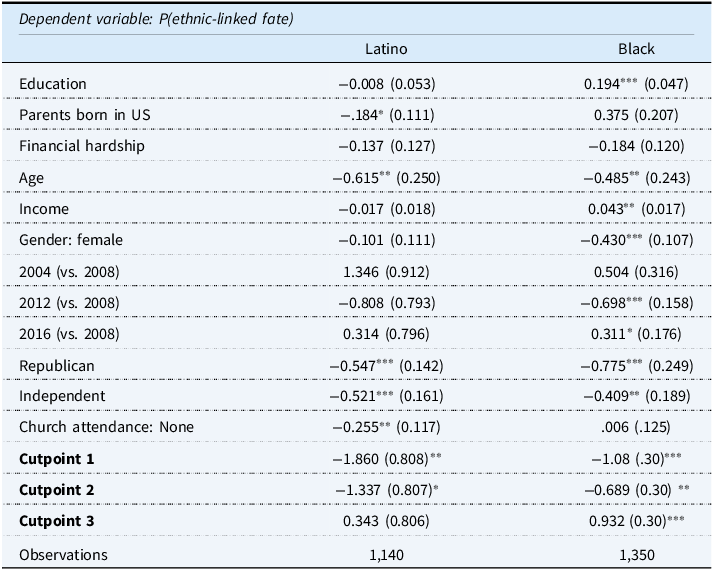
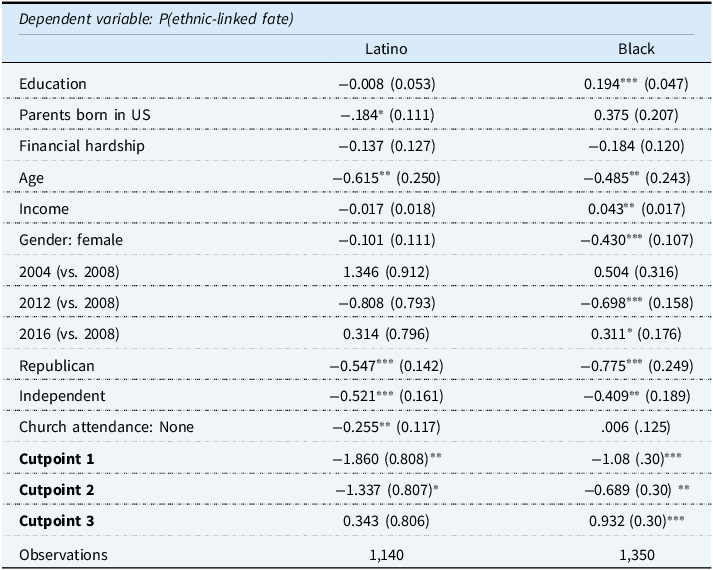
First, turning to the regression results in Table 3, differences between Black and Latino respondents are clear. Among Blacks, the year coefficient is significant and negative, growing in magnitude for 2012 relative to the baseline category of 2008, suggesting that linked fate was lower overall in 2012. The coefficient for 2004 and 2016 is positive, indicating a trend toward the baseline. Controlling for confounders, the results are consistent with H1 but only provide partial support. The year coefficients are only significant among Black respondents. There is a generalized significant decline in linked fate; there is a lagged effect, with the lowest levels measured in 2012, which was also supported by the data in Figure 1. After 2004, there is a general decrease in the log-odds of being in a self-reported high-linked fate category. This is the most pronounced for 2012 and begins to moderate in 2016.Footnote 9
ANES ordered logit predictors of linked fate by race/ethnicity
Note: ANES 2004, 2008, 2012, 2016. ∗ p < .1; ∗∗ p < .05; ∗∗∗ p < .01.
While there are significant differences by race/ethnicity, the overall pattern by year is similar. Minority-linked fate is moderately high in 2004 relative to 2008, declines in 2012 relative to 2008, and then increases significantly in 2016, though not significant in the model for Latinos. H1 predicts that the difference between Blacks and Latinos will be significant in the statistical model due to the observed differences in Table 1 and Figure 1, anticipating that linked fate among Black and Latino voters would be significantly lower in the recession years of 2008 and 2012. For Latinos, there is a general decrease in the log-odds of being in a self-reported high-linked fate category, but it is not statistically significant. This is an important result, since the recession had a greater impact on Blacks in terms of household income and self-reported financial hardship.Footnote 10 It is interesting to note that church attendance is only significant among Latinos, with lower levels of linked fate among those who do not attend church services. Because the downturn coincided with the election of the nation’s first Black president, the findings could suggest that, uniquely for Blacks, perhaps the overlap of race-ethnicity and class reinforced linked fate during a time of economic crisis.Footnote 11
Next, turn to the moderating effect of self-reported financial hardship, addressed in H2. Hypothesis 2 predicts that individual financial hardship during the recession years will be associated with a decline in linked fate for both Blacks and Latinos. Those who were doing worse off financially, beginning with 2008, would be much more likely to fall into the lowest categories of linked fate. This is done to explore whether individual financial hardship during the recession years will significantly reduce ethnic-linked fate for both Blacks and Latinos. As indicated in Table 3, the coefficient for financial hardship is not significant, and H2 is not supported. Further, the interaction term for financial situation and year is not significant, as seen in the ANES (as well as CMPS replication) model in the appendix in Tables 4 and 5. In sum, we find no support for financial hardship having any significant relationship with linked fate during this period, and this finding holds with replication. There is no evidence that identity politics takes a backseat when individual financial concerns are high, either by reason of recession or by self-reported financial hardship. The findings indicate similarity across both groups in terms of H2, but the important positive association between income, education, and linked fate among Blacks leads us to H3.
Turning to H3, the expectation was that individual financial stability, measured by education and annual household income, would be positively associated with linked fate during this period. Interestingly, H3 is only partially supported. There is no evidence that individual financial stability is associated with Latino-linked fate in the main model. Controlling for other factors, we do not report an association between income or education and ethnic-linked fate for Latinos. Instead, among Latinos, having U.S.-born parents is uniquely associated with weaker levels of linked fate, suggesting that assimilation by generational cohort could instead be at play. In contrast, income and education are both positively associated with Black-linked fate, indicating that individual financial success plays a unique role among the Black community. Age and partisanship are significant factors for both groups. Being younger and self-identifying as a Democrat are positively associated with higher levels of linked fate. The findings indicate that, for Blacks, being male, more educated, and reporting a higher income are distinctly important.
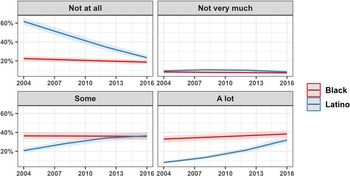
While the year variable in the previous model is coded as a factor to look at the unique effects of the recession, we use a numeric measure for year to see if there are trends uninterrupted by the economic crisis.Footnote 12 Overall trends emerge, as seen in the visuals of the predicted values and corresponding 95% confidence bands in Figure 2. The trends offer additional evidence that the recession affected Blacks and Latinos differently with respect to levels of linked fate.Footnote 13
Ethnic-linked fate for Blacks and latinos 2004–2016Footnote 16.
Data from the 2004–2016 ANES.

Turning to Figure 3, we see a significant interaction between year and race-ethnicity and a distinct, gradual elevation in Latino-linked fate over time. This visual suggests that there were uninterrupted trends across the period, despite an acute financial crisis. The visual further clarifies what might be driving the results in the model. We predicted that there would not be a significant difference between Blacks and Latinos, but that linked fate would generally decline as class divisions and individual needs take center stage. Figure 3 suggests that the overall number of Latinos reporting the lowest levels of linked fate declined over the recession period. At the same time, we observe a concurrent increase in higher levels of Latino-linked fate. However, this pattern does not hold among Black respondents. Black-linked fate is relatively stable across all years. As previously discussed, the recession had a greater impact on Blacks in terms of household income and self-reported financial hardship.Footnote 14 Figure 3 indicates that, controlling for other factors, Black- and Latino-linked fate evolved differently over time. Latino-linked fate uniquely grew for Latino voters, suggesting a distinct level of fluidity. However, we do not find evidence to suggest that this is related to the Great Recession or financial concerns. Perhaps Latino-linked fate is a protective mechanism against xenophobic rhetoric and discrimination (Lu and Jones Reference Lu and Jones2019; Pérez Reference Pérez2015), not explicitly tied to macroeconomic conditions.
Overall trends: the impact of race-ethnicity on linked fate varies by year.
Note: Shaded colors show 95% confidence intervals. Data from the 2004–2016 ANES.

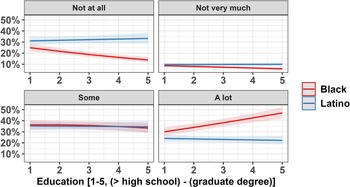
One measure of financial stability in the main model is education. Figure 4 indicates a racial/ethnic gap in the effect of education. At the lowest level of linked fate, higher education is seemingly protective for Blacks, even controlling for year. At the same time, there is a positive association between higher levels of education and linked fate uniquely for Black voters. The highest category of linked fate indicates a strong relationship between higher levels of education and the probability of reporting high levels of linked fate, as seen in Figure 4. Not only is this finding unique for Blacks, but it also further supports the idea that there were uninterrupted trends across the period, despite an acute financial crisis. Importantly, these findings do not suggest causality, but they suggest that there are systematic differences across groups. Some scholars have consistently argued that Black linked is not equivalent to linked fate in other groups; the results further support the idea that these groups lack uniformity.
The impact of education on minority-linked fate varies by race-ethnicity.
Note: Shaded colors show 95% confidence intervals. Data from the 2004–2016 ANES.

Discussion
The conditions that drive group political unity have long pervaded racial and ethnic politics scholarship. Dawson’s proposed theory of linked fate has gained significant traction with scholars since he deployed it to demonstrate that economic stratification does not have to lead to political stratification among marginalized publics like Black Americans—that it can mask a widely held sense of collective economic self-interest. But its contingent nature also has provided a fertile research agenda for scholars interested in exploring the circumstances under which it shifts, potentially impacting solidarity within and across various minority groups.
Given the central role that individual perceptions of one’s economic interests play in the theory, this paper has sought to understand how moments of economic instability and hardship impact feelings of common destiny among American Blacks and Latinos. Would sudden economic uncertainty influence the sense that their economic interests were aligned? Would we see an increased emphasis on class politics over racial commitments, with potential impacts on political solidarity to combat ongoing challenges over discrimination, police brutality, or immigration status? Or conversely, would increased economic uncertainty rigidify ethno-racial boundaries as competition for jobs increases outgroup hostility (Lu and Jones Reference Lu and Jones2019; Pérez Reference Pérez2015).
It is this tension in the literature, the suggestion that economic interests can conditionally both strengthen and undermine group unity under varying conditions, that motivated our analysis. What we found was surprising and important. Although we do not have a precise measure of how individuals assess their class interests, we are able to leverage a measure of financial hardship. And, to the extent that this measure captures the salience of class, we can apply these findings to Dawson’s framework of ethnic-linked fate. After the economic recession, levels of linked fate among the Black and Latino voting population declined. The findings suggest that the interests of race-ethnicity and class were in conflict, and linked fate weakened in the face of economic crisis. However, there was a lagged rebound among Latinos that was not observed among Blacks, despite what appears to be a more severe economic impact on Blacks.
Individual characteristics and perceptions of minority political interests may be at odds in times of financial uncertainty, given the current and historical US context. Because of this, we expected that levels of linked fate among Blacks and Latinos experiencing high levels of financial hardship would be lower during the recession years (2008 and 2012), since the distracting economic context and the salience of economic interests in 2008 led to self-interested behavior and beliefs. We did not find support for this. This finding was surprising considering previous work examining the effect of experiences of discrimination on linked fate among Latino individuals, which reported that income was a significant factor for Latinos, distinct from Blacks (Sanchez and Masuoka Reference Sanchez and Masuoka2010). In particular, Sanchez and Masuoka (Reference Sanchez and Masuoka2010) find that socio-economic status uniquely shapes linked fate for Latinos, with low-income Latinos, on average, reporting higher levels of linked fate. In fact, they report that Latino-linked fate decreases as Latinos become incorporated into US society. Among those factors unique to the Latino community are immigration policy, generational status, economic status, citizenship status, and involvement in Latino politics. Studies indicate a temporal and generational component (and our findings support this as well).Footnote 15 It appears that, for Blacks, the economic downturn was a unifying force, regardless of their level of financial hardship. If perceived financial hardship is a proxy for wealth and income, these findings suggest that Dawson’s theory did not hold in this context.
There are several potential limitations in this work. One of the difficulties with the design is that the authors cannot be sure that variation in linked fate is directly related to the economic recession. Another limitation is the absence of measures capturing the diversity of respondents’ areas of residence. This could include regional poverty rates as well as racial/ethnic diversity. Although not accounting for all potential factors influencing levels of linked fate, such as the Black Lives Matter movement, we address the overlap with Obama’s presidency by including an Obama feeling thermometer control.
In addition, more work needs to be done on building theory around differences in linked fate across racial/ethnic groups. Pre-recession measures are vital for comparison in this case study, yet Obama feeling thermometer measures were not available in the pre-recession years. Other surveys include measures of linked fate but also do not include a 2004 measure. This limited our analysis to the ANES survey. Although we did replicate the analysis using limited data, only some of the main findings are supported. In the main model, Latino-linked fate is not significantly higher following the recession; however, model replication with CMPS data (which lacks a 2004 linked fate measure) indicates that levels are significantly higher among Latinos.
Moving forward, scholars should explore the relationship between ethno-racial and group identities, including class during economic downturns. Better data is needed to explore the role of economic shock and the “community values vs material self-interest” paradigm. Future work would benefit from additional measures of financial hardship such as homeownership, debt, and job security to further disentangle the effects. Future work would benefit from considering other massive disruptive events beyond economic conditions. For example, beyond elevated health risk, the COVID-19 pandemic also ushered in unprecedented levels of unemployment and financial hardship for Hispanic communities (Vargas and Sanchez Reference Vargas and Sanchez2020). These findings prompt reconsideration of the relative importance of collective class attachments versus individual economic interests, both within and across racial groups, and point to an important direction for future research, though caution should be used in interpreting these results due to lack of consistency in replication models for some predictors. Future work could build on time as a conditional factor with additions of geographic variation in terms of demographics and state and local policies.
Supplementary material
The supplementary material for this article can be found at https://doi.org/10.1017/rep.2026.10092.
Data availability statement
The authors confirm that the data supporting the findings of this study are available within the article.
Acknowledgments
The authors thank Lauren Peritz, Chris Hare, Loren Collingwood, Carlos Algara, and the anonymous reviewers for their valuable comments on earlier drafts of this article. We are particularly grateful to Bradford Jones for his generous assistance. Any remaining errors are solely our own.
Funding statement
The authors received no financial support for this research.
Competing interests
The authors declare none.




 Open access

