





1 Introduction
Factor analysis is a practical tool for investigating the covariance structure of observed variables by constructing a small number of latent variables referred to as common factors. Factor analysis has been used in the social and behavioral sciences since its proposal more than 100 years ago (Spearman, Reference Spearman1904), and it has been recently applied to a wide variety of fields, including marketing, life sciences, materials sciences, and energy sciences (Kartechina et al., Reference Kartechina, Bobrovich, Nikonorova, Pchelinceva and Abaluev2020; Lin et al., Reference Lin, Ghazanfar, Wang, Gagnon-Bartsch, Lo, Su, Han, Ormerod, Speed, Yang and Yang2019; Shkeer & Awang, Reference Shkeer and Awang2019; Shurrab et al., Reference Shurrab, Hussain and Khan2019; Vilkaite-Vaitone et al., Reference Vilkaite-Vaitone, Skackauskiene and Díaz-Meneses2022).
In exploratory factor analysis, the model parameter is often estimated by the maximum likelihood method under the assumption that the observed variables follow the multivariate-normal distribution. The maximum likelihood estimates (MLEs), solutions that maximize the likelihood function, are obtained by solving a complicated system of multivariate algebraic equations called the normal equation. The solutions to the system are usually intractable; that is, it is difficult to solve the system analytically from the standpoint of computation time/memory. Thus, these solutions are typically computed using continuous optimization techniques.
One of the most common approaches is to use the gradient of the log-likelihood function, such as the Newton–Raphson method or Quasi-Newton method (Jennrich & Robinson, Reference Jennrich and Robinson1969; Jöreskog, Reference Jöreskog1967; Lawley & Maxwell, Reference Lawley and Maxwell1971). For given unique variances, the estimation of the loading matrix turns out to be the eigenvalue/eigenvector problem for the standardized sample covariance matrix, which is similar to the problem of the principal component analysis (Tipping & Bishop, Reference Tipping and Bishop1999). Substituting the loading matrix into the log-likelihood function, it is regarded as a function of unique variances, and these unique variances are optimized by the Newton–Raphson method or Quasi-Newton method. The above algorithm has been widely used for several decades; indeed, factanal function, one of the most popular functions that implements the maximum likelihood factor analysis in R, is based on Lawley and Maxwell’s (Reference Lawley and Maxwell1971) algorithm. Another algorithm is the expectation–maximization (EM) algorithm (Rubin & Thayer, Reference Rubin and Thayer1982), in which the unique factors are regarded as latent variables. The complete-data log-likelihood function corresponds to the log-likelihood function in multivariate regression; thus, the EM algorithm can be directly utilized in the penalized likelihood methods, such as the lasso and minimax concave penalty (Choi et al., Reference Choi, Zou and Oehlert2010; Hirose & Yamamoto, Reference Hirose and Yamamoto2015), allowing to achieve high-dimensional sparse estimation.
Although the above-mentioned algorithms often converge, the convergence value is not always optimal due to the non-concavity of the log-likelihood function. To illustrate the potential issues with convergence in factor analysis, we present an example demonstrating how the converged values depend on the initial values and the estimation algorithm. Figure 1 shows the convergence values of the discrepancy function that corresponds to the negative log-likelihood function and the MLEs of unique variance for the second observed variable, say $\hat {\psi }_2$
. These convergence values are obtained by applying estimation algorithms to an artificial dataset generated from “simulation model S2,” where the communality is relatively small, leading to unstable estimation. A detailed description of the simulation model S2 will be provided in Section 4. We employ three estimation algorithms: (i) the factanal function in R (i.e., Lawley and Maxwell’s (Reference Lawley and Maxwell1971) algorithm), (ii) the Quasi-Newton method based on Jennrich & Robinson (Reference Jennrich and Robinson1969), and (iii) the EM algorithm (Rubin & Thayer, Reference Rubin and Thayer1982). One hundred different initial values for unique variances are generated from a uniform distribution
$\hat {\psi }_2$
. These convergence values are obtained by applying estimation algorithms to an artificial dataset generated from “simulation model S2,” where the communality is relatively small, leading to unstable estimation. A detailed description of the simulation model S2 will be provided in Section 4. We employ three estimation algorithms: (i) the factanal function in R (i.e., Lawley and Maxwell’s (Reference Lawley and Maxwell1971) algorithm), (ii) the Quasi-Newton method based on Jennrich & Robinson (Reference Jennrich and Robinson1969), and (iii) the EM algorithm (Rubin & Thayer, Reference Rubin and Thayer1982). One hundred different initial values for unique variances are generated from a uniform distribution $U(0,1)$
to investigate whether the convergence value depends on the initial value. It should be noted that we use the same sets of 100 initial values for these three algorithms.
$U(0,1)$
to investigate whether the convergence value depends on the initial value. It should be noted that we use the same sets of 100 initial values for these three algorithms.
Convergence values of the discrepancy function and MLEs of unique variance for the second observed variable, $\hat {\psi }_2$
.
$\hat {\psi }_2$
.
Note: These convergence values are obtained by applying three estimation algorithms to an artificial dataset with 100 different initial values of unique variances, and the horizontal axis indicates the indices for these 100 initial values.

The results indicate that the convergence values are dependent on the initial values and estimation algorithms. In particular, the estimate of unique variance, $\hat {\psi }_2$
, is sensitive to the initial values with the Quasi-Newton method based on Jennrich and Robinson’s (Reference Jennrich and Robinson1969) algorithm. We observe that improper solutions are obtained; that is, the estimates of unique variances turn out to be zero or negative. The Quasi-Newton method based on Jennrich and Robinson’s (Reference Jennrich and Robinson1969) algorithm allows the estimates of unique variances to take zero or negative values; thus, the
$\hat {\psi }_2$
, is sensitive to the initial values with the Quasi-Newton method based on Jennrich and Robinson’s (Reference Jennrich and Robinson1969) algorithm. We observe that improper solutions are obtained; that is, the estimates of unique variances turn out to be zero or negative. The Quasi-Newton method based on Jennrich and Robinson’s (Reference Jennrich and Robinson1969) algorithm allows the estimates of unique variances to take zero or negative values; thus, the $\hat {\psi }_2$
becomes exceptionally unstable. Meanwhile, the factanal function outputs parameters such that all of the unique variances are greater than some small threshold values; by default, this threshold is set to 0.005. The EM algorithm also does not produce negative estimates of unique variances because the update equation for unique variances in the M-step produces non-negative values (see Theorem 1 of Adachi, Reference Adachi2013). Although the factanal function and EM algorithm do not yield negative unique variances, their results are dependent on the initial values. Consequently, it is quite difficult to evaluate whether an optimal value of the parameter is obtained with these estimation algorithms.
$\hat {\psi }_2$
becomes exceptionally unstable. Meanwhile, the factanal function outputs parameters such that all of the unique variances are greater than some small threshold values; by default, this threshold is set to 0.005. The EM algorithm also does not produce negative estimates of unique variances because the update equation for unique variances in the M-step produces non-negative values (see Theorem 1 of Adachi, Reference Adachi2013). Although the factanal function and EM algorithm do not yield negative unique variances, their results are dependent on the initial values. Consequently, it is quite difficult to evaluate whether an optimal value of the parameter is obtained with these estimation algorithms.
As shown in the above example, the instability of the numerical estimates is often observed when we obtain an improper solution in our experience. To our knowledge, a theoretical approach to elucidate improper solutions has not yet been provided due to the complexity of the log-likelihood function; thus, the improper solutions remain to be a challenging problem. Instead of theoretical approaches, numerical approaches have been employed to investigate the characteristics of improper solutions for the last five decades (e.g., van Driel, Reference van Driel1978; Hayashi & Lu, Reference Hayashi and Lu2014; Jöreskog, Reference Jöreskog1967; Kano, Reference Kano, Rizzi, Vichi and Bock1998; Krijnen et al., Reference Krijnen, Dijkstra and Gill1998; Sato, Reference Sato1987). However, with the numerical approaches, the result is highly dependent on the estimation algorithm and its initial values, as shown in Figure 1.
To address this issue, it is essential to compute exact algebraic solutions to the system of multivariate algebraic equations (i.e., all candidates of the MLEs). Here, “exact” specifically refers to solutions computed without rounding errors. In this study, we employ an algebraic approach based on computational algebra to obtain the exact algebraic solutions. Computational algebra can solve complicated systems of multivariate algebraic equations by using the theory of Gröbner bases. Several software that implement computational algebra, such as Magma, Maple, and Mathematica, have been developed considerably in the last two decades. Thanks to the development of the algorithm and the rapid progress in computational technology, several real problems have been resolved by computational algebra (e.g., Hinkelmann et al., Reference Hinkelmann, Brandon, Guang, McNeill, Blekherman, Veliz-Cuba and Laubenbacher2011; Laubenbacher & Sturmfels, Reference Laubenbacher and Sturmfels2009; Veliz-Cuba et al., Reference Veliz-Cuba, Aguilar, Hinkelmann and Laubenbacher2014).
In maximum likelihood factor analysis, we observe that the original system of multivariate algebraic equations requires a lot of computer resources from an algebraic viewpoint, due to the existence of the inverse covariance matrix. To reduce the heavy computational loads, we introduce an algorithm specifically designed for maximum likelihood factor analysis. In our algebraic algorithm, we employ the theory of Gröbner bases to get simplified sub-problems for a given system of algebraic equations. After getting the simplified sub-problems, we compute all exact solutions to the system. The MLEs can be obtained by selecting a solution that maximizes the likelihood function. The estimates are independent of the initial value and estimation algorithm because the algebraic algorithm produces all exact solutions. Furthermore, based on the MLE obtained by this method, we classify the solutions into three patterns: no solution, positive solution, and negative solution. While computationally demanding, our algebraic approach is applicable to small-scale problems (e.g., five variables and two factors) and provides valuable insights into the characterization of improper solutions. For larger-scale problems, we provide numerical methods as practical alternatives to the algebraic approach.
Algebraic approaches to factor analysis have been explored by several earlier studies, as highlighted by Ardiyansyah & Sodomaco (Reference Ardiyansyah and Sodomaco2023), Drton & Xiao (Reference Drton and Xiao2010), Drton et al. (Reference Drton, Sturmfels and Sullivant2007), and Drton et al. (Reference Drton, Grosdos, Portakal and Sturma2025). In particular, Drton et al. (Reference Drton, Sturmfels and Sullivant2007) employ computational algebra to study model invariants in factor analysis, and the final section spotlights algebraic study for maximum likelihood estimation and singularities as the next steps. These earlier works mostly focus on perspectives from mathematics. This study, however, aims to develop an algorithm for computing estimates, enabling us to delve into the characteristics of the MLEs. Specifically, an extensive Monte Carlo simulation is conducted to provide a detailed analysis of these characteristics. We observe that sometimes the dimension of the solution space can be more than zero, that is, the solution space can be a curve, a surface, etc. Furthermore, the MLEs do not exist in some cases, even if the parameter space for unique variances includes negative values. Such a discussion is impossible with existing algorithms. Consequently, the proposed algorithm provides not only theoretical insights but also numerical analyses that significantly advance the understanding of the behavior of MLEs, including a characterization of improper solutions. The insights gained through our approach may potentially guide future methodological development for practical data analysis.
The remainder of this article is organized as follows: Section 2 briefly reviews the maximum likelihood factor analysis. A system of algebraic equations to get MLEs is also discussed. In Section 3, we introduce a novel algorithm for computing MLEs via computational algebra. Section 4 presents numerical results for artificial datasets. In addition, Section 5 reports numerical results for actual datasets. Conclusion and future perspectives are given in Section 6.
2 Maximum likelihood factor analysis
2.1 Maximum likelihood estimation
Let ${\boldsymbol {X}}=(X_1,\ldots ,X_p)^\top $
be a p-dimensional observed random vector. The factor analysis model is
${\boldsymbol {X}}=(X_1,\ldots ,X_p)^\top $
be a p-dimensional observed random vector. The factor analysis model is
 $$ \begin{align*} {\boldsymbol{X}} =\boldsymbol{\mu} + \Lambda{\boldsymbol{f}} + {\boldsymbol{\varepsilon}} , \end{align*} $$
where $\boldsymbol {\mu }$
is a mean vector,
$\boldsymbol {\mu }$
is a mean vector, $\Lambda =(\lambda _{ij})$
is a
$\Lambda =(\lambda _{ij})$
is a $p \times k$
matrix of factor loadings, and
$p \times k$
matrix of factor loadings, and ${\boldsymbol {f}} = (f_1,\ldots ,f_k)^\top $
and
${\boldsymbol {f}} = (f_1,\ldots ,f_k)^\top $
and ${\boldsymbol {\varepsilon }} = (\varepsilon _1,\ldots , \varepsilon _p)^\top $
are unobservable random vectors. Here,
${\boldsymbol {\varepsilon }} = (\varepsilon _1,\ldots , \varepsilon _p)^\top $
are unobservable random vectors. Here, $A^\top $
denotes the transpose of a matrix A. The elements of
$A^\top $
denotes the transpose of a matrix A. The elements of $\boldsymbol {f}$
and
$\boldsymbol {f}$
and $\boldsymbol {\varepsilon }$
are referred to as common factors and unique factors, respectively. It is assumed that
$\boldsymbol {\varepsilon }$
are referred to as common factors and unique factors, respectively. It is assumed that ${\boldsymbol {f}} \sim N_k(\boldsymbol {0}, I_k)$
and
${\boldsymbol {f}} \sim N_k(\boldsymbol {0}, I_k)$
and ${\boldsymbol {\varepsilon }} \sim N_p(\boldsymbol {0}, \Psi )$
and
${\boldsymbol {\varepsilon }} \sim N_p(\boldsymbol {0}, \Psi )$
and ${\boldsymbol {f}}$
and
${\boldsymbol {f}}$
and ${\boldsymbol {\varepsilon }}$
are independent. Here,
${\boldsymbol {\varepsilon }}$
are independent. Here, $I_k$
is an identity matrix of order k and
$I_k$
is an identity matrix of order k and $\Psi $
is a
$\Psi $
is a $p \times p$
diagonal matrix with the i-th diagonal element being
$p \times p$
diagonal matrix with the i-th diagonal element being $\psi _i$
, referred to as a unique variance. Under these assumptions, the observed vector
$\psi _i$
, referred to as a unique variance. Under these assumptions, the observed vector ${\boldsymbol {X}}$
follows multivariate-normal distribution;
${\boldsymbol {X}}$
follows multivariate-normal distribution; ${\boldsymbol {X}} \sim N_p(\boldsymbol {\mu }, \Sigma )$
with
${\boldsymbol {X}} \sim N_p(\boldsymbol {\mu }, \Sigma )$
with $\Sigma =\Lambda \Lambda ^\top +\Psi $
. When the observed variables are standardized, the i-th diagonal element of
$\Sigma =\Lambda \Lambda ^\top +\Psi $
. When the observed variables are standardized, the i-th diagonal element of $ \Lambda \Lambda ^\top $
is called communality, which stands for the proportion of variance in
$ \Lambda \Lambda ^\top $
is called communality, which stands for the proportion of variance in $X_i$
explained by common factors.
$X_i$
explained by common factors.
It is well-known that factor loadings have a rotational indeterminacy since both $\Lambda $
and
$\Lambda $
and $\Lambda T$
generate the same covariance matrix
$\Lambda T$
generate the same covariance matrix $\Sigma $
, where T is an arbitrary orthonormal matrix. To obtain an identifiable model, we often use a restriction that
$\Sigma $
, where T is an arbitrary orthonormal matrix. To obtain an identifiable model, we often use a restriction that $\Lambda ^\top \Psi ^{-1}\Lambda $
is a diagonal matrix or the upper triangular elements of
$\Lambda ^\top \Psi ^{-1}\Lambda $
is a diagonal matrix or the upper triangular elements of $\Lambda $
are fixed by 0.
$\Lambda $
are fixed by 0.
Suppose that we have a random sample of N observations ${\boldsymbol {x}}_1,\ldots ,{\boldsymbol {x}}_N$
from the p-dimensional normal population
${\boldsymbol {x}}_1,\ldots ,{\boldsymbol {x}}_N$
from the p-dimensional normal population $N_p(\boldsymbol {\mu } ,\Sigma )$
. The MLEs of factor loadings and unique variances are obtained by maximizing the log-likelihood function
$N_p(\boldsymbol {\mu } ,\Sigma )$
. The MLEs of factor loadings and unique variances are obtained by maximizing the log-likelihood function
 $$ \begin{align} \log {f}(\boldsymbol{x}_1,\dots,\boldsymbol{x}_N | \Lambda,\Psi ) = -\frac{N}{2} \bigg\{ p\log(2\pi)+\log |\Sigma| + \mathrm{tr}(\Sigma^{-1} S ) \bigg\}, \end{align} $$
or equivalently, minimizing the discrepancy function:
 $$ \begin{align} {q}( \Lambda,\Psi ) = \log|\Sigma|+ \mathrm{tr}(\Sigma^{-1}S) -\log |S|-p, \end{align} $$
where $S=(s_{ij})$
is the sample variance–covariance matrix,
$S=(s_{ij})$
is the sample variance–covariance matrix,
 $$ \begin{align*} S=\frac{1}{N} \sum_{n=1}^N({\boldsymbol{x}}_n-\bar{{\boldsymbol{x}}})({\boldsymbol{x}}_n-\bar{{\boldsymbol{x}}})^\top, \quad \bar{\boldsymbol{x}} = \frac{1}{N}\sum_{n=1}^N\boldsymbol{x}_n. \end{align*} $$
We remark that it is common to use the unbiased sample covariance matrix with $n = N-1$
, and the choice between N and
$n = N-1$
, and the choice between N and $N-1$
slightly affects the statistical properties of the estimator. In this study, however, the focus is on computing estimates rather than analyzing estimator properties. Since factor analysis typically uses the sample correlation matrix, the choice between N and
$N-1$
slightly affects the statistical properties of the estimator. In this study, however, the focus is on computing estimates rather than analyzing estimator properties. Since factor analysis typically uses the sample correlation matrix, the choice between N and $N-1$
does not affect the discrepancy function.
$N-1$
does not affect the discrepancy function.
We assume that S is non-singular to ensure the existence of $S^{-1}$
, which plays an important role in constructing an algorithm to find MLEs. This assumption can be violated when the number of variables exceeds the sample size. In such a case, we may employ the ridge regularization on S; that is, we use
$S^{-1}$
, which plays an important role in constructing an algorithm to find MLEs. This assumption can be violated when the number of variables exceeds the sample size. In such a case, we may employ the ridge regularization on S; that is, we use $S_{\lambda }:=S+\lambda I_p$
with
$S_{\lambda }:=S+\lambda I_p$
with $\lambda>0$
(Yuan & Chan, Reference Yuan and Chan2008).
$\lambda>0$
(Yuan & Chan, Reference Yuan and Chan2008).
2.2 Numerical algorithms
We briefly review the algorithms for computing the MLEs (Jöreskog, Reference Jöreskog1967; Lawley & Maxwell, Reference Lawley and Maxwell1971). The candidates of the MLEs, say $(\hat {\Lambda },\hat {\Psi })$
, are given as the solutions of
$(\hat {\Lambda },\hat {\Psi })$
, are given as the solutions of
 $$ \begin{align} \frac{\partial {q}(\Lambda,\Psi ) }{ \partial \Lambda} = 0,~~ \frac{\partial {q}(\Lambda,\Psi) }{ \partial \psi_i} = 0. \quad (i=1,\ldots, p) \end{align} $$
The solution to the above equation is given by
 $$ \begin{align} \begin{aligned} \Sigma^{-1}(\Sigma-S)\Sigma^{-1}\Lambda &=0,\\ \mathrm{diag}(\Sigma^{-1}(\Sigma-S)\Sigma^{-1}) &=0, \end{aligned} \end{align} $$
where $\mathrm {{diag}}(A)$
denotes the diagonal matrix consisting of the diagonal elements of a matrix A.
$\mathrm {{diag}}(A)$
denotes the diagonal matrix consisting of the diagonal elements of a matrix A.
Since the solutions are not expressed in a closed form, some iterative algorithm is required. Typically, we use an algorithm based on the gradient of the log-likelihood function, such as the Newton–Raphson method or Quasi-Newton method. When $\Psi $
is not singular, Eq. (3) results in the following expressions (Lawley & Maxwell, Reference Lawley and Maxwell1971, page 28, Eq. (4.10)):
$\Psi $
is not singular, Eq. (3) results in the following expressions (Lawley & Maxwell, Reference Lawley and Maxwell1971, page 28, Eq. (4.10)):
 $$ \begin{align} (\Psi^{-\frac{1}{2}} S \Psi^{-\frac{1}{2}}) \Psi^{-\frac{1}{2}} \Lambda&= \Psi^{-\frac{1}{2}} \Lambda(I_k +\Lambda^\top\Psi^{-1}\Lambda), \end{align} $$
 $$ \begin{align}\kern38pt \Psi&=\mathrm{diag}(S-\Lambda\Lambda^\top). \end{align} $$
Let $\Lambda ^\top \Psi ^{-1}\Lambda =\Delta $
. The rotational indeterminacy is resolved when
$\Lambda ^\top \Psi ^{-1}\Lambda =\Delta $
. The rotational indeterminacy is resolved when $\Delta $
is a diagonal matrix (e.g., Lawley & Maxwell, Reference Lawley and Maxwell1971); in this case, (5) is an eigenvalue/eigenvector problem. Let
$\Delta $
is a diagonal matrix (e.g., Lawley & Maxwell, Reference Lawley and Maxwell1971); in this case, (5) is an eigenvalue/eigenvector problem. Let $(\theta _1,\boldsymbol {e}_1),\ldots ,(\theta _p,\boldsymbol {e}_p)$
be the eigenvalues and eigenvectors of
$(\theta _1,\boldsymbol {e}_1),\ldots ,(\theta _p,\boldsymbol {e}_p)$
be the eigenvalues and eigenvectors of $\Psi ^{-\frac {1}{2}} S \Psi ^{-\frac {1}{2}}$
, respectively, where the eigenvalues are rearranged in a weakly decreasing order; that is,
$\Psi ^{-\frac {1}{2}} S \Psi ^{-\frac {1}{2}}$
, respectively, where the eigenvalues are rearranged in a weakly decreasing order; that is, $\theta _1 \geq \theta _2 \geq \cdots \geq \theta _p$
. Let
$\theta _1 \geq \theta _2 \geq \cdots \geq \theta _p$
. Let $P =(\boldsymbol {e}_1,\ldots ,\boldsymbol {e}_k)$
and
$P =(\boldsymbol {e}_1,\ldots ,\boldsymbol {e}_k)$
and $\Theta =\mathrm {diag}(\theta _1,\theta _2, \ldots , \theta _k)$
. Eq. (5) implies
$\Theta =\mathrm {diag}(\theta _1,\theta _2, \ldots , \theta _k)$
. Eq. (5) implies
 $$ \begin{align} P (\Theta -I_k )^{\frac{1}{2}}=\Psi^{-\frac{1}{2}} \Lambda \end{align} $$
or equivalently,
 $$ \begin{align} \Lambda&= \Psi^{\frac{1}{2}} P (\Theta -I_k )^{\frac{1}{2}}. \end{align} $$
Thus, for given $\Psi $
,
$\Psi $
, $\Lambda $
can be calculated using (8). For given
$\Lambda $
can be calculated using (8). For given $\Lambda $
, one can update
$\Lambda $
, one can update $\Psi $
with (6). However, the update with (6) can be slow when some of the diagonal elements of
$\Psi $
with (6). However, the update with (6) can be slow when some of the diagonal elements of $\hat {\Psi }$
are small. Thus, the unique variances are often updated by using the Newton–Raphson method or Quasi-Newton method (Jöreskog, Reference Jöreskog1967; Lawley & Maxwell, Reference Lawley and Maxwell1971). The factanal function in R uses the optim function to update the unique variances.
$\hat {\Psi }$
are small. Thus, the unique variances are often updated by using the Newton–Raphson method or Quasi-Newton method (Jöreskog, Reference Jöreskog1967; Lawley & Maxwell, Reference Lawley and Maxwell1971). The factanal function in R uses the optim function to update the unique variances.
To summarize, the estimation algorithm in Jöreskog (Reference Jöreskog1967) is given as follows:
-
1. Set an initial value of $\Psi $
.
$\Psi $
. -
2. For given
$\Psi $
, Eq. (8) implies that
$\Lambda $
is a function of
$\Psi $
; that is,
$\Lambda $
can be written as
$\Lambda =\Lambda (\Psi )$
. Substituting
$\Lambda (\Psi )$
into the discrepancy function (2), it is a function of
$\Psi $
. The elements of
$\Psi $
are then optimized by Newton–Raphson method or Quasi-Newton method.


2.3 A system of algebraic equations for the MLEs
In this study, we will employ a computational algebraic approach to get exact algebraic solutions to the system (4) (i.e., all candidates of the MLEs). However, Eq. (4) may not be directly used as it includes an inverse matrix $\Sigma ^{-1}$
that consists of significantly complicated rational functions. Consequently, a simpler system of algebraic equations is required. One may use (5) and (6) as they do not include
$\Sigma ^{-1}$
that consists of significantly complicated rational functions. Consequently, a simpler system of algebraic equations is required. One may use (5) and (6) as they do not include $\Sigma ^{-1}$
, but Eq. (5) includes
$\Sigma ^{-1}$
, but Eq. (5) includes $\Psi ^{-1}$
, which is unavailable when
$\Psi ^{-1}$
, which is unavailable when $\Psi $
is singular. As will be demonstrated in the numerical example in Section 4, there exist many estimates whose unique variances are exactly zeros. Thus, it is essential to derive a system of algebraic equations that does not include complicated rational functions and also satisfies (4), even when
$\Psi $
is singular. As will be demonstrated in the numerical example in Section 4, there exist many estimates whose unique variances are exactly zeros. Thus, it is essential to derive a system of algebraic equations that does not include complicated rational functions and also satisfies (4), even when $\Psi $
is singular.
$\Psi $
is singular.
In the following theorem, we provide a necessary condition for (4) that does not have rational functions and holds even when $\Psi $
is singular. Therefore, all solutions of (4) must satisfy that necessary condition.
$\Psi $
is singular. Therefore, all solutions of (4) must satisfy that necessary condition.
Theorem 2.1. Whether $\Psi $
is singular or not, if (4) is satisfied, then we have
$\Psi $
is singular or not, if (4) is satisfied, then we have
 $$ \begin{align} \Lambda&=(\Lambda\Lambda^\top + \Psi) S^{-1}\Lambda, \end{align} $$
 $$ \begin{align} \kern-6pt \Psi&=\mathrm{diag}(S-\Lambda\Lambda^\top). \end{align} $$
Proof. It is shown that Eq. (9) is equivalent to the upper part of Eq. (4), since we have
 $$ \begin{align*} \Sigma^{-1}(\Sigma-S)\Sigma^{-1}\Lambda =0 &\Longleftrightarrow (\Sigma S^{-1} \Sigma) \Sigma^{-1}(\Sigma-S)\Sigma^{-1}\Lambda =0 \\ &\Longleftrightarrow \Sigma S^{-1}\Lambda=\Lambda \Longleftrightarrow (\Lambda\Lambda^\top + \Psi) S^{-1}\Lambda=\Lambda. \end{align*} $$
Therefore, what we need to prove is that Eq. (4) implies Eq. (6). First, we have
 $$ \begin{align*} \Sigma - S = (\Lambda\Lambda^\top + \Psi) \Sigma^{-1} (\Sigma - S) \Sigma^{-1} (\Lambda\Lambda^\top + \Psi) \end{align*} $$
by $\Sigma = \Lambda \Lambda ^\top + \Psi $
. Hence, the upper part of (4) implies that
$\Sigma = \Lambda \Lambda ^\top + \Psi $
. Hence, the upper part of (4) implies that
 $$ \begin{align*} \Sigma - S = \Psi \Sigma^{-1} (\Sigma - S) \Sigma^{-1} \Psi. \end{align*} $$
To handle the case where $\Psi $
is singular, suppose that
$\Psi $
is singular, suppose that $\psi _1, \ldots , \psi _q$
are not equal to zero and
$\psi _1, \ldots , \psi _q$
are not equal to zero and $\psi _{q+1}, \ldots , \psi _p$
are equal to zero, where
$\psi _{q+1}, \ldots , \psi _p$
are equal to zero, where $q \leq p$
. Let
$q \leq p$
. Let $J = \{ 1, \ldots , q\}, K = \{q+1,\ldots ,p\}$
, and let
$J = \{ 1, \ldots , q\}, K = \{q+1,\ldots ,p\}$
, and let
 $$ \begin{align*} T = \mathrm{diag}\left(\frac{1}{\psi_1}, \ldots, \frac{1}{\psi_q}, 1, \ldots, 1\right), ~~ I_{q \leq p} = \mathrm{diag}\left(\overbrace{1, \ldots, 1}^{q}, \overbrace{0, \ldots, 0}^{p-q}\right). \end{align*} $$
Let $M_{JK}$
denote a submatrix of a matrix M from which the rows corresponding to the indices in J and the columns corresponding to the indices in K are selected, respectively. Since T is not singular,
$M_{JK}$
denote a submatrix of a matrix M from which the rows corresponding to the indices in J and the columns corresponding to the indices in K are selected, respectively. Since T is not singular,
 $$ \begin{align*} \Sigma - S = \Psi \Sigma^{-1} (\Sigma - S) \Sigma^{-1} \Psi \Longleftrightarrow T(\Sigma - S) T &= T \Psi \Sigma^{-1} (\Sigma - S) \Sigma^{-1} \Psi T \\ &= I_{q \leq p} \Sigma^{-1} (\Sigma - S) \Sigma^{-1} I_{q \leq p} \\ &= \begin{pmatrix} (\Sigma^{-1} (\Sigma - S) \Sigma^{-1})_{JJ} & 0 \\ 0 & 0 \end{pmatrix}. \end{align*} $$
As $(T (\Sigma - S) T)_{JJ} = (\Sigma ^{-1} (\Sigma - S) \Sigma ^{-1})_{JJ}$
holds, the lower part of (4) implies that
$(T (\Sigma - S) T)_{JJ} = (\Sigma ^{-1} (\Sigma - S) \Sigma ^{-1})_{JJ}$
holds, the lower part of (4) implies that $\mathrm {diag}((T (\Sigma - S) T)_{JJ}) = 0$
. Hence,
$\mathrm {diag}((T (\Sigma - S) T)_{JJ}) = 0$
. Hence, $\Psi _{JJ} = \mathrm {diag}((S - \Lambda \Lambda ^\top )_{JJ})$
holds because T is diagonal. Since
$\Psi _{JJ} = \mathrm {diag}((S - \Lambda \Lambda ^\top )_{JJ})$
holds because T is diagonal. Since $(\Sigma - S)_{KK} = I_{p-q} (\Sigma - S)_{KK} I_{p-q} = (T (\Sigma - S) T)_{KK} = 0$
holds, we also have
$(\Sigma - S)_{KK} = I_{p-q} (\Sigma - S)_{KK} I_{p-q} = (T (\Sigma - S) T)_{KK} = 0$
holds, we also have $s_{ii} - \sum _{j=1}^k \lambda _{ij}^2 = 0 = \psi _i$
for each
$s_{ii} - \sum _{j=1}^k \lambda _{ij}^2 = 0 = \psi _i$
for each $i \in K$
. Consequently, we obtain Eq. (6) without an assumption that
$i \in K$
. Consequently, we obtain Eq. (6) without an assumption that $\Psi $
is not singular.
$\Psi $
is not singular.
Remark 1. As an alternative algorithm to obtain the MLEs given by Lawley & Maxwell (Reference Lawley and Maxwell1971), Jennrich & Robinson (Reference Jennrich and Robinson1969) used the eigenvalue/eigenvector problem of $S^{-\frac {1}{2}} \Psi S^{-\frac {1}{2}}$
instead of
$S^{-\frac {1}{2}} \Psi S^{-\frac {1}{2}}$
instead of $\Psi ^{-\frac {1}{2}} S \Psi ^{-\frac {1}{2}}$
by using the following equation:
$\Psi ^{-\frac {1}{2}} S \Psi ^{-\frac {1}{2}}$
by using the following equation:
 $$ \begin{align} (S^{-\frac{1}{2}} \Psi S^{-\frac{1}{2}}) S^{-\frac{1}{2}} \Lambda&= S^{-\frac{1}{2}} \Lambda(I_k -\Lambda^\top S^{-1}\Lambda), \end{align} $$
which is equivalent to Eq. (9). Hence, Jennrich and Robinson’s (Reference Jennrich and Robinson1969) algorithm can produce zero or negative unique variance estimates.
3 MLEs via Gröbner bases
Theorem 2.1 implies that all solutions to (4) must satisfy (6) and (9); therefore, we first solve all exact solutions to (6) and (9) in order to find all the solutions of (4), and then obtain an optimal solution that maximizes the likelihood function. In this section, we propose an algebraic approach to finding exact solutions to (6) and (9). Section 3.1 reviews the theory of Gröbner bases for systems of algebraic equations (see Cox et al., Reference Cox, Little and O’Shea2015 for details). A simple illustrative example concluding Gröbner bases in maximum likelihood factor analysis is also presented. We provide an essential idea for constructing an algorithm to find the MLEs through the illustrative example. In particular, Section 3.1.1 explains the relationship between the concept of systems of algebraic equations and the concept of affine varieties; Section 3.1.2 describes properties of two ideals (sum and saturation) associated with affine varieties used in our algorithm; then, in Section 3.1.3, we review the concept of monomial orderings necessary to define Gröbner bases, and the theory of Gröbner bases necessary to compute the ideals reviewed in Section 3.1.2. For clarity, Figure 2 shows the relationship among these concepts reviewed in Section 3.1. With the algebraic concepts in this section, we can guarantee the correctness of our algorithm from properties of each algebraic concept by citing theorems and propositions from a textbook (e.g., Cox et al., Reference Cox, Little and O’Shea2015).
Algebraic concepts reviewed in Section 3.1.

In Section 3.2, we introduce an algorithm for finding all candidates for the MLEs by using each concept reviewed in Section 3.1. Particularly, we decompose an original system of algebraic equations into several sub-problems, allowing us to get the MLE within a feasible computation time. Furthermore, Section 3.3 proposes an algorithm to obtain an optimal solution from the candidates for MLEs. Our proposed algorithm identifies a pattern of MLE among “Proper solution,” “Improper solution,” and “No solutions.”
3.1 Gröbner bases and systems of algebraic equations
3.1.1 Affine varieties and systems of algebraic equations
Let $\mathbb {R}[\boldsymbol {z}]$
denote the set of all polynomials in m variables
$\mathbb {R}[\boldsymbol {z}]$
denote the set of all polynomials in m variables $\boldsymbol {z} = (z_1, \ldots , z_m)$
with coefficients in the real number field
$\boldsymbol {z} = (z_1, \ldots , z_m)$
with coefficients in the real number field $\mathbb {R}$
. Recall that
$\mathbb {R}$
. Recall that $\mathbb {R}[\boldsymbol {z}]$
is a commutative ring, which is called the polynomial ring in variables
$\mathbb {R}[\boldsymbol {z}]$
is a commutative ring, which is called the polynomial ring in variables $\boldsymbol {z}$
with coefficients in
$\boldsymbol {z}$
with coefficients in $\mathbb {R}$
. For details of fields and commutative rings, please refer to Appendix A. Let
$\mathbb {R}$
. For details of fields and commutative rings, please refer to Appendix A. Let $f_1, \ldots , f_r$
be polynomials in the polynomial ring
$f_1, \ldots , f_r$
be polynomials in the polynomial ring $\mathbb {R}[\boldsymbol {z}]$
. We consider a system of algebraic equations which has the following general form:
$\mathbb {R}[\boldsymbol {z}]$
. We consider a system of algebraic equations which has the following general form:
 $$ \begin{align} f_1(\boldsymbol{z}) = \cdots = f_r(\boldsymbol{z}) = 0. \end{align} $$
Define
 $$ \begin{align*} \mathbb{V}_{W}(f_1, \ldots, f_r) = \{ \boldsymbol{z} \in W^m : f_1(\boldsymbol{z}) = \cdots = f_r(\boldsymbol{z}) = 0\} \subset W^m, \end{align*} $$
where $W = \mathbb {R}$
or
$W = \mathbb {R}$
or $\mathbb {C}$
. The set
$\mathbb {C}$
. The set $ \mathbb {V}_{W}(f_1, \ldots , f_r)$
is referred to as an affine variety defined by
$ \mathbb {V}_{W}(f_1, \ldots , f_r)$
is referred to as an affine variety defined by $f_1, \ldots , f_r$
in
$f_1, \ldots , f_r$
in $W^{m}$
(Cox et al., Reference Cox, Little and O’Shea2015, Section 1.2, Definition 1). Note that the solutions to (11) in
$W^{m}$
(Cox et al., Reference Cox, Little and O’Shea2015, Section 1.2, Definition 1). Note that the solutions to (11) in $W^m$
form the affine variety
$W^m$
form the affine variety $\mathbb {V}_{W}(f_1,\ldots , f_r)$
, that is, the solution space to (11) in
$\mathbb {V}_{W}(f_1,\ldots , f_r)$
, that is, the solution space to (11) in $W^m$
coincides with the affine variety
$W^m$
coincides with the affine variety $\mathbb {V}_{W}(f_1,\ldots , f_r)$
.
$\mathbb {V}_{W}(f_1,\ldots , f_r)$
.
Here, let us consider an illustrative example related to the system of algebraic equations (6) and (9).
Example 1. Let
 $$ \begin{align*} S = \begin{pmatrix} 1 & \frac{1}{2} & \frac{1}{3} \\ \frac{1}{2} & 1 & \frac{2}{3} \\ \frac{1}{3} & \frac{2}{3} & 1 \end{pmatrix}, ~~ \Lambda = \begin{pmatrix} \lambda_{11} \\ \lambda_{21} \\ \lambda_{31} \end{pmatrix}, ~~ \Psi = \begin{pmatrix} \psi_1 & 0 & 0 \\ 0 & \psi_2 & 0 \\ 0 & 0 & \psi_3 \end{pmatrix}. \end{align*} $$
We consider the system of algebraic equations (6) and (9) for the above $S, \Lambda , \Psi $
, that is,
$S, \Lambda , \Psi $
, that is,
 $$ \begin{align} \left\{\begin{array}{l} 0 = (\Psi - \mathrm{diag}(S - \Lambda\Lambda^\top))_{11} = (\Psi - \mathrm{diag}(S - \Lambda\Lambda^\top))_{22} = (\Psi - \mathrm{diag}(S - \Lambda\Lambda^\top))_{33}, \\ 0 = (\Lambda - (\Lambda\Lambda^\top + \Psi)S^{-1}\Lambda)_{11} = (\Lambda - (\Lambda\Lambda^\top + \Psi)S^{-1}\Lambda)_{21} = (\Lambda - (\Lambda\Lambda^\top + \Psi)S^{-1}\Lambda)_{31}. \end{array}\right. \end{align} $$
Because we have
 $$ \begin{align*} S^{-1} = \begin{pmatrix} \frac{4}{3} & -\frac{2}{3} & 0 \\ -\frac{2}{3} & \frac{32}{15} & -\frac{6}{5} \\ 0 & -\frac{6}{5} & \frac{9}{5} \end{pmatrix}, \end{align*} $$
we consider polynomials $f_1, \ldots , f_6 \in \mathbb {R}[\boldsymbol {\psi }, \boldsymbol {\lambda }] = \mathbb {R}[\psi _1, \psi _2, \psi _3, \lambda _{11},\lambda _{21},\lambda _{31}]$
defined by
$f_1, \ldots , f_6 \in \mathbb {R}[\boldsymbol {\psi }, \boldsymbol {\lambda }] = \mathbb {R}[\psi _1, \psi _2, \psi _3, \lambda _{11},\lambda _{21},\lambda _{31}]$
defined by
 $$ \begin{align*} f_1 &= (\Psi - \mathrm{diag}(S - \Lambda\Lambda^\top))_{11} = \psi_1 - (1 - \lambda_{11}^2), \\ f_2 &= (\Psi - \mathrm{diag}(S - \Lambda\Lambda^\top))_{22} = \psi_2 - (1 - \lambda_{21}^2), \\ f_3 &= (\Psi - \mathrm{diag}(S - \Lambda\Lambda^\top))_{33} = \psi_3 - (1 - \lambda_{31}^2), \\ f_4 &= (\Lambda - (\Lambda\Lambda^\top + \Psi)S^{-1}\Lambda)_{11} \\ &= \lambda_{11} - \left(\begin{array}{l} \lambda_{11} \left(- \frac{2}{3} \lambda_{11} \lambda_{21} + \frac{4}{3} (\lambda_{11}^2 + \psi_1)\right) \\ + \; \lambda_{21} \left(\frac{32}{15} \lambda_{11} \lambda_{21} - \frac{6}{5} \lambda_{11} \lambda_{31} - \frac{2}{3} (\lambda_{11}^2 + \psi_1)\right) + \; \lambda_{31} \left(-\frac{6}{5} \lambda_{11} \lambda_{21} + \frac{9}{5}\lambda_{11} \lambda_{31}\right) \end{array}\right), \\ f_5 &= (\Lambda - (\Lambda\Lambda^\top + \Psi)S^{-1}\Lambda)_{21} \\ &= \lambda_{21} - \left(\begin{array}{l} \lambda_{11} \left(\frac{4}{3} \lambda_{11} \lambda_{21} - \frac{2}{3} (\lambda_{21}^2 + \psi_2)\right) \\ + \; \lambda_{21} \left(-\frac{2}{3} \lambda_{11} \lambda_{21} - \frac{6}{5} \lambda_{21} \lambda_{31} + \frac{32}{15} (\lambda_{21}^2 + \psi_2)\right) + \; \lambda_{31} \left(\frac{9}{5} \lambda_{21} \lambda_{31} - \frac{6}{5} (\lambda_{21}^2 + \psi_2)\right) \end{array}\right), \\ f_6 &= (\Lambda - (\Lambda\Lambda^\top + \Psi)S^{-1}\Lambda)_{31} \\ &= \lambda_{31} - \left(\begin{array}{l} \lambda_{11} \left(\frac{4}{3} \lambda_{11} \lambda_{31} - \frac{2}{3} \lambda_{21} \lambda_{31}\right) \\ + \; \lambda_{21} \left(-\frac{2}{3} \lambda_{11} \lambda_{31} + \frac{32}{15} \lambda_{21} \lambda_{31} - \frac{6}{5} (\lambda_{31}^2 + \psi_3)\right) + \; \lambda_{31} \left(-\frac{6}{5} \lambda_{21} \lambda_{31} + \frac{9}{5} (\lambda_{31}^2 + \psi_3)\right) \end{array}\right). \end{align*} $$
All solutions of the above equation form the affine variety defined by $f_1,\ldots ,f_6$
. Indeed, there are seven real solutions to (12), and these solutions,
$f_1,\ldots ,f_6$
. Indeed, there are seven real solutions to (12), and these solutions, $(\boldsymbol {\psi }, \boldsymbol {\lambda }) = (\psi _1, \psi _2, \psi _3, \lambda _{11}, \lambda _{21}, \lambda _{31}) \in \mathbb {R}^6$
, form the following affine variety:
$(\boldsymbol {\psi }, \boldsymbol {\lambda }) = (\psi _1, \psi _2, \psi _3, \lambda _{11}, \lambda _{21}, \lambda _{31}) \in \mathbb {R}^6$
, form the following affine variety:
 $$ \begin{align*} &\quad\mathbb{V}_{\mathbb{R}}(f_1,\ldots,f_6) \\ &= \left\{ \left(0, \frac{3}{4}, \frac{8}{9}, \pm 1, \pm \frac{1}{2}, \pm \frac{1}{3}\right), \left(\frac{3}{4}, 0, \frac{5}{9}, \pm \frac{1}{2}, \pm 1, \pm \frac{2}{3} \right), \left(\frac{8}{9}, \frac{5}{9}, 0, \pm \frac{1}{3}, \pm \frac{2}{3}, \pm 1\right), \left(1, 1, 1, 0, 0, 0\right) \right\}. \end{align*} $$
3.1.2 Sums and saturations
In Example 1, we obtain only seven solutions to the system of algebraic equations (12). For a larger model, however, the number of solutions of (6) and (9) is considerably large and the solution space (i.e., the affine variety) is too complicated. In some cases, there are an infinite number of solutions. Therefore, it is essential to enhance an efficient computation for obtaining all solutions. A key idea is a decomposition of (6) and (9) into several simple sub-problems. This decomposition is related to the theory of polynomial ideals and Gröbner bases.
We define the following set of polynomials:
 $$ \begin{align*} \langle f_1, \ldots, f_r \rangle = \left\{\sum_{i=1}^r q_i f_i : q_i \in \mathbb{R}[\boldsymbol{z}]\right\}, \end{align*} $$
where $f_1, \ldots , f_r \in \mathbb {R}[\boldsymbol {z}]$
. The above set is an ideal in the polynomial ring
$f_1, \ldots , f_r \in \mathbb {R}[\boldsymbol {z}]$
. The above set is an ideal in the polynomial ring $\mathbb {R}[\boldsymbol {z}]$
. So, it is called the ideal generated by
$\mathbb {R}[\boldsymbol {z}]$
. So, it is called the ideal generated by $f_1,. .. ,f_r$
(Cox et al., Reference Cox, Little and O’Shea2015, Section 1.4, Definition 2). Let
$f_1,. .. ,f_r$
(Cox et al., Reference Cox, Little and O’Shea2015, Section 1.4, Definition 2). Let
 $$ \begin{align*} \mathcal{J} = \langle f_1, \ldots, f_r \rangle \subset \mathbb{R}[\boldsymbol{z}]. \end{align*} $$
For details of the ideal in the commutative ring, please refer to Appendix A. The affine variety defined by $\mathcal {J}$
in
$\mathcal {J}$
in $W^m$
is expressed as
$W^m$
is expressed as $\mathbb {V}_{W}(\mathcal {J}) = \{ \boldsymbol {z} \in W^m : f(\boldsymbol {z}) = 0, \forall f \in \mathcal {J}\}.$
Since
$\mathbb {V}_{W}(\mathcal {J}) = \{ \boldsymbol {z} \in W^m : f(\boldsymbol {z}) = 0, \forall f \in \mathcal {J}\}.$
Since $\mathbb {V}_{W}(f_1, \ldots , f_r) = \mathbb {V}_{W}(\mathcal {J})$
holds, the solution space of (11) coincides with
$\mathbb {V}_{W}(f_1, \ldots , f_r) = \mathbb {V}_{W}(\mathcal {J})$
holds, the solution space of (11) coincides with $\mathbb {V}_{W}(\mathcal {J})$
.
$\mathbb {V}_{W}(\mathcal {J})$
.
Since ideals are algebraic objects, there exist natural algebraic operations. Essentially, such algebraic operations give us some simple sub-problems of the system of algebraic equations (6) and (9). Let $\mathcal {K}$
be an ideal in
$\mathcal {K}$
be an ideal in $\mathbb {R}[\boldsymbol {z}]$
. We note that any ideal in
$\mathbb {R}[\boldsymbol {z}]$
. We note that any ideal in $\mathbb {R}[\boldsymbol {z}]$
is finitely generated by the Hilbert Basis Theorem (Cox et al., Reference Cox, Little and O’Shea2015, Theorem 4, Section 2.5), that is, there exist
$\mathbb {R}[\boldsymbol {z}]$
is finitely generated by the Hilbert Basis Theorem (Cox et al., Reference Cox, Little and O’Shea2015, Theorem 4, Section 2.5), that is, there exist $h_1, \ldots , h_s \in \mathcal {K}$
such that
$h_1, \ldots , h_s \in \mathcal {K}$
such that $\mathcal {K} = \langle h_1, \ldots , h_s \rangle $
.
$\mathcal {K} = \langle h_1, \ldots , h_s \rangle $
.
Now, we define two operations. As the first operation for ideals, we define the sum of $\mathcal {J}$
and
$\mathcal {J}$
and $\mathcal {K}$
, say
$\mathcal {K}$
, say $\mathcal {J} + \mathcal {K}$
, by
$\mathcal {J} + \mathcal {K}$
, by
 $$ \begin{align*} \mathcal{J} + \mathcal{K} = \{ f + h : f \in \mathcal{J}, h \in \mathcal{K} \}. \end{align*} $$
For details of the definition of sums, see (Cox et al., Reference Cox, Little and O’Shea2015, Section 4.3, Definition 1). Note that any sum of ideals is an ideal in $\mathbb {R}[\boldsymbol {z}]$
(Cox et al., Reference Cox, Little and O’Shea2015, Proposition 2, Section 4.3). Moreover, the affine variety
$\mathbb {R}[\boldsymbol {z}]$
(Cox et al., Reference Cox, Little and O’Shea2015, Proposition 2, Section 4.3). Moreover, the affine variety $\mathbb {V}_W(\mathcal {J} + \mathcal {K})$
coincides with
$\mathbb {V}_W(\mathcal {J} + \mathcal {K})$
coincides with $\mathbb {V}_W(\mathcal {J}) \cap \mathbb {V}_W(\mathcal {K})$
(Cox et al., Reference Cox, Little and O’Shea2015, Corollary 3, Section 4.3), that is,
$\mathbb {V}_W(\mathcal {J}) \cap \mathbb {V}_W(\mathcal {K})$
(Cox et al., Reference Cox, Little and O’Shea2015, Corollary 3, Section 4.3), that is, $\mathbb {V}_W(\mathcal {J} + \mathcal {K})$
is none other than the solution space of the equations
$\mathbb {V}_W(\mathcal {J} + \mathcal {K})$
is none other than the solution space of the equations
 $$ \begin{align*} (11) \text{ and } h_1(\boldsymbol{z}) = \cdots = h_s(\boldsymbol{z}) = 0. \end{align*} $$
As the second operation, we define the saturation of $\mathcal {J}$
with respect to
$\mathcal {J}$
with respect to $\mathcal {K}$
, say
$\mathcal {K}$
, say $\mathcal {J}:\mathcal {K}^{\infty }$
, by
$\mathcal {J}:\mathcal {K}^{\infty }$
, by
 $$ \begin{align*} \mathcal{J}:\mathcal{K}^{\infty} = \{ f \in \mathbb{R}[\boldsymbol{z}] : \text{for any } h \in \mathcal{K} \text{ there exists } t \in \mathbb{Z}_{\geq 0} \text{ such that } fh^t \in \mathcal{J} \}, \end{align*} $$
where $\mathbb {Z}_{\geq 0} = \{ t \in \mathbb {Z} : t \geq 0\}$
, and
$\mathbb {Z}_{\geq 0} = \{ t \in \mathbb {Z} : t \geq 0\}$
, and $fh^t$
means the product of the polynomial f and the t-th power of h denoted by
$fh^t$
means the product of the polynomial f and the t-th power of h denoted by $h^t$
. For details of the definition of saturations, see (Cox et al., Reference Cox, Little and O’Shea2015, Section 4.4, Definition 8). Note that any saturation is an ideal in
$h^t$
. For details of the definition of saturations, see (Cox et al., Reference Cox, Little and O’Shea2015, Section 4.4, Definition 8). Note that any saturation is an ideal in $\mathbb {R}[\boldsymbol {z}]$
(Cox et al., Reference Cox, Little and O’Shea2015, Proposition 9, Section 4.4). If
$\mathbb {R}[\boldsymbol {z}]$
(Cox et al., Reference Cox, Little and O’Shea2015, Proposition 9, Section 4.4). If $W = \mathbb {C}$
, the affine variety
$W = \mathbb {C}$
, the affine variety $\mathbb {V}_{\mathbb {C}}(\mathcal {J}:\mathcal {K}^{\infty })$
coincides with the Zariski closure of the subset
$\mathbb {V}_{\mathbb {C}}(\mathcal {J}:\mathcal {K}^{\infty })$
coincides with the Zariski closure of the subset $\mathbb {V}_{\mathbb {C}}(\mathcal {J}) \setminus \mathbb {V}_{\mathbb {C}}(\mathcal {K}) \subseteq \mathbb {C}^m$
(Cox et al., Reference Cox, Little and O’Shea2015, Theorem 10, Section 4.4), that is, the
$\mathbb {V}_{\mathbb {C}}(\mathcal {J}) \setminus \mathbb {V}_{\mathbb {C}}(\mathcal {K}) \subseteq \mathbb {C}^m$
(Cox et al., Reference Cox, Little and O’Shea2015, Theorem 10, Section 4.4), that is, the $\mathbb {V}_{\mathbb {C}}(\mathcal {J}:\mathcal {K}^{\infty })$
is none other than the Zariski closure of the solution space over
$\mathbb {V}_{\mathbb {C}}(\mathcal {J}:\mathcal {K}^{\infty })$
is none other than the Zariski closure of the solution space over $\mathbb {C}$
of
$\mathbb {C}$
of
 $$ \begin{align*} \left((11) \text{ and } h_1(\boldsymbol{z}) \neq 0 \right) \text{ or } \cdots \text{ or } \left((11) \text{ and } h_s(\boldsymbol{z}) \neq 0 \right), \end{align*} $$
where $\mathbb {V}_{\mathbb {C}}(\mathcal {J}) \setminus \mathbb {V}_{\mathbb {C}}(\mathcal {K}) \subseteq \mathbb {C}^m$
is defined by
$\mathbb {V}_{\mathbb {C}}(\mathcal {J}) \setminus \mathbb {V}_{\mathbb {C}}(\mathcal {K}) \subseteq \mathbb {C}^m$
is defined by
 $$ \begin{align*} \mathbb{V}_{\mathbb{C}}(\mathcal{J}) \setminus \mathbb{V}_{\mathbb{C}}(\mathcal{K}) = \{ \boldsymbol{z} \in \mathbb{V}_{\mathbb{C}}(\mathcal{J}) : \boldsymbol{z} \not\in \mathbb{V}_{\mathbb{C}}(\mathcal{K}) \}. \end{align*} $$
Recall that the Zariski closure of a subset in $W^m = \mathbb {R}^m$
or
$W^m = \mathbb {R}^m$
or $\mathbb {C}^m$
is the smallest affine variety containing the subset (see Appendix A for details of Zariski closures).
$\mathbb {C}^m$
is the smallest affine variety containing the subset (see Appendix A for details of Zariski closures).
Now, we provide a proposition that gives theoretical correctness to divide Eqs. (6) and (9) into some sub-problems (Cox et al., Reference Cox, Little and O’Shea2015, Theorem 10, Section 4.4).
Proposition 3.1. We have $\mathbb {V}_W(\mathcal {J}) = \mathbb {V}_W(\mathcal {J} + \mathcal {K}) \cup \mathbb {V}_{W}(\mathcal {J}:\mathcal {K}^{\infty })$
.
$\mathbb {V}_W(\mathcal {J}) = \mathbb {V}_W(\mathcal {J} + \mathcal {K}) \cup \mathbb {V}_{W}(\mathcal {J}:\mathcal {K}^{\infty })$
.
Proposition 3.1 tells that if we obtain generator sets of the sum $\mathcal {J}+\mathcal {K}$
and the saturation
$\mathcal {J}+\mathcal {K}$
and the saturation $\mathcal {J}:\mathcal {K}^{\infty }$
, and both of their affine varieties are not empty, we get meaningful sub-problems of (11).
$\mathcal {J}:\mathcal {K}^{\infty }$
, and both of their affine varieties are not empty, we get meaningful sub-problems of (11).
Now, let us turn our attention to the system of algebraic equations for the maximum likelihood factor analysis. The result of Example 1 shows that the affine variety includes many solutions whose $\Psi $
is singular; 6 out of 7 solutions are singular. In fact, as we will see in the numerical example presented in Section 4, the solution space of (6) and (9) includes a surprisingly large number of solutions whose
$\Psi $
is singular; 6 out of 7 solutions are singular. In fact, as we will see in the numerical example presented in Section 4, the solution space of (6) and (9) includes a surprisingly large number of solutions whose $\Psi $
is singular. Therefore, we propose to decompose the original problem into the following sub-problems:
$\Psi $
is singular. Therefore, we propose to decompose the original problem into the following sub-problems: $\psi _j=0$
and
$\psi _j=0$
and $\psi _j\neq 0$
for
$\psi _j\neq 0$
for $j=1,\dots , p$
. Now, we provide a simple example based on Example 1 to illustrate how the decomposition can be achieved. A rigorous procedure will be provided in Section 3.2.
$j=1,\dots , p$
. Now, we provide a simple example based on Example 1 to illustrate how the decomposition can be achieved. A rigorous procedure will be provided in Section 3.2.
Example 2. We illustrate the usefulness of Proposition 3.1 using the same example as in Example 1. Let us consider the ideal $\mathcal {J} = \langle f_1, \ldots , f_6 \rangle $
in the polynomial ring
$\mathcal {J} = \langle f_1, \ldots , f_6 \rangle $
in the polynomial ring $\mathbb {R}[\boldsymbol {\psi }, \boldsymbol {\lambda }],$
where
$\mathbb {R}[\boldsymbol {\psi }, \boldsymbol {\lambda }],$
where $f_1,\ldots ,f_6$
are polynomials given in Example 1. We construct some ideals sequentially as follows: first, by using the ideal
$f_1,\ldots ,f_6$
are polynomials given in Example 1. We construct some ideals sequentially as follows: first, by using the ideal $\mathcal {J}$
, we construct the following sum and saturation:
$\mathcal {J}$
, we construct the following sum and saturation:
 $$ \begin{align*} \mathcal{I}_0 = \mathcal{J} + \langle \psi_1 \rangle, ~~ \mathcal{I}_1 = \mathcal{J} : \langle \psi_1 \rangle^{\infty}. \end{align*} $$
Next, by using the ideals $\mathcal {I}_{0}$
and
$\mathcal {I}_{0}$
and $\mathcal {I}_{1}$
, we construct the following sums and saturations:
$\mathcal {I}_{1}$
, we construct the following sums and saturations:
 $$ \begin{align*} \mathcal{I}_{00} = \mathcal{I}_0 + \langle \psi_2 \rangle, ~~ \mathcal{I}_{01} = \mathcal{I}_0 : \langle \psi_2 \rangle^{\infty}, ~~ \mathcal{I}_{10} = \mathcal{I}_{1} + \langle \psi_2 \rangle, ~~ \mathcal{I}_{11} = \mathcal{I}_{1} : \langle \psi_2 \rangle^{\infty}. \end{align*} $$
Last, by using the ideals $\mathcal {I}_{00}$
,
$\mathcal {I}_{00}$
, $\mathcal {I}_{01}$
,
$\mathcal {I}_{01}$
, $\mathcal {I}_{10},$
and
$\mathcal {I}_{10},$
and $\mathcal {I}_{11}$
, we construct the following sums and saturations:
$\mathcal {I}_{11}$
, we construct the following sums and saturations:
 $$ \begin{align*} \mathcal{I}_{000} = \mathcal{I}_{00} + \langle \psi_3 \rangle, ~~ \mathcal{I}_{001} = \mathcal{I}_{00} : \langle \psi_3 \rangle^{\infty}, ~~ \mathcal{I}_{010} = \mathcal{I}_{01} + \langle \psi_3 \rangle, ~~ \mathcal{I}_{011} = \mathcal{I}_{01} : \langle \psi_3 \rangle^{\infty}, \\ \mathcal{I}_{100} = \mathcal{I}_{10} + \langle \psi_3 \rangle, ~~ \mathcal{I}_{101} = \mathcal{I}_{10} : \langle \psi_3 \rangle^{\infty}, ~~ \mathcal{I}_{110} = \mathcal{I}_{11} + \langle \psi_3 \rangle, ~~ \mathcal{I}_{111} = \mathcal{I}_{11} : \langle \psi_3 \rangle^{\infty}. \end{align*} $$
It follows from Proposition 3.1 that
 $$ \begin{align*} \mathbb{V}_{\mathbb{R}}(\mathcal{J}) &= \mathbb{V}_{\mathbb{R}}(\mathcal{I}_0) \cup \mathbb{V}_{\mathbb{R}}(\mathcal{I}_1) \\ &= \left(\mathbb{V}_{\mathbb{R}}(\mathcal{I}_{00}) \cup \mathbb{V}_{\mathbb{R}}(\mathcal{I}_{01})\right) \cup \left(\mathbb{V}_{\mathbb{R}}(\mathcal{I}_{10}) \cup \mathbb{V}_{\mathbb{R}}(\mathcal{I}_{11})\right) \\ &= \left( \left(\mathbb{V}_{\mathbb{R}}(\mathcal{I}_{000}) \cup \mathbb{V}_{\mathbb{R}}(\mathcal{I}_{001})\right) \cup \left(\mathbb{V}_{\mathbb{R}}(\mathcal{I}_{010}) \cup \mathbb{V}_{\mathbb{R}}(\mathcal{I}_{011})\right) \right) \\ &\quad \cup \left( \left(\mathbb{V}_{\mathbb{R}}(\mathcal{I}_{100}) \cup \mathbb{V}_{\mathbb{R}}(\mathcal{I}_{101})\right) \cup \left(\mathbb{V}_{\mathbb{R}}(\mathcal{I}_{110}) \cup \mathbb{V}_{\mathbb{R}}(\mathcal{I}_{111})\right) \right) = \bigcup_{b \in \{ 0,1\}^3} \mathbb{V}_{\mathbb{R}}(\mathcal{I}_{b}). \end{align*} $$
The affine varieties $\mathbb {V}_{\mathbb {R}}(\mathcal {I}_{000}), \mathbb {V}_{\mathbb {R}}(\mathcal {I}_{100}), \mathbb {V}_{\mathbb {R}}(\mathcal {I}_{010}), \mathbb {V}_{\mathbb {R}}(\mathcal {I}_{001})$
are empty sets. On the other hand,
$\mathbb {V}_{\mathbb {R}}(\mathcal {I}_{000}), \mathbb {V}_{\mathbb {R}}(\mathcal {I}_{100}), \mathbb {V}_{\mathbb {R}}(\mathcal {I}_{010}), \mathbb {V}_{\mathbb {R}}(\mathcal {I}_{001})$
are empty sets. On the other hand,
 $$ \begin{align*} \mathbb{V}_{\mathbb{R}}(\mathcal{I}_{011}) &= \left\{ \left(0, \frac{3}{4}, \frac{8}{9}, \pm 1, \pm\frac{1}{2}, \pm\frac{1}{3}\right) \right\}, & \mathbb{V}_{\mathbb{R}}(\mathcal{I}_{101}) &= \left\{ \left(\frac{3}{4}, 0, \frac{5}{9}, \pm\frac{1}{2}, \pm1, \pm\frac{2}{3}\right) \right\}, \\ \mathbb{V}_{\mathbb{R}}(\mathcal{I}_{110}) &= \left\{ \left(\frac{8}{9}, \frac{5}{9}, 0, \pm\frac{1}{3}, \pm\frac{2}{3}, \pm 1\right) \right\}, & \mathbb{V}_{\mathbb{R}}(\mathcal{I}_{111}) &= \left\{ \left(1, 1, 1, 0, 0, 0\right) \right\} \end{align*} $$
are non-empty proper subsets of $\mathbb {V}_{\mathbb {R}}(\mathcal {J})$
. Thus, the solution space of (12) is divided into the four affine varieties:
$\mathbb {V}_{\mathbb {R}}(\mathcal {J})$
. Thus, the solution space of (12) is divided into the four affine varieties: $\mathbb {V}_{\mathbb {R}}(\mathcal {I}_{011})$
,
$\mathbb {V}_{\mathbb {R}}(\mathcal {I}_{011})$
, $\mathbb {V}_{\mathbb {R}}(\mathcal {I}_{101})$
,
$\mathbb {V}_{\mathbb {R}}(\mathcal {I}_{101})$
, $\mathbb {V}_{\mathbb {R}}(\mathcal {I}_{110})$
, and
$\mathbb {V}_{\mathbb {R}}(\mathcal {I}_{110})$
, and $\mathbb {V}_{\mathbb {R}}(\mathcal {I}_{111})$
.
$\mathbb {V}_{\mathbb {R}}(\mathcal {I}_{111})$
.
3.1.3 Gröbner bases
Example 2 showed that the solution space can be successfully decomposed by constructing sums and saturations. To obtain some simple sub-problems of the system of algebraic equations (6) and (9) for maximum likelihood factor analysis, in addition, we need to compute generator sets of the sum $\mathcal {J} + \mathcal {K}$
and the saturation
$\mathcal {J} + \mathcal {K}$
and the saturation $\mathcal {J}:\mathcal {K}^{\infty }$
. The sum
$\mathcal {J}:\mathcal {K}^{\infty }$
. The sum $\mathcal {J} + \mathcal {K}$
is generated by
$\mathcal {J} + \mathcal {K}$
is generated by $f_1, \ldots , f_r, h_1, \ldots , h_s$
, that is,
$f_1, \ldots , f_r, h_1, \ldots , h_s$
, that is, $\mathcal {J} + \mathcal {K} = \langle f_1,\ldots , f_r, h_1,\ldots ,h_s \rangle $
. A generator set of the saturation
$\mathcal {J} + \mathcal {K} = \langle f_1,\ldots , f_r, h_1,\ldots ,h_s \rangle $
. A generator set of the saturation $\mathcal {J}:\mathcal {K}^{\infty }$
is obtained by using a Gröbner basis. The definition of the Gröbner basis requires a monomial ordering. Therefore, we define monomial orderings before giving the definition of Gröbner bases.
$\mathcal {J}:\mathcal {K}^{\infty }$
is obtained by using a Gröbner basis. The definition of the Gröbner basis requires a monomial ordering. Therefore, we define monomial orderings before giving the definition of Gröbner bases.
Let us denote $\boldsymbol {z}^{\boldsymbol {a}} = z_1^{a_1} \ldots z_m^{a_m}$
for
$\boldsymbol {z}^{\boldsymbol {a}} = z_1^{a_1} \ldots z_m^{a_m}$
for $\boldsymbol {a}=(a_1,\ldots ,a_m) \in \mathbb {Z}_{\geq 0}^m$
, which is called a monomial, where
$\boldsymbol {a}=(a_1,\ldots ,a_m) \in \mathbb {Z}_{\geq 0}^m$
, which is called a monomial, where $\mathbb {Z}_{\geq 0}^m = \{ (\alpha _1,\ldots ,\alpha _m) \in \mathbb {Z}^m : \alpha _1, \ldots , \alpha _m \geq 0\}$
. Let
$\mathbb {Z}_{\geq 0}^m = \{ (\alpha _1,\ldots ,\alpha _m) \in \mathbb {Z}^m : \alpha _1, \ldots , \alpha _m \geq 0\}$
. Let $M(\boldsymbol {z}) = \{ \boldsymbol {z}^{\boldsymbol {a}} : \boldsymbol {a} \in \mathbb {Z}_{\geq 0}^m \}$
. The definition of monomial orderings is the following (Cox et al., Reference Cox, Little and O’Shea2015, Section 2.2, Definition 1).
$M(\boldsymbol {z}) = \{ \boldsymbol {z}^{\boldsymbol {a}} : \boldsymbol {a} \in \mathbb {Z}_{\geq 0}^m \}$
. The definition of monomial orderings is the following (Cox et al., Reference Cox, Little and O’Shea2015, Section 2.2, Definition 1).
Definition 1. A monomial ordering $\succ $
on
$\succ $
on $\mathbb {R}[\boldsymbol {z}]$
is a relation on the set
$\mathbb {R}[\boldsymbol {z}]$
is a relation on the set $M(\boldsymbol {z})$
satisfying that
$M(\boldsymbol {z})$
satisfying that
-
1.
$\succ $
is a total ordering on
$M(\boldsymbol {z})$
, that is,
$\succ $
satisfies that-
(a)
$s \succeq s$
for any
$s \in M(\boldsymbol {z})$
, -
(b)
$s \succeq t$
and
$t \succeq s$
implies
$s = t$
for any
$s,t \in M(\boldsymbol {z})$
, -
(c)
$s \succeq t$
and
$t \succeq u$
implies
$s \succeq u$
for any
$s,t,u \in M(\boldsymbol {z})$
, and -
(d)
$s \succ t$
or
$s = t$
or
$s \prec t$
for any
$s,t \in M(\boldsymbol {z})$
,
-
-
2.
$\boldsymbol {z}^{\boldsymbol {a}} \succ \boldsymbol {z}^{\boldsymbol {b}} \Longrightarrow \boldsymbol {z}^{\boldsymbol {a}} \boldsymbol {z}^{\boldsymbol {c}} \succ \boldsymbol {z}^{\boldsymbol {b}} \boldsymbol {z}^{\boldsymbol {c}}$
for any
$\boldsymbol {c} \in \mathbb {Z}_{\geq 0}^m$
, and -
3. any nonempty subset of
$M(\boldsymbol {z})$
has a smallest element under
$\succ $
.


Definition 2. Fixing a monomial ordering on $\mathbb {R}[\boldsymbol {z}]$
and given a polynomial
$\mathbb {R}[\boldsymbol {z}]$
and given a polynomial $f = \sum _{\boldsymbol {a} \in \mathbb {Z}_{\geq 0}^m} c_{\boldsymbol {a}} \boldsymbol {z}^{\boldsymbol {a}}$
for
$f = \sum _{\boldsymbol {a} \in \mathbb {Z}_{\geq 0}^m} c_{\boldsymbol {a}} \boldsymbol {z}^{\boldsymbol {a}}$
for $c_{\boldsymbol {a}} \in \mathbb {R}$
, we call the monomial
$c_{\boldsymbol {a}} \in \mathbb {R}$
, we call the monomial $\mathrm {LM}(f) = \max (\boldsymbol {z}^{\boldsymbol {a}} : c_{\boldsymbol {a}} \neq 0)$
the leading monomial of f.
$\mathrm {LM}(f) = \max (\boldsymbol {z}^{\boldsymbol {a}} : c_{\boldsymbol {a}} \neq 0)$
the leading monomial of f.
We give two examples of monomial orderings. The first one is called a lexicographic order (or the lex order for short) (Cox et al., Reference Cox, Little and O’Shea2015, Section 2.2, Definition 3). The second one is called a graded reverse lexicographic order (or the grevlex order for short) (Cox et al., Reference Cox, Little and O’Shea2015, Section 2.2, Definition 6). These two monomial orderings satisfy the conditions of Definition 1 (Cox et al., Reference Cox, Little and O’Shea2015, Proposition 4 and Exercise 5, Section 2.2).
Definition 3 (Lexicographic Order; Lex).
Let $\boldsymbol {a}, \boldsymbol {b} \in \mathbb {Z}_{\geq 0}^m$
. We say
$\boldsymbol {a}, \boldsymbol {b} \in \mathbb {Z}_{\geq 0}^m$
. We say $\boldsymbol {z}^{\boldsymbol {a}} \succ _{\mathrm {lex}} \boldsymbol {z}^{\boldsymbol {b}}$
if the leftmost nonzero entry of the vector difference
$\boldsymbol {z}^{\boldsymbol {a}} \succ _{\mathrm {lex}} \boldsymbol {z}^{\boldsymbol {b}}$
if the leftmost nonzero entry of the vector difference $\boldsymbol {a} - \boldsymbol {b}$
is positive. This ordering is called a lexicographic order (or the lex order for short).
$\boldsymbol {a} - \boldsymbol {b}$
is positive. This ordering is called a lexicographic order (or the lex order for short).
Although a Gröbner basis with respect to the lex order defined above transforms a given system of algebraic equations into an equivalent system of algebraic equations that is easier to solve, it is widely known in computational algebra that such computations tend to be heavy in general. Therefore, we next define the graded lexicographic order, a monomial order under which Gröbner basis computation is generally known to be more efficient. Of course, a Gröbner basis with respect to the graded reverse lexicographic order also provides an equivalent transformation.
Definition 4 (Graded Reverse Lexicographic Order; Grevlex).
Let $\boldsymbol {a} = (a_1,\ldots , a_m) \in \mathbb {Z}_{\geq 0}^m$
and
$\boldsymbol {a} = (a_1,\ldots , a_m) \in \mathbb {Z}_{\geq 0}^m$
and $\boldsymbol {b} = (b_1,\ldots , b_m) \in \mathbb {Z}_{\geq 0}^m$
. We say
$\boldsymbol {b} = (b_1,\ldots , b_m) \in \mathbb {Z}_{\geq 0}^m$
. We say $\boldsymbol {z}^{\boldsymbol {a}} \succ _{\mathrm {grevlex}} \boldsymbol {z}^{\boldsymbol {b}}$
if
$\boldsymbol {z}^{\boldsymbol {a}} \succ _{\mathrm {grevlex}} \boldsymbol {z}^{\boldsymbol {b}}$
if $|\boldsymbol {a}| = \sum _{i=1}^{m} a_i> |\boldsymbol {b}| = \sum _{i=1}^{m} b_i$
or the rightmost nonzero entry of the vector difference
$|\boldsymbol {a}| = \sum _{i=1}^{m} a_i> |\boldsymbol {b}| = \sum _{i=1}^{m} b_i$
or the rightmost nonzero entry of the vector difference $\boldsymbol {a} - \boldsymbol {b}$
is negative. This ordering is called a graded reverse lexicographic order (or the grevlex order for short).
$\boldsymbol {a} - \boldsymbol {b}$
is negative. This ordering is called a graded reverse lexicographic order (or the grevlex order for short).
As shown in the following example, the leading monomial of a given polynomial is determined depending on a fixed monomial ordering.
Example 3 (Lexicographic Order; Lex).
When we fix the lex order, $\mathrm {LM}(3 z_1^2 + 2 z_1 z_2^3) = z_1^2$
. In addition,
$\mathrm {LM}(3 z_1^2 + 2 z_1 z_2^3) = z_1^2$
. In addition, $\mathrm {LM}(f_4) = \psi _1$
,
$\mathrm {LM}(f_4) = \psi _1$
, $\mathrm {LM}(f_5) = \psi _2$
, and
$\mathrm {LM}(f_5) = \psi _2$
, and $\mathrm {LM}(f_6) = \psi _3$
, where
$\mathrm {LM}(f_6) = \psi _3$
, where $f_4,f_5,f_6 \in \mathbb {R}[\boldsymbol {\psi },\boldsymbol {\lambda }]$
are presented in Example 1.
$f_4,f_5,f_6 \in \mathbb {R}[\boldsymbol {\psi },\boldsymbol {\lambda }]$
are presented in Example 1.
Example 4 (Graded Reverse Lexicographic Order; Grevlex).
When we fix the grevlex order, $\mathrm {LM}(3 z_1^2 + 2 z_1 z_2^3) = z_1 z_2^3$
. In addition,
$\mathrm {LM}(3 z_1^2 + 2 z_1 z_2^3) = z_1 z_2^3$
. In addition, $\mathrm {LM}(f_4) = \lambda _{11}^3$
,
$\mathrm {LM}(f_4) = \lambda _{11}^3$
, $\mathrm {LM}(f_5) = \lambda _{11}^2 \lambda _{21}$
, and
$\mathrm {LM}(f_5) = \lambda _{11}^2 \lambda _{21}$
, and $\mathrm {LM}(f_6) = \lambda _{11}^2 \lambda _{31}$
, where
$\mathrm {LM}(f_6) = \lambda _{11}^2 \lambda _{31}$
, where $f_4,f_5,f_6 \in \mathbb {R}[\boldsymbol {\psi },\boldsymbol {\lambda }]$
are presented in Example 1.
$f_4,f_5,f_6 \in \mathbb {R}[\boldsymbol {\psi },\boldsymbol {\lambda }]$
are presented in Example 1.
Now, we define Gröbner bases (Cox et al., Reference Cox, Little and O’Shea2015, Section 2.5, Definition 5).
Definition 5. Fix a monomial ordering on $\mathbb {R}[\boldsymbol {z}]$
. A finite subset
$\mathbb {R}[\boldsymbol {z}]$
. A finite subset $G = \{ g_1, \ldots , g_t \}$
of an ideal
$G = \{ g_1, \ldots , g_t \}$
of an ideal $\mathcal {J} \subseteq \mathbb {R}[\boldsymbol {z}]$
is said to be a Gröbner basis of
$\mathcal {J} \subseteq \mathbb {R}[\boldsymbol {z}]$
is said to be a Gröbner basis of $\mathcal {J}$
if we have
$\mathcal {J}$
if we have
 $$ \begin{align*} \langle \mathrm{LM}(g_1), \ldots, \mathrm{LM}(g_t) \rangle = \langle \mathrm{ \{ LM}(f) : f \in \mathcal{J} \} \rangle. \end{align*} $$
Note that every polynomial ideal has a Gröbner basis (Cox et al., Reference Cox, Little and O’Shea2015, Corollary 6, Section 2.5), and that any Gröbner basis of $\mathcal {J}$
generates the ideal
$\mathcal {J}$
generates the ideal $\mathcal {J}$
.
$\mathcal {J}$
.
For the case $\mathcal {K} = \langle h \rangle \subseteq \mathbb {R}[\boldsymbol {z}]$
, a generator set of the saturation
$\mathcal {K} = \langle h \rangle \subseteq \mathbb {R}[\boldsymbol {z}]$
, a generator set of the saturation $\mathcal {J}:\mathcal {K}^{\infty }$
is obtained by using a Gröbner basis as follows (Cox et al., Reference Cox, Little and O’Shea2015, Theorem 14(ii), Section 4.4):
$\mathcal {J}:\mathcal {K}^{\infty }$
is obtained by using a Gröbner basis as follows (Cox et al., Reference Cox, Little and O’Shea2015, Theorem 14(ii), Section 4.4):
-
1. let
$\tilde {\mathcal {J}} = \langle f_1, \ldots , f_r, 1 - y h \rangle \subseteq \mathbb {R}[y, \boldsymbol {z}]$
, -
2. compute a Gröbner basis of
$\tilde {\mathcal {J}}$
, say
$\tilde {G}$
, with respect to the lex order, -
3.
$G = \tilde {G} \cap \mathbb {R}[\boldsymbol {z}]$
is a Gröbner basis of the saturation
$\mathcal {J}:\mathcal {K}^{\infty }$
.


Example 5. Let us reconsider Example 1, which is related to the system of algebraic equations (6) and (9). Gröbner bases of the sums and saturations described above give us simplified sub-problems. For $b \in \{0,1\}^3$
, a Gröbner basis
$b \in \{0,1\}^3$
, a Gröbner basis $G_b$
of
$G_b$
of $\mathcal {I}_{b}$
with respect to the lex order is given by
$\mathcal {I}_{b}$
with respect to the lex order is given by
 $$ \begin{align*} G_{000} &= \left\{ 1 \right\},~~G_{001} = \left\{ 1 \right\},~~G_{010} = \left\{ 1 \right\},~~G_{100} = \left\{ 1 \right\}, \\ G_{011} &= \left\{ \psi_1, \psi_2-\frac{3}{4}, \psi_3-\frac{8}{9}, \lambda_{11}-3 \lambda_{31}, \lambda_{21} - \frac{3}{2} \lambda_{31}, \lambda_{31}^2-\frac{1}{9} \right\}, \\ G_{101} &= \left\{ \psi_1-\frac{3}{4}, \psi_2, \psi_3-\frac{5}{9}, \lambda_{11}-\frac{3}{4} \lambda_{31}, \lambda_{21} - \frac{3}{2} \lambda_{31}, \lambda_{31}^2-\frac{4}{9} \right\}, \\ G_{110} &= \left\{ \psi_1-\frac{8}{9}, \psi_2-\frac{5}{9}, \psi_3, \lambda_{11}-\frac{1}{3} \lambda_{31}, \lambda_{21} - \frac{2}{3} \lambda_{31}, \lambda_{31}^2-1 \right\}, \\ G_{111} &= \left\{ \psi_1+\frac{81}{25} \lambda_{31}^2-1, \psi_2-1, \psi_3+\lambda_{31}^2-1, \lambda_{11}+\frac{9}{5} \lambda_{31}, \lambda_{21}, \lambda_{31}^3 + \frac{5}{27} \lambda_{31} \right\}. \end{align*} $$
So the Gröbner bases $G_{011}, G_{101}, G_{110}, G_{111}$
divide (12) into the following simple sub-problems:
$G_{011}, G_{101}, G_{110}, G_{111}$
divide (12) into the following simple sub-problems:
 $$ \begin{align*} \left\{\begin{array}{l} \psi_1=0, \\ \psi_2=\frac{3}{4}, \\ \psi_3=\frac{8}{9}, \\ \lambda_{11}=3 \lambda_{31}, \\ \lambda_{21}=\frac{3}{2} \lambda_{31}, \\ 0 = \lambda_{31}^2-\frac{1}{9}, \end{array}\right. ~~ \left\{\begin{array}{l} \psi_1=\frac{3}{4}, \\ \psi_2=0, \\ \psi_3=\frac{5}{9}, \\ \lambda_{11}=\frac{3}{4} \lambda_{31}, \\ \lambda_{21} = \frac{3}{2} \lambda_{31}, \\ 0 = \lambda_{31}^2-\frac{4}{9}, \end{array}\right. ~~ \left\{\begin{array}{l} \psi_1=\frac{8}{9}, \\ \psi_2=\frac{5}{9}, \\ \psi_3=0, \\ \lambda_{11}=\frac{1}{3} \lambda_{31}, \\ \lambda_{21} = \frac{2}{3} \lambda_{31}, \\ 0=\lambda_{31}^2-1, \end{array}\right. ~~ \left\{\begin{array}{l} \psi_1=1-\frac{81}{25} \lambda_{31}^2, \\ \psi_2=1, \\ \psi_3=1-\lambda_{31}^2, \\ \lambda_{11}=-\frac{9}{5} \lambda_{31}, \\ \lambda_{21}=0, \\ 0 = \lambda_{31}^3 + \frac{5}{27} \lambda_{31}. \end{array}\right. \end{align*} $$
Gröbner bases have a good property that plays an important role in solving a system of algebraic equations of the form (11). The following proposition shows that Gröbner bases transform (11) into easily solvable problems, without being subject to chance. The following proposition is called the finiteness theorem (Cox et al., Reference Cox, Little and O’Shea2015, Theorem 6, Section 5.3).
Proposition 3.2. Fix a monomial ordering on $\mathbb {R}[\boldsymbol {z}]$
and let G be a Gröbner basis of an ideal
$\mathbb {R}[\boldsymbol {z}]$
and let G be a Gröbner basis of an ideal $\mathcal {J} \subseteq \mathbb {R}[\boldsymbol {z}]$
. Consider the following four statements:
$\mathcal {J} \subseteq \mathbb {R}[\boldsymbol {z}]$
. Consider the following four statements:
-
1. for each
$i = 1, \ldots , m$
, there exists
$t_i \geq 0$
such that
$z_i^{t_i} \in \langle \mathrm {LM}(f) : f \in \mathcal {J} \rangle $
, -
2. for each
$i = 1, \ldots , m$
, there exists
$t_i \geq 0$
and
$g \in G$
such that
$\mathrm {LM}(g) = z_i^{t_i}$
, -
3. for each
$i = 1, \ldots , m$
, there exists
$t_i \geq 0$
and
$g \in G$
such that
$\mathrm {LM}(g) = z_i^{t_i}$
and
$g \in \mathbb {R}[z_i, \ldots , z_m]$
, if we fix the lex order, -
4. the affine variety
$\mathbb {V}_{W}(\mathcal {J})$
is a finite set.


Then, statements 1–3 are equivalent and they all imply statement 4. An ideal $\mathcal {J}$
satisfying statement 1, 2, or 3 is called a zero-dimensional ideal. Otherwise, it is called a non-zero-dimensional ideal. Furthermore, if
$\mathcal {J}$
satisfying statement 1, 2, or 3 is called a zero-dimensional ideal. Otherwise, it is called a non-zero-dimensional ideal. Furthermore, if $W = \mathbb {C}$
, then statements 1–4 are all equivalent.
$W = \mathbb {C}$
, then statements 1–4 are all equivalent.
The above proposition shows that if we can obtain a Gröbner basis, we can determine whether the affine variety is a finite or infinite set, and if the affine variety is a finite set, the Gröbner basis with respect to the lex order gives a triangulated representation (statement 3 of Proposition 3.2). This representation produces a much simpler system of algebraic equations than the original one; for example, when we need to solve linear equations, its Gröbner basis provides a triangular matrix, corresponding to the triangularization of linear equations. In general, the computation of a Gröbner basis with respect to the grevlex order is more efficient than that with respect to the lex order. Also, if $\mathcal {J}$
is zero-dimensional, we have an efficient algorithm which converts a Gröbner basis from one monomial ordering to another, which is called the FGLM algorithm (Faugère et al., Reference Faugère, Gianni, Lazard and Mora1993). Hence, in our algebraic approach to maximum likelihood factor analysis, we first compute Gröbner bases with respect to the grevlex order, and then convert them to Gröbner bases with respect to the lex order.
$\mathcal {J}$
is zero-dimensional, we have an efficient algorithm which converts a Gröbner basis from one monomial ordering to another, which is called the FGLM algorithm (Faugère et al., Reference Faugère, Gianni, Lazard and Mora1993). Hence, in our algebraic approach to maximum likelihood factor analysis, we first compute Gröbner bases with respect to the grevlex order, and then convert them to Gröbner bases with respect to the lex order.
Remark 2. Primary ideal decompositions can more completely give us simplified sub-problems of a system of algebraic equations. However, unfortunately, the primary ideal decompositions require heavy computational loads in general. Thus, we employ Proposition 3.1 instead of primary ideal decompositions.
3.2 An algorithm to find all solutions
We provide an algorithm to find all solutions to Eq. (4). To get the solutions, we solve the following equation:
 $$ \begin{align} \left\{S-\Lambda\Lambda^{\top}-\mathrm{diag}\left(S-\Lambda\Lambda^{\top}\right)\right\}S^{-1}\Lambda =0, \end{align} $$
which is derived by substituting (6) into (9). Note that, according to Theorem 2.1, the system of algebraic equations (13) is a necessary condition for the likelihood equation (4). Since the solution space of (13) contains that of (4), we can find all solutions to (4) by solving (13). Eq. (13) is much easier to solve than Eq. (4); this is because Eq. (4) includes the inverse matrix $\Sigma ^{-1}$
that consists of rational functions, while Eq. (13) does not include any inverse matrix.
$\Sigma ^{-1}$
that consists of rational functions, while Eq. (13) does not include any inverse matrix.
As described in Example 2 in Section 3.1, (13) can have a large number of, and sometimes infinite, solutions when $\Psi $
is singular. Therefore, as in Example 2, we use Proposition 3.1 to get some sub-problems of Eq. (13).
$\Psi $
is singular. Therefore, as in Example 2, we use Proposition 3.1 to get some sub-problems of Eq. (13).
Considering a rotational indeterminacy, we suppose that the upper triangular elements of $\Lambda $
are fixed by zero. Let us consider the following ideal in
$\Lambda $
are fixed by zero. Let us consider the following ideal in $\mathbb {R}[\boldsymbol {\lambda }] = \mathbb {R}[\lambda _{ij} : 1 \leq i \leq p, 1 \leq j \leq \min (i,k)]$
:
$\mathbb {R}[\boldsymbol {\lambda }] = \mathbb {R}[\lambda _{ij} : 1 \leq i \leq p, 1 \leq j \leq \min (i,k)]$
:
 $$ \begin{align*} \mathcal{J} = \left\langle \left(\{S-\Lambda\Lambda^{\top}-\mathrm{diag}(S-\Lambda\Lambda^{\top})\}S^{-1}\Lambda\right)_{ij} : 1 \leq i \leq p, 1 \leq j \leq k \right\rangle. \end{align*} $$
We have to choose the ideals of the form $\mathcal {K} = \langle h \rangle \subseteq \mathbb {R}[\boldsymbol {\lambda }]$
well to get sub-problems of (13).
$\mathcal {K} = \langle h \rangle \subseteq \mathbb {R}[\boldsymbol {\lambda }]$
well to get sub-problems of (13).
Recall that (6) is equivalent to the lower part of (4) when $\Psi $
is not singular, and is a necessary condition of (4) when
$\Psi $
is not singular, and is a necessary condition of (4) when $\Psi $
is singular, as shown in Theorem 2.1. Focusing on (6), we consider
$\Psi $
is singular, as shown in Theorem 2.1. Focusing on (6), we consider $\psi _1, \ldots , \psi _p$
as polynomials defined by
$\psi _1, \ldots , \psi _p$
as polynomials defined by
 $$ \begin{align*} \psi_{i} = s_{ii} - \sum_{j=1}^{\min(i,k)} \lambda_{ij}^2 \in \mathbb{R}[\boldsymbol{\lambda}] ~~ (i=1,\ldots,p). \end{align*} $$
For each $\mathcal {K}_{i} = \langle \psi _i \rangle \subseteq \mathbb {R}[\boldsymbol {\lambda }]$
, we construct sums and saturations as in our algorithm.
$\mathcal {K}_{i} = \langle \psi _i \rangle \subseteq \mathbb {R}[\boldsymbol {\lambda }]$
, we construct sums and saturations as in our algorithm.
Now, we propose our algorithm in Algorithm 1. In Step 3 of Algorithm 1, the sum $\mathcal {I}_0 = \mathcal {J} + \mathcal {K}_{1}$
and the saturation
$\mathcal {I}_0 = \mathcal {J} + \mathcal {K}_{1}$
and the saturation $\mathcal {I}_1 = \mathcal {J}:\mathcal {K}_{1}^{\infty }$
are constructed, where
$\mathcal {I}_1 = \mathcal {J}:\mathcal {K}_{1}^{\infty }$
are constructed, where $\mathcal {J}, \mathcal {K}_1, \ldots , \mathcal {K}_p$
are given in Steps 1–3 of Algorithm 1. Proposition 3.1 implies that
$\mathcal {J}, \mathcal {K}_1, \ldots , \mathcal {K}_p$
are given in Steps 1–3 of Algorithm 1. Proposition 3.1 implies that
 $$ \begin{align*} \mathbb{V}_{W}(\mathcal{J}) = \mathbb{V}_{W}(\mathcal{I}_0) \cup \mathbb{V}_{W}(\mathcal{I}_1). \end{align*} $$
Second, we construct the following sums and saturations as in $i=1$
of Steps 4–8 of Algorithm 1:
$i=1$
of Steps 4–8 of Algorithm 1:
 $$ \begin{align*} \mathcal{I}_{00} = \mathcal{I}_{0} + \mathcal{K}_{2}, ~~ \mathcal{I}_{01} = \mathcal{I}_0:\mathcal{K}_{2}^{\infty}, ~~ \mathcal{I}_{10} = \mathcal{I}_{1} + \mathcal{K}_{2}, ~~ \mathcal{I}_{11} = \mathcal{I}_1:\mathcal{K}_{2}^{\infty}. \end{align*} $$
Since Proposition 3.1 implies
 $$ \begin{align*} \mathbb{V}_{W}(\mathcal{I}_0) = \mathbb{V}_{W}(\mathcal{I}_{00}) \cup \mathbb{V}_{W}(\mathcal{I}_{01}), ~~ \mathbb{V}_{W}(\mathcal{I}_1) = \mathbb{V}_{W}(\mathcal{I}_{10}) \cup \mathbb{V}_{W}(\mathcal{I}_{11}), \end{align*} $$
we have
 $$ \begin{align*} \mathbb{V}_{W}(\mathcal{J}) = \mathbb{V}_{W}(\mathcal{I}_{00}) \cup \mathbb{V}_{W}(\mathcal{I}_{01}) \cup \mathbb{V}_{W}(\mathcal{I}_{10}) \cup \mathbb{V}_{W}(\mathcal{I}_{11}). \end{align*} $$
In the same way, for each $b \in \{ 0, 1\}^{i}$
,
$b \in \{ 0, 1\}^{i}$
, $2 \leq i \leq p - 1$
, we sequentially construct
$2 \leq i \leq p - 1$
, we sequentially construct
 $$ \begin{align*} \mathcal{I}_{b0} = \mathcal{I}_{b} + \mathcal{K}_{i+1}, ~~ \mathcal{I}_{b1} = \mathcal{I}_b:\mathcal{K}_{i+1}^{\infty} \end{align*} $$
as in each $2 \leq i \leq p-1$
of Steps 4–8 of Algorithm 1. By Proposition 3.1, we have
$2 \leq i \leq p-1$
of Steps 4–8 of Algorithm 1. By Proposition 3.1, we have
 $$ \begin{align*} \mathbb{V}_{W}(\mathcal{J}) = \bigcup_{b \in \{ 0, 1\}^{p}} \mathbb{V}_{W}(\mathcal{I}_{b}). \end{align*} $$
Finally, we compute all solutions to (13) by using the following steps for each $b \in \{ 0, 1\}^{p}$
as in Steps 9–17 of Algorithm 1:
$b \in \{ 0, 1\}^{p}$
as in Steps 9–17 of Algorithm 1:
-
1. compute a Gröbner basis
$\tilde {G}_b = \{ \tilde {g}_1, \ldots , \tilde {g}_s\}$
of
$\mathcal {I}_{b}$
with respect to the grevlex order as in Step 10 of Algorithm 1, -
2. if
$\mathcal {I}_{b}$
is zero-dimensional, compute a Gröbner basis
$G_b = \{ g_1, \ldots , g_{r}\}$
of
$\mathcal {I}_b$
with respect to the lex order by converting
$\tilde {G}_b$
to a Gröbner basis with respect to the lex order as in Step 12 of Algorithm 1, and then solve the equation
$g_1 = \cdots = g_r = 0$
as in Step 13 of Algorithm 1, -
3. else, compute a sample point from each connected component defined by
$\tilde {g}_1 = \cdots = \tilde {g}_s = 0$
as in Step 15 of Algorithm 1.


Remark 3. In practice, the system of algebraic equations (13) is divided into subproblems by also using polynomials other than $\psi _1, \ldots , \psi _p \in \mathbb {R}[\boldsymbol {\lambda }]$
because the system of algebraic equations (13) has a large number of solutions in general. In addition, whether
$\psi _1, \ldots , \psi _p \in \mathbb {R}[\boldsymbol {\lambda }]$
because the system of algebraic equations (13) has a large number of solutions in general. In addition, whether $\mathcal {I}_{b}$
is zero-dimensional or not, it can be determined by statement 2 of Proposition 3.2. Since we divide (13) into a large number of sub-problems, even if
$\mathcal {I}_{b}$
is zero-dimensional or not, it can be determined by statement 2 of Proposition 3.2. Since we divide (13) into a large number of sub-problems, even if $\mathcal {I}_b$
is non-zero-dimensional,
$\mathcal {I}_b$
is non-zero-dimensional, $\tilde {G}_b$
has a simple representation. If
$\tilde {G}_b$
has a simple representation. If $\mathcal {I}_{b}$
is zero-dimensional, the Gröbner basis
$\mathcal {I}_{b}$
is zero-dimensional, the Gröbner basis $G_b$
gives us an easily solvable sub-problem, as described in Example 5 in Section 3.1.3 and statement 3 of Proposition 3.2. For details of the decomposition other than
$G_b$
gives us an easily solvable sub-problem, as described in Example 5 in Section 3.1.3 and statement 3 of Proposition 3.2. For details of the decomposition other than $\psi _1, \ldots , \psi _p \in \mathbb {R}[\boldsymbol {\lambda }]$
, please refer to Appendix B.
$\psi _1, \ldots , \psi _p \in \mathbb {R}[\boldsymbol {\lambda }]$
, please refer to Appendix B.

Remark 4. The ideals $\mathcal {I}_b$
may have multiple roots. Therefore, in practice, Step 10 computes a Gröbner basis of the radical ideals for
$\mathcal {I}_b$
may have multiple roots. Therefore, in practice, Step 10 computes a Gröbner basis of the radical ideals for $\mathcal {I}_{b}$
. The radical ideal
$\mathcal {I}_{b}$
. The radical ideal $\sqrt {\mathcal {I}_b}$
is defined by
$\sqrt {\mathcal {I}_b}$
is defined by
 $$ \begin{align*} \sqrt{\mathcal{I}_b} = \{ p : \text{there exists }t \in \mathbb{Z}_{\geq 0}\text{ such that }p^t \in \mathcal{I}_b \}. \end{align*} $$
In general, radical ideals have only solutions with multiplicity 1 (i.e., simple roots). So our algebraic approach can treat very simple sub-problems, and does not generate multiple solutions.
3.3 An algorithm to identify a solution pattern
We provide an algorithm to categorize the MLEs into three patterns: “Proper solution,” “Improper solution,” and “No solutions.” The algorithm is detailed in Algorithm 2. First, we find all solutions to Eq. (4) with Algorithm 1. Then, we get a solution ( $\hat {\Lambda }_{t^*}, \hat {\Psi }_{t^*}$
) that minimizes the discrepancy function in (2) as in Step 1 of Algorithm 2. When the Hessian matrix
$\hat {\Lambda }_{t^*}, \hat {\Psi }_{t^*}$
) that minimizes the discrepancy function in (2) as in Step 1 of Algorithm 2. When the Hessian matrix $H_q$
at the solution (
$H_q$
at the solution ( $\hat {\Lambda }_{t^*}, \hat {\Psi }_{t^*}$
) is positive definite, there exists an MLE that minimizes (2), where the Hessian matrix
$\hat {\Lambda }_{t^*}, \hat {\Psi }_{t^*}$
) is positive definite, there exists an MLE that minimizes (2), where the Hessian matrix $H_q$
is defined by the following:
$H_q$
is defined by the following:
 $$ \begin{align*} H_q = \begin{pmatrix} \frac{\partial^2 q}{\partial \lambda_{11} \partial \lambda_{11}} & \cdots & \frac{\partial^2 q}{\partial \lambda_{11} \partial \lambda_{1m}} & \cdots & \frac{\partial^2 q}{\partial \lambda_{11} \partial \lambda_{p1}} & \cdots & \frac{\partial^2 q}{\partial \lambda_{11} \partial \lambda_{pm}} & \frac{\partial^2 q}{\partial \lambda_{11} \partial \psi_1} & \cdots & \frac{\partial^2 q}{\partial \lambda_{11} \partial \psi_p} \\ \vdots & \cdots & \vdots & \cdots & \vdots & \cdots & \vdots & \vdots & \cdots & \vdots \\ \frac{\partial^2 q}{\partial \lambda_{1m} \partial \lambda_{11}} & \cdots & \frac{\partial^2 q}{\partial \lambda_{1m} \partial \lambda_{1m}} & \cdots& \frac{\partial^2 q}{\partial \lambda_{1m} \partial \lambda_{p1}} & \cdots & \frac{\partial^2 q}{\partial \lambda_{1m} \partial \lambda_{pm}} & \frac{\partial^2 q}{\partial \lambda_{1m} \partial \psi_1} & \cdots & \frac{\partial^2 q}{\partial \lambda_{1m} \partial \psi_p} \\ \vdots & \cdots & \vdots & \cdots& \vdots & \cdots & \vdots & \vdots & \cdots & \vdots \\ \frac{\partial^2 q}{\partial \lambda_{p1} \partial \lambda_{11}} & \cdots & \frac{\partial^2 q}{\partial \lambda_{p1} \partial \lambda_{1m}} & \cdots& \frac{\partial^2 q}{\partial \lambda_{p1} \partial \lambda_{p1}} & \cdots & \frac{\partial^2 q}{\partial \lambda_{p1} \partial \lambda_{pm}} & \frac{\partial^2 q}{\partial \lambda_{p1} \partial \psi_1} & \cdots & \frac{\partial^2 q}{\partial \lambda_{p1} \partial \psi_p} \\ \vdots & \cdots & \vdots & \cdots& \vdots & \cdots & \vdots & \vdots & \cdots & \vdots \\ \frac{\partial^2 q}{\partial \lambda_{pm} \partial \lambda_{11}} & \cdots & \frac{\partial^2 q}{\partial \lambda_{pm} \partial \lambda_{pm}} & \cdots& \frac{\partial^2 q}{\partial \lambda_{pm} \partial \lambda_{p1}} & \cdots & \frac{\partial^2 q}{\partial \lambda_{pm} \partial \lambda_{pm}} & \frac{\partial^2 q}{\partial \lambda_{pm} \partial \psi_1} & \cdots & \frac{\partial^2 q}{\partial \lambda_{pm} \partial \psi_p} \\ \frac{\partial^2 q}{\partial \psi_{1} \partial \lambda_{11}} & \cdots & \frac{\partial^2 q}{\partial \psi_{1} \partial \lambda_{1m}} & \cdots& \frac{\partial^2 q}{\partial \psi_{1} \partial \lambda_{p1}} & \cdots & \frac{\partial^2 q}{\partial \psi_{1} \partial \lambda_{pm}} & \frac{\partial^2 q}{\partial \psi_{1} \partial \psi_{1}} & \cdots & \frac{\partial^2 q}{\partial \psi_{1} \partial \psi_p} \\ \vdots & \cdots & \vdots & \cdots& \vdots & \cdots & \vdots & \vdots & \cdots & \vdots \\ \frac{\partial^2 q}{\partial \psi_{p} \partial \lambda_{11}} & \cdots & \frac{\partial^2 q}{\partial \psi_{p} \partial \lambda_{1m}} & \cdots& \frac{\partial^2 q}{\partial \psi_{p} \partial \lambda_{p1}} & \cdots & \frac{\partial^2 q}{\partial \psi_{p} \partial \lambda_{pm}} & \frac{\partial^2 q}{\partial \psi_{p} \partial \psi_{1}} & \cdots & \frac{\partial^2 q}{\partial \psi_{p} \partial \psi_p} \end{pmatrix}.\end{align*} $$
We are able to test whether $H_q$
at the solution (
$H_q$
at the solution ( $\hat {\Lambda }_{t^*}, \hat {\Psi }_{t^*}$
) is positive definite or not by using its observed Fisher information matrix that is defined as
$\hat {\Lambda }_{t^*}, \hat {\Psi }_{t^*}$
) is positive definite or not by using its observed Fisher information matrix that is defined as $H_q/2$
. So Step 2 of Algorithm 2 uses its observed Fisher information matrix for testing whether
$H_q/2$
. So Step 2 of Algorithm 2 uses its observed Fisher information matrix for testing whether $H_q$
at the solution (
$H_q$
at the solution ( $\hat {\Lambda }_{t^*}, \hat {\Psi }_{t^*}$
) is positive definite or not. If it is positive definite, the estimate is categorized as either proper or improper according to the sign of the unique variances, as in Step 4 or 6 of Algorithm 2. When all unique variances are positive, the estimate is referred to as a “proper solution,” as in Step 4 of Algorithm 2. Meanwhile, when at least one of the unique variances is not positive, the estimate is referred to as an “improper solution,” as in Step 6 of Algorithm 2. When the Hessian matrix at the solution is not positive definite, there are no optimal MLEs. In this case, the estimate is referred to as a “no solutions,” as in Step 9 of Algorithm 2. With Algorithm 2, we can investigate the tendency of the solution pattern through Monte Carlo simulations, which will be described in the following section.
$\hat {\Lambda }_{t^*}, \hat {\Psi }_{t^*}$
) is positive definite or not. If it is positive definite, the estimate is categorized as either proper or improper according to the sign of the unique variances, as in Step 4 or 6 of Algorithm 2. When all unique variances are positive, the estimate is referred to as a “proper solution,” as in Step 4 of Algorithm 2. Meanwhile, when at least one of the unique variances is not positive, the estimate is referred to as an “improper solution,” as in Step 6 of Algorithm 2. When the Hessian matrix at the solution is not positive definite, there are no optimal MLEs. In this case, the estimate is referred to as a “no solutions,” as in Step 9 of Algorithm 2. With Algorithm 2, we can investigate the tendency of the solution pattern through Monte Carlo simulations, which will be described in the following section.

4 Monte Carlo simulation
We conduct Monte Carlo simulations to investigate the characteristics of solution patterns of MLEs in various situations. First, we consider the following three simulation models:
 $$ \begin{align*} {\mathrm{S1}: \ \ } \Lambda = \begin{pmatrix} 0.9 & 0 \\ 0.8 & 0 \\ 0.7 & 0 \\ 0 & 0.8 \\ 0 & 0.7 \end{pmatrix}, \quad {\mathrm{S2}: \ \ } \Lambda = \begin{pmatrix} 0.5 & 0 \\ 0.5 & 0 \\ 0.5 & 0.5 \\ 0 & 0.5 \\ 0 & 0.5 \end{pmatrix}, \quad {\mathrm{S3}: \ \ } \Lambda = \begin{pmatrix} 0.9 & 0 \\ 0.8 & 0 \\ 0.6 & 0.7 \\ 0 & 0.8 \\ 0 & 0.9 \end{pmatrix}, \end{align*} $$
and $\Psi =\mathrm {diag}(I-\Lambda \Lambda ^\top )$
. On S1, the second column of
$\Psi =\mathrm {diag}(I-\Lambda \Lambda ^\top )$
. On S1, the second column of $\Lambda $
has only two nonzero elements, suggesting that a necessary condition for identification is not satisfied (Anderson & Rubin, Reference Anderson and Rubin1956, Theorem 5.6). In this case, the estimate can be unstable due to the identifiability problem (van Driel, Reference van Driel1978), and improper solutions are often obtained. S2 has small communalities and large unique variances, and then improper solutions sometimes occur due to the sampling fluctuation (van Driel, Reference van Driel1978). In S3, communalities are large and a necessary condition on identification is satisfied; thus, it is expected that the numerical estimate is stable and improper solutions are unlikely to be obtained.
$\Lambda $
has only two nonzero elements, suggesting that a necessary condition for identification is not satisfied (Anderson & Rubin, Reference Anderson and Rubin1956, Theorem 5.6). In this case, the estimate can be unstable due to the identifiability problem (van Driel, Reference van Driel1978), and improper solutions are often obtained. S2 has small communalities and large unique variances, and then improper solutions sometimes occur due to the sampling fluctuation (van Driel, Reference van Driel1978). In S3, communalities are large and a necessary condition on identification is satisfied; thus, it is expected that the numerical estimate is stable and improper solutions are unlikely to be obtained.
For all simulation models, we generate $N=100$
observations from
$N=100$
observations from $N(\boldsymbol {0}, \Lambda \Lambda ^\top +\Psi )$
, and compute the sample covariance matrix. The elements of the sample covariance matrix are rounded to one decimal place. The most fundamental reason for this is that numbers with many decimal places are generally expressed as complicated rational numbers. Many implementations for computations of Gröbner bases deal with polynomials with rational coefficients, rather than with coefficients with decimal places. Such computations with complicated rational coefficients in computational algebra can require large amounts of computer memory as the coefficients become big due to the “four arithmetic operations of coefficient” performed internally. For that reason, the elements of the sample covariance matrix are rounded to one decimal place. As described in Appendix C, we have also confirmed that rounding the values of the sample elements from two digits to one digit does not significantly affect the accuracy in most cases. Furthermore, we have confirmed that the results with two-digit values and those with more than two-digit values are almost identical.
$N(\boldsymbol {0}, \Lambda \Lambda ^\top +\Psi )$
, and compute the sample covariance matrix. The elements of the sample covariance matrix are rounded to one decimal place. The most fundamental reason for this is that numbers with many decimal places are generally expressed as complicated rational numbers. Many implementations for computations of Gröbner bases deal with polynomials with rational coefficients, rather than with coefficients with decimal places. Such computations with complicated rational coefficients in computational algebra can require large amounts of computer memory as the coefficients become big due to the “four arithmetic operations of coefficient” performed internally. For that reason, the elements of the sample covariance matrix are rounded to one decimal place. As described in Appendix C, we have also confirmed that rounding the values of the sample elements from two digits to one digit does not significantly affect the accuracy in most cases. Furthermore, we have confirmed that the results with two-digit values and those with more than two-digit values are almost identical.
For each simulation model, we run ten times and investigate the characteristics of estimates obtained by computational algebra. We note that such a small number of replications of the Monte Carlo simulation is due to the heavy computational loads of computational algebra. For implementation, we used the highest-performance computer that we had (Intel Xeon Gold 6134 processors, 3.20 GHz, 32 CPUs, 256 GB memory, and Ubuntu 18.04.2 LTS), and made efforts to optimize the algorithm of computational algebra as much as possible, as detailed in Appendix B. However, the computational timing varied from 2 weeks to 4 weeks to get the result for a single dataset.
For comparison, we also perform factanal function in R. We note that one may use the algorithm of Jennrich and Robinson (Reference Jennrich and Robinson1969), which allows for negative values. However, in our experience, the algorithm often diverges and is highly unstable when improper solutions are observed. In contrast, the factanal function provides stable estimates and is also easy to implement. Therefore, we decided to use the factanal function.
4.1 Investigation of MLEs
We investigate the MLEs obtained by computational algebra and factanal. Table 1 shows the solution pattern of the MLE computed using Algorithm 2. For S3, we obtain proper solutions in all ten simulations, implying that the results for S3 are stabler than S1 and S2. Meanwhile, several improper solutions are obtained, or no solutions are found for S1 and S2. In particular, S1 tends to produce “no solutions” more frequently than S2.
Solution pattern obtained by Algorithm 2: proper solution (P), improper solution (I), and no solution (NA)

With factanal function, however, it would be difficult to identify the solution pattern as in Table 1 because the factanal provides estimates under a restriction that all unique variances are larger than some threshold, such as 0.005. Moreover, the observed Fisher information matrices of the MLEs computed with factanal function are positive definite for all simulated datasets; therefore, it is remarkably challenging to distinguish “improper solution” and “no solutions” using factanal function.
To study the solution pattern in more detail, we investigate the number of solutions obtained by computational algebra, as shown in Table 2. When counting the number of solutions, the identifiability with respect to the sign of column vectors in a loading matrix is addressed. We categorize the algebraic solutions based on the signs of the unique variances:
-
• For (a)–(b), all unique variances are positive.
-
• For (c)–(d), all unique variances are non-zero but some are negative.
-
• For (e)–(h), some unique variances are zero.
When some unique variances are zero, the solution does not always satisfy the original normal equation in (4). Therefore, we check whether the solution satisfies (4) in such cases numerically. Meanwhile, when all unique variances are non-zero, the solutions to (6) and (9) are equivalent to those of (4). For this reason, we do not verify (4) for cases where all unique variances are non-zero.
The number of solutions obtained by computational algebra

Note: When counting the number of solutions, the identifiability with respect to the sign of column vectors in a loading matrix is addressed.
Moreover, interestingly, in our simulation, a very complicated solution space is computed when all unique variances are zero. In such cases, it is not possible to evaluate the value of the log-likelihood function. Therefore, we do not analyze these cases in this simulation.
For all cases, the number of solutions that satisfy the conditions (6) and (9) is relatively large, but most of them do not have a positive-definite observed Fisher information matrix. Thus, it would be essential to check if the observed Fisher information matrix is positive definite or not. Another noteworthy point is that although we get a number of solutions with zero unique variances using (6) and (9), about 98.5 % of them are not the solution of (4) (see (e) and (f)), implying that most of the solutions to (6) and (9) with zero unique variances are inappropriate. Furthermore, in some simulations, such solution spaces consist of a finite number of points and subspaces containing an infinite number of points. We note that, for subspaces consisting of an infinite number of points, (e) and (f) in Table 2 show the number of sample points from the connected components computed by our algorithm.
Here, we denote that the jth dataset on simulation model Si is Si-j ( $i=1,2,3; j=1,\dots 10$
). Further empirical comparison for each case in Table 2 is presented below.
$i=1,2,3; j=1,\dots 10$
). Further empirical comparison for each case in Table 2 is presented below.
4.1.1 Optimal solution does not exist: S1-2, S1-3, S1-4, S1-5, and S2-4
We first investigate the detailed results in which there are no local maxima. The result (e) in Table 2 suggests that there exist a number of improper solutions with zero unique variances obtained by (6) and (9), and some of them provide a positive-definite observed Fisher information matrix (see the result (f)). However, all of these solutions do not satisfy (4) from the result (g). Interestingly, the estimate computed using factanal function is close to one of the solutions of (6) and (9) (i.e., the result (f)), suggesting that the factanal can converge to an improper solution when the optimal solution does not exist. With the factanal function, the convergence value of the loading matrix constructed by (5) does not always satisfy (4) when $\Psi $
is singular; thus, the mixture of update equation (5) and Quasi-Newton method with respect to unique variances can lead to the improper solution when the optimal solution does not exist.
$\Psi $
is singular; thus, the mixture of update equation (5) and Quasi-Newton method with respect to unique variances can lead to the improper solution when the optimal solution does not exist.
The results also give insight into the conventional algorithm of Jennrich & Robinson (Reference Jennrich and Robinson1969). For all simulated datasets, Jennrich and Robinson’s (Reference Jennrich and Robinson1969) algorithm tends to highly depend on initial values, as demonstrated in Figure 1. Furthermore, one of the unique variances results in an exceptionally large negative value, even if the initial value is close to the estimate computed with the factanal function. We numerically observe that the estimate obtained by Jennrich and Robinson’s algorithm (Reference Jennrich and Robinson1969) satisfies (4) but does not satisfy (5). Recall that factanal function uses (5); therefore, factanal function and Jennrich and Robinson’s (Reference Jennrich and Robinson1969) algorithm result in different estimates. Furthermore, the observed Fisher information matrix computed with Jennrich and Robinson’s algorithm (Reference Jennrich and Robinson1969) is not positive definite; one of the eigenvalues of the observed Fisher information matrix is nearly zero, suggesting that the confidence interval is unavailable. These results are often observed due to the identification problem (van Driel, Reference van Driel1978; Kano, Reference Kano, Rizzi, Vichi and Bock1998). Indeed, the true loading matrix of S1-2, S1-3, S1-4, and S1-5 is not unique even if rotational indeterminacy is taken out, because theorem 5.6 in Anderson & Rubin (Reference Anderson and Rubin1956) is not satisfied.
4.1.2 Improper solutions: S1-6, S1-7, S2-3, S2-6, and S2-7
We get five improper solutions whose unique variances are negative or zero. These negative estimates are obtained when the proper solutions do not exist. The number of negative estimates is relatively large for each model from the result (c) of Table 2, but most of them do not have a positive-definite observed Fisher information matrix (see result (d)). As a result, the negative estimates are almost uniquely determined. An exception is S2-3; there are two solutions that are completely different but have similar likelihood values.
We also find that when the optimal values of unique variances are strictly negative, there often exists a solution to (6) and (9) whose corresponding unique variances are exactly zero and other parameters have similar values to the optimal value. Furthermore, that solution is quite similar to that obtained by the factanal function. The corresponding Fisher information matrix is positive-definite.
4.1.3 Proper solutions: S1-1, S1-8, S1-9, S1-10, S2-1, S2-2, S2-8, S2-9, S2-10, and S3
We briefly investigate the results where all unique variances are positive. For all models, we obtain several proper solutions (result (a) in Table 2) and only one proper solution has a positive-definite observed Fisher information matrix (result (b)). Furthermore, we obtain no improper solutions whose observed Fisher information matrix is positive (results (d) and (h)), suggesting that the likelihood function has only one local maximum that is proper.
Remark 5. As shown in Section 3.2, our approach computes all candidates for the MLE. If a candidate is a root of a non-zero-dimensional ideal, the candidate may not provide an identifiable model. On the other hand, if the candidate is the root of a zero-dimensional ideal, that candidate does not suffer from identification problems. In our experiments, we often obtain candidates that are roots of a non-zero-dimensional ideal (see Appendix B for details). Fortunately, however, those candidates do not reach the maximum value of the likelihood.
4.2 Investigation of the best estimate obtained by computational algebra and factanal
We further compare the characteristics of the loading matrix obtained by computational algebra and factanal. Figure 3 shows the heatmaps of the estimated factor loadings along with the true ones. The loading matrices of computational algebra are unavailable when the optimal solution does not exist (i.e., S1-2, S1-3, S1-4, S1-5, and S2-4).
Heatmap of the factor loadings obtained by computational algebra and factanal function.

We first investigate whether the estimates can approximate the true loading matrix. For S1, the results for the heatmap of the loading matrix in Figure 3 suggest that both computational algebra and factanal function can well approximate the true loading matrix. In particular, even if no solution is found with the computational algebra, the factanal function can approximate the true loadings. This result is surprising to us because the true loading matrix has an identifiability issue that has been considered as a severe problem (Kano, Reference Kano, Rizzi, Vichi and Bock1998). In contrast to our expectation, the estimates of S2 are much more unstable than those of S1. Thus, the small communalities rather than the identification problem would make the estimation difficult in our simulation settings. For S3, we obtain proper and stable estimates for all settings.
We compare the computational algebra’s estimates and factanal’s ones. In many cases, these estimates are essentially identical. In some cases where the computational algebra provides negative unique variances (i.e., S1-7, S2-3, S2-6, and S2-7), we find more or less difference between the two methods. This is because the computational algebra provides negative unique variances while the factanal provides 0.005 due to the restriction of the parameter space. However, the overall interpretation of these two estimates is essentially identical for S1-7, S2-6, and S2-7. An exception is S2-3; in this case, the results are entirely different from each other. Such a difference may be caused by the fact that the factanal function uses only one initial value. We prepare 100 initial values from $U(0,1)$
, perform the factanal function, and select a solution that maximizes the likelihood function; as a result, the factanal’s estimate is essentially identical to computational algebra’s one. The result suggests that performing factanal function with multiple initial values would be essential when we obtain the improper solutions.
$U(0,1)$
, perform the factanal function, and select a solution that maximizes the likelihood function; as a result, the factanal’s estimate is essentially identical to computational algebra’s one. The result suggests that performing factanal function with multiple initial values would be essential when we obtain the improper solutions.
4.3 A numerical algorithm to identify the solution pattern
Because the computational algebra remains a challenge in heavy computation, it would be difficult to apply it to a large model. Still, our empirical result is helpful for constructing a method to determine whether the estimate exists or not with a numerical approach. Specifically, we obtain the estimate by Jennrich and Robinson’s (Reference Jennrich and Robinson1969) algorithm with multiple initial values. Subsequently, we employ the same procedure as Algorithm 2 based on the numerical approach. The algorithm for identifying the solution pattern with the numerical algorithm is detailed in Algorithm 3.

With Algorithm 3, it is possible to further investigate the tendency of solution pattern with a number of simulation iterations. Table 3 shows the distribution of solution pattern with Algorithm 3 over 100 simulation runs. The results indicate that only 30% of S1 provides proper solutions, while S2 has more than double the percentage of proper solutions compared to S1. Thus, S1 tends to provide more improper solutions than S2. Interestingly, we get several “improper solutions” and “no solutions” for both S1 and S2, suggesting that various solution patterns are obtained, whether they arise from identifiability issue (S1) or sampling fluctuation (S2). In other words, it would be difficult to identify the cause of improper solutions by using the solution pattern. However, the distribution of the solution pattern appears to differ among S1–S3. Therefore, it would be essential to find the distribution of solution pattern with a number of simulations (e.g., bootstrap method) for identifying the cause of improper solutions.
Solution pattern obtained by Algorithm 3 over 100 simulation runs

5 Actual data analysis
This section consists of two sections. In Section 5.1, we apply our algebraic approach to one of the famous datasets (Davis, Reference Davis1944) that produces improper solutions. However, as the dataset contains many observed variables, it is almost impossible to conduct algebraic computations due to computational limitations. Therefore, we first select a subset of variables and fit a two-factor model. In Section 5.2, we apply a numerical approach based on Algorithm 3, which can be used for medium- to large-scale data, to five well-known datasets that yield improper solutions. We remark that the aim of the real data analysis in this research is not to find the best-fitting model for each dataset, but rather to gain a deeper understanding of the characteristics of solution patterns in maximum likelihood estimation.
5.1 Algebraic approach
In this section, we analyze the actual data studied in Davis (Reference Davis1944). The data have the following sample correlation matrix:
 $$ \begin{align*} S = \begin{pmatrix} 1 & 0.72 & 0.41 & 0.28 & 0.52 & 0.71 & 0.68 & 0.51 & 0.68 \\ & 1 & 0.34 & 0.36 & 0.53 & 0.71 & 0.68 & 0.52 & 0.68 \\ & & 1 & 0.16 & 0.34 & 0.43 & 0.42 & 0.28 & 0.41 \\ & & & 1 & 0.30 & 0.36 & 0.35 & 0.29 & 0.36 \\ & & & & 1 & 0.64 & 0.55 & 0.45 & 0.55 \\ & & & & & 1 & 0.76 & 0.57 & 0.76 \\ & & & & & & 1 & 0.59 & 0.68 \\ & & & & & & & 1 & 0.58 \\ & & & & & & & & 1 \\ \end{pmatrix}. \end{align*} $$
As reported in Jöreskog (Reference Jöreskog1967), by applying the maximum likelihood factor analysis model with two common factors to this data, we obtain an improper solution. It is not easy for Algorithm 1 to handle data with nine observed variables and two common factors from a realistic computation time/memory point of view. Therefore, we select five observed variables out of nine, and perform analysis based on these selected variables. In other words, we select five rows and five columns from the sample correlation matrix above. Note that such a variable selection procedure would not typically be performed by an analyst in practice. We reduce the number of variables only to enable the algebraic approach within a realistic computation time and to investigate whether the resulting solution patterns are consistent with those observed in the simulation study in Section 4.
By applying a variable selection algorithm with group lasso (Hirose & Konishi, Reference Hirose and Konishi2012) to the sample correlation matrix above, rows/columns 1, 2, 6, 7, 9 are selected. For this input, that is, for the sample correlation sub-matrix, say $S_{\{ 1,2,6,7,9\}\{ 1,2,6,7,9\}}$
, the factanal function in R outputs a proper solution. Changing the third row and column from 6 to 3, we obtain the sample correlation sub-matrix
$S_{\{ 1,2,6,7,9\}\{ 1,2,6,7,9\}}$
, the factanal function in R outputs a proper solution. Changing the third row and column from 6 to 3, we obtain the sample correlation sub-matrix $S_{\{ 1,2,3,7,9\}\{ 1,2,3,7,9\}}$
. For
$S_{\{ 1,2,3,7,9\}\{ 1,2,3,7,9\}}$
. For $S_{\{ 1,2,3,7,9\}\{ 1,2,3,7,9\}}$
, the factanal function produces an improper solution. Moreover, we select rows/columns 1, 2, 3, 4, 5. For
$S_{\{ 1,2,3,7,9\}\{ 1,2,3,7,9\}}$
, the factanal function produces an improper solution. Moreover, we select rows/columns 1, 2, 3, 4, 5. For $S_{\{ 1,2,3,4,5\}\{ 1,2,3,4,5\}}$
, the factanal function provides an improper solution as well. In this section, we analyze the sample correlation submatrixes
$S_{\{ 1,2,3,4,5\}\{ 1,2,3,4,5\}}$
, the factanal function provides an improper solution as well. In this section, we analyze the sample correlation submatrixes $S_{\{ 1,2,6,7,9\}\{ 1,2,6,7,9\}}$
,
$S_{\{ 1,2,6,7,9\}\{ 1,2,6,7,9\}}$
, $S_{\{ 1,2,3,7,9\}\{ 1,2,3,7,9\}}$
and
$S_{\{ 1,2,3,7,9\}\{ 1,2,3,7,9\}}$
and $S_{\{ 1,2,3,4,5\}\{ 1,2,3,4,5\}}$
by using Algorithm 2.
$S_{\{ 1,2,3,4,5\}\{ 1,2,3,4,5\}}$
by using Algorithm 2.
The MLEs are computed based on Algorithm 1 from the sub-matrices expressed as real numbers to the second decimal place. The computation time for the case of the second decimal place was about several months. Table 4 shows the solution patterns obtained by Algorithm 2 for $S_{\{ 1,2,6,7,9\}\{ 1,2,6,7,9\}}$
,
$S_{\{ 1,2,6,7,9\}\{ 1,2,6,7,9\}}$
, $S_{\{ 1,2,3,7,9\}\{ 1,2,3,7,9\}}$
, and
$S_{\{ 1,2,3,7,9\}\{ 1,2,3,7,9\}}$
, and $S_{\{ 1,2,3,4,5\}\{ 1,2,3,4,5\}}$
.
$S_{\{ 1,2,3,4,5\}\{ 1,2,3,4,5\}}$
.
Solution pattern obtained by Algorithm 2: proper solution (P), improper solution (I), and no solution (NA)

For the selected subsets of rows and columns, a proper solution (P) is obtained for $\{1,2,6,7,9\}$
, an improper solution (I) for
$\{1,2,6,7,9\}$
, an improper solution (I) for $\{1,2,3,7,9\}$
, and no solution (NA) for
$\{1,2,3,7,9\}$
, and no solution (NA) for $\{1,2,3,4,5\}$
. As in the investigation in Section 4.1, proper solutions, improper solutions, and no solutions are obtained from algebraic computations for the actual data.
$\{1,2,3,4,5\}$
. As in the investigation in Section 4.1, proper solutions, improper solutions, and no solutions are obtained from algebraic computations for the actual data.
We also investigate the performance of the numerical algorithms. Specifically, we apply factanal and the method of Jennrich & Robinson (Reference Jennrich and Robinson1969) to $S_{\{ 1,2,6,7,9\}\{ 1,2,6,7,9\}}$
,
$S_{\{ 1,2,6,7,9\}\{ 1,2,6,7,9\}}$
, $S_{\{ 1,2,3,7,9\}\{ 1,2,3,7,9\}}$
, and
$S_{\{ 1,2,3,7,9\}\{ 1,2,3,7,9\}}$
, and $S_{\{ 1,2,3,4,5\}\{ 1,2,3,4,5\}}$
. Several important findings are summarized as follows:
$S_{\{ 1,2,3,4,5\}\{ 1,2,3,4,5\}}$
. Several important findings are summarized as follows:
-
• For
$S_{\{ 1,2,6,7,9\}\{ 1,2,6,7,9\}}$
, factanal and computational algebra provide almost identical results with proper solutions. -
• For
$S_{\{ 1,2,3,7,9\}\{ 1,2,3,7,9\}}$
, factanal and computational algebra yield similar estimates for most elements of the loading matrix. An exception is the estimate of
$\lambda _{22}$
due to the negative unique variance (
$\hat {\psi }_2 = -0.212$
) with computational algebra, compared to
$\hat {\psi }_2=0.005$
with factanal. -
• For
$S_{\{ 1,2,3,4,5\}\{ 1,2,3,4,5\}}$
, the algorithm based on Jennrich & Robinson (Reference Jennrich and Robinson1969) produces a very large negative value of unique variance (
$\hat {\psi }_1 = -11642.5$
).


These results indicate that the numerical findings are largely consistent with those obtained with Monte Carlo simulation.
We perform Algorithm 3 to numerically investigate the solution pattern for such findings. The results are identical to those obtained by algebraic computation shown in Table 4. As Algorithm 3 completes the analysis in just seconds with a standard laptop, the algorithm would be useful when sufficient computational resources are unavailable. Furthermore, Algorithm 3 can be applied to larger models. We apply Algorithm 3 to the original covariance matrix, S; in this case, no optimal solution is obtained.
Table 5 shows the number of solutions to (6) and (9), which closely resembles the results in Table 2 from the Monte Carlo simulation in Section 4.1. When a proper solution is obtained, we get a unique stationary point of the log-likelihood function, with a positive definite observed Fisher information matrix and positive unique variances. When an improper solution is obtained, a stationary point of the log-likelihood function is obtained, with a positive definite observed Fisher information matrix and some negative unique variances. In addition, it can be seen that “NA” does not have these stationary points. Interestingly, most of the solutions to (6) and (9) with zero unique variances do not satisfy (4), as is the case with Monte Carlo simulations in Section 4. Thus, it is confirmed that the results of the actual data analysis in Table 5 show patterns similar to those of the Monte Carlo simulation presented in Table 2.
The number of solutions obtained by computational algebra

Note: When counting the number of solutions, the identifiability with respect to the sign of column vectors in a loading matrix is addressed.
The overall analysis of the actual data provides results similar to those from the Monte Carlo simulations. Further investigation would involve resampling methods, such as bootstrap, but this is beyond the scope of our research. We would like to take this as a future research topic.
5.2 Numerical computation
The previous section uses a low-dimensional data to apply algebraic computation. In this section, we apply Algorithm 3, a numerical algorithm to investigate the behavior of improper solutions, to five commonly-used benchmark datasets. It is known that each dataset exhibits improper solutions under certain conditions: the Davis data in the previous example ( $n=421$
and
$n=421$
and $p=9$
, improper at
$p=9$
, improper at $m=2$
) (Davis, Reference Davis1944); Harman’s 24 mental tests (
$m=2$
) (Davis, Reference Davis1944); Harman’s 24 mental tests ( $n=145$
and
$n=145$
and $p=24$
, improper at
$p=24$
, improper at $m=6$
) (Harman, Reference Harman1976); Maxwell’s normal children dataset (
$m=6$
) (Harman, Reference Harman1976); Maxwell’s normal children dataset ( $n=810$
and
$n=810$
and $p=10$
, improper at
$p=10$
, improper at $m=4$
) (Maxwell, Reference Maxwell1961); the Bechtoldt dataset based on the first half-sample of Thurstone and Thurstone’s (Reference Thurstone and Thurstone1941) 17-variable test battery (
$m=4$
) (Maxwell, Reference Maxwell1961); the Bechtoldt dataset based on the first half-sample of Thurstone and Thurstone’s (Reference Thurstone and Thurstone1941) 17-variable test battery ( $n=212$
and
$n=212$
and $p=17$
, improper at
$p=17$
, improper at $m=6$
) (Bechtoldt, Reference Bechtoldt1961); and Kendall’s job applicant ratings dataset (
$m=6$
) (Bechtoldt, Reference Bechtoldt1961); and Kendall’s job applicant ratings dataset ( $n=48$
and
$n=48$
and $p=15$
, improper at
$p=15$
, improper at $m=4$
) (Kendall, Reference Kendall1975). For each dataset, we conduct the following three analyses:
$m=4$
) (Kendall, Reference Kendall1975). For each dataset, we conduct the following three analyses:
-
(i) We apply Algorithm 3 to the original data or its correlation matrix to investigate the solution patterns of improper solutions.
-
(ii) We investigate the distribution of solution patterns by simply applying the parametric bootstrap with
$B=100$
resamples. The MLEs with varimax rotation of the loading matrix and unique variances are treated as the true values, and datasets with the same sample sizes are generated from a multivariate normal distribution using these parameters. -
(iii) Same as (ii), but with a different loading matrix. We select the column vector with the smallest sum of squares and modify it so that the two elements with the largest absolute values are retained and all others are set to zero. As a result, the column vector with the smallest sum of squares has only two nonzero entries. Therefore, the loading matrix is not identifiable because the condition of theorem 5.6 in Anderson & Rubin (Reference Anderson and Rubin1956) is not satisfied. With this modified loading matrix, the unique variances are computed such that the diagonal elements of the covariance matrix of the observed variables are equal to one; that is,
$\Psi = \mathrm {diag}(I - LL^\top )$
. The bootstrap is then performed using this loading matrix and the corresponding unique variances.


Table 6 shows the results for the above-mentioned three analyses. When we apply Algorithm 3 to the original data, the first four datasets yield “no solutions,” while Kendall’s dataset exhibits an improper solution with a negative unique variance.
Distribution of solution patterns for five datasets

Note: (i) Original data; (ii) bootstrap (estimated parameters); (iii) bootstrap (modified loading matrices). P: proper solution, I: improper solution, and NA: no solution.
Next, in (ii), we employ the parametric bootstrap. Based on the results from the original datasets, we expect a large number of cases with no solutions for the first four datasets, while improper solutions are expected for Kendall’s dataset. However, we actually observe that the first two datasets (Davis and Harman) yield mostly proper solutions, and the next two (Maxwell and Thurstone) produce mostly improper solutions. For Kendall’s dataset, we observe many improper solutions, but the proportion is still only 51%. Therefore, the distribution is quite dispersed rather than concentrated, and does not always coincide with the solution pattern of the original dataset.
In (iii), the bootstrap is conducted using loading matrices that are not identifiable. Therefore, we expect most of the results for the solution patterns to be no solutions. However, even when the true loading matrix is not identifiable, we often observe negative unique variances (especially with the Davis data), and sometimes observe positive unique variances as well.
These bootstrap results are consistent with Table 1 from the simulation study. The results suggest that it would be difficult to infer the true loading matrix based solely on the observed solution patterns. One possible reason is that the loss (discrepancy) function is highly complex. Because of this complexity, even when the true loading matrix suffers from identifiability issues, it is still possible to obtain either a proper or improper solution. As a result, the boundaries between proper solutions, improper solutions, and no solutions are ambiguous, and the outcome can easily change depending on sampling variability. While this kind of consideration may have been discussed at an intuitive level, our algebraic approach (Algorithm 2) and its numerical mimic (Algorithm 3) provide further formal support.
6 Conclusion and future perspectives
We have proposed an algorithm to get the exact MLEs via computational algebra. The method is based on the system of algebraic equations in Jennrich and Robinson’s (Reference Jennrich and Robinson1969) algorithm. We obtain all candidates based on Eq. (13), and select a solution that minimizes the discrepancy function (i.e., exact estimate). If the estimate’s observed Fisher information matrix is positive-definite, that estimate is optimal; otherwise, no estimate is obtained. As a result, we can identify the solution pattern of the MLE with computational algebra. The conventional analysis may not identify the solution pattern; thus, our proposed approach represents a significant advancement in studying improper solutions in maximum likelihood factor analysis.
This study compared the performance of the computational algebra and factanal function. Unlike the factanal function, the computational algebraic method itself offers practical advantages. First, it rigorously detects divergence or improper solutions, ensuring reliability in challenging scenarios where factanal may produce improper solutions. Second, it does not rely on random initial values, providing a unique result without requiring multiple runs. While the empirical effectiveness of factanal is notable, the computational algebraic method can offer greater precision and reliability, particularly in applications requiring rigorous validation.
This study also highlights the strengths and limitations of the factanal function. While the factanal function performs well in practice, it imposes a constraint that unique variances are greater than a threshold, such as 0.005. This constraint ensures stability but may limit the investigation of improper solutions. By comparing the factanal results with solutions obtained via computational algebra, we rigorously confirm its empirical effectiveness. These findings provide strong evidence that factanal can be used with confidence in many practical scenarios.
As shown in Table 2, there are multiple local minima, making the factanal function highly dependent on initial values. As factanal uses a single initial value by default, it can fail to converge to the global solution. Therefore, we suggest preparing a sufficiently large set of initial values and selecting one that minimizes the discrepancy function. This suggestion is supported by the findings from our extensive analysis using computational algebra.
The current approach is computationally demanding due to the complexity of solving systems of multivariate algebraic equations. To enhance the computational speed, we proposed an algorithm that incorporated advanced computational algebra techniques, such as sum and saturation, as detailed in Appendix B. We also used a fast computer algebra system “Magma.” After these extensive efforts, we successfully conducted the Monte Carlo simulations and actual data analysis presented in Sections 4 and 5.
While these efforts allowed us to achieve our current results, further improvements in computational speed are essential for making this approach practically applicable. We believe that advancements in computer technologies, such as parallel processing, GPU acceleration, and quantum computing, will play a crucial role in the next 10–20 years. Furthermore, we expect computer algebra systems will continue to evolve, significantly reducing computation time from a perspective of system advancements.
With advancements in computational power, more extensive Monte Carlo simulations under various scenarios will enable a deeper investigation for identifying the causes of unusual parameter estimation results. Understanding these causes when encountering improper solutions will make further investigation in parameter estimation procedure. Such an extensive simulation is definitely important and remains a future research topic.
For further investigation, we may study transition points among various solution patterns. For example, we use two sample covariance matrices, S1-1 and S1-2, described in Section 4; S1-1 and S1-2 correspond to a positive solution and no solutions, respectively. We linearly interpolate these two sample covariance matrices; that is, we construct $S(t) := (1-t)S_{1-1} + tS_{1-2}$
with
$S(t) := (1-t)S_{1-1} + tS_{1-2}$
with $t \in [0,1]$
. We note that the maximum likelihood estimation can be performed for any
$t \in [0,1]$
. We note that the maximum likelihood estimation can be performed for any $t \in [0,1]$
because
$t \in [0,1]$
because $S(t)$
is positive-definite. The transition point of positive and negative estimates can be observed by investigating the change in the solution pattern with varying t.
$S(t)$
is positive-definite. The transition point of positive and negative estimates can be observed by investigating the change in the solution pattern with varying t.
Figure 4 shows the minimum value of the discrepancy function as a function of $\hat {\psi }_5$
with varying t (note that
$\hat {\psi }_5$
with varying t (note that $\hat {\psi }_5 \rightarrow -\infty $
with Jennrich and Robinson’s (Reference Jennrich and Robinson1969) algorithm when
$\hat {\psi }_5 \rightarrow -\infty $
with Jennrich and Robinson’s (Reference Jennrich and Robinson1969) algorithm when $t=1$
). The results indicate that as t increases, the local minimizer decreases and becomes negative around
$t=1$
). The results indicate that as t increases, the local minimizer decreases and becomes negative around $t=0.41$
. As t increases further, the discrepancy function becomes flat, and the local minimum disappears at the transition point around
$t=0.41$
. As t increases further, the discrepancy function becomes flat, and the local minimum disappears at the transition point around $t=0.45$
. Beyond this point, there are no global minima. The discrepancy function varies with a small change in t around 0.4–0.5, and the change is smooth but drastic. Such a drastic change would make investigating the improper solutions difficult.
$t=0.45$
. Beyond this point, there are no global minima. The discrepancy function varies with a small change in t around 0.4–0.5, and the change is smooth but drastic. Such a drastic change would make investigating the improper solutions difficult.
Discrepancy function in (2) as a function of $\hat {\psi }_5$
.
$\hat {\psi }_5$
.

For further study, an analysis of geometrical structure based on singularity theory and bifurcation theory would be helpful. Moreover, in addition to investigating the change in solution pattern between S1-1 and S1-2, it would be interesting to study various change patterns near the transition points with numerous simulations. These considerations will definitely be significant for further investigating the improper solutions, but they are beyond the scope of this research. We will take them as future research topics.
Applying algebraic approaches to the least squares method, which is more commonly used in factor analysis than the maximum likelihood method, would also be a promising direction. Preliminary experiments under similar settings suggest that the algebraic approach for the least squares method requires significantly less computational effort compared to that for the maximum likelihood method. This difference appears to stem from the fact that the solution space of the normal equation for the maximum likelihood method includes non-stationary points of the likelihood function, whereas the solution space for the least squares method consists solely of stationary points of the mean squared error. A detailed comparison between these two methods, along with further theoretical exploration, will also be an important subject for future work.
Data availability statement
This manuscript does not contain any data that requires a data availability statement.
Acknowledgements
We are grateful to an associate editor and three reviewers for their detailed and insightful comments and suggestions, which have significantly improved the quality of the article.
Funding statement
This work was supported by JSPS KAKENHI Grant Number JP23K10988 (R.F.), JP25H01482 (R.F.), JP23H04474 (K.H.), JP20K14312 (Y.K.), JP21K18312 (Y.K.), Japan, and the Institute of Mathematics for Industry, Joint Usage/Research Center in Kyushu University (FY2020 Short-term Visiting Researcher (Reference No. 20200025)).
Competing interests
The authors declare none.
Appendix
A Basic concepts
In this section, we review basic concepts related to computational algebra. In particular, we deal with basic contents related to fields, rings, and affine varieties along with some concrete examples. First, we give the definition of fields (Cox et al., Reference Cox, Little and O’Shea2015, section A.1, definition 1).
Definition A.1. A field consists of a set F and two binary operations “ $+$
” and “
$+$
” and “ $\cdot $
” defined on F satisfying the following conditions:
$\cdot $
” defined on F satisfying the following conditions:
-
1. for any
$a,b,c \in F$
,
$(a+b)+c = a+(b+c)$
and
$(a \cdot b) \cdot c = a \cdot (b \cdot c)$
(associativity), -
2. for any
$a,b,c \in F$
,
$a \cdot (b + c) = a \cdot b + a \cdot c$
(distributivity), -
3. for any
$a, b \in F$
,
$a + b = b + a$
and
$a \cdot b = b \cdot a$
(commutativity), -
4. for any
$a \in F$
, there exists
$0, 1 \in F$
such that
$a + 0 = a \cdot 1 = a$
(identities), -
5. given
$a \in F$
, there exists
$b \in F$
such that
$a + b = 0$
(additive inverses), -
6. given
$a \in F$
,
$a \neq 0$
, there exists
$b \in F$
such that
$a \cdot b = 1$
(multiplicative inverses).


For example, $\mathbb {Q}$
,
$\mathbb {Q}$
, $\mathbb {R,}$
and
$\mathbb {R,}$
and $\mathbb {C}$
are fields, since they satisfy the above conditions with the sum “
$\mathbb {C}$
are fields, since they satisfy the above conditions with the sum “ $+$
” and product “
$+$
” and product “ $\cdot $
”. On the other hand,
$\cdot $
”. On the other hand, $\mathbb {Z}$
is not a field, since it does not satisfy the last condition (multiplicative inverses). Indeed, the element
$\mathbb {Z}$
is not a field, since it does not satisfy the last condition (multiplicative inverses). Indeed, the element $2 \in \mathbb {Z}$
does not have
$2 \in \mathbb {Z}$
does not have $b \in \mathbb {Z}$
such that
$b \in \mathbb {Z}$
such that $2 \cdot b = 1$
.
$2 \cdot b = 1$
.
Next, we define a commutative ring (Cox et al., Reference Cox, Little and O’Shea2015, section A.1, definition 2).
Definition A.2. A commutative ring consists of a set R and two binary operations “ $+$
” and “
$+$
” and “ $\cdot $
” defined on R satisfying conditions 1–5 of Definition A.1.
$\cdot $
” defined on R satisfying conditions 1–5 of Definition A.1.
As mentioned above, $\mathbb {Z}$
is not a field; however, it is a commutative ring. Moreover
$\mathbb {Z}$
is not a field; however, it is a commutative ring. Moreover $\mathbb {R}[\boldsymbol {z}] = \mathbb {R}[z_1, \ldots , z_m]$
is a commutative ring. In particular,
$\mathbb {R}[\boldsymbol {z}] = \mathbb {R}[z_1, \ldots , z_m]$
is a commutative ring. In particular, $\mathbb {R}[\boldsymbol {z}]$
is known as a polynomial ring.
$\mathbb {R}[\boldsymbol {z}]$
is known as a polynomial ring.
Then, we introduce ideals. In general, ideals can be defined for any ring. For simplicity, we give the definition of ideals for commutative rings (Cox et al., Reference Cox, Little and O’Shea2015, section 1.4, definition 1).
Definition A.3. Let R be a commutative ring. A subset $\mathcal {I} \subset R$
is an ideal if it satisfies that
$\mathcal {I} \subset R$
is an ideal if it satisfies that
 $$ \begin{align*} 0 \in \mathcal{I}, ~~~~ a, b \in \mathcal{I} \Rightarrow a + b \in \mathcal{I}, ~~~~ a \in \mathcal{I}, b \in R \Rightarrow b \cdot a \in \mathcal{I}. \end{align*} $$
The definition of ideals is similar to that of linear sub-spaces; both have to be closed under addition and multiplication. However, a difference lies in multiplication; for a linear sub-space, we multiply an element in the linear sub-space by an element in the field, whereas for an ideal, we multiply an element in the ideal by an element in the ring.
In Section 3.1, we defined the subset in $\mathbb {R}[\boldsymbol {z}]$
as follows:
$\mathbb {R}[\boldsymbol {z}]$
as follows:
 $$ \begin{align*} \langle f_1, \ldots, f_r \rangle = \left\{\sum_{i=1}^r q_i f_i : q_i \in \mathbb{R}[\boldsymbol{z}]\right\} \subset \mathbb{R}[\boldsymbol{z}], \end{align*} $$
where $f_1, \ldots , f_r \in \mathbb {R}[\boldsymbol {z}]$
.
$f_1, \ldots , f_r \in \mathbb {R}[\boldsymbol {z}]$
. $ \langle f_1, \ldots , f_r \rangle $
is referred to as the ideal generated by
$ \langle f_1, \ldots , f_r \rangle $
is referred to as the ideal generated by $f_1,\ldots , f_r$
. The subset
$f_1,\ldots , f_r$
. The subset $\langle f_1, \ldots , f_r \rangle $
is similar to a span of a finite number of vectors. In each case, one takes linear combinations, using field coefficients for a span and polynomial coefficients for an ideal. We show that
$\langle f_1, \ldots , f_r \rangle $
is similar to a span of a finite number of vectors. In each case, one takes linear combinations, using field coefficients for a span and polynomial coefficients for an ideal. We show that $\langle f_1, \ldots , f_r \rangle $
is an ideal in
$\langle f_1, \ldots , f_r \rangle $
is an ideal in $\mathbb {R}[\boldsymbol {z}]$
.
$\mathbb {R}[\boldsymbol {z}]$
.
Lemma A.4. $\langle f_1, \ldots , f_r \rangle \subseteq \mathbb {R}[\boldsymbol {z}]$
is an ideal.
$\langle f_1, \ldots , f_r \rangle \subseteq \mathbb {R}[\boldsymbol {z}]$
is an ideal.
Proof. Let $\mathcal {J} = \langle f_1, \ldots , f_r \rangle $
. If we put
$\mathcal {J} = \langle f_1, \ldots , f_r \rangle $
. If we put $h_1 = \cdots = h_r = 0$
, then
$h_1 = \cdots = h_r = 0$
, then $0 = \sum _{i=1}^r h_i f_i$
. So we have
$0 = \sum _{i=1}^r h_i f_i$
. So we have $0 \in \mathcal {J}$
. Let
$0 \in \mathcal {J}$
. Let $h, g \in \mathcal {J}$
. The definition of
$h, g \in \mathcal {J}$
. The definition of $\mathcal {J}$
implies that
$\mathcal {J}$
implies that $h = \sum _{i=1}^r h_i f_i, g = \sum _{i=1}^r g_i f_i$
for some
$h = \sum _{i=1}^r h_i f_i, g = \sum _{i=1}^r g_i f_i$
for some $h_1,\ldots ,h_r, g_1,\ldots ,g_r \in \mathbb {R}[\boldsymbol {z}]$
. Since
$h_1,\ldots ,h_r, g_1,\ldots ,g_r \in \mathbb {R}[\boldsymbol {z}]$
. Since $h + g = \sum _{i=1}^r h_i f_i + \sum _{i=1}^r g_i f_i = \sum _{i=1}^r (h_i + g_i) f_i$
holds, we have
$h + g = \sum _{i=1}^r h_i f_i + \sum _{i=1}^r g_i f_i = \sum _{i=1}^r (h_i + g_i) f_i$
holds, we have $h + g \in \mathcal {J}$
by
$h + g \in \mathcal {J}$
by $h_1+g_1,\ldots ,h_r+g_r \in \mathbb {R}[\boldsymbol {z}]$
and the definition of
$h_1+g_1,\ldots ,h_r+g_r \in \mathbb {R}[\boldsymbol {z}]$
and the definition of $\mathcal {J}$
. Let
$\mathcal {J}$
. Let $h \in \mathcal {J}$
and
$h \in \mathcal {J}$
and $c \in \mathbb {R}[\boldsymbol {z}]$
. Then,
$c \in \mathbb {R}[\boldsymbol {z}]$
. Then, $h = \sum _{i=1}^r h_i f_i$
holds for some
$h = \sum _{i=1}^r h_i f_i$
holds for some $h_1,\ldots ,h_r \in \mathbb {R}[\boldsymbol {z}]$
. Since
$h_1,\ldots ,h_r \in \mathbb {R}[\boldsymbol {z}]$
. Since $c h = c \sum _{i=1}^r h_i f_i = \sum _{i=1}^r (c h_i) f_i$
holds, we have
$c h = c \sum _{i=1}^r h_i f_i = \sum _{i=1}^r (c h_i) f_i$
holds, we have $c h \in \mathcal {J}$
by
$c h \in \mathcal {J}$
by $c h_1,\ldots ,c h_r \in \mathbb {R}[\boldsymbol {z}]$
and the definition of
$c h_1,\ldots ,c h_r \in \mathbb {R}[\boldsymbol {z}]$
and the definition of $\mathcal {J}$
. Thus,
$\mathcal {J}$
. Thus, $\mathcal {J} \subseteq \mathbb {R}[\boldsymbol {z}]$
is an ideal.
$\mathcal {J} \subseteq \mathbb {R}[\boldsymbol {z}]$
is an ideal.
Let $U \subseteq W^m$
, where
$U \subseteq W^m$
, where $W = \mathbb {R}$
or
$W = \mathbb {R}$
or $\mathbb {C}$
. Recall that any affine variety is the solution space in
$\mathbb {C}$
. Recall that any affine variety is the solution space in $W^m$
of a system of algebraic equations which has the form (11). Zariski closures are defined by the following (Cox et al., Reference Cox, Little and O’Shea2015, section 4.4, definition 2).
$W^m$
of a system of algebraic equations which has the form (11). Zariski closures are defined by the following (Cox et al., Reference Cox, Little and O’Shea2015, section 4.4, definition 2).
Definition A.5. The Zariski closure of U, denoted by $\overline {U}$
, is the smallest affine variety containing U (in the sense that if
$\overline {U}$
, is the smallest affine variety containing U (in the sense that if $V \subseteq W^m$
is any affine variety containing U, then
$V \subseteq W^m$
is any affine variety containing U, then $\overline {U} \subseteq V$
).
$\overline {U} \subseteq V$
).
Note that the Zariski closure $\overline {U}$
is the smallest solution space in W containing U among solution spaces of systems of algebraic equations which have the form (11). If the subset U is an affine variety, then U is the Zariski closure of U, that is, the smallest solution space containing U. We conclude this section with some examples for Zariski closures.
$\overline {U}$
is the smallest solution space in W containing U among solution spaces of systems of algebraic equations which have the form (11). If the subset U is an affine variety, then U is the Zariski closure of U, that is, the smallest solution space containing U. We conclude this section with some examples for Zariski closures.
Example A.6. Let $P = \mathbb {V}_{W}(z_1 (z_3^2+1), z_2 (z_3^2+1))$
,
$P = \mathbb {V}_{W}(z_1 (z_3^2+1), z_2 (z_3^2+1))$
, $Q = \mathbb {V}_{W}(z_3^2+1)$
, and
$Q = \mathbb {V}_{W}(z_3^2+1)$
, and $U = P \setminus Q$
. Since the subset U is an affine variety, we have
$U = P \setminus Q$
. Since the subset U is an affine variety, we have $U = \overline {U}$
. If
$U = \overline {U}$
. If $W = \mathbb {R}$
, we have
$W = \mathbb {R}$
, we have $\mathbb {V}_{\mathbb {R}}(z_1, z_2) = \overline {U} = U = P$
. If
$\mathbb {V}_{\mathbb {R}}(z_1, z_2) = \overline {U} = U = P$
. If $W = \mathbb {C}$
, then we have
$W = \mathbb {C}$
, then we have $\mathbb {V}_{\mathbb {C}}(z_1, z_2) = \overline {U} = U \subsetneq P$
.
$\mathbb {V}_{\mathbb {C}}(z_1, z_2) = \overline {U} = U \subsetneq P$
.
Example A.7. If $P = \mathbb {V}_{W}(z_1 z_2)$
,
$P = \mathbb {V}_{W}(z_1 z_2)$
, $Q = \mathbb {V}_{W}(z_1, z_2)$
, and
$Q = \mathbb {V}_{W}(z_1, z_2)$
, and $U = P \setminus Q$
, then
$U = P \setminus Q$
, then $P = \overline {U} \supsetneq U$
.
$P = \overline {U} \supsetneq U$
.
B Implementation details
As a matter of fact, the simulations conducted in Section 4 have a very large number of candidates for MLEs. However, since these candidates tend to fall into several types, it is possible to construct more simplified subproblems that further subdivide the subproblems constructed in Algorithm 1. In this section, we will show details of these candidates, and present details of the implementation for obtaining the candidates.
Considering a rotational indeterminacy, we suppose that the upper triangular elements of $\Lambda $
are fixed by zero in Section 3.2. In addition, we consider three models with
$\Lambda $
are fixed by zero in Section 3.2. In addition, we consider three models with $p = 5, k=2$
in Section 4. Therefore, we suppose the following form of factor loading matrices in our simulation:
$p = 5, k=2$
in Section 4. Therefore, we suppose the following form of factor loading matrices in our simulation:
 $$ \begin{align*} \Lambda = \begin{pmatrix} \lambda_{11} & 0 \\ \lambda_{21} & \lambda_{22} \\ \vdots & \vdots \\ \lambda_{51} & \lambda_{52} \end{pmatrix}. \end{align*} $$
Before discussing details for our implementation, we show details of solutions to Eqs. (6) and (9). Table B.1 shows the number of all real solutions to (6) and (9) satisfying that $\Psi $
is not singular, or equivalently
$\Psi $
is not singular, or equivalently
 $$ \begin{align*} s_{11} - \lambda_{11}^2 \neq 0, ~~ s_{22} - (\lambda_{21}^2 + \lambda_{22}^2) \neq 0, ~~ s_{33} - (\lambda_{31}^2 + \lambda_{32}^2) \neq 0, \\ s_{44} - (\lambda_{41}^2 + \lambda_{42}^2) \neq 0, ~~ s_{55} - (\lambda_{51}^2 + \lambda_{52}^2) \neq 0. \end{align*} $$
Note that if $\Psi $
is not singular, the likelihood equation (4) is equivalent to Eqs. (6) and (9). Therefore, Table B.1 shows the number of all real solutions to (3) satisfying that
$\Psi $
is not singular, the likelihood equation (4) is equivalent to Eqs. (6) and (9). Therefore, Table B.1 shows the number of all real solutions to (3) satisfying that $\Psi $
is not singular. In addition, Table B.2 shows the number of all complex solutions to (3) satisfying that
$\Psi $
is not singular. In addition, Table B.2 shows the number of all complex solutions to (3) satisfying that $\Psi $
is not singular. Note that the simulations with infinite complex solutions, namely, S1-6, S1-10, S2-10, S3-1, S3-3, S3-4, S3-5, and S3-7, form non-zero dimensional ideals. Since we would like to discuss the difficulty of computing all solutions from an algebraic computational aspect, Tables B.1 and B.2 do not address the identifiability with respect to the sign of column vectors in a loading matrix, unlike Table 2. Furthermore, Table 2 excludes candidates that form a one-factor model or the zero loading matrix, while Tables B.1 and B.2 do not exclude these candidates. As shown in Tables B.1 and B.2, Eq. (3) has a surprisingly large number of solutions satisfying that
$\Psi $
is not singular. Note that the simulations with infinite complex solutions, namely, S1-6, S1-10, S2-10, S3-1, S3-3, S3-4, S3-5, and S3-7, form non-zero dimensional ideals. Since we would like to discuss the difficulty of computing all solutions from an algebraic computational aspect, Tables B.1 and B.2 do not address the identifiability with respect to the sign of column vectors in a loading matrix, unlike Table 2. Furthermore, Table 2 excludes candidates that form a one-factor model or the zero loading matrix, while Tables B.1 and B.2 do not exclude these candidates. As shown in Tables B.1 and B.2, Eq. (3) has a surprisingly large number of solutions satisfying that $\Psi $
is not singular. In particular, the number of complex solutions is significantly large. Real radical ideals can remove unwanted complex solutions, but they are heavier than primary ideal decompositions. Therefore, due to such a practical problem, we must skillfully compute real solutions while unfortunately also having unnecessary complex solutions at hand.
$\Psi $
is not singular. In particular, the number of complex solutions is significantly large. Real radical ideals can remove unwanted complex solutions, but they are heavier than primary ideal decompositions. Therefore, due to such a practical problem, we must skillfully compute real solutions while unfortunately also having unnecessary complex solutions at hand.
The number of all real solutions to (3) satisfying that $\Psi $
is not singular
$\Psi $
is not singular

The number of all complex solutions to (3) satisfying that $\Psi $
is not singular
$\Psi $
is not singular

Now, let us show the number of all complex solutions to (3) satisfying that $\Psi $
is not singular, for each of four spaces satisfying the following conditions: (a)
$\Psi $
is not singular, for each of four spaces satisfying the following conditions: (a) $\lambda _{11} = 0$
, (b)
$\lambda _{11} = 0$
, (b) $\lambda _{11} \neq 0$
and
$\lambda _{11} \neq 0$
and $\lambda _{i2} = 0$
for some
$\lambda _{i2} = 0$
for some $i = 2, \ldots ,5$
, (c)
$i = 2, \ldots ,5$
, (c) $\lambda _{11} \neq 0$
,
$\lambda _{11} \neq 0$
, $\lambda _{i2} \neq 0$
for any
$\lambda _{i2} \neq 0$
for any $i = 2, \ldots ,5$
and
$i = 2, \ldots ,5$
and $\det \Lambda _{J\{ 1,2\}} = 0$
for some
$\det \Lambda _{J\{ 1,2\}} = 0$
for some $J \subset \{ 1, \ldots , 5\}$
satisfying
$J \subset \{ 1, \ldots , 5\}$
satisfying $\#J=2$
, and (d)
$\#J=2$
, and (d) $\lambda _{11} \neq 0$
,
$\lambda _{11} \neq 0$
, $\lambda _{i2} \neq 0$
for any
$\lambda _{i2} \neq 0$
for any $i = 2, \ldots ,5$
and
$i = 2, \ldots ,5$
and $\det \Lambda _{J\{ 1,2\}} \neq 0$
for any
$\det \Lambda _{J\{ 1,2\}} \neq 0$
for any $J \subset \{ 1, \ldots , 5\}$
satisfying
$J \subset \{ 1, \ldots , 5\}$
satisfying $\#J=2$
. Table B.3 provides details for Table B.2 based on these classifications.
$\#J=2$
. Table B.3 provides details for Table B.2 based on these classifications.


As can be seen from Table B.3, the spaces with an infinite number of solutions are limited to the spaces satisfying condition (a), and we have only a finite number of solutions when condition (a) is not satisfied. If we use sum ideals and saturation ideals related to the polynomial $\lambda _{11}$
, we can divide the solution spaces into the spaces which satisfy
$\lambda _{11}$
, we can divide the solution spaces into the spaces which satisfy $\lambda _{11} = 0$
or not.
$\lambda _{11} = 0$
or not.
Since the number of solutions satisfying condition (d) is greater than that satisfying conditions (b) and (c), the computation of real solutions satisfying condition (d) seems to require heavy computational loads. In reality, however, there are several cases where computing real solutions satisfying condition (b) requires more heavy computational loads than (c) and (d). The solution space for (c) is more simple than that for (d). For ease of comprehension, we will compare outlines of the systems of algebraic equations satisfying (b) and (d) for a specific dataset, S2-10, which has a large number of solutions satisfying condition (b). After making the comparison, we present the strategy in our implementation.
Now, let us consider the case of S2-10. A Gröbner basis transforms the system of algebraic equations satisfying $\lambda _{22}=0$
into a form consisting of the 15 polynomials
$\lambda _{22}=0$
into a form consisting of the 15 polynomials $g_{1}^{\mathrm {(b)}},\ldots ,g_{15}^{\mathrm {(b)}}$
, which have the following leading monomials:
$g_{1}^{\mathrm {(b)}},\ldots ,g_{15}^{\mathrm {(b)}}$
, which have the following leading monomials:
 $$ \begin{align*} & \mathrm{LM}\left(g_{1}^{\mathrm{(b)}}\right) = \lambda_{11}, && g_{1}^{\mathrm{(b)}} \in \mathbb{R}[\lambda_{11}, \lambda_{21}, \lambda_{22}, \lambda_{31}, \lambda_{32}, \lambda_{41}, \lambda_{42}, \lambda_{51}, \lambda_{52}], \\ & \mathrm{LM}\left(g_{2}^{\mathrm{(b)}}\right) = \lambda_{21}, && g_{2}^{\mathrm{(b)}} \in \mathbb{R}[\lambda_{21}, \lambda_{22}, \lambda_{31}, \lambda_{32}, \lambda_{41}, \lambda_{42}, \lambda_{51}, \lambda_{52}], \\ & \mathrm{LM}\left(g_{3}^{\mathrm{(b)}}\right) = \lambda_{22}, && g_{3}^{\mathrm{(b)}} \in \mathbb{R}[\lambda_{22}, \lambda_{31}, \lambda_{32}, \lambda_{41}, \lambda_{42}, \lambda_{51}, \lambda_{52}], \\ & \mathrm{LM}\left(g_{4}^{\mathrm{(b)}}\right) = \lambda_{31}^2, && g_{4}^{\mathrm{(b)}} \in \mathbb{R}[\lambda_{31}, \lambda_{32}, \lambda_{41}, \lambda_{42}, \lambda_{51}, \lambda_{52}], \\ & \mathrm{LM}\left(g_{5}^{\mathrm{(b)}}\right) = \lambda_{31} \lambda_{42}, && g_{5}^{\mathrm{(b)}} \in \mathbb{R}[\lambda_{31}, \lambda_{32}, \lambda_{41}, \lambda_{42}, \lambda_{51}, \lambda_{52}], \\ & \mathrm{LM}\left(g_{6}^{\mathrm{(b)}}\right) = \lambda_{31} \lambda_{51}^{74}, && g_{6}^{\mathrm{(b)}} \in \mathbb{R}[\lambda_{31}, \lambda_{32}, \lambda_{41}, \lambda_{42}, \lambda_{51}, \lambda_{52}], \\ & \mathrm{LM}\left(g_{7}^{\mathrm{(b)}}\right) = \lambda_{31} \lambda_{52}, && g_{7}^{\mathrm{(b)}} \in \mathbb{R}[\lambda_{31}, \lambda_{32}, \lambda_{41}, \lambda_{42}, \lambda_{51}, \lambda_{52}], \\ & \mathrm{LM}\left(g_{8}^{\mathrm{(b)}}\right) = \lambda_{32}, && g_{8}^{\mathrm{(b)}} \in \mathbb{R}[\lambda_{32}, \lambda_{41}, \lambda_{42}, \lambda_{51}, \lambda_{52}], \\ & \mathrm{LM}\left(g_{9}^{\mathrm{(b)}}\right) = \lambda_{41}, && g_{9}^{\mathrm{(b)}} \in \mathbb{R}[\lambda_{41}, \lambda_{42}, \lambda_{51}, \lambda_{52}], \\ & \mathrm{LM}\left(g_{10}^{\mathrm{(b)}}\right) = \lambda_{42}^2, && g_{10}^{\mathrm{(b)}} \in \mathbb{R}[\lambda_{42}, \lambda_{51}, \lambda_{52}], \\ & \mathrm{LM}\left(g_{11}^{\mathrm{(b)}}\right) = \lambda_{42} \lambda_{51}^{12}, && g_{11}^{\mathrm{(b)}} \in \mathbb{R}[\lambda_{42}, \lambda_{51}, \lambda_{52}], \\ & \mathrm{LM}\left(g_{12}^{\mathrm{(b)}}\right) = \lambda_{42} \lambda_{52},&& g_{12}^{\mathrm{(b)}} \in \mathbb{R}[\lambda_{42}, \lambda_{51}, \lambda_{52}], \\ & \mathrm{LM}\left(g_{13}^{\mathrm{(b)}}\right) = \lambda_{51}^{148}, && g_{13}^{\mathrm{(b)}} \in \mathbb{R}[\lambda_{51}, \lambda_{52}], \\ & \mathrm{LM}\left(g_{14}^{\mathrm{(b)}}\right) = \lambda_{51}^{2} \lambda_{52}, && g_{14}^{\mathrm{(b)}} \in \mathbb{R}[\lambda_{51}, \lambda_{52}], \\ & \mathrm{LM}\left(g_{15}^{\mathrm{(b)}}\right) = \lambda_{52}^{15},&& g_{15}^{\mathrm{(b)}} \in \mathbb{R}[\lambda_{52}]. \end{align*} $$
On the other hand, the system of algebraic equations of S2-10 satisfying (d), transformed into a form that is easy to solve in the Gröbner basis, consists of the nine polynomials $g_{1}^{\mathrm {(d)}},\ldots ,g_{9}^{\mathrm {(d)}}$
which have the following leading monomials:
$g_{1}^{\mathrm {(d)}},\ldots ,g_{9}^{\mathrm {(d)}}$
which have the following leading monomials:
 $$ \begin{align*} & \mathrm{LM}\left(g_{1}^{\mathrm{(d)}}\right) = \lambda_{11}, && g_{1}^{\mathrm{(d)}} \in \mathbb{R}[\lambda_{11}, \lambda_{21}, \lambda_{22}, \lambda_{31}, \lambda_{32}, \lambda_{41}, \lambda_{42}, \lambda_{51}, \lambda_{52}], \\ & \mathrm{LM}\left(g_{2}^{\mathrm{(d)}}\right) = \lambda_{21}, && g_{2}^{\mathrm{(d)}} \in \mathbb{R}[\lambda_{21}, \lambda_{22}, \lambda_{31}, \lambda_{32}, \lambda_{41}, \lambda_{42}, \lambda_{51}, \lambda_{52}], \\ & \mathrm{LM}\left(g_{3}^{\mathrm{(d)}}\right) = \lambda_{22}, && g_{3}^{\mathrm{(d)}} \in \mathbb{R}[\lambda_{22}, \lambda_{31}, \lambda_{32}, \lambda_{41}, \lambda_{42}, \lambda_{51}, \lambda_{52}], \\ & \mathrm{LM}\left(g_{4}^{\mathrm{(d)}}\right) = \lambda_{31}, && g_{4}^{\mathrm{(d)}} \in \mathbb{R}[\lambda_{31}, \lambda_{32}, \lambda_{41}, \lambda_{42}, \lambda_{51}, \lambda_{52}], \\ & \mathrm{LM}\left(g_{5}^{\mathrm{(d)}}\right) = \lambda_{32}^2, && g_{5}^{\mathrm{(d)}} \in \mathbb{R}[\lambda_{32}, \lambda_{41}, \lambda_{42}, \lambda_{51}, \lambda_{52}], \\ & \mathrm{LM}\left(g_{6}^{\mathrm{(d)}}\right) = \lambda_{41}, && g_{6}^{\mathrm{(d)}} \in \mathbb{R}[\lambda_{41}, \lambda_{42}, \lambda_{51}, \lambda_{52}], \\ & \mathrm{LM}\left(g_{7}^{\mathrm{(d)}}\right) = \lambda_{42}, && g_{7}^{\mathrm{(d)}} \in \mathbb{R}[\lambda_{42}, \lambda_{51}, \lambda_{52}], \\ & \mathrm{LM}\left(g_{8}^{\mathrm{(d)}}\right) = \lambda_{51}^2,&& g_{8}^{\mathrm{(d)}} \in \mathbb{R}[\lambda_{51}, \lambda_{52}], \\ & \mathrm{LM}\left(g_{9}^{\mathrm{(d)}}\right) = \lambda_{52}^{192},&& g_{9}^{\mathrm{(d)}} \in \mathbb{R}[\lambda_{52}]. \end{align*} $$
It is noteworthy that the leading monomials for (b), namely, $\mathrm {LM}(g_i^{\mathrm {(b)}})$
, are relatively more complicated than those for (d), namely,
$\mathrm {LM}(g_i^{\mathrm {(b)}})$
, are relatively more complicated than those for (d), namely, $\mathrm {LM}(g_i^{\mathrm {(d)}})$
, except for the last polynomial
$\mathrm {LM}(g_i^{\mathrm {(d)}})$
, except for the last polynomial $g_{15}^{\mathrm {(b)}}, g_9^{\mathrm {(d)}}$
in each case. All real solutions satisfying condition (d) can be obtained by simple substitutions and simple real number tests once
$g_{15}^{\mathrm {(b)}}, g_9^{\mathrm {(d)}}$
in each case. All real solutions satisfying condition (d) can be obtained by simple substitutions and simple real number tests once $g_9^{\mathrm {(d)}}$
is factorized, since it has only simple leading monomials except for
$g_9^{\mathrm {(d)}}$
is factorized, since it has only simple leading monomials except for $g_9^{\mathrm {(d)}}$
. On the other hand, it requires heavy computational loads for obtaining real solutions satisfying condition (b), since there are some leading monomials of high degree, even if
$g_9^{\mathrm {(d)}}$
. On the other hand, it requires heavy computational loads for obtaining real solutions satisfying condition (b), since there are some leading monomials of high degree, even if $g_{15}^{\mathrm {(b)}}$
is factorized.
$g_{15}^{\mathrm {(b)}}$
is factorized.
Therefore, the following strategy, which decomposes the solution space satisfying condition (b) as delicately as possible, is actually employed. Let
 $$ \begin{align*}\mathcal{J} = \langle (\{S-\Lambda\Lambda^{\top}-\mathrm{diag}(S-\Lambda\Lambda^{\top})\}S^{-1}\Lambda)_{ij} : 1 \leq i \leq 5, 1 \leq j \leq 2 \rangle.\end{align*} $$
Put
 $$ \begin{align*} h_1 = s_{11} - \lambda_{11}^2, ~~ h_2 = s_{22} - (\lambda_{21}^2 + \lambda_{22}^2), ~~ \ldots, ~~ h_5 = s_{55} - (\lambda_{51}^2 + \lambda_{52}^2). \end{align*} $$
The above polynomials are used in Algorithm 1. Moreover, we give the polynomials
 $$ \begin{align*} h_6 &= \lambda_{11}, ~~ h_7 = \lambda_{22}, ~~ h_8 = \lambda_{32}, ~~ h_9 = \lambda_{42}, ~~ h_{10} = \lambda_{52}, \\ h_{11} &= \det \Lambda_{\{2,3\}\{ 1,2\}}, ~~ h_{12} = \det \Lambda_{\{2,4\}\{ 1,2\}}, \\ h_{13} &= \det \Lambda_{\{2,5\}\{ 1,2\}}, ~~ h_{14} = \det \Lambda_{\{3,4\}\{ 1,2\}}, \\ h_{15} &= \det \Lambda_{\{3,5\}\{ 1,2\}}, ~~ h_{16} = \det \Lambda_{\{4,5\}\{ 1,2\}}. \end{align*} $$
First, we construct the sum $\mathcal {I}_0 = \mathcal {J} + \mathcal {K}_{1}$
and the saturation
$\mathcal {I}_0 = \mathcal {J} + \mathcal {K}_{1}$
and the saturation $\mathcal {I}_1 = \mathcal {J}:\mathcal {K}_{1}^{\infty }$
. Second, we construct the sums
$\mathcal {I}_1 = \mathcal {J}:\mathcal {K}_{1}^{\infty }$
. Second, we construct the sums $\mathcal {I}_{00} = \mathcal {I}_{0} + \mathcal {K}_{2}, \mathcal {I}_{10} = \mathcal {I}_{1} + \mathcal {K}_{2}$
and saturations
$\mathcal {I}_{00} = \mathcal {I}_{0} + \mathcal {K}_{2}, \mathcal {I}_{10} = \mathcal {I}_{1} + \mathcal {K}_{2}$
and saturations $\mathcal {I}_{01} = \mathcal {I}_0:\mathcal {K}_{2}^{\infty }, \mathcal {I}_{11} = \mathcal {I}_1:\mathcal {K}_{2}^{\infty }$
. In the same way, for each
$\mathcal {I}_{01} = \mathcal {I}_0:\mathcal {K}_{2}^{\infty }, \mathcal {I}_{11} = \mathcal {I}_1:\mathcal {K}_{2}^{\infty }$
. In the same way, for each $b \in \{ 0, 1\}^{i}$
,
$b \in \{ 0, 1\}^{i}$
, $2 \leq i \leq 13$
, we sequentially construct
$2 \leq i \leq 13$
, we sequentially construct $\mathcal {I}_{b0} = \mathcal {I}_{b} + \mathcal {K}_{i+1}, \mathcal {I}_{b1} = \mathcal {I}_b:\mathcal {K}_{i+1}^{\infty }$
. Note that, by Proposition 3.1, we have
$\mathcal {I}_{b0} = \mathcal {I}_{b} + \mathcal {K}_{i+1}, \mathcal {I}_{b1} = \mathcal {I}_b:\mathcal {K}_{i+1}^{\infty }$
. Note that, by Proposition 3.1, we have $\mathbb {V}_{W}(\mathcal {J}) = \bigcup _{b \in \{ 0, 1\}^{16}} \mathbb {V}_{W}(\mathcal {I}_{b})$
. Finally, we compute all real solutions in
$\mathbb {V}_{W}(\mathcal {J}) = \bigcup _{b \in \{ 0, 1\}^{16}} \mathbb {V}_{W}(\mathcal {I}_{b})$
. Finally, we compute all real solutions in $\mathbb {V}_{\mathbb {R}}(\mathcal {I}_b)$
for each
$\mathbb {V}_{\mathbb {R}}(\mathcal {I}_b)$
for each $b \in \{0,1\}^{16}$
. Although there are cases where such a decomposition yields an empty set of the affine variety for a sum or saturation, the above strategy has proven to be highly effective, enabling us to obtain all real solutions.
$b \in \{0,1\}^{16}$
. Although there are cases where such a decomposition yields an empty set of the affine variety for a sum or saturation, the above strategy has proven to be highly effective, enabling us to obtain all real solutions.
C Analysis with different decimal precision in sample covariance matrices
In Section 4, the sample covariance matrices were rounded to one decimal place. However, the precision of the results can be improved by rounding to more decimal places. Since computer algebra can be time-consuming when using more than one decimal place (e.g., several months), we further investigate the results of factanal between one and two decimal places.
Difference in estimates between sample covariance matrices with elements rounded to one and two decimal places

Difference in estimates between sample covariance matrices with elements rounded to one and two decimal places.

Table C.4 and Figure C.1 show differences between loading matrices obtained from sample covariance matrices, with the elements rounded to one and two decimal places. The column “Euclidean distance” in Table C.4 shows the average of the Euclidean distances, the column “Ratio” indicates the ratio of “Euclidean distance” (the average distance) to the maximum distance $\sqrt {10 \times 2^2} \risingdotseq 6.32$
, and the column “Mean absolute loading difference” shows the average of factor loading differences. Note that, for two loading matrices
$\sqrt {10 \times 2^2} \risingdotseq 6.32$
, and the column “Mean absolute loading difference” shows the average of factor loading differences. Note that, for two loading matrices $A, B \in \mathbb {R}^{5 \times 2}$
, they are given by
$A, B \in \mathbb {R}^{5 \times 2}$
, they are given by
 $$ \begin{align*} \text{"Euclidean distance"} &= \sqrt{\sum_{i=1}^{5}\sum_{j=1}^2 (A_{ij}-B_{ij})^2}, \\ \text{"Ratio"} &= \frac{1}{\sqrt{10 \times 2^2}}\times\text{"Euclidean distance,"} \\ \text{"Mean absolute loading difference"} &= \frac{1}{5 \times 2} \sum_{i=1}^{5} \sum_{j=1}^{2} |A_{ij} - B_{ij}|. \end{align*} $$
Moreover, each graph in Figure C.1 shows “Euclidean distance,” “Ratio,” and “Mean absolute loading difference” for each simulation in types S1 (blue), S2 (red), and S3 (green). The horizontal axis denotes the simulation number for each type, and the vertical axes correspond to “Euclidean distance” (left graph), “Ratio” (middle graph), and “Mean absolute loading difference” (right graph).
From Table C.4, S1 and S3 seem to have small differences, while S2 appears to have a large difference. However, if we look at Figure C.1, the large difference in S2 appears only in some specific cases (S2-2, S2-4, and S2-7), and the other differences are as small as those in S1 and S3. This indicates that the apparent large difference in S2 in Table C.4 is caused by these specific cases (S2-2, S2-4, and S2-7). Therefore, the differences between results with one-decimal and two-decimal precision are not critical in most cases.
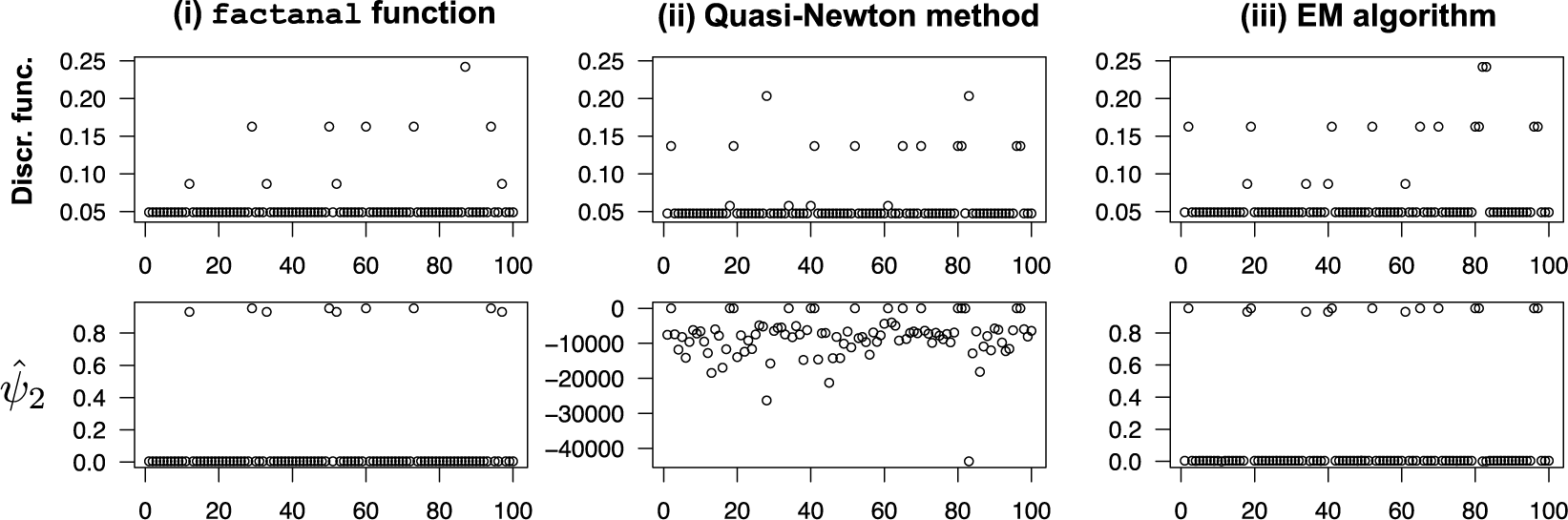

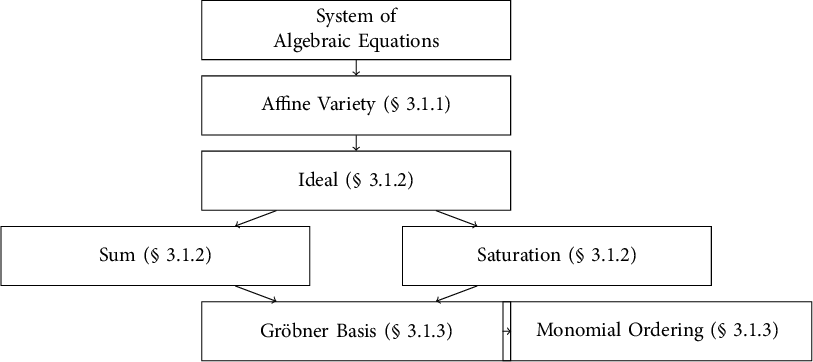

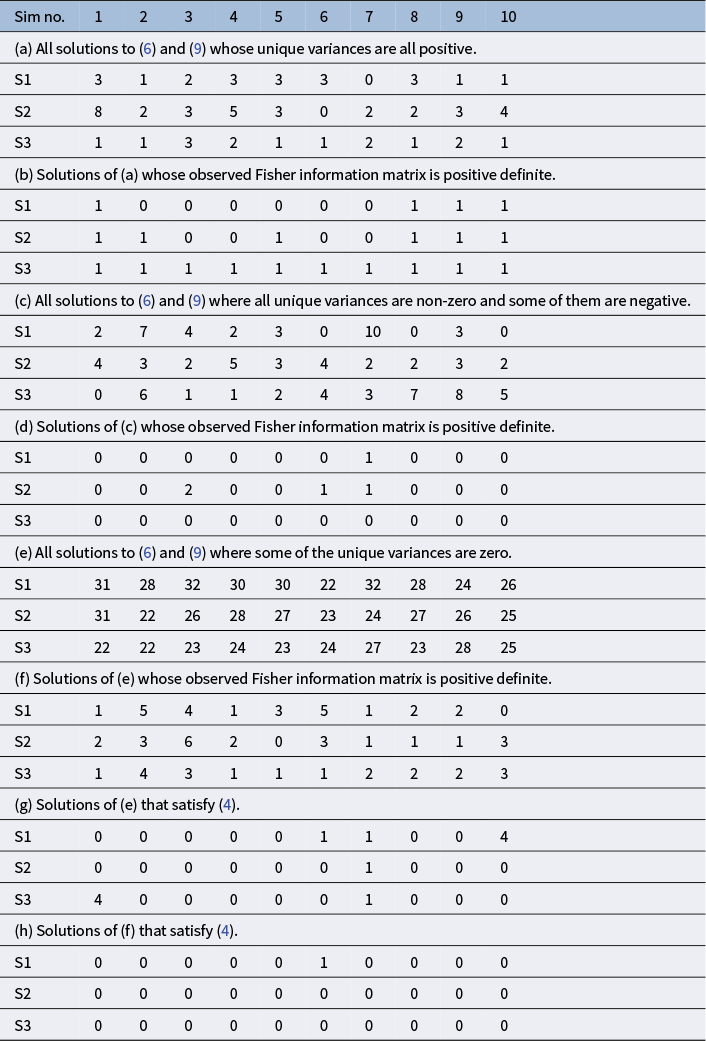
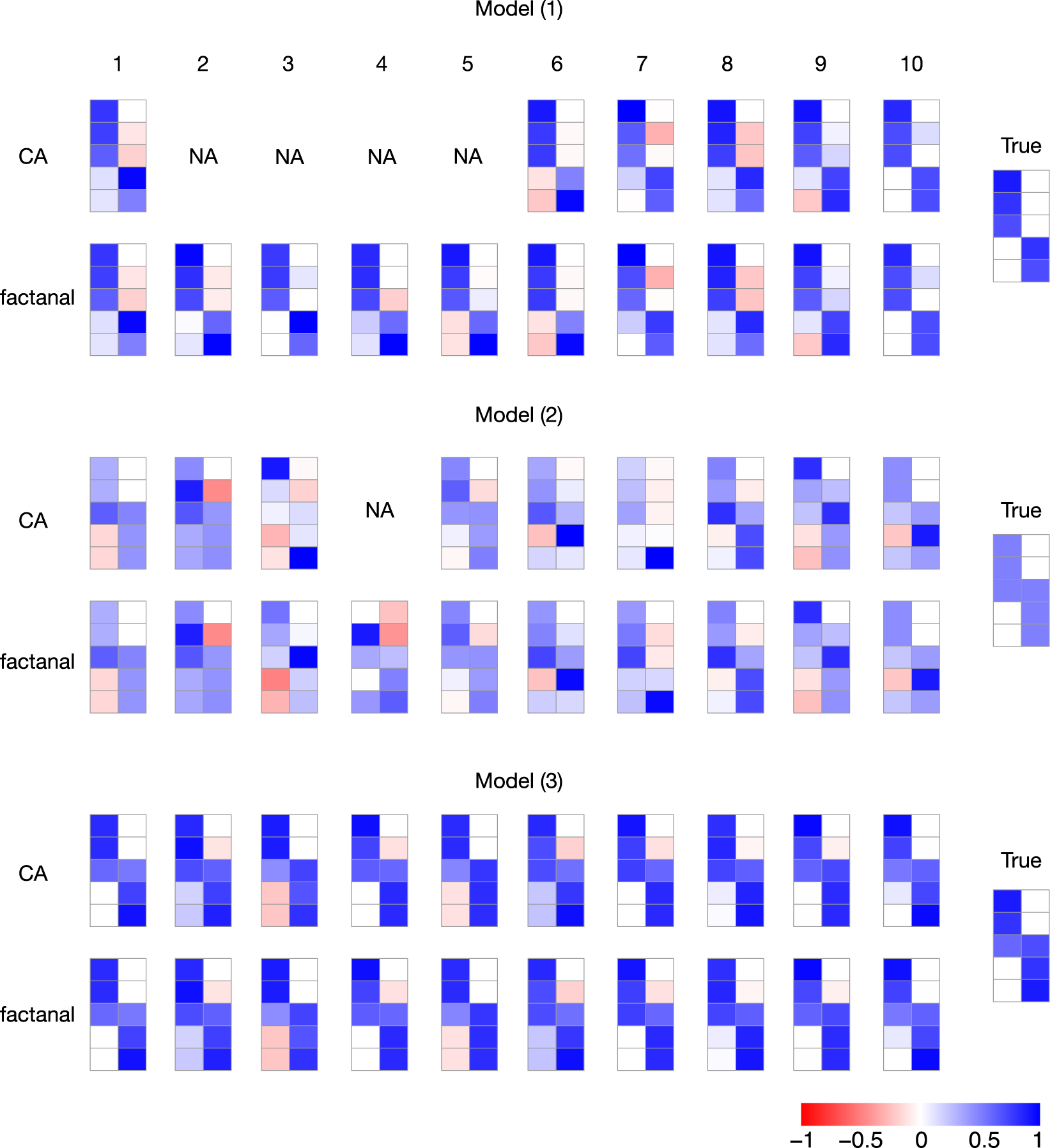
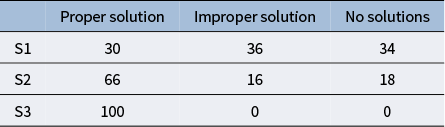

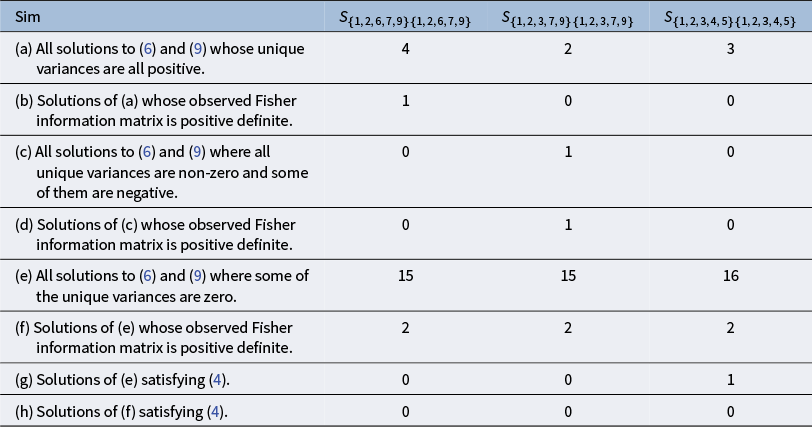
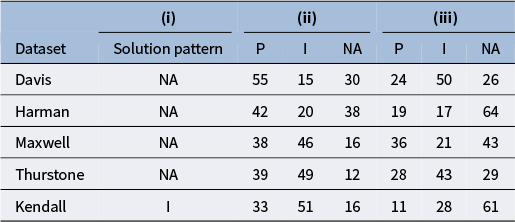
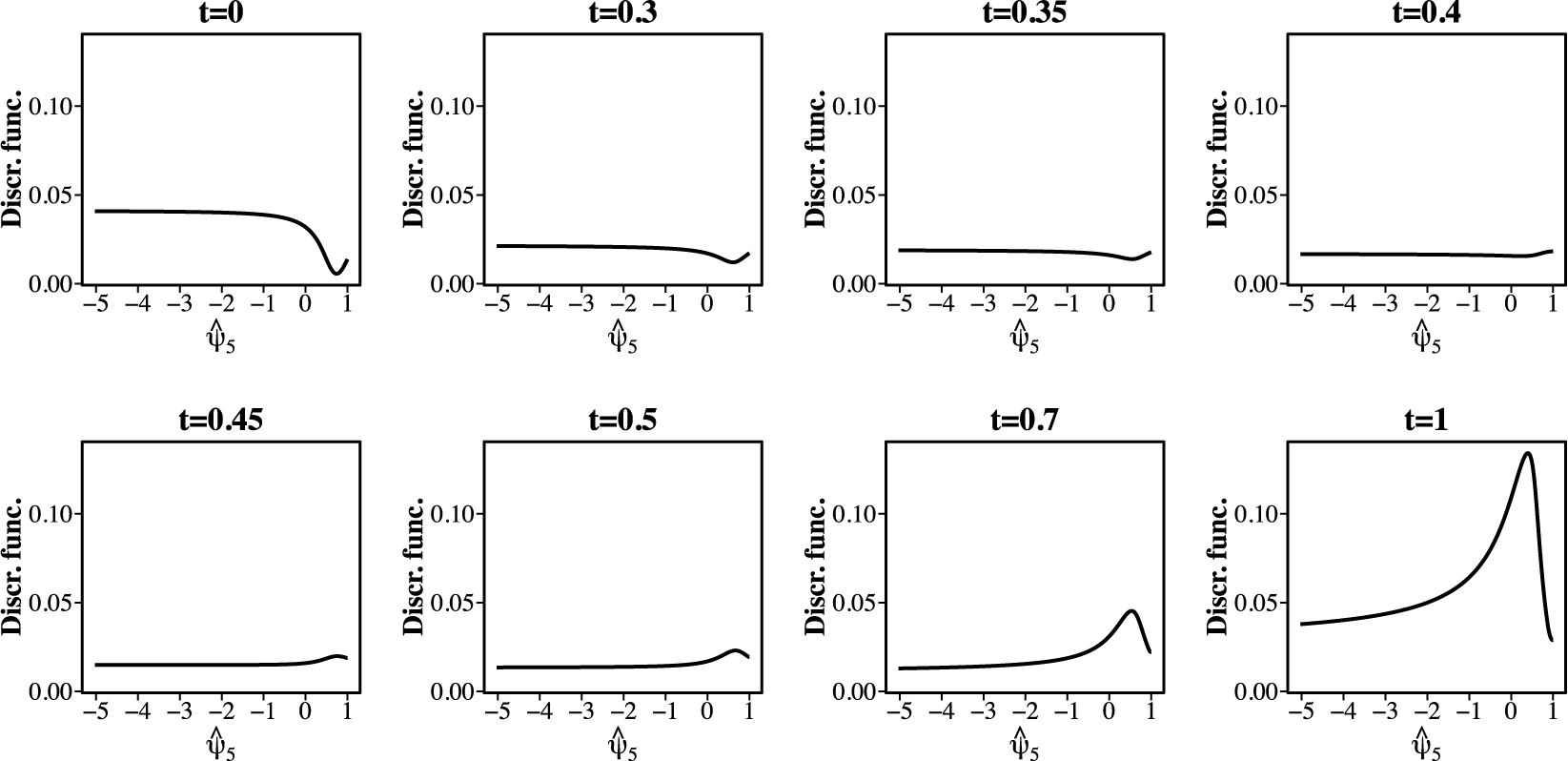

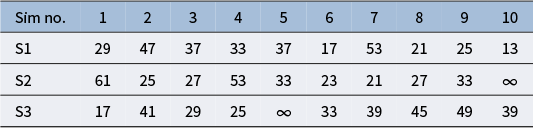



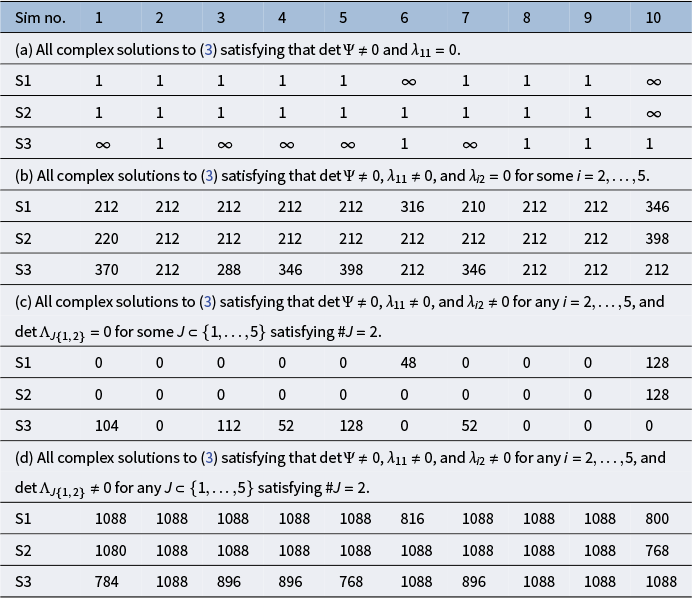

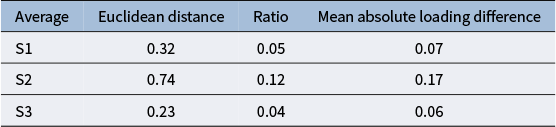
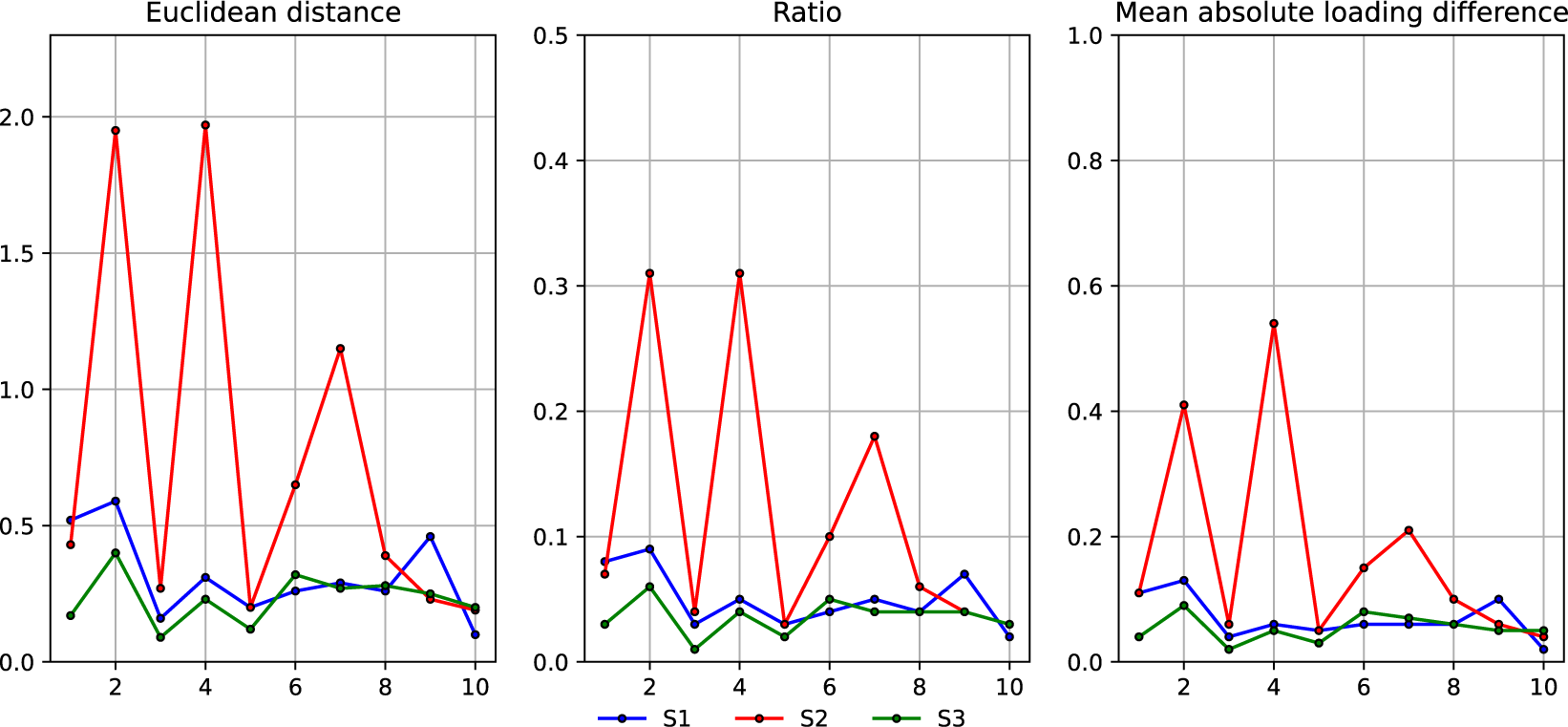

 Open access

