





The U.S. bombardment of military targets in Caracas on January 3, 2026 intensified debates on U.S.–Latin American relations. In the immediate aftermath, social media emerged as a central arena for the circulation and contestation of narratives grounded in lived experience. One testimony, attributed to an alleged survivor identified as the leader of a “Bolivarian collective” in Caracas, gained particular visibility. In this account, the U.S. operation is framed as an incomprehensible tactic marked by radical asymmetry: “they have a lot of weaponry; we had no drones, no technology.”Footnote 1 The attack is characterized as a unilateral war in which the aggressor appears both invisible and invulnerable. At the same time, those targeted are deprived of any possibility of reciprocal combat and reduced to the status of an “objective.”Footnote 2
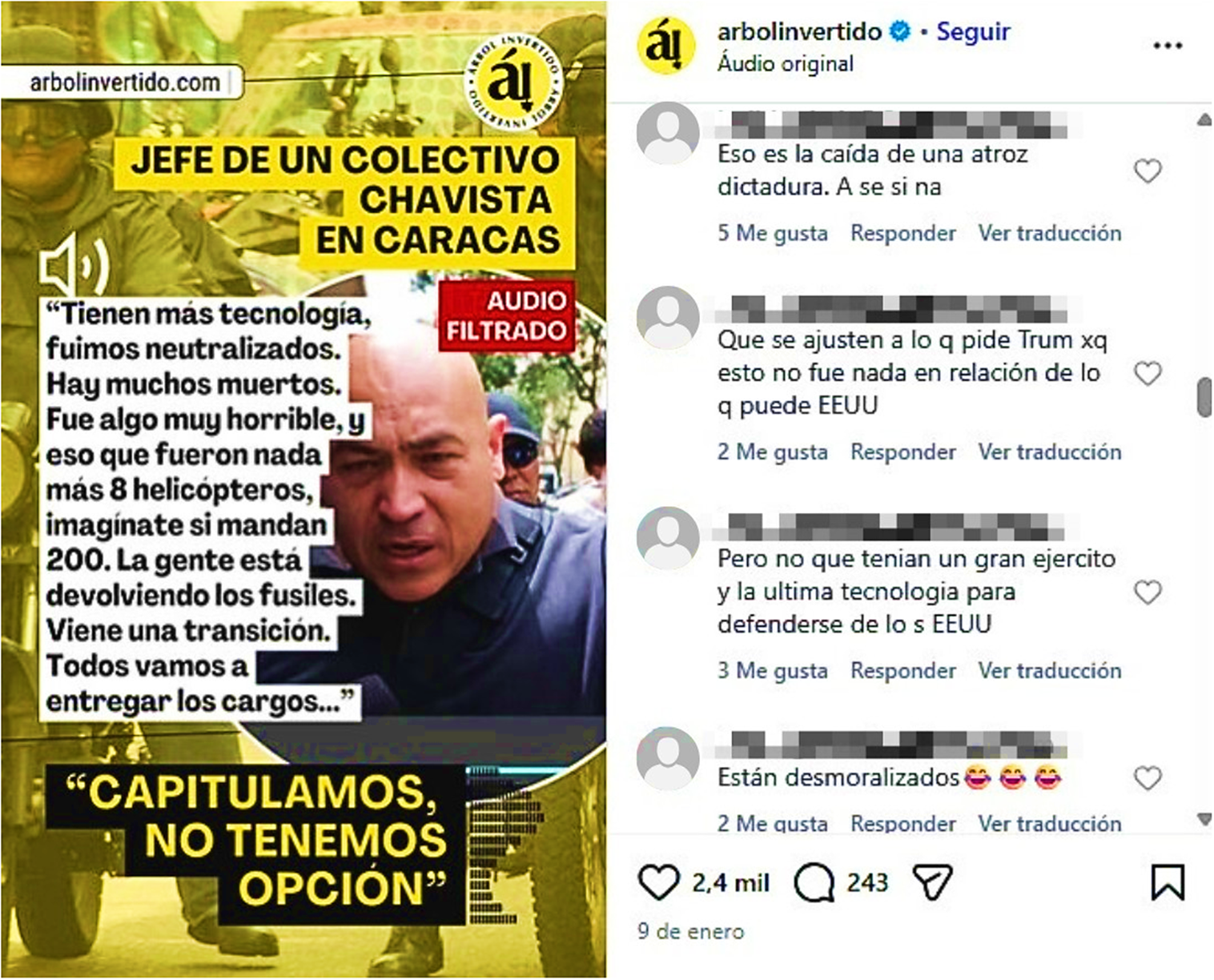
This event can be situated within a longer genealogy of U.S. military practice in the early twenty-first century, which traces back to the deployment of MQ-1 Predator drones armed with Hellfire missiles during the war in Afghanistan (2001).Footnote 3 Since then, this mode of military operation has reinforced a conception of violence as a one-sided exercise of power, in which technology serves as a geopolitical threshold beyond the reach of the adversary. The testimony reaches its climax with the description of a “sonic shockwave,” associated with bodily effects such as nosebleeds, disorientation, and temporary paralysis.Footnote 4 The debate framed this experience as an opposition between truth and exaggeration (see Figure 1). However, we draw attention to a “gray zone” between these two extremes, in which the acoustics of drones, in contexts of asymmetrical violence, can produce psychological punishment and somatic confinement, making this narrative plausible in new terms.Footnote 5
The leader of a Chavista Collective in Caracas leaked audio. Source: Arbol Invertido 2026. Transcription of the main image text: “They have more technology, we were neutralized. There are many dead. It was something very horrible, and that was with only eight helicopters; imagine what it would be like if they sent 200. People are returning their rifles. A transition is coming. We are all going to hand over our positions… WE CAPITULATE, WE HAVE NO OPTION.” Translation of user comments (from top to bottom): (1) That is the fall of an atrocious dictatorship. Mur-der-ers; (2) They had better adjust to what Trump asks because this was nothing compared to what the United States can do; (3) But did not they have a great army and the latest technology to defend themselves from the United States?; (4) “They are demoralized [laughing emoji].”

Figure 1. Long description
At the top left, a yellow banner reads ‘Leader of a Chavista Collective in Caracas.’ Below, a white box contains a Spanish quote: ‘They have more technology, we were neutralized. There are many dead. It was something very horrible, and that was with only eight helicopters; imagine what it would be like if they sent 200. People are returning their rifles. A transition is coming. We are all going to hand over our positions…’ To the right of the quote, a red label states ‘Leaked Audio.’ At the bottom left, a yellow-on-black box displays ‘We capitulate, we have no option.’ The background shows a blurred person in dark clothing and a partial motorcycle. On the right, four user comments are stacked vertically: (1) ‘That is the fall of an atrocious dictatorship. Murderers,’ (2) ‘They had better adjust to what Trump asks because this was nothing compared to what the United States can do,’ (3) ‘But did not they have a great army and the latest technology to defend themselves from the United States?’ (4) ‘They are demoralized’ with laughing emojis. The post header at the top right shows the account ‘arbolinvertido’ with a verified badge.
The idea of a supposed U.S. technological supremacy is not new. However, it acquired renewed prominence and distinctive features during the most recent presidential campaign in 2024, when Donald Trump mobilized it to legitimize ambitions of occupation and economic exploitation in the Venezuelan oil industry and the Panama Canal, as well as the annexation of Greenland. This article analyzes the military siege against Venezuela as a paradigmatic case that encapsulates the strategies of a renewed imperial incursion characterized by what can be described as spectacular techno-military coercion: a form of coercion explicitly articulated, carefully documented, and amplified through social media and mass media outlets.
This article argues that such coercion constitutes a central component of a renewed imperial strategy, one whose primary objective is to render national sovereignty unthinkable within external spaces designated as strategic by the Trump administration. To this end, a performative apparatus has been deployed that translates elements once associated with science fiction into operational military capabilities.Footnote 6 A survey of Venezuelan users’ reactions on social media platforms such as TikTok reveals responses ranging from validating techno-military coercion as a form of external justice to attacking political imaginaries associated with popular sovereignty during the Chavismo period. The spectacularization of annihilation, presented as a form of military acupuncture, seduces audiences at scale, encouraging them to voluntarily submit to technological power by reframing intervention not as coercion or invasion but as optimization and efficiency in resolving local crises.Footnote 7
1. Making explicit
During the Trump Era, strategic narratives aimed at restoring U.S. hegemony underwent strategic rearticulations. Between 2016 and 2018, America First prioritized the use of industrial capacity in the Rust Belt—the historic industrial belt of the north-eastern and Midwestern United States that Trump pledged to “take the rust off.” In that period, the project was structured around an intensive internal reindustrialization strategy: repatriating jobs, reactivating heavy manufacturing, and reversing years of offshoring manufacturing to Asian markets.Footnote 8 In his recent 2024 campaign, the discursive environment of the Make America Great Again (MAGA) movement shifted its focus toward high-technology sectors. The centrality afforded to semiconductor production, the development of artificial intelligence, and the control of critical supply chains inscribed MAGA into the global competition for leadership in technological infrastructure, large-scale data repositories, and the governance of digital space.Footnote 9
The technological supremacy inherent to MAGA deepened strategies oriented toward extensive deregulation, the granting of environmental exemptions, and the flexibilization of legal frameworks that strain the principles of international law. The second Trump administration has been unusually explicit in presenting several territories located outside the United States as strategic platforms subordinated to a corporate logic.Footnote 10 This corporate rationality suggests that foreign territories defined as “intervenable” can be stripped of their status as sovereign nation-states. It operates through what Sheila Jasanoff terms “extension”: a process through which specific sociotechnical imaginaries cross geopolitical borders, reconfiguring space itself.Footnote 11 Much as Cecil Rhodes once used mining technology to reorder colonial Africa, the MAGA imaginary deploys technological infrastructure and military capacity to redefine sovereign territories as mere supply nodes within a global architecture of power.Footnote 12 Within this framework, Venezuela is projected as a major provider of energy resources; Panama as an enclave for controlling commercial traffic; and Greenland as a space whose administration would offer strategic guarantees in matters of security and defense.
This corporate rationality has also functioned as a strategy of meaning-making that erodes the intelligibility of national sovereignty within enclaves deemed intervenable. In the Venezuelan case, two mutually reinforcing processes are evident.
The first involves the deployment of troops and military hardware in the Caribbean; persistent threats of surveillance; the spectacularization of lethal maritime control; the discretionary suspension or activation of air traffic; and practices of annihilation and kidnapping. Together, these dynamics generate a form of political seduction: many observers do not perceive themselves as victims but instead submit voluntarily, interpreting domination as a compensatory response to frustration and an internalized sense of failure.Footnote 13
The second process precedes the spectacle of attack. It encompasses entrenched technological pessimism, increasing restrictions on civil liberties, the loss of democratic legitimacy after the 2025 elections, and the rapid erosion of pre-existing narratives of national sovereignty.Footnote 14 These conditions decisively shaped social responses—passive or supportive—to foreign intervention and its narratives of supremacy.
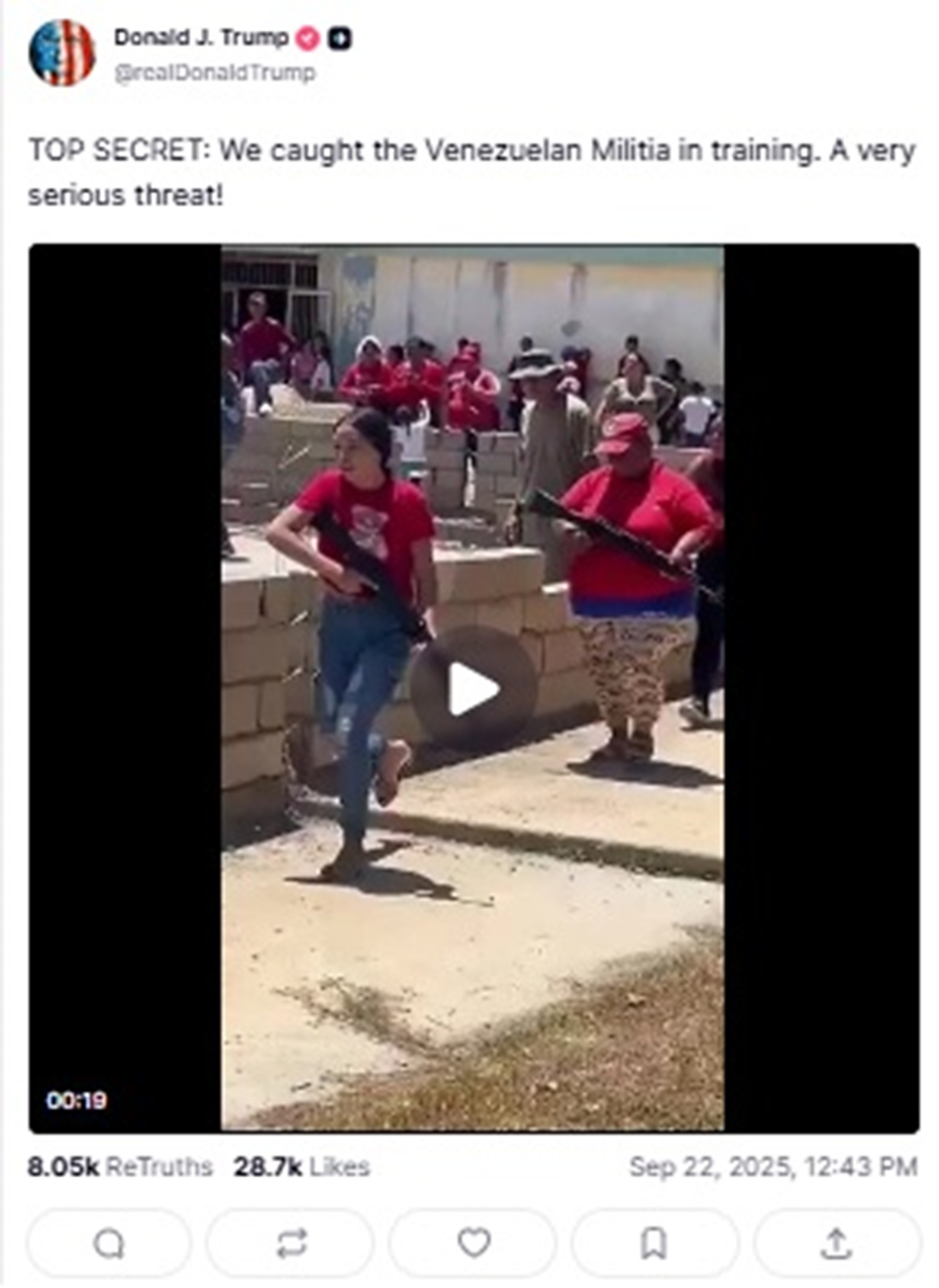
Operating within racial and power hierarchies, the exaggeration of one’s own strength and the underestimation of the adversary’s capacity function as reciprocal strategies of meaning-making.Footnote 15 Donald Trump’s social media discourse reveals a process of coded exposure through which certain groups—women, racialized subjects, and Indigenous peoples—become hypervisible to surveillance and punishment while remaining invisible as fully human subjects. A post on Truth Social dated September 22, 2025 illustrates this logic by ridiculing the obsolescence of the Bolivarian Militia’s weaponry and its alleged lack of preparedness, ironically framing it as “a very serious threat!” (see Figure 2).Footnote 16 A similar pattern emerges in his statements of January 12, 2026, when he claimed that Denmark’s defense of Greenland amounted to “two dog sleds.”Footnote 17 In the first instance, the minimization of technical and military capacity expresses implicit sexism and racism; in the second, it draws on a colonial imaginary of the Arctic as an Indigenous, unproductive, and uninhabited territory. both registers, precarity, backwardness, and absence operate as discursive resources used to justify strategic availability.Footnote 18
About the Bolivarian Militia, Trump says: “A very serious threat!” Source: Trump Reference Trump2025.
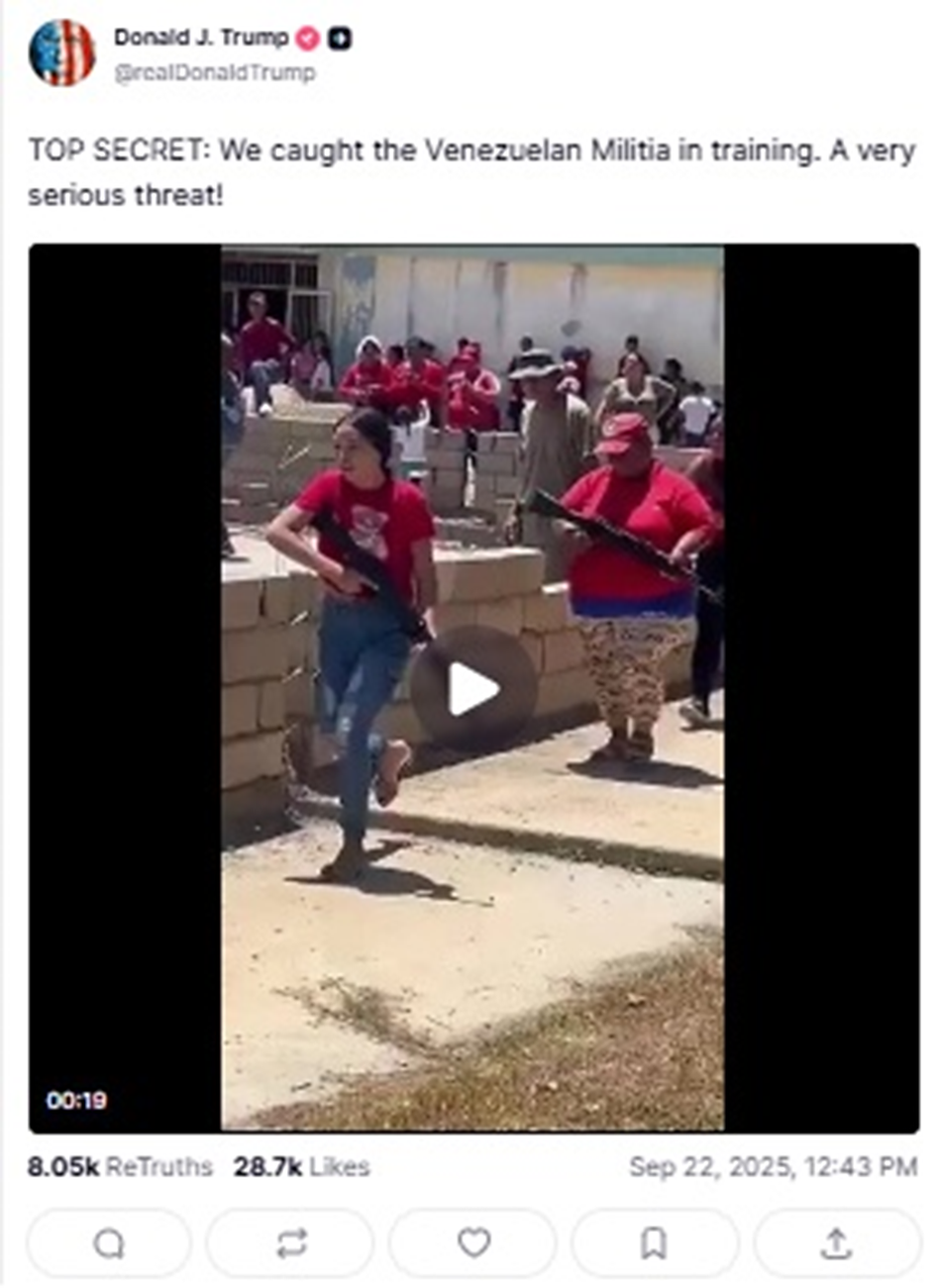
Figure 2. Long description
This image was flagged as sensitive.
2. Documenting, amplifying (… and conquering?)
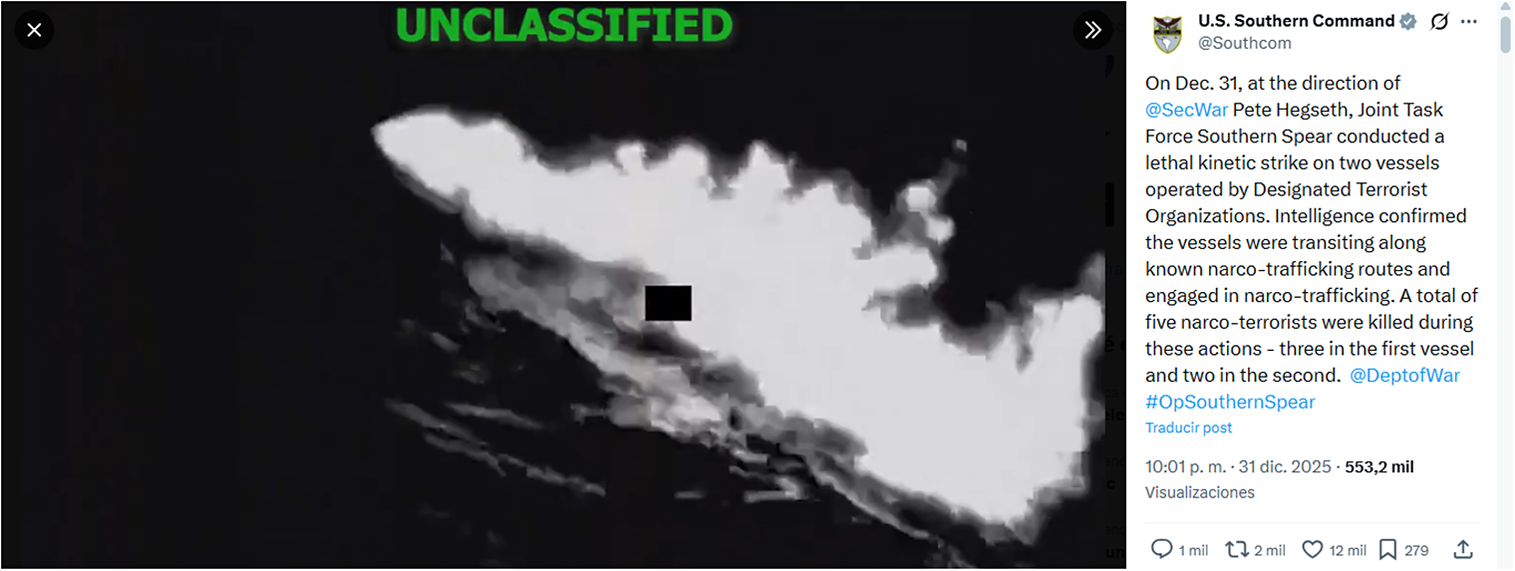
Since September 2, 2025, videos of attacks against alleged “narco-boats” in the Caribbean and the Pacific, near the Venezuelan coast, have circulated on social media. Recorded through thermal cameras and real-time tracking systems, these images reproduce the visuality of a remote-control simulator: graphic interfaces that, by obscuring (pixelating) bodies and recognizable identities, effectively contribute to the dehumanization of the victims (see Figure 3).
A “Lethal Kinetic Strike.” Source: U.S. Southern Command 2025.

In its official statements, the United States Southern Command (SOUTHCOM) frames these maritime operations as efforts to reinforce regional security and to support democratic partners against threats such as criminal organizations. Trump’s refusal to declare a state of war—which would allow these actions to be situated within a politically legible framework in the international system—aligns with what Grégoire Chamayou describes as a hybrid between war and policing, from which emerges a “global right of lethal policing,” effectively a license to kill.Footnote 19
The hypervisibility of the supposedly “unlimited” capabilities displayed by SOUTHCOM on social media has reconfigured these operations in strictly technical terms, displacing moral evaluation toward criteria of asepsis: precision, efficiency, and an almost ludic appearance.Footnote 20 Within this register, violence is reduced to an ephemeral and easily consumable event, in which the enemy ceases to be an “army” and instead becomes a set of nodes that constitute a new grammar of threat.Footnote 21
The narrative surrounding the attack on Caracas on January 3, 2026 followed this same trajectory. In Trump’s words, the incursion amounted to “one of the most striking, effective, and powerful demonstrations of U.S. military power and capability,” defined by “impressive speed, force, precision, and competence.”Footnote 22 This aseptic language enforces a separation between violence and moral judgment, appealing to expert authority to frame military intervention as a form of “technical justice” rather than as a political decision and an act of war.Footnote 23
Trump’s factual description operates as an “inverted mirror” of the testimony of the alleged survivor cited above. Where the survivor recounts the experience of technological defenselessness, Trump mobilizes similar details in support of a renewed supremacist optimism: “They were completely overwhelmed and neutralized very quickly […] Not a single U.S. soldier was killed, nor was any U.S. equipment lost.”Footnote 24 The immunity of the imperial combatant is thus elevated to a supreme moral principle, legitimizing the destruction of the adversary as a form of labor protection.Footnote 25
An analysis of Venezuelan users’ reactions on social media to the attack on Caracas shows that when citizens are excluded from the scientific-political processes that affect them so decisively, they tend to generate their own explanatory narratives. References drawn from the repertoire of science fiction are not mere delusions or post hoc rationalizations of defeat; rather, they can be understood as what Sheila Jasanoff terms imaginaries of comprehension or resistance: how ordinary people make sense of their existence and their relations with others in moments of social shock.Footnote 26
Technological supremacy narratives sustaining U.S. technological hegemony are appropriated and reproduced by many Venezuelan users in two main forms: as ironic spectacle and as paternalistic acquiescence. The following examples are examined illustratively through the recursive cycle methodology, which identifies patterns through the four “Rs”: repetition, redundancy, responsiveness, and reinforcement.Footnote 27
2.1. Technical Hegemony and Military Expertise as digital myth-making
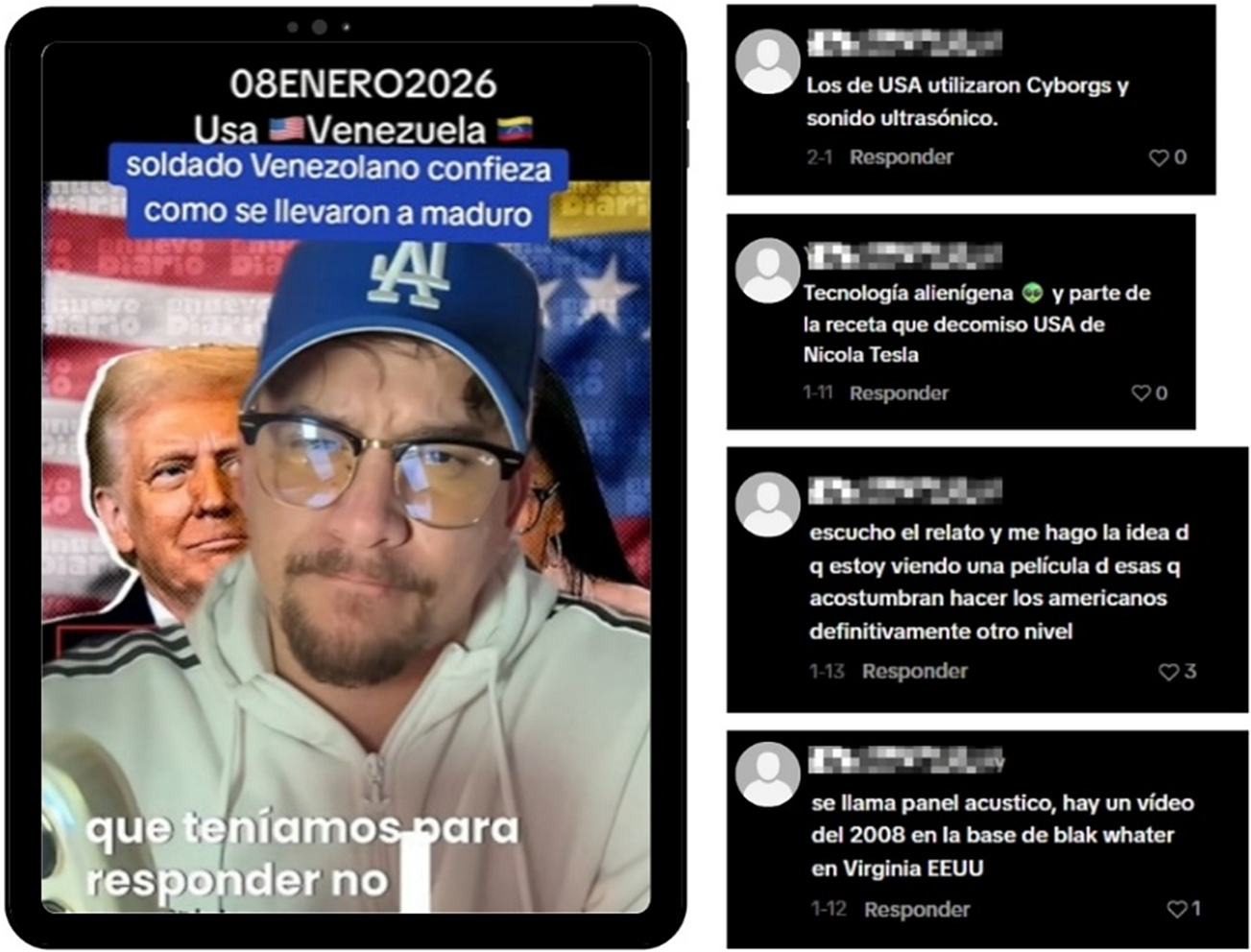
Comments on a TikTok video sharing the audio mentioned at the outset reveal a process of collective belief formation in which the technological gap is perceived as so overwhelming that it can only be explained through cinematic references or techno-magical imaginaries. Expressions such as “it looks like a movie” highlight the displacement of warfare from the political domain to the register of spectacle. Within this framework, military violence is resemanticized as technical skill, stripped of human suffering, and translated into terms of operational excellence. When available knowledge proves insufficient to account for the magnitude of the impact, explanatory categories such as cyborgs, acoustic panels, ultrasonic weapons, or even alien technology emerge. These narratives represent attempts to reinscribe the traumatic experience—even when articulated in celebratory terms—within symbolic frameworks that can confer some form of coherence (see Figure 4).Footnote 28
Myth-making on TikTok (collected by author). Source: Andrade Reference Andrade2026. Video title: January 8, 2026: Venezuelan soldier confesses to taking Maduro. Translation of user comments (from top to bottom): (1) Those from the United States used Cyborgs and ultrasonic sound; (2) Alien technology [alien emoji] and part of the formula that the United States seized from Nikola Tesla.; (3) I listen to the account and I get the idea that I am watching one of those movies the Americans usually make, definitely another level; (4) It is called an acoustic panel; there is a video from 2008 at the Blackwater base in Virginia, USA.

Figure 4. Long description
At left, a tablet displays a TikTok video with a background of U S and Venezuelan flags, overlaid with the date 08 E N E R O 2026 and the headline ‘U S A Venezuela Venezuelan soldier confesses how they took Maduro.’ The video features a person in a white hoodie, with two blurred faces behind, one wearing a blue cap. White text at the bottom reads ‘que teníamos para responder no.’ To the right, four user comments are stacked vertically: the first claims the U S used cyborgs and ultrasonic sound; the second mentions alien technology and a formula seized from Nikola Tesla; the third says the account feels like watching an American movie, ‘definitely another level’; the fourth refers to an acoustic panel and a 2008 video from the Blackwater base in Virginia, U S A.
2.2. Technological supremacy and the paternalist empire as a “democratizing force”
In a context of democratic crisis, the perceived inability to achieve political alternation through internal means opened the door to interpreting external military intervention as a corrective mechanism. Within this digital myth-making, technological superiority acquires a moral dimension: it is framed as discipline, efficiency, and heroism precisely where local political processes are perceived to have failed.Footnote 29
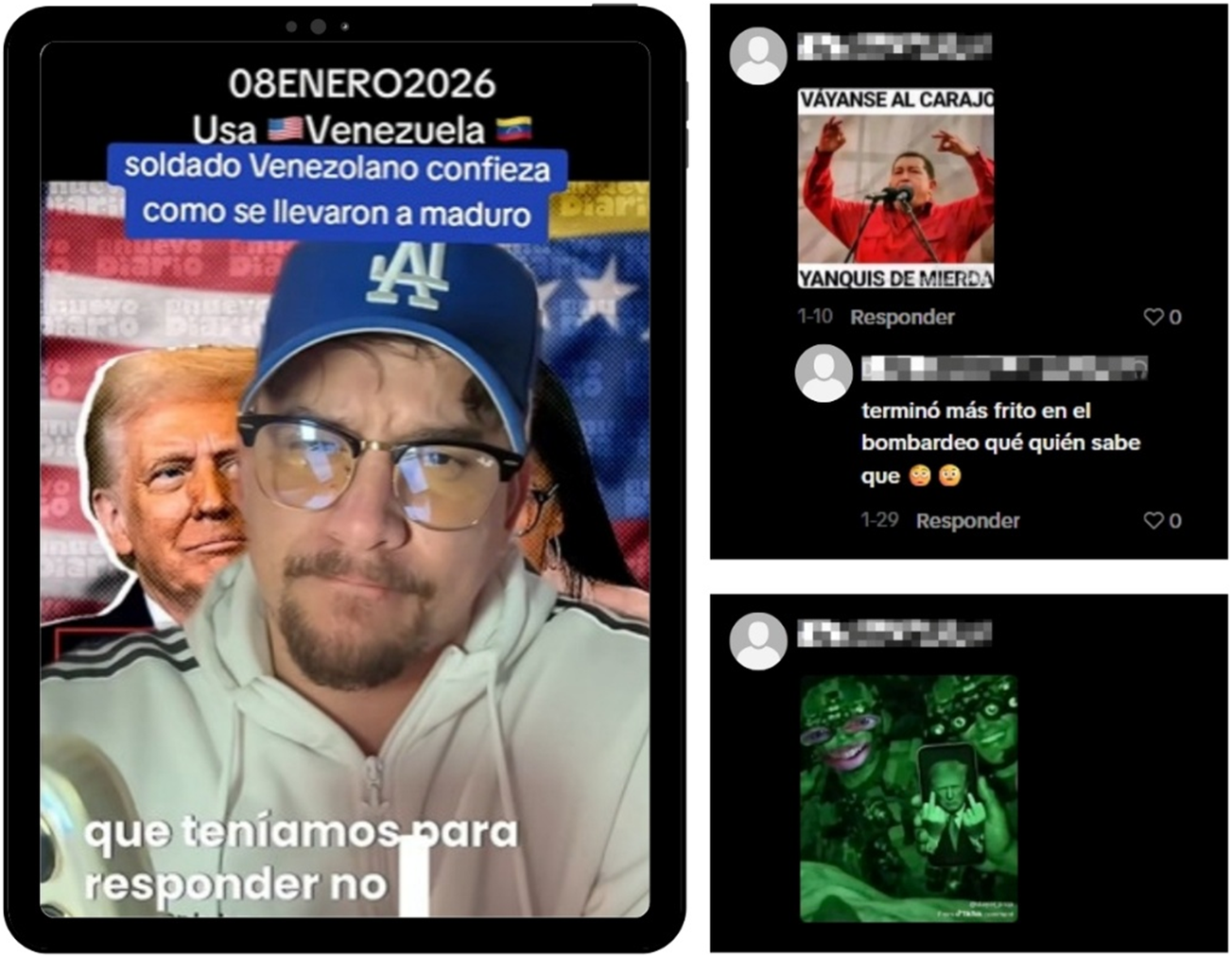
User comments contrasting U.S. “technological discipline” with a regional culture of festivity and political laxity embody a form of self-critique that internalizes colonial technical hierarchies and reinterprets them as criteria of political legitimacy. This digital dynamic simultaneously reveals the decline of popular sovereignty as an intelligible political horizon. Symbols historically associated with the Bolivarian Revolution—insurgent dignity, guerrilla expertise, and popular mobilization—are subjected to ironic neutralization through memes and sarcastic commentary.Footnote 30 References to the alleged destruction of the Cuartel de la Montaña or to the desecration of Hugo Chávez’s embalmed remains illustrate how irony strips revolutionary signifiers of their affective and mobilizing power (see Figure 5).
The (un)thinkable sovereignty (collected by the author). Source: Andrade Reference Andrade2026. Video title: January 8, 2026: Venezuelan soldier confesses to taking Maduro. Translation of user comments (from top to bottom): (1) GO TO HELL, SHIT YANKEES; (2) [Response to user 1] [He—Chavez] ended up more “fried” in the bombing than who knows what [laughing emoji].

Figure 5. Long description
On the left, a tablet displays a video screenshot with the heading 08 E N E R O 2026, U S A and Venezuela flags, and the text ‘soldado Venezolano confiesa como se llevaron a maduro’ over a background of U S and Venezuelan flags. A person in a white hoodie and blue cap is centered, with blurred faces and partial images of two other people behind. At the bottom, partially visible Spanish text reads ‘que teníamos para responder no.’ On the right, the top panel shows a user comment with a blurred profile image and a photo of a person in red raising both hands, captioned ‘VÁYANSE AL CARAJO YANQUIS DE MIERDA.’ Below, a reply reads ‘terminó más frito en el bombardeo qué quién sabe que’ with two flushed face emojis. The lower right panel contains another user comment with a blurred profile image and a green-tinted photo of people in night vision goggles, one holding up a phone with a blurred face.
In the digital debate surrounding the January 3, 2026 attack, national sovereignty abruptly ceased to be codified as a collective political will and was recoded as a quality dependent on technological parity. The idea of “popular sovereignty” appears to its radical detractors as a spurious symbol and to its defenders as a “moribund” ideal. It remains to be seen, however, whether this attitude reflects the establishment of a sociotechnical imaginary of subordination, destined to consolidate as a stable public discourse that reshapes citizens’ understanding of the historical relationship between Venezuela and the United States, or whether it merely constitutes an affective discharge that captures attention efficiently, yet fleetingly and volatily.Footnote 31
Author contribution
Conceptualization, Data curation, Formal analysis, Investigation, Methodology, Resources, Supervision, Visualization, Writing - original draft, Writing - review & editing: J.M.S.
Conflict of interests
The author declares no competing interests.

 Open access

