

Introduction: navigating between biological and social realities and new data
Kinship and Marriage among the Nuer is one of anthropology’s classic, if not canonical works. There, its author E.E. Evans-Pritchard wrote:
A daughter does not carry on the lineage of her father. She becomes one of her husband’s people and her children belong to his lineage. Hence Nuer say: ‘Nyal, mo ram me gwagh’, ‘A daughter, that is an unrelated person’. As the Roman lawyers put it, she is finis familiae, the terminus of the family. But a man’s name must continue in his lineage, and Nuer consider it very wrong if a man who dies without male heirs is not married a wife by a kinsman who will raise up seed to him by her so that he will be remembered in his sons. This is a most elementary obligation of kinship, and if it is neglected the dead man’s ghost may haunt his kin. (Evans-Pritchard Reference Evans-Pritchard1951, 109)
In that passage, Evans-Pritchard spelt out two important points for kinship studies: first, kinship principles not only include, but also exclude biologically closely related individuals (e.g. daughters in the Nuer case). Second, there are several ways of continuing one’s patri-lineage, not only through biological descendants but also through adoption and co-residence, milk kinship and even posthumous marriage. The Nuer ‘posthumous’ or ‘ghost marriage’ has not been widely documented elsewhere (see Malbrancke Reference Malbrancke and Callan2018a), so that ‘ghost marriage’ practice is not universally valid for all patrilineal societies. However, it remains an important example of cross-cultural diversity of marriage arrangements under patrilinear premises. These two main insights by Evans-Pritchard also inform the following text from the start.
The present contribution is picking up this special issue’s concept of ‘kinship trouble’ (see Cveček, Raghavan & Bickle, this issue) in two ways. First, considering kinship as a matter of both social and biological aspects at once (see Godelier Reference Godelier2004; Reference Godelier2011), the Nuer case of unilineal patrilineal descent is particularly telling. Even though Nuer siblings are born to the same parents and grow up in the same household, local kinship practices prescribe sons’ membership in the father’s lineage, whereas they exclude daughters after their marriage (which, again, is not a globally valid but widely occurring phenomenon). Second, addressing the intellectual challenge of translating kinship practices between disciplines, the Nuer case is also pertinent in showcasing the strength of socio-cultural anthropology’s knowledge and insights on kinship in their global settings through comparative kin concepts such as ‘levirate’ and (their indigenous equivalents as local terms), for example, ‘ghost marriages’.
Without a doubt, anthropological knowledge about kinship has considerable potential and explanatory power to humanize many of the results from what Kristian Kristiansen (Reference Kristiansen2014; Reference Kristiansen2022) identified as the ‘third science revolution in archaeology’ and the extraordinary ancient DNA (aDNA) databases that are being assembled along the way. As we aim to elaborate in this contribution, the careful and well-thought-through usage of socio-cultural anthropological insights for archaeological and archaeogenetic results for studying kinship in the deep past matters increasingly (see Bentley Reference Bentley2022; Brück Reference Brück2021; Cveček Reference Cveček2024; Ensor Reference Ensor2021; Fowler Reference Fowler2022). It matters for many reasons that surpass the mere inclusion or exclusion of anthropological knowledge and/or the division between the social and natural sciences, but also have to do with the ethics and integrity of research.
To demonstrate the explanatory capacities of anthropological knowledge, we chose the recently published study on Avar pedigrees in Nature (see Gnecchi-Ruscone et al. Reference Gnecchi-Ruscone, Rácz and Samu2024) to examine its palaeogenetic results in new ways. Following our summary of the authors’ arguments presented in that study, a few cases of (mis)uses and imprecision in the usage of anthropological kinship concepts—not necessarily limited to this study—will be addressed. This will lead to our short anthropological overview of key kinship concepts used in that study and alternative ways of interpreting the genetic data through ethnographically grounded insights. In this way, new light will be shed upon the importance of close collaborations not only among scientists in the humanities and natural sciences, such as archaeologists, archaeogeneticists, and historians, but also socio-cultural anthropologists.
Ethics and research integrity in kinship studies
Before addressing the Avar case study, we wish to indicate an ethical point applicable to kinship studies about the past or present. The academic and scholarly analyses of what it means to be related through ‘kinship’ at all times, be that for ancient as much as for contemporary periods and regions, is never the exclusive task of only one set of disciplines (e.g. life sciences), but of many—hence also including legal studies, history, archaeology and socio-cultural anthropology and in some cases, also linguistics and philology as well as religious studies. Therefore, from the outset, kinship analysis by definition is an interdisciplinary endeavour between both the life sciences as much as the socio-cultural academic research fields.
As soon as this basic constellation is accepted, the defining modalities of what is and what is not a proper, ethically valid and adequate academic inquiry in kinship studies necessarily go through a profound transformation. Under these new and changed paradigms, any sound professional, ethically valid and balanced process of consultation and assessment in kinship analyses at no time can be left to experts from just one academic sub-set, i.e. merely to sub-disciplines in either life sciences or in the socio-cultural research fields alone. On the contrary, this transformed process of consultation and assessment in kinship studies from the outset has actively to include serious expertise from both the life sciences as much as from the socio-cultural research fields and—equally relevant to become legitimate in terms of ethics and research integrity—before as much as during the peer-reviewing process. By logical necessity, this indispensable and unavoidable inclusion of professional expertise from both the natural/life sciences and from the socio-cultural research fields involves at least partial integration of two academic cultures (in the broadest sense: natural/life sciences and humanities/social sciences), together with their differing sets of temporalities (e.g. work rhythms, teamwork interactions, consultation modalities). After all, ever since C.P. Snow (Reference Snow1959) first raised the topic, significant advances have been made in methodologies of cross- and interdisciplinary cooperation (e.g. Bendix et al. Reference Bendix, Bizer and Noves2017).
Therefore, in our view, intensive cross-disciplinary consultation beyond the life sciences, i.e. with relevant expertise in the socio-cultural academic fields, is the ethically legitimate procedure in kinship analyses and academic publishing about it, before, during and after peer-reviewing procedures. By contrast, confining and limiting expertise to merely the natural/life sciences alone in these matters, without comprehensively consulting the socio-cultural fields before and during the reviewing process, can no longer be accepted as ethically legitimate.Footnote 1 The ethical aspect also includes a sufficient consideration of data ‘reliability’. By definition, this implies that evidence is analysed and interpreted from the perspectives of all research approaches that are competently involved in kinship analysis, not just a minimum among them. Hence, ‘reliability”’ implies its consideration to an extent that moves beyond the minimum threshold of ‘necessary, but not sufficient’. As long as other disciplinary perspectives are considered only to the extent that is necessary but not sufficient, ethical methodological requirements of data reliability are not met in any adequate manner.
In today’s world, it would be neither legitimate nor ethically acceptable to base a definite decision about a potential heir only on DNA expertise without ever consulting legal experts. For pre-literate worlds of the past, it is similarly neither legitimate nor ethically acceptable to base an academic assessment about potential relatives at a given site only on paleogeneticists’ expertise and results, without consulting the socio-cultural experts, including socio-cultural anthropologists. This lesson has to be taught, studied and implemented, and ethical consequences will have to be drawn for ignoring or abusing them. In what follows, we will showcase what socio-cultural anthropological insights may add to the necessary and sufficient study of kinship in the deep past.
Reassessing Avar pedigrees through the lens of socio-cultural anthropology
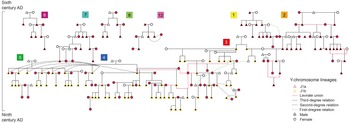
‘Network of large pedigrees reveals social practices of Avar communities’ (Gnecchi-Ruscone et al. Reference Gnecchi-Ruscone, Rácz and Samu2024) is the title of a recently published study of ancient genomes from 424 individuals buried in four (‘Pannonian’) Avar cemeteries dating to the sixth to ninth centuries ad in the Carpathian Basin. Based on sampling four complete Avar cemeteries, this study revealed 31 pedigrees of varying sizes, from 2 to 146 individuals, spanning across nine generations and comprising around 300 individuals. The authors suggest that these pedigrees indicate ‘a consistent reproductive strategy based on patrilineal descent, patrilocality, female exogamy, strict avoidance of consanguinity, and, in several cases, multiple reproductive partners and the practice of what seems to have been levirate unions.’Footnote 2 Additionally, authors argue that ‘social and biological relatedness overlapped to a large degree because patterns of biological relatedness correspond to the spatial distribution of the graves and grave goods’ (Gnecchi-Ruscone et al. Reference Gnecchi-Ruscone, Rácz and Samu2024, 8). They conclude that ‘descent units were strictly organized around patrilines but on a larger scale were connected by exogamous female individuals, and these connections may have been one of the main cohesive elements of Avar society’ (Gnecchi-Ruscone et al. Reference Gnecchi-Ruscone, Rácz and Samu2024, 8). For the reconstruction of the Avar genetic pedigrees, see Figure 1.
The largest reconstructed pedigree network from Rákóczifalva includes 146 individuals organized into five major genetic clusters, along with four smaller pedigrees (34 individuals) labeled 6, 7, 8, and 12. Levirate relationships are marked by pink connecting lines, and male Y-chromosome haplogroups are represented by colored outlines. Black symbols indicate individuals with recovered ancient DNA, whereas white symbols denote inferred but unsampled individuals. The horizontal scale on the left spans the full Avar period, representing at least nine generations. Triangles denote genetically identified XY individuals (interpreted as male), and circles denote XX individuals (interpreted as female), while acknowledging that biological sex does not necessarily align with social roles (Gnecchi-Ruscone 2024, 378, Fig. 2a). Adapted and redrawn from Gnecchi-Ruscone, G.A. et al. Reference Gnecchi-Ruscone, Rácz and Samu2024. Network of large pedigrees reveals social practices of Avar communities. Nature 629, 376–383. Licensed under CC BY 4.0 (https://creativecommons.org/licenses/by/4.0/). The figure has been redrawn and slightly modified from the original.

The present discussion is focused on the authors’ terminological usage of polygyny, levirate and female exogamy, and how this relates to the evidence. Polygyny is addressed by them repeatedly, since they propose polygyny may have been a common practice among the general Avar population and not only among the elites, as previously assumed from written sources (Gnecchi-Ruscone et al. Reference Gnecchi-Ruscone, Rácz and Samu2024, 4). Levirate, the authors suggest, is evident from genetic pedigrees. They also recognize, to an extent, its importance in written sources and ethnographic observations in Central Asia and the Caucasus. Finally, the authors’ term ‘female exogamy’ will be discussed in the light of using genetic and isotope results for inferring mobility and marriage patterns in the past. Based on network analyses of IDB or identity-by-descent DNA segments (that is, stretches of DNA inherited from a common ancestor to estimate degrees of genetic relatedness),Footnote 3 they suggest that ‘social cohesion between communities was maintained via female exogamy’ (Gnecchi-Ruscone et al. Reference Gnecchi-Ruscone, Rácz and Samu2024, 1). By revisiting this study through the lens of socio-cultural anthropology, we highlight discrepancies in the use of terms that carry different meanings in palaeogenetics and anthropology, underscore the challenges of interpreting kin relations through palaeogenetic data and demonstrate the insights socio-cultural anthropology could contribute to the study of kinship in the deep past.
Polygamy, polygyny and polyandry
In the Avar case study, the authors recurrently refer to ‘polygyny’ without specifying this term in the article or its supplementary material. Understanding polygyny as an academic concept requires an examination of its intersections with and contrasts to polygamy and polyandry. Polygamy usually designates marriages in which an individual has the right to marry several other persons. This notion, literally ‘marriage by many’, is used as a loose and unspecific umbrella term for many different versions of plural marriage, which include forms of both polygyny and polyandry (Parkin Reference Parkin1997, 43). Polygyny refers to marriages between one man and several women, which is also called sororal polygyny whenever these wives are sisters (Parkin Reference Parkin1997, 43). Polygyny is not necessarily limited to chiefs or wealthy men but can be associated with men’s rank or achievement, even among societies with few hierarchies otherwise, such as Yanomamö and the Ache (see, for instance Ember et al. Reference Ember, Ember and Low2007). Polygyny may simultaneously occur together with monogamy,Footnote 4 i.e., as a frequent yet (for obvious demographic reasons) minority form of marriage in a given society or as a part of wider polygamous settings. In the Standard Cross-Cultural Sample (SCCS), 83.8 per cent of societies are socially polygynous, meaning society’s rules, norms, or institutions permit men to have multiple wives as a legitimate and recognized marital form. Among those, 28 per cent contained more than 40 per cent polygynous marriages, even though biological polygyny, when some men father children with multiple women, regardless of whether these relationships are socially sanctioned as marriage, could have been higher. In non-state societies, the most common predictor of polygyny is high male mortality in war, whereas high pathogen stress predicts high rates of polygyny in more densely populated state societies (Ember et al. Reference Ember, Ember and Low2007).
By contrast, anthropology’s terminology refers to marriage between one woman and several men as polyandry, also called fraternal or adelphic polyandry when these husbands are brothers (Parkin Reference Parkin1997, 43). Polyandry may occur either as a sub-element in polygamous contexts or as a minority form together with monogamy (i.e. analogous to but not identical with the polygynous setting). Finally, polygyny, polyandry and monogamy may occur side by side within one and the same setting or community. Therefore, monogamy and polygamy, including polygyny and polyandry, are social and/or legal arrangements that may or may not be reflected in the same way in genetic source materials. By consequence, present archaeogenetic methods and interpretations, including those related to levirate as further elaborated below, are not yet able to consider distinctions within the range of possible kinship practices.
Levirate: some basic aspects
In their study of the Avar ‘social practices’, its authors repeatedly refer to the ‘levirate’ as cases when a genetically sexed female had more than one reproductive partner as well as ‘marriages between a widow and an agnate of the deceased’ (Gnecchi-Ruscone et al. Reference Gnecchi-Ruscone, Rácz and Samu2024, 379). While the authors use contextual information for interpreting genetic relatedness between individuals as evidence for a social practice such as levirate, we begin this section by outlining key concepts of levirate unions before returning to the Avar study to consider alternative interpretations of the same results.
In socio-cultural anthropology, levirate, also known as fraternal polyandry, refers to marriage arrangements in which a girl/bride/woman marries her husband’s brother after the death of her husband (see Godelier Reference Godelier2004; Reference Godelier2011, 567; Malbrancke Reference Malbrancke and Callan2018b; Parkin Reference Parkin1997, 43). It is opinio communis in anthropological kinship studies to distinguish between fraternal or adelphic polyandry, which refers to the simultaneous marriage of one woman to two or more brothers, and levirate, which refers to the same arrangement in a successive manner. Simultaneous fraternal or adelphic polyandry is fairly rare by global comparative evidence: apart from the Nayar in South India, the best-known cases occurred in certain areas of pre-industrial Tibet as one variant in polyandry primarily practised to ease tax pressures upon individual households (see Jahoda Reference Jahoda1994).
Levirate, by contrast, is fairly frequent on a global comparative scale. This is the case whenever after the termination of a given marriage (e.g. by divorce or death) the same woman marries her former husband’s brother. Usually, this indicates the maintenance of strong ties between the woman’s group of origin and the group she has married into—be that for reasons of affluence and/or alliances. Levirate, therefore, often goes hand-in-hand with a strong dominance of patrilineal descent, patri- or virilocal residence and male control over young women. That last particular aspect is correctly pointed out by the authors in the Avar case under scrutiny here. However, their accompanying claim about ‘simultaneous levirate’ and/or ‘polygyny’ has not been proven yet, but merely inferred based on the feeble premise that ‘the presence of older female partners in multiple reproductive partnerships suggests polygyny’ whereas serial monogamy is assumed to be linked with young ages of female partners at death (Gnecchi-Ruscone et al. Reference Gnecchi-Ruscone, Rácz and Samu2024, 4). In fact, this suggestion lacks sufficient evidence and does not consider successive polygyny or levirate as a possible alternative to simultaneous polygyny for older females,Footnote 5 nor does it sufficiently consider variations between polyandry and levirate: this would also have to be based on whether the children of sexual relations between a woman and her husband are ‘raised to the name of’ (i.e. attributed to) the dead husband.
While the evidence based on genetic pedigrees for simultaneous polygyny in the Avar case is thin and the interpretations are imprecise, the evidence for levirate is inconsistent. In supplementary material, the authors notice that all those women with several male reproductive partners were older individuals. This also holds for those women whose male partners were closely related to each other, which indicates a possible interpretation for successive levirate. In one case, a different interpretation instead of successive levirate was put forward for a senior female (RKF140, 40–49 years old) who had four reproductive male partners. In this case, the authors identified two different ‘levirate unions’ that she had entered. But instead of a subsequent levirate, the authors have suggested concurrent partners and simultaneous polyandry in this case (see Gnecchi-Ruscone et al. Reference Gnecchi-Ruscone, Rácz and Samu2024, 24 in supplementary material). Whether these unions were simultaneous or not will be addressed again below. For the present discussion, it is important to note that in supplementary materials, the authors recognized that among currently available computational methods, ‘none of the tools available’ (e.g. KIN, BREADR, identity-by-descent IBD) ‘are fully able to identify levirate unions’ (see Gnecchi-Ruscone et al. Reference Gnecchi-Ruscone, Rácz and Samu2024, 50 in supplementary material) since it is hard to distinguish whether those reproductive relations took place during the same biographical phase or one after the other. Whereas the authors suggest further development of new computational tools to understand relations such as levirate better, we suggest that in addition to that, socio-cultural anthropological insights and considering multiple possibilities for interpretation rather than just one would help to address the research puzzle in better-informed and more precise ways.
Zooming closer into the Avar ‘levirate unions’, it becomes clearer that, in line with the logic of patrilineal descent, successive levirate rather than other forms of reproductive unions emerges as an equally possible line of interpretation here. Because in most societies of patrilineal descent daughters usually do not continue the lineage of their fathers through their children whereas sons do, the successive levirate unions depicted in pedigrees 2 and 3 could be explained in new ways. In four cases depicted on the pedigree, women gave birth to a daughter who could not transmit their father’s lineage any further. Assuming the husband died without a son, the woman would then have possibly married her husband’s brother, who belonged to the same lineage as her deceased husband. In one scenario, the woman formed a reproductive union with her deceased husband’s son (from another reproductive union), who also carried on the father’s lineage affiliation. This possible union between a ‘stepmother’ and her ‘stepson’ would also explain one of the two levirate unions in the unique case in which a woman had four reproductive partners. From two of them, this woman gave birth to two daughters, who could not carry on their father’s lineage. The two successive reproductive partners, to whom she bore one son in the first union and two sons in the second union, were half-brothers connected through a paternal line.
In all of the above contexts, women reproduced with a deceased husband’s brother or her stepson through him, who possibly belonged to the same lineage as the women’s deceased husbands or previous reproductive partners. Hence, in addition to simultaneous polygyny, successive levirate among the general Avar population both appears probable and logical. This would have allowed maintaining the lineage affiliation and keeping wealth within the family. Whereas careful contextual analyses supported by radiocarbon dating (14C) and further statistical modelling may help distinguishing when certain reproductive relations took place, at present, however, a definite answer to whether it was successive levirate, simultaneous polyandry, or extramarital reproductive relation between these women and men cannot be definitely established. Hence, both levirate and polyandry as such interpretative concepts remain an inference rather than a solid scientific conclusion supported by either archaeological or archaeogenetic evidence.
There are implicit assumptions authors make when they prefer one scenario over the other. By interpreting the occurrence of male individuals having offspring with the same female partner as levirate, authors assume the predominance of monogamy and exclude extramarital relations or polygyny as a viable possibility. By putting forward the interpretation of polygyny for the same type of relations, the authors downplay the possibility of monogamous relations and/or successive levirate. In both cases, however, authors argue for some degree of certainty, even though either genetic or archaeological evidence alone cannot support their interpretations. Moreover, they prioritize the relations between individuals rather than networks of groups and/or families. After all, marriages and ensuing transactions create alliances between groups rather than individuals alone (see below).
Ghost marriage?
The levirate practices among the Avar might also be further contextualized by considering kinship terminology, although we are not aware of any relevant textual records of relevance to this particular issue. Yet based on the available limited evidence, the Avar community may have practiced bifurcate merging (Lowie [Reference Lowie, Bohannan and Middleton1929] Reference Lowie, Bohannan and Middleton1968) as in the Crow–Omaha kinship systems (or other variants of ‘classificatory’ principles: see Parkin Reference Parkin1997, 109–17; Trautman & Whiteley Reference Trautmann and Whiteley2012), where a child would address and refer to both persons, namely the father and father’s brother, by the same term, i.e. ‘father’. In such a case, the brother marrying his (previous) sister-in-law would have already been addressed as ‘father’ by the paternal nephew or niece, even when his biological father (genitor) was still alive. He would then, in case of death or divorce, step in as a substitute for the deceased and would have raised children in the name of his brother, ensuring their continuing social standing (see also Malbrancke Reference Malbrancke and Callan2018a, 1).
In addition, levirate among the Avar could also have resembled the spiritual and ideological aspects of a so-called ghost marriage as documented among the Nuer and other Atout groups (Evans-Pritchard Reference Evans-Pritchard1951; Malbrancke Reference Malbrancke and Callan2018a): Nuer women married deceased men in the form of their still-alive brother, not only to continue the deceased spouse’s name and lineage, but also to retain their own wealth, which, according to Nuer tradition, after marriage becomes a husband’s property. Marrying into groups defined by descent rather than families, as well as retaining the wealth within the group after marriage, bore significance not only among the Nuer but maybe also among the Avar.
The roles of reckoning descent and of Avar pedigree provide some important insight into how both women’s and men’s groups of origins mattered, as well as those with whom they biologically reproduced. One enduring insight by anthropological kinship studies’ alliance theory is that women in patrilineal settings did not marry a husband as an isolated single person alone, but they usually married into a husband’s group as well (Lévi-Strauss Reference Lévi-Strauss1949). Along this line of reasoning, levirate (as well as sororal polygyny) would also make much economic sense. This ensures not only the continuity of the lineage but also the perpetuation of the already established alliance and property transactions (often including so-called bridewealth) between the two groups, i.e. the woman’s group of origin and the one her husband and his brothers belonged to. This important point then disputes the possibility that ‘the elementary social unit is the patrilineally organized family’ among the Avar, as proposed by Gnecchi-Ruscone et al. (Reference Gnecchi-Ruscone, Rácz and Samu2024, 4). By contrast, an alternative description would focus on settlement unitsFootnote 6 resulting from alliances between and within patrilineal families and kinship networks instead.
Thus, even though the Avar may have reckoned descent by patrilineality, their elementary units—households—could not possibly be composed exclusively by a ‘patrilineally organized family’, since such units, without at least recognizing any matrilateral ties, would not have been able to reproduce themselves. Even though among the Avar matrilateral ties have been recognized in cases where women played an important role in connecting two independent genetic pedigrees, the role of women in patrilineal settings should also be recognized on a household level. In terms of the spatial distribution of burial sites, parents and their biological children were buried nearby in the Avar case. Yet although it is apparent that groups of families with similar genetic descent through the patriline were buried together, they are not buried in isolation from other lineages, but alongside them. Therefore, it is more likely that co-resident sets of patrilineal units that included matrilateral ties rather than ‘patrilineally organized families’ were elementary units of these Avar communities.
Ghost marriage and levirate represent related but analytically distinct institutions, both oriented toward the continuation of descent and inheritance lines within patrilineal frameworks. In certain cases, ghost marriage may be realized through a levirate-like union, whereby a brother or other male relative marries the widow and any offspring are socially ascribed to the deceased. Nevertheless, levirate does not necessarily constitute ghost marriage, nor are ghost marriages invariably structured as levirate arrangements. Ghost marriage may also attain an entirely symbolic form, including unions contracted posthumously without sexual relations or cases in which a woman is ritually married to the deceased while cohabiting with another male relative. Ethnographic examples, most prominently among the Nuer and related groups, demonstrate that such practices are embedded in large patrilineal descent systems, ensuring that heirs are attributed to the deceased and thereby safeguarding the continuity, property and collective interests of the broader descent group rather than only the immediate household. Archaeologists and archaeogeneticists should therefore consider the possibility of ghost marriage (and similar varieties) when patterns of offspring attribution cannot be fully accounted for by biological relatedness, especially in communities where inheritance and/or descent via the male line seemed to play an important role in life or at burial.
What is female exogamy meant to be?
Female exogamy is the third concept considered here in the study of the Avar under examination. However, the Avar case study is no exception in the exuberant usage of this undefined term. The concept of female exogamy is frequently employed in palaeogenetic studies, without a sufficient definition, in publications such as ‘Female exogamy and gene pool diversification at the transition from the Final Neolithic to the Early Bronze Age in central Europe’ (Knipper et al. Reference Knipper, Mittnik and Massy2017). In these and comparable publications, female exogamy is used as a synonym for patrilocality (Orlando Reference Orlando2023), or even as a ‘female exogamic residential system’ (Rivollat et al. Reference Rivollat, Rohrlach and Ringbauer2023). In palaeogenetic publications, female exogamy is inferred as based on male individuals being neatly plotted on genetic pedigrees, indicating the genetic continuity between males in several generations.Footnote 7 By contrast, women are represented as genetic outliers, related to men via their children and usually also not as related to other women in the genetic pedigree. In isotope publications, female exogamy is commonly inferred based on the evidence of strontium (87Sr/86Sr) and oxygen (δ18O) isotope results to identify non-local women, from distinct, but not necessarily ‘far-away’ geographical origins. Therefore, it appears that by intuition rather than by definition, experts in isotopes as well as palaeogeneticists entertain an underinformed usage of notions about ‘female exogamy’ by suggesting that local women from the same site were marrying out. They suggest female local exogamy, without admitting it.
In socio-cultural anthropology, however, exogamy refers to a rule that ‘an individual must marry outside his or her own kin group, caste, etc.’ (Godelier Reference Godelier2004; Reference Godelier2011, 562). Exogamy, therefore, designates a binding marriage rule to marry ‘out’ of the social rather than any genetic or geographic group (while considering the incest taboo). However, what marrying ‘out’, or outmarriage, actually means always depends on the definition of the very group from which one has to marry out (‘kin group, caste, etc.’). Without that relational qualifier, exogamy and ‘female exogamy’ remain empty phrases. In the Avar case study, the authors indicate their hypothesis that local patrilinear descent units, i.e. genetic pedigree via males, may have represented that ‘out’ group of exogamy. However, genetic relatedness may not necessarily overlap with a local perception of where the social boundaries of exogamous units are being drawn.
Exogamous marriage can occur on a wide range of scales (see also Ensor Reference Ensor2013, 63). An exogamous marriage may be arranged among members of different kin groups from the same village, by members of the same group of co-residents, among different villages or lineages in the same region, and so forth. Therefore, isotope results, which can point toward non-local individuals, cannot detect people who may have married out of their kin group but remained in the same neighbourhood, village, or region that cannot be sufficiently distinguished by geological traces. Using isotopic analyses to deduce local exogamy based on non-local individuals, therefore, may point toward some, but not all, exogamous marriages.
Exogamy is contrasted by the rule of endogamy, which prescribes that ‘an individual must marry within his or her own kin group, caste, class, religion, ethnic group, etc.’ (Godelier Reference Godelier2004; Reference Godelier2011, 562). An endogamous marriage, by consequence, may be arranged among members of the same kin groups, who can be from the same neighbourhood, village, from a different village in the same region, or different regions. Therefore, the possibility that two individuals who do not share strontium (87Sr/86Sr) and oxygen (δ18O) isotopes but may have belonged to the same social group remains. This implies that even though strontium (87Sr/86Sr) and oxygen (δ18O) isotopes may shed new light onto someone’s local origins, inferring a person’s belonging is more complicated than locating them on a map, since geographically speaking ‘non-local’ persons could be part of the same kin group, whereas ‘local’ persons could be strangers or not kin to one another.
The pursuit of a gender-sensitive approach, precisely, requires specifications regarding from what kind of unit men or women were marrying ‘out’ (ex-), i.e. whether researchers refer to households, local patrilineal units, villages, or other open units (Gingrich Reference Gingrich2022). Both endogamous and exogamous marriages may occur in societies with patrilineal, matrilineal, or bilateral descent since marriage patterns, to an extent, tend to display relative autonomy from rules of reckoning descent. Therefore, the isotopic values of non-local women or women not being genetically related to each other in a pedigree do not reveal in which way marriage followed any endogamous or exogamous preferences, as long as no qualifier is added. As for the Avar case study, the authors referred to females as ‘marriage’ outside of each pedigree. However, the possibility that belonging to the same genetic pedigree also implies belonging to the same social or kin group can only be inferred based on contextual evidence rather than exclusively palaeogenetic results. Instead of joyfully inventing empty phrases, it would be more professional to employ academic precision by specifying not only who was marrying ‘out’, but out of where or what. For socio-cultural anthropology, exogamy and endogamy often address interrelated aspects of marriage patterns. Marrying ‘out’ of a specific clan, for instance, may still observe the rule to marry ‘inside’ the same region or ethnic group.
Any new terminology for use in palaeogenetic contexts should emerge through collaboration between socio-cultural anthropologists, archaeologists and palaeogeneticists. This would move beyond the correction of particular shortcomings as identified above. This descriptive dimension of corrective interdisciplinarity to an extent may be inspired by Thomas’s (Reference Thomas, Vale, Alves-Ferreira and Garcia Rovira2004, 241) argument that ‘[the] most important role of ethnographic analogy lies not in filling in the gaps in our knowledge of prehistoric societies, but in troubling and disrupting what we think we already know’. Such an approach can be pursued in several ways: by drawing ‘simple’ analogies between archaeological and ethnographic settings (Cveček Reference Cveček2025a; Wylie Reference Wylie1988), undertaking systematic cross-cultural comparison (Ensor Reference Ensor2013), and cultivating dialogical relations between socio-cultural anthropologists, archaeologists (see Cveček Reference Cveček2025b; Parkinson Reference Parkinson, Englehardt and Rieger2017) and palaeogeneticists (Cveček, Raghavan & Bickle, this issue).
Why do anthropological kinship concepts matter?
Over more than 150 years, socio-cultural anthropologists have collected a rich assembly of information on kinship practices and local kin terms (Bamford Reference Bamford2019; Godelier Reference Godelier2004; Reference Godelier2011; Parkin Reference Parkin1997; Sahlins Reference Sahlins2013; Stone & King Reference Stone and King2019). On this basis, anthropology has developed comparative concepts such as ‘descent’, ‘alliance’, or ‘levirate’, among others, which describe ways of belonging to a kinship group following specific socio-cultural codes that are often well defined. An ethnographically grounded usage of such terminologies is by no means expected from ancient DNA specialists. However, such well-defined kinship concepts can be translated between disciplines, much in the way other anthropological concepts, such as ‘domestic mode of production’ (Cveček Reference Cveček2022; Earle Reference Earle2002) or ‘translocality’ (Furholt Reference Furholt2018) are used in archaeology. Such translations would not only do justice to the anthropological legacy in kinship studies. Moreover, this might also provide for improved comparative conceptualization and ethnographically grounded insights into kinship analyses for the deep past, together with ensuring interdisciplinary research integrity by strengthening and improving the reliability of data analyses and related methodologies. The integration of socio-cultural knowledge and insights thereby would contribute to ethically sound research on kinship in the deep past (see above), considering that from the outset, kinship analysis by definition is an interdisciplinary endeavour between both the life sciences as much as the socio-cultural academic research fields.
Conclusion
In this article, we aimed at discussing the explanatory and interpretative power, as well as the shortcomings, of palaeogenetics for analysing kinship relations in the deep past through the Avar case study. Examining this case reveals that rich databases currently assembled regarding biological relatedness in the deep past of European (pre-)history are in desperate need of a sound, critical, balanced and sufficiently interdisciplinary assessment, including ethnographically well-grounded anthropological insights. This not only leads to better scientific results but also fulfills ethically legitimate standards for interdisciplinary research integrity. Using concepts for kinship analysis without defining them and without looking up how neighbouring fields continue using them obfuscates insights rather than clarifying them. New scholarly dialogues on kinship in the deep past should include a professional usage of kinship concepts about diverse forms of reckoning descent, patterns of marriage practices, the varying and enduring contents and limits of the incest taboo, main rules of local kinship terminologies, or inheritance rules on an equal footing with the reconstruction of pedigrees based on palaeogenetic results. Although the third science revolution in archaeogenetics has made palaeogenetic insights possible, we have now arrived at a point when research is opening up considerable opportunities to create new synergies, anthropological interventions and innovative scholarly dialogues.
Acknowledgements
The authors wish to acknowledge the valuable comments and suggestions on a first draft of the present text by Maanasa Raghavan (Department of Human Genetics, University of Chicago), Penny Bickle (Department of Archaeology, University of York), Robert Parkin (Institute of Social and Cultural Anthropology, University of Oxford) and William A. Parkinson (Neuganee Integrative Research Center, Field Museum of Natural History). Andre Gingrich gratefully acknowledges comments by Michael Jursa (Austrian Academy of Sciences and University of Vienna’s Department of Near Eastern Studies) and by Peter Schweitzer (Department of Social and Cultural Anthropology, University of Vienna). Sabina Cveček’s work was supported by the European Union’s Marie Skłodowska-Curie Action (101108084), ‘X-KIN: Exploring Patterns of Prehistoric Kinship from Socio-Cultural Anthropological Perspectives’. She also wishes to thank Barbara Horejs (Austrian Archaeological Institute, Austrian Academy of Sciences) and William A. Parkinson (Neuganee Integrative Research Center, Field Museum of Natural History) for their invaluable support.

 Open access

