On September 29, 2011, former Solidarity trade union leader and Polish president Lech Wałęsa celebrated his sixty-ninth birthday at an award ceremony in Gdańsk, which was attended by another onetime labor organizer – Brazil’s former (and future) president Luiz Inácio Lula da Silva. Taking the stage and looking Lula in the eye, Wałęsa made the following confession:
In the early days of Solidarity, when we were struggling for our freedom, you and I disagreed. I wanted to move towards capitalism and you – towards socialism. I was a capitalist and you disagreed. And I was certain you were wrong and I was right. Yet once we had capitalism and communism was gone, I noticed capitalism was not so tasty. What we needed was a third way. Like what you have achieved in Brazil. Yes, Brother Lula, it turns out you are right and I was wrong. And today we must think ahead … for tomorrow will not be today, and what we needed yesterday will not be what we need today.Footnote 1
The Brazilian leader’s response to this humble self-criticism was generous, affirming the righteousness of Wałęsa’s struggle for solidarity in the 1980s and reminding his Eastern European “brother” that “under communism, the market system was an appropriate goal and true symbol.”Footnote 2 Yet, if Lula’s reassurance provided any comfort, it was not for long. Just ten days after Wałęsa’s birthday that year, an illiberal political party that vilified his legacy won – yet again – nearly a third of the vote in the Polish parliamentary election. That party, Law and Justice (PiS), not only routinely smeared the anti-communist hero’s name but also rebuked the very market system whose building blocks he had scrupulously defended as president in the early 1990s. Twenty years after Poland’s most critical market reforms and a decade into the twenty-first century, Lech Wałęsa could personally feel the weight of recent history on his country’s political present.
The basic intuition of one of Eastern Europe’s most emblematic reformers – that political leaders take one side or another during periods of dramatic historical change – is both correct and thought provoking. It is indeed true that such political agents take sides – sometimes at will, other times by chance – as history unfolds. Yet to what extent, under what conditions, and how, if at all, the sides they take are historically consequential are separate issues. While Wałęsa’s self-awareness as a key agent of transformation is admirable, his concrete effect on ensuing historical developments remains an open question. So does the impact of many other political agents who took sides – as either prominent reformers or opponents to reform – at the time when postcommunist countries made their most decisive steps toward building capitalism.
The difficult relationship between political agency and historical legacy has been at the core of debates on Eastern Europe ever since the 1989 revolutions, when much of the region transitioned from dictatorship and state-led development to democracy and the market. On one side of this argument were prominent thinkers of various ideological stripes, such as neoliberal reform advocate Anders Åslund and (former) analytical Marxist Adam Przeworski, who highlighted the capacity of agents to make history-shaping decisions during periods of significant change. On the other side were influential scholars, such as Ken Jowitt, Andrew Janos, and Herbert Kitschelt, who insisted that historical legacies – of either pre-communist or communist experiences – heavily constrained political possibilities after 1989. While this key intellectual disagreement evolved in the context of early postcommunist developments, its relevance certainly reverberated well into the present century. Indeed, as a range of highly personalistic political agents – like those in charge of Poland’s illiberal PiS – rose to prominence, and even power, by pledging to redress the historical injustices of the “not so tasty” liberal capitalism, the relationship between voluntarism and the shadow of the past has remained largely unsettled.
The present book contributes to this foundational debate by making the case that political agency and historical legacies – not of the distant past but rather of major market reforms after communism – interactively shaped illiberal outcomes in Eastern Europe, and that developments in this region are both illuminated by and instructive regarding post-neoliberal experiences in Latin America. Most generally, I advance and test a new theory of institutional development, according to which contingent political configurations during postcommunist junctures of neoliberal deepening conditioned divergent path dependencies that reflected distinct societal reactions expressed predominantly at the ballot box. As the legacies of junctures shaped political opportunities and constraints to which highly adaptive, yet fallible, critics of liberalism adjusted as they actively sought popular support, the viability of contemporary illiberalism was scarcely the result of historical determinism. Its varying expressions were, rather, the probabilistic effects of contingencies during prior junctures of market reform.
Given the essence of this core proposition, the specifics of which I detail later, this book joins other scholarship that draws linkages between neoliberal economics and illiberal politics. Two such works are Kenneth Roberts’ major analysis of Latin American party systems in the neoliberal era and Maria Snegovaya’s recent study of the decline of the Left and the rise of the populist Right in postcommunist Europe.Footnote 3 While my argument is very much in line with the former’s analysis – which also explores the linkages between market reform and societal reactions from a critical juncture perspective informed by the work of Karl Polanyi – it differs in several important ways. Unlike Roberts’ contribution, I develop an explicitly probabilistic approach to critical juncture analysis, advance an entirely different core argument, one centered on leftist parties as spheres of institutional reproduction in Eastern Europe, and apply insights cross-regionally. As I show in this book, while parallels with Latin America can be theoretically appropriate and analytically illuminating, making sense of Eastern European dynamics requires an original theoretical framework. And although my account concurs with Snegovaya’s that populism in contemporary Eastern Europe rises “when Left moves Right,” it diverges from her argument, which focuses on shorter-term outcomes of policy choices and emphasizes parallels with the more developed democracies of Western Europe. By contrast, I prioritize the historical context of longer-term trajectories and identify more counterintuitive parallels between postcommunist Europe and Latin America – two less developed regions at the periphery of global capitalism, where, as Aldo Madariaga has convincingly demonstrated, the transition to market liberalism molded political futures in uniquely comparable ways.Footnote 4
Identifying illiberal outcomes as legacies of postcommunist junctures is important, especially considering that illiberal parties took what used to be Eastern Europe’s most advanced democracies and boldest market reformers – for example, Hungary and Poland – in troubling authoritarian directions. Indeed, as the conventional wisdom that decisive liberalization would produce stable democraciesFootnote 5 now seems to have been unduly optimistic, a reassessment of the recent past can shed much light on the region’s contemporary predicament with the illiberal challenge. By offering a nuanced account of developments after communism, this book, then, joins others that have questioned the strategies and choices of political forces in charge of early and decisive market reforms.Footnote 6 Yet with its focus on how the junctures of the 1990s consistently shaped political trajectories in the first two twenty-first century decades, it breaks new theoretical and empirical grounds. The remainder of this introduction presents the central puzzle of the study and the analytical framework used to address it. After discussing postcommunist illiberal outcomes and my innovative perspective on critical junctures, I highlight the methods and data deployed in the comparative analysis and offer a brief preview of the book’s organization.
1.1 Illiberal Outcomes in Postcommunist Europe
Although political competition in Eastern Europe tends to be structured along relatively stable party programs,Footnote 7 this has not made liberal democratic politics in this region particularly coherent or robust. Indeed, especially as mainstream parties have generally been perceived as poor representatives of the electorate’s preferences, there has been little to celebrate about Eastern Europe’s state of democratic accountability.Footnote 8 If the social and ideological divisions on which voters and parties align issue preferences have been rather stable, the same cannot be said about the relationship between Eastern European constituents and their political representatives. As a clear symptom of this problem, party system instability in the region has been both “self-reinforcing” and significantly higher than in Western Europe.Footnote 9
Such poor institutionalization of linkages between popular and political classes has, of course, driven the rise and consistent salience of populismFootnote 10 – a concept that prominent commentators now associate with democratic illiberalism.Footnote 11 Often conflated with illiberal democratic regimes,Footnote 12 however, illiberalism, when not defined empirically, can be a highly subjective notion, as I have argued elsewhere.Footnote 13 It is for this reason that I follow the standard scholarly intuition, which posits that the populist rejection of liberal ideas occurs largely on the ideational level.Footnote 14 Because this rejection manifests itself in both culture and economics as two standard dimensions of political competition, this study understands illiberalism as the programmatic mix of social conservatism and economic statismFootnote 15 – both of which contest, in their own ways, the core classical liberal belief of maximizing individual freedom of choice.Footnote 16
Illiberalism is of course nothing new in Eastern Europe, where multiple layers of past legacies have long conditioned skepticism of individualism in economic and social life. For example, communism conditioned popular preferences for generous welfareFootnote 17 – a standard product of the state’s intervention in the economy. Meanwhile, the delegitimization of Marxism meant that after the Cold War, material concerns in this region were often transmuted into cultural and identity antagonisms,Footnote 18 which, in turn, regularly drew on the scarcely liberal heritage of pre-communist conservatism and nationalism.Footnote 19
If Eastern Europe’s complex past makes available the ideological resources underpinning contemporary illiberalism, it also “conditions the relationship between economic hardship and the degree and form of citizen response,” as Béla Greskovits showed early in the postcommunist transformation.Footnote 20 During the 1990s, illiberalism may have shown its teeth, but it did so mostly as an undemocratic phenomenon, as seen in Slobodan Milošević’s Yugoslavia, Vladimír Mečiar’s Slovakia, and Ion Iliescu’s Romania. While many Eastern Europeans frustrated with neoliberal reforms – the so-called transition “losers” – tended to support illiberal parties mixing socially particularist and economically statist and redistributionist messages,Footnote 21 the most successful of these were led by authoritarian ex-communists. Unlike Latin American publics, who vigorously protested structural adjustment and punished traditional parties at the ballot box, Eastern Europeans remained impressively patient – with both market reforms and their former overlords from the political Left. One decade after communism, then, Eastern Europe was a very different place from the Latin America of the late twentieth century.Footnote 22
Everything changed as the new millennium marked a shift from the crisis-ridden and quasi-democratic years of early post-communism to the region’s Europeanization. As much of Eastern Europe achieved the economic and democratic stability required of European Union (EU) aspirants, freshly salient issues of immigration, integration, and trade structured a new “transnational cleavage.” This, in turn, strengthened new parties – often, but not always, on the radical Right – which “absorbed leftist distributional concerns” as they competed in democratic elections.Footnote 23 By articulating both socially and economically based critiques in their struggle against the liberal establishment,Footnote 24 these democratic illiberals helped define a central line of contestation in the Eastern Europe of the early twenty-first century.
Although many parties in the region do not fit standard patterns of contestationFootnote 25 – a reason why it remains unclear whether the conflict shaped by illiberals represents a true Rokkanian cleavageFootnote 26 – scholars of post-communism have offered convincing evidence that “economic issues constitute the common basis for party competition in the region.”Footnote 27 Indeed, as material concerns “loom sufficiently large everywhere,” most political contenders are inevitably forced “to show their cards and take position” on economic questions.Footnote 28 Of course, this does not mean that radical leftist challenges to liberalism have been feasible in a region where both the traumatic memories from communism and the fiscal discipline required of EU members and aspirants limit such alternatives. Unlike in Latin America and Southern Europe, where serious economic concerns can inspire openly leftist rebellion,Footnote 29 opposition to liberalism in Eastern Europe during the neoliberal era has thus far been predominantly articulated by illiberal parties that typically supplement their nationalism and conservatism with economically “leftist” positions or posturing.
Take, for example, the two paradigmatic cases of Eastern European illiberalism – the conservative nationalists of Poland’s PiS and Hungary’s Fidesz. While as incumbents these parties promoted targeted and even nativist welfare programs,Footnote 30 they also enacted interventionist economic policies after campaigning for financially nationalist, statist, welfarist, and anti-austerity solutions.Footnote 31 Whereas Fidesz resisted pressures for austerity, nationalized pension funds, transportation, and telecommunication companies, and imposed a high bank tax, after 2015 PiS adopted pro-welfare policies, reduced inequality, and made efforts to “re-polonize” parts of the economy.Footnote 32 As such policies provoked the conservative Heritage Foundation to downgrade the business freedom, property rights, and limited government rankings of Hungary and Poland, the economic heterodoxy of Fidesz and PiS clearly alarmed proponents of free markets. Along with the conservative and nationalist critique of social liberalism, then, the statist challenge to liberal economics defines the illiberal society–economy nexus in postcommunist Europe.
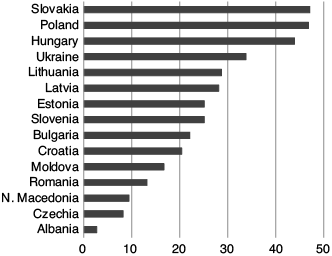
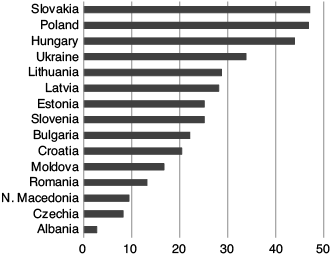
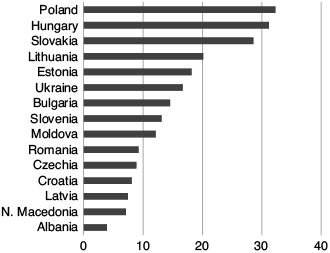
Hungary and Poland may be the most prominent cases of illiberalism in power,Footnote 33 but electoral support for illiberalism is a much more widespread phenomenon in postcommunist Europe. Figure 1.1a aggregates results for illiberal parties from eighty-seven parliamentary elections in fifteen postcommunist countries during the 2000–20 period by using expert survey data on parties’ social and economic positions. Notably, in my empirically based conceptualization, illiberal parties combined socially conservative and economically “leftist” positions, were “antiestablishment” at some – usually early – point of their development, and gained at least 1 percent of the vote. To be clear, such parties are distinct from “mainstream reformist” antiestablishment parties,Footnote 34 which take liberal economic or social positions, as well as from more traditional parties with illiberal positions, which were, however, integral to the communist or early postcommunist “establishment.” Overall, while my measure does not capture all antiestablishment and illiberal voting in the region, it does capture illiberalism with antiestablishment origins. (Appendix A details the coding procedure and lists all ninety parties categorized as illiberal in relevant parliamentary elections.) Based on this empirical and dynamic measure,Footnote 35 Figure 1.1a confirms, unsurprisingly, that illiberalism routinely gained support at the ballot box in the first two decades of twenty-first century postcommunist EuropeFootnote 36 – a quarter of the vote (24.4 percent), on average. More puzzlingly, however, the figure shows considerable variation across the region – while illiberal parties were most viable at the ballot box in Slovakia, Poland, and Hungary,Footnote 37 they were somewhat less electorally successful in Estonia, Slovenia, and Bulgaria, and significantly less so in Romania, Czechia, and Albania.
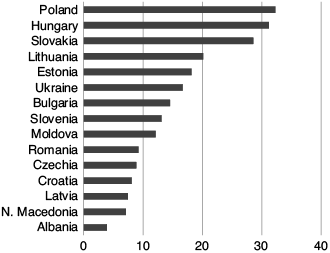
Illiberalism and post-neoliberal populism in Eastern European parliamentary elections, 2000–20.
Illiberalism, average vote share.
Post-neoliberal populism, average magnitude.
If Figure 1.1a illustrates that support for illiberalism varied across contemporary postcommunist Europe, Figure 1.1b shows that so did the salience of post-neoliberal populism – a related but distinct category, which I understand as a highly adaptive challenge to the neoliberal doctrine “that market exchange is an ethic in itself.”Footnote 38 As I have defined it in prior work, post-neoliberal populism is a family resemblance concept that integrates various interactive dimensions of contemporary antiestablishment actors. As an empirically based construction, it is specifically grounded in economic statism while, however, also incorporating sociocultural conservatism as well as personalism and outsiderness relative to party systems as two strategic-organizational attributes of those disputing neoliberalism.Footnote 39 There are three reasons why the multidimensional concept of post-neoliberal populism is particularly useful for making sense of the illiberal challenge in contemporary Eastern Europe. First, given that not all populism is critical of the free market,Footnote 40 a subtype centered on economic statism foregrounds the high salience of material questions in the region. Second, as it is sensitive to adaptations in terms of organizational strategy without ignoring programmatic positions, the concept reflects aspects that endow modern populism with efficacy and contrarian credibility.Footnote 41 Third, from a methodological perspective, the category of post-neoliberal populism offers an additional empirical baseline for assessing the illiberal challenge.
More concretely, Figure 1.1b ranks Eastern European countries by the average magnitude of post-neoliberal populism as a distinct measure based on weighting by vote shares the intensity of relevant parties’ programmatic and strategic-organizational attributes.Footnote 42 Like the measure of illiberalism, the measure of post-neoliberal populism not only excludes “traditional” parties from the 1990s but also captures evolution over time based on multiple expert survey waves and my own coding of dynamic organizational attributes. Most importantly, and reflecting that illiberalism and post-neoliberal populism are neither identical nor conflicting concepts, Figures 1.1a and b feature both differences and similarities.
Indeed, with only two countries (Slovenia and Albania) achieving the same ranking, it should be clear that illiberalism and post-neoliberal populism are distinct from one another. The difference between the former, which weights social conservatism and economic statism equally, and the latter, which prioritizes economic statism and incorporates organizational aspects, is perhaps best seen in the case of Latvia. Because of the strong electoral performance of parties like the National Alliance (NA), which were socially conservative without, however, basing their appeals on economic statism, personalism, or outsiderness, this country ranks markedly higher on illiberalism (sixth) than on post-neoliberal populism (thirteenth). The two constructs, therefore, are not identical.
And yet the tendencies of the average illiberal vote share and average magnitude of post-neoliberal populism point generally in the same direction. Indeed, while Poland, Hungary, Slovakia, and Lithuania are in the top third, Slovenia and Bulgaria appear in the middle, and Albania, Czechia, and North Macedonia are in the last third in both Figures 1.1a and b. The rankings of most other countries are relatively stable too, with Ukraine being sixth on post-neoliberal populism and fourth on illiberalism, Estonia – fifth and seventh, Croatia – twelfth and tenth, Moldova – ninth and eleventh, and Romania – tenth and twelfth, respectively. The two measures are in fact strongly correlated (r = 0.88), thereby suggesting a crucial takeaway: The economic statism typically associated with the post-neoliberal populist critique of market liberalismFootnote 43 is a key element of democratic illiberalism in contemporary Eastern Europe.
The last point is crucial and requires additional clarification. As this study conceptualizes illiberalism and post-neoliberal populism as multidimensional concepts, it facilitates comparisons of both the interactions among and relative salience of their various constituent features. Whereas my construction of the latter category incorporates more facets, as noted earlier, both illiberalism and post-neoliberal populism include not only economically statist and culturally conservative dimensions but also – when they find themselves in a position of power – a political aspect defined by maneuvers relative to liberal democracy. While these three illiberal and populist dimensions – the economic, the cultural, and the political – can certainly have affinities for one another under some circumstances, they are, in fact, distinct and do not always go hand in hand. This, in turn, suggests that even if populist parties are economically or culturally illiberal, or both, they are not necessarily autocratic when in power. Although illiberalism is often conflated with democratic backsliding, the two come together only under some historical conditions, as the case studies of evolving institutional dynamics will convey. More relevantly for the book’s main argument, it is specifically economic illiberalism as a reaction to processes of marketization that is central to political trends across contemporary postcommunist Europe. The economic dimension is often downplayed relative to the cultural and political aspects of postcommunist populism, but it is, in fact, key for understanding developments in the region.
In sum, the popular rejection of liberalism in Eastern Europe can be understood in two related ways – (1) as the vote share of parties with socially and economically illiberal positions and (2) as the magnitude of post-neoliberal populist reactions grounded in economic statism. While conceptually distinct, these two constructs uncover largely comparable tendencies in terms of illiberal outcomes. The viability of the populist challenge, itself largely driven by economic considerations, varied widely across postcommunist Europe in the first two decades of the twenty-first century.
1.2 The Latin American Connection and the Weight of Recent History
The uneven salience of illiberal outcomes has certainly provoked the interest of many scholars, who have explained it with reference to standard factors in comparative politics. Most generally, these include (1) “demand-side” arguments focused on economics (e.g., crisis or inequality), politics (e.g., perceived corruption), or culture (e.g., attitudes against minorities); (2) “supply-side” accounts prioritizing institutions of governance (e.g., the electoral system) and representation (e.g., unresponsive parties), or voluntarism (e.g., leadership charisma and manipulation); (3) explanations emphasizing the international environment (e.g., leverage and diffusion); and (4) those underscoring how the legacies of longue-durée history shaped contemporary cleavages and institutions. As I discuss in detail and demonstrate empirically in Chapters 2 and 3, this scholarship, although offering important insights, does not explain convincingly the overall patterns of variation discussed earlier. There are three reasons for this. First, suffering from a scarcity of appropriately measured concepts, much of the literature tends to equate illiberalism with radical right parties and thus ignores the considerably more nuanced nature of developments in Eastern Europe. Second, as authors tend to focus on a limited set of troubled countries, particularly Hungary and Poland, narrowness of comparative scope often results in a fragmented view of more general institutional patterns. Third, since standard explanations ignore the crucial linkages between political agency and past legacy, they usually fail to recognize both the dynamism and historical context of illiberal outcomes.
This book overcomes such limitations by developing a theory of postcommunist European institutional development, which draws insights from the Latin American experience. On the face of it, this may seem counterintuitive – after all, the two regions are fundamentally different in terms of history, structure, culture, institutions, and international environments, and if there are any similarities, those were already analyzed in classic studies of the transitions to democracy and the market.Footnote 44 Nevertheless, subsequent scholarship has problematized the similar long-lasting effects of the neoliberal revolutions that Latin America and postcommunist Europe experienced, usually under the guidance of the International Monetary Fund (IMF), late in the twentieth century.Footnote 45 Indeed, both regions transitioned from state-led development – socialism in the East, import substitution in the South – into neoliberal regimes similarly defined by “Washington Consensus” policies of privatization, free trade, deregulation, and spending cuts.Footnote 46 Without doubt, the neoliberal revolutions followed different scenarios in the two regions. Whereas in Latin America the historically high inequality dating back to Iberian colonialism and the perceptions of exploitative international financial institutions contributed to the politicization of reforms, in the relatively more egalitarian Eastern Europe economic liberalization was enacted in a context of communist stigmatization, pressures of renewed nation-building, and EU conditionality.Footnote 47 Despite these differences, which molded divergent ideological environments where the popular reactions to market reform would later play out, neoliberalism produced large-scale popular disenchantment and raised the salience of material concerns in these two world regions.
If the economic transformation unsettled societies in Latin America and Eastern Europe, political developments reinforced historical parallels. As both regions exited dictatorial rule, democratization, often an elite-driven process, typically failed to produce institutional stability.Footnote 48 Operating within shaky party systems with weak links to organized civil society, important mainstream parties continued relying on corrupt practices of patronage and clientelism rather than prioritize building programmatic linkages with voters.Footnote 49 In turn, as citizens disaffected with the transformation became ever more suspicious of political parties and liberal democratic institutions more generally,Footnote 50 they often turned to antiestablishment entrepreneurs who denounced the entire system. In their fight against liberalism, these populist challengers operated within the ideological environments that, as noted earlier, had been shaped by prior experiences. If their illiberalism was typically associated with Bolivarian left-wing nationalism in the South, it tended to attach itself to more traditional ethnic nationalism after communism. In sum, the recent economic and political challenges of Eastern Europe mimicked and even mirrored those of Latin America, where, however, both the peak of neoliberal reforms and the populist counterreaction generally occurred a decade earlier.
What precisely does such analogousness imply, and how does the Latin American experience illuminate developments in Eastern Europe? To answer this question, I turn to the idea of critical junctures – the central concept of a research tradition traceable to Max Weber, informally launched by Seymour Martin Lipset and Stein Rokkan, and substantially developed by Ruth Berins Collier and David Collier in their landmark work on the labor movement and regime dynamics in Latin America.Footnote 51 More recently, the critical juncture framework was fruitfully deployed by Roberts in his analysis of the linkages between market reform and party system stability in that region. In his formulation, the transition from state-led development to market capitalism across Latin America constituted neoliberal critical junctures – “periods of heightened uncertainty and potential institutional discontinuity,” during which crises “can unsettle existing institutions and force actors to make contested decisions about policy or institutional innovations that have durable (though often unintended) consequence.”Footnote 52 With an emphasis on the role of political actors during such watershed moments of market reform, Roberts’ insights are especially relevant for the Eastern European context, where the choices of political elites were absolutely central for the management of early economic crises and the shaping of capitalist orders.Footnote 53 Indeed, building capitalism here was not simply a product of socialism’s end; rather, as noted by Åslund, strategic policy choices had to be made.Footnote 54 Early in the postcommunist transition, political elites exercised their agency as they followed advice, usually offered to them by international experts, to choose wisely in ways shielding neoliberal reforms from popular backlash.Footnote 55 Their policy choices, in turn, conditioned important “path-contingent” institutional legacies, as Juliet Johnson showed in her study of early economic liberalization in Eastern Europe.Footnote 56
If political agency molded neoliberal reform legacies, these legacies next shaped subsequent agents’ choices. Illiberal actors in the early twenty-first century are such ensuing agents whose options are significantly conditioned by the long-term effects of prior market building efforts. For example, as populist parties tend to be highly personalistic, their leaders played definitive roles in terms of deciding policy positions, including on the highly salient economic issues of the neoliberal era.Footnote 57 Far from random, however, these positions were strategically chosen to fit particular environments conditioned by the legacies of neoliberal reform. Yet, if such legacies shaped strategies, they did not determine them. As recognized by Kitschelt, historical legacies may explain how “parties find themselves facing specific political predicaments and opportunities,” but they do not “account for all the learning that takes place, once parties encounter new challenges of the postcommunist era.”Footnote 58 Thus, as the highly autonomous leaders of populist parties made strategic choices – often, but not always, the most fitting ones given the legacy within which they operated – they exercised their agency in the probabilistic shadow of earlier events. As legacies were both inherited from the past and constructed in the present,Footnote 59 illiberalism and post-neoliberal populism must be understood as the strategic constructions of positions most likely to be viable given the specific opportunities molded by the recent past.
1.3 Core Arguments and Contributions
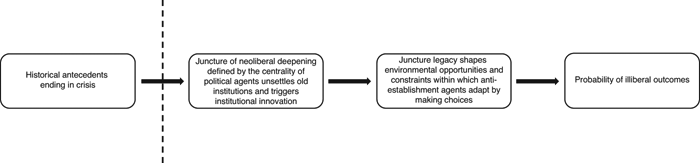
This book thus contends that illiberal outcomes in Eastern Europe are the probabilistic results of path dependencies defined by the interplay of political agency and the legacies of early critical periods of neoliberal deepening, or what I call postcommunist junctures. By using the building blocks of critical juncture analysis,Footnote 60 Figure 1.2 sketches the study’s basic explanatory framework, which I substantially elaborate theoretically in subsequent chapters (particularly Chapters 2 and 7). As postcommunist junctures resolved crises provoked by historical antecedents and triggered institutional innovation, the political agency that defined them shaped environmental opportunities and constraints within which subsequent antiestablishment agents adapted by making choices – a process that culminated in varying probabilities of illiberal outcomes. Crucially, while this framework is cross-regionally informed, it is deployed in an original manner germane to the specificity of Eastern Europe. Indeed, postcommunist junctures – conceptualized as the earliest watershed moments of neoliberal deepening after second competitive national elections (see Chapter 2) – were neither the same as Latin America’s neoliberal junctures nor did they trigger identical reactive sequences of what Collier and Collier call “institutional production and reproduction.”Footnote 61 Although historical processes in the two regions unfolded in corresponding ways, Eastern Europe experienced distinctive developments.
The basic critical juncture framework
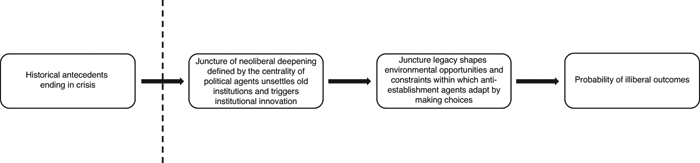
Figure 1.2 Long description
Flowchart features four blocks, linked with arrows going from left to right. The block furthest to the left is labelled “Historical antecedents ending in crisis,” and it is separated from the rest with a punctured line. The second block is labelled “Junctures of neoliberal deepening defined by the centrality of political agents unsettles old institutions and triggers institutional innovation.” The third block is labeled “Juncture legacy shapes environmental opportunities and constraints within which anti-establishment agents adapt by making choices.” The final block is labeled “Probability of illiberal outcomes.”
These developments are captured by the following core argument, which focuses on the links between leftist politics, societal coalitions, and populist strategies in postcommunist Europe. First, as the pressures of building capitalism during the early transition years forced political actors to adapt, the Left found itself at a crossroads – it could openly embrace neoliberal policies, repudiate them, or adopt a less clear position. Far from historically determined or the product of free choice, the positions leftist or labor-based parties adopted were contingent on the political roles in which they found themselves during the postcommunist juncture, when intense reforms were typically enacted in response to real or perceived economic crises. Where the Left led the parliamentary opposition at the time, the juncture was aligning – meaning that leftist parties acted consistently with ideological tenets, voiced strong opposition to neoliberalism, and generally upheld their commitment to redistribution and protectionism in the long term. By contrast, where pro-worker parties – such as communist successors or, in the case of Poland, the labor-based Solidarity – found themselves in charge of economic reform, the juncture was defined by bait-and-switch dynamics, which signaled not only broken campaign promises but also the Left’s persistent embrace of neoliberal prescriptions in the future. Where leftist parties found themselves in charge neither of the reforms nor of the parliamentary opposition – an ambiguous juncture – their positioning on economic issues was more intermediate. Crucially, as leftist parties had incentives to reproduce their positions, their stances on economic issues would persist well after postcommunist junctures.
Second, the Left’s persistent programmatic positions had serious and long-lasting political implications as the region dealt with considerable economic dislocations. As both the crises of the 1990s and the neoliberal responses to them produced uniquely negative consequences for Eastern European societies, many experienced worsening life prospects, including downward mobility, unemployment, and impoverishment, among other struggles.Footnote 62 Whereas during the communist years ruling parties could not be punished at the ballot box for their failures, postcommunist publics could vote in elections with real consequences. Of particular significance in this new context defined by both economic dislocation and democratic sanction was the positioning of the Left – the expected defender of the social segments most hurt by the neoliberal crises and shocks. Where leftist parties were positioned as credible moderators of neoliberalism, the social coalitions they represented rewarded them at the ballot box. Where they were perceived as architects of economic orthodoxy, leftist parties lost support as key constituencies in need of protection abandoned them.
Third, the relationship between the political Left and those who comprised the social coalition seeking respite from seemingly endless neoliberal adjustment mattered a great deal for the electoral prospects of illiberal or post-neoliberal populist parties. As the commodification of labor, land, and capital in postcommunist Europe provoked the rise of a reactive Polanyian countermovement, not all leftist parties could channel into the political system the demands of those seeking defense from marketization. Where such parties remained strong, the long-term loyalty of their social coalitions constrained illiberals’ electoral prospects. Where the Left crumbled, however, many victims of neoliberalism – including, among others, workers, post-peasants, lower middle-class citizens (and sometimes national capitalists)Footnote 63 – gave their votes to challengers of liberalism. As populist parties are distinguished by peculiar adaptive capacities and incentives for opportunism, they could take electoral advantage of the Left’s weakness by strategically promising statist solutions to societal problems and even enacting policies that reshaped the social relations molded by the neoliberal revolutions.
In sum, where leftist parties led the parliamentary opposition to rightist reformers during postcommunist junctures, as in Czechia and Romania, their consistent positions as credible critics of neoliberalism translated into subsequent electoral strength, which consistently constrained opportunities for illiberal success at the ballot box. By contrast, where postcommunist junctures were defined by bait-and-switch dynamics, as in Slovakia and Poland, the Left’s embrace of neoliberalism conditioned its subsequent weakening, thus enhancing chances for illiberals’ electoral viability in the long run.
Yet, if junctures of market reform triggered reactive sequences specific to Eastern Europe, they also shaped developments, which, though not identical, were highly analogous to patterns seen in Latin American countries. Once again, it was the juncture contingencies of political agency that made the difference. First, those who engaged in bait-and-switching during junctures were either standard leftist parties or populist personalists. In the first scenario, seen in Slovakia and Ecuador, subsequent illiberals mobilized highly extensive electoral coalitions centered around former leftist voters, based on which they delivered popular public goods associated with good governance – and, as a result, dominated in the long run. By contrast, where the bait-and-switching agent had been a populist personalist who politicized regional divides, as in Poland and Peru, ensuing illiberals mobilized considerably more segmented electoral coalitions, based on which they governed less cohesively and effectively – a reason why they failed to be as dominant. Second, anti-neoliberal protest was only sometimes institutionalized during junctures. Where this happened, as in Poland and Ecuador, subsequent radicalism and party system upheaval amid the solidification of the neoliberal consensus incentivized illiberals to adopt contestatory strategies vis-à-vis liberal democracy. Where, by contrast, anti-neoliberal protest was not institutionalized during the juncture, as in Slovakia and Peru, the subsequent weakness of radical alternatives and relative party system stability encouraged illiberals to embrace moderation.
As it approaches both regional distinctiveness and cross-regional parallels from a perspective preoccupied with the general historical context defined by momentous neoliberal deepening and its legacies, this comparative study makes theoretical, methodological, and empirical contributions to critical juncture research. First, it adds to theoretical debates in three ways – (1) by extending to the postcommunist European region a framework that conceptualizes concrete periods of market reform as critical junctures; (2) by developing, based on Eastern European cases, a more nuanced understanding than prior research of how political agents acted during these junctures and adapted thereafter, and then applying the refined theory back to Latin American cases; and (3) by integrating the oft-debated aspects of agency and legacy into a common causal mechanism.Footnote 64 Second, from a methodological perspective, I avoid the “inevitability framework” usually associated with the determinism prevalent in historical institutionalismFootnote 65 by accommodating voluntarism and demonstrating – with a combination of qualitative and quantitative techniques – probabilistic causality. As I show, even though junctures imposed certain restrictions on the subsequent choices of agents,Footnote 66 their legacy “entails causal patterns that are strong enough to yield a substantial interval of persistence, yet are not fully deterministic.”Footnote 67 Third, the study advances empirical knowledge by developing and analyzing data that substantiate how the linkages between junctures and illiberal outcomes materialized in the reality of Eastern Europe in ways both unique and analogous to Latin American experiences. The following section discusses considerations of methodological nature.
1.4 Research Design
1.4.1 Mixed Method Empirical Approach
To investigate empirically the linkages between agency and legacy from a perspective that incorporates intra-regional and cross-regional comparisons, this book combines qualitative and quantitative methodological approaches. The various analytical techniques and wide array of data used offer considerable leverage in terms of making sense of the varying causes, effects, and processes associated with critical junctures. Generally, the logic of inquiry involves three major steps. First, having developed a new theory that accounts for the variation identified earlier, I deploy large-N analysis to perform an initial plausibility probe vis-à-vis alternative explanations of illiberal outcomes. Second, as the findings from these tests support my theory, I next scrutinize causal mechanisms by tracing historical processes in four Eastern European countries (Czechia, Poland, Romania, and Slovakia) that exhibit crucial variation in terms of key explanatory factors. Third, after elaborating the critical juncture framework based on insights from postcommunist Europe, I assess the cross-regional validity of the refined theory by tracing processes in two Latin American countries (Ecuador and Peru).
In terms of scope, the book covers developments up through 2020, a year after which Eastern Europe faced new and dire challenges – the peak of COVID-related casualties (2021) and the start of the war in Ukraine (2022) – whose ramifications on political trajectories are yet to be understood. Additionally, as I analyze postcommunist junctures’ electoral effects during the first two twenty-first century decades, I focus on countries considered to have consistently held relatively meaningful democratic electionsFootnote 68 and safe from serious statehood challengesFootnote 69 in the aftermath period between 2000 and 2020. As a result, the large-N study assesses developments in 130 parliamentary elections, eighty-seven of which took place in the twenty-first century, from 1990 to 2020, in the following fifteen postcommunist countries: Albania, Bulgaria, Croatia, Czechia, Estonia, Hungary, Latvia, Lithuania, Moldova, North Macedonia, Poland, Romania, Slovakia, Slovenia, and, until 2012, Ukraine.Footnote 70 As it renders a sufficiently large number of observations to be analyzed by means of standard statistical techniques for cross-sectional and time series data, this broad empirical scope facilitates the identification, in Chapter 3, of strong correlational patterns that invite further investigation in case studies.
1.4.2 Case Studies
To assess causal inferences and the validity of mechanisms in a more focused manner, this study engages in qualitatively driven and quantitatively informed comparisons that emphasize both similarities and differences on two levels – intra-regionally and cross-regionally. Beginning with the within-regional assessment, I trace processes in Slovakia, Poland, Czechia, and Romania – a choice driven by several methodological factors. To begin, and incorporating insights from both Evan Lieberman and Sidney Tarrow, these four cases, nested in the statistical tests, are grouped in two pairs – the first two versus the latter two just mentioned – that are strongly representative of contrasting tendencies in terms of both theoretical predictions and statistical findings.Footnote 71 Indeed, as Slovakia and Poland experienced a type of postcommunist juncture opposite to that seen in Czechia and Romania, illiberal outcomes in the former two countries were significantly more viable than in the second pair.
Furthermore, these four cases represent a wide variation in terms of the theoretically consequential agency – that is, of labor-based or leftist actors, as explained in Chapter 2 – during critical market reform periods. For example, whereas in Poland the agent bearing the main political responsibility during the juncture was a labor-based personalist, in Slovakia this role was played by the ex-communist party. And if in Czechia and Romania crucial economic liberalization was enacted, respectively, by more and less cohesive right-leaning coalitions, opposition to reforms was led by social democrats with noncommunist roots in the first case and by ex-communists in the second.Footnote 72 Moreover, as the four countries feature both developmental similarities (e.g., imperial domination, EU membership, and even, in the Czech and Slovak cases, common statehood during most of the twentieth century) and, as detailed in Chapter 4, considerable differences in terms of historical antecedents (e.g., pre-communist and communist experiences),Footnote 73 transitions out of communism, and crises preceding junctures, the four-way comparison helps to evaluate a range of competing hypotheses, including those prioritizing distant history, as discussed in Chapter 6.
In addition to providing opportunities to assess the book’s core theory, the case studies of Eastern European historical trajectories also offer insights that facilitate refining it. Indeed, while Slovakia and Poland featured the basic building blocks and path-dependent linkages underpinning the theorized core causal mechanism, as I show in Chapter 5, reactive sequences in these two cases were far from identical. Even though both saw quantitatively high illiberal outcomes at the ballot box without undergoing significant democratic erosion (as in Hungary),Footnote 74 the two countries still had qualitatively different experiences with illiberalism. For example, whereas Slovakia’s leading illiberals dominated politics in the long term while embracing a strategy of relative moderation, Poland’s failed to be as dominant, yet they seriously contested liberal democracy. It is based on these two case studies that I refine the theory by linking nuanced differences between generally similar junctures to the peculiar institutional environments to which illiberals adapted via strategic choices in the aftermath period.
Having elaborated, in Chapter 7, how the contingencies of agency – both in charge of and against neoliberal reforms – during junctures shaped durable path dependencies in Eastern European countries, I test the validity of the refined framework by tracing processes in two Latin American cases – Ecuador and Peru. Although these two comparable Andean countries saw, after similar neoliberal junctures, an upsurge of electoral support for post-neoliberal populist projects that neither originated as bottom-up movements (as in Bolivia) nor consolidated authoritarian rule (as in Venezuela), their experiences with illiberalism diverged widely. If the leading illiberal project of Ecuador was both hegemonic and contestatory vis-à-vis liberal democracy, its Peruvian counterpart both moderated and disintegrated. As demonstrated in this paired comparison – which adds to previous scholarship by offering, in Chapter 8, an innovative reinterpretation of developments – the nuanced contingencies of neoliberal junctures shaped varying illiberal tendencies in ways strikingly parallel to those seen in Eastern Europe. Obvious regional specificities notwithstanding, the linkages between critical periods of economic liberalization and subsequent political developments were historically grounded in analogous ways.
1.4.3 Data
The study draws on a large body of data that generally fall into three categories. First, I use the specialized secondary literature on (1) historical institutionalism; (2) Eastern Europe, with a particular attention to Czechia, Poland, Romania, and Slovakia; and (3) Latin America, especially Ecuador and Peru. Second, the project extensively employs available quantitative data, which are too many to list here and which I discuss, usually in footnotes, in the course of the book. Briefly, I constructed key variables by relying on economic, national election, and expert survey data, which have many advantages for “measuring empirical information on policy positions across a wide range of countries,”Footnote 75 and I conducted empirical tests by utilizing a large variety of data on economic, political, societal, institutional, and international developments, available from reputable international and research organizations. Crucially, I also developed new datasets in order to assess illiberalism, post-neoliberal populist magnitude,Footnote 76 and party system volatility in postcommunist Europe. Likewise, to measure the territorial extensiveness of electoral coalitions – or party nationalization – in Slovakia, Poland, Ecuador, and Peru, I assembled a dataset based on subnational-level election data obtained from central electoral bodies and previous research.Footnote 77 Constructed by following Daniel Bochsler’s mathematical method for calculating weighted Party Nationalization Scores (PNSw),Footnote 78 this dataset helps me assess the relative coalition extensiveness of all political actors competing in all national elections from the transitions to democracy to the year 2020 in the four countries at the core of the cross-regional comparisons.
Third, these four case studies are significantly informed by extensive fieldwork. Specifically, I travelled to Krakow and Warsaw in Poland, Bratislava in Slovakia, Lima in Peru, and Quito in Ecuador, where, in 2015 and 2016, I conducted a total of 101 interviews with individuals involved in or impacted by the processes I study.Footnote 79 In each country, I carried out between twenty and thirty interviews ranging from thirty minutes to over three hours, attended party meetings, and visited with numerous individuals willing to share with me memories and interpretations. While I cite them in the case studies, the most crucial function of these “refracted context” interviews is to inform my comprehension of historical processes through the reconstruction of “narrative structures” and the uncovering of “landscapes of meaning.”Footnote 80 All interviews, listed in Appendix B, were semi-structured yet open-ended in order to give interlocutors opportunities to discuss their own opinions and understandings.
Although I conducted interviews based on nonrandom “convenience sampling” due to my research priority – “to gain information about context, process, and mechanism”Footnote 81 during a finite time in each country – I nevertheless maximized diversity of perspectives by talking to a wide range of individuals, as recommended by qualitative methodologists.Footnote 82 My informants thus included those of various economic circumstances and educational levels, women, who constituted about one-third of interviewees, and a number of young and older adults. Furthermore, as I explored linkages between political adaptations and societal forces, I interviewed at both the elite- and non-elite levels. Consequently, interviewees can generally be divided into three categories – (1) national-level politicians, including parliamentarians, former presidential candidates, and ministers; (2) experts such as social scientists, journalists, high-level government officials, and leaders of nongovernmental organizations; and (3) regular citizens, most of whom were political activists and some of whom had experience in local-level politics. These categories, however, are not strict, as a number of individuals belong to more than one. Whereas national-level figures typically expressed comfort with their names appearing in this project, all others were guaranteed confidentiality.
Finally, in my quest for balanced insights into the divisive political phenomena I study, I interviewed both supporters and opponents of leading illiberal or post-neoliberal populist projects. While I was in the field at a point when such phenomena were similarly salient in postcommunist Central Europe and the Andes, however, my interview schedule reflected adjustments based on the particular political circumstances of each country at the time. For example, as my trips to Slovakia (2015) and Ecuador (2016) coincided with the last year during which illiberals ruled with legislative majorities, in these countries I interviewed equal shares of pro- and anti-government individuals. I did the same in Peru but, since my visit here (2015–16) was at a time when the leading post-neoliberal project was disintegrating irreversibly, opportunities to engage with activists committed to it were diminishing. And as my trip to Poland (early 2015) was during a period when PiS, then in opposition, was actively organizing to recapture national power, here I interviewed the largest number of individuals aligned with illiberalism. Indeed, this was especially helpful for understanding developments in the Polish context since PiS, being the only explicitly rightist, and indeed anti-communist, illiberal project under study, was the least likely case of a post-neoliberal critique of capitalism. Overall, then, rather than being randomized and identical, the groups of individuals I interviewed in each country facilitate making sense of political processes in specific contexts,Footnote 83 while still representing a reasonable diversity of views.
In sum, the study uses a wide variety of methods and data, both quantitative and qualitative, in order to develop, test, and elaborate its core theoretical claims. As this mixed method approach is used to both make sense of path-dependent developments in Eastern Europe and draw cross-regional parallels with Latin America, the book offers a truly innovative perspective on comparative research in the critical juncture tradition.
1.5 Organization of the Book
The study is structured in three main parts. The first revolves around “big picture” theoretical and empirical considerations. Having presented the main puzzle and overall framework above, in Chapter 2 I discuss relevant prior work on historical legacy, agency, and illiberalism; develop, by drawing on both Polanyian scholarship and the Latin American experience, an original theory that links agency and legacy; and identify postcommunist junctures in fifteen Eastern European countries as well as the causal mechanisms that the theory posits. Chapter 3 offers a quantitative analysis, which includes the development and assessment of key variables; a demonstration of how empirical linkages between variables support the core theoretical propositions; and a discussion of why my argument is superior to alternative explanations of illiberal voting.
Having found strong correlational patterns in support of the main theory, in the second part of the study I trace processes in the four Eastern European case studies by following the conventions of critical juncture analysis.Footnote 84 By comparing historical antecedents, crises, and postcommunist junctures in Czechia, Poland, Romania, and Slovakia, Chapter 4 demonstrates that junctures indeed unsettled prior institutions and constituted moments of significant change. While Chapter 5 uncovers overall similarities in terms of the general mechanisms linking bait-and-switch junctures to the electoral viability of illiberalism in Slovakia and Poland, it also shows that reactive sequences in these two countries were, in fact, not identical. Chapter 6 traces how opposite junctures to those seen in Slovakia and Poland tended to produce persistently lower likelihoods of illiberal voting in Czechia and Romania; reassesses, based on the four Eastern European case studies, the soundness of the core theory relative to standard explanations; and concludes by briefly discussing how developments in the rest of the region also validate the theory.
If the book’s first two parts focus on Eastern Europe, the third offers a cross-regional perspective. In Chapter 7, I refine the theoretical framework by focusing on the long-term effects of the more nuanced differences between otherwise similar junctures in Slovakia and Poland; justify a comparison involving Ecuador and Peru; and discuss why standard explanations of dominant illiberalism and contestatory illiberalism do not sufficiently account for tendencies in these four countries. Chapter 8 then traces processes in the two Andean countries and discusses how developments and patterns there were analogous to those seen in Eastern Europe in ways anticipated by the refined theory. Chapter 9 closes the book by briefly discussing its main findings, its implications regarding Polanyian scholarship and the dual transition to democracy and the market after 1989, and its relevance for discussions about neoliberalism, illiberalism, and the Left.