

Introduction
‘When things go astray, other things can happen. We have a future …’Footnote 1
– Sara Ahmed
The question of political change – how the nature and distinguishing features of orders persist or change – is an enduring puzzle in international theory. Scholars have approached the subject from many angles and from many different theoretical perspectives. Research has traditionally focused on the most significant actors in world politics: the sovereign state and the institutions and norms through which ‘the world hangs together.’Footnote 2 Recently, there has been growth in research that examines the question of change as one of micro-politics.Footnote 3 The focus here is on how order is enacted through everyday practices.Footnote 4
The purpose of this essay is to contribute to these debates through two burgeoning scholarly realms: ritual and emotion. We do so by exploring how emotions are central to how rituals either affirm and entrench or, conversely, transgress and transform political orders.
The significance of rituals and processes of ritualisation has emerged as a new field that offers valuable insight into world politics. Traditionally seen as part of the sacred, magical, and supernatural, rituals are now recognised as essential components of social life and of all modern political systems.Footnote 5 International Relations scholars are increasingly drawing from these literatures and now describe the realm of world politics as ‘replete with rituals.’Footnote 6 The politics of rituals is evident in parliamentary procedures and diplomatic protocols, ranging from handshakes and gift-giving to formal state dinners and photographs with leaders. Beyond these seemingly ordinary gestures, rituals are seen as central to how key institutions of world politics function. Examples here include independence declarations by secession movements, the use of deterrence strategies by states, or the functioning of the United Nations and international law.Footnote 7 In these realms, rituals are taken to be ‘special’ social practices that actors instinctively fall back-on and enact almost intuitively.Footnote 8 In this way, and through their familiar, habitual, and repetitious nature, rituals are performative interaction practices that negotiate and enable social and political life.Footnote 9 Crucially, by privileging particular meanings, attachments, allegiances, and boundaries, rituals possess immense power. They enact and bestow authority, providing – and typically affirming – political order.
While the political significance of rituals is increasingly under investigation, exactly how rituals work to create, consolidate, or transform power, authority, and order is yet to be fully appreciated. Rituals are seen as symbolic behaviours that possess a calming and habitual magnetism, providing a social ‘anchor’ that instils certainty and security for those who perform them.Footnote 10 Scholars then unravel how this very lure lies in the meaning that rituals both emerge from and constitute.Footnote 11 What is more, though, is that ritual practices provide the context for political actors – individual or collectives – to perform. This is important for understanding the lure of rituals because it is through the performance – the embodied ‘doing of things’Footnote 12 – that ideas, values, attachments, and, in turn, political boundaries and orders become tangible.Footnote 13
Addressing and further probing these processes, we develop a broad argument about the links between emotions and rituals. We proceed in two steps.
First, we show how emotions are central to the symbolic, instinctive, and performative nature of political rituals and thus also to the political orders that rituals enact. Emotions and their more ephemeral affective dispositions and resonances are part of what make ritual practices especially powerful. Emotions embody the meanings and senses associated with ritual practices. They create ways of feeling and knowing and doing that attach individuals and collectives and provide a powerful sensory proclivity towards the respective ritual and the power relations at stake. In this way, emotions are bound up in the larger governing structures and institutions that rituals support, maintain, and legitimise.
Second and primarily, we demonstrate that emotions are also central to understanding how rituals can disrupt and transform order. To think so appears counterintuitive at first, for it is natural to think of rituals as being associated with tradition, with time-honoured processes and patters. This is as much the case in everyday thinking as in much of the academic literature, which tends to focus on how rituals bolster order. But there is meanwhile a growing body of knowledge, which we draw on, that focuses on ritual disruption and on occasions when rituals go wrong.Footnote 14
We then advance a more specific argument: that discomfort is important for understanding how ritual and political change take place. Being unsettled can shift collective feelings which, in turn, can uproot political habits and structures. Individuals and groups can feel differently and, in doing so, stimulate discontent and contravene emotional norms. New beliefs and values emerge and can then disrupt established rituals. It is in this way that emotions and their more intangible affective energies generate political change. Such change can go in all political directions – towards democratic inclusion or towards populist authoritarianism, for instance. In either case, the related affective agency is important for understanding how rituals – and the political orders they manage and sustain – are enacted and can shift over time.
We develop our arguments by building on existing work on emotions and rituals. We do so with the hope of making a two-part contribution to this body of scholarship. First, we draw on insights from a wide range of different disciplines to offer a systematic step-by-step analysis of the links between rituals, emotions, and political change. Existing contributions in International Relations, sophisticated as they are, tend to either examine emotions as part of broader engagements with ritualsFootnote 15 or, alternatively, analyse rituals as part of broader engagements with emotions.Footnote 16 Those studies that focus on emotions and rituals tackle specific issues, such as the role of atmospheres, protest movements, or militarism.Footnote 17 We hope that our concerted synthesis of these and other studies allows us to carefully map out the crucial role of emotions and, in doing so, be of interest to both specialists on rituals and, just as importantly, general readers who remain to be convinced of the central role rituals play in international politics. Second, we draw on historical and contemporary examples to make what we think is an important methodological point. Rituals often work through bodily movements and the collective emotions that these movements generate. This is why rituals tend to be seen, at least initially, as local and thus of seemingly little relevance to International Relations. But the performative nature of rituals can easily provide them with a reach that goes well beyond their everyday origin. Such links between local and global, micro and macro, are important for understanding how rituals work. This is why we illustrate our arguments not only through examples that are of an explicitly international nature – such as global sporting events or changes in humanitarian norms and policies – but also through rituals associated with seemingly apolitical everyday practices, such as breastfeeding and mothering. By broadening our understanding of the international and the sources used to investigate it, we hope to show that it is thought a wide range of rituals – and the performative circulation of them – that political orders are enacted and transformed.
The essay is structured as follows: We first define what rituals are and how they differ from broader habits and practices. We then briefly introduce the literature on rituals, outlining their ordering effects and the significance of emotions. We do so in relative detail to provide readers who are unfamiliar with these topics a chance to follow our argument. In the core part of our essay, we examine the disruptive capacities of rituals and their ability to generate social and political change. We focus on how being unsettled is essential to generating change and how the very power of rituals to enact and entrench political orders offers disenfranchised individuals and groups an ideal opportunity to challenge these orders. We conceptualise the ensuing agency as processes that link the local with the global through a slow transformation of values and political orders. In conclusion, we reflect on the normative implications that an appreciation of the productive nature of rituals and emotions holds for the study of world politics.
Before commencing, a brief disclaimer is in order. Our contribution is of a conceptual, not an empirical nature. We illustrate our analysis through examples, but our goal is to provide a theoretical foundation – and a compelling rationale – for further work on how links between rituals and emotion can shed light on how political orders change. We provide this contribution by bringing together bodies of literature that have so far existed in relative isolation from each other, most notably contributions on affect and emotion, everyday practices, ritual theory, order, gender, race, resistance, and change. Drawing linkages across these fields of inquiry inevitably means that we will be unable to comprehensively survey disciplinary debates, including those in International Relations and those that examine variations in rituals and the manner they operate. Many important contributions will thus remain unaddressed, which is a trade-off that accompanies cross-disciplinary inquiries.
Defining rituals and their interaction with habits and practices
The human desire for rituals runs deep. As Tom Driver puts its, ‘Rituals belong to us … the human choice is not whether to ritualise but when, how, where, and why.’Footnote 18 Rituals bring people together and also organise societies through several distinct but intersecting and compelling means. The rhythms and routines of ritual practices provide individuals with essential purpose and meaning and thus comfort and stability. Seemingly trivial rituals – such as attending a weekly religious service, marking a wedding anniversary, celebrating a child’s graduation, or making a traditional Thanksgiving pumpkin pie – ground and enable individuals to situate themselves within a social, collective context.Footnote 19 Perhaps, the simplest way that rituals do this is by providing an indication of the most cherished values and beliefs that we – as individuals and as members of a community – aspire to and live by.
Before moving on, it may help to focus more closely on what is meant by ‘rituals,’ ‘ritual practices,’ and processes of ‘ritualisation.’ How do rituals differ from broader practices and how is ritual theory applied to the study of international relations? In this and the next section, we define rituals and explore the links between rituals, power, and order.
Numerous scholars stress that there is no singular or objectively ‘real’ characteristic that defines a ritual.Footnote 20 Catherine Bell thinks of rituals as a spectrum of ‘distinctive social practices.’Footnote 21 This approach has been adapted by several International Relations scholars, such as Ty Solomon, Stephan Baele, and Thierry Balzac, who write of ‘kinds and degrees of ritualization.’ They define rituals in a ‘minimal’ way, following David Kerzer’s influential work, as ‘symbolic behaviour that is socially standardised and repetitive.’Footnote 22 In this sense, rituals have a lot in common with broader habits and practices, which is why we draw on the respective literatures in this essay. Emanuel Adler and Vincent Pouliot, for instance, write of practices as ‘socially meaningful patterns of action,’ stressing their ‘performative’ dimensions and how they display ‘regularities over time and space.’Footnote 23
Adapting such a broad understanding of rituals comes with risks. A frequent objection to ritual analysis, Collins point out, is that they are seen as omnipresent. Critics stress that ‘if everything is a ritual,’ the concept becomes largely meaningless.Footnote 24 Colins readily admits to being ‘one of the worst sinners’ in this regard. He sees rituals almost everywhere but takes this as an indication of how central shared symbolism is to human action and interaction.Footnote 25
To mitigate the risks of an overly broad definition, we draw a clear distinction between rituals and broader routines, habits, and practices. Rituals, the way we define the term, have a symbolic and special status that sets them apart from ‘normal’ social practices. They involve particular ways of ‘doing things’;Footnote 26 a kind of ceremony that enacts a powerful social symbolism and generates individual and collective reverence.Footnote 27 Bell writes of practices specifically ‘designed and orchestrated to distinguish and privilege what is being done in comparisons to other, usually more quotidian activities.’Footnote 28 Maria Mälksoo, likewise, insists on distinguishing rituals from ‘habitual practices’ by stressing the symbolic, rule-governed, and performative dimensions.Footnote 29 For Deborah Gould, rituals in this way possess an ‘almost sacred quality’ that creates ‘a more meaningful existence.’Footnote 30
We employ three categories designed to make an analytical distinction between rituals, habits, and practices. First are rituals per se, which are the focus of our article and which stand out through their special and symbolic quality and through the collective emotional intensity that comes with them. Second are what could be called vestigial rituals, which are habitual practices that, over time, lost the special and symbolic nature that makes them stand out as rituals. We outline, for instance, how certain practices, such as breastfeeding and mothering, can shift back and forth between the first and second categories depending on the context within which they take place and the symbolic meaning that ensues. Third are the many practices that might be habitual and repetitive but do not possess the catachrestic of rituals. These include daily personal ‘rituals,’ such as drinking a cup of coffee or brushing one’s teeth. They also, and particularly, include practices in international relations – from military exercises to diplomatic negotiations – that are routinised, socially meaningful, and politically influential but are not imbued with the typical features that make rituals stand out as special and symbolic.Footnote 31
Ritual, power, and order in International Relations
The prevailing approach to rituals – shaped by Emile Durkheim’s pioneering work – emphasises their unifying function. By enacting socially symbolic meanings, individuals participate as part of a wider collective that honours not only the respective ritual but also the worldviews it enacts. This produces attachments and detachments between individuals, which in turn installs ‘barriers to outsiders’ that create boundaries of inclusion and exclusion.Footnote 32 Durkheim stresses that it is ‘by uttering the same cry, pronouncing the same word, or performing the same gesture in regard to some object that [people] become and feel themselves in unison.’Footnote 33
Given the well-recognised unifying function of rituals, it is not a large leap to hypothesise that ritual practices also animate, cohere, and abet order in politics. But what is the exact relationship between rituals and power and the authority required to maintain order?
International Relations scholars have offered insightful answers to these questions by presenting rituals as habitual but special practices that bind people together and shape how communities behave and ‘act out’ their identity, authority, and power.Footnote 34 Rituals in international politics can thus be considered as symbolic rites and routines that are established over time and that condition the interaction and behaviour of states and other international actors. From individuals in local communities to high-level diplomatic exchanges, rituals provide what Baele and Balzacq call a ‘logic of integration.’Footnote 35 The respective practices frame and guide how social and political relations are to take place. In this sense, they can be likened to what scholars in other fields, such as psychology, call ‘organization rituals.’Footnote 36 Political rituals comprise planned or involuntary behaviours that act out meanings and symbolisms. Over time and through repetition and social acceptance, practices that are ritualised instil and routinise values, beliefs, meanings, and ways of perceiving and doing things, including generating policy.Footnote 37 Those practices provide individuals and wider communities and polities with comfort, predictability, and stability – and thereby also a sense of security.Footnote 38
Political rituals thus generate not only a common bond and purpose but also a compelling ordering influence. To be clear, political order in this context is understood broadly, as a set of structured social relations that govern and enable actors of various types and on various political levels to co-exist, and to do so with a certain degree of regularity and predictability.Footnote 39 These ‘patterns’ and ‘structures’ loosely encompass the established and legitimised codes, symbols, beliefs, values, and norms by which a society and its members form meaning and typically abide with and function. The type of society at stake may be very small, as compact as a family or a local community, or as expansive as those existing in national and international arenas. The nature of an order might be formal or informal, thick or thin, codified or loosely arranged.Footnote 40
The ordering capacities of ritual practices emerge from establishing forms of normative and behavioural regularity and expectation. The repetition of symbolic acts is central to cementing this ordering process. Rituals perform the symbolic gestures that distinguish and define a community and its polity. Examples abound, ranging from national commemorations for past wars to ceremonial diplomatic exchanges or statements.
A national flag raising ceremony offers a particular apt illustration. When raising a country’s flag, citizens typically stand to attention and, depending on the circumstances, may also sing the national anthem in unison (Figure 1). If performed by soldiers in uniform, they would salute the flag. To an alien outsider, a flag would likely be seen simply as a piece of colourful fabric. Yet, we all know that a flag is a unifying symbol of shared citizenship and belonging. Standing rigid to watch in respect is the bodily ritual enactment of such belonging and implicitly demands loyalty.Footnote 41
U.S. Marines and sailors saluting during the singing of the National Anthem as part of a memorial ceremony on the flight deck of the USS Makin Island on 8 Oct 2024. Reproduced under Creative Common Attribution via Wikimedia Commons.

In this way, rituals are intrinsically linked to power and authority. Implicitly commanding normative adherence and respect, rituals are deeply implicated in the contest for, and production of, social dominance and political power. Some scholars, including Kathryn McClymond, go as far as suggesting that power is what is principally at play in the adoption and performance of rituals. She believes that rituals establish and reinforce power relationships because they are ‘often deployed as a means for one group to establish its dominance over other groups.’Footnote 42
The struggle over rituals then becomes a struggle for power – a struggle over what rituals prevail, how they are practiced, and how they confer or exercise authority.Footnote 43 Established rituals – and especially the rituals that endure for long – can therefore be perceived as an indicator of the prevailing social and political dynamics and order at stake: who or what has power and with what effects. Rituals bring to light dominant constellations of power and ensuing order.
Recent research has homed in on the power of rituals by examining international practices that legitimise the prevailing mode of political governance and authority in world politics: the sovereign state. Rituals are here seen to ‘diffuse internal tensions and secure political hegemony.’Footnote 44 Jorg Kustermans, for instance, examines the relational dynamics through which diplomatic gift-giving ‘renders international authority palatable,’ legitimising not only the state system but also the hierarchical arrangement of states.Footnote 45 Maria Mälksoo considers rituals central to the effectiveness of deterrence strategies applied by states.Footnote 46 Nicole Wegner stresses the underlying role that rituals play in legitimising and sustaining militarism in today’s societies.Footnote 47 Zohar Kampf and Nava Löwenheim look to ‘rituals of apology,’ showing how they reproduce identities and established security discourses.Footnote 48 Tom Bentley and John Hutchinson, likewise, investigate how colonial apologies and the commemoration of wartime sacrifice can ritualise and reproduce the existing global order in which states, even when unjust, reign supreme.Footnote 49 Shirin Rai looks at the institutional spaces that sustain procedural aspects of politics, showing how an analysis of legislative rituals provides a valuable place to appreciate the linkages between power and contentious domestic and foreign policies, such as territorial (and colonial) conquest and forms of exclusionary nationalism.Footnote 50
At stake here, to be clear, is discursive and productive power: a type of power that shapes what is possible and what is not.Footnote 51 Rituals provide the symbolic structures through which political life and relations are made meaningful and coherent. Through routinised performances – the rituals we enact and ultimately live by and through – order is established and ‘power becomes invisible.’Footnote 52 It is a form of power that negotiates and upkeeps a group’s ritual practices and, with them, the understandings, identities, social relations, and organising political arrangements that the respective rituals support. An appreciation of these linkages – between rituals and power – adds to understandings of the social processes through which political orders are produced and enacted through practices.
Emotion and ritual: sustaining orders through collective feelings
So, rituals matter and they matter politically. Few scholars would contest this observation. But there is one crucial dimension of the politics of rituals that has only recently received sustained attention by International Relations scholars: the role of emotion.
In the next few sections, we now aim to outline, in a step-by-step manner, why exactly emotions are central to how rituals work politically. We first explore how emotions – and their more ephemeral affective dimensions – are part of the social processes through which rituals politically unify. We then focus in more detail on how affective energies associated with rituals can also transgress and transform political authority, power, and ultimately order.
We use the concepts of emotion, feeling, and affect relatively loosely, in part, because we want to rely on everyday language, in part, because we agree with scholars who consider the related phenomena as distinct but also interwoven.Footnote 53 We do, however, generally adhere to conventions that refer to emotions as the conscious, cognitive manifestation of feelings that can be identified, analytically separated, and examined as such. Affect, by contrast, relates to the more ephemeral and perceivably non-representable feelings and sensations experienced in our bodies and our minds.
Rituals – and the solidarity and belonging rituals create – are experienced through feelings, which grow powerfully when shared in a group. One can find engagements with emotions in some of the early ritual theory. In one of the first sociological studies of rituals, Erving Goffman recognises how affective states distinguish and constrain individuals in the everyday rituals they engage in.Footnote 54 Randal Collins extends this engagement and outlines in detail how the symbolic value of ritual practices is fuelled by an ‘emotional significance’ that gives individuals ‘a special kind of … emotional energy.’Footnote 55 This emotionality is not tied to individuals but circulates through shared practices, producing an ‘emotionally charged interdependence’ that can mobilise a collective towards particular ends.Footnote 56
International Relations scholars have, likewise, started to offer insightful analyses of the links between emotions and rituals. Tanja Aalberts and colleagues stress that ‘rituals engage affects … as a core means of communication and subjectification.’Footnote 57 Focusing on face-to-face diplomacy, Seanon Wong examines how political leaders aim to achieve specific objectives by manipulating the performance of rituals.Footnote 58 Maria Mälksoo suggests that ‘affective investments’ are central to the ‘effectiveness’ of a ritual in terms of unifying participants.Footnote 59 Following this line of inquiry, Marina Lambert examines how affective rituals shape notions of European identityFootnote 60 and Simon Koschut looks at how rituals and emotions generate a sense of community among members of the North Atlantic Treaty Organization.Footnote 61 Ty Solomon, in turn, examines how ritualised atmospheres shaped the Black Lives Matter Movements.Footnote 62 These and an increasing number of other contributions build on the meanwhile extensive body of literature on the role of emotions in international relations. Although we are unable to survey this sophisticated field, we accept one of its key premises: that ‘emotions matter’ and that an important task ahead for the field is to scrutinise how exactly they matter and to examine the processes through which emotions work and function socially and politically.
A key insight that has emerged here is that emotions are central to the unifying role rituals play. This is the case because emotions not only make the respective ritual the ‘special’ practice that it is but also enable individuals to experience, make sense of, and situate themselves in the world around them. Baele and Balzacq go as far as to suggest that emotions are the ‘main driver’ in the performance and shared meanings of rituals. The unifying nature of rituals amplifies ‘shared experience through the development of a communion among participants and the creation of emotional bonds.’Footnote 63
The special and symbolic character of rituals can, in turn, generate collective feelings in ways that are hard to achieve through non-ritual practices. Rituals elevate normal habits out of their mundane setting and provide them with an emotional intensity that becomes infectious and connects people across differences that would otherwise set them apart.
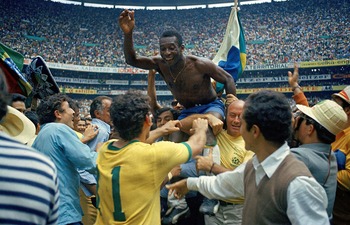
Major global sporting events illustrate this unique relationship between emotions, rituals, and order. To barrack for a national football team, Tim Aistrop points out, involves intense bodily emotions that constantly oscillate between ‘moments of tension and catharsis, exuberance and dismay, optimism and frustration.’Footnote 64 When crowds rhythmically chant for their team in a large arena, they may be cheering with varying degrees of allegiance and enthusiasm. But the communal singing fosters a ‘feeling of oneness,’ a sense of unity despite the many differences of the people involved (Figure 2). Rituals gather momentum through such collective enactments and, in doing so, generate ‘normative pressures’ on participants to upkeep rituals and the common bond they perform.Footnote 65
Football player Pele celebrated by fans and teammates after leading Brazil to the World Cup championship over Italy on 21 June 1970 in Mexico City. The image is in the public domain, via Wikimedia Commons.

Let us consider, for a moment, a counter-factual scenario: crowds in a football stadium driven not by their emotions but by purely rational calculations. Would groups still embark on the same ritualistic collective chanting or display the same level of team loyalty based on, say, pragmatic calculations about how likely a team’s operating budget leads to success on the pitch? Unlikely so. Rituals play ‘on the emotions, rather than the intellect,’ as David Kertzer puts it.Footnote 66
Emotions cannot be taken out of how rituals shape group behaviour. Nor can the related embodied nature of rituals and their collective enactment.Footnote 67 When our bodies do things, they physically act out the values, beliefs, and social connections that surround us. Abstract and contingent meanings are crystalised through the micro-rhythms and senses of the body. Our bodies respond, triggering feelings that interweave with more cognitive perceptions and prompt us to make sense of the world in particular ways.Footnote 68 Importantly, our bodies remember this sense-making.
There is something inherently emotional – as well as powerful and unifying – about bodies in groups. Scholars write of the ‘sheer physical presence of bodies in common spaces,’ of coordinated rhythmic actions that generate and intensify affective experiences.Footnote 69 There is a ‘transmission of affect’ insofar as shared bodily emotions circulate and cohere into a collective experience that is more powerful than it would have been possible otherwise.Footnote 70
How, then, do these insights about embodied emotions help us understand the politics of rituals and political order?
The most important point to stress – at least at this stage of our argument – is how emotions reinforce the unifying function of rituals. The emotional dimensions of rituals attach and detach us. They do so in relation to particular constellations of authority and power and order. Conventionally, this relationship has been understood through a positive lens because the affective power of rituals can generate social cohesion and certainty amidst the ambiguous and contingent nature of human life. This is why ‘rituals can be seen as both a source of authority and a coping mechanism to overcome anxiety,’ as Aalberts and colleagues put it.Footnote 71 Like this, the ‘affective entanglements’ at stake subdue insecurity and replace it with the habit and comfort of a prevailing way of doing things – a prevailing political order.
Ritual, order, and change
One aspect is well established, then: rituals order politics and emotions play an important role in this process. We now focus on a somewhat less appreciated factor: that rituals can also shift and unsettle us.Footnote 72 They can disrupt a particular order. It is here that the full potential of focusing on the links between emotions and rituals comes into view.
To think of rituals and change is somewhat counterintuitive. Rituals are all about order and continuity. By their very nature, rituals appear, as Bell puts it, as ‘the unchanging, time-honoured customs of an enduring community.’Footnote 73 Kertzer even writes of an inherently ‘conservative bias.’Footnote 74 Rituals are all about habit, about rhythmically enacting the existing social and political world. This is why they have traditionally been very effective in maintaining order and resisting change.Footnote 75
In reality, though, rituals are always in flux. Like the broader habits in which rituals are embedded, they are not just ‘mindless forms of repetition’ that enact and support the status quo, but always evolve, often inaudibly, and in relations to their social and political surroundings.Footnote 76 Bell reminds us that even religious leaders, who perhaps ritually enact orders more than anyone else, are all too aware that they need to adjust traditions of worship to new changing social realities.Footnote 77 International Relations scholars, likewise, point to the dual function of ritual and practices: that they are intertwined with both continuity and change.Footnote 78
We draw on this growing body of literature that addresses ritual change. Much of this work focuses on the performative, embodied nature of rituals.Footnote 79 Because rituals are practices that we enact and ‘do,’ often in routine and unreflective ways, there are always immanent possibilities of performing rituals differently. David Bissell, writing about broader habits, points to a dynamic that applies to rituals too: that subtle adaptations start to occur precisely when routine practices become so learned that they are performed unconsciously or almost automatically.Footnote 80 We do the same thing the same way, over and over again, but the mechanisms though which we enact these non-conscious habits ever so slightly shift. The same dynamic is at stake with rituals. Through initially subtle differences, the meaning and symbolism of rituals evolve. To begin with, such different, ostensibly non-compliant ‘rogue’ enactments might exist in isolation, in minority. Like this, differing enactments are a tiny fissure of resistance. They appear in the form of ‘hidden transcript,’Footnote 81 of ‘marginal experiences’Footnote 82 and of knowledges set against an overwhelming ‘flood’ of established and collectively shared ritual meaning and symbolism.Footnote 83 But even the tiniest fissures of dissent can grow. New patterns of thinking and doing – and in turn new rituals – can emerge.
The ability of rituals to reflect and generate change emerges through their inherently ambiguous nature.Footnote 84 As things we ‘do,’ rituals are not a sure thing. In theory, they may follow a set script, but in practice, this script is never completely fixed. We may rehearse a particular ritual protocol, yet there is always the possibility of performing the ritual differently. Consequently, there is always the possibility of perceiving differently; of doing things – rituals – in ways other than how power dynamics typically discipline us to do so.
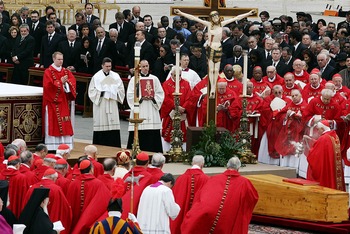
Let us look at an example from the epicentre of rituals and ritual studies: religion. Few practices are more ritualised and more linked to maintaining order than the election of a new pope in the Vatican. Established and practiced over centuries, and taking place over several days, this ritual is exceptionally elaborate, meticulously regulated and highly performative. The ritual begins when a doctor is called to certify the pontiff’s death and involves numerous private and public ceremonies, including a funeral and mass held in front of St Peter’s Basilica attended by many heads of state and other prominent figures. The ritual culminates in a secret conclave during which all cardinals under the age 80 elect a new pope, with progress on the deliberation signalled to the outside word at the end of each day via differently coloured smoke emanating from the chimney of the Sistine Chapel (Figure 3).
Ritual Funeral of Pope John Paul II, 8 April 2005. Agência Brasil, reproduced under Creative Common Attribution via Wikimedia Commons.

Figure 3. Long description
The scene is set outdoors in Saint Peter's Square. In the lower right foreground, a simple light-colored wooden cypress coffin rests on a red carpet. A red book of the Gospels lies flat on top of it. To the immediate left of the coffin, a cardinal in red and gold vestments swings a silver thurible, releasing incense smoke.
Occupying the lower left and center foreground is a large group of cardinals seen from behind, wearing bright red chasubles and red zucchettos. A member of the Swiss Guard in traditional blue, gold, and red striped uniform stands among them.
In the mid-ground, a large wooden crucifix stands vertically behind the coffin. To the left of the crucifix, several deacons and priests stand in white and red vestments. One deacon holds a large red book with a gold icon. To the right of the crucifix, a dense row of seated cardinals in red vestments face toward the center.
In the background, a vast assembly of world leaders and dignitaries are seated in rows. They are mostly dressed in dark suits or black mourning attire. Notable figures such as Luiz Inácio Lula da Silva and Mikhail Gorbachev are visible among the crowd. The ground is paved with light gray stones, and the overall lighting is bright and even.
While appearing timeless and designed to protect tradition and order, the ritual of a papal funeral and the election of a new pontiff constantly change. Each pope makes slight changes to the procedures. For instance, popes used to be entombed in three elaborate coffins. But in 2024, Pope Francis simplified this ritual and replaced it with the use of a single and more austere coffin. He also decided to defy ritual tradition and be buried not inside the Vatican but in the Basilica of Santa Maria Maggiore in Rome.Footnote 85 The same constant changes can be observed with other seemingly timeless public burial rituals. Take ceremonial funerals for members of the British royal family. Carefully regulated and deeply ritualistic, these ceremonies constantly evolve. As a result of the covid-19 pandemic, for instance, new distancing rules were introduced, which turned customary stoicism into a new ritualised practice.Footnote 86
From ritual resistance to affective agency
To apprehend this kind of ritual disruption and change more fully, we now examine the processes involved in this ‘doing’ of rituals more closely. It is here that the relationship between emotions and bodies and change become apparent and crucial.
The argument we advance in this essay – and now outline step by step – is that emotions are central to the transformative potentials of rituals. That is, just as emotions and affects associated with rituals can coalesce to stabilise and reproduce order, they can also unsettle order and abet change.
We go a step further and suggest that the very power of rituals to emotionally enact and entrench political orders also offers disenfranchised individuals and groups with an ideal opportunity to challenge these orders.
Let us start with a practical example from the politics of major global sporting events, which ideally illustrates the links between rituals, emotions, and international order. Many sporting events are, as outlined earlier, deeply emotional and reinforce not just group identities but also specific forms of nationalism linked to territorial states. Bernd Bucher and Julian Eckl discuss the ritual dimension of this phenomena and stress that games ‘mediate and communicate the rules of society,’ including the competitive co-existence of sovereign states.Footnote 87 Nowhere are these nationalist-globalist rituals more evident than with the establishment of the modern Olympic Games in Athens in 1896. The Olympics have become a paradigmatic case of major international events that simultaneously combine ‘sports, games, warfare, and ritual.’Footnote 88 Scholars analyse in detail how Olympic Games have evolved over time and how their ritual celebration of nationalist identity coalesced with a growing sense – and more often semblance – of global unity.Footnote 89
Sporting events, like the Olympics or major football games, are an ideal target for political contestation precisely because they are so effective in ritually and emotionally reinforcing existing orders and power relations. Take two prominent and interrelated cases, one historical and one contemporary.
First, one of the most iconic moments of ritual disruption took place at the 1968 Olympic Games in Mexico. Two black U.S. track-and-field athletes, Tommie Smith and John Carlos, refused to adhere to the well-established ritual that takes place during the award ceremony. When the U.S. national anthem was played, they demonstratively bowed their heads and raised their hand with fists clenched and gloved in black – in symbolic support of the civil rights movement. More than half a century later, the iconic image of this ritual disruption remains engrained in our collective consciousness and, many scholars point out, continues to stand as an important symbol for racial equality and political change.Footnote 90 The very act of ritual resistance in 1968 turned into a ritual itself, unfolding its power through the symbolism it evokes (Figure 4). Consider how decades after the original event, the Australian Aboriginal artist and activist Richard Bell, working with Emory Douglas, visually re-imagined the Mexico Olympic protest as a symbol for cross-cultural solidarity in the quest for racial justice (Bell and Douglas Reference Bell and Douglas2014).
Richard Bell and Emory Douglas, ‘White Hero for Black Australia’ mural, Burnett Lane, Brisbane, 2013. Reproduced under Creative Common Attribution via Wikimedia Commons.

Second, and building on the precedent of Smith and Carlos, is the more recent case of Colin Kaepernick, a North American Football League quarterback who refused to stand for the ritual of playing of the national anthem at the beginning of each game. To protest police brutality and racial inequality in the United States, he invented a new symbolic ritual during the 2016 season: kneeling. This new and subversive ritual soon had a ripple effect that lasted several years, with re-enactments of symbolic kneeling spreading in solidary from American High Schools and the English Premier League to numerous realms outside the sporting world.Footnote 91 Look at how the Canadian Prime Minister Justin Trudeau ‘took a knee’ during Black Lives Matter demonstrations in front of the Parliament in Ottawa.Footnote 92
Emotions are essential for understanding how such ritual resistance works. Ritual transgressions can, at times, create an even more intense emotional dynamic than rituals themselves. The protest act of kneeling during the ritual playing of the U.S. national anthem generated polarised outbursts in ways that transgressions of everyday habits and practices would not. Feelings of outrage, anger, resentment, and even fear reverberated widely and generated counter protest, including from fans, viewers, and veteran organisations. The U.S. Vice-President, Mike Pence, left a game in protest and the President, Donald Trump, called the act ‘disgraceful’ and suggested to ‘get that son of a bitch off the field right now.’Footnote 93
Political change occurs and unfolds through these interactions between rituals and emotions. Bodies sense and intuit new things and come together in ways they have not done so before.Footnote 94 This ‘coming together’ is an inherently creative process, which can open the predictable habits and routines of established rituals to the possibility of new ideas and, with this, the chance to evolve.Footnote 95 New feelings can emerge.
Bodies can, through this dissonance, through feeling differently and doing differently, contest established meanings. In this way, bodies resist and transgress prevailing power relations and order. As Carolyn Pedwell describes, the value and promise of such ‘fugitive affective moments’ are that they manage to escape constraining discourses and power relations and, in doing so, allow ‘something genuinely different to emerge.’Footnote 96 This way our emotional bodies can help to transform social arrangements, in turn reshaping political perspectives, beliefs, values, priorities, and, not least, the respective rituals through which dominant meanings and symbolisms are upheld and enacted.
We use the term ‘affective agency’ here to capture how individuals and groups can unsettle established social assumptions, meanings, and the ritualised practices that enact power and order.
The type of affective agency we describe here can generate change that goes in all political directions. For every instance of ritual promotion of diversity, as exemplified above, one can also find rituals that push in the opposite direction. Consider the increasing resistance to – and disruption of – the well-established ritual of starting public events in Australia either with a ‘welcome to country’ or an ‘acknowledgement of country.’ Designed to pay respect to the traditional Indigenous owners and recognise the contribution of Aboriginal and Torres Strait Islander people, these rituals have created heated emotional debates. Some see the ritual as ‘divisive’ because they feel it undermines liberal principles of treating all people equally.Footnote 97 Or look at the Global Black Lives Matter movement. For every ritual that promotes racial inclusion and acceptance of diversity,Footnote 98 one can find others that oppose such policies. Instances here include anti-migrant protests performed regularly and in very ritualised ways in public places across the Western world, from the United Kingdom to France and Australia.Footnote 99
The affective agency we map out here does not progress linearly. Nor does it bring about swift and decisive political shifts. Affective agency works gradually and inaudibly and generates change over extended periods of time. Public acts of ritual resistance – such as those by Smith, Carloss, and Kaepernick – are only part of the story. Just as important, if not more, are the less visible ripple-effects they generate: the countless other more private and less spectacular acts of resistance that take place in everyday life. It is these everyday acts, rather than the big events, that form the base of social and political change.Footnote 100 These micro-processes are typically obscured from view and overlooked. Turning to these seeming inconsequential social practices – including emotionally charged rituals – is important because it enables better understanding of how everyday things that individuals feel and ‘do’ gain collective traction and can cascade to catalyse significant global political transformations.
Unsettling affects: emotional discomfort as a catalyst for political change
In the final two sections, we now try to carefully map out how such micro-macro links can generate ritual and political change.
As a core part of our argument, we highlight the importance of discomfort – of feeling differently. In doing so, we want to show how a gradual transformation of political orders can emanate from the subversive effects of emotions that do not fit with customary social norms of feeling, which keep rituals and the authority and power they support in place.
To recognise how emotions are an inherent part of ritual practices and central to their transformation requires reorienting conventional theorising of emotions. Much of existing research, including in International Relations, has examined how emotional norms shape the perception and behaviour of actors and their politics. These studies often draw on pioneering concepts in the sociology of emotions, such as ‘feeling rules,’Footnote 101 ‘emotional norms,’Footnote 102 and ‘structures of feeling.’Footnote 103 Ensuing insights are important because they show how emotions reproduce social and political orders. But conceptualising emotions solely as social phenomena being ‘acted upon’ depicts emotions as passive phenomena rather than as dynamic capacities that can catalyse new ways of ‘doing politics.’ To appreciate the role of emotions in social and political change, we also need to look to emotional and affective dissonanceFootnote 104 or what Arlie Hochschild called ‘inappropriate affects.’Footnote 105
When theorising the relationship between emotion, ritual, and order, it is more appropriate to think of a constitutive ‘feed-back’Footnote 106 or ‘looping effect.’Footnote 107 Wegner writes of how ‘emotions shape and are shaped by participation … in rituals.’Footnote 108 While rituals rely on and produce spontaneous feelings and affects, there are also more conscious processes of emotional recognition involved. Take the example of commemorative events designed to honour those killed in combat. Or look at welcome-home celebrations when service-people return from active duty.Footnote 109 These ritual events evoke powerful collective feelings as they occur. At the same time, considerable thought and planning goes into their design to ensure their public emotional appeal.
Because emotions are the product of a complex range of social, cultural, and material forces, they are constantly changing. Emotions are always in the process of becoming, Dolores Martín-Moruno and Beatriz Pichel tell us. And because this is the case emotions have the potential to disrupt, to ‘do and undo us.’Footnote 110 At stake here is that while emotion and bodies are imbued with social, cultural, and political meanings, and are in this sense ‘acted upon,’ emotions enact as well. They have agency.Footnote 111 Said in a different way, emotions that individuals experience are relational. They exist in a constantly interactive and intersubjective relationship with the social world, not merely being produced by this world but also actively ‘acting back’ on it.Footnote 112
Through their interactivity – and social relationality – affective resonances can help to create ritual change. Emotions can transform meaning and shape the environment within which they exist.Footnote 113 Barbara Rosenwein traced emotional shifts through history and observed how emotions drive changes to communities over time. In doing so, she notes that ‘no emotion is pure and unchanging.’ Emotions, she stresses, can be ‘stifled’ by power but at same time ‘can be engines of conversion.’Footnote 114 Indeed, when shifting over time, emotions transform the meanings of the very practices they emerge from, thereby making ‘emotions themselves the causes of their own transformation.’Footnote 115
Crucial here – and the main argument we want to advance in this and the next section – is that political change occurs from a situation of discomfort. Scholars suggest that ‘corporeal comfort’ equates with ‘sedentary affects,’ with the bodily acceptance and feeling of pleasure associated with existing in one’s comfort zone.Footnote 116 Feminist researchers have for long reminded us that meaningful change emerges from discomfort, from disruption, and from questioning the habits and routines that shape and confine our social worlds.Footnote 117 This is the spirit in which Wegner uses her own discomfort as a methodological starting point and guiding theme to examine how rituals and emotions coalesce to sustain militarised political cultures.Footnote 118
Allow us to pause theorising for a moment and focus on the importance of discomfort through a practical example that involves gender politics: mothering and breastfeeding. At first sight, it is hard to see either rituals or politics here. Breastfeeding is a biological act that might be repetitive in nature, and it might, as anthropologist point out, be intertwined with a range of rituals associated with motherhood in a way that brings a sense of unity to groups and societies.Footnote 119 But in a normal everyday setting, breastfeeding lacks the special and symbolic character that distinguish rituals from normal practices.
There are contexts, though, when private habitual practices of breastfeeding and mothering are performed in public realms and in ways that generate the type of special and symbolic meaning that characterises rituals and renders them so powerful.
Consider the New Zealand Prime Minister, Jacinda Arden, who gave birth while in office. Her case illustrates how rituals of mothering, when performed publicly, assume a symbolic meaning that can create a deep sense of discomfort – and potential for social change – when brought into contact with other more public political rituals (Figure 5). In September 2018, Arden was the first world leader to take her baby to a United Nations General Assembly meeting: a public space that is rife with deeply entrenched ritualised interactions among representatives of states. Media coverage of this clash of rituals ranged from celebrating Ardern’s disruptive intervention as important steps towards gender equalityFootnote 120 to lamenting that this very act of multitasking reproduced gender stereotypes and led to her subsequent resignation.Footnote 121
New Zealand Prime Minister Jacinda Ardern holds her baby Neve after speaking at the Nelson Mandela Peace Summit on 24 September 2018 during the 73rd United Nations General Assembly in New York City. Reproduced with permission from Reuters.

Even more emotional disruption occurred on occasions when women politicians publicly breastfed their babies, as did Senator Larissa Waters in the Australian Federal Parliament in May 2017. The related public discomfort and anxiety about breastfeeding is much discussed and an ongoing global phenomenon.Footnote 122 As recently as 2023, several women who were breastfeeding in Australian public institutions, including courts, were asked to leave for fear of causing emotional distraction from the proceedings.Footnote 123
These brief examples illustrate how being uncomfortable – being unsettled – can be an important part of generating change. This appreciation of ritual disruption – of feeling and knowing differently – is key to the ensuing potential for political transformation.Footnote 124 The discomfort created by these disruptions of gendered political structures and practices might not immediately bring more equality to public institutions. But they are part of a slow transformation of values that has been going on for centuries and constantly shifts private and public assumptions about gendered identities and role distributions.
Reflections on how ‘feeling differently’ can disrupt and instigate changeFootnote 125 intersect with work that theorises international change through practices. Specifically, it enables a deeper and novel appreciation of how change happens in and through everyday contexts. Such emotional dissonance – what Pedwell terms ‘affective jolts’ – are the types of engagements with the social and political world that make one’s perception of the world a little bit different than it was before.Footnote 126 In other words, ‘affect initiates changes through practices by providing for a directional experience.’Footnote 127 In all social practices, we constantly encounter something or someone that triggers an affective response and, in doing so, prompts a particular meaning-making process. Cumulatively, these encounters and affects either order or disorder. They either synchronise with the status quo or they stimulate disruptive, unsettling forms of affect, which may lead to new perspectives and practices.
To be clear, and to summarise, at stake here is that performing a ritual differently – a disruption of the set ritual ‘script’ – may be inspired by feeling differently. Vice versa, alternations in the performance of a ritual may cultivate new and different feelings in an individual or group. This looping effect is of political significance because feeling differently means knowing differently. It means conceiving of the social world anew. Marginal and hidden knowledges can come to the fore, presenting the potential to do and order the political world in previously unperceived ways. This is why feminist scholars have for long drawn attention to this aspect, speaking of ‘knowing through feeling’Footnote 128 and pointing out that understanding emotions is to study how they emerge in and through bodily interactions in social relations and collective contexts.Footnote 129 They write of ‘a kind of judgement enacted at the level of the body’Footnote 130 and of the need to listen to what bodies tell us and how bodily instincts bear out in more tangible emotions, perceptions, and patterns of thought.Footnote 131
Transforming rituals: linking everyday discomfort with changing global orders
The example of rituals associated with breastfeeding and mothering demonstrates what International Relations scholars increasingly point out: that seemingly mundane things people do – from individuals at the grassroots level to prominent diplomats – can ricochet and culminate to have ‘big picture’ global effects.Footnote 132 Rituals in this sense order through structuring and traversing and then reproducing power relations that cohere the everyday with the larger structures and institutions that govern world politics. Teasing out these connections more fully brings our awareness and attention down to the ‘ground level’ of world politics.Footnote 133 Such a focus aligns with work done by International Relations scholars who have argued for a shift away from ‘grand narratives’ towards the ‘micro-disruptions’ that are happening every day.Footnote 134 The ensuing reorientation pays more attention to what Pedwell called ‘minor actions’ or ‘minor transformation’: the type of shifts in rituals that seem mundane and trivial but, over time, generate changes in individual and public perceptions and the social orders associated with them.Footnote 135
In our final section, we would like to explore more explicitly the transformative potential of such micro–macro links. We do so through one more example: how emotions and ritual disruptions, and everyday feelings of discomfort, lie at the centre of how humanitarian orders have emerged and changed over an extensive period of time.
Over the past decades, humanitarianism has become an important part of the normative architecture of global society.Footnote 136 Humanitarian ideals and practices take shape through countless non-governmental, state-based and international organisations. In recent years, some of these practices and the norms associated with them have come under challenge. Led by shifts in the U.S. foreign policy, but visible across much of the western world, states have started to subordinate humanitarian responsibilities and funding to increases in defence postures and border security. Compassion for people in need, including refugees, seems to have vanished from much of the populist rhetoric that currently drives politics in parts of the world. But these recent shifts need to be placed in a long-term context. Humanitarian practices as we know them today have been around for well over a century. They have shifted over time but prevailed through two world wars and are thus likely to prevail through the current crisis too and remain part of the ever-changing nature of international orders.
Several scholars have examined how rituals are an important part of how humanitarian practices are enacted and sustained. They look at a wide range of phenomena, including the emotional bonds and political orders that develop through the symbolic use of visual icons, such as depictions of suffering mothers and children; through repetitive donor appeals; or through ritualised interactions between aid workers and victims.Footnote 137 Some of these practices, such as the perfunctory manner in which states declare allegiance to international human rights law, have become so ritualistic that they lost the special and symbolic power that rituals hold.Footnote 138 But overall, there is enough evidence in the literature to suggest that a wide range of rituals have helped to legitimise and entrench the type of emotional and political values that sustain particular humanitarian orders.
Humanitarianism has not always been part of international politics. Until the mid-nineteenth century, humanitarians were seen largely as social outcasts. Humanitarianism as we know it today – as a form of ethics and as organised practices of responding to human hardship and suffering – has developed and become routinised over centuries.
How is it that humanitarian ideas, ideals, practices, and policies have undergone such transformation? Without going into detail, we briefly illustrate two important shifts: both involving ritual disruptions caused by everyday feelings of discomfort that, in turn, lead to changes in what could be called humanitarian orders.
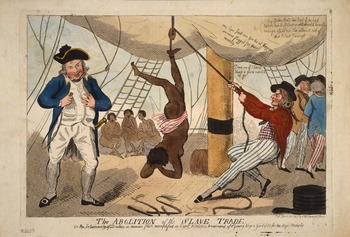
Humanitarian ideals are seen to have first emerged in the mid-1700s through anti-slavery movements and abolitionism in the United Kingdom and the United States.Footnote 139 Before then, the suffering of others was largely disregarded or even purposely intended. Rituals played an important role in upholding the respective power relations. The slave-market in New Orleans, for instance, operated along a set of precisely defined rituals – involving buyers, traders, and slaves – designed to maintain and legitimise the existing political order.Footnote 140 Other examples include the ritual flogging of slaves, who were often considered as objects of voyeuristic sensationalism or even of comic relief and laughter.Footnote 141 The anti-slavery movement employed caricatures and cartoons of ritual floggings. This was done not to endorse these practices but, to the contrary, as a way of criticising slave-holders by trying to evoke pity and sympathy in the broader population (Figure 6). Some images, such as the renowned Josiah Wedgwood medallion, attained such public resonance that they became icons of the anti-slavery movement and were proliferated in various forms over decades.Footnote 142
The Abolition of the Slave Trade: or, the inhumanity of dealers in human flesh exemplified in Capt’n Kimber’s treatment of a young Negro girl of 15 for her virgin modesty. Attributed to Isaac Cruikshank, 1792. © Trustees of the British Museum. Source: The image is in the public domain via Wikimedia Commons.

Figure 6. Long description
An 18th-century satirical etching set on the deck of a slave ship. On the far left, Captain Kimber stands with a smirk, wearing a blue coat, white waistcoat, and a bicorne hat, holding a whip. In the center, a young Black girl is suspended upside down by one ankle from a pulley system, her body twisted and her head near the deck. In the background behind her, three other enslaved people sit huddled together. To the right of the girl, a sailor in a red jacket and striped trousers pulls the rope of the pulley, looking back with a conflicted expression. His speech bubble reads, Damn me if I like it I have a good mind to let go. Further right, two other sailors observe the scene. One says, My Eyes Jack our Garls at Wapping are never flogged for their modesty. The other responds, By Goles that is too bad if he had taken her to Blackwall it would be well enough Split me I am almost sick of this Black Business. A cat-o-nine-tails whip lies on the deck floor in the foreground.
The ritualised entrenchment of slavery – and the voyeuristic enjoyment of the suffering of others – began to be disrupted. Witnesses began to feel differently – to be unsettled – at the sight of the cruelty and suffering of slaves. As numerous historical studies show, this transformed awareness of pain as repugnant and also as treatable or preventable actively developed compassionate emotions and, with them, ‘a desire to help those less fortunate.’Footnote 143 Pain and cruelty became repulsive, something to prevent and guard against, and a key inspiration and catalyst for newfound humanitarian sensibilities and practices. It was growing forms of ‘emotional dissonance’ that made such a fundamental rethinking and change possible. Gradually compassionate emotions – the idea that one should feel sympathy at the sight of cruelty and suffering – became a social expectation.Footnote 144 It is through these emotional shifts that the anti-slavery moment disrupted established ritual practices – which were legal, economic, social, cultural, and religious in nature – that upkept and legitimised slavery.
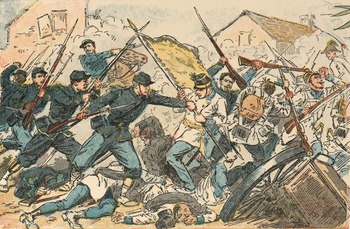
A second major shift, linking everyday experiences of emotional discomfort with changes in the global humanitarian order, took place in the nineteenth century. As well-known accounts relay, it was the horrors of so many wounded and dying soldiers left abandoned on the battlefield of Solferino in June 1859 that instigated a chain of actions that went on to inspire the formation of the International Committee of the Red Cross and the emergence of rules of war and international humanitarian law (Figure 7).
A French illustration from 1892 of the ‘10e bataillon de chasseurs’ at the battle of Solferino in 24 June 1859. The image is in the public domain via Wikimedia Commons.

Figure 7. Long description
The scene is a dense melee set against a backdrop of smoke and village buildings.
At the center, a French soldier in a dark blue uniform and kepi lunges forward to seize a yellow flag from an Austrian soldier dressed in a white tunic and shako.
On the left, several French soldiers of the 10th Battalion of Chasseurs advance with fixed bayonets. They wear dark blue jackets with green epaulettes and light blue trousers. One soldier in the upper left is mounted on a horse, brandishing a sword.
On the right, Austrian soldiers in white uniforms attempt to repel the French advance. One Austrian soldier in the foreground is seen from behind, wearing a tan backpack.
In the lower foreground, fallen soldiers from both sides lie on the ground amidst the debris of a wooden cart or barricade.
In the background, the silhouettes of gabled houses are visible through thick clouds of white gunpowder smoke, suggesting the urban or semi-urban setting of the engagement.
Passing through Solferino, a Swiss businessman from Geneva, Henry Dunant, encountered the traumatic sight and abandoned his work to come to the aid of soldiers. He witnessed the scenes of ritualised killing: a form of nineteenth-century warfare that proceeded according to a set battle-field script that had no moral place for wounded or captured enemies.Footnote 145 Shocked by the ensuing suffering, Dunand established a neutral volunteer relief society and worked towards an international treaty that would protect and care for both injured soldiers and those who came to their aid.Footnote 146 While this is a well-known and much recounted narrative in histories of humanitarianism and human rights, an implicitly recognised yet taken-for-granted element is the catalysing significance of emotion. It was, at least in part, because Dunant as well as other local bystanders and viewers became increasingly uncomfortable and unsettled in the face of such suffering that new humanitarian principles emerged and came to guide individual as well as wider state-based political behaviours in times of conflict.
These brief examples illustrate how humanitarian orders have evolved over time through the parallel processes of emotional and ritual enforcement, disruption, and transformation. The related looping-effects hark back to our key point: that rituals can, through the ambiguity of their performance, disturb and dislocate the same individuals and collectives they are intended to mollify and unify.Footnote 147 Emotional dissonances are critical for recognising and potentially instigating the process of ritual disruption and change. Affective reactions can unsettle us. They can make us feel other than how we are meant to and have been disciplined to feel. Bodily discomfort can, in this way, be an important place for contestation and the beginning of meaningful social and political change.
Conclusion: the normative role of rituals in political transformation
Rituals are a powerful and pervasive part of social and political life. The subject of scrutiny across the humanities and other social science disciplines for several decades, rituals have meanwhile also become a major topic of discussion in International Relations scholarship.
An important take-away point here lies in the crucial roles rituals play in structuring political life at all levels. The rituals that communities and polities live by and through provide symbolic and performative structures that assure, cohere, and orient them and, in doing so, reinforce authority and order. In this way, rituals provide an ontological security, a calmness and certainty that moors a collective in spite of diversity and through an uncertain and often fragile world.Footnote 148 Rituals safeguard and sure-up existing forms of order, from state-managed practices of national commemorations, formal diplomatic ceremonies, and adherence to international legal protocols, to the daily rituals that individuals and communities perform, such as singing the national anthem at a sporting competition.
But rituals also possess the potential to bring about political change. They can unsettle and disrupt as much as they can placate and situate us. It is, indeed, the very power of rituals to uphold the status quo that provides dissenting individuals or groups with an ideal opportunity to challenge this status quo by disrupting the meanings and symbolisms through which rituals cohered a collective and polity.
The aim of this essay has been to examine the crucial role that emotions play in this dual function of rituals. Paying close attention to emotions sheds light on how exactly the symbolic and performative dimensions of rituals can either affirm and entrench power relations or transgress and transform them.
We offered a step-by-step analysis of the links between emotion, ritual, and political order. Emotions shape how and why rituals emerge and then proceed and take shape. Dominant ways of thinking and feeling – as well as their embodied elements – usher individuals towards ‘emotional norms’ that are then perpetuated. These collective emotions can lull individuals into habitual patterns – expressed through numerous rituals – that provide confidence and security and, in turn, sustain existing political orders.
We then focused, as a core part of our argument, on the role that emotional discomfort – feeling differently – plays in triggering ritual and political change. Change can emanate from the subversive effects of emotions that do not fit with customary social norms of feeling, which keep rituals and the authority and power they support in place. This is the case because rituals are performed in instinctive, unconscious, and at times unpredictable ways. Ritual practices can hence be disrupted; they can be ‘done’ differently, even though they follow a regular script. Because of this, and as Sara Ahmed reminds us, ‘things can go astray.’Footnote 149 New rituals might emerge that resist and transgress power and authority, and as such work to transform the values, expectations, and norms that underpin established orders.
Finally, we explored how the ensuing affective agency works slowly, over extensive periods of time. The links between emotions and rituals are, indeed, constantly shifting, and this very shifting nature lies at the centre of political change. This change is organic and, like all meaningful change, unfolds gradually and links micro and macro forces, local and global political dynamics. When analysing the emotional power of rituals, it is thus important to look not only in obvious places, such as diplomacy, security, or war, but also at how these domains of high politics are linked to everyday practices that seem, at first sight, neither political nor international. Rituals are ‘institutional as well as everyday practices,’ Rai aptly stresses.Footnote 150
To highlight and explore the powerful relationship between ritual, emotion, and political change, we focused on key conceptual links between these phenomena rather than on variations within them. Rituals are highly diverse, as we tried to show. They include a myriad of practices from daily habits and small group interactions to mass performances and major international events. Rituals shape phenomena as wide ranging as family interactions, court proceedings, religious ceremonies, diplomatic negotiations, wars, and sporting competitions. The affective experiences that these different types of rituals embody and generate are equally diverse, ranging from subdued to intense and from awe, reverence, fear, and anger to joy, pity, empathy, and compassion. Assessing these variations goes far beyond the scope of a journal article. Detailed empirical studies are necessary to tease out the exact relationship and looping effects between these diverse rituals, the different emotions they produce, and their influence on order and change.
While more empirical work on the link between emotions and rituals is required – and while we hope this conceptual essay provides a modest foundation and an impetus to do so – the political implications of rituals are already evident. Appreciating how rituals and emotions work together enables a richer understanding of how political relations and orders are structured. This knowledge is important because it can empower individuals and their communities – including policy analysts and political leaders – to be attentive to the emotional power of rituals. This power can then be consciously used to face political challenges and explore opportunities for change.
This is another way of saying that a focus on rituals and affective agency brings into sharp relief normative dimensions. Political orders – and so also the norms and rules that underpin orders – exist for a reason. Orders not only create stability in a world of ambiguity and difference but also enact specific values and specific forms of political communities. Normative awareness of the agency involved in the links between rituals, emotions, and change thus comes with both the opportunity and the responsibility to decide what types of orders we prefer and would like to see established. This is why in our essay we tended to focus primarily on examples that reflect our normative preferences, such as those that lead towards greater racial and gender equality.
Appreciating the power of ritual disruption allows us – as scholars, as individuals, and as members of different communities – to identify opportunities to promote change at moments when orders are not doing what they are meant to. This is the case, for instance, when we believe that an order’s underpinning rules, customs, and norms exclude and harm and may need to change. Emotions and their affective dimensions are a pivotal part of the puzzle of change: feelings and affects can signal and catalyse disruption. Emotions can imbue political relations – and the nature of an order – with new possibilities. Once these normative links between emotions and change are brought into the open, Maria Hynes stresses, ‘the challenge is no longer one of planning for the future but of inventing it.’Footnote 151 International Relations scholars could, then, do more than what they usually do: look backwards to retrospectively analyse the complex dynamics through which political orders have emerged and evolved. Instead, they could also advise decision-makers about the possibilities that open-up once we embrace the power and potentials of ritual and emotion and imagine a different future through them.
Acknowledgements
This article was Emma’s main project for the last few years of her life. She gave it her everything, often working out of hospitals and under exceptionally difficult circumstances. In the end, she ran out of time and life. Roland then spent the next 18 months doing his best to complete the project as Emma had envisaged it. Together, we – Emma and Roland – are very grateful to the International Theory team, and especially to David Welch, for their exceptional editorial guidance and help, including with defining rituals. Three anonymous referees provided two rounds of unusually thorough feedback. We thank them for their time and insights. We presented a first outline of the paper at an ISA-sponsored workshop on ‘Performing Rituals in World Politics’ on 6–7 May 2021. Thanks to the chairs of session on ‘Ritual and Authority,’ Stefano Guzzini, and Jorg Kustermans, as well as to the overall conveners Tanya Aalberts, Maria Mälksoo, and Anna Leander. We are grateful to several scholars for their feedback on the manuscript: Bronte Bratton, Josie Hornung, Elliot Johnston, Xymena Kurowska, Dorothy Noyes, Cormac Opdebeeck-Wilson, Anita Schenk, Rebecca Shaw, and Ted Svensson. We acknowledge generous funding support from the Australian Research Council through Emma’s ARC DECRA Fellowship (DE180100029) and a joint ARC Linkage Grant (LP200200046).




 Open access

