




Introduction
Adult presentation of cor triatriatum sinister is extremely rare, especially when associated with severe tricuspid regurgitation. In cor triatriatum sinister, a fibromuscular membrane subdivides the left atrium into a posterosuperior chamber—receiving the pulmonary veins—and an anteroinferior chamber, which houses the mitral valve and left atrial appendage. Although the condition usually manifests in infancy, cases with an adequately sized fenestration may remain undiagnosed until adulthood. Common clinical presentations in such patients include dyspnoea and haemoptysis, with echocardiography serving as the primary diagnostic tool.Reference Rudienė, Hjortshøj and Glaveckaitė1, Reference Kilkenny and Frishman2
Case presentation
A 31-year-old male with no significant past medical history presented to the emergency department with a one-month history of progressively worsening dyspnoea and recurrent haemoptysis. Vital signs on admission were stable with a blood pressure of 120/70 mmHg and a heart rate of 70 bpm in sinus rhythm. Physical examination revealed a mid-systolic murmur audible over the left clavicular area. Chest radiography demonstrated mild pulmonary congestion with a normal cardiothoracic ratio.
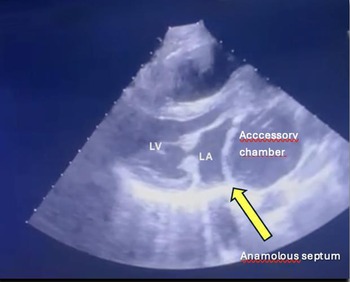
Transthoracic echocardiography identified an abnormal septum within the left atrium (Figure 1). Detailed evaluation revealed that the left atrium was divided by a fibrous membrane forming an accessory chamber; a 5-mm perforation allowed communication between the chambers, and all four pulmonary veins were seen draining into the accessory chamber (Figure 2). In addition, an atrial septal defect was documented.
Transthoracic echocardiography demonstrating an abnormal septum (arrow) within the left atrium. Abbreviations: LA = left atrium; LV = left ventricle.

(a) Four pulmonary veins draining into the accessory chamber. (b) Communication between the accessory chamber and the main left atrium via a 5-mm fenestration (yellow arrow).

Surgical procedure
Under general anaesthesia, a median sternotomy was performed. Intraoperative findings included a persistent left superior vena cava with the absence of an innominate vein. Cardiopulmonary bypass was instituted with arterial cannulation of the ascending aorta and venous cannulation of the inferior vena cava, superior vena cava, and persistent left superior vena cava. The patient was cooled to 32°C and cardiac arrest was achieved using blood cardioplegia.
A right atriotomy revealed a normal-sized coronary sinus, a large atrial septal defect, and the fibrous membrane dividing the left atrium. The mitral valve was intact, and the persistent left superior vena cava drained into the posterior left atrial compartment (Figure 3). Subsequently, a left atriotomy performed anterior to the right pulmonary veins exposed a 5-mm fenestration in the fibrous membrane that permitted limited blood flow between the two chambers. Resection of the membrane was carried out to restore a single left atrial cavity. The atrial septal defect was closed with a Dacron patch, ensuring that persistent left superior vena cava drainage remained directed into the right atrium. Owing to annular dilatation, a DeVega tricuspid annuloplasty was also performed.
Intraoperative view from the surgeon’s perspective. The fibrous septum and the 5-mm fenestration (arrow) between the left atrial chambers are clearly visible.

Intraoperative transesophageal echocardiography confirmed the successful repair with no residual atrial septal defect or tricuspid regurgitation. Notably, pulmonary artery pressure improved from 60 mmHg preoperatively to 35 mmHg postoperatively, with left atrial pressure recorded at 17 mmHg.
Discussion
Adult cor triatriatum sinister is an exceptionally rare condition, often leading to delayed diagnosis due to its nonspecific clinical manifestations. Cases that are asymptomatic in early life due to adequate fenestration may present later in adulthood with symptoms such as dyspnoea and haemoptysis. Cor triatriatum sinister is frequently associated with other congenital anomalies including atrial septal defect, patent ductus arteriosus), total anomalous pulmonary venous return, ventricular septal defect, and persistent left superior vena cava.
Echocardiography is paramount for diagnosis, while surgical intervention is essential to prevent the progression to right ventricular failure and severe pulmonary hypertension. Management of such complex cases should be undertaken in specialised centres with expertise in congenital cardiac surgery.
Conclusion
This case highlights the importance of early diagnosis and surgical management in adult patients with cor triatriatum sinister to avert life-threatening complications. The combined surgical approach—comprising membrane resection, atrial septal defect repair, and tricuspid annuloplasty—resulted in significant haemodynamic improvement, with the patient experiencing an uncomplicated recovery and remaining asymptomatic at six-month follow-up.Reference Ishida, Yagami, Fujita and Mutsuga3, Reference Kumar, Singh, Mishra and Thingnam4



 Open access

