





Introduction
Japanese knotweed (Reynoutria japonica Houtt., Polygonaceae) is an invasive Asian plant introduced as an ornamental to Europe in 1830 and to North America in the 1860s (Lavoie Reference Lavoie2019). It is a rhizomatous perennial that grows rapidly in the spring, forming dense clonal patches. The rhizomes can penetrate the soil to a depth of 2 m (Child and Wade Reference Child and Wade2000). In its introduced range, the plant is particularly abundant along rivers (Barney Reference Barney2006; Colleran and Goodall Reference Colleran and Goodall2014, Reference Colleran and Goodall2015; Colleran et al. Reference Colleran, Nozaki Lacy and Retamal2020; Descombes et al. Reference Descombes, Petitpierre, Morard, Berthoud, Guisan and Vittoz2016; Duquette et al. Reference Duquette, Hayes, Pagola, Belzile and Lavoie2016; Navratil et al. Reference Navratil, Brekenfeld, Puijalon, Sabastia, Boyer, Pella, Lejot and Piola2021; Pyšek and Prach Reference Prach1993). In riparian areas, floods and ice flows break the stems and uproot the rhizomes, facilitating their dissemination downstream. A single rhizome or stem fragment containing at least one meristematic node is sufficient to generate a new individual (Colleran and Goodall Reference Colleran and Goodall2014, Reference Colleran and Goodall2015; Gowton et al. Reference Gowton, Budsock and Matlaga2016; Lawson et al. Reference Lawson, Fennell, Smith and Bacon2021; Matte et al. Reference Matte, Boivin and Lavoie2022; van Oorschot et al. Reference van Oorschot, Kleinhans, Geerling, Egger, Leuven and Middelkoop2017).
Control of R. japonica in riparian areas can be challenging, as many jurisdictions have regulations that prohibit or restrict methods that could harm the aquatic environment. This is the case for herbicides. Although not a panacea, herbicides can quickly reduce R. japonica biomass, both above- and belowground. On the other hand, applications must be repeated over several years to achieve satisfactory results, and herbicides rarely eradicate a massive clone without additional measures (Delbart et al. Reference Delbart, Mahy, Weickmans, Henriet, Crémer, Pieret, Vanderhoeven and Monty2012; Jones et al. Reference Jones, Bruce, Fowler, Law-Cooper, Graham, Abel, Street-Perrott and Eastwood2018; Kadlecová et al. Reference Kadlecová, Vojík, Kutlvašr and Berchová-Bímová2022). Other techniques to eliminate R. japonica clones in riparian areas are occasionally suggested, but they are much more expensive and have significant limitations. For instance, although excavation can be effective, it strongly disturbs the riverbank structure. Tarping has yielded mixed results to date and is difficult to implement in repeatedly flooded riparian areas (Dusz et al. Reference Dusz, Martin, Dommanget, Petit, Dechaume-Moncharmont and Evette2021). Consequently, some environmental managers question whether it is actually possible to control R. japonica over long river stretches without massive financial input (Colleran and Goodall Reference Colleran and Goodall2014, Reference Colleran and Goodall2015; Delbart et al. Reference Delbart, Mahy, Weickmans, Henriet, Crémer, Pieret, Vanderhoeven and Monty2012; Rouifed and Cottet Reference Rouifed and Cottet2019).
An alternative to controlling large, well-established R. japonica clones is to target small, emerging individuals. Such a strategy could slow, and potentially halt, invasions along rivers where the invader is not yet abundant. To this end, Colleran and Goodall (Reference Colleran and Goodall2014, Reference Colleran and Goodall2015) proposed combating R. japonica invasions in riparian areas by manually unearthing stem or rhizome fragments newly rooted after being deposited by floodwaters, before they become firmly established. This method has been tested in Vermont (Colleran and Goodall Reference Colleran and Goodall2014, Reference Colleran and Goodall2015) and in France (Barthod and Boyer Reference Barthod and Boyer2019). In the Vermont study, rapid response removal was described as effective and easy to implement. The French study also described the technique as effective and added that it is practical for hard-to-reach areas in addition to being cost-effective. Barthod and Boyer (Reference Barthod and Boyer2019) further elaborated on the practical aspects of the method, stating that up to 80% of the unearthed fragments could be completely removed by hand, eliminating the formation of new clones that might generate additional diaspores during subsequent floods. They estimated that a manual removal campaign costs around €260 (US$280) per aborted R. japonica clone. They did not provide details on cost calculation, but this estimate is low compared with the cost of eradicating a large clone without herbicides.
While interesting, previous studies on this rapid response method to control R. japonica in riparian areas have some shortfalls. The Vermont study did not specifically state the conditions that must be met for the method to be cost-effective. Moreover, the context of the study was unique, with the removal efforts occurring after a flash flood caused by a tropical storm. Such weather events are rare, whereas in northern latitudes, R. japonica is also dispersed during spring floods that occur annually as a result of snowmelt. In the French study, although the method was applied repeatedly over many years, the cost assessment was incomplete. The study did not provide an invasion threshold above which removal costs become too high in relation to the anticipated benefits. More importantly, most of the work was conducted near a lake where stem and rhizome fragments are less likely to disperse than along rivers. In a Canadian setting, where R. japonica is found along rivers and where spring floods with abundant ice are recurrent, it is unknown whether rapid response removal of R. japonica diaspores is feasible and cost-effective.
The main objective of this study was to verify the feasibility and cost of a rapid response removal campaign against R. japonica along a river with recurrent spring floods. We supposed that a rapid response strategy is reliable, even with a modest budget, but only below a certain invasion threshold. The threshold is determined by the time spent locating versus pulling recently established R. japonica shoots. For the operation to be cost-effective, we estimated that the time spent locating the shoots must exceed the time spent unearthing them. If this is not the case, the perspective changes: it is no longer a rapid response against an invader, but instead a large-scale control operation that needs thorough planning and abundant resources before being undertaken.
Materials and Methods
Study Area
This study was carried out along the Etchemin River, in the province of Québec, Canada (Figure 1). The Etchemin is a river with stable meanders that flows along 124 km. Its source (46.58777778°N, 70.42416667°W) is located in the Appalachian Mountains. The river empties into the St Lawrence River, at the city of Lévis (46.76333333°N, 71.23111111°W). Its catchment area is about 1,466 km2; 61% of this area is covered by forests, 30% by agricultural lands, 4% by wetlands, and 2% by urban centers (Lévis, Saint-Henri-de-Lévis, Saint-Anselme, Sainte-Claire). Agricultural activities are mostly concentrated downstream in the St Lawrence River lowlands. In this downstream portion, agriculture occupies 56% of the territory (Conseil de bassin de la rivière Etchemin 2014).
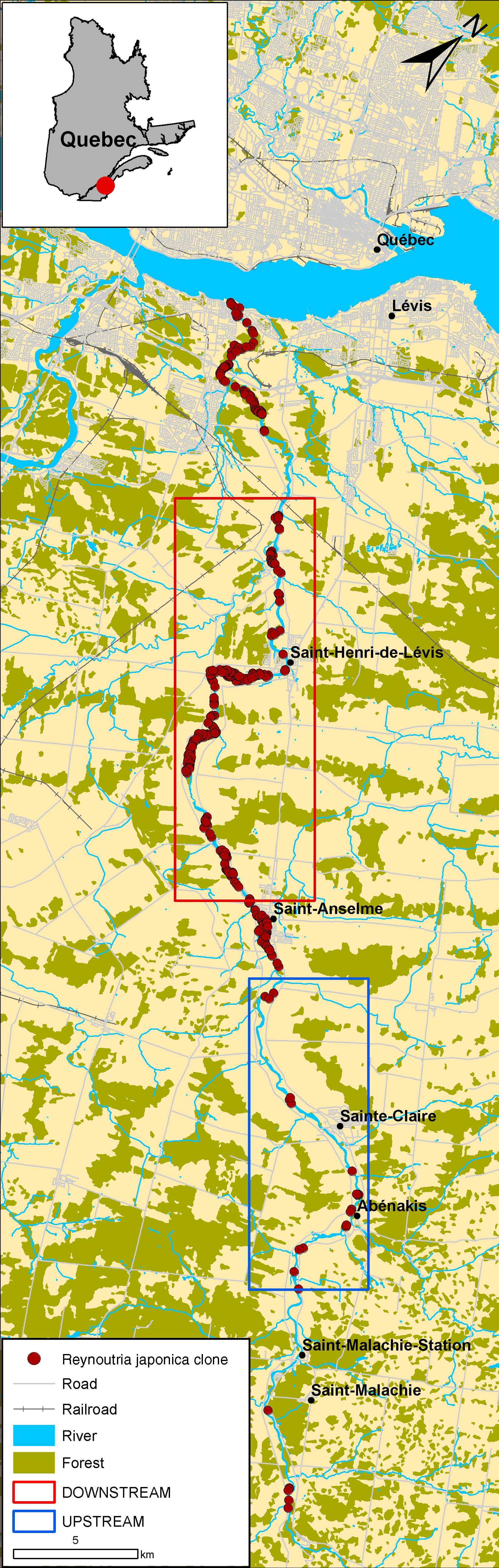
Figure 1. Map of the study area (Etchemin River watershed, Québec, Canada), showing the location of Reynoutria japonica clones in 2018, and the two river stretches (DOWNSTREAM, UPSTREAM) surveyed in 2019 and 2020 to manually remove rhizome fragments of the species on riverbanks.
Data from the Beauséjour weather station, situated 8 km west of Saint-Henri-de-Lévis, indicate that the mean annual temperature is 4 C, January being the coldest month (mean temperature: −13 C) and July the warmest month (mean temperature: 19 C). Annual precipitation averages 1,253 mm, of which 26% falls as snow (Environment Canada 2022a). The mean daily discharge of the Etchemin River at Saint-Henri-de-Lévis, 19 km from the outlet, was 27 m3 s−1 between 1980 and 2018. The months with the highest mean daily discharges were April (86 m3 s−1) and May (45 m3 s−1), whereas the months with the lowest discharges (12 to 16 m3 s−1) were January, February, August, and September. In spring 2019, the return of temperatures above 0 C and abundant precipitation caused a particularly strong flood, which began by April 14. The flood peaked on April 20, with a flow discharge of 444 m3 s−1. A mechanical ice breakup caused an ice jam at Saint-Henri-de-Lévis that lasted a few days. In 2020, the spring flood was much smaller. Ice breakup caused an ice jam at the same location as the previous spring. The discharge consequently swelled from 61 m3 s−1 on April 2 to 116 m3 s−1 on April 3 and peaked at 228 m3s-1 on April 14 (Ministère de l’Environnement et de la Lutte contre les changements climatiques, de la Faune et des Parcs du Québec 2022a, 2022b).
Removal Campaign
Two river stretches were selected for the fragment removal campaign, one heavily invaded by R. japonica and the other sparsely invaded (Figure 1). Only R. japonica was found: no knotweed hybrids (Reynoutria × bohemica Chrtek & Chrtková) were detected (Matte Reference Matte2020). The heavily invaded stretch (henceforth DOWNSTREAM) extended from the Saint-Henri-de-Lévis railway bridge (46.72944444°N, 71.13694444°W) to the Saint-Jacques road bridge, near the municipality of Saint-Anselme (46.62750000°N, 70.98500000°W). In 2018, this 23-km-long stretch had 301 R. japonica clones covering a total of 126,000 m2 (Matte Reference Matte2020). This stretch crossed Saint-Henri-de-Lévis, a town with just over 5,000 inhabitants. Most of the land bordering this stretch was agricultural. The sparsely invaded section (henceforth UPSTREAM) extended from the top of Rouillard Falls in Saint-Anselme (46.61888889°N, 70.94361111°W) to the municipality of Saint-Malachie (46.55138889°N, 70.81305556°W). This 17-km-long stretch had less than 20 R. japonica clones in 2018 (Matte Reference Matte2020). It crossed the municipality of Sainte-Claire, a small town of 2,400 inhabitants. As for DOWNSTREAM, this stretch was mostly bordered by agricultural land.
The first removal campaign occurred in 2019 in the highly invaded stretch, from June 17 to 28 (DOWNSTREAM 2019). At this time of year, new R. japonica shoots have emerged from rhizome fragments disseminated during the most recent flood. These shoots were visible, but only weakly rooted (Figure 2). The work was best done early in summer, because as the season progressed, the riverbank vegetation became denser, rendering the R. japonica shoots less visible. Only the most readily accessible DOWNSTREAM riverbanks were covered, that is, 9.6 km out of 56 km (including islet banks). The campaign was repeated in 2020 (DOWNSTREAM 2020), but a bit earlier, from June 8 to 16, to allow time for the subsequent UPSTREAM 2020 campaign.
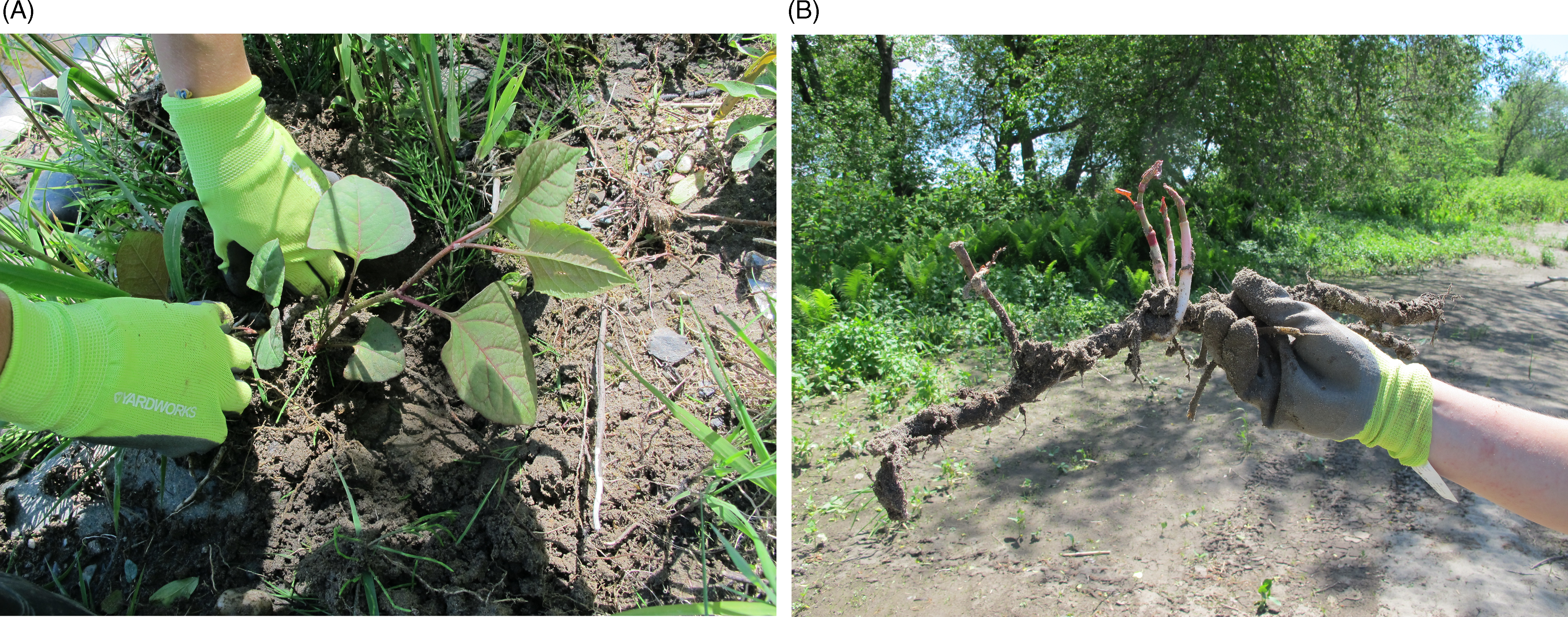
Figure 2. Shoot of Reynoutria japonica (A) emerging from a rhizome fragment (B) that was subsequently unearthed on a riverbank of the Etchemin River (Québec, Canada). Photographs: RM.
For each campaign, the riverbanks were surveyed from top to bottom by two workers walking side by side. The first worker patrolled the bank, while the second patrolled the shoreline, where rhizome fragments were more numerous. The floodplains were not surveyed, because most were plowed, cultivated, and sprayed with herbicides. Each worker was equipped with a shovel, trash bags, a geographic positioning system (GPS) with an accuracy of ±5 m (Montana 650, Montana 610, or GPSMAP 60CS×, Garmin, Olathe, KS, USA), a chronometer, and a field notebook. Only a few hours of training were necessary, as detection and unearthing of R. japonica fragments was a rapidly learned task. When a small, isolated R. japonica shoot was found, it was unearthed by hand or with a shovel. Extracting the rhizomes was delicate work. If the rhizome broke off underground, the workers assessed whether the complete removal could be achieved in a reasonable, admittedly subjective, amount of time (about 5 min), or if it was better to move on to the next shoot. Although broken rhizomes will almost certainly generate new shoots, the objective of the campaign was to maximize the number of rhizomes eliminated by the available workforce, rather than to remove 100% of the rhizomes. The walking time (survey) and the work time for each unearthing attempt, whether successful or not, were noted. The status of each rhizome fragment (complete or incomplete) was recorded. For complete fragments only, the geographic coordinates were recorded using the GPS, then the fragments were placed into a bag. In the laboratory, the total length of each collected rhizome was measured. As the leaves of emerging shoots were the most visible indication of a rhizome fragment, these were also counted.
UPSTREAM 2020 was surveyed from June 19 to 29 using the same protocol. Given the scarcity of R. japonica clones, sampling mainly focused on the riverbanks most likely to contain emerging shoots. Results of the DOWNSTREAM 2019 campaign were used to identify the types of riverbanks most likely to harbor shoots, that is, islet shores (418 rhizome fragments km−1 of riverbank) and convex banks (134), which were then targeted for the UPSTREAM 2020 campaign. In DOWNSTREAM 2019, rhizome fragments were much less numerous on linear riverbanks (80 km−1) and were absent on concave riverbanks. Consequently, in UPSTREAM 2020, almost all the accessible islets (6 km of shoreline), as well as all the accessible convex riverbanks (2 km of shoreline), were surveyed. Linear riverbanks were subdivided into 500-m segments, and four of these segments were then randomly selected for the study, providing an additional 2 km of surveyed shorelines. The total length of UPSTREAM 2020 riverbanks was 10 km, close to that of DOWNSTREAM 2019 and 2020 (9.6 km). To better compare between segments (DOWNSTREAM, UPSTREAM) and years (2019, 2020), results were standardized to 10-km-long stretches of shoreline.
In Québec, watershed management organizations (organismes de bassin versant [OBV]) are mandated by provincial law to oversee environmental protection and water-quality preservation of 40 watersheds located in the southern part of the province. These OBVs are by far the most qualified organizations to undertake rapid response removal campaigns for riparian R. japonica. GR was a biologist at the Conseil de bassin de la rivière Etchemin–Lévis-Est, the OBV in charge of the Etchemin River watershed, and was thus able to accurately estimate the cost of a single (1 yr) rapid removal campaign. The work-time data from UPSTREAM 2020 was used to evaluate the person-hours. Results were extrapolated to the entire 25-km stretch along the Etchemin River where the R. japonica clones were sparse in 2018, that is, from the town of Saint-Anselme to the village of Saint-Malachie (Matte Reference Matte2020).
Results and Discussion
The fragments collected in 2019 and 2020 were all pieces of rhizomes. This contrasts with the Vermont study, where 70% of the fragments recovered near rivers were rhizome fragments and 30% were stem pieces (Colleran and Goodall Reference Colleran and Goodall2014). In Vermont, fragments were disseminated following a summer storm and flash flood that transported living stems, unlike during springtime floods. For DOWNSTREAM 2019, 1,550 R. japonica rhizome fragments were unearthed, of which 1,200 (77%) were completely removed from the soil (Table 1). The most heavily invaded DOWNSTREAM banks were the same in 2019 and 2020 (Figure 3). However, only half as many fragments were detected in 2020 compared with 2019. This is likely because the spring floods were very different, with peak flow much lower in 2020 than in 2019. The lower forces generated by the water and ice flows in 2020 were probably less effective at dislodging rhizome fragments from the soil than those of 2019 (Matte Reference Matte2020; Matte et al. Reference Matte, Boivin and Lavoie2022). Moreover, some of the fragments unearthed in 2019 were probably generated in 2018 (Colleran and Goodall Reference Colleran and Goodall2015). Fragments were less likely to be completely unearthed by workers in DOWNSTREAM 2020 (67%) than in DOWNSTREAM 2019 (77%). The difference may be due to rainfall, as much more rain fell during the survey period in 2019 (68 mm) than during the survey period in 2020 (7 mm) (Environment Canada 2022b). The drier ground in 2020 may have made it harder to completely unearth the rhizomes.
Table 1. Results of the campaigns conducted in 2019 and 2020 along the Etchemin River (Québec, Canada) to manually remove rhizome fragments of Reynoutria japonica on riverbanks. a

a Data were standardized to 10-km-long stretches of shoreline.

Figure 3. Location of Reynoutria japonica rhizome fragments unearthed in 2019 and 2020 in the two DOWNSTREAM stretches of the Etchemin River (Québec, Canada) where the fragments were more numerous.
Fragments were generally easier to remove at the bottom of the riverbanks, where the soil was often bare and looser. Some fragments with shoots were even not buried, having been deposited on top of the soil. At the top of the riverbanks, the dense vegetation made it more difficult to spot the emerging stems and leaves of fragments, and unearthing was also harder. On average, each fragment took about 3 min to remove. Unsuccessful unearthing, for which the workers did not manage to completely extract the fragment within a reasonable amount of time, that is, in less than 5 min, was generally due to soil compaction, deeply buried fragments, dense plant cover, or the presence of impenetrable substrate such as rock.
Fragments collected in DOWNSTREAM 2019 had an average length of 32 cm. At the time of their unearthing, each fragment had produced an average of five leaves (Table 1). Fragments harvested in DOWNSTREAM 2020 were significantly shorter (27 cm) than in 2019 (t-test, P = 0.002), but the difference was not substantial. Each DOWNSTREAM 2020 fragment had produced an average of four leaves at the time of its unearthing.
Almost all of the 21 fragments found in UPSTREAM 2020 were retrieved from a single convex riverbank in the furthest downstream part of the stretch. Although similar distances were surveyed, the detection and unearthing took 62% less time for UPSTREAM 2020 than DOWNSTREAM 2020, due to the smaller number of dispersed fragments.
The cost of a single (1 yr) rapid removal campaign was estimated for a 25-km stretch of river (50 km of shoreline). Based on UPSTREAM 2020 data, this task would require 120 person-hours. Labor costs, including social benefits (+15%: retirement plan, complementary health insurances, vacation), were estimated at Can$6,600, assuming the employment of entry-level environmental technicians. To this amount, Can$1,200 was added for transportation (vehicle rental, fuel), for a total cost of Can$7,800 (about US$5,800). Although the cost will vary between jurisdictions (province, state), this example nevertheless illustrates that a simple hand-pulling campaign against R. japonica is not only effective, but also affordable in a rapid response context.
Assuming the successful unearthing of 55 fragments along this 25-km stretch of river, a figure extrapolated from UPSTREAM 2020 data, this represents an eradication cost of Can$142 (US$105) per aborted R. japonica clone, a value lower, but on the same order of magnitude, as the US$280 estimated by Barthod and Boyer (Reference Barthod and Boyer2019). It is difficult to compare this amount with the cost of eradicating a well-established R. japonica clone. Such a comparison would be purely academic, because the complete eradication of an established clone is extremely difficult without the use of herbicides or excavation, both of which are prohibited on Québec riverbanks. Rapid response removal of fragments therefore remains, in practice, the only feasible intervention to curb a R. japonica invasion.
The question is not so much whether rapid response unearthing is economically feasible—it is, even with paid workers instead of volunteers—but rather what invasion level renders the intervention practicable. Along the Etchemin River, there were 15 times more R. japonica clones DOWNSTREAM than UPSTREAM. As it is virtually impossible to eliminate the already established DOWNSTREAM clones, because they are too numerous, these will continue to generate thousands of fragments annually. Finding and removing these fragments year after year would require a massive, unsustainable effort.
The situation UPSTREAM is different. The team spent much more time searching for R. japonica fragments than unearthing them, which also meant substantially less time required overall, that is, about 60% less. The cost of a rapid response campaign in this part of the river would not be prohibitive, even for organizations with modest resources. Furthermore, the relatively low number of established clones could feasibly be controlled by newer techniques, such as the planting of fast-growth willows (Salix spp.) in regularly mowed R. japonica patches. French experiments in riparian areas have shown that after 4 yr, dense willow plantations can reduce R. japonica density by 29% to 71% and aboveground biomass by 37% to 99% (Dommanget et al. Reference Dommanget, Breton, Forestier, Poupart, Daumergue and Evette2015, Reference Dommanget, Evette, Piola, Rouifed and Brasier2019). Although this technique would not eradicate established R. japonica clones, the number of generated fragments would decrease over time, and the unearthing campaigns could eventually be carried out every 2 or 3 yr rather than annually. In conclusion, manual removal campaigns should target sparsely invaded riverbanks where results will be more sustainable. This would limit R. japonica spread at a reasonable cost and would offer an additional option to substantially reduce the number of clones of this riparian invader.
Acknowledgments
This research was financially supported by the Natural Sciences and Engineering Research Council of Canada (grant to CL, scholarship to MB), and by the Fonds de recherche du Québec Nature et Technologies (scholarship to RM). The authors thank Elisabeth Groeneveld for comments, field assistance, and the English translation of the manuscript, and two anonymous reviewers for additional comments. No conflicts of interest have been declared.


 Open access

