


The discovery of an anonymous and unknown 18th-century watercolor portrait of the two renowned Hungarian conjoined twin sisters Helen and Judith (1701–1723) and its resemblance to a picture in a popular German encyclopedia presenting the History of Nature was reported a few years ago (Van der Weiden, Reference Van der Weiden2008). The twins were portrayed numerous times and it was suggested that the anonymous artist might be a spectator in one of the public displays of the twins. This appears not to be the case since new information indicates that the watercolor was made around or after 1761. Biographical data on Helen and Judith have been published on numerous occasions (e.g., Dirks-Schuster, Reference Dirks-Schuster2013; Fontes da Costa, Reference Fontes da Costa2009; Gould and Pyle, Reference Gould and Pyle1896/2003; Torkos and Burnet, Reference Torkos and Burnet1757). Literary men like Alexander Pope, Jonatan Swift, and Laurence Sterne also took an interest in the twins (Fontes da Costa, Reference Fontes da Costa2009).
The First Wave of Picture Deployment
Depictions of Helen and Judith, Published Between 1707 and 1758: A Summary
The conjoined twins Helen and Judith, born in the vicinity of Bratislava, were rented by a Hungarian medical doctor Csúzi at the age of six and shown around in Europe for money during the years 1707–1710. This grand tour culminated with expositions in Den Haag and London, where the twins were seen by Arbuthnot, Pope, Swift, and other intellectuals, causing well-known literary aftereffects (Pope: Scriblerus). After 3 years on stage, the sisters were ordered by church authorities to retire to the convent of Ursulines in Bratislava (Pressburg) where they stayed for the rest of their lives.
Burnet (1708) and Torkos (1751/1757): Figure 1
In order to announce and propagate his asset, the Hungarian doctor Csúzi, who had studied in Franeker, the Netherlands, apparently used his connections to employ the Netherlandish engraver Michael Burghers (1647/48–1727) to design a flyer. This flyer has survived in several specimens and was published in a precise copy by James Mynde, active as an engraver between 1720 and 1760, half a century later in the Philosophical Transactions of the Royal Society of 1757/58 (Figure 1b). This reprint spawned a second wave of picture adaptions, which is our present focus. The earlier history of pictorial echoes has not yet been treated in extenso; it will be the topic of a monograph in preparation by one of us (Clausberg, Reference Clausberg2015).
(a) Philosophical Transactions (1757) Table XII.
(b) Philosophical Transactions (1757) Table XIII (copy of a flyer sent by Burnet from The Hague, 1708).

The Philosophical Transactions of 1757/58 actually included a latecomer, a letter written by William Burnet, Esq. F.R.S., in 1708 from The Hague, the Netherlands to Dr (later Sir) Hans Sloane. It conveyed ‘a print’ of the Hungarian twins, which had been on display in The Hague. Burnet's letter had been read on May 12, 1708 to the Royal Society and the print had been shown, but neither of the two items was included in editions of the Philosophical Transactions at that time. It was added decades later as a supplement to a letter by Justus Joannes Torkos (1699–1770), which was read in 1751 to the Royal Society (Torkos and Burnet, Reference Torkos and Burnet1757). Torkos, by then medical ordinarius at Pressburg, was son-in-law of Carl Rayger, who had been the attending doctor at the Ursulines convent where the sisters lived after their grand tour d’Europe and died.
Without any doubt (Clausberg, Reference Clausberg2015), the print sent by Burnet was a specimen of the flyer used by Doctor Csúzi in his public relations campaign. Only half a century later, it was carefully reproduced in size and added as folded leaf (Table XIII, Figure 1b) to the reports that had accumulated by then concerning the twins. Obviously, one may wonder why this extravagant piece of monster-heraldry was set aside for so long. Was the additional effort of a timely reproduction deemed unnecessary in view of many original flyers at hand, or were other reasons preponderant? The scientific directives of the Royal Society have been discussed in detail (Fontes da Costa, Reference Fontes da Costa2009), but clues to this particular omission remain elusive. A smaller version of the flyer (Table XII, Figure 1a) preceding the whole documentation in the Philosophical Transactions of 1757/58 belongs to an intermediate lineage of picture-propagation. Its figural layout is essentially the same as that of the copied original flyer (Clausberg, Reference Clausberg2015). It may have been added by Torkos, who provided the opening text based on first-hand information still available in his home town of Pressburg.
The 1757 publication itself refers to the print of 1708, ‘which, being now become extremely difficult to be met with, is thought to be proper to be engraved again’. Several eyewitness accounts are mentioned: First, an engraving dated ‘Londini 14. Junii 1708’, bound with a copy of the 1665 Amsterdam edition of Fortunius Licetus work, De Monstris (Torkos & Burnet, Reference Torkos and Burnet1757, pp. 316–317). This engraving is probably the same as the engraving mentioned by Dirks-Schuster (Reference Dirks-Schuster2013) that was added to an anonymous pamphlet The Strange Monster or, True News from Nottinghamshire, dated 1668 and, therefore, not related to Helen and Judith. The inscription on top of this engraving reads: ‘Londi 14. Junii 1708. Has vidi gemellas (plus annis sex natas [more than six years old]) quarum forma & vivacitas elegantior & vegetior, quam pictura, descriptio subscripta, aut ipsa fama loquunt’. This inscription closely matches the inscription mentioned on page 317 of the 1757 Torkos and Burnet letters. A second, really first-hand, description with figures is included in a manuscript book by James Paris du Plessis, who saw Helen and Judith in London on July 12, 1710. The earlier mentioned president of the Royal Society, Sir Hans Sloane, obtained the manuscript from Paris around 1741. This course of events is also mentioned in the 1757 letters (Dirks-Schuster, Reference Dirks-Schuster2013; Fontes da Costa, Reference Fontes da Costa2009; Torkos & Burnet, Reference Torkos and Burnet1757). Burnet did not mention the engraver's name, Michael Burghers, who produced the exact model for Table XIII. His initials were well hidden in a bottom line. But neither was James Mynde later mentioned who crafted and signed his copies quite distinctly.
Anticipatory Interim Conclusion
Only the exact copy of the original flyer, i.e., plate XIII of the publication in the Philosophical Transactions, could have served as a template for the single-pair reproductions of the type the newly found watercolor specimen belongs to.
The Second Wave of Picture Deployment
Houttuyn (1761) and Buffon (1777): Figures 2 and 3
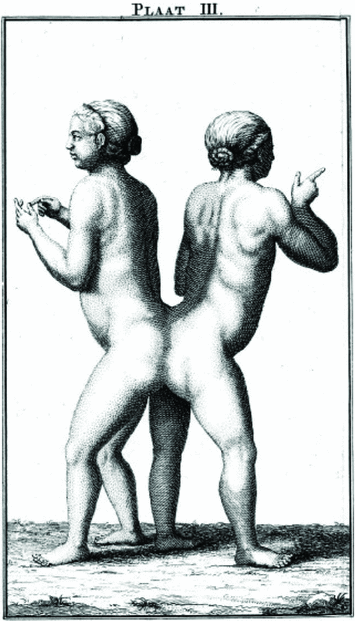
The Dutch naturalist Martinus Houttuyn (1720–1798) published many books on natural history. A full page portrait of Helen and Judith appeared in 1761 in volume I, Part I (1761), Chapter 2 (Plate III) of one of his main works: Natuurlyke Historie of Uitvoerige Beschryving der Dieren, Planten en Mineraalen, Volgens het Samenstel van den Heer Linneus [Natural History, based on the system of Linnaeus] (Boeseman & de Ligny, Reference Boeseman and De Ligny2004). After a brief introduction, Houttuyn inserted a complete translation of Torkos’ Latin account from the Philosophical Transactions to accompany the full-page illustration. It is a precise copy of one half of the Philosophical Transactions plate XIII, i.e., the reproduction of the original flyer done by Burghers. Its right side showing the twins from the back was very likely copied by tracing. In the engraving process, the silhouette was mirrored and singled out with a surrounding line-border that enlarged the empty space above the twins’ heads, and thus the vertical format was adapted to book proportions. This separated and inverted duo became a kind of standard template in further pictorial proliferations.
Helen and Judith (Houttuyn, 1761).
Helen and Judith (Buffon, 1777).
Courtesy of the Wellcome Library, London, UK.

Houttuyn stated he had based his review of mankind's history on information provided by Linnaeus and Buffon, whose Histoire Naturelle was published in first edition from 1749 onwards. But Houttuyn would not have been able to find the Hungarian twins anywhere in Buffon's work. They were only inserted as late as 1777 into the supplementary volumes.
Buffon, on the other hand, believed that the picture of Helen and Judith originated from Linnaeus’ Systema Naturae. He encountered Houttuyn's solitary twins in Statius Müller's German paraphrase of Linnaeus’ system. Buffon evidently mistook Müller's work for a genuine publication by, or at least as a reliable summary of, Linnaeus. Thus, the Hungarian twins surfaced in 1777 in a chapter entitled ‘Sur les Monstres’ in Supplement volume IV to his Histoire Naturelle as a token of the Swedish taxonomist, although the latter hated disorder and had consequently branded monsters as paradoxa right from the first edition of his Systema (1735) where he exposed the famous seven-headed ‘Hamburg Hydra’ as a fake! Consequently, Buffon's error amounts to a telltale confusion that provides insights into his reasoning and acquisition of material.
Taken at face value, Buffon's Hungarian girls (Figure 3) were turned into elder ladies rummaging nakedly in their boudoir with towels draped over their now aimless gestures. The anatomical display had changed into a kind of genre scene. This pictorial turn established a proliferation-line of its own, which can be spotted for example in Isidore Geoffroy Saint-Hilaire’s: Atlas / Histoire [. . .] des Anomalies, Paris 1837, Tf. XIV. However, the Houttuyn-type picture remained in service as well (Clausberg, Reference Clausberg2015).
Statius Müller (Reference Statius Müller1773): Figure 4
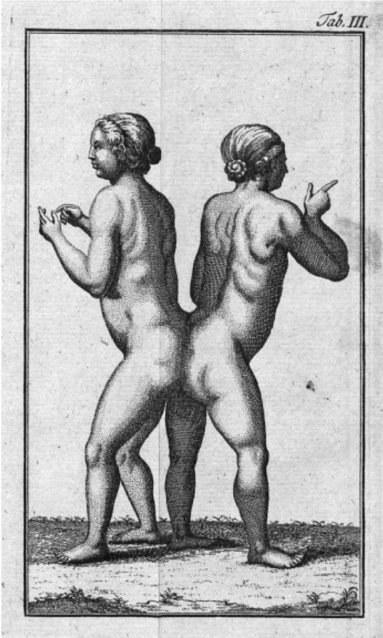
Philipp Ludwig Statius Müller (1725–1776), who originated from the Netherlands, inserted an exact and even sidewise correct copy of Houttuyn's twins into his overview of Linnaeus’ system published in 1773: ‘Des Ritters Carl von Linné [. . .] vollständiges Natursystem nach der zwölften lateinischen Ausgabe und nach Anleitung des holländischen Houttuynischen Werks mit einer ausführlichen Erklärung ausgefertiget, Teil 1: Von den säugenden Thieren’. Statius Müller's translation into German, which gave only a condensed account of the available sources, obviously complied with a widespread public desire to have the essential facts of nature's history explained in his native tongue. This way the erroneous notion was strengthened, that Linné had incorporated the Hungarian twins into his Systema. Further transfers were to follow. Statius Müller's version of the Hungarian twins was probably used at the end of the century by yet another popularizing writer.
Helen and Judith (Statius Müller, Reference Statius Müller1773).
Wilhelm (Reference Wilhelm1805): Figure 5
Gottlieb Tobias Wilhelm (1758–1811), a protestant cleric (Pfarrer) from Augsburg, described the twins in his ‘Conversations on Mankind’ (Wilhelm, Reference Wilhelm1805), which were part of a 25-volume encyclopedia on the History of Nature (Wilhelm, 1792–1812). Most likely, he used Statius Müller's work as a source book and had the picture of the twins reproduced, but slightly less refined and once more mirrored in the process of engraving. The story was told almost in the shorthand style of a fairytale. Wilhelm's extensive and lavishly illustrated volumes, which were reissued at least twice, underline in general the transition from speculative scientific investigations (Buffon) towards broad-based common knowledge typical of the advancing 19th century. Interestingly enough, the Houttuynian representation of the Hungarian sisters was carried along unchanged and undiminished with these developments. The notion of a Linnéan parentage may have helped in this perseverance.
Helen and Judith. Handcolored engraving (Wilhelm, Reference Wilhelm1805).

Anonymous Watercolor (After 1761): Figure 6
Where in this lineage of proliferation should be placed the anonymous and unknown portrait of Helen and Judith, which one of us discovered and described recently (Van der Weiden, Reference Van der Weiden2008). This 18th-century watercolor looks nearly identical, but is almost twice as large as the book illustrations in Houttuyn (Figure 6) and Statius Müller (Figure 2). Anyway, it can be safely dated after 1761, although it might even belong to a Netherlandish context leading up to Houttuyn's implementation. That this watercolor was used or even made in commission as a model for later illustrations (Statius-Müller, Wilhelm) seems far less likely though not entirely impossible. Normal reprint procedures would have implemented tracing of existing book illustrations.
Helen and Judith. Anonymous watercolor on cardboard, 305 × 505 × 2 mm, 18th century, probably 1760s.

Two other possibilities should be considered: (1) large posters or cartoons like these may have met the taste of connoisseurs and collectors, or (2) they may have served as anatomical wall charts for educational purposes. The second possibility should alert colleagues in charge of historical collections of medicine; the first possibility is underlined by the fact that even more precious versions of monster imagery (e.g., ivories) continue to surface on the art market. (Clausberg, Reference Clausberg2015).
Conclusion
Introduction of the Hungarian twins’ portrait into later 18th-century scientific literature coincided with a marked reduction of scenic detail. The two-fold double appearance originally used to announce the exhibition of the bicorporeal monster was replaced by the solitary, almost heraldic stance of an anatomical showcase. Evaluated in its new context, a strange confusion between strict systemic taxonomy (Linné) and loquacious extensiveness (Buffon) — becomes noticeable. The recently found large cartoon emphasizes these antagonistic tendencies. A more detailed expertise pending its origin can best be placed in the vicinity of Houttuyn, i.e., in the 1760s, riding the crest of the second wave of picture proliferation.



