


Without the support given by the government and its instruments – the Executive Office, the National Science and Technology Authority, the Ministry of Energy, the Philippine National Oil Company, the National Power Corporation, the Philippine Institute of Volcanology and the Bureau of Mines; by co-professionals, and by a host of agencies both foreign and local, geothermal development would not have progressed as much as it has. This development, born in the cradle of necessity some years before the 1973 energy crisis and nurtured through the state policy of energy self-reliance, is winning our battle for national economic survival.
As the third-largest producer of geothermal energy in the world, the Philippines is an important case to compare with Indonesia because it has been more successful in prioritizing the development of its geothermal energy resources. The Philippines was historically the second largest producer of geothermal energy until it was recently surpassed by Indonesia. The Philippines also provides a distinct history of geothermal energy development, involvement of development actors, variation in domestic energy resources, and domestic political economy. In the Philippines, international support for clean energy and a favorable domestic situation spurred rapid growth in geothermal energy to meet domestic energy needs in response to the energy crisis.
This chapter examines the impacts of the clean energy regime complex on the removal of barriers to geothermal energy technology development in the Philippines. The effectiveness of the regime complex is demonstrated by the change to installed geothermal generation capacity in the Philippines as barriers to development were addressed. The clean energy regime complex impacts barriers to development and supports geothermal energy deployment through the utility modifier, social learning, and capacity-building mechanisms. This analysis also looks at intervening variables that may have impacted the change in geothermal energy development, such as domestic political interests, external shocks, and political will. I begin by outlining the case study of the Philippines before tracing the history of the geothermal energy infrastructure that includes an overview of the barriers to its development over time. The chapter concludes with an analysis of the impacts of the three mechanisms of the clean energy regime complex for the case of the Philippines, before it is compared with the case of Indonesia in Chapter 7.
The Philippines as a Leading Geothermal Producer: Case Description
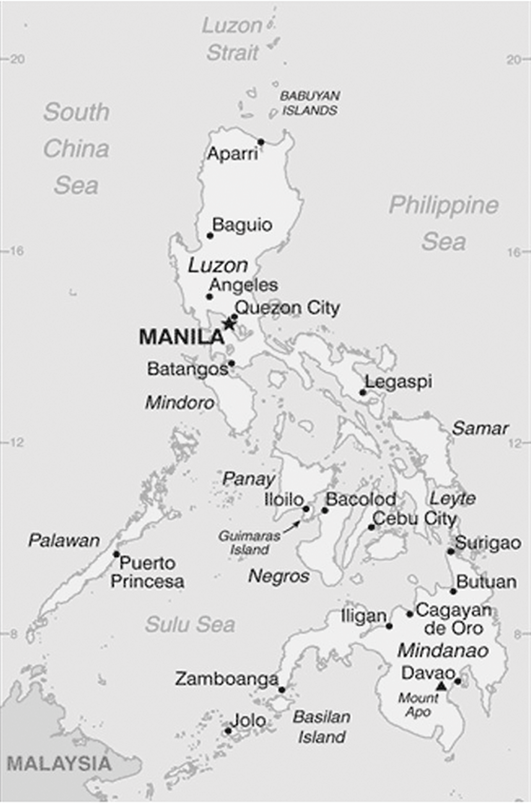
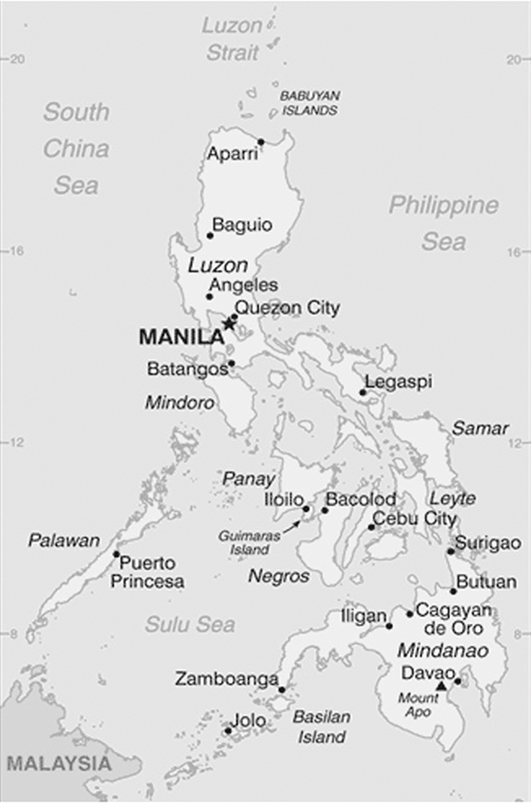
The Philippines is an archipelago of more than 7,000 islands, 2,000 of which are inhabited. The country’s population in 2022 was approximately 115 million people (World Bank 2024a). The Philippines archipelago is divided into three island groups: Luzon, Visayas, and Mindanao; the 11 largest islands comprise 94% of total land mass. The Philippines GDP was USD 437.2 billion in 2023, with a growth rate of 5.5% (World Bank 2025).
Map of the Philippines.
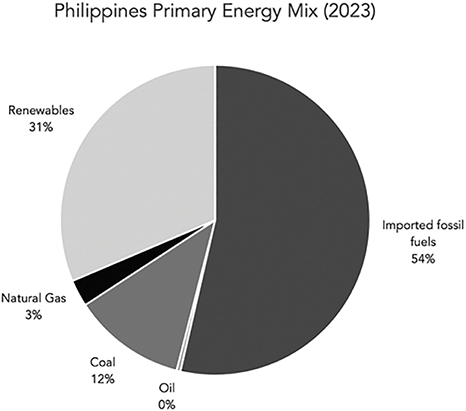
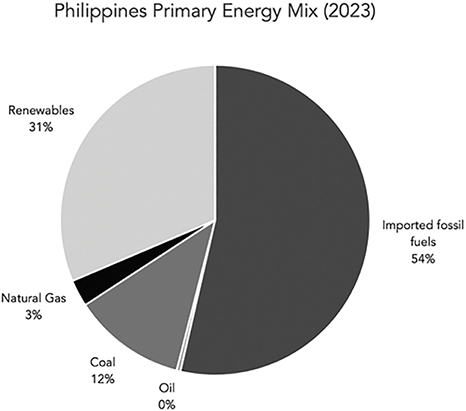
The country holds a wealth of geothermal energy resources, among other renewable energy resources, but it imports the majority of its oil, coal, and natural gas. The Philippines’ installed geothermal energy capacity as of 2023 was 1,952 MW (DOE 2023b), making it the third-largest producer of geothermal energy after Indonesia (second) and the United States (first). However, it held its position as the world’s second-largest producer for decades before Indonesia surpassed it in 2018. The Philippines’ energy generation mix in 2023 was divided across 69% oil, coal, and natural gas, 54% from imported fuels and 15% from domestic supply, and 31% renewable energy (see Figure 6.2). Geothermal energy made up 14% at 1.95 GW of installed capacity (DOE 2023b).
Philippines energy supply by fuel type (2023).
The Philippines’ limited natural resources endowment has created energy insecurity due to the limited domestic supply of fossil fuels and high import dependency. Energy diversification has motivated Filipino leaders to ensure energy security throughout the country’s history. Several energy shocks and crises have intensified energy security concerns and the urgency of energy development, particularly after the 1973 oil crisis during the Ferdinand Marcos regime (1965–1986) and the energy power crisis in the 1990s under the Corazon Aquino (1986–1992) and Fidel Ramos (1992–1998) administrations. As Pabling V. Malixi noted in a keynote address at the 1982 New Zealand Geothermal Conference:
Corollary to this overdependence on imported oil for its energy requirements, the Philippines faced the spectre of supply cuts and boycotts with the emergence of oil-based energy as an international economic and socio-political commodity. … These therefore were compelling motives for the Philippines, that found its back to the wall, to come up with a comprehensive and practical energy policy that will not only do away with the pitfalls of past complacency and inadequate planning, but also steer it towards national socio-economic development goals.
While the Philippines is a democratic regime currently under President Ferdinand “Bongbong” Marcos, Jr. administration (2022–present) – the country’s political history under the former Marcos (Sr.) authoritarian dictatorship and subsequent democratization and liberalization played a prominent role in influencing energy development. Tracing the political and economic history of the Philippines is an important exercise in understanding the forces and actors that have facilitated geothermal energy development in the country.
Main Barriers to Geothermal Energy Development
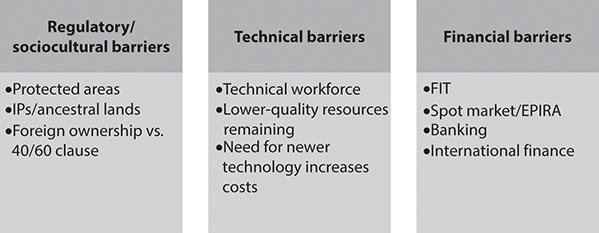
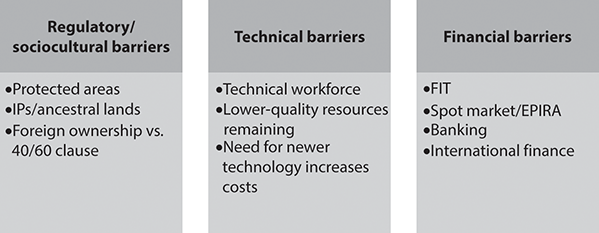
Barriers to geothermal energy development in the Philippines have changed over time. Historically, the biggest barrier to development was a limited technical workforce. More recently, technical barriers have arisen in light of the diminishing abundance of high-quality geothermal energy resources, with remaining resources largely low heat, low steam, and high acidity. Experts suggest that only 50% of the remaining resources (1 GW total) will be possible to develop with the geothermal technology currently available.Footnote 1 Technological advancements through enhanced geothermal systems or other advanced drilling technologies may unlock further geothermal potential, as underlined in Chapter 1. The geothermal resources that remain require more expensive technology such as binary steam turbines, creating added financial barriers.
Throughout the history of geothermal energy development, regulatory barriers have been an issue in the Philippines as geothermal resources are found in protected areas or within the ancestral land boundaries of Indigenous communities. These barriers are increasingly salient as quality resources become scarcer and necessitate exploration in protected areas. The next section elaborates the historical barriers to geothermal energy development in the Philippines and how they have evolved. Figure 6.3 presents a summary of historical and current barriers to geothermal energy development in the Philippines.
Historical and current barriers to geothermal energy development in the Philippines.
Regulatory Barriers: Ancestral Lands and Protected Areas
The first major barriers are sociocultural and regulatory. Many of the remaining geothermal resources are located in either ancestral lands or protected areas, and oftentimes the two overlap (van Campen Reference Van Campen2015).Footnote 2 Energy development is prohibited in these areas and requires extensive regulatory procedures to request amendments and/or rezoning of territories governed under these regulatory frameworks. Procedures to rezone protected areas or to apply for access to ancestral lands are costly in time and resources, sometimes stalling project development for years until due diligence requirements, sustainability guidelines, and approval at various levels of government are fulfilled.
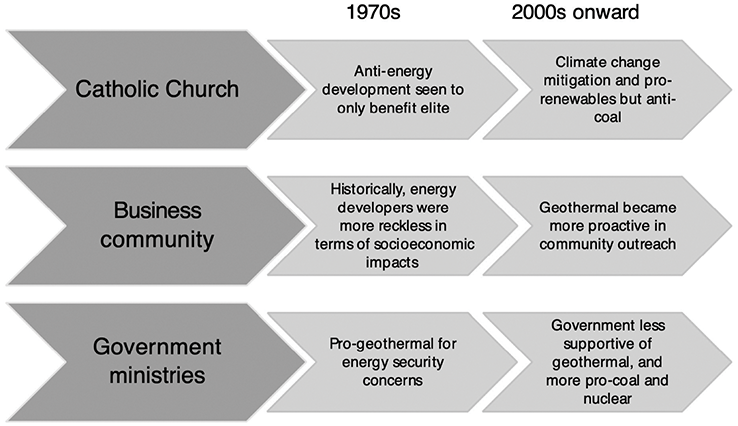
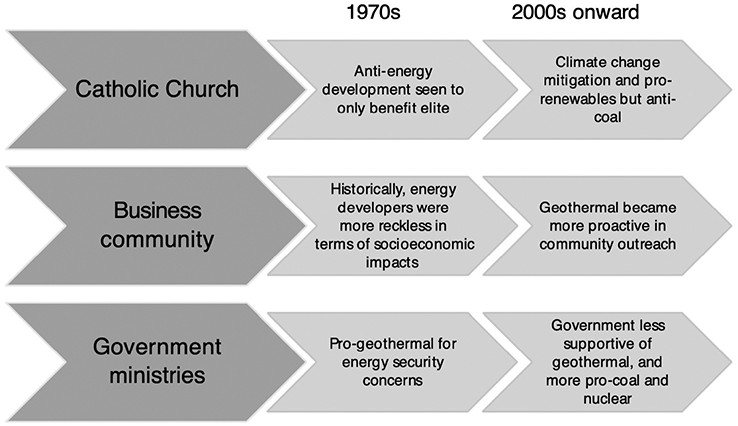
As summarized in Figure 6.4, there are several opposition groups to geothermal energy development in the Philippines. However, some of their interests have changed over time. For instance, while the Catholic Church was opposed to geothermal energy development and to energy development more broadly in the 1970s, its interests have changed to support geothermal energy development and it has promoted climate change policy since the 2000s. Government ministries and the business community were largely pro-geothermal energy in the 1970s but have become less supportive more recently. These changing perspectives demonstrate transformations in international and domestic norms surrounding climate change, energy development, and environmental awareness, occurring largely due to efforts by transnational and local advocacy groups and through the social learning mechanism of the regime complex.
Local-level opposition to geothermal energy in the Philippines.
Protected Areas
One of the major barriers to geothermal energy development is the regulatory process surrounding protected areas.Footnote 3 Protected areas are governed under Republic Act No. 7586, the National Integrated Protected Areas System (NIPAS) Act of 1992. The Environment Management Bureau in the Department of Environment and Natural Resources manages protected areas. The NIPAS Act defines protected areas as follows:
To this end, there is hereby established a National Integrated Protected Areas System (NIPAS), which shall encompass outstanding remarkable areas and biological important public lands that are habitats of rare and endangered species of plants and animals, biogeographic zones and related ecosystems, whether terrestrial wetland or marine, all of which shall be designated as “protected areas.” (GoP 1992)
The NIPAS Act prohibits natural resource extraction within a protected area. Renewable energy (less than 3 MW) can be developed in protected areas for direct use.Footnote 4 Energy surveys can only take place once an area is disestablished as a protected area through a law passed by Congress.
Sustainability and the preservation of biodiversity are a mainstay of Filipino culture and have been integrated into the mission and sustainable approach of many Filipino geothermal energy companies, particularly the Energy Development Corporation (EDC), a formerly state-owned geothermal energy developer under the Philippines National Oil Company (PNOC), privatized in 2006. Nevertheless, the way the NIPAS Act is written does not distinguish geothermal energy development from other mineral resource extraction and does not differentiate among different types of energy development. Therefore, geothermal energy developers must undergo a lengthy legal procedure for determining whether geothermal resources fall into a protected area, buffer zone, or outside of the protected area – just as a mining company would need to, despite the different environmental impacts of these two extractive processes. While geothermal energy development has negative environmental impacts as covered in Chapter 5, they are not as significant as those of coal energy development, for example. Development of any resources that fall within a protected area would require rezoning the protected area, which adds procedures and obstacles to development.
The disestablishment of protected areas, which is codified in the NIPAS Act, occurs when the Department of Environment and Natural Resources and various boards for protected areas agree that the boundaries of a certain protected area should be redrawn, or the boundaries of the protected area are modified as warranted by a study, allowing Congress to reapprove the rezoning. The modification of the border of the protected area occurs following an act of Congress (GoP 1992: 6). Geothermal energy projects located in Mt. Apo and Mt. Kanlaon both faced issues with protected areas and Indigenous peoples’ concerns, but following a lengthy review process, it was determined that the geothermal resources were in a buffer zone and did not require rezoning. Since many new geothermal resources overlap with protected areas and ancestral lands, developers need to undergo extensive review processes and apply for the boundaries of the protected areas to be redrawn.Footnote 5 In an effort to address some of the overlaps, in 2018, the NIPAS Act was expanded under RA 11038, “An Act Declaring Protected Areas and Providing for Their Management,” to include special protections for biological diversity and recognition of conservation areas and the management regimes implemented by local government units and Indigenous communities (GoP 2018). This regulation (referred to as E-NIPAS) expanded the number of protected areas and critical habitats protected under the NIPAS Act (GoP 2018; Romero Reference Romero2018).
Indigenous Communities and Ancestral Lands
The National Commission on Indigenous Peoples manages the procedures for ancestral lands and Indigenous populations. The Commission was created in 1997 with the adoption of Republic Act 8371. The law avows the rights and welfare of Indigenous peoples and helps them secure land tenure and recognition. The legal regime to protect Indigenous peoples began under the American colonial government, was later abolished, and subsequently was reissued under new authority during the Marcos and Aquino administrations. However, the Philippines constitution declares that natural resources are owned by the state, meaning exploration and development of natural resources can only be done by the state or under state control (GoP 1987). As such, while ancestral rights are protected under the Indigenous Peoples’ Right Act, subterranean resources – including mineral resources – do not belong to Indigenous communities but rather to the government or government-allocated contractors in private industry, who then have the right to explore and develop these resources.
When geothermal resources overlap with ancestral lands, the geothermal energy developer must go through a process of approval to access lands and develop resources, which involves the National Commission on Indigenous Peoples, a tribunal made up of local community representatives, local government, local Indigenous peoples’ representatives, and the Philippines Department of Energy (DOE). The DOE becomes involved if the local community requests it or if the geothermal energy developer needs additional assistance. Indigenous peoples are often divided as to the outcome of projects. While many communities are concerned over the environmental impact of projects and disruption of traditional livelihoods, some are interested in the economic benefits associated with projects such as employment opportunities or compensation for relocation or lost land (Chelminski Reference Chelminski2024).
The history of contestation between geothermal energy development and Indigenous communities is part of a larger story of energy development and Indigenous community land rights in the Philippines.Footnote 6 As geothermal resources often overlap with ancestral lands, conflicts over development arise. One example is in the Mt. Apo area in Mindanao, where more than a half million Indigenous people organized to protest the PNOC-EDC geothermal energy project in development on ancestral land (Chelminski Reference Chelminski2024). This contestation led to government militarization of the area (Weissman Reference Weissman1994). The sociocultural, legal, and environmental conflicts between PNOC–EDC and the Indigenous peoples lasted two years, but the communities were ultimately unable to stop the drilling on Phase One of the project.
Following these events, multilateral development banks aided geothermal energy developers in creating a set of community outreach practices and corporate social responsibility standards to better manage relationships with local communities and Indigenous peoples.Footnote 7 For example, in 1993, the World Bank helped PNOC–EDC develop a resettlement program for the 640 MW geothermal project in Leyte in line with international norms, since neither the company nor the government had a program in place. The project displaced more than 100 families and disrupted their traditional livelihoods that depended on farming and agriculture (de Jesus Reference Jesus2000; World Bank 2000). The aim of the resettlement program was to avoid the potential health hazards of plant emissions, provide affected families compensation for the equivalent standard of living, and facilitate formation of a community organization (de Jesus Reference Jesus2000). The World Bank’s Leyte Geothermal Project Resettlement Program has been further institutionalized by the PNOC–EDC and other project developers to better manage relationships with local and Indigenous communities.
Further externalities have arisen regarding the EDC’s policy of resettlement packages for host communities. The Nasulo Geothermal Project with the EDC, which received CDM funding, was severely delayed due to overwhelming requests for resettlement, even by communities not directly impacted by the development. Nearly 200 households filed resettlement requests with the EDC due to long-term safety concerns related to development of nearby sites in Palinpinon I and II, including landslides and hot spring thermal manifestations, though these were not linked to the Nasulo site in development (World Bank 2012b). Of these requests, 153 were approved for resettlement. The negotiations with local communities may have slowed development in this project, but they are an integral part of energy development and require addressing.
The Mt. Apo and Leyte geothermal projects exemplify how complications increase and development timelines extend exponentially when geothermal energy development overlaps with either protected areas or ancestral land. Many of the new geothermal sites in the Philippines proposed for exploration overlap with Ancestral land and protected areas. According to project developers, some Indigenous communities are more amenable to development than others: particularly in Mindanao, Indigenous communities have been relatively cooperative. However, in northern Luzon, the Indigenous communities have been less open and even outright hostile to development due to previous polarization because of contestation and conflicts with the mining sector.Footnote 8
The institutionalization of resettlement and norms around compensation packages and community outreach have developed through social learning via development assistance and international norms (see Chapter 5 for a summary of World Bank policies on resettlement). Resettlement and compensation packages are necessary for offsetting the damages of relocation, loss of livelihoods, and environmental impacts. At the same time, resettlement permanently alters communities’ way of life and raises larger questions of justice and equity surrounding land rights, tribal sovereignty, procedural justice, and the impact of renewable energy development.Footnote 9
Foreign Ownership
Another regulatory barrier to geothermal energy development in the Philippines is the foreign ownership rule. In renewable energy development, foreign companies are only allowed to own 40% of total assets and need to “Filipinize” by partnering with a local company that would then own 60%, coproducing with the government, or finding other production-sharing agreements. The Philippine constitution stipulates that natural resources are owned by the people. Therefore, exploitation must be carried out with full supervision of the state, which is why the 40/60 rule is applicable in practice. The Philippine Constitution, Article XII, Section 2 reads:
All lands of the public domain, waters, minerals, coal, petroleum, and other mineral oils, all forces of potential energy, fisheries, forests or timber, wildlife, flora and fauna, and other natural resources are owned by the State. With the exception of agricultural lands, all other natural resources shall not be alienated. The exploration, development, and utilization of natural resources shall be under the full control and supervision of the State. (GoP 1987)
The RA 9513 further reinforces the constitution: “The State may directly undertake such activities, or it may enter into co-production, joint venture or co-production sharing agreements with Filipino citizens or corporations or associations at least sixty percent (60%) of whose capital is owned by Filipinos” (GoP 2008: 21).
State ownership is a barrier to development because geothermal energy projects are highly capital-intensive and high-risk investments. However, Renewable Energy Law No. 9513/2008 also allows foreign companies to own 100% of geothermal assets, provided the president approves (DOE 2009: 13; GoP 2008). Chevron applied for 100% foreign ownership in 2013, but the petition was denied because the project was a brownfield with a previous 40/60 ownership contract. The government claimed it needed to be a greenfield (new project, new contract).Footnote 10 Chevron has applied for two additional projects under the 100% foreign ownership clause, but these were not approved. Previous governments were reluctant to approve this clause because of concerns of unconstitutionality.Footnote 11 In a change of practice, former DOE Energy Secretary Alfonso G. Cusi issued a statement in 2020 enabling foreign companies to participate in large-scale geothermal exploration, development utilization under the third Open and Competitive Selection Process, under the condition that foreign investors meet a threshold of a minimum of USD 50 million in investment and comply with the Financial and Technical Assistance Agreement that enables foreign investors (DOE 2020). The statement indicates that 100% foreign ownership of geothermal assets is politically feasible now in hopes of spurring private investment in the sector.Footnote 12
Technical Barriers: Secondary Resources and New Geothermal Technology
The second major delay in current geothermal energy development comes from the lack of high-quality resources (low enthalpy or heat, and high acidity), which makes extraction and production more costly and difficult with existing technology. Policymakers and developers refer to the resources that remain as “secondary resources.” The average temperatures needed for a geothermal project are between 140 and 180 degrees Celsius, but 220 degrees Celsius is the temperature needed for geothermal steam production. Low-temperature resources are not as high quality as those already developed. A conventional geothermal project should produce at least 40–80 MW in order to be economically viable, but the majority of geothermal concessions listed in the most recent tendering in the Philippines have an estimated capacity between 20 and 120 MW.Footnote 13 Newer advancements in geothermal drilling technologies have the potential to unlock further resources. However, these new technologies also raise production costs. As explored in the next section, it is difficult for geothermal projects to compete in the spot market against lower-cost projects.
Financial Barriers: Feed-in Tariff and the Electricity Spot Market
The major financial barriers to geothermal energy development in the Philippines are that the extraction process to develop secondary resources require more advanced and expensive geothermal drilling technology, and that the electricity regime and spot market are not structured in a way that enable renewables to fairly compete. The electricity prices in the Philippines are some of the highest in Asia – the second highest after Japan (KPMG 2014). Some argue that the high prices are attributable to the remaining independent power producer agreements from the Ramos era, which expired in 2020 (Cham Reference Cham2007; KPMG 2014).Footnote 14 In a spot market, geothermal energy developers cannot compete with coal for three main reasons: contracts are short and there is no guarantee of offtake, tariffs are too low at current coal prices, and geothermal production costs, and distributed utilities are renegotiating tariffs.Footnote 15 Project developers have argued that a feed-in tariff is needed to cover the costs of new technology, exploration, and development of these secondary resources since the production costs cannot compete on the spot market against coal.Footnote 16 A feed-in tariff could provide more stability from the government to solve some of these issues, but there is still a great deal of uncertainty created by the power sector regime. The National Geothermal Association of the Philippines (NGAP) has continually lobbied for newer geothermal technologies, such as enhanced geothermal systems or binary turbines, to be added to the list of emerging renewables encompassed in the feed-in tariff.
Political and Economic History of the Philippines and Geothermal Energy Development
Geothermal energy development occurred mainly during the Marcos and Ramos eras and was heavily influenced by the political circumstances of those periods. This section traces the political and economic history of the Philippines, evaluates the involved actors and interests, and traces how they influenced growth in geothermal energy installed capacity over time. The historical section begins in the early 1960s, under Marcos, in the lead-up to the oil crisis as a background to regime complex evolution.
Martial Law and the Energy Security Crisis
The Philippine Institute of Volcanology (ComVol, as it is commonly known) was founded in 1962 and tasked by the government with leading the investigation of geothermal resources for power generation (Cerezo Reference Cerezo2012; PGI 2013). Arturo Pineda Alcaraz was the head of ComVol and had a history working in the oil and gas sector. He recognized that the Philippines had potential for geothermal energy resources after observing similar developments in New Zealand, Italy, and the United States. Due to his leadership efforts to promote the development of these resources, Alcaraz is known in the Philippines as the “Father of Geothermal Energy Development.”Footnote 17 Under President Diosdado Macapagal (1961–1965), there was an effort to investigate indigenous energy resources due to energy security concerns and an uncertain geopolitical situation in the Gulf region (Velasco Reference Velasco2006). In 1966, the government of the Philippines, with the assistance of the United Nations Special Fund (now the UNDP), conducted the Pre-investment Study on Power, which included geothermal, hydro, coal, nuclear, oil, and gas power. George W. Grindley from the New Zealand Geological Survey was appointed as the UN Special Fund Consultant to handle the assessment of geothermal steam to produce electricity for the island of Luzon between 1963 and 1964, and he recommended the exploration of Tiwi, then Los Banos and Batong Buhay geothermal working areas. Tiwi demonstrated surface thermal manifestations in Naglagbong Park in Luzon (PGI 2013). The National Science Development Board provided financial assistance for geothermal investigation in Tiwi. The Bureau of Mines and ComVol carried out Grindley’s recommendations to conduct a series of geothermal and chemical surveys.
The government of the Philippines demonstrated its willingness to develop geothermal energy resources by devoting government resources to the task. By 1967, a successful demonstration of steam from Tiwi was used to generate power to a pilot plant. The Geothermal Energy, Natural Gas, and Methane Law (RA 5092) was enacted in 1967, allowing the government to carry out exploration and utilization of the resources, either alone or with an independent contractor. By 1970, the National Power Corporation was vested with the responsibility to explore, develop, and exploit geothermal energy for electricity power generation (PGI 2013). The government approached USAID to request financial assistance for a 10 MW pilot power plant and was provided a grant with the suggestion that the Philippines consider Unocal, a multinational energy company, as a partner through a qualified service contract. Under the qualified service contract, Unocal created a local company called Philippine Geothermal, Inc. and signed a contract with the National Power Corporation in 1971. Exploration drilling commenced in 1972.
In these early stages of geothermal energy development, there was limited local technical workforce and financial resources to develop geothermal energy. Bilateral and multilateral financial and technical assistance were crucial in supporting early geothermal energy development in the Philippines. However, assistance was provided at the request of the country’s government to develop natural resources wealth and improve energy security rather than at the initiative of the international development organizations themselves.
The SOEs- and government-led exploration allowed for immediate prioritization of geothermal development while mobilizing government resources. The top-down approach and energy security concerns spurred rapid action in the industry. This approach was institutionalized when President Marcos imposed martial law in 1972. He then announced mass arrests of opposition leaders, introduced a curfew, and closed down media offices (UPI 1972). This was an important political turning point in the history of geothermal energy development because it gave Marcos full control of the government at the same time that the Philippines was devastated by the 1973 oil crisis.
The Philippines was left without access to oil due to the oil embargo, as it was an American ally. The country’s importation of crude oil depended fully on US- and UK-owned oil companies, which is why it was so severely affected by the oil crisis (Velasco Reference Velasco2006). The energy crisis that ensued required the government to ration gasoline, implement energy conservation measures, and import naphtha and other gasoline products that were exempt from paying customs and import duties (Marcos Reference Marcos1973). To address energy supply shortages, diplomatic efforts were made to secure additional barrels of oil from China, and Suharto also led a “rice for oil” trade with Indonesia (Marcos Reference Marcos1979; Velasco Reference Velasco2006). The additional 3.2 million barrels of oil secured through these efforts helped cover deficiencies in supply for the short term. However, the government saw the necessity to act immediately in implementing a national energy development policy to reduce dependency on foreign supply by developing domestic energy resources.
To reduce dependence on oil imports, the government under Marcos rapidly prioritized the development of domestic sources, placing a priority on geothermal energy because of the exploration and discovery of resources in the early 1960s under the leadership efforts of Arturo Pineda Alcaraz. Geronimo Velasco, the previous head of PNOC and appointed Energy Secretary under President Marcos, was also an important actor in promoting geothermal energy during that time.
New Zealand played a large role in early geothermal energy development in the Philippines. As part of the bilateral cooperation agreement between New Zealand and the Philippines initiated by Arturo Alcaraz New Zealand provided financial and technical assistance and technology transfer to assist in exploration and development of the first geothermal sites. The initial group of specialists with geothermal experience came from the New Zealand Department of Scientific and Industrial Research (DSIR).Footnote 18 Following the bilateral treaty, the private New Zealand consulting company Kingston, Reynolds, Thom and Allardice, commonly known as KRTA, was appointed as the executing agency for the aid agreement (KRTA 1979; NZ Listener 1981). Between 1973 and 1985, the Philippines received a total of NZD 21.5 million (roughly equal to the same amount in USD at the time) as a grant for geothermal exploration, and KRTA provided technical assistance in conjunction with the National Power Corporation and state-owned PNOC and, later, with PNOC–EDC (Chelminski Reference Chelminski2022; Hochstein Reference Hochstein2005).Footnote 19
Following the confirmation of the Tiwi site, the government invested full resources in exploring geothermal energy potential by creating the EDC under the PNOC in 1976. The EDC was tasked with a mandate to “explore, delineate and develop indigenous resources in the country” and lessen the country’s dependence on imported fuel.Footnote 20 The company received technical training and financial assistance from the government of Indonesia throughout this period to further develop its potential; PNOC–EDC worked with the National Power Corporation under Marcos’ direction and was guaranteed offtake by the National Power Corporation for geothermal steam fields, while the government guaranteed the financing of project exploration and development.
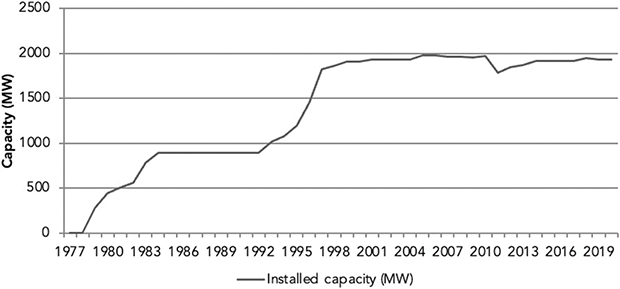
This geothermal energy development operated under a service contract system written into Presidential Decree No. 87, known as the Oil Exploration and Development Act of 1972, which upheld the sovereignty of producer-country over natural resources and guaranteed a share of the product (Chelminski Reference Chelminski2022; Velasco Reference Velasco2006). Under this structure, the Philippines quickly developed 446 MW of installed geothermal energy capacity by 1980, and by 1983, the country had already become the second-largest geothermal energy producer in the world (after the United States) with the commissioning of Tongonan I and Palinpinon I, a combined 225 MW installed capacity. Figure 6.5 shows the country’s growing installed capacity of geothermal energy over the past four decades.
Philippines installed geothermal energy capacity over time.
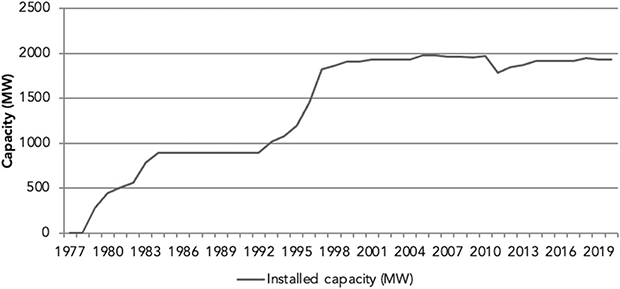
Figure 6.5 Long description
The horizontal axis represents the years from 1977 to 2019 in increments of 3. The vertical axis represents the capacity in M W, ranging from 0 to 2500 in increments of 500. The line graph starts near 0 MW in 1977 and shows the following approximate values: 1980: 490 M W; 1983: 850 M W; 1986: 900 M W; 1989: 900 M W; 1992: 900 M W; 1995: 1200 M W; 1998: 1900 M W; 2001: 1950 M W; 2004: 2000 M W; 2007: 1995 M W; 2010: 1800 M W; 2013: 1850 M W; 2016: 1900 M W and 2019: 1900 M W.
Period 1: Geothermal Growth and International Financing
The funding provided by international donors and bilateral agencies is an important part of the history of the Philippines’ early geothermal energy development. This financing started prior to Period 1 of the clean energy regime complex. The most important early bilateral sources funding geothermal development were Japan, New Zealand, and, to a lesser extent, Italy (Malixi Reference Malixi1982). The World Bank, UN Special Fund, and ADB were also involved in supporting early geothermal energy development in the Philippines. Japan provided a series of loans and technical assistance to geothermal projects during the 1980s–1990s, totaling JPY 91 billion (USD 832.4 million) (JICA 2016).Footnote 21
The Acceleration of Power Development in the Philippines
The Philippine power crisis of the 1990s was caused by a series of factors originating in the 1970s, after the nationalization of the power sector and the establishment of the National Power Corporation as a monopoly in power generation and transmission (Cham Reference Cham2007). Underinvestment in generation and transmission capacity led to rolling blackouts throughout the country. At the worst point of the crisis in 1992–1993, brownouts averaging seven hours a day were commonplace across the Philippines (World Bank 1994). Demand for electricity increased throughout the 1960s and 1970s, and the National Power Corporation enacted an ambitious power development plan financed mainly by foreign borrowing (Cham Reference Cham2007).
In 1977, the National Power Corporation began construction of the Bataan Nuclear Power Plant. The Bataan project was plagued by corruption and encountered long delays. The project cost nearly USD 2 billion when it was completed in 1984 (Cham Reference Cham2007; KPMG 2014).Footnote 22 The plant was never opened, in part due to the concerns of the Aquino administration about the legacy of corruption in the Marcos regime that had tarnished the project, but mainly because of alleged security concerns related to earthquakes (KPMG 2014). Long-term energy development was overlooked, and the lack of new installed capacity to replace the capacity lost by the Bataan plant’s cancellation led to severe under capacity and massive power failures across the country.
Pabling Malixi was the head of the EDC throughout the energy crisis and played a key role in strategizing the Philippines’ recovery.Footnote 23 His plan underlined the necessity of the Philippines becoming energy self-reliant, as he saw the country’s dependence on imported fuels to be the central cause of the energy crises. To achieve self-reliance, investment in energy diversification became a top priority. In 1982, he wrote, “As a consequence of the first strategy, the accelerated development of indigenously abundant energy resources, such as geothermal and coal, was given added impetus and all-out support by the government. Geothermal exploration and development especially became an important and large component of the national energy program” (Malixi Reference Malixi1982: 110). Malixi was a major proponent of the exploration and development of geothermal resources in Leyte (Tongonan), which required the building of deep-sea cables to connect the Luzon and Visayas island groups, effectively branching supply and demand.Footnote 24
Throughout the 1990s, the Philippines benefited from development finance directed at facilitating economic and regulatory reforms to incentivize private investment (Bacon Reference Bacon2019). To address the energy crisis, the Independent Power Producer Framework was enacted under the Build-Operate-Transfer (BOT) Law in Republic Act 6957 in 1990, and Presidential Decree 45/1991 removed additional barriers to private investment (KPMG 2014; Yasukawa and Anbumozhi Reference Yasukawa and Anbumozhi2018). Many BOT contracts were signed with highly favorable conditions for the independent power producers, which eventually led to an overcapacity issue. AES Transpower, Tokyo Electric, Marubeni, Aboitiz, Ayala, EDC, Mirant, Meralco, and SMC Global Power were some of the companies that signed independent power producer agreements during this time (KPMG 2014). The BOT structure led to the development of an additional ~1 GW of geothermal installed capacity that came online between 1996 and 2000 (Chelminski Reference Chelminski2022; GoP 1990; Yasukawa and Anbumozhi Reference Yasukawa and Anbumozhi2018). As of 2021, 67% of geothermal assets – both steam and power plants – were owned by state utilities (or former state-owned utilities in the case of EDC), and only 28% were owned by IPPs (DOE 2021).Footnote 25
The push for privatization and restructuring started in the mid 1990s following a World Bank study that proposed radical reforms and privatization. The need for privatization to help fill the supply gap was urgent, and the government made concerted efforts to create a favorable environment for private sector investment (World Bank 1994). The World Bank provided a sizeable loan of USD 390 million to support energy sector development and minimize the cost of power generation (transmission build-out) (World Bank 1997). The funding aimed at building regulatory capacity and reorienting the government’s strategy for energy sector management. The funding was provided to strengthen regulatory activities for pricing and quality control, fostering private sector investment in joint ventures and enhancing institutional technical capabilities (World Bank 1997). This targeted use of the loan demonstrates the social learning mechanism at play through efforts to reform policy and build capacity to implement new policy that would foster growth in the power sector. Social learning is evident through the subsequent adoption of policy and restructuring of the power sector.
Following financial and policy support from the World Bank, the Electricity Power Industry Reform Act (commonly known as EPIRA) was signed in 2001 (GoP 2001; KPMG 2014; World Bank 1994). After EPIRA, the Power Sector Assets & Liabilities Management Corporation was mandated to reform and restructure the sector. The Power Sector Assets & Liabilities Management Corporation privatized 26 generating plants and the National Grid Corporation of the Philippines. The goal of liquidating all of the National Power Corporation’s assets was to create a competitive electricity market, known as a spot market. The introduction of a wholesale market for electricity in a developing country was seen as a large undertaking albeit necessary to increase competition in the sector and attract private investment. The Philippines is now seen as a success story, despite the fact that electricity prices are some of the highest in Asia. The Retail Competition and Open Access Model was set up in 2013 and implemented in 2016. The Energy Regulatory Commission approved the final rules for retail competition and open access, which included the transition of end users and distribution utilities into an open electricity market (Rivera Reference Rivera2016). This model allowed customers to opt out of their local distribution utility and choose their electricity provider from members of the Wholesale Electricity Spot Market (Business World 2015). Suppliers likewise would provide packages tailored to customers’ needs.
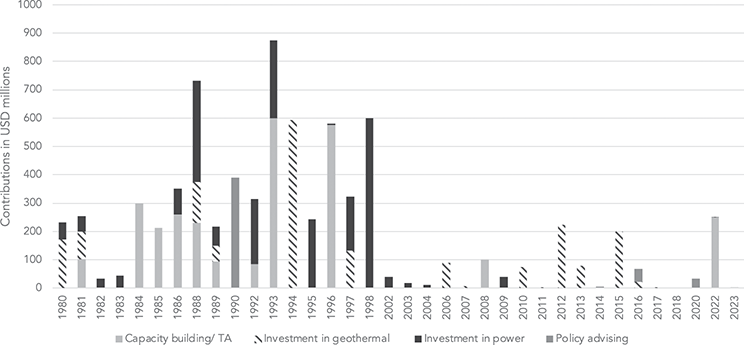
Analysis of the lead-up to and beginning of Period 1 of the regime complex and the state of geothermal energy development in the Philippines shows many changes in the structure of the energy sector driven by political and economic changes, as well as by external shocks. Martial law and the prioritization of geothermal energy as a response to the 1973 oil crisis spurred growth in geothermal energy development, funded and owned primarily by PNOC–EDC and Unocal. The power sector was completely changed in the mid 1990s and privatized to solve power shortages. There was a proliferation of BOT agreements, accelerating private sector investment in power generation. This further underlined the importance of developing geothermal energy capacity. Bilateral and multilateral donors during this period were active in prioritizing geothermal development, yet their impacts preceded the emergence of the clean energy regime complex. Figures 6.6–6.8 give an overview of finance during this period.
Overall, this period demonstrated the urgency of the government turning to geothermal energy to solve the energy security crisis. The international development funding was a response to domestic political interests, but overall, the prioritization of renewable energy development was a reaction to energy shocks. Nevertheless, the provision of development funding for geothermal installed capacity development, regulatory capacity, and institutional change shows efforts by development organizations to support geothermal expansion and regulatory change. The implementation was then demonstrative of social learning. The emphasis on social learning is even more evident during Period 2.
Period 2: Lobbying for Reform to Address Regulatory Barriers
Periods 1 and 2 saw the rise of an anti–coal mining movement that began in the 1970s and 1980s as environmentalism grew in the Philippines, fostering a desire to promote the development of cleaner indigenous resources.Footnote 26 Communities most impacted by coal mining actively protested. The Catholic Church became involved in efforts against coal mining and logging and was a highly influential voice in the Philippine policy space.
In the late 1980s, the Renewable Energy Commission was formed – first informally, then formally – to lobby for the creation of a renewable energy law to better incentivize investment in renewable energy. Its creation institutionalized the transnational advocacy network, in which the WWF played a prominent role in forming the coalition (Chelminski Reference Chelminski2022). The Commission consisted of civil society, government, and private actors, including Aboitiz, Vestas, EDC, Chevron, Greenpeace, and a variety of renewable energy companies.Footnote 27 Lobbyists pooled resources and carried out public campaigns and collected 400,000 signatures in petition for renewable energy. They also started to write a weekly column in the Philippine Daily Inquirer, a notable independent English-language newspaper founded near the end of Marcos’s regime, to promote the passage of the law. The fossil fuel and coal industries pushed back, but finally the new Renewable Energy Act was passed in 2008 (Republic Act 9513). The new law provided a range of incentives for renewable energy investors, including tax holidays, tax credits, and tax exemptions, a feed-in tariff for intermittent and emerging renewable technologies (though excluding geothermal), renewable energy portfolio standards, and financing (GoP 2008). Furthermore, the new law provided for 100% ownership of geothermal assets by a foreign company (pending the president’s approval), which addressed one of the regulatory barriers to geothermal energy development. The regime complex influenced the policy supported by the Renewable Energy Commission through the WWF, and this coalition eventually fostered cognitive shifts on the part of policymakers to support renewable energy policy adoption, demonstrating social learning.
While development assistance was low compared to Period 1, multilateral funding continued on some level (see Figure 6.6). The utility modifier mechanism was not effective in incentivizing geothermal energy development during this period. However, this period showed the outcome of collaborative efforts started in Period 1 between international NGOs, civil society, government, and the Catholic Church to promote renewable energy development through the adoption of the Renewable Energy Act. Social learning is evident in Periods 1 and 2 through the process of lobbying and efforts to promote the law that then resulted in its implementation, in line with objectives of the Renewable Energy Coalition. This is an example of the social learning mechanism at work because policymakers were eventually persuaded through a long lobbying process to support the implementation of the Renewable Energy Act, heightening the priority of renewable energy.
The adoption of the Renewable Energy Act exemplifies a cognitive shift in the way that policymakers saw renewable energy policy, providing support for the social learning mechanism. However, there was also a shift in the focus of policymakers to other renewable energy technologies as demonstrated by the feed-in-tariff scheme. The feed-in tariffs provided for renewable energy focused on emerging technologies rather than mature geothermal technologies like flash steam plants.
Period 3: Ups and Downs in the Geothermal Energy Industry
In Period 3 of geothermal energy development in the Philippines, geothermal energy development increasingly faced new technical, sociocultural, and regulatory barriers. The clean energy regime complex was not active in the Philippines’ geothermal industry during this period. While geothermal energy was deprioritized for a period of time in the early 2000s, there was a renewed effort to develop new geothermal resources and reclaim the Philippines’ spot as the world’s second-largest producer of geothermal energy (Mercurio Reference Mercurio2023).Footnote 28 As shown in Figure 6.5, geothermal energy development installed capacity plateaued and even declined as development slowed and existing geothermal sites became less productive. However, with new geothermal awards and projects in development close to completion, the installed geothermal energy capacity is expected to increase (DOE 2024; Mercurio Reference Mercurio2023). Furthermore, efforts to revive geothermal energy development are expected to catalyze additional capacity.
As detailed, many barriers to geothermal energy development have only recently arisen in the third period as a result of a mature geothermal industry. The major barriers include the lower-quality steam of geothermal resources requiring more expensive, binary turbine technology to develop them, risk associated with new exploration drilling needs, overlapping Indigenous territories and protected areas within geothermal working areas requiring high transaction costs for developers to rezone and receive approval from various levels of government, and a lack of certainty regarding an offtake guarantee, making geothermal development risky under the electricity regime and spot market. Combined, these issues have made it more difficult and less economical to develop the Philippines’ remaining geothermal energy resources without further international support.
To alleviate some of the financial barriers, the DOE passed a ruling in 2023 to create a renewable energy-only competitive procurement called the Green Energy Auction Program (GEAP). In the third round of the GEAP held in 2024, geothermal and other renewable technologies like run-of-the-river hydro and pumped-storage hydro were eligible to participate in the competitive solicitation (Chandak Reference Chandak2024). The GEAP provided capacity targets and a ceiling price, and developers bid in a price under that ceiling – winners selected in the auction typically received a tariff under a 20-year contract.Footnote 29 The DOE Department Circular No. DC2023-10–0029 notes that the DOE views a competitive bidding process as the most attractive way to develop renewables to meet the goal of 35% renewable energy in the energy mix by 2030 targeted under the National Renewable Energy Program (2020–2040) (DOE 2023a). This auction had the potential to overcome some of the financial barriers to development so that geothermal assets were not competing against coal in the spot market. Once the Energy Regulatory Commission set ceiling tariffs for geothermal energy, the third round of the GEAP took place in 2024 (GoP 2023).Footnote 30
As outlined in Chapter 5, geothermal exploration drilling is a highly risky and costly stage of geothermal energy development that represents a major barrier, particularly for private investment. The same exploration drilling risks are emerging in the Philippines in Period 3 as the private geothermal energy industry attempts to develop the remaining geothermal resources and must bear the risks and costs associated with this stage of development in the absence of the government taking on this risk.Footnote 31 Historically, the majority of exploration drilling for geothermal energy development was conducted by SOEs. While the Government of the Philippines has conducted minimal shallow exploration drilling in recent years, the data provided are not comprehensive enough to reduce the significant risks and costs for the private industry.Footnote 32 The geothermal energy industry through NGAP has advocated for the creation of a risk-mitigation mechanism to reduce the risks of geothermal exploration drilling, government subsidies for exploration wells, insurance payable in case of failed exploration wells, or a loan guarantee program (NGAP 2021). Through technical assistance from the ADB, the Government of the Philippines identified major barriers to geothermal energy development under Period 3, including exploration drilling risks (AMALA 2024).Footnote 33 To address these barriers, the Geothermal Resource De-Risking Facility (GRDF) was proposed to combine ADB and other bilateral and multilateral development funding to create a revolving fund to be managed by a government entity and benefit private development (AMALA 2024). The GRDF funding uses a similar model to the GEUDP/GREM revolving funds deployed in Indonesia.Footnote 34 The Philippines Ministry of Finance’s approval on the appropriate government entity to hold the revolving fund is needed to proceed with the creation of this fund.Footnote 35 The fund would help enable the creation of a geothermal resource database for future geothermal energy development and planning, would substantially mitigate exploration drilling risks to catalyze private investment, and unlock remaining geothermal resources in the Philippines.
Additionally, issues related to protected areas and Indigenous territories continue to represent sociocultural and regulatory barriers to development. To ensure environmental compliance and respect of ancestral lands, geothermal energy developers will need to undergo more thorough screening of projects and extensive permitting, as well as apply for special approval or rezoning with local governments and the central government, just to develop these resources – requiring more than 160 clearances and permits to construct a geothermal project (ThinkGeoenergy 2017). Permitting delays can add three to five years to project timelines,Footnote 36 impose additional costs, and require many more resources from geothermal energy developers to complete the lengthy permitting process; nevertheless, permitting and environmental impact assessments are important steps in development. To ameliorate some of these barriers, the Philippines DOE – with technical support and capacity building provided by USAID and the US DOE-funded National Renewable Energy Laboratory (NREL) – created the Competitive Renewable Energy Zones (CREZ) process (USAID, NREL, and DOE 2020). The CREZ process, institutionalized through the Philippines DOE Department Circular No. DC2018-09–0027, identifies priority zones for renewable energy development, which encourages preferential siting, supports proactive transmission planning, and removes regulatory bottlenecks related to land permitting for renewable energy. However, major challenges have arisen with the CREZ project between transmission build out, interconnection delays, and siting of projects.Footnote 37 Subsequently the DOE is looking at alternative programs to better align siting, permitting, interconnection, and transmission build-out for renewable energy projects.Footnote 38 Nevertheless, this project has been impactful in diffusing norms and building technical capacity around aligning these priorities and stages of renewable energy development.
In terms of the shifts in donor funding, bilateral support from New Zealand provides an example of waning support during Period 3. The New Zealand and Philippines Scholarship Program, created in the 1980s, offers scholarships for postgraduate certificates, postgraduate diplomas, master’s degrees, and PhDs in agricultural development, renewable energy, disaster risk reduction, public sector management/governance, and private sector development.Footnote 39 While the program is still continuing in Period 3, and in fact New Zealand increased the number of scholarships offered to the Philippines government, it no longer focuses on geothermal training specifically.Footnote 40
The CDM project for the Nasulo geothermal site is another example of the diminishing interest and increasing barriers to geothermal energy development during Period 3. During Period 2, the CDM was introduced in the Philippines. The 20 MW Nasulo Geothermal Plant, owned and operated by the EDC, was registered as a CDM project in 2005 and received the development assistance to overcome financing barriers. As stated in CDM project documents, “The lending bank has made the financing somewhat contingent on the project attaining CDM status. Without the CDM, the project would have additional difficulties getting financed” (UNFCCC 2004: 16).
However, by Period 3, there was a shift in development funding. In 2012, the CDM Nasulo project was eventually cancelled due to issues related to slow implementation caused by delays with resettlement of communities, lack of engagement by the EDC due to its recent privatization, rising equipment costs, and uncertainty related to the offtake of electricity in the wake of the EPIRA (World Bank 2012b). The World Bank was charged with implementing the project in cooperation with the EDC. Their assessment of the failure of the project is indicative of domestic political interests:
One of the main arguments for the “additionality” of this project was that it would not happen without CDM because it is financially unattractive. The project’s internal rate of return (IRR) was 9.26% and the investment cost was higher than the turnkey cost of installing an equivalent capacity of combined cycle natural gas power plant by at least 51%. It was estimated that the additional revenues from CDM would improve the project’s IRR to 10.30%. This engagement demonstrates that additional revenue from CDM helps but is not a sufficient incentive for renewable energy development in the Philippines.
This assessment insightfully demonstrates the clean energy regime complex’s failure to converge domestic interests in favor of the geothermal energy project at the time. It also reveals high transaction costs for geothermal energy developers participating in CDM projects: Even though the CDM project was cancelled, the project later moved forward to completion (Manila Times 2014). The failed project demonstrates that the CDM revenue was insufficient to incentivize the EDC’s compliance with the CDM guidelines of the project, since the climate finance was an additional hurdle deemed unnecessary by the EDC.Footnote 41 Therefore, the additional transaction costs of registering the CDM project were a hindrance to the effectiveness of the clean energy regime complex, as found in other analyses of CDM (Castro Reference Castro2014; Michaelowa and Jotzo Reference Michaelowa and Jotzo2005).
Overall, during Period 3, geothermal energy development was deprioritized in favor of other renewables. As a result, there was less demand for international support for geothermal energy development during Period 3, and funding for it therefore declined. Nevertheless, there is a renewed interest in developing remaining geothermal resources, partly in response to technological advancements. However, the future of geothermal energy development in the Philippines may hold more potential.
Clean Energy Regime Complex Impacts
Historically, international development assistance has played an important role in the Philippines, particularly for technical and financial aid to address capacity and finance barriers. While the majority of geothermal energy development in the Philippines predates the emergence of the clean energy regime complex, the bilateral and multilateral donors active in the development of the country’s early geothermal resources remained central to the overall governance of clean energy and the later emergence of the clean energy regime complex. In the next section, the mechanisms of the clean energy regime complex (utility modifier, capacity building, and social learning) are measured through an analysis of bilateral and multilateral finance for geothermal development.
Overview of Clean Energy Financing for Geothermal Energy Development in the Philippines
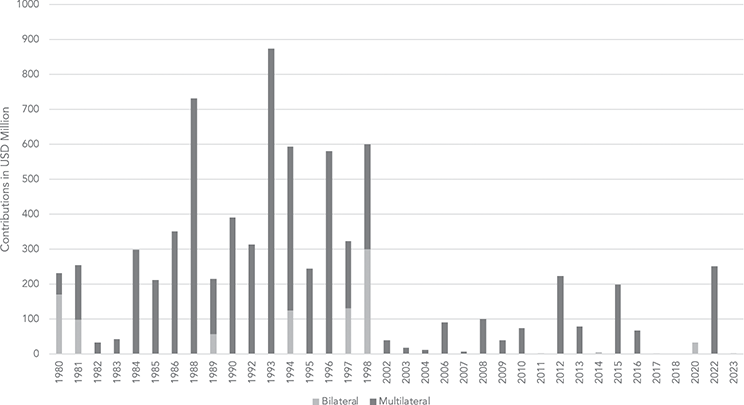
As shown in Figure 6.6, the flows in funding earmarked for geothermal energy development from bilateral and multilateral sources changed over time.Footnote 42 Funding began in the 1980s during Period 1, through bilateral and multilateral donors. There was a dramatic increase of multilateral support in the mid 1990s during Period 1, in response to the Philippines’ energy crisis. Then, during Periods 2 and 3, multilateral support was greatly reduced but still represented the majority of funding provided during these periods. Bilateral support faded during Period 2 and both bilateral and multilateral declined further during Period 3. See Figure 6.6 for a breakdown of flows in international public finance by donor type. While most of the existing geothermal energy capacity came online prior to the emergence of the regime complex, the participation of donors in promoting the development of clean energy technology is important to note. The rise in development assistance coincided with the power sector crisis in the 1990s during Period 1.
Flows in development assistance for geothermal energy in the Philippines over time.
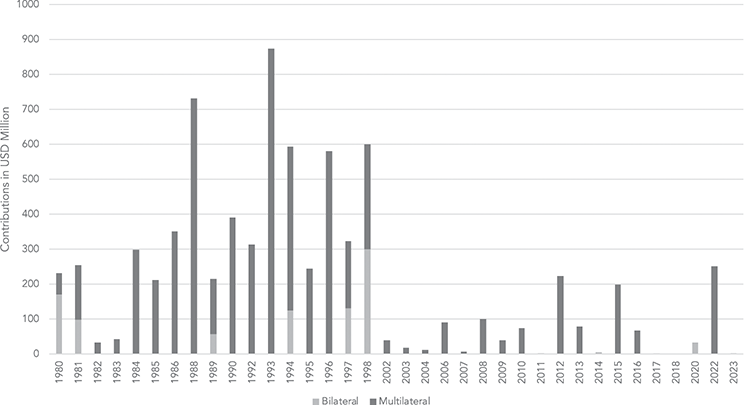
Figure 6.6 Long description
The horizontal axis represents years, ranging from 1980 to 2023 in increments of 1. The vertical axis represents the contributions in U S D millions, ranging from 0 to 1000 in increments of 100. The graph displays two types of bars for each year: 1. Bilateral contributions 2. Multilateral contributions The data depicted are as follows: 1980: bilateral contribution: 180, multilateral contribution: 50; 1981: bilateral contribution: 100, multilateral contribution: 160; 1982: bilateral contribution: 0, multilateral contribution: 30; 1983: bilateral contribution: 0, multilateral contribution: 40; 1984: bilateral contribution: 0, multilateral contribution: 300; 1985: bilateral contribution: 0, multilateral contribution: 205; 1986: bilateral contribution: 0, multilateral contribution: 350; 1988: bilateral contribution: 0, multilateral contribution: 730; 1989: bilateral contribution: 60, multilateral contribution: 150; 1990: bilateral contribution: 0, multilateral contribution: 390; 1992: bilateral contribution: 0, multilateral contribution: 320; 1993: bilateral contribution: 0, multilateral contribution: 880; 1994: bilateral contribution: 130, multilateral contribution: 460; 1995: bilateral contribution: 0, multilateral contribution: 240; 1996: bilateral contribution: 0, multilateral contribution: 570; 1997: bilateral contribution: 140, multilateral contribution: 180; 1998: bilateral contribution: 300, multilateral contribution: 300; 2002: bilateral contribution: 0, multilateral contribution: 40; 2003: bilateral contribution: 0, multilateral contribution: 30; 2004: bilateral contribution: 0, multilateral contribution: 25; 2006: bilateral contribution: 0, multilateral contribution: 90; 2007: bilateral contribution: 0, multilateral contribution: 15; 2008: bilateral contribution: 0, multilateral contribution: 100; 2009: bilateral contribution: 0, multilateral contribution: 40; 2010: bilateral contribution: 0, multilateral contribution: 70; 2011 bilateral contribution: 0, multilateral contribution: 3; 2012: bilateral contribution: 0, multilateral contribution: 230; 2013: bilateral contribution: 0, multilateral contribution: 80; 2014: bilateral contribution: 0, multilateral contribution: 4; 2015: bilateral contribution: 0, multilateral contribution: 200; 2016: bilateral contribution: 0, multilateral contribution: 60; 2017: bilateral contribution: 0, multilateral contribution: 2; 2018: bilateral contribution: 0, multilateral contribution: 0; 2020: bilateral contribution: 30, multilateral contribution: 0; 2022: bilateral contribution: 0, multilateral contribution: 250 and 2023: bilateral contribution: 0, multilateral contribution: 2. All data is approximate.
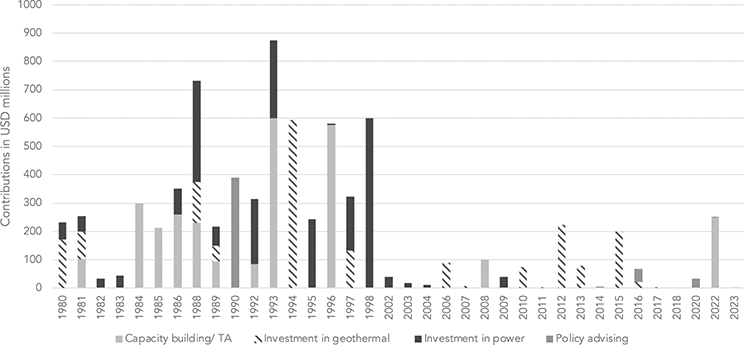
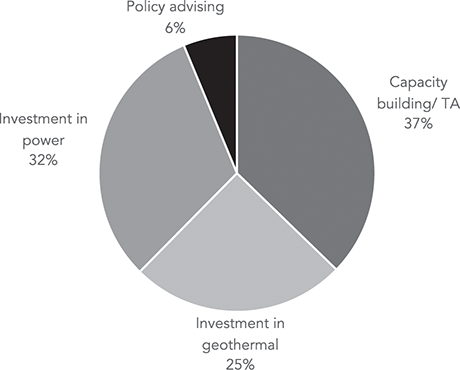
Figure 6.7 shows a breakdown of financial assistance to geothermal energy development earmarked by project type over time, and Figure 6.8 shows the breakdown in total. The majority of development assistance was focused on investments in the power sector (32%) and investments in geothermal energy development (25%), with 37% earmarked for technical capacity building. The remainder of development assistance went to policy advising (6%).This distribution shows a preference for the utility modifier mechanism through the prioritization of building installed capacity in geothermal power plants, as well as installed capacity in the power sector (57% of overall funding). Investment in geothermal and power capacity development (the utility modifier mechanism) during Period 1 was prioritized by the government of the Philippines in response to the power sector crisis. Development actors responded by providing financial assistance for installed capacity to meet energy demands. Nonetheless, in Period 1 there was also a sizeable chunk of funding devoted to capacity building and technical assistance that represented the capacity building aspects of development assistance (see Figure 6.8). The funding specifically allocated for policy advising and regulatory governance was a small share of total funding, but also played an important role in strengthening regulatory capacity for pricing and policy implementation, particularly for geothermal field development and power sector development.
Breakdown of earmarked funding allocated to geothermal energy development in the Philippines over time.
Breakdown of total earmarked funding allocated to geothermal energy development in the Philippines.
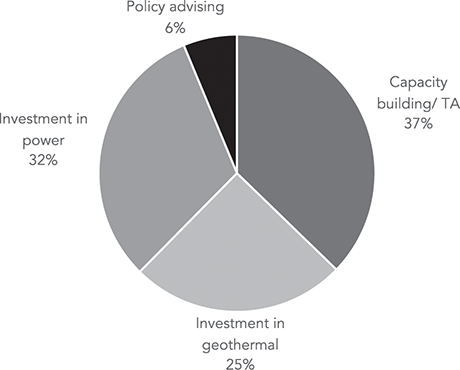
Periods 2 and 3 of the clean energy regime complex’s support showed substantially lower rates of financing of geothermal energy development in the Philippines, and a shift toward policy advising and capacity building. Figure 6.8 depicts the overall breakdown of earmarked funding for geothermal development across all three periods of analysis.
The next section analyzes the clean energy regime complex’s impacts on removing barriers to geothermal energy development in the Philippines via the three mechanisms. This analysis incorporates the data provided in Figures 6.7 and 6.8.
Utility Modifier Mechanism
Since the 1980s, international assistance has been provided to fill in gaps in financing for geothermal energy projects, representing the utility modifier mechanism. Between 1980 and 2023, financing from bilateral and multilateral donors to support investment in geothermal energy development and development of the power sector in the Philippines totaled approximately USD 7.5 billion (ADB 2004, 2016, 2024; JICA 2016; OECD 2024; UNEP DTU 2016; World Bank 2016a, 2024b). The utility modifier mechanism is increasingly necessary in the Philippines during Period 3 as the costs of geothermal energy development increase as developing the remaining resources requires more expensive technology. While the government reprioritizes developing the remaining secondary resources, de-risking private investment in exploration drilling and supporting the economics of projects will be necessary to achieve these goals.Footnote 43 However, the trends in finance show a decline in financial assistance for geothermal capacity (utility modifier) over time. The clean energy regime complex’s financing in the Philippines has not been effective in promoting changes necessary to incentivize much private investment during Periods 3 as the majority of geothermal installed capacity was completed or de-risked by SOEs in Period 1. The financial barriers that currently exist relate to the quality of remaining geothermal resources, which pose new challenges to development. Project developers have discussed the need for a feed-in tariff, but the introduction of a green auction may help solve issues around compensation and geothermal energy’s competitiveness, if the ceiling tariff is set at a high enough rate to compensate for the higher cost of geothermal energy development.Footnote 44 The creation of a geothermal revolving fund or de-risking facility could ameliorate barriers to private sector-led exploration drilling. The clean energy regime complex has an opportunity to support the development of secondary geothermal resources in the Philippines through additional financing mechanisms, technical assistance, and technology transfer.
Social Learning Mechanism
The social learning mechanism was an important aspect of the clean energy regime complex’s impact during Periods 1 and 2 of geothermal energy development in the Philippines. The first period showed efforts by the World Bank to reform policy and build institutional capacity in the government’s energy ministries. This financial assistance, policy advising, and institutional capacity building are representative of the social learning mechanism, whereby the clean energy regime complex aims to diffuse norms, converge domestic interests, and change behavior to align with its objectives of renewable energy deployment. In the case of the power sector, the funding and conditionality were effective in achieving objectives as the Philippines privatized the power sector following the energy crisis of the 1990s. The change in prioritization of renewable energy was also motivated by energy security concerns caused by energy crises.
Social learning was also evident in Period 2, when the Renewable Energy Commission carried out extensive efforts to promote the renewable energy law and advocate for low-carbon development. These efforts to reform national policy were driven from the bottom up, with some leadership by international NGOs. This movement exemplified a shift in domestic political preferences and norms against mining and in the spirit of environmental justice issues.Footnote 45 The involvement of the WWF and Greenpeace in supporting the Commission’s work provides support for the impact of the clean energy regime complex in facilitating social learning during this period.
Of the overall funding provided by clean energy regime complex for geothermal energy (Figure 6.8), a small portion (6%) was earmarked for policy advising and regulatory governance. There is evidence of a priority placed on promoting policy reform to spur the Philippines’ geothermal energy development, as representative of the regime complex’s social learning mechanism. Furthermore, the government’s adoption of policy and political will to accelerate geothermal energy development as a solution to the energy security crisis was early evidence of social learning during Period 1 in response to the substantial multilateral and bilateral support as described in the capacity-building mechanism section that follows.
Capacity-Building Mechanism
When the Philippines first began developing geothermal energy in the 1960s and 1970s, technical capacity building was a major focus of development support. Training programs began in the 1980s with bilateral support from New Zealand and continued throughout Periods 1 and 2.Footnote 46 New Zealand’s role in promoting and supporting early geothermal exploration and development through technical assistance, technology transfer, and technical capacity building in the Philippines was substantial during Period 1. The training program initiated by New Zealand in 1972 through the University of Auckland and funded in part by UNDP provided technical geothermal courses and training to catalyze the transfer of geothermal technology (Hochstein Reference Hochstein1988, Reference Hochstein2005). However, analysis of Periods 2 and 3 showed that capacity-building priorities shifted and were no longer of key importance for the government or donors. Figure 6.8 shows that 37% of overall funding to develop geothermal energy was earmarked for technical capacity building. This share is significant and demonstrates that capacity building has been a priority for donors, particularly during Period 1, but also evident in the financing trends of Period 3, providing support for the importance of the capacity-building mechanism.
Domestic Political Interests and External Shocks
Domestic political interests and external shocks played a large role in driving geothermal energy development in the case of the Philippines. The 1973 oil crisis and the 1990s energy crisis posed enormous challenges to the country’s energy security. Geothermal energy was chosen as the major domestic energy resource for development owing to its abundance, but also because of political will and the leadership of key government officials, namely Alcaraz – the “Father of Geothermal Energy Development” – and Pabling Malixi, who held enough authority to influence Marcos to prioritize geothermal energy development in response to the energy crises. Domestic political interests also played a role in supporting geothermal energy development. Geothermal energy was seen as the most viable resource to develop, in place of coal or nuclear. Therefore, geothermal energy was developed before any other alternative energy sources, and there was a convergence of domestic political interests in favor of this pathway to energy diversification. The full commitment of the government and its resources to geothermal energy development allowed the country to quickly meet energy demands, increase electrification rates, and become the second-largest producer of geothermal energy in the world at the time. In contrast, during Period 3, interest in geothermal energy development waned largely due to financial and technical barriers to development as the resource quality declined and costs for production increased. This chapter demonstrated that the energy security crisis, triggered by the energy shock of the oil crisis, along with political will to promote an energy transition as a solution to the crisis, opened a window for the clean energy regime complex to have an impact and support the development of geothermal energy.
Table 6.1 summarizes facilitating and obstructing conditions across the three periods of analysis to show how the regime complex mechanisms of impact have influenced and overcome lock-in. In Period 1, the external shock of the oil crisis provided motivation and political will for policy and technology change, and the regime complex’s utility modifier and capacity-building mechanisms had a major impact on geothermal development. Lock-in was not an issue in the Philippines during Period 1, as the country was under the Marcos dictatorship. Under Period 2, the major facilitating conditions included the normative change and advocacy that provided avenues for social learning to occur with impacts from the regime complex. During Period 3, the obstructing conditions included a lack of political will, overlapping political priorities, and stronger energy security, which made geothermal less relevant. Therefore, there was less of an opportunity for regime complex impact.
| Period factors | Conditions and mechanisms of impact | Summary |
|---|---|---|
| Period 1: Marcos and Ramos eras |
|
|
| 1973 oil crisis and power sector crisis, Asian financial crisis and martial law | Regime complex impact through mechanisms:
| |
| Period 2: 2002 Renewable Energy Law |
|
|
| Environmental movements |
|
|
| Period 3: Fade of geothermal |
|
|
| Secondary resources government and industry prioritize other renewables |
|
|
Conclusion: Philippines’ Commitment to Rapid Geothermal Energy Development
Overall, the case of the Philippines demonstrates that the rapid development of geothermal energy resources is possible with government commitment and political will. This provides a contrast to Indonesia, where there is a lack of will and support from the government to accelerate geothermal energy development, resulting in the overall slow development of geothermal resources. Motivated by energy crises of the 1970s and 1990s, the Philippine government under Marcos reacted by devoting government resources to geothermal development and incentivizing private investment in this sector. The financial and technical assistance, technical capacity building and policy advising provided by different bilateral and multilateral actors helped support early geothermal energy development in the Philippines. Transnational actors were not present or very active in directly supporting geothermal energy development, but they did play an active role in pushing forward the adoption of the Renewable Energy Law in 2008. The bilateral and multilateral development actors that played a fundamental role in the Philippines’ geothermal energy development later became central to the clean energy regime complex. This chapter demonstrates the clean energy regime complex’s impact through the utility modifier, social learning, and capacity-building mechanisms.
An important finding of this chapter concerns the external shocks of the energy crisis and the convergence of domestic political interests and political will in favor of geothermal energy development, showing that these played a large role in accelerating the development of installed geothermal energy capacity in the Philippines. There are thus some parallels with the Indonesian case study, particularly related to external shocks, and how the regime complex impacts domestic politics through the utility modifier, social learning, and capacity-building mechanisms. The next chapter provides a comparative analysis of the clean energy regime complex’s impacts in Indonesia and the Philippines and analyzes overall effectiveness in both cases before providing a broader discussion and analysis of the cases.

 Open access