


1. Introduction and problem statement
In today’s product development, companies are confronted with increasing product complexity, constantly changing customer requirements, and dynamic environmental conditions (Reference Albers, Behrendt, Klingler, Reiß and BursacAlbers et al., 2017; Reference Riesener, Rebentisch, Doelle, Kuhn and BrockmannRiesener et al., 2019; Reference Schuh, Rebentisch, Dölle, Mattern, Volevach and MengesSchuh et al., 2018b; Reference Zink, Hostetter, Böhmer, Lindemann, Knoll and Jardim-GonçalvesZink et al., 2017). At the same time, development cycles are becoming shorter despite a high level of uncertainty regarding actual customer needs and usage contexts (Reference Albers, Behrendt, Klingler, Reiß and BursacAlbers et al., 2017; Reference Zink, Hostetter, Böhmer, Lindemann, Knoll and Jardim-GonçalvesZink et al., 2017). Several of these challenges can be described by the VUCA model, which characterizes the framework of modern markets through volatility, uncertainty, complexity, and ambiguity (Reference Schuh, Rebentisch, Dölle, Mattern, Volevach and MengesSchuh et al., 2018b). Forecasts suggest that this trend will intensify further, underlining the need for adaptable and flexible concepts, iterative thinking, and the early validation of insights and ideas within agile product development (Reference Schuh, Dölle, Schloesser, Ekströmer, Schütte and ÖlvanderSchuh et al., 2018a; Reference Zink, Hostetter, Böhmer, Lindemann, Knoll and Jardim-GonçalvesZink et al., 2017).
The development of preliminary products (referred to in this publication following Reference Van RiesenVan Riesen (2025) as early versions) represents a widely used and effective approach to address these challenges (Reference Van RiesenVan Riesen, 2025). In this process, knowledge about the product under development is increased through the validation of defined technical requirements and customer needs. Trough iterative confirmation of decisions during the early development phase risk is reduced (Reference Albers, Behrendt, Klingler, Reiß and BursacAlbers et al., 2017; Reference Zink, Hostetter, Böhmer, Lindemann, Knoll and Jardim-GonçalvesZink et al., 2017).
The main forms of of early versions identified in the literature are
-
• Proof of Concept (PoC),
-
• Prototypes,
-
• and the Minimum Viable Product (MVP).
The literature does not provide a clear delineation or universally accepted definition of these forms (Reference Van RiesenVan Riesen, 2025). Distinctions can, however, be drawn with respect to development and application timing as well as intended objectives. Their chronological order of implementation corresponds to the list above. To establish a consistent understanding within this publication, the forms are defined and differentiated as follows:
PoC: The PoC is applied in the earliest phase of product development to confirm technical feasibility before committing to a specific solution concept (Reference Arnowitz, Arent and BergerArnowitz et al., 2007). It addresses the technical capabilities of a system and the feasibility of requirements and constraints using the selected technology. Validation is performed internally, without reference to end users (Reference Van RiesenVan Riesen, 2025).
Prototypes: After a successful PoC, the focus shifts to practical implementation, incorporating visual and interactive aspects of the idea. Prototypes are commonly classified into physical and virtual prototypes (Reference KirchnerKirchner, 2020). Physical prototypes, in particular, have proven valuable for analyzing complex phenomena and enhancing performance (Reference Menold, Jablokow and SimpsonMenold et al., 2017; Reference Schork, Kirchner, Ekströmer, Schütte and ÖlvanderSchork & Kirchner, 2018). Each prototype should address a specific question or purpose (Reference Camburn, Viswanathan, Linsey, Anderson, Jensen, Crawford, Otto and WoodCamburn et al., 2017; Reference Jensen, Özkil, Mortensen, Marjanović, Štorga, Pavković, Bojčetić and ŠkecJensen et al., 2016) and is applied at different stages of the product development process (Reference KirchnerKirchner, 2020).
MVP: A product with a reduced set of features is typically applied toward the end of the product development process to address fundamental business questions with minimal effort through end-user feedback (Reference HansenHansen, 2021; Reference Lortie, Cox, DeRosset, Thompson and KellyLortie et al., 2025; Reference RiesRies, 2011). Depending on the source, the term minimum may refer not only to effort and functionality but also to value organization, requirements, or feasible implementation (Reference Lenarduzzi and TaibiLenarduzzi & Taibi, 2016).
All forms of early versions share the characteristic that experimental investigations are conducted to empirically validate assumptions. This often involves the application of experimental methodologies to enhance efficiency and generate insights, while minimizing resource expenditure through systematic planning, execution, and evaluation (Reference KleppmannKleppmann, 2006; Reference Siebertz, Van Bebber and HochkirchenSiebertz et al., 2017).
As a result, Design of Experiments (DoE) is frequently applied as a universal method for planning and conducting experiments (Reference CavazzutiCavazzuti, 2013). DoE provides a suitable methodological foundation due to its broad applicability, particularly for predicting product properties and screening significant influencing variables from a large pool of candidates. This is particularly relevant for PoCs, as the early phase of product development is characterized by a large parameter space (e.g., geometry, materials, surfaces) and limited knowledge of system behavior and interactions between parameters and output variables. This large experimental space and uncertainty about system behavior contrast with the need for a small number of samples, imposed by cost and effort constraints.
However, specific limitations arise when applying the DoE to a PoC. Core strengths of DoE, such as extrapolating results beyond the defined experimental space, cannot be leveraged in this phase. Instead, the focus lies on demonstrating initial technical feasibility and screening key influencing factors (Reference CavazzutiCavazzuti, 2013). Thus, statistical generalizability is not the primary objective, and the typical boundary conditions of DoE are only partially applicable. Against this background, it appears necessary to adapt the classical DoE approach to meet the specific requirements of PoCs.
2. Goal and approach to research
This section addresses the research question (RQ) derived from the problem statement outlined above. The RQ is formulated as follows:
How can the DoE be adapted to efficiently and systematically obtain a minimally sufficient combination of parameters for a PoC?
The RQ can be addressed through a systematic adaptation of the DoE, which serves as a macro-model and is complemented by characteristic elements of existing methods or independently developed micro-models tailored to the specific application. To address the RQ, the following two sub questions (SQ) must first be answered:
-
• SQ1: Where are the limitations of DoE with respect to the investigation of a PoC?
-
• SQ2: Which existing methods can be used to complement DoE and in which areas is it necessary to develop new approaches?
The PoC under investigation is designed to validate the technical concept efficiently during the early product development phase, while simultaneously identifying and visualizing the associated geometric and conceptual constraints to potential stakeholders. For the PoC, based on the objective, demonstrating a minimally sufficient concept is adequate. This is ensured by reducing the geometric parameters to the required functional minimum. The main resulting advantage is a simplification of the specimens.
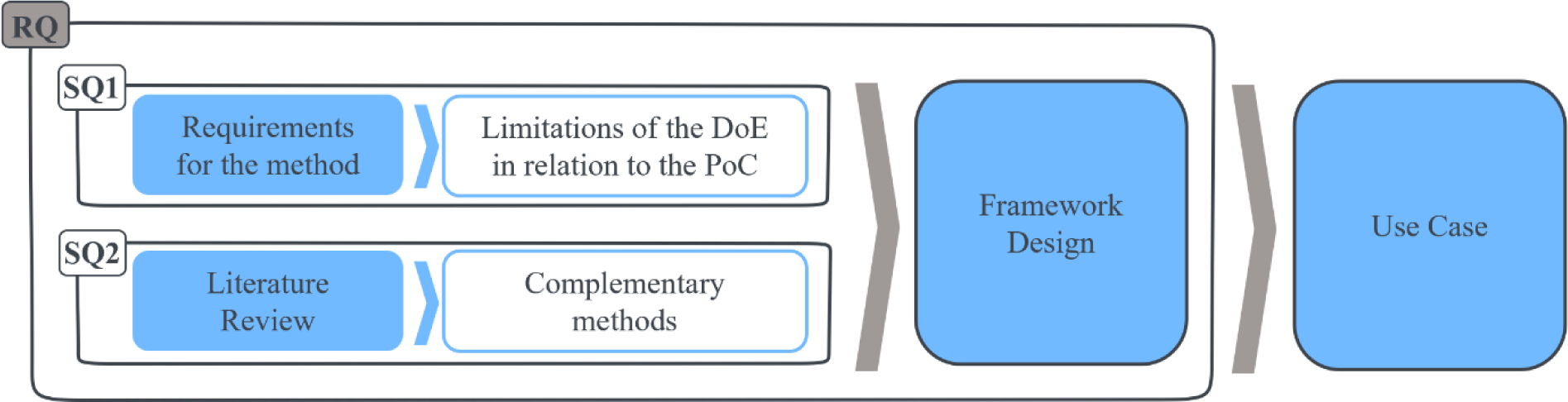
The aim of the method to be developed is to enable the user to make a clear and reliable selection of the appropriate parameter set for a PoC while keeping the required number of samples as low as possible. This research follows the Design Research Methodology (DRM) by Reference Blessing and ChakrabatiBlessing and Chakrabarti (2009). The study is based on a systematic literature review and experimental investigations supporting the development and evaluation of the proposed method. The methodological approach to addressing the research question is illustrated in Figure 1.
Overview of the research approach

First, Section 3 introduces the essential foundations of DoE. Section 4 then defines the requirements for the new method. By evaluating how well DoE meets these requirements, weaknesses are identified with respect to the PoC use case and SQ1 is answered. Section 5 presents the results of the literature review, aiming to identify potential methods that can complement DoE at the detected weak points. This answers SQ2. Section 6 introduces the new method, which is subsequently validated in Section 7 through its application to a suitable use case.
3. State of the art: DoE
DoE is a widely applied statistical methodology in science and industry that supports the design, development, and optimization of products (Reference Jankovic, Chaudhary and GoiaJankovic et al., 2021). The core idea is the targeted selection of experimental samples within a defined design space in order to obtain a maximum amount of information with minimal resources, particularly by reducing the number of samples (Reference CavazzutiCavazzuti, 2013). In this process, the influence of input variables on one or more response variables is examined, with the aim of obtaining as much information as possible with minimal effort and subjecting it to statistical analysis. General guidelines and procedures are available to facilitate the implementation of DoE (Reference Jankovic, Chaudhary and GoiaJankovic et al., 2021). The methodological process typically follows a structured sequence comprising task analysis, system analysis, experiment design, execution, and evaluation, and can be applied throughout all phases of product development (Reference KleppmannKleppmann, 2006). Different experimental designs are available to support this process. Full factorial designs enable the comprehensive investigation of the influence of multiple factors on a response variable. Fractional factorial designs, by contrast, do not consider all factor-level combinations, which makes them particularly useful in early stages when relationships are not yet well understood, as they allow the identification of potentially relevant factors with relatively low effort. A simpler approach is the One-Factor-at-a-Time (OFAT) design, where, starting from a baseline setting, only a single factor is varied at a time, enabling the clear attribution of changes in the response variable to a specific cause.
DoE therefore makes it possible to gather a maximum amount of information with minimal experimental effort and to evaluate it on a statistically sound basis. Due to the standardized approach, a clear understanding of central terminology is essential: in this work, the observed system behavior is referred to as the response variable. All parameters affecting this behavior are denoted as influencing variables. A deliberately selected subset of these variables chosen for variation are called factors, while their defined states are referred to as factor levels (Reference KleppmannKleppmann, 2006; Reference Siebertz, Van Bebber and HochkirchenSiebertz et al., 2017).
4. Requirements definition
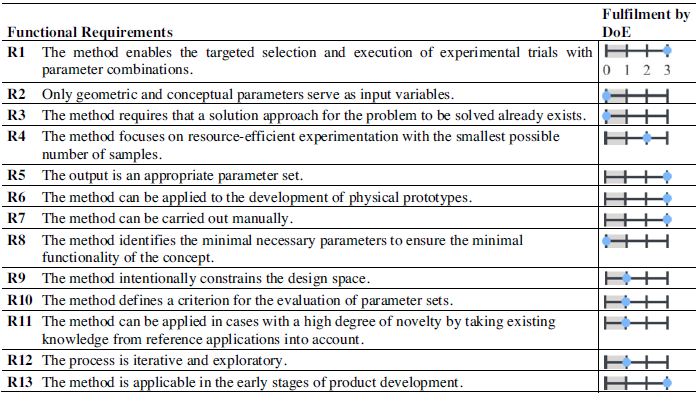
The functional requirements for the method depend on the objective and are derived from the characteristics of the PoC. All requirements are summarized in Table 1, along with an assessment of whether they are met by DoE. This assessment serves to identify weaknesses of DoE in relation to the use case. The evaluation was carried out using a Likert scale from zero to three (0: not fulfilled; 1: insufficiently fulfilled; 2: sufficiently fulfilled; 3: fully fulfilled). Requirements rated with zero or one (highlighted as grey area) represent those not covered by DoE and therefore indicate where extensions or modifications to DoE are necessary.
Overview of the functional requirements of the new method and the evaluation of the fulfilment by the DoE with the grey area indicating necessary modifications

In total, six requirements were identified that are not, or only insufficiently, fulfilled by DoE, thereby necessitating adaptations and extensions of the approach. The suitability of DoE for the present application is based on several identified strengths. These include its applicability to the experimental investigation of physical prototypes, its clearly defined fundamental procedural steps, and its ability to systematically screen influencing factors to identify the most relevant parameters with a limited number of experiments. In contrast, the weaknesses lie in the identification of a minimal parameter set without consideration of statistical validation.
5. Literature review
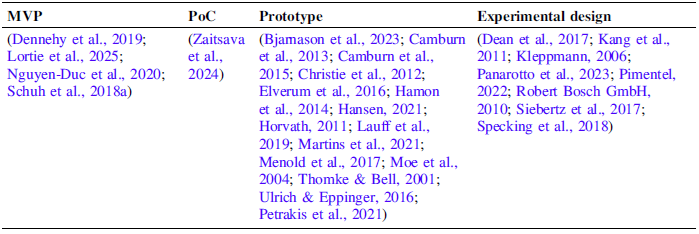
The DoE should be supplemented with existing methods. Therefore, a systematic review of existing methods and frameworks was conducted in the relevant fields of MVP, PoC, prototype development, and in the field of experimental design and execution, which support the development of any kind of early versions. Table 2 provides an overview of the identified literature.
Results of the relevant literature review

The literature sources were systematically analysed with respect to the requirements outlined in Table 1. While the issue of a restricted experimental design space (R9) can be resolved by DSE according to Reference Kang, Jackson, Schulte, Calinescu and JacksonKang et al. (2011) and the identification of conceptual parameters (R2) was facilitated by the framework of Reference Nguyen-Duc, Münch, Prikladnicki, Wang and AbrahamssonNguyen-Duc et al. (2020), the remaining shortcomings of the DoE approach were not addressed by the methods reviewed. Consequently, tailored modifications to the DoE methodology were required.
6. Presentation of the method
The following focuses on the methodological embodiment of the core idea, the representation, and the procedure. The aim of the method is the effective and resource-efficient identification of a suitable parameter set (geometric and conceptual parameters) for a minimally functional PoC. Only through the targeted adaptation of the DoE is it possible to investigate a PoC reliably and meaningfully with a low number of samples. This targeted adaptation is presented in the following section. The representation, including the central steps of the DoE, the objectives, and a summarized overview of the procedure is shown in Figure 2.
Illustration of the method’s procedure

In the following description of the procedure, the implemented additions and the specific considerations for applying the DoE are particularly highlighted. For better clarity, however, the fundamental principles and objectives of each step are briefly presented.
Task Analysis. The first step serves to examine the initial situation. It includes defining the research objective and analyzing the context (e.g., prior knowledge, existing experimental scenarios) (Reference KleppmannKleppmann, 2006). Since a PoC is considered in the present application, a structured context analysis at the business, operational, and design levels is required. For this purpose, the 6W3H framework by Reference Nguyen-Duc, Münch, Prikladnicki, Wang and AbrahamssonNguyen-Duc et al. (2020) is employed. It was originally developed for the creation of MVPs and systematically captures conceptual factors and contextual dimensions via guiding questions that link existing competencies with the envisioned product. The task analysis is concluded with a checklist to ensure that the considered application is suitable for the method. The questions are derived from boundary conditions and methodological requirements; if all are answered “yes,” the application is deemed suitable.
System Analysis. The experiment represents an empirical investigation of the relationship between influencing factors and system behavior. All relevant variables (input, target, measured, and noise factors) are identified and documented in a process model (Reference KleppmannKleppmann, 2006; Reference Siebertz, Van Bebber and HochkirchenSiebertz et al., 2017). In the present case, the input factors correspond to system parameters derived from technical drawings and reference applications. For overview and preparation of experimental planning, an input–output matrix can be created according to Reference KleppmannKleppmann (2006). This matrix preferably includes physical cause-effect relationships. Noise factors are also adopted from reference applications. This defines the design space for the investigation.
Planning. The planning is guided by the research objective, which is why an iterative, hypothesis-based experimental design is developed. To reduce the number of samples and, consequently, the design space, a DSE according to Reference Kang, Jackson, Schulte, Calinescu and JacksonKang et al. (2011) is additionally conducted, implemented in three steps:
-
• Derivation of Factors. Factors are derived from the input variables. The criterion is the relevance of the input variable to the target variable, which can be determined, for example, from the input–output matrix. The number of factors is limited to three per trial.
-
• Elimination of Equivalent Factors. To avoid redundant factors, an equivalence relation is introduced based on the target variable, and factors/levels are compared.
-
• Exclusion of Equivalent Factors and Levels. Equivalent factors and factor levels are excluded. The number of factor levels is unlimited, but based on practical experience, a maximum of three levels is recommended.
This approach enables a targeted narrowing of the design space without limiting the potential insights. The resulting design space is represented as a factorial cube model, where each factor defines an axis and the respective factor levels correspond to the nodes. For each factor and its levels, a hypothetically least favourable configuration is defined. Based on prior knowledge or reference applications, this configuration is assumed to have the lowest suitability for achieving the response variable. The least favourable factor is represented on the z-axis, and its least favourable factor level corresponds to the highest available factor level on this axis (e.g., 3 when three factor levels are defined). The step is concluded with the definition of a termination criterion for the experimental investigations, i.e., when the minimal functionality of the target variable is achieved. Overall, n this step, a set-based concurrent engineering approach is applied. Instead of developing and optimizing a single solution, a set of possible solutions representing the known design space is considered. Consequently, multiple solution alternatives are developed in parallel, which reduces overall development time. Design options are deliberately kept open.
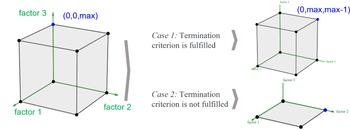
Implementation. The experiments are conducted according to the OFAT method of DoE in an iterative and adaptive manner which is represented in Figure 3. Design options are systematically eliminated based on increasing knowledge until the minimally functional and feasible solution remains.
Exemplary cube modeling for three factors, each with two factor levels (blue dot represents the parameter set to be investigated experimentally in each case)

Initially, the parameter set (0, 0, max), which is marked with a blue dot, is experimentally tested to quickly identify the minimum factor level of the most critical factor. After this, a case distinction is made. If the termination criterion is fulfilled (Case 1), the parameter set is working however the chosen parameters may not be the minimum. The factor level of the most critical factor is set with this experiment. The remaining factor levels of the remaining factors need to be investigated starting with the maximum factor level of the second highest factor.
If the termination criterion is not fulfilled (Case 2), the corresponding max factor level of the most critical factor can be excluded. This is because no combination with other minimum factor levels of the remaining factors is expected to provide an improvement. The then to be investigated parameter set (0, max, 0) or (0, 0, max-1) in case the max factor has three factor levels provides a statement about the necessary factor level of the second most critical factor and so on. For both cases can be applied: when done and specimens are left, there is the possibility of adding a new factor.
The procedure is therefore highly adaptive, as the outcome of each individual experiment determines the subsequent course of action. In this way, a stepwise approach emerges that does not follow a rigid experimental plan but dynamically adapts to interim results. The iterative process ensures that the specimen number is minimized while simultaneously identifying the critical geometric properties that guarantee minimal functionality.
Evaluation. The evaluation is based on analyzing the target variable with respect to the defined termination criterion. If the criterion is not met, experimental planning is resumed, varying the factor level of the current factor. This allows for the determination of the minimally required factor level. Subsequently, the next most critical factor in the design space is considered, while previously determined factors remain in their baseline configuration. Since the definition of the hypothetically least favorable configurations is based on subjective assessments and analogical reasoning, this decision basis is explicitly documented. This ensures a traceable chain of reasoning, supporting both the reproducibility of the results and the assessment of the method’s limitations.
7. Use case
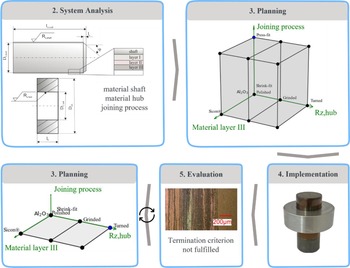
An overview of the steps taken are exemplary illustrated in Figure 4.
Procedure of the method exemplified on a sample

In the selected application case, the focus is on the development of a smart shaft–hub connection (SHC). A multisensory thin-film system is integrated into a cylindrical interference-fit in order to determine, for the first time, the stress state in the joint in-situ (directly at the point of formation) via the piezoresistive behavior of the coating system. It is intended to demonstrate the feasibility of contact pressure measurement using the multisensory thin-film system since the effects of the coating system on the machine element and the other way round are unknown (Reference Breuning, Kreimeyer, Plogmeyer, Pongratz, Schott and BräuerBreuning et al., 2024). So as a first step, a PoC is created to show the feasibility of joining the SHC and to identify the minimal parameters of the SHC and thin-film system. The objective of the experiment, following the method described above, is to identify the minimal parameters of the SHC. These parameters should allow joining the connection with the thin-film sensor system without damaging the thin-film system so that the sensors fail. In this way, uncertainty regarding the technical feasibility is resolved early in the product development process, and the PoC can be simplified by not yet structuring the sensors within the coating system. A joining experiment is considered successful if the thin-film system remains microscopically undamaged (= termination criterion). Numerous reference applications are available.
All influencing factors can be derived from the potential joining parameters as well as from the technical drawings of the shaft with coating system and the hub. An equivalence criterion is defined as a similar influence on the contact pressure profile. Three factors (material layer III – Rz,hub – joining process) are defined and sorted based on their assumed impact on joinability (i.e., the degree of expected coating damage). The factor levels were determined based on empirical knowledge, with particular attention given to ensuring that they are distinctly differentiated from one another. The values of the input variables are derived from reference applications, test bench integration, or industrial applications. Because of experiences from reference applications, the most critical combination of parameters is chosen as a press-fit with a turned bore of the hub and the SICON® top layer (= blue dot). As can be seen in the microscopic picture, the thin-film system shows extensive damage, thus the termination criterion is not fulfilled. With one specimen, the design space could already be significantly reduced due to the strategic selection of the parameter set. Using six specimens, the method reliably identified a parameter set (Al2O3 – Polished – Shrink-fit) that allowed a successful joining-process.
Given the low number of samples and the successful identification of a suitable parameter set for the smart SHC, the objective of the method was achieved, and the method was successfully validated.
8. Conclusion and outlook
This study developed a method for experimentally investigating a PoC to identify the minimally required geometric and conceptual properties for functional verification using the smallest possible number of samples. DoE served as the basis, but required adaptation for the specific PoC context, as statistical validation and repetitions were not objectives.
First, the limitations of the DoE were identified by defining method requirements and evaluating them on a Likert scale from zero to three. Requirements scoring zero or one indicated insufficient coverage. A systematic literature review suggested that the DSE is useful for constraining the experimental domain and Reference Nguyen-Duc, Münch, Prikladnicki, Wang and AbrahamssonNguyen et al.’s (2020) framework supports the identification of conceptual factors. These elements, combined with a custom experimental plan, formed the proposed method. A central feature is the modeling of the experimental space as a cube, with factors spanning the axes and factor levels forming discrete nodes, prioritized by criticality. Experiments begin with the parameter set (0, 0, max) to fix the first z-factor level and address minimal functional properties with a single sample. The method was validated on a smart SHC, demonstrating the functionality of thin-film sensors in a cylindrical interference-fit. The minimal parameter set preserving the coating was identified with only six samples, confirming the method’s efficiency.
The method is limited to cases with reference applications and requires an iterative approach, as subsequent parameter selection depends on prior results, making it time-intensive. Future work could focus on automating iterations and slightly extending statistical support to increase confidence in minimal parameter identification.
Acknowledgement
This research was funded by the German Research Foundation, Deutsche Forschungsgemeinschaft with the project number 511576481.


 Open access

