








1 Introduction
1.1 Poonen’s heuristic
We follow [Reference PoonenPoo06]. Let
$a,b,c$
 be positive integers, and consider the following subset of the rational points on the projective line
$\mathbb {P}^1(\mathbb {Q}) \cong \mathbb {Q} \cup \left \{ \tfrac 10 \right \}$
be positive integers, and consider the following subset of the rational points on the projective line
$\mathbb {P}^1(\mathbb {Q}) \cong \mathbb {Q} \cup \left \{ \tfrac 10 \right \}$
 :
:

By the
${\color {linkcolor}\textsf {numerator}}$
 and
${\color {linkcolor}\textsf {denominator}}$
and
${\color {linkcolor}\textsf {denominator}}$
 of a point
$Q = (s:t) \in \mathbb {P}^1(\mathbb {Q})$
of a point
$Q = (s:t) \in \mathbb {P}^1(\mathbb {Q})$
 , we mean the first and second coordinate, respectively, of a representative point
$\pm (s,t) \in \mathbb {Z}^2$
, we mean the first and second coordinate, respectively, of a representative point
$\pm (s,t) \in \mathbb {Z}^2$
 with
$\gcd (s,t) = 1$
with
$\gcd (s,t) = 1$
 . This pair is only well defined up to sign. We say that an integer m is an
${\color {linkcolor}{n}^{\textsf {th}}\ \textsf{power}}$
. This pair is only well defined up to sign. We say that an integer m is an
${\color {linkcolor}{n}^{\textsf {th}}\ \textsf{power}}$
 if the ideal
$m\mathbb {Z}$
if the ideal
$m\mathbb {Z}$
 equals
$e^n\mathbb {Z}$
equals
$e^n\mathbb {Z}$
 for some
$e \geqslant 0$
for some
$e \geqslant 0$
 . In particular,
$0,1,\infty \in \Omega (a,b,c)$
. In particular,
$0,1,\infty \in \Omega (a,b,c)$
 .
.
To any subset
$\Omega \subseteq \mathbb {P}^1(\mathbb {Q}),$
 we associate the subset of points of bounded height, and the corresponding counting function. Given h positive, define

where
${\mathrm {Ht}}\colon \mathbb {P}^1(\mathbb {Q}) \to \mathbb {Z}_{\geqslant 0}$
 is the usual multiplicative height, given by

Heuristic 1.1 We estimate the probability that a uniformly random rational number of height not exceeding
$h \gg 0$
 is in the set
$\Omega (a,b,c)$
is in the set
$\Omega (a,b,c)$
 . We do this under the heuristic assumption that the events (i)–(iii) defining
$\Omega (a,b,c)$
. We do this under the heuristic assumption that the events (i)–(iii) defining
$\Omega (a,b,c)$
 in Equation (2) are independent.
We have that

where the notation
$f(h) \doteq g(h)$
 means that there exists an implicit constant
$\kappa> 0$
means that there exists an implicit constant
$\kappa> 0$
 such that
$f(h) = \kappa \cdot g(h)$
such that
$f(h) = \kappa \cdot g(h)$
 as
$h \to \infty $
as
$h \to \infty $
 . The independence assumption implies that

The heuristic above suggests that the
${\color {linkcolor}\textsf {Euler}\ \textsf {characteristic}}$


forces
$\Omega (a,b,c)$
 to be
to be

This prediction turns out to be correct. The
${\color {linkcolor}\textsf {hyperbolic}}$
 case (when
$\chi < 0$
case (when
$\chi < 0$
 ) can be deduced from a theorem of Darmon and Granville [Reference Darmon and GranvilleDG95, Theorem 2]. In the
${\color {linkcolor}\textsf {spherical}}$
) can be deduced from a theorem of Darmon and Granville [Reference Darmon and GranvilleDG95, Theorem 2]. In the
${\color {linkcolor}\textsf {spherical}}$
 case (when
$\chi> 0 $
case (when
$\chi> 0 $
 and therefore the multiset
$\{a,b,c\}$
and therefore the multiset
$\{a,b,c\}$
 is one of
$\{2,3,3\}, \{2,3,4\}, \{2,3,5\},$
is one of
$\{2,3,3\}, \{2,3,4\}, \{2,3,5\},$
 or
$\{2,2,c\}$
or
$\{2,2,c\}$
 for
$c \geqslant 2$
for
$c \geqslant 2$
 ) the heuristic suggests that
$N(\Omega (a,b,c);h) \asymp h^{\chi }$
) the heuristic suggests that
$N(\Omega (a,b,c);h) \asymp h^{\chi }$
 , as h tends to infinity. This can be deduced from a theorem of Beukers [Reference BeukersBeu98, Theorem 1.2].
1.2 Results
Our first result confirms the prediction of Heuristic 1.1.
Theorem 1.2 Suppose that
$a,b,c> 1$
 and that
$\chi := \chi (a,b,c)> 0$
and that
$\chi := \chi (a,b,c)> 0$
 . Then, there exists an explicitly computable constant
$\kappa (a,b,c)>0$
. Then, there exists an explicitly computable constant
$\kappa (a,b,c)>0$
 such that for every
$\varepsilon> 0$
such that for every
$\varepsilon> 0$
 ,
,

as
$h \to \infty $
 . The implicit constant depends on
$(a,b,c)$
. The implicit constant depends on
$(a,b,c)$
 and
$\varepsilon $
and
$\varepsilon $
 .
.
Consider the generalized Fermat equation

for arbitrary integers
$A,B,C$
 satisfying
$A\cdot B \cdot C \neq 0$
satisfying
$A\cdot B \cdot C \neq 0$
 . A solution
$(x,y,z) \in \mathbb {Z}^3 - \left \{ (0,0,0) \right \}$
. A solution
$(x,y,z) \in \mathbb {Z}^3 - \left \{ (0,0,0) \right \}$
 is said to be
${\color {linkcolor}\textsf {primitive}}$
is said to be
${\color {linkcolor}\textsf {primitive}}$
 when
$\gcd (x,y,z) = 1$
when
$\gcd (x,y,z) = 1$
 . Corresponding to each F, we have the
${\color {linkcolor}\textsf {punctured cone}}\ \mathcal {U}$
. Corresponding to each F, we have the
${\color {linkcolor}\textsf {punctured cone}}\ \mathcal {U}$
 (obtained by deleting the closed subscheme
$\left \{ \textsf {x} = \textsf {y} = \textsf {z} = 0 \right \}$
(obtained by deleting the closed subscheme
$\left \{ \textsf {x} = \textsf {y} = \textsf {z} = 0 \right \}$
 from F) and the morphism

Note that
$\mathcal {U}(\mathbb {Z})$
 is identified with the set of primitive integral solutions to F. Define the subset
$\Omega (F) \subset \mathbb {P}^1(\mathbb {Q})$
is identified with the set of primitive integral solutions to F. Define the subset
$\Omega (F) \subset \mathbb {P}^1(\mathbb {Q})$
 to be the image of the function
$j(\mathbb {Z})\colon \mathcal {U}(\mathbb {Z}) \to \mathbb {P}^1(\mathbb {Z}) = \mathbb {P}^1(\mathbb {Q})$
to be the image of the function
$j(\mathbb {Z})\colon \mathcal {U}(\mathbb {Z}) \to \mathbb {P}^1(\mathbb {Z}) = \mathbb {P}^1(\mathbb {Q})$
 .
.
The set
$\Omega (a,b,c)$
 and the primitive integral solutions to the equation are closely related when
$A,B,C \in \mathbb {Z}^\times = \left \{ \pm 1 \right \}$
and the primitive integral solutions to the equation are closely related when
$A,B,C \in \mathbb {Z}^\times = \left \{ \pm 1 \right \}$
 . Indeed, given
$Q\in \Omega (a,b,c)$
. Indeed, given
$Q\in \Omega (a,b,c)$
 , then
$|{\mathrm {num}}(Q)| = |x|^a$
, then
$|{\mathrm {num}}(Q)| = |x|^a$
 ,
$|{\mathrm {num}}(Q-1)| = |y|^b$
,
$|{\mathrm {num}}(Q-1)| = |y|^b$
 , and
$|{\mathrm {den}}(Q)| = |z|^c$
, and
$|{\mathrm {den}}(Q)| = |z|^c$
 . From the identity

we deduce that
$(x,y,z)$
 is a primitive integral solution to Equation (6) for some choice of
$(A,B,C)\in \left \{ \pm 1 \right \}^3$
is a primitive integral solution to Equation (6) for some choice of
$(A,B,C)\in \left \{ \pm 1 \right \}^3$
 . Conversely, given a primitive integral solution
$(x,y,z)$
. Conversely, given a primitive integral solution
$(x,y,z)$
 to the equations

we see that
$Q = \pm x^a/z^c$
 is in
$\Omega (a,b,c)$
is in
$\Omega (a,b,c)$
 .
.
By carefully identifying how the sets
$\Omega (F)$
 fit inside of
$\Omega (a,b,c)$
fit inside of
$\Omega (a,b,c)$
 (or rather, certain supersets
$\Omega _{\mathcal {S}}(a,b,c) \supset \Omega (a,b,c)$
(or rather, certain supersets
$\Omega _{\mathcal {S}}(a,b,c) \supset \Omega (a,b,c)$
 ), we are able to obtain the following stronger result.
Theorem 1.3 Consider Equation (6) with
$A,B,C \in \mathbb {Z}$
 nonzero and
$a,b,c> 1$
nonzero and
$a,b,c> 1$
 . Suppose that
$\chi := \chi (a,b,c)>0$
. Suppose that
$\chi := \chi (a,b,c)>0$
 , and that there exists at least one primitive integral solution to F. Then, there exists an explicit constant
$\kappa (F)>0$
, and that there exists at least one primitive integral solution to F. Then, there exists an explicit constant
$\kappa (F)>0$
 such that for every
$\varepsilon> 0$
such that for every
$\varepsilon> 0$
 ,
,

as
$h \to \infty $
 . The implied constant depends on
$\varepsilon $
. The implied constant depends on
$\varepsilon $
 .
.
1.3
$\mathcal {S}$
 -integral points on the Belyi stack

Our approach is geometric. We use the method of Fermat descent, developed by [Reference DarmonDar97, Reference Darmon and GranvilleDG95, Reference Poonen, Schaefer and StollPSS07], and expanded on in [Reference Arango-PiñerosAra25] from the point of view of stacks. It turns out
$\Omega (a,b,c)$
 is precisely the set of
$\mathbb {Z}$
is precisely the set of
$\mathbb {Z}$
 -points on the
${\color {linkcolor}\textsf {Belyi stack of signature (a,b,c)}}$
-points on the
${\color {linkcolor}\textsf {Belyi stack of signature (a,b,c)}}$
 , denoted by
$\mathbb {P}^1(a,b,c)$
, denoted by
$\mathbb {P}^1(a,b,c)$
 (see [Reference Arango-PiñerosAra25, Section 3]). This is the stacky version of Darmon’s M-curve
$\textbf {P}^1_{a,b,c}$
(see [Reference Arango-PiñerosAra25, Section 3]). This is the stacky version of Darmon’s M-curve
$\textbf {P}^1_{a,b,c}$
 [Reference DarmonDar97, p. 4].
Notation 1.4 (Set of points on a stack)
If
$\mathscr{X}$
 is a stack and R is a ring, we denote by
$\mathscr{X}(R)$
is a stack and R is a ring, we denote by
$\mathscr{X}(R)$
 the groupoid of R-points, and by
$\mathscr{X}\langle R \rangle $
the groupoid of R-points, and by
$\mathscr{X}\langle R \rangle $
 the set of R-points (see [Reference Arango-PiñerosAra25, Section 2.1]).
For the purposes of this work, we need only to understand the set
$\mathbb {P}^1(a,b,c)\langle R \rangle $
 in the case that
$R = \mathbb {Z}[\mathcal {S}^{-1}]$
in the case that
$R = \mathbb {Z}[\mathcal {S}^{-1}]$
 for some finite set of rational primes
$\mathcal {S}$
for some finite set of rational primes
$\mathcal {S}$
 . In [Reference Arango-PiñerosAra25, Lemma 3.3], we show that the set
$\mathbb {P}^1(a,b,c)\langle R \rangle $
. In [Reference Arango-PiñerosAra25, Lemma 3.3], we show that the set
$\mathbb {P}^1(a,b,c)\langle R \rangle $
 is in bijective correspondence with the subset
$\Omega _{\mathcal {S}}(a,b,c)$
is in bijective correspondence with the subset
$\Omega _{\mathcal {S}}(a,b,c)$
 of the rational points on the projective line
$Q\in \mathbb {P}^1(\mathbb {Q})$
of the rational points on the projective line
$Q\in \mathbb {P}^1(\mathbb {Q})$
 which satisfy the property that the ideals

are
$a^{\text {th}}$
 ,
$b^{\text {th}}$
,
$b^{\text {th}}$
 , and
$c^{\text {th}}$
, and
$c^{\text {th}}$
 powers, respectively. Since R is a principal ideal domain, Q belongs to
$\Omega _{\mathcal {S}}(a,b,c) \subset \mathbb {P}^1(\mathbb {Q})$
powers, respectively. Since R is a principal ideal domain, Q belongs to
$\Omega _{\mathcal {S}}(a,b,c) \subset \mathbb {P}^1(\mathbb {Q})$
 if and only if

for some
$A, B, C \in R^\times $
 , and
$x,y,z\in \mathbb {Z}$
, and
$x,y,z\in \mathbb {Z}$
 with
$\gcd (x,y,z) = 1$
with
$\gcd (x,y,z) = 1$
 . This choice of coefficients
$(A,B,C)\in (R^\times )^{3}$
. This choice of coefficients
$(A,B,C)\in (R^\times )^{3}$
 is only well defined up to coordinate-wise multiplication by a unit in R. In particular, we can arrange for
$A,B,C$
is only well defined up to coordinate-wise multiplication by a unit in R. In particular, we can arrange for
$A,B,C$
 to be in
$\mathbb {Z} \cap R^\times = \left \{ n \in \mathbb {Z}: p\mid n \text { implies } p \in \mathcal {S} \right \}$
to be in
$\mathbb {Z} \cap R^\times = \left \{ n \in \mathbb {Z}: p\mid n \text { implies } p \in \mathcal {S} \right \}$
 . These considerations lead to the following definition.
Definition 1.5 Let
$\mathcal {S}$
 be a finite set of primes. Define the
${\color {linkcolor}\mathcal {S}-\textsf {simplified Fermat}}$
be a finite set of primes. Define the
${\color {linkcolor}\mathcal {S}-\textsf {simplified Fermat}}$ ${\color {linkcolor}\textsf {coefficient triple}}$
 of a point
$Q \in \Omega _{\mathcal {S}}(a,b,c)$
of a point
$Q \in \Omega _{\mathcal {S}}(a,b,c)$
 to be the unique triple
$(A,B,C) \in \mathbb {Z}^3$
to be the unique triple
$(A,B,C) \in \mathbb {Z}^3$
 satisfying the following properties:
-
(i) The integers $A,B,C$
are
$\mathcal {S}$
-units (i.e.,
$A,B,C \in \mathbb {Z}[\mathcal {S}^{-1}]^{\times }\cap \mathbb {Z}$
). -
(ii) A is $a^{\text {th}}$
power-free, B is
$b^{\text {th}}$
power-free, and C is
$c^{\text {th}}$
power-free. -
(iii) $\gcd (A,B,C) = 1$
and
$A> 0$
. -
(iv) $A \mid {\mathrm {num}}(Q)$
,
$B \mid {\mathrm {num}}(Q-1)$
, and
$C \mid {\mathrm {den}}(Q)$
.


We denote this assignment by
$\textbf {sfc}(Q) = (A,B,C)$
 . We say that a generalized Fermat equation
$F\colon A\textsf {x}^{a} + B\textsf {y}^{b} + C\textsf {z}^{c} = 0$
. We say that a generalized Fermat equation
$F\colon A\textsf {x}^{a} + B\textsf {y}^{b} + C\textsf {z}^{c} = 0$
 is
${\color {linkcolor}\mathcal {S}-\textsf {simple}}$
is
${\color {linkcolor}\mathcal {S}-\textsf {simple}}$
 or
${\color {linkcolor}\mathcal {S}-\textsf {simplified}}$
or
${\color {linkcolor}\mathcal {S}-\textsf {simplified}}$
 if the coefficients
$(A,B,C)$
if the coefficients
$(A,B,C)$
 satisfy the properties i–iii above. We say that F is
${\color {linkcolor}\textsf {simple}}$
satisfy the properties i–iii above. We say that F is
${\color {linkcolor}\textsf {simple}}$
 or
${\color {linkcolor}\textsf {simplified}}$
or
${\color {linkcolor}\textsf {simplified}}$
 if it is
$\mathcal {S}$
if it is
$\mathcal {S}$
 -simple for
$\mathcal {S} := \left \{ p \text { prime}: p \mid A\cdot B \cdot C \right \}$
-simple for
$\mathcal {S} := \left \{ p \text { prime}: p \mid A\cdot B \cdot C \right \}$
 .
.
Example 1.6 The
$\varnothing $
 -simple Fermat equations have
$\pm 1$
-simple Fermat equations have
$\pm 1$
 coefficients.
1.4 The Pythagorean case
To introduce the main ideas in our proofs, we consider the elementary case of signature
$(a,b,c) = (2,2,2)$
 , where the mention of stacks is unnecessary and could be considered excessive. We remark that Lehmer [Reference LehmerLeh00, p. 38] and Lambek–Moser [Reference Lambek and MoserLM55] already counted the number of Pythagorean triangles with bounded hypotenuse, and the analytic number theory techniques used in their work and in ours remain essentially the same. In our notation, their theorem would read as follows.
Theorem 1.7 (Lehmer and Lambek–Moser)
Consider the Pythagorean equation
$F_3\colon \textsf {x}^2+\textsf {y}^2-\textsf {z}^2 = 0$
 . Then,

as
$h \to \infty $
 .
.
We observe that Theorem 1.7 implies the following consequence of Theorem 1.2.
Theorem 1.8 The asymptotic

holds, as
$h \to \infty $
 .
.
Proof Consider the group
$G := \left \{ \pm 1 \right \}^3/\langle \pm 1\rangle $
 , and list its elements

Consider the Fermat conics
$F_0, F_1, F_2, F_3$
 with
$\textsf {x}^2,\textsf {y}^2,\textsf {z}^2$
with
$\textsf {x}^2,\textsf {y}^2,\textsf {z}^2$
 coefficients given by the element in G with matching index. For each element in G, we attach a corresponding map
$j\colon \mathcal {U} \to \mathbb {P}^1$
coefficients given by the element in G with matching index. For each element in G, we attach a corresponding map
$j\colon \mathcal {U} \to \mathbb {P}^1$
 as in Equation (7).
The set
$\Omega (2,2,2)$
 is the pushout

In other words,
$\Omega (2,2,2) = \Omega (F_1)\cup \Omega (F_2) \cup \Omega (F_3)$
 and the pairwise intersections
$\Omega (F_i)\cap \Omega (F_j)$
and the pairwise intersections
$\Omega (F_i)\cap \Omega (F_j)$
 for
$i,j \in \left \{ 1,2,3 \right \}$
for
$i,j \in \left \{ 1,2,3 \right \}$
 are contained in
$\left \{ 0,1,\infty \right \}$
are contained in
$\left \{ 0,1,\infty \right \}$
 . This can be checked by partitioning the set
$\Omega (2,2,2)$
. This can be checked by partitioning the set
$\Omega (2,2,2)$
 according to the signs of
${\mathrm {num}}(Q), {\mathrm {num}}(Q-1),$
according to the signs of
${\mathrm {num}}(Q), {\mathrm {num}}(Q-1),$
 and
${\mathrm {den}}(Q)$
and
${\mathrm {den}}(Q)$
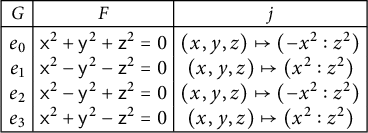
 , and staring at Table 1. From this description, we deduce from Theorem 1.7 that

G-twists of Pythagorean equation.

Table 1 Long description
The table is organized into three columns.
Row 1:
- Column G: e sub 0.
- Column F: x-squared plus y-squared plus z-squared equals 0.
- Column j: open parenthesis x comma y comma z close parenthesis maps to open parenthesis minus x-squared colon z-squared close parenthesis.
Row 2:
- Column G: e sub 1.
- Column F: x-squared minus y-squared minus z-squared equals 0.
- Column j: open parenthesis x comma y comma z close parenthesis maps to open parenthesis x-squared colon z-squared close parenthesis.
Row 3:
- Column G: e sub 2.
- Column F: x-squared minus y-squared plus z-squared equals 0.
- Column j: open parenthesis x comma y comma z close parenthesis maps to open parenthesis minus x-squared colon z-squared close parenthesis.
Row 4:
- Column G: e sub 3.
- Column F: x-squared plus y-squared minus z-squared equals 0.
- Column j: open parenthesis x comma y comma z close parenthesis maps to open parenthesis x-squared colon z-squared close parenthesis.
Now, we will prove Theorem 1.7 using the method of Fermat descent.
Proof of Theorem 1.7
The proof proceeds in three steps: covering, twisting, and sieving.
Step 1: (Covering) A suitable covering is readily available. Indeed, if
$Z_0$
 denotes the plane conic defined by
$F_0$
denotes the plane conic defined by
$F_0$
 , the j-map
$j_0\colon \mathcal {U}_0 \to \mathbb {P}^1$
, the j-map
$j_0\colon \mathcal {U}_0 \to \mathbb {P}^1$
 induces the morphism

One verifies that
$\phi $
 is a Galois Belyi map defined over
$\mathbb {Q}$
is a Galois Belyi map defined over
$\mathbb {Q}$
 with Galois group G, diagonally embedded in
${\mathrm {PGL}}_3(\mathbb {Q})$
with Galois group G, diagonally embedded in
${\mathrm {PGL}}_3(\mathbb {Q})$
 . Since
$\mathcal {U}_0(\mathbb {Z})$
. Since
$\mathcal {U}_0(\mathbb {Z})$
 is empty, so is
$\Omega (F_0)$
is empty, so is
$\Omega (F_0)$
 .
.
Any other cover
$\phi _i\colon Z_i \to \mathbb {P}^1$
 (induced from
$j_i\colon \mathcal {U}_i \to \mathbb {P}^1$
(induced from
$j_i\colon \mathcal {U}_i \to \mathbb {P}^1$
 ) would suffice, but we choose the pointless conic for dramatic emphasis.
Step 2: (Twisting) Consider the Galois cohomology group
$\mathrm {H}^1(\mathbb {Q}, G)$
 . Since the absolute Galois group
${\mathrm {Gal}}_{\mathbb {Q}} := {\mathrm {Gal}}({\bar {\mathbb {Q}}} | \mathbb {Q})$
. Since the absolute Galois group
${\mathrm {Gal}}_{\mathbb {Q}} := {\mathrm {Gal}}({\bar {\mathbb {Q}}} | \mathbb {Q})$
 acts trivially on the abelian group G,
$\mathrm {H}^1(\mathbb {Q}, G)$
acts trivially on the abelian group G,
$\mathrm {H}^1(\mathbb {Q}, G)$
 is the group of continuous group homomorphisms
${\mathrm {Gal}}_{\mathbb {Q}} \to G$
is the group of continuous group homomorphisms
${\mathrm {Gal}}_{\mathbb {Q}} \to G$
 . Every such map factors through a unique injective morphism
${\mathrm {Gal}}(L|\mathbb {Q}) \hookrightarrow G$
. Every such map factors through a unique injective morphism
${\mathrm {Gal}}(L|\mathbb {Q}) \hookrightarrow G$
 , where
$L \supset \mathbb {Q}$
, where
$L \supset \mathbb {Q}$
 is a finite Galois extension.
The only bad prime for the covering (in the sense of [Reference Arango-PiñerosAra25, Lemma 3.23])
$\phi $
 is
$p=2$
is
$p=2$
 . In the notation of Section 1.3,
$\mathcal {S} = \left \{ 2 \right \}$
. In the notation of Section 1.3,
$\mathcal {S} = \left \{ 2 \right \}$
 , and
$R = \mathbb {Z}[1/2]$
, and
$R = \mathbb {Z}[1/2]$
 . By descent theory, we are only interested in the subset
$\mathrm {H}^1_{\mathcal {S}}(\mathbb {Q},G) \subset \mathrm {H}^1(\mathbb {Q}, G)$
. By descent theory, we are only interested in the subset
$\mathrm {H}^1_{\mathcal {S}}(\mathbb {Q},G) \subset \mathrm {H}^1(\mathbb {Q}, G)$
 corresponding to those injections
${\mathrm {Gal}}(L|\mathbb {Q}) \hookrightarrow G$
corresponding to those injections
${\mathrm {Gal}}(L|\mathbb {Q}) \hookrightarrow G$
 for which L is unramified outside
$\{2\}$
for which L is unramified outside
$\{2\}$
 . The possible fields are

Descent theory tells us that the set
$\Omega _{\mathcal {S}}(2,2,2) := \mathbb {P}^1(2,2,2)\langle R \rangle \cong [\mathbb {P}^1_R/{\textbf {Aut}}(\Phi )]\langle R \rangle $
 is partitioned by the disjoint union of the sets
$\phi _\rho (Z_\rho (\mathbb {Q}))$
is partitioned by the disjoint union of the sets
$\phi _\rho (Z_\rho (\mathbb {Q}))$
 , as
$\rho $
, as
$\rho $
 ranges over
$\mathrm {H}^1_{\mathcal {S}}(\mathbb {Q}, G)$
ranges over
$\mathrm {H}^1_{\mathcal {S}}(\mathbb {Q}, G)$
 :
:

It is well known that for a finite morphism
$\phi \colon \mathbb {P}^1_{\mathbb {Q}} \to \mathbb {P}^1_{\mathbb {Q}}$
 , one has
$N(\phi (\mathbb {P}^1(\mathbb {Q})); h) \asymp h^{2/\deg \phi }$
, one has
$N(\phi (\mathbb {P}^1(\mathbb {Q})); h) \asymp h^{2/\deg \phi }$
 . Moreover, in the special case that
$\phi $
. Moreover, in the special case that
$\phi $
 is geometrically Galois,
$N(\phi (\mathbb {P}^1(\mathbb {Q})); h) \sim \kappa (\phi )\cdot h^{2/\deg \phi }$
is geometrically Galois,
$N(\phi (\mathbb {P}^1(\mathbb {Q})); h) \sim \kappa (\phi )\cdot h^{2/\deg \phi }$
 for some explicitly computable constant
$\kappa (\phi )>0$
for some explicitly computable constant
$\kappa (\phi )>0$
 . We give a detailed proof of these results in Section 3 for completeness. Combining this with the partition, Equation (9) implies that

where the sum is restricted to those
$\rho \colon {\mathrm {Gal}}(L|\mathbb {Q}) \hookrightarrow G$
 in
$\mathrm {H}_{\mathcal {S}}(\mathbb {Q}, G)$
in
$\mathrm {H}_{\mathcal {S}}(\mathbb {Q}, G)$
 for which the twist
$Z_\rho $
for which the twist
$Z_\rho $
 is isomorphic to
$\mathbb {P}^1_{\mathbb {Q}}$
is isomorphic to
$\mathbb {P}^1_{\mathbb {Q}}$
 . In particular, the constant
$\kappa ((2,2,2),\mathcal {S})$
. In particular, the constant
$\kappa ((2,2,2),\mathcal {S})$
 will be the sum of the constants
$\kappa (\phi _\rho )$
will be the sum of the constants
$\kappa (\phi _\rho )$
 .
.
Step 3: (Sieving) The count above already contains the count of the proper subset
$\Omega (F_3) \subset \Omega _{\mathcal {S}}(2,2,2)$
 that we seek. Indeed, starting from the partition (9), we note that, since the twists
$\phi _\rho $
that we seek. Indeed, starting from the partition (9), we note that, since the twists
$\phi _\rho $
 are (Galois) Belyi maps of signature
$(2,2,2)$
are (Galois) Belyi maps of signature
$(2,2,2)$
 , we can assign to each
$\rho \in \mathrm {H}^1_{\mathcal {S}}(\mathbb {Q}, G)$
, we can assign to each
$\rho \in \mathrm {H}^1_{\mathcal {S}}(\mathbb {Q}, G)$
 a unique
$2$
a unique
$2$
 -simplified coefficient
$(A_\rho , B_\rho , C_\rho )$
-simplified coefficient
$(A_\rho , B_\rho , C_\rho )$
 such that
$\phi _\rho (Z_\rho (\mathbb {Q}))$
such that
$\phi _\rho (Z_\rho (\mathbb {Q}))$
 is contained in the set
$\Omega (F_\rho )$
is contained in the set
$\Omega (F_\rho )$
 , associated with the generalized Fermat equation

In particular, we deduce that some twist of
$\phi _0\colon Z_0 \to \mathbb {P}^1$
 is isomorphic to
$\phi _3\colon Z_3 \to \mathbb {P}^1$
is isomorphic to
$\phi _3\colon Z_3 \to \mathbb {P}^1$
 , and that
$\Omega (F_3) = \Omega (\phi _3(Z_3(\mathbb {Q})))$
, and that
$\Omega (F_3) = \Omega (\phi _3(Z_3(\mathbb {Q})))$
 . In Example 3.5, we calculate that
$\kappa (F_3) = 1/\pi $
. In Example 3.5, we calculate that
$\kappa (F_3) = 1/\pi $
 , and we conclude that

1.5 Previous work on spherical Fermat equations
This work is closely related to, and inspired by, the foundational contributions of Beukers [Reference BeukersBeu98]. Indeed, the arguments in Section 4 can be slightly modified to reprove [Reference BeukersBeu98, Theorem 1.2]. On a related note, the excellent Master’s thesis of Esmonde [Reference EsmondeEsm99] addresses the problem of solving the equation
$\textsf {x}^a + \textsf {y}^b - \textsf {z}^c = 0$
 in polynomial rings
$k[t]$
in polynomial rings
$k[t]$
 , for certain examples of fields k. Building on work of Beukers, Edwards [Reference EdwardsEdw04] completed the parameterizations of the spherical equations
$\textsf {x}^2+\textsf {y}^3-\textsf {z}^3=0$
, for certain examples of fields k. Building on work of Beukers, Edwards [Reference EdwardsEdw04] completed the parameterizations of the spherical equations
$\textsf {x}^2+\textsf {y}^3-\textsf {z}^3=0$
 ,
$\textsf {x}^2+\textsf {y}^3-\textsf {z}^4 = 0$
,
$\textsf {x}^2+\textsf {y}^3-\textsf {z}^4 = 0$
 , and
$\textsf {x}^2+\textsf {y}^3-\textsf {z}^5 = 0$
, and
$\textsf {x}^2+\textsf {y}^3-\textsf {z}^5 = 0$
 . We expect that the method of Fermat descent employed here can be extended to compute parameterizations for general spherical Fermat equations; this is work in progress by the author.
2 Belyi maps and triangle groups
2.1 (Spherical) triangle groups
We follow [Reference Clark and VoightCV19, Section 2]. For more on this topic, see [Reference MagnusMag74, Chapter II].
Let
$a,b,c> 1$
 be positive integers. We say that the triple
$(a,b,c)$
be positive integers. We say that the triple
$(a,b,c)$
 is
${\color {linkcolor}\textsf {spherical}}$
is
${\color {linkcolor}\textsf {spherical}}$
 ,
${\color {linkcolor}\textsf {Euclidean}}$
,
${\color {linkcolor}\textsf {Euclidean}}$
 , or
${\color {linkcolor}\textsf {hyperbolic}}$
, or
${\color {linkcolor}\textsf {hyperbolic}}$
 according as the quantity

is positive, zero, or negative.
Definition 2.1 Given integers
$a,b,c> 1$
 , the
${\color {linkcolor}\textsf {extended triangle group}}$
, the
${\color {linkcolor}\textsf {extended triangle group}}$ $\triangle (a,b,c)$
 is defined as the group generated by elements
$\delta _0, \delta _1, \delta _\infty , -1$
is defined as the group generated by elements
$\delta _0, \delta _1, \delta _\infty , -1$
 , with
$-1$
, with
$-1$
 central in
$\triangle (a,b,c)$
central in
$\triangle (a,b,c)$
 , subject to the relations
$(-1)^2 = 1$
, subject to the relations
$(-1)^2 = 1$
 and
and

Define the
${\color {linkcolor}\textsf {triangle group}} \bar \triangle (a,b,c)$
 as the quotient of
$\triangle (a,b,c)$
as the quotient of
$\triangle (a,b,c)$
 by
$\left \{ \pm 1 \right \}$
by
$\left \{ \pm 1 \right \}$
 .
.
The spherical triangle groups are all finite groups. Moreover, they are all finite subgroups of
${\mathrm {PGL}}_2({\bar {\mathbb {Q}}})$
 . These were classified by Klein more than a century ago. By [Reference Clark and VoightCV19, Remark 2.2], reordering the signature
$(a,b,c)$
. These were classified by Klein more than a century ago. By [Reference Clark and VoightCV19, Remark 2.2], reordering the signature
$(a,b,c)$
 to be nondecreasing
$a \leqslant b \leqslant c$
to be nondecreasing
$a \leqslant b \leqslant c$
 does not affect the isomorphism class of
$\bar \triangle (a,b,c)$
does not affect the isomorphism class of
$\bar \triangle (a,b,c)$
 .
.
-
• For the ${\color {linkcolor}\textsf {dihedral signatures}} (a,b,c) = (2,2,c)$
with
$c\geqslant 2$
, the triangle groups
$\bar \triangle (2,2,c)$
are isomorphic to the dihedral group
$D_{c}$
with
$2c$
elements. In particular,
$\bar \triangle (2,2,3)$
is isomorphic to the symmetric group in three letters
$S_3$
. The group
$\bar \triangle (2,2,2)$
is isomorphic to the Klein four group
$C_2 \times C_2$
. -
• For the ${\color {linkcolor}\textsf {tetrahedral signature}} (a,b,c) = (2,3,3)$
, the triangle group
$\bar \triangle (2,3,3)$
is isomorphic to
$A_4$
; the group of rotational symmetries of the tetrahedron. -
• For the ${\color {linkcolor}\textsf {octahedral signature}} (a,b,c) = (2,3,4)$
, the triangle group
$\bar \triangle (2,3,4)$
is isomorphic to
$S_4$
; the group of rotational symmetries of the octahedron. -
• For the ${\color {linkcolor}\textsf {icosahedral signature}} (a,b,c) = (2,3,5)$
, the triangle group
$\bar \triangle (2,3,5)$
is isomorphic to
$A_5$
; the group of rotational symmetries of the icosahedron.


2.2 (Spherical) Belyi maps
By
${\color {linkcolor}\textsf {curve,}}$
 we mean a separated scheme of finite type over a field of dimension one. We say that a curve is
${\color {linkcolor}\textsf {nice}}$
we mean a separated scheme of finite type over a field of dimension one. We say that a curve is
${\color {linkcolor}\textsf {nice}}$
 if it is smooth, projective, and geometrically irreducible.
Definition 2.2 Let
$Z_k$
 be a nice curve defined over a perfect field k. A
${\color {linkcolor}\textsf {k-Belyi map}}$
be a nice curve defined over a perfect field k. A
${\color {linkcolor}\textsf {k-Belyi map}}$
 is a finite k-morphism
$\phi \colon Z_k \to \mathbb {P}^1_k$
is a finite k-morphism
$\phi \colon Z_k \to \mathbb {P}^1_k$
 that is unramified outside
$\left \{ 0, 1, \infty \right \} \subset \mathbb {P}^1(k)$
that is unramified outside
$\left \{ 0, 1, \infty \right \} \subset \mathbb {P}^1(k)$
 .
.
Remark 2.3 These remarkable covers of the projective line are named after the Ukrainian mathematician G. V. Belyi, who famously proved that a complex algebraic curve can be defined over a number field if and only if it admits a
$\mathbb {C}$
 -Belyi map [Reference BelyiBel02, Reference BelyiBel79]. For this reason, it is customary to require that
$k \subset \mathbb {C}$
-Belyi map [Reference BelyiBel02, Reference BelyiBel79]. For this reason, it is customary to require that
$k \subset \mathbb {C}$
 to use the term
$Belyi $
to use the term
$Belyi $
 map. We ignore this convention and allow k to be perfect of positive characteristic.
Definition 2.4 Let
$\phi \colon Z_k \to \mathbb {P}^1_k$
 be a k-Belyi map with automorphism k-group scheme
${\mathrm {Aut}}(\phi )$
be a k-Belyi map with automorphism k-group scheme
${\mathrm {Aut}}(\phi )$
 . We say that
$\phi $
. We say that
$\phi $
 is
${\color {linkcolor}\textsf {geometrically Galois}}$
is
${\color {linkcolor}\textsf {geometrically Galois}}$
 if the extension of function fields
${\textbf k}(Z_{\bar {k}}) \supset {\textbf k}(\mathbb {P}^1_{\bar {k}})$
if the extension of function fields
${\textbf k}(Z_{\bar {k}}) \supset {\textbf k}(\mathbb {P}^1_{\bar {k}})$
 is Galois, with
${\color {linkcolor}\textsf {Galois group}}$
is Galois, with
${\color {linkcolor}\textsf {Galois group}}$
 denoted by
${\mathrm {Gal}}(\phi )$
denoted by
${\mathrm {Gal}}(\phi )$
 . Equivalently,
$\phi $
. Equivalently,
$\phi $
 is geometrically Galois if
${\textbf {Aut}}(\phi )({\bar {k}}) = {\mathrm {Aut}}(\phi _{\bar {k}})$
is geometrically Galois if
${\textbf {Aut}}(\phi )({\bar {k}}) = {\mathrm {Aut}}(\phi _{\bar {k}})$
 acts transitively on the fibers. This is the case if and only if
${\mathrm {Aut}}(\phi _{\bar {k}}) \cong {\mathrm {Gal}}(\phi )$
acts transitively on the fibers. This is the case if and only if
${\mathrm {Aut}}(\phi _{\bar {k}}) \cong {\mathrm {Gal}}(\phi )$
 .
.
Remark 2.5 If
$\phi \colon Z_k \to \mathbb {P}^1_k$
 is a geometrically Galois k-Belyi map, for any
$Q \in \mathbb {P}^1(k)-\left \{ 0,1,\infty \right \}$
is a geometrically Galois k-Belyi map, for any
$Q \in \mathbb {P}^1(k)-\left \{ 0,1,\infty \right \}$
 , the fiber
$\phi ^{-1}(Q) := Z \times _k Q$
, the fiber
$\phi ^{-1}(Q) := Z \times _k Q$
 is a
${\mathrm {Gal}}(\phi )$
is a
${\mathrm {Gal}}(\phi )$
 -torsor over
${\mathrm {Spec}} k$
-torsor over
${\mathrm {Spec}} k$
 .
.
Definition 2.6 The
${\color {linkcolor}\textsf {signature}}$
 of a geometrically Galois k-Belyi map
$\phi \colon Z_k \to \mathbb {P}^1_k$
of a geometrically Galois k-Belyi map
$\phi \colon Z_k \to \mathbb {P}^1_k$
 is the triple
$(e_0, e_1, e_\infty ),$
is the triple
$(e_0, e_1, e_\infty ),$
 where
$e_P$
where
$e_P$
 is the ramification index
$e_\phi (z)$
is the ramification index
$e_\phi (z)$
 of any critical point
$z \in Z_k$
of any critical point
$z \in Z_k$
 with critical value
$P \in \left \{ 0,1,\infty \right \}$
with critical value
$P \in \left \{ 0,1,\infty \right \}$
 . The
${\color {linkcolor}\textsf {Euler characteristic}}$
. The
${\color {linkcolor}\textsf {Euler characteristic}}$
 of
$\phi $
of
$\phi $
 is the quantity

As a consequence of the Riemann Existence Theorem, there exist Galois Belyi maps of any spherical signature. See [Reference Darmon and GranvilleDG95, Proposition 3.1] and [Reference PoonenPoo05, Lemma 2.5] for a proof of the following proposition.
Proposition 2.7 For any positive integers
$a,b,c> 1$
 , there exists a number field K and a geometrically Galois K-Belyi map
$\phi \colon Z_K \to \mathbb {P}^1_K$
, there exists a number field K and a geometrically Galois K-Belyi map
$\phi \colon Z_K \to \mathbb {P}^1_K$
 of signature
$(e_0,e_1,e_\infty ) = (a,b,c)$
of signature
$(e_0,e_1,e_\infty ) = (a,b,c)$
 . Let g be the genus of
$Z_K$
. Let g be the genus of
$Z_K$
 , and G be the Galois group of
$\phi $
, and G be the Galois group of
$\phi $
 . Then
$2-2g = (\deg \phi )\cdot \chi (\phi )$
. Then
$2-2g = (\deg \phi )\cdot \chi (\phi )$
 . In particular,
-
(i) If $\chi (\phi )> 0$
, then
$g = 0$
and
$\deg \phi = \# G = 2/\chi (\phi )$
. -
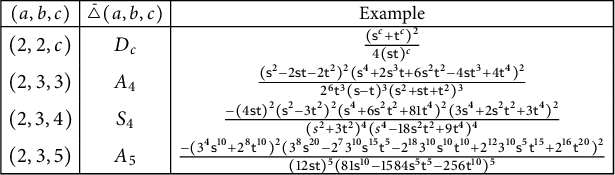
(ii) If $\chi (\phi ) = 0$
, then
$g = 1$
. -
(iii) If $\chi (\phi ) < 0$
, then
$g> 1$
.


A crucial fact that we will need later is that for every spherical signature
$(a,b,c)$
 , there exists a geometrically Galois Belyi map defined over
$\mathbb {Q}$
, there exists a geometrically Galois Belyi map defined over
$\mathbb {Q}$
 with signature
$(a,b,c)$
with signature
$(a,b,c)$
 . The reader may find several examples in the Belyi maps LMFDB beta database [LMF25]. The maps presented in Table 2 are adapted from the parameterizations found in [Reference CohenCoh07, Chapter 14]. The original sources are [Reference BeukersBeu98, Reference EdwardsEdw04].
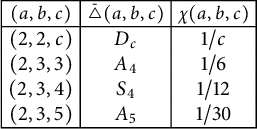
Spherical triangle groups.

Table 2 Long description
The table consists of three columns and five rows including the header.
Column 1 header is open parenthesis a comma b comma c close parenthesis.
Column 2 header is triangle bar open parenthesis a comma b comma c close parenthesis.
Column 3 header is chi open parenthesis a comma b comma c close parenthesis.
Row 1: Column 1 is open parenthesis 2 comma 2 comma c close parenthesis. Column 2 is D sub c. Column 3 is 1 all over c.
Row 2: Column 1 is open parenthesis 2 comma 3 comma 3 close parenthesis. Column 2 is A sub 4. Column 3 is 1 all over 6.
Row 3: Column 1 is open parenthesis 2 comma 3 comma 4 close parenthesis. Column 2 is S sub 4. Column 3 is 1 all over 12.
Row 4: Column 1 is open parenthesis 2 comma 3 comma 5 close parenthesis. Column 2 is A sub 5. Column 3 is 1 all over 30.
3 Counting rational points in the image of a rational function
The results presented in this section are undoubtedly well known [Reference Hindry and SilvermanHS00, Theorem B.6.1] and [Reference SerreSer97, p. 133]; however, authors often ignore the leading constants we seek. For completeness, we provide full proofs, making the leading constants explicit.
Situation 3.1 Throughout the remainder of this section, we shall work with the following notations:
-
• Let $\phi \colon \mathbb {P}^1_{\mathbb {Q}} \to \mathbb {P}^1_{\mathbb {Q}}$
be a nonconstant
$\mathbb {Q}$
-morphism with
$d := \deg (\phi )$
. -
• Let $\phi _0, \phi _\infty \in \mathbb {Z}[\textsf {s},\textsf {t}]$
be a choice of relatively prime homogeneous polynomials of degree d such that
$\phi $
is given by $$ \begin{align*} \phi(s:t) = (\phi_0(s,t):\phi_\infty(s,t)). \end{align*} $$
-
• Let $\mathcal {V} := \mathbb {A}^2 - \textbf {0}$
be the punctured cone over
$\mathbb {P}^1_{\mathbb {Z}}$
. We identify
$\mathcal {V}(\mathbb {Z})$
with the set
$\left \{ (s,t) \in \mathbb {Z}^2: \gcd (s,t) = 1 \right \}$
. The map
$\mathcal {V}(\mathbb {Z}) \to \mathbb {P}^1(\mathbb {Q})$
given by
$(s,t) \mapsto (s:t)$
is two-to-one. -
• Denote by $\tilde \phi \colon \mathbb {A}^2 \to \mathbb {A}^2$
the lift
$\tilde \phi (s,t) := (\phi _0(s,t),\phi _\infty (s,t))$
of
$\phi $
. -
• On $\mathbb {P}^1(\mathbb {Q}) = \mathbb {P}^1(\mathbb {Z})$
,
${\mathrm {Ht}}\colon \mathbb {P}^1(\mathbb {Q}) \to \mathbb {Z}_{\geqslant 0}$
is the usual multiplicative height, given by
${\mathrm {Ht}}(Q) = \max \left \{ |{\mathrm {num}}(Q)|,|{\mathrm {den}}(Q)| \right \}$
. -
• $\Omega (\phi ) \subset \mathbb {P}^1(\mathbb {Q})$
is the image of
$\phi (\mathbb {Q})\colon \mathbb {P}^1(\mathbb {Q}) \to \mathbb {P}^1(\mathbb {Q})$
. -
• For any $\Omega \subset \mathbb {P}^1(\mathbb {Q})$
and for every
$h> 0$
,
$\Omega _{\leqslant h}$
is the finite subset of
$\Omega $
consisting of those points Q with
${\mathrm {Ht}}(Q) \leqslant h$
. The
${\color {linkcolor}\textsf {counting function of}\ \Omega \subset \mathbb {P}^1(\mathbb {Q})}$
is denoted
$N(\Omega ;h) := \# \Omega _{\leqslant h}$
. -
• We denote by ${\mathrm {Aut}}(\phi )$
the group of
$\mathbb {Q}$
-automorphisms of the map
$\phi $
.


The main result of this section is as follows.
Proposition 3.2 We have
$N(\Omega (\phi );h) \asymp h^{2/d}$
 as
$h\to \infty $
as
$h\to \infty $
 . More precisely, there exists an explicitly computable constant
$\delta (\phi )> 0$
. More precisely, there exists an explicitly computable constant
$\delta (\phi )> 0$
 such that

The constant
$\delta (\phi )$
 is described in Equation (19).
In the special case where
$\phi $
 is geometrically Galois, we can keep track of the exact number of
$\mathbb {Q}$
is geometrically Galois, we can keep track of the exact number of
$\mathbb {Q}$
 -rational points on each fiber
$\phi ^{-1}(Q) := \mathbb {P}^1\times _{\mathbb {Q}} Q$
-rational points on each fiber
$\phi ^{-1}(Q) := \mathbb {P}^1\times _{\mathbb {Q}} Q$
 , for all but finitely many
$Q \in \Omega (\phi )$
, for all but finitely many
$Q \in \Omega (\phi )$
 . This allows us to promote the asymptotic bounds of Proposition 3.2 to an asymptotic count.
Corollary 3.3 Suppose that
$\phi $
 is geometrically Galois. Then, there exists an explicitly computable constant
$\kappa (\phi ) \in \mathbb {R}_{>0}$
is geometrically Galois. Then, there exists an explicitly computable constant
$\kappa (\phi ) \in \mathbb {R}_{>0}$
 such that for every
$\varepsilon> 0$
such that for every
$\varepsilon> 0$
 ,
,

as
$h \to \infty $
 . Moreover, the leading constant is given by

and the implied constant depends on
$\phi $
 and
$\varepsilon $
and
$\varepsilon $
 .
.
3.1 The primitivity defect set
Given
$(s,t) \in \mathcal {V}(\mathbb {Z})$
 , it does not follow that
$\tilde \phi (s,t) = (\phi _0(s,t), \phi _\infty (s,t))\in \mathcal {V}(\mathbb {Z})$
, it does not follow that
$\tilde \phi (s,t) = (\phi _0(s,t), \phi _\infty (s,t))\in \mathcal {V}(\mathbb {Z})$
 . For example, consider the map

arising in the parameterization of Pythagorean triples. When s and t have the same parity,
$\gcd \tilde \phi (s,t) = 4$
 . In general,
$\tilde \phi \colon \mathcal {V}(\mathbb {Z}) \to \mathbb {Z}^2$
. In general,
$\tilde \phi \colon \mathcal {V}(\mathbb {Z}) \to \mathbb {Z}^2$
 and we have the following commutative diagram of sets:

Define the
${\color {linkcolor}\textsf {primitivity\ defect\ set\ of}\ \phi }$
 by
by

The set
$\mathcal {D}(\phi )$
 is finite. Indeed, let
$R(\phi ) \in \mathbb {Z}$
is finite. Indeed, let
$R(\phi ) \in \mathbb {Z}$
 denote the resultant of the homogeneous polynomials
$\phi _0$
denote the resultant of the homogeneous polynomials
$\phi _0$
 and
$\phi _\infty $
and
$\phi _\infty $
 . Then, every primitivity defect divides
$R(\phi )$
. Then, every primitivity defect divides
$R(\phi )$
 .
.
Lemma 3.4 If
$e \in \mathcal {D}(\phi )$
 , then
$e \mid R(\phi )$
, then
$e \mid R(\phi )$
 .
.
Proof Let
$e \in \mathcal {D}(\phi )$
 . By definition, there exists
$(s,t)\in \mathcal {V}(\mathbb {Z})$
. By definition, there exists
$(s,t)\in \mathcal {V}(\mathbb {Z})$
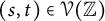 such that
$\gcd \tilde \phi (s,t) = e$
such that
$\gcd \tilde \phi (s,t) = e$
 . By standard properties of the resultant, we can find polynomials
$g_0,g_\infty \in \mathbb {Z}[\textsf {s},\textsf {t}]$
. By standard properties of the resultant, we can find polynomials
$g_0,g_\infty \in \mathbb {Z}[\textsf {s},\textsf {t}]$
 such that

By evaluating the expression above at
$(\textsf {s},\textsf {t}) = (s,t)$
 , we see that
$R(\phi )$
, we see that
$R(\phi )$
 is a multiple of e.
For each
$e \in \mathcal {D}(\phi )$
 , consider the set

We have a partition

For each
$e\in \mathcal {D}(\phi )$
 , consider the subsets

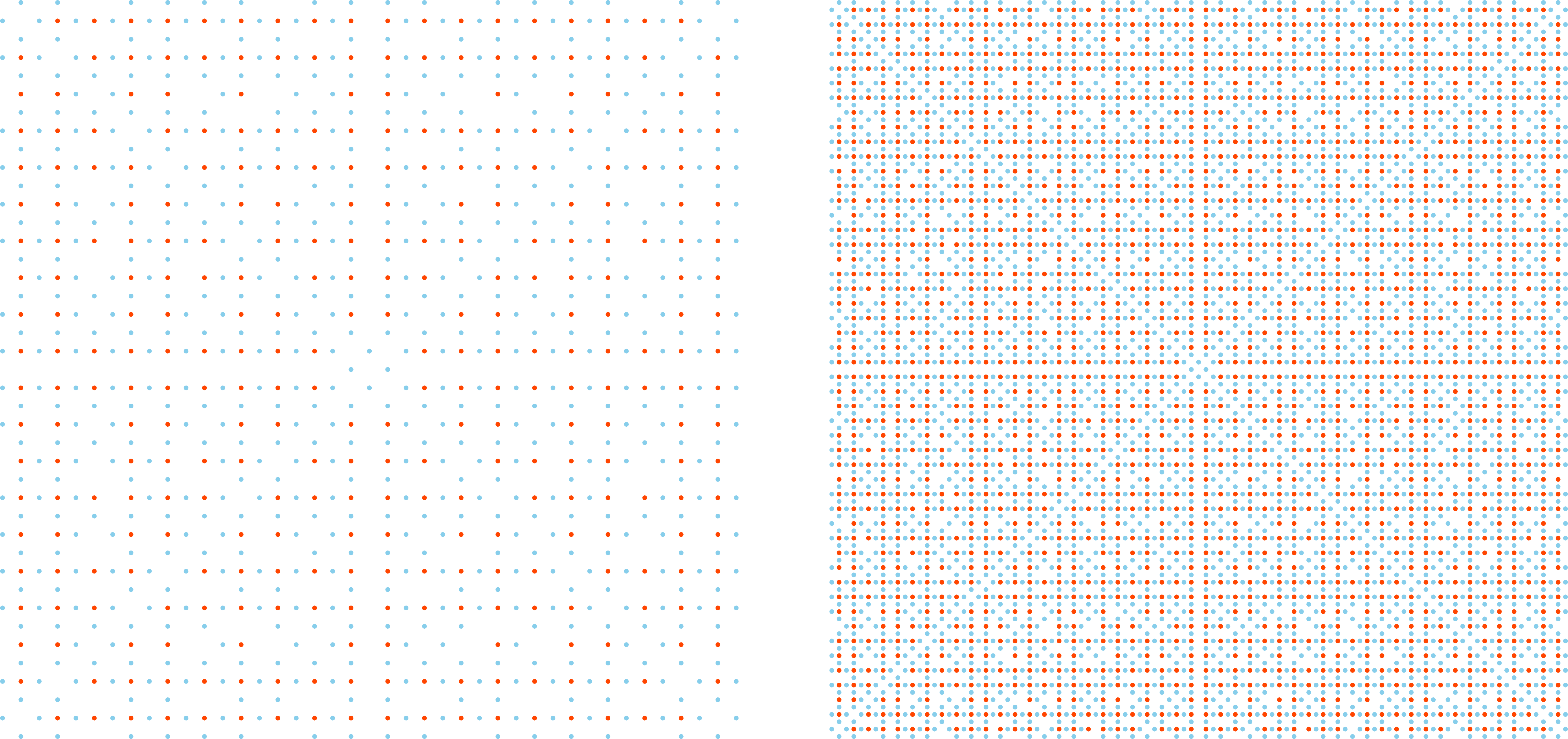
From the partition Figure 1 of primitive points, we obtain the partition

Partition
$\mathcal {V}(\mathbb {Z}) = \mathcal {V}(\mathbb {Z})_1 \sqcup \mathcal {V}(\mathbb {Z})_4$
 with respect to the Galois map
$\phi (s:t) = ((s^2-t^2)^2:(s^2+t^2)^2)$
with respect to the Galois map
$\phi (s:t) = ((s^2-t^2)^2:(s^2+t^2)^2)$
 , with primitivity defect set
$\mathcal {D}(\phi ) = \left \{ 1,4 \right \}$
, with primitivity defect set
$\mathcal {D}(\phi ) = \left \{ 1,4 \right \}$
 .
.

Figure 1 Long description
The visualization consists of two square panels side-by-side, each containing a grid of light blue and orange-red dots.
* The left panel shows a sparse grid where the majority of the dots are light blue. Orange-red dots are distributed in a symmetric, repeating pattern that forms a larger square lattice within the grid. The density of dots is lower compared to the right panel, with significant white space between individual points.
* The right panel shows a much denser grid of dots. The pattern is more complex, with orange-red and light blue dots alternating to create a textured, woven appearance. A distinct X-shaped cross of light blue dots intersects at the center of the panel, extending toward the four corners. The orange-red dots are concentrated in the quadrants created by this central cross, forming a highly regular and dense mathematical field.
3.2 Proof of Proposition 3.2 and Corollary 3.3
We start with the proof of the asymptotic bounds. We will abbreviate

Proof of Proposition 3.2
We may apply the principle of Lipschitz [Reference DavenportDav51] to obtain

where
${\mathrm {vol}}\left ( \mathcal {R}_1 \right )$
 is the Lebesgue measure of the compact region
$\mathcal {R}_1$
is the Lebesgue measure of the compact region
$\mathcal {R}_1$
 in
$\mathbb {R}^2$
in
$\mathbb {R}^2$
 given by
$\max \left \{ |\phi _0(s,t)|,|\phi _\infty (s,t)| \right \} \leqslant 1$
given by
$\max \left \{ |\phi _0(s,t)|,|\phi _\infty (s,t)| \right \} \leqslant 1$
 .
.
In light of the partition Equation (14), we see that, for each
$e\in \mathcal {D}(\phi ),$
 the set
$\mathbb {Z}\cdot \mathcal {V}(\mathbb {Z})_e$
the set
$\mathbb {Z}\cdot \mathcal {V}(\mathbb {Z})_e$
 has a density
$\delta _e\in [0,1]$
has a density
$\delta _e\in [0,1]$
 , and
$\sum _{e\in \mathcal {D}(\phi )}\delta _e = 1$
, and
$\sum _{e\in \mathcal {D}(\phi )}\delta _e = 1$
 . Moreover, if we define

then
$\widetilde M_e(h) = \delta _e\cdot \widetilde M(h) + O(1)$
 .
.
We apply a standard Möbius sieve to Equation (15) to obtain, for every
$\varepsilon> 0$
 , the asymptotic

Moreover, if we define

then
$\widetilde N_e(h) = \delta _e\cdot \widetilde N(h) + O(1)$
 . Consider the counting function

which counts all
$\mathbb {Q}$
 -rational points on
$\mathbb {P}^1$
-rational points on
$\mathbb {P}^1$
 with respect to the height
${\mathrm {Ht}}$
with respect to the height
${\mathrm {Ht}}$
 pulled back by
$\phi $
pulled back by
$\phi $
 . In general, we have the inequalities

which arise from the fact that a point
$Q = \phi (P) \in \Omega (\phi )$
 has at least one rational point in the fiber
$\phi ^{-1}(Q)$
has at least one rational point in the fiber
$\phi ^{-1}(Q)$
 , and at most
$d = \deg \phi $
, and at most
$d = \deg \phi $
 .
.
To conclude, we relate
$N(h)$
 to the counting functions
$\widetilde N_e(h)$
to the counting functions
$\widetilde N_e(h)$
 . By the definition of
${\mathrm {Ht}}$
. By the definition of
${\mathrm {Ht}}$
 , we see that

In particular, the leading constant is

We will use Proposition 3.2 in the special case of a geometrically Galois
$\mathbb {Q}$
 -Belyi map
$\phi $
-Belyi map
$\phi $
 .
.
Proof of Corollary 3.3
Suppose that
$\phi $
 is geometrically Galois, with Galois group
${\mathrm {Gal}}(\phi ) = {\mathrm {Aut}}(\phi _{\bar {\mathbb {Q}}})$
is geometrically Galois, with Galois group
${\mathrm {Gal}}(\phi ) = {\mathrm {Aut}}(\phi _{\bar {\mathbb {Q}}})$
 . Then,
${\mathrm {Gal}}(\phi )$
. Then,
${\mathrm {Gal}}(\phi )$
 acts transitively and without stabilizers on the fibers of unramified points
$Q\in \mathbb {P}^1(\mathbb {Q})$
acts transitively and without stabilizers on the fibers of unramified points
$Q\in \mathbb {P}^1(\mathbb {Q})$
 . Since there are finitely many points that ramify, they do not influence the asymptotic count, so we ignore them. We claim that for every
$Q \in \phi (\mathbb {P}^1(\mathbb {Q})) = \Omega (\phi )$
. Since there are finitely many points that ramify, they do not influence the asymptotic count, so we ignore them. We claim that for every
$Q \in \phi (\mathbb {P}^1(\mathbb {Q})) = \Omega (\phi )$
 , we have that

Indeed
${\mathrm {Aut}}(\phi ) = {\mathrm {Aut}}(\phi _{{\bar {\mathbb {Q}}}})^{{\mathrm {Gal}}_{\bar {\mathbb {Q}}}}$
 , and for every
$P \in \phi ^{-1}(Q)(\mathbb {Q})$
, and for every
$P \in \phi ^{-1}(Q)(\mathbb {Q})$
 and
$\gamma \in {\mathrm {Aut}}(\phi )$
and
$\gamma \in {\mathrm {Aut}}(\phi )$
 , we have that
$\gamma (P) \in \phi ^{-1}(Q)(\mathbb {Q})$
, we have that
$\gamma (P) \in \phi ^{-1}(Q)(\mathbb {Q})$
 as well. On the other hand, given
$P,P' \in \phi ^{-1}(Q)(\mathbb {Q})$
as well. On the other hand, given
$P,P' \in \phi ^{-1}(Q)(\mathbb {Q})$
 , there exists
$\gamma \in {\mathrm {Aut}}(\phi _{\bar {\mathbb {Q}}})$
, there exists
$\gamma \in {\mathrm {Aut}}(\phi _{\bar {\mathbb {Q}}})$
 such that
$\gamma (P') = P$
such that
$\gamma (P') = P$
 . For any
$\sigma \in {\mathrm {Gal}}_{\mathbb {Q}}$
. For any
$\sigma \in {\mathrm {Gal}}_{\mathbb {Q}}$
 , we see that
$\gamma ^\sigma (P') = \gamma (\sigma ^{-1}P') = \gamma (P')$
, we see that
$\gamma ^\sigma (P') = \gamma (\sigma ^{-1}P') = \gamma (P')$
 . Therefore,
$\gamma ^{-1}\gamma ^\sigma $
. Therefore,
$\gamma ^{-1}\gamma ^\sigma $
 stabilizes
$P'$
stabilizes
$P'$
 , which implies that
$\gamma ^{-1}\gamma ^\sigma =1$
, which implies that
$\gamma ^{-1}\gamma ^\sigma =1$
 , and therefore
$\gamma \in {\mathrm {Aut}}(\phi )$
, and therefore
$\gamma \in {\mathrm {Aut}}(\phi )$
 . It follows that
$N_\phi (h) = \#{\mathrm {Aut}}(\phi )\cdot N(\Omega (\phi );h)$
. It follows that
$N_\phi (h) = \#{\mathrm {Aut}}(\phi )\cdot N(\Omega (\phi );h)$
 , and the proof is complete. In particular, the leading constant is

Example 3.5 (Pythagorean constant)
In Section 1.4, we concluded that for
$F\colon \textsf {x}^2 + \textsf {y}^2 - \textsf {z}^2 = 0$
 , we have the identity
$\Omega (F) = \Omega (\phi )$
, we have the identity
$\Omega (F) = \Omega (\phi )$
 , where
$\phi \colon Z := {\mathrm {Proj}} \mathbb {Q}[\textsf {x},\textsf {y},\textsf {z}]/(\textsf {x}^2 + \textsf {y}^2 - \textsf {z}^2) \to \mathbb {P}^1_{\mathbb {Q}}$
, where
$\phi \colon Z := {\mathrm {Proj}} \mathbb {Q}[\textsf {x},\textsf {y},\textsf {z}]/(\textsf {x}^2 + \textsf {y}^2 - \textsf {z}^2) \to \mathbb {P}^1_{\mathbb {Q}}$
 is the Galois Belyi map
$(x:y:z) \mapsto (x^2:z^2)$
is the Galois Belyi map
$(x:y:z) \mapsto (x^2:z^2)$
 . Take the isomorphism
$\mathbb {P}^1 \cong Z$
. Take the isomorphism
$\mathbb {P}^1 \cong Z$
 given by
$(s:t) \mapsto (s^2-t^2:2st:s^2+t^2)$
given by
$(s:t) \mapsto (s^2-t^2:2st:s^2+t^2)$
 , and rename
$\phi $
, and rename
$\phi $
 to be the composition
$\mathbb {P}^1 \cong Z \to \mathbb {P}^1$
to be the composition
$\mathbb {P}^1 \cong Z \to \mathbb {P}^1$
 ,
$(s:t) \mapsto ((s^2-t^2)^2: (s^2+t^2)^2)$
,
$(s:t) \mapsto ((s^2-t^2)^2: (s^2+t^2)^2)$
 .
.
-
• Since $\max \left \{ |s^2-t^2|^2, |s^2+t^2|^2 \right \} = (s^2+t^2)^2$
, the region
$\mathcal {R}_1$
is the unit disc, and
${\mathrm {vol}}(\mathcal {R}_1) = \pi $
. -
• The primitivity defect set $\mathcal {D}(\phi ) = \left \{ 1,4 \right \}$
. The densities are
$\delta _1 = 2/3$
and
$\delta _4 = 1/3$
.


Putting this data into Equation (19), we see that

Finally, since
${\mathrm {Aut}}(\phi ) \cong G \cong C_2\times C_2$
 , we obtain
$\kappa (\phi ) = \delta (\phi )/4 = \tfrac {1}{\pi }$
, we obtain
$\kappa (\phi ) = \delta (\phi )/4 = \tfrac {1}{\pi }$
 .
.
4 Proof of main results
Situation 4.1 We adopt the following notation for the rest of this section:
-
• Let $(a,b,c)$
be a spherical signature (see Table 2), we do not assume that
$a \leqslant b \leqslant c$
. -
• Let $\mathcal {S}$
denote a finite set of primes, and
$R = \mathbb {Z}[\mathcal {S}^{-1}]$
. -
• Recall that $\mathrm {H}^1_{\mathcal {S}}(\mathbb {Q}, G)$
denotes the Galois cohomology pointed set which classifies G-torsors over
${\mathrm {Spec}} \mathbb {Q}$
unramified outside of
$\mathcal {S}$
. -
• For any $\Omega \subset \mathbb {P}^1(\mathbb {Q})$
, and any
$h> 0$
, we have the counting function
$N(\Omega; h)$
defined in Situation 3.1.


Our proof follows the guidelines of the method of Fermat descent, as presented in [Reference Arango-PiñerosAra25]. It consists of three steps: covering, twisting, and sieving.
4.1 Covering
The covering is a geometrically Galois
$\mathbb {Q}$
 -Belyi map
$\phi \colon \mathbb {P}^1_{\mathbb {Q}} \to \mathbb {P}^1_{\mathbb {Q}}$
-Belyi map
$\phi \colon \mathbb {P}^1_{\mathbb {Q}} \to \mathbb {P}^1_{\mathbb {Q}}$
 with signature
$(a,b,c)$
with signature
$(a,b,c)$
 . For instance, we can always start with one of the maps described by the rational functions in Table 3 and, since we are not assuming that
$a \leqslant b \leqslant c$
. For instance, we can always start with one of the maps described by the rational functions in Table 3 and, since we are not assuming that
$a \leqslant b \leqslant c$
 , compose with an appropriate permutation
$\gamma \in {\mathrm {PGL}}_2(\mathbb {Q})$
, compose with an appropriate permutation
$\gamma \in {\mathrm {PGL}}_2(\mathbb {Q})$
 of
$\left \{ 0,1,\infty \right \}$
of
$\left \{ 0,1,\infty \right \}$
 .
.
Examples of geometrically Galois
$\mathbb {Q}$
 -Belyi maps for the spherical signatures.

Table 3 Long description
The table consists of three columns: open parenthesis a comma b comma c close parenthesis, triangle group delta bar open parenthesis a comma b comma c close parenthesis, and Example.
* Row 1: Signature open parenthesis 2 comma 2 comma c close parenthesis. Group D sub c. Example: numerator open parenthesis s to the c power plus t to the c power close parenthesis squared all over denominator 4 open parenthesis s t close parenthesis to the c power.
* Row 2: Signature open parenthesis 2 comma 3 comma 3 close parenthesis. Group A sub 4. Example: numerator open parenthesis s squared minus 2 s t minus 2 t squared close parenthesis squared open parenthesis s to the 4 power plus 2 s cubed t plus 6 s squared t squared minus 4 s t cubed plus 4 t to the 4 power close parenthesis squared all over denominator 2 to the 6 power t cubed open parenthesis s minus t close parenthesis cubed open parenthesis s squared plus s t plus t squared close parenthesis cubed.
* Row 3: Signature open parenthesis 2 comma 3 comma 4 close parenthesis. Group S sub 4. Example: numerator negative open parenthesis 4 s t close parenthesis squared open parenthesis s squared minus 3 t squared close parenthesis squared open parenthesis s to the 4 power plus 6 s squared t squared plus 81 t to the 4 power close parenthesis squared open parenthesis 3 s to the 4 power plus 2 s squared t squared plus 3 t to the 4 power close parenthesis squared all over denominator open parenthesis s squared plus 3 t squared close parenthesis to the 4 power open parenthesis s to the 4 power minus 18 s squared t squared plus 9 t to the 4 power close parenthesis to the 4 power.
* Row 4: Signature open parenthesis 2 comma 3 comma 5 close parenthesis. Group A sub 5. Example: numerator negative open parenthesis 3 to the 4 power s to the 10 power plus 2 to the 8 power t to the 10 power close parenthesis squared open parenthesis 3 to the 8 power s to the 20 power minus 2 to the 7 3 to the 10 power s to the 15 power t to the 5 power minus 2 to the 18 power 3 to the 10 power s to the 10 power t to the 10 power plus 2 to the 12 power 3 to the 10 power s to the 5 power t to the 15 power plus 2 to the 16 power t to the 20 power close parenthesis squared all over denominator open parenthesis 12 s t close parenthesis to the 5 power open parenthesis 81 s to the 10 power minus 1584 s to the 5 power t to the 5 power minus 256 t to the 10 power close parenthesis to the 5 power.
4.2 Twisting
By [Reference Arango-PiñerosAra25, Lemma 3.23], there exists a finite set of primes
$\mathcal {S}$
 for which the map
$\phi $
for which the map
$\phi $
 admits an R-model
$\Phi \colon \mathbb {P}^1_R \to \mathbb {P}^1_R$
admits an R-model
$\Phi \colon \mathbb {P}^1_R \to \mathbb {P}^1_R$
 such that
$\mathbb {P}^1(a,b,c)_R \cong [\mathbb {P}^1_R/{\textbf {Aut}}(\Phi )]$
such that
$\mathbb {P}^1(a,b,c)_R \cong [\mathbb {P}^1_R/{\textbf {Aut}}(\Phi )]$
 . Descent theory gives the partition

Here,
$\mathrm {H}^1(R,{\textbf {Aut}}(\Phi ))$
 denotes the fppf Čech cohomology pointed set. It is in bijection with isomorphism classes of fppf
${\textbf {Aut}}(\Phi )$
denotes the fppf Čech cohomology pointed set. It is in bijection with isomorphism classes of fppf
${\textbf {Aut}}(\Phi )$
 -torsor schemes
$T \to {\mathrm {Spec}}\ R$
-torsor schemes
$T \to {\mathrm {Spec}}\ R$
 . Restriction to the generic fiber induces an isomorphism

of pointed sets. Note that
${\mathrm {Gal}}(\phi ) \cong {\textbf {Aut}}(\phi )({\bar {\mathbb {Q}}}) = {\mathrm {Aut}}(\phi _{\bar {\mathbb {Q}}})$
 , so the action of the absolute Galois group
${\mathrm {Gal}}_{\mathbb {Q}}$
, so the action of the absolute Galois group
${\mathrm {Gal}}_{\mathbb {Q}}$
 is the natural one. In general,
$\mathrm {H}^1_{\mathcal {S}}(\mathbb {Q},{\mathrm {Gal}}(\phi ))$
is the natural one. In general,
$\mathrm {H}^1_{\mathcal {S}}(\mathbb {Q},{\mathrm {Gal}}(\phi ))$
 is only a pointed set and not a group, since
${\mathrm {Gal}}(\phi ) \cong \bar \triangle (a,b,c)$
is only a pointed set and not a group, since
${\mathrm {Gal}}(\phi ) \cong \bar \triangle (a,b,c)$
 as abstract groups, and the only abelian spherical triangle group is
$\bar \triangle (2,2,2) \cong C_2 \times C_2$
as abstract groups, and the only abelian spherical triangle group is
$\bar \triangle (2,2,2) \cong C_2 \times C_2$
 . Crucially, the set
$\mathrm {H}^1_{\mathcal {S}}(\mathbb {Q}, {\mathrm {Gal}}(\phi ))$
. Crucially, the set
$\mathrm {H}^1_{\mathcal {S}}(\mathbb {Q}, {\mathrm {Gal}}(\phi ))$
 is finite and classifies twists of the Belyi map
$\phi $
is finite and classifies twists of the Belyi map
$\phi $
 . It is worth noting that in some cases, the source curve of a twist
$\phi _\tau \colon \mathbb {P}^1_\tau \to \mathbb {P}^1$
. It is worth noting that in some cases, the source curve of a twist
$\phi _\tau \colon \mathbb {P}^1_\tau \to \mathbb {P}^1$
 might be a pointless conic. Nevertheless, since the equations

all have primitive integral solutions, we know that
$\Omega (a,b,c) \neq \varnothing $
 , and there will always be at least one twist for which
$\mathbb {P}^1_\tau (\mathbb {Q}) \neq \varnothing $
, and there will always be at least one twist for which
$\mathbb {P}^1_\tau (\mathbb {Q}) \neq \varnothing $
 .
.
4.3 Sieving
Combining the partition above with Corollary 3.3, we obtain

where the sum ranges over all the
$\tau \in \mathrm {H}^1_{\mathcal {S}}(\mathbb {Q}, {\mathrm {Gal}}(\phi ))$
 for which
$\mathbb {P}^1_\tau $
for which
$\mathbb {P}^1_\tau $
 is isomorphic to
$\mathbb {P}^1_{\mathbb {Q}}$
is isomorphic to
$\mathbb {P}^1_{\mathbb {Q}}$
 . To sieve out the excess of elements in
$\mathbb {P}^1(a,b,c)\langle R \rangle $
. To sieve out the excess of elements in
$\mathbb {P}^1(a,b,c)\langle R \rangle $
 not corresponding to points in
$\Omega (a,b,c) = \mathbb {P}^1(a,b,c)\langle \mathbb {Z} \rangle $
not corresponding to points in
$\Omega (a,b,c) = \mathbb {P}^1(a,b,c)\langle \mathbb {Z} \rangle $
 , we show that we can restrict to certain subsets
$T(F) \subset T(a,b,c) \subset \mathrm {H}^1_{\mathcal {S}}(\mathbb {Q},{\mathrm {Gal}}(\phi ))$
, we show that we can restrict to certain subsets
$T(F) \subset T(a,b,c) \subset \mathrm {H}^1_{\mathcal {S}}(\mathbb {Q},{\mathrm {Gal}}(\phi ))$
 to cover all of
$\Omega (F)$
to cover all of
$\Omega (F)$
 and
$\Omega (a,b,c)$
and
$\Omega (a,b,c)$
 . The proofs of both Theorems 1.2 and 1.3 (in the special case of simplified equations (Definition 1.5)) will follow immediately from the following lemma.
Lemma 4.2 Fix a possibly empty subset
$\mathcal {T} \subset \mathcal {S}$
 . Take a
$\mathcal {T}$
. Take a
$\mathcal {T}$
 -simplified Fermat equation
$F\colon A\textsf {x}^{a} + B\textsf {y}^{b} + C\textsf {z}^{c} = 0$
-simplified Fermat equation
$F\colon A\textsf {x}^{a} + B\textsf {y}^{b} + C\textsf {z}^{c} = 0$
 . Then, there is a finite subset
$T(F) \subseteq \mathrm {H}^1_{\mathcal {S}}(\mathbb {Q},{\mathrm {Gal}}(\phi ))$
. Then, there is a finite subset
$T(F) \subseteq \mathrm {H}^1_{\mathcal {S}}(\mathbb {Q},{\mathrm {Gal}}(\phi ))$
 such that

Moreover, defining
$T(a,b,c)$
 as the disjoint union of the sets
$T(F)$
as the disjoint union of the sets
$T(F)$
 , as F ranges over all
$\varnothing $
, as F ranges over all
$\varnothing $
 -simplified Fermat equations of signature
$(a,b,c)$
-simplified Fermat equations of signature
$(a,b,c)$
 , we have

Proof Any geometrically Galois
$\mathbb {Q}$
 -Belyi map
$\phi \colon \mathbb {P}^1_{\mathbb {Q}} \to \mathbb {P}^1_{\mathbb {Q}}$
-Belyi map
$\phi \colon \mathbb {P}^1_{\mathbb {Q}} \to \mathbb {P}^1_{\mathbb {Q}}$
 of signature
$(a,b,c)$
of signature
$(a,b,c)$
 is given by a rational function

where
-
(i) $\phi _0, \phi _1,\phi _\infty \in \mathbb {Z}[\textsf {s},\textsf {t}]$
are homogeneous of degree
$\#\bar \triangle (a,b,c)$
, -
(ii) $\gcd (\phi _0,\phi _\infty ) = \gcd (\phi _1, \phi _\infty ) = 1$
, and -
(iii) we can write
$$ \begin{align*} \phi_0(\textsf{s},\textsf{t}) &= C_0\cdot X(\textsf{s},\textsf{t})^a, \\ \phi_1(\textsf{s},\textsf{t}) &= C_1\cdot Y(\textsf{s},\textsf{t})^b,\\ \phi_\infty(\textsf{s},\textsf{t}) &= C_\infty\cdot Z(\textsf{s},\textsf{t})^c, \end{align*} $$for unique polynomials $X,Y,Z \in \mathbb {Z}[\textsf {s},\textsf {t}]$
, and a unique triple
$(C_0,C_1,C_\infty )$
of
$\mathcal {S}(\phi )$
-simplified Fermat coefficients, where
$\mathcal {S}(\phi )$
is an explicit set of bad primes.


We denote this triple by
$\textbf {sfc}(\phi )$
 . Observe that for any
$Q\in \mathbb {P}^1(\mathbb {Q})$
. Observe that for any
$Q\in \mathbb {P}^1(\mathbb {Q})$
 , we have that
$\textbf {sfc}(\phi ) = \textbf {sfc}(\phi (Q))$
, we have that
$\textbf {sfc}(\phi ) = \textbf {sfc}(\phi (Q))$
 .
.
Returning to the situation of this section, to each cohomology class
$\tau ,$
 we can associate the
$\mathcal {S}$
we can associate the
$\mathcal {S}$
 -simplified Fermat coefficient triple
$ \textbf {sfc}(\phi _\tau )$
-simplified Fermat coefficient triple
$ \textbf {sfc}(\phi _\tau )$
 . If F is
$\mathcal {T}$
. If F is
$\mathcal {T}$
 -simplified, then it is also
$\mathcal {S}$
-simplified, then it is also
$\mathcal {S}$
 -simplified. Moreover, for every primitive integral solution
$(x,y,z)$
-simplified. Moreover, for every primitive integral solution
$(x,y,z)$
 to F, the point
$j(x,y,z) \in \mathbb {P}^1(\mathbb {Q})$
to F, the point
$j(x,y,z) \in \mathbb {P}^1(\mathbb {Q})$
 is in
$\Omega _{\mathcal {S}}(a,b,c)$
is in
$\Omega _{\mathcal {S}}(a,b,c)$
 . Define

To finish the proof of Theorem 1.3, we must consider the case of non-simple equations. To guide our intuition, consider the equation
$F'\colon 25\textsf {x}^2 + \textsf {y}^2 = \textsf {z}^2$
 . Our strategy is to use the simplification
$F \colon \textsf {x}^2 + \textsf {y}^2 = \textsf {z}^2$
. Our strategy is to use the simplification
$F \colon \textsf {x}^2 + \textsf {y}^2 = \textsf {z}^2$
 to deduce the asymptotic result for
$F'$
to deduce the asymptotic result for
$F'$
 from that of F. In this case, the
$\mathbb {Q}$
from that of F. In this case, the
$\mathbb {Q}$
 -isomorphism of nice curves
$C \to C', \quad (x:y:z) \mapsto (x/5:y:z)$
-isomorphism of nice curves
$C \to C', \quad (x:y:z) \mapsto (x/5:y:z)$
 enables this translation. The idea is that the congruence condition
$x \equiv 0 \operatorname{mod} 5$
enables this translation. The idea is that the congruence condition
$x \equiv 0 \operatorname{mod} 5$
 cuts out a positive proportion of the primitive integral solutions to the Pythagorean equation, and only the constant term in the asymptotic will change.
Start with a non-simple equation
$F'\colon A'\textsf {x}^a + B'\textsf {y}^b + C'\textsf {z}^c = 0$
 . Without loss of generality, we may assume that
$\gcd (A',B',C') = 1$
. Without loss of generality, we may assume that
$\gcd (A',B',C') = 1$
 . In this case, we can write

to obtain a
$\mathcal {T}$
 -simplified coefficient triple
$(A,B,C)$
-simplified coefficient triple
$(A,B,C)$
 , where
$\mathcal {T}$
, where
$\mathcal {T}$
 is the set of primes dividing
$A'\cdot B'\cdot C'$
is the set of primes dividing
$A'\cdot B'\cdot C'$
 . The Fermat equation
$F\colon A\textsf {x}^{a} + B\textsf {y}^{b} + C\textsf {z}^{c} = 0$
. The Fermat equation
$F\colon A\textsf {x}^{a} + B\textsf {y}^{b} + C\textsf {z}^{c} = 0$
 is the
${\color {linkcolor}\textsf {simplification}}$
is the
${\color {linkcolor}\textsf {simplification}}$
 of
$F'$
of
$F'$
 . From Lemma 4.2, we have a partition

where each
$\phi _\tau $
 is a geometrically Galois
$\mathbb {Q}$
is a geometrically Galois
$\mathbb {Q}$
 -Belyi map
$\mathbb {P}^1_{\mathbb {Q}} \to \mathbb {P}^1_{\mathbb {Q}}$
-Belyi map
$\mathbb {P}^1_{\mathbb {Q}} \to \mathbb {P}^1_{\mathbb {Q}}$
 of signature
$(a,b,c)$
of signature
$(a,b,c)$
 . Let
$\phi $
. Let
$\phi $
 be one of these maps. We have seen that
$\phi $
be one of these maps. We have seen that
$\phi $
 corresponds to a rational function

To conclude, we use a clever argument of Beukers [Reference BeukersBeu98, Proof of Theorem 1.5]. Consider the polynomial map

We use
$\alpha $
 to define a lattice of rank two generated by the points whose image is integral

Choose an integral basis
$\left \{ \vec \alpha _1, \vec \alpha _2 \right \}$
 for
$\Lambda (\alpha )$
for
$\Lambda (\alpha )$
 , and define

Applying this construction to every
$\phi _\tau $
 appearing in Equation (23), we obtain the partition

from which we conclude the proof.
Acknowledgements
This work is part of the author’s Ph.D. thesis. We thank David Zureick-Brown, John Voight, and Andrew Kobin for many enlightening conversations on this topic and for their valuable feedback. We are also grateful to Bjorn Poonen for agreeing to serve on the thesis committee and for his detailed and insightful comments on an earlier draft.






 Open access

