


“A blank page, where new laws, new codes, new systems of education, new freedom of speech, new forms of government, could be invented according to the principle of the greatest happiness for the greatest number.” It was roughly in these terms that Jeremy Bentham envisioned the economic and political potentials of Spain's “Ultramaria” (its American possessions) following the collapse of its empire.Footnote 1 In the wake of the Atlantic consequences of the Napoleonic Wars—a moment in what Eric Hobsbawm famously named the “Age of Revolution”—the early decades of the nineteenth century indeed saw the emergence of new American political regimes (i.e., Colombia, Peru, Chile, Mexico, Buenos Ayres, and Guatemala) that essentially favored British trade.Footnote 2 Their representatives were in turn strongly encouraged by London merchant-bankers to finance the development and consolidation of newly acquired but fragile independence by floating loans on the London Stock Exchange. Between 1822 and 1825, a time when financial and mercantile activities were heavily confounded with each other, numerous British joint-stock companies also issued significant amounts of shares—often before obtaining the necessary parliamentary charters. These business activities were aimed at benefiting from the riches soon to be made available by the imminent development of a more direct British West Indian and transatlantic trade with the Americas.Footnote 3
Bentham himself considered the development of business and political enterprises within newly liberated American territories as participating in the concretization of new utopias, or “dreamed territories with, as yet, no real existence, and where new governments could be installed and legislation drawn up according to the principle of the greatest happiness of the greatest number.”Footnote 4 Rather than delusional idealizations devoid of any scientific interest, such utopias essentially established concrete forces of political and commercial change and, therefore, constituted specific efforts to transcend problematic historical situations: in this instance, Atlantic imperial transformation.Footnote 5 Yet the concretization of these changes took place in far-reaching and distinct local, regional, and transatlantic spaces, stretching from the Americas to the very heart of the City of London, and weaving also into the fabric of transatlantic trade flows in the making. In other words, the realization of such dreamed-of commercial and political projects took place simultaneously on different levels, and on multiple sides of an Atlantic World in transformation.Footnote 6
However, when Bentham raved about the existence of American infant states, or ones that at that time existed only on (his) paper, he solely envisaged them as capable of emerging from and being consolidated by the effort of the Spanish revolutionaries of Ultramaria, brushing aside in a few lines the very existence of other actors (i.e., the “Indians”) of the political and economic processes that were then also transforming the Atlantic.Footnote 7 In a similar way, numerous studies have provided fascinating insights into the general and the more particular histories of the intricate political and financial endeavors that contributed to the making of new—and generally still existing—Spanish American republics and the improvement of their Atlantic commercial relationships with Britain.Footnote 8 However, recent works reveal how other, more discreet actors also played a role in the constitution and dissemination of nineteenth-century utopian ideas, ideals, and enterprises.Footnote 9 These suggest, in a way, that the histories of Atlantic transformations are ridden with “blind spots,” glaring absences that mark the “unacknowledged knowledges” of the diversity of actors and their levels of involvement in these political and, especially, financial and commercial metamorphoses.Footnote 10
This article casts light on one such “blind spot” in the Atlantic financial and political entanglements tied to these early years of American states formation and economic improvement. It does so by telling the well-studied story of the creation and financing of new American utopias, characteristic of these times, but from the perspective of an actor seldom considered in the relevant literature, namely that of an American Indigenous actor. His name was George Frederic Augustus II, king of the Miskitu on the Central American Miskitu Shore (hereafter referred to as “the Shore”) between 1816 and 1824.Footnote 11 This study illuminates how he sought, throughout his short-lived rule, to actively occupy various political and commercial spaces, near and far, in person and by proxy, in an Atlantic World undergoing important political and economic transformations, with echoes of his endeavors even reaching as far as the city of London's money market. Inspired by American Republican uprisings and the spreading of abolitionist ideas, George Frederic attempted to transform not only the economic and political foundations of his kingdom to concretize his own Miskitu utopia, for which he would even design a flag and draft a constitution; he also sought to reconfigure networks of foreign trade in Central America and the Caribbean, in which his kingdom had been and would remain an important node. Short on capital and labor, George Frederic had nevertheless benefited from an adequate education in matters related to regional politics and transatlantic trade. This enabled him to consider outsourcing the improvement of his territory to foreign agents with experience in statebuilding and financing: British mercenaries involved in Latin American revolutionary wars. These would, in his name, access both European and American capital markets to finance the realization of this Miskitu utopia.
As highlighted by Carlo Ginzburg or Alain Corbin, studying up close the life of a single, marginal individual or institution can reveal the often unsuspected interweaving of local, regional, or global dynamics in which they were (successfully or not) embedded.Footnote 12 Similarly, this article reintegrates George Frederic's actions within the various political, commercial, and financial dynamics in which they were inscribed, be they on the Shore, Central American, or transatlantic. Yet, in the absence of George Frederic's own memoirs, his story can only be written through a close reading of a wide range of dispersed archival sources, including manuscript and printed material found in repositories located in England, Scotland, and Belize. These hold diaries, newspaper articles, and private correspondence sent to or from George Frederic or that mention the Miskitu king. Taken together, these scattered documents constitute an original corpus of primary sources that help delve into different episodes of George Frederic's eventful life, from his upbringing to the constitution of his utopia.
This research also relies on the published testimonies of foreign merchants who encountered the Miskitu king. These were narratives provided most notably by Jacob Dunham, a North American trader who dealt with the Miskitu between 1816 and 1819, and, more importantly, by the English West Indian merchant Orlando Roberts, who visited the Shore regularly between 1816 and 1822.Footnote 13 Using such printed sources implies a potentially important self-centered bias, because these only transcribe the intentions and understandings of their authors. Indeed, both were writing for European or North American audiences interested in the development of trade relations with Central America in the aftermath of the collapse of the Spanish Empire. Contrary to Bentham and other contemporaries, Dunham and Roberts consider that the improvement of Atlantic trade in the region rested on a better understanding of the Shore's Indigenous polities, the latter providing access to natural resources of interest to European and American commerce.Footnote 14 Yet both texts are tinged with recurring tropes discriminating against the Miskitu (e.g., the “drunken Indian”), relatively common for the time. Descriptions provided by late modern European commentators of their interactions with American Indigenous interlocutors involving alcohol were often exaggerated, however, defined as they were by trepidations about the dangers of excessive drinking and anxieties about the place of American Indigenous peoples in new American societies.Footnote 15 An often contradictory image of George Frederic thus emerges from the reading of these accounts: he appears at the same time a feckless drunkard and a determined actor in full possession of his means.
To be clear, the Miskitu drank spirits, which they obtained from trade conducted with foreign merchants.Footnote 16 To portray George Frederic as a raging alcoholic, however, is certainly more than an exaggeration. Still, because these merchant accounts are not entirely “objective” does not mean they should be discarded. Considering such stereotypes, these remain at present some of the sole sources that can provide insight into and context for not only George Frederic's biography but also how the Miskitu conducted commercial and political interactions with various foreign actors. It is the multiplicity of often concordant testimonies that, taken together, make it possible to reconstruct the tumultuous life of George Frederic.Footnote 17 In turn, putting together such scattered clues allows for the telling of a chronological story of these Atlantic transformations from the unusual perspective of George Frederic. It also highlights whether certain actors or polities that are generally mischaracterized or omitted from the historiography in fact played an active role for their potential own utopian benefit within and between these different metamorphosing political and financial Atlantic spaces.
Historiographical attention paid to the Miskitu Shore offers rich insight into the region's Spanish, British, German, and American colonial history.Footnote 18 Studies focusing on the Miskitu in particular also offer valuable inquiries into their economic and political interrelations with and independence from the Shore's various colonial waves since Christopher Columbus's 1502 landing in the area.Footnote 19 Yet these historiographies generally focus on the geographical setting of the Shore, seldom investigating the impact that the events taking place there had beyond its borders.Footnote 20 George Frederic has also been the subject, in passing, of studies in colonial and Miskitu history. Rather than being portrayed as an individual worthy of any historical interest, he generally appears as a minor historical figure, owing to the short duration of his reign, or as a British colonial puppet (sharing the fate of many Miskitu rulers).Footnote 21 Moreover, George Frederic's story has often been confounded with that of Poyais. Specifically, he is often anecdotally remembered for having conceded in 1820, allegedly after a night of heavy drinking, the territory on which Gregor MacGregor planned to establish his principality of Poyais. This infamous story has been described as the “most audacious fraud in History,” with MacGregor believed to have been the fraudulent architect of the so-called fake state and loan of Poyais.Footnote 22 Yet recent works calling into question the fraudulent foundations of MacGregor's Poyaisian project make it possible to lift the veil of guilt or gullibility too often attached to the different actors involved, from near or far, in his affair—including George Frederic.Footnote 23
Pointing out how George Frederic's singular life both fitted into and molded, in often unsuspected ways, wider financial and political dynamics underlying the making of new American states offers a wider contribution to historiographical debates discussing the agency of American Indigenous actors in the shaping of Central American, Caribbean, and Atlantic trade and colonial networks. Seminal studies by such scholars as Arthur Ray, Ann Carlos and Lewis Frank, and Richard White have highlighted how American Indigenous peoples’ active involvement in the long eighteenth-century North American trade and colonial patterns affected their political and material cultures as well as their transatlantic commercial dynamics.Footnote 24 More recently, historians have noted how American Indigenous peoples played an active monetary or financial part in the development of North American capitalism, as well as how finance and money in themselves became tools of imperial dispossession for them.Footnote 25 Illuminating the longstanding involvement of Indigenous polities in the realm of American economic dynamics, these works allow for the integration of their subjects into novel fields of investigation, especially that of nineteenth-century business history.Footnote 26
More broadly, recent works focusing on nineteenth-century Pacific and North America discuss the need to consider Indigenous peoples on their own political terms, as full-fledged state actors, or even imperial actors.Footnote 27 Not only do these challenge commonly accepted understandings of global political landscapes by providing more nuanced narratives of the imperial transformations and competitions of their time; they also provide better insights into the historical trajectories of given Indigenous polities, without them being eclipsed by the chronologies, theories, or viewpoints imposed by colonial/imperial historiographical frameworks.Footnote 28 Although they tend to concentrate more on political than economic aspects, these historiographical developments are particularly relevant when it comes to studying the interwoven development of early nineteenth-century Central American, Caribbean, and wider Atlantic British merchant-banking and statebuilding processes, as historians seldom include American Indigenous peoples in their narratives, much less tell these stories from their perspectives.Footnote 29 At best, few studies mention the existence of political and commercial links between American Indigenous peoples and British traders.Footnote 30 Although these do, fortunately, nuance the asymmetrical relations in favor of British merchants and settlers emerging from such interactions, their scope is often limited to the American territory, and they generally understand American Indigenous history through the sole context of their relationships with foreigners.
In line with this scholarship, studying the biographical particularities of a Miskitu king at the head of an early nineteenth-century Central American and transatlantic Indigenous utopian venture sheds light on a drastic moment of global political, financial, and commercial possibility. It shows how George Frederic tried to benefit and shape the English drive to improve British trade in the Americas to his own financial, commercial, and political benefit. By highlighting the reach of George Frederic's action beyond the American continent, mainly from his perspective, this article also helps resituate the active global economic and political impacts that a Miskitu protagonist had—and could have had—within financial and colonial processes of early nineteenth-century statebuilding. Offering a chronological dive into George Frederic's life, each section of this article reveals insights into the creation, development, and tragic end of his utopia, along with the local, regional, and transatlantic impacts and progresses of this episode of Miskitu state formation. The first section provides contextual background to the Shore and biographical information on George Frederic from his early years to his accession to the throne in 1816. The second illustrates how a combination of local and Atlantic transformations offered George Frederic the opportunity to reposition himself politically within the Shore. The third describes how George Frederic envisioned, like other South American independence or abolitionist projects of the time, the establishment of a slave-free commercial and political utopia on the Shore. In doing so, this section details the interactions of George Frederic with foreign mercenaries to finance and build his project. The fourth section describes how George Frederic had to adapt his ambitions to deal with significant difficulties in establishing himself, on the London money market and the Shore, as the valid owner of his utopia—ultimately, to no avail. The last section concludes.
George Frederic's Miskitu Shore
The Shore stretches from the southeastern coast of present-day Nicaragua to that of eastern Honduras, forming a triangle that roughly connects the San Juan River to Cape Camarón via Cape Gracias a Dios. In the early nineteenth century, at the time of George Frederic's reign, it was inhabited by a number of American Indigenous peoples, differing mainly in language, geographical distribution, and ethnicity. The Indigenous Sumu (Mayangna) lived mostly inland. The Paya formed a linguistically isolated group comprising as many Zambo as Indigenous peoples, occupying northern lands around Black River near Cape Camarón.Footnote 31 The south was occupied by the Rama, of similar ethnic descent. By far the largest and most dominant group, the Miskitu, of mixed Indigenous, African, and European ancestry, originally occupied the area around Cape Gracias a Dios but, by the early 1800s, had extended to a good part of the Shore. Interestingly, they divided themselves ethnically and culturally between the Sambo Miskitu (based in the north and identifying as Afro-Indigenous) and the Tawira Miskitu (identifying as Indigenous-descended and concentrated in the south).Footnote 32
The demographic and geographical predominance of the Miskitu can be explained mainly by the Shore's particular political economy, a consequence of a long history dating back to the seventeenth century. As historians have highlighted, the Miskitu established long-lasting trade with European and, more specifically, British settlers in the region, whose presence there the Spanish Empire technically tolerated. Following seventeenth-century Puritan colonial ventures, the Miskitu actively positioned themselves as partners of choice for the successive waves of English private enterprises settling in the area. Ethnic intercourses and economic contacts intensified with British settlers (and their African slaves) based in Black River starting in 1732, with whom essential political, economic, and cultural synergies were established. In exchange for firearms and other valuable European commodities (e.g., textiles, iron wares), the Miskitu essentially granted British settlers’ safe access to their territory and natural resources (e.g., turtle shell, sarsaparilla), which were then mainly traded with Jamaica. In particular, an extractive economy centered around the logging of precious timber—cedar and, especially, mahogany—emerged during the eighteenth century. Labor intensive, it essentially contributed to the establishing of an important system of American Indigenous slavery, headed by the Miskitu. Obtaining preferential access to European markets, technologies, and specific knowledges (particularly English or African), the Miskitu acquired economic and military superiority over the region's other ethnic polities. Redistributing foreign commodities within local markets or using firearms obtained from these exchanges—muskets, hence their demonym—to raid and enslave neighboring polities, the Miskitu progressively subjected the surrounding Rama, Sumu, and Paya peoples. The Miskitu then sold to British settlers the Indigenous slaves necessary for the lumbering of the Shore's woods, after helping themselves for their farming or ranching needs.Footnote 33
The development of such Indigenous slave raids, in conjunction with polygamous matrimonial alliances, contributed to a gradual shaping of the region's political dynamics in favor of the Miskitu. By the early nineteenth century, the Shore was divided into different “districts,” each ruled by a hereditary aristocratic figure of authority of Miskitu descent. The northern division was controlled by a Sambo general, having under his authority the Paya and, to some extent, Sumu peoples. A Tawira governor led southern Rama polities, and a Tawira admiral settled the everyday affairs of the Miskitu near Cape Gracias a Dios (see Figure 1). A king of Sambo Miskitu descent ensured the cohabitation of these different Indigenous polities over the whole Shore. Although the king's role evolved following, on one side, contacts with Spanish, British, or African populations and, on the other, Tawira-Sambo Miskitu civil wars between the seventeenth and eighteenth centuries, it eventually became that of a middleman between the leading polities of the Shore. He essentially provided a platform for negotiation among local leaders and legitimized decisions made by and between Sambo-Tawira Miskitu aristocrats. The Miskitu king was also assigned the role of cultural intermediary between representatives of the different peoples of the Shore and the European traders, settlers, or authorities. Young Miskitu princes, given English names to facilitate cultural intermediation with British interlocutors (e.g., Edward, Peter, George), were therefore often offered a European education in Black River, in Jamaica, or in England, at least since the seventeenth century.Footnote 34
Miskitu Kingdom, c. 1815. (Source: Michael D. Olien, “The Miskito Kings and the Line of Succession,” Journal of Anthropological Research 39, no. 2 [1983]: 217.)

Born sometime in the 1790s, George Frederic Augustus was destined to become one such Miskitu king. George Frederic and his younger brother, Robert Charles Frederic, were taken to Kingston in June 1805 “to impress upon [their] mind the advantage of our alliance,” as stated by Jamaica's commander in chief.Footnote 35 To ensure the continuity of his political legacy, their father, George II, had previously negotiated with Alexander Lindsay, Earl of Balcarres and then-governor of Jamaica, to have his two sons educated in Kingston.Footnote 36 Chaperoning the two princes, their great-uncle Isaac was to ensure that their education would suit their future position. Like previous Miskitu princes, George Frederic was certainly taught arithmetic and Greek, Roman, and English history, as well as the British cultural and social codes.Footnote 37 He was also awarded £100 per year by Jamaican authorities for his personal needs and those of his entourage.Footnote 38
As a child, George Frederic was also regularly presented to some of the island's most prestigious residents. On August 13, 1804, a dinner was organized at the governor's residence, bringing together a small party of high-ranking British officers and dignitaries. Although the young prince threw a fit that evening (to the displeasure of his hostess, Lady Maria Nugent, who recounted the episode in her diary), the objective of the encounter had been relatively clear: maintaining the interest of his interlocutors in the commercial potentials of the Shore. Throughout the evening, his great-uncle took great care to remind the guests about “the good and hospitable customs of his country,” soon to be ruled by the prince who was, at that very moment, receiving a British education to ensure the continuation of West Indian British privileged access to trade on the Shore.Footnote 39 In turn, George Frederic's upbringing would leave him with a clear sensibility not only for engaging with British interlocutors and customs but, above all, that the very legitimacy of his position as king depended on the state of the Shore's foreign trade.Footnote 40
George Frederic's upbringing did not take place solely with British preceptors. West Indian merchants also conducted part of his training as a future ruler. Wishing to ensure that George Frederic's future reign would guarantee them continued access to the Shore's resources, some traders sought to maintain regular contact with the prince during his time in Jamaica. For example, Peter Sheperd, a British merchant, regularly ferried leaders of the Valiente (a Rama polity established in the southern parts of the Shore) to Jamaica to visit George Frederic.Footnote 41 Allowing the prince to familiarize himself with the distribution of commissions to future vassals and assert his role as an allocator of legitimate accesses to the Shore for foreigners, these meetings also enabled Sheperd to ensure proper contacts with the prince in the hope of maintaining his flourishing business. Indeed, Sheperd was then a merchant who not only dominated the whole trade between the Shore, Jamaica, San Andreas, and Old Providence but also acted as an intermediary for North American merchants trading in Miskitu commodities.Footnote 42 More importantly, interactions with British West Indian merchants like Sheperd essentially helped George Frederic to establish relationships with foreign merchants while also learning how to play an active part in the facilitation of long-distance trade.Footnote 43
While George Frederic was pursuing his cultural and commercial education in Jamaica, the Shore was governed by his uncle, Stephen.Footnote 44 Following the death of George Frederic's father in 1800, Stephen continued his late brother's policy of trade conciliation with foreigners established in the region, essential for the maintenance of the Miskitu political regime. Yet Stephen had to fill the trade gap created by British settlers’ forced abandonment of the Black River colony. In a 1786 treaty between Spain and Britain, the latter agreed to recognize full Spanish sovereignty over Central America and to evacuate all British presence from the Shore.Footnote 45 Miskitu interests then rapidly moved toward the settlement of British Honduras. Having received many evacuees from Black River, this private British colony saw a significant commercial advantage in maintaining lasting relations with the Miskitu. Its magistrates, composed mainly of the most potent mahogany merchants of the colony, had already been courting the Miskitu for several years—for example, sending gifts totaling £40 to young George Frederic and three other leaders in 1802.Footnote 46
In November 1815, once George Frederic had come of age, Stephen organized a meeting with about thirty Indigenous leaders, during which they all agreed to sign a submission “giving [their] assent, consent, choice, and declaration to, for, and of the appointment of the hereditary Prince Frederic . . . to his father's Crown, Franc, and Government, as [their] lawful King and Sovereign.”Footnote 47 With this support, George Frederic was ready to embrace his royal role. In January 1816, he wrote to George Arthur, then superintendent of British Honduras, requesting to be crowned in the settlement's capital, Belize.Footnote 48 Happy at the idea of officially counting the young king as the new middleman in charge of ensuring a military and commercial alliance between British Honduras and the Miskitu, the superintendent granted George Frederic's demand.Footnote 49 The ceremony took place on January 18. George Frederic chartered a British sloop of war from Jamaica to Belize for the occasion. Surrounded by his chiefs as well as the British merchants and officers of the colony, George Frederic, dressed in the uniform of a British major, rode on horseback to the settlement's main church. Placed near the altar, he was enthroned “King and Sovereign of the Miskitu Nation” with a proper English coronation service, accompanied by cries from the audience of “Long live [the] King!”Footnote 50
Local and Atlantic Transformations
Following his coronation, George Frederic settled at Cape Gracias a Dios. Marking the end of the protrusion of land into the Caribbean Sea between the Yucatán Peninsula and the South American mainland, the cape was an important point of political and commercial negotiation. As the seat of the Miskitu kingdom, it constituted a mediation venue for representatives of the Shore's various polities. The cape also constituted a passage for foreign merchants seeking legitimate access to the resources of the Shore. Like his forefathers, George Frederic approved trading rights for foreign merchants who periodically settled in the area to gather quantities of mahogany, sarsaparilla, or turtle shell for their trade. For example, during a voyage made in the late 1810s and early 1820s, British merchant Orlando Roberts met different French and British traders on his way to the cape. Their presence on the Shore was conditioned by the regular renewal of their allegiance to the king.Footnote 51 Moreover, in July 1815, an American merchant named Jacob Dunham, who had taken up residency in Cape Gracias a Dios, received from George Frederic a permit to “touch and trade in all parts of my dominions in any vessel from North America.”Footnote 52
Foreign merchants even took up permanent residency in Cape Gracias a Dios. Roberts depicted the capital as largely composed of several poorly built huts, with a handful of impressive houses. In addition to those belonging to the king or the admiral, one of these houses belonged to William Boggs, whom Roberts described as “old” and “of the worst description.”Footnote 53 Probably an Irish merchant, Boggs had opened a shop at the cape and served as counsel for different generations of Miskitu leaders. For example, Stephen had appointed him “proxy” for some of the leaders who signed the 1815 submission.Footnote 54 Another shop opened by a North American trader—probably Dunham—is mentioned in some testimonies.Footnote 55
In this setting, Miskitu aristocrats and British merchants established on the Shore or in nearby British Honduras and Jamaica hoped that the coronation of George Frederic would result in a status quo that benefited British West Indian trade—essentially conditions very close to what his late father George II had established. When George Frederic requested to have his coronation in Belize, Superintendent Arthur indicated that he would be honored to grant the privilege, provided the Miskitu king did not forget that he was “in a particular manner under the protection of the British Government.”Footnote 56 In other words, George Frederic was advised not to prejudice the privileged connections between Miskitu and British West Indian merchants, consolidated by his predecessors. British merchants even agreed among themselves to implement this West Indian exclusivity properly. Dunham, the American merchant who traded on the Shore, was in turn forbidden by the British merchants there to go to Jamaica or send letters on board their vessels, as they feared he would “become a rival in the trade, and be the means of introducing others into it.”Footnote 57
Yet the first years of the king's reign were characterized by significant tensions, both internal and external to the Shore, that prevented the maintaining—or even favored the disruption—of a model of economic and political colonial cohabitation intermediated by the Miskitu king.
Within the internal setting of the Shore, George Frederic's reign started on the wrong foot: he was unwilling or unable to establish royal authority over his kingdom as an intermediary. Fifteen years of regency under Stephen's rule had given both the general and the governor time to strengthen themselves politically and economically. In the north, General Robinson became a wealthy cattle rancher who had dared to distance himself from the Miskitu royal authority. His absence from both the 1815 meeting of chiefs organized by Stephen (his signature is absent) and the coronation of George Frederic in Belize earned Robinson copious insults from the young king.Footnote 58 In the south, Governor Clementi (also a wealthy rancher) deliberately refused contact with the new king, even taking it upon himself to kill one of his somewhat disrespectful envoys. George Frederic also managed to alienate one of his closest allies, Admiral Earnee, by assaulting one of his wives.Footnote 59
Transformations originating far beyond the Shore had significant consequences for George Frederic's reign as well. The scope of British antislavery campaigns impacted the stability of the Miskitu polity. An admirer of British antislavery MP William Wilberforce, Superintendent Arthur of British Honduras sought to concretely enforce a ban on the holding of American Indigenous slaves from the Shore.Footnote 60 On the eve of the royal coronation, Arthur strongly urged George Frederic to cease these enslaving practices and instead to “administer justice in mercy.”Footnote 61 Arthur would then pressure Belizean loggers by commissioning a British king's advocate to assess the issue of American Indigenous enslavement.Footnote 62 These efforts to promote English antislavery in Central America constituted a problem for George Frederic. The sale of slaves was the cornerstone not only of the internal Miskitu economy but also of the system of exchange linking the British and the Miskitu, ultimately guaranteeing the latter's political, military, and commercial domination on the Shore. Abolishing Indigenous slavery would, consequently, undermine his already faltering royal power.
Processes of American decolonization also had an impact on George Frederic's reign, introducing new actors and ideas to the Shore. First the French Revolution and then the Napoleonic Wars had important repercussions on the other side of the Atlantic.Footnote 63 For former Spanish colonies, these quickly translated into revolutionary defiance, in favor of republican constitutions and independent utopias.Footnote 64 Revolutionary uprisings in Haiti also fueled the realization of new, slaveless political possibilities in the Caribbean.Footnote 65 Consequently, the American continent and the Caribbean became important hubs of contestation where new utopias could be imagined and concretized. And Americans of Spanish descent or former Haitian slaves opposed to their former sovereign were not the only ones participating in these political reconfigurations; important contingents of British mercenaries hired by Spanish revolutionaries also very often adopted South American revolutionary utopias, which they disseminated during various battles against Spanish imperial armies.Footnote 66
Some of these battles took place at the gates of the Miskitu. Jean-Louis Aury, a French corsair hired on behalf of Buenos Ayres, attacked the Spanish ports of Omoa and Truxillo between May 1819 and April 1820.Footnote 67 Located in the Bay of Honduras, these settlements were only a short distance from the Shore. To prepare for these attacks, Aury sent representatives to George Frederic to request military support at best or, at least, a right of way.Footnote 68 Much to the displeasure of General Robinson, who had trade relations with these Spanish positions, George Frederic found the idea of allying with South American insurgents appealing. He in turn allowed Aury's fleet to circulate in the region and gave him livestock to replenish his supplies.Footnote 69
The promises of commercial openings made by the emergence of American independences also resulted in the arrival of new foreign merchants on the continent. Motivated to establish a more direct transatlantic trade, many landed alongside mercenaries hired under American revolutionary banners in various parts of the continent.Footnote 70 George Frederic's kingdom was not excluded. The Shore's valuable resources of mahogany and cedar, colorfully depicted in travel writings of the time, had piqued the interest of British merchants other than West Indian traders and Belizean loggers—to the latter's displeasure.Footnote 71 George Frederic was, in fact, very aware of the important commercial potential of his territory's precious timber. For instance, he once commissioned Roberts to convoy two large mahogany dories to British Honduras to convince the merchants there of the high quality of the Shore's wood.Footnote 72 Above all, the possibility of a transoceanic passage sparked curiosity. In the south of George Frederic's kingdom, some—including Bentham!Footnote 73—were indeed considering the possibility of connecting some rivers with a canal to the Pacific via Lake Nicaragua. The account of Roberts's journey through the Shore, for example, depicts his search for an ideal passage connecting the two oceans.Footnote 74
Making a Miskitu Utopia
The arrival of new foreign merchants on the Shore had important consequences for the inhabitants of the Shore. As recalled by Roberts, the Valiente understood this well. Visits by new foreigners to their lands “made a considerable impression on [their] minds.”Footnote 75 For George Frederic, the contact with new foreigners had other consequences: it allowed him to expand his future political and commercial prospects in these times of Miskitu and Atlantic imperial transformations. Constrained by the internal political dissent on the Shore that brought him increasingly into conflict with other Miskitu aristocrats, and by mounting external criticism of the practice of Indigenous slavery, George Frederic now envisioned becoming something else: an actor of change within and beyond the Shore. As such, he very happily “associated with, and listened to, every visionary scheme submitted to him by the traders.”Footnote 76
Counseled by some of the foreign merchants (as he often had been as a teenager in Jamaica) passing through Cape Gracias a Dios, George Frederic decided to take the opportunity that the encounters with these Atlantic movements offered: like other Spanish American insurgents, and foreign mercenaries like Aury, he sought to build a utopia of his own, for his own political and economic benefit. He envisioned himself freed from the rigidity of the system of Miskitu-British cohabitation now coveted by new external actors, within which he had only ever meant to play the role of an intermediary. In its place, George Frederic described (in fragmentary primary sources) a utopia in which he could play a more active role.Footnote 77 He sought to become the lone ruler of a new state, the exploitation of whose natural resources he himself would supervise, thereby benefiting and strengthening his reign. He would then gain new prerogatives, including collecting taxes (in cash or in kind), taking justice into his own hands, and assembling an army, all supervised by well-educated commissioners and other “Men of Wisdom and Integrity” that he appointed. All of this would be undertaken for the betterment of the various peoples in the region, which were, according to him, violently ruled by the local general or governor. Moreover, under mounting pressure and being moved by international ideas for reform (in London and, especially, British Honduras), George Frederic considered replacing the traditional Indigenous slave-based economy of the Shore. Rather than being enslaved, Indigenous communities could be educated to work freely and contribute to the improvement of their territory. Locals would then ultimately be socially and morally indebted to the king, preferring to be governed by George Frederic than by current local Miskitu aristocracies.
Just as Aury had requested assistance from George Frederic for the realization of his utopia, George Frederic needed help in pursuing his own. Shortly after the French mercenary's departure from the Shore, George Frederic instructed some of his captains, notably in British Honduras, to determine the best way to meet the educational needs of young children on the Shore. About George Frederic's expressed willingness to educate his young subjects, Superintendent Arthur, who was also a member of the Church Missionary Society, replied joyfully that it would indeed be “highly pleasing to the Mosquito [sic] people to have their Children educated.”Footnote 78 George Frederic also sought to actively speed up the improvement of his territory on his own terms. He hired foreign workers to begin working on the development of agriculture, forestry, and commerce in his kingdom. By 1820, George Frederic had hired Black Carib refugees, evacuated to Roatan Island (off the coast of Truxillo) from St. Vincent after their defeat in the Second Carib War of 1797, to form settlements between Cape Camarón and the Patook River.Footnote 79 Incidentally, the region was in the middle of the lands controlled by General Robinson, recently deceased. He had died on an operating table in Belize in 1820, leaving an heir too young to rule and a regent too cruel for northern communities.Footnote 80
George Frederic sought to further benefit from the void left by General Robinson's death by encouraging the creation of additional colonies dedicated to improving the region. In place of slaves and in addition to Carib settlers, he hired foreigners who had interests in the Shore's commercial potentials as well as experience in statebuilding and financing: foreign mercenaries engaged in Spanish American wars. In preparation for the attack on Truxillo, Aury had, as mentioned above, dispatched some of his officers to persuade George Frederic to support him militarily. James David Roy Gordon, a Scottish mercenary, was thus sent to Cape Gracias a Dios to hold talks with the Miskitu king on the matter. Apparently, Gordon and George Frederic became close, so much so that on August 4, 1819, the king appointed him to the rank of general in his army.Footnote 81 As foreign mercenaries hired under American Republican banners often liked to show off their accomplishments and titles, no doubt George Frederic could consider Gordon one of those much sought-after men of “Wisdom and Integrity.”Footnote 82 However, Gordon was not yet able to honor his new commitments, at least not on the eve of the battle of Truxillo to be led by Aury. Yet since the outcome of the attack would ultimately be in favor of Spain, Gordon left Aury's service and returned to George Frederic's court.Footnote 83 This time, he was accompanied by other Scottish mercenaries fighting for American revolutionaries, including General Gregor MacGregor, Captains Murray and Hosmore, and a North American named Samuel Warren.Footnote 84 Wishing to distance themselves from the battles against Spanish forces, they preferred George Frederic's offer to establish a potentially successful commercial operation on the Shore. On April 29, 1820, the Miskitu king offered them an enormous tract of land (more than 33,000 square kilometers) beginning at Black River and extending far into the interior. The colony was to be headed by MacGregor and his heirs, who were granted “full power and authority to enact laws, establish customs, and in a word to take and adopt all measures that he may deem fit and necessary for the protection, defence, better government and prosperity of the . . . District of land, commonly called Black River [or] Poyais.”Footnote 85
For George Frederic, this hiring of foreigners constituted a shortcut to improving the Shore and, in turn, emerging as the full Miskitu ruler he sought to become, in asserting an effective sovereign right over his territory following a reshuffling of imperial cards that was expected to happen on or near his envisioned kingdom. Gordon and his acolytes were to bring the necessary skill, labor, and capital needed to concretize George Frederic's desire for political independence. As mercenaries, they had already made several trips to London to enlist new British volunteers (military labor) in the American Republican cause. Most importantly, they had experience in raising transatlantic capital. MacGregor, for example, had taken out large loans in London from merchant-bankers for the acquisition of various military provisions and for the payment of advances promised to volunteers.Footnote 86 Redefining the sovereignty of imperially contested territories was also one of their skills, as some of the mercenaries had previously been involved in the constitution of temporary sovereign states at the beginning of the Spanish American wars of independence (e.g., Amelia and Galveston Islands).Footnote 87 One thing, however, was to be clear to all: the Miskitu king would cede no sovereignty whatsoever to these new settlers. It did not take long for George Frederic to impress upon these mercenaries the important commercial potential of their new colony, with its abundance of precious woods. Some of their subsequent writings abound with detailed descriptions of the mahogany or cedar found on the Shore.Footnote 88 Boggs, the old Irish merchant living in Cape Gracias a Dios and a counselor of Miskitu kings, must have also considered allowing British compatriots to participate in the improvement of the Shore, thereby strengthening the commercial power of his counselee, as beneficial to his own business. His signature can be found, alongside that of George Frederic's, at the bottom of the concession granted to MacGregor.
George Frederic's first British settlement was to become a prosperous colony; indeed, it started off well. Hiring some of the nearby Carib settlers, Gordon and the others established their colony on the banks of Black River—near the point where the former English settlement, evacuated in 1786, had been located. They rapidly cleared a considerable area of land on which they planted significant quantities of corn. Proud of the settlement whose creation he had commissioned, George Frederic showcased it as a model to other foreign merchants to encourage them to invest in the improvement of the Shore. When the Miskitu king gave him a tour of the Black River colony, Roberts was impressed with the quality of the first crops harvested and the resources to be obtained from the area.Footnote 89
In January 1821, shortly after founding the Black River colony, Gordon sailed to British Honduras, and later to Jamaica. In both places, he sought to procure tools, capital, and future outlets from which to sell the Black River colony products. Interestingly, it was quite well understood within British Honduras that he had been hired by and was acting on behalf of George Frederic, who had authorized his new general “to act for us with Foreign Nations in any way or manner he may judge of the greatest utility to our public service.”Footnote 90 In a letter sent to the Colonial Office, Superintendent Arthur of British Honduras notably reported that Gordon had “entered very much into the affairs of the Mosquito King, under what Instructions he was acting [and] appointing him a General in his service.”Footnote 91 This authority also enabled Gordon to ask the Spanish forces in the region—after assuring them that he was no longer under the orders of Aury—to politically tolerate the existence of the settlement and to commercially engage with its improvement.Footnote 92
Yet the magistrates of British Honduras began to worry after realizing that they had been ousted by British mercenaries like Gordon as the sole interlocutors of George Frederic. In a letter sent to his superiors in London, Superintendent Arthur raised concerns about the political schemes of the Miskitu king, who was suddenly behaving more like a political ruler than an intermediary. Unsure of the measures to take respecting the “Mosquito King and Nation in general,” Arthur expressed apprehension regarding George Frederic's ambitions and feared that offering him and his chieftains presents, as was customary, would this time not be sufficient to put an end to the king's plans to integrate non-Belizeans into the trade of the Shore.Footnote 93
MacGregor took a different approach, proclaiming that he wanted to take the “most active measures for procuring [the Miskitu] religious and moral instructors, the implements of husbandry, and persons to guide and assist [them] in the cultivation of the valuable productions, for which [his] soil and climate are so well adapted.”Footnote 94 He sailed to London to recruit new settlers to work on the improvement of his territory. In the absence of Gordon and MacGregor, Warren (the North American) oversaw the colony, along with Murray and Hosmore. All that remained was to accelerate George Frederic's promising colonial project, with the aid of the capital, supplies, and settlers promised by Gordon and, especially, MacGregor. However, after his departure from the Shore around May 1820, there would be no more news from MacGregor.
Saving the Utopia
Three years after MacGregor's departure, a ship finally appeared. Having left England on November 22, 1822, the Honduras Packet arrived off Black River in February 1823, after long stopovers in St. Thomas and Kingston. MacGregor had kept his promise. Soon after his initial departure, MacGregor managed to secure a 6 percent foreign loan on the London money market for the “Service of the State of Poyais” of an amount totaling £200,000.Footnote 95 In most instances, MacGregor's promotional materials were very clear on the matter: he had been hired by George Frederic, to whom the entire Black River project belonged, and funds were raised in the name of the Miskitu king.Footnote 96 A handful of London merchants invested in the project in the hope of taking part in or benefiting from the development of the Shore. These funds enabled MacGregor to recruit hundreds of English and Scottish volunteers and charter four ships to take them to Black River (the Honduras Packet, Kennersley Castle, Skeene, and Albion).Footnote 97 Many of the recruits were agricultural laborers and woodworkers, hired specifically to exploit the colony's mahogany resources, as intended by George Frederic.Footnote 98
Aboard the first ship to set sail for Black River, the Honduras Packet, was James Douglas, the settlement's doctor. He noted that passengers arriving at Black River were greeted by Warren (MacGregor and Gordon had still not returned). Assisted by Caribs, they began unloading the ship's provisions. The conditions were relatively pleasant during these first weeks. In exchange for medical treatment by Douglas or gunpowder, Caribs and Paya provided food and helped build the settlers’ huts. In the early days of March 1823, however, the aid provided by the locals came to a halt. They were apparently dissatisfied with the salary paid by the settlers, which was less than what Gordon had initially promised (about £80/year). This help had been vital for the settlers, and without it, their already precarious living conditions rapidly deteriorated. Hall, who oversaw the settlers, decided to lead an expedition to the Miskitu capital to seek help directly from the king. The arrival of another ship, the Kennersley Castle, three days after Hall's departure, along with a shortage of medical equipment, quickly made things worse. An epidemic of “fever” (probably dysentery or malaria) broke out, which affected all the settlers. The bleedings practiced by Douglas could not contain the spread of the disease.Footnote 99
Hall reached Cape Gracias a Dios in late March 1823. There, he implored the Miskitu king to come to the rescue of the settlers. George Frederic agreed on the condition that some changes would be made to the initial agreement with MacGregor and Gordon. In fact, the king was disappointed to find heavy weaponry (i.e., cannons and other “arms and ammunitions of War”) in the cargo holds of the Honduras Packet. He feared that these might be used against the Miskitu or his authority. He was also concerned about the way the new settlers treated the Caribs and Paya in Black River, stating in a letter to Murray that his Indigenous subjects would be more than entitled to ruin the foreigners’ “property and probably [their] lives.”Footnote 100 More importantly, George Frederic was well aware of MacGregor's financial operation in London. He believed he had been deceived by his agent, who had, the king claimed, taken out a foreign loan without his express authorization and thus had “defrauded People.”Footnote 101
On closer inspection, George Frederic's anger may have derived less from an actual deception undertaken by MacGregor than from a desire to distance himself from a particularly bad financial and colonial operation. Although his financial operations had been made in the name of the Miskitu king, it is true that MacGregor had claimed for himself (certainly out of personal enthusiasm) the Spanish American authority title of Cacique when promoting his loan in London. As indicated in some of the Miskitu king's correspondence, he saw this as a bold attempt on MacGregor's part to appropriate for himself a title that George Frederic had most likely not given him—at least not explicitly in the grant of land.Footnote 102 George Frederic's accusations, alleging the existence of an appropriation of sovereignty by MacGregor, seem to be political rhetoric designed to discredit the actions of his political and financial agent. Proof of this is that MacGregor's loan had fueled rumors in London that not only questioned the actual existence of a valid improvement project on the Shore but also ridiculed the very idea that a Miskitu leader might decide to utilize British agents and funds. An article criticizing this loan published in John Murray's Quarterly Review of October 1822, for example, stated that the real sovereignty of the Shore legally remained in the hands of Spain. Hence, George Frederic's utopia had no legitimacy. The article compared the supposed power of the Miskitu king, crowned during what was described as a “foolish” ceremony, to that of West African “King Toms and King Jacks.” Its author concluded that “the ‘lands’ and the ‘loan’ . . . are non-entities, and the whole affair merely, what is vulgarly called, a hoax.”Footnote 103
In the same month, the London Courier published a short piece entitled “More Loans!!!” Its anonymous author sarcastically rejoiced at the arrival in London of agents, “each charged with authority to negotiate a Loan . . . for the improvement and advantage of the Tribes of Indians which inhabit the Coasts of the Mississippi.”Footnote 104 Acting as the chief ministerial organ in the London press at the time, the Courier then certainly made an indirect mockery of George Frederic's venture, while extending an alleged inability of the Miskitu king to obtain funds from the London stock market to all American Indigenous peoples. Adding to this, the Courier published another piece the next day, again mocking the fictitious arrival in London of agents supposedly raising funds for American Indigenous peoples.Footnote 105
Delegitimized in London and potentially in the eyes of any other merchant wishing to conduct Caribbean or Atlantic trade with him, and with his Black River settlement brought down by disastrous sanitary conditions, George Frederic decided to distance himself from MacGregor and Gordon. The Miskitu king requested that the settlers at Black River, like Gordon and MacGregor before them, pledge allegiance to him. This essentially clarified the full strength of his political authority within the utopia to which these foreign laborers were henceforth to belong and established the legal framework within which they had to conform. George Frederic also sought to raise more funds locally. Although no taxes would be collected for the first year, settlers would need to purchase, within five years, the appropriated plots of land at the price of twenty-five cents per acre paid “in money, goods, or service.”Footnote 106 Moreover, George Frederic began to realign himself with the mahogany merchants from British Honduras, who were more than happy to reposition themselves as the king's preferred trade partners.Footnote 107 Finally, George Frederic canceled the grant made to MacGregor. This was done on March 28, 1823, in a proclamation given to Hall for the Black River settlers.Footnote 108
George Frederic's proclamation would be sent to London, where it would have important repercussions on the money market. The crossing of the king's decision was facilitated by Belizean loggers who, by means of letters sent by their own agent of the maritime insurer Lloyd's of London, were more than happy to relate the torments of the Black River settlement to the English press as a way to discredit any foreign endeavor not of their own making.Footnote 109 Indeed, in September 1823, the Times published George Frederic's statement announcing that MacGregor's grant had been canceled, “he not having fulfilled his contract with me agreeable to his stipulations.”Footnote 110 This publication had a significant impact on the prices of Poyais bonds exchanged in London, which would then lose most of their value. In a way, the intention underlying this publication seems clear. In addition to allowing George Frederic to pull away from a situation that seemed beyond his control, it also made the entire financial responsibility toward the bondholders fall to MacGregor, who was eventually presented as the sole borrower of a failed colonial project and a “fake” state.Footnote 111
In Black River, the settlers refused to swear allegiance to George Frederic. Exhausted, they preferred to leave the colony rather than submit to the authority of a foreign power, especially a Miskitu one.Footnote 112 As a result, George Frederic authorized, during April and May 1823, magistrates from British Honduras to take all the settlers to Belize. While some were sent back to England, others were employed as laborers in mahogany works in British Honduras.Footnote 113 Gordon, visiting Jamaica to promote his colony and prepare a claim for recognition by Guatemalan authorities, became the helpless witness of the dismantling of his settlement. In London, MacGregor struggled to raise the price of his bonds, plagued by accusations of fraud following the cancellation of his land grant.Footnote 114
George Frederic's settlement was now empty, but he did not intend for it to remain that way. Indeed, he persevered in his attempt to establish himself as the sole political leader of the Shore and as the head of a major commercial improvement effort based on the founding of foreign settlements. Preferably, this was to be carried out in close collaboration with British merchants. However, George Frederic became more selective in his collaborations with foreign agents who showed interest in his projects. In fact, as mentioned in a letter sent to the superintendent of British Honduras following the evacuation of the settlers from Black River, George Frederic would “not suffer any person whatsoever to attempt to settle in my Territory without first obtaining My permission in Writing.”Footnote 115 In other words, British settlers and capital would still be welcome on the Shore, but only with George Frederic's own explicit accord. He made this very clear in a letter sent to one Admiral Wright, captain of the Albion, the last ship chartered by MacGregor, which arrived at Black River long after the unfortunate events there. When Wright asked the Miskitu king if he could still settle in his own name at Black River with the settlers accompanying him, George Frederic simply replied that, although “all British Subjects are welcome to settle in this Country,” the fact that Wright was connected to MacGregor was enough for him to deny the request.Footnote 116
To further remedy the failure of his Black River project, George Frederic considered better defining his political and economic role as his utopia's sovereign. He therefore sought to give a constitution to his kingdom—a document that has not been found but is partially described in one of George Frederic's letters.Footnote 117 In addition to providing for the resolution of future conflicts that might arise between Miskitu, Caribs, and other foreigners, the document would provide George Frederic's utopia with an institutional framework sufficiently close to those of the new Spanish American republics. Replicating the principle of the design of fundamental laws established by neighboring contemporary utopian American states-in-the-making would, he likely hoped, make his improvement project more credible in the eyes of potential financiers, settlers, merchants, or diplomatic representatives.Footnote 118
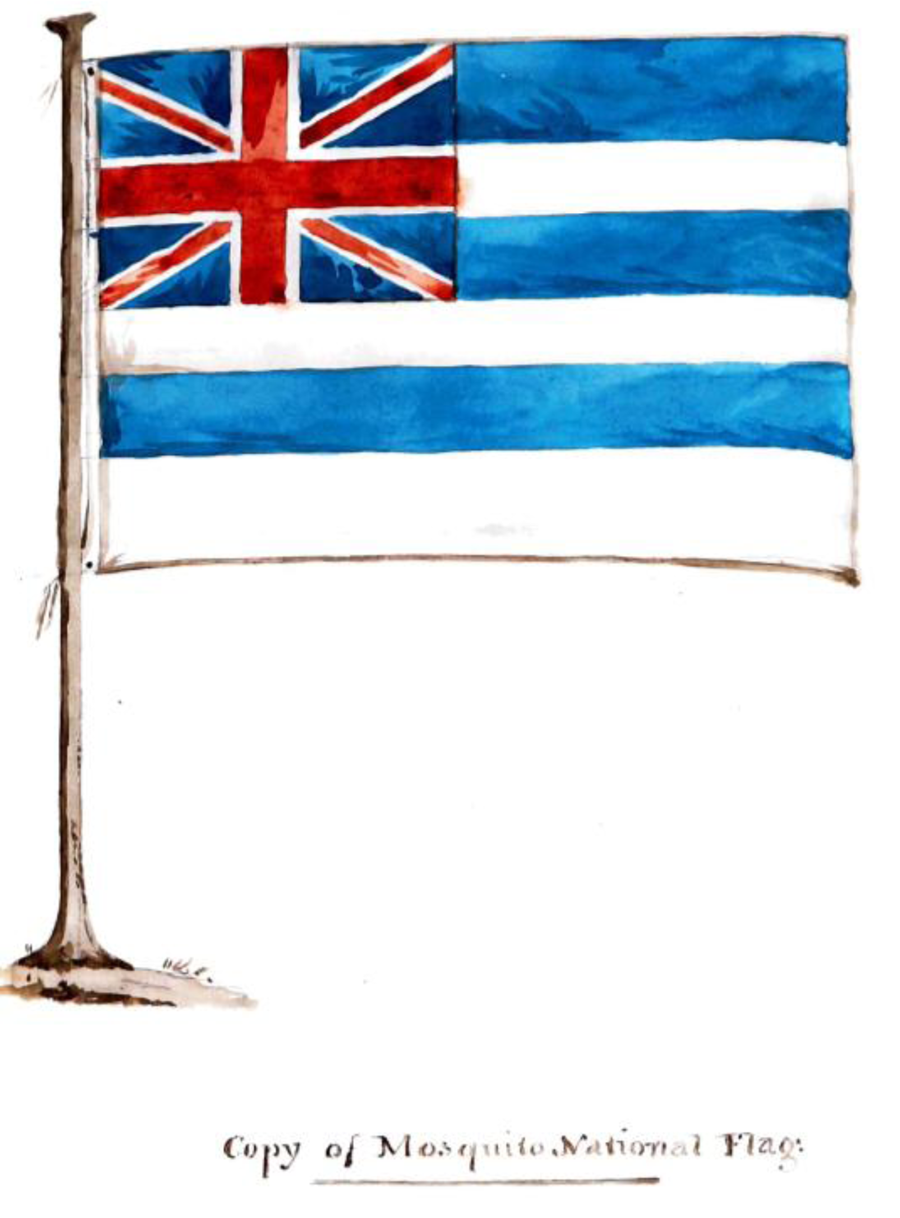
George Frederic also wanted to affirm the independence and very existence of his utopia more symbolically. In response to the rise of Colombian claims on the Shore, George Frederic informed the British authorities in Belize in March 1824 of his desire to give a visual identity to his kingdom through a new flag: six horizontal stripes alternating blue and white, and in the canton, a Union Jack (see Figure 2).Footnote 119 Expressing a desire to further strengthen a commercial alliance with British merchants established in the area, the king was with this flag clarifying his desire never to be confused with other Spanish American republics. According to Roberts, George Frederic made clear his wish to always remain the ruler of a soon-to-be independent country.Footnote 120 The animosity toward Colombia was reciprocal. Furious that George Frederic had hired former British mercenaries, Francisco de Paula Santander decreed on July 5, 1824, a ban on the organization and financing of colonial projects on the Shore.Footnote 121
George Frederic's Miskitu Flag. (Source: George Frederic to Codd, March 8, 1824, CO 123/35, The National Archives, Kew.)
Conclusion
This article set out to reveal the Central American, Caribbean, and Atlantic story of George Frederic's life. It has done so by bringing together and taking seriously into account a wide range of scattered sources produced by or mentioning the Miskitu king. The result is a portrait different from that provided by historians studying the Shore and its king, who is still too often accused of credulity by those who consider him only as a minor actor in an episode of foreign borrowing in the London foreign loan market. Not resulting from intoxication, George Frederic's policy of distributing grants of land to and hiring foreign mercenaries constituted an active, deliberate, and well-informed strategy for political reform and economic improvement of the Shore. Aimed at promoting centralization of his power as king, it was based on the commercial improvement and political independence of his subjects and territory, which, given his education, he understood as having the potential to play an important role in Caribbean and Atlantic trade. This was to be undertaken by British agents hired specifically to mobilize the foreign capital and labor needed to concretize George Frederic's political and commercial project. In other words, rather than being a minor or even nonexistent figure in these moments of Atlantic political and commercial transformation, George Frederic was the mastermind of a story of American Indigenous state-making, provided it is told from his perspective.
However, as this article has shown, George Frederic's first attempt at setting up a singular Miskitu economic and political utopia would fail and, in doing so, raise significant concerns. First, it became clear that foreign settlers working in Black River needed to be instructed to respect Miskitu and other non-European peoples. Indeed, as mentioned at the beginning of this article, a utopia could only be one if it resulted in “the greatest happiness for the greatest number” of the territory's population. Yet disdain for the Caribs and the Paya proved to be a significant factor in the rapid deterioration of the settlers’ on-site living conditions. Second, it proved necessary to supervise agents hired to promote the financial, political, and commercial aspects of the project from the Caribbean to the very heart of the City of London. MacGregor's enthusiasm for raising capital for the expansion of the Black River colony eventually forced George Frederic to intervene directly on the Shore, and indirectly in the English capital market by way of the press, to repudiate a poorly performing foreign loan. Finally, there were issues in London related to the perceived legitimacy of a Miskitu actor with utopian aspirations like those of South American revolutionaries. English critics of George Frederic's project argued that it was inconceivable that a Miskitu ruler could, of his own accord, consider using foreign funds and labor to implement political and economic reform in his kingdom.
Although he ultimately considered ways to better consolidate the institutional characteristics and recruitment processes related to the development of his project, George Frederic would never see his dream of utopia come true: his lifeless body would be found on a beach just days after the presentation of his flag. The reasons for George Frederic's death remained shady for some time. An investigation conducted by William Boggs (George Frederic's counselor) and other foreign merchants established at Cape Gracias a Dios would quickly conclude that the king had “drowned [himself] during a state of Intoxication.”Footnote 122 However, a historical inquiry (conducted by Karen Sorsby in 2001) notes that one Peter Lelacheur, a merchant and former privateering captain from Guernsey, had actually orchestrated George Frederic's assassination, on grounds that the Miskitu king, having learned his lesson from the failed collaboration with Gordon and MacGregor, had refused to allocate Lelacheur an important grant of land.Footnote 123 George Frederic's brother, Robert Charles Frederic, succeeded him, at first initiating a more conciliatory policy toward British Honduras. He was crowned at Belize in April 1824 during a ceremony for which the magistrates of British Honduras spent £1,000 (Jamaican currency) on entertainment and presents, “to maintain the great attachment of the Mosquito nation to the English.”Footnote 124 However, the resumption of his role as a cultural intermediary would not last: like his brother, Robert Charles Frederic would soon try to establish himself as a real head of state, notably by levying taxes and forbidding the enslavement of any more Indigenous peoples. By 1830, he would also commission a French private company to improve the Atlantic trade connections of the Shore and urbanize the seat of the Miskitu kingdom, Cape Gracias a Dios.Footnote 125
Shedding light on what constitutes a historiographical “blind spot,” this article has also (re)integrated this Miskitu king's story into the dynamic Central American, Caribbean, and Atlantic contexts of the first decades of the nineteenth century. Based on a particular and singular case study, this article has illustrated how one American Indigenous polity took an active part in early nineteenth-century processes of state formation. Although generally denied any form of agency beyond that of the Central American continent by the relevant historiography, George Frederic's interactions and encounters, whether in person or by proxy of his agents, with political, commercial, and financial dynamics were quite characteristic of the transformations taking place in Central America and the Caribbean, as well as over the Atlantic. Despite his never setting foot in England, the case of George Frederic reveals that British American and Atlantic commercial and, consequently, financial dynamics of the early nineteenth century could nonetheless be influenced by American Indigenous political and economic struggles and aspirations. The king's utopian ambitions resonated well beyond the Shore, having an impact in broader Central America as well as in the London money market itself. His actions were a source of commercial projects run by British merchants and mercenaries in Central America, beneficial to Caribbean and Atlantic trade. The Miskitu king's efforts would also originate a foreign loan floated on the London money market and be the indirect cause of its poor performance. Finally, George Frederic's strategy resulted in the emergence in London of processes of cultural delegitimization targeted against attempts to raise funds for this Miskitu project, which was described as whimsical.
Yet, in light of the effects of George Frederic's utopian aspirations not only on the Shore but across the Atlantic, this study of his life shows how American Indigenous peoples had an important and independent role to play in the financial and political entanglements of early nineteenth-century Atlantic dynamics of state-making. More importantly, it illuminates how the Miskitu constituted, during George Frederic's reign, a full-fledged state actor, equivalent to, if not in competition with, other utopian projects emerging from the collapse of the Spanish American empire. In the end, by considering the possibility of conceiving new utopias only for the descendants of settlers of the Spanish Ultramaria, Bentham may well have marked out the historical study of these financial and political transformations, thus confiscating multiple actors, including American Indigenous polities, from being fully acknowledged as actively and knowingly taking ownership of legitimate political and economic places in this Atlantic age of revolution.


 Open access

