


The atypical antipsychotics have equivalent efficacy to the older drugs but less neurological side-effects. This has led some to recommend atypical antipsychotics as first-line agents in schizophrenia, although this stance is controversial (Reference Geddes, Freemantle and HarrisonGeddes et al, 2000). Clozapine is uniquely effective in treatment-resistant schizophrenia (Reference Kane, Honifeld and SingerKane et al, 1988).
The National Service Framework for Mental Health (Department of Health, 1999) states that all patients have the right to receive the most effective treatment and further recommends that all patients should be assessed to see if they might benefit from the reduced neurological side-effects of the newer drugs.
In the UK, forensic psychiatrists provide care primarily for mentally disordered offenders, most of whom are referred through the criminal justice system. Although such patients may have lengthy hospital admissions, the majority are eventually cared for in the community.
Atypical antipsychotics are currently available only as oral formulations. This complicates their use in forensic settings where the potential consequences of non-compliance can be significant, both for the patient and for others. Both clozapine and risperidone have been used with some success in the special hospitals (Special Hospitals' Treatment Resistant Schizophrenia Research Group, 1996), but little is known about the use of these drugs by psychiatrists based in medium-secure settings or caring for community-based forensic patients.
We aimed to survey the views and practice of all consultant psychiatrists working in forensic settings in the UK.
Method
We designed a semi-structured questionnaire that explored prescribing patterns for in-patients and out-patients, in terms of factors influencing antipsychotic choice and strategies used to improve compliance. The questionnaire concluded with a section on prescribers' perceptions of the efficacy and tolerability of atypical antipsychotics. Some questions required yes/no answers, some asked for a mark to be made on a visual analogue scale and some allowed free text to be entered (a copy of the full questionnaire is available from the authors upon request). For the purposes of the survey, amisulpride, sulpiride, olanzapine, risperidone, quetiapine and zotepine were identified as atypical antipsychotics. Questions did not refer to clozapine unless it was mentioned specifically by name.
The questionnaire was given to six specialist registrars in forensic psychiatry at the Bracton Centre, as a pilot study, and amended following their comments. A list of forensic psychiatrists was obtained from The Forensic Directory (Rampton Hospital Social Work Department, 1999). This directory covers all levels of security and the private sector. Those doctors identified as locums, consultants in learning disability or any grade other than consultant were excluded. A total of 261 questionnaires were sent in a one-off mailing. No reminders were sent.
Questionnaires were anonymous, but subjects were invited to give their name so that one reply could be chosen at random to receive a £ 100 book token in appreciation of the time taken to respond. Data analysis was performed using SPSS for Windows, Version 9.
Results
A total of 156 (60%) questionnaires were returned. Twenty-two were not completed for a variety of reasons that mostly consisted of relocation of the post-holder or retirement. This left 134 (51%) completed questionnaires for analysis.
Respondents' clinical work was biased towards inpatient settings because 54 (40%) indicated that currently they did not have out-patient commitments. The views expressed by those respondents who provided care solely for in-patients did not differ significantly in any respect from their colleagues who also had responsibility for out-patients. The main findings are summarised in Box 1 and are described in more detail below.
Summary of forensic psychiatrists' views of atypical antipsychotics
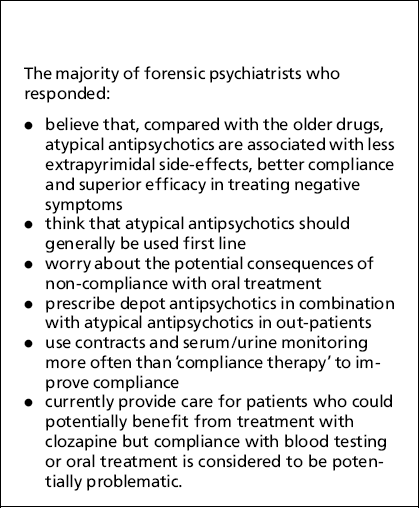
| The majority of forensic psychiatrists who responded: |
|
Prescribing for in-patients
The following factors were rated as having a strong influence on antipsychotic choice by the majority of respondents: patient's previous response to drug (93%), previous/current side-effects (87%), fear of future sideeffects, such as tardive dyskinesia (53%), and availability of intramuscular preparations (51%). Other factors rated as important by a small number of respondents included patient preference, availability of liquid preparations and the evidence base for the drug. Drug cost was of minimal significance to all but 6%.
Fifty-two per cent of respondents preferred atypical antipsychotics to typical drugs in patients with a history of, or potential for, significant violence when unwell; 56% in patients who were a self-harm/suicide risk; 42% in patients with comorbid substance misuse or comorbid antisocial perosnality disorder (44%); 48% in patients detained on restriction orders; and 21% in patients with a history of non-compliance. Ninety-four per cent of respondents worried about the potential consequences of non-compliance when atypical antipsychotics were prescribed as antipsychotic monotherapy and 92% stated that they would prescribe atypical antipsychotics more often if depot preparations were available.
Sixty-three per cent stated that they currently had in-patients eligible for treatment with clozapine who were not receiving the drug because of concerns about compliance (either with blood testing or oral treatment). Strategies used to increase compliance with oral medication included: patient attendance at illness awareness groups (63% of respondents) and compliance therapy (45%); a contract with the patient (56%); serum/urine monitoring (50%); and discussion regarding alternative treatments, usually depots (44%).
Prescribing for out-patients
Atypical antipsychotics were ‘always or sometimes’ prescribed in combination with depot antipsychotics by 66%. Strategies used to monitor compliance included serum level monitoring, supervised administration and keyworker reports.
Prescribers' perceptions of atypical antipsychotics
Atypical antipsychotics were perceived to be associated with less extrapyramidal side-effects (EPS) than the older drugs by 89%, less sexual dysfunction by 49%, less weight gain by 15% and better compliance by 69%. Superior efficacy in treating positive symptoms was highlighted by 24% and superior efficacy in treating negative symptoms by 70%. When asked whether atypical antipsychotics should be used as first-line in the general adult population, 60% believed that they should in the majority of cases and 33% responded ‘as often as not’.
Discussion
The majority of psychiatrists working in forensic settings think that atypical antipsychotics should be first-line drugs in patients with schizophrenia, and indeed prescribe them in this way for a large proportion of the patients that they treat. Many of these patients have comorbid personality disorder and/or problems with substance misuse, are likely to be subject to restriction orders and may pose a serious threat to others when unwell (Reference Anderson, Beer, Pereira and PatonAnderson, 2001). The primary concern of prescribers is to minimise the side-effects that patients currently experience and hopefully also reduce longer-term side-effects such as tardive dyskinesia. There is little doubt that the atypical antipsychotics are associated with less neurological side-effects than the older drugs, and if used as antipsychotic monotherapy then prescribers' aims would be realised in practice. Two-thirds of psychiatrists, however, said that they use atypical antipsychotics in combination with depot antipsychotics. This may be due to concerns over the potential consequences of non-compliance and the lack of current availability of atypical antipsychotics as long-acting injectable preparations. Prescribing surveys have shown the prevalence of typical/atypical co-prescribing to be high nationally (Reference Taylor, Mace and MirTaylor et al, 2000) and that patients receiving this combination require anticholinergic drugs as frequently as those receiving the older drugs alone (unpublished data from National Audit of Antipsychotic Prescribing, Royal College of Psychiatrists Research Unit; available from the author upon request). Combinations are, therefore, unlikely to be EPS sparing. Contrary to the belief of some respondents, atypical antipsychotics also are associated with more weight gain than the older drugs (Reference Taylor and McaskillTaylor & McAskill, 2000), potentially adding to the side-effect burden experienced by the patient.
Atypical antipsychotics, with the exception of clozapine, are not significantly more effective than the older drugs in the treatment of either positive or negative symptoms (Reference Geddes, Freemantle and HarrisonGeddes et al, 2000) and there is no objective evidence to support improved outcomes with antipsychotic polypharmacy. Symptomatic improvement and reductions in violence (Special Hospitals' Treatment Resistant Schizophrenia Research Group, 1996) are most likely with clozapine. The majority of respondents stated that they currently had in-patients who were eligible for clozapine treatment but were not receiving it due to perceived problems with compliance. The issues around treating non-compliant patients with clozapine against their will are complex (a full discussion can be found in Reference Pereira, Beer and PatonPereira et al, 1999), but it could be argued that more patients in forensic settings should receive this drug.
It has not been proven that compliance with atypicals per se is better than with the older drugs, but evidence to support the positive effects of psycho-education is mounting (Reference Pekkala and MerinderPekkala & Merinder, 2000). Compliance also can be measured directly for the most commonly prescribed atypical antipsychotics (olanzapine, risperidone and clozapine) by serum-level monitoring. These approaches are not used widely, with many respondents relying on less-reliable methods such as supervised administration and keyworker reports (poor reliability is discussed by Reference Young, Spitz and HillbrandYoung et al, 1999).
In conclusion, psychiatrists working in forensic settings tend to overestimate the benefits and under-estimate the side-effects of atypical antipsychotics. They frequently prescribe atypical antipsychotics in combination with depots. Available strategies are not always used to optimise compliance.
Acknowledgements
The authors would like to thank all of the consultant psychiatrists who gave their time to complete the questionnaire.


 Open access


eLetters
No eLetters have been published for this article.