

Introduction
Half of mental health disorders develop by the age of 14 years old (Kessler et al., Reference Kessler, Berglund, Demler, Jin, Merikangas and Walters2005) and around 18% of children and 22% of young people are living with a mental health condition in the UK (Newlove-Delgado et al., Reference Newlove-Delgado, Marcheselli, Williams, Mandalia, Davis, McManus, Savic, Treloar and Ford2022). This said, only a small percentage of children and young people in need receive evidence-based psychological interventions (Reardon et al., Reference Reardon, Harvey and Creswell2020). Low-intensity CBT can help to bridge the demand–capacity gap. Low-intensity CBT has been defined as utilising self-help materials, with six hours or less of contact time, with each contact typically 30 minutes or less, where input can be provided by trained practitioners or supporters (Shafran et al., Reference Shafran, Myles-Hooton, Bennett and Öst2021). It is recommended by the National Institute for Health and Clinical Excellence (NICE) as a first-line treatment for common mental health disorders in adults and young people.
In 2007, the UK government launched Improving Access to Psychological Therapies (IAPT) (now known as Talking Therapies) in line with recommendations from NICE (Department of Health, 2018). A new workforce of practitioners was trained to deliver low-intensity CBT interventions to adults, and specific training was later launched for practitioners working with children and young people in 2017. Low-intensity psychological interventions are a central part of Talking Therapies and practitioners follow a national curriculum that is taught by university courses, which includes techniques that are contained within NICE-recommended treatments such as graded exposure for anxiety disorders and behavioural activation for low mood (e.g. Higher Education England, n.d.; NHS England, Reference NHS2023). Some materials are freely available, whereas others are not (e.g. cost money, require passwords or only available in specific locations). Talking Therapies training courses have also developed and taught interventions for areas where there are evidence gaps. Together, this has resulted in variation in the interventions and materials used by the low-intensity workforce in the UK and lack of standardisation.
A recent special issue of tCBT (2023) raised important questions about the use of low-intensity CBT in routine clinical practice (Lockhart, Reference Lockhart, Jones and Sopp2021) as well as the need to ensure that free to use and accessible guided self-help materials are available and evidence-based (Farrand et al., Reference Farrand, Dawes, Doughty, Phull, Saines, Winter and Roth2022). Frameworks have been developed to help provide guidance to practitioners on the use of certain materials (e.g. Baguley et al., Reference Baguley, Farrand, Hope, Leibowitz, Lovell, Lucock, O’Neill, Paxton, Pilling and Richards2010; Farrand et al., Reference Farrand, Dawes, Doughty, Phull, Saines, Winter and Roth2022). However, at present, these only include interventions for adults delivered by Psychological Wellbeing Practitioners (PWPs). Children’s Wellbeing Practitioner (CWP) and Education Mental Health Practitioner (EMHP) roles were created at a later date to deliver low-intensity CBT interventions for children and young people with mental health difficulties (Fonagy et al., Reference Fonagy, Pugh and O’Herlihy2017). To our knowledge, no framework yet exists to guide this workforce and it is currently not known which low-intensity psychological interventions are provided in routine clinical practice or the empirical support underlying them. Such information is essential to ensure optimal quality of care and equality of access to empirically supported interventions.
The aims of this paper are (1) to explore the current implementation of low-intensity psychological interventions used in routine practice for children and young people across the UK and (2) to support the implementation of evidence-based low-intensity CBT in clinical practice by providing information on (a) the availability and (b) strength of empirical support for low-intensity CBT interventions for children and young people with anxiety, depression and behavioural difficulties.
Study 1
Given there are a wide range of potential treatments and guided self-help materials that can be used as low-intensity psychological interventions for children and young people (Lewis and Simons, Reference Lewis and Simons2011), it is helpful to understand which ones are being used in routine clinical practice. The study aimed to understand and characterise the low-intensity psychological interventions for children and young people that are currently being delivered by practitioners across the UK.
Study 1: Method
Participants
Practitioners delivering low-intensity psychological interventions and guided self-help to children, young people and families in the UK were invited to complete an online questionnaire.
A questionnaire based on a previous survey of interventions given by psychological services in a paediatric hospital during the pandemic (Ching et al., Reference Ching, Bennett, Heyman, Liang, Catanzano, Fifield, Berger, Gray, Hewson and Bryon2022) was developed by the research team and clinical team leads through iterative discussion. The anonymous online questionnaire included structured and open-ended questions that were used to gather rich insight into respondents’ diverse perspectives and experiences of providing low-intensity interventions to children and young people. The final version was hosted on Redcap (see Appendix A in the Supplementary material).
The questionnaire collected demographic information about where participants worked, their profession and speciality. The next section used a branching structure where respondents were first asked whether they delivered any brief or low-intensity interventions (and were given the example of guided self-help books or a single psychoeducation session) and then given space to describe the intervention in an open text box. Prompts were included, asking respondents who the intervention(s) are for, their aim, who delivers them, if they are based on any manual or protocol, and how often they are delivered. There were then tick boxes for respondents to indicate who the intervention was for, what the intervention was for, who delivered the intervention, how the sessions were delivered, how many sessions in total, how often the intervention was delivered and the length of sessions. For all questions, more information could be provided in open text boxes and there was space to describe multiple interventions. The final section of the survey asked about outcome measures. Participants were asked whether they used standardised outcomes measures, to list the measures commonly used, when they were administered and space was given to provide more information in an open-text box.
Procedure
A flyer was designed and sent out to promote the study which linked potential participants to the online questionnaire. The flyer and questionnaire were shared between 1 February and 31 March 2023 with relevant online networks and newsletters (The Psychological Professions Network, BABCP Low-Intensity Special Interest Group, British Psychological Society, Paediatric Psychology Network) and shared on social media (Facebook Groups, LinkedIn, Twitter).
Data analysis
Descriptive and frequency statistics were calculated for the responses.
Study 1: Results
Participant characteristics
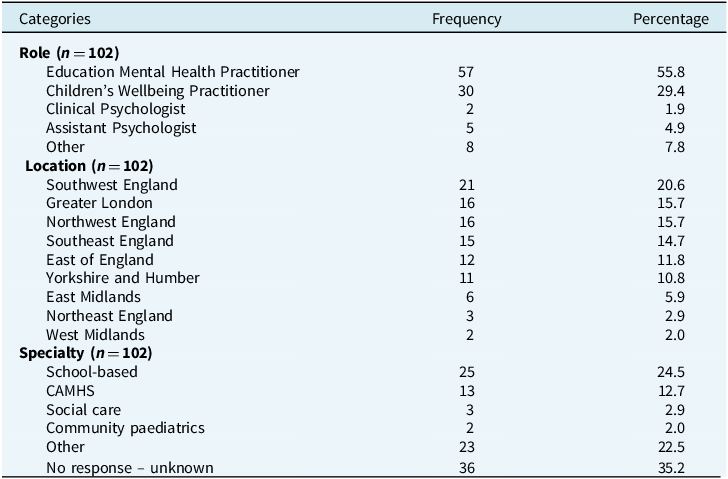
The questionnaire was completed by 102 participants and the characteristics of the respondents are shown in Table 1; 55.8% of respondents were EMHPs and CWPs. Roles categorised as ‘other’ included: Associate Psychological Practitioner, CWP Managers and Systemic Practitioners, High-Intensity CBT Therapist (HICBT) for children and young people and CWP Supervisor, Child and Adolescent Psychotherapist, Trainee Family Therapist and EMHP Supervisor. The majority of respondents left their specialty blank or indicated their speciality to be ‘low-intensity CBT’ or ‘early intervention’ which is denoted by the ‘other’ category. The majority of respondents worked in schools or CAMHS.
Participant characteristics
Intervention delivery and use of routine outcome measures
Respondents reported on the interventions they delivered and the use of routine outcome measures. Data are presented in Table 2 on the recipient of the intervention and which mental health difficulty the intervention targets.
Intervention delivery and routine outcome measures
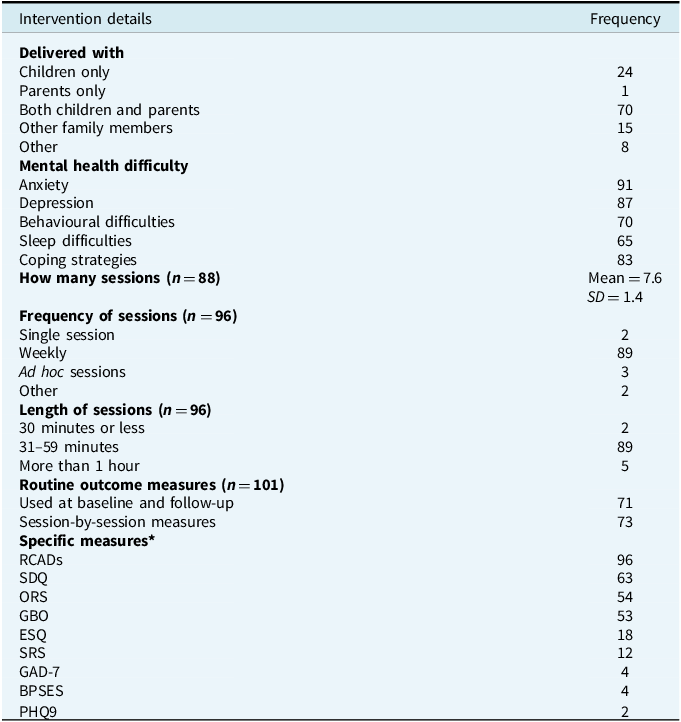
* This table reports on routine outcome measures mentioned by one or more participant.
RCADs, Revised Children’s Anxiety and Depression Scale; SDQ, Strengths and Difficulties Questionnaire; ORS, Outcome Rating Scale; GBO, goals-based outcomes; ESQ, Experience of Service Questionnaire; SRS, Session Rating Scale; GAD-7, Generalised Anxiety Disorder Questionnaire; BPSES, Brief Parental Self Efficacy Scale; PHQ-9, Patient Health Questionnaire.
Interventions for primary school aged children were often delivered to parents or carers in line with NICE recommendations (parent-led low-intensity CBT). Of the ‘other’ respondents, who specified that they did not deliver the intervention with children, young people or their parents directly, it was often indicated that interventions were delivered to school staff and/or the whole school.
Most interventions were delivered weekly, with only a small percentage of respondents using single-session interventions. Most sessions lasted between 31 and 59 minutes and interventions had an average of 7.6 sessions.
All respondents except one (101/102) indicated that they used routine outcome measures. These were used during the first and last session for 70% of respondents, and session-by-session measures used for 72% of the sample. The most commonly reported outcome measures were the Revised Children’s Anxiety and Depression Scale (RCADS), which was used by 94% of respondents, the Strengths and Difficulties Questionnaire (SDQ) used by 62% of sample, goal-based outcomes (GBOs) used by 52% and the Child Outcome Rating Scale (CORS), used by 53%. Other examples included specific symptom trackers such as the Generalised Anxiety Disorder Questionnaire (GAD-7) and Patient Health Questionnaire (PHQ-9). The Experience of Service Questionnaire was used by 18% of respondents.
Materials used
When asked to describe the intervention, respondents provided titles of 21 materials used (see Table 3).
Materials used
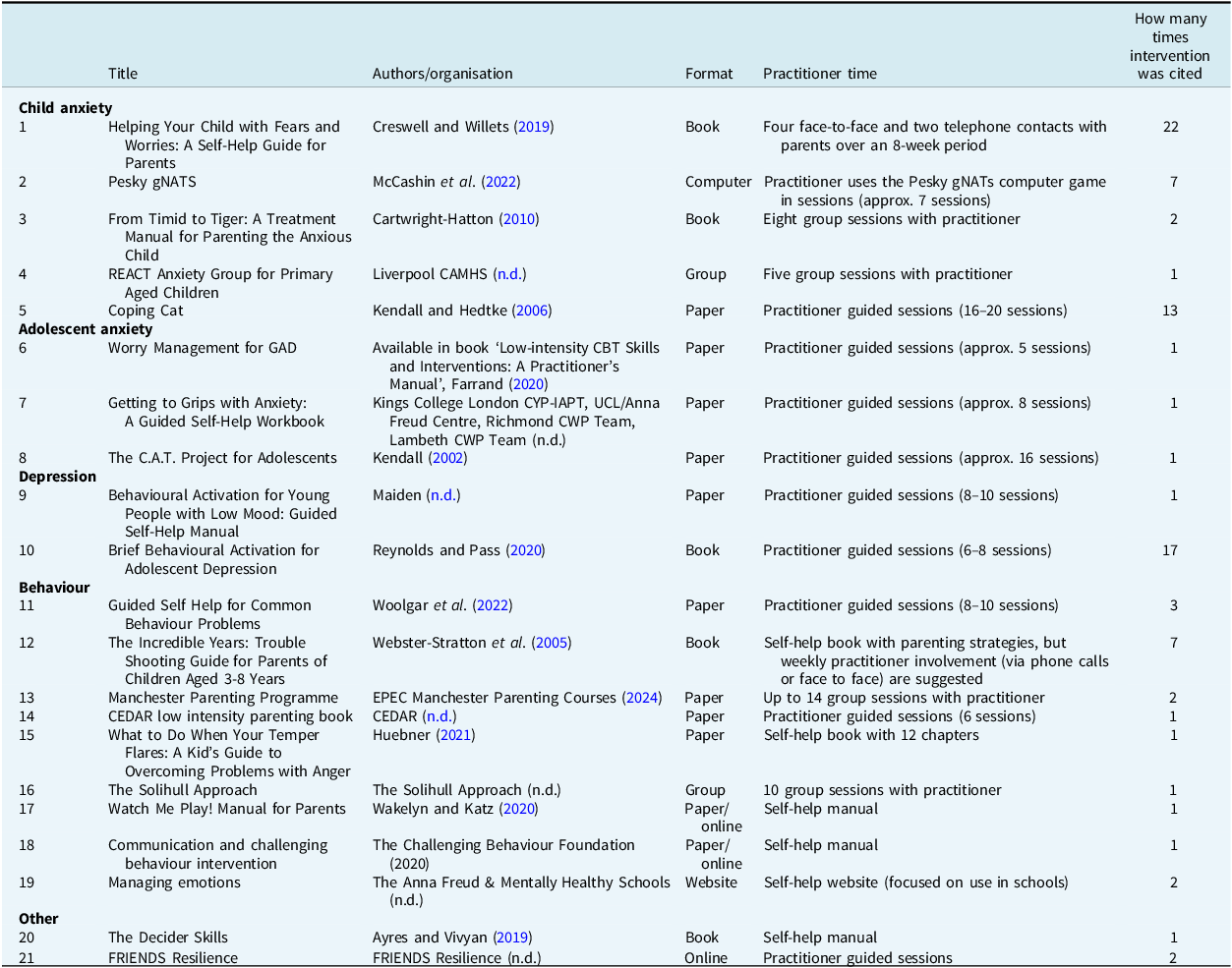
The majority of interventions named were for behavioural difficulties (n=9), followed by anxiety (n=8), depression (n=2) and other (n=2). Some respondents also listed specific techniques used such as graded exposure, thought challenging and psychoeducation. Although 65 respondents indicated that they delivered interventions for sleep difficulties, no specific manuals or techniques were specified, and it is not known if the interventions specifically targeted sleep. Similarly, 83 respondents delivered interventions for ‘coping difficulties’, but it was not possible to ascertain which interventions were delivered and whether they were targeting coping.
Study 1: Discussion
The survey highlights the wide variation of low-intensity psychological interventions and guided self-help materials that are currently being delivered in practice by low-intensity practitioners to children and young people with anxiety, depression and behavioural difficulties in the UK.
There are likely to be several reasons why there is such a wide range of interventions being offered and variation between what practitioners deliver. This may be because the national curricula for the practitioners do not specify the use of specific manuals or materials. For example, the EMHP curriculum aims are general, focusing on ‘acquiring knowledge and skills in low-intensity interventions for children, young people and family systems experiencing anxiety, depression and behavioural difficulties, based on the most up to date evidence’ (p. 13, Higher Education England, n.d.), but do not dictate the use of specific guided self-help materials. This allows universities to choose different materials and manuals for each presenting difficulty, resulting in differences between what practitioners learn across the UK. Such differences allow for fidelity with flexibility to the local services which is central to successful implementation of interventions (Kendall et al., Reference Kendall, Gosch, Furr and Sood2008). This study focused on titled manuals and protocols, rather than specific skills or techniques used as it was not possible to ascertain how skills are being delivered amongst different professionals.
In addition, some existing and widely used evidence-based materials do not meet the recent definition of low-intensity CBT (Shafran et al., Reference Shafran, Myles-Hooton, Bennett and Öst2021). For example, ‘Coping Cat’ is a 16-session intervention lasting for 50 minutes (Kendall and Hedtke, Reference Kendall and Hedtke2006), and Webster-Stratton’s Incredible Years programme can last up to 22 sessions although variants of these interventions do exist which are briefer (e.g. Reedtz et al., Reference Reedtz, Handegård and Mørch2011) or computer-assisted (Khanna and Kendall, Reference Khanna and Kendall2008; Khanna and Kendall, Reference Khanna and Kendall2010) and may be the ones being used in practice to provide a low-intensity treatment.
Finally, it is highly encouraging that so many practitioners used outcome measures, although this paper does not focus on their frequency (e.g. session-by-session measurement). Using outcome measures has been shown to improve patient outcomes and described as ‘essential’ to implementing evidence-based practice (Boswell, Reference Boswell, Kraus, Miller and Lambert2015); session-by-session feedback is also strongly supported by empirical data from adult research (Delgadillo et al., Reference Delgadillo, de Jong, Lucock, Lutz, Rubel, Gilbody and McMillan2018). The finding that their use in this sample was nearly universal indicates that they are feasible and being implemented in routine low-intensity psychological treatment.
Conclusion
This study identified and characterised the specific interventions and techniques currently delivered by practitioners across the UK. There are a number of reasons why this variation may exist, but further empirical support for some of the low-intensity psychological interventions and guided self-help materials currently in use is needed. It is also possible that practitioners are not clear on which interventions are easily available and have also been fully and rigorously evaluated in randomised controlled trials and which have not, since such information is lacking.
Study 2:
The first study highlighted the wide range of low-intensity psychological interventions that are offered to children and young people with mental health difficulties. One reason for the wide range is the potential variation in resources among services as some interventions may have a cost implication and require technological resources. Another is that there is a lack of information for practitioners about the evidence base for the interventions. Some of the specific manuals taught on training courses are evidence-informed rather than evidence-based due to a gap in the current research.
This second study aims to establish (a) the availability and (b) strength of empirical support for low-intensity CBT for children and young people with anxiety, depression and behavioural difficulties. This study was restricted to CBT interventions rather than other low-intensity psychological interventions as CBT interventions are the ones with the strongest empirical support (Horrocks, Reference Horrocks2023).
Study 2: Method
Materials
A comprehensive list of efficacious low-intensity CBT interventions for children and young people was compiled from a range of relevant sources. This included recent systemic reviews on guided self-help and low-intensity CBT interventions (Bennett et al., Reference Bennett, Cuijpers, Ebert, McKenzie Smith, Coughtrey, Heyman, Manzotti and Shafran2019; Roach et al., Reference Roach, Cullinan, Shafran, Heyman and Bennett2023) and updated searches, treatments described in a recently published book on brief and low-intensity interventions for children and young people (Bennett et al., Reference Bennett, Myles-Hooton, Schleider and Shafran2022), interventions described for anxiety, low mood or behaviour problems in the survey responses from Study 1, and interventions used as part of low-intensity practitioner programmes in London that are freely available to access online (https://manuals.annafreud.org).
Procedure
Interventions were categorised by primary symptom (child anxiety, adolescent anxiety, adolescent depression or child behavioural difficulties), and whether there is randomised control trial (RCT) evidence available supporting the efficacy of the intervention.
It was also noted whether there were any restrictions to access the interventions: location, website or intervention defunct or insufficient information. Location refers to when the intervention was only available in a specific country or language and ‘website or intervention defunct’ is when the manual or website were no longer available. Insufficient information was denoted when only brief descriptions of the intervention were presented in research papers rather than a manual or session plan, and would not be sufficient for a practitioner to use. Interventions were considered inaccessible if they met one or more of these three conditions. In addition, the cost of the intervention has been presented (all information is available in Appendix B of the Supplementary material).
Following the principles of the hierarchy of evidence (Murad et al., Reference Murad, Asi, Alsawas and Alahdab2016), the interventions were provisionally rated using a scoring system of gold, silver or bronze to represent the evidence base of each low-intensity intervention (Table 4). Two researchers (A.R. and I.S.) independently ranked all interventions using the below definitions. Where this was unclear a discussion took place with a clinical supervisor (S.B.) and consensus was reached on the categorisation of all included interventions. When interventions were tested in multiple research studies (e.g. a feasibility study and then an RCT), the results from the study with the highest level of evidence (e.g. RCT) was used for the ranking. If RCT evidence suggested an intervention was not efficacious, it was not included in the table.
Ranking criteria for LICBT interventions

Study 2: Results
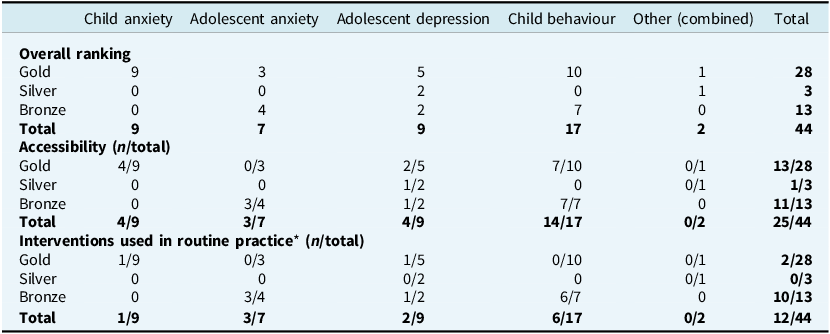
In total, 44 low-intensity CBT interventions for child and adolescent anxiety, adolescent depression and child behavioural difficulties were identified and ranked gold, silver or bronze. Results are displayed in Table 5 and a full table with more information on each intervention is available in Appendix B of the Supplementary material. Behavioural difficulties had the most ‘gold’ and total interventions.
Intervention ranking and accessibility
* Named in survey from Study 1.
Of the 44 interventions identified, 28 had been evaluated in an RCT, deemed effective and rated ‘gold’. Of the 28 gold-rated interventions, 13 were accessible to practitioners. This included four child anxiety treatments (Creswell and Willetts, Reference Creswell and Willetts2019; Kendall and Khanna, Reference Kendall and Khanna2008; Morgan et al., Reference Morgan, Rapee and Bayer2016; Rapee et al., Reference Rapee, Spence, Cobham and Wignall2000), two adolescent depression interventions (Burns and Beck, Reference Burns and Beck1999; Grudin et al., Reference Grudin, Ahlen, Mataix-Cols, Lenhard, Henje, Månsson, Sahlin, Beckman, Serlachius and Vigerland2022) and seven child behavioural difficulties interventions (Forehand et al., Reference Forehand, Merchant, Long and Garai2010; Irvine et al., Reference Irvine, Gelatt, Hammond and Seeley2015; Markie-Dadds and Sanders, Reference Markie-Dadds and Sanders2006; Morawska et al., Reference Morawska, Tometzki and Sanders2014; PCIT, 2023; PCIT, n.d.; Turner and Sanders, Reference Turner and Sanders2013). There were no gold-rated accessible interventions for adolescent anxiety.
Only two out of the 28 gold-rated interventions were named as being used in routine practice by practitioners in the survey from Study 1. This included one of the accessible child anxiety interventions (Creswell and Willetts, Reference Creswell and Willetts2019) and one for adolescent depression (Grudin et al., Reference Grudin, Ahlen, Mataix-Cols, Lenhard, Henje, Månsson, Sahlin, Beckman, Serlachius and Vigerland2022). There were no gold-rated adolescent anxiety or child behaviour difficulties interventions identified as being used in routine practice Most interventions used by practitioners in routine practice were deemed ‘bronze’ (n=10).
Of the 44 total interventions, only 25 were accessible to practitioners to use with children, young people and families with interventions not accessible due to location restrictions (n=8), website or intervention now defunct (n=6), or insufficient information available to deliver the intervention (n=8). Some interventions were inaccessible for multiple reasons and this is noted in Appendix B of the Supplementary material.
Conclusion
In summary, 44 low-intensity CBT interventions for child and adolescent anxiety, adolescent depression and child behavioural difficulties were identified. Of these, 28 (64%) were rated as gold. This suggests that high-quality empirically tested low-intensity CBT interventions do exist. However, there is a research–practice gap. Of these 28 interventions, 13 are accessible to practitioners to use (46%). Furthermore, taken together with the results of the survey in Study 1, only two gold-rated interventions were reported as being used in routine practice (one child anxiety, and one child behaviour intervention). Instead, the majority of interventions named as used in practice by practitioners were rated bronze. This highlights a gap between research and evidence-based practice that could be addressed relatively speedily by researchers, increasing the accessibility and reducing the cost of the interventions rated as gold.
Study 2: Discussion
The first study found a wide variability in the low-intensity psychological interventions and guided self-help materials offered to children, young people and families by practitioners across the UK. The second study reported that ‘gold’ standard low-intensity CBT interventions for children and young people with anxiety, depression and behavioural difficulties do exist, but many are difficult to access resulting in a research–practice gap. Furthermore, although they are drawn from longer evidence-based CBT treatments, none of the accessible anxiety interventions was found to be empirically tested with adolescents despite adolescent anxiety being one of the most common referrals to child and adolescent mental health services (Gibbons et al., Reference Gibbons, Harrison and Stallard2021; Hansen et al., Reference Hansen, Christoffersen, Telléus and Lauritsen2021) and evidence that adolescents respond favourably to CBT (Kendall and Peterman, Reference Kendall and Peterman2015).
There are multiple reasons practitioners may not be using interventions that have ‘gold’ rated empirical support, including researchers often failing to follow rigorous RCTs with implementation studies to optimise their use in clinical practice. In addition, lack of access to funding and resources within children’s mental health services means that there are not excess resources for organisations to pay for intervention manuals or specific training programmes (Peters-Corbett et al., Reference Peters-Corbett, Parke, Bear and Clarke2023). It is well documented that mental health services have not been well invested in, and increases in funding have often been attached to specific interventions or trialling new programmes, which has left core frontline services without necessary investment (The King’s Fund, 2019). Within the UK, prior to the pandemic, less than 1% of national funding went to children’s mental health services (Lennon, Reference Lennon2021). Cost to services remains one of the largest barriers to the implementation of interventions across healthcare settings (Peters-Corbett et al., Reference Peters-Corbett, Parke, Bear and Clarke2023).
This study found variation in costs of interventions from free to over £1700 for training. There are expectations that physical healthcare costs are not free of charge, and positive attitudes towards the principle of paying towards prescriptions more generally for physical health conditions (Schafheutle, Reference Schafheutle2008). It is unclear if there is an expectation that mental health treatment should be free, despite general acceptance for means tested prescription fees, and the principle of parity of esteem between physical and mental health care (Mitchell et al., Reference Mitchell, Hardy and Shiers2017). Furthermore, inequalities in access to health care occur for a huge variety of reasons of which economic ones are only part of the issue.
There were also accessibility issues due to location restrictions, for example interventions that were only available in certain countries or languages. Seven gold-rated interventions are not freely available in the UK. Many low-intensity interventions with ‘gold standard’ RCT evidence have been developed and tested in Australia and New Zealand, where low-intensity CBT has long since been recognised, delivered and evaluated (e.g. New Access, MindStep and Orygen Research Institute). The reasons for such geographical disparity in access is unclear. As well as language, it is important to highlight the paucity of research with CYP and families from different cultures and communities, meaning it is not clear the extent to which these ‘evidence-based’ interventions are culturally relevant or sensitive to many of the UK population. As these interventions are developed for children and young people with mental health difficulties, potential risk must be acknowledged about having the materials freely available on a website without sufficient accompanying training or monitoring that they will be implemented with fidelity. Therefore, researchers may not want their intervention to be used without closer control. Furthermore, research evidence may sometimes be solely available in academic journals, which practitioners may find challenging to access.
A large proportion of interventions used in routine practice by practitioners were rated ‘bronze’. It may be that bronze-rated interventions are easier to access than some of the gold ones, due to gold interventions often taking a longer time to develop, using more sophisticated technology such as websites which can require regular maintenance, having had more initial investment in their development and facing issues of intellectual property. Conversely, clinicians may be creating their own manuals, quickly, without significant investment in a randomised controlled trial with the primary purpose of sharing expertise and without significant concerns about intellectual property. It would be useful to empirically test these interventions to understand the clinical effectiveness and to provide ‘practice-based’ evidence, especially as there is sparse research into the clinical outcomes of low-intensity practitioner teams (Lockhart, Reference Lockhart, Jones and Sopp2021). However, it is important to highlight both the difficulty, and time commitment, in obtaining funding for such research, in particular large-scale randomised control trials of mental health interventions.
Finally, it is important to highlight the wider debate in mental health services and research regarding manualised interventions. Typically, research trials that form the evidence base have manuals or protocols. NICE guidance suggests that ‘psychological and psychosocial interventions should be based on the relevant treatment manual(s), which should guide the structure and duration of the intervention’ (National Institute for Health and Care Excellence, 2022; p. 113). A multi-level meta-analysis of 52 studies found that evidence-based youth psychotherapies, based on manuals, outperform usual care which is less likely to utilise manuals (Weisz et al., Reference Weisz, Kuppens, Eckshtain, Ugueto, Hawley and Jensen-Doss2013) although the question of the benefit of manuals is still debated (e.g. Truijens et al., Reference Truijens, Zühlke-van Hulzen and Vanheule2019). The provision of manuals, however, facilitates standardisation of care and therefore can reduce inequalities in the provision and access to care.
Study 2: Limitations
Although there was an encouraging response to the national survey (n=102), the responses may not be a representative sample of the thousands of low-intensity CBT practitioners that have been trained and are working in the UK; thus this was a convenience sample. Responses were largely from the South of England and over-represented by EMHPs. This may have been reflected by the way the survey was shared with specific groups. Additionally, it may be that individuals did not complete the survey as they do not recognise or acknowledge that they deliver low-intensity interventions.
A full systematic review of the literature on low-intensity interventions for common mental health disorders was not conducted, but instead the study relied on previous reviews (e.g. Bennett et al., Reference Bennett, Cuijpers, Ebert, McKenzie Smith, Coughtrey, Heyman, Manzotti and Shafran2019) and other sources. It is possible that some interventions were therefore overlooked, for example those designed for specific phobias (Wright et al., Reference Wright, Tindall, Scott, Lee, Cooper, Biggs and Marshall2023). It is also likely that there are low-intensity interventions that children’s mental health services and practitioners have developed themselves that are not available to access via the internet. Additionally, it is noteworthy that the interventions did not include those that are aimed at non-clinical samples such as those of Schleider and colleagues (Schleider et al., Reference Schleider, Dobias, Sung, Mumper and Mullarkey2020).
We acknowledge that the system used for determining the ‘gold’, ‘silver’ and ‘bronze’ categories were somewhat arbitrary and other systems have developed for the classification of high-intensity interventions (Anna Freud Centre, 2023) or practice elements (Blue Menu of Evidence-Based Interventions, 2015). However, the classification was based on the hierarchy of evidence (Murad et al., Reference Murad, Asi, Alsawas and Alahdab2016) and the relative lack of research in the area of low-intensity interventions. This meant that the threshold for interventions to be ranked silver was low: studies only had to be shown to reduce symptoms in any research study. This meant that interventions from a single case study which showed a positive impact, were categorised as silver (e.g. Borschuk et al., Reference Borschuk, Jones, Parker and Crewe2015). Furthermore, such categorisation did not allow for nuances in the literature. For example, a recent RCT found that Pesky gNATs (an intervention indicated in Survey 1 that is used in practice), was not effective in providing clinically significant levels of change when compared with a waitlist control group (McCashin et al., Reference McCashin, Coyle and O’Reilly2022), despite the initial feasibility study suggesting potential effectiveness (Chapman et al., Reference Chapman, Loades, O’Reilly, Coyle, Patterson and Salkovskis2016). This intervention was therefore not included in the list of interventions in Appendix B of the Supplementary material. Other interventions, in particular group interventions, were difficult to categorise at times. This was particularly true for the Incredible Years programmes; however, given that these interventions were typically not led by the materials and did not involve paraprofessionals, they were not deemed to be low-intensity but instead considered as brief interventions (Shafran et al., Reference Shafran, Myles-Hooton, Bennett and Öst2021).
Overall conclusion
This study has highlighted the research–practice gap for low-intensity psychological interventions for children and young people. It is hoped that by identifying the interventions with the strongest evidence base and their accessibility, that practitioners and educators will be in a better position to provide interventions and focus on training practitioners to implement them effectively. However, it is also clear that there are many barriers to the implementation of the interventions and a need to fill evidence gaps. In addition, there is a paucity of research on the use of these low-intensity interventions with the different cultures and communities that live in the UK. We hope this paper is a first step in identifying available low-intensity, evidence-based resources for children and young people that practitioners and young people akin to the available resource for high-intensity interventions (Anna Freud Centre, 2023) and classification of evidence for specific techniques (Blue Menu of Evidence-Based Interventions, 2015). Such resources will hopefully serve to genuinely improve access to evidence-based psychological therapies delivered by the low-intensity workforce and improve clinical outcomes.
Supplementary material
The supplementary material for this article can be found at https://doi.org/10.1017/S1352465824000390
Data availability statement
Data are available on request from the authors.
Acknowledgements
None.
Author Contributions
Anna Roach: Conceptualization (equal), Data curation (lead), Formal analysis (lead), Investigation (equal), Methodology (equal), Project administration (equal), Writing - original draft (lead), Writing - review & editing (equal); Isabella Stokes: Formal analysis (equal), Investigation (equal), Methodology (equal), Writing - original draft (equal), Writing - review & editing (equal); Katie McDonnell: Investigation (supporting), Methodology (supporting), Supervision (lead), Writing - review & editing (equal); Helen Griffiths: Investigation (equal), Methodology (equal), Writing - review & editing (equal); Vicki Curry: Investigation (equal), Methodology (equal), Writing - review & editing (equal); Isobel Heyman: Investigation (equal), Methodology (equal), Writing - review & editing (equal); Sonia Balakrishnan: Formal analysis (supporting), Investigation (equal), Methodology (equal), Writing - review & editing (equal); Xhorxhina Ndoci: Formal analysis (supporting), Investigation (equal), Methodology (equal), Writing - review & editing (equal); Sophie Bennett: Conceptualization (equal), Funding acquisition (equal), Investigation (equal), Methodology (equal), Supervision (equal), Writing - review & editing (equal); Roz Shafran: Conceptualization (equal), Funding acquisition (equal), Investigation (equal), Methodology (equal), Supervision (equal), Writing - review & editing (equal).
Financial support
This work was supported by the Beryl Alexander Charity and Great Ormond Street Hospital Children’s Charity (Project grant number: 16HN11). All research at Great Ormond Street Hospital NHS Foundation Trust and UCL Great Ormond Street Institute of Child Health is made possible by the NIHR Great Ormond Street Hospital Biomedical Research Centre. The views expressed are those of the author(s) and not necessarily those of the NHS, the NIHR or the Department of Health.
Competing interests
Sophie Bennett and Roz Shafran receive royalties from the Oxford Guide to Brief and Low-intensity Interventions for Children and Young People mentioned in this paper (Bennett et al., Reference Bennett, Myles-Hooton, Schleider and Shafran2022). The remaining authors have no potential competing interests.
Ethical standards
All authors have abided by the Ethical Principles of Psychologists and Code of Conduct as set out by the BABCP and BPS. Ethics approval for this study was granted by UCL Research Ethics Service (Project ID: 22875/001). All responses to the survey were anonymous and survey responses did not collect any personally identifiable information.


 Open access


Comments
No Comments have been published for this article.