





Introduction
Previous studies have linked many aspects to second language (L2) learning—such as age of onset, amount of exposure, and motivation—to the proficiency level eventually achieved in the target language (Blom & Bosma, Reference Blom and Bosma2016; Moskovsky et al., Reference Moskovsky, Assulaimani, Racheva and Harkins2016; Noels et al., Reference Noels, Pelletier, Clément and Vallerand2003). Interestingly, a portion of the variance in L2 proficiency is explained by learners’ musical ability (Slevc & Miyake, Reference Slevc and Miyake2006), which is not a characteristic commonly associated with language learning. However, this association may not be surprising for two main reasons. First, detecting and producing auditory cues—like pitch height, duration, intensity, pauses, and other temporal patterns—is both a musical skill, as well as one that is required for intonation, lexical stress and tones (Alexander et al., Reference Alexander, Wong and Bradlow2005; Bhatara et al., Reference Bhatara, Henny Yeung and Nazzi2015; Cohrdes et al., Reference Cohrdes, Grolig and Schroeder2016; Hausen et al., Reference Hausen, Torppa, Salmela, Vainio and Särkämö2013; Kolinsky et al., Reference Kolinsky, Cuvelier, Goetry, Peretz and Morais2009; Marques et al., Reference Marques, Moreno, Castro and Besson2007; Reference Morrill, Mcauley, Dilley and HambrickMorrill et al.; Nakata, Reference Nakata2002; Perrachione et al., Reference Perrachione, Fedorenko, Vinke, Gibson and Dilley2013; Slevc & Miyake, Reference Slevc and Miyake2006). Second, both musical and language-learning abilities depend on working memory resources (Franklin et al., Reference Franklin, Sledge Moore, K., Yip, C. Y., Jonides, J., Rattray, K. and Moher, J.2008; Hansen et al., Reference Hansen, Wallentin and Vuust2013; Tierney et al., Reference Tierney, Bergeson-Dana and Pisoni2008), as well as the processing of hierarchical constituents (Douglas & Willatts, Reference Douglas and Willatts1994; Featherstone et al., Reference Featherstone, Morrison, Waterman and MacGregor2014; Franklin et al., Reference Franklin, Sledge Moore, K., Yip, C. Y., Jonides, J., Rattray, K. and Moher, J.2008). Thus, music abilities and language learning may share requirements at both lower levels of acoustic-phonetic processing, like perceiving or producing pitch, duration, or amplitude distinctions, as well as higher levels of processing, like understanding and producing both musical and syntactic phrases.
Prior theories suggest shared cognitive and neurological processes underlying the processing of both speech sounds and musical phrases (Alexander et al., Reference Alexander, Wong and Bradlow2005; Atherton et al., Reference Atherton, Chrobak, Rauscher, Karst, Hanson, Steinert and Bowe2018; Bidelman & Alain, Reference Bidelman and Alain2015; Marques et al., Reference Marques, Moreno, Castro and Besson2007; Patel, Reference Patel2011, Reference Patel2014; Peretz et al., Reference Peretz, Vuvan, Lagrois and Armony2015; Perrachione et al., Reference Perrachione, Fedorenko, Vinke, Gibson and Dilley2013; Sammler & Elmer, Reference Sammler and Elmer2020). For example, brain regions like Heschl’s gyrus, secondary auditory cortex, the planum temporale, and the anterior part of the superior temporal gyrus were found to be involved in different facets of language processing, and larger activation in these areas was also presented in musicians’ brain (Alexander et al., Reference Alexander, Wong and Bradlow2005; Marques et al., Reference Marques, Moreno, Castro and Besson2007). One prominent account suggests that speech learning is more likely to be improved by having better musical abilities, but not vice versa, since music processing requires higher auditory processing demands in the brain than speech processing (Patel, Reference Patel2011, Reference Patel2014).
In behavior, the link between these two domains has also been established in many studies examining L2 learners’ perception of speech, especially of vowels and consonants (Sadakata & Sekiyama, Reference Sadakata and Sekiyama2011; Slevc & Miyake, Reference Slevc and Miyake2006). However, beyond segments, there may also be overlap between musical abilities and the perception of prosodic patterns, like identifying lexical stress and tone. This may be because cues such as pitch variation, duration, and intensity encoded in suprasegmental components also occur in musical phrases, and because musical training usually requires constant practice to identify melody, rhythm, and phrasal boundaries, etc. Indeed, several studies have reported that musical training/greater musical abilities correlate with the perceptual processing of L2 speech prosody (Alexander et al., Reference Alexander, Wong and Bradlow2005; Choi, Reference Choi2022; Cohrdes et al., Reference Cohrdes, Grolig and Schroeder2016; Deguchi et al., Reference Deguchi, Boureux, Sarlo, Besson, Grassi, Schön and Colombo2012; Delogu et al., Reference Delogu, Lampis and Belardinelli2010; Hausen et al., Reference Hausen, Torppa, Salmela, Vainio and Särkämö2013; Jansen et al., Reference Jansen, Loerts, Harding, Başkent and Lowie2023; Kolinsky et al., Reference Kolinsky, Cuvelier, Goetry, Peretz and Morais2009; Marie et al., Reference Marie, Delogu, Lampis, Belardinelli and Besson2011; Marques et al., Reference Marques, Moreno, Castro and Besson2007; Mok & Zuo, Reference Mok and Zuo2012; Nakata, Reference Nakata2002; Schwab & Dellwo, Reference Schwab and Dellwo2019; Zheng & Samuel, Reference Zheng and Samuel2018).
For example, when looking at perception of lexical stress, Choi (Reference Choi2022) found that English-speaking musicians were more accurate than non-musicians in discriminating lexical stress patterns in their native language, which are encoded by longer duration, higher pitch, greater intensity, and change of vowel quality (Gay, Reference Gay1978; Lindblom, Reference Lindblom1963; Sluijter & van Heuven, Reference Sluijter and van Heuven1996; Wang, Reference Wang2008). In parallel, Kolinsky et al. (Reference Kolinsky, Cuvelier, Goetry, Peretz and Morais2009) examined French musicians and non-musicians whose native language does not have lexical stress and found that French musicians exerted enhanced sensitivity in detecting lexical stress, while the non-musicians exhibited greater difficulty in encoding the lexical stress contrasts.
In the realm of perceiving lexical tone, which is primarily encoded by F0 height and contour (Howie, Reference Howie1976; Leung & Wang, Reference Leung and Wang2024; Wang et al., Reference Wang, Jongman and Sereno2003), greater sensitivity for pitch in a series of tone identification tasks was detected in musicians with no previous exposure to tonal languages, compared to similar tone-language-naïve non-musicians, who showed relatively worse performance (Alexander et al., Reference Alexander, Wong and Bradlow2005; Cooper & Wang, Reference Cooper and Wang2012; Lee & Hung, Reference Lee and Hung2008; Marie et al., Reference Marie, Delogu, Lampis, Belardinelli and Besson2011). Moreover, listeners’ L1 backgrounds modulate this musical advantage: Experience with a tonal language provides similar, non-additive benefits as musical training (Cooper & Wang, Reference Cooper and Wang2012; Laméris & Post, Reference Laméris and Post2023). In addition, a growing body of theories has proposed a close link between speech perception and production (Leung & Wang, Reference Leung and Wang2024), either through a shared motor command system (Galantucci et al., Reference Galantucci, Fowler and Turvey2006; Liberman et al, Reference Liberman, Cooper, Shankweiler and Studdert-Kennedy1967) or enhanced linguistic exposures (Guenther, Reference Guenther1994, Reference Guenther1995). Thus, it is not unreasonable to speculate that the auditory gain from improved musical sensitivity can also be transferred to speech production. In fact, prior studies have also begun to measure how musical training elicits a positive effect, not just on perception but also on more native-like production of various prosodic components: Both Li and Dekeyser (Reference Li and Dekeyser2017) and Laméris et al. (Reference Laméris, Li and Post2023) found that musical experience, as a holistic factor, significantly predicted the production of more accurate tone words by non-tonal language speakers in picture-naming tasks, measured either by native speakers’ judgments or acoustic analysis of tonal distance between productions and the target stimuli. Here, we further explore the idea that auditory gains from improved musical sensitivity can also be transferred to the production of speech prosody in L2 speakers in some more specific ways.
Speech prosody and its link with sub-domains of musical abilities
Several studies have decomposed musical abilities and investigated how distinct musical features are independently correlated with the production of L2 prosody (Cason et al., Reference Cason, Marmursztejn, D’Imperio and Schön2020; Feng et al., Reference Feng, Lian and Zhao2019; Nakata, Reference Nakata2002). For instance, Nakata (Reference Nakata2002) found a link between improved production of Japanese geminates (encoded by longer duration) in native English speakers’ speech (who did not have significant exposure to Japanese) and their production of musical rhythm, without evidence for melody skills playing a role. Similarly, Cason et al. (Reference Cason, Marmursztejn, D’Imperio and Schön2020) found that only French natives’ sensitivity in musical rhythm was predictive of more accurate production of penultimate stress placement in English, while no significant contribution was found from melody. Finally, Feng et al. (Reference Feng, Lian and Zhao2019) trained Mandarin learners of English on distinguishing the pitch and loudness of musical notes produced by piano, violin, flute, and triangle: After training, they found significant enhancement of pitch and intensity contrasts in disyllabic (English-based) pseudoword productions and improved accuracy of stress assignment in unfamiliar English real words. Overall, these studies suggest selective overlap in the processing and production of duration, pitch, and intensity in music to certain linguistic sub-skills, with further evidence suggesting that selective transfer from music sub-skills may be critical (e.g., the production of musical rhythm, in particular, seems to overlap with the production of linguistic prosody).
In sum, there are several findings indicating specific associations between music and L2 learning, but in the current literature, music is often treated as a holistic predictor of L2 learning outcomes. Often when measuring participants’ music abilities, either total years of musical experience is recorded (Alexander et al., Reference Alexander, Wong and Bradlow2005; Deguchi et al., Reference Deguchi, Boureux, Sarlo, Besson, Grassi, Schön and Colombo2012; Franklin et al., Reference Franklin, Sledge Moore, K., Yip, C. Y., Jonides, J., Rattray, K. and Moher, J.2008; Kolinsky et al., Reference Kolinsky, Cuvelier, Goetry, Peretz and Morais2009; Marie et al., Reference Marie, Delogu, Lampis, Belardinelli and Besson2011; Marques et al., Reference Marques, Moreno, Castro and Besson2007; Mok & Zuo, Reference Mok and Zuo2012; Sadakata & Sekiyama, Reference Sadakata and Sekiyama2011), or performance on general musical perception is tested (Jansen et al., Reference Jansen, Loerts, Harding, Başkent and Lowie2023; Schwab & Dellwo, Reference Schwab and Dellwo2019; Slevc & Miyake, Reference Slevc and Miyake2006). However, several studies further investigate how distinct musical skills (e.g., rhythm but not melody) may be independently correlated with the production of L2 prosody and underscore the idea that connections between various sub-domains of music and production of L2 prosodic units may be interwoven with each other in a more complex way (Bhatara et al., Reference Bhatara, Henny Yeung and Nazzi2015; Cason et al., Reference Cason, Marmursztejn, D’Imperio and Schön2020; Delogu et al., Reference Delogu, Lampis and Belardinelli2010; Feng et al., Reference Feng, Lian and Zhao2019; Nakata, Reference Nakata2002; Zheng & Samuel, Reference Zheng and Samuel2018).
One gap in this above work is that it is poorly understand which specific acoustic cue(s) in the production of speech prosody may be correlated with sub-domains of music skill. Note, for example, that Cason et al. (Reference Cason, Marmursztejn, D’Imperio and Schön2020) and Nakata (Reference Nakata2002) only evaluated the correctness of production by native speakers, instead of conducting acoustic measurements for the corresponding prosodic units. Here, we conduct a more thorough investigation on how specific sub-domains of music and production of specific acoustic cues of L2 prosody are linked, focusing on native L1-Mandarin speakers who are L2 speakers of English.
L1-Mandarin speakers of English
In perception, native and non-native speakers rely on distinct cues to differentiate prosodic contrasts, with L1-Mandarin English listeners being particularly well-studied. For example, Connell et al. (Reference Connell, Hüls, Martínez-García, Qin, Shin, Yan and Tremblay2018) and Lin et al. (Reference Lin, Wang, Idsardi and Xu2014) found that Mandarin learners of English exhibited a perceptual over-reliance on suprasegmental cues when encoding stress patterns, compared to native English speakers who utilize a combination of both segmental and suprasegmental cues. On the other hand, other studies found that vowel quality was the strongest perceptual cue to lexical stress for both native English and Mandarin speakers (Chrabaszcz et al., Reference Chrabaszcz, Winn, Lin and Idsardi2014; Zhang & Francis, Reference Zhang and Francis2010). Mandarin speakers also depend less on duration and intensity in perception, relying instead more on F0 (Chrabaszcz et al., Reference Chrabaszcz, Winn, Lin and Idsardi2014; Wang, Reference Wang2008).
In production, although Mandarin speakers can signal the contrast between stressed and unstressed English syllables or words using duration, F0, and intensity, the use of these acoustic characteristics is not completely native-like (Chen et al., Reference Chen, Robb, Gilbert and Lerman2001a; Wang, Reference Wang2008; Zhang et al., Reference Zhang, Nissen and Francis2008). For example, Zhang et al. (Reference Zhang, Nissen and Francis2008) found that while Mandarin speakers produced comparable cues of duration and amplitude relative to native English speakers, their F0 in stressed syllables was significantly higher.
Here we studied how musical skills in Mandarin L2 learners of English are related to their production of speech prosody. Specifically, we tested their performance on music tests that assessed the perception of two major properties of music (melody and rhythm), as well as administered language proficiency tasks evaluating different facets of L2 learning, such as segment perception, lexical stress perception, and semantic processing (i.e., vocabulary and text comprehension). These parameters were then used to predict the accurate production of the prosodic aspects of English lexical stress, which is generally cued by longer duration, higher F0, and greater intensity (Beckman & Edwards, Reference Beckman and Edwards1994; Sluijter & van Heuven, Reference Sluijter and van Heuven1996). We focused here on whether there would be a significant amount of variance in the accuracy of English lexical stress production along three acoustic dimensions—duration, pitch, and intensity—that could be accounted for by perception of melody and rhythm after variance from other language skills (e.g., segment perception, stress perception, and semantic processing) had been accounted for. In summary, our study is the first to ask how L2 speakers’ melodic and rhythmic perception in music, controlling for other aspects of L2 proficiency, is linked to production of native-like lexical stress by measuring acoustic cues in stressed syllables: duration, F0, and amplitude of the stressed versus unstressed syllable.
What makes this L2 learner group interesting is that Mandarin is a tonal language that is also claimed to be a syllable-timed language. This means that it has less variation in the phonetic realization of both lexical and phrasal stress in sentential contexts, at least in the dimension of duration (Mok & Dellwo, Reference Mok and Dellwo2008). At the word-level alone, researchers like Chao (Reference Chao1968) and Duanmu Reference Duanmu(2007) otherwise argued that there existed equivalent stress contrasts in Mandarin disyllabic and multisyllabic words where the heavy and light syllables were akin to the stressed and unstressed syllables in English. Acoustic studies indeed revealed that light syllables in Mandarin carried reduced tones, duration, intensity, and sometimes reduced vowels, compared to their heavy counterparts (Shen, Reference Shen1993; Sui, Reference Sui2013). Nevertheless, even with these L1 features, producing native-like prosody of lexical stress in English has been reported to be problematic for Mandarin speakers (Chen et al., Reference Chen, Robb, Gilbert and Lerman2001a; Li & Grigos, Reference Li and Grigos2021; Zhang et al., Reference Zhang, Nissen and Francis2008). These inconsistent results hint at the possibility that the stress-related cues available in Mandarin are not directly transferable to English lexical stress production, perhaps due to differences in how prosodic prominence is structured and to how suprasegmental cues to lexical stress are weighted across the two languages. If sensitivity in detecting cues of duration, pitch, and intensity in the musical domain can be transferred to producing lexical stress, it is expected that the better musical abilities in some Mandarin speakers would provide them with extra aid in producing more fine-grained English lexical stress in a more native-like way.
The current study
Drawing upon the literature on how Mandarin speakers weigh distinct acoustic cues in prosody (Chen et al., Reference Chen, Robb, Gilbert and Lerman2001a; Wang, Reference Wang2008; Zhang, et al., Reference Zhang, Nissen and Francis2008), we made several more specific predictions: A first hypothesis was that Mandarin speakers’ rhythm perception would be significantly correlated with the production of more native-like durational contrasts between stressed and unstressed vowels. We did not make similar predictions for F0 and intensity; however, as a test of rhythm perception, we used (introduced below) and did not manipulate either intensity or pitch of the music beats.
A second hypothesis was that Mandarin speakers’ melody perception may also be significantly correlated with their production of F0 contrasts, since pitch height is an important cue for perceiving and producing both melody and stress. However, as Mandarin itself is a tonal language, Mandarin speakers may gain pitch sensitivity from using their own L1. Thus, it is further hypothesized that if their perception of melody and production of F0 are indeed correlated, the effect size would be smaller than that of the correlation between the perception of rhythm and production of duration.
A third hypothesis was that hypothesized that non-musical assessments of speech perception, such as lexical stress perception, should be correlated with the production of at least one of the three acoustic cues of lexical stress. Finally, it is unknown whether segment perception and non-auditory/semantic aspects of language proficiency, such as vocabulary and text comprehension, also contribute to the auditory aspects of language proficiency, such as stress perception and production. We thus included tests for segment perception, lexical knowledge, and reading comprehension in the current study to control for general cognitive factors, like memory capacities.
One additional note about our study design is that we modified our L2 language proficiency tasks to be more ecological. Instead of asking participants to listen to or to read isolated words, as prior studies have done (Alexander et al., Reference Alexander, Wong and Bradlow2005; Kolinsky et al., Reference Kolinsky, Cuvelier, Goetry, Peretz and Morais2009; Nakata, Reference Nakata2002; Slevc & Miyake, Reference Slevc and Miyake2006), we requested participants to listen to a passage of fluent speech, where words with wrongly assigned stress or wrongly pronounced segments were embedded. The task for participants was to make use of the context to judge whether the stress assignment was correct based on the part of speech of the word. Critically, this was similar to our production test, where we asked participants to read a short passage where disyllabic words were targeted. In other words, both of these tests were intended to imitate stress processing and production in a more naturalistic setting. Finally, we took a cue from prior studies (Bhatara et al., Reference Bhatara, Henny Yeung and Nazzi2015; Slevc & Miyake, Reference Slevc and Miyake2006) and included a set of demographic predictors in our study, like how long the participants had been in Canada, their years of learning English, years of learning music, and age of onset of acquiring English.
Methods
Participants
Forty-nine native Mandarin learners of English (42 females, 7 males) and twenty-five native English speakers (21 females, 4 males) were recruited for the current study from our university, all of whom were aged between 19 and 30. The maximum age was capped to guard against effects of age-related hearing loss. During the recruitment process, potential participants were requested to complete a questionnaire, where they were asked to provide information about their language background (including all the languages they learned since birth and the years of learning), music and English learning experience, including years of learning English, age of arrival in Canada, length of residence in Canada, what types of music training (whether it is vocal or instrumental) they had and years of each type of training. Mandarin-speaking participants were excluded if they had studied other stress-timed languages, such as German, Spanish, etc. (n = 2), or if they reported having acquired a Chinese dialect, such as Cantonese (n = 5), as their first language.Footnote 1 Bilingual speakers of Mandarin who acquired English before the age of 3 were also eliminated (n = 3). Such exclusion resulted in 39 native Mandarin speakers (32 females, 7 males) being entered into the final analyses.
Stimuli
Music tests
Two musical tests and four language tests were conducted to assess participants’ musical abilities and L2 proficiency. The two musical tests were Mandarin-adapted versions of Musical Ear Test (MET), which is a standardized test comprised of 52 pairs of short melodic and rhythmic phrases (Wallentin et al., Reference Wallentin, Nielsen, Friis-Olivarius, Vuust and Vuust2010). In the Melody subtest, each melodic phrase was three to eight tones, played with sampled piano sounds, and half of the pairs consisted of a single-pitch difference between the two melodies. In the Rhythm subtest, each rhythmic phrase was 4 to 11 beats played with a wood block sound, and half of the pairs contain a single rhythmic change (Wallentin et al., Reference Wallentin, Nielsen, Friis-Olivarius, Vuust and Vuust2010). Participants had to decide whether the two short musical phrases were identical or different. The MET was chosen in the current study to evaluate their musical ability because it has been reported to be a valid method to distinguish professional musicians, amateurs, and non-musicians with a great consistency, and the results of MET have also been demonstrated to be correlated with the amount of practice within the group of professional musicians (Wallentin et al., Reference Wallentin, Nielsen, Friis-Olivarius, Vuust and Vuust2010).
Stress production test
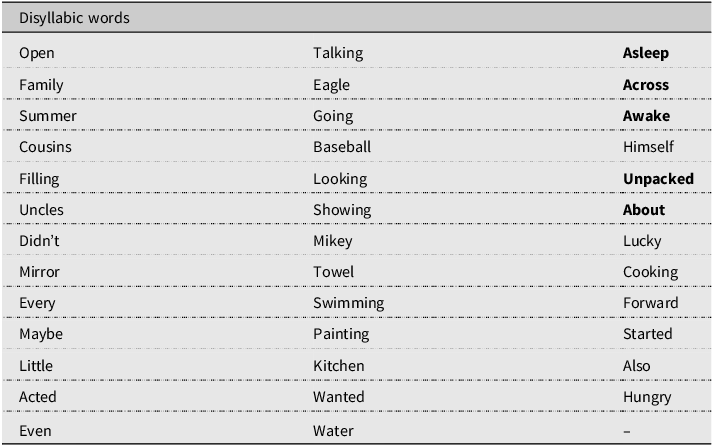
A short passage composed of thirty-eight disyllabic words was created, among which 6 have iambic stress while the other thirty-two have trochaic stress (as shown in Table 1) . The ratio of these two stress patterns among our target words reflects a natural distribution that there are more trochaic than iambic words in English (Cutler & Carter, Reference Cutler and Carter1987). The acoustic features of the stressed and unstressed syllables in these words were our targets of analysis. These disyllabic words are presented as follows:
Disyllabic words for analysis in the production passage
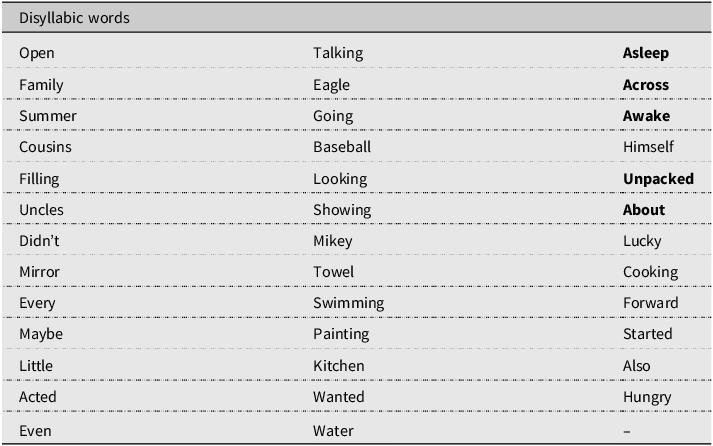
Table 1 Long description
The table presents disyllabic words categorized into three groups: Open, Talking, and Asleep. It has three columns and fourteen rows. The first column lists words under the Open category: Open, Family, Summer, Cousins, Filling, Uncles, Didn’t, Mirror, Every, Maybe, Little, Acted, Even. The second column lists words under the Talking category: Talking, Eagle, Going, Baseball, Looking, Showing, Mikey, Towel, Swimming, Painting, Kitchen, Wanted, Water. The third column lists words under the Asleep category: Asleep, Across, Awake, Himself, Unpacked, About, Lucky, Cooking, Forward, Started, Also, Hungry.
Note: The boldface words bear iambic stress.
Text comprehension test
The same short passage from the production test was visually presented to the participants, and they needed to answer 10 comprehension questions regarding the details of the passage.
Stress perception test
For the stress perception test, a recording of a new text passage was made, which contained 42 critical words with contrastive lexical stress. These 42 critical words were highlighted in yellow for the purpose of catching participants’ attention, and the stress pattern for 20 of these critical words was intentionally mispronounced. For example, the word “increase” in a sentence like “they have both been very busy from the increase in their work hours” will be pronounced as [In’kris] where the second syllable is stressed whereas as the correct pronunciation should be [’Inkris] since “increase” in this sentence is a noun.
In this task, participants needed to pay attention to the critical words and identify the words with incorrectly pronounced lexical stress from not only the phonetic and phonological aspects of the target words, but also the syntactic and semantic context surrounding them. All the 42 words were chosen from the basic and intermediate levels of a vocabulary book of a Chinese secondary-level English textbook, which should be common enough for university-level L2 English learners to recognize. The passage was recorded by native English speakers and was designed to be easily comprehensible to university-level L2 English speakers.
Segment perception
For the segment perception test, a recording of the same native English speaker as in the stress perception test read a passage in a normal pace and a natural tone, which also contained 42 critical words. These words were chosen to contain 7 pairs of vowels (/i, ɪ/, /u, ʊ/, /æ, ɛ/, /eɪ, ɛ/, /ɪ, ʌ/, /u, ʌ/, /æ, eI/) and 5 pairs of consonants (/θ, s/, /θ, f/, /v, ð/, /r, l/, /f, v/), most of which are typically difficult for Mandarin speakers to distinguish (Chen et al., Reference Chen, Robb, Gilbert and Lerman2001b; Jia et al., Reference Jia, Strange, Wu, Collado and Guan2006; Rau et al., Reference Rau, Chang and Tarone2009; Rogers & Dalby, Reference Rogers and Dalby2005; Zhang et al., Reference Zhang, Zhang and Lee2021): each critical word only contained one target segment. These 42 critical words were again highlighted in yellow to catch participants’ attention. The target segments in 20 of the 42 critical words were intentionally pronounced with the other segment by the native English speaker producing the passage. For example, [æ] is usually difficult for Mandarin speakers to perceive since it does not exist in the Mandarin phonetic inventories and is often perceived as [ɛ]. In this case, words such as [træk] (“track”) were pronounced as [trɛk] on purpose. All the 42 words were chosen from the basic and intermediate levels of the same vocabulary books used in the stress perception task.
Lexical knowledge test
A list of 20 English words was selected from intermediate- and advanced-level vocabulary lists in a study guide for the Test of English as a Foreign Language (TOEFL). Participants needed to select the correct Chinese translation for each word from the four options. Some incorrect options were intentionally designed to represent the meaning of another word that shares a similar form with the target word. For example, for word “contemporary,” there was an option of “短暂的,” which is the translation of the word “temporary.” Thus, these options could function as foils to the correct meanings, and only participants with more refined lexical knowledge would make a correct choice, separating those with average lexical knowledge from those with more advanced lexical knowledge.
Procedure
The procedure was completely identical for Mandarin and English speakers. The experiment was conducted in a sound-proof room in a lab on a website created through jsPsych (de Leeuw, Reference de Leeuw2015). Before the experiment began, informed consent was obtained, and participants were directed to the experiment room and asked to put on a pair of headphones. They were asked to carefully read instructions on the screen, and questions were answered. The MET started first, and participants needed to indicate whether each pair of musical phrases was identical by clicking on “YES” or “NO” on the screen. Participants had one second to choose their answer after each pair of sounds was played. The order of the melody and rhythm tests was randomized for each participant. This was followed by the segment and lexical stress tests, where participants listened to the passages and decided if any highlighted (target words) were mispronounced. Participants only got one chance to listen to each passage, which lasted about 2 minutes. The order of the segment test and lexical stress test was again randomized for each participant, and participants were not informed about whether the test focused on segments or lexical stress.
Finally, participants were tested on semantic tasks (i.e., lexical knowledge and text comprehension). These two tests served the same purpose: to test participants’ language proficiency in ways that were mostly unrelated to perception of sounds. For the lexical knowledge test, all questions were presented simultaneously, and participants needed to click on “continue” to start the next section. There was no time limit for this test. For the text comprehension task, participants needed to choose among four options for each question. Their answers were recorded, and raw scores and accuracy rates were calculated. Finally, participants were asked to read aloud the production passage (which was the same as the passage in text comprehension) into a microphone, and the recordings were stored for further acoustic analysis. The whole experiment lasted about an hour, and there was a 5-minute break after the perception tasks.
Statistical analysis
The accuracy rates of all the music and language proficiency tests completed by Mandarin speakers—including stress, segment, melody, and rhythm perception, as well as lexical knowledge and text comprehension—were calculated and converted to standardized (z) scores. The same procedure was also done for variables like time in Canada, years of learning music, years of learning English, and age of onset of acquiring English. These z-scores, along with stress patterns (whether the word has trochaic or iambic stress), were entered to three linear mixed effects models as predictors.
Each model predicted one aspect of production data, i.e., duration (in ms), F0 (normalized in semitones), and amplitude (in dB), which were extracted from the midpoint of each vowel from all target disyllabic words in the passage, produced by both English and Mandarin speakers. Because our stimuli were recorded from a fluent passage of speech, we were interested in how “English-like” our Mandarin speakers’ pronunciations were, rather than measuring absolute acoustic values of our dependent variables. To do this, we calculated a dependent variable that indexed the “distance” for stress-versus-unstressed vowels. More specifically, we first subtracted the duration, F0, and amplitude between the stressed and unstressed vowels (Vstressed – Vunstressed) in each disyllabic word for both English and Mandarin speakers. Second, we measured difference between this stress-minus-unstressed value for one Mandarin speaker’s pronunciation of one disyllable (M a,i , a is an index for words ranging from 1 to 38, i is an index for Mandarin participants ranging from 1 to 39), and one English speaker’s stress-minus-unstressed value for the same word (E a,j , j is an index for English participants ranging from 1 to 25). Third, we took the absolute value of this within-word difference, repeating this procedure for all combinations of Mandarin-English speakers for each disyllabic word (Distance = |M a,i –E a,j |). Finally, we repeated all these steps for each of the three acoustic cues using the following formula. These “distances” in duration, F0, and amplitude were thus a measure of how divergent Mandarin speakers’ pronunciations were from English speakers’ pronunciations and thus constituted the dependent variable in the three linear mixed effects models.
 \begin{align} {\rm{Distance}}\,{\rm{ = }}\,\left| {{M_{1,1}} - {E_{1,1}}} \right|,\;\left| {{M_{1,1}} - {E_{1,2}}} \right|,\left| {{M_{1,1}} - {E_{1,3}}} \right| \cdot \cdot \cdot \left| {{M_{38,39}} - {E_{38,25}}} \right| \end{align}
Three linear mixed effects models run with the afex R package (Singmann et al., Reference Singmann, Bolker, Westfall and Aust2017) using the Satterwaithe method, and all of them included the above-mentioned predictors (melody perception, rhythm perception, stress perception, segment perception, lexical knowledge, text comprehension, years of learning music, years of learning English, time of residence in Canada, age of onset of acquiring English) as fixed factors and word (item), English, and Mandarin subjects as random intercepts to construct the maximal model structure.
Results
Three sets of results are presented. First, we investigated each independent variable, measuring the normality of their distribution and whether music-relevant and language-relevant predictors were significantly correlated with each other (both within and across different variable groupings). Second, we examined the dependent variables, examining the productions of the three target acoustic measures in both stressed and unstressed vowels to obtain a general picture of how Mandarin speakers produced lexical stress, compared to the native English speakers. Finally, the third analysis brought these factors together, and reports the three critical linear mixed effects models, which asked how each independent variable predicted to the distance between English and Mandarin speakers’ production. In other words, this last analysis asked whether music and language sub-skills were correlated with more native-like production of English lexical stress.
Descriptive summary of independent variables
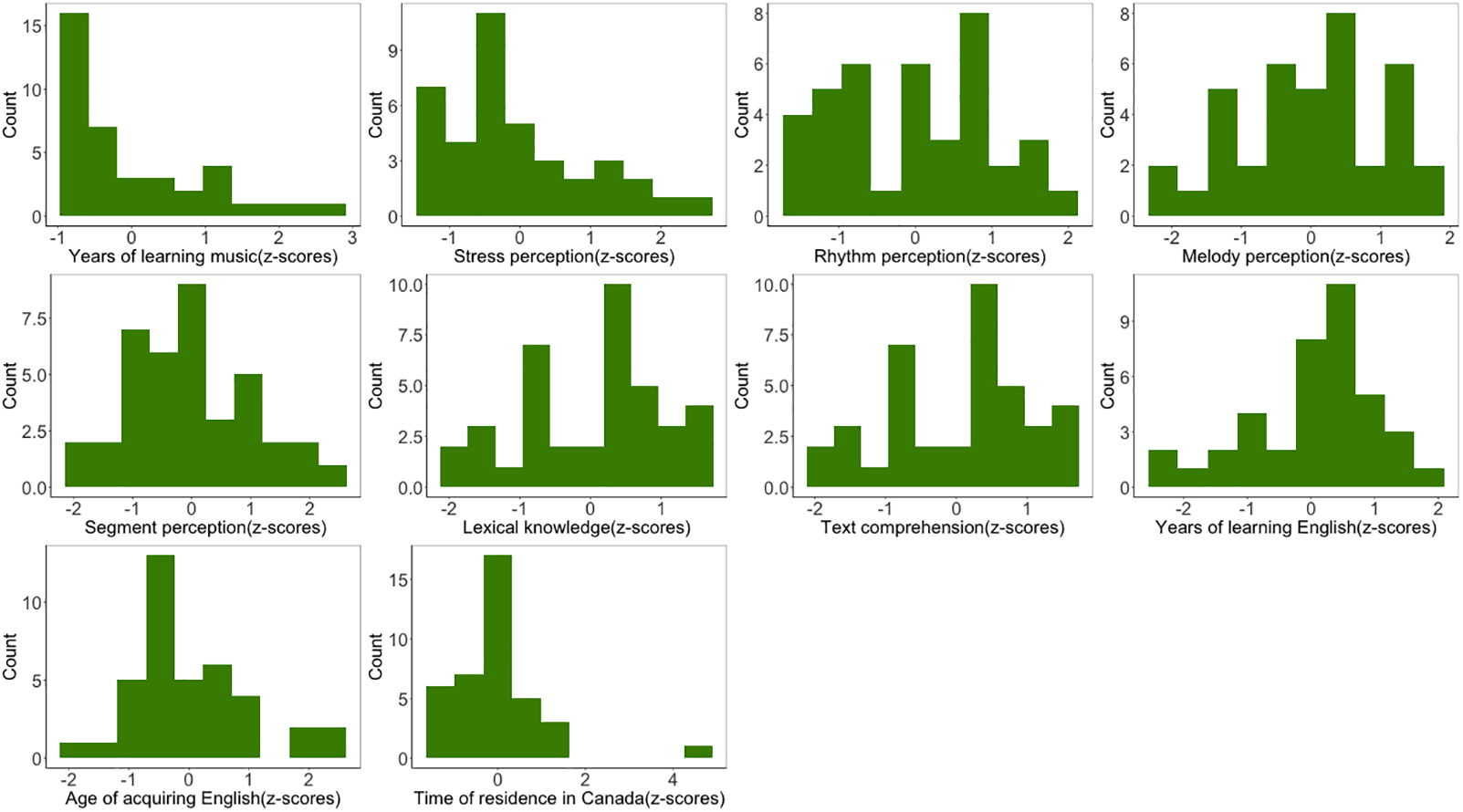
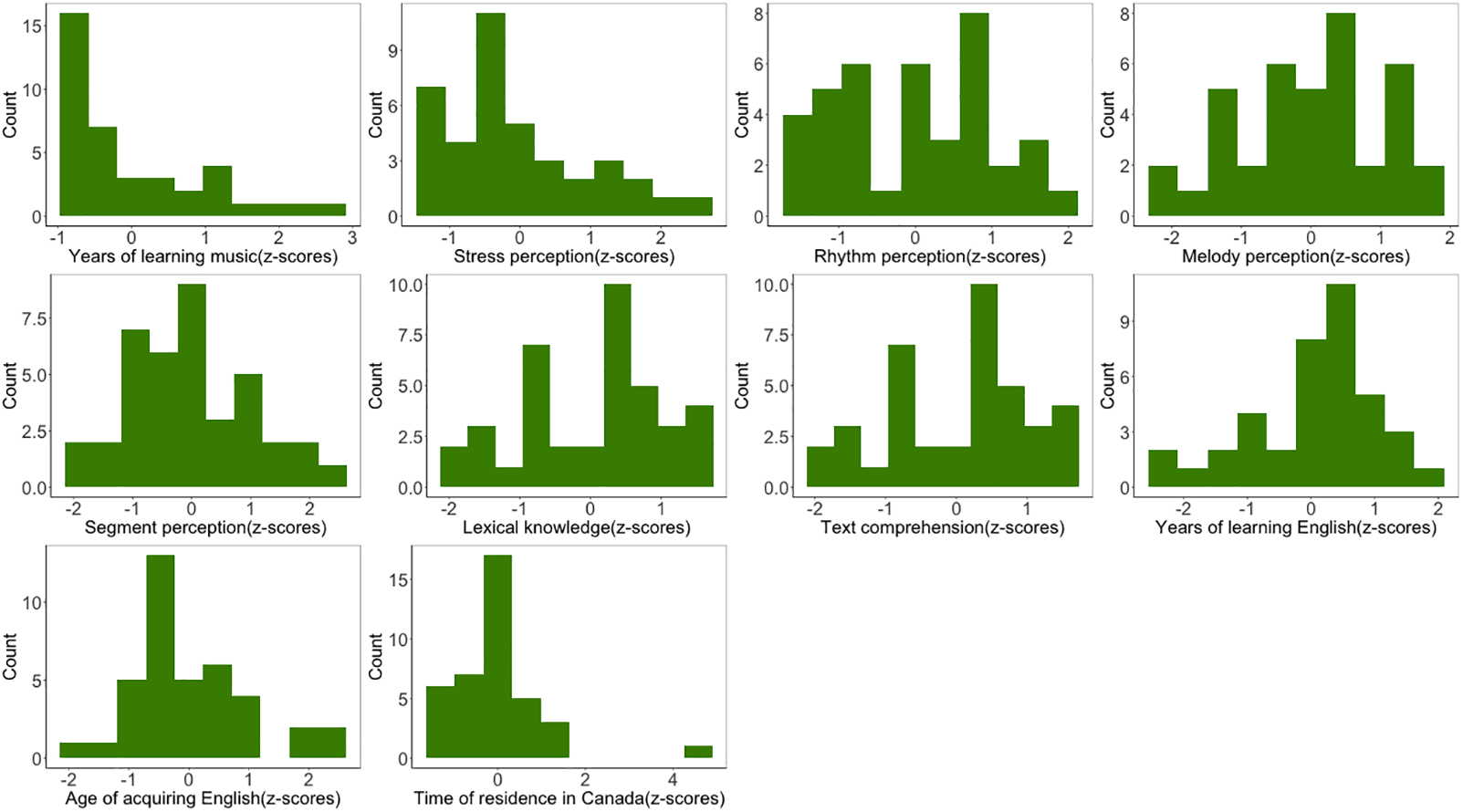
Raw scores on music and language tasks, as well as participants’ self-reported years of learning music, years of learning English, time of residence in Canada, and age of onset of acquiring English, were converted to standardized scores. The results are shown in Figure 1. Shapiro-Wilks Normality Tests were performed for all the independent variables: Stress perception (p = .005), lexical knowledge (p = .02), text comprehension (p < .001), age of acquiring English (p = .04), time of residence in Canada (p < .001), and years of learning music (p < .001) were all found to be non-normally distributed. The distribution of stress perception scores was positively skewed and indicated that the stress perception test was especially difficult. Additionally, the negative skewness for the measures of years of learning music, age of acquiring English, and time of residence in Canada may reflect that a relatively homogenous group of participants were recruited in our study, most of whom started to learn English in the 7th grade in China, arrived in Canada at 19–22 years to study, and also had received minimum music training since it was not compulsory in many Chinese schools.
Histograms showing the frequency of the z-scores of all the independent variables.
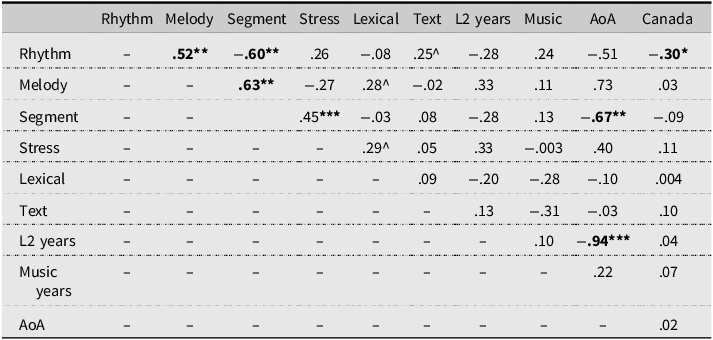
Subsequently, correlations among all the independent variables were tested and the results are shown in Table 2: First, results showed that rhythm perception and melody perception were significantly and positively correlated with each other (β = .52, p = .004), replicating what was found in Wallentin et al. (Reference Wallentin, Nielsen, Friis-Olivarius, Vuust and Vuust2010). Second, stress perception was significantly correlated with segment perception (r = .45, p = .001), reflecting that greater sensitivity to the alternation of lexical stress was associated with greater sensitivity to segmental differences, which is not unreasonable as stress alternation in English is usually accompanied by vowel alternation. Third, melody perception was positively correlated with segment perception (β = .63, p = .002), which is in line with the significant correlation between musical abilities and receptive phonology found in previous studies (Anvari et al., Reference Anvari, Trainor, Woodside and Levy2002; Politimou et al., Reference Politimou, Dalla Bella, Farrugia and Franco2019; Zuk et al., Reference Zuk, Andrade, Andrade, Gardiner and Gaab2013) and may reflect shared spectral information underlying perception of melody and segments. Fourth, melody perception was marginally associated with lexical knowledge (β = .28, p = .06), while rhythm perception was also marginally associated with text comprehension (β = .25, p = .08). This is consistent with findings where vocabulary size was significantly correlated with musical ability of 4-year-old preschoolers (Anvari et al., Reference Anvari, Trainor, Woodside and Levy2002) and rhythm processing abilities significantly contributed to reading comprehension and literacy skills (Cohrdes et al., Reference Cohrdes, Grolig and Schroeder2016; Dellatolas et al., Reference Dellatolas, Watier, Le Normand, Lubart and Chevrie-Muller2009; Douglas & Willatts, Reference Douglas and Willatts1994; Steinbrink et al., Reference Steinbrink, Knigge, Mannhaupt, Sallat and Werkle2019). Finally, segment perception was significantly correlated with age of acquisition (β = −.67, p = .007), showing the earlier one acquired English, the greater sensitivity they would have in perception of segments).
Surprisingly, neither music abilities (rhythm: p = .13; melody: p = .15) were correlated with stress perception, which contradicts previous studies showing musicians’ effects on perception of L2 prosody (Kolinsky et al., Reference Kolinsky, Cuvelier, Goetry, Peretz and Morais2009; Marie et al., Reference Marie, Delogu, Lampis, Belardinelli and Besson2011). However, in a post hoc exploratory analysis (detail in our OSF repository), we analyzed all of these effects together in a logistic mixed effects model where accuracy of stress perception (0 or 1) on each target word was included as the dependent variable, while the same aforementioned factors (except the stress perception scores) as the independent variables, and participant and word as random intercepts. The results parallel the correlational analysis above, in showing significant effects of segment perception and lexical knowledge (all p’s < .05), and which again revealed that only rhythm was marginally significantly predictive of stress perception (β = 1.05, p = .08), while melody was not (β = −1.00, p = .10). One possible reason for these insignificant effects may be that listeners may also need to process the semantic-syntactic context to identify the misplacement of stress, which may have increased their cognitive load and reduced their mental capacity to directly perceive the prosodic cues borne by the target words, weakening the potential contribution of music abilities to stress perception.
Correlations among all the independent variables
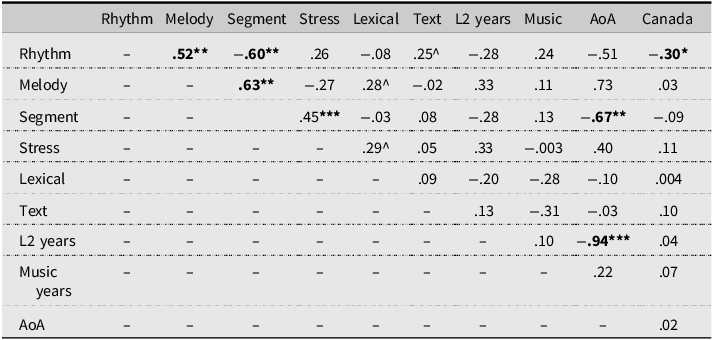
Table 2 Long description
A table with 10 rows and 11 columns displaying correlation coefficients among different variables. The columns are labeled Rhythm, Melody, Segment, Stress, Lexical, Text, L2 years, Music, AoA, and Canada. The row labels are Rhythm, Melody, Segment, Stress, Lexical, Text, L2 years, Music years, AoA, and Canada. Each cell contains a correlation coefficient value. Notable values include significant correlations between Rhythm and Melody (.52**), Segment and Stress (.45***), and Melody and Segment (.63**). Marginal associations are observed between Melody and Lexical (.28^), Rhythm and Text (.25^), and Segment and AoA (.67**).
Note: The boldface values are significant at p < .05, *p < .05. **p ≤ .01, ***p ≤ .001, ^p < .1. Lexical = Lexical knowledge test, Text = Text comprehension test, L2 years = years of learning English as an L2, Music = years of music training, AoA = Age of acquiring English, Canada= time of residence in Canada.
Group-level comparisons of production data
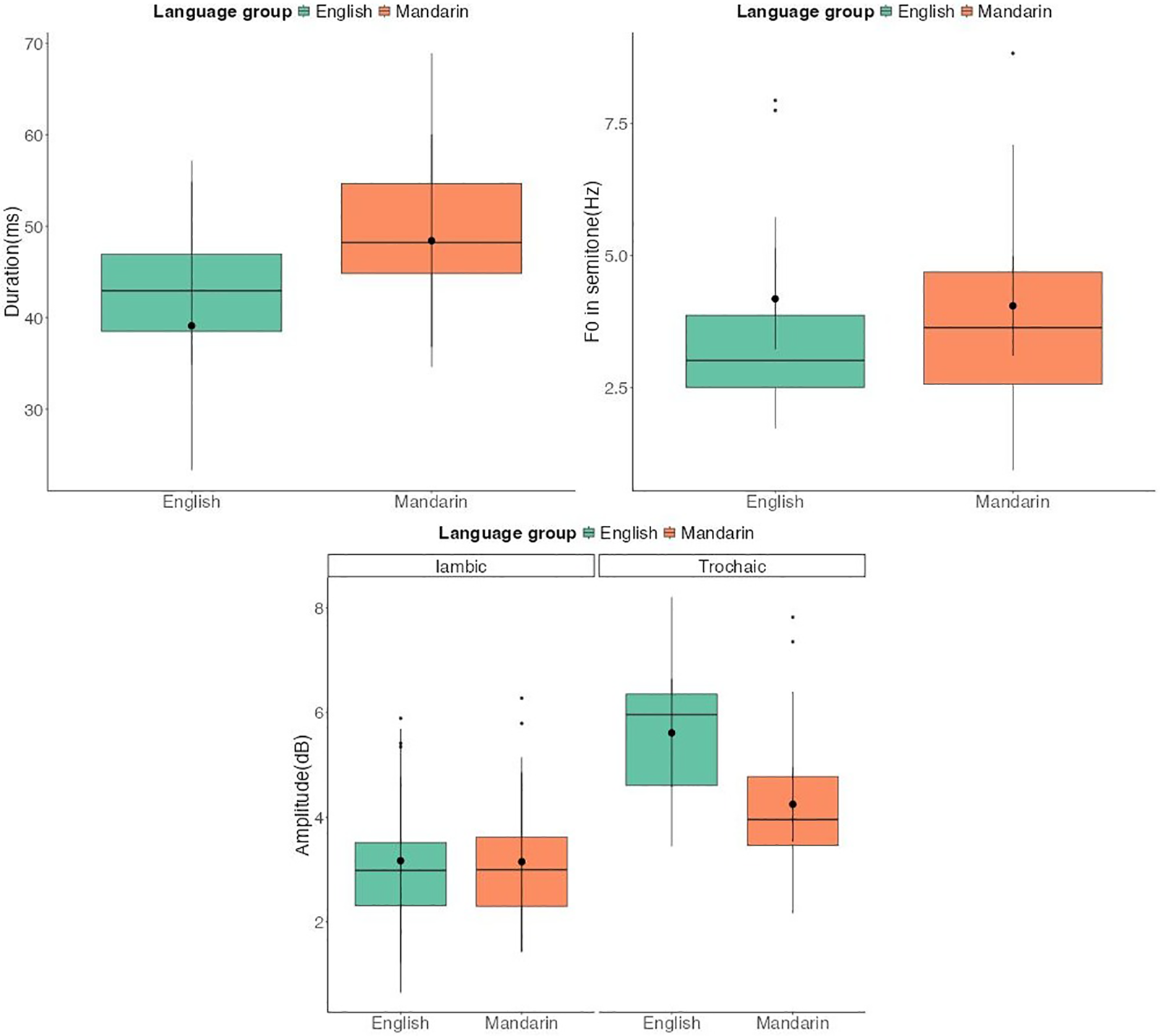
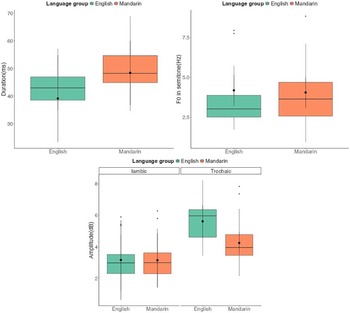
In this sub-section, the results from group-level comparisons are presented, where the absolute differences between stressed and unstressed vowels in duration, F0, and amplitude were analyzed by three linear mixed effects models using Satterthwaite estimates in the afex package in R (Singmann, H. et al., Reference Singmann, Bolker, Westfall and Aust2017), just like the main analysis. The purpose of this preliminary analysis was to see how Mandarin speakers’ production pattern of phonetic variability of lexical stress is different from native English speakers’ pattern at the group level, which will help to further contextualize how predictors of more “native-like” patterns of production at the individual level emerge in the final analysis. The group-level differences in the three acoustic parameters are illustrated in Figure 2.
Group-level differences in acoustic contrasts between stressed and unstressed vowels in duration (ms), F0 (Hz), and amplitude (dB) for English and Mandarin speakers. Dots indicate model estimates, thick error bars indicate 95%-CIs, overlaid over boxplots showing raw data distributions. Amplitdue is further separated by Stress Type, due to the marginal interaction between this factor and Language.
Three linear mixed effects models were performed to show whether there were any significant between-group differences of duration, F0, and amplitude, which all include stress type (trochaic or iambic), language (English or Mandarin), and their interaction as fixed factors. All models were first run with a maximal random effects structure: Participant and word as random intercepts; stress type as a random slope for the participant-intercept, as well as language as a random slope for the word-intercept. Models were reduced by the same method as we used in our principal analysisReference Kuznetsova, Brockhoff and Christensen until the model converged (Kuznetsova et al., Reference Kuznetsova, Brockhoff and Christensen2017).
Results from linear mixed effects model predicting duration, F0, and amplitude
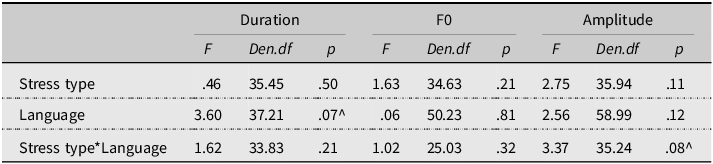
Table 3 Long description
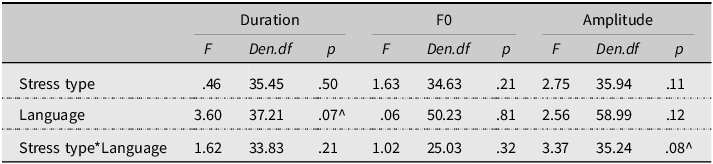
A table with three rows and seven columns comparing the effects of stress type, language, and their interaction on duration, F0, and amplitude. The columns are labeled Duration, F0, and Amplitude, each with sub-columns F, Den.df, and p. The row labels are Stress type, Language, and Stress type*Language. Row 1: Stress type, Duration: F .46, Den.df 35.45, p .50; F0: F 1.63, Den.df 34.63, p .21; Amplitude: F 2.75, Den.df 35.94, p .11. Row 2: Language, Duration: F 3.60, Den.df 37.21, p .07^; F0: F .06, Den.df 50.23, p .81; Amplitude: F 2.56, Den.df 58.99, p .12. Row 3: Stress type*Language, Duration: F 1.62, Den.df 33.83, p .21; F0: F 1.02, Den.df 25.03, p .32; Amplitude: F 3.37, Den.df 35.24, p .08^.
Note: The results are from the models specified as following, using lme4 syntax in R: Duration ∼ Stress type * Language + (1 | Participant) + (1 + Language| Word); F0 ∼ Stress type * Language + (1 | Participant) + (1 + Language | Word); Amplitude ∼ Stress type * Language + (1 | Participant) + (1 + Language | Word). ^p < .1.
The results are displayed in Table 3. In the first model predicting duration, there was only a marginally significant main effect of language (F = 3.60, p = .07), as Mandarin speakers had marginally greater overall durational contrasts than English speakers. In the second model predicting F0, there was no significant interaction between language group and stress type, nor were there significant main effects of either factor (both p’s ≥ .21). This indicates that Mandarin and English speakers produced comparable contrasts between stressed and unstressed syllables in F0 across both stress types. In the third model predicting amplitude, there was a marginally significant interaction between stress type and language (F = 3.37, p = .08). Post hoc pairwise comparisons with a Bonferroni correction using emmeans() package (Lenth, Reference Lenth2020) revealed that, in the English-speaking group, the amplitude produced on the trochaic words was significantly greater than that by Mandarin speakers (M = 1.36, p = .0003), while no group differences were found for the iambic words (p = .98). To summarize, on average, when producing multisyllabic words in longer context, Mandarin speakers were able to achieve English-like pitch contrast between stressed and unstressed syllables, although they marginally tended to increase the contrast in duration, and produced a marginally smaller contrast in amplitude compared to native English speakers.
Predicting production of lexical stress at the individual level
To test our hypotheses on whether individual language proficiency and abilities of perceiving musical elements are predictive of the individual variances in producing native-like differences of duration, F0, and amplitude in lexical stress, we conducted three linear mixed effects models, which all included the z-scores of stress perception, segment perception, melody, and rhythm perception, lexical knowledge, text comprehension, time of residence in Canada, years of learning English, years of learning music and age of onset of acquiring English as the independent variables. Recall that the distance between English and Mandarin speakers’ production of difference in duration, F0, and amplitude (stressed vowel minus unstressed vowel in each word) were the dependent variables in each of the three models, respectively. The results of each model are presented separately in the following three subsections.
Duration
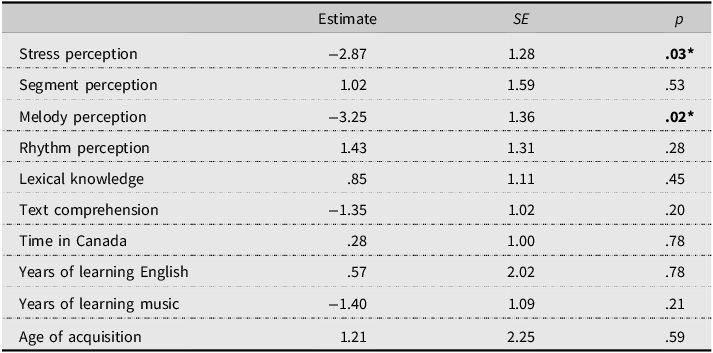
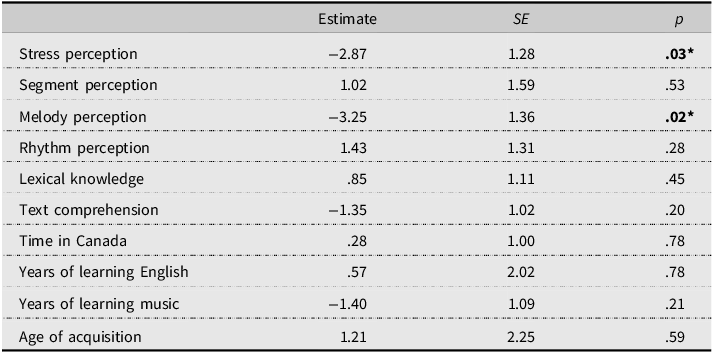
In the first linear mixed effects model, the independent variables were those mentioned above while the dependent variable was the distance between English and Mandarin speakers’ production of within-word differences of duration. The model was designed to test the independent contribution of each of the predictors after factoring out the potential effects of the other predictors, which also includes random intercepts of Mandarin participant, English participant, and word. The results are shown in Table 4.
Results from linear mixed effects model predicting distance in duration
Note: Syntax: distance in duration ∼ segment perception + rhythm + melody + lexical knowledge + text comprehension + stress perception + time in Canada + years of learning English + age of acquisition + years of learning music + (1 | Mandarin subject) + (1 | English subject)+(1 | word). The boldface values are significant at p < .05, *p < .05.
The significant correlations lay between melody perception and production of duration (β = −.75, p = .03) and also between stress perception and distance between the two groups of speakers in production of duration was only marginally significant (β = −2.23, p = .08), suggesting that the better the participants were at distinguishing melody, the more their production of duration difference would approximate that of the native English speakers and the higher their scores of stress perception was, the distance between their production of duration differences and that of the English speakers was smaller. However, rhythm perception was not predictive of the distance between the two groups of speakers in production of duration (β = 1.43, p = .28).
F0
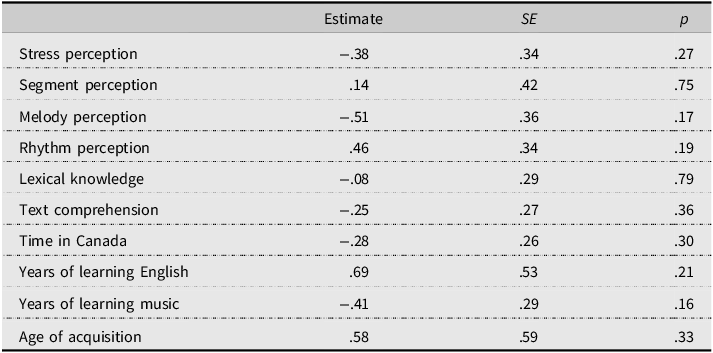
The same linear mixed effects model was performed except the dependent variable this time was the distance between English and Mandarin speakers’ production of F0 difference (stressed vowel minus unstressed vowel in each word). The results are shown in Table 5.
Results from linear mixed effects model predicting distance in F0
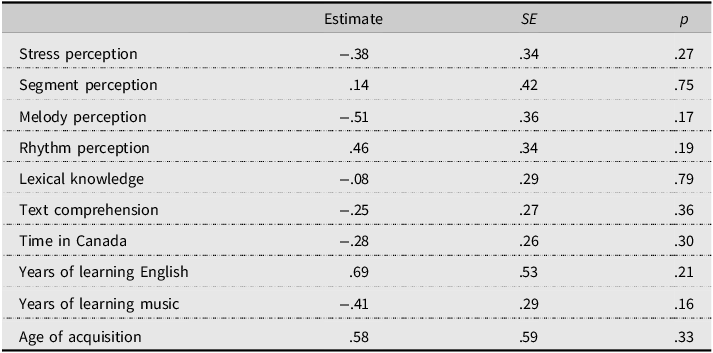
Table 5 Long description
A table with three columns and twelve rows. The columns are labeled Estimate, SE, and p. The rows are labeled with different predictors: Stress perception, Segment perception, Melody perception, Rhythm perception, Lexical knowledge, Text comprehension, Time in Canada, Years of learning English, Years of learning music, and Age of acquisition. Each row contains values for Estimate, SE, and p. For example, Row 1: Stress perception, Estimate: -0.38, SE: 0.34, p: 0.27. Row 2: Segment perception, Estimate: 0.14, SE: 0.42, p: 0.75. Row 3: Melody perception, Estimate: -0.51, SE: 0.36, p: 0.17. Row 4: Rhythm perception, Estimate: 0.46, SE: 0.34, p: 0.19. Row 5: Lexical knowledge, Estimate: -0.08, SE: 0.29, p: 0.79. Row 6: Text comprehension, Estimate: -0.25, SE: 0.27, p: 0.36. Row 7: Time in Canada, Estimate: -0.28, SE: 0.26, p: 0.30. Row 8: Years of learning English, Estimate: 0.69, SE: 0.53, p: 0.21. Row 9: Years of learning music, Estimate: -0.41, SE: 0.29, p: 0.16. Row 10: Age of acquisition, Estimate: 0.58, SE: 0.59, p: 0.33.
Note: Syntax: distance in F0 ∼ segment perception + rhythm + melody + lexical knowledge + text comprehension + stress perception + time in Canada + years of learning English + age of acquisition + years of learning music + (1 | Mandarin subject) + (1 | English subject) + (1 | word).
The results show that neither the correlation between rhythm perception and distance between the two groups of speakers in production of F0 difference (β = .46, p = .19), nor the correlation between melody perception and production distance was significant (β = −.51, p = .17). Similarly, stress perception did not significantly contribute to the distance in production of F0 (β = .14, p = .75).
Amplitude
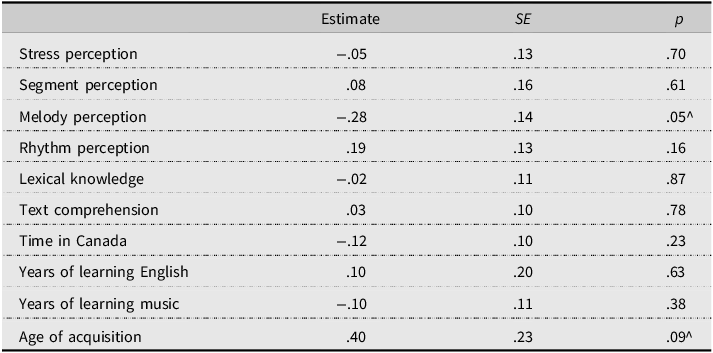
The same linear mixed effects model was performed except the dependent variable was the distance between English and Mandarin speakers’ production of amplitude difference (stressed vowel minus unstressed vowel in each word). The results are shown in Table 6.
Results from linear mixed effects model predicting distance in amplitude
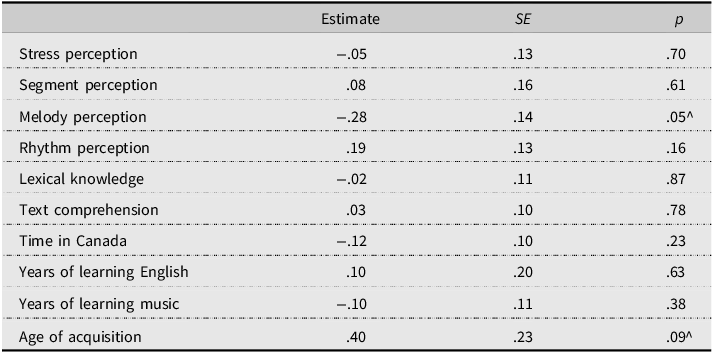
Table 6 Long description
A table with three columns and eleven rows. The columns are labeled Estimate, SE, and p. The rows are labeled with different factors: Stress perception, Segment perception, Melody perception, Rhythm perception, Lexical knowledge, Text comprehension, Time in Canada, Years of learning English, Years of learning music, and Age of acquisition. Each row contains values for Estimate, SE, and p. Row 1: Stress perception, Estimate: -.05, SE: .13, p: .70. Row 2: Segment perception, Estimate: .08, SE: .16, p: .61. Row 3: Melody perception, Estimate: -.28, SE: .14, p: .05^. Row 4: Rhythm perception, Estimate: .19, SE: .13, p: .16. Row 5: Lexical knowledge, Estimate: -.02, SE: .11, p: .87. Row 6: Text comprehension, Estimate: .03, SE: .10, p: .78. Row 7: Time in Canada, Estimate: -.12, SE: .10, p: .23. Row 8: Years of learning English, Estimate: .10, SE: .20, p: .63. Row 9: Years of learning music, Estimate: -.10, SE: .11, p: .38. Row 10: Age of acquisition, Estimate: .40, SE: .23, p: .09^.
Note: Syntax: distance in amplitude ∼ segment perception + rhythm + melody + lexical knowledge + text comprehension + stress perception + time in Canada + years of learning English + age of acquisition + years of learning music + (1 | Mandarin subject) + (1 | English subject) + (1 | word). ^p < .1.
The results show that there was only a marginally significant contribution from melody perception (β = −.28, p =.05), and the negative estimate suggests that better perception of melodic differences was predictive of smaller distance between the two language groups in producing amplitude contrasts. Again, rhythm perception was not significantly correlated with production of amplitude (β = .19, p =.16), nor was stress perception (β = −.05, p =.70).
Summary of predictive models
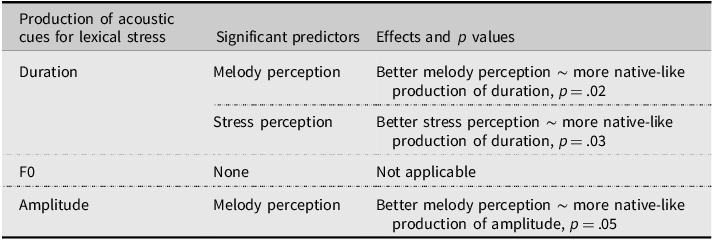
In summary, our analysis showed better melody perception was predictive of more native-like production of within-word differences in duration, and to a lesser degree, amplitude. Nevertheless, neither of the two musical aspects contributed to production of native-like F0.
Finally, only stress perception appeared to contribute to production of duration, whereas non-auditory aspects of language proficiency (such as years of learning L2, age of onset of acquisition, and time of residence in Canada) did not seem to be significantly associated with production of any of those acoustic cues (except age of acquisition was marginally associated with production of amplitude). The summarized results are presented in Table 7.
Summarized results from the models predicting the acoustic cues of lexical stress
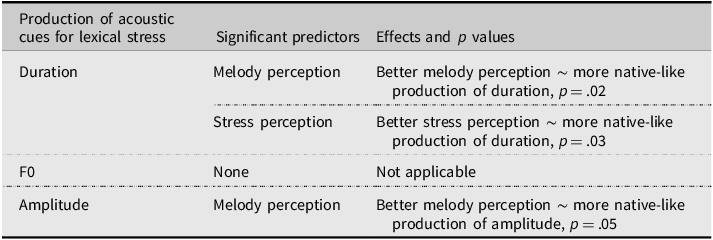
Table 7 Long description
A table summarizing results from models predicting the acoustic cues of lexical stress. The table has four rows and three columns. The columns are labeled Production of acoustic cues for lexical stress, Significant predictors, and Effects and p values. The rows are labeled Duration, F0, and Amplitude. Row 1: Duration, Melody perception, Better melody perception more native-like production of duration, p equals 02. Row 2: Duration, Stress perception, Better stress perception more native-like production of duration, p equals 03. Row 3: F0, None, Not applicable. Row 4: Amplitude, Melody perception, Better melody perception more native-like production of amplitude, p equals 05.
Discussion
We hypothesized that there would be significant correlation between rhythm perception and production of duration, while also predicting that melody perception would be predictive of production of F0. Additionally, we predicted that stress perception would be correlated with production of at least one of the three acoustic cues. However, our results diverged from these predictions. Instead, our results show that melody, instead of rhythm, significantly predicted production of duration and was marginally significantly correlated with amplitude. Additionally, melody perception did not exhibit any statistical significance in predicting F0. On the other hand, stress perception was indeed found to be significantly correlated with production of duration only. Finally, non-auditory aspects, such as lexical knowledge and text comprehension, as well as more holistic aspects of language proficiency (years of learning L2, age of onset of acquisition, time of residence in Canada) did not seem to contribute to production of any of the acoustic cues of lexical stress, beyond a very marginal effect of Age of Acquisition in predicting intensity cues. In the current section, we will discuss the underlying implications and assumptions from our results and the reasons why our results did not meet our proposed hypotheses in terms of the three acoustic cues in the corresponding subsections.
Duration
Results suggest that, as participants’ perception of musical melody improved, their production of duration in stressed disyllables got closer to the native norm, which differs from what we expected. Another interesting pattern is that there was a significant correlation between stress perception and production of duration in stress, which was hypothesized, and which also aligns with the weak correlation between discrimination ability of lexical tones and the acoustic distance to native speakers’ production observed in Kirby & Giang Reference Kirby and Giang(2021).
In prior work, some Mandarin speakers have been observed to selectively lengthen vowels (or syllables) in different sentential positions, likely because of their low proficiency in English. For example, in Mok and Dellwo (Reference Mok and Dellwo2008), the researchers found that several parameters of variation in syllable duration, such as standard deviation and the Pairwise Variability Index (PVI), were found to be greater in Mandarin speakers’ production of English than native English speakers’ production, even though, as native speakers of a syllable-timed language, Mandarin speakers’ production was hypothesized to have less variation. These authors posited that the unexpected results were probably due to selective lengthening after an impressionistic inspection of the individual recordings. Our results parallel these results, and at the group-level, showed that Mandarin speakers seemed to increase global variability in durational contrasts between stressed and unstressed vowels, as shown in Plot A of Figure 2. Such a larger between-syllable variation may also be due to selective lengthening.
However, at the individual level, our principal results contrast with our first hypothesis in that melody perception, instead of rhythm perception, significantly contributed to production of duration. In previous studies, selective transfer was found between sub-domains of music production and speech production when both sub-domains share similar acoustic/auditory cues. For example, both Cason et al. (Reference Cason, Marmursztejn, D’Imperio and Schön2020) and Nakata (Reference Nakata2002) tested perception and production of both melody and rhythm and found only rhythm production significantly contributed to more successful assignment of English lexical stress (Cason et al., Reference Cason, Marmursztejn, D’Imperio and Schön2020) and production of Japanese geminates (Nakata, Reference Nakata2002). Interestingly, Cason et al. (Reference Cason, Marmursztejn, D’Imperio and Schön2020) also used MET as their perception test and did not find a significant correlation between rhythm perception and stress production.
In our current study, better melody perception predicted a better approximation of the native norm of producing contrasts of duration, suggesting that the perceptual mechanisms engaged when processing music melody—specifically, the fine-grained tracking of temporal envelope changes and relative durational relationships between successive elements (Jones & Boltz, Reference Jones and Boltz1989)—may be more critical than beat-based rhythmic parsing for mastering phonological duration distinctions for these Mandarin-speaking participants. This pattern may reflect either differences in the emphasis of musical training systems across cultures or Mandarin speakers’ heightened sensitivity to musical elements involving pitch variation, stemming from their experience with lexical tone. Such sensitivity to melodic features could confer a greater advantage for the production of acoustic cues underlying L2 prosody, particularly duration contrasts that unfold along continuous temporal dimensions.
Amplitude
Overall, results suggest that Mandarin speakers, at the group-level, produced a smaller contrast between stressed and unstressed syllables in amplitude (particularly for trochaic words), compared to English speakers. At the individual level, a similar pattern, though to a lesser degree, was also found between melody perception and more native-like production of amplitude.
Our results converge with those in Chen et al. (Reference Chen, Robb, Gilbert and Lerman2001a), which investigated sentential stress produced by native English speakers and Mandarin speakers, and found that across different sentences containing the same monosyllabic words (but different foci), production of amplitude on the stressed words was comparable, whereas Mandarin speakers produced a greater amplitude on the unstressed words than English speakers. Although these authors did not calculate the difference of amplitude between a word when it was stressed and unstressed, because these words were across different sentences, the results nevertheless suggest that Mandarin speakers tended to produce a smaller contrast of amplitude when placing sentential stress on words than English speakers.
It is unknown, however, how sentence-level rhythm affected word-level amplitude for both groups of speakers in our current study. If greater sentence-level contrasts of amplitude also somehow accentuate within-word amplitude contrasts, it is not surprising to see that the amplitude difference within a word was more extreme in English speakers’ production. Nevertheless, no matter whether this assumption holds true for the current case, the effect of melody perception on production of amplitude could possibly be facilitating Mandarin speakers’ production of greater contrasts of amplitude at both word and sentence level, as their general auditory sensitivity to music melody increased.
Our results are also in parallel with the results in Feng et al. (Reference Feng, Lian and Zhao2019), where it was found that music training for Mandarin speakers was associated with a greater contrast in amplitude between the stressed and unstressed syllables. However, their music training was composed of perceptually distinguishing pitch and loudness, while our current rhythm perception test in MET did not involve manipulation of intensity in the beats of the test items. Therefore, it would not be reasonable to assume rhythm perception would be significantly correlated with the production of amplitude.
In addition, although Feng et al. (Reference Feng, Lian and Zhao2019) found that such training of pitch differences resulted in little improvement in producing durational contrasts in the pseudowords (unlike ours where melody perception was predictive of production of duration), there are lots of differences between our methodology and that in Feng et al. (Reference Feng, Lian and Zhao2019) and the other above-mentioned studies. The most noticeable ones are that we measured the acoustic distance between the two language groups, instead of collecting native speakers’ judgments on stress assignment for the real words. Moreover, all the stressed and unstressed vowels in our study were produced in a longer context instead of isolated words, where unexpected variation caused by L2 learners’ unmastered skills for the target language could have been present, such as above-mentioned selective lengthening and the interaction between word-level and sentence-level stress. Even a strong non-native accent (illustrated by producing a non-native norm of acoustic cues, for example) will not necessarily reduce speech intelligibility (Munro & Derwing, Reference Munro and Derwing1995). For example, Wang et al. (Reference Wang, Jongman and Sereno2003) revealed that although the intelligibility of the Mandarin tones produced by English speakers was improved after the perceptual training, the production of pitch height and contour did not achieve a completely native-like status, with greater improvement of pitch contour than pitch height. This indicates that even if non-native speakers produced sound contrasts in a non-native way, native listeners are still likely to successfully identify the distinction.
In summary, the marginally significant association between melody perception and native-like production of amplitude seems to consolidate our assumption that Mandarin speakers’ potentially greater sensitivity to melodic patterns may transfer to the improvement of production of amplitude-related prosodic contrasts in L2 English, an acoustic dimension that is less salient in their native phonological system.
F0
Neither melody nor rhythm was significantly correlated with the distance in production of F0. This did not align with our second hypothesis about the correlation between melody perception and having more native-like pitch production but was in accordance with our prediction that the contribution of melody to F0 would be minimal. One possibility is that Mandarin speakers master the usage of pitch from their native language, which is a tonal language, instead of gaining pitch sensitivity through music training. Indeed, previous research found that Mandarin speakers predominantly utilize F0 to differentiate stressed and unstressed English syllables in production. For example, Li and Grigos (Reference Li and Grigos2021) found that Mandarin speakers produced words with comparable trochaic and iambic stress as native English speakers, but with less native-like patterns of duration. Moreover, it was also found that Mandarin speakers even “overuse” the cue of F0 by signaling stressed syllables with a higher F0 compared to native English speakers (Zhang et al., Reference Zhang, Nissen and Francis2008). These researchers posited that Mandarin speakers transfer F0 cues from lexical tone to lexical stress. Our current comparison between native and non-native speakers showed that Mandarin speakers were capable of realizing as extreme F0 contrasts between stressed and unstressed syllables as native English speakers.
Note that, seemingly in opposition to our findings, Feng et al. (Reference Feng, Lian and Zhao2019) found that improvement in Mandarin speakers’ musical pitch discrimination correlated positively with the production of pitch contrast, as well as higher accuracy scores for stress assignment by native listeners. However, since those authors did not acoustically compare Mandarin speakers’ and native English speakers’ production, the functional benefit of this increase in F0 contrast is unknown: Was this increase in F0 contrast approaching or deviating from the native norm? In addition, even though the accuracy scores for stress assignment increased after music training, more perceptual distinctiveness does not always entail a more native-like pattern in production. Therefore, this training study should be interpreted with caution and cannot really be taken as contradictory to our results.
Here, to create a more naturalistic setting, target words in the current studies were not embedded in the same position in a controlled carrier sentence, nor did we control target word syllable structure, leaving open the possibility that contextual effects had some effect on the acoustic properties of the target vowels. It is thus reasonable to posit that Mandarin speakers and English speakers aligned intonation with word-level F0 contrasts in different ways, causing greater variation of between-syllable F0 contrast for Mandarin speakers (as shown in Plot B of Figure 2), and such variation cannot be explained by participants’ music abilities or their sensitivity to wrongly produced stress assignment.
In summary, for F0, there may have been little transfer from either melody or rhythm perception skills to more native-like production of F0. One possibility is that this is due to Mandarin speakers’ existing familiarity with manipulating F0 cues to achieve F0 contrasts in production of lexical stress, which was gained through their experience with their native language. Another, non-mutually exclusive possibility, is that our method embedded production targets in sentences, and thus sentence-level intonation could have resulted in much more variation in stress contrasts than expected, which could not be predicted by our tasks measuring sensitivity to stress perception or certain sub-domains of music perception. Further investigation on how intonation influences word-level stress contrasts and how it differs across the two languages should be conducted.
Despite investigating the relationship between music perception and production of various prosodic cues in L2 English lexical stress, vowel quality, which is considered a primary cue to lexical stress for native English speakers (Connell et al., Reference Connell, Hüls, Martínez-García, Qin, Shin, Yan and Tremblay2018 ; Gay, Reference Gay1978; Lindblom, Reference Lindblom1963; Zhang & Francis, Reference Zhang and Francis2010), was not included as a dependent measure. This was primarily because our music perception tests, which assessed melody and rhythm perception, did not directly tap into spectral acuity, and vowel quality does not share the same acoustic dimensions (F0, duration, and intensity) that form the basis of our other dependent measures. Future studies aiming to examine the associations between music abilities and the production of vowel quality in L2 lexical stress could design production materials that systematically vary vowel quality contrasts (e.g., CONtrast vs. conTRAST) alongside music perception and/or production tests that assess sensitivity to spectral cues in music, such as timbre perception.
Conclusions
Our current study investigated the link between two different sub-domains of music, melody and rhythm perception, and production of English lexical stress by native Mandarin speakers. In previous studies, it has been found that there was a facilitatory effect of musical abilities on the production of L2 segments and prosodic units. More specifically, we were interested in how each of the two sub-domains of music perception may have been linked to the production of more native-like contrasts of three acoustic cues: duration, F0, and amplitude.
It was found in the current study that both melody perception and stress perception significantly contributed to production of duration, and melody perception was also marginally predictive of production of amplitude, but not F0. Crucially, rhythm perception was not correlated with any of these acoustic cues. We posit that Mandarin speakers may have a greater sensitivity to melodic than rhythmic patterns through their musical training or L1 experience with lexical tone, and improved melody perception may be linked to reduced selective lengthening and enhanced between-syllable contrasts in amplitude. The lack of musical influences on F0 may be due to the fact that Mandarin speakers have already mastered using F0 when producing English lexical stress, and therefore, facilitation from melody would be minimal: This conclusion is also supported in our group-level comparison between English and Mandarin speakers (who showed no difference from each other for F0). In addition, both F0 and amplitude may have interacted with sentence-level intonation and focus in some way. Therefore, the choice to use naturalistic stimuli here may have yielded complex interactions between acoustic cues. Future studies may need to find a better way to control the interaction between intonation, sentential stress, and word-level stress contrasts, while keeping the context as naturalistic as possible. The current findings contribute to the broader field of second language acquisition by highlighting the role of domain-general auditory perception—specifically, melody perception—in shaping non-native production of specific prosodic cues, i.e., duration, F0, and amplitude of English lexical stress. While previous research has demonstrated that musical ability can facilitate L2 phonetic and prosodic learning, our study refines this understanding by showing that melody perception plays a key role in certain acoustic dimensions of English lexical stress production by Mandarin speakers. This suggests that future studies on the associations between music and L2 acquisition should further differentiate between subcomponents of musical ability when considering its effects on language learning. Our specific findings show that Mandarin speakers’ melody perception scores are not predictive of their use of F0 cues, but do contribute to their English-like production of duration and amplitude cues when producing lexical stress. This result underscores the importance of L1 transfer effects and selective sensitivity to different acoustic cues in prosodic learning.
Potential implications of our results are on pronunciation training methods for L2 learners: We suggest that integrating targeted musical training—particularly melody perception exercises—into the curriculum of Mandarin learners of English may enhance Mandarin speakers’ ability to produce lexical stress in a more native-like way. Future studies could investigate the relationship between musical abilities (both melodic and rhythmic) and L2 prosodic skills in speakers whose L1 also phonemically relies on F0, as this may reveal similar patterns of facilitation from musical abilities. To conclude, while further research is required to explore the role of melody on production of specific cues of lexical stress by tonal language speakers, this study demonstrates a strong relationship between the perception of musical melody and production of duration and amplitude cues in lexical stress. Extending these findings to learners with different language backgrounds will be crucial in determining whether the observed effects generalize across various L1–L2 pairings and how musical training on select musical abilities might be adapted to benefit a broader range of L2 learners.
Replication package
The data and related materials that support the findings of this study and analysis are available on the Open Science Framework at https://osf.io/z6mgu/.
Acknowledgements
We thank Elise McClay, Gloria Jue, Celeste Medina, Faith Yue, Paula Correa, Fabiana Parra-Avila, Keren Sun, and Kim Mann for help creating experimental stimuli and programming experimental protocols, and Ankit Dassor for technical support.
Competing interests
The authors declare that they have no known competing financial interests or personal relationships that could have appeared to influence the work reported in this paper.

 Open access

