

Documentation is a core ethical practice that defines archaeology as a discipline. Archaeologists preserve information even when employing excavation techniques that destroy. Given this defining practice, this article seeks to understand and share what is happening to documentation generated by archaeologists as the ongoing digital revolution changes the way archaeological records and data are created and preserved.
Tools and repositories have been developed to address needs specific to digital archaeological records and data—such as the Archaeological Data Service (ADS), the Center for Digital Antiquity's Digital Archaeological Record (tDAR), and Open Context—and many valuable recommendations about best practices in digital associated records and data management have been published (e.g., Archaeological Data Service [ADS] 2013; ADS and Center for Digital Antiquity 2023; Clarke Reference Clarke2015; D'Gluyas and Gibbs Reference D'Gluyas and Gibbs2022; McManamon Reference McManamon and Smith2018; McManamon and Ellison Reference McManamon, Ellison, Lercari, Wendrich, Porter, Burton and Levy2022; Rivers Cofield and Majewski Reference Rivers Cofield, Majewski, Childs and Warner2019; Rivers Cofield and Reeves Flores Reference Rivers Cofield and Flores2014). Additionally, visionary publications have discussed how the digital revolution might be leveraged to increase data integration and make data findable, accessible, interoperable, and reusable (FAIR) so that archaeologists can move from project or site-based research to a broader, more synthetic understanding of humanity (Heilen and Manney Reference Heilen and Manney2023; Nicholson et al. Reference Nicholson, Kansa, Gupta and Fernandez2023; Ortman and Altschul Reference Ortman and Altschul2023; Wilkinson et al. Reference Wilkinson, Dumontier, Aalbersberg, Appleton, Axton, Baak and Blomberg2016).
We are conscious that just because digital repositories and guidance on best practices are available, it does not necessarily follow that everyone is using them. Instead, it seems that record generators have embraced the digital age as a cost savings from their perspective: No more slides and photo prints? Take as many pictures as you want!
To understand how archaeological repositories that developed primarily to address artifacts and hard copy records are managing this flood of digital records and data, we created a survey to collect information about the ability of repositories to collect, manage, preserve, use, and make accessible digital archaeological records and data. We note that tDAR conducted a survey in 2010 to learn how repositories plan, preserve, and make accessible digital records, but it was largely done to facilitate the development of tDAR (Watts Reference Watts2011). We did not consult that survey when establishing our questions, and our survey is not affiliated with any digital repository.
We are interested in the kinds of challenges repositories are now facing regarding digital records and data, and digital curation, and whether and how they are overcoming them successfully. We regard digital curation as understanding and executing the full life cycle of managing, preserving, and providing access to digital records and data over the long term (Digital Curation Centre 2004–2023; McManamon and Ellison Reference McManamon, Ellison, Lercari, Wendrich, Porter, Burton and Levy2022:182–183). The survey results offer a snapshot of current practice and challenges facing repositories in this area and point to strategies that should be pursued to ensure that the discipline is meeting its professional obligations into the future.
THE SURVEY
The “Survey for Archaeological Repositories about Digital Associated Records and Data” was launched on January 3, 2023, as an initiative of the Archaeological Collections Consortium (Domeischel and Childs Reference Domeischel and Childs2024). The survey consisted of 32 questions, with seven general questions about the responding archaeological repositories, and the remaining 25 questions targeted at their digital data management practices (Supplemental Table 1, Supplemental Table 2). All multiple-choice questions offered an “Other” write-in option so that no one was limited in how to respond. Eighty-eight respondents completed the survey, many anonymously.
Although we were not explicit about this in the survey, we are particularly interested in the long-term preservation of relatively static records—such as notes, maps, and photos generated during fieldwork—that serve as the original associated documentation of a project along with reports. However, records that are never fully finished as long as collections are actively used are also a concern (i.e., catalogs, computer-generated maps, distributions, and other records that may change for interpretive reasons). Both original records that should not change and digital records that should remain active and changeable are important, and we did not differentiate between the two in our questions.
When writing the survey, we did not strictly define archaeological “repository.” Instead, we cast a wide net and allowed respondents to decide whether the survey was relevant to their work. Of the 88 respondents, 83 represent institutions housing both artifacts and associated records. In this article, when standing alone, the term “repository” or “physical repository” refers to institutions holding both artifacts and associated records. “Digital repository” or “digital archive” refers to institutions managing, preserving, and making accessible digital records and data but not physical collections. The 83 respondents that represent repositories by the former definition are the focus of the numbers presented below unless otherwise stated.
Institutional Information
The survey was designed primarily for repositories in the United States, and this represented 93% of the respondents (n = 82). International responses were welcome, and we heard from Australia (n = 2), Austria (n = 1), Canada (n = 1), the United Kingdom (n = 1), and the Mariana Islands (n = 1). Of the international responses, two were digital repositories, and one was not a repository of any data, so only three international institutional repositories of both artifacts and records are included in the “repository” dataset as defined above.
To understand repository affiliations, the survey allowed respondents to choose multiple options (Figure 1). Whereas 61 repositories listed only a single affiliation (such as a university, museum, or government entity), 24 represented partnerships such as museums within a university setting. Having multiple affiliations may have a significant impact on the availability of funding and staffing.
This diagram summarizes all respondent affiliations and illustrates how many repositories have more than one affiliation. All respondents, including outliers, are included. Two digital repositories have university affiliations. One digital repository and the project principal investigator are in the “Other” category.

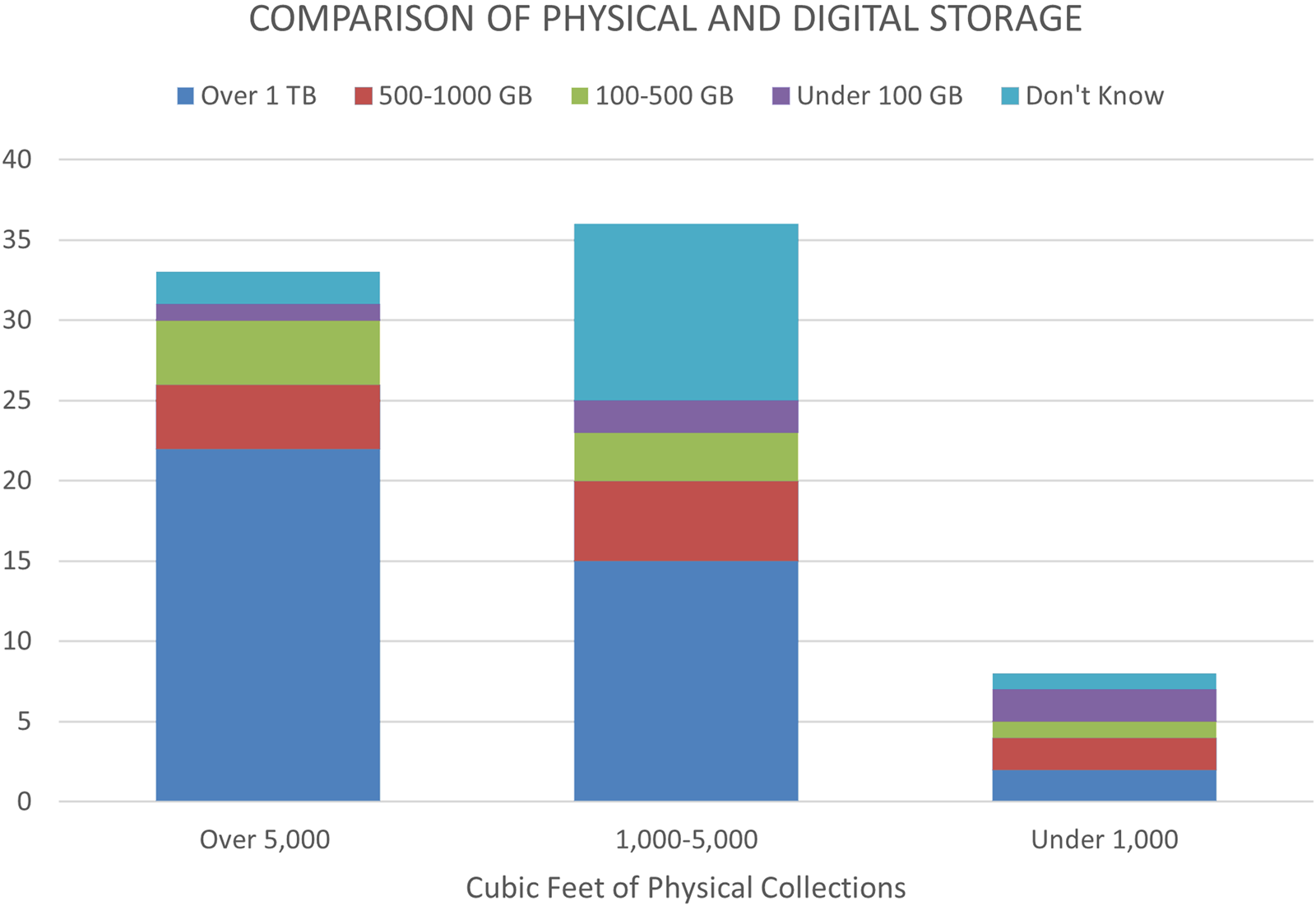
Repositories responding to the survey either focus primarily on archaeological collections or have archaeological collections as a major portion of their holdings (n = 75). Given this result, and not surprisingly, most of the repositories have large physical collections (Figure 2). Associated records are typically stored with collections (n = 75) or in a library or archive (n = 25), and some are stored in both. Where both were listed, we hope that the second system is a backup and not an indication that records are being separated into two, although the survey did not ask respondents to specify on that point. Forty-three repositories report having physical records in two or more locations, whereas 38 reported only one physical copy. Although this question was about paper records, seven respondents wrote in “digital” as a form of backup.
Repository holdings according to survey responses about the percentages of collections that are archaeological, the origin of archaeological collections, the size of physical collections, and the size of digital assets.

Overall, 80%–90% of the responses represent repositories with a major or primary focus on archaeological collections, each with holdings of over 1,000 ft.3 (28.3 m3) of physical materials. This is a good sample for understanding how major archaeological repositories are addressing the increasing influx of digital associated records and data.
Management of Associated Digital Records and Data
Most of the survey questions asked respondents for details about digital associated records and data. Of the 83 physical repositories responding, an overwhelming majority (88%) acknowledged having responsibility for in-perpetuity care of digital associated records, and the size of these assets, if known, skewed high (see Figures 2 and 3). One museum reported over a million files amounting to more than 25 TB of data. An open-ended question offered respondents a chance to expand on their responsibilities for digital associated records and data. Six respondents mentioned digitization or scanning of existing records in addition to handling born digital ones from new projects. Others offered specifics about how they meet their obligations, including examples where repositories share responsibility with other institutions.
Comparison of the size of physical versus digital resources being managed by the repositories that responded to the survey.
Standards for Digital Records
In this section of the survey, we asked questions to learn whether the standards developed by digital repositories had been adopted to address the different preservation needs of the digital records held by the respondents. About half (49%) reported having no standards (n = 13), little or no mention of digital files in their standards (n = 22), or standards under development (n = 6; Figure 4). This shows very little change from the tDAR survey conducted in 2010, which found that 46% of respondents offered no guidance for digital submissions (Watts Reference Watts2011:22). We note, however, that some of the respondents to our survey (1) only house legacy collections with no digital records, (2) do not actively accept collections, or (3) experience growth in their collections because of excavations conducted in-house. Repositories that do not take in collections processed by others might have less incentive to write formal standards, instead relying on shared internal procedures that may or may not be based on written policies. Still, the number of respondents operating with little or no guidance about how to manage and preserve digital associated records and data is sobering. We argue that repositories should have written policies for managing their digital records, regardless of whether they accept outside collections. What is unclear from the data is the level of awareness that digital standards exist. In retrospect, we should have added “I have never looked for or given much thought to digital standards” as an option.
Summary of responses about standards being used by repositories to address digital resources.

We also included five requirements that impose standards on digital assets and asked respondents to select all that are included in their standards (see Figure 4). Not surprisingly, given that half of respondents either had no standards or little mention of digital records in their standards, 42% impose none of these requirements. Only one repository reported employing all five requirements. Of the respondents who do report some requirements for digital submissions, no one standard jumps out as being most important. There is a relatively even split between file naming (n = 34), what to keep (n = 27), acceptable formats (n = 31), and metadata standards (n = 27).
An open-ended question prompted respondents to explain their standards—or lack thereof—whereby some common themes emerged from those who responded. Reasons that appeared more than once for why no standards for digital records had been developed were lack of time, short staffing, lack of expertise in the subject, and a lack of prioritization by leadership. A few respondents mentioned taking on the work to standardize digital assets in-house, through digitizing, renaming, or just finding it easier to adapt files taken in than to try to explain the system to others. Two repositories said they operated only in hard copies, and on a similar note, multiple respondents noted that they were still developing or implementing standards for physical collections.
Another theme that emerged in these responses was the impact of staff turnover. Three respondents cited the introduction of new staff as the impetus for developing or implementing standards for digital records, and one of these described the previous curator of 35 years as “not savvy to digital-age archiving.” This speaks to digital literacy factors impacting archaeological repositories. As retirements and staff changes occur, digital literacy may be an increasing consideration for new hires that will influence approaches to digital associated records.
Access to Digital Associated Records and Data
The survey asked repositories having digital associated records and data whether they have policies regarding access to these data, whether access is tracked, and if so, how many requests are received annually. Just over half of the respondents reported having access policies, whereas the remainder either lack these policies or did not know if one existed. The numbers were similar for tracking access, with equal numbers of “yes” and “no” responses (n = 37 each). Interesting responses in this category include one repository reporting that it did not make the records available at all, making access tracking moot; two repositories said they had yet to get any access requests to track; and another two noted that they tracked access, but inconsistently or inefficiently. These responses speak further to factors that arose when respondents were asked how many access requests they receive annually. The question proved complicated for many to answer because some records are publicly available online, some are available to registered users through online databases, or tracking only applied to certain file types, such as images. Because we asked for counts only, we are unable to evaluate these results in a meaningful way. Should we interpret the 19 respondents who reported 0–10 requests annually as a symptom that people are not accessing data, or could it indicate that the repositories are not the only gatekeepers of the records people want most? This remains unclear.
The accessibility of digital associated records is a complex topic that could easily warrant its own survey. It would be especially helpful to learn more about how organizations divide responsibility for making these resources available given that digital resources can be accessed remotely and do not require that physical repositories always act as the gatekeepers. Physical repositories are being tasked with long-term preservation and management of digital assets, but if site files, reports, catalogs, and finding aids are available online or through databases managed by partners or external agencies, such as State Historic Preservation Offices, then repositories may have no way of tracking access. This can be beneficial for distributing the workload of making digital associated records and data available, but it can have unintended consequences. Repositories tasked with long-term preservation and management of digital assets need resources to achieve this goal, but when it is time to justify their budget and staffing requests, they are in a weak position if people can get the records elsewhere.
Digital Asset Management Systems
Some of the more complex information gathered from the survey pertains to the question of whether repositories employ a digital data management system (DAMS) of any kind. We did not attempt to define what we meant by a DAMS, but we did ask respondents to name any systems they employ, which indirectly helps us understand how others set that definition. Of the 88 respondents, 41% either do not employ a DAMS or did not know if they did so. The remaining 59% answered in the affirmative, but the types of systems listed varied greatly (Figure 5).
Chart showing the types of DAMS mentioned by survey respondents.

Most of the systems mentioned (n = 16) fall into the category of cloud storage, such as Google Drive, Dropbox, Box.com, SharePoint, OneDrive, and Microsoft Azure. All of these systems offer storage with robust backups and search capabilities. Another oft-cited type of system was the repository's collections management system (CMS), such as Proficio, EMu by Axiell, Argus by Lucidea, and Qi by Keepthinking. These programs have varied capabilities largely focused on museum inventory, object metadata, and making collections information available online. Digital assets are among the resources that can typically be included in these systems. Four respondents cited systems that can be grouped as “bespoke finding aids,” of which three are affiliated with state governments (Arkansas, Iowa, and Virginia) that offer certain records online through a portal to registered users. The fourth in this category is the Digital Archaeological Archive of Comparative Slavery (DAACS), which offers users access to records such as catalogs, maps, and field photos. Finally, four respondents listed backups on servers, external hard drives, and CDs as their DAMS.
The next series of questions focused on specific capabilities by asking respondents if the systems they use can do the following:
• Store descriptive metadata with each digital object
• Facilitate public access to collections while protecting confidential or sensitive information, such as site locations and images of human remains and funerary objects
• Monitor for obsolete software and migrate outdated formats
• Regularly and systematically check for and remedy file corruption or deterioration
The first two of these capabilities fall under the heading of “management,” and the CMS and cloud-based systems cited by respondents often do have these capabilities, although a few respondents indicate that they are not employing the features. The latter two capabilities focus on the preservation of digital assets, and this is where the situation in repositories appears to be most dire. Only five repositories reported some kind of system to check for file damage or corruption, and a mere two use DAMS that handle migration. Consequently, although all but seven of the repositories report employing some form of responsible backup system (two have no backup, and five did not know), most are not safeguarding the functionality of the records. Just because a file still exists in a folder does not mean it will open and retain its formatting and functionality. Without that preservation element, the DAMS being used are not digital archives. It is notable that this finding is similar to the 2010 tDAR survey conclusion that preservation practices were underdeveloped at a majority of the responding repositories (Watts Reference Watts2011:12).
Not surprisingly, given the lack of preservation systems employed, 67% of respondents report having lost data. The most common reason for data loss was obsolete or corrupted storage media, such as floppy discs and CDs, but losses were also reported when formats and software became obsolete; when software or computer systems were updated, converted, or moved; as a result of human error; and, in one case, due to a lightning strike. Even cloud storage systems, such as OneDrive and SharePoint, failed to escape the data-loss phenomenon. Cloud-based systems that allow file sharing among large groups are convenient for creativity but risky for file integrity and preservation. Human error is a major risk factor when these systems are adopted and shared by people without sufficient training in how they work.
Training in Digital Archives
Training in digital archives is a specialized field of study. In recognition that the skills required to care for artifacts and paper records differ from those needed to care for digital assets, we asked questions about whether repositories have this specialized expertise in-house or through partnerships.
Regarding in-house digital archive expertise, results closely mirror the responses about whether repositories have standards for digital records or DAMSs. About half responded that they have no one with this training. The level of training among the remaining repositories varied greatly. Only eight respondents reported having staff with a degree or graduate level coursework related to digital archives. Although another 20 respondents mentioned courses, workshops, conferences, and on-the-job training, the focus of that professional development was unclear. Respondents may be reporting on training in their respective CMS, for example, which might help maintain a catalog and manage digital assets but could still be missing the preservation piece needed to act as a true digital repository.
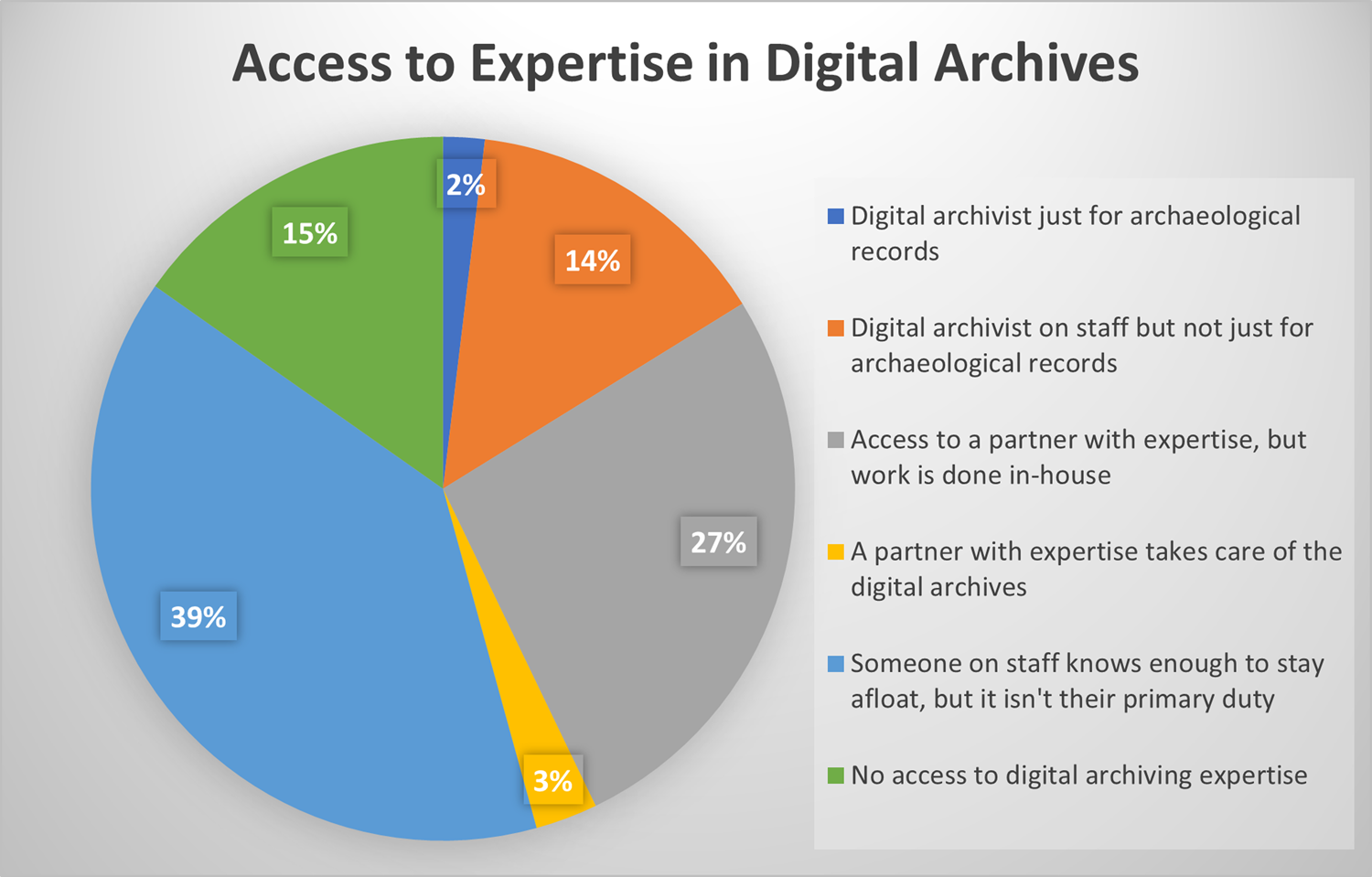
We wondered if repositories in a university setting might have easier access to expertise in digital archives thanks to degree programs in information science or partnerships with university libraries. Some repositories can create such partnerships, but more than half (54%) report that they either have no access to staff with expertise in digital archives or have someone on staff who can just keep things afloat, although it is not that individual's primary duty (Figure 6).
Chart summarizing responses to the question about access to staff with expertise in digital archives.
Fees and Funding
Archaeological repositories frequently have fee policies for incoming collections, although these fees vary greatly by region and repository (Childs et al. Reference Childs, Kinsey and Kagan2010). Given that associated records are increasingly delivered in digital form, we wondered whether fee schedules have been adapted to include digital asset management on top of box fees or fees for linear feet of paper records. When asked if they charge fees for digital asset submission, respondents overwhelmingly answered no (82%, including two who simply do not accept digital records). This is another area that has changed little since tDAR's 2010 survey (Watts Reference Watts2011:6). Of the respondents in our survey who do charge fees for digital assets (n = 13), two do so only partially—at the behest of federal agencies that require tDAR, for example. Others in this group stated that they have fees for digital data because they have intake fees in general; digital records are just considered part of the collections without a separate line item in the fee policy. With 88% of respondents reporting that they have responsibility for in-perpetuity preservation and management of digital associated records and data, but 82% saying that they charge no fees associated with this task, the question remains: where do repositories get funding to support their digital stewardship efforts?
The answers to an open-ended question on this topic were mixed. Twenty-four respondents cited their funding as coming from a parent agency, government, or operating budget, whereas 19 reported gathering funding piecemeal through grants, donations, contracts, and other revenue-generating activities. We suspect that most of these answers have to do with funding for the repository overall rather than digital records management specifically. Eight respondents admitted that there was no funding, and we worry that the silence of the 34 respondents who left this question blank is indicative of further examples falling into this latter category.
Challenges and Success Stories
The final two questions offered open-ended spaces for respondents to describe the challenges they face and the successful strategies they have employed to overcome them. In general, the challenges listed outweighed the successful strategies, and some of the strategies read more like warnings, such as “DON'T WAIT,” “don't rely on CDs,” and “if you're feeling overwhelmed, you're not alone.” Although no one offered model success stories (with the exception of the digital repository ADS that was founded to specifically address digital curation in the United Kingdom and will be discussed more below), some tips were mentioned that warrant discussion.
One respondent suggested setting a schedule for opening files to make sure they still function, which we agree with but feel would only work well with smaller collections. Repositories with large growing collections may not be able to employ this strategy efficiently and should explore other options. As an example, the Maryland Archaeological Conservation Laboratory (MAC Lab) is currently responsible for 563 GB of digital associated records representing 99,829 individual files. To check the viability of each file once a year, staff would have to open 48 files per hour every day, leaving no time to work on any other collections duties (not to mention vacation or sick days). Additionally, if corruption is discovered, no one at the facility has the expertise of a digital archivist, who might know what to do about it.
Another tip offered that would be a better fit for larger institutions with growing collections was the recommendation to look into professional services that care for digital files and to include these in annual budget discussions. Services designed to manage digital resources tend to employ computer programs to check for corruption and migration needs, and although they do have costs, they are likely to be better equipped to recover files when problems arise.
One respondent suggested piecemealing collections into smaller projects that could be funded through grants. This was another tip that we feel might work better for smaller collections without a rapid rate of growth. Large collections with ever-increasing submissions of digital associated records and data will require more sustained funding (see below). Some final tips include recommendations to implement a file-naming protocol and employ programs such as LibreOffice to open legacy software files. Several other respondents offered links to guidance that we include in Table 1.
Helpful Resources for the Curation of Archaeological Digital Records and Data.

Note: All links were accessed on October 18, 2023.
The remainder of this article will focus on challenges and the way forward, now that we have learned more about what is happening with digital associated records and data in archaeological repositories.
CHALLENGES FACING REPOSITORIES
The challenges cited by survey respondents closely mirror those of the curation crisis facing physical collections: lack of resources, the ever-increasing volume of material to manage, and the task of managing this material—new and old—according to current standards.
Challenges Cited in the Survey
Of the 43 people who chose to answer our open-ended question about challenges, 72% described a lack of funding, lack of staff or staff expertise, and/or lack of institutional support, either because the problem is invisible to the institution or there are information technology constraints. Second to the general refrain of “underresourced” was the issue of being sandwiched between staying current with rapidly changing digital technologies as they arrive in born digital formats while also digitizing paper-only records and incorporating inherited digital messes into new systems. “Inherited digital messes” include digital records that lack sufficient metadata to clearly define their purpose, digital files with multiple versions, old media (cassettes, videotapes, floppy discs, etc.), and different systems having been employed (old catalog databases, software, etc.) without later migration or successful integration into new systems. As one anonymous respondent put it, “Organizational strategies for digital files have varied over time, creating difficulty when trying to locate files associated with a particular site or collection. It's kind of like a building that has been added onto one room at a time.”
Only a few respondents mentioned worries about proprietary software being inaccessible or obsolete, the exponential increase in data associated with technologies such as GIS and remote sensing (not listed by name but also of concern are lidar, 3D scans, and photogrammetry), and the need for industry standards to deal with digital archaeological records and data. We fear that these issues were cited rarely not because they are infrequent, but because so many repositories are too underresourced to have reached this depth of understanding of the problem.
Even where staff are available, another theme that emerged in the responses is that collections duties are commonly at the low end of the priority list after other duties such as teaching, research, social media, administration, and facilities management. One respondent covered most of the common themes under challenges as follows:
Lack of resources (digital space, funding for programs, tech support, etc.) and staff to do the work is our largest challenge/frustration. Our repository has three full-time employees that have inherited over 100 years of one-of-a-kind paper archaeological records, of which less than 10% are digitized. While digitization and preservation of these records is a top priority for us, the three of us have additional responsibilities, including care of artifact collections, building management, volunteer supervision, and public outreach. This limits the time we can dedicate to creating and preserving digital data. Our office as whole does not have a records manager or archivist, nor do we have the funding to hire one, so the duty for understanding current standards, policies, and practices falls to already overworked staff.
Challenging Faulty Beliefs
We have inferred from the survey results that there may be some common beliefs held by many archaeologists and repositories that are contributing to the challenges mentioned above. First, the survey demonstrates that archaeological repositories have been—and apparently believe they should be—acting as one-stop shopping for people to submit archaeological collections and archives, whether they are artifacts, hard copy records, or digital records and data. This practice assumes that all receiving repositories have the resources and qualifications necessary to address the specialized needs of digital records on top of their obligations to physical collections, which the survey shows to be untrue. Repositories also seem to feel pressured to become digital archives because they have digital records to care for. Many respondents expressed their desire to develop digital standards if they did not already have some, as if they recognized that it is their obligation to do so. A recurring theme was that people need to do better digital preservation and management, but lack the staff / funding / time / institutional support to make it a priority.
The idea that each repository must also qualify as a digital repository is problematic. Active management of digital associated records can take place remotely without loss of access or control over digital resources, and digital archives such as ADS and tDAR already exist for this purpose. Although it might be beneficial to have more options, there is no reason for every physical repository to build its own digital repository system.
The reliance on cloud-based systems by so many survey respondents suggests that repositories already know how to interface with online service providers to manage digital resources, so why are people choosing the cloud over trustworthy digital repositories? Cloud storage may offer accessibility and some assurance that files will continue to exist, but without systematic corruption checks, migration efforts, formatting protocols, obsolescence planning, and so on, there is no way to know if the resource will be readable and functional when someone tries to open it. Although we did not explicitly ask it in the survey, we wonder if this is an awareness issue where respondents believe that cloud backups are enough to achieve “preservation.” Alternately, respondents may be aware of the cloud's shortcomings but rely on it for other reasons (e.g., lack of funding, institutional policies, etc.).
Finally, many survey responses suggested that repositories believe they should be doing more for digital records and data and may even feel guilt or shame for not doing so. For example, when asked if they had digital submission standards, respondent answers such as “we are working on it,” “we want to do this, but don't have the resources,” or “we're developing standards now” read like “no” responses from people who really wish that this was not their honest answer. The intent of the survey was just to take a snapshot of current practice, but the questions may have inadvertently invoked shame in areas where needs are not being met. However, we feel strongly that digital archaeological records are not vulnerable solely because repositories have dropped the ball. Instead, the shortcomings are another expression of the much larger systemic “curation crisis” that has been dogging the discipline for decades.
THE WAY FORWARD
As technology continues to change and practitioners increasingly look to noninvasive techniques to help do research without exacerbating the physical curation crisis, digital resources will increasingly take over as primary documentation of archaeological findings. To embrace this change without amassing more problems, efforts must focus on education about digital curation and a redistribution of responsibility so that the load does not fall solely onto repositories. Below, we outline both big-picture culture changes that are needed and a few successful band-aid strategies to improve current practice incrementally.
Attention Everyone! Culture Shifts for the Entire Discipline
Recognizing a Digital Archive
Everyone involved in the creation and retention of digital archaeological records and data needs to understand the difference between a “digital archive” and a traditional archaeological repository for physical collections. That means regulators who oversee compliance, everyone who funds archaeological work, project leads, fieldworkers, people who teach others how to do archaeology (public archaeology, college, graduate level), the repositories that care for the collections—seriously, everyone. Archaeological curation principles and information management need to better infiltrate each classroom, field project, and lab setting (Hrynick et al. Reference Hrynick, Anderson, Moore and Meade2023; Warner and Rivers Cofield Reference Warner and Cofield2024). Although various government entities and policymakers also have a responsibility to these resources, they are unlikely to be proactive and supportive of funding for digital curation without a major education effort directed their way as well.
This is easier than it sounds, because people outside of the archaeological discipline have already written the definitions, which are readily available and updated regularly. For example, the CoreTrustSeal Trustworthy Data Repositories Requirements describe the characteristics required to be a trustworthy repository for digital data and metadata (CoreTrustSeal 2023–2025), and they maintain an online list of repositories that meet the standards. For federal projects, the National Science and Technology Council of the US federal government recently issued a list of desirable characteristics of data repositories for federally funded or supported research (National Science and Technology Council 2022), which provide a useful framework for repositories that curate archaeological digital records and data. ADS, the Center for Digital Antiquity, and others have published about how to apply such standards within the discipline of archaeology (see, for example, the detailed description of a trustworthy digital archive in McManamon and Ellison Reference McManamon, Ellison, Lercari, Wendrich, Porter, Burton and Levy2022:176–177). Links to key standards and applications, such as the ADS guide to the life cycle of digital associated records and data, are provided in Table 1.
Reading these guidance documents can be intimidating because technical terms can read like a foreign language to archaeologists, but we suggest that archaeologists need not fully comprehend the standards as long as they know that they exist. It is not necessary to know how to meet these requirements unless one is trying to be a digital repository. It is only necessary to be able to evaluate digital repositories by knowing the capabilities to look for or checking to see if a potential repository is on a vetted list.
Archaeologists need not be trained to do digital curation, but they must understand what digital archiving is, what digital archivists do in general, why archaeologists need digital archivists, and where archaeologists fit in the digital data system (see Bollwerk et al. Reference Bollwerk, Gupta and Smith2024).
Hire Professionals
Just as a DIY plumber is unlikely to fix a water-main break, all archaeological practitioners need to recognize that digital curation requires specialized skills and training beyond those existing in physical repositories. If resources allow, physical repositories should hire digital archivists who are generally getting degrees such as a master's degree in library and information sciences or museum studies. Ideal candidates will also have some background in archaeology or anthropology to reduce the need for on-site training in how archaeologists manage and use archives. Having such staff will not instantly make each repository a trustworthy digital repository, but it will add individuals who recognize the needs of the records and can develop informed strategies to address them.
The strategies they develop may involve working with existing digital repositories that meet the CoreTrustSeal requirements, such as tDAR (for example, see Center for Digital Antiquity 2013). tDAR, along with ADS, have established standards for digital curation that include metadata, file formats, guidance on the life cycle of an archaeological project in relation to the digital data created, ways to archive records and data by file type, and many other strategies useful for both archaeologists and repositories. Why reinvent the wheel?
In general, archaeologists would literally rather have their head in the sand than have to address digital stewardship. Fortunately, there are whole organizations of professionals and practitioners to lean on, such as the National Digital Stewardship Alliance, the Digital Library Federation, the Digital Curation Centre, the Open Preservation Foundation, and even the other SAA—the Society of American Archivists. If we want to keep our heads in the sand, we should be inviting people from these groups to apply their expertise to archaeological resources, and we must be willing to pay for it.
Get Real about Costs
One of the common refrains in the survey results is that there is no funding for the extra staff or fees to upload files to an existing system or to hire a digital archivist. Repositories rely heavily on free storage systems, such as Dropbox, Box.com, and Google Drive, because “free” seems to be all they can afford. If this is just accepted as an unchangeable reality, then we must also concede that the digital resources produced by archaeologists will be fleeting. This not only undermines the ethical documentation of archaeological projects but also runs contrary to legal requirements for federal projects (Cultural Heritage Partners 2012).
The Federal Highway Administration Federal Preservation Officer David Clarke has advocated for one-time fees for digital curation because agencies would pay up front if only repositories would charge them (Witze Reference Witze2019:44–45). One-time curation fees allow project leads to budget for curation in contracts and infuse repositories with some income.
We agree that one-time fees are a legitimate fundraising strategy, and every bit helps, but up-front fees can only cover the true cost of in-perpetuity curation—including staff, space, equipment, and materials—if they are high enough to sustain an interest-bearing account akin to a trust or endowment. When fee policies do not meet this threshold, repositories cannot realistically expect to raise enough money to become a digital archive, or even support the salary of a digital curator. We do not suggest that everyone charge higher one-time fees, because dramatic fee increases could lead to an increase in orphaned collections. Repositories need to base fees on a balance between their funding needs and the price point that new projects will support. However, it is important for everyone to recognize the limitations of one-time fee structures for creating a sustainable program. One-time intake fees to support salary requires constant and predictable growth in collections while staffing remains level, but one person cannot address ever-growing collections indefinitely.
Additionally, intake fees only help repositories that accept outside collections. According to an interactive map of repositories in the United States compiled by the Collections and Curation Committee of the Society for Historical Archaeology, 85% of the repositories that accept collections charge intake fees. However, of the 150 repositories on the map, 57% do not accept collections because they are out of space or because they care only for the collections generated or owned by their own institution (e.g., park systems, historic sites, universities, etc.). We therefore want people to think realistically about the concept of one-time fees and funding for sustainable repositories.
Just as it costs money to conduct fieldwork, do lab work, and write reports, it costs money to maintain the results of this work. Ongoing infrastructure and human resources are needed. As the ADS respondent to the survey noted, “There is no system in the world that automatically migrates obsolete formats, but our archivists manually monitor this and will carry our bulk migrations where needed.” Digital archives, such as ADS and tDAR, charge fees because they have real costs (Kintigh and Altschul Reference Kintigh and Altschul2010; Richards Reference Richards2017; Richards et al. Reference Richards, Austin and Hardman2010). These organizations are not profit-seeking inventors pushing a newfangled tool to cut a tomato when a knife will do. They are the ones who recognized that when it comes to digital archaeological data, existing repositories do not even have a knife.
All practitioners who share responsibility for the archaeological record—regulators, funders, project leads, those creating the records, et cetera—should know what digital curation is and check that each new project has planned and budgeted appropriately to make it a reality. This needs to go beyond the one-time fee to include lobbying by professional archaeological organizations so as to make curation of digital associated records in a trusted digital repository an explicit requirement of archaeological permits issued at the federal, tribal, state, and local levels. Those organizations should also lobby for grant programs, such as at the National Science Foundation, to ensure that all grants include funding for the curation of both physical and digital collections, as well as have a funding program to assist repositories in their curation practices. Most importantly, however, will be lobbying for sustained funding for repositories (digital and physical) that is sufficient to maintain existing collections and increase in parallel with the growth of collections.
What Physical Archaeological Repositories Can Do
Although larger culture shifts across the discipline are needed to address digital curation, physical repositories facing this challenge in the present can help by changing their messaging and taking control of the digital resources they accept. We suggest that physical repositories become familiar enough with guidance for trusted digital repositories to do a self-evaluation with these requirements in mind (Community Owned Digital Preservation Tool Registry 2021; CoreTrustSeal 2023–2025; see Table 1). Armed with an informed self-evaluation, repositories can be transparent about their capabilities—or lack thereof.
The survey results indicate that physical repositories are generally not meeting the standard of a digital archive, which means that they have a choice between working to become one or redirecting digital resources elsewhere. We suspect that the latter is most realistic, so an important first step is to be explicit about not being a trustworthy digital archive. If the repository wishes to control the disposition of the digital resources, it may opt to select a digital archive to use, form contractual partnerships with experts, and charge fees accordingly.
Alternately, repositories may explicitly limit themselves to physical artifacts and hard copy records, leaving depositors responsible for finding a separate digital archive that the physical repository can easily access and communicate with about linking the different parts of a collection. In this case, it may be wise to have depositors sign some kind of acknowledgment to that effect.
Given that tablets are increasingly used in the field, more original records are born digital, including field forms, journals, and sketched maps. Those repositories that decide to limit themselves to hard copies should require both original hard copies (when generated) and printed versions of born-digital records whenever feasible. Additionally, it may not be wise to shut the door completely on digital records given that they are convenient to have as long as they are functional and can be used for reference and research access. In many cases (e.g., lidar, GIS maps, and 3D scans), they may have important information that cannot adequately translate to a hard copy. For internal use, repositories should apply their strengths in collections management to impose standards that require digital records to be organized, inventoried, and culled prior to submission. If repositories want to add more technical details, Table 1 offers some helpful links for learning more.
Unfortunately, the survey results indicate that physical repositories are already responsible for huge quantities of digital resources, and these are at risk. Even if policies are rewritten to stop the problem from growing by redirecting submissions to specialized digital archives, there will still be a backlog. Therefore, repositories will need to seek help. Grants may be a viable option once there is a finite, measurable backlog of resources to address.
Another option is to work with established libraries or archives that have a shared community, university system, or government agency with the repository. Most libraries and archives understand the life cycle of digital materials, the management hardware and software necessary to do the work, access and use protocols, and appropriate metadata, among many other issues that pertain to archaeological records and data. As outlined by Hrynick and colleagues (Reference Hrynick, Anderson, Moore and Meade2023), there are great benefits to having liaison librarians on archaeological projects to help with various aspects of information management.
FINAL THOUGHTS
A primary takeaway of the survey is that repositories are carrying a huge burden. This is not a revelation. The many problems related to the curation of archaeological objects and hard copy associated records have long been recognized. Progress to rectify those problems has been slow and piecemeal but steady (Childs Reference Childs and Stevenson2022; Childs and Warner Reference Childs and Warner2019). The importance and impact of the digital revolution in archaeology, both hardware and software, are only about 20 years old and, in a sense, were foisted on repositories already stretched thin by their responsibilities to traditional collections.
What is problematic is that repositories seem to think that this is appropriate; it is their responsibility to act as digital archives even though they lack the funding, staff expertise, and institutional support to do the work. Furthermore, repositories are joined by depositors, who also think they either are or should be trustworthy digital repositories. This may be influenced by 36 CFR 79, “The Curation of Federally Owned or Administered Archeological Collections” (https://www.ecfr.gov/current/title-36/chapter-I/part-79?toc=1), which does address digital records as if all repositories should be able to care for all artifacts and associated records—both hard copy and digital. However, its adoption in 1990 could not have foreseen the digital reality of the 2020s and beyond. The creation of numerous independent trusted digital archives is simply untenable.
The solution, as ever, must be a systemic one. Raising awareness about what digital curation is and what digital curators do in general is key. Archaeologists in every sector of practice must develop that awareness, take responsibility for the records they generate, and raise funds to cover curation, including preservation costs. Professional archaeological organizations must lobby regulators to update the requirements for preserving and funding digital data and records. Otherwise, repositories will remain unsustainable and eventually fail. Records and data that have not already been lost will disappear. Then how will we justify the expense of making more data to throw into the void?
Acknowledgments
We would like to thank all the respondents to the “Survey for Archaeological Repositories about Digital Associated Records and Data,” particularly those who elaborated on their answers in the open-ended questions. Thanks also to Maria Molina who translated the abstract into Spanish. A permit was not required for this research.
Funding Statement
The authors received no financial support for the authorship of this article.
Data Availability Statement
The “Survey for Archaeological Repositories about Digital Associated Records and Data” was conducted using Google forms, with responses exported to an Excel spreadsheet. This file is available as Supplemental Table 2, with names and affiliations changed to numbers for purposes of confidentiality. This file is also available at the Maryland Archaeological Conservation Laboratory in the “Digital Media” folder for associated archaeological records and in the subfolder named “Digital_Curation_Survey_2023.” Please contact the authors for a copy of this file.
Competing Interests
S. Terry Childs is on the editorial board of Advances in Archaeological Practice.
Supplemental Material
For supplemental material accompanying this article, visit https://doi.org/10.1017/aap.2023.29.
Supplemental Table 1. List of the Questions Asked in the “Survey for Archaeological Repositories about Digital Associated Records and Data.”
Supplemental Table 2. Survey Responses (with names and affiliations removed for purposes of confidentiality).


 Open access

