





Management Implications
Generally, control of invasive species is shown to be economically beneficial at the landscape scale. However, within mosaics of public–private land ownership, control of invasive plants presents challenges that may make economic justification difficult. We calculated the cost of purchasing additional hay needed to maintain a 500-head cattle herd given three Ventenata dubia (ventenata) invasion scenarios. We then compared these costs with the cost of controlling V. dubia with indaziflam versus purchasing supplemental hay to replace forage lost to V. dubia invasion. Ventenata dubia management was economically feasible on ranches in northeast Wyoming in many cases. Information on the impacts of V. dubia, control options, and the long-term benefits to be had from control are likely persuasive to many landowners, because most landowners are interested in conservation of natural resources and ecosystem goods and services. However, when utilization of available forage or site productivity was low and where higher discount rates were used, purchasing supplemental hay was warranted over V. dubia control. In these cases, support and coordination among neighboring landowners is needed to overcome trade-offs between realized and potential losses due to further weed spread and to achieve effective landscape-scale control. Coordination works by aligning individuals’ motives with their neighbors, thereby considering the costs and benefits to neighboring properties. In northeast Wyoming, the NRCS has also implemented a cost-share program to relieve much of the cost of control, making control even more realistic for most landowners.
Introduction
Many people rely on rangelands for their livelihoods and for ecosystem goods and services (EGS), including cultural and aesthetic needs (DiTomaso et al. Reference DiTomaso, Monaco, James, Firn and Briske2017; Havstad et al. Reference Havstad, Peters, Skaggs, Brown, Bestelmeyer, Fredrickson, Herrick and Wright2007; York et al. Reference York, Brunson and Hulvey2019). Invasive species are a major cause of global change and pose a threat to EGS provided by rangelands (DiTomaso et al. Reference DiTomaso, Monaco, James, Firn and Briske2017; Finnoff et al. Reference Finnoff, Strong and Tschirhart2008; Olson Reference Olson2006). Invasive plant species are one of the largest causes of biodiversity loss and habitat degradation (Olson Reference Olson2006; Pimentel et al. Reference Pimentel, Zuniga and Morrison2005; Vitousek et al. Reference Vitousek, D’Antonio, Loope, Rejmanek and Westbrooks1997).
Introduction and spread of nonnative species is largely the result of human mobility and economic drivers, such as trade (Epanchin-Niell Reference Epanchin-Niell2017; García-Llorente et al. Reference García-Llorente, Martín-López, González, Alcorlo and Montes2008; Goodenough Reference Goodenough2010; Holmes et al. Reference Holmes, Aukema, Von Holle, Liebhold and Sills2009; Olson Reference Olson2006; Pejchar and Mooney Reference Pejchar and Mooney2009; Sala et al. Reference Sala, Chapin, Armesto, Berlow, Bloomfield, Dirzo, Huber-Sanwald, Huenneke, Jackson, Kinzig, Leemans, Lodge, Mooney, Oesterheld and Poff2000; Vitousek et al. Reference Vitousek, D’Antonio, Loope, Rejmanek and Westbrooks1997). Land managers are often faced with multiple target species or populations, multiple control options with different trade-offs, and limited budgets (Carrasco et al. Reference Carrasco, Mumford, MacLeod, Knight and Baker2010; D’Antonio and Meyerson Reference D’Antonio and Meyerson2002; Epanchin-Niell Reference Epanchin-Niell2017; Leung et al. Reference Leung, Lodge, Finnoff, Shogren, Lewis and Lamberti2002; McIntosh et al. Reference McIntosh, Shogren and Finnoff2010). Therefore, economic considerations of managing invasive species play a central role in determining how best to approach invasive species problems, including preventing introductions, prioritizing different species or populations, slowing spread, weighing control options, and comparing policy options and structures.
Although there is a clear need to prevent and manage invasive plants and their spread, many ranchers may not be able to do so, because prevention and management may be cost-prohibitive. Invasive species management may not be profitable for ranches (Tanaka et al. Reference Tanaka, Brunson, Torell and Briske2011). This potential lack of profitability seems contradictory with the general finding that invasive species prevention and control is beneficial (De Groot et al. Reference De Groot, Blignaut, Van Der Ploeg, Aronson, Elmqvist and Farley2013; Taylor et al. Reference Taylor, Rollins, Kobayashi and Tausch2013). Part of the discrepancy is that invasive species exist on mosaics of public–private ownership, whereas most economic studies of invasion assess the problem at the landscape scale (Epanchin-Niell and Wilen Reference Epanchin-Niell and Wilen2015). From the private landowner perspective, each weighs the cost and benefits of management options on their own property (Epanchin-Niell Reference Epanchin-Niell2017; Epanchin-Niell and Wilen Reference Epanchin-Niell and Wilen2015).
As invasive species spread across the landscape, individual landowners incur only a subset of the total costs to the region. The damages invasive plants cause at larger scales far exceed the damages caused at smaller, parcel-level scales (Cook et al. Reference Cook, Liu, Murphy and Lonsdale2010; Epanchin-Niell and Wilen Reference Epanchin-Niell and Wilen2015; Liu and Sims Reference Liu and Sims2016). Some landowners may not be aware of the presence or impacts of invasive species and may tend not to act on invasive species until after they are affected directly by noticeably severe impacts (Johnson et al. Reference Johnson, Davies, Schreder and Chamberlain2011; Rajala et al. Reference Rajala, Sorice and Toledo2021).
Also important to consider is the long-term nature of prevention and control efforts. Conservation and invasive species control practices generally result in the intended benefits in terms of EGS, and for large entities such as governments and larger ranching operations, invasive species control can be justified at landscape scales (Liu and Sims Reference Liu and Sims2016). However, many EGS are externalities that cannot be accounted for in a profit-driven ranch budget (Roche et al. Reference Roche, Saitone and Tate2021). Additionally, many control efforts are long-term investments that may not yield net benefits for many years, making them unprofitable for smaller private landowners (Dyer et al. Reference Dyer, Maher, Ritten, Tanaka and Maczko2021; McDermott et al. Reference McDermott, Irwin and Taylor2013). The risk of failure over the long term for individual control efforts is also often high, and ranchers may not be able to justify the repeated treatments necessary to maintain control (Hardegree et al. Reference Hardegree, Jones, Roundy, Shaw and Monaco2016; Monaco et al. Reference Monaco, Mangold, Mealor, Mealor and Brown2017; Sheley et al. Reference Sheley, James, Rinella, Blumenthal, DiTomaso, Briske and Briske2011).
In northeast Wyoming, ventenata [Ventenata dubia (Leers) Coss.] and medusahead [Taeniatherum caput-medusae (L.) Nevski] have recently been documented with self-sustaining populations in the Great Plains ecoregion (Garner and Lakes Reference Garner and Lakes2019; Hart and Mealor Reference Hart and Mealor2021). Ranches affected by invasive annual grasses are more likely to be forced to leave the livestock industry due to the necessity of procuring alternative feeds or decreasing stocking rates to suboptimal levels (Maher et al. Reference Maher, Tanaka and Rimbey2013). Ventenata dubia is associated with reduced perennial forage while being unpalatable, making it a poor forage replacement and a threat to the large livestock industry of Wyoming and neighboring states (Hart and Mealor Reference Hart and Mealor2021). Ranchers in northeast Wyoming are therefore faced with a dilemma. Is it more cost-effective to control V. dubia with herbicide or purchase additional feed to offset forage losses?
To facilitate the management of V. dubia and T. caput-medusae in northeast Wyoming, the Northeast Wyoming Invasive Grass Working Group (NEWIGWG) was formed in early 2017. NEWIGWG is composed of agencies and landowners within the region, including the NRCS, country weed and pest offices, and the Nature Conservancy, among others (Sheridan County Weed and Pest 2017). NEWIGWG has been working to curtail the spread of V. dubia and T. caput-medusae in northeast Wyoming by implementing landscape-scale control efforts, engaging in community outreach and education, and implementing cost-share programs to help with management efforts. We explored the economic efficacy of V. dubia control by incorporating field-collected forage and control data for northeast Wyoming into an existing enterprise budget—a cow–calf (Bos taurus L.) operation. Our objective was to compare the cost of controlling V. dubia with herbicide to the cost of increasing supplemental hay feeding of cattle for a ranch operation in northeast Wyoming. We wanted to learn whether damages caused by V. dubia are high enough, and control costs low enough, to justify management on private ranches in the region.
Materials and Methods
The Enterprise Budget
To estimate the economic impacts of V. dubia management, we incorporated multiyear forage production data into an enterprise budget developed by University of Wyoming Extension that lists expected expenses and income of specific enterprises for a large (500-head), private land ranch in Major Land Resource Area 58b. This area is described as northern rolling high plains consisting of Campbell, Converse, Johnson, Natrona, Niobrara, Sheridan, and Weston counties of Wyoming, and Big Horn County, Montana (Dyer et al. Reference Dyer, Kirkpatrick, Hilken, Roberts, Maher, Ashwell, Feuz, Tanaka, Ritten and Maczko2018). We developed partial budgets to assess the economic impacts of V. dubia and subsequent control with herbicide compared with the baseline with no V. dubia impacts. Partial budgets are decision-making tools used to compare different options in terms of costs and benefits. They are divided into four components: added income, added costs, reduced income, and reduced costs.
Forage Estimates
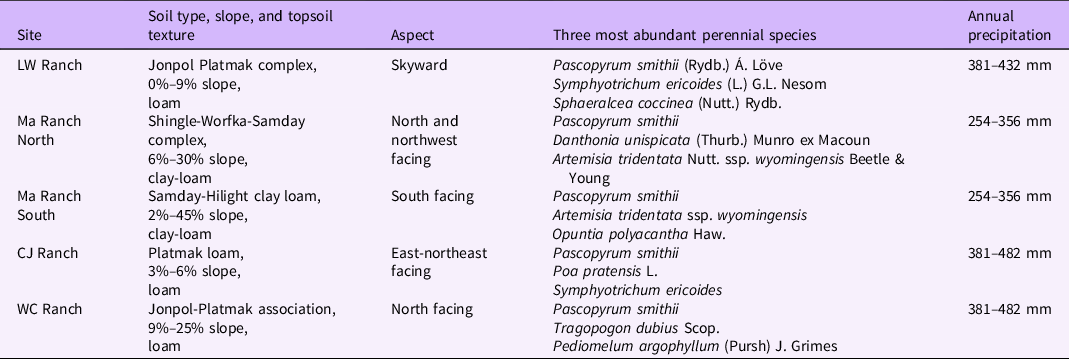
Because the enterprise budget used here does not specify actual land area of the rangeland portion of the ranch (Dyer et al. Reference Dyer, Kirkpatrick, Hilken, Roberts, Maher, Ashwell, Feuz, Tanaka, Ritten and Maczko2018), we calculated the acreage based on 3 yr of rangeland biomass collections. The forage estimate was needed to estimate the cost of herbicide spraying, which depends on the spatial extent of land to be sprayed. We sampled rangeland forage production at five sites in Sheridan County, Wyoming, to estimate productivity and forage losses associated with V. dubia in the region. These sites were treated aerially with 73 g ai ha−1 of indaziflam in the fall of 2018, creating treated and nontreated sites adjacent to one another. These sites account for a wide range of productivity (Table 1) and environmental variability within the region (Table 2). In July of 2019, 2020, and 2021, we sampled four paired, treated and nontreated plots at each site. Each sampling plot was 30 m2, and all plots at each site were within 100 m of one another. In each plot, we haphazardly placed two 0.25-m2 subplots. We collected all herbaceous aboveground biomass and separated it into the following functional groups: perennial grasses, annual grasses, perennial forbs, and annual forbs. We pooled biomass at the plot level for analysis. All biomass was air-dried in a forced-air oven at 60 C for 48 h and then weighed. We calculated total rangeland area for the ranch by estimating the average animal unit months (AUM; defined as 363 kg [800 lb] of air-dried forage) across these sites for a range of forage utilization levels: 25%, 35%, and 50% utilization of total available forage.
Perennial productivity of sites used to estimate available forage on treated (t) and nontreated (n) acres in Major Land Resource Area 58b.
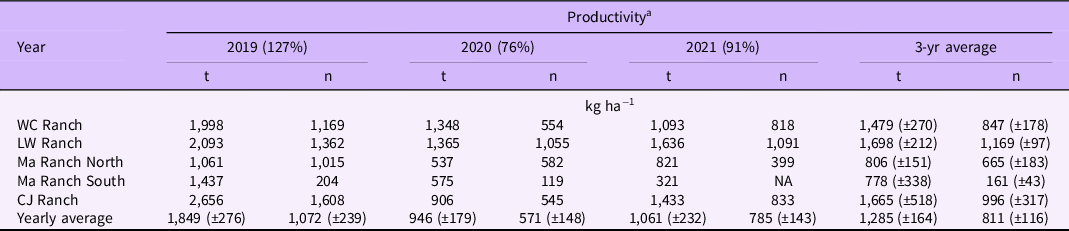
a Productivity is kg ha−1 of air-dried biomass sampled in July. The 30-yr average annual precipitation in Sheridan county is 359.7 mm (14.2 in.). The percent of the 30-yr average is given in parentheses for each year. Standard error is given for each average in parentheses.
Site information for Ventenata dubia removal study sites in Sheridan County, Wyoming.
Invasion Scenarios
We calculated forage impacts for three invasion scenarios: low invasion, high invasion, and a worst-case scenario. Invasion size in these scenarios (20% of rangeland acres impacted for the low-invasion scenario, 80% for the high-invasion and worst-case scenarios) are somewhat arbitrary. Actual acreage will vary widely depending on suitability for V. dubia on any particular ranch. Between 2018 and 2022, NEWIGWG partners treated more than 40,500 ha (100,000 ac) of V. dubia– and T. caput-medusae–infested rangelands. Initially, several of our sites had extensive, mostly unbroken populations of V. dubia, meaning 80% of acres impacted is a reasonable estimate, while 20% allows for a low estimate of population expanse. We based our estimates of impacts on our field production data as well as reports and personal communication from weed and pest offices in the region. Of the impacted acres, ∼60% are low population density infestations causing a 20% reduction in forage of those areas, ∼10% are medium density causing a 40% reduction of forage on those areas, and the remaining ∼30% have a high density of V. dubia causing an 80% reduction in forage. Using these estimates, we weighted the impacts based on their expected distribution. For example, in the low-invasion scenario, 12%, 2%, and 6% of rangelands (20% of the total rangeland) are affected by low, medium, and high densities of V. dubia, respectively. This invasion scenario causes an estimated 8% reduction (∼231 AUM) of forage from the total rangeland AUM (2,890) provided by the baseline of the enterprise budget (2,890*0.12*0.2 + 2,890*0.02*0.4 + 2,890*0.06*0.8 = 231.2). In the high-invasion scenario, 80% of the area is impacted, causing an estimated 32% reduction (∼925 AUM) of forage from rangelands. For the worst-case scenario, we still assumed that 80% of the area is impacted by V. dubia, but with a 50% reduction (1,445 AUM) of total forage; this represents our most extreme observations in the region.
Once we estimated our V. dubia impacts, we adjusted available AUM in the rangeland portion of the baseline enterprise budget to simulate a ranch invaded by V. dubia in the three scenarios above assuming that (1) perennial grasses on affected lands are still available forage, as we do not know at what point cattle will refuse to graze V. dubia; and (2) V. dubia is entirely unpalatable to cattle. For the purposes of illustration, we assume that any loss in AUM is what the ranch has been operating at up to the present. Therefore, the decision being made is whether to treat V. dubia, not prevent it. We also assume the rancher wishes to maintain the full size of their 500-cow herd. Other options for the ranch, such as reducing herd size to account for reduced grazing capacity, are not explored for this analysis.
Options for the Ranch
Because the rancher in our scenarios wishes to maintain the size of their herd, the loss of rangeland AUM must be offset by an equivalent amount of supplemental feed, +25% to account for losses associated with hay feeding. These losses can range from 25% to 30% for hay stored outdoors on the ground caused by continued plant respiration and microbial activity after baling, which are affected by moisture content at the time of baling, storage conditions, forage species, and environmental conditions (Lemus Reference Lemus2020). The additional hay needed to feed the herd is split evenly between meadow and alfalfa (Medicago sativa L.) hay (sensu Dyer et al. Reference Dyer, Kirkpatrick, Hilken, Roberts, Maher, Ashwell, Feuz, Tanaka, Ritten and Maczko2018). The price of this hay is US$249 1,000 kg−1 (US$226 U.S. ton−1) of alfalfa and US$222 1,000 kg−1 (US$201 U.S. ton−1) of meadow hay. These costs are the 3-yr averages (2019 to 2021) of inflation-adjusted market price for Wyoming (USDA-NASS 2021). One important point is that if excess hay that could be sold were produced on the ranch, we would need to account for the lower quality of V. dubia–infested hay. However, excess hay is not produced by this ranch, so accounting for lower-quality hay sold is not necessary.
Because our rangeland forage production estimates were derived from post-treatment data, we calculated that removal of V. dubia would return 100% of perennial forage species and lost AUM would completely return the year following herbicide application, bringing the costs and values to the baseline given by the unaffected model. However, results will likely vary across sites and with environmental variability. In other ecoregions with a mix of rhizomatous and bunchgrasses, an additional year to recover from invasion may be required. Cost of control is based on actual costs of applying indaziflam by helicopter for Sheridan County, including labor (US$144 ha−1; US$58 ac−1; NRCS and Sheridan County Weed and Pest Office, personal communication). We calculated costs associated with these options at the end of 3 yr, the time frame when the NRCS re-treats sites in northeast Wyoming. Suitability of rangelands for V. dubia will also vary widely on different ranches. Depending on how early V. dubia is detected, a ranch may see increases in its presence and associated impacts or may have a relatively stable population. For our scenarios, we assume that the V. dubia population and its associated costs remain stable, rather than increasing or decreasing from one year to the next.
To calculate the net present value (NPV) of the costs of each option in each scenario, we applied a range of discount rates. A discount rate is applied to take into account the time value of money: the concept that money is worth more now than the same amount of money in the future. We used discount rates of 3%, 5%, 7%, and 10% to account for a range of possibilities. Different discount rates can change the outcome of analyses. For example, a higher discount rate would make the present value of future hay purchases less, but would not change the value of treating V. dubia by applying herbicide, as that is an upfront cost. At a high enough discount rate, the cost of hay would be less than the upfront cost of herbicide application for V. dubia. Other discount rates may also be appropriate depending on available rates on operational loans and individual risk preference. Agricultural operations can often get a lower interest rate on operational loans, which could justify using a lower rate. However, a risky investment may justify a higher discount rate. For our selected rates, we applied a discount factor to the cost of each year to calculate the present value using the formula PV = C t /[(1 + r) t ], where PV is present value, r is the discount rate, and C t is the cost at time t. For example, with a discount rate of 5%, a cost of $100 in year 3 would be calculated as 100/[(1 + 0.05)3], or 100/1.1576, which is ∼US$86 in present value.
Results and Discussion
Forage and Acreage Estimates
Based on our forage samples, our estimate for average July forage was 1,285 ± 164 kg ha−1 (∼1,147 lb ac−1) after herbicide treatment (Table 1). We used this estimate as our available forage, post V. dubia control. Using this forage estimate, at 50% utilization (1,285 kg ha−1 * 0.5 = 643 kg ha−1 forage utilized), we found that rangelands at our sites produce ∼1.8 AUM ha−1 (643 kg ha−1/363 kg AUM−1). Therefore, our biomass production estimates indicate that we would need 1,633 ha (4,033 ac) to provide the 2,890 AUM of usable forage (2,890 AUM/1.8 AUM ha−1) presented in the enterprise budget of Dyer et al. (Reference Dyer, Kirkpatrick, Hilken, Roberts, Maher, Ashwell, Feuz, Tanaka, Ritten and Maczko2018). For 35% utilization, 2,331 ha (5,761 ac) are needed to provide the same AUM. At 25% utilization, 3,264 ha (8,066 ac) are needed.
In nontreated plots, perennial forage for July was 811 ± 116 kg ha−1 (∼724 lb ac−1). This is a drop in available forage of 37% of the 3-yr average. The lowest drop in forage seen in our study sites was about 4% on Ma Ranch North in 2019. Compare this with the highest drop, which was an 86% drop on Ma Ranch South, also in 2019. These data, along with the reports from weed and pest offices in Wyoming also experiencing V. dubia invasion, were used to formulate the three invasion scenarios outlined above.
Hay Costs
In the low-invasion scenario, 8% (231 AUM) of the rangeland AUM are lost due to V. dubia invasion. The amount of extra hay needed to supplement the lost grazing would be 104,900 kg (116 U.S. tons) split between alfalfa and meadow hay forages. An extra 52,400 kg (58 U.S. tons) of alfalfa at US$249 1,000 kg−1 and 52,400 kg of meadow hay at US$222 1,000 kg−1 adds an additional US$24,679 to that spent on hay already in the baseline enterprise budget. This amount, which represents a 5.7% increase in annual operational costs over the baseline enterprise budget, would need to be spent every year the rancher decides not to control V. dubia or to explore other options (Table 3). In the high-invasion scenario, with 32% of forage lost (925 AUM), an additional 209,700 kg (231 U.S. tons) of alfalfa and 209,700 kg of meadow hay are needed to maintain the size of the herd each year. This hay amounts to US$98,715 annually (Table 3), which is 22.9% added to the annual operational costs of the ranch. In the worst-case scenario, with 50% of forage lost (1,445 AUM), 327,700 kg (361 U.S. tons) each of meadow and alfalfa are needed. The cost of this hay would be US$154,243 spent annually (Table 3), which is a 35.8% increase over the baseline operational costs of the ranch.
Hay costs under low-invasion, high-invasion, and worst-case scenarios of Ventenata dubia impacts for a 500-head, private land ranch in Major Land Resource Area 58b. a
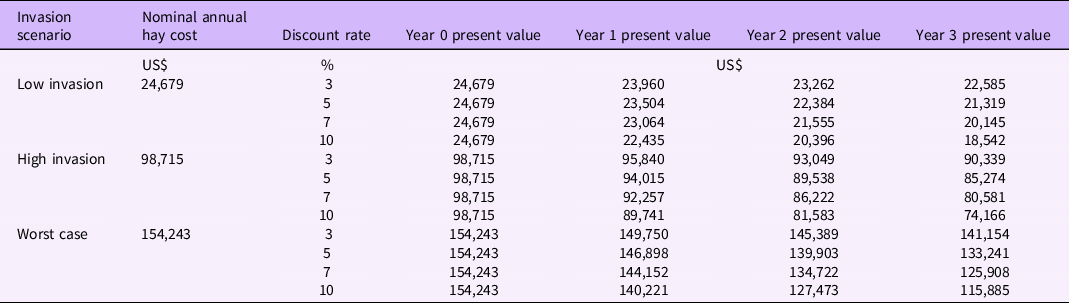
a Nominal hay costs are presented, with various discount rates applied for 3 yr into the future.
Control Costs
Because the cost of controlling V. dubia with herbicide is all incurred in Year 0, there are no future costs within the analysis time frame. Therefore, discount rates do not affect the cost of control options. Rather, the cost of this option is dependent upon the land area to be sprayed. The enterprise budget tool we used has a fixed quantity of rangeland forage, so different potential forage utilization rates affect the land area needed to provide the same amount of usable forage. At lower utilization rates, a larger land area is needed to provide the 2,890 AUM, while the same AUM can be provided on smaller areas that are utilized more completely. We calculated our lowest utilization rate (25%) to have 3,264 ha (8,066 ac) of rangeland, while the highest utilization rate (50%) had 1,633 ha (4,033 ac). At 35% utilization, we calculated that the ranch would require 2,331 ha (5,761 ac) of rangeland to provide the same amount of forage. Utilization is somewhat analogous to productivity, where lower annual productivity would also need a larger area to provide the same quantity of forage. The area to be sprayed also increases with increasing severity of invasion. In our low-invasion scenario, 20% of the calculated land area is invaded with V. dubia and needs to be sprayed. In both the high-invasion and worst-case scenarios, 80% of the land area will need to be sprayed. The cost of herbicide application in our analyses ranges from US$46,926 in our low-invasion scenario at 50% forage utilization to US$375,405 in our high-invasion and worst-case scenarios at 25% forage utilization (Table 4). These additional costs range from 10.9% to 87.2% of the baseline added to the operating costs of the ranch.
Herbicide application costs to control Ventenata dubia under low-invasion, high-invasion, and worst-case scenarios on a 500-head, private land ranch in Major Land Resource Area 58b. a
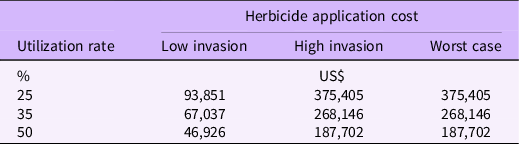
a Costs are calculated assuming the ranch has a fixed forage availability of 2,890 animal unit months (AUM), making lower utilization rates increase the land area of the grazed rangelands. The cost of applying indaziflam, our herbicide used, is US$143.77 ha −1 (US$58.18 ac −1).
We assume that indaziflam is used as the herbicide sprayed to control V. dubia. Indaziflam, however, does not yield forage improvement until the year following application. By that time, additional hay would already need to be purchased for Year 0. Therefore, all options where V. dubia is controlled in our analyses must also include Year 0 hay costs. Afterward, forage is assumed to return to the baseline scenario, with no loss of forage or additional hay needed. This may not hold true for regions with fewer rhizomatous grasses and dry summers, where additional time may be necessary to fully recover.
Three-Year NPV
We calculated the NPV of each option after a 3-yr period, as that is when reapplication of indaziflam has typically been done in northeast Wyoming (Table 5; NRCS and Sheridan County Weed and Pest Office, personal communication). After the 3-yr period, it is cheaper to treat V. dubia with herbicide in the worst-case scenarios with all combinations of discount rates and utilization rates we analyzed (Table 5). However, aside from the worst case, it becomes more expensive to apply herbicide than to buy hay in any scenario with 25% utilization (Table 5). At 35% utilization, the lower discount rates (3% and 5%) result in hay that is more expensive over the 3-yr period than control, while higher discount rates (7% and 10%) result in hay that is cheaper over the 3 yr (Table 5). At 50% utilization, which is more typical of private land management plans, it is cheaper to control V. dubia than to purchase hay in all scenarios with our assumptions (Table 5).
A table of the costs of Ventenata dubia strategies (buy hay to offset forage losses or apply herbicide) at the end of a 3-yr period on a 500-head, private land ranch in Major Land Resource Area 58b. a
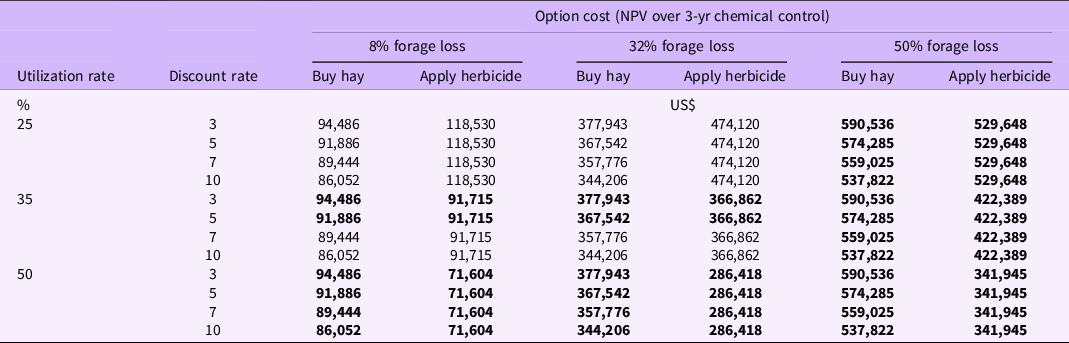
a These options are displayed for a range of forage utilization rates, invasion impact severities, and discount rates. Each value represents the cost net present value (NPV) of each option assuming herbicide application costs of US$143.77 ha −1 (US$58.18 ac−1), productivity of these rangelands is 1,285 kg ha−1 (1,147 lb ac−1), and hay costs of US$221.62 1,000 kg−1 (US$201.05 U.S. ton−1) and US$249.03 1,000 kg−1 (US$225.92 U.S. ton−1) for meadow and alfalfa hay, respectively. Bolded values represent where annual grass control is the cheaper option.
We have provided a range of circumstances in our analyses that we believe reasonably captures variation within the northeast Wyoming region. Even so, each ranch is different, and our conclusions should not be applied outside of Major Land Resource Area 58b due to differences in productivity, ranching practices, regional economic differences, and potential differences in the impacts of V. dubia and its removal. In addition to regional differences, there are year-to-year variations to consider. We did not take into account yearly variation in cost of hay or herbicide. However, we have provided a reasonably conservative estimate for the amount of hay needed, and have provided a 3-yr average of hay prices that gives an accurate estimate of hay cost for northeast Wyoming. Due to the relatively short time frame of our analyses, we did not account for future costs of herbicide. The cost of control could vary considerably due to changes in herbicide price and area in need of retreatment.
Another option we did not explore was to reduce the herd size of the ranch. Doing so may have different outcomes and impacts for different ranches. Other analyses examining decisions of whether to liquidate herds or feed extra hay during reductions in forage related to drought have found that there is no single correct decision, and both have merits (Bastian et al. Reference Bastian, Ponnamaneni, Mooney, Ritten, Frasier, Paisley, Michael and Umberger2009; Ritten et al. Reference Ritten, Frasier, Bastian, Paisley, Smith and Mooney2010). Decreasing herd size may be a long-term option to consider, but comes with other considerations. In other economic analyses exploring the effects of invasive species on ranches, those threatened with cheatgrass (Bromus tectorum L.) invasion were more likely to be forced from the industry due to decreased optimal stocking rates and alternative feed costs (Maher et al. Reference Maher, Tanaka and Rimbey2013). Their study, as well as ours presented here, demonstrates the economic dangers of invasive annual grasses for ranches.
Importantly, none of these options are as ideal as the baseline ranch without any V. dubia impacts. We assumed that V. dubia would remain stable in the no-control option, but in many cases, ranchers may find that their invasive grass population is increasing, leading to larger economic impacts. In our analyses, comparing low-invasion with high-invasion scenarios shows a greater proportional benefit at low invasion. In other words, the benefits of controlling V. dubia are greater when the population is small. This finding is consistent with the literature, which shows that as invasive species spread, their impacts increase exponentially (Epanchin-Niell and Wilen Reference Epanchin-Niell and Wilen2015). Other costs analyses have also found that the cost-effectiveness of given actions is highest on healthy rangelands rather than those already degraded (Taylor et al. Reference Taylor, Rollins, Kobayashi and Tausch2013). It is important to note, however, that in our analyses, the benefits are greater in the worst-case scenario than in the high-invasion scenario, as the impacts are greater, but the affected area to be treated does not change.
Overcoming Challenges
Unfortunately, invasive species prevention and management are inherently complex social issues. The differences between costs and benefits to the individual versus those of their neighbors and broader society make controlling invasive species that exist on mosaics of private properties, public lands, and multiple jurisdictions more complex and difficult (Epanchin-Niell and Wilen Reference Epanchin-Niell and Wilen2015; Grimsrud et al. Reference Grimsrud, Chermak, Hansen, Thacher and Krause2008; Perrings 2002; Rich et al. Reference Rich, Winter-Nelson and Brozović2005; Siriwardena et al. Reference Siriwardena, Cobourn, Amacher and Haight2018). Moving from centrally organized invasive plant management to individual management creates misaligned control incentives that favor personal profits over the collective goals of invasive species management (Cook et al. Reference Cook, Liu, Murphy and Lonsdale2010; Liu and Sims Reference Liu and Sims2016). Invasive species management is also characterized as a “weakest link” problem. This means that the effectiveness of management is only as strong as the least effective “link” (Perrings et al. Reference Perrings, Williamson, Barbier, Delfino, Dalmazzone, Shogren, Simmons and Watkinson2002). If one neighbor decides to control an invasive plant, it is linked with their neighbors’ actions, affecting both the efficacy of their own control options and the benefits that could be attained (Grimsrud et al. Reference Grimsrud, Chermak, Hansen, Thacher and Krause2008). Because of these factors, invasive species are usually suboptimally controlled on private property, and cooperation and coordination are required to reach maximum benefits (Epanchin-Niell and Wilen Reference Epanchin-Niell and Wilen2015; McDermott et al. Reference McDermott, Irwin and Taylor2013).
There are a few potential solutions to these problems with invasive species management. One is to provide necessary support for the weakest link (Perrings et al. Reference Perrings, Williamson, Barbier, Delfino, Dalmazzone, Shogren, Simmons and Watkinson2002). The NRCS has implemented a cost-share program for the purpose of controlling V. dubia and other invasive annual grasses in Wyoming. The program can greatly reduce the cost to ranchers who elect to control V. dubia (Sheridan Country USDA-NRCS Field Office and Sheridan County Weed and Pest, personal communication). These kinds of economic incentives attempt to encourage ranchers to implement conservation practices. In effect, when accounting for this cost-share program in our analysis, it becomes cheaper to control V. dubia than to purchase hay in all scenarios.
This study has demonstrated that V. dubia control is economically viable under our assumptions in the region of study. However, there are some cases where V. dubia control does not fit within the budget of ranchers. To obtain effective control over multiple private lands, the weakest link problem must be addressed. A cost-share program has shown some success for V. dubia control in this region by making control a more economically viable option. Programs facilitating organization and cooperation on invasive species control should also be supported. In this way, more effective landscape-scale management can be obtained.
Acknowledgments
We thank the NRCS and the Sustainable Rangelands Roundtable for primary funding of this research. The Nature Conservancy provided partial support for this work through the Nebraska chapter’s J.E. Weaver Competitive Grants Program. This research was supported in part by the intramural research program of the U.S. Department of Agriculture–National Institute of Food and Agriculture, Hatch accession no. 1013280 and McIntire-Stennis accession no. 7001691. We also thank the ranching families (names redacted for privacy) for allowing our research to take place on their properties. Finally, we thank Wyoming Game and Fish, Wyoming State Lands, Wyoming Agricultural Experiment Station, John Ritten, Beth Fowers, Jordan Skovgard, Jaycie Arndt, Jodie Crose, Tyler Jones, Shawna LaCoy, Nancy Webb, Heidi Schueler, Steve Paisley, Kelsey Crane, and Kerry White for their contributions to this research in the lab and field. No conflicts of interest have been declared.


 Open access

