


A troubling proportion (6–22%) of adolescents do not complete secondary school in the UK and North America. 1 These adolescents are at high risk of engaging in a protracted trajectory of occupational difficulties, but also to experience a wide range of psychosocial, physical and mental health difficulties as adults. 1–Reference Eide and Showalter4 From a societal point of view, secondary school non-completion is a double blow: it is a direct loss in the expected social returns of public investments in education (for example, reduced work productivity and tax revenues) and a long-term strain on the public system, as those who do not complete their schooling are disproportionately likely to rely on public institutions for support (such as social assistance, health services). 1,Reference Rumberger3,Reference Belfield and Levin5 It is also one of the main mechanisms that perpetuate social and health inequalities across generations. Reference Heckman6 Research has identified early academic deficits (such as repeating a school year, poor school engagement and achievement) and behavioural problems (for example, conduct problems and substance use) as important antecedents of school non-completion, Reference Rumberger3,Reference Janosz, LeBlanc, Boulerice and Tremblay7,Reference Newcomb, Abbott, Catalano, Hawkins, Battin-Pearson and Hill8 but comparatively limited research has focused on the potential role of internalising mental health difficulties. Findings on depression have been mixed, with studies reporting a prospective association with school non-completion, Reference Vander Stoep, Weiss, McKnight, Beresford and Cohen9–Reference Champaloux and Young11 inconsistent or lack of association beyond confounding Reference Johnson, Cohen, Dohrenwend, Link and Brook12–Reference Miech, Caspi, Moffitt, Wright and Silva15 or an association only in girls. Reference Kandel and Davies16,Reference Fletcher17 The few studies that have examined anxiety as a prospective risk factor have similarly reported an association, Reference Vander Stoep, Weiss, McKnight, Beresford and Cohen9 no association, Reference Johnson, Cohen, Dohrenwend, Link and Brook12,Reference Miech, Caspi, Moffitt, Wright and Silva15 or mixed associations depending on type of anxiety disorder. Reference Chalita, Palacios, Cortes, Panza, Landeros-Weisenberger and Bloch18 Not all of these studies included large samples or long-term follow-up periods and, most importantly, many did not control for reverse causality by adjusting for the baseline academic functioning of students, which arguably represents the best indicator of school non-completion risk and the potential cause of depressive or anxious symptoms in students who have early academic deficits. In addition, few studies have examined whether associations between internalising symptoms and school non-completion vary as a function of the baseline academic functioning of students, although heterogeneity in the predominant difficulties of those who do not complete their schooling (academic v. psychosocial) has been reported and may help to explain inconsistencies in previous findings. Reference Dupéré, Leventhal, Dion, Crosnoe, Archambault and Janosz19,Reference Janosz, Le Blanc, Boulerice and Tremblay20 In this study, we use a large sample of adolescents to examine associations between internalising symptoms and subsequent secondary school non-completion. Our first objective was to determine whether depressive and anxious symptoms at secondary school entry (grade 7; age 12–14) predict subsequent non-completion of secondary school (by age 18–20), adjusting for a composite index of baseline academic functioning (as a proxy indicator of school non-completion risk) and other potential sociodemographic and psychosocial confounders. Our second objective was to determine whether associations differ as a function of the baseline academic functioning of participants.
Method
Participants
Participants were followed-up on a yearly basis throughout secondary school as part of the evaluation of the New Approaches New Solutions (NANS) drop-out prevention programme. Reference Janosz, Bélanger, Dagenais, Bowen, Abrami and Cartier21 In this study, we used NANS cohort 1, which initially included 5469 participants from 56 French-speaking schools in the province of Quebec (Canada) who entered grade 7 in 2002. Most of the participants (three-quarters) attended a secondary school exposed to NANS. These schools were selected to be representative of all schools located in disadvantaged areas of Quebec in terms of size, language (i.e. English and French), and geographical location using a stratified random sampling strategy. Reference Janosz, Bélanger, Dagenais, Bowen, Abrami and Cartier21 The remainder of participants attended a comparison school in a convenience sample of schools located in areas of slightly higher socioeconomic status (SES) that were not exposed to NANS. Written informed consent was obtained from all study participants (77% of eligible participants). For this study, we included the participants who completed two assessments in grade 7: one assessment on psychosocial functioning and a second assessment in which participants completed the Raven matrices and provided detailed sociodemographic information (n = 4962). Comparison of participants who were included and excluded (online Table DS1) showed that excluded participants did not differ from included participants, except for the fact that they were more likely to be girls. The sample was mostly of Canadian origin (86.3%), roughly equally represented by gender (52.6% females) and included participants between 12 and 14 years of age (mean 12.2, s.d. = 0.5). No participants had missing information on school non-completion. A few participants had missing data on depressive and anxious symptoms (2–3%) and potential confounders (0–7.3%). All study procedures were approved by the Institutional Review Board of the University of Montréal.
Measures
Depressive and anxious symptoms (grade 7; age 12–14)
Depressive symptoms were measured using the Center for Epidemiologic Studies-Depression (CES-D) questionnaire. Reference Radloff22 The CES-D was validated in French Reference Riddle, Blais and Hess23 and includes 20 items exploring how participants felt in the past week. Items are answered on a four-point scale (0, never or none of the time (0–1 day); 1, some or little of the time (1–2 days); 2, moderately or much of the time (3–4 days); 3, most or almost all of the time (5–7 days)). The scale showed good internal consistency (α = 0.87). Anxious symptoms were measured using 12 items comprised in two subscales (generalised anxiety and social anxiety) from the Spence Children's Anxiety Scale (SCAS). Reference Spence24 The original SCAS is a widely used 38-item questionnaire that requires participants to rate the degree to which they experienced each anxious symptom on a four-point frequency scale with no specific reference period (never, 0; sometimes, 1; often, 2; always, 3). The scale also showed good internal consistency in our sample (α = 0.88).
School non-completion (age 18–20)
Official data on school non-completion were obtained from the Quebec Ministry of Education, Leisure, and Sports (MELS). Participants were assigned a non-completer status (= 1) if they stopped being registered in school without re-entering or obtaining a diploma in the period spanning from October of grade 8 to 2 years past grade 11 (age 18–20), which corresponds to the last year of compulsory secondary school in Quebec.
Baseline academic functioning (grade 7; age 12–14)
Baseline academic functioning was measured using a composite index developed and validated by our group. Reference Janosz, LeBlanc, Boulerice and Tremblay7,Reference Archambault and Janosz25 This index combines self-reports of three major academic risk factors of school non-completion: grades (two items assessing average scores in mathematics and language arts), school failure (two items assessing repeating a school year in primary and secondary school) and school engagement (four items assessing liking and valuing school). The three risk factors are combined in the index using regression weights reflecting their relative contribution to the prediction of school non-completion. Scores vary between 0 and 1. These scores can be interpreted as the reverse probability that each participant leaves secondary school without qualification based on their overall academic functioning at secondary school entry (0, maximum probability; 1 no probability). In this study, baseline academic functioning is used both as the primary potential confounder (as a proxy of baseline risk of school non-completion) and moderating factor.
Other potential confounders (grade 7; age 12–14)
Apart from baseline academic functioning, we included the following sociodemographic indicators as potential confounders: gender, age, ethnicity (0, Quebec-born White; 1, minority (of Native, Caribbean, Latin American, African, Asian, Middle Eastern or European origin)) and family adversity, as assessed using a cumulative index of family risk factors (low maternal occupational prestige, low paternal occupational prestige, low family wealth, low home educational resources, parental separation, mother secondary school non-completion, father secondary school non-completion, sibling school non-completion, frequent house moves). We also included fluid reasoning (Raven Standard Progressive Matrices) Reference Raven, Court and Raven26 and conduct problems, measured using a 16-item self-reported scale enquiring about various delinquent behaviours in the past year (such as did you take something from a shop and keep it without paying?), Reference Le Blanc, McDuff and Fréchette27 as potential confounders.
Data analytic strategy
We conducted all analyses in Mplus 7.1. Reference Muthen and Muthén28 We examined the association between depressive and anxious symptoms in grade 7 and subsequent school non-completion using unadjusted and adjusted logistic regression. We probed a potential interaction between internalising symptoms and baseline academic functioning by creating an interaction term with the two centred variables and adding it to the regression model. Missing data were taken into account using full-information maximum likelihood (FIML) estimation. This strategy is useful to preserve the full sample and reduce the risk of missing data. Reference Enders29 Models were corrected for the non-independence of observations because of the nesting of participants in schools using the Mplus ‘Type = complex’ and ‘CLUSTER’ options. This means that standard errors of associations were adjusted for the sampling structure. In sensitivity analyses (not shown), we also specified multilevel models in which associations of interest were estimated net of school-level variation in the outcome that could be related to school characteristics (for example, school SES or participation in the NANS programme) and obtained identical results.
Results
Descriptive statistics
Descriptive statistics are presented in Table 1. One student out of five left secondary school without re-entering at some point during the 6-year follow-up period. As expected, school non-completion was more prevalent in boys than girls, but depressive and anxious symptoms were more elevated in girls than boys.
Descriptive statistics for study outcome, predictors and potential confounders

| Total (n = 4962) | Girls (n = 2610) | Boys (n = 2352) | χ2 or t-test, P for gender difference | |
|---|---|---|---|---|
| School non-completion, % | 19 | 16 | 23 | <0.001 |
| Depressive symptoms, mean (s.d.) | 13.2 (10.7) | 14.9 (11.6) | 11.3 (9.1) | <0.001 |
| Anxious symptoms, mean (s.d.) | 11.1 (6.8) | 12.9 (6.7) | 9.0 (6.4) | <0.001 |
| Baseline academic functioning, mean (s.d.) | 0.7 (0.3) | 0.8 (0.2) | 0.7 (0.3) | <0.001 |
| Age, mean (s.d.) | 12.2 (0.5) | 12.2 (0.5) | 12.3 (0.5) | 0.01 |
| Ethnicity, minority: % | 13.7 | 13.8 | 13.5 | 0.74 |
| Family adversity, mean (s.d.) | 1.7 (1.7) | 1.8 (1.7) | 1.7 (1.7) | 0.06 |
| Conduct problems, mean (s.d.) | 1.8 (2.8) | 1.3 (2.3) | 2.4 (3.2) | <0.001 |
| Fluid reasoning, mean (s.d.) | 60.8 (26.0) | 61.6 (25.1) | 60.0 (27.0) | 0.03 |
Associations between depressive and anxious symptoms in grade 7 and subsequent school non-completion
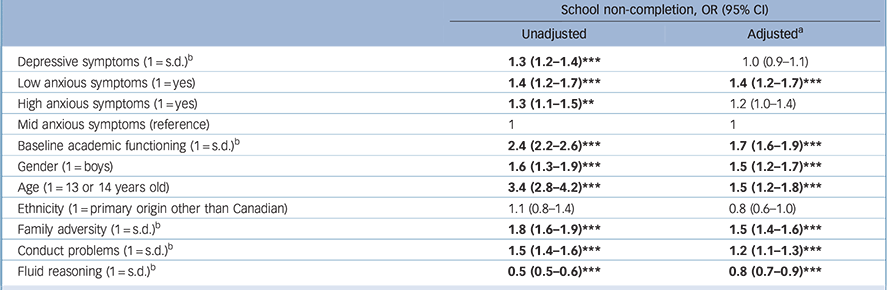
We first examined unadjusted and adjusted associations between each type of internalising symptom and subsequent school non-completion (Table 2). There was a modest but statistically significant linear association between depressive symptoms and school non-completion in unadjusted analyses, with each standard deviation increase on the CES-D raising the odds of school non-completion by 30%. However, this association did not remain significant after adjusting for potential confounders. A test of moderation by gender (odds ratio (OR) = 0.9; 95% CI = 0.8–0.99) indicated slightly stronger associations in boys than girls, but associations for each gender were nonetheless non-significant.
Unadjusted and adjusted associations between depressive and anxious symptoms in grade 7 (age 12–14) and school non-completion (by age 18–20)
| School non-completion, OR (95% CI) | ||
|---|---|---|
| Unadjusted | Adjusted a | |
| Depressive symptoms (1 = s.d.) b | 1.3 (1.2–1.4)*** | 1.0 (0.9–1.1) |
| Low anxious symptoms (1 = yes) | 1.4 (1.2–1.7)*** | 1.4 (1.2–1.7)*** |
| High anxious symptoms (1 = yes) | 1.3 (1.1–1.5)** | 1.2 (1.0–1.4) |
| Mid anxious symptoms (reference) | 1 | 1 |
| Baseline academic functioning (1 = s.d.) b | 2.4 (2.2–2.6)*** | 1.7 (1.6–1.9)*** |
| Gender (1 = boys) | 1.6 (1.3–1.9)*** | 1.5 (1.2–1.7)*** |
| Age (1 = 13 or 14 years old) | 3.4 (2.8–4.2)*** | 1.5 (1.2–1.8)*** |
| Ethnicity (1 = primary origin other than Canadian) | 1.1 (0.8–1.4) | 0.8 (0.6–1.0) |
| Family adversity (1 = s.d.) b | 1.8 (1.6–1.9)*** | 1.5 (1.4–1.6)*** |
| Conduct problems (1 = s.d.) b | 1.5 (1.4–1.6)*** | 1.2 (1.1–1.3)*** |
| Fluid reasoning (1 = s.d.) b | 0.5 (0.5–0.6)*** | 0.8 (0.7–0.9)*** |
Results in bold are significant.
a. Odds ratio (OR) for confounders were identical in models examining depressive and anxious symptoms.
b. OR associated with a 1 s.d. increase in the predictor.
*** P < 0.001;
** P < 0.01.
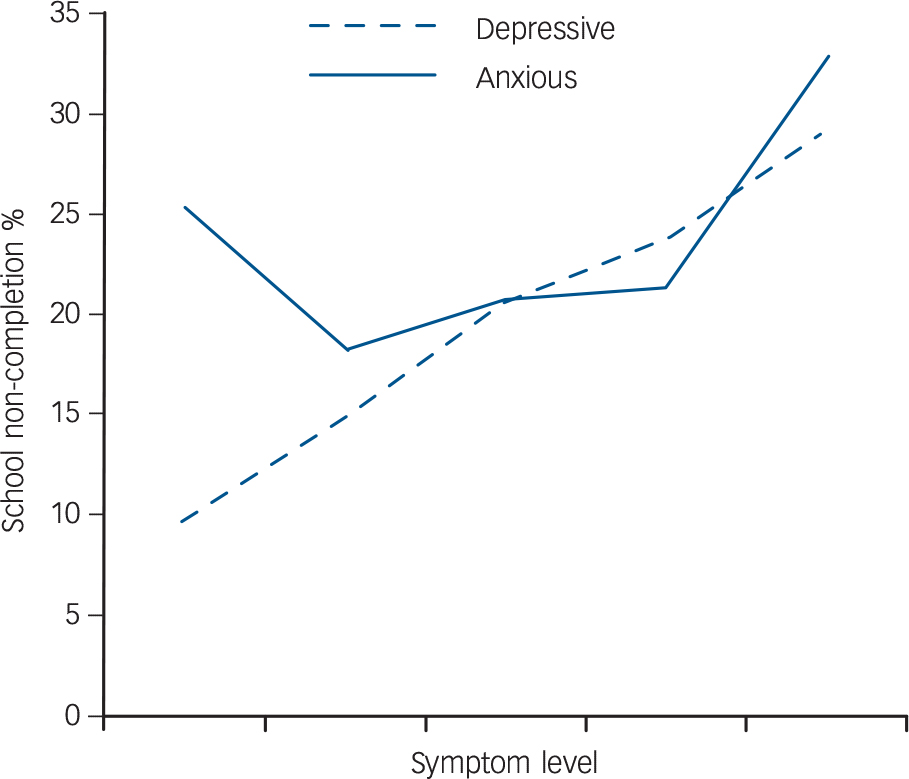
There was no linear association between anxious symptoms and school non-completion (OR = 1.0, 95% CI = 0.9–1.1). However, visual inspection (Fig. 1) suggested the existence of a curvilinear association rather than a linear one. To probe this association, we divided anxious symptoms into thirds to create two dummy variables. The first dummy coded low anxious symptoms (1) v. medium or high symptoms (0). The second dummy coded high anxious symptoms (1) v. low or medium symptoms (0). These two dummies were included simultaneously in models and thus each category was compared with moderate/average symptoms as an omitted reference category. In unadjusted analyses, both high and low anxious symptoms were modestly predictive of school non-completion, respectively raising the odds by 30% and 40%. The association between high anxious symptoms and school non-completion did not remain significant after adjusting for potential confounders. However, the association between low anxious symptoms and school non-completion was largely independent from confounders. The associations between low or high anxious symptoms and school non-completion did not differ by gender.
Rates of school non-completion as a function of depressive and anxious symptoms.
Moderation by baseline academic functioning
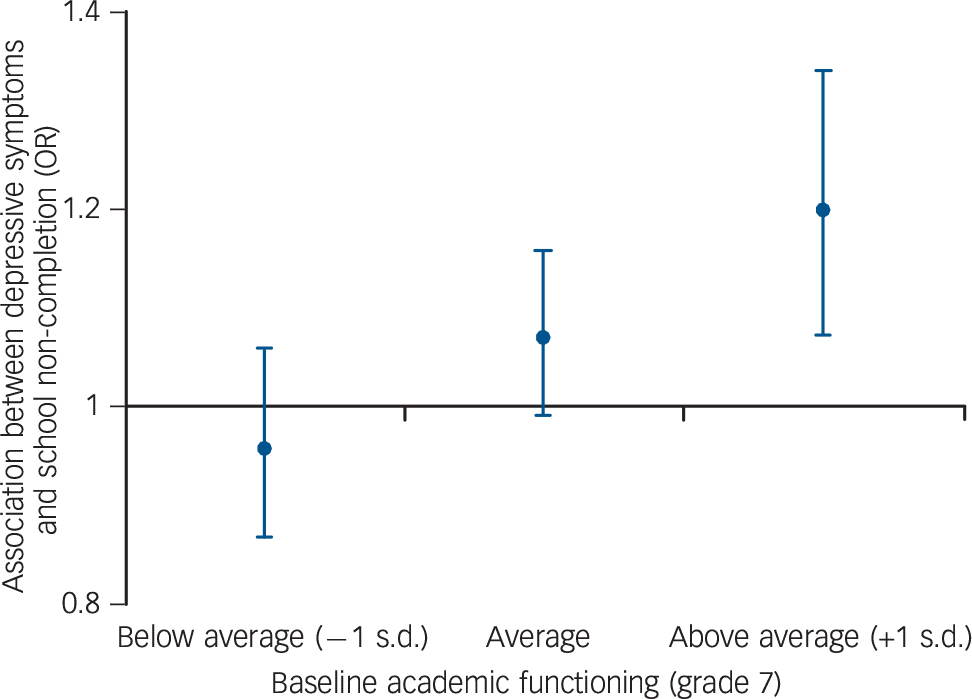
We next examined whether associations between depressive and anxious symptoms at secondary school entry and subsequent school non-completion differed as a function of baseline academic functioning in participants. We found a significant interaction between depressive symptoms and baseline academic functioning (P < 0.001). Interestingly, depressive symptoms were only predictive of school non-completion in participants who had better overall academic functioning (above average) at secondary school entry (Fig. 2). We found no interaction between anxious symptoms and baseline academic functioning. There was also no triple interaction involving gender, symptoms and baseline academic functioning in the prediction of school non-completion for either depressive or anxious symptoms.
Association between depressive symptoms and school non-completion at different levels of baseline academic functioning at secondary school.
OR, odds ratio.
Secondary analyses
We conducted several analyses to test the robustness of our findings. We re-examined models in which we included confounders based on their effect on the primary exposure-outcome associations rather than on a priori reasoning. We tested whether confounders accounted for (i.e. mediated) a portion of the association between exposure and school non-completion and removed confounders that did not. Based on these analyses, only ethnicity was removed from models. The size and significance of associations for depressive and anxious symptoms remained identical in the parsimonious model compared with the main model. Baseline academic functioning and family adversity were the primary confounders of associations, whereas gender exerted a suppression effect for both depressive and high anxious symptoms (online Table DS2). We also conducted the following checks: (a) testing models with additional confounders available in the NANS data-set, including family (parental school involvement, conflict with parents), peer (peer school involvement, peer deviancy) and individual (substance use) predictors, (c) testing models with the generalised and social anxiety subscales of the SCAS tested separately, and (d) testing models in the full sample with excluded participants using FIML estimation. Main effects and interaction results were substantively identical in these secondary models.
Finally, to quantify the populational contribution of internalising symptoms to the risk of school non-completion, we estimated population attributable risk and population attributable risk per cent (or attributable fraction; PAF). We derived these estimates from predicted probabilities obtained from logistic regression parameters. In the case of low anxious symptoms, we computed (a) true predicted probabilities for each participant based on their actual predictor values and (b) counterfactual predicted probabilities based on the same predictor values except for low anxious symptoms, which were set to 0 in all participants. Reference Vach30 We then compared predicted drop-out rates based on the sum of probabilities in the true scenario (17.72 per 100 students) and counterfactual scenario (16.43 per 100 students). This analysis suggests that bringing all low anxious symptoms in the population within normal range would prevent 1.29 cases of school non-completion for every 100 students, or 7% of cases of school non-completion. In the case of depressive symptoms, we computed (a) true predicted probabilities for each participant based on their actual predictor values and (b) counterfactual predicted probabilities based on the same predictor values except for depressive symptoms, which were set to 0 specifically in participants with higher than average baseline academic functioning (0.75 or higher, the threshold for significant associations between depressive symptoms and school non-completion). This analysis indicated that eradicating all depressive symptoms in students with higher than average academic functioning would prevent 0.75 cases of school non-completion for every 100 students, or 4% of cases of school non-completion.
Discussion
Using a multisource prospective design, this study allowed us to identify key novel properties of associations between depressive and anxious symptoms and subsequent secondary school non-completion in adolescents, which may help to explain contradictions in previous findings. Consistent with two well-controlled prospective studies from New Zealand, Reference Fergusson and Woodward14,Reference Miech, Caspi, Moffitt, Wright and Silva15 we did not find depressive symptoms to independently predict school non-completion after adjusting for confounders. However, we found depressive symptoms to increase the odds of early school leaving specifically in students who were functioning above average in terms of academic performance and engagement when they entered secondary school. This association was relatively modest, however, with a 20% increase in odds of school non-completion for each standard deviation increase on the CES-D. This finding suggests that depressive symptoms do not generate additional risk in students who have early academic deficits, but may contribute to diverting a subset of students who are otherwise functioning well at school away from a trajectory leading to successful school completion. The notion that pupils who do not complete their schooling form a heterogeneous population that comprises one or more subgroup(s) who are primarily vulnerable to difficulties other than protracted academic deficits (for example, psychological difficulties, poor capacity to cope with stressful events) is consistent with previous theoretical and typology studies. Reference Dupéré, Leventhal, Dion, Crosnoe, Archambault and Janosz19,Reference Janosz, Le Blanc, Boulerice and Tremblay20 Considering this heterogeneity in the profile of those who do not complete their schooling is likely to be key in advancing knowledge on the role of depressive symptoms in early secondary school termination in the future.
We found a curvilinear association between anxious symptoms and subsequent school non-completion, with both low and high levels of anxiety associated with increased risk of students leaving secondary school without qualification. To our knowledge, this curvilinear association has not been reported in previous studies. Interestingly, this association is reminiscent of the well-known U-shaped association between stress/arousal and performance Reference Duffy31 and suggests that students may be at optimal disposition to succeed in school when they experience moderate levels of anxiety in general, and not just in relation to specific tasks. That said, adjusted models also imply that the mechanisms linking low and high anxiety to school non-completion may differ. The association between high anxiety and school non-completion did not remain after adjusting for confounders, which suggests that this association primarily reflects a by-product of the correlation between high anxiety and other important risk factors of school non-completion, such as low baseline academic functioning. Conversely, low anxious symptoms remained independently predictive of school non-completion even after accounting for confounders, raising the odds of school non-completion by 40%. This unexpected finding raises the possibility that the lack of anxiety experienced by some students directly or indirectly contributes to their chances of leaving secondary school without qualification. Alternatively, low anxiety may represent a ‘marker’ of other characteristics that are causally related to school non-completion, although our models ruled out many of the most intuitive candidates, such as low-school engagement (controlled via baseline academic functioning) and conduct problems. Low anxiety may nonetheless reflect unmeasured confounders, such as callous-unemotional traits or boredom proneness that have been independently associated with poor academic outcomes. Reference Ciucci, Baroncelli, Franchi, Golmaryami and Frick32,Reference Tze, Daniels and Klassen33
Strengths and limitations
This study has several important strengths, including a large sample, a prospective design with complete official outcome data, and comprehensive measurement of baseline academic functioning. However, several limitations should be noted. First, due to the observational nature of our design, associations should not be interpreted as causal even if we accounted for baseline academic functioning and other potential confounders. Second, school non-completion was only recorded up to ages 18 to 20, despite the fact that many young people acquire their secondary school diploma or equivalent in their early twenties. 1 As such, several of the participants who were coded as school non-completers in our study are likely to have left school temporarily rather than definitively. Third, our measures of depressive and anxious symptoms were based on self-report and do not reflect clinical diagnoses of internalising disorders. Fourth, the NANS sample mostly comprises participants from public schools located in disadvantaged areas who agreed to provide information. Although these participants are at especially elevated risk of school non-completion, our findings may not generalise to all adolescents in secondary schools.
Implications
Our findings have important implications for the focus and design of future research. Prospective studies should systematically take into account (a) the pre-existing academic functioning of participants and (b) test the possibility of a curvilinear relation between anxious symptoms and school non-completion, given that our findings suggest that modelling the association between anxiety and school non-completion only as linear is likely to lead to inappropriate conclusions. An interesting and important issue for future research will be to document the mechanisms that explain why depressive symptoms pose a greater risk in high-achieving students, as well as how low anxiety fosters risk that students leave school without qualification. It will also be interesting for future studies to compare the relative importance of trait and state aspects of internalising characteristics, as differences in the predictive patterns of anxious and depressive symptoms in our study could be explained in part by the past-week focus of CES-D depressive symptoms v. the lack of a specific reference period of SCAS anxious symptoms. Finally, intervention studies that test whether experimentally reducing depressive and anxious symptoms at secondary school entry (for example, via school-based prevention or treatment programmes) leads to lower rates of school non-completion would be particularly valuable and would circumvent the inherent limitations of prospective observational studies such as this one.
The policy implications of our findings are not straightforward. On the one hand, there is little doubt that the contribution of internalising symptoms to the risk of school non-completion is modest, explaining only 4–7% of cases of school non-completion. Common school-based promotion and prevention programmes targeting internalising symptoms Reference Hetrick, Cox, Witt, Bir and Merry34,Reference Stallard35 are unlikely to have a major impact on school non-completion rates and may not be relevant for all at-risk students (for example, students with low anxiety and low school functioning). On the other hand, the risks associated with internalising symptoms do not differ substantially from the risk conferred by other important risk factors of school non-completion in our models (such as conduct problems) and even small populational contributions may be considered meaningful given the importance and cost of school non-completion. Reference Belfield and Levin5 Implementing programmes with the primary aim of preventing depression is likely to yield the secondary benefit of preventing a few atypical cases of school non-completion in students who perform well at secondary school entry. These may represent some of the most preventable cases of school non-completion in pupils, yet some of the most difficult to detect via traditional screening systems that focus on academic and behavioural deficits.
Funding
This research was funded by a postdoctoral grant from the School Environment Research Group (SERG) awarded to F.N.B. Funding organisations played no role in any part of the study. Authors had full access to data, are responsible for its integrity and accuracy of analysis.




eLetters
No eLetters have been published for this article.