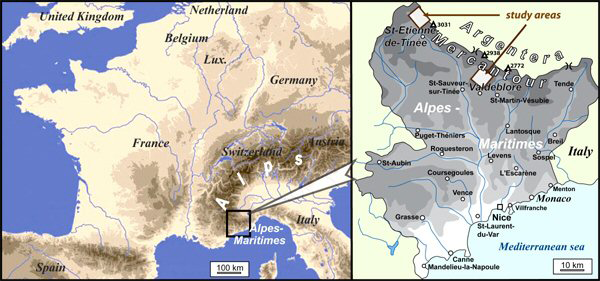


Between 2001 and 2004, field investigations carried out throughout the Argentera-Mercantour massif threw important new light on the origin of iron metallurgy in the southern French Alps, little-known up to now (Depine 1822; Roux 1862; Domergue & Leroy 2000; Mangin 2004). The results obtained make it possible to draw up a chronological assessment of two mining and smelting districts (Figure 1).
Location of the Argentera-Mercantour massif in Europe. Map of the investigated areas (National Park of the Mercantour).

In the Valdeblore district, the iron ore resources of Col Ferrière are located in the upstream part of the Millefonts valley, at an altitude of 2225-2484m. They are associated with the mylonitised gneiss formation of Valletta-Mollières (Faure-Muret 1955). Mylonite and its margins are affected by multidirectional fracturing: cracks and joints are cemented by ferruginous hematite fillings (Reference PicotPierrot et al. 1974). Hematite outcrops were mainly exploited in open quarries.
They supplied three main areas of metallurgy:
Towards the south, in the Millefonts valley, sorting and crushing were carried out directly by the mines, at an altitude of 2400-2484m. The ore was smelted in furnaces lower down, whose remains spread out at an altitude ranging from 2010m to 1480m (Morin & Rosenthal 2006).
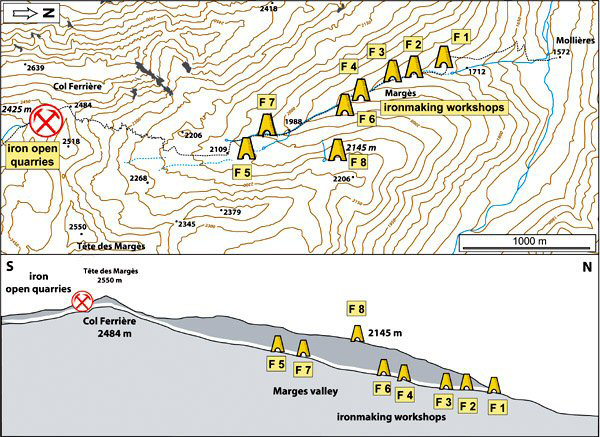
Towards the north, in the Margès valley, metallurgical remains were found between 2145m and 1785m (Figure 2).
In the Mollières valley, slags were discovered at an altitude of 1675-1670m. Footpaths connected the mining works to the smelting sites.
Iron exploitation at Col Ferrière and iron-producing workshops of the Margès valley. Map and cross section with location of the open quarries close the top; downstream, staged remains of the metallurgical workshops. The Fr 08 site (2145m) is the highest ancient iron workshop located.

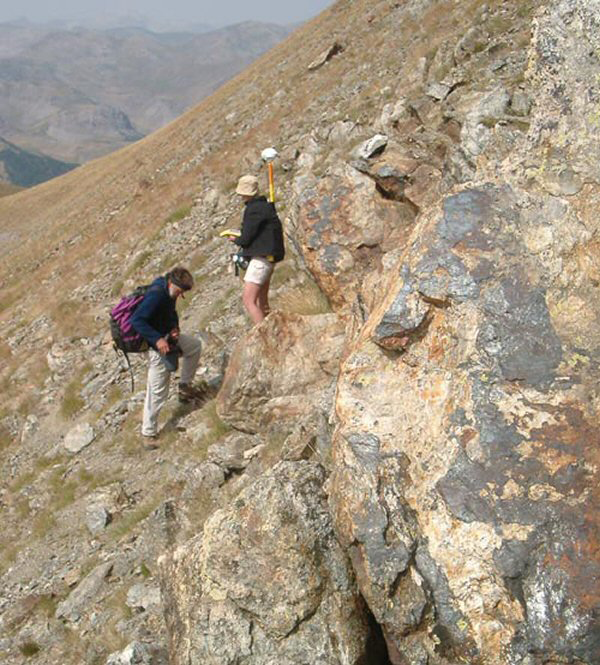
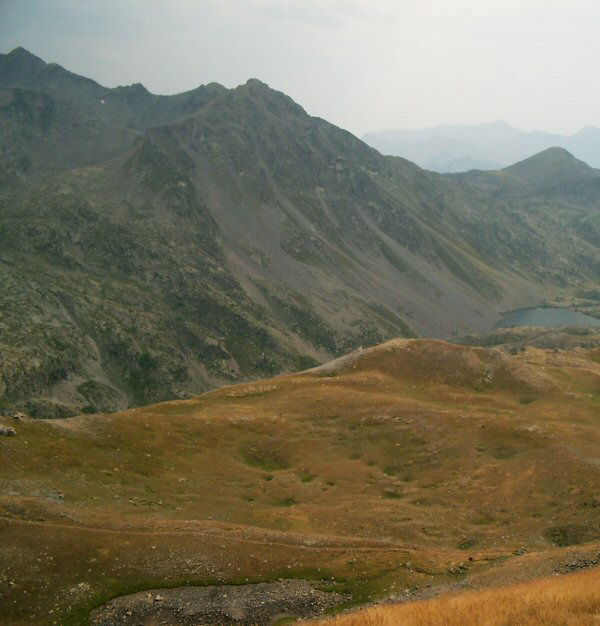
In the Saint-Etienne-de-Tinée district, field investigations identified mining works on the top of the Tortisse valley at an altitude ranging between 2500 and 2700m (Figure 3). They are related to the primary mineralised lodes in the Palaeozoic micaschists of the Cime du Fer, and a sedimentary breccia in the Triassic cellular dolomite, reworking micaschists and hematite fragments from the lodes. Ore dressing areas are located below the screes (Figure 4). Downstream, charcoal kilns and smelting sites have been identified at an altitude of between 2050 and 2070m, close to settlements and dry stone enclosures.
Cime du Fer. Hematite mining works and outcrops. Differential GPS field survey.

Cime du Fer. General view of the pass showing mining and associated ore dressing areas (dumps).

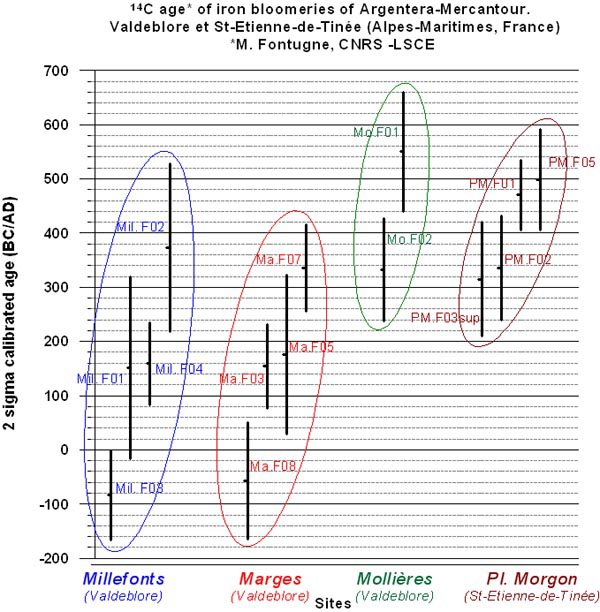
Charcoal samples for 14C dating were collected on the slag-bearing sites by coring (Figure 5). Calibrated dates, gathered by sites (Figure 6), show that metallurgical activity took place between the second century BC and the seventh century AD in the Valdeblore district; in the Saint-Etienne-de-Tinée district, the ages range between the third and the sixth centuries AD.
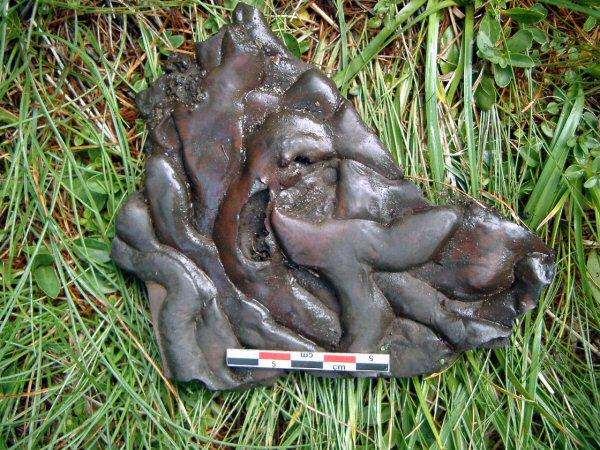
Fragment of slag flows.

14C dating of iron bloomeries of Argentera-Mercantour. Valdeblore and Saint-Etienne-de-Tinée (Alpes-Maritimes, France) (M. Fontugne, CNRS-LSCE). This diagram clearly shows two distinct series of occupations. Millefonts and Marges, two complementary opposite small valleys whose furnaces are supplied with the Col Ferrières, show a virtually identical occupation span ranging from 160 BC to AD 520. The slag deposits of the Mollières valley and Morgon area are more recent, covering a period ranging between AD 205 and AD 660. Over the whole area, the metallurgical activities span between the second century BC and the seventh century AD.

The distribution of the remains highlights a real strategy. Mining and ore dressing took place directly in the alpine level at an altitude of 2700-2400 m. Sorted and sized ore was transported downstream, beyond the higher limit of the subalpine level, between 2145 and 2000 m. This activity expands between the second century BC and the seventh century AD.
The mines and slag deposits of Valdeblore are the highest known and dated iron metallurgy remains in Europe. Our results suggest that investigations undertaken in other potential high altitude areas could prove most fruitful.
Acknowledgements
The different field missions were brought to a successful conclusion thanks to the participation of the speleo-archaeologists of the ERMINA association (a national association bringing together an interdisciplinary team devoted to study and research on old mines and industrial heritage) and to the financial and logistic support of the following services, organisations and communities:
-
• DRAC PACA (Départements of Alpes-de-Haute-Provence, Hautes-Alpes, Alpes-Maritimes, Var, Vaucluse)
-
• National Park of the Mercantour (B. Lequette)
-
• The ONF, National Forestry Office (Alpes-Maritimes)
-
• The communes of Saint-Dalmas-Valdeblore and Saint-Etienne-de-Tinée (Alpes-Maritimes).
This study is mainly linked with the PCR (Collective Research Project: Ores, Mines, Mineralogy and Metallurgy in Provence and the southern Alps) of the Ministry of Culture, with the support of the National Park of the Mercantour and the ONF. Our thanks are addressed to the members of the ERMINA National Association whose endurance was severely tested by the conditions of field investigation at high altitude. The research team included: Marie-Anne Boudot, Laurent Colchen, Julien Deprez, Mylène Fantone, Yves Imbert, Denis Jacquemot, Stéphanie Jacquemot, Fabienne Marchand, Gilles Meyer, Verena Obrecht-Schaltenbrand, Jacques Olivier, Michel Philippe, Stephane Vuillemin.