


A recent study (World Health Organization, 2006) has pointed to the possibility of preventing disease by controlling environmental factors; it has been estimated that more than 20% of total suicides in North America and Europe can be attributed to environmental factors, one of which is access to firearms. Suicide prevention measures include the training of primary healthcare personnel, school-based programmes, improvement of the availability of telephone hotlines and crisis centres, implementation of guidelines for the media's portrayal of suicide, and the restriction of access to methods and means of suicide (Reference BertoloteBertolote, 2004). One of the methods of reducing access to suicidal means is the restriction of firearm availability through more stringent firearm legislation (Reference Mann, Apter and BertoloteMann et al, 2005). Generally, studies on the impact of firearm availability and legislation on suicide rates can be divided into three categories: cross-sectional comparisons of firearm availability and suicide rates in different countries; cross-sectional correlations of the stringency of firearm control and suicide rates in the USA; and quasi-experimental studies examining the impact of changes in firearm legislation on suicide rates (Reference BrentBrent, 2001).
The availability of firearms in homes has been shown to be a risk factor for suicide (Reference Kellermann, Rivara and SomesKellermann et al, 1992) and homicide (Reference Dahlberg, Ikeda and KresnowDahlberg et al, 2004). Furthermore, peer-reviewed publications provide vast evidence to support the view that changes in firearm legislation have influenced the rate of firearm suicides in the USA (Reference Ludwig and CookLudwig & Cook, 2000), Canada (Reference CaronCaron, 2004), Australia (Reference Ozanne-Smith, Ashby and NewsteadOzanne-Smith et al, 2004) and New Zealand (Reference Beautrais, Fergusson and HorwoodBeautrais et al, 2006), whereas there is only some evidence from continental Europe and Britain to suggest the same (Reference Hawton, Fagg and SimkinHawton et al, 1998; Reference Haw, Sutton and SimkinHaw et al, 2004). Other researchers have shown that different state firearm regulations across the USA have influenced suicide (Reference Conner and ZhongConner & Zhong, 2003) and homicide rates (Reference Rosengart, Cummings and NathensRosengart et al, 2005).
METHOD
We examined suicide and homicide rates in Austria recorded before and after a new firearm law came into effect. We expanded a longitudinal approach from a recent study which evaluated the association between changes in firearm availability and suicide rates in the USA (Reference Miller, Azrael and HepburnMiller et al, 2006) and accounted for the availability of firearms. Since the accuracy of survey data and other proxy variables of firearm availability have recently been questioned (Reference Miller, Hemenway and AzraelMiller et al, 2004), the number of officially issued firearm licences was used to assess the availability of firearms.
Austrian firearm legislation
The Austrian firearms law was adapted in July 1997 after the European Council Directive 91/477/EEC on the control of the acquisition and possession of weapons was implemented in European Union member states. The transposition of the European directive into Austrian national law brought changes concerning the acquisition of firearms over 60 cm in length, which had previously enjoyed a more liberal regime. Moreover, the new law abolished the previous possibility of obtaining a firearm without specifying a reason. In addition to the European Directive, other restrictions were implemented in Austria. The legal criteria for obtaining a category B weapon (handguns, semi-automatic firearms or repeating firearms) for the first time now include psychological testing, being at least 21 years of age, and background checks. Furthermore, the new legislation also specifies safe firearm storage regulations and a 3-day ‘cooling-off’ waiting period for category C and D weapons (including long firearms with smooth bore and rifled barrels) (Commission of the European Communities, 2000).
Data collection
Records for each year between 1985 and 2005 in Austria were examined. The starting year was set at 1985 because of recording restrictions at the Ministry of the Interior, where data on firearm licences were obtained. Data on the number of suicides per year and the number of firearm homicides per year (with external cause-of-death codes according to ICD–9 and ICD–10), as well as data on the size of the general population and on unemployment rates, were obtained from Statistics Austria. Details on these data have been described elsewhere (Reference Etzersdorfer, Kapusta and SonneckEtzersdorfer et al, 2006). The figures on alcohol consumption per capita were obtained from the Austrian Alcohol Coordination and Information Centre (Reference Uhl, Kopf and SpringerUhl et al, 2006).
Statistical analysis
To assess the effect of the enactment of the 1997 firearm law, a regression of the number of firearm licences per 100 000 inhabitants per year was performed with an autoregressive error model of first order to compare time trends before and after enactment. Similarly, Poisson regressions were performed to compare time trends of firearm suicides, of firearm suicides as a percentage of total suicides and of the total number of homicides, before and after the law was enacted (using SAS/STAT version 8 for Windows). Because of underdispersion, we allowed the variance estimate in both models to depend on an underdispersion factor estimated from the data. Data on total suicides indicated overdispersion, hence total suicides were modelled with negative binomial distribution. The regression model included linear time trends allowing for a change point in 1998. Changing population sizes were taken into account by including the respective changes in the model. To distinguish between the effects of the new legislation and other factors known to influence rates of suicide and homicide, unemployment rates and average alcohol consumption per capita were included in the analysis as covariates. In the calculation of the regression model of homicide rates, the ratio of young men in the population was also included as a covariate. All parameter estimates are reported with 95% confidence intervals. The analysis is based on figures for firearm licences, suicide, firearm suicide, firearm homicide and population sizes in the period 1985–2005. The two-tailed significance level was set at 5%.
RESULTS
During the observation period 6071 firearm suicides were counted. Of these, 95.1% were by men and 4.9% by women. When firearm suicides by men are split into age groups, 3.3% of all firearm suicides were by men aged under 19 years, 62.9% by men aged 20–64, and 28.8% by men aged 64 or older. Of all suicides, 0.2% were by females aged 19 years or younger, 3.8% by women aged 20–64 and 0.9% by women aged 64 or older.
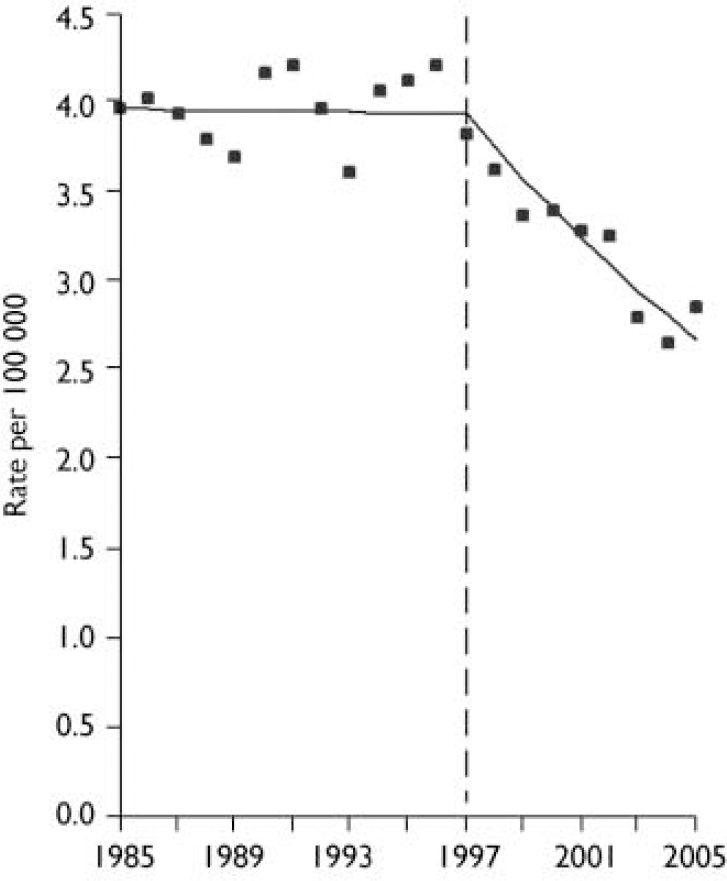
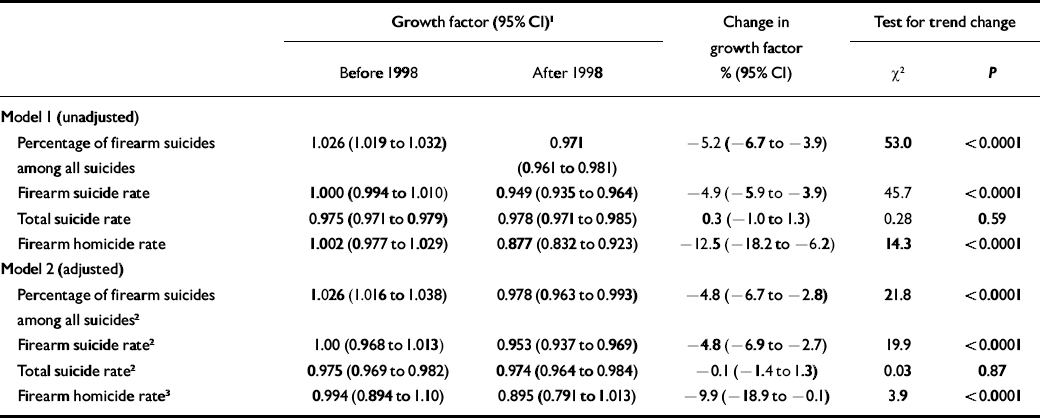
Figure 1 shows the trend of the firearm suicide rate, prior to and after enactment of the legislation. We observed no significant time trend in the total number of firearm suicides between 1985 and 1997 (χ2=0.04, d.f.=18, P=0.84). During this period the mean firearm suicide rate was 3.96 per 100 000 (s.d.=0.19). In the period 1998–2005, we observed a significant negative trend (χ2=88.0, P<0.0001) with a steady decline in the firearm suicide rate of 4.7% each year (Table 1). The firearm suicide rate reached a low of 2.67 per 100 000 in the year 2005. The change in the time trend after 1998 is significant (χ2=46.0, P<0.0001) even when adjusted for unemployment and alcohol consumption (χ2=19.9, P<0.0001).
Firearm suicide rates before and after the 1997 firearm legislation (squares indicate counted numbers, line shows numbers predicted through regression models).
Parameter estimates derived from the Poisson regression model.
| Growth factor (95% CI) 1 | Change in growth factor % (95% CI) | Test for trend change | |||||
|---|---|---|---|---|---|---|---|
| Before 1998 | After 1998 | χ2 | P | ||||
| Model 1 (unadjusted) | |||||||
| Percentage of firearm suicides among all suicides | 1.026 (1.019 to 1.032) | 0.971 (0.961 to 0.981) | -5.2 (-6.7 to -3.9) | 53.0 | <0.0001 | ||
| Firearm suicide rate | 1.000 (0.994 to 1.010) | 0.949 (0.935 to 0.964) | -4.9 (-5.9 to -3.9) | 45.7 | <0.0001 | ||
| Total suicide rate | 0.975 (0.971 to 0.979) | 0.978 (0.971 to 0.985) | 0.3 (-1.0 to 1.3) | 0.28 | 0.59 | ||
| Firearm homicide rate | 1.002 (0.977 to 1.029) | 0.877 (0.832 to 0.923) | -12.5 (-18.2 to -6.2) | 14.3 | <0.0001 | ||
| Model 2 (adjusted) | |||||||
| Percentage of firearm suicides among all suicides 2 | 1.026 (1.016 to 1.038) | 0.978 (0.963 to 0.993) | -4.8 (-6.7 to -2.8) | 21.8 | <0.0001 | ||
| Firearm suicide rate 2 | 1.00 (0.968 to 1.013) | 0.953 (0.937 to 0.969) | -4.8 (-6.9 to -2.7) | 19.9 | <0.0001 | ||
| Total suicide rate 2 | 0.975 (0.969 to 0.982) | 0.974 (0.964 to 0.984) | -0.1 (-1.4 to 1.3) | 0.03 | 0.87 | ||
| Firearm homicide rate 3 | 0.994 (0.894 to 1.10) | 0.895 (0.791 to 1.013) | -9.9 (-18.9 to -0.1) | 3.9 | <0.0001 | ||
1. A growth factor of e.g. 1.05 indicates an increase in the suicide rate of 5% per year
2. Adjusted for unemployment and per capita alcohol consumption
3. Adjusted for unemployment, per capita alcohol consumption and proportion of young men in the population
When the firearm suicide rates were analysed by age group and gender, the only significant trend changes after the legislation reform could be found in the group of women aged 20–64 years (χ2=9.9, P=0.0016), in men aged 20–64 years (χ2=81.7, P<0.0001) and in men 65 years old or older (χ2=6.4, P=0.01). The group of persons aged under 19 years and women more than 64 years old showed no significant trend change in suicide by firearms after enactment of the law. When all ages were pooled for each gender, the trend of firearm suicides after enactment changed significantly among both women and men (women: χ2=12.5, P=0.0004; men: χ2= 28.9, P<0.0001).
We observed a significant negative time trend in the total number of suicides before 1998 (χ2=131.0, d.f.=18, P<0.0001), as well as in the period 1998–2005 (χ2=23.4, P<0.0001). The overall suicide rate decreased from 27.6 per 100 000 in 1985 to 16.7 per 100 000 in 2005. The change in the trend was not significant (χ2=0.3, P=0.590), even when adjusted for unemployment and alcohol consumption (χ2=0.03, P=0.870).
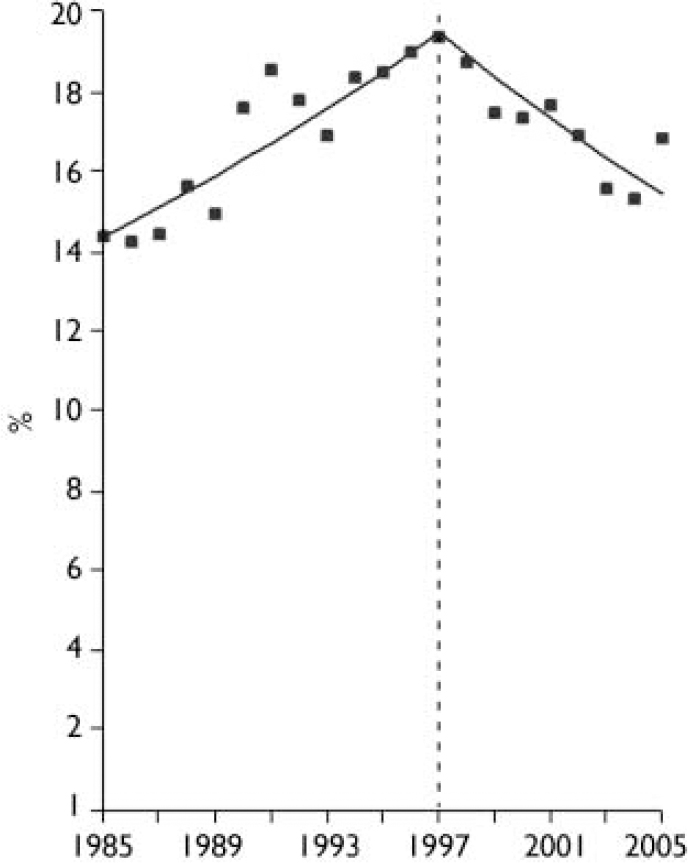
During the examined pre-legislation period, a significant positive time trend in firearm suicides as a percentage of total suicides was observed (χ2=68.5, d.f.=18, P<0.0001). During this period the percentage of firearm suicides increased from 14.3% in 1985 to 19.3% in 1997. Conversely, during the post-implementation period, a significant negative time trend was observed (χ2=30.5, P<0.0001), with a decrease to 16.8% in 2005 (Fig. 2). The growth factor of the percentage of firearm suicides per year, derived from Poisson regression analysis, was +2.6% prior to and –2.9% following the change in legislation (Table 1). Consequently, with 1998 set as offset, the change in trend was significant (χ2=53.5, P<0.0001). Figure 3 shows the course of suicide methods in the examined period. After the implementation of the firearm law, no increase in other methods was observed.
Firearm suicides as a percentage of total suicides.
Course of suicide methods before and after the 1997 firearm legislation.
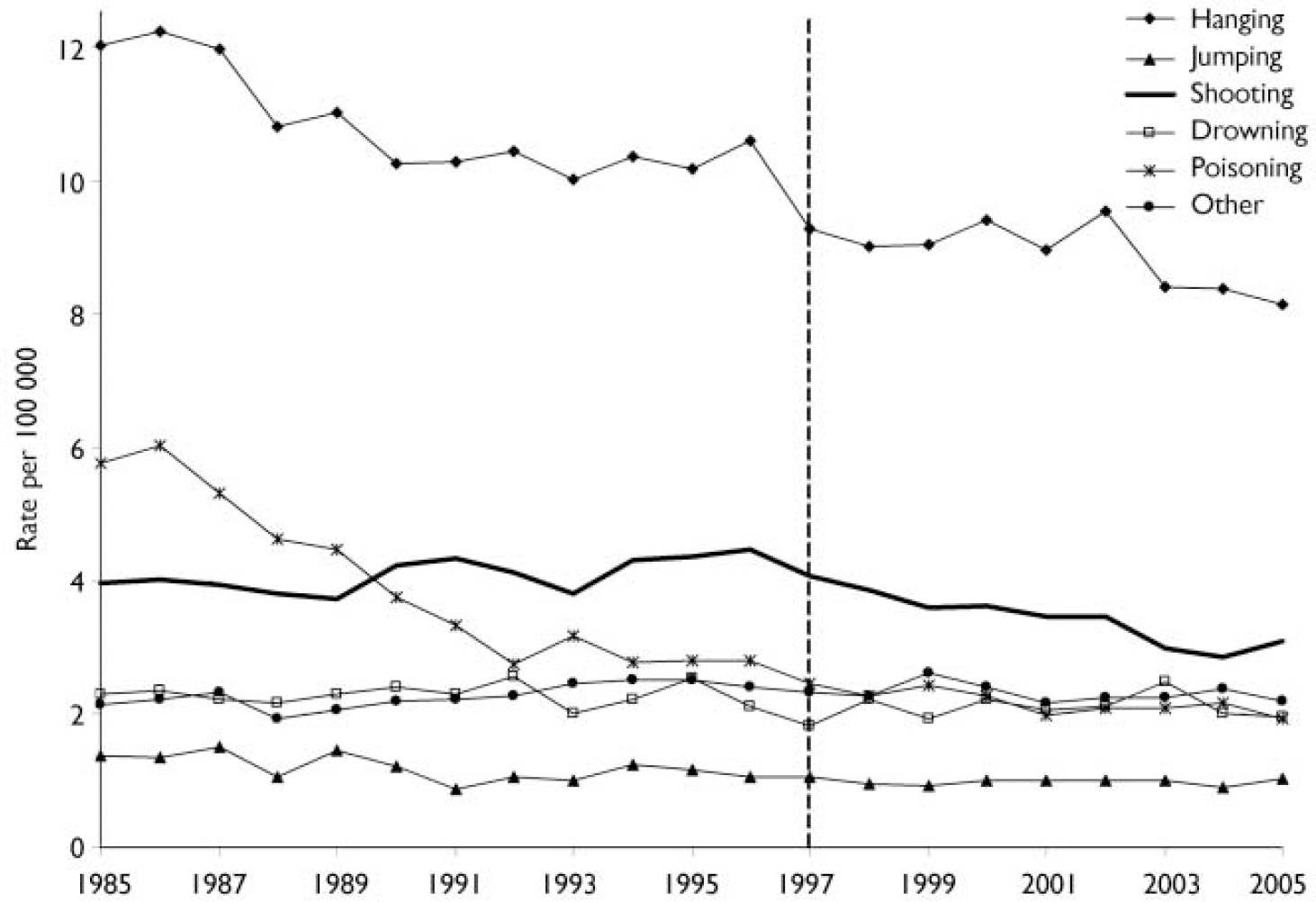
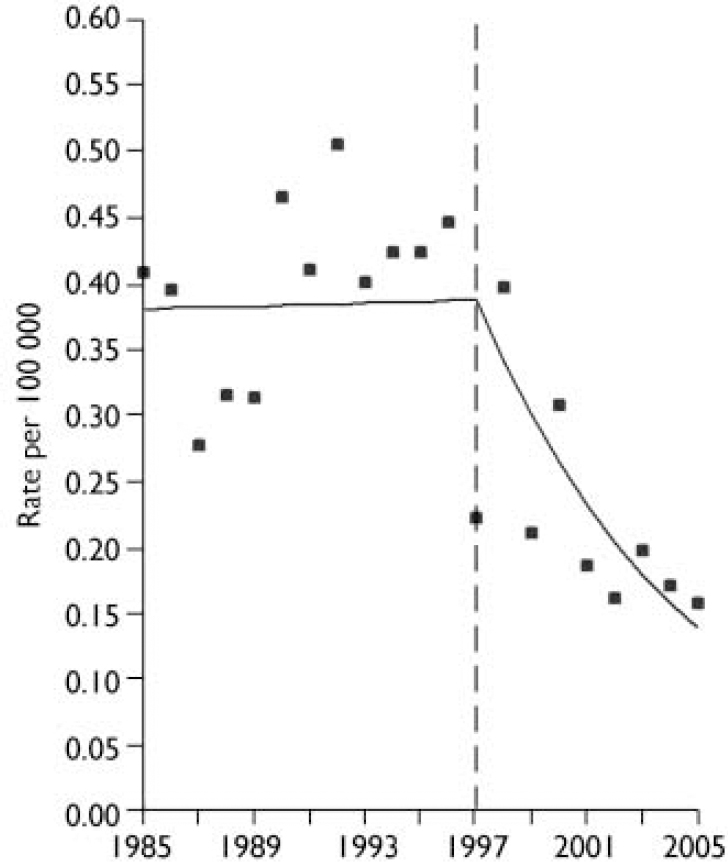
Figure 4 shows the time trend of the total number of firearm homicides, indicating no significant trend before 1998 (χ2=0.04, d.f.=18, P=0.840) with a mean of 0.39 (s.d.=0.08) firearm homicides per 100 000. The growth factor during this period was a modest +0.2% per year. A negative time trend was observed in the post-1998 period (χ2=23.6, P<0.0001); the growth factor was –2.3% per year. Firearm homicides reached a 20-year low of 0.16 per 100 000 in the year 2005. The change in the firearm homicide trend pre- and post-legislation was significant (χ2=14.3, P=0.0002). When adjusted for unemployment, alcohol consumption and the proportion of young men in the population, the trend change remained significant (χ2=3.9, P=0.049) (Table 1).
Firearm homicide rates.
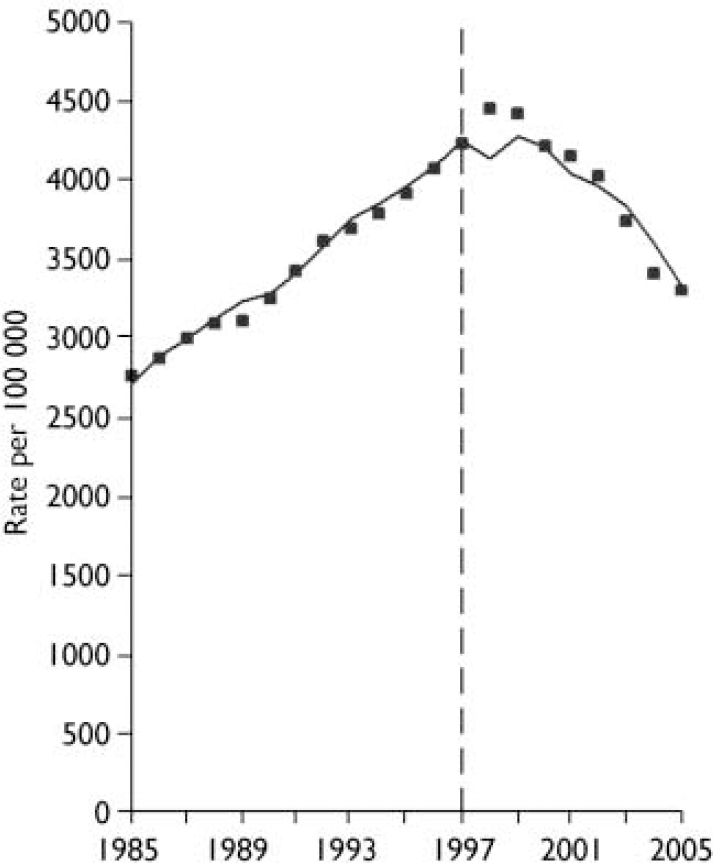
Finally, we observed a significant positive time trend in firearm licences per 100 000 before 1998 (Fig. 5) with an estimated increase of 140 per year (t=6.85, P<0.0001) and a significant negative time trend after the law with an estimated decrease of 125 per year (t=–3.52, P=0.0026). Hence, the change in the trend of firearm licence rates is also significant (t=–5.28, P<0.0001). Significant positive autocorrelation (P=0.0015) was observed (Table 1).
Firearm licence rates before and after the 1997 firearm legislation.
DISCUSSION
More stringent firearm legislation has been suggested as an evidence-based suicide prevention strategy (Reference Mann, Apter and BertoloteMann et al, 2005). We examined the effects of a firearm legislation reform in Austria over a period of 12 years prior to and 8 years following its enactment. The results show that the firearm suicide rate decreased among women aged 20–64 years, men aged 20–64 years and men aged 65 years or older; firearm suicides as a percentage of total suicides decreased; the firearm homicide rate decreased; and the overall firearm licence rate decreased after enactment of the new law. These results hold true even when adjusting for common confounders of suicide rates such as unemployment and average alcohol consumption per capita as well as the proportion of young men in the population.
The observed decline in the number of firearm suicides among some age groups after enactment of more stringent legislation is in congruence with previous studies. In the USA, the Brady Handgun Violence Prevention Act has been shown to have reduced suicide rates among people aged 55 years and over (Reference Ludwig and CookLudwig & Cook, 2000). In Canada, Leenaars & Lester (Reference Leenaars and Lester1997) observed a decrease in firearm suicides, but this effect was not apparent for those over 65 years old. In Australia a decline in the firearm suicide rate, especially among younger men, was observed in metropolitan and provincial cities after legal restrictions were introduced in 1992 (Reference Cantor and SlaterCantor & Slater, 1995). The decline in firearm suicides in Australia was further accelerated after the enactment of a more stringent firearm law in 1996 (Reference GoldneyGoldney, 2006). Data from New Zealand showed that the mean firearm suicide rate decreased after assessment of firearm reliability and licence tests were introduced in 1992 (Reference Beautrais, Fergusson and HorwoodBeautrais et al, 2006). Besides this decline in firearm suicides, a decrease in firearm suicides as a percentage of total suicides was also observed, similar to the decrease observed in our findings. The decrease in the percentage of firearm suicides has been discussed as ruling out the possibility that the decline in firearm-related suicides is due to changes in overall suicide rates (Reference Beautrais, Fergusson and HorwoodBeautrais et al, 2006).
A series of studies is also available from Canada, where the criminal code was amended in 1977 (Bill C-51). Some studies reported a decrease in firearm suicide rates after enactment of the reform (Reference Rich, Young and FowlerRich et al, 1990; Reference Carrington and MoyerCarrington & Moyer, 1994; Reference Leenaars, Moksony and LesterLeenaars et al, 2003). Although Rich et al (Reference Rich, Young and Fowler1990) suggested possible switching effects from firearm suicides to suicides by jumping, comparing 5-year periods before and after the reform, a subsequent study (Reference Carrington and MoyerCarrington & Moyer, 1994) with a longer observation period found this trend to be insignificant. The findings on the effects of legal restriction in Canada have been replicated by a further study, after two additional firearm laws (Bills C-17 and C-68) were enacted in 1991 and 1995; subsequent to this legislation, firearm suicides, the percentage of firearm suicides and firearm homicides further decreased (Reference BridgesBridges, 2004). However, when re-examining these Canadian data, Leenaars et al (Reference Leenaars, Moksony and Lester2003) found evidence of switching for men but not women. Since firearm suicide rates among women accounted for a small proportion of all firearm suicides in our study, switching effects for each gender were not calculated.
The potential switch to other suicide methods is a complex phenomenon which is often misinterpreted. Since firearm suicides (as a percentage of all suicides) decline after an effective law, the proportion of other methods of suicide logically increases. But this does not explain a possible switching phenomenon – one has to consider the course of suicide rates. Accordingly, a switching phenomenon would be reflected in an increase in absolute suicides by all other methods (or some of the methods) after the enactment of a more stringent firearm law, which was not observed in our work.
Besides cross-sectional studies on the association of firearm availability and firearm suicides in the USA (Reference Dahlberg, Ikeda and KresnowDahlberg et al, 2004; Reference Miller, Hemenway and AzraelMiller et al, 2004) and Austria (Reference Etzersdorfer, Kapusta and SonneckEtzersdorfer et al, 2006), longitudinal studies have shown that firearm suicides are associated with household firearm ownership (Reference Miller, Azrael and HepburnMiller et al, 2002; Reference Haw, Sutton and SimkinHaw et al, 2004). Our results support and supplement these findings, additionally demonstrating that a change in firearm legislation has an impact on firearm availability. A change in firearm legislation simultaneously alters the number of firearm licences and the firearm suicide rate, and this emphasises the hypothesised association between both variables.
In a cross-sectional study we have recently shown that there is a trend towards higher firearm suicide rates in counties with higher firearm licensing rates (Reference Etzersdorfer, Kapusta and SonneckEtzersdorfer et al, 2006). These findings have been described as representing an urgent public health issue (Reference LeenaarsLeenaars, 2006). Along with the results of the longitudinal analysis reported here, there is even more evidence to support the view that a reduction in firearm suicides and firearm homicides can be achieved by restriction of firearm availability through implementation of more stringent firearms legislation.
Limitations of the study
Because of the limiting ecological design of this study, it must be noted that the decreasing firearm homicide and suicide trends we observed – although having significantly changed in and after the year of the legal reform – may be attributable to socio-economic or other factors. The influence of well-known confounders such as consumption of alcohol per capita and unemployment did not significantly diminish the positive effects of the new law as observed in our study. This has also been found in earlier multivariate models, where the association of firearm availability and firearm suicide rates has not been ruled out (Reference Ludwig and CookLudwig & Cook, 2000; Lenaars et al, 2003; Reference Miller, Azrael and HepburnMiller et al, 2006).
Since the accuracy of survey data and other proxy variables of firearm availability are questionable (Reference Miller, Hemenway and AzraelMiller et al, 2004), the number of officially issued firearm licences was used to assess the availability of firearms. We acknowledge that this measure is an underestimation of firearm availability, but it is the only available measure for Austria. Another limitation of our results is that aggregated data analyses allow no direct conclusion about individuals. Miller et al (Reference Miller, Azrael and Hemenway2002) discussed the possibility that individuals who die by suicide may not share the characteristics (level of income, available firearm) of the group from which they were drawn. However, this does not limit the growing evidence that more stringent firearm legislation reduces firearm deaths in the overall population.
Finally, it could be argued that the decrease in firearm suicide rates observed in our study might be a randomly found effect of an overall decline in suicide rate and not due to the change in legislation. This is found to be improbable when the decline in post-legislation firearm homicides is also taken into consideration. We could show that, along with a decline in the number of firearm suicides, the number of firearm homicides also decreased after enactment of the new legislation. The firearm homicide rate trend had previously been steady, but it decreased after enactment, whereas the overall suicide rate was in continuous decline both before and after the legal reform. We argue that the effect of changes in firearm laws can be observed in two different measures: firearm suicides and firearm homicides. Restrictive firearm legislation has previously been shown to reduce firearm suicides as well as homicides in cross-sectional (Reference Conner and ZhongConner & Zhong, 2003; Reference Rosengart, Cummings and NathensRosengart et al, 2005) and longitudinal studies (Reference Loftin, McDowall and WiersemaLoftin et al, 1991; Reference Leenaars and LesterLeenaars & Lester, 1994; Reference Leenaars, Moksony and LesterLeenaars et al, 2003; Reference BridgesBridges, 2004).
Implications of the study
Suicide prevention plans encounter resistance when they demand more stringent firearm laws, because national firearm restrictions inevitably affect many people, including those who are not at risk of suicide. Yet it should also be remembered that those who are at risk will be more effectively protected by such laws. Some researchers state that suicide prevention strategies are based on two different approaches, which should be balanced – namely, the restriction of the means of suicide and the prevention of mental disorders (Reference Gunnell and LewisGunnell & Lewis, 2005). They rightly point to the fact that restriction of means does not address the root cause of the problem. However, until the effective prevention of mental disorders realistically becomes our long-term aim, we should recall that the restriction of means very probably does prevent suicide in the short term, thereby increasing the likelihood of people who are suicidal receiving professional help in time. Despite its limitations, this study provides evidence from a European country that firearm suicides and homicides may indeed be prevented through legal restriction of the availability of firearms. Therefore, we recommend that further steps be taken in Austria and in other countries to reduce the availability of firearms.




eLetters
No eLetters have been published for this article.