


People with intellectual disability (also known as learning disability in UK health services) constitute up to 2% of the UK population, according to the statistics of the Foundation for People with Learning Disabilities. 1 These individuals are at risk of developing serious mental illness. Around half will have serious mental health problems some time in their lives. Reference Cooper2 They have highly complex additional needs that cannot be met by the current mainstream mental health services.
Since the publication of Valuing People:A New Strategy for Learning Disability for the 21st Century, 3 there has been a renewed focus on the principles of inclusivity, choice and integration for people with intellectual disability, with a consequent acceleration of closure of National Health Service (NHS) hospital beds. Recent reviews have shown that the availability of in-patient beds for psychiatric admissions in the NHS is decreasing. Reference Weich4 The number of NHS beds in England fell from 8197 in 1997–8 to 3927 in 2005–6. This has been achieved by an increase of community-based services, increased use of mainstream psychiatric services and an increase in the use of independent sector hospital beds. The adverse impact of institutional care has been documented in recent investigations by the Healthcare Commission. 5
Cowley et al reported that the presence of symptoms associated with psychosis and symptoms of physical aggression predicted psychiatric admissions for adults with intellectual disabilities. Reference Cowley, Newton, Sturmey, Bouras and Holt6 Alexander et al found that admissions from residential care homes predicted longer in-patient stay. Reference Alexander, Piachaud and Singh7 Allen examined admissions to a intellectual disability hospital over a 20-year period and found no change in the rate of admissions following the development of community support teams but a reduction in long- and short-term admissions following the introduction of specialist services. Reference Allen8
An earlier local study examining the use of intellectual disability hospital beds showed a clear decrease in the use of beds between the 1970s and the 1980s, with a reduction in social admissions, a reduction in long-term admissions, a decrease in informal admissions and a decrease in readmissions. Reference Shaw and Roy9 Around the same time Perry et al reported a reduction in bed occupancy following the development of a community-based challenging behaviour service, although the effects were not sustained as beds became blocked. Reference Perry, Krishnan, Tewari, Cowan and Roy10,Reference Cumella, Marston and Roy11
Several intellectual disability hospitals in a strategic health authority in which the study took place were closed as the process of deinstitutionalisation gathered pace and the investment in community services grew. It was possible to examine long-term admission trends in one large specialist NHS hospital in this authority to look for the impact of community services, the rapid growth of the private sector and special arrangements for commissioning forensic beds, and beds for children and adolescents with an intellectual disability.
Method
All admissions to a large intellectual disability hospital were identified over a 3-year period (April 2003 to March 2006). The medical records were then examined for age, gender, legal status, reason for admission and where the patient was living at that time. The number of previous admissions was recorded, as was the length of stay. This was then compared with similar information on admissions to the same hospital in 3-year periods in three preceding decades (1975–7, 1985–7 and 1995–7). Admissions less than 1 month in duration, forensic admissions and out-of-area admissions were excluded from the study. The categories used in all studies were as follows.
-
• Home: private accommodation where the person was living alone or with relatives, and which was not accommodation specifically provided for people with intellectual disabilities.
-
• Hostel or group home: accommodation provided for people with intellectual disabilities by the local authority, private sector or the NHS, excluding buildings designated as ‘hospital’.
-
• Hospital: NHS accommodation designated as a hospital.
-
• Special hospital: a high secure hospital such as Rampton.
-
• Other: used for admissions from police stations or courts and for people with no fixed abode.
Results
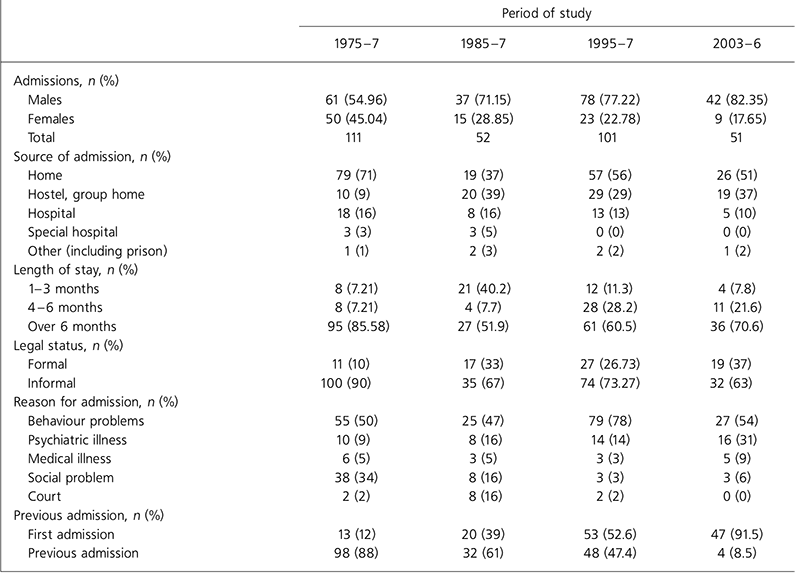
The study findings are summarised in Table 1. It was found that the percentage of patients admitted from hostels or group homes increased threefold, whereas admissions from home decreased over time. Long-stay admissions decreased in the second and third periods followed by an increase in the fourth period. There was a progressive increase in formal admissions and a decrease in informal ones. There was a decrease in admissions because of social difficulties and an increase in admissions of people with psychiatric illness. The percentage of first admissions gradually increased and the percentages of readmissions gradually decreased.
Study findings
| Period of study | ||||
|---|---|---|---|---|
| 1975-7 | 1985-7 | 1995-7 | 2003-6 | |
| Admissions, n (%) | ||||
| Males | 61 (54.96) | 37 (71.15) | 78 (77.22) | 42 (82.35) |
| Females | 50 (45.04) | 15 (28.85) | 23 (22.78) | 9 (17.65) |
| Total | 111 | 52 | 1 01 | 51 |
| Source of admission, n (%) | ||||
| Home | 79 (71) | 19 (37) | 57 (56) | 26 (51) |
| Hostel, group home | 10 (9) | 20 (39) | 29 (29) | 19 (37) |
| Hospital | 18 (16) | 8 (16) | 13 (13) | 5 (10) |
| Special hospital | 3 (3) | 3 (5) | 0 (0) | 0 (0) |
| Other (including prison) | 1 (1) | 2 (3) | 2 (2) | 1 (2) |
| Length of stay, n (%) | ||||
| 1-3 months | 8 (7.21) | 21 (40.2) | 12 (11.3) | 4 (7.8) |
| 4-6 months | 8 (7.21) | 4 (7.7) | 28 (28.2) | 11 (21.6) |
| Over 6 months | 95 (85.58) | 27 (51.9) | 61 (60.5) | 36 (70.6) |
| Legal status, n (%) | ||||
| Formal | 11 (10) | 17 (33) | 27 (26.73) | 19 (37) |
| Informal | 100 (90) | 35 (67) | 74 (73.27) | 32 (63) |
| Reason for admission, n (%) | ||||
| Behaviour problems | 55 (50) | 25 (47) | 79 (78) | 27 (54) |
| Psychiatric illness | 10 (9) | 8 (16) | 14 (14) | 16 (31) |
| Medical illness | 6 (5) | 3 (5) | 3 (3) | 5 (9) |
| Social problem | 38 (34) | 8 (16) | 3 (3) | 3 (6) |
| Court | 2 (2) | 8 (16) | 2 (2) | 0 (0) |
| Previous admission, n (%) | ||||
| First admission | 13 (12) | 20 (39) | 53 (52.6) | 47 (91.5) |
| Previous admission | 98 (88) | 32 (61) | 48 (47.4) | 4 (8.5) |
Discussion
It was to be expected that there would be changes in the admission pattern of people with an intellectual disability between the four periods of study, owing to the change in philosophy of hospital admissions. Following the Bournewood judgment, 12 the Mental Health Act Commission undertook a survey which implied that at any one time there were some 22 000 compliant, incapacitated hospital in-patients in England and Wales who would instead have to be detained formally under the 1983 Mental Health Act and that each year there would be about 48 000 more formal admissions. Reference Cumella, Marston and Roy11
The percentage of patients admitted from home decreased after the first period of our study but remained more or less stable after the second and the third periods. The decrease in numbers admitted from home in the second, third and fourth periods compared with the first period is possibly a reflection of increased provision of alternative community-based residential options.
Length of stay
Closure of hospitals and development of community teams in the late 1970s would account for the initial reduction in the length of stay. However, the pace of community development was insufficient to reverse this trend in the next three decades, leading to a progressive increase in the length of stay. The increase in the fourth period could be due to delayed discharges. It could also be a reflection of pschiatric morbidity and severity of the condition. In the study by Lyall & Kelly, the delayed discharge rate was 46%. Reference Lyall and Kelly13
Legal status
The increase in the percentages of formal admissions after the first period and the accompanying decrease in the percentages of informal admissions could be explained by a more appropriate use of the Mental Health Act and better risk assessment.
Reason for admission
The marked increase in admissions in the second, third and fourth periods of patients with psychiatric illnesses and the decrease in admissions because of social difficulties could be attributed to greater detection of psychiatric illnesses in the intellectual disability population and increased community-based options for those with social difficulties, thus avoiding the need for hospital admission.
Readmission rate
The percentages of first admissions gradually increased from the first to the fourth periods, whereas the percentages of readmission gradually decreased from the first to the fourth periods. There is better aftercare following discharge and better community services, which might have helped to reduce the readmission rates. This could be due to more selective admission criteria, more careful assessment during admissions and improved liaison between hospital and community services. Our findings are in agreement with those of Lyall & Kelly, who examined the use of psychiatric beds for people with intellectual disability who were relatively new to the service. They found that out of 348 admission episodes, only 59 (16.9%) were for individuals formerly resident in a local long-term hospital. Reference Lyall and Kelly13 New admissions and delayed discharges would be responsible for increased numbers of people with intellectual disability admitted in general psychiatric settings.
Out-of-area admissions
Reduction of in-patient capacity for people with intellectual disability in the NHS has been accompanied by a substantial number of people being placed outside their district of origin, predominately in the private and voluntary sector, often at considerable expense. Reference Pritchard and Roy14 The volume of such placements is on the increase and a study of such placements from the same geographical area predicted a continuation of this trend. Reference Goodman, Nix and Ritchie15 Taken out of this context, a reduction in the use of local NHS in-patient beds could be artefactual. Overall commissioning trends for people with an intellectual disability in a geographical area might be a better measure of the quality of services.
Conclusions
People with intellectual disability are now more likely to be admitted for psychiatric reasons and less likely to be admitted for social reasons. They are also more likely to be detained under the Mental Health Act than they were in the 1970s.
The length of long-stay admissions decreased in the 1980s and 1990s but increased in 2003–6. Readmissions have decreased. There needs to be much greater integration between hospital and community services through a pathway of care to facilitate shorter stay and early discharge. Out-of-area placements must be taken into account when commissioning for the needs of the total population with intellectual disabilities and mental health needs.
Declaration of interest
None.
Acknowledgements
We thank Debbie Kenny for secretarial assistance and the Medical Records Department for their help in obtaining medical notes.


 Open access


eLetters
No eLetters have been published for this article.