


Impact statement
Reliable measurement of soil chemistry is essential for developing and scaling climate solutions that depend on field-based observations. This study introduces a practical and reliable method for extracting soil porewater that works even under the dry or highly variable soil conditions that commonly limit field measurements through traditional extraction methods, such as rhizons or lysimeters. By enabling consistent soil-water sampling from a known soil volume, the SATuration–Centrifugation (SAT-C) approach helps overcome one of the main limitations of soil-based monitoring programs. The method has immediate relevance for enhanced rock weathering, a carbon dioxide removal approach that depends on soil chemistry measurements to support verification and carbon accounting. More broadly, SAT-C could improve soil monitoring in agriculture, environmental remediation and land restoration projects, where data gaps caused by seasonal drying or uneven soil conditions often undermine long-term datasets. By reducing uncertainty and increasing data reliability, this work supports more robust decision-making by researchers, practitioners and regulators. The approach is designed to be compatible with existing laboratory infrastructure, making it readily adoptable at scale. As interest in soil-based climate and environmental solutions grows globally, methods that enable dependable, comparable measurements will be critical for translating field observations into credible, scalable outcomes.
Introduction
Soil porewater is defined as the aqueous phase occupying the void spaces between soil particles (Di Bonito et al., Reference Di Bonito, Breward, Crout, Smith, Young, De vivo, Belkin and Lima2008) and is a critical component of subsurface geochemical systems, mediating the transport of nutrients, contaminants and ions (Sposito, Reference Sposito2008). Measurements of porewater composition are therefore widely used across disciplines to infer soil processes but are highly sensitive to both extraction techniques and soil moisture conditions (Geibe et al., Reference Geibe, Danielsson, van Hees and Lundström2006). These methodological sensitivities become particularly important in applied settings where porewater chemistry is used for quantitative interpretation (Di Bonito et al., Reference Di Bonito, Breward, Crout, Smith, Young, De vivo, Belkin and Lima2008).
Enhanced rock weathering (ERW) is one such application, in which crushed silicate rocks are applied to soils to promote carbon dioxide removal (CDR) alongside potential co-benefits for soil health (Hartmann et al., Reference Hartmann, West, Renforth, Köhler, Rocha, Wolf-Gladrow, Dürr and Scheffran2013; Beerling et al., Reference Beerling, Kantzas, Lomas, Wade, Eufrasio, Renforth, Sarkar, Andrews, James, Pearce, Mercure, Pollitt, Holden, Edwards, Khanna, Koh, Quegan, Pidgeon, Janssens, Hansen and Banwart2020; Levy et al., Reference Levy, Almaraz, Beerling, Raymond, Reinhard, Suhrhoff and Taylor2024). Within ERW monitoring, reporting and verification (MRV) frameworks, aqueous measurements are used to validate CDR credits (Isometric, 2025; Puro.earth, 2025). Within ERW, soil porewater acts both as a reagent, supplying carbonic and organic acids to mineral surfaces (Renforth and Campbell, Reference Renforth and Campbell2021), and as a temporary reservoir of mineral hydrolysis reaction products (bicarbonate alkalinity and the cations that charge-balance it, typically Ca2+, Mg2+, Na+ and K+) (McBride et al., Reference McBride, Skov, Wade, Betz, Stubbs, Bierowiec, Albahri, Cazzagon, Chen, Frew, Healey, Idam, Jones, Kelland, Mann, Manning, Mitchell, Murphy, Radkova, de toro, Solpuker, Teh, Tostevin, Turner, Wardman, Wilkie and Liu2025). Temporal changes in the concentration and stoichiometry of these dissolved species therefore provide a direct indicator of ongoing weathering reactions and associated CO₂ consumption (Clarkson et al., Reference Clarkson, Larkin, Swoboda, Reershemius, Suhrhoff, Maesano and Campbell2024). Although studies have shown that the proportion of weathering-derived cations on the exchange sites and secondary phases may be an order of magnitude greater than the signal captured in soil porewater (Hammes et al., Reference Hammes, Hartmann, Barth, Linke, Smet, Hagens, Pogge Von Strandmann, Reershemius, Casimiro, Vienne, Stoeckel, Steffens and Paessler2025), porewater and exchangeable pools are dynamically coupled, such that porewater chemistry reflects the balance between mineral dissolution, cation exchange and solute transport (Bache, Reference Bache1984; Hammes et al., Reference Hammes, Hartmann, Barth, Linke, Smet, Hagens, Pogge Von Strandmann, Reershemius, Casimiro, Vienne, Stoeckel, Steffens and Paessler2025; Kanzaki et al., Reference Kanzaki, Planavsky, Zhang, Jordan, Suhrhoff and Reinhard2025). As a result, accurate porewater measurements are essential for resolving both the magnitude and mechanism of labile ERW-driven weathering products, particularly for distinguishing carbonic-acid-driven alkalinity generation from strong-acid weathering using noncarbonic anions (Holden et al., Reference Holden, Davies, Bird, Hume, Green, Beerling and Nelson2024; McDermott et al., Reference McDermott, Bryson, Magee and van Acken2024; Maxbauer et al., Reference Maxbauer, Milliken, Yambing, Watson, Gregg, Swanson, Sohng, Sokol and Planavsky2025).
Challenges in using soil porewater measurements to estimate elemental concentrations stem from the transient nature of porewater itself (Milatz et al., Reference Milatz, Törzs, Nikooee, Hassanizadeh and Grabe2018; Hirst et al., Reference Hirst, Monhonval, Mauclet, Thomas, Villani, Ledman, Schuur and Opfergelt2023). The volume and composition of porewater in topsoils vary as a function of precipitation, evapotranspiration and leaching (Ehrhardt et al., Reference Ehrhardt, Groh and Gerke2025). Soil moisture exerts a first-order control on porewater chemistry, with changes in water content altering solute concentrations through dilution, concentration and the activation of distinct flow paths (Sigfusson et al. Reference Sigfusson, Paton and Gislason2006; Dyer et al. Reference Dyer, Kopittke, Sheldon and Menzies2008). Constructing accurate weathering fluxes requires year-round assessment of weathering products (te Pas et al., Reference te Pas, Chang, Marklein, Comans and Hagens2025), where single or isolated measurements may lead to erroneous estimates (Carmo et al., Reference Carmo, Silva, Lima and Pinheiro2016). Consequently, reliance on traditional extraction methods that preferentially yield samples during wetter periods risks biasing annual or seasonal flux estimates toward diluted conditions, potentially leading to systematic underestimation of total solute and alkalinity fluxes (Bertagni et al., Reference Bertagni, Calabrese, Cipolla, Noto and Porporato2025).
Traditional extraction methods, such as rhizon samplers and suction lysimeters, rely on porous membranes and applied tension (60–100 kPa) to mobilize porewater but differ in scale and performance (Di Bonito et al., Reference Di Bonito, Breward, Crout, Smith, Young, De vivo, Belkin and Lima2008). Rhizons (9 cm long, 0.45 cm Ø) enable repeated sampling but sample from lower soil volumes, rendering them unsuitable for flux estimates (Coutelot et al., Reference Coutelot, Sappin-Didier, Keller and Atteia2014), while larger lysimeters (20 cm long, ~5 cm Ø ceramic tip) capture more heterogeneous solutes yet risk soil structural alteration and preferential flow (Geibe et al., Reference Geibe, Danielsson, van Hees and Lundström2006; Edaphic Sci., 2025). Both face common challenges: (1) air ingress causing vacuum loss, (2) moisture-dependent yields (failing in dry periods), (3) device performance may differ substantially between different soil types (Orlowski et al., Reference Orlowski, Pratt and McDonnell2016) and (4) uncertainty in sampled soil volumes due to fluctuations in pore connectivity (Di Bonito et al., Reference Di Bonito, Breward, Crout, Smith, Young, De vivo, Belkin and Lima2008). This limits the granularity of mineral dissolution estimates in soils and increases uncertainty in CDR estimates (Levy et al., Reference Levy, Almaraz, Beerling, Raymond, Reinhard, Suhrhoff and Taylor2024).
Centrifugation of soil cores, known as the drainage centrifuge method, is a well-established approach for studying soil water retention, solute concentrations and structural changes (Di Bonito et al., Reference Di Bonito, Breward, Crout, Smith, Young, De vivo, Belkin and Lima2008; Fraters et al., Reference Fraters, Boom, Boumans, de Weerd and Wolters2017). The method is particularly useful for analyzing solute concentrations for highly mobile porewater constituents (e.g., nitrate, Fraters et al., Reference Fraters, Boom, Boumans, de Weerd and Wolters2017). In a recent study, elevated total alkalinity and calcium concentrations were determined on centrifuged soil aliquots (Jones et al., Reference Jones, Zhang, Clayton, Lancastle, Paschalis and Waring2025). The study is the first where soil centrifugation has been presented in an ERW context to mitigate challenges with traditional sample methods (Jones et al., Reference Jones, Zhang, Clayton, Lancastle, Paschalis and Waring2025). However, porewater recovery using the drainage centrifuge method remains constrained by soil moisture content, requiring higher centrifugation speeds under drier conditions. This can induce soil slumping, pore structure collapse and shifts in the pore domains sampled over time.
To address the limitations of traditional porewater extraction techniques, we present a novel SATuration–Centrifugation technique (hereafter SAT-C) for extracting soil porewater from intact soil cores. The novelty of SAT-C lies in the deliberate integration of a controlled saturation step with centrifugation to enable reproducible porewater extraction from a known soil volume, independent of in-situ soil moisture conditions. While centrifugation-based approaches have been used previously in soil science, SAT-C represents a methodological development designed to improve sampling reliability and temporal comparability. Here, the SAT-C method is tested and evaluated within the framework of ERW, where robust porewater chemistry is required for MRV. We compare the SAT-C method with two traditional pore water extraction techniques (rhizons and lysimeters) across two ERW field trials in Scotland.
Methods
Site description
Porewater was extracted from two multiyear basalt ERW gradient trials on Scottish grasslands (Dumyat and Glensaugh), featuring control plots and application rates from 20 t ha−1 (operationally feasible) to 126–130 t ha=1 for signal detection (McBride et al., Reference McBride, Skov, Wade, Betz, Stubbs, Bierowiec, Albahri, Cazzagon, Chen, Frew, Healey, Idam, Jones, Kelland, Mann, Manning, Mitchell, Murphy, Radkova, de toro, Solpuker, Teh, Tostevin, Turner, Wardman, Wilkie and Liu2025). Feedstocks were hand-applied via sieves to the surface. Trial plots remained ungrazed despite surrounding livestock grazing.
Dumyat is located on the Future Forest Company-managed Estate in central Scotland (56.14930789 N; −3.89292692). Texturally, the soil is a silty clay loam (McBride et al., Reference McBride, Skov, Wade, Betz, Stubbs, Bierowiec, Albahri, Cazzagon, Chen, Frew, Healey, Idam, Jones, Kelland, Mann, Manning, Mitchell, Murphy, Radkova, de toro, Solpuker, Teh, Tostevin, Turner, Wardman, Wilkie and Liu2025). The soil organic carbon (SOC) content is 3.55 ± 0.37 wt.% (McBride et al., Reference McBride, Skov, Wade, Betz, Stubbs, Bierowiec, Albahri, Cazzagon, Chen, Frew, Healey, Idam, Jones, Kelland, Mann, Manning, Mitchell, Murphy, Radkova, de toro, Solpuker, Teh, Tostevin, Turner, Wardman, Wilkie and Liu2025). The Dumyat trial commenced in September 2022, with basalt applied between the 20th and 27th of September 2022 (McBride et al., Reference McBride, Skov, Wade, Betz, Stubbs, Bierowiec, Albahri, Cazzagon, Chen, Frew, Healey, Idam, Jones, Kelland, Mann, Manning, Mitchell, Murphy, Radkova, de toro, Solpuker, Teh, Tostevin, Turner, Wardman, Wilkie and Liu2025).
Glensaugh is located on land owned by the James Hutton Institute in Aberdeenshire, Scotland (56.89427868 N; −2.54168692). The soil at Glensaugh is a sandy silt loam, with an SOC content of 3.16 ± 0.84 wt.%. Basalt was applied on May 19, 2023.
Both sites fall within the temperate oceanic climate zone, under the Köppen-Geiger classification scheme (Beck et al., Reference Beck, Zimmermann, McVicar, Vergopolan, Berg and Wood2018), with slight differences in the 10-year (January 1, 2015–January 1, 2025) mean annual temperature (9.1 °C at Dumayat and 7.9 °C at Glensaugh) and mean annual precipitation (1207.2 and 1054.1 mm, respectively) (Muñoz Sabater, Reference Muñoz Sabater2019).
Experimental layout
In each control and high-density plot at both sites, three sample arrays were installed ~5 m apart to avoid edge effects. Each array duplicated the three extraction methods twice (~30 cm apart; Figure 1), yielding three duplicate pairs per method per plot and 96 total porewater samples across sites. Colocated plots ensure equivalent atmospheric solute inputs from precipitation, enabling valid method comparisons.
Overview of the relative location of the plots used in this study from Dumyat and Glensaugh, with a schematic representation of how different extraction methods (rhizon samplers, suction lysimeters and soil cores) were positioned relative to each other. The outer plot boundaries at Dumyat are 100 m by 48 m, and at Glensaugh, the larger plots are 90 m by 12 m and the smaller plots 12 m by 12 m. Within each, three sample arrays were installed, each ~5 m apart. The horizontal distance between different extraction methods within each array is ~30 cm.

Feedstock description
Both trials used local quarry basalt byproducts: Hillend quarry (quartz microgabbro, Carboniferous Midland Valley Sill Complex; Cameron et al., Reference Cameron, Aitken, Browne and Stephenson1998; situated in Ayrshire [55.88552, −3.88448], Tillicoultry Quarries Ltd.) for Dumyat, and Pitcaple quarry (norite/gabbronorite, Ordovician Insch Pluton; Gould, Reference Gould1997; situated in Aberdeenshire [57.32786, −2.45161]) for Glensaugh.
Both contained 69.9% fast-weathering minerals (plagioclase, pyroxene, ilmenite, amphibole and magnetite; when compared with grouping in Lewis et al., Reference Lewis, Sarkar, Wade, Kemp, Hodson, Taylor, Yeong, Davies, Nelson, Bird, Kantola, Masters, DeLucia, Leake, Banwart and Beerling2021), but Pitcaple had ~8.4 wt.% fewer slow-weathering minerals and ~ 8.4 wt.% more unknown-rate minerals (mostly amorphous) (see Supplementary Table S1). Major element chemistry was similar (Epot: 0.28–0.29 tCO₂ tRock−1; see Supplementary Table S2). Pitcaple had a finer mean particle size (567 μm vs. 1279 μm) and higher surface area (1.75 vs. 0.917 m2 g−1).
Extraction methods
The soil porewater extraction methods deployed are (1) macro-rhizon samplers (Macro-rhizons, Rhizosphere, 2025), (2) ceramic lysimeters (1,900 soil water samplers, Soilmoisture, 2025), (3) soil cores extracted for saturation over 24 hours and (4) soil cores extracted for saturation over 72 hours.
Macro-rhizons were installed at 10 cm depth in mid-April at both sites, with two per array ~30 cm apart horizontally (Figure 1). Shallow pits enabled horizontal placement, and installation holes were predrilled using old rhizons to avoid membrane damage. The porous polymers were saturated in deionized water before installation and left in the field for a week to stabilize in the soil profile. Disposable 30 mL syringes, attached to the rhizon tubing, were used to create a vacuum 24 h pre-collection on April 24, 2025. Porewater samples from rhizons were collected into pre-labeled 50 mL centrifuge tubes.
Lysimeters were installed vertically ~50 cm from rhizons at 20 cm depth (effective sampling: 15–20 cm) using an auger (Figure 1). Excavated soil was sieved (9.5 mm), slurried with deionized water and backfilled around probes to ensure good soil-membrane connectivity. Similar to the rhizons, the lysimeters were left in the field for more than a week to stabilize in the soil. On April 24, 2025, a target vacuum of 60 kPa was applied using a hand pump 24 h pre-collection. Lysimeters were exhumed for central water retrieval into pre-labeled 50 mL centrifuge tubes.
Soil cores were taken with a spacing of ~30 cm outward from the lysimeter installation locations (Figure 1), to avoid any soil compaction. Soil cores were extracted by inserting two stacked metal collection rings (Ø = 5 cm, h = 5 cm, V = 95.03 cm3) hammered flush to the ground’s surface (following root/litter zone removal). The two rings were excavated, carefully keeping the rings together until fully extracted. The rings were separated using a pallet knife, and the lower core, 5–10 cm depth, was capped on both ends to preserve the cores prior to saturation and centrifugation.
Porewater samples and soil cores were collected from both sites in the morning of April 25, 2024, and transported chilled to James Hutton Institute (JHI) Invergowrie for refrigerated storage pre-analysis.
Soil core saturation and centrifugation
Upon arrival at JHI, gauze was fitted around the bottom of the soil cores and secured to eliminate the risk of soil loss during the SAT-C process. The fresh weight of the cores was determined before saturation. Following the centrifugation, the cores were oven-dried (at 105 °C for 24 hours) and the dry weight was recorded, to determine the initial soil moisture content and soil bulk density before saturation. For saturation, the prepared soil cores were placed in individual polythene bags, and 60–100 mL of deionized water was added to the bags to ensure full saturation, reaching two-thirds of the core height, allowing air to leave the cores. Following water addition, the bags were sealed and left to saturate in a cold room at 4 °C for either 24 or 72 hours. Following saturation, cores were transported in cool boxes from JHI Invergrowie to JHI Aberdeen (~2-hour drive), where the centrifugation was conducted.
The cores were transferred to a wire rack to allow the drip off, ensuring that any water extracted during the centrifugation process originated from within the soil pores. Porewater was extracted through the use of core holders, which had two chambers: the upper chamber contained the core and was separated from the lower chamber by a perforated plastic disc with filter paper. The core, perforated disc and filter paper were contained in the polythene bag to collect the extracted water and ensure no cross-contamination between the cores.
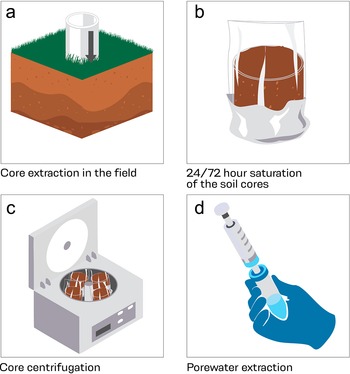
A pilot study, with a centrifuge speed of 1,000 RPM for a duration of 30 minutes, was found to eliminate challenges with soil slumping, physical damage to core bags and deformation of the perforated plate. Hence, cores in this study were spun at a speed of 1,000 RPM for 30 minutes using a Beckmann Coulter J6-MI temperature-controlled centrifuge and JS-4.2 swinging bucket rotor assembly to hold the core water extraction assembly. Following the centrifugation process, the soil core, perforated disc and filter paper were removed from the bag, and the supernatant was transferred using syringes from the polythene bag and passed through a 0.22 μm filter into a 50 mL Falcon tube (Figure 2).
Schematic illustration of the SAT-C process from (a) soil core sampling in the field, (b) saturation in the lab, (c) centrifugation of saturated cores and (d) filtration of the supernatant extracted from the cores during centrifugation.

Chemical analysis
The soil porewater samples from all three extraction methods were acidified using 2 M nitric acid and analyzed for cations (boron, calcium, magnesium, sodium, potassium, phosphorus, sulfur and silicon) using Perkin Elmer AVIO 500 inductively coupled plasma optical emission spectroscopy (ICP-OES). The instrument was calibrated using multipoint calibration, and standards were matrix-matched to the samples (see limits of detection in Supplementary Table S3). Anions (fluoride, chloride, nitrate and sulfate) were analyzed using a Thermo Aquion ion chromatography (IC) system. For low-volume samples, dilutions were prepared manually with high-purity water using electronic dispensing pipettes. Phosphate and total alkalinity as calcium carbonate were analyzed using a Seal AQ400 discrete colorimetric analyzer. Alkalinity was determined following reaction with bromocresol blue solution. Phosphate was determined using a blue phosphomolybdic complex reaction.
SAT-C porewater concentrations
The cation and anion concentrations measured on the supernatant from SAT-C soil cores were diluted during the saturation process. In order to calculate the original concentrations, had the core not been saturated, the following mixing model was applied (Eq. 1):
 $$ {\mathrm{C}}_1{\mathrm{V}}_1={\mathrm{C}}_2{\mathrm{V}}_2 $$
where C 1 is the initial concentration of the solution, V 1 is the initial volume of the solution (found through fresh and dry weight of the cores), C 2 is the final concentration of the solution after dilution (the concentration of cations and anions in the supernatant) and V 1 is the final volume of the solution after dilution.
Bicarbonate estimation
The concentration of bicarbonate from each porewater sample was estimated by balancing the equivalents of the sum of major cations and anions with bicarbonate according to the following equation (Eq. 2, modified from McDermott et al., Reference McDermott, Bryson, Magee and van Acken2024):
 $$ \left[{HCO}_3^{-}\right]=\left(\left(\left[ Mg\right]+\left[ Ca\right]\right)*2+\left[K\right]+\left[ Na\right]\right)-\left(\left[ Cl\right]+\left[{NO}_3\right]+\left(\left[{SO}_4\right]*2\right)+\left(\left[{PO}_4\right]*3\right)\right. $$
where the elements and compounds in the equation are expressed in mol L−1.
Data analysis
The estimated bicarbonate from the different porewater extraction methods was evaluated using two linear mixed models, for Dumyat and Glensaugh, respectively. The extraction method was included as a fixed categorical explanatory variable with the rhizon group as the reference level and application rate as a random effect, taking the clustering of samples within plots into account (West et al., Reference West, Welch and Galecki2022). Plots of model residuals were inspected to ensure model assumptions of normality, homogeneity and independence of residuals were met. The residual normality and homoscedasticity were also evaluated using Shapiro–Wilk (Shapiro and Wilk, Reference Shapiro and Wilk1965) and White’s Lagrange multiplier test (White, Reference White1980), respectively. Within each treatment, Tukey’s HSD (Tukey Reference Tukey1953) performed pairwise comparisons across extraction methods (12 total). Furthermore, the balance between the sum of conservative cation and anion equivalents, as measured on the diluted SAT-C porewater samples, was compared using linear regression to the measured alkalinity converted to mol L−1. For a further comparison of the relative proportions of major ions within and between the extraction methods, Piper diagrams for each site are presented. All statistical analyses were carried out using Python (version 3.9) and the package Statsmodels (version 0.14.4, Seabold and Perktold, Reference Seabold and Perktold2010).
Results and discussion
Soil pore water yield
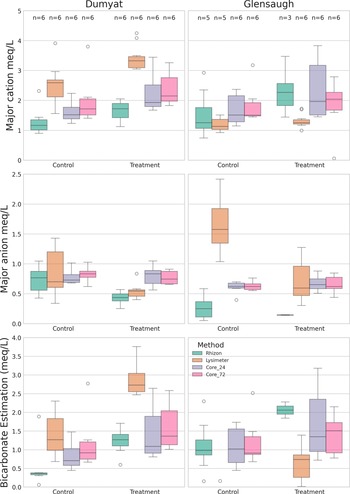
A key motivation for developing SAT-C is that traditional porewater extraction techniques can fail to produce sufficient sample volumes for chemical analysis, whether due to low soil moisture or device failure, leading to low replication or uneven spatial and temporal coverage (Holzer et al., Reference Holzer, Nocco and Houlton2023 and McDermott et al., Reference McDermott, Bryson, Magee and van Acken2024). In this study, water yield was sufficient (3 mL) for chemical analysis in 91 of the 96 porewater samples collected across all extraction methods (Figure 3). While all sample collections were successful at Dumyat, several rhizons and one lysimeter sampler did not produce the minimum required volume for analysis at Glensaugh, despite the experiment occurring in early spring when soil water reservoirs are usually at their highest in Scotland. In contrast, all SAT-C cores yielded sufficient porewater at both sites, reflecting the role of the saturation step in ensuring adequate soil moisture for porewater extraction.
First row: Sum of major cations (calcium, magnesium, sodium and potassium) in their equivalents. Second row: Sum of major anions (chloride, nitrate, sulfate and phosphate) in their equivalents. Third row: Estimated bicarbonate in equivalents found through charge balancing major cations and major anions. Grouped by site (Dumyat in the first column and Glensaugh in the second column). Box plots are colored according to the porewater extraction method used (rhizon, lysimeter, as well as SAT-C cores saturated for 24 and 72 hours). Control and treatment (basalt application) on the x-axis. The number of replicas (n) within each group that yielded sufficient sample volume for porewater analysis is indicated above the individual boxes in the upper two plots.

Major cations, major anions and estimated bicarbonate between the extraction methods
The sum of major cation and anion equivalents, as well as the inferred bicarbonate concentrations, is presented for the individual site, extraction methods and treatment in Figure 3. Concentrations from the SAT-C samples have been corrected for the dilution of the saturation using the mixing model in Equation 1. Overall, concentrations across the sampling methods are of the same order of magnitude, with inter- and intra-group variation for major cations and anions.
The SAT-C method yields porewater bicarbonate and major ion concentrations comparable to those obtained from rhizon sampling, confirming its reliability for accurate porewater analysis in ERW studies. The linear mixed-effect models showed that the only extraction method that was different from the rhizon was, unexpectedly, the lysimeters (p < 0.001 and p = 0.002 for Dumyat and Glensaugh, respectively). For both models, the residuals met model assumptions of normality and homoscedasticity (Shapiro–Wilk and White Lagrange multiplier, p > 0.05). The largest variability between extraction methods is observed for the anions at Glensaugh, where concentrations were high in the control lysimeter samples, resulting in a negative estimated bicarbonate, which suggests an underlying issue with the analysis of the samples. For that reason, the mixed linear model for Glensaugh was run with and without the lysimeter data. Regardless, the models showed that the SAT-C groups were not significantly different from the rhizon group (p > 0.1). For Dumyat, the Tukey’s HSD post hoc test revealed that the basalt-amended lysimeter concentrations were significantly higher compared to SAT-C cores that had been saturated for 24 hours (p < 0.05). For Glensaugh, only the lysimeter concentrations from the control groups were significantly different from those of the SAT-C cores (p < 0.05).
In ERW, elevated porewater bicarbonate concentrations relative to the control reflect potential CDR from mineral weathering of the applied feedstock. As such, consistency within each extraction method is pivotal in producing reliable CDR estimations. However, the lysimeter-derived bicarbonate estimates diverged in the relative difference from rhizon and SAT-C values, with direction varying by site: higher at Dumyat, lower at Glensaugh (Figure 3).
Although lysimeters and rhizons are widely established techniques for soil porewater sampling, our results show that they do not necessarily produce equivalent porewater chemistries. Similar method-dependent differences have been reported previously, with porewater composition shown to vary according to sampler type and extraction physics (Geibe et al., Reference Geibe, Danielsson, van Hees and Lundström2006). These discrepancies likely arise because the three extraction methods differ fundamentally in how porewater is mobilized and which pore domains they access, driven by differences in (1) the tension exerted during extraction and (2) the soil–sampler interface area over which water is drawn.
The tension during the centrifugation was substantially lower than the target tension that was applied to the rhizon and suction lysimeters. The theoretical maximum tension achievable with rhizons is 100 kPa. For the lysimeter, the target tension was set at 60 kPa. A tension range of 60–80 kPa is generally considered the upper limit for soil pore water extraction (Carter, Reference Carter2007). In contrast, the tension exerted during centrifugation is 22.25 kPa (with a rotor radius of 203 mm and 1,000 rpm). This tension falls within the typical range of 10–30 kPa for the soil matrix potential at field capacity, depending on soil type (Datta et al., Reference Datta, Taghvaeian and Stivers2018). Notably, although the maximum target tension of the rhizons and lysimeters is known, it is infeasible to know the actual tension exerted throughout the duration of the soil extraction (24 hours). The absence of systematically higher solute concentrations in the rhizons and lysimeters compared to the SAT-C cores may indicate that realized tensions were lower.
Our centrifugation approach contrasts with that of Jones et al. (Reference Jones, Zhang, Clayton, Lancastle, Paschalis and Waring2025), who applied a much higher centrifugal tension (300 kPa) to aliquots of homogenized soil and observed significantly elevated porewater alkalinity relative to lysimeters, which they attributed to mobilization of solutes from smaller, micropore domains inaccessible to lysimeter sampling. We do not see elevated alkalinity within SAT-C porewater; at the lower tensions applied here, the SAT-C porewater represents the ‘water extractable ions’ in the soil solution, that is, the ions that are readily leachable during the next rain event, rather than porewater contained within the smallest soil pores. The similar magnitude of bicarbonate estimations across methods suggests that chemical equilibrium was reached between the existing soil moisture content in the soil cores and the deionized water in the SAT-C cores.
The significant difference between the lysimeter and rhizon groups is probably partially driven by the fact that the soil interface of the different samplers differs considerably. The smaller contact area of the rhizons effectively reduces the soil volume from which the porewater is extracted, with potentially higher variability through sampling of local heterogeneity (Di Bonito et al., Reference Di Bonito, Breward, Crout, Smith, Young, De vivo, Belkin and Lima2008). Larger-area samplers (lysimeters) and bulk methods (including centrifugation) integrate water over many pores and, as such, are less prone to microscale variability (Geibe et al., Reference Geibe, Danielsson, van Hees and Lundström2006; Orlowski et al., Reference Orlowski, Pratt and McDonnell2016). Hence, method comparison regarding contact area reveals centrifugation and lysimeters as most analogous. However, although a theoretical surface area of the soil cores can be calculated, the direct comparison is arbitrary. Rather, the bicarbonate estimate suggests that the SAT-C groups are similar to the rhizon groups, regardless of the theoretical discrepancy in the soil interface. Furthermore, the lysimeter data exhibit the greatest variability, possibly due to differences in contact area between samples and across sites. While the soil interface of traditional extraction methods reflects the maximum possible area, the actual area is unknown, as this is influenced by spatial and temporal soil moisture differences, hence introducing an uncertainty in the volume of soil sampled. This uncertainty is alleviated through SAT-C, where soil volume and moisture are constant between inter- and intra-event samples. Hence, it is proposed that the SAT-C porewater time series will be more comparable over time, compared to those from traditional soil porewater extraction methods.
Alkalinity
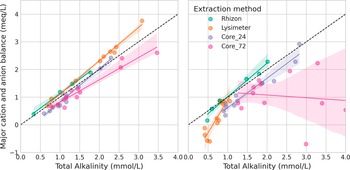
In order to check the validity of estimating bicarbonate from the conservative cations and anions, the balance between the two is compared to the measured alkalinity expressed in mmol L−1 (Figure 4). At Dumyat, the linear fit is good for each extraction method (R 2 ranging from 0.94 to 0.99, p < 0.005 for all extraction methods). At Glensaugh, there is a strong linear relationship between alkalinity and the charge balance between major ions for the rhizon samples (R 2 = 0.97, p < 0.001) and SAT-C cores that were saturated for 24 hours (R 2 = 0.94, p < 0.001). Given the negative balance of cations and anions from the lysimeter samples at Glensaugh, the linear fit is predictably weaker (R 2 = 0.79, p < 0.001). However, the lowest linear fit from Glensaugh is in the data from the SAT-C cores that were saturated for 72 hours (R 2 = −0.01, p = 0.7). This suggests that a 24-hour saturation period yields more reproducible results than longer saturation durations using the SAT-C method. Albeit, no significant differences in estimated bicarbonate were found between the SAT-C cores that were saturated for 24 and 72 hours, indicating that no additional mineral dissolution occurred over this period. Although the mechanism underlying the higher alkalinity observed in the Glensaugh cores following 72 h saturation remains unclear, prolonged saturation may promote microbial processes and the production of organic alkalinity, which could contribute to the observed increase (Zhan, Reference Zhan2024; Bijma et al., Reference Bijma, Hagens, Hammes, Planavsky, Pogge von Strandmann, Reershemius, Reinhard, Renforth, Suhrhoff, Vicca, Vienne and Wolf-Gladrow2026; Rieder et al., Reference Rieder, Hagens, Poetra, Vidal, Calogiuri, Neubeck, Singh, Corbett, Niron, Vicca, Vlaeminck, Janssens, Verdonck, Janssens, Li, Hammes and Hartmann2026).
Scatter plots between total alkalinity and the balance between the conservative cations and anions. Note that for the SAT-C data, the balance between major cations and anions plotted here is the actual measured concentrations on the diluted samples, not the corrected data.

In natural, uncontaminated soils, bicarbonate is assumed to be the main contributor to alkalinity (Rounds and Wilde, Reference Rounds and Wilde2012; Gastmans et al., Reference Gastmans, Hutcheon, Menegário and Chang2016). In an ERW context, elevated levels of bicarbonate originate from silicate mineral dissolution, although hydroxide ions (in alkaline soils, pH > 7) and organic alkalinity (in organic matter-rich soils) may also contribute to alkalinity (Rounds and Wilde, Reference Rounds and Wilde2012). Total alkalinity is often used as a measure of mineral dissolution in ERW studies (e.g., Amann and Hartmann, Reference Amann and Hartmann2022). However, total alkalinity for SAT-C samples cannot be determined by direct measurements of porewater alkalinity because of the latent effects of deionized water on the carbonate system. This means that we are unable to compare direct measurements of total alkalinity for SAT-C samples against rhizon and lysimeter samples.
Instead, we used the measured alkalinity to compare with the charge balance of major conservative cations and anions (using the diluted/uncorrected concentrations from SAT-C), as a check of the validity of using conservative ions to estimate the bicarbonate concentration. In order to ensure that charge balance was a good proxy for alkalinity, we regressed direct measurements of alkalinity against charge balance for all extraction methods. We found that total alkalinity was generally significantly correlated to the charge balance of conservative cations and anions, indicating that charge balance was an accurate proxy for alkalinity (Figure 4). However, at Glenasugh, the SAT-C cores that were saturated for 72 hours showed a nonsignificant relationship (Figure 4, R 2 = −0.01, p = 0.7). SAT-C cores saturated for 24 hours showed a similar slope and curve shape to rhizon samples, both from Dumyat and Glensaugh (Figure 4). For the lysimeter samples, there was good correspondence with rhizon and SAT-C samples for Dumyat, but a poorer agreement for Glensaugh (Figure 4). This implies, overall, that charge balance for SAT-C samples incubated for 24 hours is a relatively good proxy for alkalinity and hence bicarbonate concentration.
Concentration of conservative cations and anions across extraction methods
Piper diagrams were used to compare the relative proportions of major ions between extraction methods at both sites (Figure 5). The proportion of magnesium was broadly similar between methods, with magnesium contributing ~20% of the total cation charge at both Dumyat and Glensaugh. Overall, the variability in the relative proportions of major ions between the different extraction methods is visually similar to the variability observed within each of the extraction methods (Figure 5). There is a tendency toward higher sodium and potassium concentrations relative to calcium in the SAT-C cores at both sites compared with the rhizon samples. This could be due to differences in the pore spaces contributing to the porewater extracts. However, the differences are small, and the populations overlap.
Piper diagrams showing the relative proportions of major cations and anions in the porewater samples taken using the four different extraction methods. Circles represent samples taken from the control plots, squares represent samples from the basalt-amended plots. For Glensaugh, the lysimeter data have not been plotted due to unrealistic estimated bicarbonate concentrations.

The lysimeter samples (only shown for Dumyat, due to the negative charge balance at Glensaugh) show considerable variation. For anions, rhizon and core samples overlap, showing variation in chloride and bicarbonate with higher chloride contents for the centrifuged cores, especially at Glensaugh, where the concentration of conservative anions was relatively low (see also Figure 4).
Prospects of the SAT-C method
MRV for the quantification of CDR in enhanced weathering systems is not only limited to aqueous-phase measurements but also includes quantification of CDR through solid-phase measurements that aim to measure cation loss from the bulk soils (Reershemius et al., Reference Reershemius, Kelland, Jordan, Davis, D’Ascanio, Kalderon-Asael, Asael, Suhrhoff, Epihov, Beerling, Reinhard and Planavsky2023; Isometric, 2025; Puro.earth, 2025).
Substantial quantities of weathering-derived cations can be retained on soil exchange sites (Hammes et al., Reference Hammes, Hartmann, Barth, Linke, Smet, Hagens, Pogge Von Strandmann, Reershemius, Casimiro, Vienne, Stoeckel, Steffens and Paessler2025). Although these pools do not represent realized CDR, their characterization provides important contextual information on buffering and the temporal dynamics of weathering products in ERW systems (Hammes et al., Reference Hammes, Hartmann, Barth, Linke, Smet, Hagens, Pogge Von Strandmann, Reershemius, Casimiro, Vienne, Stoeckel, Steffens and Paessler2025). Because SAT-C recovers intact soil cores for porewater extraction, the same cores can be used to characterize soil-phase pools directly, for example, through bulk soil digests or ammonium-acetate extractions of exchangeable cations. Furthermore, an understanding of the physical properties of soils, such as bulk density and water-filled porosity, is important in estimating the stocks of potential CDR, both in the solid and aqueous phases of the soil. The boundary conditions of taking a soil core mean that these properties can be directly constrained from simple measurements on the cores, eliminating the need for separate sampling and potentially reducing operational costs. Hence, SAT-C offers a sampling method that links porewater chemistry, exchangeable cations and soil physical structure, improving coherence between aqueous and solid-phase measurements and enhancing sampling efficiency.
While this study provides proof of concept for the SAT-C method as a reliable alternative to traditional soil porewater extraction methods under the conditions studied here, validation of the method’s universal applicability necessitates testing across diverse soil types and cropping regimes.
Conclusion
Soil porewater extracted using the SAT-C method produced similar estimated bicarbonate concentrations as compared to the traditional rhizon sampling method, across two different multiyear ERW trials in Scotland. The traditional lysimeter differed most from the other extraction methods, highlighting that even well-established techniques can yield varying results. Regression analysis between measured total alkalinity and the charge balance of major conservative cations and anions revealed similar relationships for rhizon samples and 24 hour saturated SAT-C cores at both sites. This consistency indicates that, under the conditions examined here, charge balance-derived bicarbonate of SAT-C porewater provides a reliable estimate of soil-solution alkalinity in these ERW trials. Overall, the SAT-C method alleviates some of the limitations during low soil moisture periods of traditional porewater extraction methods, while producing realistic concentrations of the readily leachable mineral dissolution products in soil porewater.
Open peer review
To view the open peer review materials for this article, please visit http://doi.org/10.1017/cat.2026.10011.
Supplementary material
The supplementary material for this article can be found at http://doi.org/10.1017/cat.2026.10011.
Data availability statement
The data that support the findings of this study are openly available in Zenodo at: https://doi.org/10.5281/zenodo.18657689
Acknowledgments
The authors sincerely thank Tom Reershemius for insightful discussions, which were instrumental in shaping the framework of this study.
Artificial intelligence (AI, specifically perplexity.ai) was used on occasion to assist with improving the clarity and language of the manuscript and to aid in identifying relevant literature. All substantive content, data analysis and interpretation and final editing were conducted by the authors, who take full responsibility for the integrity and accuracy of the manuscript.
Author contribution
Conceptualization: K.S., A.R., K.L., X.L.; Data Curation: K.S., A.R., G.C.; Funding Acquisition: J.M.; Investigation: K.A., T.B., C-J.C., A.F., S.H., L.J., C.M., J.O., M.W.; Methodology: A.R., M.A., D.B., M.C., K.L., X.L.; Project Administration: A.R., T.B., K.L., X.L.; Resources: D.B., K.L., J.O.; Supervision: M.E.K., D.M., R.S., Y.A.T., X.L.; Visualization: K.S., Writing – Original Draft: K.S., A.R., A.L.M.; Writing – Review and Editing: K.S., M.A., D.D., M.D., M.H., M.E.K., D.M., A.L.M., R.S., A.S., Y.A.T., R.T., W.T., P.W., X.L.
Financial support
The authors were supported by their regular institutional salaries and did not receive any additional funding specifically for this research.
Competing interests
The authors have the following competing interests: Kirstine Skov, Anežka Radková, Kitty Agace, Talal Albahri, Tzara Bierowiec, Giulia Cazzagon, Chieh-Jhen Chen, Declan DeJordy, Amy Frew, Sophie Harrity, Matthew Healey, Lucy Jones, Jim Mann, Callum Mitchell, Amanda Stubbs, Rosalie Tostevin, Will Turner, Peter Wade, Morven Wilkie and XinRan Liu all currently work or have recently worked (i.e., within the last 12 months) at UNDO Carbon Ltd. Mike E Kelland and Amy L McBride are independent consultants for UNDO Carbon Ltd. Jim Mann is the founder and CEO of UNDO Carbon Ltd. David Manning is part of UNDO Carbon Ltd’s scientific advisory board. Roy Sanderson and Yit Arn Teh are scientific consultants for UNDO Carbon Ltd. Matt Aitkenhead, David Boldrin, Malcolm Coull, Kenneth Loades and Jason Owen declare no conflict of interest.
This does not alter our adherence to policies on sharing data and materials within this study.



 Open access


Comments
Dear Editor
I am pleased to submit our manuscript titled ‘A Novel Soil Porewater Extraction Technique for Enhanced Rock Weathering products: SATuration - Centrifugation’ for your special issue on ‘Innovation in Carbon Dioxide Removal’ in Cambridge Prism. Our study presents a novel method for soil porewater extraction of soil cores. The novel aspect of the method is the inclusion of a saturation step prior to traditional centrifugation of soil cores, through the classic drainage centrifugation method (abbreviated SAT-C).
Reliable measurement of soil chemistry is essential for developing and scaling climate solutions that depend on field-based observations. This study introduces a practical and reliable method for extracting soil porewater that works even when soils are dry or highly variable in moisture, conditions that commonly limit field measurements through traditional extraction methods, such as rhizons or lysimeters. By enabling consistent soil water sampling from a known soil volume, the SATuration–Centrifugation (SAT-C) approach helps overcome one of the main bottlenecks in soil-based monitoring programmes.
The method has immediate relevance for enhanced rock weathering, a carbon dioxide removal approach that depends on soil chemistry measurements to support verification and carbon accounting. More broadly, SAT-C could improve soil monitoring in agriculture, environmental remediation, and land restoration projects, where data gaps caused by seasonal drying or uneven soil conditions often undermine long-term datasets.
By reducing uncertainty and increasing data reliability, this work supports more robust decision-making by researchers, practitioners, and regulators. The approach is designed to be compatible with existing laboratory infrastructure, making it readily adoptable at scale. As interest in soil-based climate and environmental solutions grows globally, methods that enable dependable, comparable measurements will be critical for translating field observations into credible, scalable outcomes.
In the manuscript, the method is compared to two traditional methods, rhizon and suction lysimeter samplers. Soil cores and porewater was extracted from two existing enhanced rock weathering (ERW) trials in Scotland. The trials are located in areas that differ in terms of soil type and annual mean precipitation. The overall outcome of the experiment is that the chemical composition of the porewater extracted from the SAT-C method was not significantly different from that extracted using rhizon samplers. Unexpectedly the estimated bicarbonate concentration from the suction lysimeter method was significantly different from the rhizon groups. It is suggested that the SAT-C method may alleviate some of the challenges with low porewater yield that traditional methods face.
The authors believe that this manuscript fits well within the scope of the special issue in ‘Innovation in Carbon Dioxide Removal’ as it explores the novel porewater extraction method that may improve the monitoring, reporting and verification of carbon dioxide removal following enhanced weathering on agricultural fields.
All authors have approved this manuscript, and it is not being considered by another journal.
We thank you for your time and consideration.
All the best,
Kirstine Skov
Corresponding Author: kirstine.skov@un-do.com
UNDO Carbon Ltd.
London, United Kingdom